o Writing a business letter
o Job application letter
o Invitation letter
o Requesting Information Letter
o Reprimanding letter
o Sales Upgradation letter
 Memos
 Faxes
OUTLINE
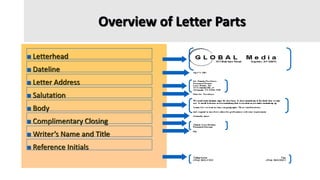
Overview of Letter Parts
 Letterhead
 Dateline
 Letter Address
 Salutation
 Body
 Complimentary Closing
 Writer’s Name and Title
 Reference Initials
• The letter head is the heading at the top of a letter.
• It usually consists of the name, address, telephone
number and fax number of the company.
• The letterhead can be typed out but it is usually
printed on the company’s stationery
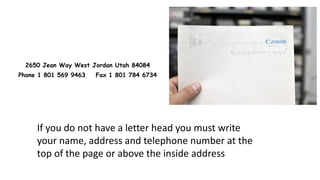
2650 Jean Way West Jordan Utah 84084
Phone 1 801 569 9463 Fax 1 801 784 6734
If you do not have a letter head you must write
your name, address and telephone number at the
top of the page or above the inside address
• MOUTAOUAKIL YOUSSEF
• Boulevard Hassan 2 N°189
• Agadir Morocco
• Phone 1 801 569 9463
• September 15, 2005
• The date line is used to indicate the date the letter was
written.
• If your letter is completed over a number of days, use the
date it was finished and mailed.
• When writing to companies within the United States, use
the American date format. (The United States-based
convention for formatting a date places the month
before the day. For example: June 11, 2001. )
•If you are writing to England use the day/month/ year
•If you are writing to China use the year/month/day
• The inside address is the recipient’s address.
• It is always best to write to a specific individual at the firm to which
you are writing.
• If you do not have the person’s name, do some research by calling
the company or speaking with employees from the company
• Follow a woman’s preference in being addressed as:
• Miss, Mrs., or Ms.
• If you are unsure of a woman’s preference in being addressed, use
Ms.
• If there is a possibility that the person to whom you
are writing is a Dr. or has some other title, use that
title.
•Usually, people will not mind being addressed by a
higher title than they actually possess.
• Use the same name as the inside address, including
the personal title.
• If you know the person and typically address them by
their first name, it is acceptable to use only the first
name in the salutation (i.e., Dear Nisrine :).
• In all other cases, however, use the personal title and
full name followed by a colon.
•Leave one line blank after the salutation.
• If you don’t know a reader’s gender, use a nonsexist
salutation, such as "To Whom it May Concern."
• It is also acceptable to use the full name in a
salutation if you cannot determine gender.
• For example, you might write Dear jihad madih:
• Dear Personnel Director,
• Dear Sir or Madam (use if you don't know who you are writing to)
• Dear Mr., Mrs., Miss or Ms (use if you know who you are writing to.
• VERY IMPORTANT use Ms for women unless asked to use Mrs. or Miss)
• Dear Abdelhamid (use if the person is a close business contact or friend)
• For block and modified block formats, single space and left justify
each paragraph within the body of the letter.
• Leave a blank line between each paragraph.
• When writing a business letter, be careful to remember that
conciseness is very important.
• In the first paragraph, consider a friendly opening and then a
statement of the main point.
• The next paragraph should begin justifying the importance of the
main point.
• In the next few paragraphs, continue justification with background
information and supporting details.
• The closing paragraph should restate the purpose of the letter and,
in some cases, request some type of action.
• With reference to your advertisement in the Times,
• your letter of 23 rd March,
• your phone call today,
• Thank you for your letter of March 5 th
•I am writing to enquire about
•I am writing to apologize for
•I am writing to confirm
• Could you possibly?
• I would be grateful if you could
Agreeing to Requests
•I would be delighted to
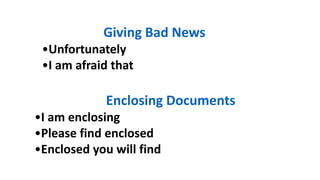
Giving Bad News
•Unfortunately
•I am afraid that
Enclosing Documents
•I am enclosing
•Please find enclosed
•Enclosed you will find
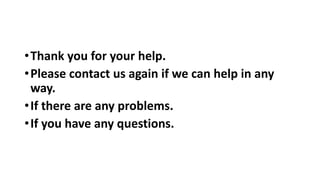
•Thank you for your help.
•Please contact us again if we can help in any
way.
•If there are any problems.
•If you have any questions.
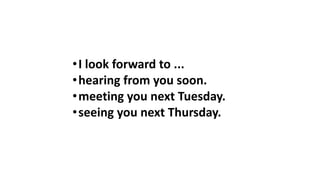
•I look forward to ...
•hearing from you soon.
•meeting you next Tuesday.
•seeing you next Thursday.
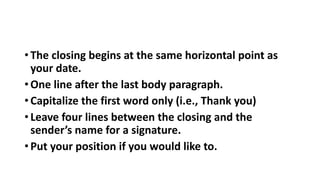
• The closing begins at the same horizontal point as
your date.
• One line after the last body paragraph.
• Capitalize the first word only (i.e., Thank you)
• Leave four lines between the closing and the
sender’s name for a signature.
• Put your position if you would like to.
•If a colon follows the salutation, a comma
should follow the closing
• otherwise, there is no punctuation after the
closing.
Job applicationletter
Invitation letter
Mr. ___________,
Managing Director,
Buy-You-Out International
24 Cheshire Street,
_________, (country name).
23rd, January, 2008,
To,
Dear Mr. _____,
The Flagstone Company is a fast food company based in UK. We have various outlets within the city and in
other cities and towns around the country. Our fast food outlets are quite popular with young people. The easy
going modern ambiance and great tasting food makes our restaurants ideal places for social gatherings.
We are planning to expand our network into Scotland and France. To do this we require more capital. We are
therefore offering to sell some of our outlets to interested investors. Should you be interested in this, you will
become a shareholder in Flagstone Company. This is a great opportunity to be part of a company with great
potential for growth.
For more details on the outlets available for sale and the nature of the contract please visit our website at
______________. Would you please, have your assistant drop me a note or phone if you require further information.
We look forward to hearing from you.
Yours Truly,
Name : _____________,
Director
Flagstone Co Limited
Fax, Phone, e-mail,
_______________.
Sales upgradation letter
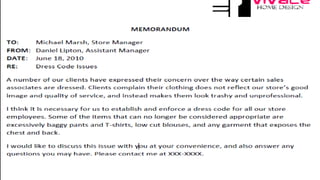
A memorandum is an internal document used
within an enterprise to "formally" communicate
information and policies. For a variety of both
operational and functional reasons, businesses
should use memo formats only for internal
communications- or communications inside the
boundaries of the organization.
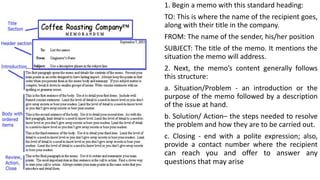
1. Begin a memo with this standard heading:
TO: This is where the name of the recipient goes,
along with their title in the company.
FROM: The name of the sender, his/her position
SUBJECT: The title of the memo. It mentions the
situation the memo will address.
2. Next, the memo’s content generally follows
this structure:
a. Situation/Problem - an introduction or the
purpose of the memo followed by a description
of the issue at hand.
b. Solution/ Action– the steps needed to resolve
the problem and how they are to be carried out.
c. Closing - end with a polite expression; also,
provide a contact number where the recipient
can reach you and offer to answer any
questions that may arise
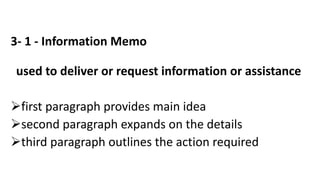
3- 1 - Information Memo
used to deliver or request information or assistance
first paragraph provides main idea
second paragraph expands on the details
third paragraph outlines the action required
A type of memo that is used to inform or
present an announcement.
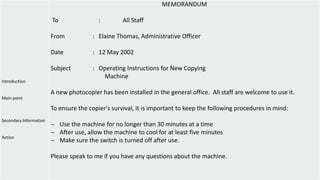
Introduction
Main point
Secondary Information
Action
MEMORANDUM
To : All Staff
From : Elaine Thomas, Administrative Officer
Date : 12 May 2002
Subject : Operating Instructions for New Copying
Machine
A new photocopier has been installed in the general office. All staff are welcome to use it.
To ensure the copier's survival, it is important to keep the following procedures in mind:
 Use the machine for no longer than 30 minutes at a time
 After use, allow the machine to cool for at least five minutes
 Make sure the switch is turned off after use.
Please speak to me if you have any questions about the machine.

The purpose of this memo is to provide the audience with
desired information. It usually has four parts:
purpose statement
summary
discussion
action
 Fax is derived from the Latin word “fac simile”.
 It is a mode of international telecommunications, which has been
increasingly in use over the world. It is characterized by using the
advanced electronic data interchange (EDI) procedures to make
true-track duplicates of original writings and send to the desired
destinations.
 Heading
 Body
2.1 - Sample Fax
i. I sent a fax of my letter to our Hong Kong office.
ii. I faxed it this morning.
iii. He sent his letter by fax to Mexico City yesterday.
iv. Have you got the contract faxed to you by Mr. Thompson this
morning?
v. All I do is fax her the price list.
I. The content that can be used for transmission ranges over a wide field.
II. It is fast in transmitting.
III. It is cheap in cost.
IV. It is simple as well as convenient to use.
V. It is a 24-hour service.
VI. It can provide a written record of what you have transmitted.
I. it is easy to make imitations of true documents. So, care must be taken when we use this
method.
II. different country holds different view about the legal force of a fax message.
III. Make your message as clear and concise as possible
IV. A fax is a kind of document which has legal effect. If you make quotation to your customer or
convey the content of the contract, you should make sure what you have written is correct.
V. A fax is not an instant operation, and the sender can’t ensure whether the receiver can receive
the fax in time or that its content won’t be seen by others. Therefore, the sender should
carefully handle the sensitive and confidential information.
Memo  houssaini final

Memo houssaini final

  • 2.
    o Writing abusiness letter o Job application letter o Invitation letter o Requesting Information Letter o Reprimanding letter o Sales Upgradation letter  Memos  Faxes OUTLINE
  • 4.
    Overview of LetterParts  Letterhead  Dateline  Letter Address  Salutation  Body  Complimentary Closing  Writer’s Name and Title  Reference Initials
  • 5.
    • The letterhead is the heading at the top of a letter. • It usually consists of the name, address, telephone number and fax number of the company. • The letterhead can be typed out but it is usually printed on the company’s stationery
  • 6.
    2650 Jean WayWest Jordan Utah 84084 Phone 1 801 569 9463 Fax 1 801 784 6734 If you do not have a letter head you must write your name, address and telephone number at the top of the page or above the inside address
  • 7.
    • MOUTAOUAKIL YOUSSEF •Boulevard Hassan 2 N°189 • Agadir Morocco • Phone 1 801 569 9463 • September 15, 2005
  • 8.
    • The dateline is used to indicate the date the letter was written. • If your letter is completed over a number of days, use the date it was finished and mailed. • When writing to companies within the United States, use the American date format. (The United States-based convention for formatting a date places the month before the day. For example: June 11, 2001. ) •If you are writing to England use the day/month/ year •If you are writing to China use the year/month/day
  • 9.
    • The insideaddress is the recipient’s address. • It is always best to write to a specific individual at the firm to which you are writing. • If you do not have the person’s name, do some research by calling the company or speaking with employees from the company • Follow a woman’s preference in being addressed as: • Miss, Mrs., or Ms. • If you are unsure of a woman’s preference in being addressed, use Ms.
  • 10.
    • If thereis a possibility that the person to whom you are writing is a Dr. or has some other title, use that title. •Usually, people will not mind being addressed by a higher title than they actually possess.
  • 11.
    • Use thesame name as the inside address, including the personal title. • If you know the person and typically address them by their first name, it is acceptable to use only the first name in the salutation (i.e., Dear Nisrine :). • In all other cases, however, use the personal title and full name followed by a colon. •Leave one line blank after the salutation.
  • 12.
    • If youdon’t know a reader’s gender, use a nonsexist salutation, such as "To Whom it May Concern." • It is also acceptable to use the full name in a salutation if you cannot determine gender. • For example, you might write Dear jihad madih:
  • 13.
    • Dear PersonnelDirector, • Dear Sir or Madam (use if you don't know who you are writing to) • Dear Mr., Mrs., Miss or Ms (use if you know who you are writing to. • VERY IMPORTANT use Ms for women unless asked to use Mrs. or Miss) • Dear Abdelhamid (use if the person is a close business contact or friend)
  • 14.
    • For blockand modified block formats, single space and left justify each paragraph within the body of the letter. • Leave a blank line between each paragraph. • When writing a business letter, be careful to remember that conciseness is very important.
  • 15.
    • In thefirst paragraph, consider a friendly opening and then a statement of the main point. • The next paragraph should begin justifying the importance of the main point. • In the next few paragraphs, continue justification with background information and supporting details. • The closing paragraph should restate the purpose of the letter and, in some cases, request some type of action.
  • 16.
    • With referenceto your advertisement in the Times, • your letter of 23 rd March, • your phone call today, • Thank you for your letter of March 5 th
  • 17.
    •I am writingto enquire about •I am writing to apologize for •I am writing to confirm
  • 18.
    • Could youpossibly? • I would be grateful if you could Agreeing to Requests •I would be delighted to
  • 19.
    Giving Bad News •Unfortunately •Iam afraid that Enclosing Documents •I am enclosing •Please find enclosed •Enclosed you will find
  • 20.
    •Thank you foryour help. •Please contact us again if we can help in any way. •If there are any problems. •If you have any questions.
  • 21.
    •I look forwardto ... •hearing from you soon. •meeting you next Tuesday. •seeing you next Thursday.
  • 22.
    • The closingbegins at the same horizontal point as your date. • One line after the last body paragraph. • Capitalize the first word only (i.e., Thank you) • Leave four lines between the closing and the sender’s name for a signature. • Put your position if you would like to.
  • 23.
    •If a colonfollows the salutation, a comma should follow the closing • otherwise, there is no punctuation after the closing.
  • 27.
  • 29.
  • 37.
    Mr. ___________, Managing Director, Buy-You-OutInternational 24 Cheshire Street, _________, (country name). 23rd, January, 2008, To, Dear Mr. _____, The Flagstone Company is a fast food company based in UK. We have various outlets within the city and in other cities and towns around the country. Our fast food outlets are quite popular with young people. The easy going modern ambiance and great tasting food makes our restaurants ideal places for social gatherings. We are planning to expand our network into Scotland and France. To do this we require more capital. We are therefore offering to sell some of our outlets to interested investors. Should you be interested in this, you will become a shareholder in Flagstone Company. This is a great opportunity to be part of a company with great potential for growth. For more details on the outlets available for sale and the nature of the contract please visit our website at ______________. Would you please, have your assistant drop me a note or phone if you require further information. We look forward to hearing from you. Yours Truly, Name : _____________, Director Flagstone Co Limited Fax, Phone, e-mail, _______________. Sales upgradation letter
  • 39.
    A memorandum isan internal document used within an enterprise to "formally" communicate information and policies. For a variety of both operational and functional reasons, businesses should use memo formats only for internal communications- or communications inside the boundaries of the organization.
  • 40.
    1. Begin amemo with this standard heading: TO: This is where the name of the recipient goes, along with their title in the company. FROM: The name of the sender, his/her position SUBJECT: The title of the memo. It mentions the situation the memo will address. 2. Next, the memo’s content generally follows this structure: a. Situation/Problem - an introduction or the purpose of the memo followed by a description of the issue at hand. b. Solution/ Action– the steps needed to resolve the problem and how they are to be carried out. c. Closing - end with a polite expression; also, provide a contact number where the recipient can reach you and offer to answer any questions that may arise
  • 41.
    3- 1 -Information Memo used to deliver or request information or assistance first paragraph provides main idea second paragraph expands on the details third paragraph outlines the action required
  • 43.
    A type ofmemo that is used to inform or present an announcement.
  • 44.
    Introduction Main point Secondary Information Action MEMORANDUM To: All Staff From : Elaine Thomas, Administrative Officer Date : 12 May 2002 Subject : Operating Instructions for New Copying Machine A new photocopier has been installed in the general office. All staff are welcome to use it. To ensure the copier's survival, it is important to keep the following procedures in mind:  Use the machine for no longer than 30 minutes at a time  After use, allow the machine to cool for at least five minutes  Make sure the switch is turned off after use. Please speak to me if you have any questions about the machine.
  • 45.
    The purpose ofthis memo is to provide the audience with desired information. It usually has four parts: purpose statement summary discussion action
  • 48.
     Fax isderived from the Latin word “fac simile”.  It is a mode of international telecommunications, which has been increasingly in use over the world. It is characterized by using the advanced electronic data interchange (EDI) procedures to make true-track duplicates of original writings and send to the desired destinations.
  • 49.
  • 50.
  • 51.
    i. I senta fax of my letter to our Hong Kong office. ii. I faxed it this morning. iii. He sent his letter by fax to Mexico City yesterday. iv. Have you got the contract faxed to you by Mr. Thompson this morning? v. All I do is fax her the price list.
  • 52.
    I. The contentthat can be used for transmission ranges over a wide field. II. It is fast in transmitting. III. It is cheap in cost. IV. It is simple as well as convenient to use. V. It is a 24-hour service. VI. It can provide a written record of what you have transmitted.
  • 53.
    I. it iseasy to make imitations of true documents. So, care must be taken when we use this method. II. different country holds different view about the legal force of a fax message. III. Make your message as clear and concise as possible IV. A fax is a kind of document which has legal effect. If you make quotation to your customer or convey the content of the contract, you should make sure what you have written is correct. V. A fax is not an instant operation, and the sender can’t ensure whether the receiver can receive the fax in time or that its content won’t be seen by others. Therefore, the sender should carefully handle the sensitive and confidential information.