
Membership DevelopmentChamber of Commerce
The Marketing UmbrellaResearchProduct DevelopmentAdvertisingBrandingPublicityCommunicationsSalesCustomer ServicePricingPackagingPromotion
Branding and Marketing“Marketing is branding. The two concepts are so inextricably linked that it is impossible to separate them.  Furthermore, since everything a company does can contribute to the brand-building process, marketing is not a function that can be considered in isolation.”22 Immutable Laws of Branding, Al Ries and Laura RiesOrganizational Branding
What is a Brand?It’s more than a nameBranding ‘pre-sells’ the product or service to the userBranding is simply a more efficient way to sell thingsA brand stands for something, a position in the mindIt’s more than a logoA brand requires a visual vocabularyConsistent use of a “look and feel” A common “voice” and tone/styleStandardized color palette, typefaces, visual styleConsistent use of wording, tag lines, theme linesOrganizational Branding
Branding is Boring!It requires consistencyRepetition of key phrases (radio burn)Redundant visual identityTarget your audienceFocus on presentationCreative limitationsOrganizational Branding
Connecting to your customers“Building brand awareness is not simply about throwing money at the moon. It’s about creating a consistent, emotional connection with your customers.– James Daly, Editor in Chief, Business 2.0Organizational Branding
2 Ways to choose your brand1. Be who you want to beDecide how you want the public to perceive youCommunicate and act in support of itWorks for new companies, mergers, new marketsNew brands often rejected by consumersOrganizational Branding
2 Ways to choose your brandOr 2. Be who you are Be who your audience/the public expects you to beSelectively reinforce what your existing customers feel and say about your product or serviceRun focus groups or surveys to find out why people buy initially, and why they returnCollect testimonials to find common words, themesOrganizational Branding
3 Steps to develop your brandWho is your target audience? End user, Influencer, Buyer, or ReferrerFind their “hot buttons”Tailor message to audienceOrganizational Branding
1. Who is your target audience?Do you know everyone you’re selling to? Who buys? Who influences? Who refers?  Who uses? Consider all audiences, their expectationsSpeak their languageAppeal to their emotionsOrganizational Branding
Examine their job positionBusiness audiences: What is their responsibility to their company?Gatekeepers tend to protect decision makersBuyers tend to look for the best dealSalespeople seek new prospects, partnershipsManagers tend to control costsInvestors want bottom-line growthOwners are more holistic, but typically not “joiners”Organizational Branding
2. Find their “hot buttons”Unique Selling Proposition provides prospects with an emotional reason to buyDistinguishes your brand from the competitionOrganizational Branding
3. Tailor message to audienceTailor message to audienceFor results, prioritize marketing tools by audiences and buying powerSome audiences may drive repeat sales instead of just one timeConsider “lifetime value”Invest in customer retentionOne tool for many uses, extend the lifeOrganizational Branding
4 Considerations For Communicating Your Brand1. Consider learning stylesDifferent people take in information in different ways – appeal to as many senses as possibleVisual images that touch and relateWording that paints a pictureTextures/paper that encourage touchSounds (Intel’s mnemonic)Organizational Branding
4 Considerations For Communicating Your Brand2. Review the competitionCompetition may be direct or indirectWe’re competing for time and attentionWe’re offering another choice in similar product or serviceOr another choice of use of time (if I don’t do this, I can do that)What are the alternatives for your target audience?Organizational Branding
4 Considerations For Communicating Your Brand3. Referrals are KeyGenerate talk about your product or service amongst peer groupsSome products/services will only be sold with referralTestimonials: People trust other people’s opinionsOrganizational Branding
4 Considerations For Communicating Your Brand4. Buying and JustifyingBusinesses: People BUY emotionally, JUSTIFY intellectuallyChambers & Associations: People JOIN emotionally and JUSTIFY upon renewal Who MUST you reach in order to be successful? Who will have the most impact over the long-term?Organizational Branding
Brand vs. AudienceIs your audience willing to respond to your image?You may want to appear complex, intelligent and powerfulYour audience might prefer simple, folksy... A persona to which they can relateOrganizational Branding
Who is your audience? How do they take in information? Age/generation affiliationTheir likes and dislikesWhat/who do they relate to?Organizational Branding & Research
Information versus TrustNeed A High Level Of Trust: Florist“Don’t give me the details and the names of the flowers, just give me something that’s pretty, smells good and only costs about $70.” Need Trust and Information: Appliance Retailer“I need to know what features are included, how it works, as well as how reliable the brand is before I make a purchase decision.”Need A High Level Of Detail: Technical Product“Give me all of the facts, details, charts and graphs. I want to understand how this thing works, what it does and how it’s different from the other products like it.”	Organizational Branding & Research
         Understand your audience’s expectationsMakes each communication more effectiveYou’ll provide what your audience needs to make a decisionEach point of contact will build on the last message - WACE Tool Kit!Organizational Branding & Research
Define Your Brand CharacterIf your chamber was a car, what brand would it be?  Give 3 one-word adjectives to describe it.Organizational Branding
Build it!Branding is the foundation of any effective, ongoing marketing program. The success of every business relies on a strong brand identity implemented into all communications.Organizational Branding
Value Proposition DefinedA value proposition is a clear statement of the tangible results a customer gets from using your products or services. The more specific your value proposition is, the betterWeak examples: We connect businessesWe advocate for businessesWe provide networking and eventsValue Propositions & Messaging
Value Proposition ExamplesThe Chamber delivers tangible results likeLess government red tape and taxesMore businessIncreased visibilityBetter connectionsTimely informationValue Propositions & Messaging
Your Marketing MessageThe Wrong PitchOur Organization is a private non-profit membership organization that works to ensure a healthy local economy.Our Association is a group of businesses that share common goals. Value Propositions & Messaging
Your Marketing MessageThe Right PitchThe chamber solves common business problems like not having enough time to lobby the government for less red tape and taxes. The Chamber connects businesses to consumers and each other, in order to help them grow. The Chamber helps people who are tired of doing business out of a phone book. Value Propositions & Messaging
Written Exercisea)	 My target market is ________________________Value Propositions & Messaging
Written Exerciseb) Identify and summarize the 3 biggest and most critical problems that your target market faces1__________________________2__________________________3__________________________Value Propositions & Messaging
Written Exercisec) List how you solve these problems and present members with unique solutions______________________________________________________________________________________________________________________________________________________Value Propositions & Messaging
Written Exercised)	Include the most dramatic (WOW!) results that you or your members have achieved ______________________________________________________________________________________________________________________________________________________Value Propositions & Messaging
Written Exercisee) List the results and deepest benefits your members receive ______________________________________________________________________________________________________________________________________________________Value Propositions & Messaging
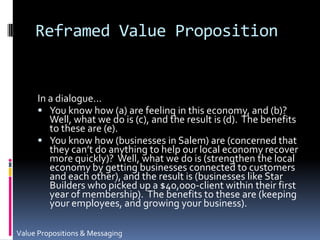
Reframed Value PropositionIn a dialogue…You know how (a) are feeling in this economy, and (b)?  Well, what we do is (c), and the result is (d).  The benefits to these are (e).  You know how (businesses in Salem) are (concerned that they can’t do anything to help our local economy recover more quickly)?  Well, what we do is (strengthen the local economy by getting businesses connected to customers and each other), and the result is (businesses like Star Builders who picked up a $40,000-client within their first year of membership).  The benefits to these are (keeping your employees, and growing your business).  Value Propositions & Messaging
Value Propositions & Messaging
Basic ResearchWhy did you join?  (What were your expectations?)How is the organization performing against your expectations?What should the organization be doing that we’re not?Research
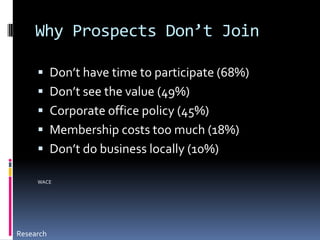
Why Prospects Don’t JoinDon’t have time to participate (68%)Don’t see the value (49%)Corporate office policy (45%)Membership costs too much (18%)Don’t do business locally (10%)WACEResearch
Customer Service = RetentionMember-focusedFormal Customer Service Plans Customer Relation ManagementManaging our InformationDon’t just satisfy ‘em… WOW ‘EMFollow through with saleService as Marketing
The Service AdvantageWhat is GoDaddy and why are they number 1?Selling just got FUN again!Service as Marketing
Participation vs. Partnership Set long-term expectationsMembership does not require participationPrevent drops due to “no time to participate”Health club comparisonChamber Church ConfessionalSetting Expectations
Quantify your benefitsHow much does membership cost?How much is membership worth?Quantify it and sell it!Add to the value with media partners and give-awaysFastChamber.com for moreSetting Expectations
Testimonials: Get them started!“As a service business, membership in the Chamber is especially valuable because…”“The Chamber helps me to…”“The Chamber saves me time/trouble by…” Testimonials as Marketing
Segmenting TestimonialsSegment the sources of your testimonials for use in targeting like audiencesStart-up, Emerging, or MatureRetailer, Restaurant, Manufacturer, Service, Professional, etc.Match prospects with corresponding testimonialsTestimonials as Marketing
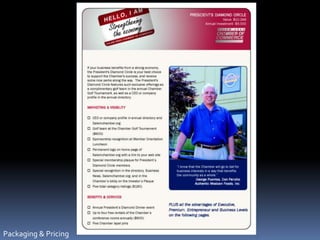
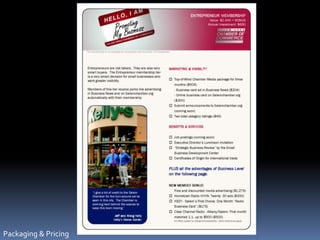
Common Dues StructuresFair Share (usually based on number of employees)Special Formulas (usually for certain industry categories)Tiered Dues StructuresNegotiated DuesDues/Non-Dues Package (such as Napa’s President’s Circle)Packaging & Pricing
Membership TiersOffer something for everyoneCreate “upsell” opportunitiesCreate a sense of privilege, recognition and exclusivity with upper tiersCreate benefits that require little or no hard costs to the chamberPackaging & Pricing
Upper Tier Benefit ObjectivesSelf-SegmentationPro-active leadership roleAbove “Cost-per-member” benchmarkIncreased membership stature and personal/professional recognitionImproved personal and professional skills and networking contactsPackaging & Pricing
Packaging & Pricing
Packaging & Pricing
Packaging & Pricing
Packaging & Pricing
Packaging & Pricing
Creative Marketing IdeasRadio “Business Beat”Co-Brand Television AdvertisingImageBuilder 1ImageBuilder 2Partner with Members for Newspaper AdsAdvertising & Media
Advertising & Media
LET’S CHAT!All resources for this presentation atwww.FastChamber.comKyle J. SextonFast Chamber LLCkyle@fastchamber.com

Membership Development

  • 1.
  • 2.
    The Marketing UmbrellaResearchProductDevelopmentAdvertisingBrandingPublicityCommunicationsSalesCustomer ServicePricingPackagingPromotion
  • 3.
    Branding and Marketing“Marketingis branding. The two concepts are so inextricably linked that it is impossible to separate them. Furthermore, since everything a company does can contribute to the brand-building process, marketing is not a function that can be considered in isolation.”22 Immutable Laws of Branding, Al Ries and Laura RiesOrganizational Branding
  • 4.
    What is aBrand?It’s more than a nameBranding ‘pre-sells’ the product or service to the userBranding is simply a more efficient way to sell thingsA brand stands for something, a position in the mindIt’s more than a logoA brand requires a visual vocabularyConsistent use of a “look and feel” A common “voice” and tone/styleStandardized color palette, typefaces, visual styleConsistent use of wording, tag lines, theme linesOrganizational Branding
  • 5.
    Branding is Boring!Itrequires consistencyRepetition of key phrases (radio burn)Redundant visual identityTarget your audienceFocus on presentationCreative limitationsOrganizational Branding
  • 6.
    Connecting to yourcustomers“Building brand awareness is not simply about throwing money at the moon. It’s about creating a consistent, emotional connection with your customers.– James Daly, Editor in Chief, Business 2.0Organizational Branding
  • 7.
    2 Ways tochoose your brand1. Be who you want to beDecide how you want the public to perceive youCommunicate and act in support of itWorks for new companies, mergers, new marketsNew brands often rejected by consumersOrganizational Branding
  • 8.
    2 Ways tochoose your brandOr 2. Be who you are Be who your audience/the public expects you to beSelectively reinforce what your existing customers feel and say about your product or serviceRun focus groups or surveys to find out why people buy initially, and why they returnCollect testimonials to find common words, themesOrganizational Branding
  • 9.
    3 Steps todevelop your brandWho is your target audience? End user, Influencer, Buyer, or ReferrerFind their “hot buttons”Tailor message to audienceOrganizational Branding
  • 10.
    1. Who isyour target audience?Do you know everyone you’re selling to? Who buys? Who influences? Who refers? Who uses? Consider all audiences, their expectationsSpeak their languageAppeal to their emotionsOrganizational Branding
  • 11.
    Examine their jobpositionBusiness audiences: What is their responsibility to their company?Gatekeepers tend to protect decision makersBuyers tend to look for the best dealSalespeople seek new prospects, partnershipsManagers tend to control costsInvestors want bottom-line growthOwners are more holistic, but typically not “joiners”Organizational Branding
  • 12.
    2. Find their“hot buttons”Unique Selling Proposition provides prospects with an emotional reason to buyDistinguishes your brand from the competitionOrganizational Branding
  • 13.
    3. Tailor messageto audienceTailor message to audienceFor results, prioritize marketing tools by audiences and buying powerSome audiences may drive repeat sales instead of just one timeConsider “lifetime value”Invest in customer retentionOne tool for many uses, extend the lifeOrganizational Branding
  • 14.
    4 Considerations ForCommunicating Your Brand1. Consider learning stylesDifferent people take in information in different ways – appeal to as many senses as possibleVisual images that touch and relateWording that paints a pictureTextures/paper that encourage touchSounds (Intel’s mnemonic)Organizational Branding
  • 15.
    4 Considerations ForCommunicating Your Brand2. Review the competitionCompetition may be direct or indirectWe’re competing for time and attentionWe’re offering another choice in similar product or serviceOr another choice of use of time (if I don’t do this, I can do that)What are the alternatives for your target audience?Organizational Branding
  • 16.
    4 Considerations ForCommunicating Your Brand3. Referrals are KeyGenerate talk about your product or service amongst peer groupsSome products/services will only be sold with referralTestimonials: People trust other people’s opinionsOrganizational Branding
  • 17.
    4 Considerations ForCommunicating Your Brand4. Buying and JustifyingBusinesses: People BUY emotionally, JUSTIFY intellectuallyChambers & Associations: People JOIN emotionally and JUSTIFY upon renewal Who MUST you reach in order to be successful? Who will have the most impact over the long-term?Organizational Branding
  • 18.
    Brand vs. AudienceIsyour audience willing to respond to your image?You may want to appear complex, intelligent and powerfulYour audience might prefer simple, folksy... A persona to which they can relateOrganizational Branding
  • 19.
    Who is youraudience? How do they take in information? Age/generation affiliationTheir likes and dislikesWhat/who do they relate to?Organizational Branding & Research
  • 20.
    Information versus TrustNeedA High Level Of Trust: Florist“Don’t give me the details and the names of the flowers, just give me something that’s pretty, smells good and only costs about $70.” Need Trust and Information: Appliance Retailer“I need to know what features are included, how it works, as well as how reliable the brand is before I make a purchase decision.”Need A High Level Of Detail: Technical Product“Give me all of the facts, details, charts and graphs. I want to understand how this thing works, what it does and how it’s different from the other products like it.” Organizational Branding & Research
  • 21.
    Understand your audience’s expectationsMakes each communication more effectiveYou’ll provide what your audience needs to make a decisionEach point of contact will build on the last message - WACE Tool Kit!Organizational Branding & Research
  • 22.
    Define Your BrandCharacterIf your chamber was a car, what brand would it be? Give 3 one-word adjectives to describe it.Organizational Branding
  • 23.
    Build it!Branding isthe foundation of any effective, ongoing marketing program. The success of every business relies on a strong brand identity implemented into all communications.Organizational Branding
  • 24.
    Value Proposition DefinedAvalue proposition is a clear statement of the tangible results a customer gets from using your products or services. The more specific your value proposition is, the betterWeak examples: We connect businessesWe advocate for businessesWe provide networking and eventsValue Propositions & Messaging
  • 25.
    Value Proposition ExamplesTheChamber delivers tangible results likeLess government red tape and taxesMore businessIncreased visibilityBetter connectionsTimely informationValue Propositions & Messaging
  • 26.
    Your Marketing MessageTheWrong PitchOur Organization is a private non-profit membership organization that works to ensure a healthy local economy.Our Association is a group of businesses that share common goals. Value Propositions & Messaging
  • 27.
    Your Marketing MessageTheRight PitchThe chamber solves common business problems like not having enough time to lobby the government for less red tape and taxes. The Chamber connects businesses to consumers and each other, in order to help them grow. The Chamber helps people who are tired of doing business out of a phone book. Value Propositions & Messaging
  • 28.
    Written Exercisea) Mytarget market is ________________________Value Propositions & Messaging
  • 29.
    Written Exerciseb) Identifyand summarize the 3 biggest and most critical problems that your target market faces1__________________________2__________________________3__________________________Value Propositions & Messaging
  • 30.
    Written Exercisec) Listhow you solve these problems and present members with unique solutions______________________________________________________________________________________________________________________________________________________Value Propositions & Messaging
  • 31.
    Written Exercised) Include themost dramatic (WOW!) results that you or your members have achieved ______________________________________________________________________________________________________________________________________________________Value Propositions & Messaging
  • 32.
    Written Exercisee) Listthe results and deepest benefits your members receive ______________________________________________________________________________________________________________________________________________________Value Propositions & Messaging
  • 33.
    Reframed Value PropositionIna dialogue…You know how (a) are feeling in this economy, and (b)? Well, what we do is (c), and the result is (d). The benefits to these are (e). You know how (businesses in Salem) are (concerned that they can’t do anything to help our local economy recover more quickly)? Well, what we do is (strengthen the local economy by getting businesses connected to customers and each other), and the result is (businesses like Star Builders who picked up a $40,000-client within their first year of membership). The benefits to these are (keeping your employees, and growing your business). Value Propositions & Messaging
  • 34.
  • 35.
  • 36.
    Basic ResearchWhy didyou join? (What were your expectations?)How is the organization performing against your expectations?What should the organization be doing that we’re not?Research
  • 37.
    Why Prospects Don’tJoinDon’t have time to participate (68%)Don’t see the value (49%)Corporate office policy (45%)Membership costs too much (18%)Don’t do business locally (10%)WACEResearch
  • 38.
    Customer Service =RetentionMember-focusedFormal Customer Service Plans Customer Relation ManagementManaging our InformationDon’t just satisfy ‘em… WOW ‘EMFollow through with saleService as Marketing
  • 39.
    The Service AdvantageWhatis GoDaddy and why are they number 1?Selling just got FUN again!Service as Marketing
  • 40.
    Participation vs. PartnershipSet long-term expectationsMembership does not require participationPrevent drops due to “no time to participate”Health club comparisonChamber Church ConfessionalSetting Expectations
  • 41.
    Quantify your benefitsHowmuch does membership cost?How much is membership worth?Quantify it and sell it!Add to the value with media partners and give-awaysFastChamber.com for moreSetting Expectations
  • 42.
    Testimonials: Get themstarted!“As a service business, membership in the Chamber is especially valuable because…”“The Chamber helps me to…”“The Chamber saves me time/trouble by…” Testimonials as Marketing
  • 43.
    Segmenting TestimonialsSegment thesources of your testimonials for use in targeting like audiencesStart-up, Emerging, or MatureRetailer, Restaurant, Manufacturer, Service, Professional, etc.Match prospects with corresponding testimonialsTestimonials as Marketing
  • 44.
    Common Dues StructuresFairShare (usually based on number of employees)Special Formulas (usually for certain industry categories)Tiered Dues StructuresNegotiated DuesDues/Non-Dues Package (such as Napa’s President’s Circle)Packaging & Pricing
  • 45.
    Membership TiersOffer somethingfor everyoneCreate “upsell” opportunitiesCreate a sense of privilege, recognition and exclusivity with upper tiersCreate benefits that require little or no hard costs to the chamberPackaging & Pricing
  • 46.
    Upper Tier BenefitObjectivesSelf-SegmentationPro-active leadership roleAbove “Cost-per-member” benchmarkIncreased membership stature and personal/professional recognitionImproved personal and professional skills and networking contactsPackaging & Pricing
  • 47.
  • 48.
  • 49.
  • 50.
  • 51.
  • 52.
    Creative Marketing IdeasRadio“Business Beat”Co-Brand Television AdvertisingImageBuilder 1ImageBuilder 2Partner with Members for Newspaper AdsAdvertising & Media
  • 53.
  • 54.
    LET’S CHAT!All resourcesfor this presentation atwww.FastChamber.comKyle J. SextonFast Chamber LLCkyle@fastchamber.com