How can your research impact
    your target groups?


 Andes • Ganges • Limpopo • Mekong • Nile • Volta
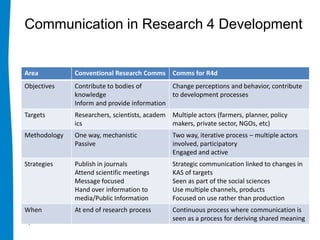
Communication in Research 4 Development


Area                  Conventional Research Comms Comms for R4d
Objectives            Contribute to bodies of        Change perceptions and behavior, contribute
                      knowledge                      to development processes
                      Inform and provide information
Targets               Researchers, scientists, academ Multiple actors (farmers, planner, policy
                      ics                             makers, private sector, NGOs, etc)
Methodology           One way, mechanistic                      Two way, iterative process – multiple actors
                      Passive                                   involved, participatory
                                                                Engaged and active
Strategies            Publish in journals                       Strategic communication linked to changes in
                      Attend scientific meetings                KAS of targets
                      Message focused                           Seen as part of the social sciences
                      Hand over information to                  Use multiple channels, products
                      media/Public Information                  Focused on use rather than production
When                  At end of research process                Continuous process where communication is
             Andes • Ganges • Limpopo • Mekong • Nile • Volta   seen as a process for deriving shared meaning
Target groups – based on project OLMs
Researchers (incl. internal)                           Dam operators and investors/financers
Project staff (MK1) (MK2)                              Dam developers and financers (MK1)
Researchers and practitioners incl. NARS               Dam operators (MK1)
partners (MK2)                                         Dam operators (power sector) (MK3)
Mekong BDC teams (MK5)                                 Investors/developers & WB, ADB, donors
MK5 staff (MK5)                                        (MK3)
BDC teams (MK5)                                        Dam operators (MK4)
Technical platform, i.e. Mekong BDC                    Dam Developers and Operators (MK5) (MK6)
researchers + in our networks (MK5) (MK6)
Government                                                       NGOs/Civil society/communities
Ministries in charge of Energy in each Mekong Water stakeholders and Policy-makers at
country (MK1)                                                    national levels (MK2)
Policy makers (Ministries: energy, agriculture,                  Non-hydropower deciders / stakeholders
fisheries, forestry, environment) (MK3)                          (national and provincial levels) (MK2)
Policy and planning officials in relevant state                  Members of riparian WSI communities (MK1)
agencies (MK4)                                                   Local NGOs/activists/civil society/medias
Local communities and their mediators (MK4) involved in the debate on hydropower (MK2)
Catchment managers (RBOS, Dept. fisheries,                       Communities and their mediators (MK4)
forestry, water resources, agricultural                          Civil Society and NGOs (MK5)
                Andes • Ganges • Limpopo • Mekong • Nile • Volta
extension protected areas) (MK3)                                 Regional/International Organizations (MK5)
Government (MK5) (MK6)                                           (MK6)
Modes of communications

Irrigation model


                                                One-way, decentralized
     Andes • Ganges • Limpopo • Mekong • Nile • Volta
Bank model


                                                 Two-way, centralized

   Andes • Ganges • Limpopo • Mekong • Nile • Volta
Transport model


                                         Non-linear, decentralized
   Andes • Ganges • Limpopo • Mekong • Nile • Volta
How can we influence decision-making?
• Evidence plays a relatively modest role in decision-
  making, which is dominated by political expediency.
• Policy makers tend to use stories rather than ‘hard’
  evidence as they are easy to understand and
  effective.
• Change is a product of a participatory development
  process.
• Personal interaction remains the most effective
  means of communicating with decision-makers.
• Communication strategies should build on existing
  networks and communities of interest.
     Andes • Ganges • Limpopo • Mekong • Nile • Volta

                                                Source: http://www.healthlink.org.uk/we-do/comms_icd.html
When decision-making processes are not
rational, then how can we influence them?
• Different ways of looking at change of policy and
  practice, including:
   – Interactions between different groups with differing
     political interests
   – Actor-oriented approaches: such as policy communities
     and networks, MSPs,interfaces, actor-network, epistemic
     communities, entrepreneurs/saboteurs
   – Discourse, which is an ensemble of ideas communicated
     through practices via coalitions, narratives, or rhetoric
   – External drivers: economics, investment, climate variability


      Andes • Ganges • Limpopo • Mekong • Nile • Volta
Communicating your research discussion

 What is the role of the researchers?
 What is the role of MK5?
 In which ways do we best reach our
 target groups?


     Andes • Ganges • Limpopo • Mekong • Nile • Volta

Mekong impact targetgroups

  • 1.
    How can yourresearch impact your target groups? Andes • Ganges • Limpopo • Mekong • Nile • Volta
  • 2.
    Communication in Research4 Development Area Conventional Research Comms Comms for R4d Objectives Contribute to bodies of Change perceptions and behavior, contribute knowledge to development processes Inform and provide information Targets Researchers, scientists, academ Multiple actors (farmers, planner, policy ics makers, private sector, NGOs, etc) Methodology One way, mechanistic Two way, iterative process – multiple actors Passive involved, participatory Engaged and active Strategies Publish in journals Strategic communication linked to changes in Attend scientific meetings KAS of targets Message focused Seen as part of the social sciences Hand over information to Use multiple channels, products media/Public Information Focused on use rather than production When At end of research process Continuous process where communication is Andes • Ganges • Limpopo • Mekong • Nile • Volta seen as a process for deriving shared meaning
  • 3.
    Target groups –based on project OLMs Researchers (incl. internal) Dam operators and investors/financers Project staff (MK1) (MK2) Dam developers and financers (MK1) Researchers and practitioners incl. NARS Dam operators (MK1) partners (MK2) Dam operators (power sector) (MK3) Mekong BDC teams (MK5) Investors/developers & WB, ADB, donors MK5 staff (MK5) (MK3) BDC teams (MK5) Dam operators (MK4) Technical platform, i.e. Mekong BDC Dam Developers and Operators (MK5) (MK6) researchers + in our networks (MK5) (MK6) Government NGOs/Civil society/communities Ministries in charge of Energy in each Mekong Water stakeholders and Policy-makers at country (MK1) national levels (MK2) Policy makers (Ministries: energy, agriculture, Non-hydropower deciders / stakeholders fisheries, forestry, environment) (MK3) (national and provincial levels) (MK2) Policy and planning officials in relevant state Members of riparian WSI communities (MK1) agencies (MK4) Local NGOs/activists/civil society/medias Local communities and their mediators (MK4) involved in the debate on hydropower (MK2) Catchment managers (RBOS, Dept. fisheries, Communities and their mediators (MK4) forestry, water resources, agricultural Civil Society and NGOs (MK5) Andes • Ganges • Limpopo • Mekong • Nile • Volta extension protected areas) (MK3) Regional/International Organizations (MK5) Government (MK5) (MK6) (MK6)
  • 4.
    Modes of communications Irrigationmodel One-way, decentralized Andes • Ganges • Limpopo • Mekong • Nile • Volta
  • 5.
    Bank model Two-way, centralized Andes • Ganges • Limpopo • Mekong • Nile • Volta
  • 6.
    Transport model Non-linear, decentralized Andes • Ganges • Limpopo • Mekong • Nile • Volta
  • 7.
    How can weinfluence decision-making? • Evidence plays a relatively modest role in decision- making, which is dominated by political expediency. • Policy makers tend to use stories rather than ‘hard’ evidence as they are easy to understand and effective. • Change is a product of a participatory development process. • Personal interaction remains the most effective means of communicating with decision-makers. • Communication strategies should build on existing networks and communities of interest. Andes • Ganges • Limpopo • Mekong • Nile • Volta Source: http://www.healthlink.org.uk/we-do/comms_icd.html
  • 8.
    When decision-making processesare not rational, then how can we influence them? • Different ways of looking at change of policy and practice, including: – Interactions between different groups with differing political interests – Actor-oriented approaches: such as policy communities and networks, MSPs,interfaces, actor-network, epistemic communities, entrepreneurs/saboteurs – Discourse, which is an ensemble of ideas communicated through practices via coalitions, narratives, or rhetoric – External drivers: economics, investment, climate variability Andes • Ganges • Limpopo • Mekong • Nile • Volta
  • 9.
    Communicating your researchdiscussion What is the role of the researchers? What is the role of MK5? In which ways do we best reach our target groups? Andes • Ganges • Limpopo • Mekong • Nile • Volta