Megaloblastic
Anemias
Cobalamin and Folate
Absorption and Metabolism
COBALAMIN(vitamin B12)
• Naturally occurs mainly in 2 forms:
1) 2-deoxyadenosyl (ado) form--present in
mitochondria
2) Methyl-cobalamin-- the form in human
plasma and in cell cytoplasm.
Cont…
DIETARY SOURCES AND REQUIREMENTS:
• Only source for humans-- food of animal origin,
for example, meat, fish, and dairy products.
• Body stores--2–3 mg, sufficient for 3–4 years if
supplies are completely cut off.
• Adult daily losses (mainly in the urine and feces) -
- 1–3 μg (~0.1% of body stores)
• Daily requirements-- 1–3 μg.
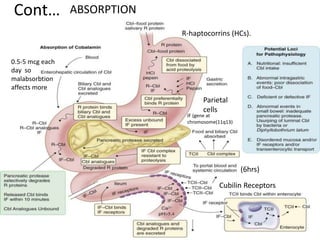
Cont… ABSORPTION
R-haptocorrins (HCs).
Parietal
cells
Cubilin Receptors
(6hrs)
0.5-5 mcg each
day so
malabsorbtion
affects more
IF (gene at
chromosome(11q13)
TRANSPORT
Two main cobalamin transport proteins:
1)TC I(Gene TCNL is at chromosome 11q11-
q12.3)—Enterohepatic circulation mainly
2)TC II(chromosome 22q11-q13.1)--
Synthesized by liver and by other tissues,
including macrophages, ileum, and vascular
endothelium.
Enters by receptor-mediated endocytosis
involving the TC II receptor and megalin (encoded
by the LRP- 2 gene)
(readilygives up cobalamin to marrow, placenta)
FOLATE
DIETARY FOLATE:
-The highest concentrations are found in liver, yeast,
spinach, other greens, and nuts (>100 μg/100 g)
-Easily destroyed by heating, particularly in large
volumes of water.
-Total body folate in the adult -- ~10 mg, with the
liver containing the largest store.
-Daily adult requirements-- ~100 μg,
-so stores are sufficient for only 3–4 months in
normal adults and severe folate deficiency may
develop rapidly
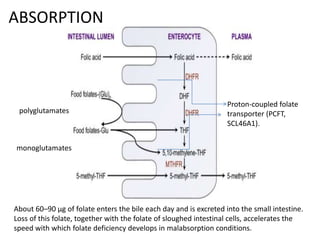
ABSORPTION
Proton-coupled folate
transporter (PCFT,
SCL46A1).
polyglutamates
monoglutamates
About 60–90 μg of folate enters the bile each day and is excreted into the small intestine.
Loss of this folate, together with the folate of sloughed intestinal cells, accelerates the
speed with which folate deficiency develops in malabsorption conditions.
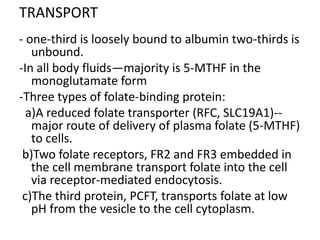
TRANSPORT
- one-third is loosely bound to albumin two-thirds is
unbound.
-In all body fluids—majority is 5-MTHF in the
monoglutamate form
-Three types of folate-binding protein:
a)A reduced folate transporter (RFC, SLC19A1)--
major route of delivery of plasma folate (5-MTHF)
to cells.
b)Two folate receptors, FR2 and FR3 embedded in
the cell membrane transport folate into the cell
via receptor-mediated endocytosis.
c)The third protein, PCFT, transports folate at low
pH from the vesicle to the cell cytoplasm.
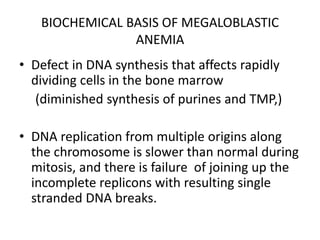
BIOCHEMICAL BASIS OF MEGALOBLASTIC
ANEMIA
• Defect in DNA synthesis that affects rapidly
dividing cells in the bone marrow
(diminished synthesis of purines and TMP,)
• DNA replication from multiple origins along
the chromosome is slower than normal during
mitosis, and there is failure of joining up the
incomplete replicons with resulting single
stranded DNA breaks.
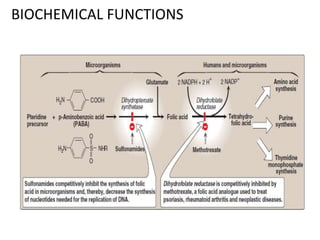
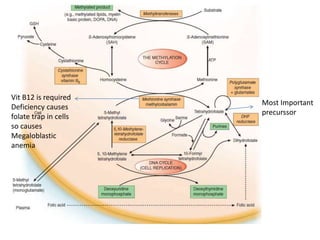
BIOCHEMICAL FUNCTIONS
Most Important
precurssor
Vit B12 is required
Deficiency causes
folate trap in cells
so causes
Megaloblastic
anemia
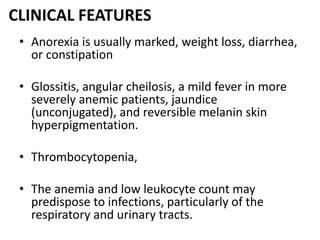
CLINICAL FEATURES
• Anorexia is usually marked, weight loss, diarrhea,
or constipation
• Glossitis, angular cheilosis, a mild fever in more
severely anemic patients, jaundice
(unconjugated), and reversible melanin skin
hyperpigmentation.
• Thrombocytopenia,
• The anemia and low leukocyte count may
predispose to infections, particularly of the
respiratory and urinary tracts.
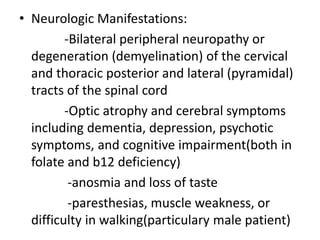
• Neurologic Manifestations:
-Bilateral peripheral neuropathy or
degeneration (demyelination) of the cervical
and thoracic posterior and lateral (pyramidal)
tracts of the spinal cord
-Optic atrophy and cerebral symptoms
including dementia, depression, psychotic
symptoms, and cognitive impairment(both in
folate and b12 deficiency)
-anosmia and loss of taste
-paresthesias, muscle weakness, or
difficulty in walking(particulary male patient)
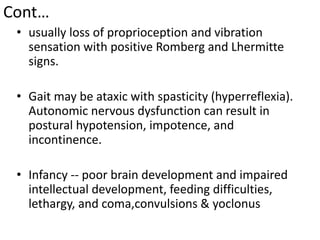
Cont…
• usually loss of proprioception and vibration
sensation with positive Romberg and Lhermitte
signs.
• Gait may be ataxic with spasticity (hyperreflexia).
Autonomic nervous dysfunction can result in
postural hypotension, impotence, and
incontinence.
• Infancy -- poor brain development and impaired
intellectual development, feeding difficulties,
lethargy, and coma,convulsions & yoclonus
Cont…
• GENERAL TISSUE EFFECTS OF COBALAMIN
AND FOLATE DEFICIENCIES:
1) Epithelial Surfaces:- Glossitis and epithelium
of GIT & Genito- Urinary trct
2) Complications of Pregnancy:-Infertility is
common in both men and women with severe
deficiency, prematurity, recurrent fetal loss
3)Neural Tube Defects:-Anencephaly,
meningomyelocele, encephalocele, and spina
bifida in the fetus
Cont…
• Can be caused by antifolate and antiepileptic
drugs.
• Folic acid supplements at the time of
conception and in the first 12 weeks of
pregnancy reduce by ~70% the incidence of
neural tube defects(0.4 mg Folic acid daily)
• The incidence of cleft palate and harelip also
can be reduced by prophylactic folic acid.
Cont…
4) Cardiovascular Disease:
severe homocystinuria (blood levels
≥100 μmol/L) due to deficiency of one of
three enzymes, methionine synthase, MTHFR,
or cystathionine synthase
Ischemic heart disease,
cerebrovascular disease, or pulmonary
embolus, as teenagers or in young adulthood.
Cont..
5)Malignancy:-
-Prophylactic folic acid in pregnancy
may reduce the subsequent incidence of acute
lymphoblastic leukemia (ALL) in childhood.
-Because folic acid may “feed”
tumors, it probably should be avoided in those
with established tumors unless there is severe
megaloblastic anemia due to folate deficiency
HEMATOLOGIC FINDINGS
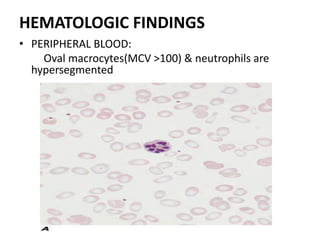
• PERIPHERAL BLOOD:
Oval macrocytes(MCV >100) & neutrophils are
hypersegmented
Cont…
-Leukopenia-- >1.5 × 10⁹/L;
-Platelet count, rarely reduced to <40 × 109/L.
-Nonanemic patient--the presence of a few
macrocytes and hypersegmented neutrophils
in the peripheral blood may be the only
indication
BONE MARROW
• Marrow is hypercellular with an accumulation
of primitive cells
• The cells are larger than normoblasts
• Giant and abnormally shaped metamyelocytes
and enlarged hyperpolyploid megakaryocytes
are characteristic
Cont…
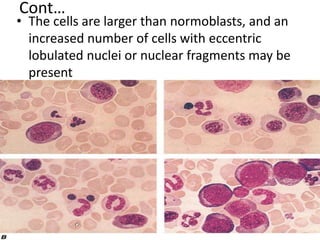
• The cells are larger than normoblasts, and an
increased number of cells with eccentric
lobulated nuclei or nuclear fragments may be
present
INEFFECTIVE HEMATOPOIESIS
-Accumulation of unconjugated bilirubin in
plasma due to the death of nucleated red cells
in the marrow
-Raised urine urobilinogen, reduced
haptoglobins and positive urine hemosiderin,
and a raised serum lactate dehydrogenase.
CAUSES OF COBALAMIN DEFICIENCY
• INADEQUATE DIETARY INTAKE
1) Adults:- Vegans
Subnormal serum cobalamin levels are
found in up to 50% of randomly selected, young,
adult Indian vegans.(but no anemia)
poverty & Psychaitric illness
2) Infants :- severely cobalamin-deficient mothers
growth retardation, impaired
psychomotor development, and other neurologic
sequelae.
•
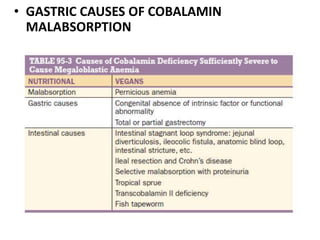
• GASTRIC CAUSES OF COBALAMIN
MALABSORPTION
Pernicious Anemia
-Defined as a severe lack of IF due to gastric
atrophy.
-only 10% of patients <40 years of age
-associated with hypogammaglobulinemia, with
premature graying or blue eyes, and persons
of blood group A.
-Association with HLA-B8, -B12, and -BW15.
-Gastric output of hydrochloric acid, pepsin, and
IF is severely reduced.
-The serum gastrin level is raised, and serum
pepsinogen I levels are low.
Cont…
Gastric Biopsy:
A single endoscopic examination is
recommended
Atrophy of all layers of the body and
fundus
loss of glandular elements,
an absence of parietal and chief cells
and replacement by mucous cells, a mixed
inflammatory cell infiltrate, and perhaps
intestinal metaplasia
Serum Antibodies
• Two types of IF immunoglobulin G:Type
1(~55%) & Type 2(35%)
• Parietal cell antibody is present in the sera of
almost 90% of adult patients with PA but is
frequently present in other subjects
• Fish Tapeworm Infestation(Diphyllobothrium
latum)--
Lives in the small intestine of humans
and accumulates cobalamin from food,
rendering the cobalamin unavailable for
absorption.
• HIV Infection
• Zollinger-Ellison Syndrome
• Radiotherapy(cervical ca)
• Graft-versus-Host Disease
Miscellaneous causes
ABNORMALITIES OF COBALAMIN METABOLISM
• Congenital Transcobalamin II Deficiency or Abnormality
• Congenital Methylmalonic Acidemia and Aciduria--
Infants with this abnormality are ill from birth
with vomiting, failure to thrive, severe metabolic
acidosis, ketosis, and mental retardation.
• Acquired Abnormality of Cobalamin Metabolism:
Nitrous Oxide Inhalation Nitrous oxide (N2O)
irreversibly oxidizes methylcobalamin to an inactive
precursor;
prolonged N2O anesthesia (e.g., in intensive
care units).
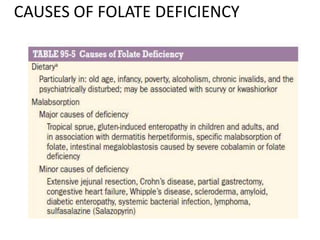
CAUSES OF FOLATE DEFICIENCY
CONT…
DIAGNOSIS OF COBALAMIN AND FOLATE
DEFICIENCIES
• Serum Cobalamin:- Normal serum levels range
from 118–148 pmol/L (160–200 ng/L) to ~738
pmol/L (1000 ng/L).
• Serum Methylmalonate and Homocysteine:-
recommended for the early
diagnosis of cobalamin deficiency, even in the
absence of hematologic abnormalities or
subnormal levels of serum cobalamin.
Serum homocysteine is raised in
both early cobalamin and folate deficiency
FOLATE DEFICIENCY
• Serum Folate:- Normal-- 11 nmol/L (2 μg/L) to
~82 nmol/L (15 μg/L).
Serum folate rises in severe
cobalamin deficiency because of the block in
conversion of MTHF to THF inside cells;
• Red Cell Folate:-
The red cell folate assay is a
valuable test of body folate stores.
It is less affected than the serum
assay by recent diet and traces of hemolysis
TREATMENT
• COBALAMIN DEFICIENCY:-
It is usually necessary to treat
patients who have developed cobalamin
deficiency with lifelong regular cobalamin
injections
In a few instances, the underlying
cause of cobalamin deficiency can be
permanently corrected, for example, fish
tapeworm, tropical sprue, or an intestinal
stagnant loop that is amenable to surgery
Cont…
• The indications for starting cobalamin therapy are
a well-documented megaloblastic anemia or
other hematologic abnormalities and neuropathy
due to the deficiency.
• Cobalamin should be given routinely to all
patients who have had a total gastrectomy or ileal
resection
• Replenishment of body stores should be
complete with six 1000-μg IM injections of
hydroxocobalamin given at 3- to 7-day intervals.
Cont…
• For maintenance therapy, 1000 μg
hydroxocobalamin IM once every 3 months is
satisfactory
• Sublingual & oral therapy can also be
recommended
FOLATE DEFICIENCY
• Oral doses of 5–15 mg folic acid daily are
satisfactory, as sufficient folate is absorbed
from these extremely large doses even in
patients with severe malabsorption.
• It is customary to continue therapy for about 4
months, when all folate-deficient red cells will
have been eliminated and replaced by new
folate-replete populations.
Cont…
• Before large doses of folic acid are given,
cobalamin deficiency must be excluded and, if
present, corrected;
otherwise cobalamin neuropathy may
develop despite a response of the anemia of
cobalamin deficiency to folate therapy
• Long-term folic acid therapy is required when the
underlying cause of the deficiency cannot be
corrected and the deficiency is likely to recur
e.g-chronic dialysis or hemolytic anemias
Cont…
• In any patient receiving long-term folic acid
therapy, it is important to measure the serum
cobalamin level at regular (e.g., once-yearly)
intervals to exclude the coincidental
development of cobalamin deficiency.
• Folinic Acid--- orally or parenterally to
overcome the toxic effects of methotrexate or
other DHF reductase inhibitors, for example,
trimethoprim or cotrimoxazole.
PROPHYLACTIC FOLIC ACID
• Prophylactic folic acid is used in chronic
dialysis patients and in parenteral feeds.
• Pregnancy-- folic acid, 400 μg daily, should be
given as a supplement before and throughout
pregnancy to prevent megaloblastic anemia
and reduce the incidence of NTDs,
• Supplemental folic acid reduces the incidence
of birth defects in babies born to diabetic
mothers.
Infancy and Childhood
• The incidence of folate deficiency is so high in
the smallest premature babies during the first
6 weeks of life that folic acid (e.g., 1 mg daily)
should be given routinely to those weighing
<1500 g at birth and to larger premature
babies who require exchange transfusions or
develop feeding difficulties, infections, or
vomiting and diarrhea.
MEGALOBLASTIC ANEMIA NOT DUE TO
COBALAMIN OR FOLATE DEFICIENCY OR
ALTERED METABOLISM
• Antimetabolic drugs (e.g., hydroxyurea, cytosine
arabinoside, 6-mercaptopurine) that inhibit DNA
replication. Antiviral nucleoside analogues used in
treatment of HIV infection
• Orotic aciduria:-(purine synthesis)The condition
responds to therapy with uridine, which bypasses the
block.
• In thiamine-responsive megaloblastic anemia, there is
a genetic defect in the high-affinity thiamine transport
(SLC19A2) gene.(pentose pathway)

Megaloblastic anemia 2 copy

  • 1.
  • 3.
  • 4.
    COBALAMIN(vitamin B12) • Naturallyoccurs mainly in 2 forms: 1) 2-deoxyadenosyl (ado) form--present in mitochondria 2) Methyl-cobalamin-- the form in human plasma and in cell cytoplasm.
  • 5.
    Cont… DIETARY SOURCES ANDREQUIREMENTS: • Only source for humans-- food of animal origin, for example, meat, fish, and dairy products. • Body stores--2–3 mg, sufficient for 3–4 years if supplies are completely cut off. • Adult daily losses (mainly in the urine and feces) - - 1–3 μg (~0.1% of body stores) • Daily requirements-- 1–3 μg.
  • 6.
    Cont… ABSORPTION R-haptocorrins (HCs). Parietal cells CubilinReceptors (6hrs) 0.5-5 mcg each day so malabsorbtion affects more IF (gene at chromosome(11q13)
  • 7.
    TRANSPORT Two main cobalamintransport proteins: 1)TC I(Gene TCNL is at chromosome 11q11- q12.3)—Enterohepatic circulation mainly 2)TC II(chromosome 22q11-q13.1)-- Synthesized by liver and by other tissues, including macrophages, ileum, and vascular endothelium. Enters by receptor-mediated endocytosis involving the TC II receptor and megalin (encoded by the LRP- 2 gene) (readilygives up cobalamin to marrow, placenta)
  • 8.
    FOLATE DIETARY FOLATE: -The highestconcentrations are found in liver, yeast, spinach, other greens, and nuts (>100 μg/100 g) -Easily destroyed by heating, particularly in large volumes of water. -Total body folate in the adult -- ~10 mg, with the liver containing the largest store. -Daily adult requirements-- ~100 μg, -so stores are sufficient for only 3–4 months in normal adults and severe folate deficiency may develop rapidly
  • 9.
    ABSORPTION Proton-coupled folate transporter (PCFT, SCL46A1). polyglutamates monoglutamates About60–90 μg of folate enters the bile each day and is excreted into the small intestine. Loss of this folate, together with the folate of sloughed intestinal cells, accelerates the speed with which folate deficiency develops in malabsorption conditions.
  • 10.
    TRANSPORT - one-third isloosely bound to albumin two-thirds is unbound. -In all body fluids—majority is 5-MTHF in the monoglutamate form -Three types of folate-binding protein: a)A reduced folate transporter (RFC, SLC19A1)-- major route of delivery of plasma folate (5-MTHF) to cells. b)Two folate receptors, FR2 and FR3 embedded in the cell membrane transport folate into the cell via receptor-mediated endocytosis. c)The third protein, PCFT, transports folate at low pH from the vesicle to the cell cytoplasm.
  • 11.
    BIOCHEMICAL BASIS OFMEGALOBLASTIC ANEMIA • Defect in DNA synthesis that affects rapidly dividing cells in the bone marrow (diminished synthesis of purines and TMP,) • DNA replication from multiple origins along the chromosome is slower than normal during mitosis, and there is failure of joining up the incomplete replicons with resulting single stranded DNA breaks.
  • 12.
  • 13.
    Most Important precurssor Vit B12is required Deficiency causes folate trap in cells so causes Megaloblastic anemia
  • 14.
    CLINICAL FEATURES • Anorexiais usually marked, weight loss, diarrhea, or constipation • Glossitis, angular cheilosis, a mild fever in more severely anemic patients, jaundice (unconjugated), and reversible melanin skin hyperpigmentation. • Thrombocytopenia, • The anemia and low leukocyte count may predispose to infections, particularly of the respiratory and urinary tracts.
  • 15.
    • Neurologic Manifestations: -Bilateralperipheral neuropathy or degeneration (demyelination) of the cervical and thoracic posterior and lateral (pyramidal) tracts of the spinal cord -Optic atrophy and cerebral symptoms including dementia, depression, psychotic symptoms, and cognitive impairment(both in folate and b12 deficiency) -anosmia and loss of taste -paresthesias, muscle weakness, or difficulty in walking(particulary male patient)
  • 16.
    Cont… • usually lossof proprioception and vibration sensation with positive Romberg and Lhermitte signs. • Gait may be ataxic with spasticity (hyperreflexia). Autonomic nervous dysfunction can result in postural hypotension, impotence, and incontinence. • Infancy -- poor brain development and impaired intellectual development, feeding difficulties, lethargy, and coma,convulsions & yoclonus
  • 17.
    Cont… • GENERAL TISSUEEFFECTS OF COBALAMIN AND FOLATE DEFICIENCIES: 1) Epithelial Surfaces:- Glossitis and epithelium of GIT & Genito- Urinary trct 2) Complications of Pregnancy:-Infertility is common in both men and women with severe deficiency, prematurity, recurrent fetal loss 3)Neural Tube Defects:-Anencephaly, meningomyelocele, encephalocele, and spina bifida in the fetus
  • 18.
    Cont… • Can becaused by antifolate and antiepileptic drugs. • Folic acid supplements at the time of conception and in the first 12 weeks of pregnancy reduce by ~70% the incidence of neural tube defects(0.4 mg Folic acid daily) • The incidence of cleft palate and harelip also can be reduced by prophylactic folic acid.
  • 19.
    Cont… 4) Cardiovascular Disease: severehomocystinuria (blood levels ≥100 μmol/L) due to deficiency of one of three enzymes, methionine synthase, MTHFR, or cystathionine synthase Ischemic heart disease, cerebrovascular disease, or pulmonary embolus, as teenagers or in young adulthood.
  • 20.
    Cont.. 5)Malignancy:- -Prophylactic folic acidin pregnancy may reduce the subsequent incidence of acute lymphoblastic leukemia (ALL) in childhood. -Because folic acid may “feed” tumors, it probably should be avoided in those with established tumors unless there is severe megaloblastic anemia due to folate deficiency
  • 21.
    HEMATOLOGIC FINDINGS • PERIPHERALBLOOD: Oval macrocytes(MCV >100) & neutrophils are hypersegmented
  • 22.
    Cont… -Leukopenia-- >1.5 ×10⁹/L; -Platelet count, rarely reduced to <40 × 109/L. -Nonanemic patient--the presence of a few macrocytes and hypersegmented neutrophils in the peripheral blood may be the only indication
  • 23.
    BONE MARROW • Marrowis hypercellular with an accumulation of primitive cells • The cells are larger than normoblasts • Giant and abnormally shaped metamyelocytes and enlarged hyperpolyploid megakaryocytes are characteristic
  • 24.
    Cont… • The cellsare larger than normoblasts, and an increased number of cells with eccentric lobulated nuclei or nuclear fragments may be present
  • 25.
    INEFFECTIVE HEMATOPOIESIS -Accumulation ofunconjugated bilirubin in plasma due to the death of nucleated red cells in the marrow -Raised urine urobilinogen, reduced haptoglobins and positive urine hemosiderin, and a raised serum lactate dehydrogenase.
  • 26.
    CAUSES OF COBALAMINDEFICIENCY • INADEQUATE DIETARY INTAKE 1) Adults:- Vegans Subnormal serum cobalamin levels are found in up to 50% of randomly selected, young, adult Indian vegans.(but no anemia) poverty & Psychaitric illness 2) Infants :- severely cobalamin-deficient mothers growth retardation, impaired psychomotor development, and other neurologic sequelae.
  • 27.
    • • GASTRIC CAUSESOF COBALAMIN MALABSORPTION
  • 28.
    Pernicious Anemia -Defined asa severe lack of IF due to gastric atrophy. -only 10% of patients <40 years of age -associated with hypogammaglobulinemia, with premature graying or blue eyes, and persons of blood group A. -Association with HLA-B8, -B12, and -BW15. -Gastric output of hydrochloric acid, pepsin, and IF is severely reduced. -The serum gastrin level is raised, and serum pepsinogen I levels are low.
  • 29.
    Cont… Gastric Biopsy: A singleendoscopic examination is recommended Atrophy of all layers of the body and fundus loss of glandular elements, an absence of parietal and chief cells and replacement by mucous cells, a mixed inflammatory cell infiltrate, and perhaps intestinal metaplasia
  • 30.
    Serum Antibodies • Twotypes of IF immunoglobulin G:Type 1(~55%) & Type 2(35%) • Parietal cell antibody is present in the sera of almost 90% of adult patients with PA but is frequently present in other subjects
  • 31.
    • Fish TapewormInfestation(Diphyllobothrium latum)-- Lives in the small intestine of humans and accumulates cobalamin from food, rendering the cobalamin unavailable for absorption. • HIV Infection • Zollinger-Ellison Syndrome • Radiotherapy(cervical ca) • Graft-versus-Host Disease Miscellaneous causes
  • 32.
    ABNORMALITIES OF COBALAMINMETABOLISM • Congenital Transcobalamin II Deficiency or Abnormality • Congenital Methylmalonic Acidemia and Aciduria-- Infants with this abnormality are ill from birth with vomiting, failure to thrive, severe metabolic acidosis, ketosis, and mental retardation. • Acquired Abnormality of Cobalamin Metabolism: Nitrous Oxide Inhalation Nitrous oxide (N2O) irreversibly oxidizes methylcobalamin to an inactive precursor; prolonged N2O anesthesia (e.g., in intensive care units).
  • 33.
    CAUSES OF FOLATEDEFICIENCY
  • 34.
  • 35.
    DIAGNOSIS OF COBALAMINAND FOLATE DEFICIENCIES • Serum Cobalamin:- Normal serum levels range from 118–148 pmol/L (160–200 ng/L) to ~738 pmol/L (1000 ng/L). • Serum Methylmalonate and Homocysteine:- recommended for the early diagnosis of cobalamin deficiency, even in the absence of hematologic abnormalities or subnormal levels of serum cobalamin. Serum homocysteine is raised in both early cobalamin and folate deficiency
  • 36.
    FOLATE DEFICIENCY • SerumFolate:- Normal-- 11 nmol/L (2 μg/L) to ~82 nmol/L (15 μg/L). Serum folate rises in severe cobalamin deficiency because of the block in conversion of MTHF to THF inside cells; • Red Cell Folate:- The red cell folate assay is a valuable test of body folate stores. It is less affected than the serum assay by recent diet and traces of hemolysis
  • 37.
    TREATMENT • COBALAMIN DEFICIENCY:- Itis usually necessary to treat patients who have developed cobalamin deficiency with lifelong regular cobalamin injections In a few instances, the underlying cause of cobalamin deficiency can be permanently corrected, for example, fish tapeworm, tropical sprue, or an intestinal stagnant loop that is amenable to surgery
  • 38.
    Cont… • The indicationsfor starting cobalamin therapy are a well-documented megaloblastic anemia or other hematologic abnormalities and neuropathy due to the deficiency. • Cobalamin should be given routinely to all patients who have had a total gastrectomy or ileal resection • Replenishment of body stores should be complete with six 1000-μg IM injections of hydroxocobalamin given at 3- to 7-day intervals.
  • 39.
    Cont… • For maintenancetherapy, 1000 μg hydroxocobalamin IM once every 3 months is satisfactory • Sublingual & oral therapy can also be recommended
  • 40.
    FOLATE DEFICIENCY • Oraldoses of 5–15 mg folic acid daily are satisfactory, as sufficient folate is absorbed from these extremely large doses even in patients with severe malabsorption. • It is customary to continue therapy for about 4 months, when all folate-deficient red cells will have been eliminated and replaced by new folate-replete populations.
  • 41.
    Cont… • Before largedoses of folic acid are given, cobalamin deficiency must be excluded and, if present, corrected; otherwise cobalamin neuropathy may develop despite a response of the anemia of cobalamin deficiency to folate therapy • Long-term folic acid therapy is required when the underlying cause of the deficiency cannot be corrected and the deficiency is likely to recur e.g-chronic dialysis or hemolytic anemias
  • 42.
    Cont… • In anypatient receiving long-term folic acid therapy, it is important to measure the serum cobalamin level at regular (e.g., once-yearly) intervals to exclude the coincidental development of cobalamin deficiency. • Folinic Acid--- orally or parenterally to overcome the toxic effects of methotrexate or other DHF reductase inhibitors, for example, trimethoprim or cotrimoxazole.
  • 43.
    PROPHYLACTIC FOLIC ACID •Prophylactic folic acid is used in chronic dialysis patients and in parenteral feeds. • Pregnancy-- folic acid, 400 μg daily, should be given as a supplement before and throughout pregnancy to prevent megaloblastic anemia and reduce the incidence of NTDs, • Supplemental folic acid reduces the incidence of birth defects in babies born to diabetic mothers.
  • 44.
    Infancy and Childhood •The incidence of folate deficiency is so high in the smallest premature babies during the first 6 weeks of life that folic acid (e.g., 1 mg daily) should be given routinely to those weighing <1500 g at birth and to larger premature babies who require exchange transfusions or develop feeding difficulties, infections, or vomiting and diarrhea.
  • 45.
    MEGALOBLASTIC ANEMIA NOTDUE TO COBALAMIN OR FOLATE DEFICIENCY OR ALTERED METABOLISM • Antimetabolic drugs (e.g., hydroxyurea, cytosine arabinoside, 6-mercaptopurine) that inhibit DNA replication. Antiviral nucleoside analogues used in treatment of HIV infection • Orotic aciduria:-(purine synthesis)The condition responds to therapy with uridine, which bypasses the block. • In thiamine-responsive megaloblastic anemia, there is a genetic defect in the high-affinity thiamine transport (SLC19A2) gene.(pentose pathway)