COVER INTRODUCTION DISCUSSION
216
ABOUT BUSINESS
ETHICAL ISSUES
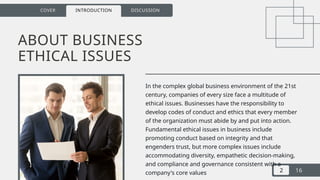
In the complex global business environment of the 21st
century, companies of every size face a multitude of
ethical issues. Businesses have the responsibility to
develop codes of conduct and ethics that every member
of the organization must abide by and put into action.
Fundamental ethical issues in business include
promoting conduct based on integrity and that
engenders trust, but more complex issues include
accommodating diversity, empathetic decision-making,
and compliance and governance consistent with a
company's core values
3.
COVER INTRODUCTION DISCUSSION
316
LIST OF ETHICAL
ISSUES IN BUSINESS
• Fundamental Ethical Issues
• Diversity and the Respectful
Workplace
• Decision-Making Issues
• Compliance and Governance Issues
4.
16
COVER INTRODUCTION DISCUSSION
FUNDAMENTAL
ETHICALISSUES
Integrity and trust
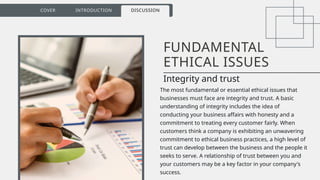
The most fundamental or essential ethical issues that
businesses must face are integrity and trust. A basic
understanding of integrity includes the idea of
conducting your business affairs with honesty and a
commitment to treating every customer fairly. When
customers think a company is exhibiting an unwavering
commitment to ethical business practices, a high level of
trust can develop between the business and the people it
seeks to serve. A relationship of trust between you and
your customers may be a key factor in your company's
success.
5.
5 16
COVER INTRODUCTIONDISCUSSION
SERVICES
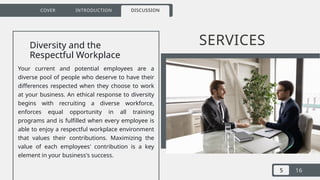
Diversity and the
Respectful Workplace
Your current and potential employees are a
diverse pool of people who deserve to have their
differences respected when they choose to work
at your business. An ethical response to diversity
begins with recruiting a diverse workforce,
enforces equal opportunity in all training
programs and is fulfilled when every employee is
able to enjoy a respectful workplace environment
that values their contributions. Maximizing the
value of each employees' contribution is a key
element in your business's success.
6.
6 16
COVER INTRODUCTIONDISCUSSION
Decision-Making Issues
A useful method for exploring ethical dilemmas and
identifying ethical courses of action includes collecting the
facts, evaluating any alternative actions, making a
decision, testing the decision for fairness and reflecting on
the outcome. Ethical decision-making processes should
center on protecting employee and customer rights,
making sure all business operations are fair and just,
protecting the common good, and making sure the
individual values and beliefs of workers are protected.
WHAT
WE
OFFER
7.
COMPLIANCE AND
GOVERNANCE ISSUES
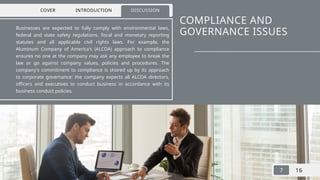
Businessesare expected to fully comply with environmental laws,
federal and state safety regulations, fiscal and monetary reporting
statutes and all applicable civil rights laws. For example, the
Aluminum Company of America's (ALCOA) approach to compliance
ensures no one at the company may ask any employee to break the
law or go against company values, policies and procedures. The
company's commitment to compliance is shored up by its approach
to corporate governance: the company expects all ALCOA directors,
officers and executives to conduct business in accordance with its
business conduct policies.
COVER INTRODUCTION DISCUSSION
7 16
8.
9 16
COVER INTRODUCTIONDISCUSSION
THE 5 BIGGEST ETHICAL
ISSUES FACING BUSINESSES
According to the Global Business Ethics
Survey of 2018, employees (40%) believe that
their company has a weak leaning ethical
culture, and that little progress has been
made to mitigate wrongdoing. Here are
some of the ethical issues in business and
real-world cases of how these ethical issues
have affected companies.
9.
10 16
COVER INTRODUCTIONDISCUSSION
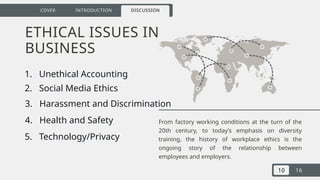
ETHICAL ISSUES IN
BUSINESS
From factory working conditions at the turn of the
20th century, to today’s emphasis on diversity
training, the history of workplace ethics is the
ongoing story of the relationship between
employees and employers.
1. Unethical Accounting
2. Social Media Ethics
3. Harassment and Discrimination
4. Health and Safety
5. Technology/Privacy
10.
15 16
COVER INTRODUCTIONDISCUSSION
CONCLUSION
ethics is based on standards of right and
wrong that dictate what humans should do,
usually in terms of “rights, obligations,
benefits to society, fairness, or specific
virtues.”
Ethics is not the same as religion, feelings,
following the law or societal expectations. Rather,
ethics encompasses:
• Refraining from wrong actions, such as theft,
murder or fraud
• Human rights, such as the right to life and the
right to privacy
• Virtues, such as honesty, compassion and
loyalty
11.
14 16
COVER INTRODUCTIONDISCUSSION
QUESTION TO BE DISCUSSED
• Why in making decision strategy
should be considered in ethical
issues ?
• Is there any correlation between ethics
and emotionally decision making
whilst in making decision have to be
more rationally than emotionally?