THE STYLE AND DECORATIVE DETAILS
OF ALL PERIODS TO CONTEMPORARY
M A D E B Y : - A P O O RW A A P O RW A L
INTERIOR DESIGN
STYLE:
The Definitive guide
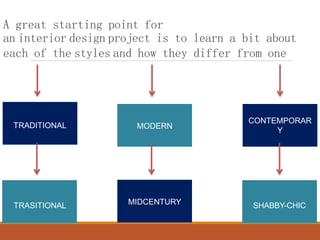
A great starting point for
an interior design project is to learn a bit about
each of the styles and how they differ from one
another.
TRADITIONAL MODERN
CONTEMPORAR
Y
TRASITIONAL MIDCENTURY SHABBY-CHIC
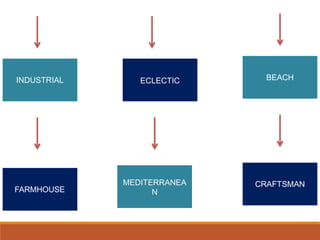
INDUSTRIAL
FARMHOUSE
ECLECTIC
MEDITERRANEA
N
BEACH
CRAFTSMAN
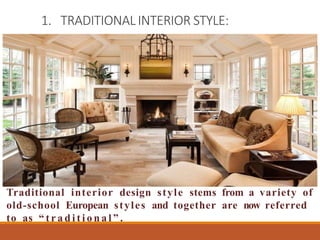
1. TRADITIONAL INTERIOR STYLE:
Traditional interior design style stems from a variety of
old-school European styles and together are now referred
to as “ t r a d i t i o n a l ” .
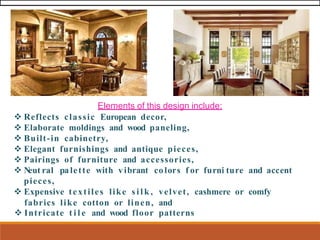
Elements of this design include:
❖ Reflects classic European decor,
❖ Elaborate moldings and wood paneling,
❖ Built-in cabinetry,
❖ Elegant furnishings and antique pieces,
❖ Pairings of furniture and accessories,
❖ N
eut ral palette with vibrant colors f or furni ture and accent
pieces,
❖ Expensive textiles like s i l k , velvet, cashmere or comfy
fabrics like cotton or linen,
❖ Intricate t i l e and wood floor
and
patterns
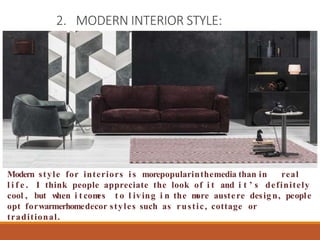
2. MODERN INTERIOR STYLE:
Modern style for interiors i s morepopularinthemedia than in real
l i f e . I think people appreciate the look of i t and i t ’ s definitely
cool , but w
hen i t com
es t o l iv ing i n the m
ore austere desig n, people
opt forwarmerhomedecor styles such as rustic, cottage or
traditional.
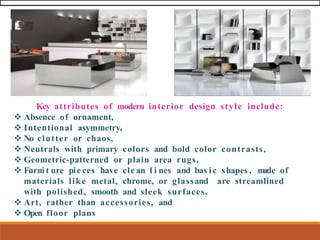
Key attributes of modern interior design style include:
❖ Absence of ornament,
❖ Intentional asymmetry,
❖ No clutter or chaos,
❖ Neutrals with primary colors and bold color contrasts,
❖ Geometric-patterned or plain area rugs,
❖ Furni t ure pie ces have cle an l i nes and bas ic shapes , m
ade of
materials like metal, chrome, or glassand are streamlined
with polished, smooth and sleek surfaces,
❖ Art, rather than accessories, and
❖ Open floor plans
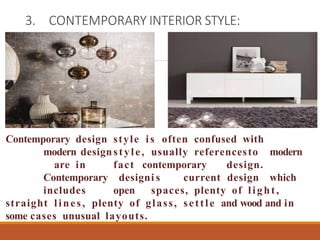
3. CONTEMPORARY INTERIOR STYLE:
Contemporary design style is often confused with
modern designstyle, usually referencesto modern
are in fact contemporary design.
Contemporary designi s current design which
includes open spaces, plenty of light,
straight lines, plenty of glass, settle and wood and in
some cases unusual layouts.
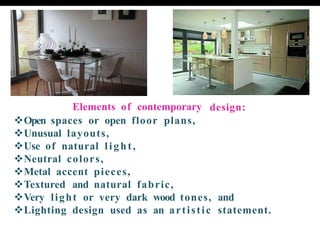
design:
Elements of contemporary
❖Open spaces or open floor plans,
❖Unusual layouts,
❖Use of natural light,
❖Neutral colors,
❖Metal accent pieces,
❖Textured and natural fabric,
❖Very light or very dark wood tones, and
❖Lighting design used as an artistic statement.
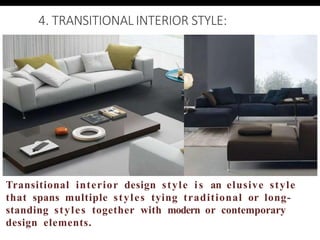
4. TRANSITIONAL INTERIOR STYLE:
Transitional interior design style is an elusive style
that spans multiple styles tying traditional or long-
standing styles together with modern or contemporary
design elements.
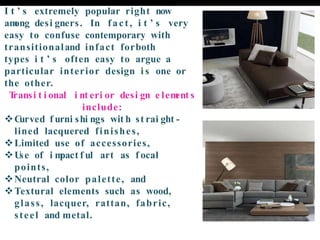
I t ’ s extremely popular right now
am
ong desi gners. In fact, i t ’ s very
easy to confuse contemporary with
transitionaland infact forboth
types i t ’ s often easy to argue a
particular interior design i s one or
the other.
T
ransi t i onal i nt eri or desi gn e lem
ent s
include:
❖C
urved f urni shi ngs wit h st rai ght -
lined lacquered finishes,
❖Limited use of accessories,
❖U
se of i m
pact f ul art as f ocal
points,
❖Neutral color palette, and
❖Textural elements such as wood,
glass, lacquer, rattan, fabric,
steel and metal.
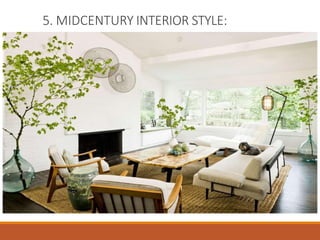
5. MIDCENTURY INTERIOR STYLE:
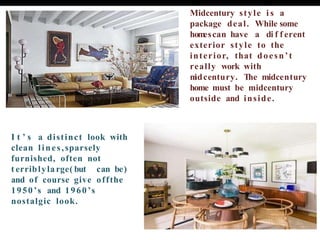
I t ’ s a distinct look with
clean lines,sparsely
furnished, often not
t erriblyla rge( but can be)
and of course give offthe
1950’s and 1960’s
nostalgic look.
Midcentury style i s a
package deal. While some
hom
escan have a di f f erent
exterior style to the
interior, that doesn’t
really work with
m
idcentury. The midcentury
home must be midcentury
outside and inside.
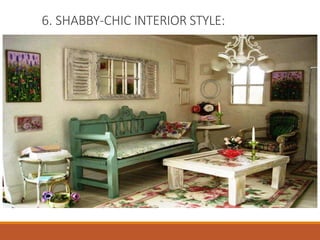
6. SHABBY-CHIC INTERIOR STYLE:
Shabby-chici s big these days with
the popularity of vintage and DIY
hom
e decor. W
hi l e I don’ t w
ant t o
say shabby-chici s a full crafty
style, thee are definitely craft
elements that people like suchas
distressed furnishings, floral
prints and design elements and
whitewashed floors.
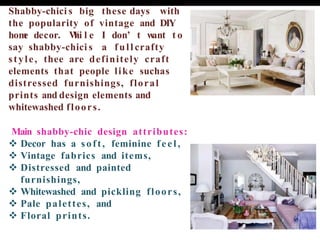
Main shabby-chic design attributes:
❖ Decor has a soft, feminine feel,
❖ Vintage fabrics and items,
❖ Distressed and painted
furnishings,
❖ Whitewashed and pickling floors,
❖ Pale palettes, and
❖ Floral prints.
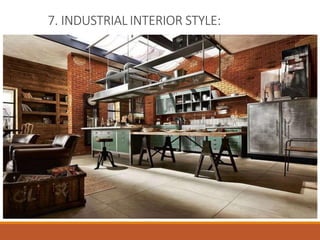
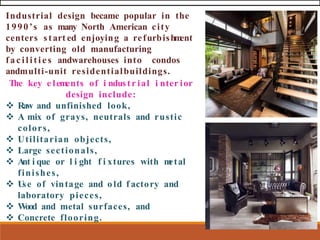
7. INDUSTRIALINTERIOR STYLE:
Industrial design became popular in the
1990’s as many North American city
centers start ed enjoying a refurbishm
ent
by converting old manufacturing
facilities andwarehouses into condos
andmulti-unit residentialbuildings.
The key e lements of i ndustr ial i nter ior
design include:
❖ Raw and unfinished look,
❖ A mix of grays, neutrals and rustic
colors,
❖ Utilitarian objects,
❖ Large sectionals,
❖ A
nt i que or l i ght f i xtures with m
etal
finishes,
❖ U
se of vintage and old f actory and
laboratory pieces,
❖ Wood and metal surfaces, and
❖ Concrete flooring.
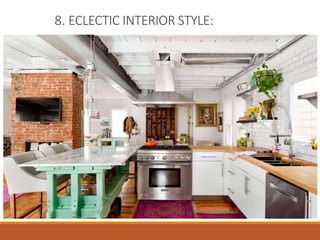
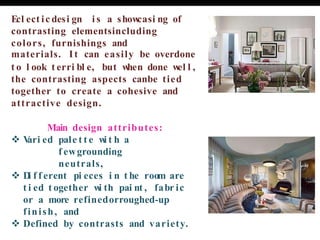
8. ECLECTIC INTERIOR STYLE:
Ecl ect ic desi gn i s a show
casi ng of
contrasting elementsincluding
colors, furnishings and
materials. It can easily be overdone
t o l ook t erri bl e, but w
hen done w
el l ,
the contrasting aspects canbe tied
together to create a cohesive and
attractive design.
Main design attributes:
❖ V
ari ed pale t t e w
i t h a
f ewgrounding
neutrals,
❖ D
i f f erent pi eces i n t he room are
t i ed t ogether w
i th pai nt , fabr ic
or a more refinedorroughed-up
finish, and
❖ Defined by contrasts and variety.
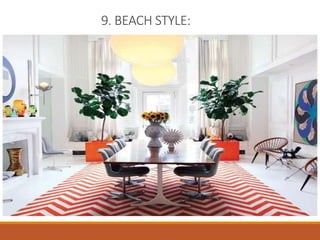
9. BEACH STYLE:
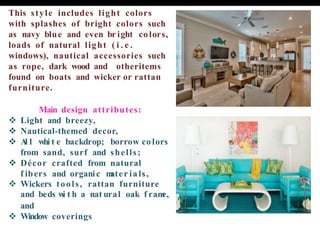
This style includes light colors
with splashes of bright colors such
as navy blue and even br ight colors,
loads of natural light ( i . e .
windows), nautical accessories such
as rope, dark wood and otheritems
found on boats and wicker or rattan
furniture.
Main design attributes:
❖ Light and breezy,
❖ Nautical-themed decor,
❖ A
l l whi t e backdrop; borrow colors
from sand, surf and shells;
❖ Décor crafted from natural
f ibers and organic m
ater ials,
❖ Wickers tools, rattan furniture
and beds w
i t h a nat ural oak f ram
e,
and
❖ Window coverings
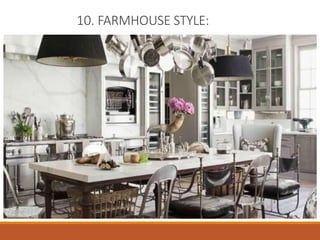
10. FARMHOUSE STYLE:
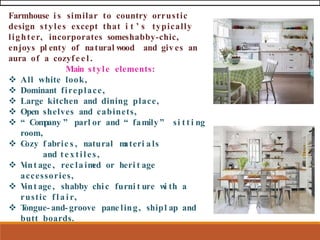
Farmhouse i s similar to country orrustic
design styles except that i t ’ s typically
lighter, incorporates someshabby-chic,
enjoys pl enty of natural wood and giv es an
aura of a cozyf e e l .
Main style elements:
❖ All white look,
❖ Dominant fireplace,
❖ Large kitchen and dining place,
❖ Open shelves and cabinets,
❖ “ Com
pany ” parl or and “ family ” si t t i ng
room,
❖ C
ozy f abric s , natural m
ateri als
and textiles,
❖ V
int age, rec laim
ed or heri t age
accessories,
❖ V
int age, shabby chic furni t ure w
i th a
rustic f l a i r,
❖ T
ongue- and- groove pane ling, shipl ap and
butt boards.
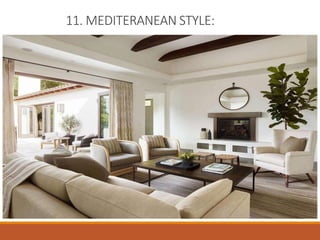
11. MEDITERANEAN STYLE:
Mediterranean i s a stylethatseems
more popular than i t i s . I t ’ s
distinct with plenty of ornamental
styling and features including
columns and arches. It also has a
distinct color scheme being earth
tones.
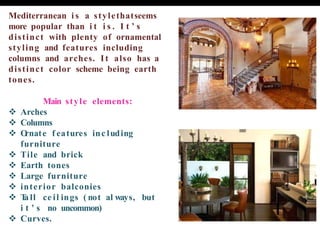
Main style elements:
❖ Arches
❖ Columns
❖ O
rnate f eatures inc luding
furniture
❖ Tile and brick
❖ Earth tones
❖ Large furniture
❖ interior balconies
❖ T
all ce il ings ( not al ways, but
i t ’ s no uncommon)
❖ Curves.
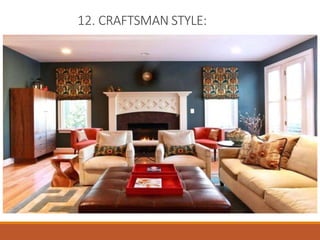
12. CRAFTSMAN STYLE:
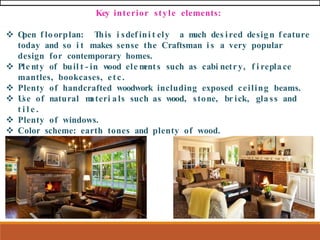
Key interior style elements:
❖ O
pen f lo orplan: This i sdef ini t ely a m
uch des ired desig n f eature
today and so i t makes sense the Craftsman i s a very popular
design for contemporary homes.
❖ Ple nty of buil t - in w
ood ele m
ents such as cabi netry, f i repla ce
mantles, bookcases, etc.
❖ Plenty of handcrafted woodwork including exposed ceiling beams.
❖ U
se of natural m
ateri als such as wood, stone, br ick, gla ss and
t i l e .
❖ Plenty of windows.
❖ Color scheme: earth tones and plenty of wood.

contemporary design_112703.pdf

  • 1.
    THE STYLE ANDDECORATIVE DETAILS OF ALL PERIODS TO CONTEMPORARY M A D E B Y : - A P O O RW A A P O RW A L
  • 2.
  • 3.
    A great startingpoint for an interior design project is to learn a bit about each of the styles and how they differ from one another. TRADITIONAL MODERN CONTEMPORAR Y TRASITIONAL MIDCENTURY SHABBY-CHIC
  • 4.
  • 5.
    1. TRADITIONAL INTERIORSTYLE: Traditional interior design style stems from a variety of old-school European styles and together are now referred to as “ t r a d i t i o n a l ” .
  • 6.
    Elements of thisdesign include: ❖ Reflects classic European decor, ❖ Elaborate moldings and wood paneling, ❖ Built-in cabinetry, ❖ Elegant furnishings and antique pieces, ❖ Pairings of furniture and accessories, ❖ N eut ral palette with vibrant colors f or furni ture and accent pieces, ❖ Expensive textiles like s i l k , velvet, cashmere or comfy fabrics like cotton or linen, ❖ Intricate t i l e and wood floor and patterns
  • 7.
    2. MODERN INTERIORSTYLE: Modern style for interiors i s morepopularinthemedia than in real l i f e . I think people appreciate the look of i t and i t ’ s definitely cool , but w hen i t com es t o l iv ing i n the m ore austere desig n, people opt forwarmerhomedecor styles such as rustic, cottage or traditional.
  • 8.
    Key attributes ofmodern interior design style include: ❖ Absence of ornament, ❖ Intentional asymmetry, ❖ No clutter or chaos, ❖ Neutrals with primary colors and bold color contrasts, ❖ Geometric-patterned or plain area rugs, ❖ Furni t ure pie ces have cle an l i nes and bas ic shapes , m ade of materials like metal, chrome, or glassand are streamlined with polished, smooth and sleek surfaces, ❖ Art, rather than accessories, and ❖ Open floor plans
  • 9.
    3. CONTEMPORARY INTERIORSTYLE: Contemporary design style is often confused with modern designstyle, usually referencesto modern are in fact contemporary design. Contemporary designi s current design which includes open spaces, plenty of light, straight lines, plenty of glass, settle and wood and in some cases unusual layouts.
  • 10.
    design: Elements of contemporary ❖Openspaces or open floor plans, ❖Unusual layouts, ❖Use of natural light, ❖Neutral colors, ❖Metal accent pieces, ❖Textured and natural fabric, ❖Very light or very dark wood tones, and ❖Lighting design used as an artistic statement.
  • 11.
    4. TRANSITIONAL INTERIORSTYLE: Transitional interior design style is an elusive style that spans multiple styles tying traditional or long- standing styles together with modern or contemporary design elements.
  • 12.
    I t ’s extremely popular right now am ong desi gners. In fact, i t ’ s very easy to confuse contemporary with transitionaland infact forboth types i t ’ s often easy to argue a particular interior design i s one or the other. T ransi t i onal i nt eri or desi gn e lem ent s include: ❖C urved f urni shi ngs wit h st rai ght - lined lacquered finishes, ❖Limited use of accessories, ❖U se of i m pact f ul art as f ocal points, ❖Neutral color palette, and ❖Textural elements such as wood, glass, lacquer, rattan, fabric, steel and metal.
  • 13.
  • 14.
    I t ’s a distinct look with clean lines,sparsely furnished, often not t erriblyla rge( but can be) and of course give offthe 1950’s and 1960’s nostalgic look. Midcentury style i s a package deal. While some hom escan have a di f f erent exterior style to the interior, that doesn’t really work with m idcentury. The midcentury home must be midcentury outside and inside.
  • 15.
  • 16.
    Shabby-chici s bigthese days with the popularity of vintage and DIY hom e decor. W hi l e I don’ t w ant t o say shabby-chici s a full crafty style, thee are definitely craft elements that people like suchas distressed furnishings, floral prints and design elements and whitewashed floors. Main shabby-chic design attributes: ❖ Decor has a soft, feminine feel, ❖ Vintage fabrics and items, ❖ Distressed and painted furnishings, ❖ Whitewashed and pickling floors, ❖ Pale palettes, and ❖ Floral prints.
  • 17.
  • 18.
    Industrial design becamepopular in the 1990’s as many North American city centers start ed enjoying a refurbishm ent by converting old manufacturing facilities andwarehouses into condos andmulti-unit residentialbuildings. The key e lements of i ndustr ial i nter ior design include: ❖ Raw and unfinished look, ❖ A mix of grays, neutrals and rustic colors, ❖ Utilitarian objects, ❖ Large sectionals, ❖ A nt i que or l i ght f i xtures with m etal finishes, ❖ U se of vintage and old f actory and laboratory pieces, ❖ Wood and metal surfaces, and ❖ Concrete flooring.
  • 19.
  • 20.
    Ecl ect icdesi gn i s a show casi ng of contrasting elementsincluding colors, furnishings and materials. It can easily be overdone t o l ook t erri bl e, but w hen done w el l , the contrasting aspects canbe tied together to create a cohesive and attractive design. Main design attributes: ❖ V ari ed pale t t e w i t h a f ewgrounding neutrals, ❖ D i f f erent pi eces i n t he room are t i ed t ogether w i th pai nt , fabr ic or a more refinedorroughed-up finish, and ❖ Defined by contrasts and variety.
  • 21.
  • 22.
    This style includeslight colors with splashes of bright colors such as navy blue and even br ight colors, loads of natural light ( i . e . windows), nautical accessories such as rope, dark wood and otheritems found on boats and wicker or rattan furniture. Main design attributes: ❖ Light and breezy, ❖ Nautical-themed decor, ❖ A l l whi t e backdrop; borrow colors from sand, surf and shells; ❖ Décor crafted from natural f ibers and organic m ater ials, ❖ Wickers tools, rattan furniture and beds w i t h a nat ural oak f ram e, and ❖ Window coverings
  • 23.
  • 24.
    Farmhouse i ssimilar to country orrustic design styles except that i t ’ s typically lighter, incorporates someshabby-chic, enjoys pl enty of natural wood and giv es an aura of a cozyf e e l . Main style elements: ❖ All white look, ❖ Dominant fireplace, ❖ Large kitchen and dining place, ❖ Open shelves and cabinets, ❖ “ Com pany ” parl or and “ family ” si t t i ng room, ❖ C ozy f abric s , natural m ateri als and textiles, ❖ V int age, rec laim ed or heri t age accessories, ❖ V int age, shabby chic furni t ure w i th a rustic f l a i r, ❖ T ongue- and- groove pane ling, shipl ap and butt boards.
  • 25.
  • 26.
    Mediterranean i sa stylethatseems more popular than i t i s . I t ’ s distinct with plenty of ornamental styling and features including columns and arches. It also has a distinct color scheme being earth tones. Main style elements: ❖ Arches ❖ Columns ❖ O rnate f eatures inc luding furniture ❖ Tile and brick ❖ Earth tones ❖ Large furniture ❖ interior balconies ❖ T all ce il ings ( not al ways, but i t ’ s no uncommon) ❖ Curves.
  • 27.
  • 28.
    Key interior styleelements: ❖ O pen f lo orplan: This i sdef ini t ely a m uch des ired desig n f eature today and so i t makes sense the Craftsman i s a very popular design for contemporary homes. ❖ Ple nty of buil t - in w ood ele m ents such as cabi netry, f i repla ce mantles, bookcases, etc. ❖ Plenty of handcrafted woodwork including exposed ceiling beams. ❖ U se of natural m ateri als such as wood, stone, br ick, gla ss and t i l e . ❖ Plenty of windows. ❖ Color scheme: earth tones and plenty of wood.