VIVA-Tech International Journal for Research and Innovation Volume 1, Issue 6 (2023)
ISSN(Online): 2581-7280 Article 16
PP 01-06
www.viva-technology.org/New/IJRI 1
Medichain - Securing pharma supply chain with blockchain
Chaitany Ghadigaonkar1
, Suraj Sakhare2
, Taj Mohammad Khan3
, Prof Reshma
Chaudhari4
1
(Computer Engineering, Viva Institute of Technology, India)
2
(Computer Engineering, Viva Institute of Technology, India)
3
(Computer Engineering, Viva Institute of Technology, India)
4
(Assistant Professor of Computer Engineering, Viva Institute of Technology, India)
Abstract : The pharmaceutical industry plays a vital role in safeguarding global health. However, its supply
chain is complex, susceptible to fraud, and often inefficient. Pharmaceutical supply chains are characterized by
multiple stakeholders, including manufacturers, distributors, suppliers, and healthcare providers. The intricate
nature of this supply chain makes it vulnerable to issues like counterfeit drugs and data inaccuracies. Blockchain,
with its inherent features of transparency, immutability, and decentralization, offers a compelling framework to
mitigate these challenges. Blockchain enhances transparency by creating an immutable ledger of all transactions.
Each drug batch is assigned a unique identifier, recorded on the blockchain and associated with relevant data
such as manufacturing details, shipping records and quality test results. Stakeholders across the supply chain can
access this information in real-time, ensuring complete visibility and traceability. Counterfeit drugs pose a
significant threat to public health. Blockchain's secure, tamper-proof records enable consumers and healthcare
professionals to verify the authenticity of pharmaceutical products. Smart contracts, self-executing agreements
triggered by predefined conditions can automate verification processes, reducing the risk of counterfeit drugs
entering the supply chain. Blockchain's cryptographic techniques ensure data security, privacy and protecting
sensitive information. Pharmaceutical recalls can be costly and time-consuming. Blockchain's traceability allows
for targeted recalls, pinpointing affected batches quickly. Smart contracts can automate the recall process,
notifying relevant parties and facilitating the return of products. This efficiency not only saves resources but also
enhances patient safety.
Keywords – Blockchain, counterfeit drugs, pharmaceutical supply chain, smart contract.
I. INTRODUCTION
The pharmaceutical industry stands as a cornerstone of modern healthcare, responsible for producing and
distributing medications that are essential to human well-being across the globe. However, beneath the surface of
this vital sector lies a web of complexity known as the pharmaceutical supply chain. This intricate network
connects pharmaceutical manufacturers, distributors, regulatory bodies, healthcare providers, and the patients who
rely on its life-saving products. The pharmaceutical supply chain is a multifaceted system, encompassing the
production, distribution and delivery of pharmaceutical products. This journey begins with the creation of a drug
in a manufacturing facility and extends to its transport to distribution centers, pharmacies and ultimately into the
hands of patients worldwide. Every step along this path is subject to quality control measures, stringent regulatory
requirements and documentation. Collaboration among stakeholders, which include pharmaceutical
manufacturers, distributors, logistics companies, healthcare providers and regulatory agencies, is often hindered
by a lack of real-time visibility and transparency.
Blockchain's transparency ensures that all participants in the supply chain have access to a shared, immutable
record of transactions. Each pharmaceutical product from its inception in a manufacturing facility is assigned a
unique identifier that is recorded on the blockchain. This identifier accompanies the product throughout its
journey, accumulating critical data such as manufacturing details, shipping records, quality test results, and more.
In the battle against counterfeit drugs, one of the most pressing issues, blockchain emerges as a powerful ally.
Consumers, healthcare providers and regulatory agencies can easily verify a drug's authenticity by scanning its
unique identifier. Smart contracts, self-executing agreements triggered by predefined conditions, can automate
VIVA-Tech International Journal for Research and Innovation Volume 1, Issue 6 (2023)
ISSN(Online): 2581-7280 Article 16
PP 01-06
www.viva-technology.org/New/IJRI 2
verification processes. This not only enhances patient safety by reducing the risk of counterfeit drugs entering the
supply chain but also in stills confidence in consumers regarding the authenticity of pharmaceutical products. As
the pharmaceutical industry strides into an era of technological advancement, blockchain's role in safeguarding
global health through secure and transparent pharmaceutical supply chains is poised to become increasingly
significant. However, successful implementation requires collaboration among industry stakeholders, regulatory
bodies, and technology providers. As blockchain continues to evolve, its transformative impact on the
pharmaceutical supply chain promises a future marked by enhanced safety, efficiency, and trust in the medicines
that improve and save lives.
II. METHODOLOGY
The pharmaceutical supply chain employs blockchain technology to establish a transparent and secure ecosystem.
Manufacturers, distributors, retailers, and consumers interact within this blockchain-powered framework.
Manufacturers register and upload product details, including QR codes, onto the immutable ledger. Distributors
access and update product information as it moves through the supply chain, while retailers retrieve data for sales
and consumers verify product authenticity. Security measures, including user authentication and data encryption,
protect sensitive information, and regular audits maintain data accuracy.
The blockchain ledger ensures data immutability and transparency, facilitating efficient traceability and real-time
alerts on product status. While recognizing limitations like scalability challenges, the proposed system represents
a significant step toward enhancing pharmaceutical supply chain management, bolstering patient safety, and
combating counterfeit drugs. Future work could explore IoT and AI integrations and collaboration with regulatory
bodies to further improve the system.
The pharmaceutical supply chain consists of various entities like Admin, Transporter, Raw Material Supplier,
Wholesaler, Distributor & Customer. They perform the handover of the drug package so whenever there is any
handover of the package between two entities a transaction gets recorded on the Blockchain network.
Admin/ Owner:- CREATE a new user to be added to the chain the users could be anyone like Transporter,
Supplier, etc. READ the information of any user, owner can use it for identification of entities into the supply
chain. UPDATE the roles of a user and can DELETE a user from the chain.
Transporter:- Verify the package (Raw Material or Medicine). Pick the package from an entity (based on
transporter type). Deliver the product to an entity.
Supplier:- CREATE a Raw Material. GET the addresses of the Raw Materials created.
Manufacturer:- Receive the Raw Material from the Supplier through the Transporter. Verify the source of the
product received. CREATE a new Medicine using received raw materials.
Wholesaler:- Receive the medicine from the manufacturer through the Transporter. Verify the source of the
medicine.
Distributor:- Receive the medicine from the Wholesaler through the Transporter. Verify the source of the
medicine. Transfer the ownership of the medicine.
Customer:- Get medical drug information. Receive the medicine from the Distributor through the Transporter.
Verify the source of the medicine. Place orders in a mobile application.
Smart Contracts Implementation:
Admin Contract:
It defines roles and permissions for entities. It has the functions for adding, updating, and deleting entities. It
handles event emissions for these actions.
Supplier Contract:
It has the functions for managing raw materials. It handles the events for raw material transactions.
Manufacturer Contract:
It having the functions for processing raw materials and manufacturing medicines. It has the events for
manufacturing transactions.
Transporter Contract:
It has the functions for verifying and authorizing transactions. It has the events for verification and authorization.
Customer Contract:
It has functions for purchasing medicines. It has the events for purchase transactions.
Events and Authorization:
Define a standardized event structure for various transactions. Emit events in smart contract functions. Implement
a system for the transporter to verify and authorize transactions based on emitted events.
User Interface (UI):
Admin Dashboard:
VIVA-Tech International Journal for Research and Innovation Volume 1, Issue 6 (2023)
ISSN(Online): 2581-7280 Article 16
PP 01-06
www.viva-technology.org/New/IJRI 3
Created web-based dashboards for admin, supplier, manufacturer, and transporter using ReactJs and Tailwind css.
Using web3.js to interact with the smart contracts from the UI. Block chain technologies like Solidity, Ganache ,
Truffle, Metamask and Web3 are used for contract execution and deployment.
Customer React Native App:
Develop a React Native app for customers to browse and purchase medicines. Utilize a library like web3.js to
interact with the smart contract.
Database:`
Used MongoDB for storing all the transaction details and medicines. These medicines and transactions are fetched
by react native application to show it to the customer.
Integration:
Connected the UI components with the smart contracts, allowing entities to perform actions through the UI. We
used the Ethereum provider like metamask to handle user wallet interactions.
III. LITERATURE STUDY
The integration of blockchain technology into the pharmaceutical supply chain represents a transformative frontier
in the healthcare industry, holding the promise of revolutionizing the way pharmaceutical products are
manufactured, distributed, and monitored. The inherent challenges within the pharmaceutical supply chain,
including issues of counterfeiting, traceability gaps, and data integrity, have spurred growing interest in leveraging
blockchain's decentralized and transparent nature to address these critical issues. This literature survey aims to
comprehensively explore the current state of research, developments, and challenges surrounding the adoption of
blockchain technology in the pharmaceutical supply chain.
The pharmaceutical industry's research and development process is complex and lengthy beginning with drug
discovery and culminating in regulatory approval. These proposes a solution using blockchain technology to
design a secure and transparent pharmaceutical supply chain. Blockchain's potential in the pharmaceutical industry
lies in its ability to create a shared ledger of information, including the drug's source, product license and
transactional data [1]. Digital transformation is reshaping industries, including pharmaceuticals by introducing
new ways of doing business and enhancing existing processes. Companies in the pharmaceutical sector are re-
evaluating their operations from internal systems to customer interactions with a focus on digitization.
Implementing digital traceability, including barcodes has proven effective in minimizing such risks [2].
Pharmaceutical companies prioritize maintaining distribution quality and patient safety throughout the complex
pharmaceutical supply chain. Counterfeit medications, often substandard and improperly formulated, pose a
significant risk, including the absence of active pharmaceutical ingredients, contaminants or repackaged expired
drugs. The solution involves a network architecture with pharmaceutical companies, regulatory authorities and
local vendors like hospitals and pharmacies [3]. The intricate nature of pharmaceutical supply chain has introduced
challenges in tracking and tracing drug products making them vulnerable to counterfeit drugs, which can be
dangerous to consumers. It leverages Ethereum and Hyperledger Fabric platforms to enhance the security and
transparency of pharmaceutical supply chains. The system aims to revolutionize pharmaceutical supply chains by
providing end-to-end transparency, combating counterfeit drugs and enhancing consumer confidence in drug
authenticity [4]. Blockchain offers supply chain managers the ability to develop data-driven models, enhancing
privacy protection, transparency and tamper-proof systems. This technology utilizes a shared, cryptographically
unaltered distributed ledger to record and secure digital transaction histories. By leveraging blockchain technology
the pharmaceutical industry aims to safe and efficient delivery of critical healthcare products [5]. The
pharmaceutical supply chain can be susceptible to improper or unethical activities, making investigations
challenging. Blockchain is a distributed ledger database that records transactions transparently and immutably. It
enhances trust among supply chain entities by providing complete transparency and uses smart contracts to record
transactions [6]. Counterfeit medications pose a significant threat to public health, leading to detrimental
consequences for patients and treatment outcomes. These blockchain architectures can establish private
permissioned ecosystems within the pharmaceutical industry, with regulatory authorities or stakeholders
overseeing registration and control [7]. Traditional blockchain platforms like Bitcoin and Ethereum use proof-of-
work consensus, which is computationally intensive and inefficient for querying data. Querying data from a
blockchain ledger is cumbersome, as there are no primary keys or indexes, making it inefficient compared to
centralized databases. To address this, the article explores smart contracts as a way to optimize data indexing and
retrieval in the blockchain [8]. Modern information technology solutions have facilitated the development of inter-
organizational networks, enabling real-time information processing and exchange. Blockchain also finds use in
tracking shipments and improving supply chain visibility. Technological factors, including information quality
and system benefits, influence the adoption of drug traceability systems within organizations [9]. Despite
regulatory efforts and industry initiatives, drug breaches continue to rise, potentially costing billions in healthcare
fraud. The findings reinforce the alarming statistics regarding substandard and counterfeit drugs highlighted by
the World Health Organization [10]. The global pharmaceutical commodity trade has surged from $113 billion in
VIVA-Tech International Journal for Research and Innovation Volume 1, Issue 6 (2023)
ISSN(Online): 2581-7280 Article 16
PP 01-06
www.viva-technology.org/New/IJRI 4
2000 to $629 billion in 2019, a six -fold increase, resulting in increasingly complex and opaque pharmaceutical
supply chains. A key element is a drug traceability system that can effectively monitor the movement of
pharmaceuticals across various supply chain stakeholders. The proposed solution employs a permissioned
blockchain, specifically Hyperledger Fabric, which provides access control, permitting only registered users to
execute actions within the system. Endorsing peers simulate transactions to ensure their stability, while ordering
peers package and distribute transactions to committing peers [11]. Blockchain based supply chain systems offer
users the ability to access and manage critical information such as product location, pricing, dates and quality. By
tracing and tracking pharmaceuticals through the supply chain, the system can pinpoint the source of issues caused
by faulty manufacturing processes, enabling targeted recalls and protecting consumer safety. It employs QR codes
for product tracking, ensuring data integrity and traceability [12]. The introduction of blockchain technology has
revolutionized this landscape. It operates on a request-response mechanism, ensuring that all parties involved in
a transaction agree on the transfer of medical drugs. The data stored on the blockchain ledger is tamper-proof,
enhancing security and trust [13]. The system's primary objectives are to enhance brand anti-counterfeiting
certification, expand sales channels and empower small vendors to validate the authenticity of their products. It
achieves this by storing relevant product sales information on a transparent and immutable blockchain accessible
to anyone [14].
IV. FIGURES
Fig. 1: Block Diagram
The above figure shows the different blocks of the project. The blocks are the different entities involved in project.
This figure shows how those blocks are connected to each other and work.
V. IMPLEMENTATION
Fig. 2: Raw Material Details
VIVA-Tech International Journal for Research and Innovation Volume 1, Issue 6 (2023)
ISSN(Online): 2581-7280 Article 16
PP 01-06
www.viva-technology.org/New/IJRI 5
The Figure 2 shows the details of the raw material available at the raw material supplier. The admin can track and
trace the current location of the raw material.
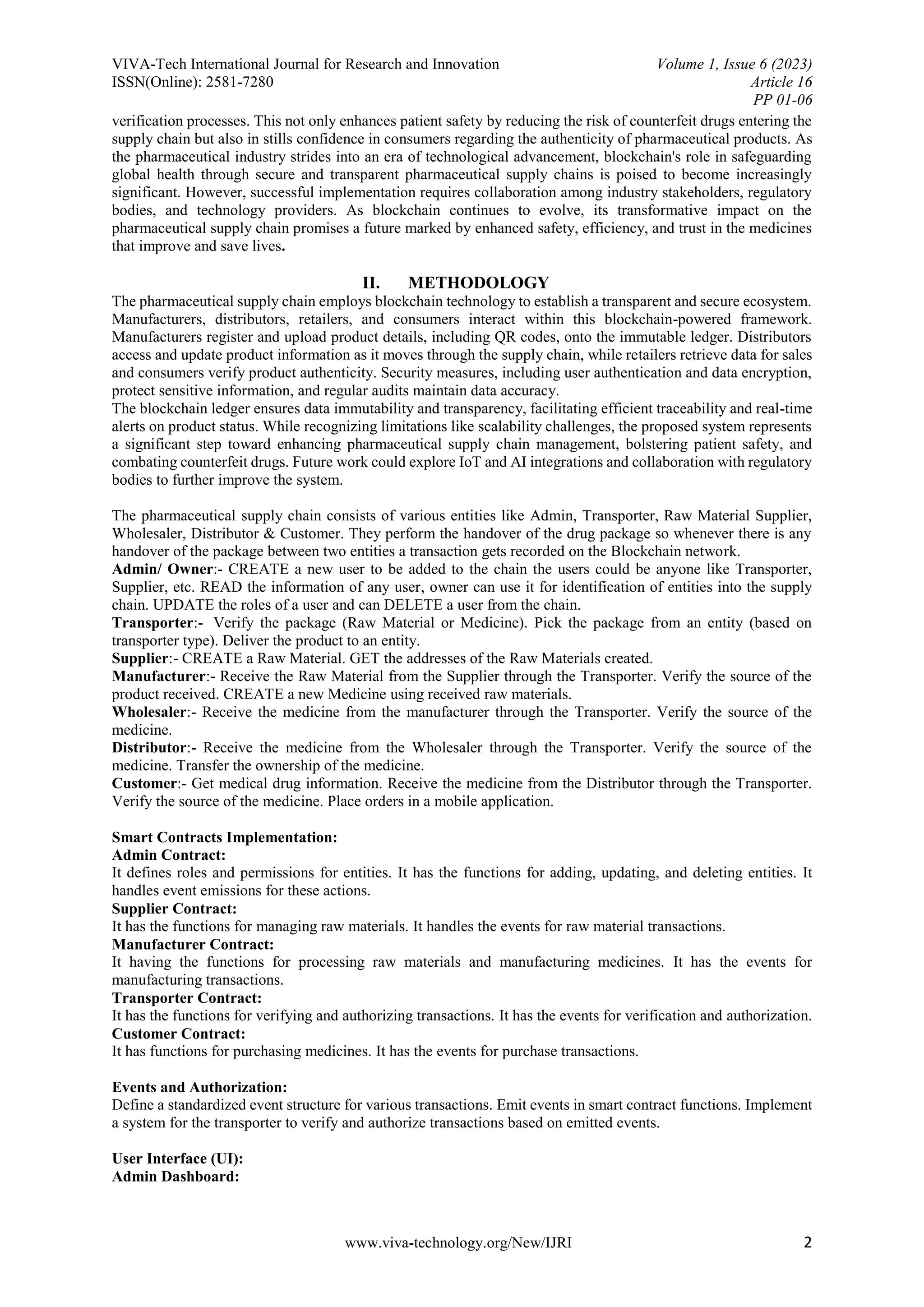
Fig. 3: Medicine Details
The Figure 3 shows the medicine details. The details of the medicine created by the manufacturer are uploaded
and the data is traversed through each entity related to this medicine. The admin can trace and track the medicine,
so that no one can tamper the medicine. If anyone can tamper it then it will easily recognize.
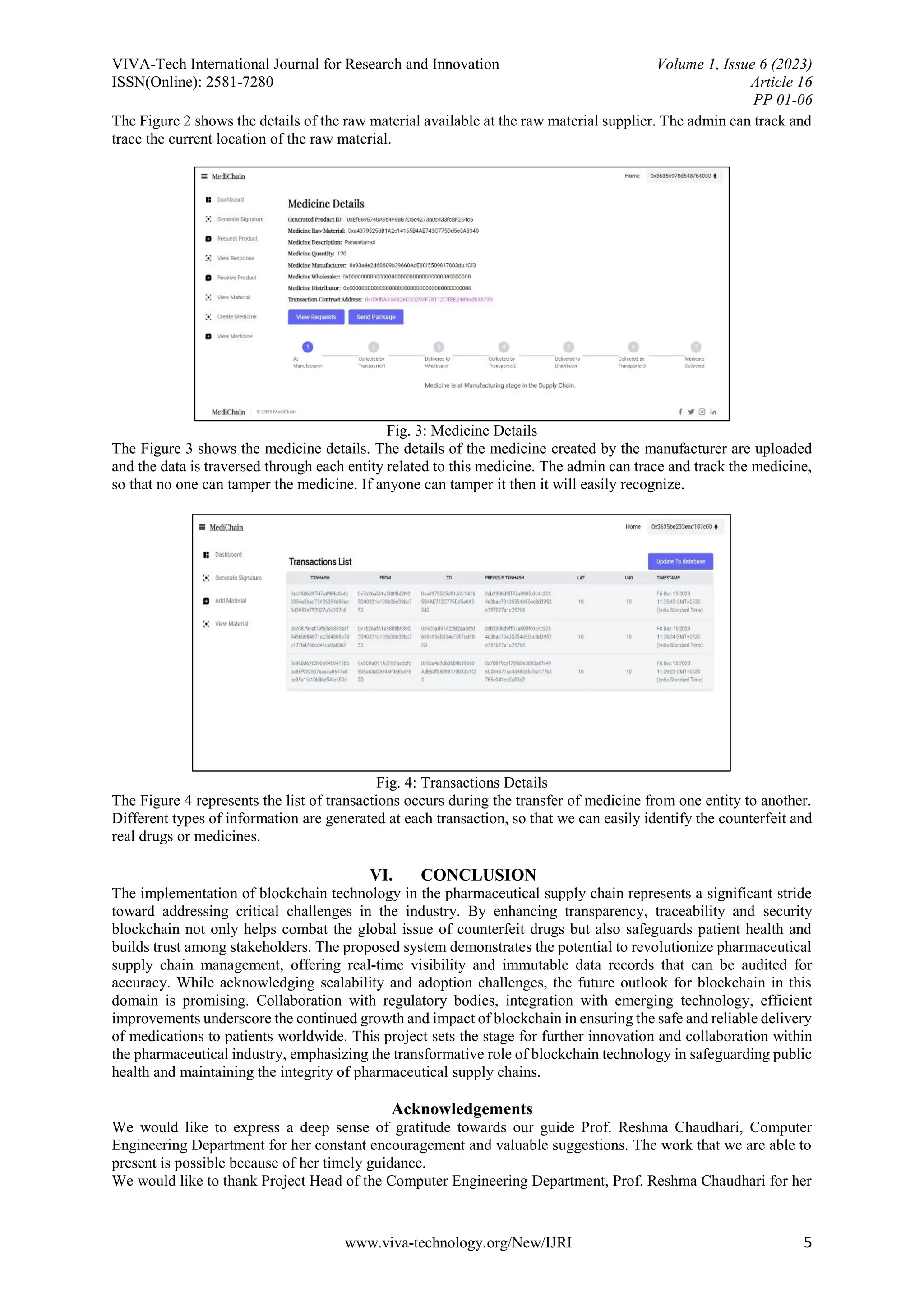
Fig. 4: Transactions Details
The Figure 4 represents the list of transactions occurs during the transfer of medicine from one entity to another.
Different types of information are generated at each transaction, so that we can easily identify the counterfeit and
real drugs or medicines.
VI. CONCLUSION
The implementation of blockchain technology in the pharmaceutical supply chain represents a significant stride
toward addressing critical challenges in the industry. By enhancing transparency, traceability and security
blockchain not only helps combat the global issue of counterfeit drugs but also safeguards patient health and
builds trust among stakeholders. The proposed system demonstrates the potential to revolutionize pharmaceutical
supply chain management, offering real-time visibility and immutable data records that can be audited for
accuracy. While acknowledging scalability and adoption challenges, the future outlook for blockchain in this
domain is promising. Collaboration with regulatory bodies, integration with emerging technology, efficient
improvements underscore the continued growth and impact of blockchain in ensuring the safe and reliable delivery
of medications to patients worldwide. This project sets the stage for further innovation and collaboration within
the pharmaceutical industry, emphasizing the transformative role of blockchain technology in safeguarding public
health and maintaining the integrity of pharmaceutical supply chains.
Acknowledgements
We would like to express a deep sense of gratitude towards our guide Prof. Reshma Chaudhari, Computer
Engineering Department for her constant encouragement and valuable suggestions. The work that we are able to
present is possible because of her timely guidance.
We would like to thank Project Head of the Computer Engineering Department, Prof. Reshma Chaudhari for her
VIVA-Tech International Journal for Research and Innovation Volume 1, Issue 6 (2023)
ISSN(Online): 2581-7280 Article 16
PP 01-06
www.viva-technology.org/New/IJRI 6
support and coordination. We would like to thank Head of the Computer Engineering Department, Prof. Janhvi
Sanghoi for her support and coordination. We are also grateful to the teaching and non-teaching staff of the
Computer Engineering Department who lend their helping hands in providing continuous support.
REFERENCES
[1]. A. D. Shetty, S. Shenoy, D. Sreedhar, A. Shetty, R. Rao, K. D’souza, “Traceability of counterfeit drugs in pharma supply
chain through Blockchain Technology”, Research J. Pharm. and Tech., 2022.
[2]. S. Sarkar, “Digital Traceability of pharmaceutical drugs in supply chain”, International Journal of Advance Research in
Computer Science and Management Studies, 2022.
[3]. S. Gomasta, A. Dhali, T. Tahlil, M. Anwar, A.B. Ali, “PharmaChain: Blockchain-based drug supply chain provenance
verification system”, Heliyon, 2023.
[4]. A. Bapatla, S. Mohanty, E. Kougianos and D. Puthal, “PharmaChain 3.0: Blockchain Integrated Efficient QR Code
Mechanism for Pharmaceutical SupplyChain”, IEEE, 2022.
[5]. M. Rahaman, B. Chappu1, A. Widodo, A. Wisnujati, A. Haque, R. Sarkar, H. Chen, “Blockchain Implementation in Indian
Pharmaceutical Supply Chain Diminish Counterfeit Product”, MIMSE-I-C, 2022.
[6]. S. D’souzaa, D. Nazareth, C. Vaz, M. Shetty, “Blockchain and AI in Pharmaceutical Supply Chain”, International
Conference on Smart Data Intelligence, 2021.
[7]. M. Uddin, K. Salah, R. Jayaraman, S. Pesic, S. Ellahham, “Blockchain for drug traceability”, Health Informatic Journal,
2021.
[8]. A. Abuhashim, C. Tan, “Smart Contract Designs on Blockchain Applications”, IEEE, 2021.
[9]. G. Kumar, “Optimizing pharmaceutical supply chain with digital technologies”, International Journal of Science and
Research Archive, 2023.
[10]. A. Ghadge, M. Bourlakis, S.Kamble, S. Seuring, “Blockchain implementation in pharmaceutical supply chains”,
International Journal of Production Research, 2022.
[11]. M. Dave, K. Patil, R. Jaiswal, R. Pawar, “Monitoring Supply Chain of Pharmaceutical Drugs Using Blockchain”, IEEE,
2021.
[12]. L. Gupta, M. Bansal, . Gupta, N. Khaitan, “Blockchain Based Solution to Enhance Drug
Supply Chain Management for Smart Pharmaceutical Industry”, IEEE, 2022.
[13]. A. Pathak, S. Shrivastava, P. Vardhini, A. Meka, D. Swami, Z. Hussain, M. Borah, “Blockchain Technology in
Pharmaceutical Supply Chain Management”, IEEE, 2022.
[14]. J. Ma, S. Lin, X. Chen, H. Sun, Y. Chen, H. Huaxiong Wang, “A Blockchain-Based Application System for Product
Anti-Counterfeiting”, IEEE, 2021.

Medichain - Securing pharma supply chain with blockchain

  • 1.
    VIVA-Tech International Journalfor Research and Innovation Volume 1, Issue 6 (2023) ISSN(Online): 2581-7280 Article 16 PP 01-06 www.viva-technology.org/New/IJRI 1 Medichain - Securing pharma supply chain with blockchain Chaitany Ghadigaonkar1 , Suraj Sakhare2 , Taj Mohammad Khan3 , Prof Reshma Chaudhari4 1 (Computer Engineering, Viva Institute of Technology, India) 2 (Computer Engineering, Viva Institute of Technology, India) 3 (Computer Engineering, Viva Institute of Technology, India) 4 (Assistant Professor of Computer Engineering, Viva Institute of Technology, India) Abstract : The pharmaceutical industry plays a vital role in safeguarding global health. However, its supply chain is complex, susceptible to fraud, and often inefficient. Pharmaceutical supply chains are characterized by multiple stakeholders, including manufacturers, distributors, suppliers, and healthcare providers. The intricate nature of this supply chain makes it vulnerable to issues like counterfeit drugs and data inaccuracies. Blockchain, with its inherent features of transparency, immutability, and decentralization, offers a compelling framework to mitigate these challenges. Blockchain enhances transparency by creating an immutable ledger of all transactions. Each drug batch is assigned a unique identifier, recorded on the blockchain and associated with relevant data such as manufacturing details, shipping records and quality test results. Stakeholders across the supply chain can access this information in real-time, ensuring complete visibility and traceability. Counterfeit drugs pose a significant threat to public health. Blockchain's secure, tamper-proof records enable consumers and healthcare professionals to verify the authenticity of pharmaceutical products. Smart contracts, self-executing agreements triggered by predefined conditions can automate verification processes, reducing the risk of counterfeit drugs entering the supply chain. Blockchain's cryptographic techniques ensure data security, privacy and protecting sensitive information. Pharmaceutical recalls can be costly and time-consuming. Blockchain's traceability allows for targeted recalls, pinpointing affected batches quickly. Smart contracts can automate the recall process, notifying relevant parties and facilitating the return of products. This efficiency not only saves resources but also enhances patient safety. Keywords – Blockchain, counterfeit drugs, pharmaceutical supply chain, smart contract. I. INTRODUCTION The pharmaceutical industry stands as a cornerstone of modern healthcare, responsible for producing and distributing medications that are essential to human well-being across the globe. However, beneath the surface of this vital sector lies a web of complexity known as the pharmaceutical supply chain. This intricate network connects pharmaceutical manufacturers, distributors, regulatory bodies, healthcare providers, and the patients who rely on its life-saving products. The pharmaceutical supply chain is a multifaceted system, encompassing the production, distribution and delivery of pharmaceutical products. This journey begins with the creation of a drug in a manufacturing facility and extends to its transport to distribution centers, pharmacies and ultimately into the hands of patients worldwide. Every step along this path is subject to quality control measures, stringent regulatory requirements and documentation. Collaboration among stakeholders, which include pharmaceutical manufacturers, distributors, logistics companies, healthcare providers and regulatory agencies, is often hindered by a lack of real-time visibility and transparency. Blockchain's transparency ensures that all participants in the supply chain have access to a shared, immutable record of transactions. Each pharmaceutical product from its inception in a manufacturing facility is assigned a unique identifier that is recorded on the blockchain. This identifier accompanies the product throughout its journey, accumulating critical data such as manufacturing details, shipping records, quality test results, and more. In the battle against counterfeit drugs, one of the most pressing issues, blockchain emerges as a powerful ally. Consumers, healthcare providers and regulatory agencies can easily verify a drug's authenticity by scanning its unique identifier. Smart contracts, self-executing agreements triggered by predefined conditions, can automate
  • 2.
    VIVA-Tech International Journalfor Research and Innovation Volume 1, Issue 6 (2023) ISSN(Online): 2581-7280 Article 16 PP 01-06 www.viva-technology.org/New/IJRI 2 verification processes. This not only enhances patient safety by reducing the risk of counterfeit drugs entering the supply chain but also in stills confidence in consumers regarding the authenticity of pharmaceutical products. As the pharmaceutical industry strides into an era of technological advancement, blockchain's role in safeguarding global health through secure and transparent pharmaceutical supply chains is poised to become increasingly significant. However, successful implementation requires collaboration among industry stakeholders, regulatory bodies, and technology providers. As blockchain continues to evolve, its transformative impact on the pharmaceutical supply chain promises a future marked by enhanced safety, efficiency, and trust in the medicines that improve and save lives. II. METHODOLOGY The pharmaceutical supply chain employs blockchain technology to establish a transparent and secure ecosystem. Manufacturers, distributors, retailers, and consumers interact within this blockchain-powered framework. Manufacturers register and upload product details, including QR codes, onto the immutable ledger. Distributors access and update product information as it moves through the supply chain, while retailers retrieve data for sales and consumers verify product authenticity. Security measures, including user authentication and data encryption, protect sensitive information, and regular audits maintain data accuracy. The blockchain ledger ensures data immutability and transparency, facilitating efficient traceability and real-time alerts on product status. While recognizing limitations like scalability challenges, the proposed system represents a significant step toward enhancing pharmaceutical supply chain management, bolstering patient safety, and combating counterfeit drugs. Future work could explore IoT and AI integrations and collaboration with regulatory bodies to further improve the system. The pharmaceutical supply chain consists of various entities like Admin, Transporter, Raw Material Supplier, Wholesaler, Distributor & Customer. They perform the handover of the drug package so whenever there is any handover of the package between two entities a transaction gets recorded on the Blockchain network. Admin/ Owner:- CREATE a new user to be added to the chain the users could be anyone like Transporter, Supplier, etc. READ the information of any user, owner can use it for identification of entities into the supply chain. UPDATE the roles of a user and can DELETE a user from the chain. Transporter:- Verify the package (Raw Material or Medicine). Pick the package from an entity (based on transporter type). Deliver the product to an entity. Supplier:- CREATE a Raw Material. GET the addresses of the Raw Materials created. Manufacturer:- Receive the Raw Material from the Supplier through the Transporter. Verify the source of the product received. CREATE a new Medicine using received raw materials. Wholesaler:- Receive the medicine from the manufacturer through the Transporter. Verify the source of the medicine. Distributor:- Receive the medicine from the Wholesaler through the Transporter. Verify the source of the medicine. Transfer the ownership of the medicine. Customer:- Get medical drug information. Receive the medicine from the Distributor through the Transporter. Verify the source of the medicine. Place orders in a mobile application. Smart Contracts Implementation: Admin Contract: It defines roles and permissions for entities. It has the functions for adding, updating, and deleting entities. It handles event emissions for these actions. Supplier Contract: It has the functions for managing raw materials. It handles the events for raw material transactions. Manufacturer Contract: It having the functions for processing raw materials and manufacturing medicines. It has the events for manufacturing transactions. Transporter Contract: It has the functions for verifying and authorizing transactions. It has the events for verification and authorization. Customer Contract: It has functions for purchasing medicines. It has the events for purchase transactions. Events and Authorization: Define a standardized event structure for various transactions. Emit events in smart contract functions. Implement a system for the transporter to verify and authorize transactions based on emitted events. User Interface (UI): Admin Dashboard:
  • 3.
    VIVA-Tech International Journalfor Research and Innovation Volume 1, Issue 6 (2023) ISSN(Online): 2581-7280 Article 16 PP 01-06 www.viva-technology.org/New/IJRI 3 Created web-based dashboards for admin, supplier, manufacturer, and transporter using ReactJs and Tailwind css. Using web3.js to interact with the smart contracts from the UI. Block chain technologies like Solidity, Ganache , Truffle, Metamask and Web3 are used for contract execution and deployment. Customer React Native App: Develop a React Native app for customers to browse and purchase medicines. Utilize a library like web3.js to interact with the smart contract. Database:` Used MongoDB for storing all the transaction details and medicines. These medicines and transactions are fetched by react native application to show it to the customer. Integration: Connected the UI components with the smart contracts, allowing entities to perform actions through the UI. We used the Ethereum provider like metamask to handle user wallet interactions. III. LITERATURE STUDY The integration of blockchain technology into the pharmaceutical supply chain represents a transformative frontier in the healthcare industry, holding the promise of revolutionizing the way pharmaceutical products are manufactured, distributed, and monitored. The inherent challenges within the pharmaceutical supply chain, including issues of counterfeiting, traceability gaps, and data integrity, have spurred growing interest in leveraging blockchain's decentralized and transparent nature to address these critical issues. This literature survey aims to comprehensively explore the current state of research, developments, and challenges surrounding the adoption of blockchain technology in the pharmaceutical supply chain. The pharmaceutical industry's research and development process is complex and lengthy beginning with drug discovery and culminating in regulatory approval. These proposes a solution using blockchain technology to design a secure and transparent pharmaceutical supply chain. Blockchain's potential in the pharmaceutical industry lies in its ability to create a shared ledger of information, including the drug's source, product license and transactional data [1]. Digital transformation is reshaping industries, including pharmaceuticals by introducing new ways of doing business and enhancing existing processes. Companies in the pharmaceutical sector are re- evaluating their operations from internal systems to customer interactions with a focus on digitization. Implementing digital traceability, including barcodes has proven effective in minimizing such risks [2]. Pharmaceutical companies prioritize maintaining distribution quality and patient safety throughout the complex pharmaceutical supply chain. Counterfeit medications, often substandard and improperly formulated, pose a significant risk, including the absence of active pharmaceutical ingredients, contaminants or repackaged expired drugs. The solution involves a network architecture with pharmaceutical companies, regulatory authorities and local vendors like hospitals and pharmacies [3]. The intricate nature of pharmaceutical supply chain has introduced challenges in tracking and tracing drug products making them vulnerable to counterfeit drugs, which can be dangerous to consumers. It leverages Ethereum and Hyperledger Fabric platforms to enhance the security and transparency of pharmaceutical supply chains. The system aims to revolutionize pharmaceutical supply chains by providing end-to-end transparency, combating counterfeit drugs and enhancing consumer confidence in drug authenticity [4]. Blockchain offers supply chain managers the ability to develop data-driven models, enhancing privacy protection, transparency and tamper-proof systems. This technology utilizes a shared, cryptographically unaltered distributed ledger to record and secure digital transaction histories. By leveraging blockchain technology the pharmaceutical industry aims to safe and efficient delivery of critical healthcare products [5]. The pharmaceutical supply chain can be susceptible to improper or unethical activities, making investigations challenging. Blockchain is a distributed ledger database that records transactions transparently and immutably. It enhances trust among supply chain entities by providing complete transparency and uses smart contracts to record transactions [6]. Counterfeit medications pose a significant threat to public health, leading to detrimental consequences for patients and treatment outcomes. These blockchain architectures can establish private permissioned ecosystems within the pharmaceutical industry, with regulatory authorities or stakeholders overseeing registration and control [7]. Traditional blockchain platforms like Bitcoin and Ethereum use proof-of- work consensus, which is computationally intensive and inefficient for querying data. Querying data from a blockchain ledger is cumbersome, as there are no primary keys or indexes, making it inefficient compared to centralized databases. To address this, the article explores smart contracts as a way to optimize data indexing and retrieval in the blockchain [8]. Modern information technology solutions have facilitated the development of inter- organizational networks, enabling real-time information processing and exchange. Blockchain also finds use in tracking shipments and improving supply chain visibility. Technological factors, including information quality and system benefits, influence the adoption of drug traceability systems within organizations [9]. Despite regulatory efforts and industry initiatives, drug breaches continue to rise, potentially costing billions in healthcare fraud. The findings reinforce the alarming statistics regarding substandard and counterfeit drugs highlighted by the World Health Organization [10]. The global pharmaceutical commodity trade has surged from $113 billion in
  • 4.
    VIVA-Tech International Journalfor Research and Innovation Volume 1, Issue 6 (2023) ISSN(Online): 2581-7280 Article 16 PP 01-06 www.viva-technology.org/New/IJRI 4 2000 to $629 billion in 2019, a six -fold increase, resulting in increasingly complex and opaque pharmaceutical supply chains. A key element is a drug traceability system that can effectively monitor the movement of pharmaceuticals across various supply chain stakeholders. The proposed solution employs a permissioned blockchain, specifically Hyperledger Fabric, which provides access control, permitting only registered users to execute actions within the system. Endorsing peers simulate transactions to ensure their stability, while ordering peers package and distribute transactions to committing peers [11]. Blockchain based supply chain systems offer users the ability to access and manage critical information such as product location, pricing, dates and quality. By tracing and tracking pharmaceuticals through the supply chain, the system can pinpoint the source of issues caused by faulty manufacturing processes, enabling targeted recalls and protecting consumer safety. It employs QR codes for product tracking, ensuring data integrity and traceability [12]. The introduction of blockchain technology has revolutionized this landscape. It operates on a request-response mechanism, ensuring that all parties involved in a transaction agree on the transfer of medical drugs. The data stored on the blockchain ledger is tamper-proof, enhancing security and trust [13]. The system's primary objectives are to enhance brand anti-counterfeiting certification, expand sales channels and empower small vendors to validate the authenticity of their products. It achieves this by storing relevant product sales information on a transparent and immutable blockchain accessible to anyone [14]. IV. FIGURES Fig. 1: Block Diagram The above figure shows the different blocks of the project. The blocks are the different entities involved in project. This figure shows how those blocks are connected to each other and work. V. IMPLEMENTATION Fig. 2: Raw Material Details
  • 5.
    VIVA-Tech International Journalfor Research and Innovation Volume 1, Issue 6 (2023) ISSN(Online): 2581-7280 Article 16 PP 01-06 www.viva-technology.org/New/IJRI 5 The Figure 2 shows the details of the raw material available at the raw material supplier. The admin can track and trace the current location of the raw material. Fig. 3: Medicine Details The Figure 3 shows the medicine details. The details of the medicine created by the manufacturer are uploaded and the data is traversed through each entity related to this medicine. The admin can trace and track the medicine, so that no one can tamper the medicine. If anyone can tamper it then it will easily recognize. Fig. 4: Transactions Details The Figure 4 represents the list of transactions occurs during the transfer of medicine from one entity to another. Different types of information are generated at each transaction, so that we can easily identify the counterfeit and real drugs or medicines. VI. CONCLUSION The implementation of blockchain technology in the pharmaceutical supply chain represents a significant stride toward addressing critical challenges in the industry. By enhancing transparency, traceability and security blockchain not only helps combat the global issue of counterfeit drugs but also safeguards patient health and builds trust among stakeholders. The proposed system demonstrates the potential to revolutionize pharmaceutical supply chain management, offering real-time visibility and immutable data records that can be audited for accuracy. While acknowledging scalability and adoption challenges, the future outlook for blockchain in this domain is promising. Collaboration with regulatory bodies, integration with emerging technology, efficient improvements underscore the continued growth and impact of blockchain in ensuring the safe and reliable delivery of medications to patients worldwide. This project sets the stage for further innovation and collaboration within the pharmaceutical industry, emphasizing the transformative role of blockchain technology in safeguarding public health and maintaining the integrity of pharmaceutical supply chains. Acknowledgements We would like to express a deep sense of gratitude towards our guide Prof. Reshma Chaudhari, Computer Engineering Department for her constant encouragement and valuable suggestions. The work that we are able to present is possible because of her timely guidance. We would like to thank Project Head of the Computer Engineering Department, Prof. Reshma Chaudhari for her
  • 6.
    VIVA-Tech International Journalfor Research and Innovation Volume 1, Issue 6 (2023) ISSN(Online): 2581-7280 Article 16 PP 01-06 www.viva-technology.org/New/IJRI 6 support and coordination. We would like to thank Head of the Computer Engineering Department, Prof. Janhvi Sanghoi for her support and coordination. We are also grateful to the teaching and non-teaching staff of the Computer Engineering Department who lend their helping hands in providing continuous support. REFERENCES [1]. A. D. Shetty, S. Shenoy, D. Sreedhar, A. Shetty, R. Rao, K. D’souza, “Traceability of counterfeit drugs in pharma supply chain through Blockchain Technology”, Research J. Pharm. and Tech., 2022. [2]. S. Sarkar, “Digital Traceability of pharmaceutical drugs in supply chain”, International Journal of Advance Research in Computer Science and Management Studies, 2022. [3]. S. Gomasta, A. Dhali, T. Tahlil, M. Anwar, A.B. Ali, “PharmaChain: Blockchain-based drug supply chain provenance verification system”, Heliyon, 2023. [4]. A. Bapatla, S. Mohanty, E. Kougianos and D. Puthal, “PharmaChain 3.0: Blockchain Integrated Efficient QR Code Mechanism for Pharmaceutical SupplyChain”, IEEE, 2022. [5]. M. Rahaman, B. Chappu1, A. Widodo, A. Wisnujati, A. Haque, R. Sarkar, H. Chen, “Blockchain Implementation in Indian Pharmaceutical Supply Chain Diminish Counterfeit Product”, MIMSE-I-C, 2022. [6]. S. D’souzaa, D. Nazareth, C. Vaz, M. Shetty, “Blockchain and AI in Pharmaceutical Supply Chain”, International Conference on Smart Data Intelligence, 2021. [7]. M. Uddin, K. Salah, R. Jayaraman, S. Pesic, S. Ellahham, “Blockchain for drug traceability”, Health Informatic Journal, 2021. [8]. A. Abuhashim, C. Tan, “Smart Contract Designs on Blockchain Applications”, IEEE, 2021. [9]. G. Kumar, “Optimizing pharmaceutical supply chain with digital technologies”, International Journal of Science and Research Archive, 2023. [10]. A. Ghadge, M. Bourlakis, S.Kamble, S. Seuring, “Blockchain implementation in pharmaceutical supply chains”, International Journal of Production Research, 2022. [11]. M. Dave, K. Patil, R. Jaiswal, R. Pawar, “Monitoring Supply Chain of Pharmaceutical Drugs Using Blockchain”, IEEE, 2021. [12]. L. Gupta, M. Bansal, . Gupta, N. Khaitan, “Blockchain Based Solution to Enhance Drug Supply Chain Management for Smart Pharmaceutical Industry”, IEEE, 2022. [13]. A. Pathak, S. Shrivastava, P. Vardhini, A. Meka, D. Swami, Z. Hussain, M. Borah, “Blockchain Technology in Pharmaceutical Supply Chain Management”, IEEE, 2022. [14]. J. Ma, S. Lin, X. Chen, H. Sun, Y. Chen, H. Huaxiong Wang, “A Blockchain-Based Application System for Product Anti-Counterfeiting”, IEEE, 2021.