MEDICATION
King Saud University
College of Nursing
NUR 122
Medication: substance administered for the
diagnosis, cure, treatment, or relief of a
symptom or for prevention of a disease.
Medication or drugs are given to exert
specific physiologic effects on the body.
They play an important role in preventing,
treating, and curing illness, their
administration has become one of the most
important, complex and risk-laden aspects
of nursing care.
Drug administration
Routes of drug administration
 Oral: Per mouth
 Sublingual: under the tongue
 Buccal: against the cheek
 Pareneteral: IV, IM, SC, intradermal, intracardiac,
intrathecal,intrapleural, intraosseous
 Topical: skin, eyes, ear, nose, rectum or vagina.
 Effects: local, systematic.
 Medication are prescribe by physician.
 Medication order includes the name of the drug,
the dose, the route, frequency, date and time.
Effects of Drugs
 Therapeutic effect = desired effect
– Reason drug is prescribed
 Side effect = secondary effect
– Unintended, usually predictable
– May be harmless or harmful
 Drug toxicity
– Result from overdose, ingestion of external use
drug
– Buildup of drug in blood
 Drug allergy
– Immunologic reaction to drug
– Mild to severe reactions (anaphylaxis)
 Drug tolerance
– Need increasing doses to maintain therapeutic
effect
 Drug interaction
– One drug affecting effect of another
Actions of Drug on the body
 Pharmacodynamics:
– Process by which drug changes the body
(mechanism of action).
 Pharmacokinetics:
– Study of absorption, distribution,
biotransformation, and excretion of drugs
Absorption: movement from the
administration site into the bloodstream.
 Distribution: transportation of the drug from
its site to the site of action.
Metabolism: the drug is converted by
enzymes into a less active form that can be
excreted, (most drugs are metabolized in
the liver).
Excretion: elimination from the body. The
kidneys are the most important route.
Pharmacokinetics
Drug Nomenclature
 Chemical name — describes the chemical
constituents of the drug
 Generic name — assigned by the
manufacturer that first develops the drug
 Trade name — brand name given by the
company that sells the drug
Drug Preparations
 Oral:
– Capsule, pill, tablet, suspension, syrup
 Topical:
– lotion, ointment, suppository, transdermal patch
 Injectable:
- Vial, Ampoule
Mechanisms of Drug Actions
 Drug-receptor interaction — drug interacts
with one of more cellular structures to alter
cell function
 Drug-enzyme interaction — combines with
enzymes to achieve desired effect
 Acting on cell membrane or altering the
cellular environment
Factors Affecting Drug
Absorption
 Route of administration
 Drug solubility
 pH
 Local conditions at site of administration
 Drug dosage
 Serum drug levels
Adverse Effect of Medications
 Iatrogenic disease: disease caused
unintentionally by medical therapy.
 Allergic effects: immunologic reaction to the
drug.
 Toxic effects
 Drug interactions
Signs and Symptoms of Drug
Allergy
 Rash
 Urticaria
 Fever
 Diarrhea
 Nausea
 Vomiting
 Anaphylactic reaction
Factors affecting
Medication action
 Developmental considerations
 Weight
 Gender
 Diet
 Genetic and cultural factors
 Psychological factors
 Illness & disease
 Environment, timing of administration
Types of Medication Orders
 Standing order — carried out until cancelled
by another order
 Prn order — as needed
 Stat order — carried out immediately & once
Parts of the Medication Order
 Patient’s name
 Date and time order is written
 Name of drug to be administered
 Dosage of drug
 Route by which drug is to be administered
 Frequency of administration of the drug
 Signature of person writing the order
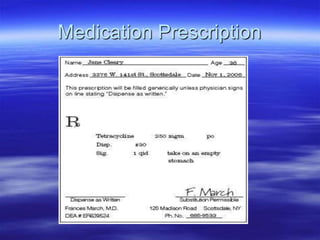
Medication Prescription
The 7 rights
1. Right Medication
2. Right Dose
3. Right Rout
4. Right Time (b.i.d, t.i.d, q.i.d. q8h)
5. Right Client
6. Right information
7. Right Documentation
Controlled Substances
Required Information
 Name of patient receiving narcotic
 Amount of narcotic used
 The hour narcotic was given
 The name of physician prescribing narcotic
 Name of the nurse administering narcotic
Oral Medications
 Solid form — tablets, capsules, pills
 Liquid form — suspensions, syrups
– Oral Route — having patient swallow the drug.
– Enteral route — administering drug through an
enteral tube
– Sublingual administration — placing drug under
tongue
– Buccal administration — placing drug between
tongue and cheek
Administration of Parenteral
Medications
 Subcutaneous injection — subcutaneous tissue
(0.5-1 ml)
 Intramuscular injection - muscle tissue (1-3ml)
 Intradermal injection — corium (under
epidermis) (0.1 ml)
 Intravenous injection — into a vein
 Intracardial injection — heart tissue
 Intraperitoneal injection — peritoneal cavity
 Intraspinal injection — spinal canal
 Intraosseous injection — bone
Sites for Intramuscular Injections
 Ventrogluteal site
 Vastus lateralis site
 Deltoid muscle site
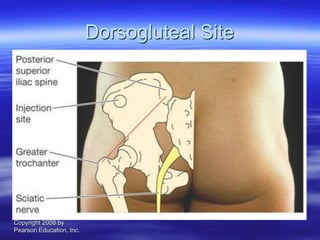
 Dorsogluteal site
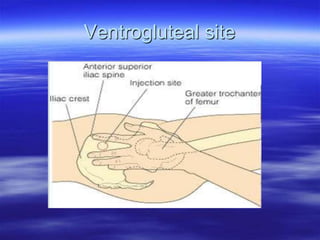
Ventrogluteal site
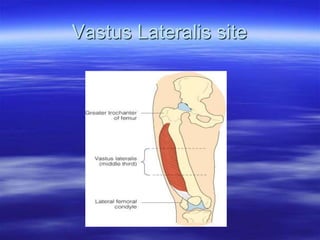
Vastus Lateralis site
Copyright 2008 by
Pearson Education, Inc.
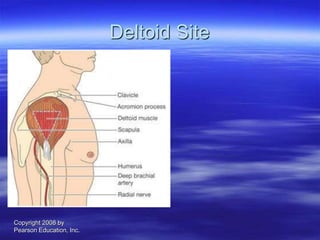
Deltoid Site
Copyright 2008 by
Pearson Education, Inc.
Dorsogluteal Site
 Route of administration
 Viscosity of the solution
 Quantity to be administered
 Body size
 Type of medication
Criteria for Choosing Equipment
for Injections
Topical Administration of
Medications
 Eye: eye drops, ointments
 Ears: ear drops
 Nose: nasal drops
 Rectal: suppositories
 Skin applications: ointment, cream lotion
Medical Record Documentation
 Document & sign each dose of medication,
as soon as it is given, and the patient
response.
 Intentional or inadvertent omitted drugs.
 Refused drugs.
 Medication errors.
Type of Medication Errors
 Inappropriate prescribing of the drug
 Extra, omitted, or wrong doses
 Administration of drug to wrong patient
 Administration of drug by wrong route or rate
 Failure to give medication within prescribed
time
 Incorrect preparation of a drug
 Improper technique when administering drug
 Giving a drug that has deteriorated
Medication Errors
 Check patient’s condition immediately;
observe for adverse effects.
 Notify nurse manager and physician.
 Write description of error on medical record
and remedial steps taken.
 Complete special form for reporting errors.
Patient Teaching
1. Review techniques of medication
administration.
2. Remind patient to take the medication as
prescribed for as long as prescribed.
3. Instruct patient not to alter dosages without
consulting physician.
4. Caution patient not to share medications
with others even if they have the same
disease.

medication-ksuu0.ppt

  • 1.
  • 2.
    Medication: substance administeredfor the diagnosis, cure, treatment, or relief of a symptom or for prevention of a disease. Medication or drugs are given to exert specific physiologic effects on the body. They play an important role in preventing, treating, and curing illness, their administration has become one of the most important, complex and risk-laden aspects of nursing care. Drug administration
  • 3.
    Routes of drugadministration  Oral: Per mouth  Sublingual: under the tongue  Buccal: against the cheek  Pareneteral: IV, IM, SC, intradermal, intracardiac, intrathecal,intrapleural, intraosseous  Topical: skin, eyes, ear, nose, rectum or vagina.  Effects: local, systematic.  Medication are prescribe by physician.  Medication order includes the name of the drug, the dose, the route, frequency, date and time.
  • 4.
    Effects of Drugs Therapeutic effect = desired effect – Reason drug is prescribed  Side effect = secondary effect – Unintended, usually predictable – May be harmless or harmful  Drug toxicity – Result from overdose, ingestion of external use drug – Buildup of drug in blood
  • 5.
     Drug allergy –Immunologic reaction to drug – Mild to severe reactions (anaphylaxis)  Drug tolerance – Need increasing doses to maintain therapeutic effect  Drug interaction – One drug affecting effect of another
  • 6.
    Actions of Drugon the body  Pharmacodynamics: – Process by which drug changes the body (mechanism of action).  Pharmacokinetics: – Study of absorption, distribution, biotransformation, and excretion of drugs
  • 7.
    Absorption: movement fromthe administration site into the bloodstream.  Distribution: transportation of the drug from its site to the site of action. Metabolism: the drug is converted by enzymes into a less active form that can be excreted, (most drugs are metabolized in the liver). Excretion: elimination from the body. The kidneys are the most important route. Pharmacokinetics
  • 8.
    Drug Nomenclature  Chemicalname — describes the chemical constituents of the drug  Generic name — assigned by the manufacturer that first develops the drug  Trade name — brand name given by the company that sells the drug
  • 9.
    Drug Preparations  Oral: –Capsule, pill, tablet, suspension, syrup  Topical: – lotion, ointment, suppository, transdermal patch  Injectable: - Vial, Ampoule
  • 10.
    Mechanisms of DrugActions  Drug-receptor interaction — drug interacts with one of more cellular structures to alter cell function  Drug-enzyme interaction — combines with enzymes to achieve desired effect  Acting on cell membrane or altering the cellular environment
  • 11.
    Factors Affecting Drug Absorption Route of administration  Drug solubility  pH  Local conditions at site of administration  Drug dosage  Serum drug levels
  • 12.
    Adverse Effect ofMedications  Iatrogenic disease: disease caused unintentionally by medical therapy.  Allergic effects: immunologic reaction to the drug.  Toxic effects  Drug interactions
  • 13.
    Signs and Symptomsof Drug Allergy  Rash  Urticaria  Fever  Diarrhea  Nausea  Vomiting  Anaphylactic reaction
  • 14.
    Factors affecting Medication action Developmental considerations  Weight  Gender  Diet  Genetic and cultural factors  Psychological factors  Illness & disease  Environment, timing of administration
  • 15.
    Types of MedicationOrders  Standing order — carried out until cancelled by another order  Prn order — as needed  Stat order — carried out immediately & once
  • 16.
    Parts of theMedication Order  Patient’s name  Date and time order is written  Name of drug to be administered  Dosage of drug  Route by which drug is to be administered  Frequency of administration of the drug  Signature of person writing the order
  • 17.
  • 18.
    The 7 rights 1.Right Medication 2. Right Dose 3. Right Rout 4. Right Time (b.i.d, t.i.d, q.i.d. q8h) 5. Right Client 6. Right information 7. Right Documentation
  • 19.
    Controlled Substances Required Information Name of patient receiving narcotic  Amount of narcotic used  The hour narcotic was given  The name of physician prescribing narcotic  Name of the nurse administering narcotic
  • 20.
    Oral Medications  Solidform — tablets, capsules, pills  Liquid form — suspensions, syrups – Oral Route — having patient swallow the drug. – Enteral route — administering drug through an enteral tube – Sublingual administration — placing drug under tongue – Buccal administration — placing drug between tongue and cheek
  • 21.
    Administration of Parenteral Medications Subcutaneous injection — subcutaneous tissue (0.5-1 ml)  Intramuscular injection - muscle tissue (1-3ml)  Intradermal injection — corium (under epidermis) (0.1 ml)  Intravenous injection — into a vein  Intracardial injection — heart tissue  Intraperitoneal injection — peritoneal cavity  Intraspinal injection — spinal canal  Intraosseous injection — bone
  • 22.
    Sites for IntramuscularInjections  Ventrogluteal site  Vastus lateralis site  Deltoid muscle site  Dorsogluteal site
  • 23.
  • 24.
  • 25.
    Copyright 2008 by PearsonEducation, Inc. Deltoid Site
  • 26.
    Copyright 2008 by PearsonEducation, Inc. Dorsogluteal Site
  • 27.
     Route ofadministration  Viscosity of the solution  Quantity to be administered  Body size  Type of medication Criteria for Choosing Equipment for Injections
  • 28.
    Topical Administration of Medications Eye: eye drops, ointments  Ears: ear drops  Nose: nasal drops  Rectal: suppositories  Skin applications: ointment, cream lotion
  • 29.
    Medical Record Documentation Document & sign each dose of medication, as soon as it is given, and the patient response.  Intentional or inadvertent omitted drugs.  Refused drugs.  Medication errors.
  • 30.
    Type of MedicationErrors  Inappropriate prescribing of the drug  Extra, omitted, or wrong doses  Administration of drug to wrong patient  Administration of drug by wrong route or rate  Failure to give medication within prescribed time  Incorrect preparation of a drug  Improper technique when administering drug  Giving a drug that has deteriorated
  • 31.
    Medication Errors  Checkpatient’s condition immediately; observe for adverse effects.  Notify nurse manager and physician.  Write description of error on medical record and remedial steps taken.  Complete special form for reporting errors.
  • 32.
    Patient Teaching 1. Reviewtechniques of medication administration. 2. Remind patient to take the medication as prescribed for as long as prescribed. 3. Instruct patient not to alter dosages without consulting physician. 4. Caution patient not to share medications with others even if they have the same disease.