
Current Regulatory Requirement
Though not mandatory by law but a progressive employer
is expected to provide health facilities to their employees.
There are some mandatory provisions such as workmen
compensation / ESI but they have limited coverage.
In some of the countries providing healthcare for employees is a must
In such cases , maternity , dental and optical treatment
and the expenses thereon are normally not given.
There are many ways of extending medical facilities to the
employees.
Medical insurance is one such step.
Systems in use – Health Management
Depending up on the size / decision of management ,we
find different solutions of health management
The Small and Medium size organizations have the
system of reimbursement of the actual expenses.
Some of them even have the system of medical allowance
on monthly basis.
Few big organizations have their own medical facility set
up and in a way it is self managed
Group Medical insurance is getting accepted as a
wholesome solution .
Need for health insurance
For Employers it gives an opportunity to outsource this
non-core activity.
It provides a cover against unexpected health related
expenses – helps in financial planning & cost saving.
For employees – it provides a wider range of medical
facilities.
Depending up on the coverage – specialized treatment
abroad / special care can be arranged.
Control on leakages – Managed by professionals
Provides far wide options for the employees –
Geographical sense
Present & Future Ahead
At present < 15% population in india has some sort of health
insurance . Out of pocket health expense is around 86%
No wonder - Health Insurance is the fasted growing segment in
insurance business.
Premium income has gone up from Rs. 2221 Cr in 2005-06 to Rs.
13975 Cr. In 2012-13 – CAGR 30%
Commission pay out was Rs. 876 Cr. In 2012-13 – means bulk of
the business is thru direct channel
Incurred Claim ration 96.43 - a bit improvement
Future is promising as there is a growing concern for the health
care and empoloyee are becoming more & more demanding.
Govt. too is thinking of providing some universal health care on
the lines of RSBY
Stake holders
Employees
Employer
Govt. Regulations / Regulators
Intermediaries (Agents/ Brokers)
Insurance Companies (Reinsurance Co.)
TPAs / Internal Claim settlement
 Medical Service Providers
IT network
Insurance vs. Cost Management
Unlike other forms of insurance Medical
insurance is more of cost management nature
The frequency of claim and related costs are more
or less similar and consistent over the period.
The pricing is more dependent on the past claims
history than the technical parameters.
The success of Medical Schemes depends much
on the approach of the Management and the co-
ordination of all involved.
Market Realities
There is a very cut-throat competition in market
Group Medical is a big bargaining point for clients to
place other lines of business
Companies are looking for the lowest possible rates
irrespective of their claims experience
Normally claim experiences are not favourable
This has resulted into frequent shifting of the
portfolio from one Company to another.
Essentials for success
Understanding of the basic needs of the customer
Simple product features with least deviation from the
universal and standard norms.
Having least possible feature and sub-limits.
Regular communication between all concerned
Limiting the number of Service Outlets.
Emphasis on quality delivery which need not be the
costliest.
Optimum pricing
Continuous feedback / corrective measures
Important Product Features
Annual Max. Limit (Flexibility)
Sub-limits
Provision of Pre-Existing Condition
Wide option of Geographical coverage (Abroad/USA )
Tie –up in other counties
In-patient / Out-patient
Discount for limiting outpatient limit as a % of AML
Wide & attractive options of deductible
Improved Group / favorable loss ratio discount
Gate-keeper / Preventive schemes
Standard Exclusions….
Aids/HIV
Infertility, In-vitro fertilization, Surrogacy
Psychiatric, mental retardation, Alzheimer and similar
degenerative diseases
Congenital disease, malformations or malfunctions
Oncology, Kidney dialysis, Hormone replacement, Bone
densitometory, Tumours, Development problems, Physical
aids
Organ donation
Expenses for homecare, sanatoriums, long term care
facilities and similar institutions
Epidemics declared by Government/WHO
Standard Exclusions
Regular/Preventive health check ups
Expenses for work related injuries/accident as these are covered
under WC policy – mandatory in Oman
Elective Treatment received outside area of cover
Health Spas/Nature Cure Clinics etc
Plastic and cosmetic surgery and beauty related skin treatment
Vitamins and supplements, medicated shampoos, mouth wash
Any treatment which only offers temporary relief of symptoms
rather than dealing with the underlying medical conditions
Treatment following drugs or substance abuse
Injuries from playing professional sport or from any dangerous
sport and activity
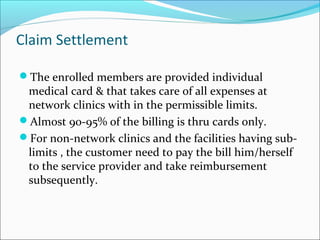
Claim Settlement
The enrolled members are provided individual
medical card & that takes care of all expenses at
network clinics with in the permissible limits.
Almost 90-95% of the billing is thru cards only.
For non-network clinics and the facilities having sub-
limits , the customer need to pay the bill him/herself
to the service provider and take reimbursement
subsequently.
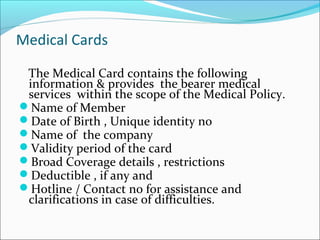
Medical Cards
The Medical Card contains the following
information & provides the bearer medical
services within the scope of the Medical Policy.
Name of Member
Date of Birth , Unique identity no
Name of the company
Validity period of the card
Broad Coverage details , restrictions
Deductible , if any and
Hotline / Contact no for assistance and
clarifications in case of difficulties.
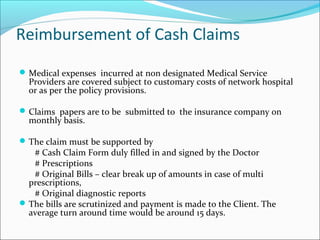
Reimbursement of Cash Claims
Medical expenses incurred at non designated Medical Service
Providers are covered subject to customary costs of network hospital
or as per the policy provisions.
Claims papers are to be submitted to the insurance company on
monthly basis.
The claim must be supported by
# Cash Claim Form duly filled in and signed by the Doctor
# Prescriptions
# Original Bills – clear break up of amounts in case of multi
prescriptions,
# Original diagnostic reports
The bills are scrutinized and payment is made to the Client. The
average turn around time would be around 15 days.
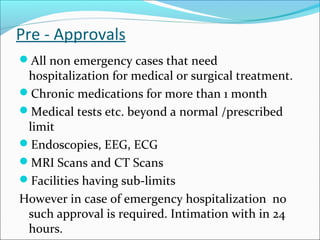
Pre - Approvals
All non emergency cases that need
hospitalization for medical or surgical treatment.
Chronic medications for more than 1 month
Medical tests etc. beyond a normal /prescribed
limit
Endoscopies, EEG, ECG
MRI Scans and CT Scans
Facilities having sub-limits
However in case of emergency hospitalization no
such approval is required. Intimation with in 24
hours.
Claim Process – essentials
Tie up reputed TPA having high volume of business /
IT infrastructure
Network availability in promised locations
24*7 customer helpline by TPAs
Availability of Ins. Co official for TPA support
Claim processing by experienced professionals
Possibility of Expert / Second opinion
Cost reduction – better discount from providers
Medical insurance concept

Medical insurance concept

  • 2.
    Current Regulatory Requirement Thoughnot mandatory by law but a progressive employer is expected to provide health facilities to their employees. There are some mandatory provisions such as workmen compensation / ESI but they have limited coverage. In some of the countries providing healthcare for employees is a must In such cases , maternity , dental and optical treatment and the expenses thereon are normally not given. There are many ways of extending medical facilities to the employees. Medical insurance is one such step.
  • 3.
    Systems in use– Health Management Depending up on the size / decision of management ,we find different solutions of health management The Small and Medium size organizations have the system of reimbursement of the actual expenses. Some of them even have the system of medical allowance on monthly basis. Few big organizations have their own medical facility set up and in a way it is self managed Group Medical insurance is getting accepted as a wholesome solution .
  • 4.
    Need for healthinsurance For Employers it gives an opportunity to outsource this non-core activity. It provides a cover against unexpected health related expenses – helps in financial planning & cost saving. For employees – it provides a wider range of medical facilities. Depending up on the coverage – specialized treatment abroad / special care can be arranged. Control on leakages – Managed by professionals Provides far wide options for the employees – Geographical sense
  • 5.
    Present & FutureAhead At present < 15% population in india has some sort of health insurance . Out of pocket health expense is around 86% No wonder - Health Insurance is the fasted growing segment in insurance business. Premium income has gone up from Rs. 2221 Cr in 2005-06 to Rs. 13975 Cr. In 2012-13 – CAGR 30% Commission pay out was Rs. 876 Cr. In 2012-13 – means bulk of the business is thru direct channel Incurred Claim ration 96.43 - a bit improvement Future is promising as there is a growing concern for the health care and empoloyee are becoming more & more demanding. Govt. too is thinking of providing some universal health care on the lines of RSBY
  • 6.
    Stake holders Employees Employer Govt. Regulations/ Regulators Intermediaries (Agents/ Brokers) Insurance Companies (Reinsurance Co.) TPAs / Internal Claim settlement  Medical Service Providers IT network
  • 7.
    Insurance vs. CostManagement Unlike other forms of insurance Medical insurance is more of cost management nature The frequency of claim and related costs are more or less similar and consistent over the period. The pricing is more dependent on the past claims history than the technical parameters. The success of Medical Schemes depends much on the approach of the Management and the co- ordination of all involved.
  • 8.
    Market Realities There isa very cut-throat competition in market Group Medical is a big bargaining point for clients to place other lines of business Companies are looking for the lowest possible rates irrespective of their claims experience Normally claim experiences are not favourable This has resulted into frequent shifting of the portfolio from one Company to another.
  • 9.
    Essentials for success Understandingof the basic needs of the customer Simple product features with least deviation from the universal and standard norms. Having least possible feature and sub-limits. Regular communication between all concerned Limiting the number of Service Outlets. Emphasis on quality delivery which need not be the costliest. Optimum pricing Continuous feedback / corrective measures
  • 10.
    Important Product Features AnnualMax. Limit (Flexibility) Sub-limits Provision of Pre-Existing Condition Wide option of Geographical coverage (Abroad/USA ) Tie –up in other counties In-patient / Out-patient Discount for limiting outpatient limit as a % of AML Wide & attractive options of deductible Improved Group / favorable loss ratio discount Gate-keeper / Preventive schemes
  • 11.
    Standard Exclusions…. Aids/HIV Infertility, In-vitrofertilization, Surrogacy Psychiatric, mental retardation, Alzheimer and similar degenerative diseases Congenital disease, malformations or malfunctions Oncology, Kidney dialysis, Hormone replacement, Bone densitometory, Tumours, Development problems, Physical aids Organ donation Expenses for homecare, sanatoriums, long term care facilities and similar institutions Epidemics declared by Government/WHO
  • 12.
    Standard Exclusions Regular/Preventive healthcheck ups Expenses for work related injuries/accident as these are covered under WC policy – mandatory in Oman Elective Treatment received outside area of cover Health Spas/Nature Cure Clinics etc Plastic and cosmetic surgery and beauty related skin treatment Vitamins and supplements, medicated shampoos, mouth wash Any treatment which only offers temporary relief of symptoms rather than dealing with the underlying medical conditions Treatment following drugs or substance abuse Injuries from playing professional sport or from any dangerous sport and activity
  • 13.
    Claim Settlement The enrolledmembers are provided individual medical card & that takes care of all expenses at network clinics with in the permissible limits. Almost 90-95% of the billing is thru cards only. For non-network clinics and the facilities having sub- limits , the customer need to pay the bill him/herself to the service provider and take reimbursement subsequently.
  • 14.
    Medical Cards The MedicalCard contains the following information & provides the bearer medical services within the scope of the Medical Policy. Name of Member Date of Birth , Unique identity no Name of the company Validity period of the card Broad Coverage details , restrictions Deductible , if any and Hotline / Contact no for assistance and clarifications in case of difficulties.
  • 15.
    Reimbursement of CashClaims Medical expenses incurred at non designated Medical Service Providers are covered subject to customary costs of network hospital or as per the policy provisions. Claims papers are to be submitted to the insurance company on monthly basis. The claim must be supported by # Cash Claim Form duly filled in and signed by the Doctor # Prescriptions # Original Bills – clear break up of amounts in case of multi prescriptions, # Original diagnostic reports The bills are scrutinized and payment is made to the Client. The average turn around time would be around 15 days.
  • 16.
    Pre - Approvals Allnon emergency cases that need hospitalization for medical or surgical treatment. Chronic medications for more than 1 month Medical tests etc. beyond a normal /prescribed limit Endoscopies, EEG, ECG MRI Scans and CT Scans Facilities having sub-limits However in case of emergency hospitalization no such approval is required. Intimation with in 24 hours.
  • 17.
    Claim Process –essentials Tie up reputed TPA having high volume of business / IT infrastructure Network availability in promised locations 24*7 customer helpline by TPAs Availability of Ins. Co official for TPA support Claim processing by experienced professionals Possibility of Expert / Second opinion Cost reduction – better discount from providers