ISSUES RAISED BY
MEDIA OWNERSHIP
AS Media Studies
What is media ownership?
 All “media” whether it is film, music, or
print is owned by a company.
 They hold the “rights” to publish,
distribute and manipulate their work.
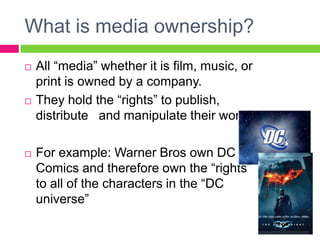
 For example: Warner Bros own DC
Comics and therefore own the “rights”
to all of the characters in the “DC
universe”
Key Issues
 For a question on “issues raised by media
ownership” you will primarily write about the
following key areas:
 Piracy
 The dominance of Hollywood over the industry
 The destruction of the UK Film Council
Piracy
 Piracy – the illegal distribution of media
without the permission of its owner. E.g.
Downloading, Pirate DVDs
 Advances in digital technology have made
piracy easier, cheaper and has improved the
quality of the content.
 Electronic files can be leaked in advance of a
films release.
 The internet allows pirate material to be
distributed all over the world very quickly
Piracy
 Digital cameras and sound equipment used in
cinemas to record pirate copies of a film have
improved greatly in quality
 This technology is now far cheaper and easier
to use.
Combating Piracy
 Digital technology has allowed films to be released
simultaneously across the world. Previously the
delay in films reaching the UK from America meant
that piracy was a more popular option.
 Digital encryption means that films can be securely
distributed.
 The rise in digital film production and exhibition has
paved the way for 3D cinema.
 3D cinema is currently more difficult to “pirate”.
 It can not be filmed effectively in cinemas.
 The cost of watching good quality 3D material at
home is high.
Hollywood – the big issue
 Production companies like Warner Brothers,
Paramount andDisney are multi million pound
industries.
 This enables them to dominate the
international film industry as they are able to
release lots of titles and have vast amounts of
money to market and distribute them.
 They are businesses that are interested in
making money, hence they concentrate their
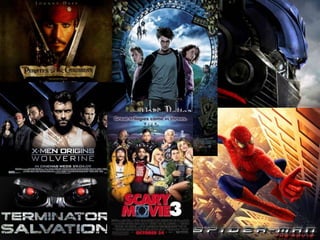
efforts in to endless sequels
 What does this mean for audiences?
 Limited choice in cinemas
 Endless sequels
 Poor quality films
 A dying British industry
Tackling Hollywood
 The number of American films shown at film
festivals is always far greater than the number
of British independent films beings shown.
 Organisations like the UK Film Council have
been forced to act in recent years to challenge
this problem.
Films helped by the Film
Council
 Vera Drake, The Last King of Scotland, My
Summer of Love, Bend it Like Beckham, Fish
Tank, Adulthood, London to Brighton, Nowhere
Boy, How to loose friends and Alienate People,
This Is England, Happy-Go-Lucky
 For everyone £1 of lottery money invested,
British films are reckoned to generate £5 at the
box office.
UK Film Council dismissed!
 The UK Film Council is essential to film-
making in the UK. Put simply, if it wasn’t for the
UK Film Council, many projects (films)
wouldn't exist
 Along with BBC Films and Film4, the Film
Council is the main port of call for film makers
trying to get feature films off the ground,
especially if those films are outside the
mainstream.
 In 2010 the government announced that the
scheme was going to be dismissed.
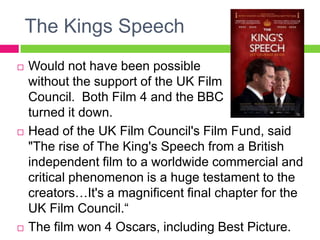
The Kings Speech
 Would not have been possible
without the support of the UK Film
Council. Both Film 4 and the BBC
turned it down.
 Head of the UK Film Council's Film Fund, said
"The rise of The King's Speech from a British
independent film to a worldwide commercial and
critical phenomenon is a huge testament to the
creators…It's a magnificent final chapter for the
UK Film Council.“
 The film won 4 Oscars, including Best Picture.
FACT FILE: THE KING’S
SPEECH
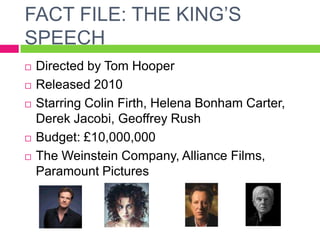
 Directed by Tom Hooper
 Released 2010
 Starring Colin Firth, Helena Bonham Carter,
Derek Jacobi, Geoffrey Rush
 Budget: £10,000,000
 The Weinstein Company, Alliance Films,
Paramount Pictures
CRITICAL SUCCESS
 Nominated for seven Golden Globes
 Nominated for fourteen BAFTAs
 Nominated for twelve Academy Awards
 Won four Oscars for, Best Picture, Best
Director, Best Actor and Best Original
Screenplay
FINANCIAL SUCCESS
 In the UK it took £3,510,000 from 395 cinemas
on the opening weekend.
 In the US it made $355,450 in four screens,
 It was then widened into 700 screens and then
1,543
 The film has made $40 million in profit from
the theatrical release alone.
 Compare these figure to those of Shifty
A Case Study: Watchmen
An extra example that could be used in the
exam
Understanding Film Rights
Film Rights
 When an existing story (book, play, comic) is made
into a film the “rights” have to be bought from the
author – the product is their “intellectual property”
 E.g. Warner Brothers bought the rights to make the
first 4 Harry Potter for £ 1 million. (They bought the
remaining 3 when the first had been a success.)
 Film makers may “option” a script – meaning they
only pay 10% of the fee and then pay the full amount
if the project is “green lit” ( goes into production) .
 There is normally a time limit on an “option” – usual
two or three years. If the film isn’t made in this time
the rights can be re-sold.
Film Rights
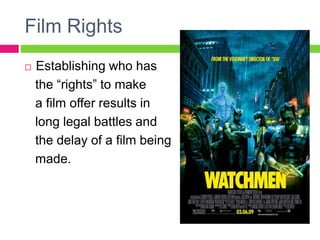
 Establishing who has
the “rights” to make
a film offer results in
long legal battles and
the delay of a film being
made.
Watchmen
 There have been numerous attempts to make
a film version of Watchmen since 1986, when
producers Lawrence Gordon and Joel Silver
acquired film rights to the series for 20th
Century Fox.
 In 1991, Fox put the project into “turnaround”
and was moved to Warner Bros.,
 A turnaround is an arrangement in the film
industry, whereby the rights to a project one
studio has developed are sold to another
studio in
exchange for the cost of development.
Watchmen
 Gilliam later abandoned the project because
he decided that Watchmen would have been
un-filmable. Subsequently it was dropped by
Warner Bros.
 In 2004 the film went to Paramount Pictures
but again it was placed in turnaround when
the lead director left to work on other projects.
 In 2005 Lawrence Gordon took the film back to
Warner Bros where it was eventually brought
to life.
Watchmen
 20th Century Fox filed a lawsuit to block the
film's release, stating that they still had the “rights”
to the film and that L. Gordon was supposed to
resubmit Watchmen to Fox every time he came
up with a changed element.
 Warner Bros fought this claim but eventually the
studios eventually settled.
 Fox received an upfront payment and a
percentage of the worldwide gross from the film
and all sequels and spin-offs in return.
 The film was released to cinemas in March 2009 a
year after the original release date.
Sample Question / Homework
 Discuss the issues raised by media ownership
in contemporary media practice within a media
industry (Hollywood) which you have studied.
 The main issues you will focus on are:
 Piracy
 Hollywood’s Dominance
 The loss of the UK Film Council

Mediaownership issues

  • 1.
    ISSUES RAISED BY MEDIAOWNERSHIP AS Media Studies
  • 2.
    What is mediaownership?  All “media” whether it is film, music, or print is owned by a company.  They hold the “rights” to publish, distribute and manipulate their work.  For example: Warner Bros own DC Comics and therefore own the “rights” to all of the characters in the “DC universe”
  • 3.
    Key Issues  Fora question on “issues raised by media ownership” you will primarily write about the following key areas:  Piracy  The dominance of Hollywood over the industry  The destruction of the UK Film Council
  • 4.
    Piracy  Piracy –the illegal distribution of media without the permission of its owner. E.g. Downloading, Pirate DVDs  Advances in digital technology have made piracy easier, cheaper and has improved the quality of the content.  Electronic files can be leaked in advance of a films release.  The internet allows pirate material to be distributed all over the world very quickly
  • 5.
    Piracy  Digital camerasand sound equipment used in cinemas to record pirate copies of a film have improved greatly in quality  This technology is now far cheaper and easier to use.
  • 6.
    Combating Piracy  Digitaltechnology has allowed films to be released simultaneously across the world. Previously the delay in films reaching the UK from America meant that piracy was a more popular option.  Digital encryption means that films can be securely distributed.  The rise in digital film production and exhibition has paved the way for 3D cinema.  3D cinema is currently more difficult to “pirate”.  It can not be filmed effectively in cinemas.  The cost of watching good quality 3D material at home is high.
  • 7.
    Hollywood – thebig issue  Production companies like Warner Brothers, Paramount andDisney are multi million pound industries.  This enables them to dominate the international film industry as they are able to release lots of titles and have vast amounts of money to market and distribute them.  They are businesses that are interested in making money, hence they concentrate their efforts in to endless sequels
  • 8.
     What doesthis mean for audiences?  Limited choice in cinemas  Endless sequels  Poor quality films  A dying British industry
  • 10.
    Tackling Hollywood  Thenumber of American films shown at film festivals is always far greater than the number of British independent films beings shown.  Organisations like the UK Film Council have been forced to act in recent years to challenge this problem.
  • 11.
    Films helped bythe Film Council  Vera Drake, The Last King of Scotland, My Summer of Love, Bend it Like Beckham, Fish Tank, Adulthood, London to Brighton, Nowhere Boy, How to loose friends and Alienate People, This Is England, Happy-Go-Lucky  For everyone £1 of lottery money invested, British films are reckoned to generate £5 at the box office.
  • 12.
    UK Film Councildismissed!  The UK Film Council is essential to film- making in the UK. Put simply, if it wasn’t for the UK Film Council, many projects (films) wouldn't exist  Along with BBC Films and Film4, the Film Council is the main port of call for film makers trying to get feature films off the ground, especially if those films are outside the mainstream.  In 2010 the government announced that the scheme was going to be dismissed.
  • 13.
    The Kings Speech Would not have been possible without the support of the UK Film Council. Both Film 4 and the BBC turned it down.  Head of the UK Film Council's Film Fund, said "The rise of The King's Speech from a British independent film to a worldwide commercial and critical phenomenon is a huge testament to the creators…It's a magnificent final chapter for the UK Film Council.“  The film won 4 Oscars, including Best Picture.
  • 14.
    FACT FILE: THEKING’S SPEECH  Directed by Tom Hooper  Released 2010  Starring Colin Firth, Helena Bonham Carter, Derek Jacobi, Geoffrey Rush  Budget: £10,000,000  The Weinstein Company, Alliance Films, Paramount Pictures
  • 15.
    CRITICAL SUCCESS  Nominatedfor seven Golden Globes  Nominated for fourteen BAFTAs  Nominated for twelve Academy Awards  Won four Oscars for, Best Picture, Best Director, Best Actor and Best Original Screenplay
  • 16.
    FINANCIAL SUCCESS  Inthe UK it took £3,510,000 from 395 cinemas on the opening weekend.  In the US it made $355,450 in four screens,  It was then widened into 700 screens and then 1,543  The film has made $40 million in profit from the theatrical release alone.  Compare these figure to those of Shifty
  • 17.
    A Case Study:Watchmen An extra example that could be used in the exam Understanding Film Rights
  • 18.
    Film Rights  Whenan existing story (book, play, comic) is made into a film the “rights” have to be bought from the author – the product is their “intellectual property”  E.g. Warner Brothers bought the rights to make the first 4 Harry Potter for £ 1 million. (They bought the remaining 3 when the first had been a success.)  Film makers may “option” a script – meaning they only pay 10% of the fee and then pay the full amount if the project is “green lit” ( goes into production) .  There is normally a time limit on an “option” – usual two or three years. If the film isn’t made in this time the rights can be re-sold.
  • 19.
    Film Rights  Establishingwho has the “rights” to make a film offer results in long legal battles and the delay of a film being made.
  • 20.
    Watchmen  There havebeen numerous attempts to make a film version of Watchmen since 1986, when producers Lawrence Gordon and Joel Silver acquired film rights to the series for 20th Century Fox.  In 1991, Fox put the project into “turnaround” and was moved to Warner Bros.,  A turnaround is an arrangement in the film industry, whereby the rights to a project one studio has developed are sold to another studio in exchange for the cost of development.
  • 21.
    Watchmen  Gilliam laterabandoned the project because he decided that Watchmen would have been un-filmable. Subsequently it was dropped by Warner Bros.  In 2004 the film went to Paramount Pictures but again it was placed in turnaround when the lead director left to work on other projects.  In 2005 Lawrence Gordon took the film back to Warner Bros where it was eventually brought to life.
  • 22.
    Watchmen  20th CenturyFox filed a lawsuit to block the film's release, stating that they still had the “rights” to the film and that L. Gordon was supposed to resubmit Watchmen to Fox every time he came up with a changed element.  Warner Bros fought this claim but eventually the studios eventually settled.  Fox received an upfront payment and a percentage of the worldwide gross from the film and all sequels and spin-offs in return.  The film was released to cinemas in March 2009 a year after the original release date.
  • 23.
    Sample Question /Homework  Discuss the issues raised by media ownership in contemporary media practice within a media industry (Hollywood) which you have studied.  The main issues you will focus on are:  Piracy  Hollywood’s Dominance  The loss of the UK Film Council