One billion shoppers

 Media140, Perth

Thomas Tudehope
BACKGROUND

•   Online adviser to Malcolm Turnbull
•   Journalist at Sky News
•   2008 US Presidential election
•   Principal at iSocial Consulting
•   Authoring a book with Mia Freedman
•   Not a GEEK!
Why Social Media Matters
•   If you’re not there someone else is

•   It is the consumer coal face

•   New audience, new markets and new
    consumers

•   Mitigate against online risk
Social Media Trends
• Social search is taking over the web
• Consumers now wants news, views, reviews and
  more to be powered by what their friends think
  rather than what marketers can tell them
• New platforms emerge daily that seek to
  penetrate and promote all aspects of every day
  life from photos to video
• Significant ramifications for business - adapt or
  wither
Why Social Media Matters
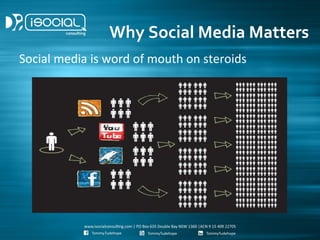
Social media is word of mouth on steroids
Social Media in Australia
Which sites are Australians using the most?
2. Facebook – over 10 million users
3. Twitter – over 4 million users
4. Pinterest – fastest growing
5. Google+ - struggling to attract mass market
   attention
6. Instagram – popular photo sharing app for
   iPhones
7. FourSquare – popular geo-locational tool
Facebook’s Australian Popularity
Australian’s are using Facebook more than ever:
• 88% of people know about Facebook
• 40% of users follow a brand
• 40% login every day
• Facebook is now used for
    –   Online shopping
    –   Brand reviews
    –   Community activism
•   Facebook is now valued at over $100 billion
Australian Companies Online
Are Australian companies using social media?
• Yes but not particularly well compared to
   international standards
• Some sectors like retail have been early
   adopters whilst government and finance remain
   reluctant
• There is a thirst from consumers for a better
   online service that is not reciprocated by the
   average business
Social Media Reluctance
Why are companies so reluctant to engage online?
• Social media may just be a fad
• How do you value social media interactions?
• Its just too hard to measure
• We don’t have the resources
• Our competitors aren't doing it
• We don’t have the skills to execute it
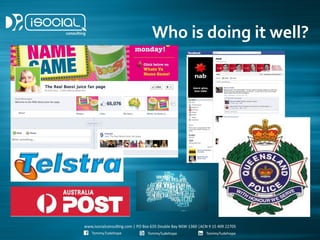
Who is doing it well?
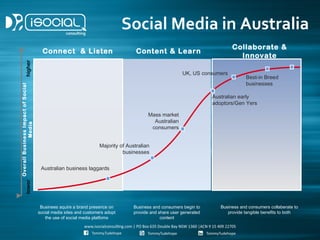
Social Media in Australia
                                                                                                                             Collaborate &
                                       Connect & Listen                            Content & Learn
                                                                                                                               Innovate
          higher


                                                                                                         UK, US consumers
                                                                                                                                    Best-in Breed
                                                                                                                                    businesses
Overall Business Imp act of Social


                                                                                                                     Australian early
                                                                                                                     adoptors/Gen Yers

                                                                                         Mass market
                                                                                           Australian
             Media


                                                                                          consumers


                                                                   Majority of Australian
                                                                             businesses


                                      Australian business laggards
          lower


                                      Businees aquire a brand presence on         Business and consumers begin to       Business and consumers collaberate to
                                     social media sites and customers adopt       provide and share user generated         provide tangible benefits to both
                                        the use of social media platfoms                       content
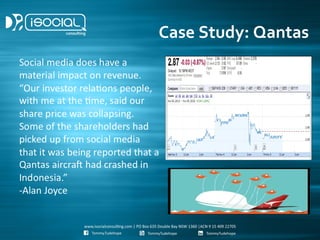
Case Study: Qantas
Case Study- Comm Bank
•   Reluctant social media adopters
•   External promotions but banned internally
•   Immediate and severe criticism
•   Employees are champions
•   Education first
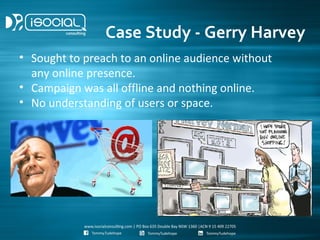
Case Study - Gerry Harvey
• Sought to preach to an online audience without
  any online presence.
• Campaign was all offline and nothing online.
• No understanding of users or space.
Case Study – Census 2011
• There is an online conversation
  for every brand and product
• Awareness about the Census
  changed from a boring data
  drive exercise to something
  that was human and humorous
• Resulted in increased media
  exposure and interest from the
  average user
• Demonstrates how important
  tone is
Building an Online Community
The key to social media success is building an online
community around your brand, product or idea.
• A social media profile allows consumers to
coalesce around your product or brand.
• By facilitating and moderating online
conversations you can foster greater awareness
and loyalty.
• But, it takes time, resources and good judgment
Online Community Building


   MOST USERS
Online Community Building

F                H
A                I
N                T
S                S

AUDIENCE        LOYALTY   CHAMPIONS

                 T
T
                 O
I
                 O
M
                 L
E
                 S
Creating Digital Value
Understanding the value of digital output can be difficult. Are
fans customers? Is awareness the only measurable activity?
Each business has a different digital value proposition. Some
factors to consider:
• Who is your audience and where are they
• Are they well organized with key influencers?
• How can you contact and convert them
• What can you measure – fans, gender, location, interaction

The more you measure the more you will understand about your
digital footprint and what that means for your business.
Creating Digital Value
How can social media add value to your business?
2.Sales
   –   Drive sales in-store and online
•Awareness
   –   About your products, staff and brand
•Relationships
   –   With and between consumers
5.Competitive advantage
   –   A dynamic social media presence will set you aside from competitors
•Internally
   –   Allow for staff to communicate internally and champion the business
Creating Digital Value
Having fans on Facebook is fine but what does it mean? How do
you accurately measure value:
2.Cost cutting
   –     Can social media reduce costs in other areas of the business?
•Sales
   –     Is there a direct correlation between online activities and in-store
         traffic
•Sentiment
   –     Has social media improved the manner in which consumers converse
         about our brand and products
5.Efficiency
   –     Has it enabled our staff to engage more efficiently on an internal and
         external basis?
How to spread ideas quickly
How do I get something to go viral?
• Sadly, there is no set formula for making
  something go viral. However, you can enhance
  the process by:
  –   Creating a content calendar
  –   Connecting with field leaders
  –   Ensure all your profiles are connected
  –   Road test your ideas
  –   Get creative
  –   Be prepared for some bumps along the way
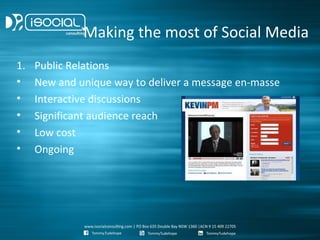
Making the most of Social Media
1.   Public Relations
•    New and unique way to deliver a message en-masse
•    Interactive discussions
•    Significant audience reach
•    Low cost
•    Ongoing
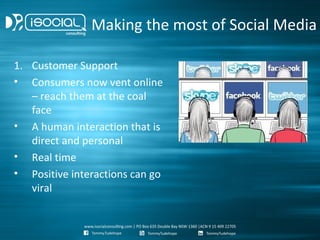
Making the most of Social Media

1. Customer Support
• Consumers now vent online
   – reach them at the coal
   face
• A human interaction that is
   direct and personal
• Real time
• Positive interactions can go
   viral
Making the most of Social Media
1. Research
• Access to thousands of
   supporters and customers
   who can provide direct and
   instantaneous feedback
• Social media profiles are rich
   in personal data
• What are consumers saying
   about your own brand and
   that of your competitors?
Making the most of Social Media
1. Sales
• New avenues to reach
   consumers in new markets
• Enhance your existing
   purchasing experience
• Leverage existing online sales
   points
• Collate greater consumer data
Making the most of Social Media
1. Crisis management
• How would you respond if your
   brand came under online attack
   on social media tomorrow?
• Could you correct the record?
• Could you interact with
   journalists online
• Could you use it to recall a
   product?
• A perfunctory profile *should*
   be a bare minimum
Why CEOs should use Twitter
•   Achieve personal recognition
•   Insulate their own brand from
    that of the company
•   Minimal presence is better
    than no presence
•   Build connections and
    networks
•   Project a technologically savvy
    approach
How to manage LinkedIn

• Fill out all fields honestly
• Corporate leakage – who needs
  to know what and when?
• Exert caution before connecting
• Should you give an online
  reference?
Social Media Risks
1.   Rushing into action:
•    Hasty decision based on a knee jerk reaction
•    One-off approach to deal with a single issue
•    Focused on too many platforms or the wrong
     platforms
•    Misunderstanding the resources and requirements
Social Media Risks
2. Measurement
• Define measurable objectives
• Clear metrics thank link back to those objectives
• Have the right tools, free or paid, that will enhance
    measurement
• Correct methodology to calculate ROI
Social Media Risks
3. Content
• Too often is an afterthought
• Requires
  –   Planning
  –   Approval
  –   Guidelines
  –   Formatting
  –   Tone
Social Media Risks
4. Failure to engage
• Listen, learn, interact and convert
• Too much broadcast not enough engagement
• Wrong tools, wrong platform
• Why engagement fails
  –   Poor content creation
  –   Too self focused
  –   Wrong audience
Social Media Risks
5. Limited Reach
• Right audience right place
• Built over time through content
• Updates matched to audience size
• Reach = ROI
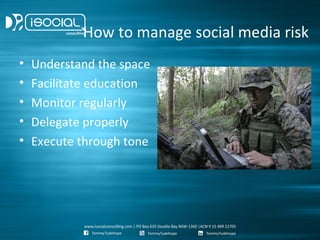
How to manage social media risk
•   Understand the space
•   Facilitate education
•   Monitor regularly
•   Delegate properly
•   Execute through tone
Facebook campaigns
•   Should represent a peak in activity
•   Highly targeted to a specific demographic
•   Have a key measurable on return
•   Offer a clear incentive for the audience
•   Conducted over a short time frame
How to handle criticism
• Be responsive – take it
  on board
• Create an online culture
  where dissent becomes
  a rarity
• Cushion dissenting
  remarks with supportive,
  constructive feedback
How to handle criticism
1. Facebook
• Offensive comments should be removed
   immediately
• Negative or critical comments should be
   responded to ASAP
• Allow other users to intervene and respond
   on your behalf
• Block members from the page
How to handle criticism
2. Twitter
• Monitor as often as possible
• Respond to negative criticism but not
    offensive material. Block users who are serial
    abusers
• In some circumstances it is useful to retweet
    an abusive remark to co-opt other users.
• Ensure high profile users are responded to
Social Media Rules
1. Showing up isn't enough
2. You cant be everywhere, nor should you
3. Authenticity and transparency are nothing
   without a connection
4. Talking to people isn't a business strategy
5. Keeping customers tuned in
Social Media Crisis Plan

2. Offensive post – courteous and informative response.
3. User replies with another offensive remark – courteous reply
   offering to take the conversation offline.
4. User again replies with another offensive comment – delete
   post. Attempt to email/phone user.
5. User posts another offensive post – block from page.
6. Reiterate that the page is moderated and governed by ‘rules’.
DISCUSSION

Social Shopping at Media140

  • 1.
    One billion shoppers Media140, Perth Thomas Tudehope
  • 2.
    BACKGROUND • Online adviser to Malcolm Turnbull • Journalist at Sky News • 2008 US Presidential election • Principal at iSocial Consulting • Authoring a book with Mia Freedman • Not a GEEK!
  • 3.
    Why Social MediaMatters • If you’re not there someone else is • It is the consumer coal face • New audience, new markets and new consumers • Mitigate against online risk
  • 4.
    Social Media Trends •Social search is taking over the web • Consumers now wants news, views, reviews and more to be powered by what their friends think rather than what marketers can tell them • New platforms emerge daily that seek to penetrate and promote all aspects of every day life from photos to video • Significant ramifications for business - adapt or wither
  • 5.
    Why Social MediaMatters Social media is word of mouth on steroids
  • 6.
    Social Media inAustralia Which sites are Australians using the most? 2. Facebook – over 10 million users 3. Twitter – over 4 million users 4. Pinterest – fastest growing 5. Google+ - struggling to attract mass market attention 6. Instagram – popular photo sharing app for iPhones 7. FourSquare – popular geo-locational tool
  • 7.
    Facebook’s Australian Popularity Australian’sare using Facebook more than ever: • 88% of people know about Facebook • 40% of users follow a brand • 40% login every day • Facebook is now used for – Online shopping – Brand reviews – Community activism • Facebook is now valued at over $100 billion
  • 8.
    Australian Companies Online AreAustralian companies using social media? • Yes but not particularly well compared to international standards • Some sectors like retail have been early adopters whilst government and finance remain reluctant • There is a thirst from consumers for a better online service that is not reciprocated by the average business
  • 9.
    Social Media Reluctance Whyare companies so reluctant to engage online? • Social media may just be a fad • How do you value social media interactions? • Its just too hard to measure • We don’t have the resources • Our competitors aren't doing it • We don’t have the skills to execute it
  • 10.
    Who is doingit well?
  • 11.
    Social Media inAustralia Collaborate & Connect & Listen Content & Learn Innovate higher UK, US consumers Best-in Breed businesses Overall Business Imp act of Social Australian early adoptors/Gen Yers Mass market Australian Media consumers Majority of Australian businesses Australian business laggards lower Businees aquire a brand presence on Business and consumers begin to Business and consumers collaberate to social media sites and customers adopt provide and share user generated provide tangible benefits to both the use of social media platfoms content
  • 12.
  • 13.
    Case Study- CommBank • Reluctant social media adopters • External promotions but banned internally • Immediate and severe criticism • Employees are champions • Education first
  • 14.
    Case Study -Gerry Harvey • Sought to preach to an online audience without any online presence. • Campaign was all offline and nothing online. • No understanding of users or space.
  • 15.
    Case Study –Census 2011 • There is an online conversation for every brand and product • Awareness about the Census changed from a boring data drive exercise to something that was human and humorous • Resulted in increased media exposure and interest from the average user • Demonstrates how important tone is
  • 16.
    Building an OnlineCommunity The key to social media success is building an online community around your brand, product or idea. • A social media profile allows consumers to coalesce around your product or brand. • By facilitating and moderating online conversations you can foster greater awareness and loyalty. • But, it takes time, resources and good judgment
  • 17.
  • 18.
  • 19.
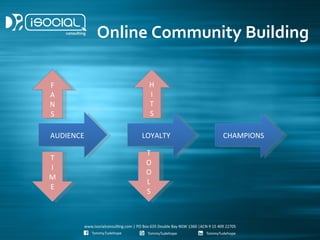
    Online Community Building F H A I N T S S AUDIENCE LOYALTY CHAMPIONS T T O I O M L E S
  • 20.
    Creating Digital Value Understandingthe value of digital output can be difficult. Are fans customers? Is awareness the only measurable activity? Each business has a different digital value proposition. Some factors to consider: • Who is your audience and where are they • Are they well organized with key influencers? • How can you contact and convert them • What can you measure – fans, gender, location, interaction The more you measure the more you will understand about your digital footprint and what that means for your business.
  • 21.
    Creating Digital Value Howcan social media add value to your business? 2.Sales – Drive sales in-store and online •Awareness – About your products, staff and brand •Relationships – With and between consumers 5.Competitive advantage – A dynamic social media presence will set you aside from competitors •Internally – Allow for staff to communicate internally and champion the business
  • 22.
    Creating Digital Value Havingfans on Facebook is fine but what does it mean? How do you accurately measure value: 2.Cost cutting – Can social media reduce costs in other areas of the business? •Sales – Is there a direct correlation between online activities and in-store traffic •Sentiment – Has social media improved the manner in which consumers converse about our brand and products 5.Efficiency – Has it enabled our staff to engage more efficiently on an internal and external basis?
  • 23.
    How to spreadideas quickly How do I get something to go viral? • Sadly, there is no set formula for making something go viral. However, you can enhance the process by: – Creating a content calendar – Connecting with field leaders – Ensure all your profiles are connected – Road test your ideas – Get creative – Be prepared for some bumps along the way
  • 24.
    Making the mostof Social Media 1. Public Relations • New and unique way to deliver a message en-masse • Interactive discussions • Significant audience reach • Low cost • Ongoing
  • 25.
    Making the mostof Social Media 1. Customer Support • Consumers now vent online – reach them at the coal face • A human interaction that is direct and personal • Real time • Positive interactions can go viral
  • 26.
    Making the mostof Social Media 1. Research • Access to thousands of supporters and customers who can provide direct and instantaneous feedback • Social media profiles are rich in personal data • What are consumers saying about your own brand and that of your competitors?
  • 27.
    Making the mostof Social Media 1. Sales • New avenues to reach consumers in new markets • Enhance your existing purchasing experience • Leverage existing online sales points • Collate greater consumer data
  • 28.
    Making the mostof Social Media 1. Crisis management • How would you respond if your brand came under online attack on social media tomorrow? • Could you correct the record? • Could you interact with journalists online • Could you use it to recall a product? • A perfunctory profile *should* be a bare minimum
  • 29.
    Why CEOs shoulduse Twitter • Achieve personal recognition • Insulate their own brand from that of the company • Minimal presence is better than no presence • Build connections and networks • Project a technologically savvy approach
  • 30.
    How to manageLinkedIn • Fill out all fields honestly • Corporate leakage – who needs to know what and when? • Exert caution before connecting • Should you give an online reference?
  • 31.
    Social Media Risks 1. Rushing into action: • Hasty decision based on a knee jerk reaction • One-off approach to deal with a single issue • Focused on too many platforms or the wrong platforms • Misunderstanding the resources and requirements
  • 32.
    Social Media Risks 2.Measurement • Define measurable objectives • Clear metrics thank link back to those objectives • Have the right tools, free or paid, that will enhance measurement • Correct methodology to calculate ROI
  • 33.
    Social Media Risks 3.Content • Too often is an afterthought • Requires – Planning – Approval – Guidelines – Formatting – Tone
  • 34.
    Social Media Risks 4.Failure to engage • Listen, learn, interact and convert • Too much broadcast not enough engagement • Wrong tools, wrong platform • Why engagement fails – Poor content creation – Too self focused – Wrong audience
  • 35.
    Social Media Risks 5.Limited Reach • Right audience right place • Built over time through content • Updates matched to audience size • Reach = ROI
  • 36.
    How to managesocial media risk • Understand the space • Facilitate education • Monitor regularly • Delegate properly • Execute through tone
  • 37.
    Facebook campaigns • Should represent a peak in activity • Highly targeted to a specific demographic • Have a key measurable on return • Offer a clear incentive for the audience • Conducted over a short time frame
  • 38.
    How to handlecriticism • Be responsive – take it on board • Create an online culture where dissent becomes a rarity • Cushion dissenting remarks with supportive, constructive feedback
  • 39.
    How to handlecriticism 1. Facebook • Offensive comments should be removed immediately • Negative or critical comments should be responded to ASAP • Allow other users to intervene and respond on your behalf • Block members from the page
  • 40.
    How to handlecriticism 2. Twitter • Monitor as often as possible • Respond to negative criticism but not offensive material. Block users who are serial abusers • In some circumstances it is useful to retweet an abusive remark to co-opt other users. • Ensure high profile users are responded to
  • 41.
    Social Media Rules 1.Showing up isn't enough 2. You cant be everywhere, nor should you 3. Authenticity and transparency are nothing without a connection 4. Talking to people isn't a business strategy 5. Keeping customers tuned in
  • 42.
    Social Media CrisisPlan 2. Offensive post – courteous and informative response. 3. User replies with another offensive remark – courteous reply offering to take the conversation offline. 4. User again replies with another offensive comment – delete post. Attempt to email/phone user. 5. User posts another offensive post – block from page. 6. Reiterate that the page is moderated and governed by ‘rules’.
  • 43.

Editor's Notes

  • #2 Thanks for having me here today. I don’t propose to talk for the full time quota. Understandably many of you will be a different stage of the social media life cycle. Some of you may need not tips or help while others may yet need some convincing of of its efficacy.
  • #3 Some brief background on myself.
  • #4 Social media is dramatically changing the way we communicate. It opens up new markets to new consumers. If you’re not there someone else will be there in your place. This may take the form of a fake profile or even a swath of negative reviews. Even a basic presence is better than no presence at all. At the very least it will ensure potential visitors see your legitimate profile. Social Media is here to stay. It has consumed, taken over and now dominates the internet. It has empowered the voiceless, opened new markets and connect millions across continent. For business the downside is now not doing it but not doing it right. Social media is less about marketing and more about building and online community. Consumers are talking about your brand right now online. Some positive, some negative and some indifferent. Business can choose to ignore social media but it will be at their peril. Those that master will mitigate against online damage, open themselves to new markets and set themselves aside from their competitors.
  • #5 For the consumer social media is the ultimate coal face. Not only do they now read about a product or venue online before purchasing, they tweet about it while they are buying, post a photo of their purchase and discuss it on Facebook afterwards. All the while potentially reaching hundreds if not thousands of other users. If a business does not insert themselves into this process they may well suffer long-term damage.
  • #6 With this in mind, social media is word of mouth on steroids. A potent review, a funny photo or an embarrassing video has the potential to go viral in hours. With just a few clicks information – good or bad – can spread across social networking sites. Viral videos have destroyed brands and share prices in a matter of hours. Conversely most viral material that is positive only creates more awareness rather than selling a product? So how do you create something viral to sell a product, and, in turn what value to you put on a tweet or Facebook post?
  • #7 Importantly, the fastest growing demographic online is women aged between 25 and 40. Without overloading you with statistics I would like to make a simple point about the fastest growing demographic online and this is women aged between 35 and 55. Traditionally these women went online to keep in touch with children or grandchildren. Arriving on blogs and Facebook pages these women have now found vibrant conversation about their favorite books, baby issues, and even old friend from school. Their consumption habits within months resemble nothing what they were when they started.
  • #12 Australian businesses are generally at the start of the social media lifecycle. Some have profiles, some have multiple profiles. Some are connecting with consumers while some are even selling products. But social media at its greatest potential is a lot more than that. It can be a self regulating community that will drive sales through the roof and build and army of advocates online where reputations live and die by the click
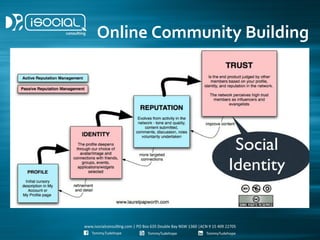
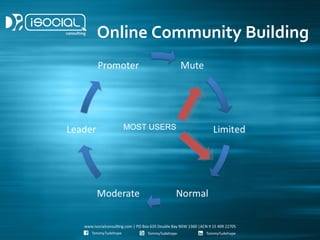
  • #18 Building an online community is no different to building an offline community. You need to attract members, have something to sell, have something to encourage fans to stay and then proselytize your work to others. Currently, Generation One is only part of the way through. There are profiles, a level of identity and a degree of reputation. Howe ever, there is little trust or engagement. The relationship through social media is very superficial. By building up trust and reputation users will be more inclined to defend you online and then in turn boost your following and fans.
  • #21 The most common problem for companies engaging in social media is attempting to quantify what they are doing online. Even for the most season operators putting a dollar figure on your social media profiles can be a particularly difficult undertaking. This task is made even more difficult if you are operating in a services or issues based arena where you are not selling an individual product. Each business has a different social media value proposition. It is, from the outset, worth comparing your position to your competitors but at the end of the day you must quantify you own activities against your own goals and resources. Too often business and social media campaigners will just say “we need to in the social space, lets do everything”. And, in no time at all they have a presence on every social media platform. However, unbeknownst to them, they are probably saying the wrong things to the the wrong audience with no impact. Within a month they are saying to themselves – why did we bother. No value, no impact and most importantly – no return on investment.
  • #24 If you are only taking your first steps online this is best done on a weekly basis. But for advanced large scale campaigns it should be a daily calendar of posts. Ideally relationships should be built and nurtured over time that will allow you to connect with these leaders for the purposes of spreading ideas quickly. Too often campaigns fail to get off the ground because all communications arms aren't properly talking to each other. This must include website, email and hard copy distribution channels. Pointless to being a large scale Twitter campaign if it is your first foray on the medium. Conduct a pilot, test content, connect with users, trial different mediums. Think about how you can put an edge on your message? How can it be communicated in such a way to grab the attention of the audience? How will you handle dissent or criticism? Do you have contingency plans in place to change your strategy or campaign?
  • #25 Social media can and in most cases is a more effective public relations tool than any other communications tool available. Again, because it is authentic and organic. You don’t have to overtly advertise a product or service of company. There are many other options: Charity work? Employee activities? News and current affairs? Humor? Public service information?
  • #26 For me this the most pertinent yet underutilised aspect of social media. It is one that companies could take up tomorrow with instance success and reward. How many people send letters or call up to complain? Venting is now done online. Not only can you vent with great effect but you can find other venters with similar experience. TELSTRA
  • #37 Most common mistake corporates make is diving into social media without fully understanding the space in which they are seeking to operate. Know who you want to connect with, how you want to connect and what message you would like to communicate. Appoint the most appropriate person in the company to manage your social media outreach. Do NOT, do NOT give it to the geek in IT. As I previously said, this is a communications tool not a technology tool. A senior spokesperson is best. Dominoes example. Monitor regularly, keep an eye on what you are doing and what people are saying. Nothing worse that posting something and then leaving it idle for users to pillage and plunder. Find the right tone. Don’t post media releases.