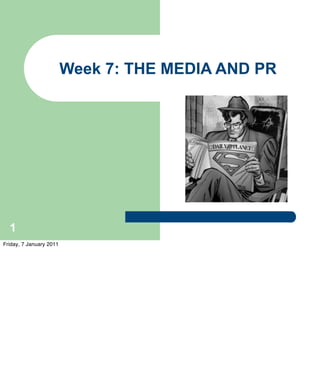
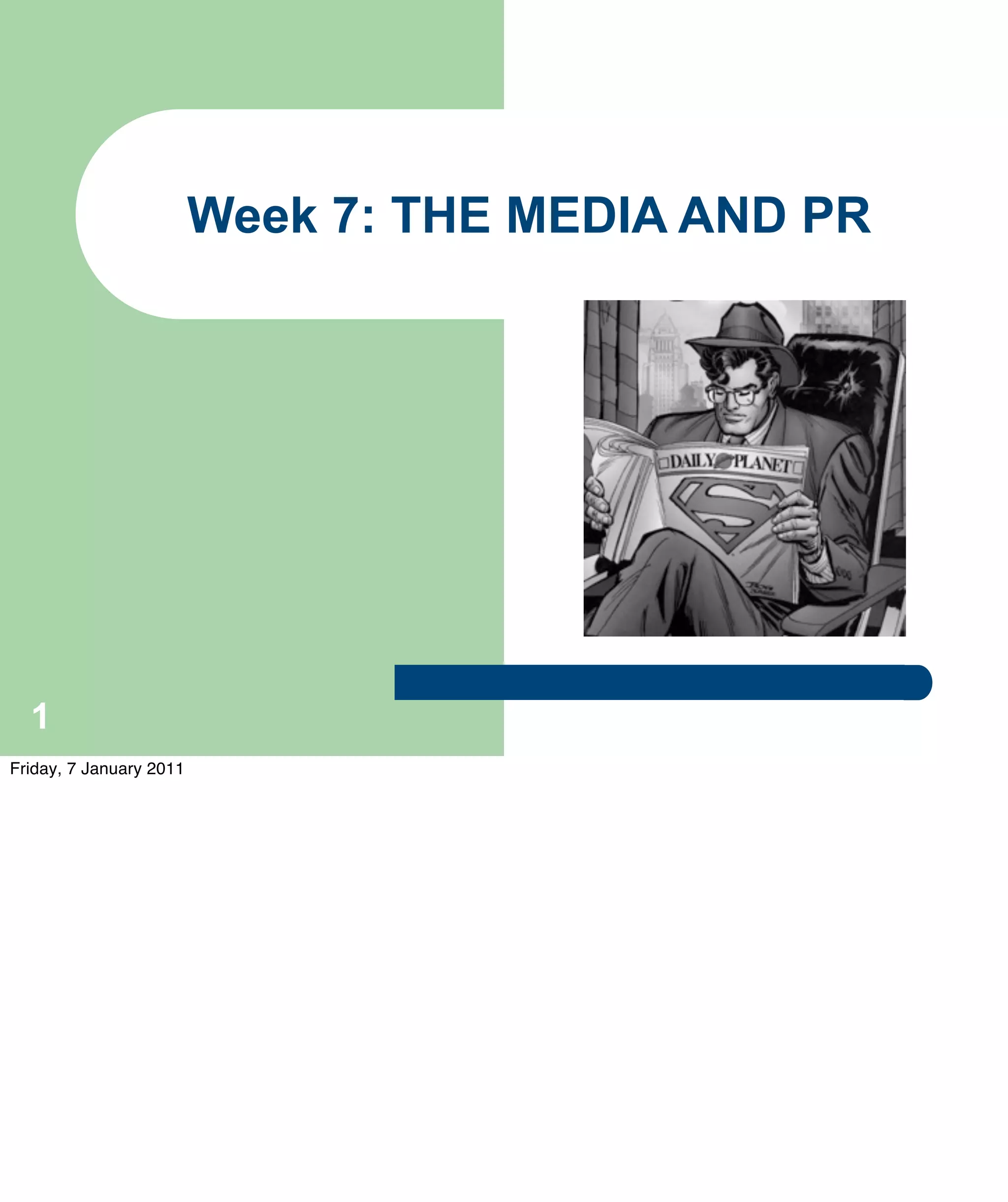
Week 7: THE MEDIA AND PR


  1
Friday, 7 January 2011
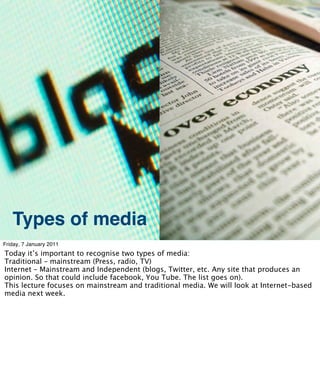
Types of media
Friday, 7 January 2011
Today it’s important to recognise two types of media:
Traditional – mainstream (Press, radio, TV)
Internet – Mainstream and Independent (blogs, Twitter, etc. Any site that produces an
opinion. So that could include facebook, You Tube. The list goes on).
This lecture focuses on mainstream and traditional media. We will look at Internet-based
media next week.
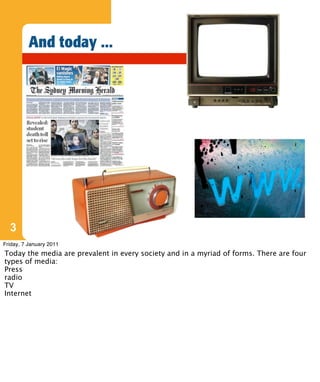
And today ...


  3
Friday, 7 January 2011
Today the media are prevalent in every society and in a myriad of forms. There are four
types of media:
Press
radio
TV
Internet
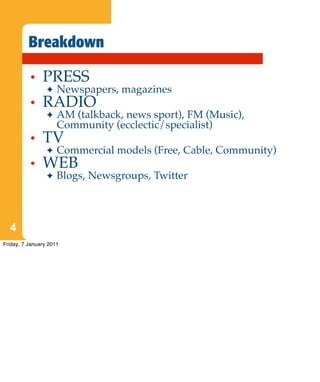
Breakdown

          •    PRESS
                 ✦   Newspapers, magazines
          •    RADIO
                 ✦   AM (talkback, news sport), FM (Music),
                     Community (ecclectic/specialist)
          •    TV
                 ✦   Commercial models (Free, Cable, Community)
          •    WEB
                 ✦   Blogs, Newsgroups, Twitter


  4
Friday, 7 January 2011
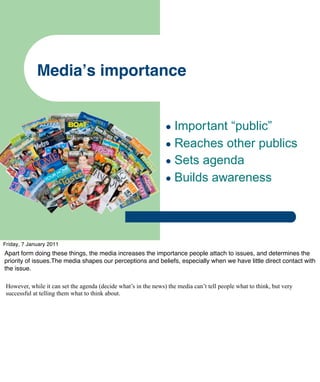
Mediaʼs importance


                                                                 • Important “public”
                                                                 • Reaches other publics
                                                                 • Sets agenda
                                                                 • Builds awareness


Friday, 7 January 2011
Apart form doing these things, the media increases the importance people attach to issues, and determines the
priority of issues.The media shapes our perceptions and beliefs, especially when we have little direct contact with
the issue.

 However, while it can set the agenda (decide what’s in the news) the media can’t tell people what to think, but very
 successful at telling them what to think about.
Mediaʼs functions

                                                                         • Political informant
                                                                         • Watchdog
                                                                         • Economic
                                                                         • Entertainment


Friday, 7 January 2011
     Despite what you may think about it, the media performs many valuable functions in society. Journos are the
     public’s eyes and ears. They seek the truth and put it into perspective, so therfore they are never entirely objective. Among the main
     roles the media plays are:
 •   Facilitating the functioning of the political system by providing a forum for news and debate (ie, opinon
     pieces, letters to the editor). It informs the public.
 •   Itʼs a watchdog against govt and corrporations and can act as a protector of rights
 •   The media facilitates economic exchange via advertising.
 •   And it entertains. This can be through
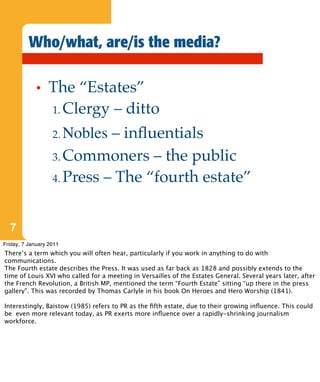
Who/what, are/is the media?

             •   The “Estates”
                 1. Clergy – ditto

                   2. Nobles – influentials
                   3. Commoners – the public

                   4. Press – The “fourth estate”


  7
Friday, 7 January 2011
There’s a term which you will often hear, particularly if you work in anything to do with
communications.
The Fourth estate describes the Press. It was used as far back as 1828 and possibly extends to the
time of Louis XVI who called for a meeting in Versailles of the Estates General. Several years later, after
the French Revolution, a British MP, mentioned the term “Fourth Estate” sitting “up there in the press
gallery”. This was recorded by Thomas Carlyle in his book On Heroes and Hero Worship (1841).

Interestingly, Baistow (1985) refers to PR as the fifth estate, due to their growing influence. This could
be even more relevant today, as PR exerts more influence over a rapidly-shrinking journalism
workforce.
Making and maintaining
           media relationships


Friday, 7 January 2011
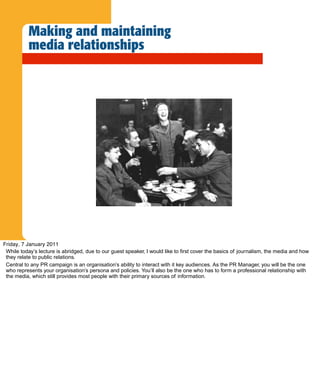
 While today’s lecture is abridged, due to our guest speaker, I would like to first cover the basics of journalism, the media and how
 they relate to public relations.
 Central to any PR campaign is an organisation’s ability to interact with it key audiences. As the PR Manager, you will be the one
 who represents your organisation’s persona and policies. You’ll also be the one who has to form a professional relationship with
 the media, which still provides most people with their primary sources of information.
Perceptions


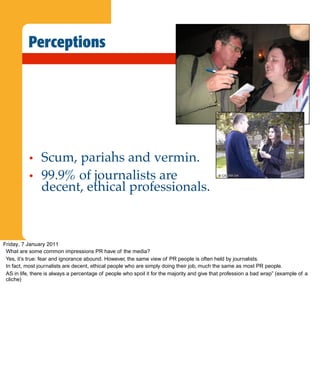
           •    Scum, pariahs and vermin.
           •    99.9% of journalists are
                decent, ethical professionals.


Friday, 7 January 2011
 What are some common impressions PR have of the media?
 Yes, it’s true: fear and ignorance abound. However, the same view of PR people is often held by journalists.
 In fact, most journalists are decent, ethical people who are simply doing their job, much the same as most PR people.
 AS in life, there is always a percentage of people who spoil it for the majority and give that profession a bad wrap” (example of a
 cliche)
Role of the media (in Australia)


          1. A business
          2. Report news


 10
Friday, 7 January 2011
So what is the purpose of the media?

The media, of course, operates everywhere – in both democracies and in dictatorships. Obviously the roles of the media
in different political environments will vary greatly.

Everybody hears about our free press. We should all know what that means ... that the media is free to report on mostly
anything (some matters of national security aside). But in countries such as China, the media is not free in that sense.

So we’ll just focus on democracies and leave comparitative debates on government systems and the media for another
unit.

1. In Australia, as in the US, UK, Canada, the media is essentially a business. Understand that first up.
Newspapers, radio & TV stations exist to make money for their shareholders/owners, and to pay the salaries of
employees, whether they be journalists, sales or technical staff.

2. Secondary to that role, particularly when we talk about the news media is that they are there to report the news. In
that sense they are also entrusted with
Your media relationship

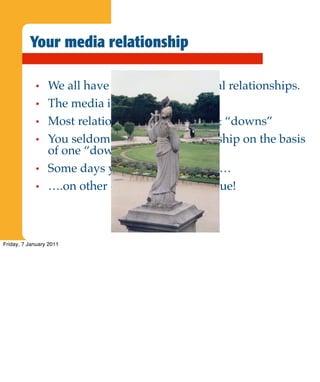
             •   We all have professional, external relationships.
             •   The media is just one other.
             •   Most relationships have “ups” & “downs”
             •   You seldom terminate a relationship on the basis
                 of one “down”
             •   Some days you are the pigeon……
             •   ….on other days you are the statue!


Friday, 7 January 2011
The media & story selection


            •    Harder to get your issue aired.
            •    ‘Dumbing down’ of media.
            •    The vibe


Friday, 7 January 2011
 Sensationalism is a priority in the media. This has long been the case in commercial news and the tabloids. But that is their
 audience, and they wouldn’t serve up that diet if it didn’t sell.
 Even the ABC sells down meritorious stories for those that evoke reaction.
 In the end you have to work with what you have and try to evoke the best reaction from the media you target. It’s about finding the
 synergies between your story and their objectives. Or, to paraphrase that great Aussie movie, The Castle: it’s about the vibe.
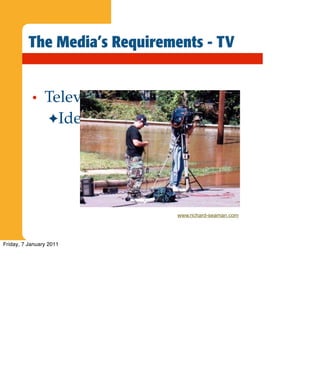
The Media’s Requirements - TV


           •    Television = pictures
                ✦ Identify possible vision


                                   www.richard-seaman.com


Friday, 7 January 2011
Radio Talk Programs


           •    Provides a wealth of opportunities.
           •    Research the talk program market.
           •    Target your program.
           •    Prepare!


Friday, 7 January 2011
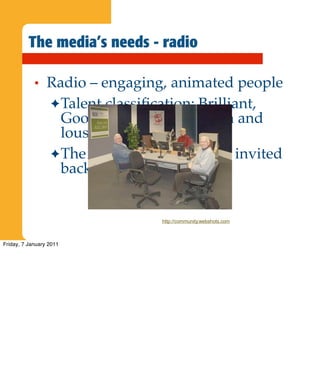
The media’s needs - radio

            •    Radio – engaging, animated people
                 ✦ Talent classification: Brilliant,
                   Good, OK, Not Real Flash and
                   lousy!
                 ✦ The latter two are seldom invited
                   back!


                                  http://community.webshots.com


Friday, 7 January 2011
Radio News


            •   Average story length is 40 seconds.
            •   The “seven-second grab”
            •   Rehearse/prepare grabs.


Friday, 7 January 2011
Newsprint


           •    Examine architecture of newspapers.
           •    Magazines and specialist
                publications.
           •    Watch “by lines”


Friday, 7 January 2011
Media Directory


Friday, 7 January 2011
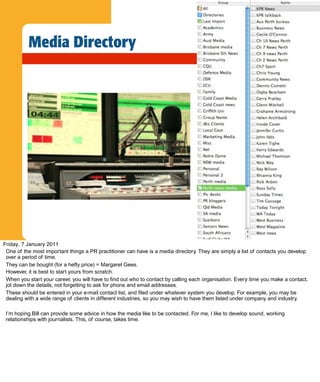
 One of the most important things a PR practitioner can have is a media directory. They are simply a list of contacts you develop
 over a period of time.
 They can be bought (for a hefty price) = Margaret Gees.
 However, it is best to start yours from scratch.
 When you start your career, you will have to find out who to contact by calling each organisation. Every time you make a contact,
 jot down the details, not forgetting to ask for phone and email addresses.
 These should be entered in your e-mail contact list, and filed under whatever system you develop. For example, you may be
 dealing with a wide range of clients in different industries, so you may wish to have them listed under company and industry.

 I’m hoping Bill can provide some advice in how the media like to be contacted. For me, I like to develop sound, working
 relationships with journalists. This, of course, takes time.
And Finally!


          •    The media is not your PR arm.
          •    Be objective about the news value of
               your story.
          •    Find an angle in your story that will act
               as a good hook.
          •    Go reel ‘em in

Friday, 7 January 2011
 No matter how worthy your cause, never assume that the media will act as your PR arm. You have to do the work, not them. They
 are merely following a lead - hopefully one you have provided in your media release.
 To that end you will have to be objective about the news value of your story.
 AS we mentioned last week, the the key to doing that is to find an angle in your story.
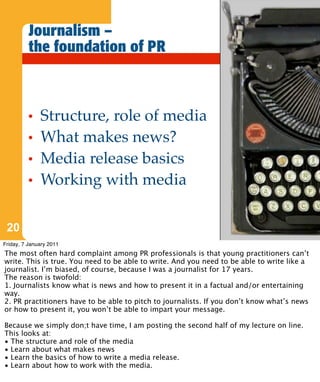
Journalism –
          the foundation of PR


          •   Structure, role of media
          •   What makes news?
          •   Media release basics
          •   Working with media

 20
Friday, 7 January 2011
The most often hard complaint among PR professionals is that young practitioners can’t
write. This is true. You need to be able to write. And you need to be able to write like a
journalist. I’m biased, of course, because I was a journalist for 17 years.
The reason is twofold:
1. Journalists know what is news and how to present it in a factual and/or entertaining
way.
2. PR practitioners have to be able to pitch to journalists. If you don’t know what’s news
or how to present it, you won’t be able to impart your message.

Because we simply don;t have time, I am posting the second half of my lecture on line.
This looks at:
• The structure and role of the media
• Learn about what makes news
• Learn the basics of how to write a media release.
• Learn about how to work with the media.
Friday, 7 January 2011

Media part 1

  • 1.
    Week 7: THEMEDIA AND PR 1 Friday, 7 January 2011
  • 2.
    Types of media Friday,7 January 2011 Today it’s important to recognise two types of media: Traditional – mainstream (Press, radio, TV) Internet – Mainstream and Independent (blogs, Twitter, etc. Any site that produces an opinion. So that could include facebook, You Tube. The list goes on). This lecture focuses on mainstream and traditional media. We will look at Internet-based media next week.
  • 3.
    And today ... 3 Friday, 7 January 2011 Today the media are prevalent in every society and in a myriad of forms. There are four types of media: Press radio TV Internet
  • 4.
    Breakdown • PRESS ✦ Newspapers, magazines • RADIO ✦ AM (talkback, news sport), FM (Music), Community (ecclectic/specialist) • TV ✦ Commercial models (Free, Cable, Community) • WEB ✦ Blogs, Newsgroups, Twitter 4 Friday, 7 January 2011
  • 5.
    Mediaʼs importance • Important “public” • Reaches other publics • Sets agenda • Builds awareness Friday, 7 January 2011 Apart form doing these things, the media increases the importance people attach to issues, and determines the priority of issues.The media shapes our perceptions and beliefs, especially when we have little direct contact with the issue. However, while it can set the agenda (decide what’s in the news) the media can’t tell people what to think, but very successful at telling them what to think about.
  • 6.
    Mediaʼs functions • Political informant • Watchdog • Economic • Entertainment Friday, 7 January 2011 Despite what you may think about it, the media performs many valuable functions in society. Journos are the public’s eyes and ears. They seek the truth and put it into perspective, so therfore they are never entirely objective. Among the main roles the media plays are: • Facilitating the functioning of the political system by providing a forum for news and debate (ie, opinon pieces, letters to the editor). It informs the public. • Itʼs a watchdog against govt and corrporations and can act as a protector of rights • The media facilitates economic exchange via advertising. • And it entertains. This can be through
  • 7.
    Who/what, are/is themedia? • The “Estates” 1. Clergy – ditto 2. Nobles – influentials 3. Commoners – the public 4. Press – The “fourth estate” 7 Friday, 7 January 2011 There’s a term which you will often hear, particularly if you work in anything to do with communications. The Fourth estate describes the Press. It was used as far back as 1828 and possibly extends to the time of Louis XVI who called for a meeting in Versailles of the Estates General. Several years later, after the French Revolution, a British MP, mentioned the term “Fourth Estate” sitting “up there in the press gallery”. This was recorded by Thomas Carlyle in his book On Heroes and Hero Worship (1841). Interestingly, Baistow (1985) refers to PR as the fifth estate, due to their growing influence. This could be even more relevant today, as PR exerts more influence over a rapidly-shrinking journalism workforce.
  • 8.
    Making and maintaining media relationships Friday, 7 January 2011 While today’s lecture is abridged, due to our guest speaker, I would like to first cover the basics of journalism, the media and how they relate to public relations. Central to any PR campaign is an organisation’s ability to interact with it key audiences. As the PR Manager, you will be the one who represents your organisation’s persona and policies. You’ll also be the one who has to form a professional relationship with the media, which still provides most people with their primary sources of information.
  • 9.
    Perceptions • Scum, pariahs and vermin. • 99.9% of journalists are decent, ethical professionals. Friday, 7 January 2011 What are some common impressions PR have of the media? Yes, it’s true: fear and ignorance abound. However, the same view of PR people is often held by journalists. In fact, most journalists are decent, ethical people who are simply doing their job, much the same as most PR people. AS in life, there is always a percentage of people who spoil it for the majority and give that profession a bad wrap” (example of a cliche)
  • 10.
    Role of themedia (in Australia) 1. A business 2. Report news 10 Friday, 7 January 2011 So what is the purpose of the media? The media, of course, operates everywhere – in both democracies and in dictatorships. Obviously the roles of the media in different political environments will vary greatly. Everybody hears about our free press. We should all know what that means ... that the media is free to report on mostly anything (some matters of national security aside). But in countries such as China, the media is not free in that sense. So we’ll just focus on democracies and leave comparitative debates on government systems and the media for another unit. 1. In Australia, as in the US, UK, Canada, the media is essentially a business. Understand that first up. Newspapers, radio & TV stations exist to make money for their shareholders/owners, and to pay the salaries of employees, whether they be journalists, sales or technical staff. 2. Secondary to that role, particularly when we talk about the news media is that they are there to report the news. In that sense they are also entrusted with
  • 11.
    Your media relationship • We all have professional, external relationships. • The media is just one other. • Most relationships have “ups” & “downs” • You seldom terminate a relationship on the basis of one “down” • Some days you are the pigeon…… • ….on other days you are the statue! Friday, 7 January 2011
  • 12.
    The media &story selection • Harder to get your issue aired. • ‘Dumbing down’ of media. • The vibe Friday, 7 January 2011 Sensationalism is a priority in the media. This has long been the case in commercial news and the tabloids. But that is their audience, and they wouldn’t serve up that diet if it didn’t sell. Even the ABC sells down meritorious stories for those that evoke reaction. In the end you have to work with what you have and try to evoke the best reaction from the media you target. It’s about finding the synergies between your story and their objectives. Or, to paraphrase that great Aussie movie, The Castle: it’s about the vibe.
  • 13.
    The Media’s Requirements- TV • Television = pictures ✦ Identify possible vision www.richard-seaman.com Friday, 7 January 2011
  • 14.
    Radio Talk Programs • Provides a wealth of opportunities. • Research the talk program market. • Target your program. • Prepare! Friday, 7 January 2011
  • 15.
    The media’s needs- radio • Radio – engaging, animated people ✦ Talent classification: Brilliant, Good, OK, Not Real Flash and lousy! ✦ The latter two are seldom invited back! http://community.webshots.com Friday, 7 January 2011
  • 16.
    Radio News • Average story length is 40 seconds. • The “seven-second grab” • Rehearse/prepare grabs. Friday, 7 January 2011
  • 17.
    Newsprint • Examine architecture of newspapers. • Magazines and specialist publications. • Watch “by lines” Friday, 7 January 2011
  • 18.
    Media Directory Friday, 7January 2011 One of the most important things a PR practitioner can have is a media directory. They are simply a list of contacts you develop over a period of time. They can be bought (for a hefty price) = Margaret Gees. However, it is best to start yours from scratch. When you start your career, you will have to find out who to contact by calling each organisation. Every time you make a contact, jot down the details, not forgetting to ask for phone and email addresses. These should be entered in your e-mail contact list, and filed under whatever system you develop. For example, you may be dealing with a wide range of clients in different industries, so you may wish to have them listed under company and industry. I’m hoping Bill can provide some advice in how the media like to be contacted. For me, I like to develop sound, working relationships with journalists. This, of course, takes time.
  • 19.
    And Finally! • The media is not your PR arm. • Be objective about the news value of your story. • Find an angle in your story that will act as a good hook. • Go reel ‘em in Friday, 7 January 2011 No matter how worthy your cause, never assume that the media will act as your PR arm. You have to do the work, not them. They are merely following a lead - hopefully one you have provided in your media release. To that end you will have to be objective about the news value of your story. AS we mentioned last week, the the key to doing that is to find an angle in your story.
  • 20.
    Journalism – the foundation of PR • Structure, role of media • What makes news? • Media release basics • Working with media 20 Friday, 7 January 2011 The most often hard complaint among PR professionals is that young practitioners can’t write. This is true. You need to be able to write. And you need to be able to write like a journalist. I’m biased, of course, because I was a journalist for 17 years. The reason is twofold: 1. Journalists know what is news and how to present it in a factual and/or entertaining way. 2. PR practitioners have to be able to pitch to journalists. If you don’t know what’s news or how to present it, you won’t be able to impart your message. Because we simply don;t have time, I am posting the second half of my lecture on line. This looks at: • The structure and role of the media • Learn about what makes news • Learn the basics of how to write a media release. • Learn about how to work with the media.
  • 21.