Prayer
Lord Jesus,
We praise you in your Passion,
Death and Resurrection.
We thank you for being with us in our sorrows, Pains
and joys.
We pray that through our classmates, parents,
teachers and staff, we may see and encounter you in
many ways.
Teach us to be compassionate, Loving and forgiving
as you are.
May the Passion of Christ be always in our heart!
Amen.
SAMPLE FOOTER TEXT 4
20XX
Welcome to the
world of Media
SAMPLE FOOTER TEXT 5
Let's conduct a brief test to assess your
knowledge of media and information literacy.
20XX
SAMPLE FOOTER TEXT 6
1.It refers to anything that blocks or changes the source’s intended
meaning of the message
A. Medium C. Individual
B. Technology D. Interference
20XX
SAMPLE FOOTER TEXT 7
2. It refers to tools used by the source to disseminate
information to the receivers.
a. Media c. Literacy
b. Technology d. Information
20XX
SAMPLE FOOTER TEXT 8
3. It pertains to any information that is passed on through
communication.
a. Receiver c. Message
b. Media d. Source
20XX
SAMPLE FOOTER TEXT 9
4. It refers to the atmosphere, physical and
psychological, where you send and receive messages.
a. Context c. Feedback
b. Environmentd. Interference
20XX
SAMPLE FOOTER TEXT 10
5. New media is also referred to as ____________.
a.Social Media c. the Internet
b.Wi-Fi d. Artificial intelligence
20XX
SAMPLE FOOTER TEXT 11
20XX
Activity: Breaking Down Miscommunication
In your notebook, try to recall a major
miscommunication or misunderstanding that you
were involved in and its consequences. Describe such
situation. Who or what was the reason of the
misunderstanding? Explain what you did and give
suggestions on how problems as such can be avoided
in the future.
SAMPLE FOOTER TEXT 20XX 13
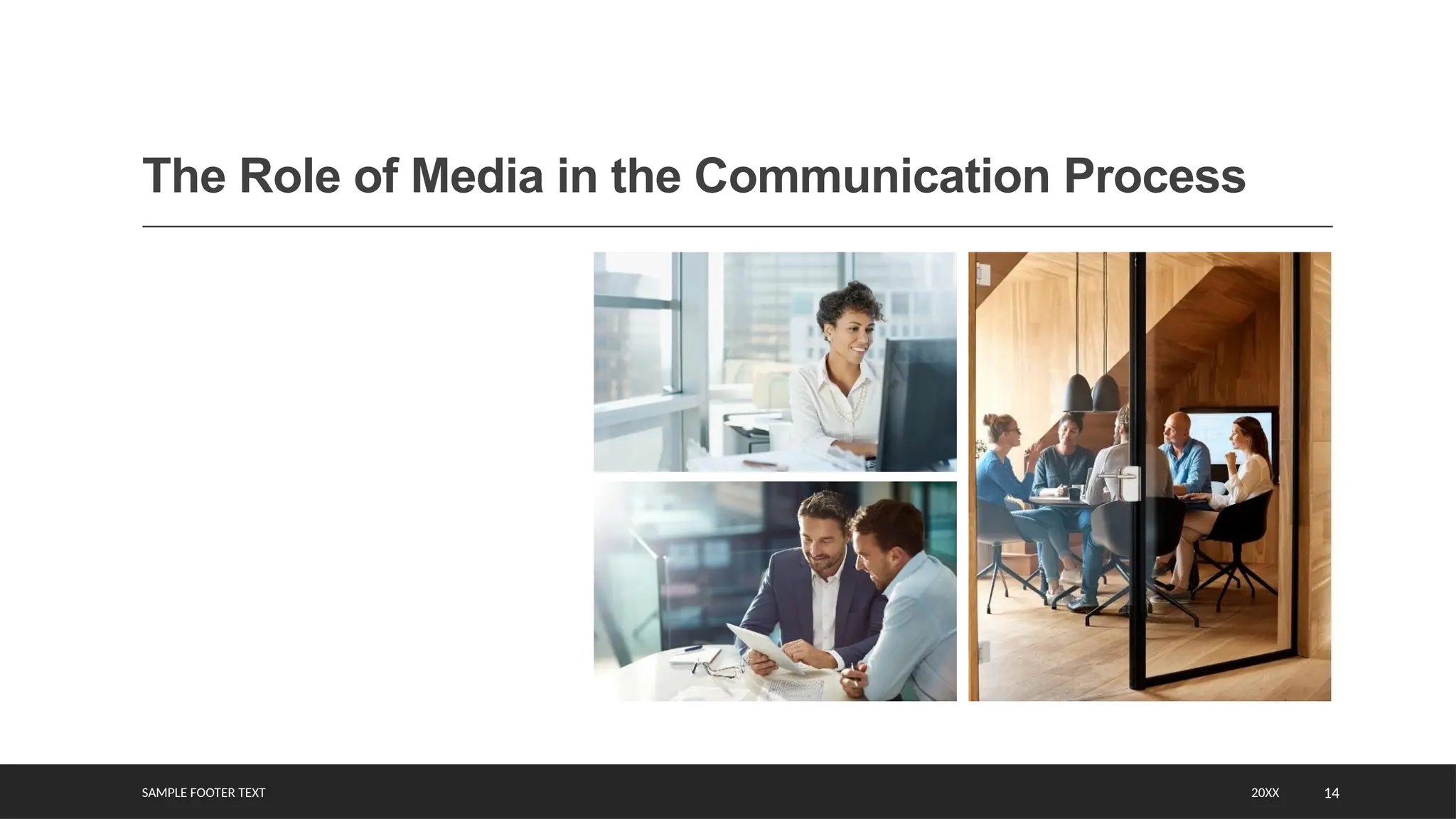
The Role of Media in the Communication Process
SAMPLE FOOTER TEXT 20XX 14
Objectives
SAMPLE FOOTER TEXT 20XX 15
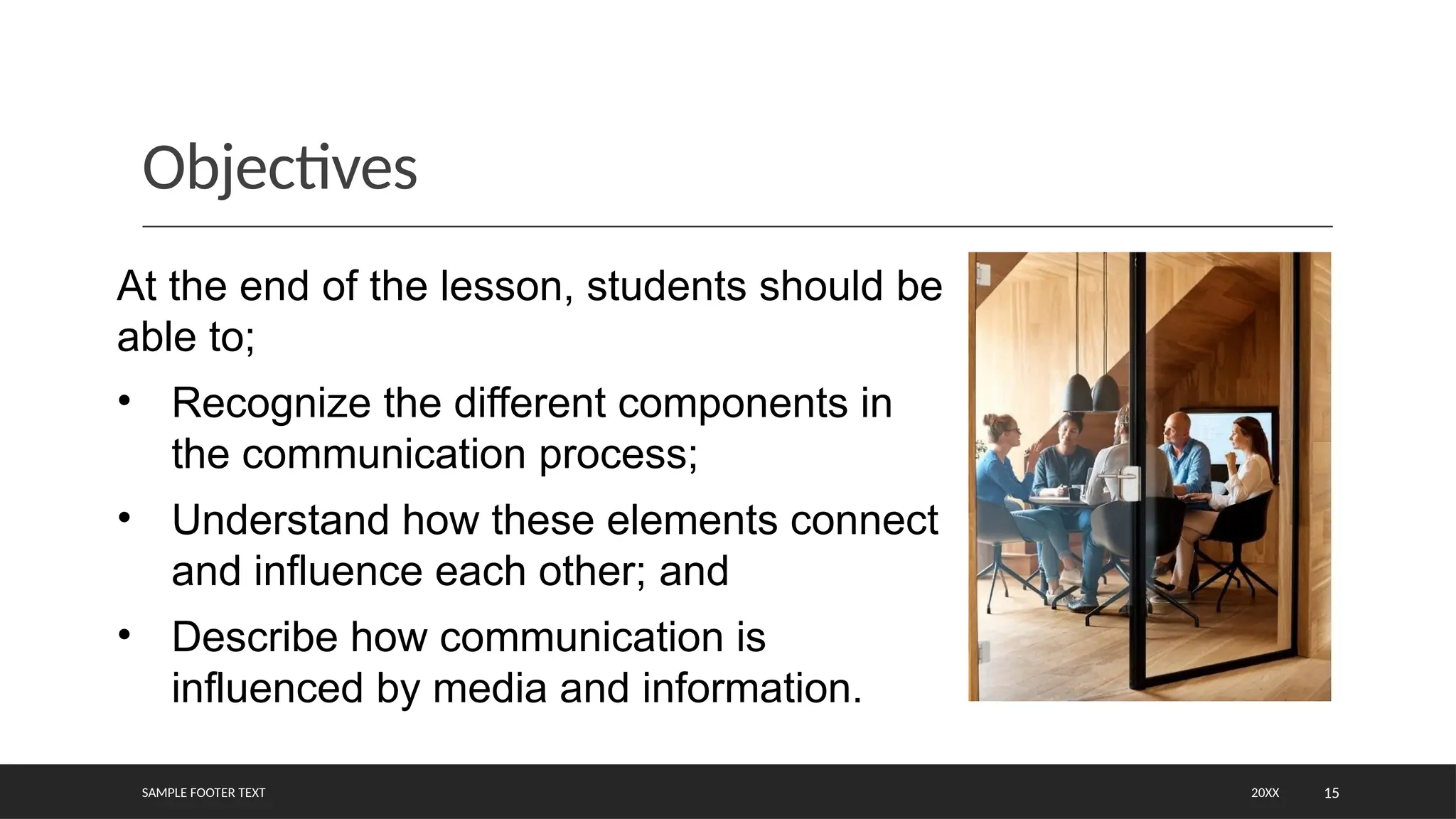
At the end of the lesson, students should be
able to;
• Recognize the different components in
the communication process;
• Understand how these elements connect
and influence each other; and
• Describe how communication is
influenced by media and information.
SAMPLE FOOTER TEXT 16
Components of Communication
Although intrinsic in nature, communication is deemed a
complex process. The course through which information
is sent, passed, or spread, involves several elements –
elements which, in turn, have their own significant
components.
20XX
complex process
sent, passed, or spread
1.Source
2.Message
3.Channel
4.Receiver
5.Feedback
6.Environment
7.Context
8.Interference
Components of Communication
SAMPLE FOOTER TEXT 18
Eight essential components of
communication:
20XX
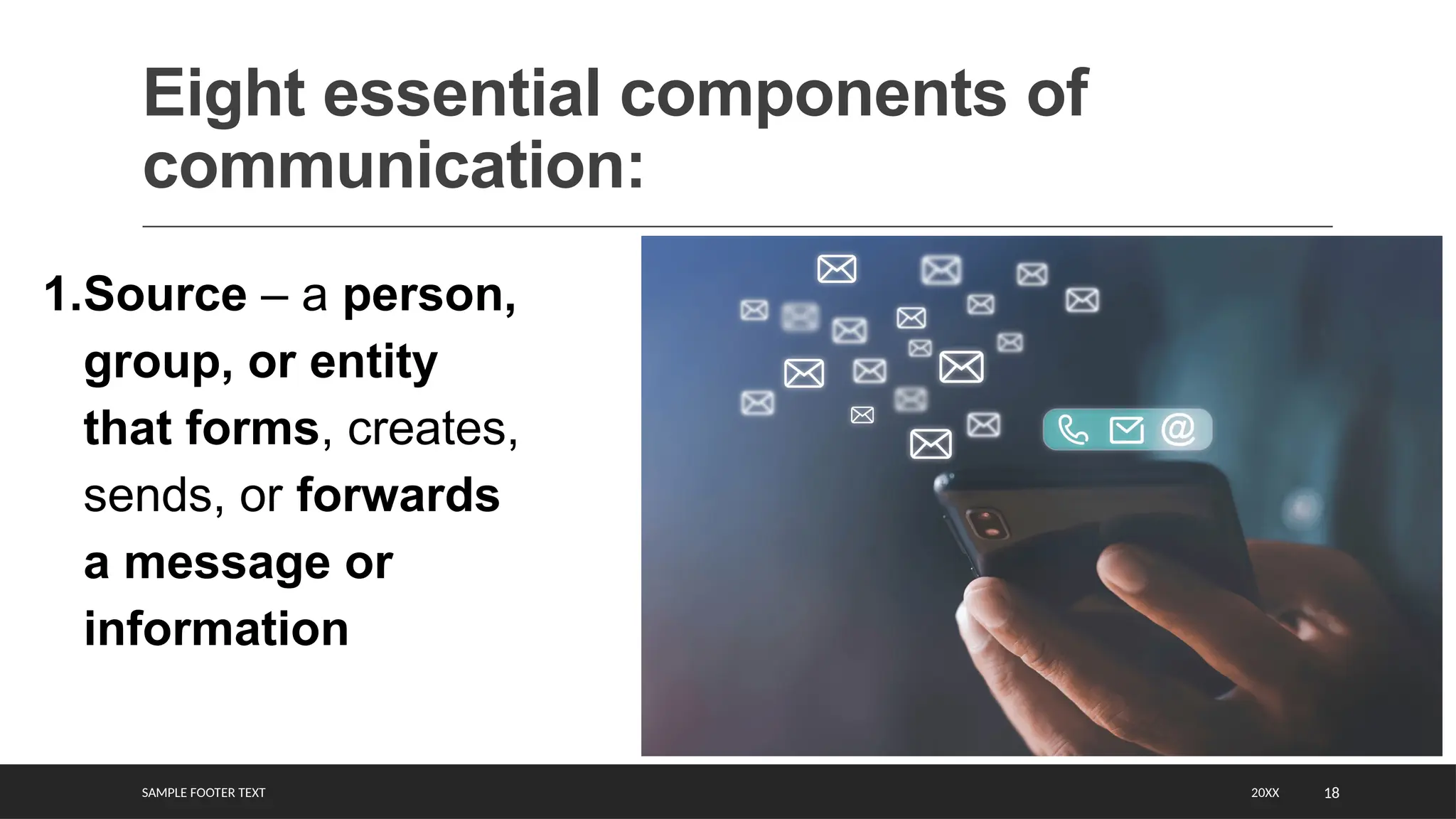
1.Source – a person,
group, or entity
that forms, creates,
sends, or forwards
a message or
information
SAMPLE FOOTER TEXT 19
Eight essential components of
communication:
20XX
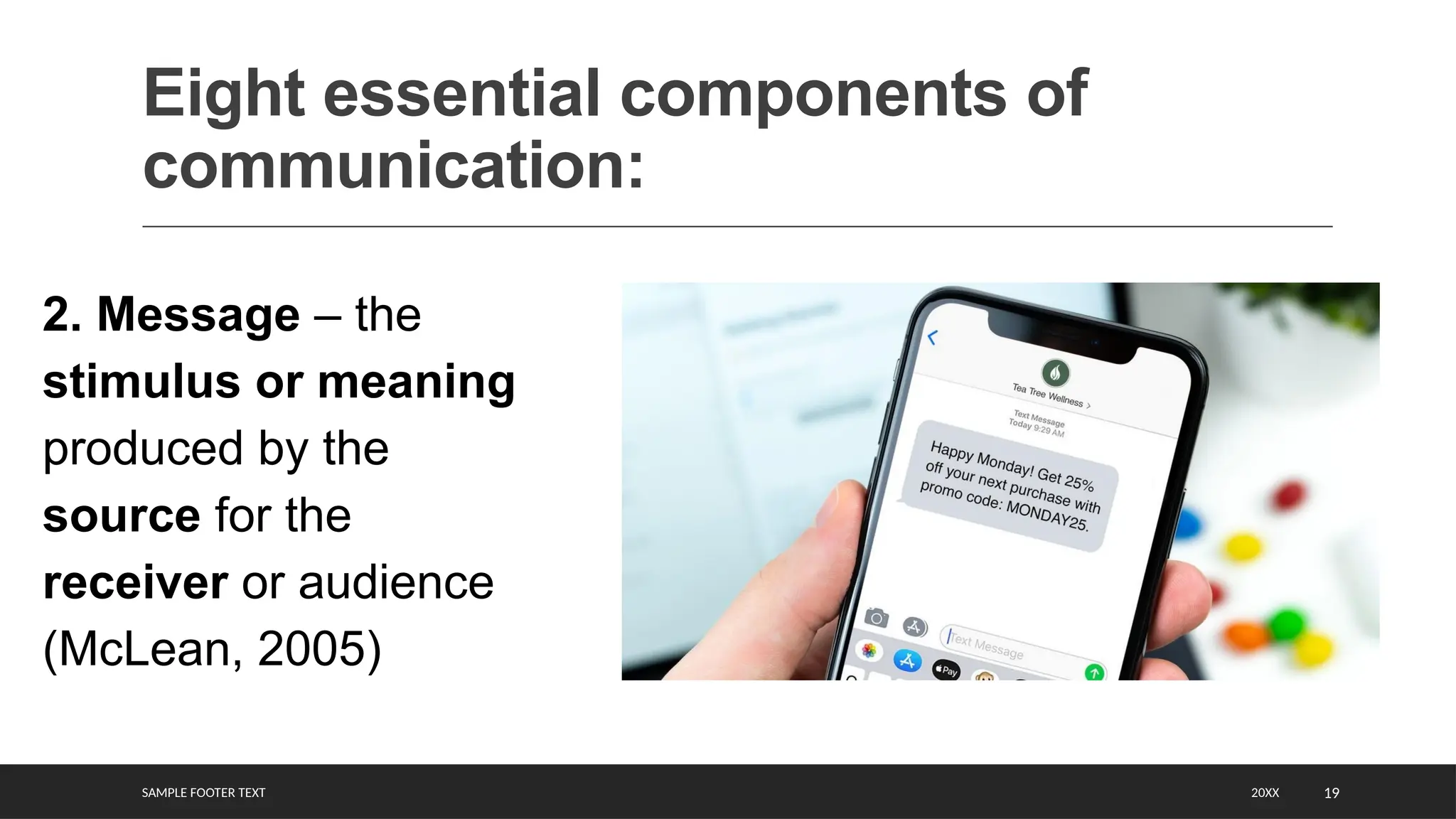
2. Message – the
stimulus or meaning
produced by the
source for the
receiver or audience
(McLean, 2005)
SAMPLE FOOTER TEXT 20
Eight essential components of
communication:
20XX
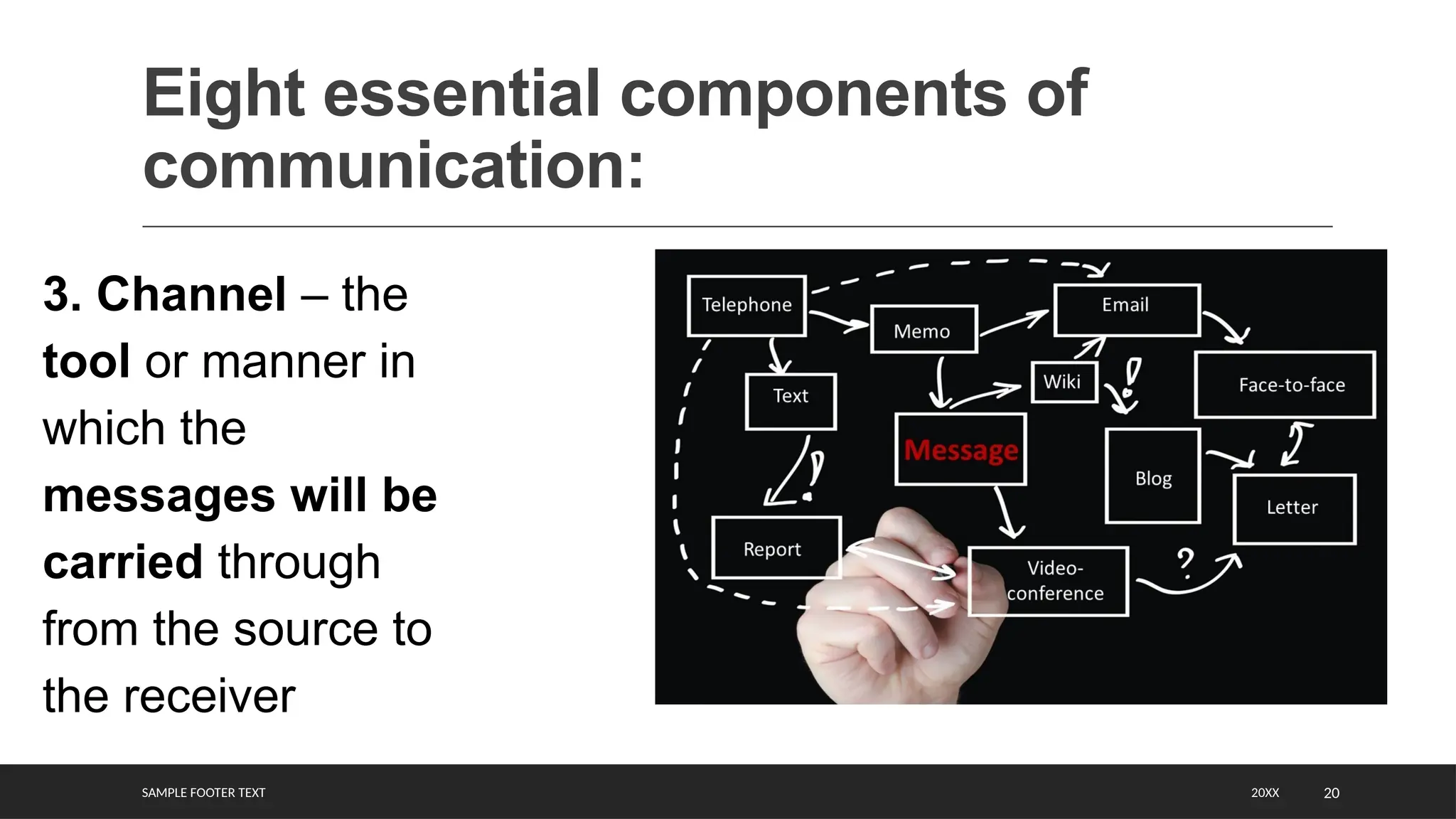
3. Channel – the
tool or manner in
which the
messages will be
carried through
from the source to
the receiver
SAMPLE FOOTER TEXT 21
Eight essential components of
communication:
20XX
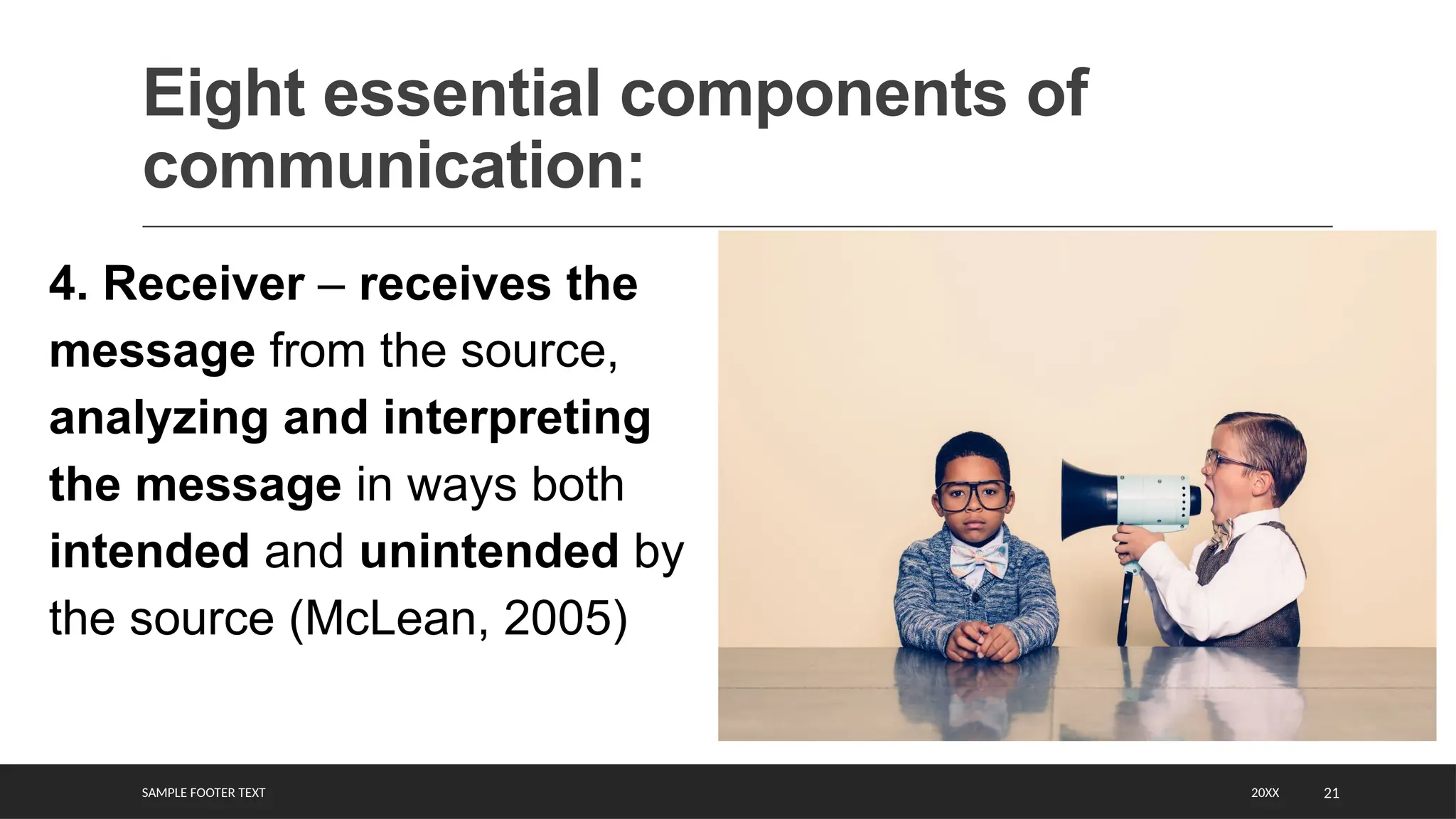
4. Receiver – receives the
message from the source,
analyzing and interpreting
the message in ways both
intended and unintended by
the source (McLean, 2005)
SAMPLE FOOTER TEXT 22
Eight essential components of
communication:
20XX
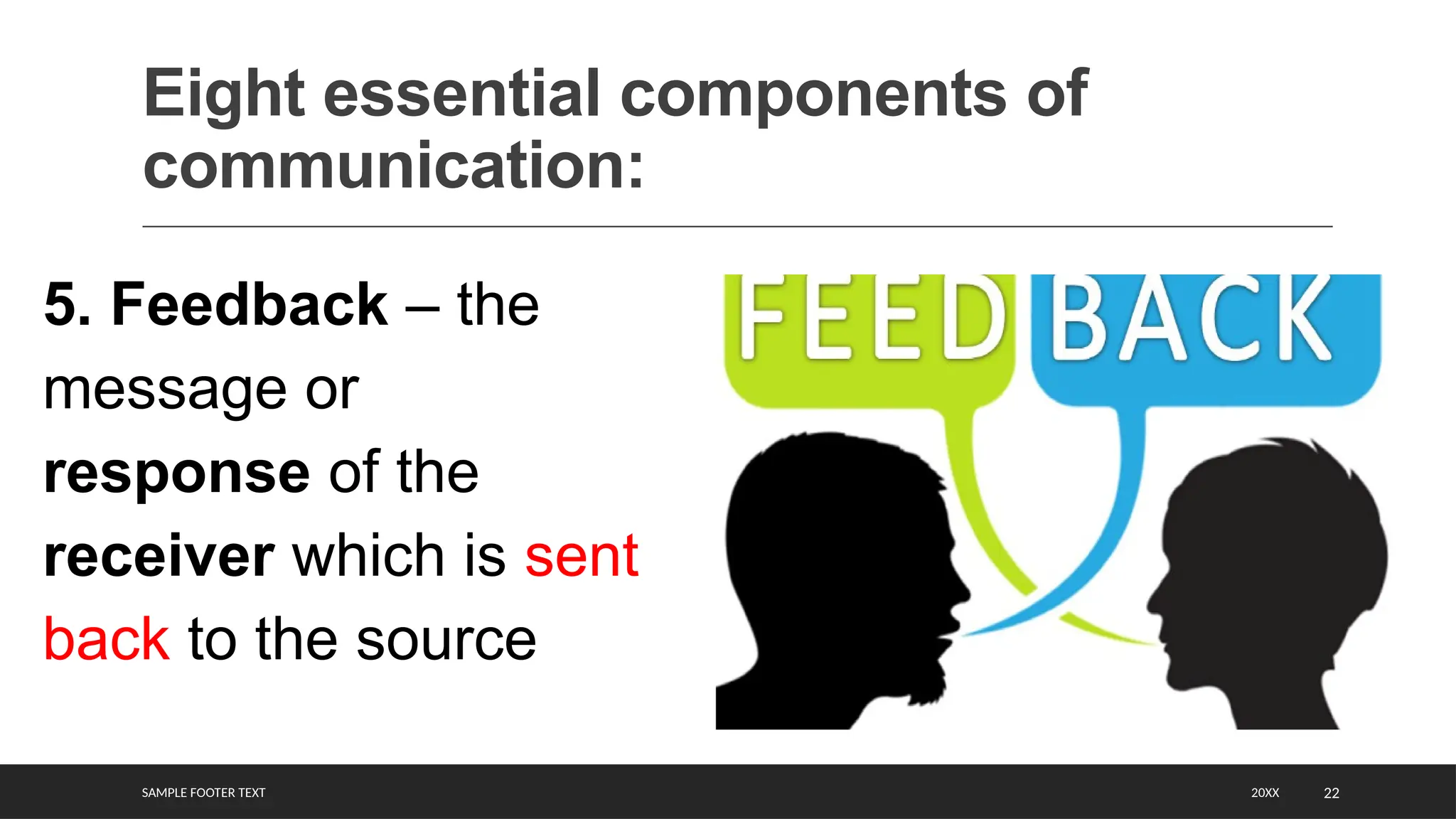
5. Feedback – the
message or
response of the
receiver which is sent
back to the source
SAMPLE FOOTER TEXT 23
Eight essential components of
communication:
20XX
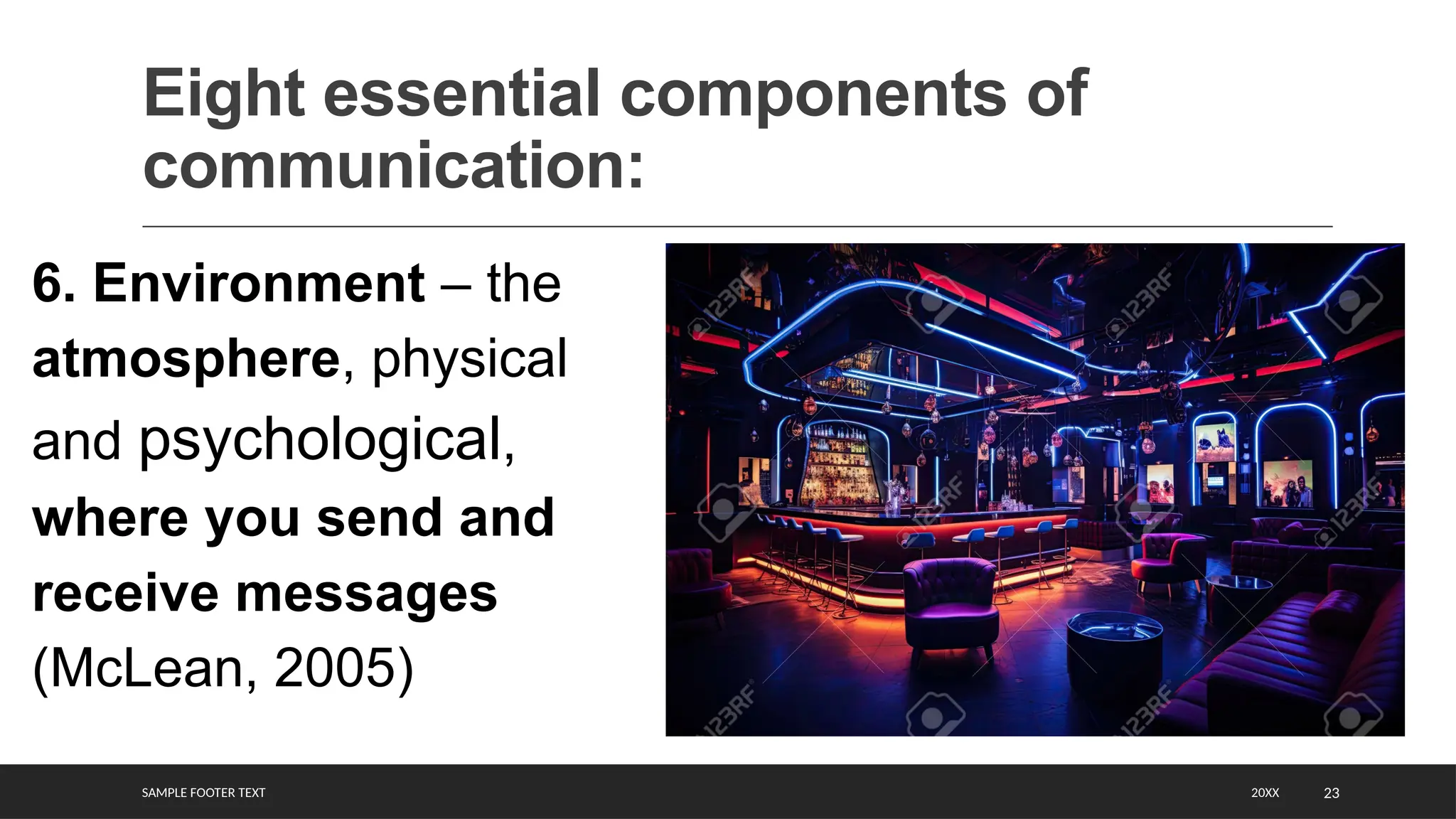
6. Environment – the
atmosphere, physical
and psychological,
where you send and
receive messages
(McLean, 2005)
SAMPLE FOOTER TEXT 24
Eight essential components of
communication:
20XX
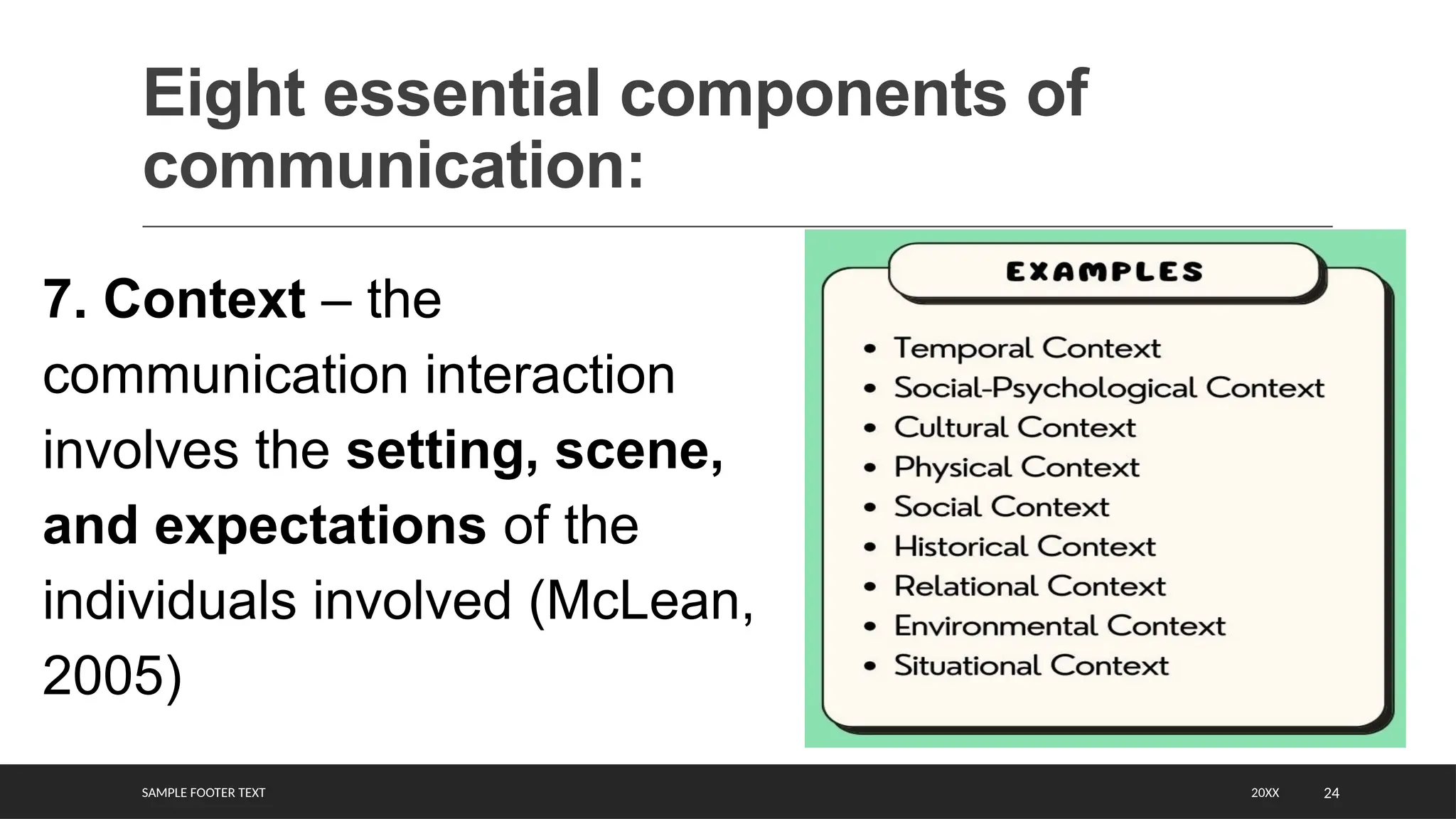
7. Context – the
communication interaction
involves the setting, scene,
and expectations of the
individuals involved (McLean,
2005)
SAMPLE FOOTER TEXT 26
Eight essential components of
communication:
20XX
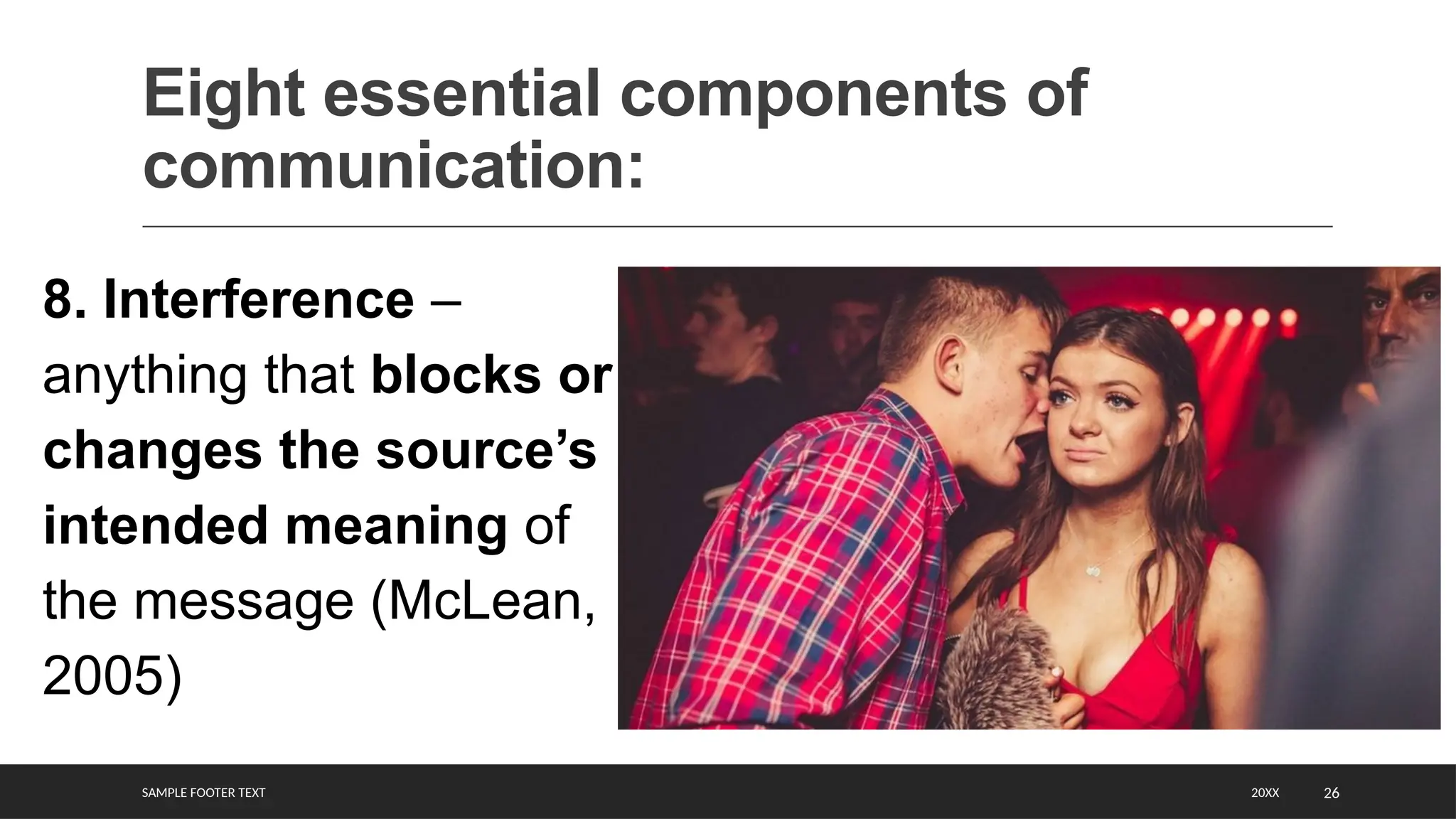
8. Interference –
anything that blocks or
changes the source’s
intended meaning of
the message (McLean,
2005)
1.Source
2.Message
3.Channel
4.Receiver
5.Feedback
6.Environment
7.Context
8.Interference
Components of Communication
What is “communication”?
The root of the word “communication” in Latin is
communicare, which means to share or to make
common (Weekley, 1967). Furthermore,
communication is defined as the process of
understanding and sharing meaning (Pearson &
Nelson, 2000). With this, we can see how
communication has a lot to do with information
sharing and arriving at a common understanding.
SAMPLE FOOTER TEXT 30
20XX
The Communication Process through Models
“Humans are
social beings.”
SAMPLE FOOTER TEXT 31
1. HAROLD LASSWELL’S
COMMUNICATION MODEL
20XX
SAMPLE FOOTER TEXT 32
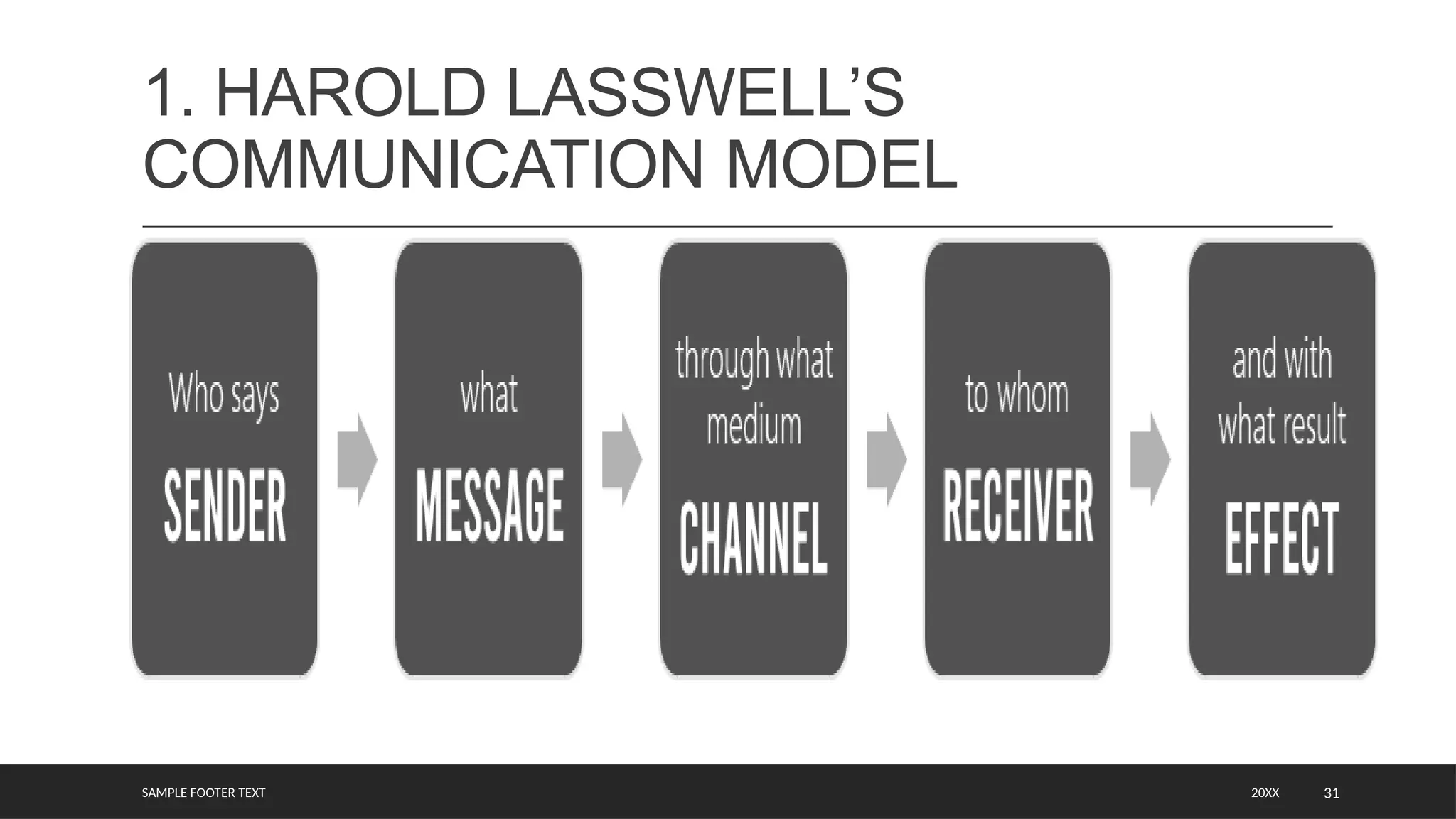
2. SHANNON AND WEAVER’S
COMMUNICATION MODEL
20XX
Sender who
encode the
message
Channel
A device or
medium that
decode the
message
Person or entity
that receives and
interprets
Interference
The mother of all
models
SAMPLE FOOTER TEXT 33
3. DAVID BERLO’S SMCR
COMMUNICATION MODEL
20XX
Why?
SAMPLE FOOTER TEXT 34
Forms of Communication
Communication may come in different
forms. These forms may vary and differ in
terms of participants, channels used, and
contexts.
20XX
SAMPLE FOOTER TEXT 35
1. Intrapersonal Communication
2. Interpersonal Communication
3. Group Communication
4. Public Communication
5. Mass Communication
20XX
The following are the five main forms
of communication:
SAMPLE FOOTER TEXT 36
1. Intrapersonal Communication
20XX
communication
with oneself or
self-to-self
communication
SAMPLE FOOTER TEXT 37
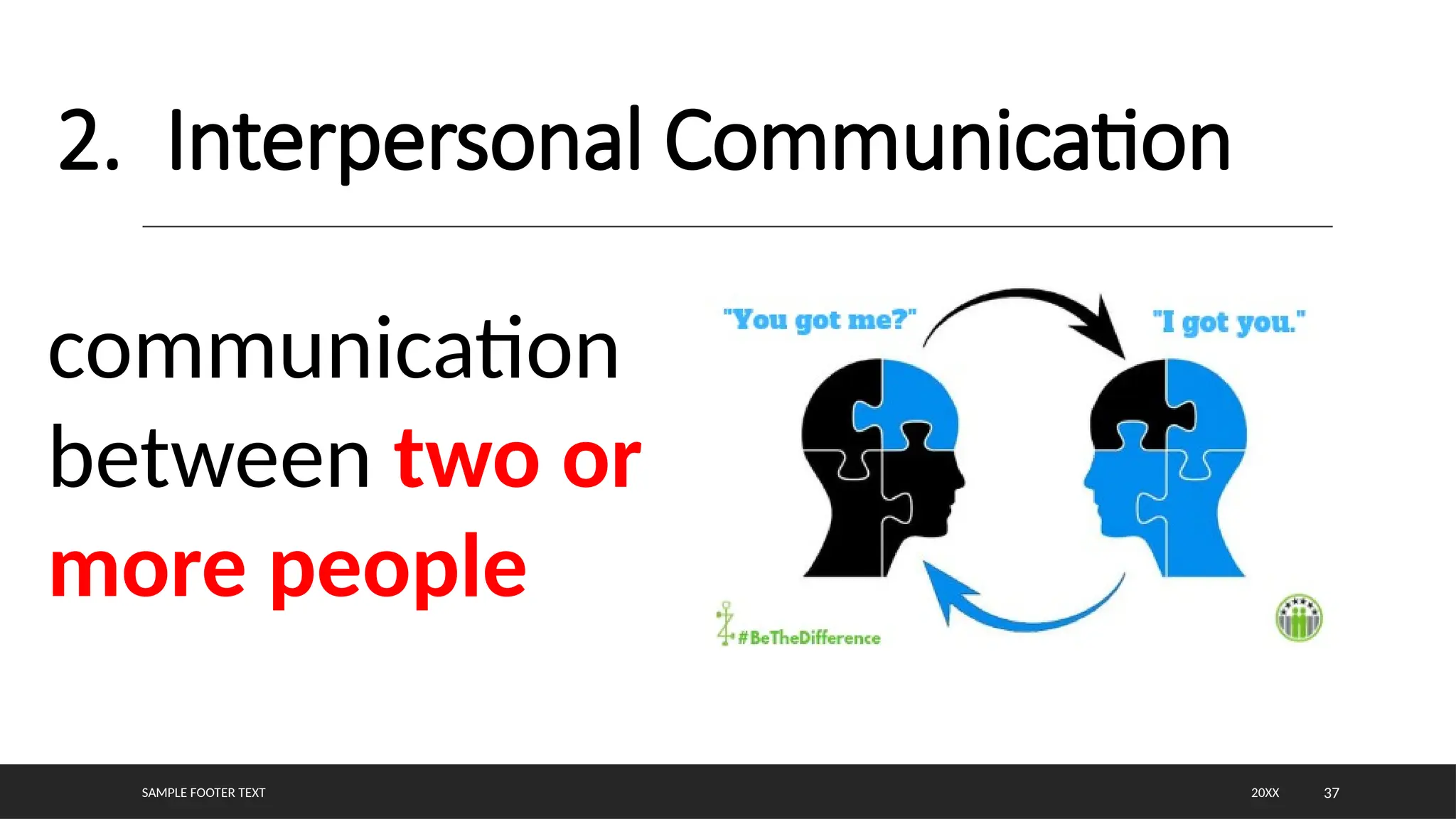
2. Interpersonal Communication
20XX
communication
between two or
more people
SAMPLE FOOTER TEXT 38
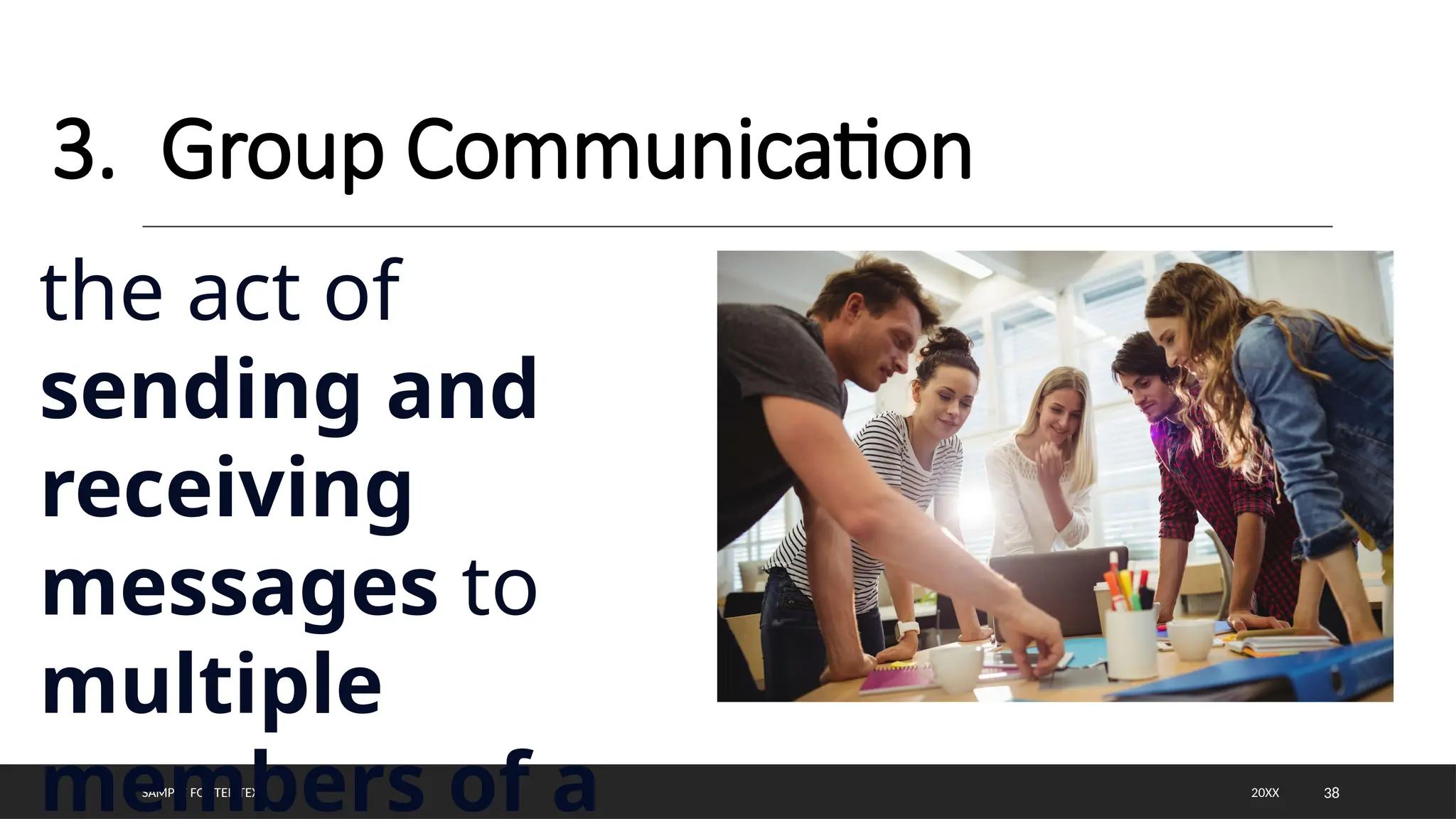
3. Group Communication
20XX
the act of
sending and
receiving
messages to
multiple
members of a
SAMPLE FOOTER TEXT 39
4. Public Communication
20XX
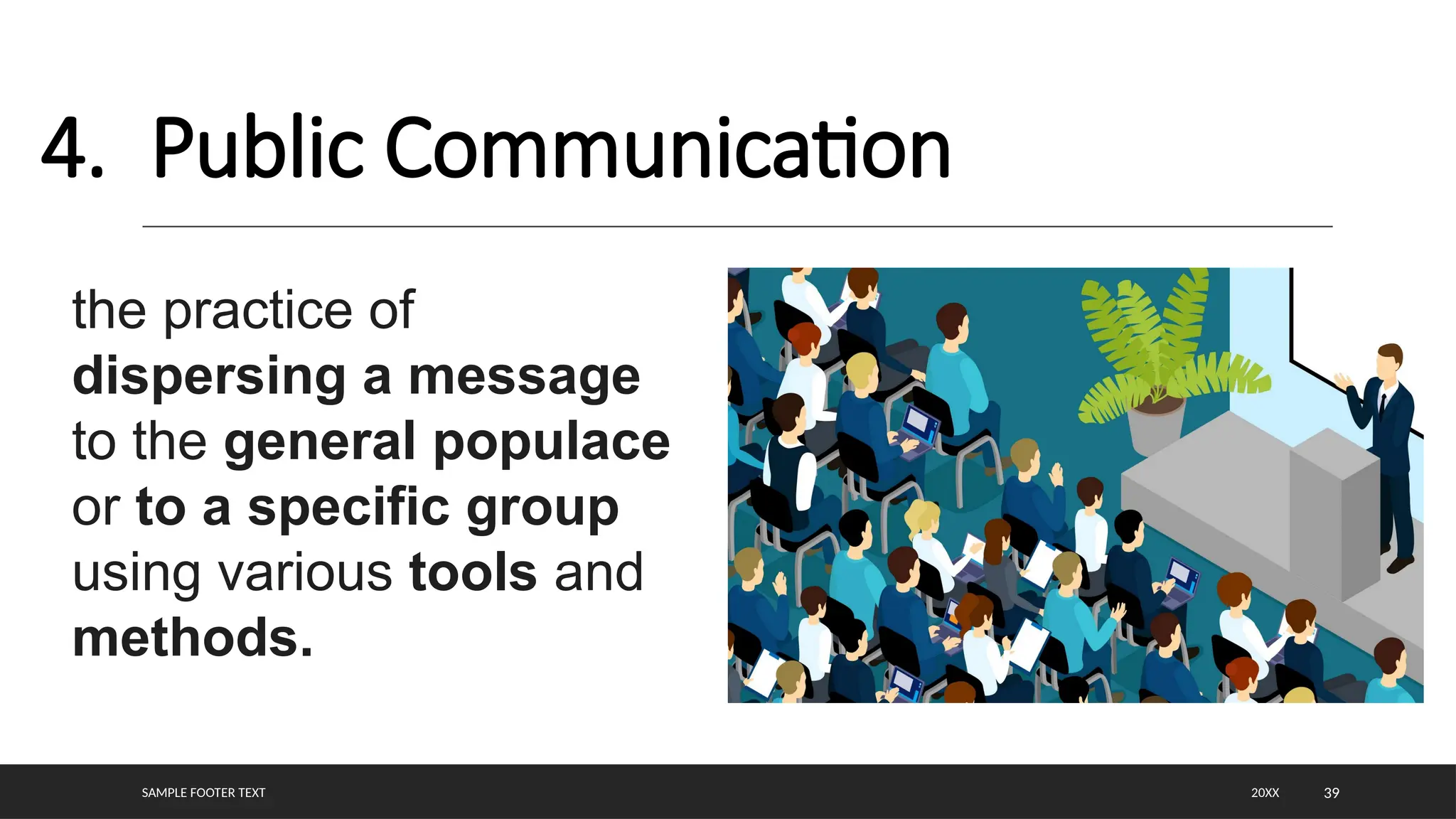
the practice of
dispersing a message
to the general populace
or to a specific group
using various tools and
methods.
SAMPLE FOOTER TEXT 40
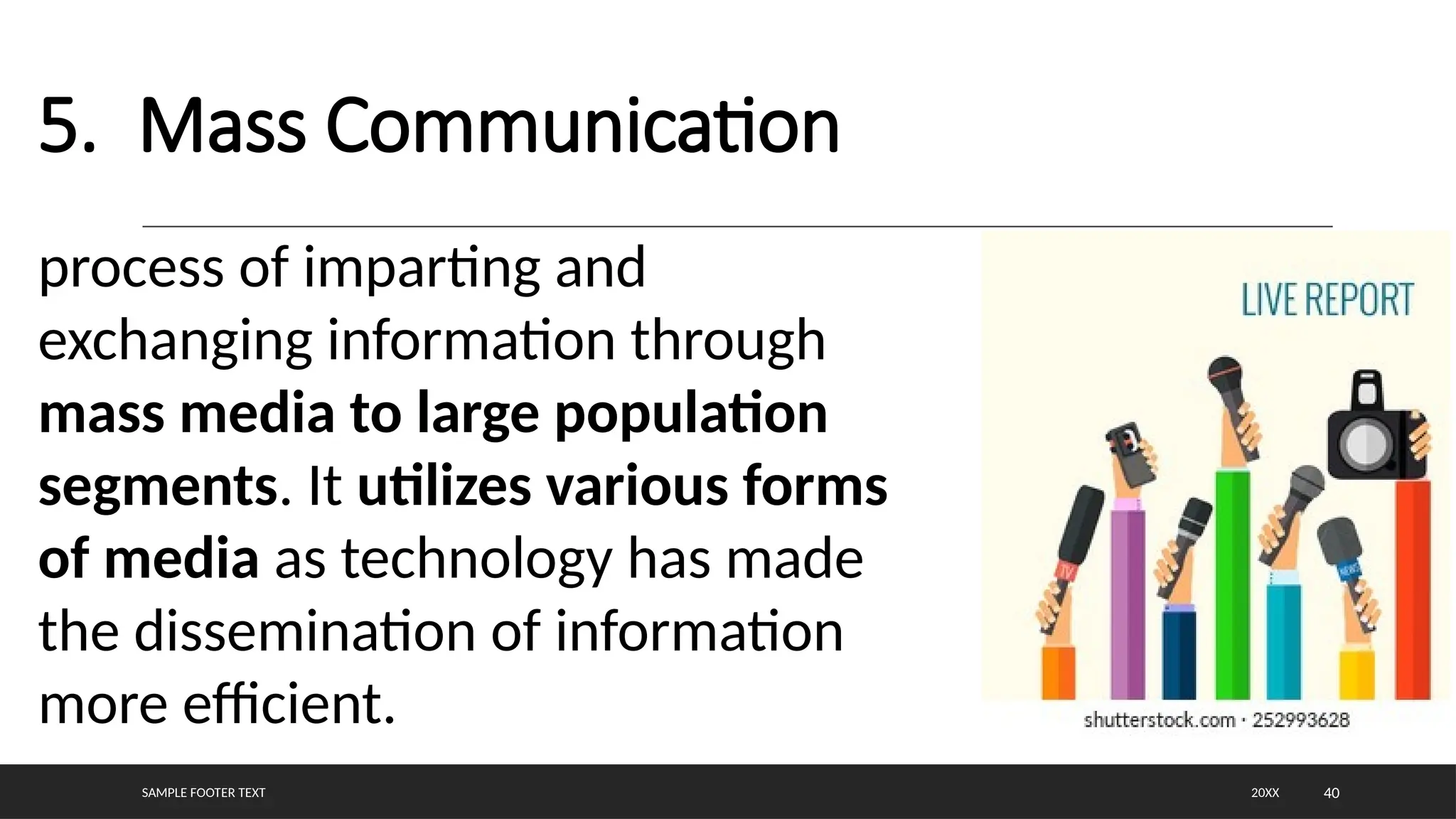
5. Mass Communication
20XX
process of imparting and
exchanging information through
mass media to large population
segments. It utilizes various forms
of media as technology has made
the dissemination of information
more efficient.
SAMPLE FOOTER TEXT 41
20XX
The Role of Media and Information in
Communication
This leads us to the two distinct elements that are intrinsically
interconnected with the concept of communication – media and
information. In other words, information is one of the reasons why
communication is done in the first place, and this information can be
shared through media.
SAMPLE FOOTER TEXT 42
20XX
The Role of Media and Information in
Communication
media is an instrument for
transmitting information – it’s the
vehicle for a message.
43
20XX
The Role of Media and Information in
Communication
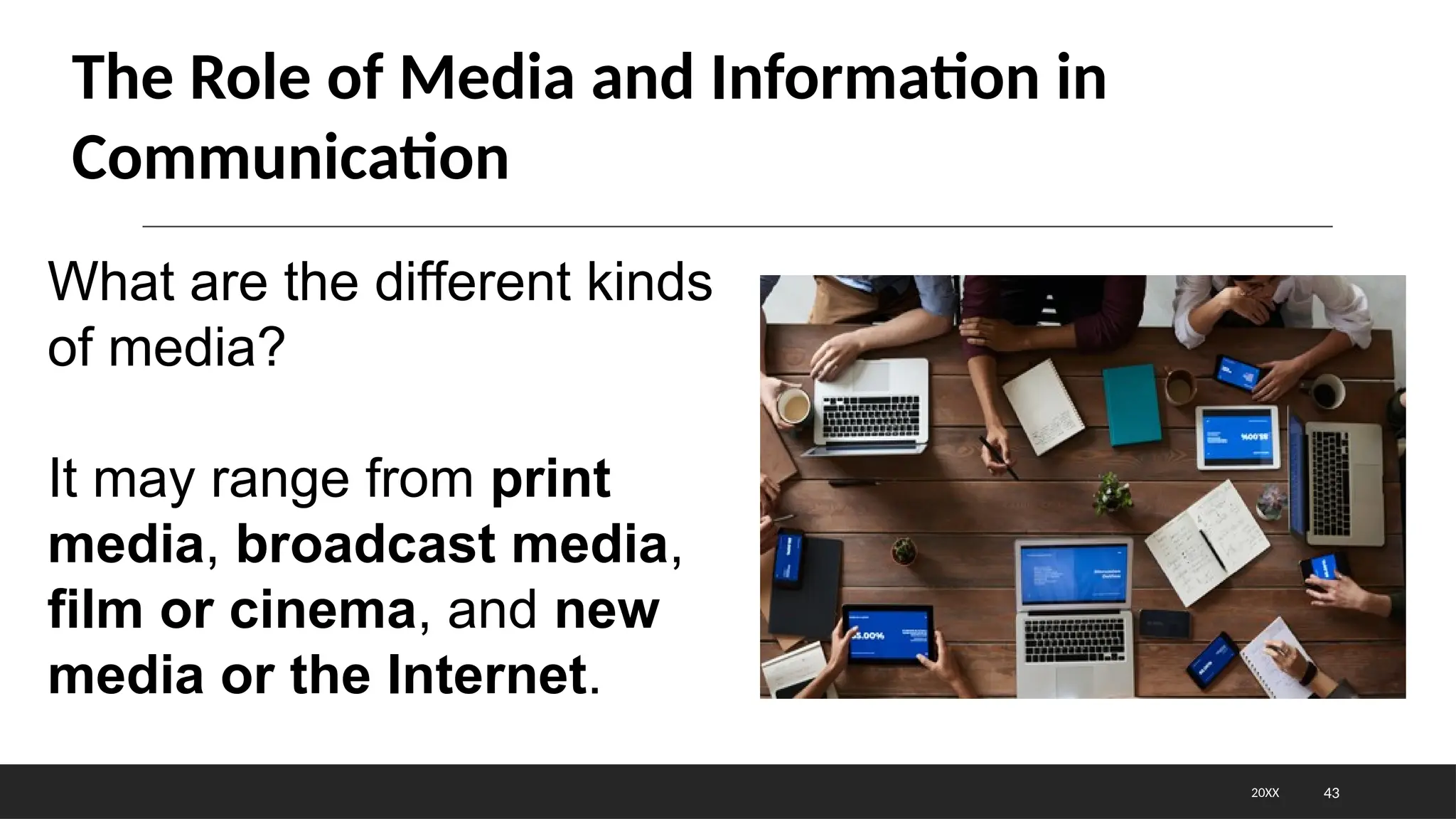
What are the different kinds
of media?
It may range from print
media, broadcast media,
film or cinema, and new
media or the Internet.
SAMPLE FOOTER TEXT 44
20XX
The Role of Media and Information in
Communication
The media has become a constant in the
lives of everyone as a source of news,
information, and entertainment. It is not
surprising that because of this, media and
information plays a vital role not only in
communication but in our lives.
SAMPLE FOOTER TEXT 45
20XX
1.It makes the world a smaller place
A person can be connected to anyone
else in the world at any given time.
media creates bridges between
countries and cultures without having
the need to travel physically.
2. It makes communication convenient
In the past, communicating with someone from far
away meant sending telegrams and snail mails.
Now, people may communicate without having to
wait long through the existence of the e-mail and
various messaging sites and apps.
20XX
SAMPLE FOOTER TEXT 46
SAMPLE FOOTER TEXT 47
20XX
3. It shapes public opinion
They can sway the opinion of their audience
according to the message they convey. When a TV
network broadcasts the results of a recent survey,
they do more than just inform the public where
their candidates currently stand. They also affect
the decision-making process of their listeners or
viewers in the upcoming elections.
SAMPLE FOOTER TEXT 48
Do you have any question?
20XX
Activity:
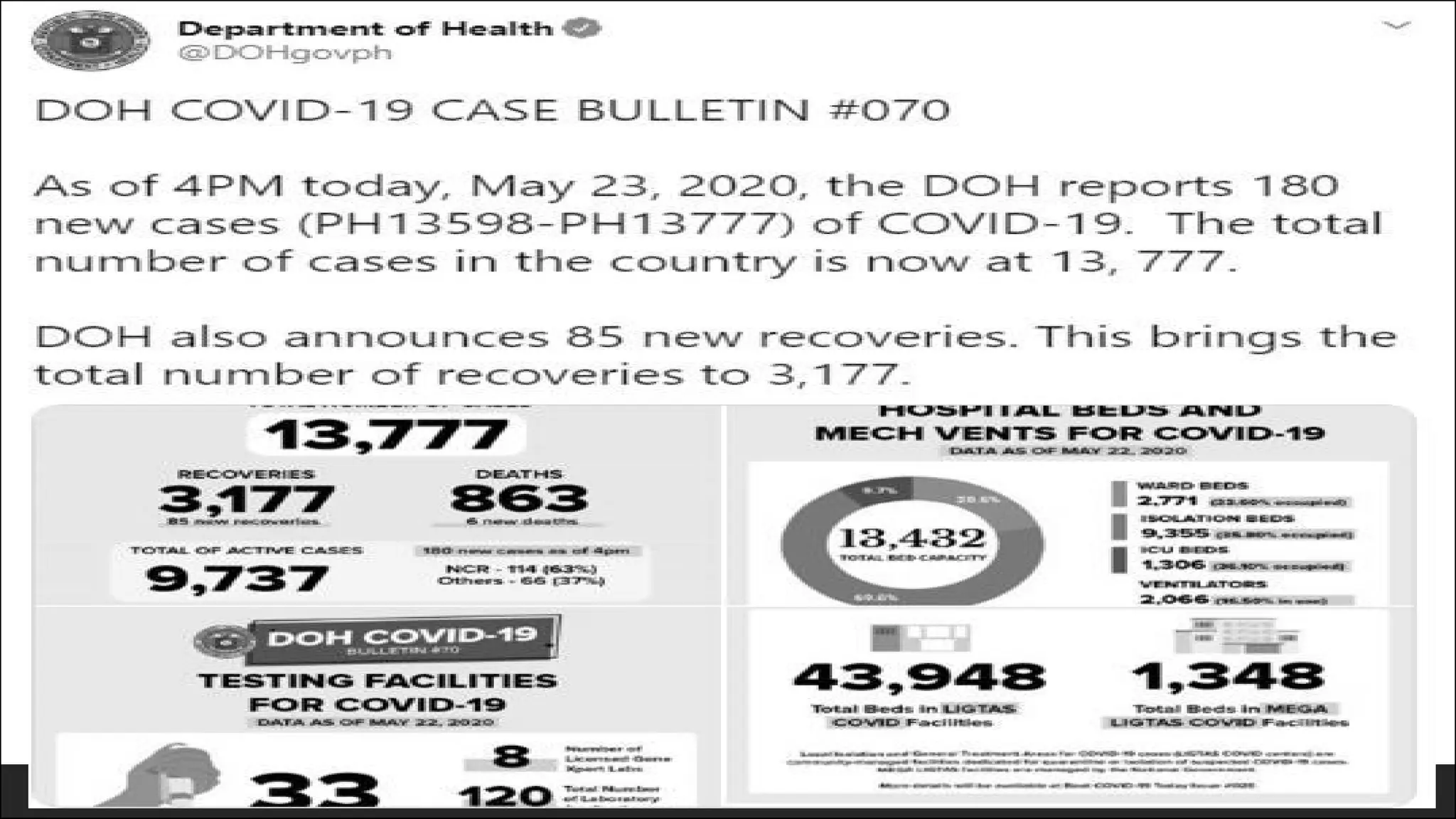
This is a tweet from the Department of
Health’s Official Twitter account. Your
task is to evaluate this graphic based on
the components found in the Media-
Message Evaluation Guide below.
20XX
SAMPLE FOOTER TEXT 49
SAMPLE FOOTER TEXT 50
20XX
SAMPLE FOOTER TEXT 51
20XX
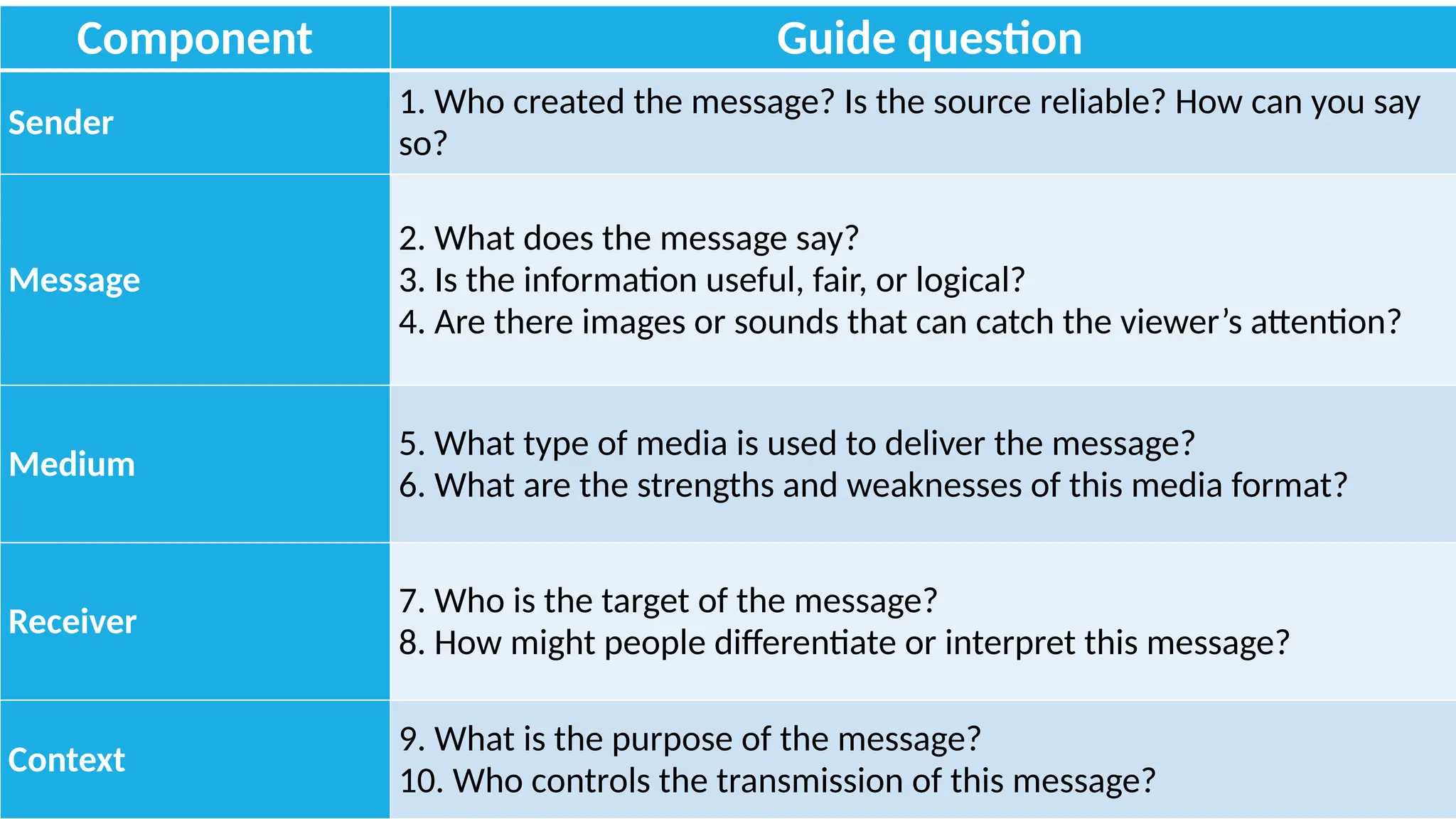
Component Guide question
Sender
1. Who created the message? Is the source reliable? How can you say
so?
Message
2. What does the message say?
3. Is the information useful, fair, or logical?
4. Are there images or sounds that can catch the viewer’s attention?
Medium
5. What type of media is used to deliver the message?
6. What are the strengths and weaknesses of this media format?
Receiver
7. Who is the target of the message?
8. How might people differentiate or interpret this message?
Context
9. What is the purpose of the message?
10. Who controls the transmission of this message?
SAMPLE FOOTER TEXT 52
20XX
Complete the sentence stem below. Write your answers on a separate sheet of paper.
1. Communication is a complex process because ______________________________
___________________________________________________________________________
___________________________________________________________.
2. Media and information plays an important role in communication because
___________________________________________________________________________
___________________________________________________________.
1. This is a Latin term which means
“to share” or “to make common.”
a. Communican c. Communicante
b. Communista d. Communicare
2. This component incorporates the
setting, scene, and other external
biases and expectations of the
participants of communication.
a. Feedback c. Interference
b. Context d. Transmitters
3. What do you call a component of
communication, which is a response
from the receiver and is sent back to
the source?
a. Feedback c. Interference
b. Context d. Transmitters
4. This is anything that blocks or
changes the source’s intended
meaning of the message.
a. Feedback c. Interference
b. Contextd. Transmitters
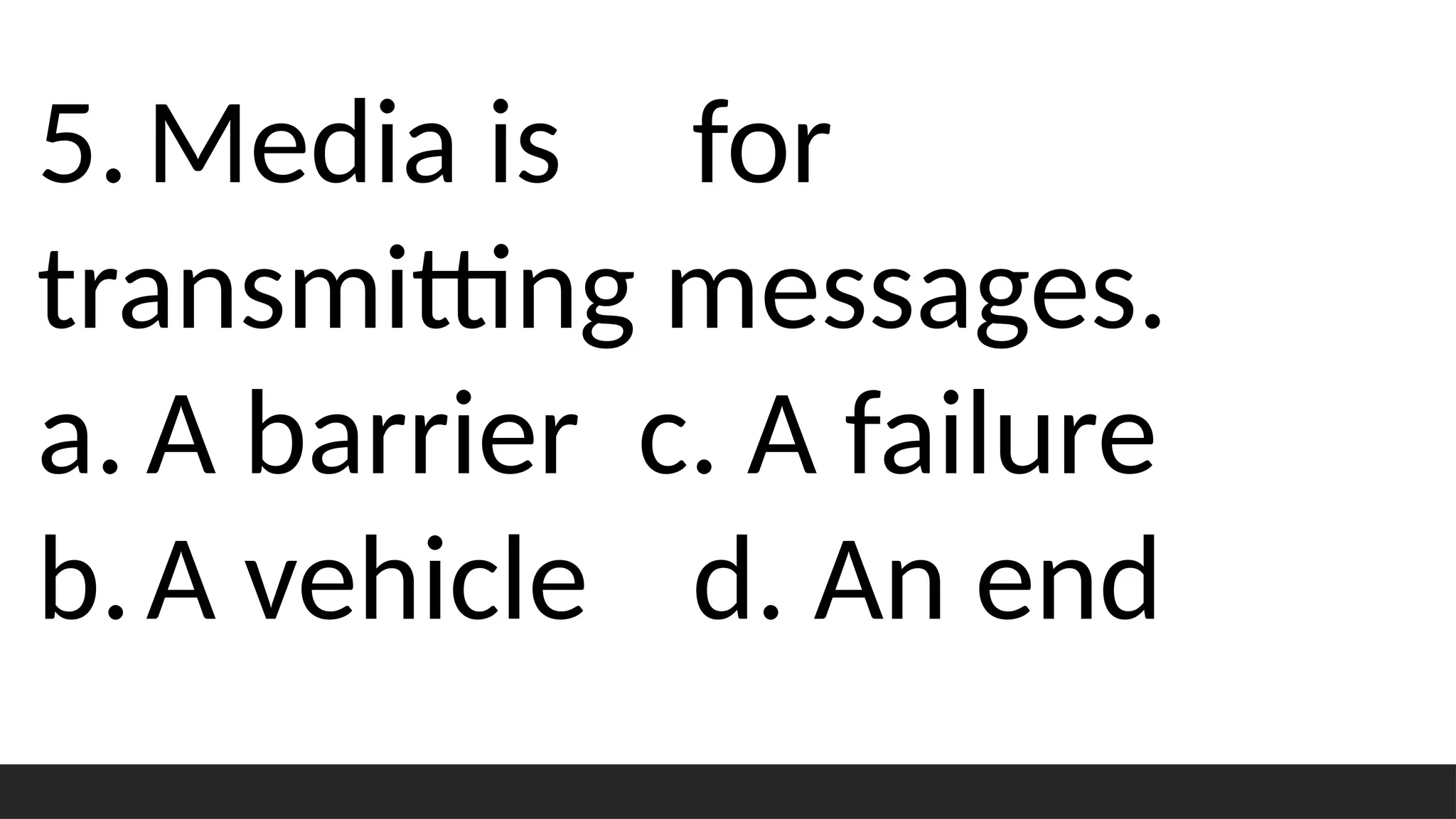
5.Media is for
transmitting messages.
a. A barrier c. A failure
b.A vehicle d. An end
6.Which among the
choices are NOT media?
a. Traffic signs c. Letters
b.Billboards d. None
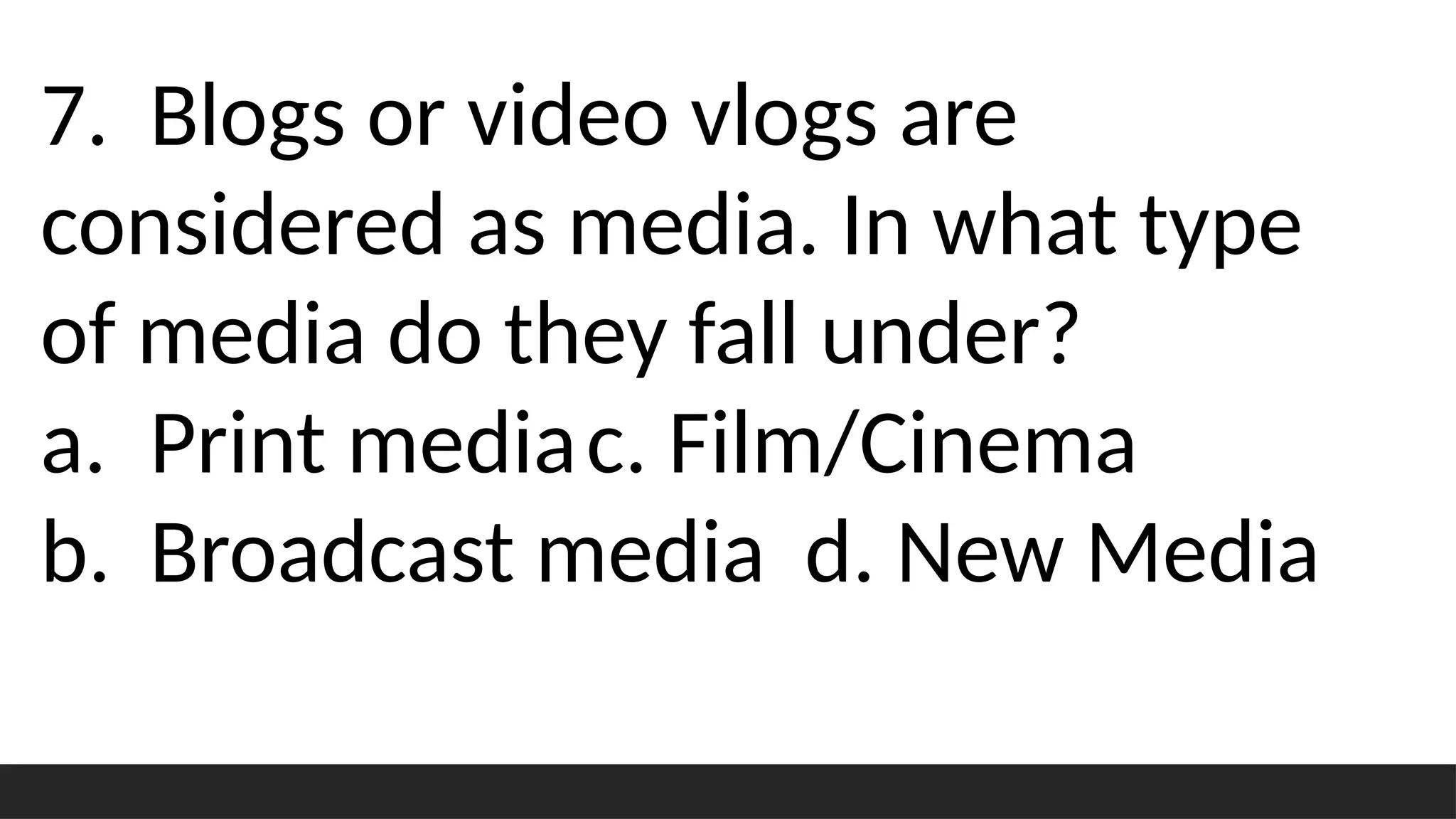
7. Blogs or video vlogs are
considered as media. In what type
of media do they fall under?
a. Print mediac. Film/Cinema
b. Broadcast media d. New Media
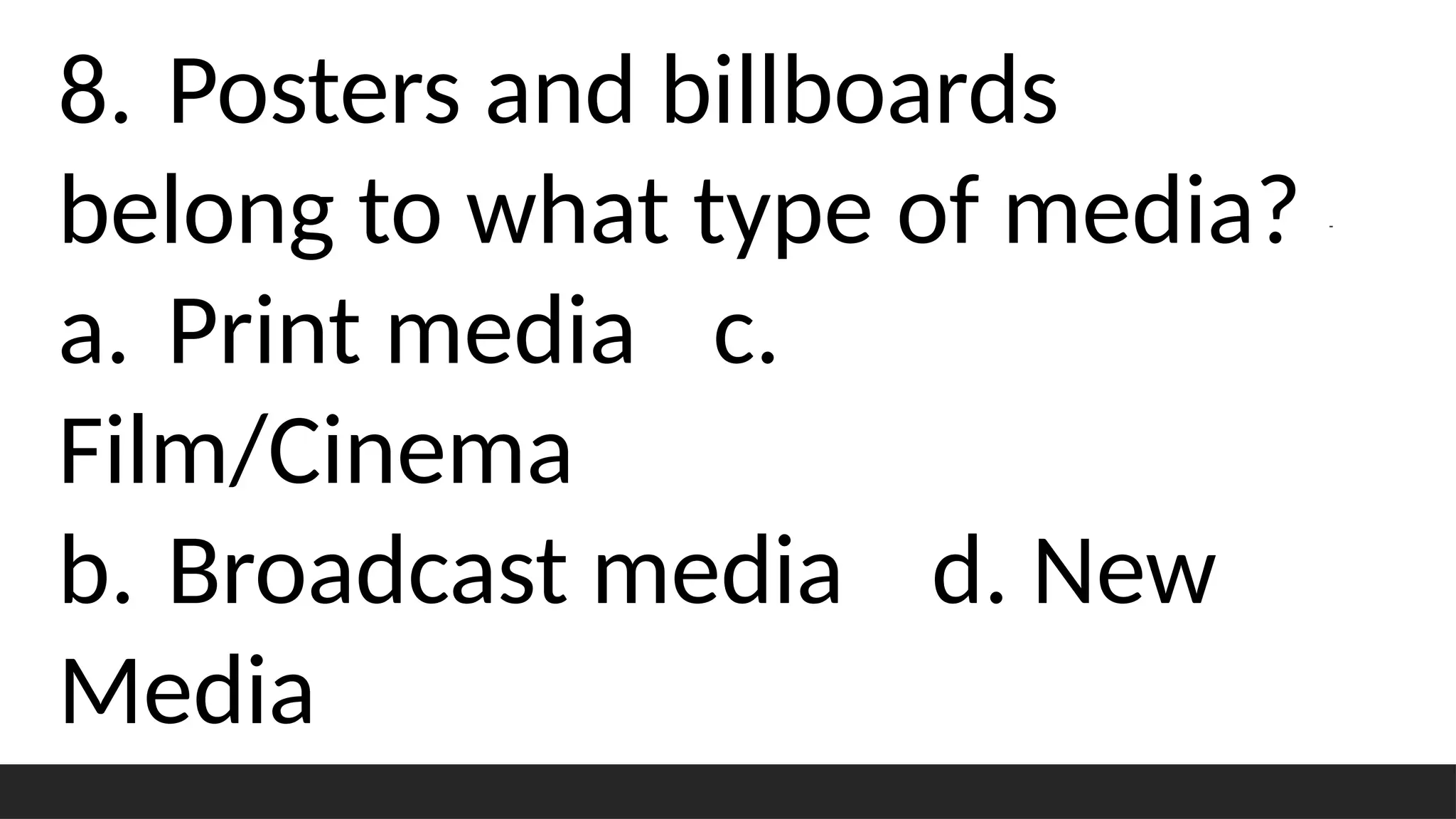
8. Posters and billboards
belong to what type of media?
a. Print media c.
Film/Cinema
b. Broadcast media d. New
Media
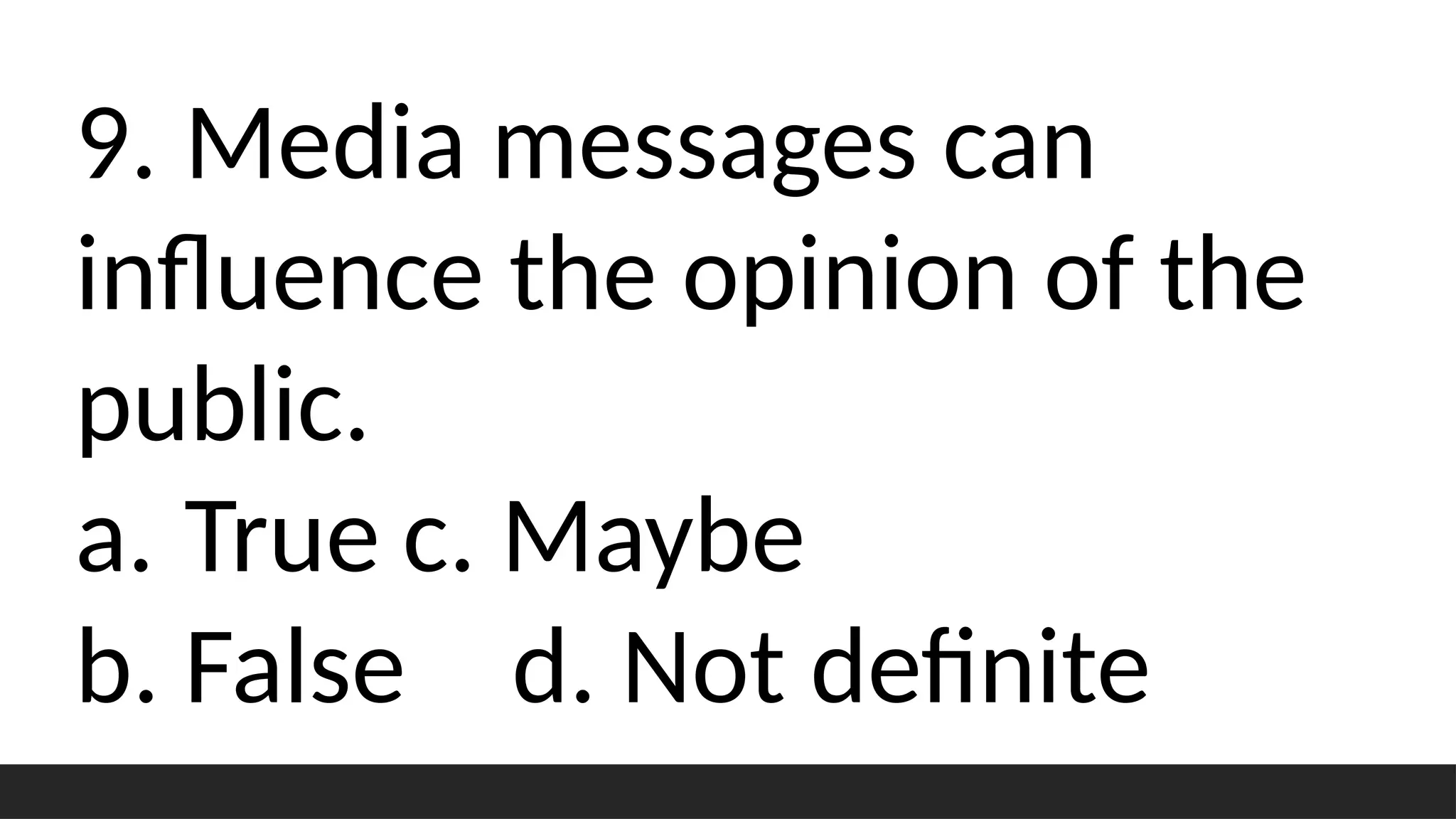
9. Media messages can
influence the opinion of the
public.
a. True c. Maybe
b. False d. Not definite
10. Changes in media and
technology will not change the
nature of your content.
a. True c. Maybe
b. False d. Not Definite

media and information literary introduction

  • 2.
    Prayer Lord Jesus, We praiseyou in your Passion, Death and Resurrection. We thank you for being with us in our sorrows, Pains and joys. We pray that through our classmates, parents, teachers and staff, we may see and encounter you in many ways. Teach us to be compassionate, Loving and forgiving as you are. May the Passion of Christ be always in our heart! Amen.
  • 4.
    SAMPLE FOOTER TEXT4 20XX Welcome to the world of Media
  • 5.
    SAMPLE FOOTER TEXT5 Let's conduct a brief test to assess your knowledge of media and information literacy. 20XX
  • 6.
    SAMPLE FOOTER TEXT6 1.It refers to anything that blocks or changes the source’s intended meaning of the message A. Medium C. Individual B. Technology D. Interference 20XX
  • 7.
    SAMPLE FOOTER TEXT7 2. It refers to tools used by the source to disseminate information to the receivers. a. Media c. Literacy b. Technology d. Information 20XX
  • 8.
    SAMPLE FOOTER TEXT8 3. It pertains to any information that is passed on through communication. a. Receiver c. Message b. Media d. Source 20XX
  • 9.
    SAMPLE FOOTER TEXT9 4. It refers to the atmosphere, physical and psychological, where you send and receive messages. a. Context c. Feedback b. Environmentd. Interference 20XX
  • 10.
    SAMPLE FOOTER TEXT10 5. New media is also referred to as ____________. a.Social Media c. the Internet b.Wi-Fi d. Artificial intelligence 20XX
  • 11.
  • 12.
    Activity: Breaking DownMiscommunication In your notebook, try to recall a major miscommunication or misunderstanding that you were involved in and its consequences. Describe such situation. Who or what was the reason of the misunderstanding? Explain what you did and give suggestions on how problems as such can be avoided in the future.
  • 13.
  • 14.
    The Role ofMedia in the Communication Process SAMPLE FOOTER TEXT 20XX 14
  • 15.
    Objectives SAMPLE FOOTER TEXT20XX 15 At the end of the lesson, students should be able to; • Recognize the different components in the communication process; • Understand how these elements connect and influence each other; and • Describe how communication is influenced by media and information.
  • 16.
    SAMPLE FOOTER TEXT16 Components of Communication Although intrinsic in nature, communication is deemed a complex process. The course through which information is sent, passed, or spread, involves several elements – elements which, in turn, have their own significant components. 20XX complex process sent, passed, or spread
  • 17.
  • 18.
    SAMPLE FOOTER TEXT18 Eight essential components of communication: 20XX 1.Source – a person, group, or entity that forms, creates, sends, or forwards a message or information
  • 19.
    SAMPLE FOOTER TEXT19 Eight essential components of communication: 20XX 2. Message – the stimulus or meaning produced by the source for the receiver or audience (McLean, 2005)
  • 20.
    SAMPLE FOOTER TEXT20 Eight essential components of communication: 20XX 3. Channel – the tool or manner in which the messages will be carried through from the source to the receiver
  • 21.
    SAMPLE FOOTER TEXT21 Eight essential components of communication: 20XX 4. Receiver – receives the message from the source, analyzing and interpreting the message in ways both intended and unintended by the source (McLean, 2005)
  • 22.
    SAMPLE FOOTER TEXT22 Eight essential components of communication: 20XX 5. Feedback – the message or response of the receiver which is sent back to the source
  • 23.
    SAMPLE FOOTER TEXT23 Eight essential components of communication: 20XX 6. Environment – the atmosphere, physical and psychological, where you send and receive messages (McLean, 2005)
  • 24.
    SAMPLE FOOTER TEXT24 Eight essential components of communication: 20XX 7. Context – the communication interaction involves the setting, scene, and expectations of the individuals involved (McLean, 2005)
  • 26.
    SAMPLE FOOTER TEXT26 Eight essential components of communication: 20XX 8. Interference – anything that blocks or changes the source’s intended meaning of the message (McLean, 2005)
  • 27.
  • 28.
  • 29.
    The root ofthe word “communication” in Latin is communicare, which means to share or to make common (Weekley, 1967). Furthermore, communication is defined as the process of understanding and sharing meaning (Pearson & Nelson, 2000). With this, we can see how communication has a lot to do with information sharing and arriving at a common understanding.
  • 30.
    SAMPLE FOOTER TEXT30 20XX The Communication Process through Models “Humans are social beings.”
  • 31.
    SAMPLE FOOTER TEXT31 1. HAROLD LASSWELL’S COMMUNICATION MODEL 20XX
  • 32.
    SAMPLE FOOTER TEXT32 2. SHANNON AND WEAVER’S COMMUNICATION MODEL 20XX Sender who encode the message Channel A device or medium that decode the message Person or entity that receives and interprets Interference The mother of all models
  • 33.
    SAMPLE FOOTER TEXT33 3. DAVID BERLO’S SMCR COMMUNICATION MODEL 20XX Why?
  • 34.
    SAMPLE FOOTER TEXT34 Forms of Communication Communication may come in different forms. These forms may vary and differ in terms of participants, channels used, and contexts. 20XX
  • 35.
    SAMPLE FOOTER TEXT35 1. Intrapersonal Communication 2. Interpersonal Communication 3. Group Communication 4. Public Communication 5. Mass Communication 20XX The following are the five main forms of communication:
  • 36.
    SAMPLE FOOTER TEXT36 1. Intrapersonal Communication 20XX communication with oneself or self-to-self communication
  • 37.
    SAMPLE FOOTER TEXT37 2. Interpersonal Communication 20XX communication between two or more people
  • 38.
    SAMPLE FOOTER TEXT38 3. Group Communication 20XX the act of sending and receiving messages to multiple members of a
  • 39.
    SAMPLE FOOTER TEXT39 4. Public Communication 20XX the practice of dispersing a message to the general populace or to a specific group using various tools and methods.
  • 40.
    SAMPLE FOOTER TEXT40 5. Mass Communication 20XX process of imparting and exchanging information through mass media to large population segments. It utilizes various forms of media as technology has made the dissemination of information more efficient.
  • 41.
    SAMPLE FOOTER TEXT41 20XX The Role of Media and Information in Communication This leads us to the two distinct elements that are intrinsically interconnected with the concept of communication – media and information. In other words, information is one of the reasons why communication is done in the first place, and this information can be shared through media.
  • 42.
    SAMPLE FOOTER TEXT42 20XX The Role of Media and Information in Communication media is an instrument for transmitting information – it’s the vehicle for a message.
  • 43.
    43 20XX The Role ofMedia and Information in Communication What are the different kinds of media? It may range from print media, broadcast media, film or cinema, and new media or the Internet.
  • 44.
    SAMPLE FOOTER TEXT44 20XX The Role of Media and Information in Communication The media has become a constant in the lives of everyone as a source of news, information, and entertainment. It is not surprising that because of this, media and information plays a vital role not only in communication but in our lives.
  • 45.
    SAMPLE FOOTER TEXT45 20XX 1.It makes the world a smaller place A person can be connected to anyone else in the world at any given time. media creates bridges between countries and cultures without having the need to travel physically.
  • 46.
    2. It makescommunication convenient In the past, communicating with someone from far away meant sending telegrams and snail mails. Now, people may communicate without having to wait long through the existence of the e-mail and various messaging sites and apps. 20XX SAMPLE FOOTER TEXT 46
  • 47.
    SAMPLE FOOTER TEXT47 20XX 3. It shapes public opinion They can sway the opinion of their audience according to the message they convey. When a TV network broadcasts the results of a recent survey, they do more than just inform the public where their candidates currently stand. They also affect the decision-making process of their listeners or viewers in the upcoming elections.
  • 48.
    SAMPLE FOOTER TEXT48 Do you have any question? 20XX
  • 49.
    Activity: This is atweet from the Department of Health’s Official Twitter account. Your task is to evaluate this graphic based on the components found in the Media- Message Evaluation Guide below. 20XX SAMPLE FOOTER TEXT 49
  • 50.
  • 51.
    SAMPLE FOOTER TEXT51 20XX Component Guide question Sender 1. Who created the message? Is the source reliable? How can you say so? Message 2. What does the message say? 3. Is the information useful, fair, or logical? 4. Are there images or sounds that can catch the viewer’s attention? Medium 5. What type of media is used to deliver the message? 6. What are the strengths and weaknesses of this media format? Receiver 7. Who is the target of the message? 8. How might people differentiate or interpret this message? Context 9. What is the purpose of the message? 10. Who controls the transmission of this message?
  • 52.
    SAMPLE FOOTER TEXT52 20XX Complete the sentence stem below. Write your answers on a separate sheet of paper. 1. Communication is a complex process because ______________________________ ___________________________________________________________________________ ___________________________________________________________. 2. Media and information plays an important role in communication because ___________________________________________________________________________ ___________________________________________________________.
  • 53.
    1. This isa Latin term which means “to share” or “to make common.” a. Communican c. Communicante b. Communista d. Communicare
  • 54.
    2. This componentincorporates the setting, scene, and other external biases and expectations of the participants of communication. a. Feedback c. Interference b. Context d. Transmitters
  • 55.
    3. What doyou call a component of communication, which is a response from the receiver and is sent back to the source? a. Feedback c. Interference b. Context d. Transmitters
  • 56.
    4. This isanything that blocks or changes the source’s intended meaning of the message. a. Feedback c. Interference b. Contextd. Transmitters
  • 57.
    5.Media is for transmittingmessages. a. A barrier c. A failure b.A vehicle d. An end
  • 58.
    6.Which among the choicesare NOT media? a. Traffic signs c. Letters b.Billboards d. None
  • 59.
    7. Blogs orvideo vlogs are considered as media. In what type of media do they fall under? a. Print mediac. Film/Cinema b. Broadcast media d. New Media
  • 60.
    8. Posters andbillboards belong to what type of media? a. Print media c. Film/Cinema b. Broadcast media d. New Media
  • 61.
    9. Media messagescan influence the opinion of the public. a. True c. Maybe b. False d. Not definite
  • 62.
    10. Changes inmedia and technology will not change the nature of your content. a. True c. Maybe b. False d. Not Definite