MEDIA AND INFORMATION LITERACY
MEDIA, INFORMATION
AND TECHNOLOGY
LITERACY
FAKE NEWS AND HOAXES
Activity 1. : Media Use Log
“Today's topic embodies essential knowledge that should allow
users to engage with media and information channels in a
meaningful manner.” Bring out a sheet of paper.
 think of the past week, and record your use and interaction with
media and information providers (such as internet, social media,
TV, radio, newspaper, etc.)
indicate how many hours were spent engaged with each one.
(these do not have to be exact, and they can estimate the number
of hours they spend each week.
FAKE NEWS AND HOAXES
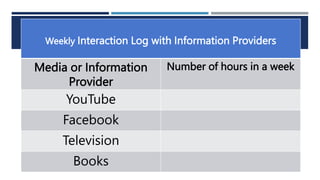
Weekly Interaction Log with Information Providers
Media or Information
Provider
Number of hours in a week
YouTube
Facebook
Television
Books
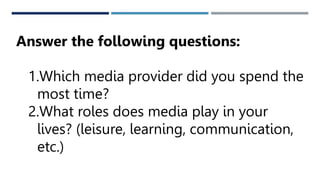
Answer the following questions:
1.Which media provider did you spend the
most time?
2.What roles does media play in your
lives? (leisure, learning, communication,
etc.)
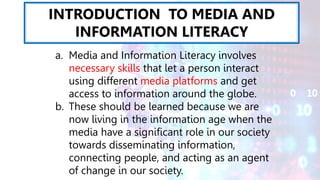
INTRODUCTION TO MEDIA AND
INFORMATION LITERACY
a. Media and Information Literacy involves
necessary skills that let a person interact
using different media platforms and get
access to information around the globe.
b. These should be learned because we are
now living in the information age when the
media have a significant role in our society
towards disseminating information,
connecting people, and acting as an agent
of change in our society.
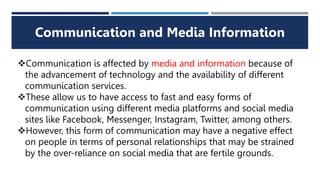
Communication and Media Information
Communication is affected by media and information because of
the advancement of technology and the availability of different
communication services.
These allow us to have access to fast and easy forms of
communication using different media platforms and social media
sites like Facebook, Messenger, Instagram, Twitter, among others.
However, this form of communication may have a negative effect
on people in terms of personal relationships that may be strained
by the over-reliance on social media that are fertile grounds.
FAKE NEWS AND HOAXES
.
FAKE NEWS AND HOAX
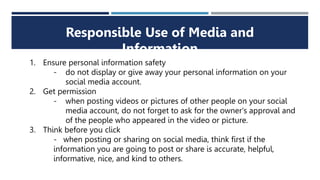
Responsible Use of Media and
Information
1. Ensure personal information safety
- do not display or give away your personal information on your
social media account.
2. Get permission
- when posting videos or pictures of other people on your social
media account, do not forget to ask for the owner's approval and
of the people who appeared in the video or picture.
3. Think before you click
- when posting or sharing on social media, think first if the
information you are going to post or share is accurate, helpful,
informative, nice, and kind to others.
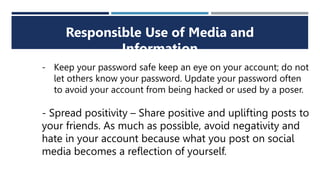
Responsible Use of Media and
Information
- Keep your password safe keep an eye on your account; do not
let others know your password. Update your password often
to avoid your account from being hacked or used by a poser.
- Spread positivity – Share positive and uplifting posts to
your friends. As much as possible, avoid negativity and
hate in your account because what you post on social
media becomes a reflection of yourself.
KEY CONCEPTS ABOUT MEDIA,
INFORMATION AND TECHNOLOGY
LITERACY
WHAT IS LITERACY?
The ability to identify, understand, interpret,
create, communicate and compute, using
printed and written materials associated with
varying contexts. Literacy involves a continuum
of learning, wherein individuals are able to
achieve their goals, develop their knowledge
and potential, and participate fully in their
community and wider society
WHAT IS MEDIA?
The physical objects used to communicate with,
or the mass communication through physical
objects such as radio, television, computers,
film, etc. It also refers to any physical object
used to communicate messages.
WHAT IS MEDIA LITERACY?
UNESCO identified the key elements of media literacy, and
these follows:
1. Understand the role of media and functions of media in
democratic societies
2. Understand the conditions where media can fulfill their
functions
3. Critically evaluate media content in the light of media
functions
4. Engage with media content in the light of media
functions
WHAT IS MEDIA LITERACY?
The ability to access, analyze, evaluate, and
create media in a variety of forms. It aims
to empower citizens by providing them
with the competencies (knowledge and
skills) necessary to engage with traditional
media and new technologies.
PREREQUISITES OF MEDIA LITERACY
1.Understand how media function;
2.how they construct reality and create
meaning; and
3.how they organized as well as knowing
how to use the media in a sensible way.
WHAT IS INFORMATION LITERACY?
 The ability to recognize when
information is needed, and to locate,
evaluate, and effectively communicate
information in its various formats.
INFORMATION COMPETENCIES
 The information literate person is
capable, in Mackenzie’s words of:
• Prospecting – to locate relevant
information to sort it and to select it.
• Interpreting –to translate the data and
information into knowledge.
• Creating new ideas –developing new
ideas.
WHAT IS TECHNOLOGY LITERACY?
The Colorado Department of Education define technology
literacy as the ability to responsibly use appropriate
technology to:
• Communicate
• Solve problems
• Access, manage, evaluate and create information.
• Acquire lifelong knowledge and skills in the 21st
Century.
Small Group Discussions
 In your opinion, what makes an individual
literate in media and information?
 What activities/habits do you practice
which illustrate media and information
literacy? Give at least three examples
END OF 1ST WEEK
THANK YOU
 someone@example.com
EVOLUTION OF
TRADITIONAL MEDIA
TO NEW MEDIA
THANK YOU
 someone@example.com
“During the time of your ancestors,
how do you think did they transmit
information to their relatives from
the other places?”
THANK YOU
 someone@example.com
“At present, how do you think
did they transmit information to
their relatives from the other
places?”
WHAT IS TRADITIONAL MEDIA?
The term refers to the traditional
means of communication and
expression that have existed since
before the advent of internet.
EXAMPLES OF TRADITIONAL MEDIA
TV
Radio
Newspaper
Billboard
Direct Mall
ADVANTAGES OF USING TRADITIONAL MEDIA
1.Easy to consume
2.Wider Education
3.Better general knowledge
4.Trusted
WHAT IS NEW MEDIA?
- Refers to content organized and
distributed on digital platforms.
SCOPE OF NEW MEDIA
1. Social Media
2. Search Engine Marketing (SEM)
3. Search Engine Optimization (SEO)
4. Blogs
SOCIAL MEDIA
- The term social media is often associated with
Facebook, X (formerly known as Twitter),
Snapchat and others.
- Social media as forms of electronic
communication through which users create
online communities to share information,
ideas, personal, messages, and content (as
video).
TYPES OF SOCIAL MEDIA
1. Social Networking
2. Video Sharing
3. Live-Streaming
4. Microblogging
5. Blogging
6. Social News
7. Photo Sharing
8. Content Curations
9. Wikis
1. SOCIAL NETWORKING
- A platforms allow users to connect with
others.
a. Facebook
b. LinkedIn
c. Google
2. VIDEO SHARING
- Allowing its users to upload videos that
can be shared.
a. YouTube
b. Vimeo
3. LIVE-STREAMING
- Platforms provide its users to broadcast
and watch live video.
a. Periscope
b. Blab
4. MICROBLOGGING
- Platforms allow users to share content
and information in short, little burbs.
a. Twitter
b. Tumbler
5. BLOGGING
- Blogs are written content or video
content that can read, view,
comment and share.
a. WordPress
b. Blogger
6. SOCIAL NEWS
- Type of the platforms goes over
some people’s head.
- Is used to share news or outside
articles with the community or
network.
7. PHOTO SHARING
- Sharing images on the internet.
a. Instagram
b. Flicker
8. CONTENT CURATION
THANK YOU
 someone@example.com
HOW HAS MEDIA
EVOLVED?
Media and information literacylesso.pptx

Media and information literacylesso.pptx

  • 1.
  • 2.
  • 3.
    FAKE NEWS ANDHOAXES Activity 1. : Media Use Log “Today's topic embodies essential knowledge that should allow users to engage with media and information channels in a meaningful manner.” Bring out a sheet of paper.  think of the past week, and record your use and interaction with media and information providers (such as internet, social media, TV, radio, newspaper, etc.) indicate how many hours were spent engaged with each one. (these do not have to be exact, and they can estimate the number of hours they spend each week.
  • 4.
    FAKE NEWS ANDHOAXES Weekly Interaction Log with Information Providers Media or Information Provider Number of hours in a week YouTube Facebook Television Books
  • 5.
    Answer the followingquestions: 1.Which media provider did you spend the most time? 2.What roles does media play in your lives? (leisure, learning, communication, etc.)
  • 6.
    INTRODUCTION TO MEDIAAND INFORMATION LITERACY a. Media and Information Literacy involves necessary skills that let a person interact using different media platforms and get access to information around the globe. b. These should be learned because we are now living in the information age when the media have a significant role in our society towards disseminating information, connecting people, and acting as an agent of change in our society.
  • 7.
    Communication and MediaInformation Communication is affected by media and information because of the advancement of technology and the availability of different communication services. These allow us to have access to fast and easy forms of communication using different media platforms and social media sites like Facebook, Messenger, Instagram, Twitter, among others. However, this form of communication may have a negative effect on people in terms of personal relationships that may be strained by the over-reliance on social media that are fertile grounds.
  • 8.
    FAKE NEWS ANDHOAXES . FAKE NEWS AND HOAX
  • 9.
    Responsible Use ofMedia and Information 1. Ensure personal information safety - do not display or give away your personal information on your social media account. 2. Get permission - when posting videos or pictures of other people on your social media account, do not forget to ask for the owner's approval and of the people who appeared in the video or picture. 3. Think before you click - when posting or sharing on social media, think first if the information you are going to post or share is accurate, helpful, informative, nice, and kind to others.
  • 10.
    Responsible Use ofMedia and Information - Keep your password safe keep an eye on your account; do not let others know your password. Update your password often to avoid your account from being hacked or used by a poser. - Spread positivity – Share positive and uplifting posts to your friends. As much as possible, avoid negativity and hate in your account because what you post on social media becomes a reflection of yourself.
  • 11.
    KEY CONCEPTS ABOUTMEDIA, INFORMATION AND TECHNOLOGY LITERACY
  • 12.
    WHAT IS LITERACY? Theability to identify, understand, interpret, create, communicate and compute, using printed and written materials associated with varying contexts. Literacy involves a continuum of learning, wherein individuals are able to achieve their goals, develop their knowledge and potential, and participate fully in their community and wider society
  • 13.
    WHAT IS MEDIA? Thephysical objects used to communicate with, or the mass communication through physical objects such as radio, television, computers, film, etc. It also refers to any physical object used to communicate messages.
  • 14.
    WHAT IS MEDIALITERACY? UNESCO identified the key elements of media literacy, and these follows: 1. Understand the role of media and functions of media in democratic societies 2. Understand the conditions where media can fulfill their functions 3. Critically evaluate media content in the light of media functions 4. Engage with media content in the light of media functions
  • 15.
    WHAT IS MEDIALITERACY? The ability to access, analyze, evaluate, and create media in a variety of forms. It aims to empower citizens by providing them with the competencies (knowledge and skills) necessary to engage with traditional media and new technologies.
  • 16.
    PREREQUISITES OF MEDIALITERACY 1.Understand how media function; 2.how they construct reality and create meaning; and 3.how they organized as well as knowing how to use the media in a sensible way.
  • 17.
    WHAT IS INFORMATIONLITERACY?  The ability to recognize when information is needed, and to locate, evaluate, and effectively communicate information in its various formats.
  • 18.
    INFORMATION COMPETENCIES  Theinformation literate person is capable, in Mackenzie’s words of: • Prospecting – to locate relevant information to sort it and to select it. • Interpreting –to translate the data and information into knowledge. • Creating new ideas –developing new ideas.
  • 19.
    WHAT IS TECHNOLOGYLITERACY? The Colorado Department of Education define technology literacy as the ability to responsibly use appropriate technology to: • Communicate • Solve problems • Access, manage, evaluate and create information. • Acquire lifelong knowledge and skills in the 21st Century.
  • 20.
    Small Group Discussions In your opinion, what makes an individual literate in media and information?  What activities/habits do you practice which illustrate media and information literacy? Give at least three examples
  • 21.
  • 22.
    THANK YOU  someone@example.com EVOLUTIONOF TRADITIONAL MEDIA TO NEW MEDIA
  • 23.
    THANK YOU  someone@example.com “Duringthe time of your ancestors, how do you think did they transmit information to their relatives from the other places?”
  • 24.
    THANK YOU  someone@example.com “Atpresent, how do you think did they transmit information to their relatives from the other places?”
  • 25.
    WHAT IS TRADITIONALMEDIA? The term refers to the traditional means of communication and expression that have existed since before the advent of internet.
  • 26.
    EXAMPLES OF TRADITIONALMEDIA TV Radio Newspaper Billboard Direct Mall
  • 27.
    ADVANTAGES OF USINGTRADITIONAL MEDIA 1.Easy to consume 2.Wider Education 3.Better general knowledge 4.Trusted
  • 28.
    WHAT IS NEWMEDIA? - Refers to content organized and distributed on digital platforms.
  • 29.
    SCOPE OF NEWMEDIA 1. Social Media 2. Search Engine Marketing (SEM) 3. Search Engine Optimization (SEO) 4. Blogs
  • 30.
    SOCIAL MEDIA - Theterm social media is often associated with Facebook, X (formerly known as Twitter), Snapchat and others. - Social media as forms of electronic communication through which users create online communities to share information, ideas, personal, messages, and content (as video).
  • 31.
    TYPES OF SOCIALMEDIA 1. Social Networking 2. Video Sharing 3. Live-Streaming 4. Microblogging 5. Blogging 6. Social News 7. Photo Sharing 8. Content Curations 9. Wikis
  • 32.
    1. SOCIAL NETWORKING -A platforms allow users to connect with others. a. Facebook b. LinkedIn c. Google
  • 33.
    2. VIDEO SHARING -Allowing its users to upload videos that can be shared. a. YouTube b. Vimeo
  • 34.
    3. LIVE-STREAMING - Platformsprovide its users to broadcast and watch live video. a. Periscope b. Blab
  • 35.
    4. MICROBLOGGING - Platformsallow users to share content and information in short, little burbs. a. Twitter b. Tumbler
  • 36.
    5. BLOGGING - Blogsare written content or video content that can read, view, comment and share. a. WordPress b. Blogger
  • 37.
    6. SOCIAL NEWS -Type of the platforms goes over some people’s head. - Is used to share news or outside articles with the community or network.
  • 38.
    7. PHOTO SHARING -Sharing images on the internet. a. Instagram b. Flicker
  • 39.
  • 40.