CHAPTER II 
MEDCO SINGA CPP DESCRIPTION  
2.1. OPERATIONS and PROCESS  
LNG  processing  facility  Singa  Central  Processing  CPP  is  the  operating  phase  of  the  separation  and 
purification of natural gas from four (4) existing wells in field. STAGEs of processing operations of gas flow 
from the well done aims to meet the specifications of the desired gas by Perusahaan Gas Negara (PGN) 
unit area of South Sumatra. Production capacity at Singa Field CPP each well by 30 MMSCFD.    
1. the Gas processing Unit Singa CPP consists of:  
a. Gas Gathering System,  
b. Separation System  
c. Acid Gas Removal System  
d. Dehydration Unit System,  
e. Thermal Unit Oxidasi,  
f. Sales Gas Pipeline and Pagardewa Receiving Facilities  
 
2. Supporting Utilities Unit consisting of:  
g. the Thermal Fluid System,  
h. Closed Drain System.   
i. Water Treatment Unit * Fire Water,  
j. Produced Water/Disposal  
k. Unit Power generators, Diesel Fuel System  
 
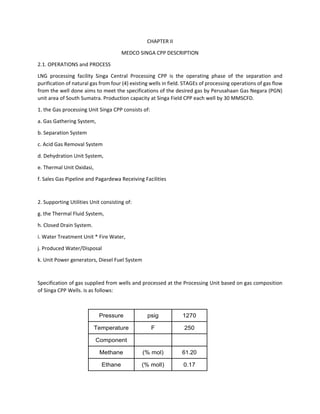
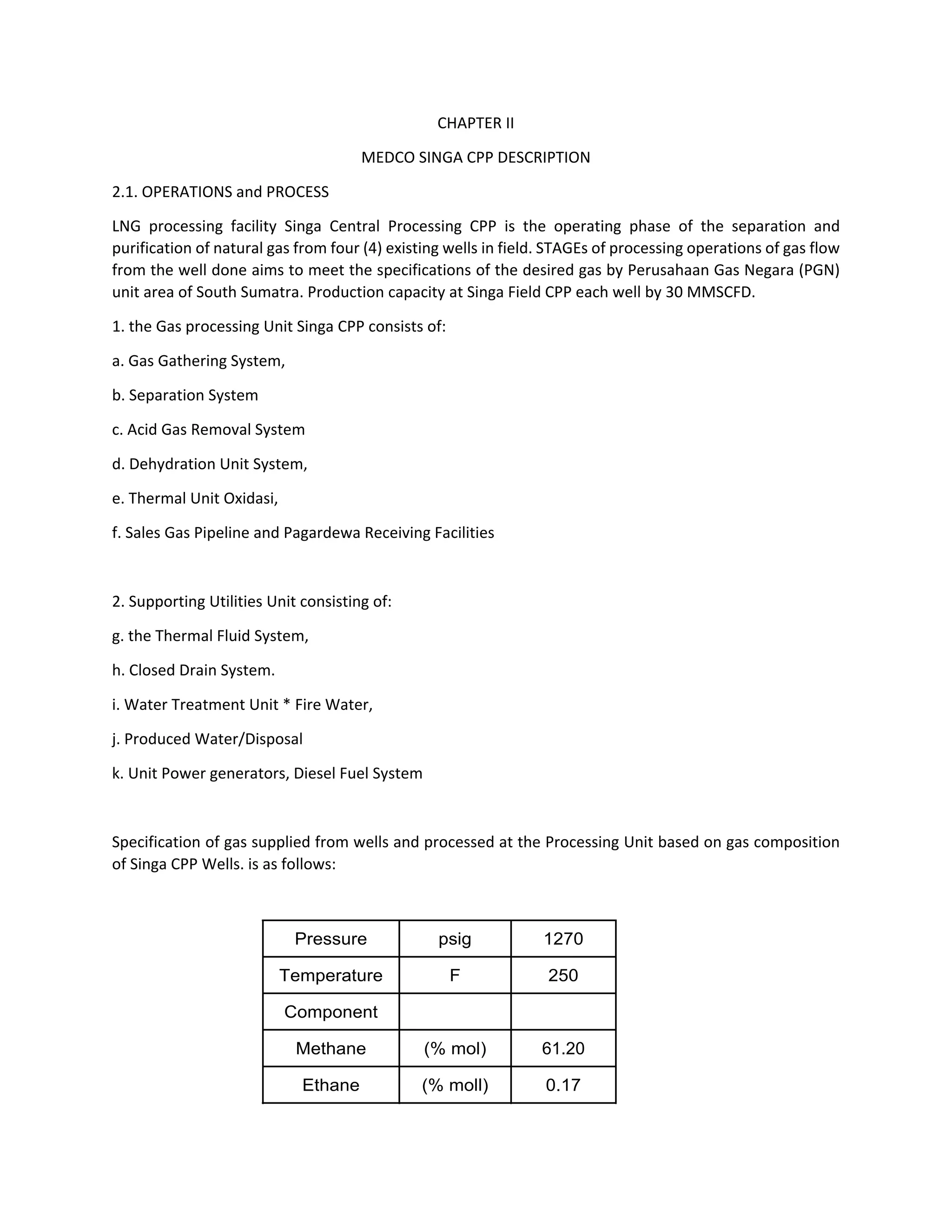
Specification of gas supplied from wells and processed at the Processing Unit based on gas composition 
of Singa CPP Wells. is as follows: 
Pressure psig 1270
Temperature F 250
Component
Methane (% mol) 61.20
Ethane (% moll) 0.17
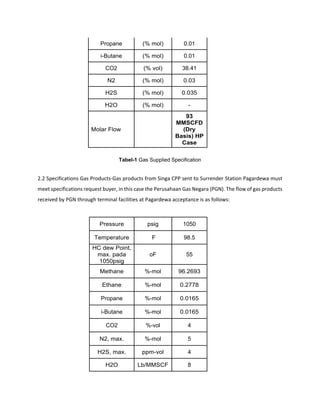
Propane (% mol) 0.01
i-Butane (% mol) 0.01
CO2 (% vol) 38.41
N2 (% mol) 0.03
H2S (% mol) 0.035
H2O (% mol) -
Molar Flow
93
MMSCFD
(Dry
Basis) HP
Case
Tabel-1 Gas Supplied Specification
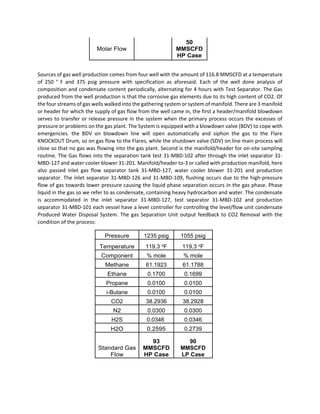
2.2 Specifications Gas Products‐Gas products from Singa CPP sent to Surrender Station Pagardewa must 
meet specifications request buyer, in this case the Perusahaan Gas Negara (PGN). The flow of gas products 
received by PGN through terminal facilities at Pagardewa acceptance is as follows: 
 
Pressure psig 1050
Temperature F 98.5
HC dew Point,
max. pada
1050psig
oF 55
Methane %-mol 96.2693
Ethane %-mol 0.2778
Propane %-mol 0.0165
i-Butane %-mol 0.0165
CO2 %-vol 4
N2, max. %-mol 5
H2S, max. ppm-vol 4
H2O Lb/MMSCF 8
Molar Flow
50
MMSCFD
HP Case
 
Sources of gas well production comes from four well with the amount of 116.8 MMSCFD at a temperature 
of  250  °  F  and  375  psig  pressure  with  specification  as  aforesaid.  Each  of  the  well  done  analysis  of 
composition and condensate content periodically, alternating for 4 hours with Test Separator. The Gas 
produced from the well production is that the corrosive gas elements due to its high content of CO2. Of 
the four streams of gas wells walked into the gathering system or system of manifold. There are 3 manifold 
or header for which the supply of gas flow from the well came in, the first a header/manifold blowdown 
serves to transfer or release pressure in the system when the primary process occurs the excesses of 
pressure or problems on the gas plant. The System is equipped with a blowdown valve (BDV) to cope with 
emergencies.  the  BDV  on  blowdown  line  will  open  automatically  and  siphon  the  gas  to  the  Flare 
KNOCKOUT Drum, so on gas flow to the Flares, while the shutdown valve (SDV) on line main process will 
close so that no gas was flowing into the gas plant. Second is the manifold/header for on‐site sampling 
routine. The Gas flows into the separation tank test 31‐MBD‐102 after through the inlet separator 31‐
MBD‐127 and water cooler blower 31‐201. Manifold/header to‐3 or called with production manifold, here 
also  passed  inlet  gas  flow  separator  tank  31‐MBD‐127,  water  cooler  blower  31‐201  and  production 
separator. The inlet separator 31‐MBD‐126 and 31‐MBD‐109, flushing occurs due to the high‐pressure 
flow of gas towards lower pressure causing the liquid phase separation occurs in the gas phase. Phase 
liquid in the gas so we refer to as condensate, containing heavy hydrocarbon and water. The condensate 
is  accommodated  in  the  inlet  separator  31‐MBD‐127,  test  separator  31‐MBD‐102  and  production 
separator 31‐MBD‐101 each vessel have a level controller for controlling the level/flow unit condensate 
Produced Water Disposal System. The gas Separation Unit output feedback to CO2 Removal with the 
condition of the process: 
Pressure 1235 psig 1055 psig
Temperature 119.3 oF 119.3 oF
Component % mole % mole
Methane 61.1923 61.1788
Ethane 0.1700 0.1699
Propane 0.0100 0.0100
i-Butane 0.0100 0.0100
CO2 38.2936 38.2928
N2 0.0300 0.0300
H2S 0.0346 0.0346
H2O 0.2595 0.2739
Standard Gas
Flow
93
MMSCFD
HP Case
90
MMSCFD
LP Case
 
2.3 CO2 Removal Unit and Membrane  
Acid Gas Removal Unit (AGRU) consists of the Amine unit and Membrane units that operate in parallel. 
The function of this unit in goal to lower the concentration of CO2 and H2S in gas flow feed. The content 
of CO2 and H2S in gas feed, each about 38% and 0.03% mole. As the desired gas flow product has content 
of CO2 and H2S out AGRU respectively 4% mole maximum and 4 ppmv.   Feed the gas into the system 
through the gas filter AGRU separator 35‐MAJ‐103 which filter out particles of solids > 10 micron.  Gas 
flow exit gas filter separator part towards the membrane unit and amine units. 
1. Absorber (35‐MAF‐104)  
on the Amine unit, CO2 and H2S in the flow of acid gas (sour gas) absorbed by amine solution 
through two STAGEs, namely through the lean amine stream of spring and the lean amine.  The 
flow of gas from the Gas Filter (35‐JANG‐103) enters from the bottom of the absorber Tower (35‐
MAF‐104) in 1194 psig and flows into the 118oF meliwati 4 STAGE tower over the bed, packing 
the absorber is going with the flow of gas between the contact spring lean and lean amin in 
opposite  direction  (counter  current).  CO2  and  H2S  is  absorbed  and  react  chemically  with  a 
solution of methyldiethanolamine (aMDEA).  Gas flow out of the top of the Tower the absorber 
(sweet gas) into the Sweet Gas KO drums 35‐MBD‐109 with van plate (pack) on top of it with the 
size of the diameter of 10 glow aims to prevent dew bubble liquid amine/MDEA (losses) carried 
by the gas flow. Out of amine loop system, due to the flow of sweet gas is saturated with water 
then the need to separate the content of water in a stream of sweet gas. 
 
2. Amine System  
Solution out of the base of the absorber is called Rich amine. Flows out of the base of the column 
to the Amine Flash Column 35‐MBF‐105.  Flow rate set by the level controller on the basis of the 
absorber  opens  and  closes  a  control  valve  35‐LV‐104  to  keep  high  fluid  (level)  of  rich  amine 
constant.  Rich amine on the basis of flash column in the into two streams, 85% of the total stream 
flow into the Semi Lean Pumps 35‐PBA‐331A/B/C and 15% goes to Rich Pumps 35‐PBA‐333A/b. 
Rich amine Solution of Flash Column on 13 psig and 168 0F, flows into the Lean/Rich Amine 
Exchangers 35‐HZZ‐204 through Rich Pump 35‐PBA‐333A/B and in the heat to temperature 218 
0F. The exchangers are used is the type of plate frames. The flow of rich amine into the Amine 
Regenerator 35‐NAF‐107 the top column after pressure was lowered from 30 to 20 psig with no 
flow valve 35‐FV‐714. This column ran on the top column pressure psig 12 and 14 psig pressure 
at the base of the column, liquid accumulated inside the accumulator tray Amine Regenerator 
flows into Reboiler Amine 35‐HBC‐205.  In the reboiler, liquid heated with hot oil.  Part of the 
liquid evaporates. Steam coming out from the top of reboiler in regenerator base and headed out 
of the regenerator.     The Liquid overflow through the top of the weir is a solution of acid gas 
content with lean to be grilled more on TOX and Flare. The flow of liquid out of the boiler flowing 
back gravity to the regenerator.   Reboiler uses hot oil as a heating source. The heat entered the 
reboiler set with control 35‐FV‐716 on hot oil line.  Incoming heat controlled by setting the set 
point  flow  controler.  Hot  lean  amine  regenerator  flows  out  of  the  base  into  the  lean  Amine 
Exchange through the Lean side Booster Pumps 35‐PBA‐337A/B in which heat is exchanged with 
the cold rich amine from the flash column. Lean amine in chill temperature to 125 0F with Lean 
Cooler 35‐HAL‐202. Lean amine has been in the refrigerator through the lean Amine cooler then 
headed into the Absorber 35‐MAF‐104.  Before entering the absorber, through 35‐FIC‐712 10% 
lean amine from Booster Pumps are intended to the Amine Particulate filter‐35‐JANG‐108, 40% 
of the flow of the lean amine in transferred to the Amine Charcoal Filter 35‐JANG‐109 and Amine 
Particulate After filter‐35‐JANG‐111 to take contaminant particles and later transferred to both 
Amine Absorber using pump 35‐PBA‐334A/B. 
 
3. Acid Gas System  
Acid gas out of the flash column on 12 psig and 161 oF and cooled with condenser 35‐HAL‐203 to 
temperature 140 oF.  The flow out of the condenser is a mixture of water and acid, into the 
accumulator 30‐MBD‐109 which served as a gas‐liquid separator.  Acid gas passing through the 
accumulator  to  the  Thermal  Oxidizer  (T‐Ox).    The  water  that  goes  into  the  bottom  of  the 
accumulator flow Flash Column using a reflux pump 35‐PBA‐332A/B.   Acid gas is burned inside 
the chimney Thermal Oxidizer before safely and in accordance with the gas quality emissions 
government regulation role to be released into the atmosphere through the vent stack. 
 
A. Antifoam Injection System  
Antifoam Injection System was installed to minimize Antifoam injection of foam (foam) in the 
amine system. Flow injection antifoam are:  
• Suction of the Reflux Pumps (35‐PBA‐332A/B)  
• Suction of Rich Pumps (35‐PBA‐333A/B)  
• Suction of Lean Pumps (35‐PBA‐334A/B)  
 
B. Membrane Unit  
STAGE  I  Membrane  Pre  Treatment  System  of  gas  filter  Gas  Feed  45  MILLION  towards  the 
membrane unit and the rest flows to the amine unit.  The Feed gas at 1230 psig and 119 0F entered 
the tube side of the Gas/Gas Exchanger 35‐HBG‐281 in the chill to the temperature of the gas 
residue 88 oF Membrane Skid Package STAGE I.  A Gas has on the chill in the First STAGE Filter 
Coalescer 35‐MAJ‐175 to eliminate the water and the condensed hydrocarbons.  Vapor at 1223 
psig and 87oF streamed to the First STAGE Electrical Heater 35‐NAP‐681 to raise the temperature 
to 109 oF.  The Feed gas is then transferred to the First STAGE Guard bed 35‐MBA‐182 and First 
STAGE Particle Filter 35‐JANG‐183 for the first. 
 
B.1. STAGE I Membrane Skid Package Each membrane is made up of four skids of bank with 7 
pieces  of  tube,  membrane  tube  has  four  nozzle:  A  nozzle  the  inlet  feed‐gas.  ‐One  nozzle  for 
residual gas outlet. ‐Two nozzle to permeate outlet gas. Separex membrane elements made from 
cellulose acetat which has two layers: the thick micro porous layer and a thin active layer on top 
of the micro porous layer. The Feed gas into the tube membrane and distributed into membrane 
meliwati high pressure channel spacer. Along the way the gas inside the tube membrane, CO2, 
H2S, and other materials which are highly permeable to quickly penetrate the membrane to reach 
into a permeate channel spacer. Components permeate this move with spiral patterns in a tube 
to permeate tube. Components with  such a small permeable  methane power missed in high 
pressure channel spacer next element flows into or out of the membrane tube, go to residual 
header. The flow of incoming feedback flow freely from the element to the element on the eve 
of the U‐cup seal installed in upstream side of each element. Each tip out the covered with epoxy 
membrane elements.  The Feed gas enters Membrane Skid Package STAGE I in 1210 psig and 
109oF. Unit membrane lowers CO2 and H2S from the gas feed 38.4 mole% down to 4% mole and 
H2S 346 ppm‐v down to 18 ppm‐v, each producing gas 24.7 MMSCFD. Then the gas is heated by 
Gas/Gas Exchanger 35‐HBG‐281 up to 111 oF.  Due to the high content of H2S is still high, mounted 
two H2S scavenger units 35‐MBA‐187A/B to reduce the content of H2S below 4 ppm‐v to fit the 
sales gas specification before it is combined with outlet flow of gas Dehydration Unit. 
 
2.4 Dehydration Unit (DHU)  
Dehydration Unit (DHU) of sweet gas from the Amine Absorber is saturated with water equilibrium. Then 
on the next process aimed at making the content of the water in the stream of sweet gas. Dehydration 
unit used a solution of Triethylene glycol (TEG) as absorben to absorb water.  This Unit consists of two 
parts, dehydration and regeneration. 
 
a. TEG Contactor 36‐MAF‐112 gas dehydration Process feed takes place in counter current in the Glycol 
Contactor between lean TEG with high pressure gas feed. Gas flow which is rich in moisture content (wet 
gas) through a series of internal part a mist pad on top to prevent contactor glycol loss.  Gas with a 
moisture content of smaller 8 lb/MMSCFD later in the chill by lean TEG up to temperature in contact 
through 25oF the Gas Glycol Heat Exchanger 36‐HBG‐206.  Rich TEG 93.72% wt in 1183 psig out through 
the bottom TEG contactor, then in flash to 85 psig pressure and flow to the Glycol Still Column 36‐HBA‐
209. 
 
b. TEG Regeneration System Rich TEG 93.72% wt on 1183 psig out through the bottom Glycol Contactor, 
flash up to 85 psig pressure and flow to the Glycol Flash Separator 36‐MBD‐109 via level control 36‐LV‐
112A. A large part of hydrocarbons is not dissolved and sour gas from the liquid in the flash TEG into flash 
drum.  Rich TEG (containing water) from the flash drum into two‐STAGE filter system. TEG Particulate 
Filter 36‐JANG‐116 take the particles larger than 5 microns, and heavy hydrocarbons not dissolved and 
organic contaminant in the Carbon Filter TEG take on 36‐JANG‐117.  Clean, rich TEG then flows into the 
Hot Glycol/Glycol Exchanger 36‐HBG‐207A. Rich TEG heated to temperature 329 ° F via the exchange of a 
hot, lean TEG of Glycol Reboiler Surge Tank 36‐MBD‐109 and then into the low pressure still column 36‐
HBA‐209. The flow of rich TEG entry and flow down in the TEG still column, a number of hydrocarbons in 
water and evaporating of glycol with heat still column packing.
TEG into reboiler is heated under a temperature of boiling glycol. Lean TEG on 385 ° F flowing towards a 
surge vessel, the liquid level is maintained by using a weir in the reboiler, TEG then flow by the gravity of 
the reboiler flow through the shell side Hot Glycol/Glycol exchanger 36‐HBG‐207A and Cold Glycol/Glycol 
Exchanger  36‐HBG‐207B,  cooled  to  170  °  F  by  interchanging  with  the  rich  TEG.    Lean  TEG  out  heat 
exchangers  and  gravity  flow  toward  Lean  TEG  Pumps  36‐PBA‐337A/b.  Lean  TEG  then  dipompakan 
Gas/Glycol Exchanger 36‐HBG206 and cooled down to 138.4 ° by exchanging heat with effluent dry gas 
from the TEG Contactor. Cool lean TEG (98.83% wt‐TEG) and then flows into the tray top contactor. 
 
2.4 Thermal Oxidizer (T‐Ox)  
Waste gas from the permeate Membrane Units and acid gas from the Amine Unit burned (oxidation) first 
before released into the atmosphere. Thermal Oxidizers function to burn exhaust gases and absorb heat 
to hot oil used for heating in the Waste Heat Recovery Unit.  The Thermal Oxidizer unit consists of:  
• Main Burner  
• Incinerator  
• Stack  
• Induced and Forced Draft Fan 
• Waste Heat Recovery Unit (WHRU) 
 
Josh
Digitally signed by Josh
DN: cn=Josh, o, ou,
email=joser.mbo@gmail.
com, c=ID
Date: 2013.06.11 11:54:18
+07'00'
2.3.5 Sales Gas Header, Pig Launcher Pagardewa Station Receiver Sales gas outlet DHU combined with 
Sales of H2S Gas Scavenger sent to Pagardewa through pipe 12 "is 42 km from CPP Medco Lematang EP.  
To equalize the pressure between the two outlets, mounted a pressure valve 38‐PV‐702 with a pressure 
drop of about 30 psi on the Dehydration Unit.    Sales Gas header in complete with a Pig Launcher for 
pigging line transfer gas from the Singa to the CPP Pagardewa metering station. 
The pressure on the line pipe sales gas is maintained using a control valve 38‐PV‐701. A portion of the 
amount of gas delivered to flare gas if the pressure exceeds the set point of sales. At Pagardewa Station, 
line is equipped with: 2 instruments online analyzer H2O, H2S, and GC online. 
 

MEDCO SINGA CPP PROCESSING