www.studymafia.org
Submitted To: Submitted By:
www.studymafia.org www.studymafia.org
Seminar
On
Lathe Machine
Content
• Introduction
• History
• Uses
• Operations of Lathe Machine
• Parts of the Lathe
• Lathe Bed
• Headstock
• Quick-Change Gearbox
• Carriage
• Advantages
• Types
• Special Types of Lathes
• Conclusion
• References
Introduction
• Lathe is one of the most important machine tools in the metal
working industry. A lathe operates on the principle of a rotating
work piece and a fixed cutting tool.
• The cutting tool is feed into the work piece, which rotates
about its own axis, causing the work piece to be formed to the
desired shape.
Lathe machine is also known as “the mother/father of the entire
tool family”.
HISTORY
• The lathe machine is one of the oldest and most important
machine tools. As early as 1569, wood lathes were in use in
France.
• The lathe machine was adapted to metal cutting in England
during the Industrial Revolution.
• Lathe machine also called “Engine Lathe” because the first
type of lathe was driven by a steam engine.
USES
 Wood Lathing
 Metal Lathing
 Acrylic Lathing
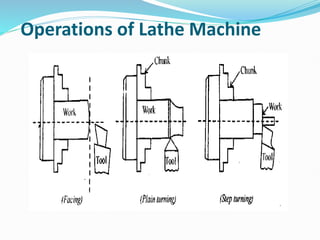
Operations of Lathe Machine
Operations of Lathe Machine…
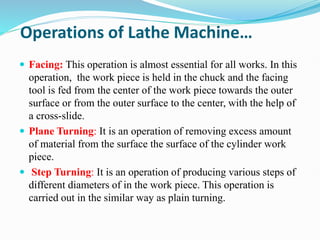
 Facing: This operation is almost essential for all works. In this
operation, the work piece is held in the chuck and the facing
tool is fed from the center of the work piece towards the outer
surface or from the outer surface to the center, with the help of
a cross-slide.
 Plane Turning: It is an operation of removing excess amount
of material from the surface the surface of the cylinder work
piece.
 Step Turning: It is an operation of producing various steps of
different diameters of in the work piece. This operation is
carried out in the similar way as plain turning.
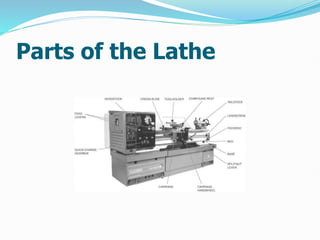
Parts of the Lathe
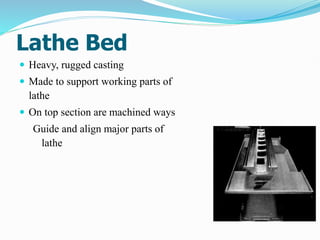
Lathe Bed
 Heavy, rugged casting
 Made to support working parts of
lathe
 On top section are machined ways
Guide and align major parts of
lathe
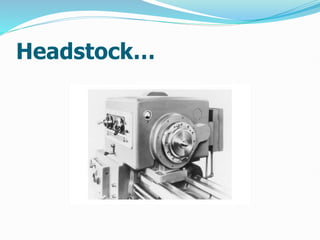
Headstock
 Clamped on left-hand end of bed
 Headstock spindle
 Hollow cylindrical shaft supported by bearings
 Provides drive through gears to work-holding devices
 Live center, faceplate, or chuck fitted to spindle nose to hold
and drive work
 Driven by stepped pulley or transmission gears
 Feed reverse lever
 Reverses rotation of feed rod and lead screw
Headstock…
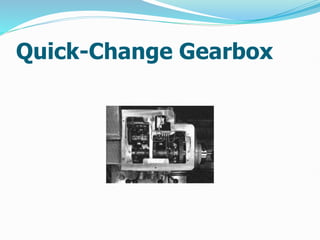
Quick-Change Gearbox
 Contains number of different-size gears
 Provides feed rod and lead-screw with various speeds for
turning and thread-cutting operations
 Feed rod advances carriage when automatic feed lever
engaged
 Lead screw advances the carriage for thread-cutting
operations when split-nut lever engaged
Quick-Change Gearbox
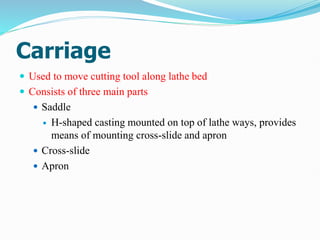
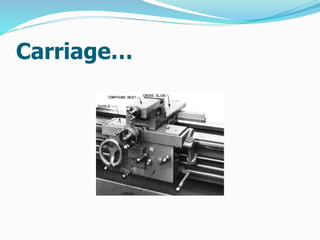
Carriage
 Used to move cutting tool along lathe bed
 Consists of three main parts
 Saddle
 H-shaped casting mounted on top of lathe ways, provides
means of mounting cross-slide and apron
 Cross-slide
 Apron
Carriage…
Advantages
Accuracy
Speed
Cost Effectiveness
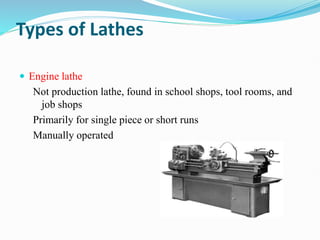
Types of Lathes
 Engine lathe
Not production lathe, found in school shops, tool rooms, and
job shops
Primarily for single piece or short runs
Manually operated
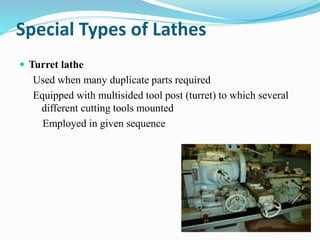
Special Types of Lathes
 Turret lathe
Used when many duplicate parts required
Equipped with multisided tool post (turret) to which several
different cutting tools mounted
Employed in given sequence
Special Types of Lathes…
 Single- and multiple-spindle automatic lathes
 Six or eight different operations may be performed on many
parts at the same time
 Will produce parts for as long as required
 Tracer lathes
 Used where a few duplicate parts required
 Hydraulically operated cross-slide controlled by stylus
bearing against round or flat template
 Conventional/programmable lathe
 Operated as standard lathe or programmable lathe to
automatically repeat machining operations
Conclusion
 Computerized Numerical Control (CNC) machining
technology is a mouthful, but it is also fascinating by using
computers to create metal parts and products for equipment and
machines.
 In more simple terms, it is high-tech machining technology.
References
 www.studymafia.org
 www.google.com
 www.wikipedia.com
THANKS

mech lathe machine ppt.pptx

  • 1.
    www.studymafia.org Submitted To: SubmittedBy: www.studymafia.org www.studymafia.org Seminar On Lathe Machine
  • 2.
    Content • Introduction • History •Uses • Operations of Lathe Machine • Parts of the Lathe • Lathe Bed • Headstock • Quick-Change Gearbox • Carriage • Advantages • Types • Special Types of Lathes • Conclusion • References
  • 3.
    Introduction • Lathe isone of the most important machine tools in the metal working industry. A lathe operates on the principle of a rotating work piece and a fixed cutting tool. • The cutting tool is feed into the work piece, which rotates about its own axis, causing the work piece to be formed to the desired shape. Lathe machine is also known as “the mother/father of the entire tool family”.
  • 4.
    HISTORY • The lathemachine is one of the oldest and most important machine tools. As early as 1569, wood lathes were in use in France. • The lathe machine was adapted to metal cutting in England during the Industrial Revolution. • Lathe machine also called “Engine Lathe” because the first type of lathe was driven by a steam engine.
  • 5.
    USES  Wood Lathing Metal Lathing  Acrylic Lathing
  • 6.
  • 7.
    Operations of LatheMachine…  Facing: This operation is almost essential for all works. In this operation, the work piece is held in the chuck and the facing tool is fed from the center of the work piece towards the outer surface or from the outer surface to the center, with the help of a cross-slide.  Plane Turning: It is an operation of removing excess amount of material from the surface the surface of the cylinder work piece.  Step Turning: It is an operation of producing various steps of different diameters of in the work piece. This operation is carried out in the similar way as plain turning.
  • 8.
  • 9.
    Lathe Bed  Heavy,rugged casting  Made to support working parts of lathe  On top section are machined ways Guide and align major parts of lathe
  • 10.
    Headstock  Clamped onleft-hand end of bed  Headstock spindle  Hollow cylindrical shaft supported by bearings  Provides drive through gears to work-holding devices  Live center, faceplate, or chuck fitted to spindle nose to hold and drive work  Driven by stepped pulley or transmission gears  Feed reverse lever  Reverses rotation of feed rod and lead screw
  • 11.
  • 12.
    Quick-Change Gearbox  Containsnumber of different-size gears  Provides feed rod and lead-screw with various speeds for turning and thread-cutting operations  Feed rod advances carriage when automatic feed lever engaged  Lead screw advances the carriage for thread-cutting operations when split-nut lever engaged
  • 13.
  • 14.
    Carriage  Used tomove cutting tool along lathe bed  Consists of three main parts  Saddle  H-shaped casting mounted on top of lathe ways, provides means of mounting cross-slide and apron  Cross-slide  Apron
  • 15.
  • 16.
  • 17.
    Types of Lathes Engine lathe Not production lathe, found in school shops, tool rooms, and job shops Primarily for single piece or short runs Manually operated
  • 18.
    Special Types ofLathes  Turret lathe Used when many duplicate parts required Equipped with multisided tool post (turret) to which several different cutting tools mounted Employed in given sequence
  • 19.
    Special Types ofLathes…  Single- and multiple-spindle automatic lathes  Six or eight different operations may be performed on many parts at the same time  Will produce parts for as long as required  Tracer lathes  Used where a few duplicate parts required  Hydraulically operated cross-slide controlled by stylus bearing against round or flat template  Conventional/programmable lathe  Operated as standard lathe or programmable lathe to automatically repeat machining operations
  • 20.
    Conclusion  Computerized NumericalControl (CNC) machining technology is a mouthful, but it is also fascinating by using computers to create metal parts and products for equipment and machines.  In more simple terms, it is high-tech machining technology.
  • 21.
  • 22.

Editor's Notes