NATIVE ADVERTISING
AGENDA AGENDA
1| Origin and Definition of Native Advertising
2| Status Quo
3| Drivers of the Trend
4| Relevance for Brand Communications
5| Categorisation of Native Advertising Types
6| Role of Native within the Customer Journey
7| Measurement
8| Critical Reflection and Recommendation
2
Everybod
y talks
about it.
3
No one
really
knows
exactly
what it is.4
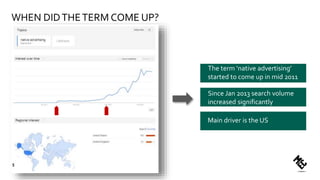
WHEN DIDTHETERM COME UP?
The term ‘native advertising’
started to come up in mid 2011
Since Jan 2013 search volume
increased significantly
Main driver is the US
5
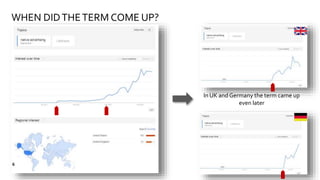
WHEN DIDTHETERM COME UP?
In UK and Germany the term came up
even later
6
SEEMSTO BE A NEW PHENOMENON?!?
7
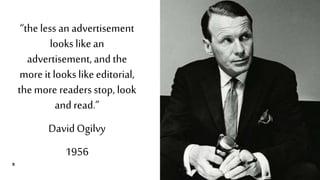
“the less an advertisement
looks likean
advertisement, and the
more it looks likeeditorial,
themore readers stop, look
and read.”
DavidOgilvy
1956
8
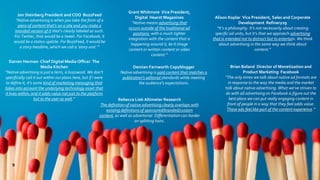
Brian Boland Director of Monetization and
Product Marketing Facebook
“The only times we talk about native ad formats are
in response to the way the media and the market
talk about native advertising. What we’ve striven to
do with all advertising on Facebook is figure out the
best place we can put really engaging content in
front of people in a way that they feel adds value.
These ads feel like part of the content experience.”
Grant Whitmore Vice President,
Digital Hearst Magazines
“Native means advertising that
occurs outside of the traditional ad
positions, with a much tighter
integration with the content that is
happening around it, be it image
content or written content or video
content.”
Jon Steinberg President and COO BuzzFeed
“Native advertising is when you take the form of a
piece of content that’s on a site and you make a
branded version of it that’s clearly labeled as such.
For Twitter, that would be a tweet. For Facebook, it
would be a status update. For BuzzFeed, it would be
a story headline, which we call a ‘story unit.’”
Darren Herman Chief Digital Media Officer The
Media Kitchen
“Native advertising is just a term, a buzzword. We don’t
specifically call it out within our plans here, but if I were
to define it, it’s some kind of marketing messaging that
takes into account the underlying technology asset that
it lives within, and it adds value not just to the platform
but to the user as well.”
Alison Koplar Vice President, Sales and Corporate
Development Refinery29
“It’s a philosophy. It’s not necessarily about creating
specific ad units, but it’s that we approach advertising
that is intended not to distract but to entertain. We think
about advertising in the same way we think about
content.”
Demian Farnworth Copyblogger
Native advertising is paid content that matches a
publication’s editorial standards while meeting
the audience’s expectations.
Rebecca Lieb Altimeter Research
The definition of native advertising clearly overlaps with
existing definitions of sponsored/branded/custom
content, as well as advertorial. Differentiation can border
on splitting hairs.
9
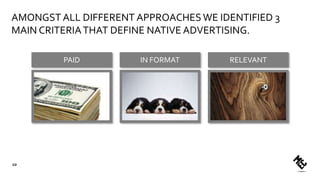
PAID IN FORMAT RELEVANT
AMONGST ALL DIFFERENT APPROACHES WE IDENTIFIED 3
MAIN CRITERIATHAT DEFINE NATIVE ADVERTISING.
10
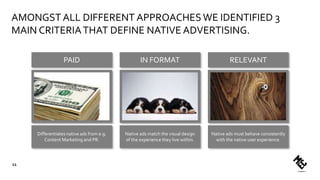
PAID IN FORMAT RELEVANT
AMONGST ALL DIFFERENT APPROACHES WE IDENTIFIED 3
MAIN CRITERIATHAT DEFINE NATIVE ADVERTISING.
Differentiates native ads from e.g.
Content Marketing and PR.
Native ads match the visual design
of the experience they live within.
Native ads must behave consistently
with the native user experience.
11
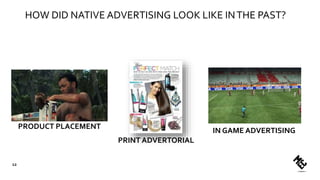
HOW DID NATIVE ADVERTISING LOOK LIKE INTHE PAST?
PRODUCT PLACEMENT
PRINT ADVERTORIAL
IN GAME ADVERTISING
12
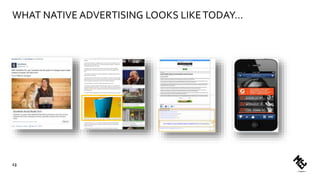
WHAT NATIVE ADVERTISING LOOKS LIKETODAY…
13
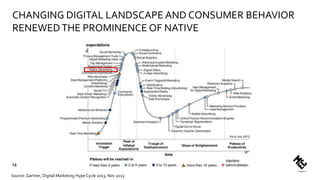
OLD CONCEPT – NEW HYPE!
14
Source: Gartner, Digital Marketing Hype Cycle 2013, Nov 2013
CHANGING DIGITAL LANDSCAPE AND CONSUMER BEHAVIOR
RENEWEDTHE PROMINENCE OF NATIVE
15
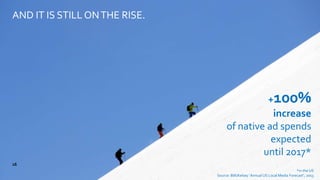
AND IT IS STILL ONTHE RISE.
+100%
increase
of native ad spends
expected
until 2017*
*in the US
Source: BIA/Kelsey ‘Annual US Local Media Forecast’, 2013
16
WHAT DRIVES
THATTREND?
17
Banner
blindness
Mobile era
Market
landscape
#upgrading#
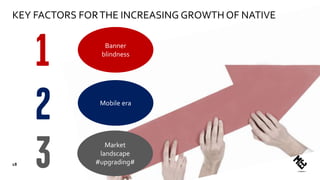
KEY FACTORS FORTHE INCREASING GROWTH OF NATIVE
18
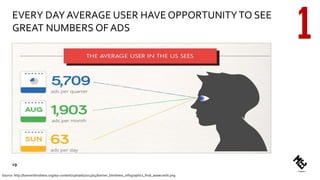
EVERY DAY AVERAGE USER HAVE OPPORTUNITYTO SEE
GREAT NUMBERS OF ADS
Source: http://bannerblindness.org/wp-content/uploads/2013/04/banner_blindness_infographics_final_aswecredit.png
19
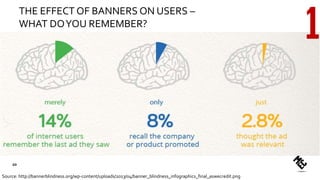
THE EFFECT OF BANNERS ON USERS –
WHAT DOYOU REMEMBER?
Source: http://bannerblindness.org/wp-content/uploads/2013/04/banner_blindness_infographics_final_aswecredit.png
20
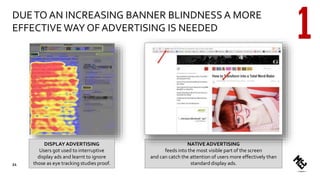
NATIVE ADVERTISING
feeds into the most visible part of the screen
and can catch the attention of users more effectively than
standard display ads.
DUETO AN INCREASING BANNER BLINDNESS A MORE
EFFECTIVE WAY OF ADVERTISING IS NEEDED
DISPLAYADVERTISING
Users got used to interruptive
display ads and learnt to ignore
those as eye tracking studies proof.21
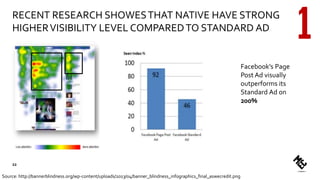
RECENT RESEARCH SHOWESTHAT NATIVE HAVE STRONG
HIGHERVISIBILITY LEVEL COMPAREDTO STANDARD AD
Source: http://bannerblindness.org/wp-content/uploads/2013/04/banner_blindness_infographics_final_aswecredit.png
Facebook’s Page
Post Ad visually
outperforms its
Standard Ad on
200%
22
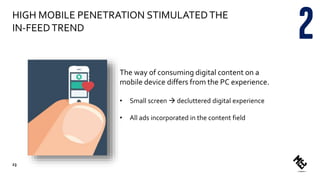
HIGH MOBILE PENETRATION STIMULATEDTHE
IN-FEEDTREND
The way of consuming digital content on a
mobile device differs from the PC experience.
• Small screen  decluttered digital experience
• All ads incorporated in the content field
23
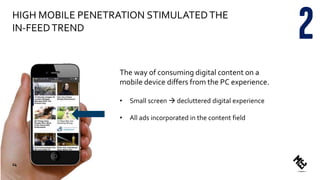
HIGH MOBILE PENETRATION STIMULATEDTHE
IN-FEEDTREND
The way of consuming digital content on a
mobile device differs from the PC experience.
• Small screen  decluttered digital experience
• All ads incorporated in the content field
24
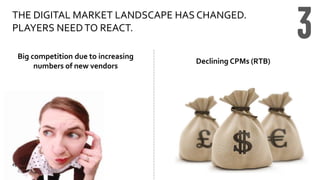
Big competition due to increasing
numbers of new vendors
Declining CPMs (RTB)
THE DIGITAL MARKET LANDSCAPE HAS CHANGED.
PLAYERS NEEDTO REACT.
25
WHY NATIVE ADVERTISING?26
FROM
BEINGTHE
LOUDEST
NATIVE MEANS A SHIFT OF HOWTO COMMUNICATE WITH
THE AUDIENCE
27
NATIVE MEANS A SHIFT OF HOWTO COMMUNICATE WITH
THE AUDIENCE
TO
BEINGTHE
MOST ENGAGING
28
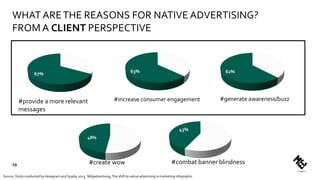
43%
48%
#combat banner blindness
#provide a more relevant
messages
#increase consumer engagement
62%
#generate awareness/buzz
63%67%
#create wow
WHAT ARETHE REASONS FOR NATIVE ADVERTISING?
FROM A CLIENT PERSPECTIVE
Source: Study conducted by Hexagram and Spada, 2013, Mdgadvertising, The shift to native advertising in marketing infographic
29
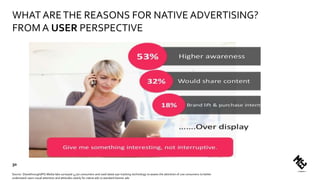
Source: Sharethrough/IPG Media labs surveyed 4,770 consumers and used latest eye-tracking technology to assess the attention of 200 consumers to better
understand users visual attention and attitudes clearly for native ads vs standard banner ads
WHAT ARETHE REASONS FOR NATIVE ADVERTISING?
FROM A USER PERSPECTIVE
30
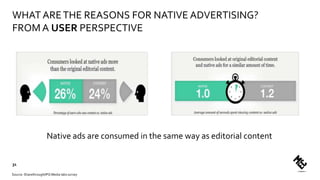
Native ads are consumed in the same way as editorial content
Source: Sharethrough/IPG Media labs survey
WHAT ARETHE REASONS FOR NATIVE ADVERTISING?
FROM A USER PERSPECTIVE
31
LETS STEP INTOTHE FORMATS
OF NATIVE AD INTEGRATION
32
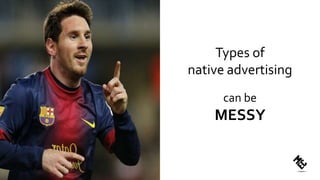
can be
MESSY
Types of
native advertising
33
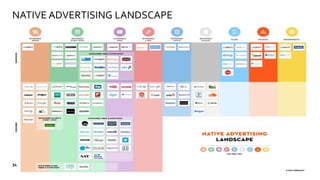
NATIVE ADVERTISING LANDSCAPE
34
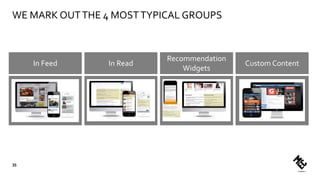
In Read
Recommendation
Widgets
Custom Content
WE MARK OUTTHE 4 MOSTTYPICAL GROUPS
In Feed
35
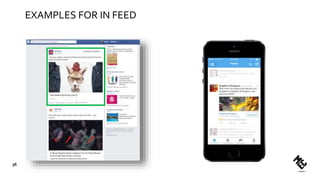
EXAMPLES FOR IN FEED
36
EXAMPLES FOR IN READ
http://www.sharethrough.com/portfolio-item/search-and-promoted-listings/
37
EXAMPLES FOR RECOMMENDATION WIDGETS
38
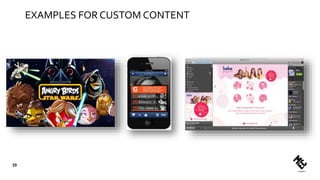
EXAMPLES FOR CUSTOM CONTENT
39
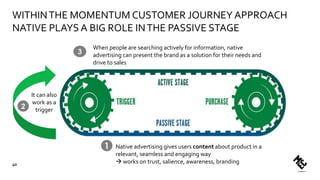
Native advertising gives users content about product in a
relevant, seamless and engaging way
 works on trust, salience, awareness, branding
It can also
work as a
trigger
1
2
When people are searching actively for information, native
advertising can present the brand as a solution for their needs and
drive to sales
3
WITHINTHE MOMENTUM CUSTOMER JOURNEY APPROACH
NATIVE PLAYS A BIG ROLE INTHE PASSIVE STAGE
40
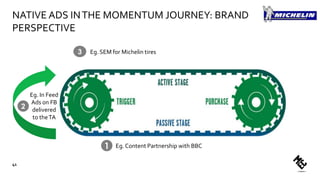
Eg. Content Partnership with BBC
Eg. In Feed
Ads on FB
delivered
to theTA
1
2
Eg. SEM for Michelin tires3
NATIVE ADS INTHE MOMENTUM JOURNEY: BRAND
PERSPECTIVE
41
WHATTO MEASURE?
42
No one sets out baking without first
knowing what to make
So why carry on NativeAdvertising
without GOALS?
43
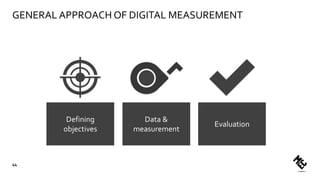
Defining
objectives
Data &
measurement
Evaluation
GENERAL APPROACH OF DIGITAL MEASUREMENT
44
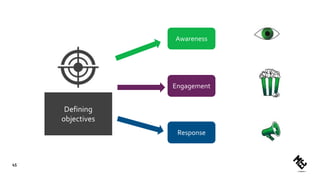
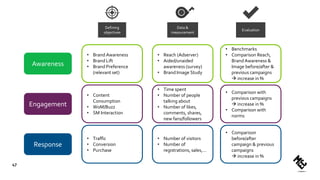
Awareness
Engagement
Response
Defining
objectives
45
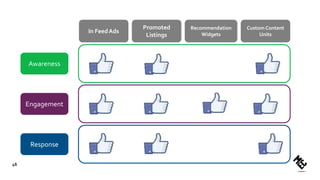
Awareness
Engagement
Response
Promoted
Listings
Custom Content
Units
Recommendation
Widgets
In FeedAds
46
Defining
objectives
Data &
measurement
Evaluation
Awareness
Engagement
Response
• Brand Awareness
• Brand Lift
• Brand Preference
(relevant set)
• Content
Consumption
• WoM/Buzz
• SM Interaction
• Traffic
• Conversion
• Purchase
• Reach (Adserver)
• Aided/unaided
awareness (survey)
• Brand Image Study
• Time spent
• Number of people
talking about
• Number of likes,
comments, shares,
new fans/followers
• Number of visitors
• Number of
registrations, sales,…
• Benchmarks
• Comparison Reach,
Brand Awareness &
Image before/after &
previous campaigns
 increase in %
• Comparison with
previous campaigns
 increase in %
• Comparison with
norms
• Comparison
before/after
campaign & previous
campaigns
 increase in %
47
THANK YOU.
EXAMPLES OF NATIVE ADVERTISINGVENDORS
49
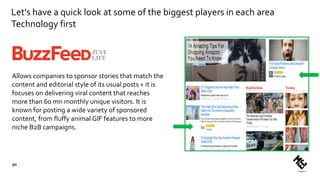
Let's have a quick look at some of the biggest players in each area
Technology first
Allows companies to sponsor stories that match the
content and editorial style of its usual posts + it is
focuses on delivering viral content that reaches
more than 60 mn monthly unique visitors. It is
known for posting a wide variety of sponsored
content, from fluffy animal GIF features to more
niche B2B campaigns.
50
Let's take a look at some of the biggest players in each area.
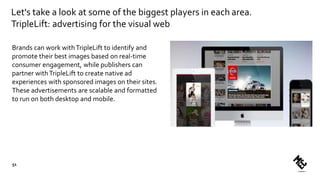
TripleLift: advertising for the visual web
Brands can work withTripleLift to identify and
promote their best images based on real-time
consumer engagement, while publishers can
partner withTripleLift to create native ad
experiences with sponsored images on their sites.
These advertisements are scalable and formatted
to run on both desktop and mobile.
51
Let's take a look at some of the biggest players in each area.
Sponsored links: Disqus
Online discussion and commenting service for websites and
online communities that uses a networked platform.
Promoted Discovery points users to content that marketers
are looking to promote to your audience. As a publisher, you
earn a revenue share from Disqus for each click on a
promoted content link. Advertisers agree to pay Disqus to
distribute their content in relevant places across the web.
52

Mec gs native_advertising_deck final

  • 1.
  • 2.
    AGENDA AGENDA 1| Originand Definition of Native Advertising 2| Status Quo 3| Drivers of the Trend 4| Relevance for Brand Communications 5| Categorisation of Native Advertising Types 6| Role of Native within the Customer Journey 7| Measurement 8| Critical Reflection and Recommendation 2
  • 3.
  • 4.
  • 5.
    WHEN DIDTHETERM COMEUP? The term ‘native advertising’ started to come up in mid 2011 Since Jan 2013 search volume increased significantly Main driver is the US 5
  • 6.
    WHEN DIDTHETERM COMEUP? In UK and Germany the term came up even later 6
  • 7.
    SEEMSTO BE ANEW PHENOMENON?!? 7
  • 8.
    “the less anadvertisement looks likean advertisement, and the more it looks likeeditorial, themore readers stop, look and read.” DavidOgilvy 1956 8
  • 9.
    Brian Boland Directorof Monetization and Product Marketing Facebook “The only times we talk about native ad formats are in response to the way the media and the market talk about native advertising. What we’ve striven to do with all advertising on Facebook is figure out the best place we can put really engaging content in front of people in a way that they feel adds value. These ads feel like part of the content experience.” Grant Whitmore Vice President, Digital Hearst Magazines “Native means advertising that occurs outside of the traditional ad positions, with a much tighter integration with the content that is happening around it, be it image content or written content or video content.” Jon Steinberg President and COO BuzzFeed “Native advertising is when you take the form of a piece of content that’s on a site and you make a branded version of it that’s clearly labeled as such. For Twitter, that would be a tweet. For Facebook, it would be a status update. For BuzzFeed, it would be a story headline, which we call a ‘story unit.’” Darren Herman Chief Digital Media Officer The Media Kitchen “Native advertising is just a term, a buzzword. We don’t specifically call it out within our plans here, but if I were to define it, it’s some kind of marketing messaging that takes into account the underlying technology asset that it lives within, and it adds value not just to the platform but to the user as well.” Alison Koplar Vice President, Sales and Corporate Development Refinery29 “It’s a philosophy. It’s not necessarily about creating specific ad units, but it’s that we approach advertising that is intended not to distract but to entertain. We think about advertising in the same way we think about content.” Demian Farnworth Copyblogger Native advertising is paid content that matches a publication’s editorial standards while meeting the audience’s expectations. Rebecca Lieb Altimeter Research The definition of native advertising clearly overlaps with existing definitions of sponsored/branded/custom content, as well as advertorial. Differentiation can border on splitting hairs. 9
  • 10.
    PAID IN FORMATRELEVANT AMONGST ALL DIFFERENT APPROACHES WE IDENTIFIED 3 MAIN CRITERIATHAT DEFINE NATIVE ADVERTISING. 10
  • 11.
    PAID IN FORMATRELEVANT AMONGST ALL DIFFERENT APPROACHES WE IDENTIFIED 3 MAIN CRITERIATHAT DEFINE NATIVE ADVERTISING. Differentiates native ads from e.g. Content Marketing and PR. Native ads match the visual design of the experience they live within. Native ads must behave consistently with the native user experience. 11
  • 12.
    HOW DID NATIVEADVERTISING LOOK LIKE INTHE PAST? PRODUCT PLACEMENT PRINT ADVERTORIAL IN GAME ADVERTISING 12
  • 13.
    WHAT NATIVE ADVERTISINGLOOKS LIKETODAY… 13
  • 14.
    OLD CONCEPT –NEW HYPE! 14
  • 15.
    Source: Gartner, DigitalMarketing Hype Cycle 2013, Nov 2013 CHANGING DIGITAL LANDSCAPE AND CONSUMER BEHAVIOR RENEWEDTHE PROMINENCE OF NATIVE 15
  • 16.
    AND IT ISSTILL ONTHE RISE. +100% increase of native ad spends expected until 2017* *in the US Source: BIA/Kelsey ‘Annual US Local Media Forecast’, 2013 16
  • 17.
  • 18.
  • 19.
    EVERY DAY AVERAGEUSER HAVE OPPORTUNITYTO SEE GREAT NUMBERS OF ADS Source: http://bannerblindness.org/wp-content/uploads/2013/04/banner_blindness_infographics_final_aswecredit.png 19
  • 20.
    THE EFFECT OFBANNERS ON USERS – WHAT DOYOU REMEMBER? Source: http://bannerblindness.org/wp-content/uploads/2013/04/banner_blindness_infographics_final_aswecredit.png 20
  • 21.
    NATIVE ADVERTISING feeds intothe most visible part of the screen and can catch the attention of users more effectively than standard display ads. DUETO AN INCREASING BANNER BLINDNESS A MORE EFFECTIVE WAY OF ADVERTISING IS NEEDED DISPLAYADVERTISING Users got used to interruptive display ads and learnt to ignore those as eye tracking studies proof.21
  • 22.
    RECENT RESEARCH SHOWESTHATNATIVE HAVE STRONG HIGHERVISIBILITY LEVEL COMPAREDTO STANDARD AD Source: http://bannerblindness.org/wp-content/uploads/2013/04/banner_blindness_infographics_final_aswecredit.png Facebook’s Page Post Ad visually outperforms its Standard Ad on 200% 22
  • 23.
    HIGH MOBILE PENETRATIONSTIMULATEDTHE IN-FEEDTREND The way of consuming digital content on a mobile device differs from the PC experience. • Small screen  decluttered digital experience • All ads incorporated in the content field 23
  • 24.
    HIGH MOBILE PENETRATIONSTIMULATEDTHE IN-FEEDTREND The way of consuming digital content on a mobile device differs from the PC experience. • Small screen  decluttered digital experience • All ads incorporated in the content field 24
  • 25.
    Big competition dueto increasing numbers of new vendors Declining CPMs (RTB) THE DIGITAL MARKET LANDSCAPE HAS CHANGED. PLAYERS NEEDTO REACT. 25
  • 26.
  • 27.
    FROM BEINGTHE LOUDEST NATIVE MEANS ASHIFT OF HOWTO COMMUNICATE WITH THE AUDIENCE 27
  • 28.
    NATIVE MEANS ASHIFT OF HOWTO COMMUNICATE WITH THE AUDIENCE TO BEINGTHE MOST ENGAGING 28
  • 29.
    43% 48% #combat banner blindness #providea more relevant messages #increase consumer engagement 62% #generate awareness/buzz 63%67% #create wow WHAT ARETHE REASONS FOR NATIVE ADVERTISING? FROM A CLIENT PERSPECTIVE Source: Study conducted by Hexagram and Spada, 2013, Mdgadvertising, The shift to native advertising in marketing infographic 29
  • 30.
    Source: Sharethrough/IPG Medialabs surveyed 4,770 consumers and used latest eye-tracking technology to assess the attention of 200 consumers to better understand users visual attention and attitudes clearly for native ads vs standard banner ads WHAT ARETHE REASONS FOR NATIVE ADVERTISING? FROM A USER PERSPECTIVE 30
  • 31.
    Native ads areconsumed in the same way as editorial content Source: Sharethrough/IPG Media labs survey WHAT ARETHE REASONS FOR NATIVE ADVERTISING? FROM A USER PERSPECTIVE 31
  • 32.
    LETS STEP INTOTHEFORMATS OF NATIVE AD INTEGRATION 32
  • 33.
  • 34.
  • 35.
    In Read Recommendation Widgets Custom Content WEMARK OUTTHE 4 MOSTTYPICAL GROUPS In Feed 35
  • 36.
  • 37.
    EXAMPLES FOR INREAD http://www.sharethrough.com/portfolio-item/search-and-promoted-listings/ 37
  • 38.
  • 39.
  • 40.
    Native advertising givesusers content about product in a relevant, seamless and engaging way  works on trust, salience, awareness, branding It can also work as a trigger 1 2 When people are searching actively for information, native advertising can present the brand as a solution for their needs and drive to sales 3 WITHINTHE MOMENTUM CUSTOMER JOURNEY APPROACH NATIVE PLAYS A BIG ROLE INTHE PASSIVE STAGE 40
  • 41.
    Eg. Content Partnershipwith BBC Eg. In Feed Ads on FB delivered to theTA 1 2 Eg. SEM for Michelin tires3 NATIVE ADS INTHE MOMENTUM JOURNEY: BRAND PERSPECTIVE 41
  • 42.
  • 43.
    No one setsout baking without first knowing what to make So why carry on NativeAdvertising without GOALS? 43
  • 44.
  • 45.
  • 46.
  • 47.
    Defining objectives Data & measurement Evaluation Awareness Engagement Response • BrandAwareness • Brand Lift • Brand Preference (relevant set) • Content Consumption • WoM/Buzz • SM Interaction • Traffic • Conversion • Purchase • Reach (Adserver) • Aided/unaided awareness (survey) • Brand Image Study • Time spent • Number of people talking about • Number of likes, comments, shares, new fans/followers • Number of visitors • Number of registrations, sales,… • Benchmarks • Comparison Reach, Brand Awareness & Image before/after & previous campaigns  increase in % • Comparison with previous campaigns  increase in % • Comparison with norms • Comparison before/after campaign & previous campaigns  increase in % 47
  • 48.
  • 49.
    EXAMPLES OF NATIVEADVERTISINGVENDORS 49
  • 50.
    Let's have aquick look at some of the biggest players in each area Technology first Allows companies to sponsor stories that match the content and editorial style of its usual posts + it is focuses on delivering viral content that reaches more than 60 mn monthly unique visitors. It is known for posting a wide variety of sponsored content, from fluffy animal GIF features to more niche B2B campaigns. 50
  • 51.
    Let's take alook at some of the biggest players in each area. TripleLift: advertising for the visual web Brands can work withTripleLift to identify and promote their best images based on real-time consumer engagement, while publishers can partner withTripleLift to create native ad experiences with sponsored images on their sites. These advertisements are scalable and formatted to run on both desktop and mobile. 51
  • 52.
    Let's take alook at some of the biggest players in each area. Sponsored links: Disqus Online discussion and commenting service for websites and online communities that uses a networked platform. Promoted Discovery points users to content that marketers are looking to promote to your audience. As a publisher, you earn a revenue share from Disqus for each click on a promoted content link. Advertisers agree to pay Disqus to distribute their content in relevant places across the web. 52

Editor's Notes

  • #4 Native Advertising is a Buzz Word. Everybody talks about it.
  • #5 But no one really knows what it is. So, obsessed as we always by the next big thing, this work on native advertising we have done shall take a step back to understand what native actually is in order to be able to give then guidance on the role native advertising has for us as a media agency.
  • #6 We started with analyzing the term native advertising on google trends and what we saw is that the term only came up in the recent years. Mainly driven by the US, it started to come up in 2011 and then significantly increased in 2013.
  • #7 In Europe even a bit later
  • #9 But then there are also quotes like this one from David Ogilvy from 1956 that “ the less an advertisement looks like an advertisement, and the more it looks like editorial, the more readers stop, look and read.” Does he mean the same thing as we when we speak about native advertising? So what exactly is native advertising and what differentiates our understanding with what David Ogilvy was speaking about in the 50s?
  • #10 There are a lot of different understandings of native advertising across a vary of different players in the market. There is no common sense or one agreed definition.
  • #11 BUT: after analysing all those definitions we were able to find 3 main criteria that can define native ads.
  • #12 Paid - differentiates native ads from e.g. Content Marketing and PR. In Format= look & feel is like natural content. Relevant= not only the visual design but as well the function just like natural content
  • #14 To make it a bit more tangible, those are just a few examples that match all 3 criteria and therefor are native advertising.
  • #15 So what became obvious is that the idea of native advertising, being paid, relevant and in-format is nothing new! But due to a changing media landscape and changing user behaviour native advertising became a new role and digital native advertising solutions gained more importance.
  • #16 So there IS a re-newed prominence of native advertising and according to the Gartner Hype Cycle approach the hype is till growing.
  • #17 Until 2017 there is an increase of native ad spends of 100% expected
  • #18 In order to understand the changing landscape and the role native advertising plays for us and our clients now and in future, we analysed the key drivers of this trend.
  • #19 We chose 3 key factors which influence a lot for increasing growth of native.
  • #20 So, the first key factor is increasing banners blindness. This stats shows that average user in US can see huge number of banners ads - about 63 per day and almost 2 thousands per month
  • #21 But only 14% of users remember the last ad they saw and only 8% recall the company or product promoted.
  • #22 As we can see on eye tracking study on left side standard display ads are often out of users eyesight - most of users attention goes to content part Users got used to interruptive display ads and learnt to ignore them All this lead market to be more effective in terms of visibility. And native can be used as good decision in this case because feeds into the most visible part of the screen and can catch the attention of users more effectively
  • #23 Facebook’s Page Post Ad visually outperforms its Standard Ad on 200%
  • #24 The 2nd factor is all about mobile. Mobile penetration strongly increasing last years and mobile experience is common for millions of people now. The way of consuming digital content on a mobile device differs from the PC experience. You have Small screen which cant provide a lot of space for ads as PC does
  • #25 And now all ads incorporated in the visible content field which also drive NA trend because in feed/in format are main criteria for it.
  • #26 Third driver connected with digital market landscape changing. We cansee a lot of new vendors (and their quantity are still growing) which provide big competition. That’s why all of them try to suggest new business solutions/technologies => push market to be more effective and valuable for clients Also, advent of real-time bidding lead market to declining CPMs levels which stress publishers to consider alternative monetization sources
  • #27 Now we went throw NA background and what factors drive the trend. Lets check how NA are really effective for business
  • #28 The main idea of NA that it MEANS A SHIFT OF HOW TO COMMUNICATE WITH THE AUDIENCE FROM BEING THE LOUDEST
  • #29 TO BEING THE MOST ENGAGING
  • #30 From clients perspective numbers shows that most of the reasons are close to this engagement metric. 63% of clients chose NA because it is increase consumer engagement and generate buzz, 67% -> because it provides more relevant messages
  • #31 From a users perspective studies shows that native ads drive more attention and brand lift over traditional standard display Consumers looked at native ads 53% more frequently than display ads; 32% of respondents said the native ad “is an ad I would share with a friend of family member” Native ads registered 18% higher lift in purchase intent than banner ads;
  • #32 Another study showed that users visual attention for native ads was nearly equivalent to the visual engagement of original editorial content, So, they are consumed content in the same way
  • #35 Native Advertising is growing fast. This is a landscape of all different Native Advertising formats. There are a lot of vendors offering placements and also the technology behind. But, this landscape is too confusing. Therefore we need to sum up in groups which are clearer to understand.
  • #36 In Feed Ads: most popular example is the in feed ad on fb when scrolling down to read your friends’ postings. At first view it’s not easy to realise that it is commercial but it is always clear labelled as paid commercial. Language: #promoted#, #sponsored#, #presented by# In read: they have the same look and feel as the rest of the website. Mostly in-read appear as teaser which link to external sites. Recommendation Widget: After reading an article you find frequently on the bottom of the page further links labelled as “might be also interesting”. These links bring the user to an external site. Custom Content Unit: is platform specific. The most popular custom content unit is a content partnership within a platform where the client and the platform work together closely to provide articles, competitions and so on.
  • #37 FB and Twitter examples. FB – have sponsored posts since 2011 with high engagement rate and visibility Globally on market several types of in-feed units. sold with a guaranteed placement: Full story w/o leaving page =>is measured on brand metrics such as interaction and brand lift; Only a promotional ad (linked-in); links off of the site to content =>is measured by CTR; not a guaranteed placement - has been sold in a broad section and not =>is measured on brand metrics (interaction and brand lift)
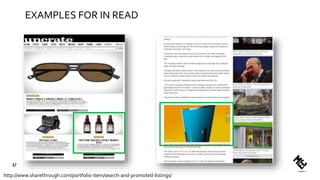
  • #38 In read as users browsing experience Where: Found on sites that typically do not have a traditional editorial content well How: They are designed to fit seamlessly into the browsing experience, are presented to look identical to the products or services offered on a given site What's next: Ad link to a special brand/product page directly via the publisher (hyper-contextually targeted) and are measured on direct response metrics Uncrate – is a digital magazine for men that features content regarding several new products daily. Uncrate runs sponsored product or gear campaigns that fit into its stream of content. All the products are clearly marked as sponsored or featured, but they are generally of the same nature as the publication's organic content. + Another example from outbrain It shows textlinks to external Websites. The textlinks fit to the article
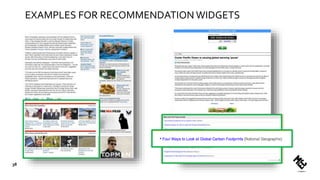
  • #39 Main features: Does not mimic the appearance of the editorial content feed Links to a page off the site Has not been sold with a guaranteed placement Language: #you might also like#, “you may have missed”, “recommended by Outbrain”
  • #40 This group includes: examples that don’t neatly fit into one of the above groups; platform-specific (as in the case of custom playlists) to warrant their own category but need to be on a marketer’s radar as native advertising options. Angry birds is a very famous online and mobile game – make a sponsorship with Star Wars Bebe is  a brand from J&J for Face and Bodycare for a young female target group - sponsorship with Spotify via own playlist
  • #41 We find it interesting to think about native in Momentum cycle perspective, in other words how it correlates with the process of making decision how to buy. Lets take an example of mouth wash Listerin. On active stage native can present for user a Listerin like a best solution for its needs (if they have a problem with fresh breath, for example). And can lead users to brand territory when they can find info about stores they can buy a product. Also Native can work like a trigger. For example, I can understand that I want to improve my tooth care culture and suddenly read an article that mouth wash is the good additional and necessary product for mouth hygiene. It can drives me to active stage to search information more actively. But the biggest role native plays on passive stage. In this case NA gives users content about product in a relevant, seamless and engaging way (it important not to frighten user with massive ads attack because they don’t want to have active presence in this theme now). All information from native works on trust, awareness and branding. Stay in users mind and when they will be on active stage can help to make a decision with Listerin brand.
  • #53 The mission of Disqus is to enhance online discussion for audiences and publishers everywhere. Each day, over 5,000 sites add Disqus to create a more dynamic audience experience and increase advertiser value. Disqus reaches over 900 million unique visitors per month across 2 million websites while generating 6 billion page views every month. Disqus is the #1 distributed social application on the web according to reports by comScore and Quantcast.