MEASURES OF CENTRAL
TENDENCY
IN FREQUENCY DISTRIBUTIONS
UNIT II: DISTRIBUTION OF ONE-DIMENSIONAL
FREQUENCIES.
RBK
LEARNING OBJECTIVES
2
SUMMARY STATISTICS
we constructed tables and graphs from raw
data. The resulting “pictures” of frequency
distributions illustrated trends and patterns in the
data. In most cases, however, we need more
exact measures. In these cases, we can use
single numbers called summary statistics to
describe characteristics of a data set. Central
tendency, and dispersion.
3
Central Tendency: Central tendency is the middle point of a distribution.
Measures of central tendency are also called measures of location.
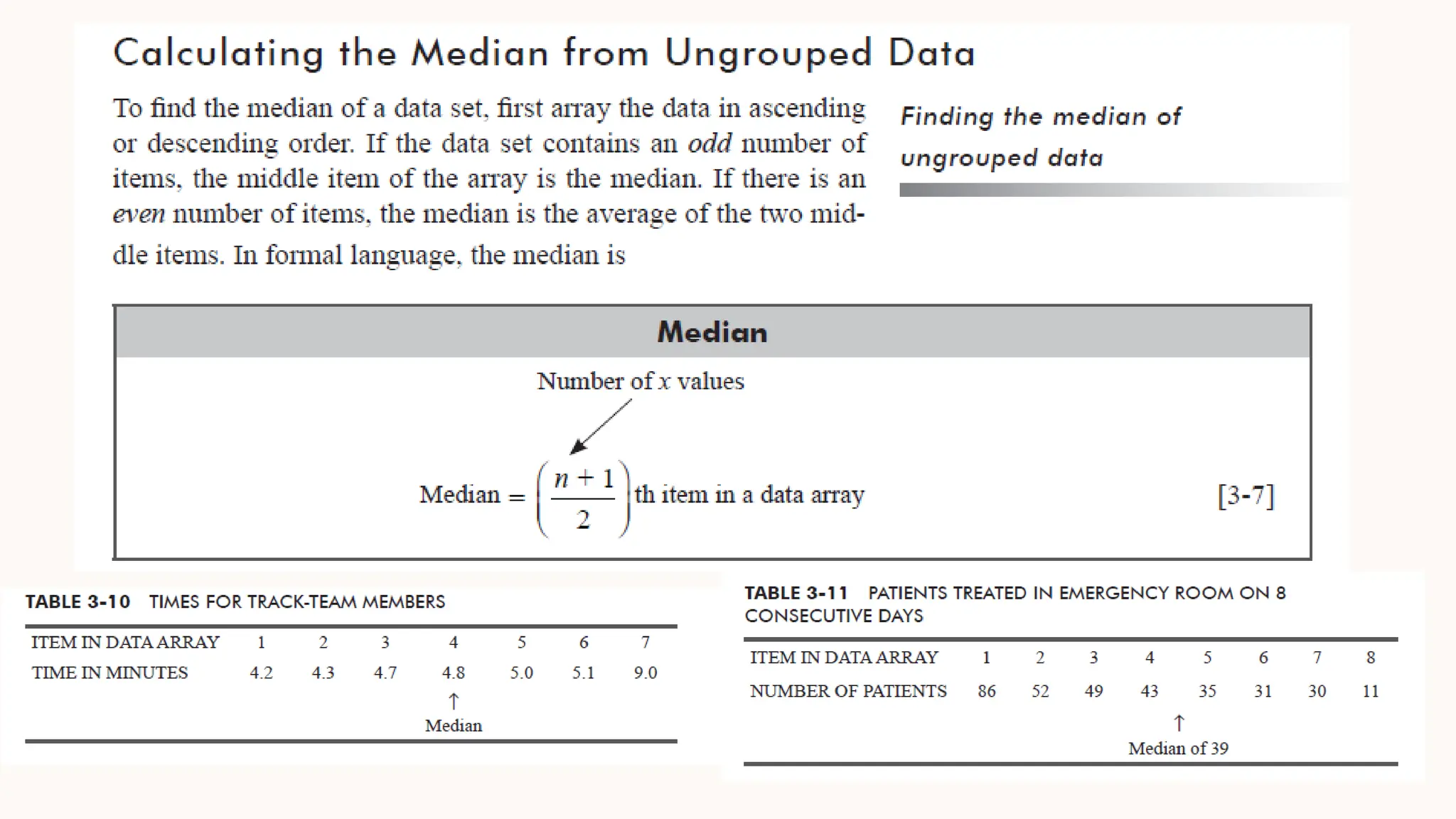
CALCULATING THE MEAN,
MEDIAN, AND MODE FROM
UNGROUPED DATA
4
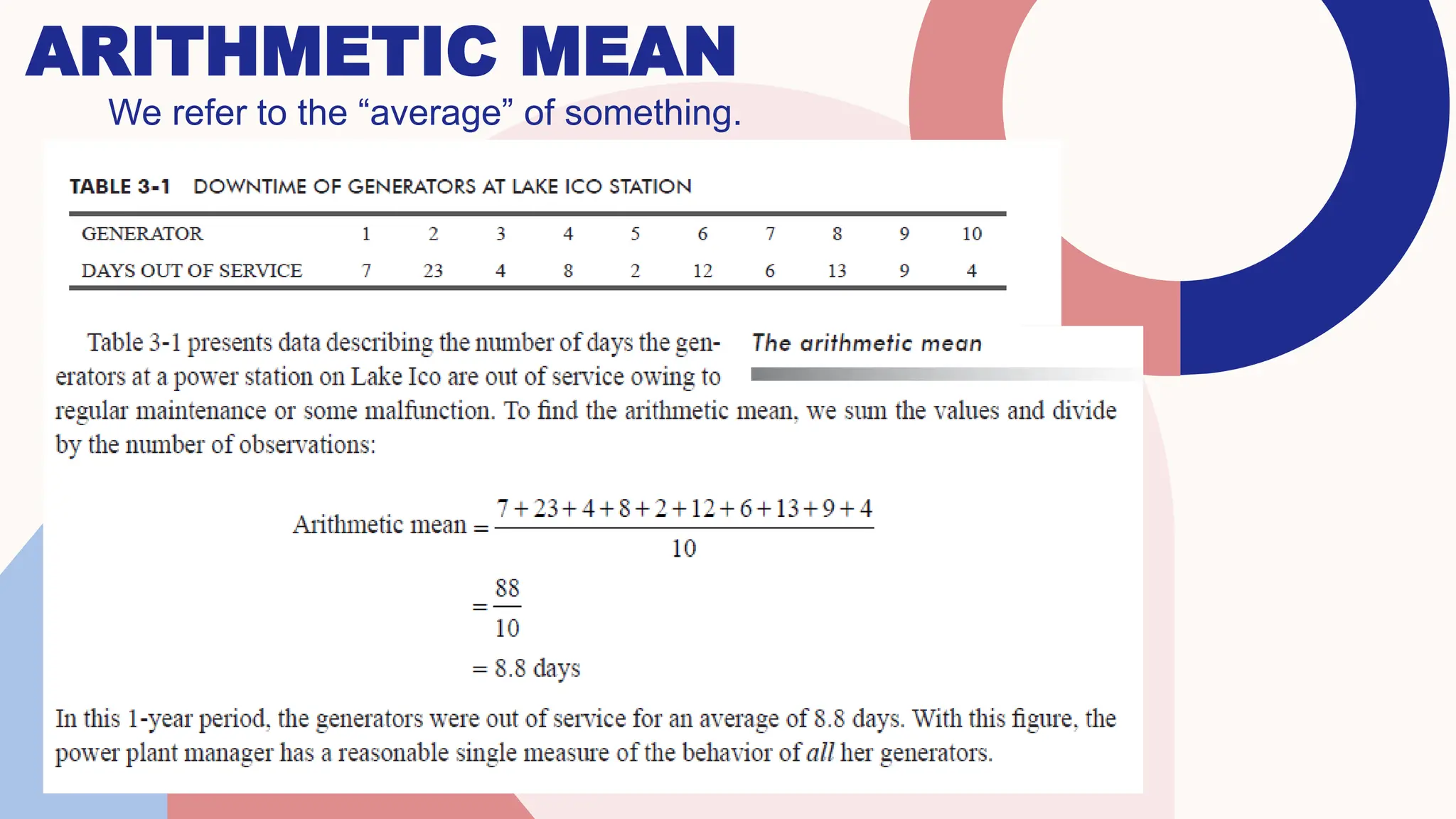
ARITHMETIC MEAN
We refer to the “average” of something.
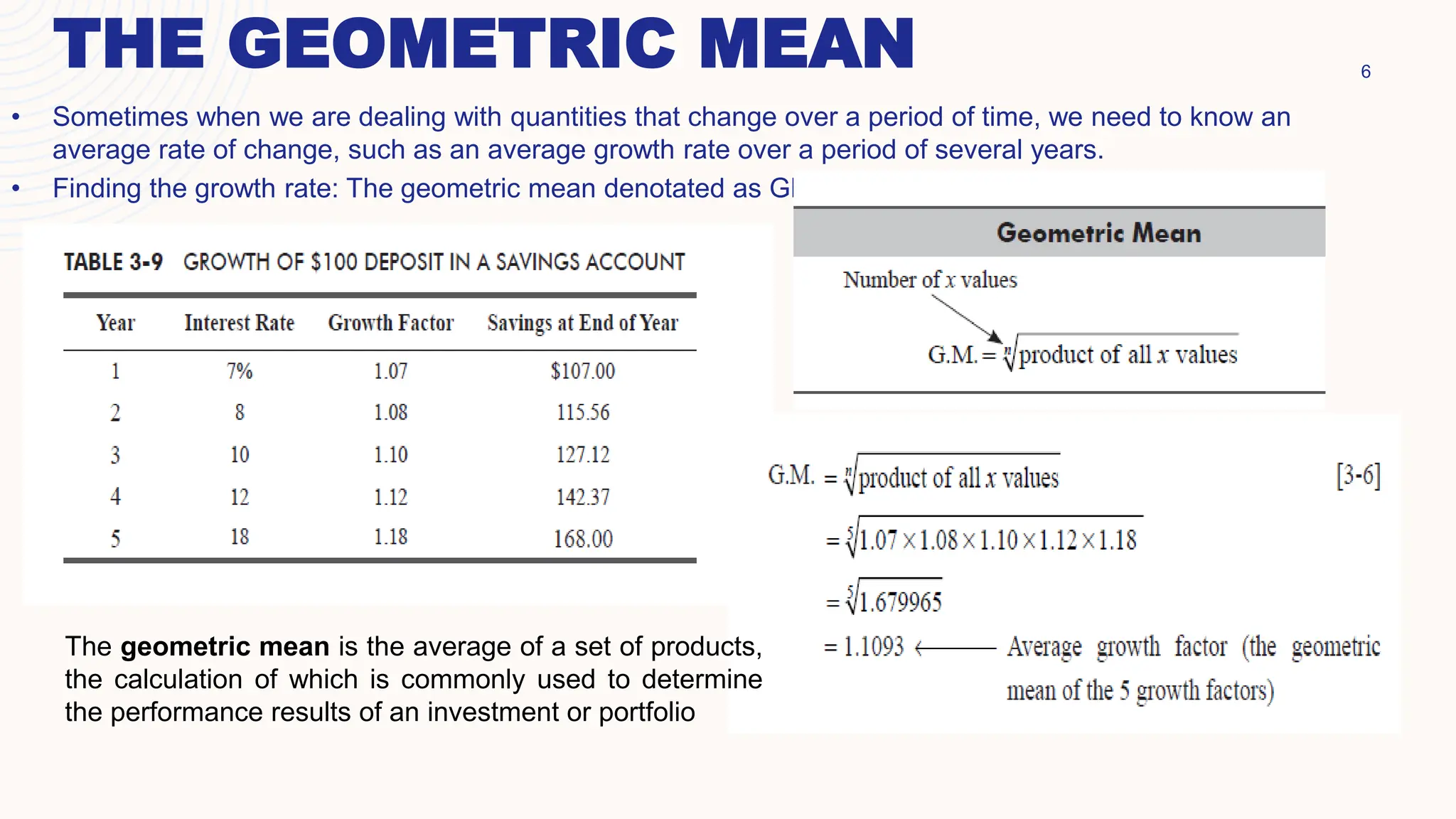
THE GEOMETRIC MEAN 6
• Sometimes when we are dealing with quantities that change over a period of time, we need to know an
average rate of change, such as an average growth rate over a period of several years.
• Finding the growth rate: The geometric mean denotated as GM
The geometric mean is the average of a set of products,
the calculation of which is commonly used to determine
the performance results of an investment or portfolio
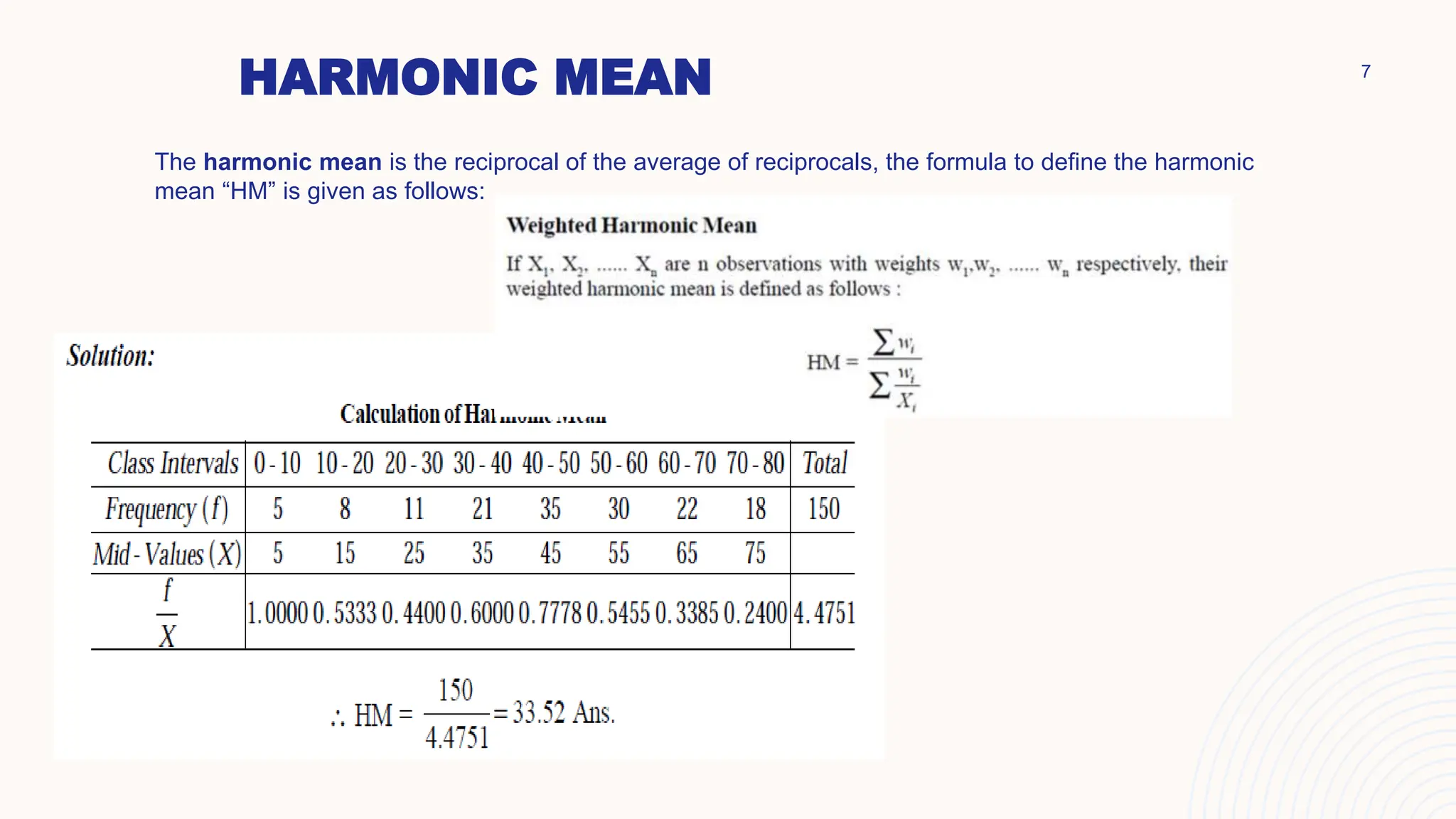
HARMONIC MEAN
The harmonic mean is the reciprocal of the average of reciprocals, the formula to define the harmonic
mean “HM” is given as follows:
7
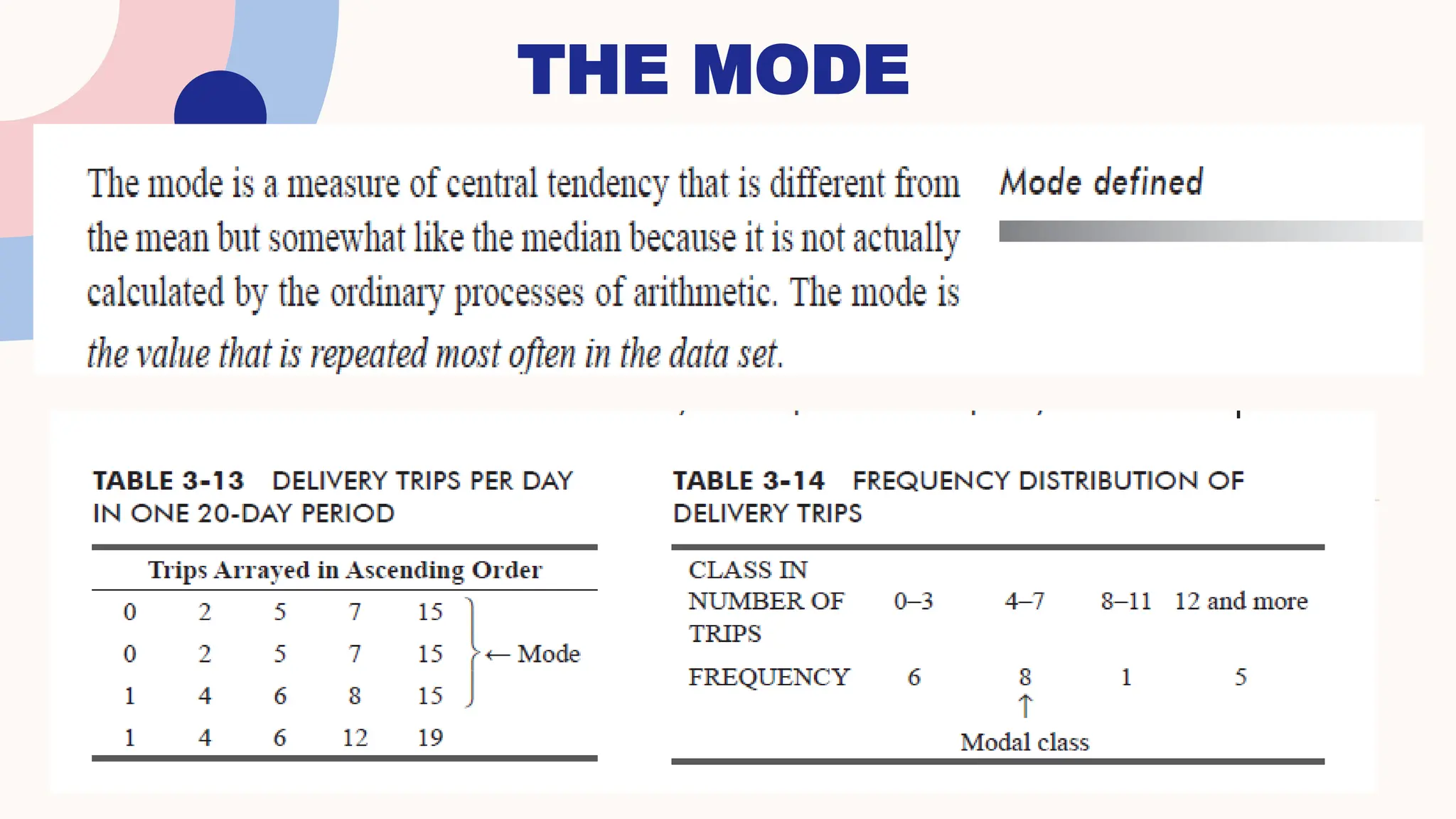
THE MODE
10
CALCULATING THE MEAN,
MEDIAN, AND MODE FROM
GROUPED DATA
11
12
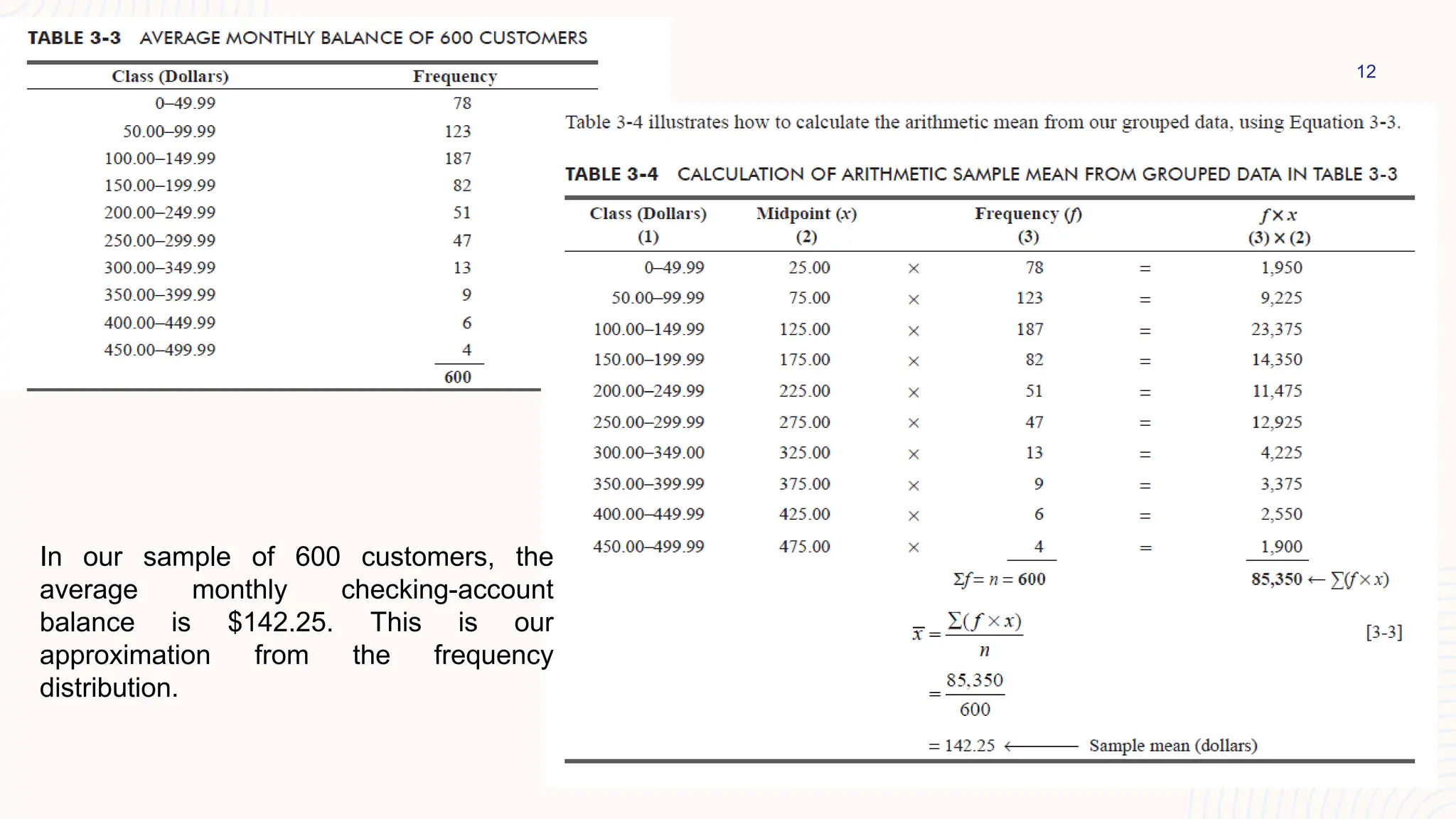
In our sample of 600 customers, the
average monthly checking-account
balance is $142.25. This is our
approximation from the frequency
distribution.
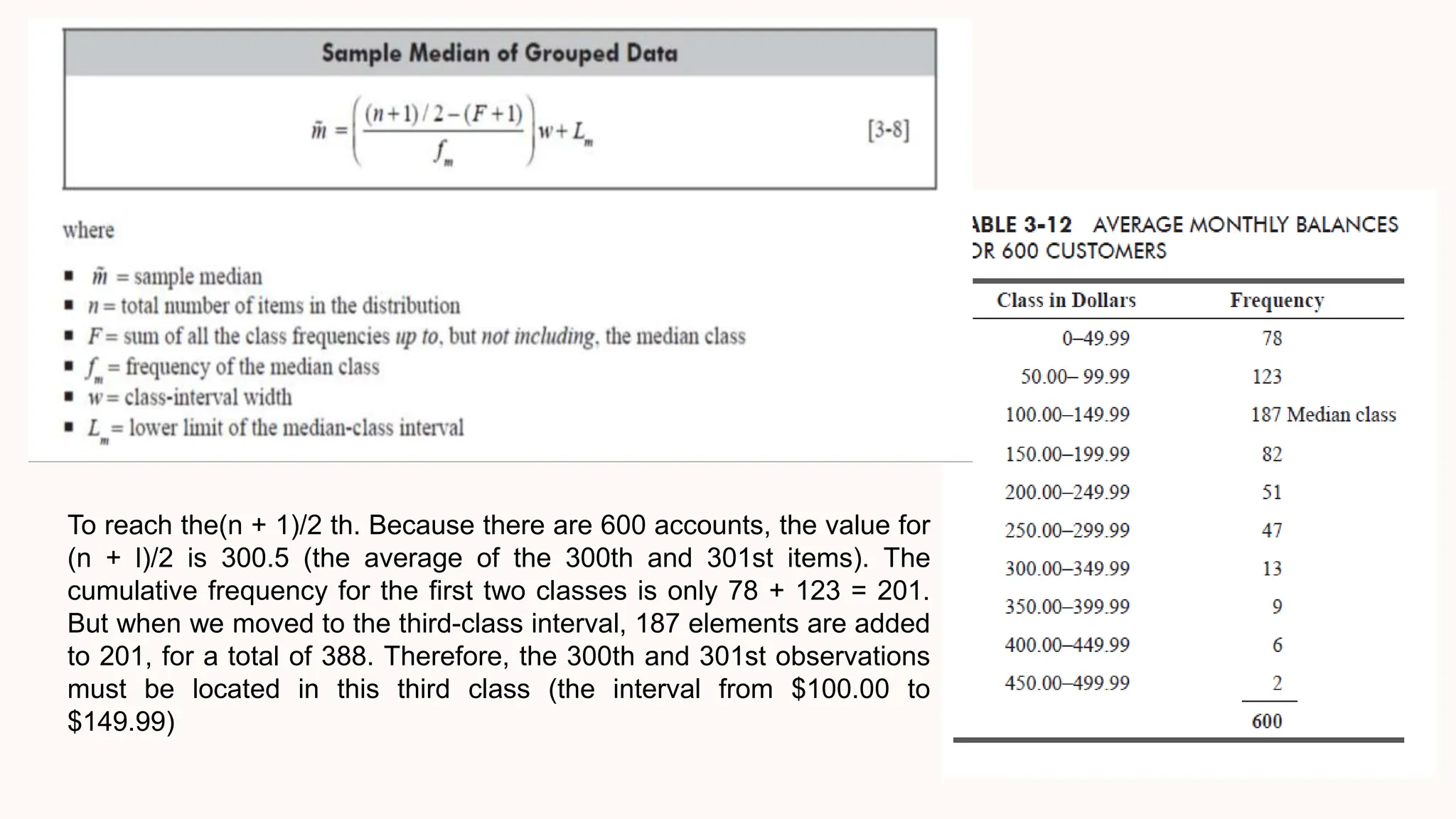
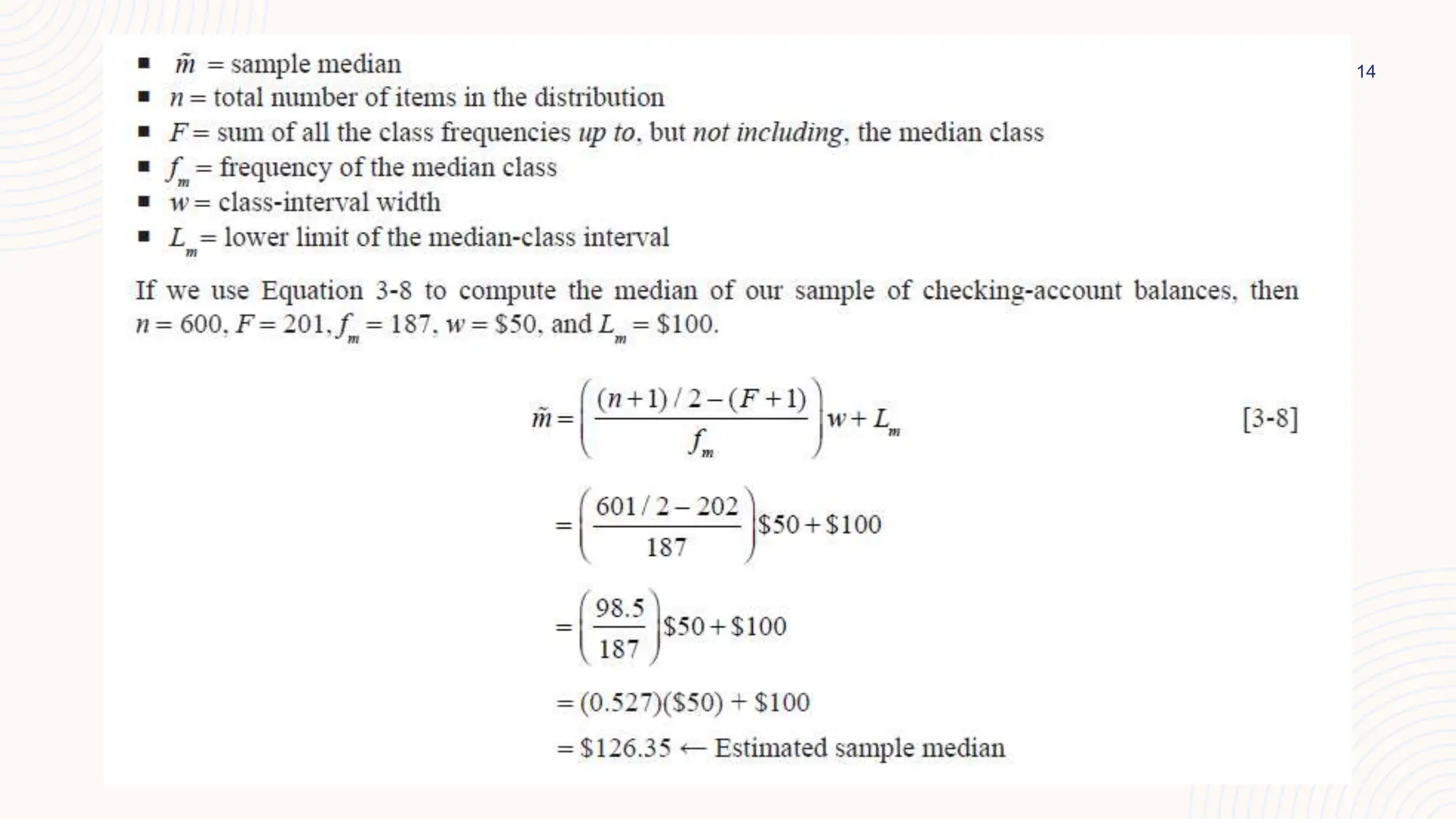
To reach the(n + 1)/2 th. Because there are 600 accounts, the value for
(n + l)/2 is 300.5 (the average of the 300th and 301st items). The
cumulative frequency for the first two classes is only 78 + 123 = 201.
But when we moved to the third-class interval, 187 elements are added
to 201, for a total of 388. Therefore, the 300th and 301st observations
must be located in this third class (the interval from $100.00 to
$149.99)
14
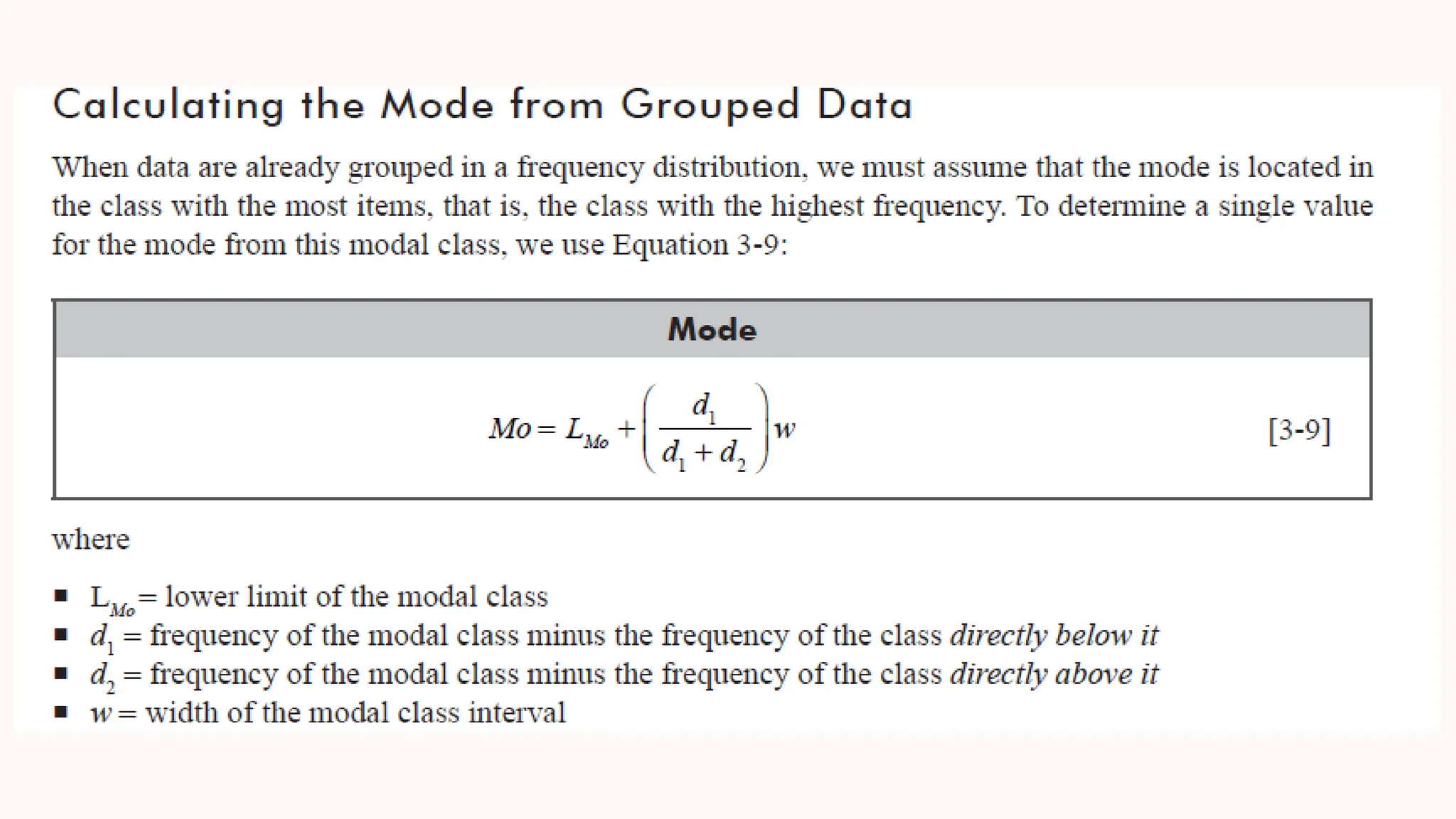
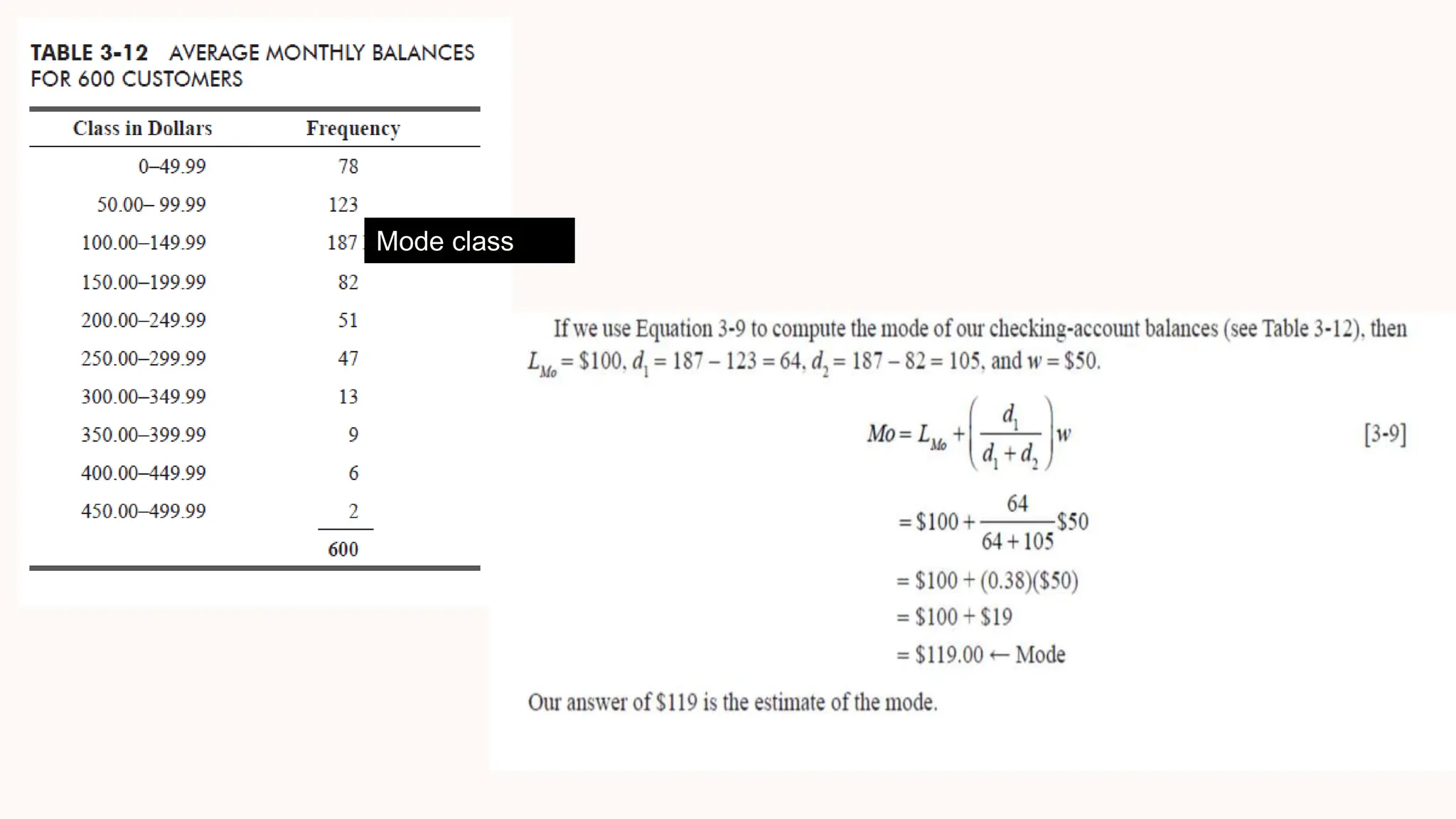
Mode class
17
18
THANK YOU

Measures of central Tendency group and ungroup data

  • 1.
    MEASURES OF CENTRAL TENDENCY INFREQUENCY DISTRIBUTIONS UNIT II: DISTRIBUTION OF ONE-DIMENSIONAL FREQUENCIES. RBK
  • 2.
  • 3.
    SUMMARY STATISTICS we constructedtables and graphs from raw data. The resulting “pictures” of frequency distributions illustrated trends and patterns in the data. In most cases, however, we need more exact measures. In these cases, we can use single numbers called summary statistics to describe characteristics of a data set. Central tendency, and dispersion. 3 Central Tendency: Central tendency is the middle point of a distribution. Measures of central tendency are also called measures of location.
  • 4.
    CALCULATING THE MEAN, MEDIAN,AND MODE FROM UNGROUPED DATA 4
  • 5.
    ARITHMETIC MEAN We referto the “average” of something.
  • 6.
    THE GEOMETRIC MEAN6 • Sometimes when we are dealing with quantities that change over a period of time, we need to know an average rate of change, such as an average growth rate over a period of several years. • Finding the growth rate: The geometric mean denotated as GM The geometric mean is the average of a set of products, the calculation of which is commonly used to determine the performance results of an investment or portfolio
  • 7.
    HARMONIC MEAN The harmonicmean is the reciprocal of the average of reciprocals, the formula to define the harmonic mean “HM” is given as follows: 7
  • 9.
  • 10.
    10 CALCULATING THE MEAN, MEDIAN,AND MODE FROM GROUPED DATA
  • 11.
  • 12.
    12 In our sampleof 600 customers, the average monthly checking-account balance is $142.25. This is our approximation from the frequency distribution.
  • 13.
    To reach the(n+ 1)/2 th. Because there are 600 accounts, the value for (n + l)/2 is 300.5 (the average of the 300th and 301st items). The cumulative frequency for the first two classes is only 78 + 123 = 201. But when we moved to the third-class interval, 187 elements are added to 201, for a total of 388. Therefore, the 300th and 301st observations must be located in this third class (the interval from $100.00 to $149.99)
  • 14.
  • 16.
  • 17.
  • 18.
  • 19.