Mean Recurrence Interval (MRI)
ASCE 7
CONTENT
 Mean Recurrence Interval (MRI)
 3-SEC Gust wind Speed
 ASCE 7-5 wind Provision
 ASCE 7-10 wind Provision
 Converting ASCE 7-5 wind speed value to ASCE 7-10
 Velocity Pressure
 Probability & Annual probability
 Wind Drift
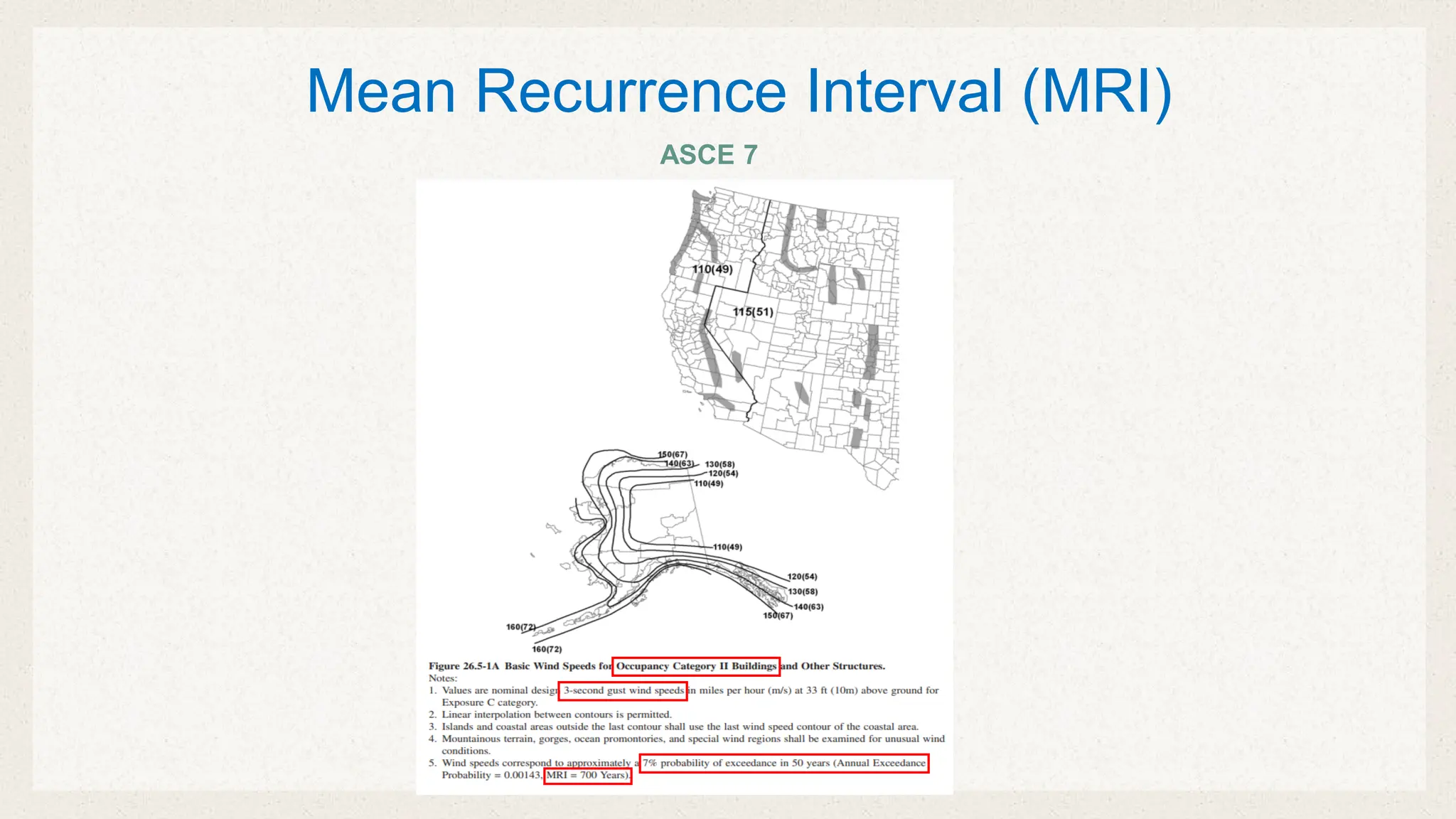
 The mean recurrence interval is the inverse of the probability that a wind event of a certain
magnitude will be exceeded in any one year. For example, A 700-year return period wind of
115 mph (51 m/s) means that, on average, these areas will experience wind speeds
exceeding 115 mph once every 700 years. This corresponds to an annual probability of
occurrence of 1/700, or approximately 0.14%. Therefore, the chance of a wind exceeding 115
mph occurring in these regions in any given year is 0.14%.
Mean Recurrence Interval (MRI)
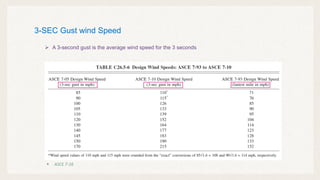
 A 3-second gust is the average wind speed for the 3 seconds
3-SEC Gust wind Speed
 ASCE 7-16
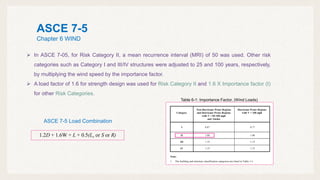
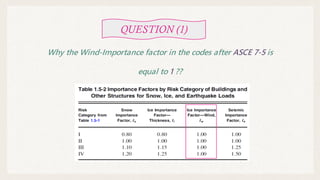
Table 6-1: Importance Factor, (Wind Loads)
ASCE 7-5
Chapter 6 WIND
1.2D + 1.6W + L + 0.5(Lr or S or R)
ASCE 7-5 Load Combination
 In ASCE 7-05, for Risk Category II, a mean recurrence interval (MRI) of 50 was used. Other risk
categories such as Category I and III/IV structures were adjusted to 25 and 100 years, respectively,
by multiplying the wind speed by the importance factor.
 A load factor of 1.6 for strength design was used for Risk Category II and 1.6 X Importance factor (I)
for other Risk Categories.
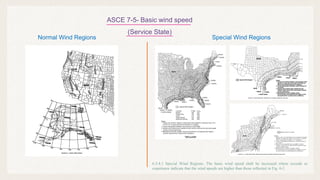
ASCE 7-5- Basic wind speed
(Service State)
Normal Wind Regions Special Wind Regions
6.5.4.1 Special Wind Regions. The basic wind speed shall be increased where records or
experience indicate that the wind speeds are higher than those reflected in Fig. 6-1.
ASCE 7-10
Chapter 26 WIND LOADS
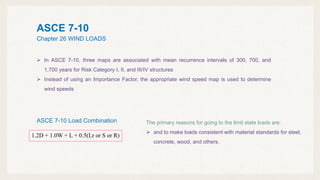
1.2D + 1.0W + L + 0.5(Lr or S or R)
ASCE 7-10 Load Combination
 In ASCE 7-10, three maps are associated with mean recurrence intervals of 300, 700, and
1,700 years for Risk Category I, II, and III/IV structures
 Instead of using an Importance Factor, the appropriate wind speed map is used to determine
wind speeds
The primary reasons for going to the limit state loads are:
 and to make loads consistent with material standards for steel,
concrete, wood, and others.
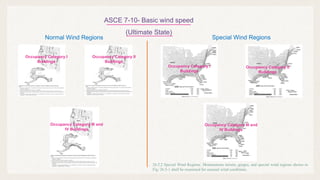
ASCE 7-10- Basic wind speed
(Ultimate State)
Normal Wind Regions Special Wind Regions
Occupancy Category III and
IV Buildings
Occupancy Category I
Buildings
Occupancy Category II
Buildings
Occupancy Category III and
IV Buildings
Occupancy Category I
Buildings
Occupancy Category II
Buildings
26.5.2 Special Wind Regions. Mountainous terrain, gorges, and special wind regions shown in
Fig. 26.5-1 shall be examined for unusual wind conditions.
Converting ASCE 7-5 wind speed value to
ASCE 7-10
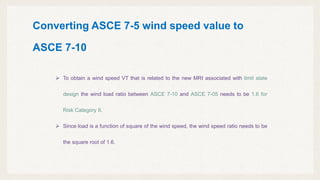
 To obtain a wind speed VT that is related to the new MRI associated with limit state
design the wind load ratio between ASCE 7-10 and ASCE 7-05 needs to be 1.6 for
Risk Category II.
 Since load is a function of square of the wind speed, the wind speed ratio needs to be
the square root of 1.6.
ASCE 7-10
ASCE 7-05
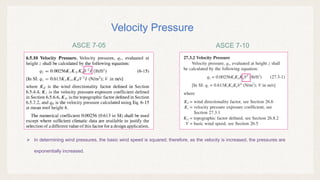
Velocity Pressure
 In determining wind pressures, the basic wind speed is squared; therefore, as the velocity is increased, the pressures are
exponentially increased.
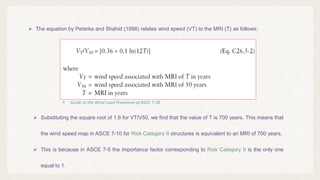
 The equation by Peterka and Shahid (1998) relates wind speed (VT) to the MRI (T) as follows:
 Substituting the square root of 1.6 for VT/V50, we find that the value of T is 700 years. This means that
the wind speed map in ASCE 7-10 for Risk Category II structures is equivalent to an MRI of 700 years.
 This is because in ASCE 7-5 the importance factor corresponding to Risk Category II is the only one
equal to 1.
 Guide to the Wind Load Provisions of ASCE 7-10
1.6 x (V50)2 = (Vu)2
 To convert wind velocity of Risk Category II from ASCE 7-5 to ASCE 7-10 :
(𝑉𝑉
𝑢𝑢)
2
𝑉𝑉50
2
= 1.6
(𝑉𝑉
𝑢𝑢)
𝑉𝑉50
= 1.6
 To convert wind velocity of Risk Category I from ASCE 7-5 to ASCE 7-10 :
𝑉𝑉𝑡𝑡 / 𝑉𝑉50= [0.36 + 0.1 ln(12 T)]
By substituting in this equation
1.6 = [0.36 + 0.1 ln(12 T)] T = 700
1.6 x .87 x (V50)2 = (Vu)2
(𝑉𝑉
𝑢𝑢)
2
𝑉𝑉50
2
= 1.6x .87
(𝑉𝑉
𝑢𝑢)
𝑉𝑉50
= 1.6x .87
𝑉𝑉𝑡𝑡 / 𝑉𝑉50= [0.36 + 0.1 ln(12 T)]
By substituting in this equation
1.6 𝑥𝑥 .87 = [0.36 + 0.1 ln(12 T)] T = 300
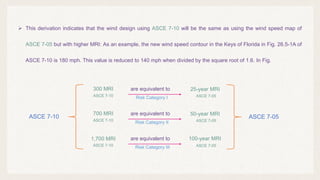
1,700 MRI
ASCE 7-05
ASCE 7-10
are equivalent to 100-year MRI
300 MRI
ASCE 7-05
ASCE 7-10
are equivalent to 25-year MRI
700 MRI
ASCE 7-05
ASCE 7-10
are equivalent to 50-year MRI
 This derivation indicates that the wind design using ASCE 7-10 will be the same as using the wind speed map of
ASCE 7-05 but with higher MRI: As an example, the new wind speed contour in the Keys of Florida in Fig. 26.5-1A of
ASCE 7-10 is 180 mph. This value is reduced to 140 mph when divided by the square root of 1.6. In Fig.
ASCE 7-05
ASCE 7-10
Risk Category I
Risk Category II
Risk Category III
QUESTION (1)
Why the Wind-Importance factor in the codes after ASCE 7-5 is
equal to 1 ??
QUESTION (2)
Why Risk Category III & Risk Category IV have the same map??
QUESTION (3)
How do we exactly know that the MRI corresponding to Risk
Category I is equal to 25 year in ASCE 7-5??
QUESTION (4)
How do we get V300 from V700??
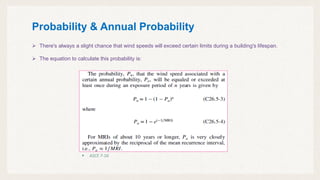
Probability & Annual Probability
 There's always a slight chance that wind speeds will exceed certain limits during a building's lifespan.
 The equation to calculate this probability is:
 ASCE 7-16
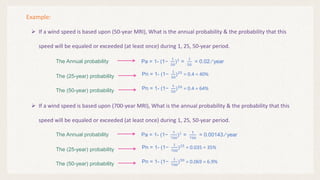
Example:
 If a wind speed is based upon (50-year MRI), What is the annual probability & the probability that this
speed will be equaled or exceeded (at least once) during 1, 25, 50-year period.
Pn = 1- (1−
1
50
)25
= 0.4 = 40%
The Annual probability Pa = 1- (1−
1
50
)1
=
1
50
= 0.02 ∕ year
The (25-year) probability
Pn = 1- (1−
1
50
)50
= 0.4 = 64%
The (50-year) probability
 If a wind speed is based upon (700-year MRI), What is the annual probability & the probability that this
speed will be equaled or exceeded (at least once) during 1, 25, 50-year period.
Pn = 1- (1−
1
700
)25
= 0.035 = 35%
The Annual probability Pa = 1- (1−
1
700
)1
=
1
700
= 0.00143 ∕ year
The (25-year) probability
Pn = 1- (1−
1
700
)50
= 0.069 = 6.9%
The (50-year) probability
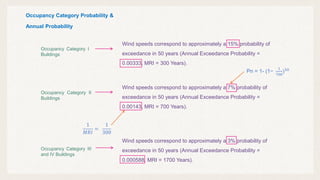
Wind speeds correspond to approximately a 7% probability of
exceedance in 50 years (Annual Exceedance Probability =
0.00143, MRI = 700 Years).
Wind speeds correspond to approximately a 3% probability of
exceedance in 50 years (Annual Exceedance Probability =
0.000588, MRI = 1700 Years).
Wind speeds correspond to approximately a 15% probability of
exceedance in 50 years (Annual Exceedance Probability =
0.00333, MRI = 300 Years).
Occupancy Category III
and IV Buildings
Occupancy Category I
Buildings
Occupancy Category II
Buildings
Occupancy Category Probability &
Annual Probability
Pn = 1- (1−
1
700
)50
1
𝑀𝑀𝑀𝑀𝑀𝑀
=
1
300
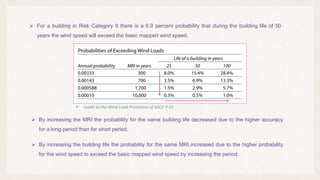
 For a building in Risk Category II there is a 6.9 percent probability that during the building life of 50
years the wind speed will exceed the basic mapped wind speed.
 By increasing the MRI the probability for the same building life decreased due to the higher accuracy
for a long period than for short period.
 By increasing the building life the probability for the same MRI increased due to the higher probability
for the wind speed to exceed the basic mapped wind speed by increasing the period.
 Guide to the Wind Load Provisions of ASCE 7-10
ASCE 7-10
WIND DRIFT
ASCE 7-05
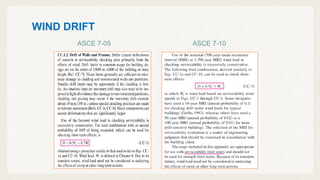
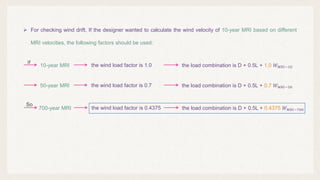
 For checking wind drift, If the designer wanted to calculate the wind velocity of 10-year MRI based on different
MRI velocities, the following factors should be used:
10-year MRI the wind load factor is 1.0 the load combination is D + 0.5L + 1.0 𝑊𝑊𝑀𝑀𝑀𝑀𝑀𝑀−10
So
50-year MRI the wind load factor is 0.7 the load combination is D + 0.5L + 0.7 𝑊𝑊𝑀𝑀𝑀𝑀𝑀𝑀−50
700-year MRI the wind load factor is 0.4375 the load combination is D + 0.5L + 0.4375 𝑊𝑊𝑀𝑀𝑀𝑀𝑀𝑀−700
If
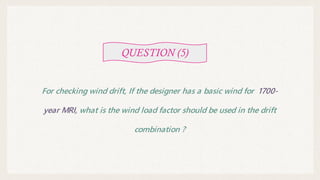
QUESTION (5)
For checking wind drift, If the designer has a basic wind for 1700-
year MRI, what is the wind load factor should be used in the drift
combination ?

Mean_Recurrence_Interval_MRI__1717582543.pdf

  • 1.
  • 2.
    CONTENT  Mean RecurrenceInterval (MRI)  3-SEC Gust wind Speed  ASCE 7-5 wind Provision  ASCE 7-10 wind Provision  Converting ASCE 7-5 wind speed value to ASCE 7-10  Velocity Pressure  Probability & Annual probability  Wind Drift
  • 3.
     The meanrecurrence interval is the inverse of the probability that a wind event of a certain magnitude will be exceeded in any one year. For example, A 700-year return period wind of 115 mph (51 m/s) means that, on average, these areas will experience wind speeds exceeding 115 mph once every 700 years. This corresponds to an annual probability of occurrence of 1/700, or approximately 0.14%. Therefore, the chance of a wind exceeding 115 mph occurring in these regions in any given year is 0.14%. Mean Recurrence Interval (MRI)
  • 4.
     A 3-secondgust is the average wind speed for the 3 seconds 3-SEC Gust wind Speed  ASCE 7-16
  • 5.
    Table 6-1: ImportanceFactor, (Wind Loads) ASCE 7-5 Chapter 6 WIND 1.2D + 1.6W + L + 0.5(Lr or S or R) ASCE 7-5 Load Combination  In ASCE 7-05, for Risk Category II, a mean recurrence interval (MRI) of 50 was used. Other risk categories such as Category I and III/IV structures were adjusted to 25 and 100 years, respectively, by multiplying the wind speed by the importance factor.  A load factor of 1.6 for strength design was used for Risk Category II and 1.6 X Importance factor (I) for other Risk Categories.
  • 6.
    ASCE 7-5- Basicwind speed (Service State) Normal Wind Regions Special Wind Regions 6.5.4.1 Special Wind Regions. The basic wind speed shall be increased where records or experience indicate that the wind speeds are higher than those reflected in Fig. 6-1.
  • 7.
    ASCE 7-10 Chapter 26WIND LOADS 1.2D + 1.0W + L + 0.5(Lr or S or R) ASCE 7-10 Load Combination  In ASCE 7-10, three maps are associated with mean recurrence intervals of 300, 700, and 1,700 years for Risk Category I, II, and III/IV structures  Instead of using an Importance Factor, the appropriate wind speed map is used to determine wind speeds The primary reasons for going to the limit state loads are:  and to make loads consistent with material standards for steel, concrete, wood, and others.
  • 8.
    ASCE 7-10- Basicwind speed (Ultimate State) Normal Wind Regions Special Wind Regions Occupancy Category III and IV Buildings Occupancy Category I Buildings Occupancy Category II Buildings Occupancy Category III and IV Buildings Occupancy Category I Buildings Occupancy Category II Buildings 26.5.2 Special Wind Regions. Mountainous terrain, gorges, and special wind regions shown in Fig. 26.5-1 shall be examined for unusual wind conditions.
  • 9.
    Converting ASCE 7-5wind speed value to ASCE 7-10  To obtain a wind speed VT that is related to the new MRI associated with limit state design the wind load ratio between ASCE 7-10 and ASCE 7-05 needs to be 1.6 for Risk Category II.  Since load is a function of square of the wind speed, the wind speed ratio needs to be the square root of 1.6.
  • 10.
    ASCE 7-10 ASCE 7-05 VelocityPressure  In determining wind pressures, the basic wind speed is squared; therefore, as the velocity is increased, the pressures are exponentially increased.
  • 11.
     The equationby Peterka and Shahid (1998) relates wind speed (VT) to the MRI (T) as follows:  Substituting the square root of 1.6 for VT/V50, we find that the value of T is 700 years. This means that the wind speed map in ASCE 7-10 for Risk Category II structures is equivalent to an MRI of 700 years.  This is because in ASCE 7-5 the importance factor corresponding to Risk Category II is the only one equal to 1.  Guide to the Wind Load Provisions of ASCE 7-10
  • 12.
    1.6 x (V50)2= (Vu)2  To convert wind velocity of Risk Category II from ASCE 7-5 to ASCE 7-10 : (𝑉𝑉 𝑢𝑢) 2 𝑉𝑉50 2 = 1.6 (𝑉𝑉 𝑢𝑢) 𝑉𝑉50 = 1.6  To convert wind velocity of Risk Category I from ASCE 7-5 to ASCE 7-10 : 𝑉𝑉𝑡𝑡 / 𝑉𝑉50= [0.36 + 0.1 ln(12 T)] By substituting in this equation 1.6 = [0.36 + 0.1 ln(12 T)] T = 700 1.6 x .87 x (V50)2 = (Vu)2 (𝑉𝑉 𝑢𝑢) 2 𝑉𝑉50 2 = 1.6x .87 (𝑉𝑉 𝑢𝑢) 𝑉𝑉50 = 1.6x .87 𝑉𝑉𝑡𝑡 / 𝑉𝑉50= [0.36 + 0.1 ln(12 T)] By substituting in this equation 1.6 𝑥𝑥 .87 = [0.36 + 0.1 ln(12 T)] T = 300
  • 13.
    1,700 MRI ASCE 7-05 ASCE7-10 are equivalent to 100-year MRI 300 MRI ASCE 7-05 ASCE 7-10 are equivalent to 25-year MRI 700 MRI ASCE 7-05 ASCE 7-10 are equivalent to 50-year MRI  This derivation indicates that the wind design using ASCE 7-10 will be the same as using the wind speed map of ASCE 7-05 but with higher MRI: As an example, the new wind speed contour in the Keys of Florida in Fig. 26.5-1A of ASCE 7-10 is 180 mph. This value is reduced to 140 mph when divided by the square root of 1.6. In Fig. ASCE 7-05 ASCE 7-10 Risk Category I Risk Category II Risk Category III
  • 14.
    QUESTION (1) Why theWind-Importance factor in the codes after ASCE 7-5 is equal to 1 ??
  • 15.
    QUESTION (2) Why RiskCategory III & Risk Category IV have the same map??
  • 16.
    QUESTION (3) How dowe exactly know that the MRI corresponding to Risk Category I is equal to 25 year in ASCE 7-5??
  • 17.
    QUESTION (4) How dowe get V300 from V700??
  • 18.
    Probability & AnnualProbability  There's always a slight chance that wind speeds will exceed certain limits during a building's lifespan.  The equation to calculate this probability is:  ASCE 7-16
  • 19.
    Example:  If awind speed is based upon (50-year MRI), What is the annual probability & the probability that this speed will be equaled or exceeded (at least once) during 1, 25, 50-year period. Pn = 1- (1− 1 50 )25 = 0.4 = 40% The Annual probability Pa = 1- (1− 1 50 )1 = 1 50 = 0.02 ∕ year The (25-year) probability Pn = 1- (1− 1 50 )50 = 0.4 = 64% The (50-year) probability  If a wind speed is based upon (700-year MRI), What is the annual probability & the probability that this speed will be equaled or exceeded (at least once) during 1, 25, 50-year period. Pn = 1- (1− 1 700 )25 = 0.035 = 35% The Annual probability Pa = 1- (1− 1 700 )1 = 1 700 = 0.00143 ∕ year The (25-year) probability Pn = 1- (1− 1 700 )50 = 0.069 = 6.9% The (50-year) probability
  • 20.
    Wind speeds correspondto approximately a 7% probability of exceedance in 50 years (Annual Exceedance Probability = 0.00143, MRI = 700 Years). Wind speeds correspond to approximately a 3% probability of exceedance in 50 years (Annual Exceedance Probability = 0.000588, MRI = 1700 Years). Wind speeds correspond to approximately a 15% probability of exceedance in 50 years (Annual Exceedance Probability = 0.00333, MRI = 300 Years). Occupancy Category III and IV Buildings Occupancy Category I Buildings Occupancy Category II Buildings Occupancy Category Probability & Annual Probability Pn = 1- (1− 1 700 )50 1 𝑀𝑀𝑀𝑀𝑀𝑀 = 1 300
  • 21.
     For abuilding in Risk Category II there is a 6.9 percent probability that during the building life of 50 years the wind speed will exceed the basic mapped wind speed.  By increasing the MRI the probability for the same building life decreased due to the higher accuracy for a long period than for short period.  By increasing the building life the probability for the same MRI increased due to the higher probability for the wind speed to exceed the basic mapped wind speed by increasing the period.  Guide to the Wind Load Provisions of ASCE 7-10
  • 22.
  • 23.
     For checkingwind drift, If the designer wanted to calculate the wind velocity of 10-year MRI based on different MRI velocities, the following factors should be used: 10-year MRI the wind load factor is 1.0 the load combination is D + 0.5L + 1.0 𝑊𝑊𝑀𝑀𝑀𝑀𝑀𝑀−10 So 50-year MRI the wind load factor is 0.7 the load combination is D + 0.5L + 0.7 𝑊𝑊𝑀𝑀𝑀𝑀𝑀𝑀−50 700-year MRI the wind load factor is 0.4375 the load combination is D + 0.5L + 0.4375 𝑊𝑊𝑀𝑀𝑀𝑀𝑀𝑀−700 If
  • 24.
    QUESTION (5) For checkingwind drift, If the designer has a basic wind for 1700- year MRI, what is the wind load factor should be used in the drift combination ?