Minnesota Digital Library Steve In Action Community Tagging Project
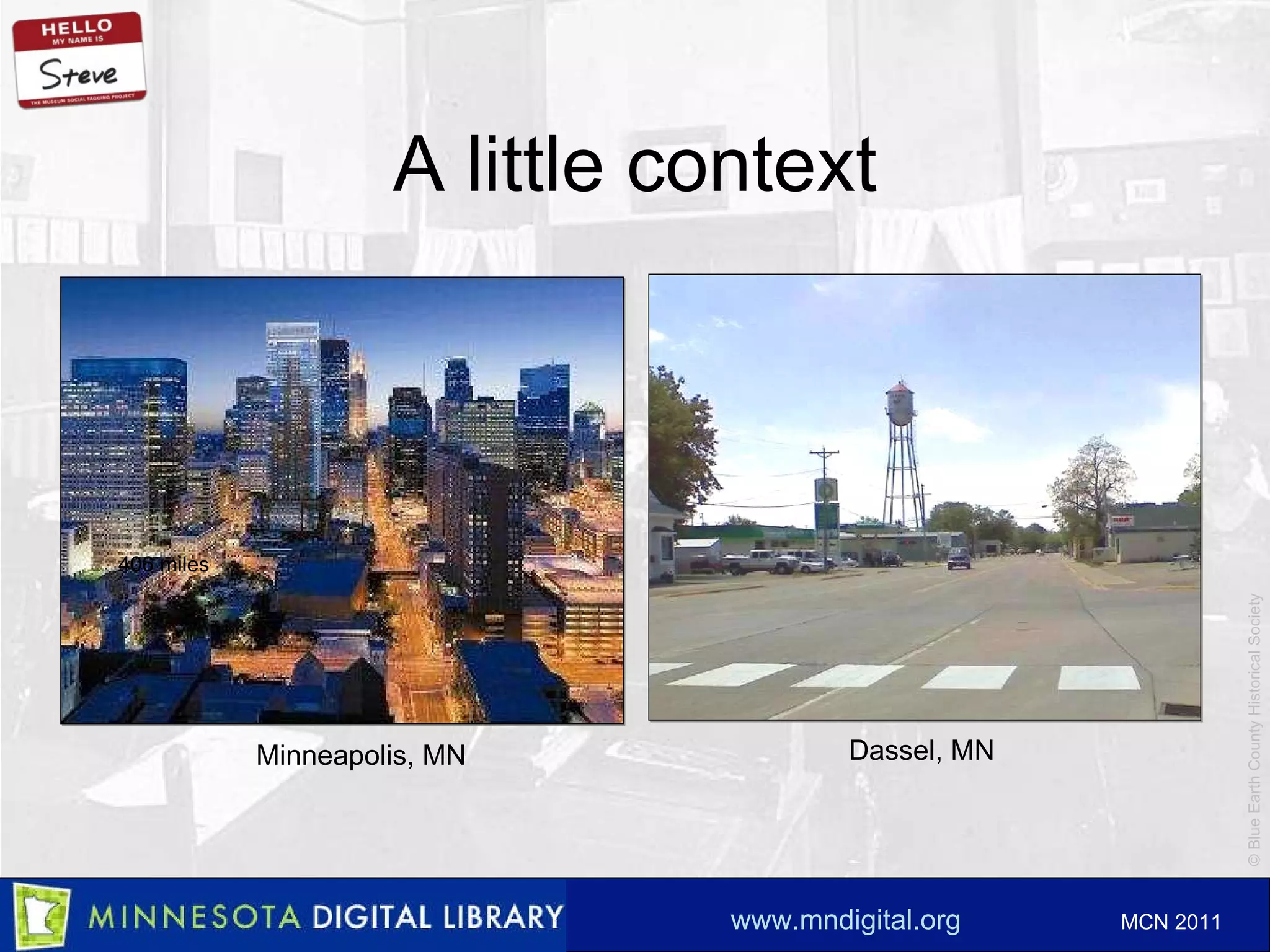
A little context 406 miles Minneapolis, MN Dassel, MN
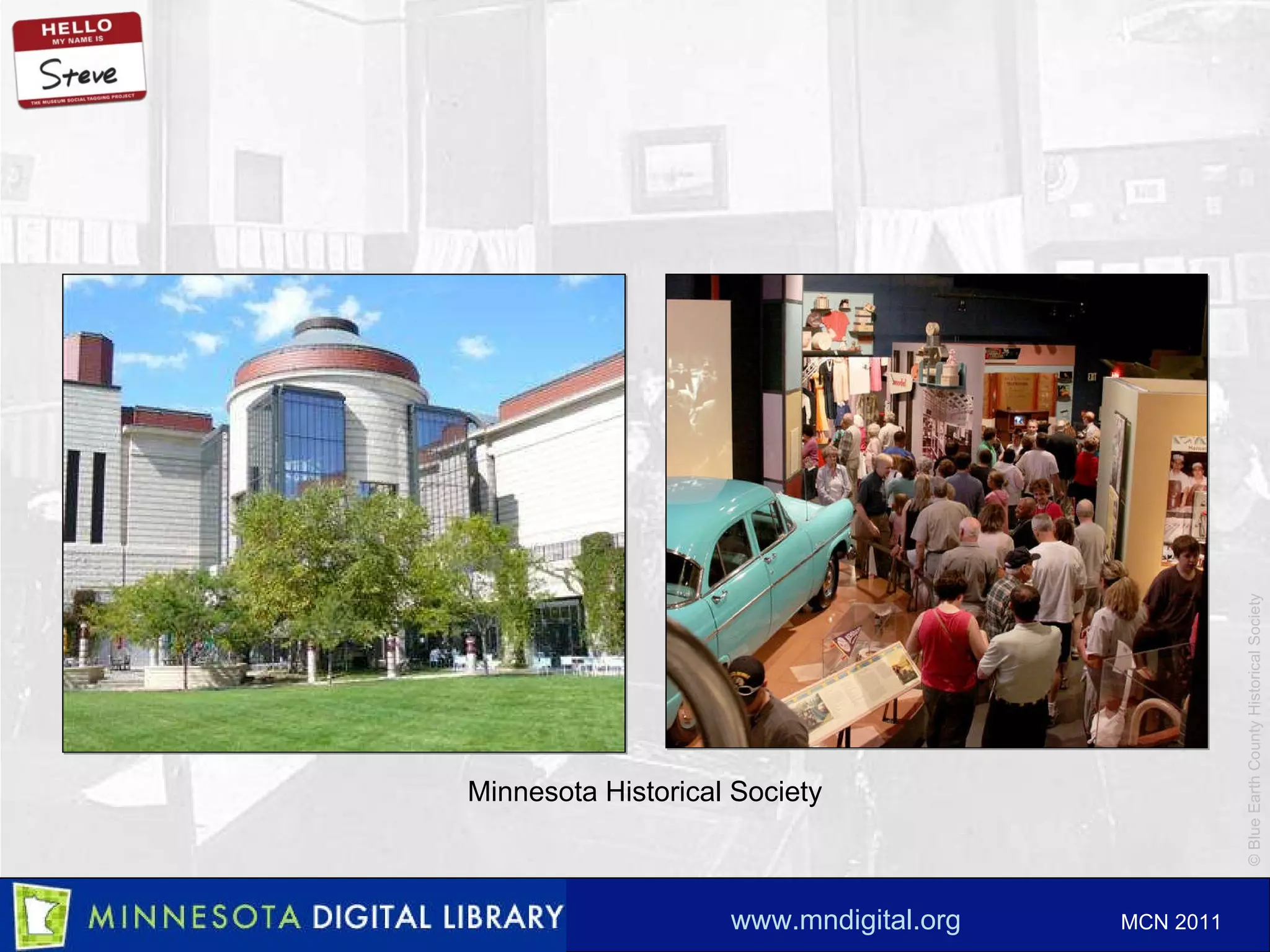
Minnesota Historical Society
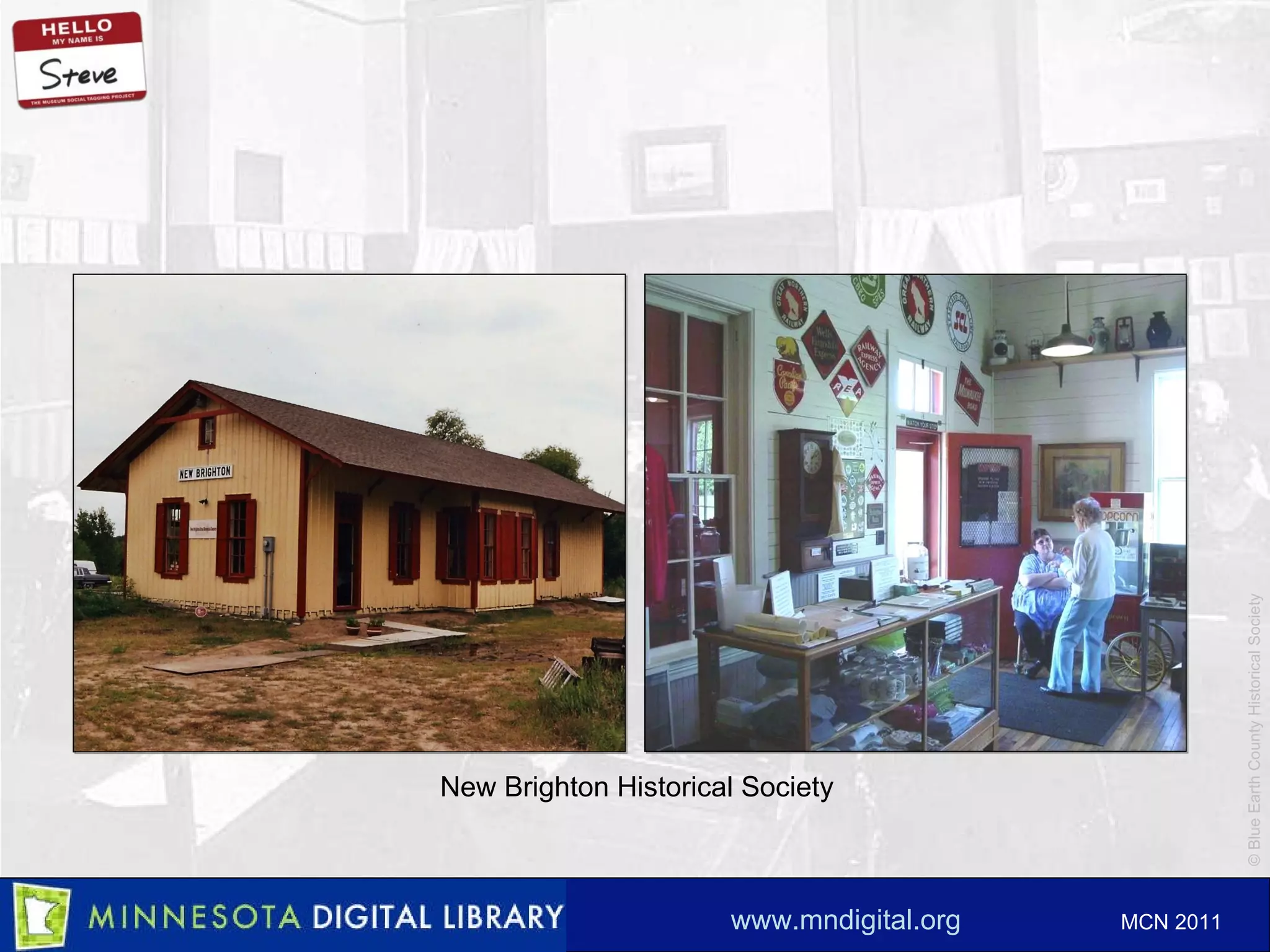
New Brighton Historical Society
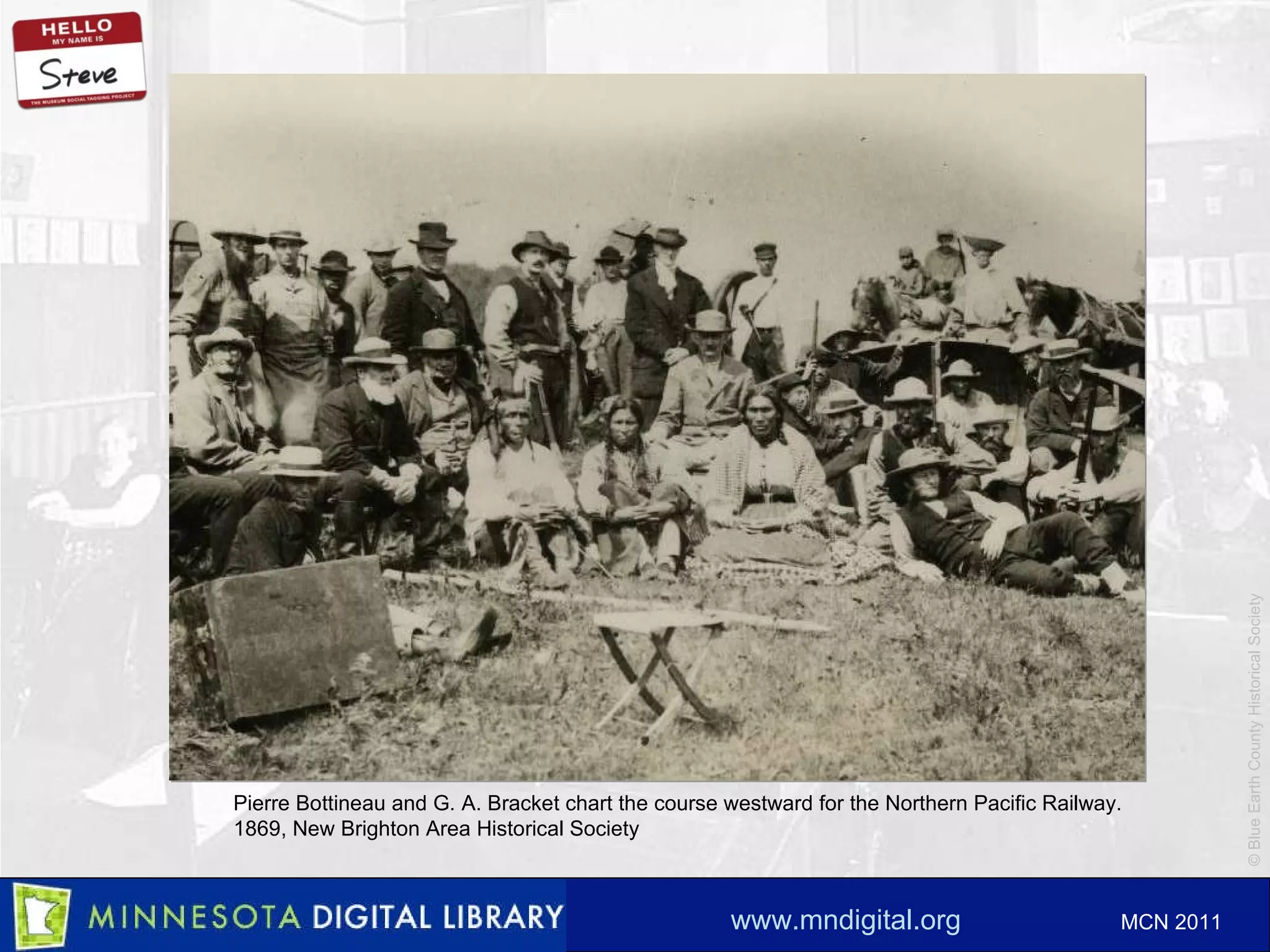
Pierre Bottineau and G. A. Bracket chart the course westward for the Northern Pacific Railway.  1869, New Brighton Area Historical Society
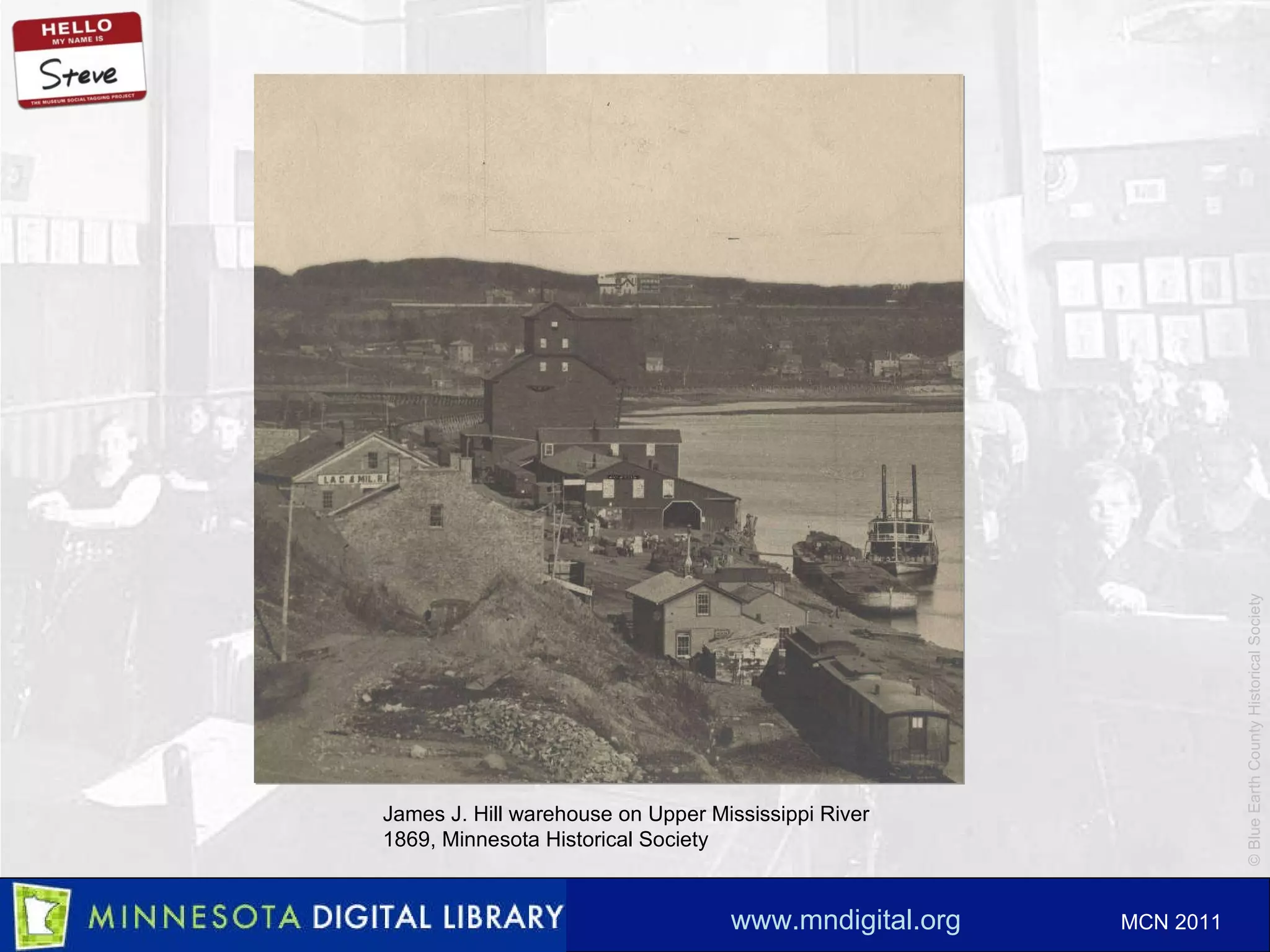
James J. Hill warehouse on Upper Mississippi River  1869, Minnesota Historical Society
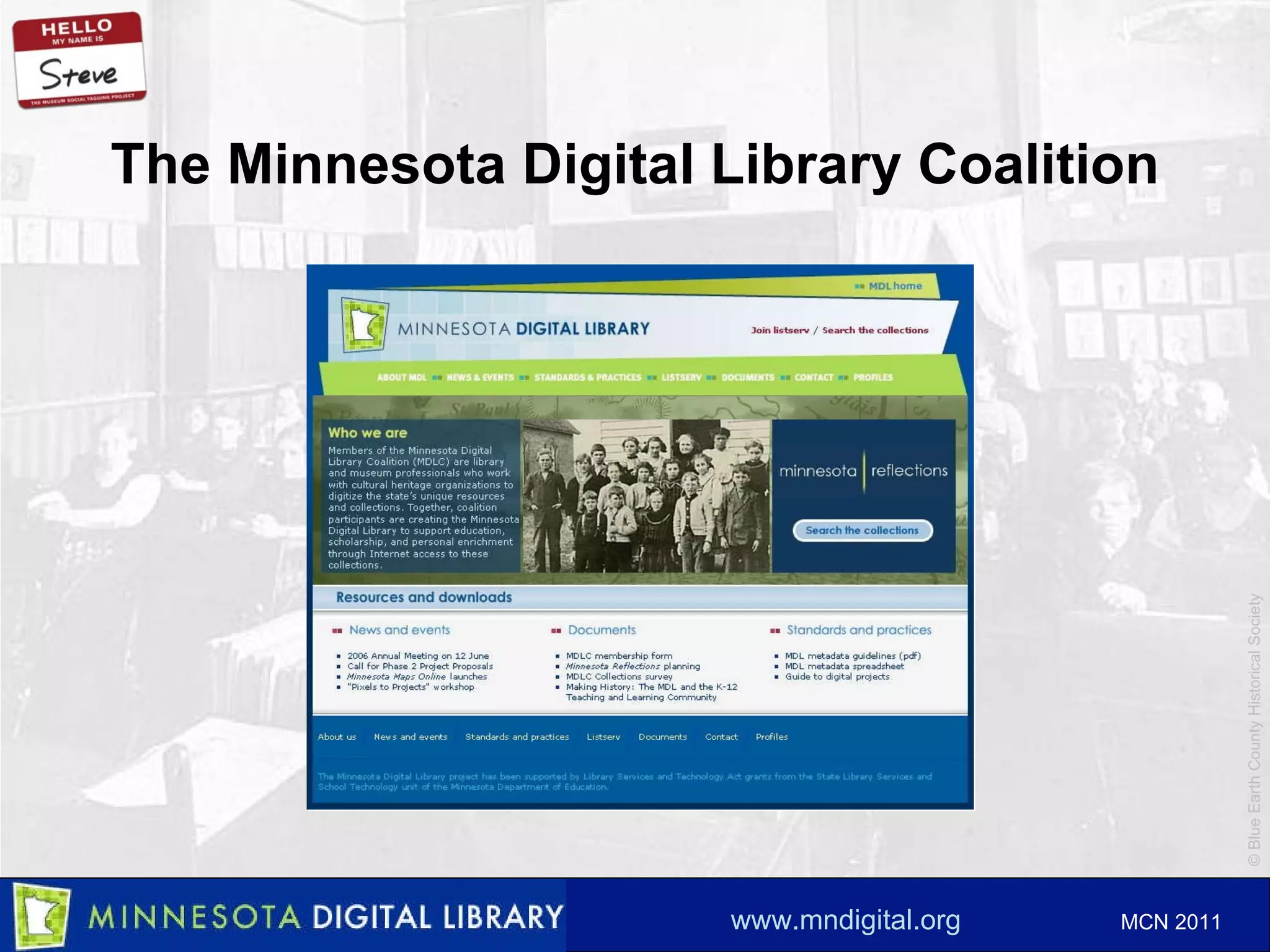
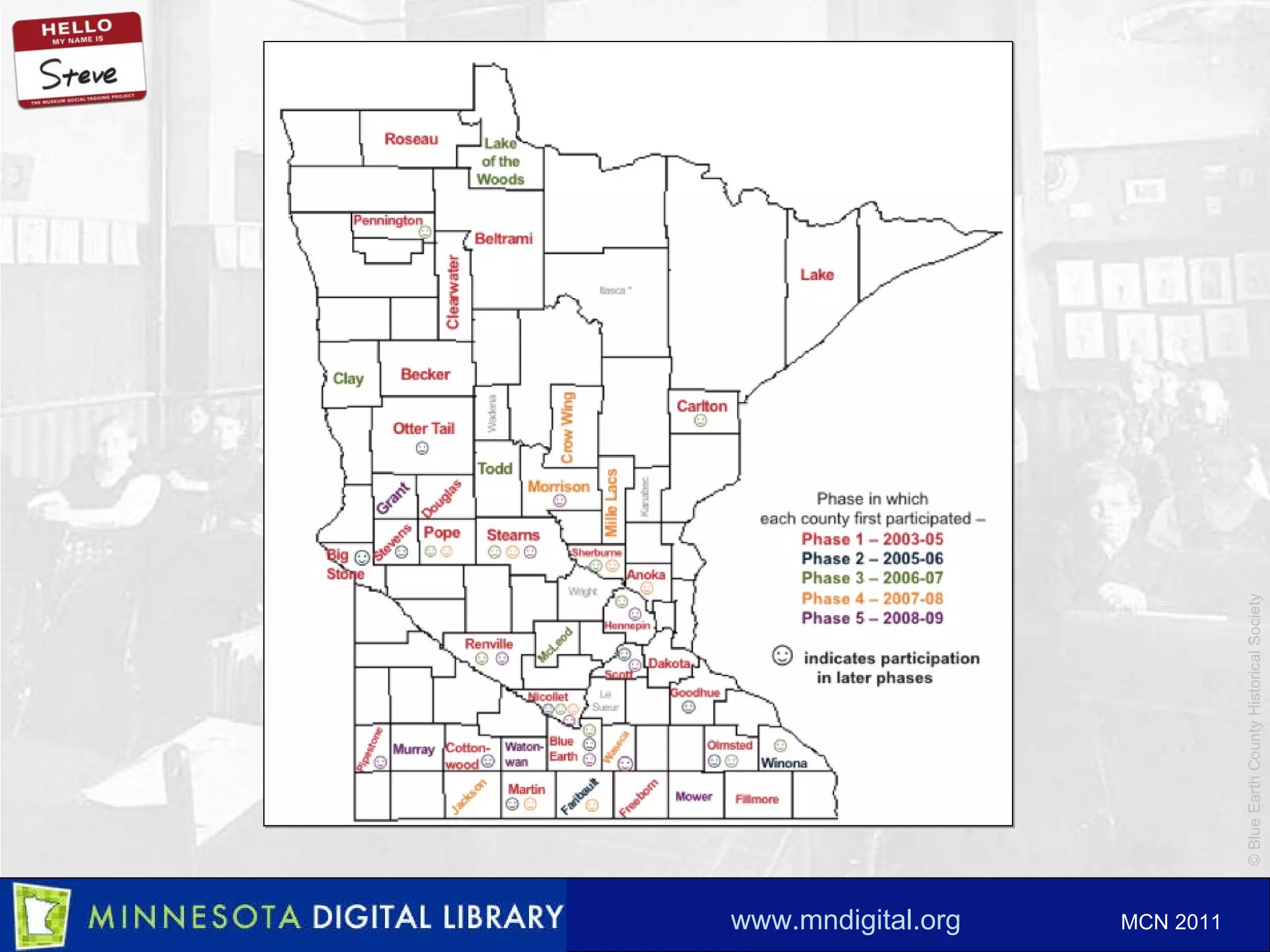
The Minnesota Digital Library Coalition
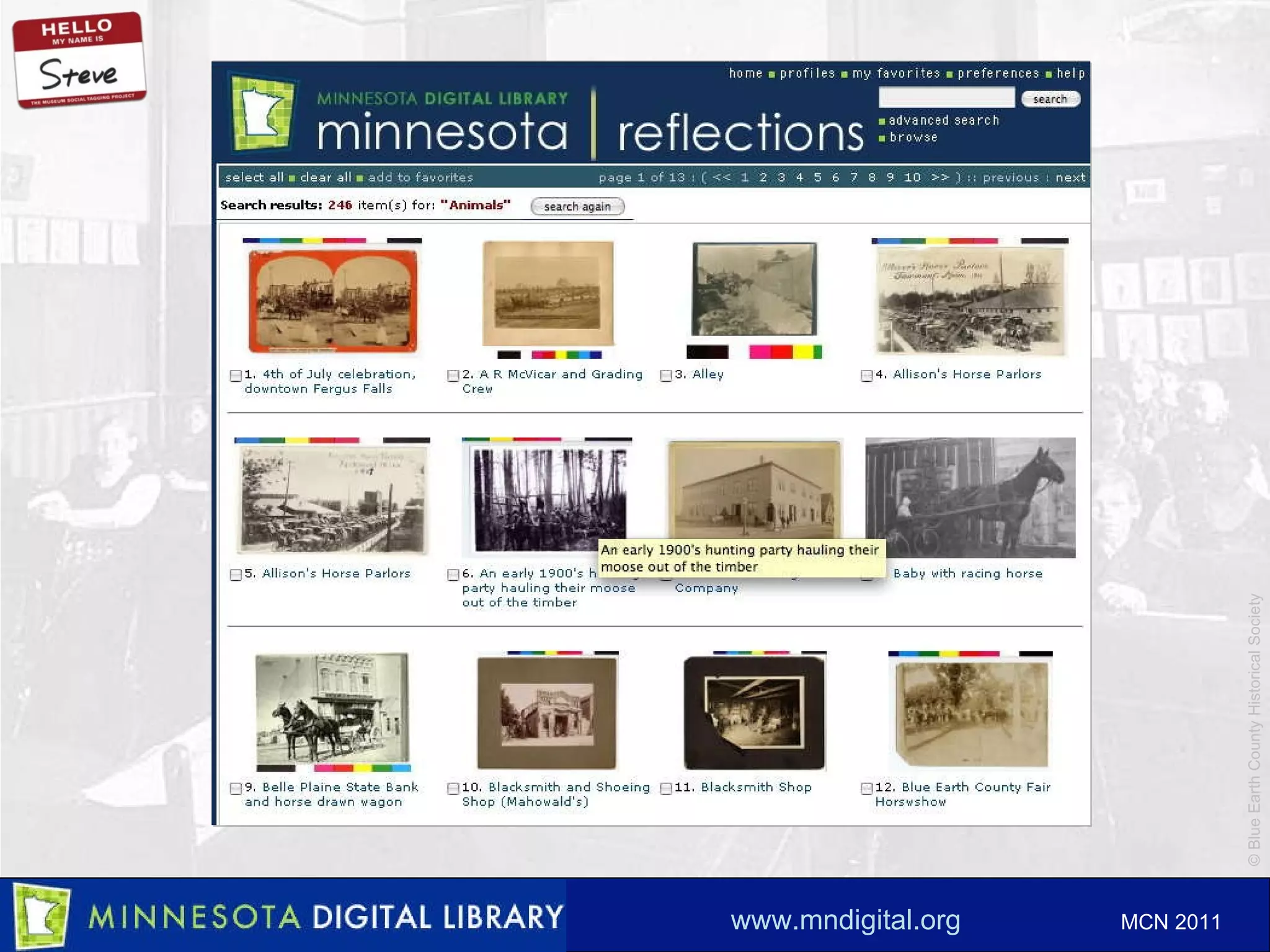
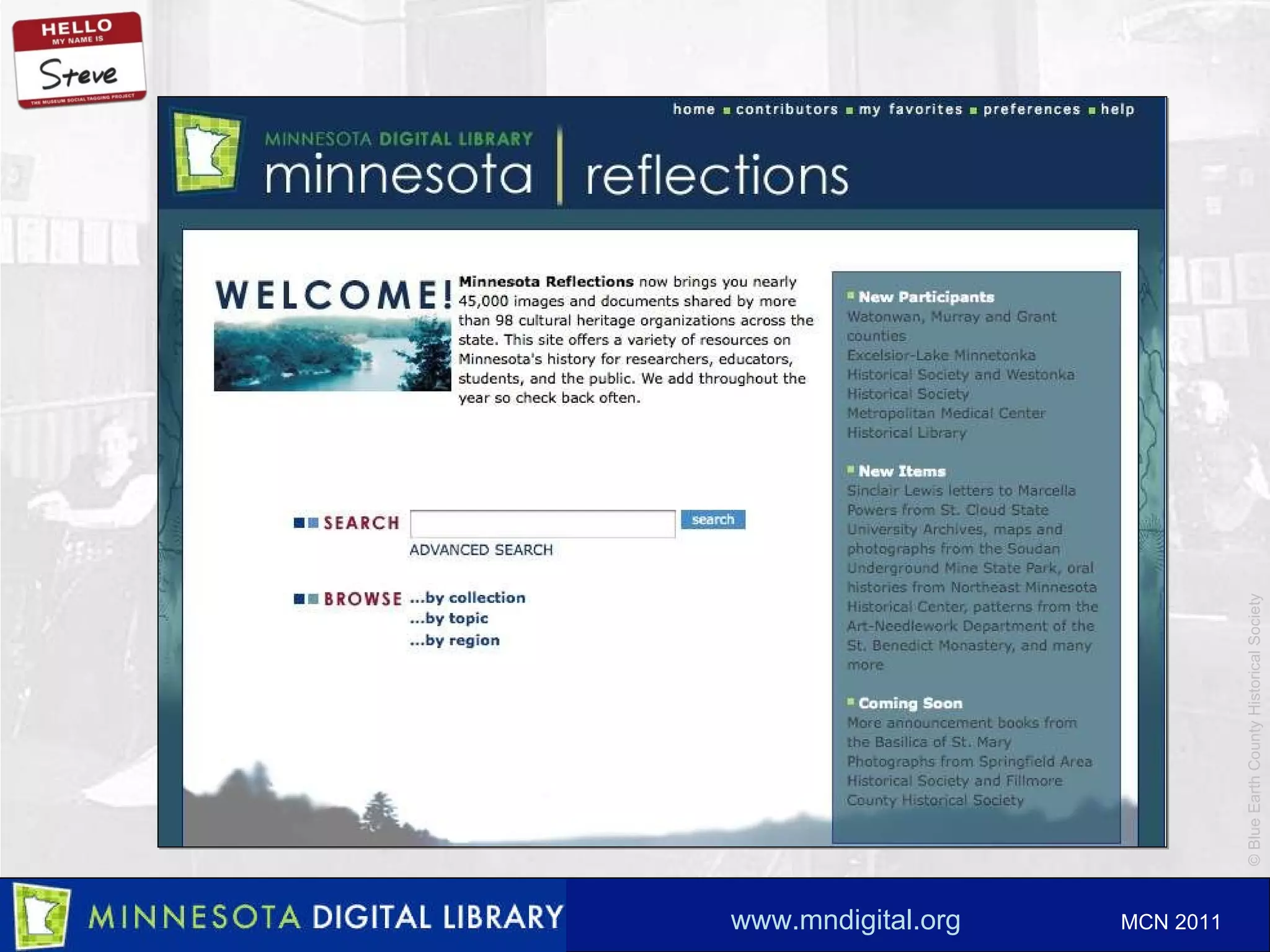
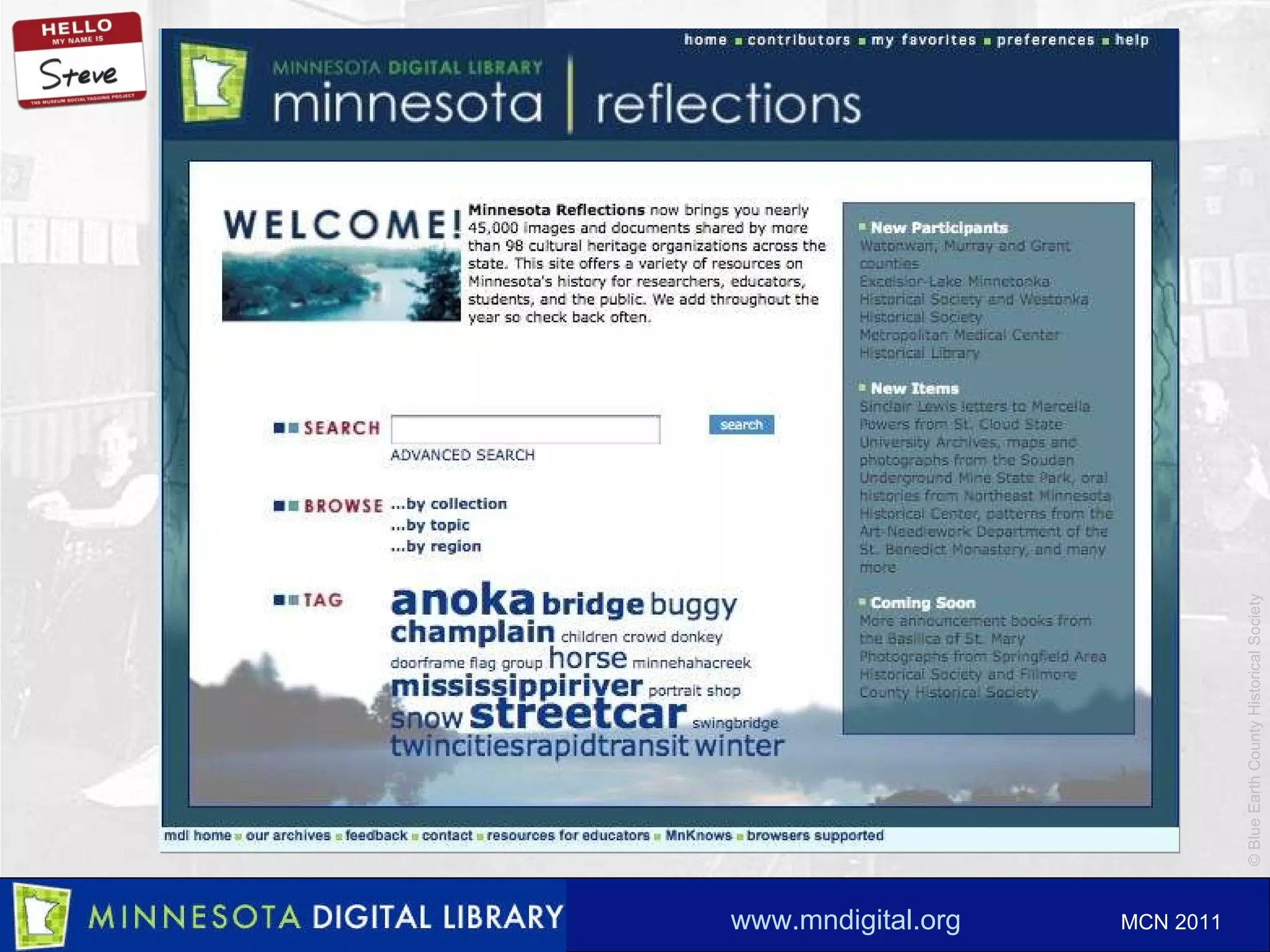
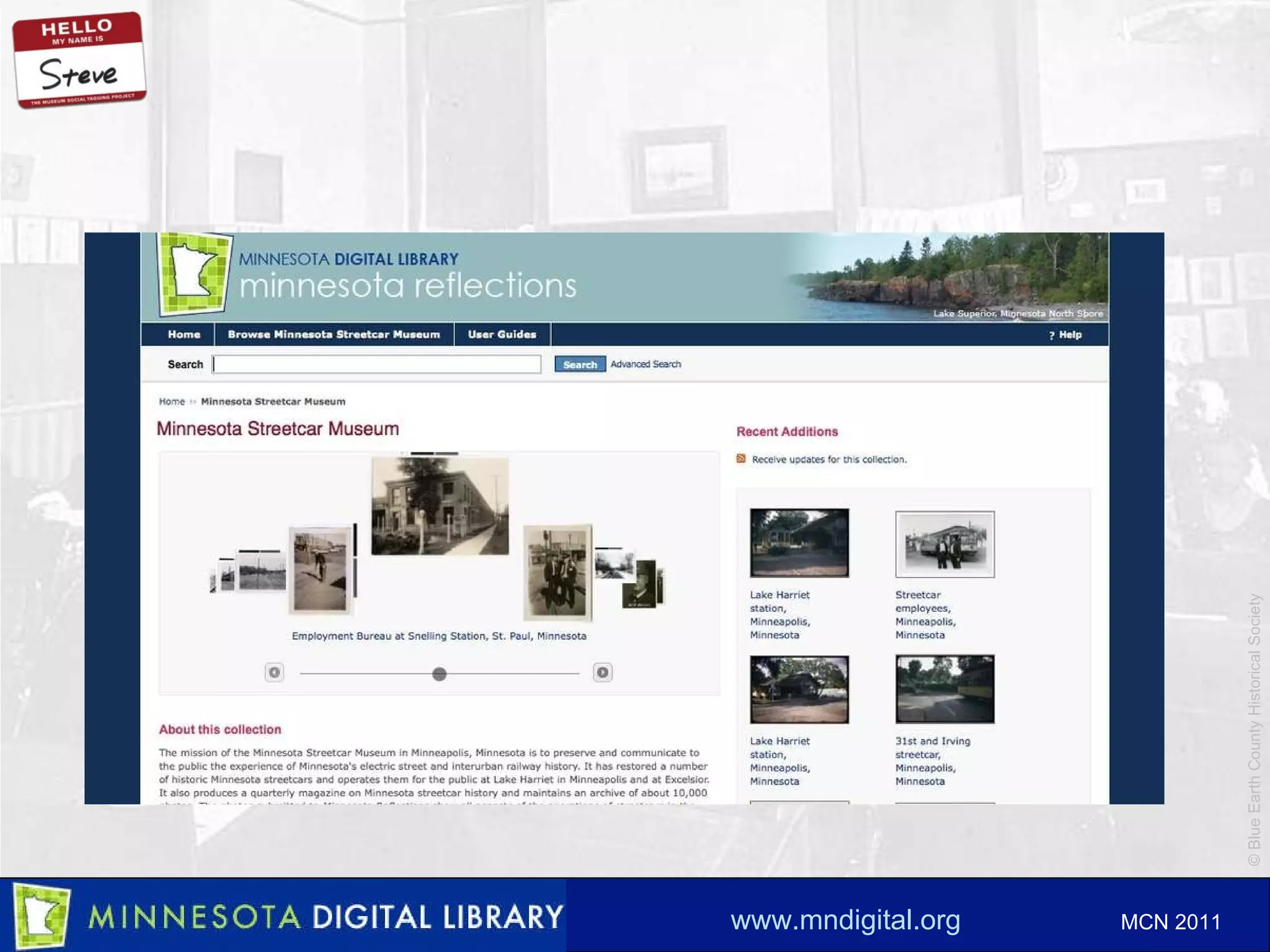
The Minnesota Digital Library Coalition ’s Minnesota Reflections 105+ cultural heritage institutions 55,000 photographs, maps, journals, and documents State and federally funded small digitization grants Centralized digitization facilities


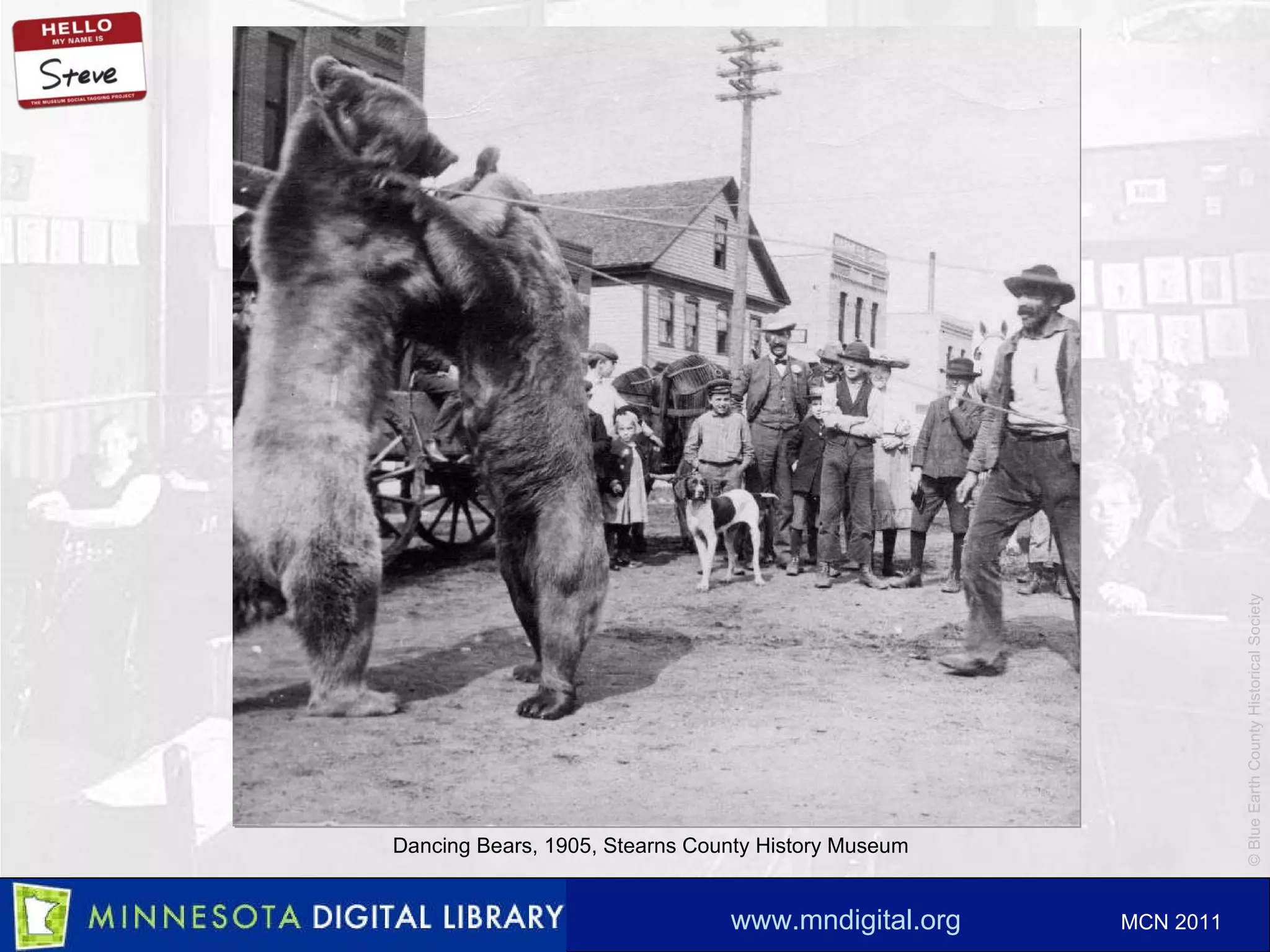
Dancing Bears, 1905, Stearns County History Museum
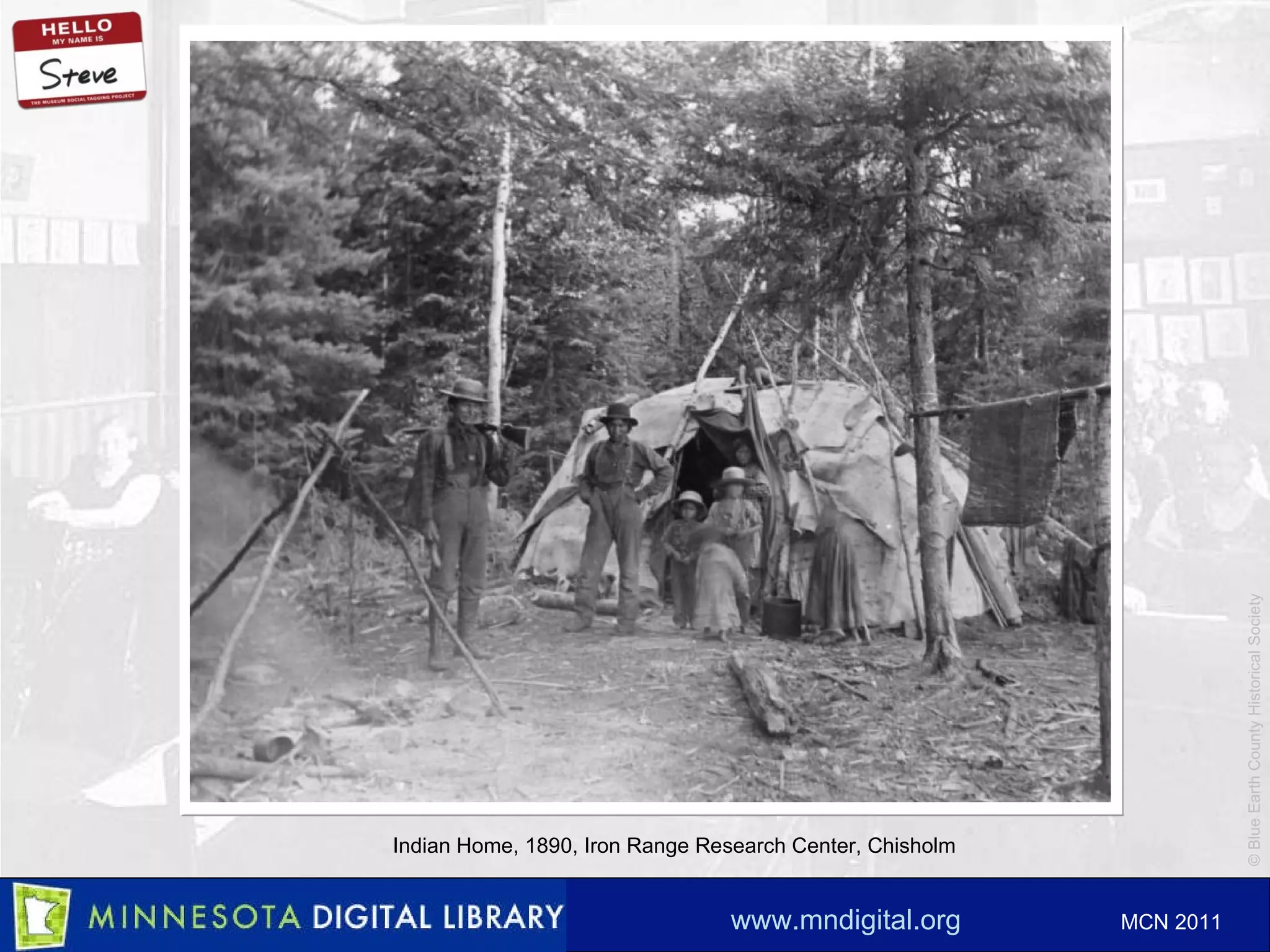
Indian Home, 1890, Iron Range Research Center, Chisholm
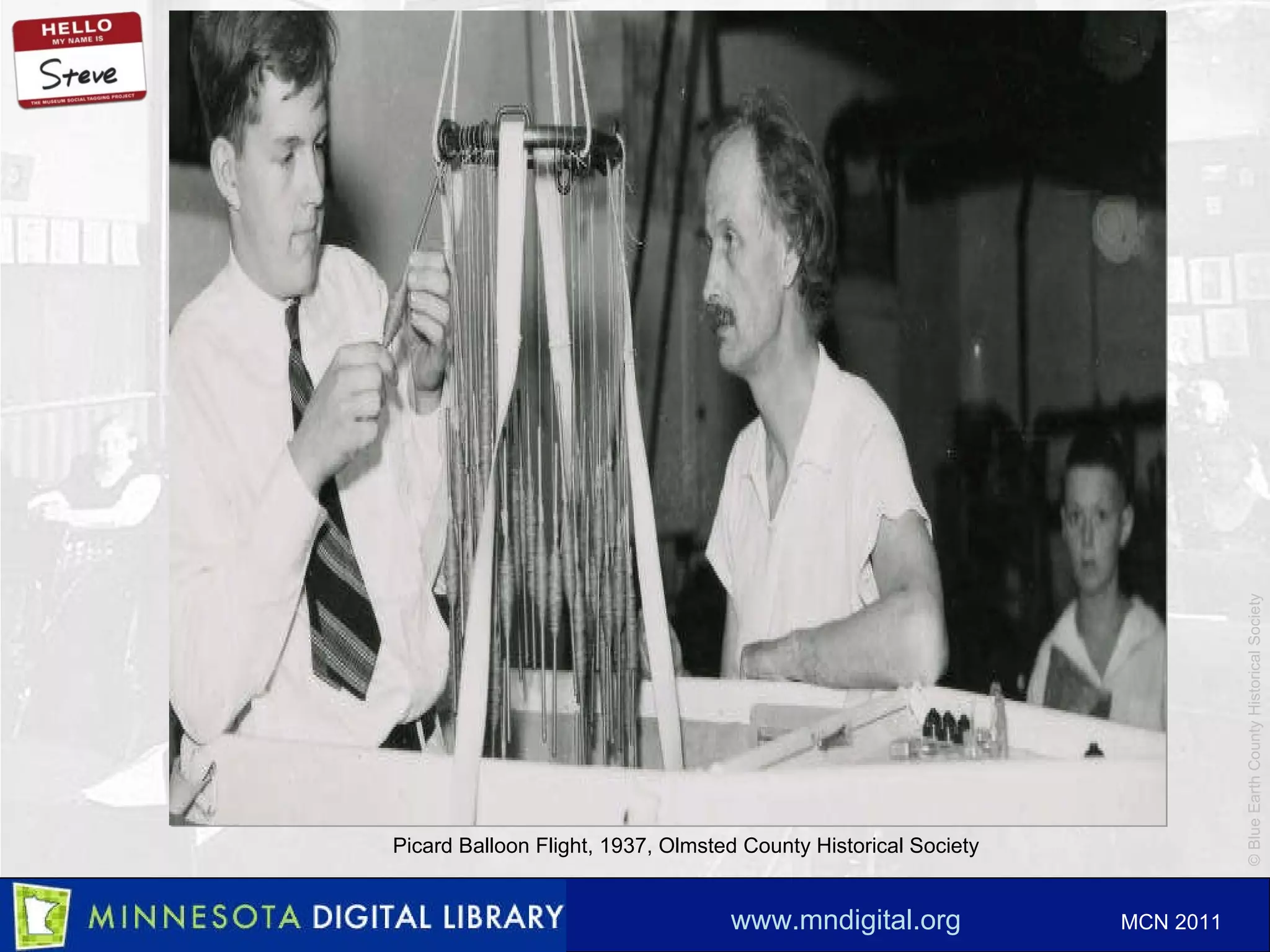
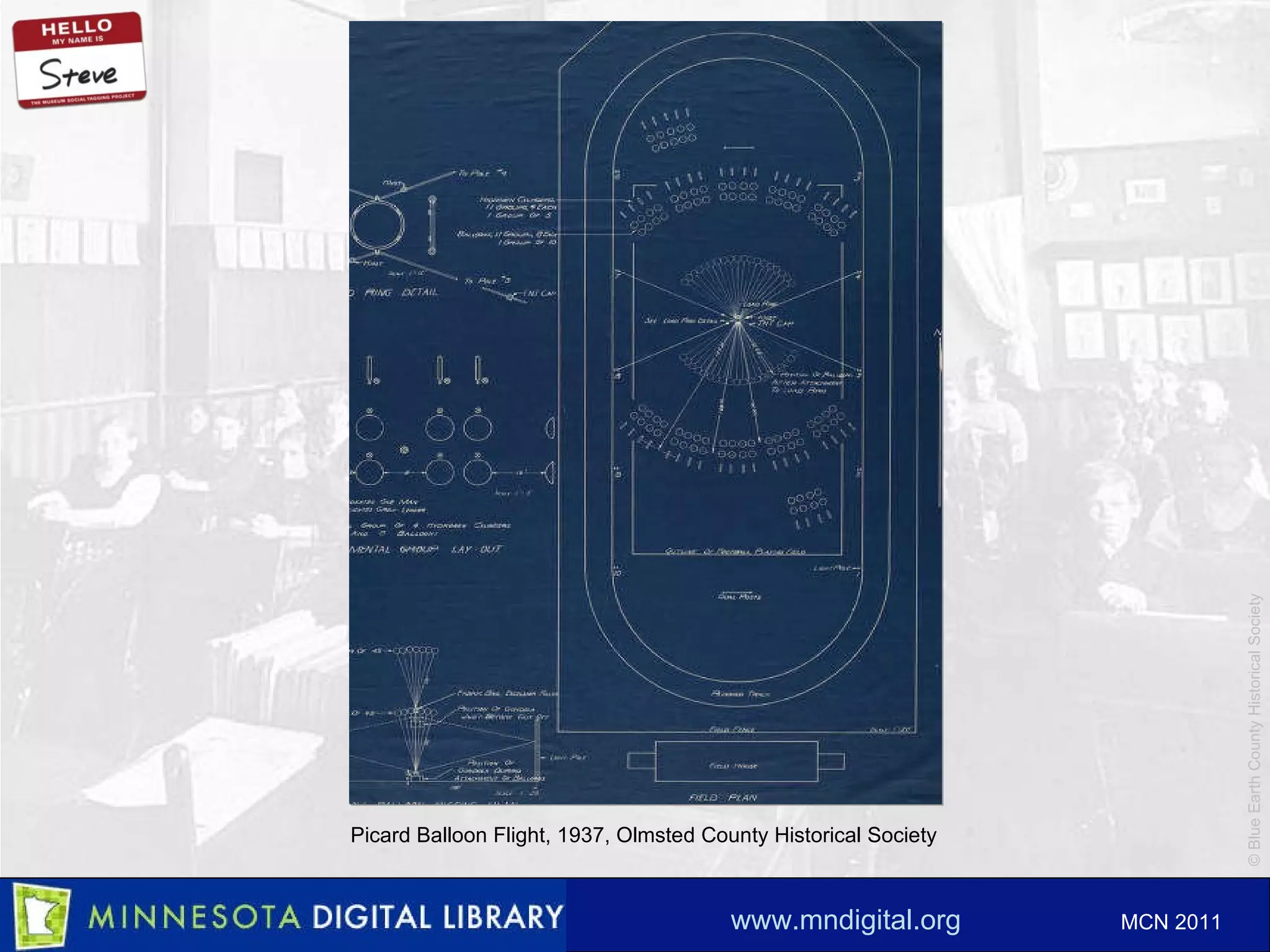
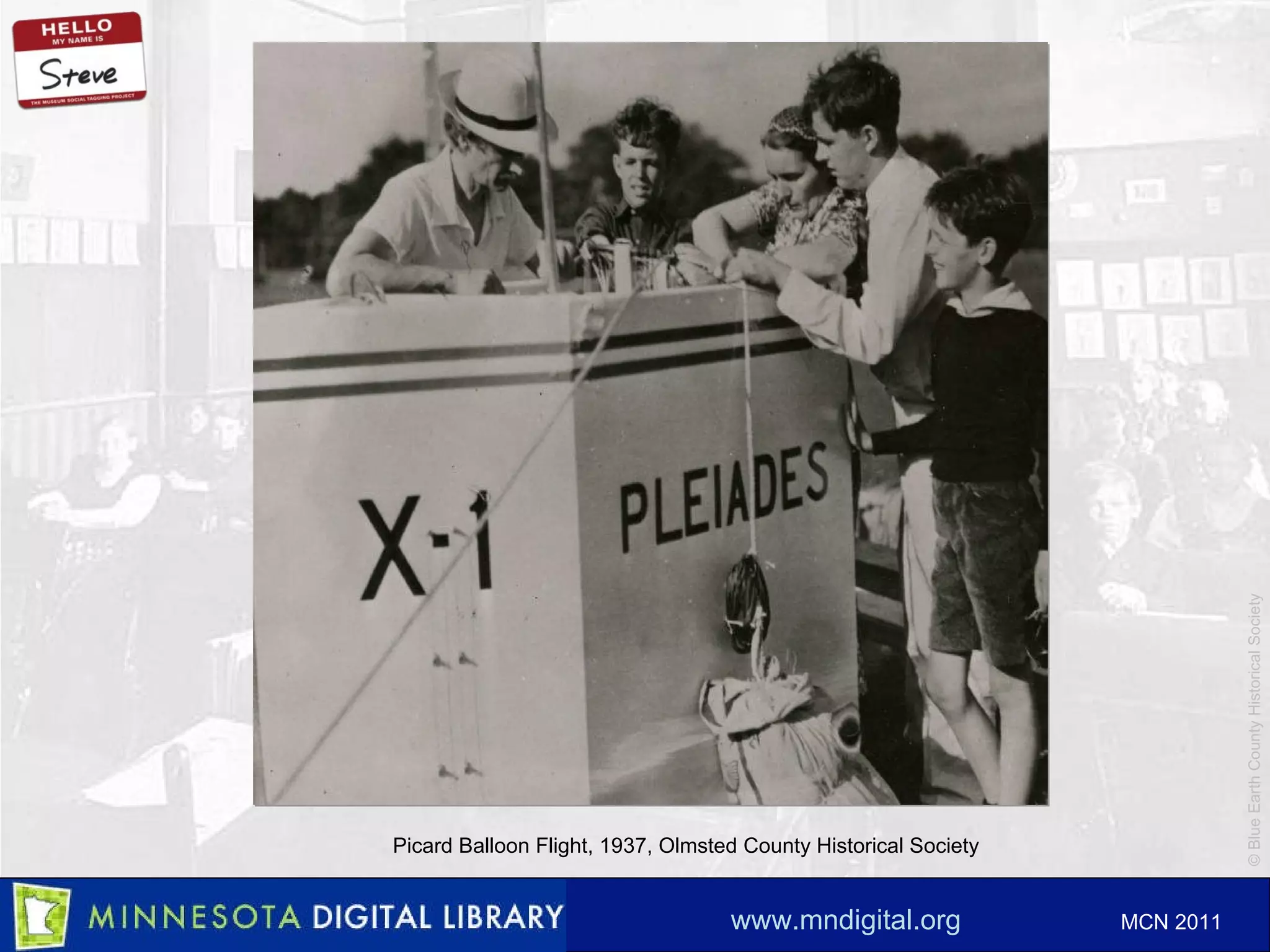
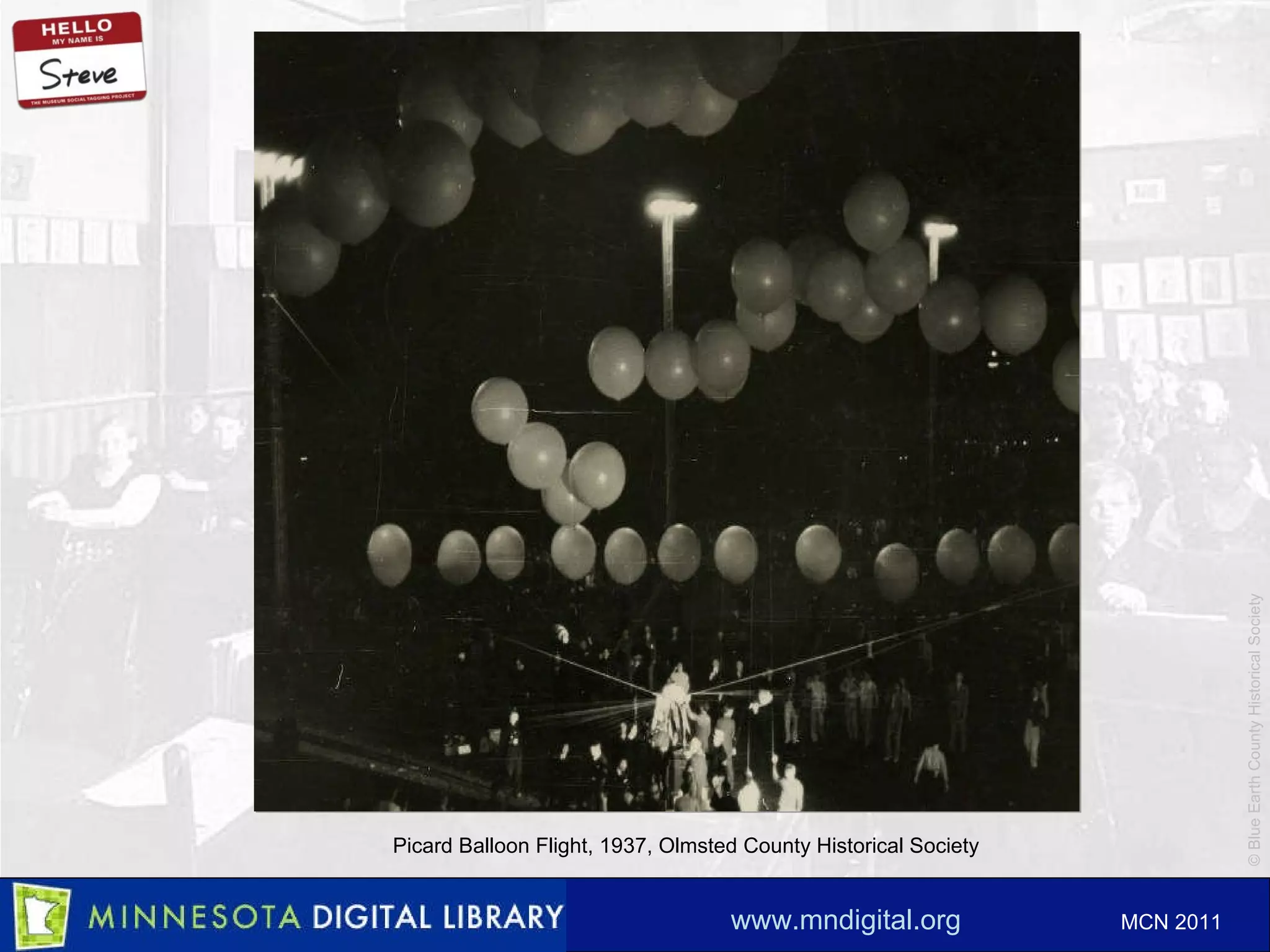
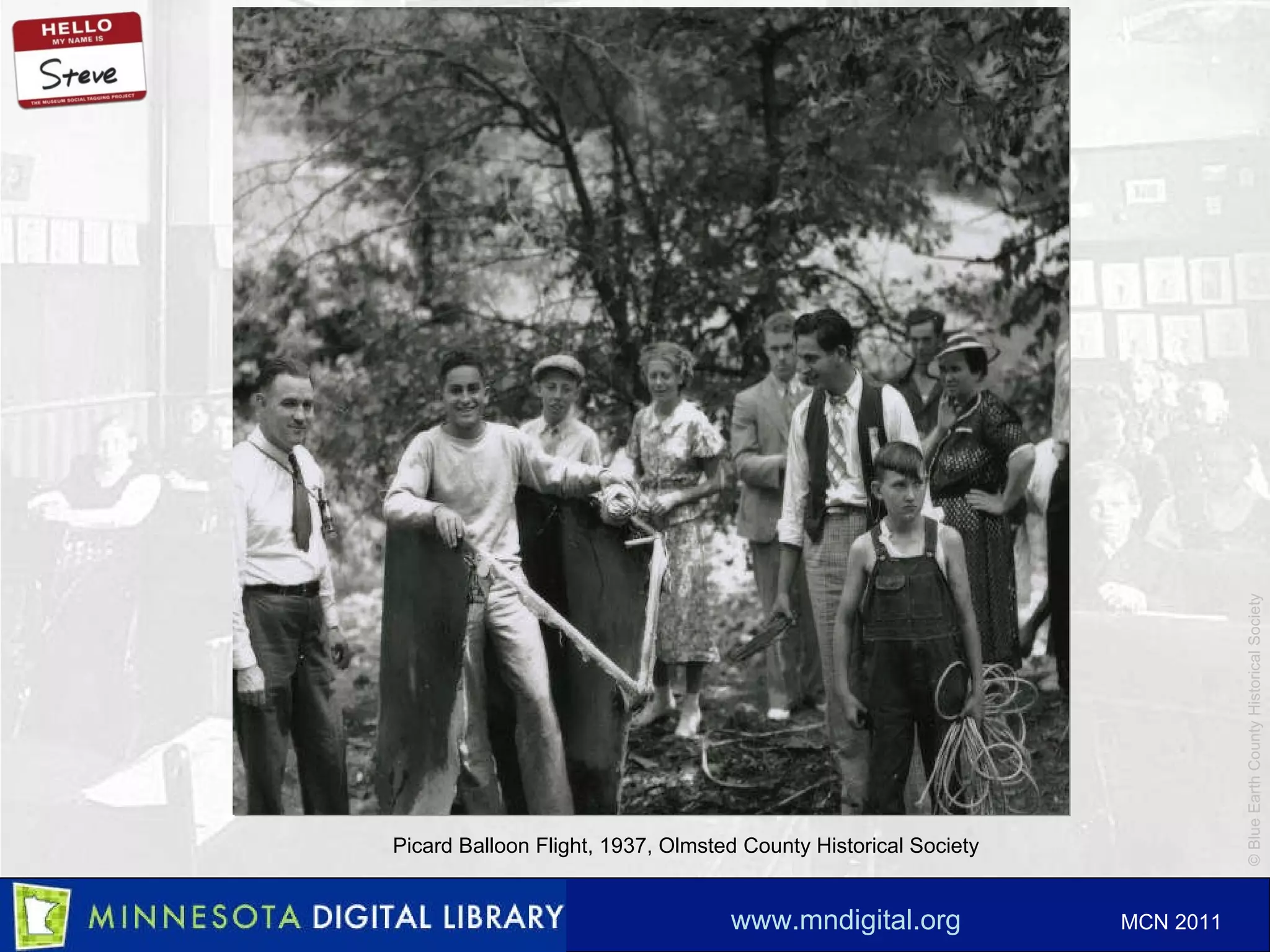
Picard Balloon Flight, 1937, Olmsted County Historical Society
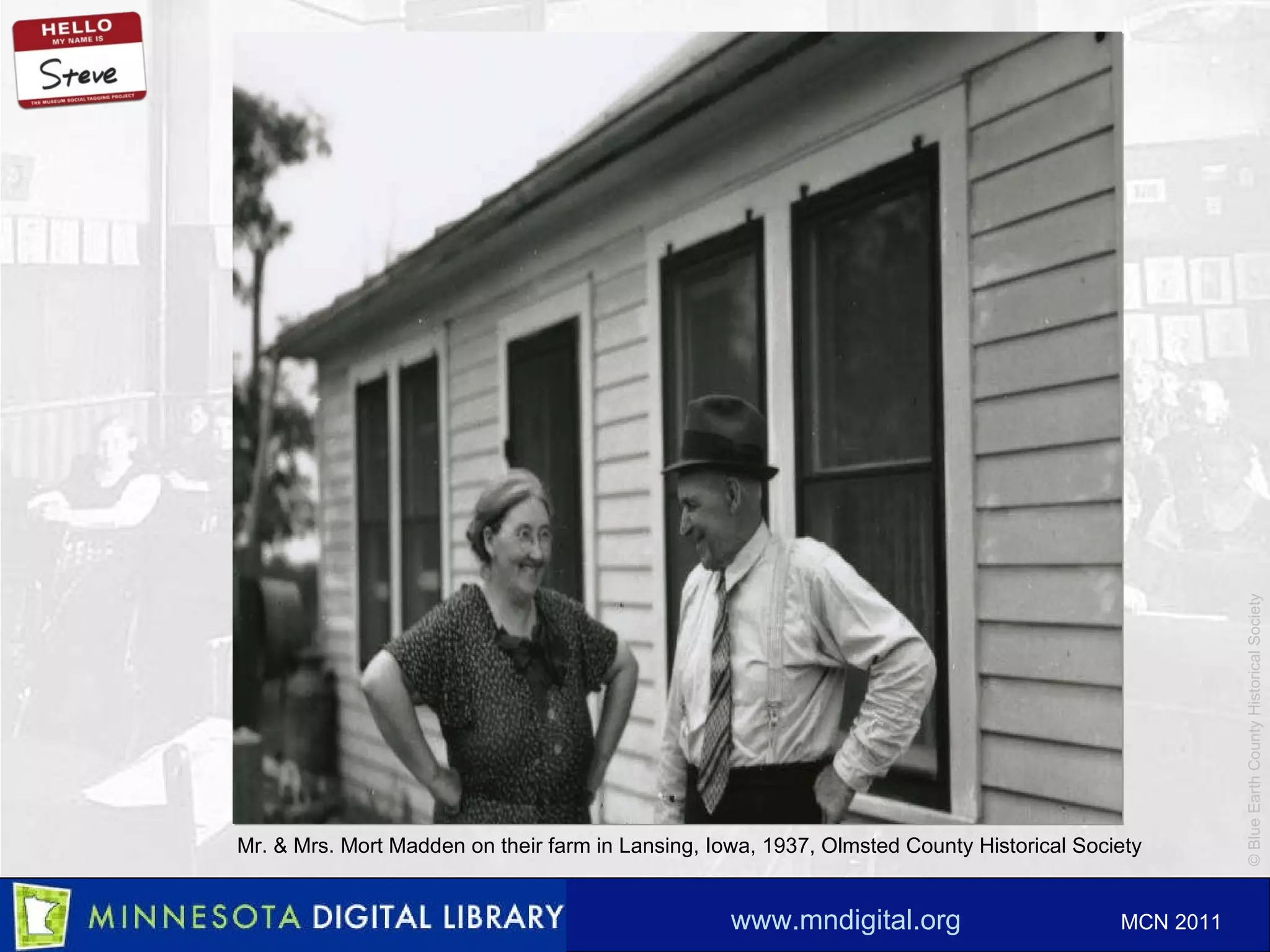
Mr. & Mrs. Mort Madden on their farm in Lansing, Iowa, 1937, Olmsted County Historical Society
Here ’s the problem!
 
 
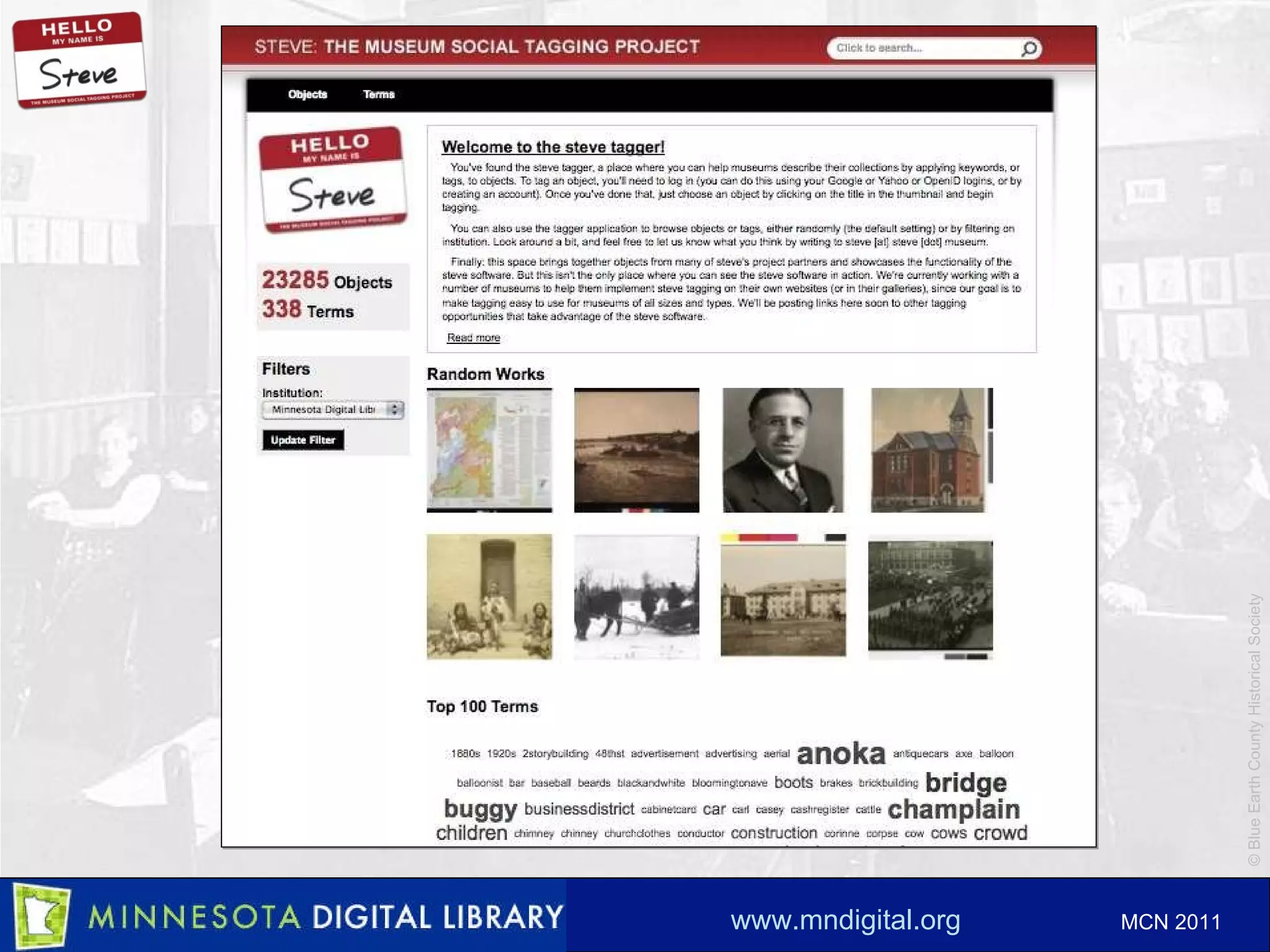
MDL Steve Tagging Project
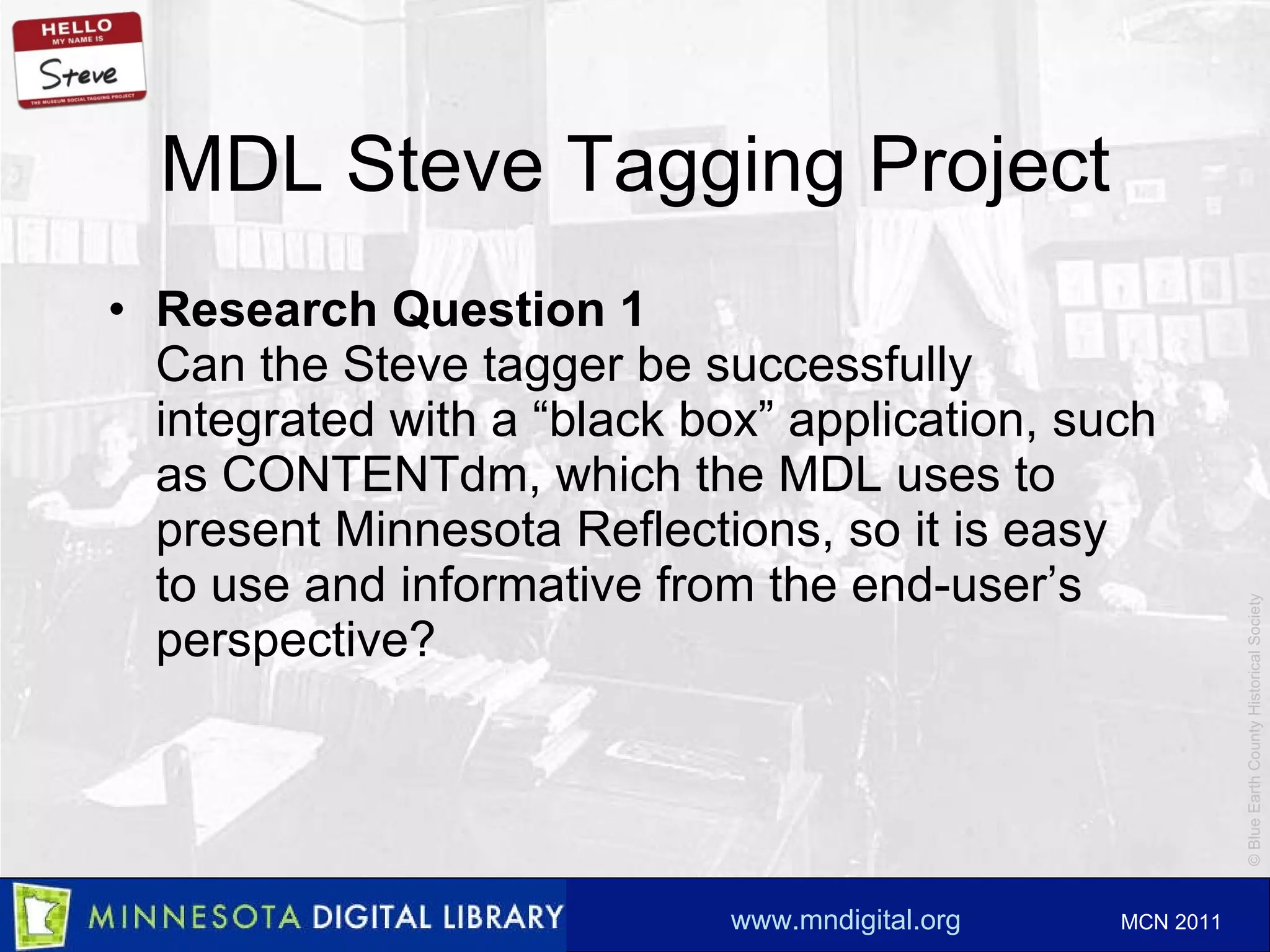
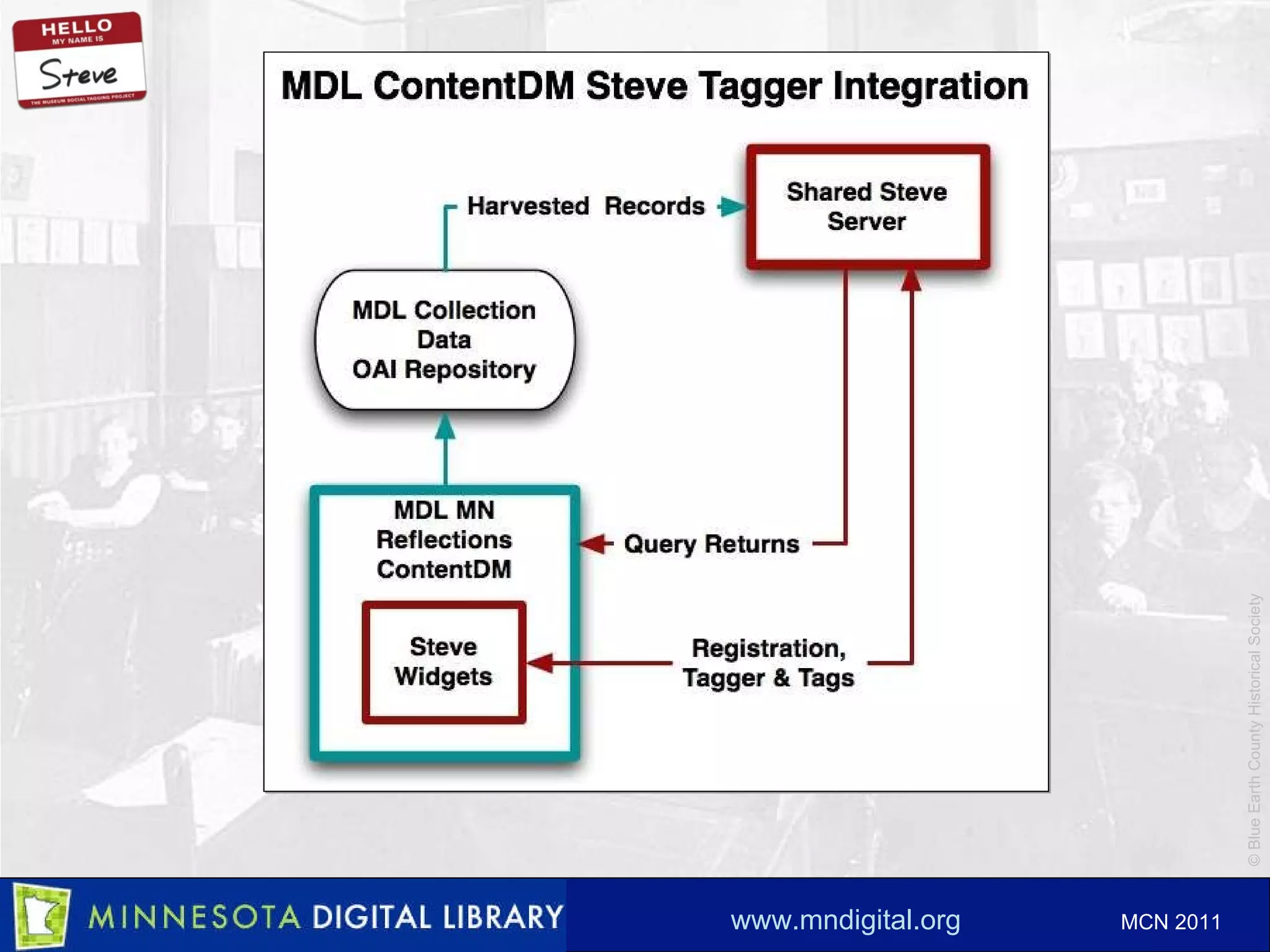
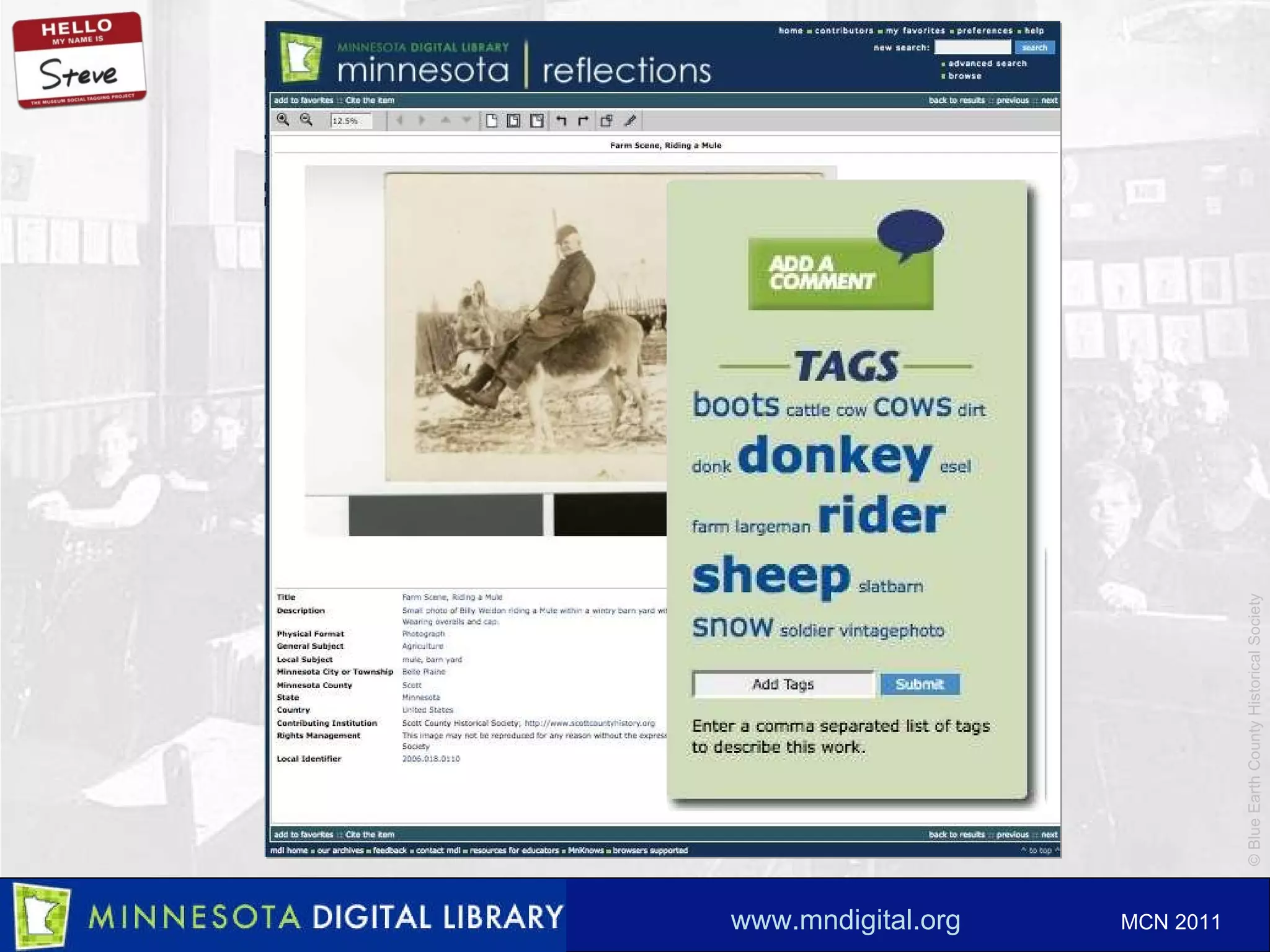
MDL Steve Tagging Project Research Question 1 Can the Steve tagger be successfully integrated with a “black box ” application, such as CONTENTdm, which the MDL uses to present Minnesota Reflections, so it is easy to use and informative from the end-user’s perspective?


MDL Steve Tagging Project Research Question 2 What type of marketing, education and training is necessary to engage MDL members and their communities of volunteers and end-users in the tagging of MDL assets?
MDL Steve Tagging Project MDL Partner Training The MDL project team conducted 2  training sessions for interested MDL partners and the members of the public they recruit.
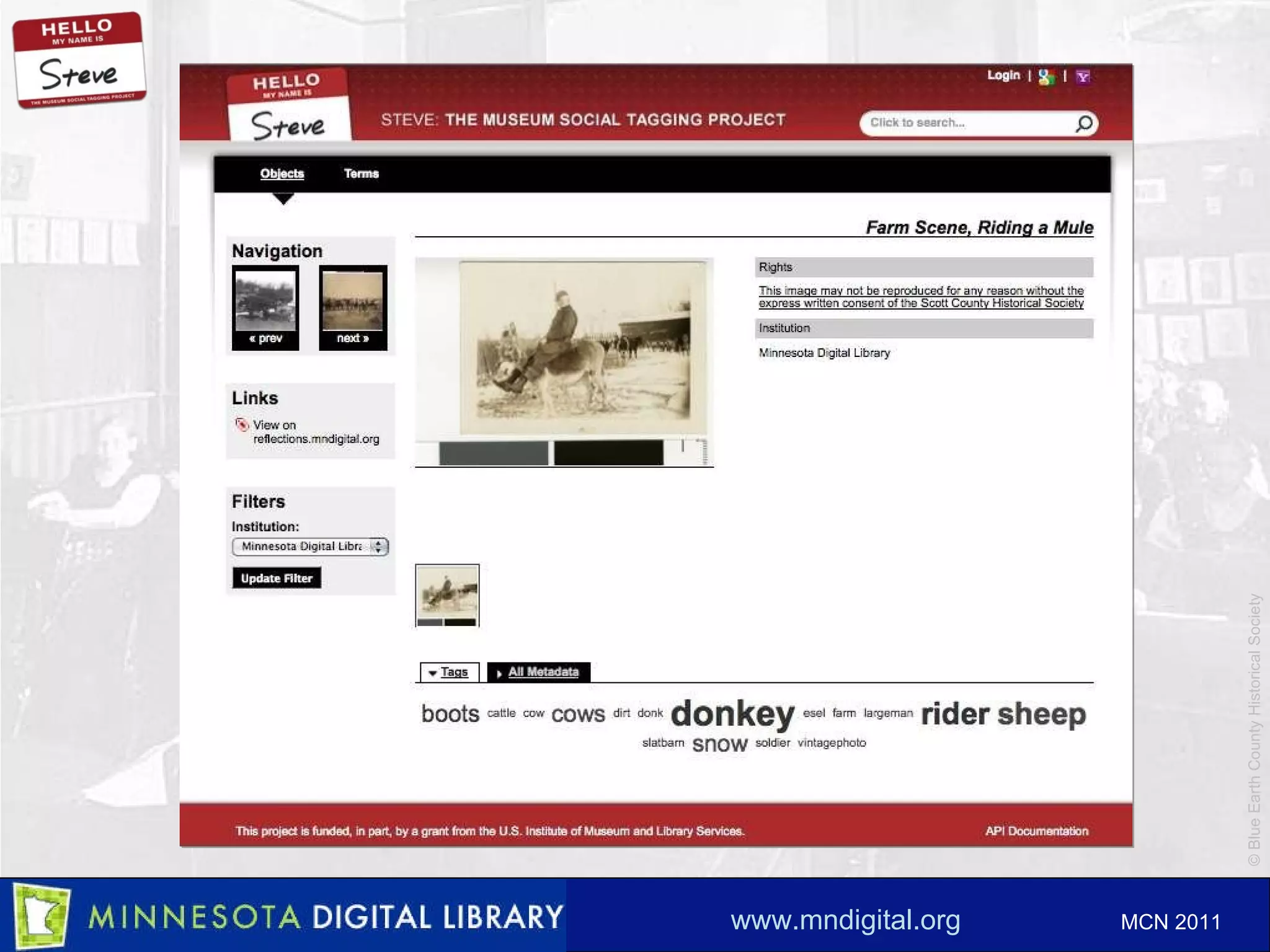
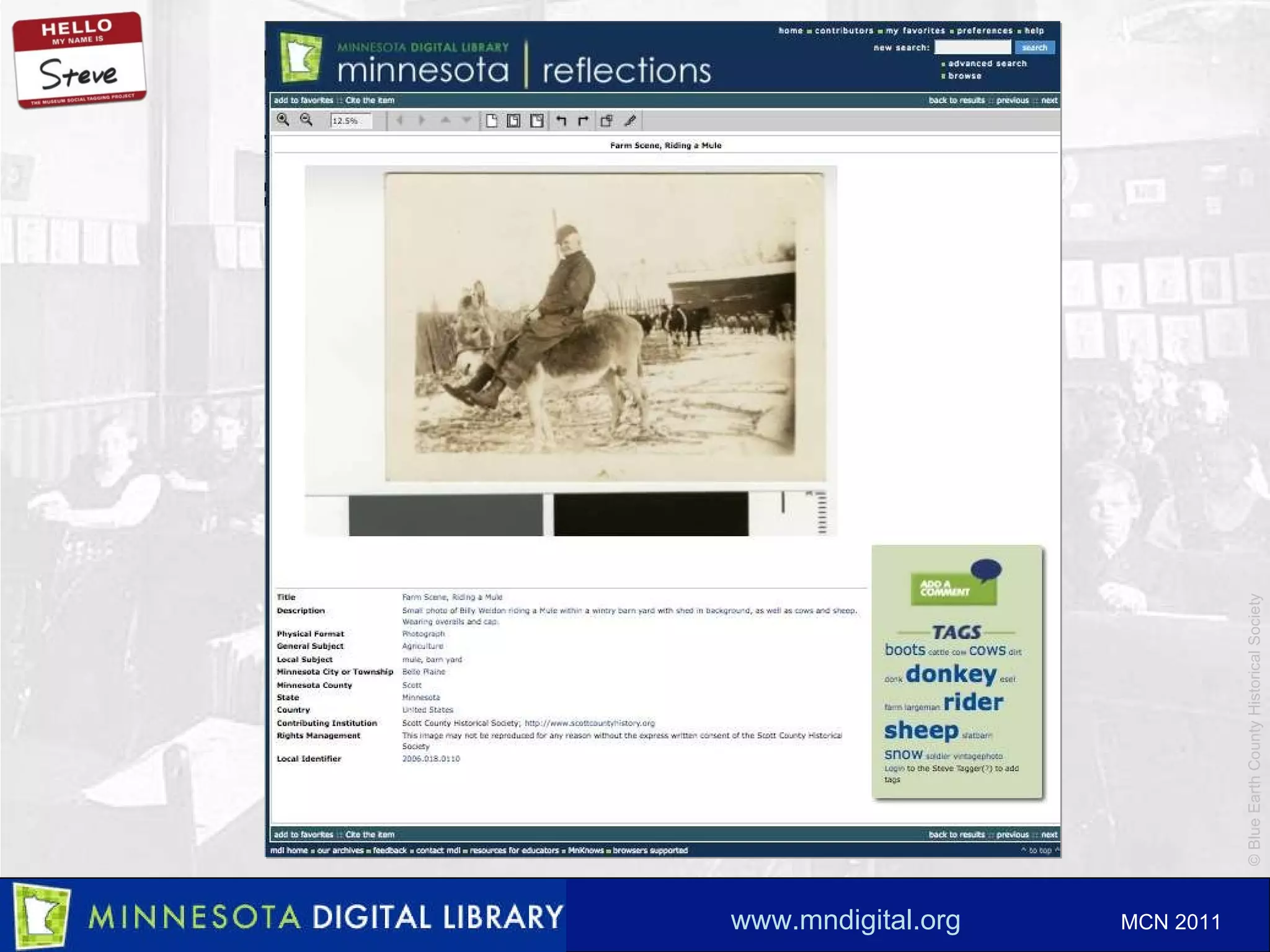
MDL Steve Tagging Project The training program included: Definition of tagging Potential public and institutional benefits of tagging Overview of the components of a tagging application How tagging is facilitated within  Minnesota Reflections How tags can be used to query  Minnesota Reflections Tagging Q & A Goals for tag contribution short term and long term
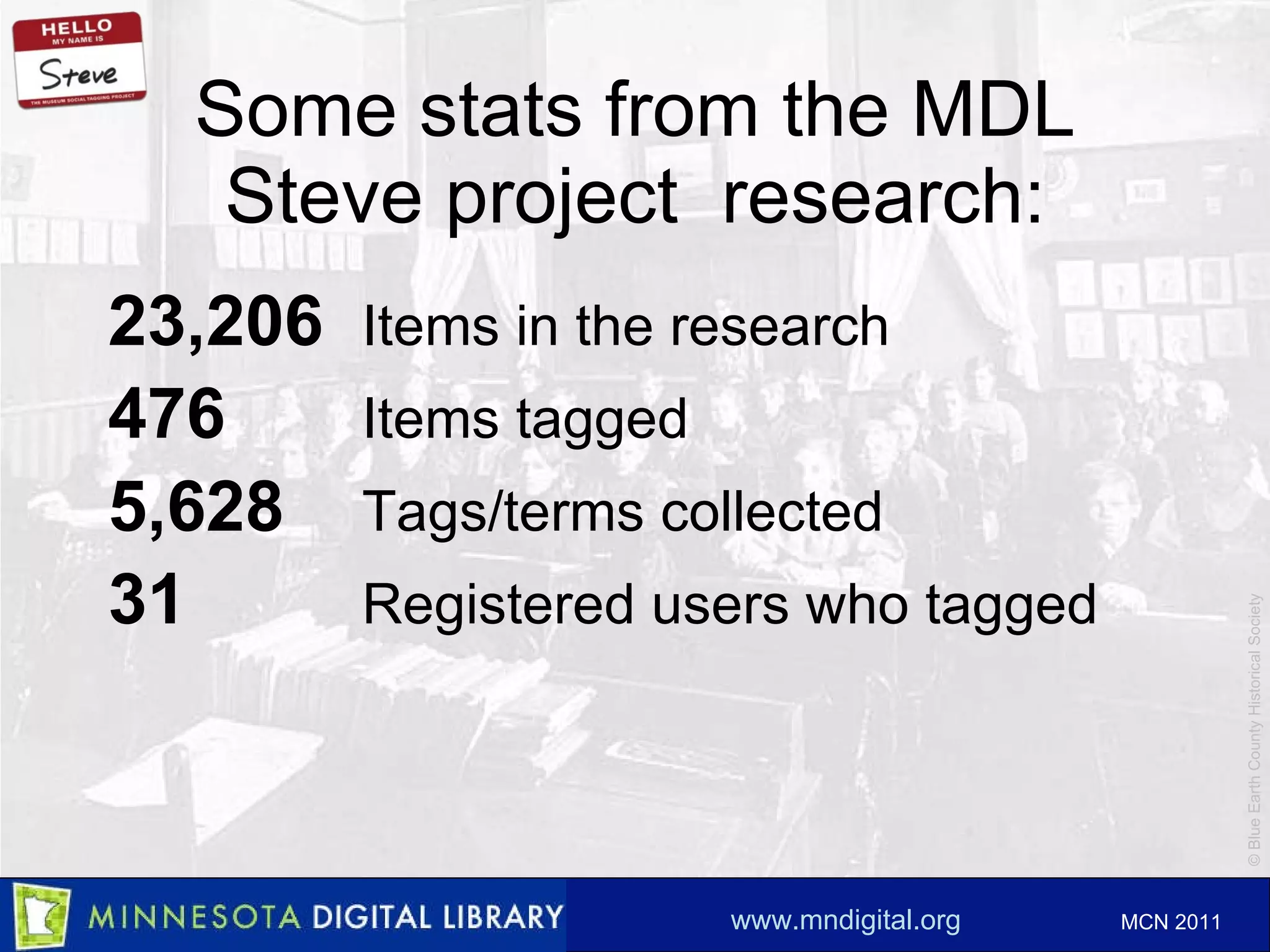
23,206   Items in the research 476   Items tagged  5,628   Tags/terms collected  31   Registered users who tagged Some stats from the MDL Steve project  research:
MDL Steve Tagging Project Research Question 3 What incentives in the way of feedback and interface are required or helpful to encourage and sustain community-generated tags?
MDL Steve Tagging Project Research Question 4 What was the perceived usefulness of community-generated tags by the members of the MDL before and after the Steve tagging initiative?
MDL Steve Tagging Project Research Question 5 What are the requirements needed to feasibly sustain community-based tagging within the MDL beyond the project period?
 
 
Visit the Minnesota Digital Library http://www.mndigital.org Scott Sayre Minnesota Digital Library  Steve In Action Project Manager Principal, Sandbox Studios [email_address] Twitter: @zbartrout

MCN 2011: Steve in Action and the Minnesota Digital Library

  • 1.
    Minnesota Digital LibrarySteve In Action Community Tagging Project
  • 2.
    A little context406 miles Minneapolis, MN Dassel, MN
  • 3.
  • 4.
  • 5.
    Pierre Bottineau andG. A. Bracket chart the course westward for the Northern Pacific Railway. 1869, New Brighton Area Historical Society
  • 6.
    James J. Hillwarehouse on Upper Mississippi River 1869, Minnesota Historical Society
  • 7.
    The Minnesota DigitalLibrary Coalition
  • 8.
    The Minnesota DigitalLibrary Coalition ’s Minnesota Reflections 105+ cultural heritage institutions 55,000 photographs, maps, journals, and documents State and federally funded small digitization grants Centralized digitization facilities
  • 9.
  • 10.
  • 11.
  • 12.
    Dancing Bears, 1905,Stearns County History Museum
  • 13.
    Indian Home, 1890,Iron Range Research Center, Chisholm
  • 14.
    Picard Balloon Flight,1937, Olmsted County Historical Society
  • 15.
    Picard Balloon Flight,1937, Olmsted County Historical Society
  • 16.
    Picard Balloon Flight,1937, Olmsted County Historical Society
  • 17.
    Picard Balloon Flight,1937, Olmsted County Historical Society
  • 18.
    Picard Balloon Flight,1937, Olmsted County Historical Society
  • 19.
    Mr. & Mrs.Mort Madden on their farm in Lansing, Iowa, 1937, Olmsted County Historical Society
  • 20.
    Here ’s theproblem!
  • 21.
  • 22.
  • 23.
  • 24.
    MDL Steve TaggingProject Research Question 1 Can the Steve tagger be successfully integrated with a “black box ” application, such as CONTENTdm, which the MDL uses to present Minnesota Reflections, so it is easy to use and informative from the end-user’s perspective?
  • 25.
  • 26.
  • 27.
  • 28.
  • 29.
  • 30.
  • 31.
    MDL Steve TaggingProject Research Question 2 What type of marketing, education and training is necessary to engage MDL members and their communities of volunteers and end-users in the tagging of MDL assets?
  • 32.
    MDL Steve TaggingProject MDL Partner Training The MDL project team conducted 2 training sessions for interested MDL partners and the members of the public they recruit.
  • 33.
    MDL Steve TaggingProject The training program included: Definition of tagging Potential public and institutional benefits of tagging Overview of the components of a tagging application How tagging is facilitated within Minnesota Reflections How tags can be used to query Minnesota Reflections Tagging Q & A Goals for tag contribution short term and long term
  • 34.
    23,206 Items in the research 476 Items tagged 5,628 Tags/terms collected 31 Registered users who tagged Some stats from the MDL Steve project research:
  • 35.
    MDL Steve TaggingProject Research Question 3 What incentives in the way of feedback and interface are required or helpful to encourage and sustain community-generated tags?
  • 36.
    MDL Steve TaggingProject Research Question 4 What was the perceived usefulness of community-generated tags by the members of the MDL before and after the Steve tagging initiative?
  • 37.
    MDL Steve TaggingProject Research Question 5 What are the requirements needed to feasibly sustain community-based tagging within the MDL beyond the project period?
  • 38.
  • 39.
  • 40.
    Visit the MinnesotaDigital Library http://www.mndigital.org Scott Sayre Minnesota Digital Library Steve In Action Project Manager Principal, Sandbox Studios [email_address] Twitter: @zbartrout

Editor's Notes

  • #2 This demonstration project examines the unique qualities of the Minnesota Digital Library and explores the ways it can be used by K-12 teachers and students in their classrooms. The Minnesota Digital Library is a digital collection of the state ’s unique resources and special collections. The library contains Minnesota specific photos, maps, documents and objects held by Minnesota Digital Library partners to support education, scholarship and enrichment through Internet access to the collection. The digital collection was contributed by the partners, more than 50 participating historical societies, special archives, and libraries around Minnesota. Minnesota Reflections was the initial digitization effort of the Minnesota Digital Library, conducted from 2004-05 and contains over 6,000 unique photographs, images and information about them in a searchable database to help people access and use them.
  • #8 This demonstration project examines the unique qualities of the Minnesota Digital Library and explores the ways it can be used by K-12 teachers and students in their classrooms. The Minnesota Digital Library is a digital collection of the state ’s unique resources and special collections. The library contains Minnesota specific photos, maps, documents and objects held by Minnesota Digital Library partners to support education, scholarship and enrichment through Internet access to the collection. The digital collection was contributed by the partners, more than 60 participating historical societies, special archives, and libraries around Minnesota. Minnesota Reflections was the initial digitization effort of the Minnesota Digital Library, conducted from 2004-05 and contains over 6,000 unique photographs, images and information about them in a searchable database to help people access and use them.
  • #9 This demonstration project examines the unique qualities of the Minnesota Digital Library and explores the ways it can be used by K-12 teachers and students in their classrooms. The Minnesota Digital Library is a digital collection of the state ’s unique resources and special collections. The library contains Minnesota specific photos, maps, documents and objects held by Minnesota Digital Library partners to support education, scholarship and enrichment through Internet access to the collection. The digital collection was contributed by the partners, more than 60 participating historical societies, special archives, and libraries around Minnesota. Minnesota Reflections was the initial digitization effort of the Minnesota Digital Library, conducted from 2004-05 and contains over 6,000 unique photographs, images and information about them in a searchable database to help people access and use them.
  • #11 The Minnesota Digital Library is not a search engine, rather it ’s a repository: an online image bank that county historical societies, special archives, and libraries from around Minnesota contribute images to. Teachers and students can access primary sources from Minnesota historical societies no matter when they are staffed or where they ’re located. Resources that used to be housed in separate buildings in each county can now be viewed in one location online. Each image in the Minnesota Digital Library has detailed contact information, allowing researchers easy access to the contributing historical society for further information. Advertising can be confusing for students who often find it difficult to differentiate between Web sites that contain relevant information and the advertising or sponsors that may support it. When students use the Minnesota Digital Library, they aren ’t searching the Web, they are searching a non-commercial repository where advertising won’t be a confusing distraction. All of the materials in the Minnesota Digital Library are digital reproductions of primary sources: original documents or objects made when a historical event occurred and reflecting the point of view of the people who made them.Students who study primary sources construct their own understandings of people, events, and ideas.