Sit Down and Write
An Introduction to Writing for the Media
Sit Down and Write
 “There’s nothing to writing. All you do is sit down at
a typewriter and open a vein.”
- Red Smith (Sportswriter for New York Times)
What is good writing?
 Precise
 Clear
 Modest
What is good writing?
 “But it is preposterous to imagine that we ourselves are
determinate, and hence susceptible both to correct and to incorrect
descriptions, while supposing that the ascription of determinacy to
anything else has been exposed as a mistake. As conscious
beings, we exist only in response to other things, and we cannot
know ourselves at all without knowing them. Moreover, there is
nothing in theory, and certainly nothing in experience, to support
the extraordinary judgment that it is the truth about himself that is
the easiest for a person to know. Facts about ourselves are not
peculiarly solid and resistant to skeptical dissolution. Our natures
are, indeed, elusively insubstantial — notoriously less stable and
less inherent than the natures of other things. And insofar as this is
the case, sincerity itself is bullshit.”
 Harry Frankfurt, On Bullshit
 What is this passage about?
 The author has limited his audience with his pretentious writing
style
What is good writing?
 Efficient
 Consider this piece of flash fiction:
“For Sale. Baby shoes. Never worn.”
 An entire story is told above with six words. We
don’t have details, but this simple, efficient set of
words is far easier to follow compared to the quote
from Harry Frankfurt on the previous slide.
Writing for Mass
Audiences
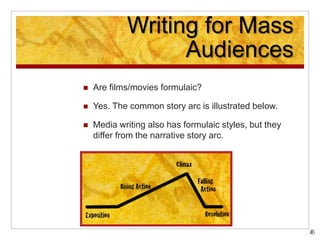
 Are films/movies formulaic?
 Yes. The common story arc is illustrated below.
 Media writing also has formulaic styles, but they
differ from the narrative story arc.
Writing for Mass
Audiences
 Is writing collaborative?
 YES!
 Writers share drafts of their works with colleagues,
peers, etc. to gain a sense of what changes need
to be made.
 No good writer ever settles on a first draft.
Sometimes, business demands require that quick
works be created to meet tight deadlines, but
these are seldom quality works.
Be Willing to Improve
 Writing is an art, and practitioners of any art must
practice to improve
 And yes, those shaking their heads at the above
bullet point should know that everyone is capable
of becoming a better writer
 It requires:
 Understanding of language
 Understanding of subject matter
 Expectation of rewrites (multiple drafts)
Basic Techniques
 Write simply
“You will either step forward into growth, or backward into safety.”
- Abraham Maslow
“I have not failed. I’ve just found 10,000 ways that don’t work.”
- Thomas Edison
“The best way to predict the future is to create it.”
- Alan Kay
“Everyone is trying to accomplish something big, not realizing that
life is made up of little things.”
- Frank A. Clark
Basic Techniques
 Use simple words
“One of the really bad things you can do to your
writing is dress up the vocabulary, looking for long
words because you’re maybe a little bit ashamed
of your short ones.”
- Stephen King, On Writing, p. 117.
Basic Techniques
The five most important writing techniques for media
professionals…
 Write simply
 Use simple words
 Use simple sentences
 Practice Brevity
 Eliminate Jargon, Clichés, and Bureaucratese
Media Writers…
 Media writers have three primary objectives…
 Inform
 Entertain
 Persuade
The Profession
Requires…
 Versatility
 Be open-minded about topics, approaches, ideas,
etc.
 No successful writer will survive as a one-trick pony
 Adaptability
 You never know what kind of writing assignments will
come your way
 My first ‘professional’ project was to write and
produce a video about how factory employees could
reduce listeria outbreaks in poultry processing
equipment
 I didn’t even know what listeria was, but I accepted
the project, did my research, and wound up with a
happy client
The Profession
Requires…
 Deadlines
 Every writer in a media-related profession has
deadlines
 You MUST meet your deadlines
 Missed deadlines = angry clients, bosses,
consumers, etc.
 Missed deadlines = job loss
 Missed deadlines in this course = zero score on
assignments
Writing
 It is a skill that can be learned/developed
 It requires discipline and desire to improve
 You have a vested interest in being a good writer
 It is very difficult to succeed in the field of mass
communication if you cannot write
Writing
 Consider some basic writing examples that are
common in professional mass communication jobs
 Emailing coworkers/supervisors/clients
 Writing scripts for video/film
 Writing stories for journalistic professions
 Writing scripts for news reporters/anchors
 Writing copy for print advertisements
 Writing instructional/training documents and/or video
 Writing content for social media outlets
 The list goes on…
Writing
 The key takeaway from this lesson is that you
should embrace writing as a necessary tool for
success
 You can improve your writing
 This class is designed to help you accomplish this
This concludes the presentation

MCM 2400 Stovall Chapter 1

  • 1.
    Sit Down andWrite An Introduction to Writing for the Media
  • 2.
    Sit Down andWrite  “There’s nothing to writing. All you do is sit down at a typewriter and open a vein.” - Red Smith (Sportswriter for New York Times)
  • 3.
    What is goodwriting?  Precise  Clear  Modest
  • 4.
    What is goodwriting?  “But it is preposterous to imagine that we ourselves are determinate, and hence susceptible both to correct and to incorrect descriptions, while supposing that the ascription of determinacy to anything else has been exposed as a mistake. As conscious beings, we exist only in response to other things, and we cannot know ourselves at all without knowing them. Moreover, there is nothing in theory, and certainly nothing in experience, to support the extraordinary judgment that it is the truth about himself that is the easiest for a person to know. Facts about ourselves are not peculiarly solid and resistant to skeptical dissolution. Our natures are, indeed, elusively insubstantial — notoriously less stable and less inherent than the natures of other things. And insofar as this is the case, sincerity itself is bullshit.”  Harry Frankfurt, On Bullshit  What is this passage about?  The author has limited his audience with his pretentious writing style
  • 5.
    What is goodwriting?  Efficient  Consider this piece of flash fiction: “For Sale. Baby shoes. Never worn.”  An entire story is told above with six words. We don’t have details, but this simple, efficient set of words is far easier to follow compared to the quote from Harry Frankfurt on the previous slide.
  • 6.
    Writing for Mass Audiences Are films/movies formulaic?  Yes. The common story arc is illustrated below.  Media writing also has formulaic styles, but they differ from the narrative story arc.
  • 7.
    Writing for Mass Audiences Is writing collaborative?  YES!  Writers share drafts of their works with colleagues, peers, etc. to gain a sense of what changes need to be made.  No good writer ever settles on a first draft. Sometimes, business demands require that quick works be created to meet tight deadlines, but these are seldom quality works.
  • 8.
    Be Willing toImprove  Writing is an art, and practitioners of any art must practice to improve  And yes, those shaking their heads at the above bullet point should know that everyone is capable of becoming a better writer  It requires:  Understanding of language  Understanding of subject matter  Expectation of rewrites (multiple drafts)
  • 9.
    Basic Techniques  Writesimply “You will either step forward into growth, or backward into safety.” - Abraham Maslow “I have not failed. I’ve just found 10,000 ways that don’t work.” - Thomas Edison “The best way to predict the future is to create it.” - Alan Kay “Everyone is trying to accomplish something big, not realizing that life is made up of little things.” - Frank A. Clark
  • 10.
    Basic Techniques  Usesimple words “One of the really bad things you can do to your writing is dress up the vocabulary, looking for long words because you’re maybe a little bit ashamed of your short ones.” - Stephen King, On Writing, p. 117.
  • 11.
    Basic Techniques The fivemost important writing techniques for media professionals…  Write simply  Use simple words  Use simple sentences  Practice Brevity  Eliminate Jargon, Clichés, and Bureaucratese
  • 12.
    Media Writers…  Mediawriters have three primary objectives…  Inform  Entertain  Persuade
  • 13.
    The Profession Requires…  Versatility Be open-minded about topics, approaches, ideas, etc.  No successful writer will survive as a one-trick pony  Adaptability  You never know what kind of writing assignments will come your way  My first ‘professional’ project was to write and produce a video about how factory employees could reduce listeria outbreaks in poultry processing equipment  I didn’t even know what listeria was, but I accepted the project, did my research, and wound up with a happy client
  • 14.
    The Profession Requires…  Deadlines Every writer in a media-related profession has deadlines  You MUST meet your deadlines  Missed deadlines = angry clients, bosses, consumers, etc.  Missed deadlines = job loss  Missed deadlines in this course = zero score on assignments
  • 15.
    Writing  It isa skill that can be learned/developed  It requires discipline and desire to improve  You have a vested interest in being a good writer  It is very difficult to succeed in the field of mass communication if you cannot write
  • 16.
    Writing  Consider somebasic writing examples that are common in professional mass communication jobs  Emailing coworkers/supervisors/clients  Writing scripts for video/film  Writing stories for journalistic professions  Writing scripts for news reporters/anchors  Writing copy for print advertisements  Writing instructional/training documents and/or video  Writing content for social media outlets  The list goes on…
  • 17.
    Writing  The keytakeaway from this lesson is that you should embrace writing as a necessary tool for success  You can improve your writing  This class is designed to help you accomplish this This concludes the presentation