

Holistic Health Factors in the
Workplace
Biophilia, Ergonomics and Exercise
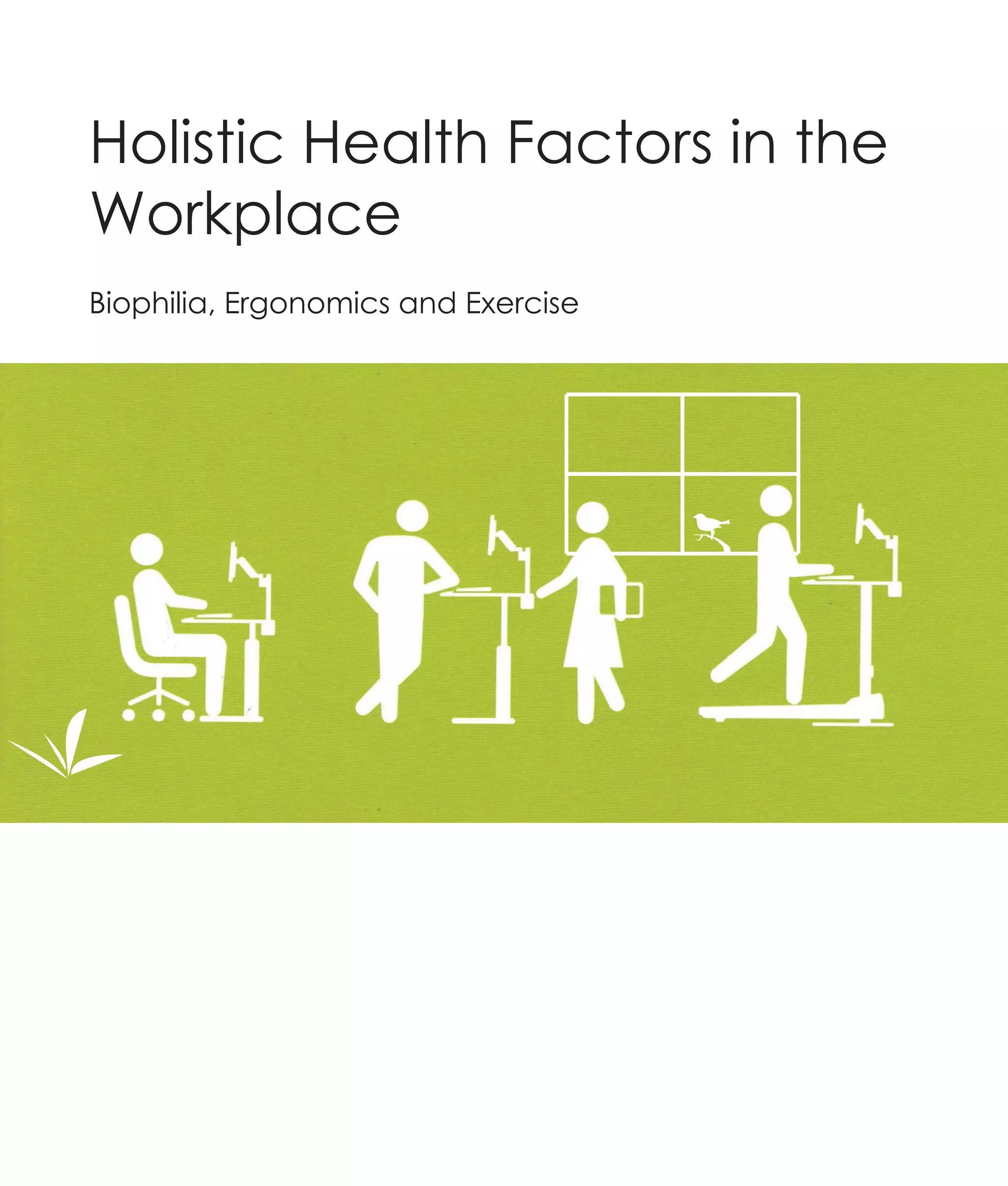
Image on cover & facing page derived from: Steelcase. (n.d.). The movement toward wellness in the workplace. Retrieved April 20, 2011,
                                              from www.steelcase.com/ergonomics
Holistic Health Factors in the
Workplace
Biophilia, Ergonomics and Exercise


April P. McEwan
Holistic Health Factors in the Workplace
     Biophilia, Ergonomics and Exercise

                      by
              April P. McEwan


All content has been derived from the original
      Thesis presented in partial fulfillment
      of the requirements for the degree
          Master of Science in Design


        Approved April 2011 by the
     Graduate Supervisory Committee:

              Philip White, Chair
               Rebecca Barry
                James Shraiky


         ARIZONA STATE UNIVERSITY
                May 2011
Holistic Health Factors in the Workplace: Biophilia, Ergonomics and Exercise


Abstract

    In an attempt to advocate body-            with qualitative and flexible research             average miles walked by participants
conscious design and healing work              approaches using observation, survey,              in each workplace as well as existing
environments, this research study              interview and pedometer readings as                incentives and descriptions of ideal work
of holistic health in the workplace            methods for data collection. Two small             environments.
explores cognitive, social and physical        corporate franchise financial institutions
                                                                                                  Implications of this research study involve
well-being in four small US offices that       and two small private healthcare
                                                                                                  interior design, industrial design and
are between 1000 and 4000 square               providers from both Arizona and Georgia
                                                                                                  fashion design that can accommodate
feet and employ three to twelve                participated in this study. Each office
                                                                                                  the desires of the four participating
employees. Holistic health, as pursued         volunteered one employer and two
                                                                                                  workplaces. Major design implications
in this research, includes social health,      employee participants.
                                                                                                  involve accommodating these particular
emotional health and physical health.
                                               Of the holistic health factors considered          workplaces to provide personnel with
These three factors of holistic health
                                               in these four case studies, this study             opportunities for holistic health in working
have been identified and investigated
                                               found that a majority of participants              environments. More specific implications
in this study: biophilia: peoples’ love and
                                               equally valued emotional health, social            of office related design involve providing
affiliation with other species and the
                                               health and physical health. A majority             access to natural environments, body-
natural environment; ergonomics: the
                                               of participants declared a preference              conscious equipment and spaces, as
relationship between the human body,
                                               for workplace environments with serene             well as opportunities for exercise and
movement, the immediate environment
                                               natural environments with outdoor                  social interaction. These elements
and productivity; and exercise: exertion
                                               spaces and interaction with other                  of the factors biophilia, ergonomics
of the body to obtain physical fitness.
                                               species, work environments with body-              and exercise were found to be said
This research study proposes that
                                               conscious furniture, equipment and                 to contribute to cognitive, social and
employees and employers of these four
                                               workstations, as well as exercise space            physical health.
participating workplaces desire mobility
                                               and equipment. As these particular
and resources in the workplace that
                                               workplace environments affirmed value
support holistic health practices involving
                                               for elements of the factors biophilia,
biophilia, ergonomics, and exercise.
                                               ergonomics and exercise, all three
Literature review of holistic health and
                                               factors are considered valueable within
the holistic health factors of this research
                                               the workplaces of these case studies.
topic support the idea that interaction
                                               Furthermore, factors that were said to
with other species can be healing,
                                               contribute to personal productivity in
ergonomic body-conscious furniture and
                                               participating workplaces were found
equipment increase productivity, limit
                                               as well as sacrifices that participants
body aches, pains and health costs; and
                                               stated they would be willing to make
exercise stimulates the mind and body,
                                               in order to implement their preferred
increasing productivity.
                                               work environment(s). In addition,
This study has been conducted primarily        this study recorded and calculated


                                                                                                                                                         iii
Contents


Chapter                                                                                                                                          Page


Introduction ............................................................................................................................... 2

Problem Statement ..................................................................................................................             4

Assumption ................................................................................................................................      6

Significance ............................................................................................................................... 7

Scope ......................................................................................................................................... 9

Review of Literature .................................................................................................................. 12

	           Holistic Health ............................................................................................................... 14

	           Biophilia ......................................................................................................................... 19

	           Ergonomics ................................................................................................................... 22

	           The Chair ....................................................................................................................... 24

	           Exercise .........................................................................................................................   26

	           Environmental Psychology .........................................................................................                   29

	           Health and Healing Environments .............................................................................                        30

Findings and Opportunities ...................................................................................................... 32

Methodology ............................................................................................................................         34

Primary Research Findings .......................................................................................................                37

Discussion and Conclusion ......................................................................................................                 40

References ................................................................................................................................      49
Figures


Figure                                                                                                                             Page


Word cloud of words used to describe Galen Cranz’s ideal workspace .......................... 2

“Something, somewhere went terribly wrong” .................................................................... 4

Steelcase image from Movement Toward Health in the Workplace booklet ..................                                            5

Steelcase image from Movement Toward Health in the Workplace booklet ..................                                            6

Elderly man and dog in park photo by April P. McEwan ....................................................                          7

Conceptual framework ...........................................................................................................   9

Elements of factors of conceptual framework .....................................................................                  10

Word cloud describing emotional health .............................................................................               13

Word cloud describing social health .....................................................................................          15

Steelcase social health image ...............................................................................................      16

Word cloud describing physical health .................................................................................            17

Photo of Bougainvillea by April P. McEwan ..........................................................................               20

Photo of tree spirit on Saint Simons Island by April P. McEwan ...........................................                         21

Varier® Gravity chair designed by Peter Opsvik ..................................................................                  24

Le Corbusier’s lounge chair ..................................................................................................... 24

Varier® Variable ™ Balans ®, designed by Peter Opsvik ....................................................                         24

Steelcase physical health image ...........................................................................................        26

Steelcase Walkstation by Details ............................................................................................      27

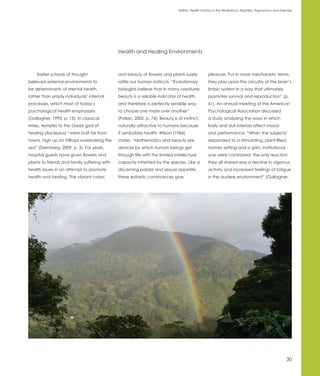
Rainbow rainforest hoto by April P. McEwan ........................................................................                30

Portland photo by April P. McEwan .......................................................................................          32


                                                                                                                                          v
Figures


Figure                                                                                                               Page


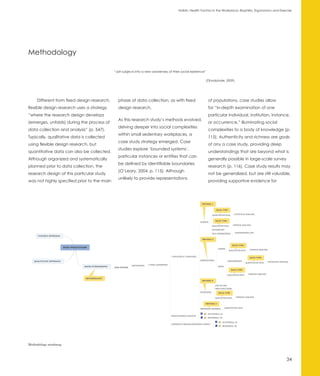
Research Methodology mind map ........................................................................................ 34

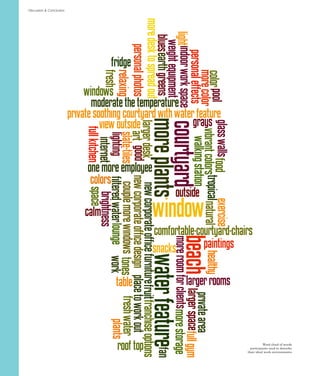
Word cloud of ideal work environment descriptions ...........................................................        39

Categories of ideal work environment descriptions diagram ............................................               43
Introduction


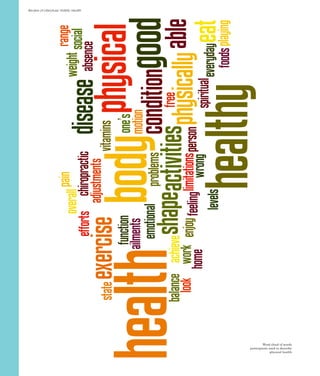
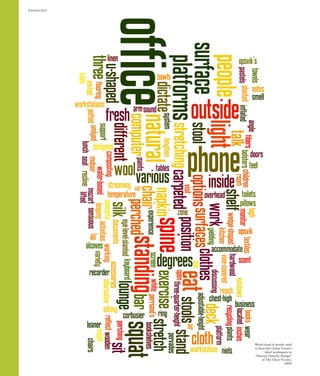
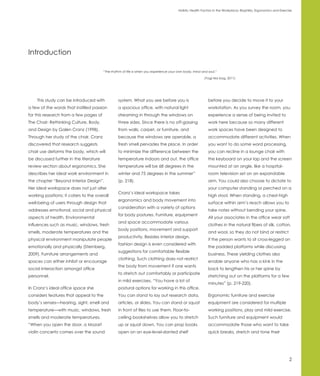
               Word cloud of words used
               to describe Galen Cranz’s
                      ideal workspace in
               “Beyond Interior Design”
                    of The Chair (Cranz,
                                   1998)
Holistic Health Factors in the Workplace: Biophilia, Ergonomics and Exercise


Introduction

                                         “The rhythm of life is when you experience your own body, mind and soul.”

                                                                                                          (Yogi tea bag, 2011)


    This study can be introduced with             system. What you see before you is                        before you decide to move it to your
a few of the words that instilled passion         a spacious office, with natural light                     workstation. As you survey the room, you
for this research from a few pages of             streaming in through the windows on                       experience a sense of being invited to
The Chair: Rethinking Culture, Body,              three sides. Since there is no off-gassing                work here because so many different
and Design by Galen Cranz (1998).                 from walls, carpet, or furniture, and                     work spaces have been designed to
Through her study of the chair, Cranz             because the windows are operable, a                       accommodate different activities. When
discovered that research suggests                 fresh smell pervades the place. In order                  you want to do some word processing,
chair use deforms the body, which will            to minimize the difference between the                    you can recline in a lounge chair with
be discussed further in the literature            temperature indoors and out, the office                   the keyboard on your lap and the screen
review section about ergonomics. She              temperature will be 68 degrees in the                     mounted at an angle, like a hospital-
describes her ideal work environment in           winter and 75 degrees in the summer”                      room television set on an expandable
the chapter “Beyond Interior Design”.             (p. 218).                                                 arm. You could also choose to dictate to
Her ideal workspace does not just alter                                                                     your computer standing or perched on a
                                                  Cranz’s ideal workspace takes
working positions; it caters to the overall                                                                 high stool. When standing, a chest-high
                                                  ergonomics and body movement into
well-being of users through design that                                                                     surface within arm’s reach allows you to
                                                  consideration with a variety of options
addresses emotional, social and physical                                                                    take notes without bending your spine.
                                                  for body postures. Furniture, equipment
aspects of health. Environmental                                                                            All your associates in the office wear soft
                                                  and space accommodate various
influences such as music, windows, fresh                                                                    clothes in the natural fibers of silk, cotton,
                                                  body positions, movement and support
smells, moderate temperatures and the                                                                       and wool, so they do not bind or restrict
                                                  productivity. Besides interior design,
physical environment manipulate people                                                                      if the person wants to sit cross-legged on
                                                  fashion design is even considered with
emotionally and physically (Sternberg,                                                                      the padded platforms while discussing
                                                  suggestions for comfortable flexible
2009). Furniture arrangements and                                                                           business. These yielding clothes also
                                                  clothing. Such clothing does not restrict
spaces can either inhibit or encourage                                                                      enable anyone who has a kink in the
                                                  the body from movement if one wants
social interaction amongst office                                                                           back to lengthen his or her spine by
                                                  to stretch out comfortably or participate
personnel.                                                                                                  stretching out on the platforms for a few
                                                  in mild exercises. “You have a lot of
                                                                                                            minutes” (p. 219-220).
In Cranz’s ideal office space she                 postural options for working in this office.
considers features that appeal to the             You can stand to lay out research data,                   Ergonomic furniture and exercise
body’s senses—hearing, sight, smell and           articles, or slides. You can stand or squat               equipment are considered for multiple
temperature—with music, windows, fresh            in front of files to use them. Floor-to-                  working positions, play and mild exercise.
smells and moderate temperatures.                 ceiling bookshelves allow you to stretch                  Such furniture and equipment would
“When you open the door, a Mozart                 up or squat down. You can prop books                      accommodate those who want to take
violin concerto comes over the sound              open on an eye-level-slanted shelf                        quick breaks, stretch and tone their


                                                                                                                                                                   2
Introduction


bodies, or energize themselves at work.       natural environment and other species         After reading Cranz’s enlightening
“If you were a newcomer, the thing in         (Kellert, et al., 1993). Outdoor space        and innovative thoughts on her ideal
the office that might make you most           in workplaces can also be used by             workspace, I cannot help but desire
curious is related to exercise: a large       personnel for breaking and exercise.          the same type of work environment for
inflated ball over which staff members        “You notice a set of French doors that        myself and others.
occasionally draped themselves to             lead onto a wooden deck or balcony,
promote flexibility of the spine. Some        vine-covered. Down the steps is a pool
sit on it in lieu of a stool. It also keeps   or fountain. Sometimes people assume
children entertained when they visit. You     the rest position on the deck or exercise
might be equally intrigued by a cluster       or eat or talk on the phone. Inside
of three rings of Opsvik pedestals that       and outside are not that different—a
support a variety of standing postures.       Modernist’s dream” (p. 220).
An overhead bar for hanging and an
                                              “But this vision need not remain a
inverter offer other opportunities to
                                              dream. Running throughout this study of
stretch your spine” (p. 220).
                                              the chair has been a call to action. First,
Access to the natural outdoors and            honor your body; learn how to attend
natural elements such as balconies            to it, and educate it to communicate
or water features support peoples’            with our culture. From this, develop
innate desire to be affiliated with the       your own ideal environments (p. 221).
Holistic Health Factors in the Workplace: Biophilia, Ergonomics and Exercise


Problem Statement

                              “Probably the single most important principle of body-conscious design is to use design to keep
                                                          posture varied and the body moving.”

                                                                                                          (Cranz, 1998, p. 185)


    In our Information Age, affluent             or hand-written messages, people send                       widespread computer technology, it
people all over the world adapt to               emails or make phone calls. Telephones                      seems some people have forgotten
computer technology. Computers                   are mini-computers; they are even                           their bodies. People cram information
are ubiquitous, in our pockets, purses,          replacing desktops and laptops. With                        into their brains, an important and
offices, homes, schools, cars. People use        new stresses and cultural changes due                       complicated organ; but many people
computers as encyclopedias, replacing            to demands of computer technology,                          neglect their muscles in today’s age of
books with computer monitors, key                our workplaces evolve. People should                        Information Technology. With information
boards, mice, and hard drives. Not only          not have to adapt to technology,                            and computer-technology demands
do computers replace books, but they             technology should adapt to and for                          in the workplace, employees and
have also taken the place of physical            people.                                                     employers spend more time sitting at
activity—and human communication.                                                                            computers, reading display screens,
                                                 With rapid implementation of
Rather than physically delivering verbal                                                                     going digital, taking work with them on


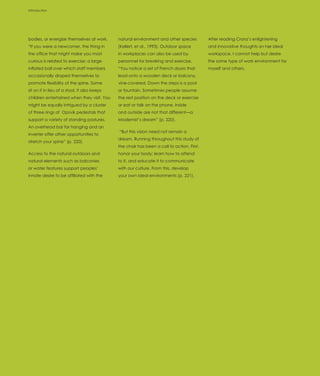
 “Something, somewhere
went terribly wrong” image
by an unknown artist (Neato
Shop, 2011)
                                                                                                                                                                   4
Problem Statement
Introduction


taking work with them on mobile               (Clements-Croome, 2006).                      more positive, energized, motivated
devices. Such demands can be stressful                                                      and more productive. This is analogous
                                              Many people accept what space,
and harmful for the body and mind;                                                          to the argument for evidence-based
                                              environment, furniture and equipment
however, relief can be found. Such                                                          design practices for health and healing
                                              they are given to work with without
things as: freedom to move between                                                          environments; patients heal faster and
                                              question. “It is what I am used to,” “It is
one social phase and another (from                                                          hospitals have higher turnover rates
                                              what I have always done,” are common
solitary work to group interaction), music,                                                 when hospital design caters to patient
                                              responses of people asked about why
opportunities to engage in spontaneous                                                      desires and experience. Workplaces
                                              they do what they do. Why must we
social encounters, opportunity to                                                           should perhaps design according to and
                                              accommodate ourselves to poorly
engage in creativity, self-expression                                                       cater to worker desires and experiences.
                                              configured furniture, uncomfortable
and exploration, appealing visual                                                           Cranz and I believe this is what most
                                              working positions and environments?
environments, exercise, space for body                                                      many work environments need. After all,
                                              I hope to improve these conditions. If
movements such as exercise stretching                                                       most working people spend the majority
                                              people had opportunities to question,
and a variety of working positions,                                                         of their days at work.
                                              opportunities to request healthier
furniture and equipment, personal
                                              choices, body—conscious and mind-
accessories, plant life and association
                                              conscious work environments designed
with other species, access to outdoor
                                              for movement, multiple working positions
environments, and sensory variability
                                              and worker preferences, perhaps
can provide relief from everyday
                                              people would be happier, healthier,
stresses and demands in the workplace


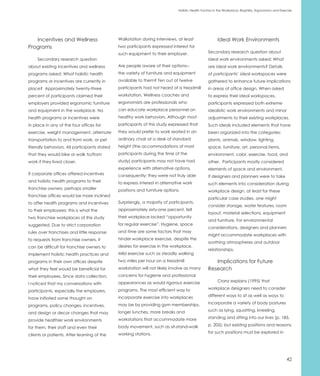
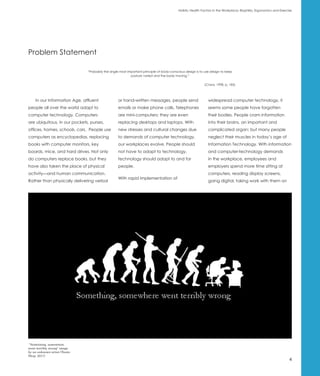
                                                                                                               Steelcase image from Movement
                                                                                                               Toward Health in the Workplace
                                                                                                                                      booklet
Holistic Health Factors in the Workplace: Biophilia, Ergonomics and Exercise


Assumption

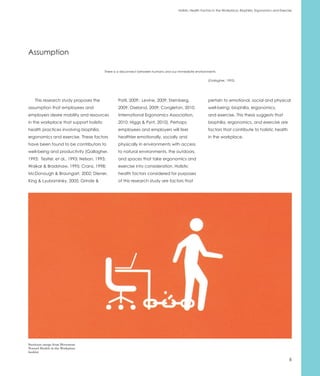
                                         There is a disconnect between humans and our immediate environments

                                                                                                        (Gallagher, 1993).


    This research study proposes the             Patil, 2009; Levine, 2009; Sternberg,                  pertain to emotional, social and physical
assumption that employees and                    2009; Oseland, 2009; Congleton, 2010;                  well-being: biophilia, ergonomics,
employers desire mobility and resources          International Ergonomics Association,                  and exercise. This thesis suggests that
in the workplace that support holistic           2010; Higgs & Pynt, 2010). Perhaps                     biophilia, ergonomics, and exercise are
health practices involving biophilia,            employees and employers will feel                      factors that contribute to holistic health
ergonomics and exercise. These factors           healthier emotionally, socially and                    in the workplace.
have been found to be contributors to            physically in environments with access
well-being and productivity (Gallagher,          to natural environments, the outdoors,
1993; Tesitel, et al., 1993; Nelson, 1993;       and spaces that take ergonomics and
Waikar & Bradshaw, 1995; Cranz, 1998;            exercise into consideration. Holistic
McDonough & Braungart, 2002; Diener,             health factors considered for purposes
King & Lyubomirsky, 2005; Grinde &               of this research study are factors that


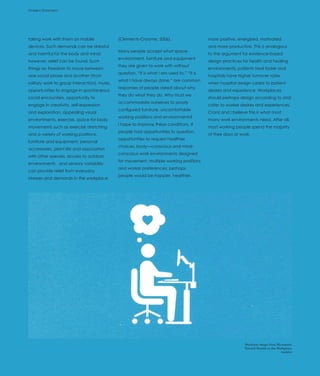
Steelcase image from Movement
Toward Health in the Workplace
booklet

                                                                                                                                                               6
Significance

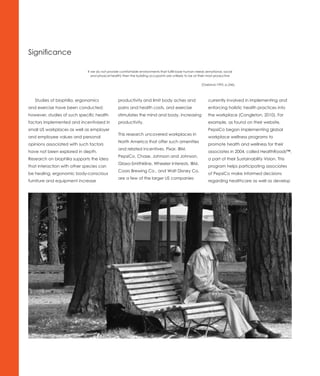
                             If we do not provide comfortable environments that fulfill base human needs (emotional, social
                                and physical health) then the building occupants are unlikely to be at their most productive

                                                                                                       (Oseland,1995, p.246).


   Studies of biophilia, ergonomics             productivity and limit body aches and                       currently involved in implementing and
and exercise have been conducted;               pains and health costs, and exercise                        enforcing holistic health practices into
however, studies of such specific health        stimulates the mind and body, increasing                    the workplace (Congleton, 2010). For
factors implemented and incentivized in         productivity.                                               example, as found on their website,
small US workplaces as well as employer                                                                     PepsiCo began implementing global
                                                This research uncovered workplaces in
and employee values and personal                                                                            workplace wellness programs to
                                                North America that offer such amenities
opinions associated with such factors                                                                       promote health and wellness for their
                                                and related incentives. Pixar, IBM,
have not been explored in depth.                                                                            associates in 2004, called HealthRoads™,
                                                PepsiCo, Chase, Johnson and Johnson,
Research on biophilia supports the idea                                                                     a part of their Sustainability Vision. This
                                                Glaxo-Smithkline, Wheeler Interests, IBM,
that interaction with other species can                                                                     program helps participating associates
                                                Coors Brewing Co., and Walt Disney Co.
be healing, ergonomic body-conscious                                                                        of PepsiCo make informed decisions
                                                are a few of the larger US companies
furniture and equipment increase                                                                            regarding healthcare as well as develop
Introduction                                                                    Holistic Health Factors in the Workplace: Biophilia, Ergonomics and Exercise


and sustain healthy behaviors with            In growing popular efforts to increase               (2) The use of effective worksite policies
motivational incentives. Such behavioral      worker health, productivity and                      and programs can reduce health risks
changes involving HealthRoads™                happiness, it makes sense to incorporate             and improve the quality of life for the 135
primary focuses on diet, exercise and         incentives and programs supporting                   million full-time and part-time workers in
nutrition reduce health risks. Participants   holistic health into work environments.              the United States.
are encouraged to seek preventative           At the 2010 National Ergonomics
                                                                                                   (3) Workers spend more than one-third
care and work one-on-one with wellness        Conference, Jerome, J. Congleton, PhD,
                                                                                                   of their day on the job and, as a result,
coaches to manage existing health             spoke of the Healthy Workforce Act of
                                                                                                   employers are in a unique position to
conditions. Tracking their wellness           2009. Although “A resolution affirming
                                                                                                   promote the health and safety of their
efforts, PepsiCo found that their wellness    the importance of exercise and physical
                                                                                                   employees.
initiatives have slowed the rate of           activity as key components of a healthy
increased medical costs; for every dollar     lifestyle, including in combating obesity,           (4) Chronic diseases such as heart
spent on workplace wellness during            reducing chronic disease, and lowering               disease, stroke, cancer, obesity, and
2007, they saved approximately $3.45          health care costs” was introduced and                diabetes are among the most prevalent
on healthcare, reducing healthcare            passed by Senate Mary 9, 2011, the                   and costly worker health problems for
costs for PepsiCo and associates. In          Healthy Workforce Act of 2009 did not                most employers.
2009, PepsiCo’s HealthRoads™ program          become law after being introduced
received external recognition with a          in April of 2009 (GovTrack). It is a bill to         (5) The use by employers of effective
Platinum award for Best Employers for         amend the Internal Revenue Code of                   worksite policies and programs can
Healthy Lifestyles. Many workplaces           1986 to provide tax credit to employees              reduce health risks and improve the
implementing and enforcing holistic           for the costs of implementing wellness               quality of life for their employees.
health practices are larger companies,        programs offering health promotion and
                                                                                                   (6) The good health of workers is good
while many smaller companies                  preventative care (GovTrack.). It was
                                                                                                   for business because healthier workers
are unaware or lack the means to              proposed that a fifty percent tax credit
                                                                                                   miss less work, are more productive, and
implement such practices in their work        for the costs of providing employees
                                                                                                   have lower health care costs.
environments. As literature review will       with a qualified wellness program
show, many researchers argue that such        would be granted to employers. A                     Congress said it. People spend much of
amenities and opportunities contribute        “qualified wellness program” is defined              their lives at work, therefore; it is smart to
to well-being as well as productive           as a program certified by the Secretary              begin and influence the implementations
performance and overall success and           of Health and Human Services and                     of healthy practices and lifestyles in
happiness for employees, employers and        consists of a health awareness and                   workplaces. This research employs a
companies involved. Medical doctors,          education component, a behavioral                    subjective approach to draw attention
designers, neuroscientists, even t-shirts     change component, and a supportive                   to the workspace desires of employees
and tea bags support arguments for            environment component. In the Healthy                and employers. Many people adapt to
holistic health in the workplace.             Workforce Act of 2009, Congress stated               their work conditions and environments
                                              its findings about the US workforce (Open            rather than question existing policies
The US Department of Labor,
                                              Congress, 2011):                                     and conditions about their and others’
Employment Standards Administration
                                                                                                   personal well-being.
promotes labor rights and employment          (1) The US has more than 12 million
standards with the objective of               employers and approximately 135 million
fostering economic and social equity          working adults.
for personnel health and well-being.


                                                                                                                                                          8
Scope

                              “Past research has identified many factors, such as demographic, task-related, workstation-related,
                               ergonomic, and psychosocial factors, associated with health complaints of employees engaged
                                                                      in sedentary work.”

                                                                                                (Waikar & Bradshaw, 1995, p.18)


   In an attempt to advocate body-                  thesis study involve detailed elements of                  collected using a subjective measure
conscious design, health and healing                each factor—biophilia, ergonomics, and                     of self report by participants through
work environments, this research study              exercise.                                                  surveys and interviews. Observations
of holistic health in the workplace                                                                            identified existing elements linked to
                                                    Health, happiness, productivity,
explores emotional, social and physical                                                                        the specific health factors, biophilia,
                                                    motivation, and work performance
well-being in small work environments                                                                          ergonomics, and exercise, such as
                                                    of participants and offices were not
through investigation of existing, lack of                                                                     windows, plants, participant behaviors
                                                    measured with external measurements
and desires for holistic health factors in                                                                     and workstations that existed or were
                                                    in this research study. Only miles
four small North American offices that                                                                         taking place in participating workplaces.
                                                    walked were measured externally with
are between 1000 and 4000 square feet                                                                          Comparison of participant opinions in
                                                    pedometers. Measurements of holistic
and employ three to twelve employees.                                                                          surveys and interviews to observations
                                                    health factors in the workplace were
Specific areas of concentration for this                                                                       and pedometer readings enhanced


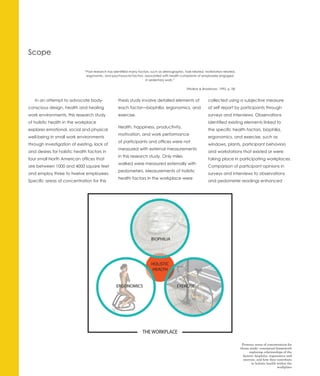
                                                                                                                                     Primary areas of concentration for
                                                                                                                                    thesis study: conceptual framework
                                                                                                                                          exploring relationships of the
                                                                                                                                      factors: biophilia, ergonomics and
                                                                                                                                      exercise, and how they contribute
                                                                                                                                            to holistic health within the
                                                                                                                                                               workplace
Introduction                                                                   Holistic Health Factors in the Workplace: Biophilia, Ergonomics and Exercise


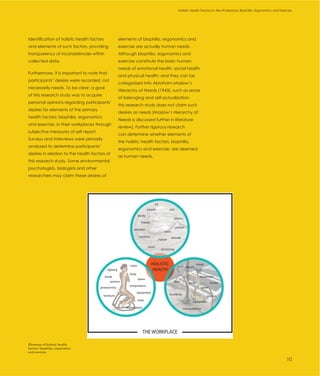
identification of holistic health factors      elements of biophilia, ergonomics and
and elements of such factors, providing        exercise are actually human needs.
transparency of inconsistencies within         Although biophilia, ergonomics and
collected data.                                exercise constitute the basic human
                                               needs of emotional health, social health
Furthermore, it is important to note that
                                               and physical health; and they can be
participants’ desires were recorded, not
                                               categorized into Abraham Maslow’s
necessarily needs. To be clear, a goal
                                               Hierarchy of Needs (1943), such as sense
of this research study was to acquire
                                               of belonging and self-actualization,
personal opinions regarding participants’
                                               this research study does not claim such
desires for elements of the primary
                                               desires as needs (Maslow’s Hierarchy of
health factors: biophilia, ergonomics
                                               Needs is discussed further in literature
and exercise, in their workplaces through
                                               review). Further rigorous research
subjective measures of self report.
                                               can determine whether elements of
Surveys and interviews were primarily
                                               the holistic health factors, biophilia,
analyzed to determine participants’
                                               ergonomics and exercise, are deemed
desires in relation to the health factors of
                                               as human needs.
this research study. Some environmental
psychologists, biologists and other
researchers may claim these desires of


Elements of holistic health
factors: biophilia, ergonomics
and exercise

                                                                                                                                                       10
Review of Literature

                                                            Introduction


    Numerous literature on topics of              Television shows like Rupert Bear         relieve stress and have positive effects
health, holistic health, emotional health,    send positive messages to children, such      on physical and psychological health.
social health, psychological health           as when Rupert was outside enjoying           Grinde and Patil (2009) share findings
and ergonomics exist. This literature         a picnic with his Professor; his Professor    of Richard Louv who uses the term
review attempts to share an assortment        said: “Fresh air, sunshine and exercise…      “nature-deficit” and suggests that “the
of information of topics related to this      ahh…there’s nothing like it!” (Rupert         increase in prevalences of conditions
research study’s focus, holistic health in    Bear, 1920). Documentaries explicating        such as obesity, attention disorders, and
workplaces. Holistic health encompasses       poor health practices, such as Super          depression is partly due to a decrease
a person’s overall health. When a             Size me, Food Inc, and The Corporation,       in the degree children are exposed
person’s overall health is considered, any    and TV shows like The Biggest Loser,          to Nature” (p. 2338). Dr. Brown (2009)
factors which contribute to a person’s        are quite popular today. People are           argues that play is beneficial in our lives,
well-being are taken into account.            expressing concerns for their well-being.     “actually making us more productive
All aspects of people’s needs can be          Positive changes in the home and office       and happier in everything we do” (p. 7).
organized into cognitive, social and          in support of health and well-being           Dr. Brown talks not just about children at
physical needs; these needs contribute        are occurring slowly. Some high school        play, he talks about everyone. Adults are
to the whole of a person. Although            physical fitness education programs           grown children. We all need play time,
alternative medicine also considers           are being enforced with more rigor            motivation, and stimulation. Classrooms
spiritual aspects when assessing a            and seriousness as the US experiences         and workplaces need to accommodate
person’s overall well-being, this research    an obesity epidemic. As a child, my           play time, social activities and provide
study does not attempt to include             teachers repeatedly told students to          stimulating work environments. “[W]
spiritual health in the factors of holistic   be quiet, stop fidgeting and remain           hile we readily accept that a healthy
health. Holistic health factors considered    sedentary in the classroom so as to focus     seed can’t grow into a plant without
for purposes of this research study are       on our studies; but as Gallagher points       right soil, light, and water, and that a
factors that pertain to emotional, social     out, “America’s obesity epidemic offers       feral dog wont behave like a pet, we
and physical well-being: biophilia,           stunning illustrations of what can happen     resist recognizing the importance of
ergonomics, and exercise. Literature          when motivation and attention become          environment in our own lives” (Gallagher,
review is organized into subchapters          disconnected from daily behavior in           1993, p. 16). For the older and employed,
addressing: small sedentary workplaces,       general and each other in particular”         no longer in a classroom setting, Dr.
sedentary work, holistic health, biophilia,   (Gallagher, 2009, p. 174). More               Brown describes a popular problem,
ergonomics, the chair, body and mind,         interaction, team work, and play time         “We strive to always be productive,
exercise, environmental psychology,           would enhance motivation, stimulating         and if an activity doesn’t teach us skill,
health and healing environments.              students to find interest in their studies.   make us money, or get on the boss’s
                                              Studies also suggest that nature can          good side, then we feel we should
Introduction                                                                  Holistic Health Factors in the Workplace: Biophilia, Ergonomics and Exercise


not be doing it. Sometimes the sheer          students who took PE before math
demands of daily living seem to rob us        reported dramatic improvement in their
of the ability to play” (Brown, 2009, p.      standardized tests” (Iskander, 2011).
7). As ergonomic research studies show,
                                              As research and literature report,
workplaces that demand a high level of
                                              emotional health, social health and
sedentary work and deprive workers of
                                              physical health are important factors in
healthy opportunities for interaction and
                                              being fulfilled and healthy human beings.
play, harm employees and employers.
                                              Together, emotional health, social health
Quality of life, blood flow, respiration,
                                              and physical health constitute health
collaboration, injuries, and overall health
                                              on a larger scale, holistic health. Factors
can all be enhanced and improved
                                              of holistic health, then, are biophilia,
when ergonomics are considered in
                                              ergonomics, and exercise, which are
workplace development, design and
                                              believed to contribute to well-being and
processes (Congleton, December 2,
                                              productivity in the workplace. Observing
2010, ErgoExpo presentation). Waikar, et
                                              and recognizing employees’ and
al (1995) identified factors, such as task-
                                              employers’ perceptions of holistic health
related, workstation-related, ergonomic,
                                              and workplace design have implications
and psychosocial factors, associated
                                              for a healthier workforce and healthier
with health complaints of employees
                                              working environments, productivity
engaged in sedentary work. Such
                                              gains and happier personnel. Winifred
health complaints often lead to work
                                              Gallagher (2009) claims, “Staying
lost to sick days, ergonomic assessments
                                              focused is an excellent strategy for well-
and medical appointments. Medical
                                              being,” and “the skillful management
and insurance costs for employees
                                              of attention is the first step toward any
and companies rise and workers’
                                              behavioral change and covers most
compensation costs increase. Similarly,
                                              self-improvement approaches like a vast
Yerkes-Dodson Law (1908) states people
                                              umbrella” (p. 10). Focusing on health
perform better if they are stimulated or
                                              in workplaces of the more affluent
motivated (Oseland, 2009, p. 245). A
                                              consumer capitalist economies of the
Chicago high school, Naperville Central
                                              more prosperous populations of the
High School, experiencing the culture
                                              planet can be a proactive effort to
of fitness has embraced a daily graded
                                              enforce some basics of sustainable living
physical education program. One group
                                              by improving quality of life and working
of struggling students at this high school
                                              conditions, providing jobs, conserving
have been involved in an innovative
                                              natural resources, enhancing economic
program which schedules PE right before
                                              growth and managing risk.
their most challenging classes. “In the
six years since that program started,
students who signed up for PE directly
before English read on average a half
year ahead of those who didn’t, and


                                                                                                                                                      12
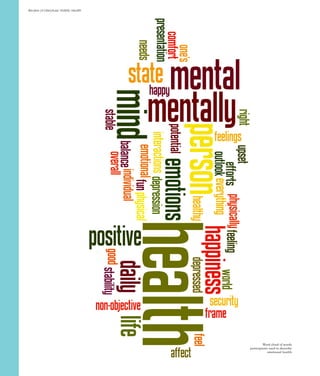
Review of Literature: Holistic Health


                                                 Word cloud of words
                                        participants used to describe
                                                    emotional health
Holistic Health Factors in the Workplace: Biophilia, Ergonomics and Exercise


                                                         Holistic Health


      For purposes of this study, the        connections. And the emotions they                relationships and overall health (Diener,
factors: biophilia, ergonomics and           evoke are among the greatest forces               King & Lyubomirsky, 2005). Happiness,
exercise, have been linked to emotional      that affect our hormonal, our nerve               an expression of healthy emotions, is
health, social health and physical health,   chemical, and our immune responses—               factor contributing to productivity in the
which constitute holistic health. Holistic   and through these, our health and our             workplace according to research of
health equally encompasses emotional         resistance to disease” (Sternberg, 2001,          Diener, King & Lyubomirsky. Researchers
health, social health and physical health.   p. 133). Essentially, emotions that are           have often believed that mere financial
In Dr. Sternberg’s explanations of human     rooted in social relationships or mental          success made people happy, but recent
connections, she connects relationships      capacities can affect the health of               research that examined the connections
with spirituality, emotions, and physical    the physical body. The body cannot                between desirable personality
well-being: “Our sense that powerful         be improved or worsened without also              characteristics, life successes and well-
forces beyond our bodies link us to others   affecting the mind, and vice versa.               being in over 275,000 people revealed
is so ingrained that we use phrases such                                                       that “happy individuals are predisposed
                                                 Emotional health has been
as “ties that bind,” “family ties,” and                                                        to seek out and undertake new goals in
                                             found to contribute to work success,
“bonding,” to describe those intangible                                                        life and this reinforces positive emotions”


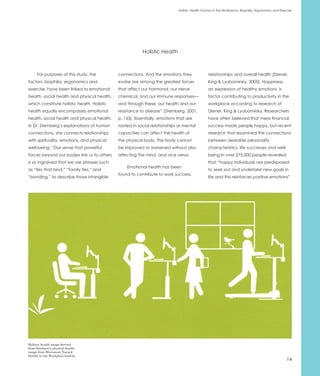
Holistic health image derived
from Steelcase’s physical health
image from Movement Toward
Health in the Workplace booklet
                                                                                                                                                    14
Review of Literature: Holistic Health


                                                 Word cloud of words
                                        participants used to describe
                                                        social health
Holistic Health Factors in the Workplace: Biophilia, Ergonomics and Exercise


(p. 803). Goleman states that “emotions      include air, food, water, sleep, sex; then         of humankind.
are contagious” (2006, p. 13). If emotions   security of environment, employment,
                                                                                                “Past research has identified many
are contagious, and happiness is a           resources, health, property; then
                                                                                                factors, such as demographic, task-
socially contagious emotion, emotional       love, friendship, intimacy, family; then
                                                                                                related, workstation-related, ergonomic,
health and social health are connected.      confidence, self-esteem, achievement,
                                                                                                and psychosocial factors, associated
                                             respect. The higher-order needs consist
Abraham Maslow’s Hierarchy of Needs,                                                            with health complaints of employees
                                             of morality, creativity and problem
a motivational theory of psychology that                                                        engaged in sedentary work” (Waikar
                                             solving. Although there is a range of
represents a model of human-centered                                                            & Bradshaw, 1995, p.18). Gallagher
                                             interpretation about how much each
motivation based on goals, suggests that                                                        (1993) states that there is a disconnect
                                             of the lower order needs must be
people have five tiers of needs in order                                                        between humans and our immediate
                                             satisfied prior to the ability to develop
to grow into the ultimate person they are                                                       environments. Our immediate
                                             the capacity of self-realization, human
capable of being (Maslow, 1943). These                                                          environments—home environments, work
                                             needs consist of emotional, social and
five needs consist of physiological needs,                                                      environments and larger urban systems—
                                             physical needs. Based on Maslow’s
safety needs, love needs, esteem needs                                                          affect us socially and physically, even
                                             Hierarchy of Needs, one can say that
and the need for self-actualization.                                                            biologically, as where biophilia is
                                             workplaces catering to well-being of
The first four lower need to be satisfied                                                       concerned (Dugdill, 2000). Whether
                                             personnel take aspects of emotional,
before higher-order needs can influence                                                         or not these immediate environments
                                             social health and physical health into
behavior; hence the hierarchy of this                                                           provide space and activities for social
                                             consideration—essentially the body and
model of needs. The lower levels needs                                                          and physical activities, our overall well-
                                             mind, as they are quite naturally priorities


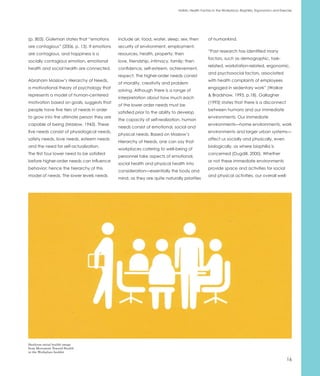
Steelcase social health image
from Movement Toward Health
in the Workplace booklet

                                                                                                                                                     16
Review of Literature: Holistic Health


                                                 Word cloud of words
                                        participants used to describe
                                                      physical health
Introduction                                                                Holistic Health Factors in the Workplace: Biophilia, Ergonomics and Exercise


being is affected.                           cognitive health, one may be able to                    • Work tools that come to you and
                                             function more efficiently, pleaseantly,           are easily adjustable.”
Steelcase promotes holistic health with a
                                             comfortably.
balance of cognitive, social and physical                                                            • “Seating that is easily adjustable
well-being through its “movement                 “Social Checklist”:                           and made to fit you, not the other way
toward wellness in the workplace”                                                              around.”
                                                 • “Provide a variety of collaborative
design guides. Printed in the Details
                                             spaces.”                                          A work environment that demands or
booklet by Steelcase Inc. (2009) is a
                                                                                               provides more space and opportunities
“Physical Checklist” as well as cognitive        • “Offer collaborative solutions that
                                                                                               simply for more body movement
and social checklists that can also be       work for longer periods of time, keeping
                                                                                               promotes physical health. Even moving
found by visiting Steelcase’s website.       workers refreshed.”
                                                                                               around a little bit more on a daily basis
      “Cognitive Checklist”:                                                                   can help maintain healthy body weight
                                                 • “Train workers to use the
                                                                                               and burn calories (Levine & Yeager,
                                             ergonomic features of their work
     • “Work areas that provide sufficient
                                                                                               2009). A healthy body helps a health
                                             environment.”
lighting.”
                                                                                               mind. Research has found that exercise
                                                 • “Encourage health with employee             stimulates the mind and body, increasing
     • “Provide a variety of solutions for
                                             wellness.”                                        productivity.
privacy and interaction.”

                                             A work environment that encourages                Through literature review, previous
     • “Address information processing
                                             freedom and creativity for personnel              research studies, a workplace aiming
and storage needs of diverse jobs.”
                                             welcomes confidence, inspirations and             for overall personnel well-being supports
     • “Work tools that allow you            innovation. Emotionally, personnel are            cognitive (mental and emotional),
to organize your information to              affected by their social relationships;           social and physical health for a balance
accommodate the way you work.”               and as the mind affects the body and              of holistic health. Through workplace
                                             vice versa, contributors to social and            planning and design, the incorporation
     • “Workstation that promote
                                             emotional health should be considered             of elements of biophilia, ergonomics and
movement, keeping users energized.”
                                             even in workplace design in order to              exercise may help contribute to overall
                                             achieve ultimate well-being. Spaces that          well-being, as elements of these factors
A work environment that takes into
                                             promote collaboration and spontaneus              are directly related to cognitive health,
considerations elements of ergonomics
                                             interaction amongst personnel                     social health and physical health.
such as lighting, space, furniture and
                                             accomodate aspects of social health.
equipment so that one can work more
efficiently and productively addresses
                                                 “Physical Checklist”:
cognitive health. As the body is affected
by the mind and the mind is affected             • “Seating that allows dynamic
by the body, bodily discomfort can           movement and postural change.”
trigger mental or emotioanl frustrations.
                                                 • Workstations that allow you to
Research has found ergonomic body-
                                             work while you stand.”
conscious furniture and equipment to
increase productivity and limit body             • Seating that keeps you oriented to
aches and pains and health costs. With       your work.”
such accomodations designed for


                                                                                                                                                    18
Review of Literature: Biophilia


                                                               Biophilia


      Evolutionary psychology is a newer     and illuminated regardless of season or       (p. 406). Biophilia became a popular
science that argues that “innate human       time of the day—although even on a            term when Edward O. Wilson published
behaviour is governed by adaptations         rainy morning, it is brighter outside than    Biophilia: The Human Bond with Other
of psychological processes which             inside with the lights on” (Gallagher,        Species, in 1984. Wilson defined biophilia
evolved to aid our survival and well-        1993, p. 12). Evolutionary psychologists      as “the innate tendency to focus on
being” (Oseland, 2009, p. 250). As a         argue that “people feel refreshed sitting     life and lifelike processes” (Wilson,
result of human’s innate predispositions     in a natural environment because              1984, Prologue). To Wilson, it seemed
for survival and well-being, people are      nature provides a setting for “non-taxing     unquestionable that human beings
social, needing a sense of community         involuntary attention” (Oseland, 2009,        have an innate sensitivity to and need
and belonging, human sense of direction      p. 250). As evolutionary psychologists        for other living things, because we have
is based on natural clues such as the        argue for innate tendencies to be             coexisted in the closest relationship
sun and landmarks, and people want to        affiliated with other species and natural     with the natural world for so many
explore what is around them, with clear      environments, biophilia is a key theme        millennia. According to Wilson, it is
views in all directions. “Only a hundred     within evolutionary psychology. To some,      ultimately human nature and a genetic
years ago, the overwhelming majority         “nature” means plants as in gardens,          predisposition, hereditary desire to have
of Americans lived in the country, while     forests and parks, but weather and            an emotional affiliation with human
today, most cluster in metropolitan          animals (humans included) are also            beings and other living organisms (Kellert,
areas” (Gallagher, 1993, p. 13).             directly connected. Although not may          et al., 1993, p. 31). Because elements of
Classrooms teach us that humans, similar     studies on the topic of biophilia address     biophilia (or lack of) constitute peoples’
to other living species, have evolved        human preferences for affiliations with       physical and social environments,
over millions of years responding to earth   animals, one study by Tesitel et al.          elements of biophilia affect peoples’
and sun cycles. Such cycles produced         (2001) found that of a community of           social health and emotional health. For
predictable biochemical and behavior         approximately six-hundred families in         example, a lack of plants or animals may
changes. “Environmentally minded             Czech Republic, almost twenty-five            weaken one’s emotional, or similarly,
scientists have begun to question the        percent claimed their pets to be family       cognitive health. Grinde and Patil (2009)
trade-offs we unwittingly make in order      members. These pets consist of mainly         report that even though some people
to live sealed up inside an artificially     dogs, budgies, fish, hamsters, turtles,       do not express any interest in plants
heated, cooled, and lighted world that       guinea pigs, cats and snakes.                 and nature, the absence of nature can
is structured around economic rather                                                       actually have a negative effect on them
                                                  The term biophilia was first coined by
than biologic concerns” (Gallagher,                                                        (p. 2339). Although some people may
                                             Erich Fromm in The Anatomy of Human
1993, p. 13). Gallagher reminds us that                                                    suffer from biophobia, a fear of nature
                                             Destructiveness (1973). Fromm defined
the Industrial Revolution brought people                                                   and other living species, studies report
                                             biophilia as “the passionate love of life
indoors. “Turning away from the natural                                                    that the absence of greenery can be
                                             and of all that is alive; it is the wish to
world, huge populations gravitated                                                         a stress factor, whether the absence
                                             further growth, whether in a person,
toward a very different one made up of                                                     of greenery is noticed consciously or
                                             a plant, an idea, or a social group”
homes and workplaces that were warm                                                        without thinking; “the presence of plants
Holistic Health Factors in the Workplace: Biophilia, Ergonomics and Exercise


can impact on the human mind”                          sun (Gallagher, 1993, p. 12). Gallagher
(Grinde & Patil, 2009, p. 2338).                       notes the startling disconnect in current
                                                       science studies and theories of the
Besides the necessary conversion of
                                                       sun. “…in the West, exposure to the
carbon dioxide into oxygen, biological
                                                       sun’s bright light has become erratic
plants offer growth, life, change, value,
                                                       in duration and timing for the first time
aesthetic qualities, emotional benefit,
                                                       in history, and they [environmentally
and health and healing properties to
                                                       minded scientists] suspect that the fact
humans and other living organisms.
                                                       that most of us are no longer wakened
Wilson’s Biophilia Hypothesis associates
                                                       by the dawn, drawn outdoors for much
our fondness of and desires for plants
                                                       of the day by our way of life, and lulled
with our innate desire and genetic
                                                       to sleep by darkness helps explain why
predisposition towards plants for means
                                                       up to a third of us suffer from sleep or
of survival, food and shelter. “For the
                                                       mood problems, or both” (Gallagher,
indefinite future more children and
                                                       1993, p. 14). Hundreds of years ago
adults will continue, as they do now,
                                                       the idea that light affects mental and
to visit zoos than attend all major
                                                       physical health was a widely accepted
professional sports combined (at
                                                       principle. This more recent observation
least this is so in the United States and
                                                       made by environmentally minded
Canada), the wealthy will continue
                                                       scientists suggests, as Gallagher puts it,
to seek dwellings on prominences
                                                       that “science forgot about it”, a widely
above water amidst parkland, and
                                                       accepted belief many years ago.
urban dwellers will go on dreaming of
snakes for reasons they cannot explain”                Despite intuitive thoughts on the
(Kellert, et al., 1993, p. 32).                        benefits of affiliations with nature,
                                                       an increasing number of studies
In the second century A.D., Aretaeus
                                                       report findings that nature provides
prescribed for people suffering from
                                                       psychological and physical health
lethargy to lay in the sunlight because
                                                       benefits. Grinde and Patil (2009)
their disease was gloom (Gallagher,
                                                       share reports of health benefits from
1993, p. 12). The four humors, or body
                                                       association with nature experiences,
fluids, according to Aretaeus: yellow
                                                       true wilderness experiences,
bile, black bile, phlegm, and blood,
                                                       neighborhood parks, gardens, and
were said to determine everything from
                                                       natural features around residences:
a person’s constitution to his character.
                                                       nature reduces stress; improves
These four body fluids were said to
                                                       attention, by having a positive effect
correspond to the four elements of
                                                       on mental restoration and by coping
fire, earth, water, and air, and were
                                                       with attention deficits; and increases
also related to summer, fall, winter,
                                                       longevity (p. 2335).
and spring; therefore, an individual’s
physiological and behavioral changes                   William McDonough and Michael
could be viewed in the context of the                  Braungart designed an “eco-effective”


                                                                                                          20
Review of Literature: Biophilia
Introduction


factory for Herman Miller that brought       not the object of focus (Grinde & Patil,
together visions of “a life-centered         2009, p. 2335). Velarde et al. assert
community and environment”                   that a lack of city green spaces or
(McDonough & Braungart, 2002, p.             unmanaged green spaces can cause
75). This factory noticed “dramatic          increased anxiety that increases the
productivity gains,” which analyses          incidence of crime (p. 2339). Expressing
confirmed were a result of one factor,       a growing problem in the United States
biophilia. Retention rates were noted as     in the 70’s, Scuhmacher noted that,
“impressive” and employees who left          “Modern man does not experience
the factory for higher paid jobs returned    himself as a part of nature but as an
stating they could not work “in the dark”    outside force destined to dominate
(p. 75-76). Their goal of the design was     and conquer it” (Schumacher, 1973, p.
to “give workers the feeling that they’d     14). Some propose that love, an aspect
spent the day outdoors, unlike workers in    of biophilia, will cure this disconnect
the conventional factory of the Industrial   between man and nature as well as cure
Revolution, who might not see daylight       mankind of other worldwide problems,
until the weekend” (p. 75). McDonough        even health problems in the workplace.
and Braungart succeeded in designing         “The human need for nature is linked not
an ideal work environment for industry       just to the material exploitation of the
workers: “We designed the factory            environment but also to the influence
around a tree-lined interior conceived       of the natural world on our emotional,
as a brightly day lit street that ran the    cognitive, aesthetic, and even spiritual
entire length of the building. There are     development” (Nelson, 1993, p. 42).
rooftop skylights everywhere the workers
are stationed, and the manufacturing
space offers views of both the internal
street and the outdoors, so that even
as they work indoors, employees get to
participate in the cycles of the day and
the seasons” (p. 75).

A study (Tesitel, et al., 1993) of the
absence of natural components in
an urban environment found that the
absence of parks and landscaped
community areas limited the ‘pleasant
experience’ of people living in the area.
“The absence of plants may suggest an
“unnatural”, and thus potentially unsafe,
environment;” as plants may affect
the human mind through unconscious
mechanisms, even when plants are
Holistic Health Factors in the Workplace: Biophilia, Ergonomics and Exercise


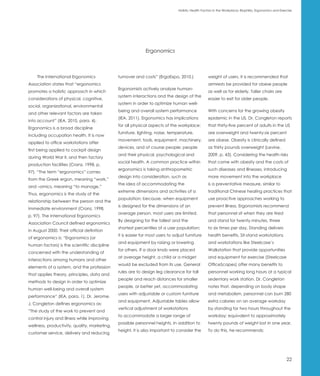
                                                             Ergonomics


    The International Ergonomics              turnover and costs” (ErgoExpo, 2010.)               weight of users. It is recommended that
Association states that “ergonomics                                                               armrests be provided for obese people
                                              Ergonomists actively analyze human-
promotes a holistic approach in which                                                             as well as for elderly. Taller chairs are
                                              system interactions and the design of the
considerations of physical, cognitive,                                                            easier to exit for older people.
                                              system in order to optimize human well-
social, organizational, environmental
                                              being and overall system performance                With concerns for the growing obesity
and other relevant factors are taken
                                              (IEA, 2011). Ergonomics has implications            epidemic in the US, Dr. Congleton reports
into account” (IEA, 2010, para. 4).
                                              for all physical aspects of the workplace:          that thirty-five percent of adults in the US
Ergonomics is a broad discipline
                                              furniture, lighting, noise, temperature,            are overweight and twenty-six percent
including occupation health. It is now
                                              movement, tools, equipment, machinery,              are obese. Obesity is clinically defined
applied to office workstations after
                                              devices, and of course people; people               as thirty pounds overweight (Levine,
first being applied to cockpit design
                                              and their physical, psychological and               2009, p. 43). Considering the health risks
during World War II, and then factory
                                              social health. A common practice within             that come with obesity and the costs of
production facilities (Cranz, 1998, p.
                                              ergonomics is taking anthropometric                 such diseases and illnesses, introducing
97). “The term “ergonomics” comes
                                              design into consideration, such as                  more movement into the workplace
from the Greek ergon, meaning “work,”
                                              the idea of accommodating the                       is a preventative measure, similar to
and –omics, meaning “to manage.”
                                              extreme dimensions and activities of a              traditional Chinese healing practices that
Thus, ergonomics is the study of the
                                              population; because, when equipment                 use proactive approaches working to
relationship between the person and the
                                              is designed for the dimensions of an                prevent illness. Ergonomists recommend
immediate environment (Cranz, 1998,
                                              average person, most users are limited.             that personnel sit when they are tired
p. 97). The International Ergonomics
                                              By designing for the tallest and the                and stand for twenty minutes, three
Association Council defined ergonomics
                                              shortest percentiles of a user population;          to six times per day. Standing delivers
in August 2000. Their official definition
                                              it is easier for most users to adjust furniture     health benefits. Sit-stand workstations
of ergonomics is: “Ergonomics (or
                                              and equipment by raising or lowering                and workstations like Steelcase’s
human factors) is the scientific discipline
                                              for others. If a door knob were placed              Walkstation that provide opportunities
concerned with the understanding of
                                              at average height, a child or a midget              and equipment for exercise (Steelcase
interactions among humans and other
                                              would be excluded from its use. General             OfficeScapes) offer many benefits to
elements of a system, and the profession
                                              rules are to design leg clearance for tall          personnel working long hours at a typical
that applies theory, principles, data and
                                              people and reach distances for smaller              sedentary work station. Dr. Congleton
methods to design in order to optimize
                                              people, or better yet, accommodating                notes that, depending on body shape
human well-being and overall system
                                              users with adjustable or custom furniture           and metabolism, personnel can burn 280
performance” (IEA, para. 1). Dr. Jerome.
                                              and equipment. Adjustable tables allow              extra calories on an average workday
J. Congleton defines ergonomics as:
                                              vertical adjustment of workstations                 by standing for two hours throughout the
“The study of the work to prevent and
                                              to accommodate a larger range of                    workday; equivalent to approximately
control injury and illness while improving
                                              possible personnel heights. In addition to          twenty pounds of weight lost in one year.
wellness, productivity, quality, marketing,
                                              height, it is also important to consider the        To do this, he recommends:
customer service, delivery and reducing


                                                                                                                                                       22
Review of Literature: Ergonomics


raising desk heights from thirty to forty      ideal situation would allow individuals to
inches; raising the chair to stool height      choose the most appropriate chair or
so as to allow users to easily and freely      chairs for themselves.
stand up to work periodically; and
                                               Why should workers sit? Sitting causes
using a keyboard tray and monitor arm,
                                               less fatigue, comforts the knee, hip
essentials if an electric height adjustable
                                               back, ankle, offers stability, assists in data
desk is not available. By working at sit-
                                               entry, allows for use of foot controls,
stand-walk workstations, personnel can
                                               and accommodates meetings.	
burn more calories, possibly lose weight,
                                               Sit-stand workstations with adjustable
relieve pressure on spinal discs and ease
                                               keyboard platforms and monitors
physical ailments.
                                               are recommended by Dr. Congleton
Why should people stand at work? Dr.           for workplaces where personnel use
J. Congleton supports standing with            computers for more than four hours
justified reasons: standing allows for         per day. GeekDesk® recommends
a wider range of motion, uses larger           its product for the options of working
forces, promotes blood flow and                sitting and standing at the same desk;
postural changes, better respiration and       it is electrically operated. They claim
reaction alertness, burns more calories,       this electric desk adjusts working height
and lowers pressure in low back discs.         from sitting to standing (or anywhere
When we sit, pressure on some spinal           in between) at the touch of a button,
discs increases thirty percent compared        increases productivity, supports a variety
to when we are standing (Cranz, 1998,          of positions, reduces back & neck pain,
p. 97). Dr. James A. Levine, an obesity        helps people feel better and focused
specialist at the Mayo Clinic, notes           stay more easily (GeekDesk, 2011). The
that, compared to sitting, one can burn        sit-stand workstations are recommended
three times as many calories an hour           by Dr. Congelton for personnel who
standing; (Levine, 2009, p. 43). “If sitting   are tied to their work areas by phone
is the problem, standing is the answer”        or other equipment within reach, for
(p. 43). Standing is not necessarily better    example, customer service, data entry,
than sitting; studies show that sitting and    and help desk personnel. Monitor
standing should be alternated, allowing        placement for sit-stand workstations
for movement and multiple positions.           should be placed according to the
Dr. Congleton recommends personnel             user. The top of the screen should be
to sit when tired and stand when they          approximately eye level with the user
can for twenty minutes, three to six           and about thirty-two inches from the
times per day. If options for sit-stand or     user; the appropriate location results
standing workstations are not provided,        in an approximate angle of twenty to
other ergonomic solutions are also             twenty-five degrees down from the user’s
possible. A variety of sizes of chairs to      eye height to the monitor screen (Dr. J.
meet the varying needs of personnel            Congelton, 2010).
can be provided. The best and most
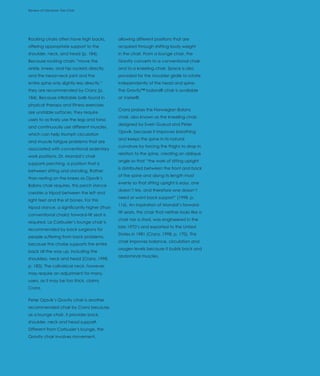
                                                                                                                     From top:
                                                                                                Varier® Gravity chair designed
                                                                                                by Peter Opsvik; Le Corbusier’s
                                                                                                          lounge chair; Varier®
                                                                                                 Variable ™ Balans ®, designed
                                                                                                               by Peter Opsvik
Holistic Health Factors in the Workplace: Biophilia, Ergonomics and Exercise


                                                              The Chair


    Galen Cranz, in The Chair: Rethinking     Seat of Your Pain May Be Your Chair.               chairs” (p. 93). Linton et al. (1994) found
Culture, Body, and Design, boldly             From experience, Cranz states that:                that furniture design is one aspect of a
described the history, functions, and         “Improving the basic configuration of the          multidimensional problem. Specifically,
possible improvements of chair design         conventional chair involves aligning and           pupils’ attitude and behavior problems
while addressing ergonomics and               supporting the torso properly” (p. 152).           were found to be associated with poor
mind-body relationships. She suggested        Cranz explores culture, ergonomics, and            ergonomic school furniture. During a
“inventing an entirely new system [of         mind-body relationships for the reform             six month controlled experiment of
seating] to promote movement at work          of the chair. Critical for recognition by          testing and ergonomic assessments, the
and at schools” as she argues against         designers, is Cranz’s statement that:              experimental group of fourth graders
the chair (1998, p. 19). Chairs are popular   “Probably the single most important                who used ergonomically designed
decorative elements today, prized for         principle of body-conscious design is to           school furniture experienced a reduction
appearance over function, resulting in        use design to keep posture varied and              in musculoskeletal symptoms and
concerns of the body, especially where        the body moving” (p. 185).                         found their furniture to be significantly
sedentary work is required. Dr. Jenny                                                            more comfortable than the traditional
                                                  Cranz explores why stools are
Pynt and Joy Higgs published a book                                                              furniture used by the controlled group.
                                              uncomfortable for a majority of us. She
on the design and history of chairs and                                                          Sitting behaviors differed only slightly
                                              believes that “we can’t sit upright simply
seating, A History of Seating, 3000 Bc                                                           in this investigation, although proper
                                              because we have grown accustomed
to 2000 Ad: Function Versus Aesthetics.                                                          instructions on how to use the ergonomic
                                              to being supported by chair backs” (p.
They argue that functional seating                                                               furniture correctly were provided.
                                              95). She explains this “vicious cycle”
needs to assist users for performance                                                            Although Cranz stated that ergonomic
                                              with her hypothesis: “we lean back
of seated asks, enhancing rather than                                                            recommendations never completely
                                              because our muscles are weak, and
detracting from user posture and health.                                                         eliminate the damage caused by chair
                                              leaning back weakens the muscles even
Aesthetic features should be taken into                                                          sitting, following such recommendations
                                              further, so that we ‘need’ support even
consideration as well, aesthetics that                                                           would minimize health risks (p. 101-102).
                                              more” (p. 96). After collecting evidence
do not limit tasks or health. In the home,
                                              from multiple countries and cultures,                    Stating that no body should remain
office, and schools, chairs need to be
                                              Cranz found that sitting is associated             in one single posture for long periods
reformed for healthier postures. Our
                                              with back problems, varicose veins,                of time, Cranz recommends healthier
bodies were not meant to sit in positions
                                              stress, fatigue, diaphragm, circulation,           chairs for human posture. Among her
for long periods of time; they need
                                              digestion, elimination, and general                recommendations are: rocking chairs,
movement. According to Cranz, “from
                                              body movement (p. 97). According                   inflatable therapy and exercise balls,
a somatic point of view, chairs pose
                                              to Cranz, scientific literature on chair           Le Corbusier’s lounge chair, Opsvik’s
many different problems” (p. 135). The
                                              design is concerned with ergonomics;               Norwegian Balans chair, also called the
seated position we are accustomed, is a
                                              measures of the relationship between               kneeling chair, Opsvik’s Gravity lounge
health hazard, causing back pains and
                                              work-related human activity and the                chair and Mandal’s tilting stool.
many other health problems. Dr. Jenny
                                              immediate environment, “which includes
Pynt published a book in 1998, titled The


                                                                                                                                                      24
Review of Literature: The Chair
Introduction


Rocking chairs often have high backs,         allowing different positions that are
offering appropriate support to the           acquired through shifting body weight
shoulder, neck, and head (p. 184).            in the chair. From a lounge chair, the
Because rocking chairs “move the              Gravity converts to a conventional chair
ankle, knees, and hip sockets directly,       and to a kneeling chair. Space is also
and the head-neck joint and the               provided for the shoulder girdle to rotate
entire spine only slightly less directly,”    independently of the head and spine.
they are recommended by Cranz (p.             The Gravity™ balans® chair is available
184). Because inflatable balls found in       at Varier®.
physical therapy and fitness exercises
                                              Cranz praises the Norwegian Balans
are unstable surfaces, they require
                                              chair, also known as the kneeling chair,
users to actively use the legs and torso
                                              designed by Svein Gusrud and Peter
and continuously use different muscles,
                                              Opsvik, because it improves breathing
which can help triumph circulation
                                              and keeps the spine in its natural
and muscle fatigue problems that are
                                              curvature by forcing the thighs to drop in
associated with conventional sedentary
                                              relation to the spine, creating an oblique
work positions. Dr. Mandal’s chair
                                              angle so that “the work of sitting upright
supports perching, a position that is
                                              is distributed between the front and back
between sitting and standing. Rather
                                              of the spine and along its length most
than resting on the knees as Opsvik’s
                                              evenly so that sitting upright is easy, one
Balans chair requires, this perch stance
                                              doesn’t tire, and therefore one doesn’t
creates a tripod between the left and
                                              need or want back support” (1998, p.
right feet and the sit bones. For this
                                              116). An inspiration of Mandal’s forward-
tripod stance, a significantly higher (than
                                              tilt seats, this chair that neither looks like a
conventional chairs) forward-tilt seat is
                                              chair nor a stool, was engineered in the
required. Le Corbusier’s lounge chair is
                                              late 1970’s and exported to the United
recommended by back surgeons for
                                              States in 1981 (Cranz, 1998, p. 170). This
people suffering from back problems,
                                              chair improves balance, circulation and
because the chaise supports the entire
                                              oxygen levels because it builds back and
back all the way up, including the
                                              abdominal muscles.
shoulders, neck and head (Cranz, 1998,
p. 183). The cylindrical neck, however,
may require an adjustment for many
users, as it may be too thick, claims
Cranz.

Peter Opsvik’s Gravity chair is another
recommended chair by Cranz because,
as a lounge chair, it provides back,
shoulder, neck and head support.
Different from Corbusier’s lounge, the
Gravity chair involves movement,
Holistic Health Factors in the Workplace: Biophilia, Ergonomics and Exercise


                                                             Exercise


     Although most overweight health       “physical inactivity”, is a risk factor for          psychological well-being (WHO).
problems result from poor nutrition and    chronic diseases entirely on its own.
                                                                                                Endocrinologist, Dr. James A.
diet than lack of exercise, exercise       Overall, physical inactivity is estimated
                                                                                                Levine partnered with Steelcase to
has been known to be beneficial in         to cause 1.9 million deaths globally
                                                                                                manufacture a workstation called the
maintaining health. Ideally, workplaces    (WHO, 2011). On the other hand, the
                                                                                                Walkstation that combines an adjustable
would incorporate more play, exercise      World Health Organization states that
                                                                                                sitting and standing height surface with
and movement. “By actively choosing        significant health benefits are related to
                                                                                                a treadmill, operating at two miles per
endeavors that demand your total           regular physical activity such as walking
                                                                                                hour at the most. Just as Rachel Carson’s
focus and skillfully using attention to    and sports activities. Thirty minutes of
                                                                                                Silent Spring shook common thought and
make even inevitable rote chores more      moderate physical activity per day is
                                                                                                ignorance and took at least a decade
engaging, you can blur the distinction     recommended by the World Health
                                                                                                to rattle change in agricultural treatment
between work and play—a hallmark of        Organization. Regular physical activity
                                                                                                methods and environmental policies,
the focused life” (Gallagher, 2009, p.     can reduce the risk of cardiovascular
                                                                                                implementation of the Walkstation
99). Aside from any other health issues,   disease, diabetes and osteoporosis,
                                                                                                into everyday workspaces that are
a lack of physical activity, known as      help control weight, and promote


Steelcase physical health image
from Movement Toward Health
in the Workplace booklet

                                                                                                                                                     26
Review of Literature: Exercise


accustomed to sedentary work may             paper published in Science) that             nature because they do not require
take decades, especially in today’s          quantified body postures with “NEAT          the maintenance of planting, watering,
slow economic recovery. Costs and            underwear” lean and healthy volunteers,      placement according to sunlight, or
receptiveness to new ideas are factors       not “gym goers”, “simply lived their life    pruning, but the extra body movements
slowing such implementations of exercise     with greater movement, just the way          required to retrieve a water pitcher,
and movement into workplaces.                nature intended” (p. 43). Technological      filling up the water pitcher and watering
                                             advances have made some things               the plant burn calories. Having living
Despite today’s explosion of gyms and
                                             are more convenient than they used           plants to care for provide opportunities
fitness clubs to fight obesity, Dr. Levine
                                             to be, such as driving to and from           to burn more calories. Dr. Levine would
states that “the calories we burn behind
                                             places that are less than a mile away        say watering plants is an opportunity
their mirrored walls pale in comparison to
                                             instead of walking. Small activities like    to boost one’s “NEAT”, or calorie
those we could and should be burning
                                             watering plants, walking stairs, walking     burning metabolism, also known as
in normal life” (Levine & Yeager, 2009,
                                             to the printer rather than printing at the   “nonexercise activity thermogenesis”
p. 43). Dr. Levine introduces everyday
                                             desk, and walking the long route are         the US population regularly “exercises,”
innovative practices for exercise at
                                             daily activities that require use of more    and why half of all people who embark
work in, Move a Little, Lose A Lot. Even
                                             energy by simply living. Interior plants     on an exercise plan abandon it within six
moving around a little bit more on a
                                             support healthy efforts towards eight        weeks. We’re simply not engineered to
daily basis can help maintain healthy
                                             loss and weight management. Besides          live like that” (p. 5).
body weight and burn calories. In one
                                             dusting, artificial plants may provide
of Levine’s scientific studies (an obesity                                                     Standing rather than sitting or in
                                             a convenient green representation of


                                                                                                                    Steelcase Walkstation by
                                                                                                                                     Details
Introduction                                                                 Holistic Health Factors in the Workplace: Biophilia, Ergonomics and Exercise


addition to sitting while working is a        1996, illustrates examples of how workers         environments, increased performance
way to address the issue Dr. Levine           can self-treat their pain, improve posture        pressure and the hopes of leaving work
brings up, therefore he designed the          and prevent chronic health problems in            early contribute to “killing lunchtime”
Walkstation treadmill. Simply having a        the office.                                       (Steelcase, July 2006). Steelcase found
dog, or children, gives people more                                                             that forty-nine percent of US workers who
                                                   Waikar & Bradshaw (1995), refer
opportunities to walk, run, take the long                                                       participated in the Workplace Survey
                                              to Austin’s findings (1984) noting that
way, play, bend, reach, stretch, skip,                                                          Index spent their lunch hour working with
                                              “physical exercise has the potential to
and spend more time outdoors. These                                                             colleagues, working during lunch and
                                              reduce work-related musculoskeletal
simple activities support one’s health;                                                         even eating at their desks. Other popular
                                              stress” (Waikar & Bradshaw, 1995, p. 16).
specifically through the factors of                                                             lunchtime activities include Internet
                                              Waikar and Bradshaw studied businesses
biophilia, ergonomics and exercise with                                                         shopping, reading, making phone calls,
                                              that provided formal exercise programs
access to and affiliations with nature,                                                         running errands, exercising and even
                                              (or not), the willingness of personnel to
space, body-conscious activities and                                                            dating. Steelcase found in 2006 that the
                                              participate in formal exercise programs,
equipment.                                                                                      US lunch hour dropped to about half an
                                              and employees’ preferences for features
                                                                                                hour and women are more likely to take
     Lack of exercise, smoking and poor       of an exercise program. They concluded
                                                                                                shorter lunches than men.
diet pose major risk factors for diseases     that ninety-seven percent of participants
such as cancer, heart disease and             indicated that their employer did not
diabetes. Due to higher health costs          have a formal exercise program (p. 23).
and sick days associated with people          Of that ninety-seven percent, sixty-nine
who are overweight and therefore not          percent responded that they would
as healthy as physically fit and healthy      be willing to participate in a formal
people, workplaces are more likely            exercise program if one were offered by
to hire and retain physically fit and         their company (p. 24). Dr. Levine notes,
healthy employees; their health costs         however, that a recent poll of more than
are typically lower and they require          one thousand mend an women found
fewer sick days from work. It would           that “only 29 percent of American’s
therefore be beneficial for personnel         current favorite pastimes involve any
if workplaces provided space, time,           physical activity, down more than a third
opportunities, equipment and incentives       from ten years ago” (Levine, 2009, p. 17).
for physical fitness actually within          Clearly, the way people actually behave
workplaces. “Since we spend the               is not always consistent with how they
majority of our waking hours at work,         report their behavior. “Past favorites such
our loss of NEAT [“nonexercise activity       as swimming, walking, and gardening
thermogenesis” or the energy one              have slipped from favor. Fishing and
burns simply living life] at the workplace    bowling are becoming quaint activities
has had the most profound effect on           from bygone days,” reports Dr. Levine
our energy expenditure,” possibly also        (p. 17).
limiting motivation and productivity
                                                   Steelcase’s 360 article on the topic
levels (Levine, 2009, p. 16). Simple desk
                                              of workplace lunch breaks addresses
exercises such as those listed in Dr. Jenny
                                              the concern that changing work
Pynt’s book Desk Exercises published in


                                                                                                                                                     28
Review of Literature: Environmental Psychology
Introduction


                                                      Environmental Psychology


     Because emotions such as                    lives” (p. 16). Boyden (1971) distinguished    Healing spaces, rooted in environmental
happiness affect motivation levels,              needs for survival from needs for well-        psychology, now have a scientific
productivity and success, living in              being. Well-being needs consist of             basis. “Our decisions about where to
environments that create and sustain             physiological, psychological and social        live or work can have significant if often
happiness for individuals can support            needs which can be addressed in interior       unsuspected impact on our well-being,
work performance. It is valuable to              design: meaningful change and sensory          whether through subtle means, such
consider location, macro and micro               variability; opportunity to engage in a        as lighting and plants, or more directly,
environments when relocating, choosing           full range of species typical behaviors        through agents such as allergens or
a school, a workplace, building, and             (creativity, self-expression, cooperation,     pollutants” (Gallagher, 1993, p. 19)
designing. “Past research has identified         exploration); opportunity to engage
many factors, such as demographic,               in spontaneous social encounters; an
task-related, workstation-related,               interesting visual environment; noise
ergonomic, and psychosocial factors,             levels not much above or below that
associated with health complains of              in nature; freedom to move between
employees engaged in sedentary                   one social phase and another (from
work” (Waikar & Bradshaw, 1995, p. 18).          solitary work to group interaction);
The physical environment surrounding             and opportunity for regular exercise
people affects their performance and             (Clements-Croome, 2006).
health. Gallagher states: “Now modern
                                                 Gallagher and Sternberg propose
science is confirming that our actions,
                                                 that people live in environments that
thoughts, and feelings are indeed
                                                 support their well-being, whether a
shaped not just by our genes and
                                                 city location, beach or farm location
neurochemistry, history and relationships,
                                                 is healthier depends on the person, a
but also by our surroundings” (Gallagher,
                                                 person’s experiences, emotions, mind.
1993, p. 12). Just like the simplest of
                                                 “Hofer points to the migrations of the
microorganisms, humans depend on
                                                 tiny typhoid bacillus: in order to live, it
their environmental interactions for
                                                 must swim to a place rich in the nutrient
survival (p. 15). Concerned for the
                                                 it wants, stop, and remain there, finding
disconnect between humans and our
                                                 its way by the reactions of receptors
immediate environments, Gallagher
                                                 on its cell membrane to chemicals that
states that “While we readily accept that
                                                 send it into different states” (p. 15). Just
a healthy seed can’t grow into a plant
                                                 in 1984, the first study to test the idea
without the right soil, light, and water,
                                                 that physical space might contribute
and that a feral dog wont behave
                                                 to healing was published in Science
like a pet, we resist recognizing the
                                                 magazine (Sternberg, 2009, p. 1-2).
importance of environment in our own
Holistic Health Factors in the Workplace: Biophilia, Ergonomics and Exercise


                                              Health and Healing Environments


    Earlier schools of thought                and beauty of flowers and plants surely             pleasure. Put in more mechanistic terms,
believed external environments to             rattle our human instincts. “Evolutionary           they play upon the circuitry of the brain’s
be determinants of mental health,             biologists believe that in many creatures           limbic system in a way that ultimately
rather than simply individuals’ internal      beauty is a reliable indicator of health,           promotes survival and reproduction” (p.
processes, which most of today’s              and therefore a perfectly sensible way              61). An annual meeting of the American
psychological health emphasizes               to choose one mate over another”                    Psychological Association discussed
(Gallagher, 1993, p. 15). In classical        (Pollan, 2002, p. 74). Beauty is of instinct,       a study analyzing the ways in which
times, temples to the Greek god of            naturally attractive to humans because              lively and dull interiors affect mood
healing (Asclepius) “were built far from      it symbolizes health. Wilson (1984)                 and performance. “When the subjects’
towns, high up on hilltops overlooking the    states: “Mathematics and beauty are                 responded to a stimulating, plant-filled,
sea” (Sternberg, 2009, p. 3). For years,      devices by which human beings get                   homey setting and a grim, institutional
hospital guests have given flowers and        through life with the limited intellectual          one were contrasted, the only reaction
plants to friends and family suffering with   capacity inherited by the species. Like a           they all shared was a decline in vigorous
health issues in an attempt to promote        discerning palate and sexual appetite,              activity and increased feelings of fatigue
health and healing. The vibrant colors        these esthetic contrivances give                    in the austere environment” (Gallagher,


                                                                                                                                                       30
Review of Literature: Health & Healing Environments
Introduction


1993, p. 17).                                         connection is an assumption that               ensure the workspaces on offer are
                                                      physical places that set the mind at ease      made available to all (p. 251).
“More than two thousand years ago,
                                                      can contribute to well-being, and those
Hippocrates’ observation that our                                                                    With innovative efforts to create healthy
                                                      that trouble the emotions might foster
well-being is affected by our settings                                                               workplace design, Steelcase provides
                                                      illness” (p. 10). Oseland (2009) states that
was established as a cornerstone of                                                                  surveys on their website that can be used
                                                      “design implications for evolutionary
Western medicine” (Gallagher, 1993, p.                                                               by workplaces to help them gain insight
                                                      psychology are self-explanatory, but
12). Health and healing environments,                                                                into employee desires and opinions
                                                      nevertheless many offices fail to meet
such as hospitals, medical clinics, and                                                              of their work environments. Gallagher
                                                      these basic psychological needs:
doctors’ offices, incorporate artificial                                                             states that in today’s rapid paced world
plants and representations of nature.                      • provide a variety of spaces that        of information technology, “we must
For example, NatureMaker’s Steel                      allow people to gather, preferably with        put the principles emerging from the
Art Trees support healing processes                   food and drink (“watering holes”) made         multidisciplinary science of places into
by softening environments that                        available;                                     practice on local and global levels” to
may potentially appear bleak and                                                                     secure environmental quality (Gallagher,
                                                           • offer a stimulating and interesting
uninviting (NatureMaker). Views, color,                                                              1993, p. 19).
                                                      environment and allow us to move
temperature, light, plants, smells and
                                                      around and explore rather than stay
other factors have been documented
                                                      working in one place;
as elements that affect people
psychologically, influencing positive or                   • create places which offer quieter
negative emotions, levels of motivation               environments away from colleagues to
and hunger. These elements are also                   concentrate or just contemplate;
considered in human factors. Oseland
argues that poor working conditions can                    • design facades which offer views
lead to dissatisfaction and therefore                 out and good daylight ingress that
reduced performance and interprets                    will meet biophilia needs as will good
Maslow’s Hierarchy of Needs into:                     landscaping externally and planting
“if we do not provide comfortable                     internally;
environments that fulfill base human
                                                           • ideally, provide natural ventilation
needs then, regardless of rewards, the
                                                      and the control of internal temperatures,
building occupants are unlikely to be at
                                                      or failing that good fresh air ventilation
their most productive” (1995, p. 246).
                                                      and the option to work in locations of a
As with Planetree’s patient-centered                  different temperature;
and evidence based approaches
                                                           • plan desks to offer views across
to healthcare design, healthcare
                                                      the office and to the outside without
environments today use patient-
                                                      the occupier feeling at risk of being
centered approaches while
                                                      overlooked from passersby (if located
incorporating design features to foster
                                                      with their back to a main circulation
well-being and healing (Planetree, 2009).
                                                      route); and
Dr. Sternberg (2009) notes that “implicit
in an understanding of the mind-body                       • to satisfy egalitarian principles,
Holistic Health Factors in the Workplace: Biophilia, Ergonomics and Exercise


Findings & Opportunities

                               “... [O]ne of the most important aspects of a designer’s role is to help change social perception”


                                                                                                             (Cranz 1998, p. 185).


    Literature review has illuminated              workplaces is an approach this research                      to biophilia, ergonomics and exercise.
existing problems with regards to overall          study suggests based on literature review                    Social encounters and exposure
well-being, from health issues associated          and case study findings.                                     to natural environments affect the
with chairs, sitting, sedentary work,                                                                           mind; and the body is affected by
                                                   This research study is based on the
lack of exercise, obesity, and features                                                                         the mind while the mind is affected
                                                   assumption that employees as well as
(or lack of features) in our surrounding                                                                        by the body. Social health is similar to
                                                   employers desire mobility and resources
environments. How can we solve these                                                                            emotional health, affecting the mind,
                                                   in the workplace that support holistic
problems? We can solve these problems                                                                           and is directly correlated to biophilia
                                                   health practices involving factors:
by focusing on health holistically.                                                                             such as with human encounters with
                                                   biophilia, ergonomics, and exercise.
Taking into consideration all aspects of                                                                        other living species. Physical health is
                                                   Based on findings in literature review,
emotional, social and physical health                                                                           related to ergonomics and exercise, as
                                                   emotional health directly corresponds
while planning, designing and operating                                                                         physical health pertains to health of the


                                                                                                                                                                    32
Findings & Opportunities
Introduction


body, tissue, organs, muscles, bones,       contributors to well-being in the
nerves. Literature review of existing       workplace?
and previous research supports the
                                            4) At what economic cost are
assumption that workplace personnel
                                            employees and employers willing to
desire holistic health, but also reveals
                                            implement their preference of holistic
a gap in research. There is a lack of
                                            health factor(s) into their place of work?
understanding of what employees and
employers believe contributes to their      The purpose of secondary research
personal well-being in the workplace        questions below is to follow-up with
and what they think specifically about      results of the primary research questions.
the factors of holistic health in their     These questions provide clarifications
workplaces. This research study proposes    and illuminate any inconsistencies
questions that address workplace            amongst participants’ responses and
personnel opinions about health that        actions; people do not always do as
have not recently been asked and            they say they do.
methodically documented.
                                            A) How much does each worker
The primary research questions below        currently walk during a typical work day?
address workplace personnel beliefs
about value, productivity, well-being       B) What holistic health programs or
and cost with regards to the holistic       incentives are currently in place?
health factors: biophilia, ergonomics and
                                            C) What are ideal work environments?
exercise.

1) Of the holistic health factors—
biophilia, ergonomics and exercise—
considered in the workplace, which are
valued by employees and employers in
the workplace?

2) Of the holistic health factors—
biophilia, ergonomics and exercise—
considered in the workplace, which
are considered by employees and
employers to be the most significant
contributors to productivity in the
workplace?

3) Of the holistic health factors—
biophilia, ergonomics and exercise—
considered in the workplace, which
are considered by employees and
employers to be the most significant
Holistic Health Factors in the Workplace: Biophilia, Ergonomics and Exercise


Methodology

                                             “Jolt subjects into a new awareness of their social existence”

                                                                                                              (Dhadphale, 2009).


     Different from fixed design research,     phase of data collection, as with fixed                         of populations, case studies allow
flexible design research uses a strategy       design research.                                                for “in-depth examination of one
“where the research design develops                                                                            particular individual, institution, instance,
                                               As this research study’s methods evolved,
(emerges, unfolds) during the process of                                                                       or occurrence,” illuminating social
                                               delving deeper into social complexities
data collection and analysis” (p. 547).                                                                        complexities to a body of knowledge (p.
                                               within small sedentary workplaces, a
Typically, qualitative data is collected                                                                       115). Authenticity and richness are goals
                                               case study strategy emerged. Case
using flexible design research, but                                                                            of any a case study, providing deep
                                               studies explore ‘bounded systems’,
quantitative data can also be collected.                                                                       understandings that are beyond what is
                                               particular instances or entities that can
Although organized and systematically                                                                          generally possible in large-scale survey
                                               be defined by identifiable boundaries
planned prior to data collection, the                                                                          research (p. 116). Case study results may
                                               (O’Leary, 2004, p. 115). Although
research design of this particular study                                                                       not be generalized, but are still valuable,
                                               unlikely to provide representations
was not highly specified prior to the main                                                                     providing supportive evidence for


Methodology mindmap


                                                                                                                                                                34
Methodology


theories or debunking theories (p.116).        responses and willingness to participate.      Upon recruitment of four small offices
This research study is based on the            Each workplace in this research study is       in both Georgia and Arizona, primary
theory that employees and employers            considered a case study.                       research data collection began. Each
value factors of holistic health in the                                                       employee and employer was asked
                                               As a part of this qualitative design
workplace, so a case study strategy is                                                        to complete a self-administered link-
                                               research study, ethnography was used
appropriate. This research study does                                                         specific survey online, designed by
                                               as a strategy in combination of case
not attempt to generalize findings of this                                                    the investigator using Survey Monkey.
                                               studies. Ethnography is seeing things
research study.                                                                               Employees and employers responded
                                               in the other’s perspective. A professor
                                                                                              to the same survey. The survey consisted
As with other case studies, the four           described ethnography as a research
                                                                                              of both open questions and closed
case studies of this research study have       strategy used “to write a culture.” It
                                                                                              questions. Some questions were a similar
drawn upon a variety of data collection        involves “exploration of the cultural
                                                                                              question asked a different way, so as
methods such as surveys, interviews and        group in a bid to understand, discover,
                                                                                              to catch discrepancies. Open ended
observation; and methodologies such            describe and interpret a way of life in the
                                                                                              questions are valuable for qualitative
as ethnography (p. 116). This study used       point of view of its participants,” which is
                                                                                              research, as they offer space for
surveys, interviews, and observation to        essentially what this research study seeks
                                                                                              participants’ opinions and expressions
collect data; and case studies and rapid       to do with employees and employers
                                                                                              and participants are not limited to
ethnography methodologies. Four small          of small US workplaces (O’Leary, 2004,
                                                                                              answer choices. Coded and analyzed
workplaces in the United States were           p. 118). Because this research study
                                                                                              were the closed-ended questions, which
recruited for participation in this research   was conducted within five months and
                                                                                              required participants to select answers
study. These four offices provide services     traditional ethnographic studies usually
                                                                                              from already provided answer selections,
to either patients or clients (in some         demand long term data collection, this
                                                                                              although; most closed questions had an
instances, “clients” is used to represent      research study uses rapid ethnography.
                                                                                              “other” answer choice if participants’
patients throughout this research              As methods of collecting data with an
                                                                                              felt like further expressing their opinions or
document). Two of these workplaces             ethnographic approach, observations,
                                                                                              reasoning for answer choice. Also, some
are financial institutions, both corporate     surveys, and interviews were used to
                                                                                              closed questions were followed by open
privately owned franchises; and two            collect personal opinions and responses
                                                                                              questions asking for reasons supporting
of these workplaces are privately-             from three participants from each
                                                                                              their previous answers. If open questions
owned medical offices, one an office of        workplace. One of three participants
                                                                                              were not addressed, interviews provided
chiropractic care and the other an office      from each office was an employer, and
                                                                                              opportunities for asking the question
of ophthalmology. In an effort to avoid        two participants from each office were
                                                                                              again, and recording of responses.
investigator bias, there were no specific      employees. Although more employees
medical or financial office preferences        or employers of each office could have         As previously mentioned, interviewing
for participant selections. The office         participated, each office chose the            is “a method of data collection that
selections were random, simply based           minimum number of participants to              involves researchers asking respondents
on the requirements that each office           participate in this research study, three—     basically open-ended questions”
hold sedentary work positions within,          one employer and two employees.                (O’Leary, 2004, p. 162). Using an
and that one of each type (financial                                                          interview guide for employers and
                                               This research study began with a
or medical) was located in Maricopa                                                           employees, interviews were conducted
                                               research proposal for approval from
County, Arizona, and Glynn County,                                                            after receiving consent. Each interview
                                               the human subjects Institutional Review
Georgia. Offices were selected based                                                          guide was altered according to survey
                                               Board (IRB) in September of 2010.
on office type specifics, recruitment                                                         responses or lack of survey responses per
Introduction                                                                  Holistic Health Factors in the Workplace: Biophilia, Ergonomics and Exercise


each participant. Each interview was         be a widely understood concept, the                 a full work day. The mileage recorded
semi-structured and conducted one-on-        data collection method observation is               supports or illuminates inconsistencies
one with privacy, allowing conversations     considered a systematic data collection             when compared to previous survey
to flow naturally. Each interview with the   method to design researchers and                    responses regarding participant’s values,
twelve participants lasted anywhere          other post-positivist researchers. Should           current behaviors, and thoughts on
from thirty minutes to just over one hour    further research on these particular case           exercise at work.
in duration. These interviews were all       studies be of interest to third parties
transcribed verbatim so that findings        or other researchers, many digital
could easily be found using a more           photographs, notes, and sketches were
strategic process of reading and noting      taken and made during the twenty-four
findings that correspond to primary          hours of observations at all workplaces.
and secondary research questions.            Observations were used to collect data
During interviews, the researcher relies     pertaining to primary and secondary
on the interviewee to provide honest         research questions. For example, plants,
and open answers (p. 162). This type of      both living and artificial, were counted,
data collection necessitates rapport,        windows locations, noise levels, tasks,
honesty, and respect between the             floor plans, work stations and equipment
researcher and participants. And open,       within each participant’s workstation
non-judgmental mind is necessary for a       were recorded and measured
successful interview process.                appropriately. Observations were also
                                             made with purposes of eliminating and
Prior to interviews, two observation days
                                             discrepancies in survey responses.
of each workplace lasting in duration of
three one-hour intervals were conducted      Pedometer readings were used to
so that interview questions could address    record mileage walked by each
questions that arose during observations.    participant during a typical work day,
Observation is “a systematic method          yielding quantitative data. Following all
of data collection that relies on a          other data collection methods, each
researcher’s ability to gather data          participant was given a pedometer,
through his or her senses” (O’Leary,         programmed specifically for his/her
2004, p. 170). When using observations       body, as per directions. Weight, height,
as a method of data collection, it is        date and time were programmed on
important to consider researcher biases      each pedometer according to each
and impact on the observed. Robson           participant’s body. Most participants
(1993) notes in “Approaches to Social        programmed their own pedometers
Research” that “it has been amply            with assistance from a direction booklet;
demonstrated that what observers             while I set up others. Pedometers were
‘see’ is not determined simply by the        clipped to participant waist bands
characteristics of the thing observed;       during the first thirty minutes of arriving
the characteristics and perspective          at the office. Participants recorded their
of the observer also have an effect”         mileage and or calories, and steps that
(p. 21). Although observations may           were measured by the pedometers from


                                                                                                                                                      36
Primary Research Findings


     Refer to McEwan’s complete                are considered by employees and               preferred work environment(s). 30.77%
thesis document, published with                employers to be the most significant          of participants were willing to sacrifice
other dissertations and theses by UMI/         contributors to productivity in the           their hours in order to implement their
ProQuest, for a full review of all findings    workplace?                                    preferred work environment(s).
and analysis of data. A review of findings
                                               The most popular answer choices to              Secondary Research
are linked to primary and secondary
                                               survey question #37 yeilded a finding         Questions	
research questions which were listed in
                                               representing 84.62% of participants who
the Findings and Opportunities .                                                                A) How much does each worker
                                               believed “freedom to move between
                                                                                             currently walk during a typical work day?
  Primary Research                             one social phase and another (from
Questions	                                     solitary work to group interaction)” and      Participants were recorded through
                                               “music” contributed or would contribute       pedometer readings to walk from the
    1) Of the holistic health factors—
                                               to their personal levels of productivity in   least mileage of .33 miles per average
biophilia, ergonomics and exercise—
                                               the workplace.                                work day to the most mileage of 2.66
considered in the workplace, which are
                                                                                             miles per average work day.
valued by employees and employers in               3) Of the holistic health factors—
the workplace?                                 biophilia, ergonomics and exercise—              B) What holistic health programs or
                                               considered in the workplace, which            incentives are currently in place?
A majority, ten participants, equally
                                               are considered by employees and
valued emotional health, physical
                                               employers to be the most significant          Three of thirteen participants claimed
health, social health, and spiritual health.
                                               contributors to well-being in the             their employers provided ergonomic
Three participants valued emotional
                                               workplace?                                    furniture and equipment in the
health over the physical, social, and                                                        workplace. No health programs or
spiritual health, believing all other health   A majority of participants, seven             incentives were in place in any of
follows emotional health; therefore,           participants, felt their workplace lacked     the four offices for exercise, weight
biophilia, ergonomics and exercise             “opportunity for regular exercise”. No        management, alternate transportation
were all considered to be valuable to all      participants felt that their workplace        to and from work, or pet friendly
participants. A majority of participants,      lacked “meaningful change and sensory         behaviors.
eight out of thirteen participants,            variability”.
preferred to work in a workplace                                                                C) What are ideal work
                                                   4) At what economic cost are
environment with exercise space and                                                          environments?
                                               employees and employers willing to
equipment, serene natural environment
                                               implement their preference of holistic        When asked to express their ideal
with outdoor space, and body-conscious
                                               health factor(s) into their place of work?    workspaces, participants expressed both
furniture, equipment and workstations.
                                                                                             extreme idealistic work environments
                                               69.23% of participants were unwilling to
    2) Of the holistic health factors—                                                       and minor adjustments to their existing
                                               sacrifice vacation time, hours, or salary
biophilia, ergonomics and exercise—                                                          workplaces. Such ideals included:
                                               or pay cuts in order to implement their
considered in the workplace, which                                                           plants, animals, window, lighting,
Holistic Health Factors in the Workplace: Biophilia, Ergonomics and Exercise


space, furniture, art, personal items,
environment, color, exercise, food, and
other.

The purpose of secondary research
questions below is to follow-up with
results of the primary research questions.
These questions provide clarifications
and illuminate any inconsistencies
amongst participants’ responses and
actions; people do not always do as
they say they do.


                                                                                                                     38
Discussion & Conclusion


                                     Word cloud of words
                            participants used to describe
                          their ideal work environments
Holistic Health Factors in the Workplace: Biophilia, Ergonomics and Exercise


Discussion & Conclusion


     Introduction                              related design involve providing access                As a majority of participants felt
                                               to natural environments, body-conscious           their workplaces lacked opportunity
    This chapter discusses the results of      equipment and spaces, as well as                  for regular exercise, design implications
the data analysis presented in Chapter         opportunities for exercise and social             involve exercise space and equipment,
four. Topics covered include conclusions       interaction. These were exposed as                even clothing. Participants were
about the research questions and               contributing factors to cognitive, social         recorded through pedometer readings
assumption, implications for design            and physical health.                              to walk from the least mileage of .33
and further research. The intent of this                                                         miles per average work day to the most
research study is not to apply the findings        Value                                         mileage of 2.66 miles per typical work
from the four case studies to other                                                              day, representing the more sedentary
                                                  The primary research question about
general workplaces, but to illuminate                                                            personnel and the more active
                                               value asks: Of the holistic health factors—
what a small population personally thinks                                                        personnel.
                                               biophilia, ergonomics and exercise—
about their overall well-being in their
                                               considered in the workplace, which are
workplaces; and how these particular                                                                    Productivity
                                               valued by employees and employers in
workplaces can attain and promote
                                               the workplace? A majority of participants              The primary research question about
holistic health in their workplaces. Future
                                               expressed that they equally valued                productivity asked: Of the holistic health
research may build upon this study,
                                               emotional health, physical health, social         factors—biophilia, ergonomics and
expanding the participant size and
                                               health, and spiritual health; therefore,          exercise—considered in the workplace,
illuminating further thoughts on holistic
                                               indirectly, biophilia, ergonomics and             which are considered by employees
health in workplaces. This conclusion
                                               exercise were all considered to be                and employers to be the most significant
summary also provides an explanation
                                               valuable to all participants. A majority          contributors to productivity in the
of how this research contributes to the
                                               of participants, eight out of thirteen            workplace? A marjority of participants
existing bodies of knowledge within the
                                               participants, expressed preferences for           believed freedom to move from solitary
fields of interior design, industrial design
                                               a workplace environment with exercise             work to group interaction as well as
and fashion design. This research study
                                               space and equipment, serene natural               music contributed or would contribute to
proposes that employees and employers
                                               environment with outdoor space,                   their personal levels of productivity in the
of these four participating workplaces
                                               animals and/or social atmosphere, plants          workplace. Office design and planning
desire mobility and resources in the
                                               and natural scenery, and a workplace              might include design elements that cater
workplace that support holistic health
                                               environment with body-conscious                   to social interaction between workplace
practices involving biophilia, ergonomics,
                                               furniture, equipment and workstations. As         personnel, as elements and factors that
and exercise. Major design implications
                                               these particular workplace environments           influence and accommodate social
for these particular case studies involve
                                               possess elements of the factors biophilia,        health have been noted as contributors
accommodating the workplaces to
                                               ergonomics and exercise, all three                to productivity in the four participating
provide personnel with opportunities for
                                               factors are considered preferrerences in          workplaces of these particular case
holistic health in working environments.
                                               the workplaces of these case studies.             studies. Furthermore, the more socially
More specific implications of office
                                                                                                 active have been noted to be also the


                                                                                                                                                      40
Discussion & Conclusion


more physically active of workplace         cost asked: At what economic cost are          breaks needed? Some people don’t
personnel.                                  employees and employers willing to             take the time to break or stretch, but
                                            implement their preference of holistic         should. As literature review and primary
     Well-being                             health factor(s) into their place of work?     research findings illustrate, some people
                                            More than half (69.23%) of participants        eat while they work. Does this affect their
    The primary research question about
                                            stated they were unwilling to sacrifice        productivity or their well-being? Is eating
well-being asked: Of the holistic health
                                            vacation time, hours, salary or pay cuts in    lunch while working a bad habit? How
factors—biophilia, ergonomics and
                                            order to implement their preferred work        beneficial is this really? Further research
exercise—considered in the workplace,
                                            environment(s). 30.77% of participants         could be explored on this subject in
which are considered by employees
                                            were willing to sacrifice their hours in       order to find the most efficient and
and employers to be the most significant
                                            order to implement their preferred work        proper way to implement exercise and
contributors to well-being in the
                                            environment(s). Participants expressed         breaks into workplaces.
workplace?
                                            their willingness to sacrifice hours at work
A majority of participants, seven                                                               Current Miles
                                            by sacrificing lunch hour such as with
participants, felt their workplace lacked   eating at desks, working while eating             Secondary research question about
“opportunity for regular exercise”. No      (which Steelcase stated was already            miles walked at work asked: How much
participants felt that their workplace      occurring in workplaces in 2006, 360           does each worker currently walk during
lacked “meaningful change and               article) in order to spend the actual          a typical work day? Participants were
sensory variability”. When asked what a     “lunch hour” exercising, either at the         recorded through pedometer readings
participant thought about how her office    office or a nearby gym. Transportation         to walk from the least mileage of .33
might incorporate exercise into their       time to and from gyms, and shower              miles per average work day to the most
workplace, she said, “I don’t see how       time at work and during work hours may         mileage of 2.66 miles per average work
we could unless we actually took a time     not be realistic for all workplaces; so        day. The average miles walked during
out of our schedule and made time to        the question is, what is the proper, most      a typical work day for eight participants
go for a walk or do something other than    efficient way to implement exercise into       (four participants that were noted as
on our lunch hour”; but that may not        the workplace? Vigorous exercise versus        borderline introvert/extrovert were
be economically feasible, as she says,      mild exercise preferences need to be           not included in average calculations)
“that’s taking away from having another     determined in order to accommodate             were figured to be .78 miles for the less
paying patient coming in which could        concerns for sweat, stench and shower          socially active and 1.41 miles for the
affect out bottom like and someone          time associated with vigorous exercise.        more socially active. This data shows
losing a job”. The most efficient way to    Mild exercise such as steadily walking         that the less social participants walked
incorporate exercise into the workplace,    two miles per hour on a treadmill              less than the more social participants in
then, seems to be by providing gym          Walkstation will not likely involve as many    participating workplaces. Seeing as most
memberships, longer lunches, or             concerns for hygiene and professional          participants felt their workplaces lacked
workstations that accommodate and           appearances.                                   opportunities for exercise and the more
offer more body movement, such
                                                                                           socially active personnel were noted as
                                            Regarding breaks, one participant
as treadmill walk stations or sit-stand
                                                                                           more physically active in the workplace,
                                            stated that she did not think she would
working positions.
                                                                                           it may be beneficial for workplaces
                                            still go outside and stretch if she did not
                                                                                           to consider implementing exercises or
     Cost                                   take cigarette breaks. Some breaks,
                                                                                           physical activity that less socially active
                                            such as lunch breaks, are mandatory
    The primary research question about                                                    personnel would feel comfortable with.
                                            in some workplaces. Are mandatory
Holistic Health Factors in the Workplace: Biophilia, Ergonomics and Exercise


   Incentives and Wellness                    Walkstation during interviews, at least                   Ideal Work Environments
Programs                                      two participants expressed interest for
                                              such equipment to their employer.                  Secondary research question about
     Secondary research question                                                                 ideal work environments asked: What
about existing incentives and wellness        Are people aware of their options--                are ideal work environments? Details
programs asked: What holistic health          the variety of furniture and equipment             of participants’ ideal workspaces were
programs or incentives are currently in       available to them? Ten out of twelve               gathered to enhance future implications
place? Approximately twenty-three             participants had not heard of a treadmill          in areas of office design. When asked
percent of participants claimed their         workstation. Wellness coaches and                  to express their ideal workspaces,
employers provided ergonomic furniture        ergonomists are professionals who                  participants expressed both extreme
and equipment in the workplace. No            can educate workplace personnel on                 idealistic work environments and minor
health programs or incentives were            healthy work behaviors. Although most              adjustments to their existing workplaces.
in place in any of the four offices for       participants of this study expressed that          Such ideals included elements that have
exercise, weight management, alternate        they would prefer to work seated in an             been organized into the categories:
transportation to and from work, or pet       ordinary chair at a desk of standard               plants, animals, window, lighting,
friendly behaviors. All participants stated   height (the accommodations of most                 space, furniture, art, personal items,
that they would bike or walk to/from          participants during the time of the                environment, color, exercise, food, and
work if they lived closer.                    study) participants may not have had               other. Participants mostly considered
                                              experience with alternative options,               elements of space and environment.
If corporate offices offered incentives       consequently; they were not truly able             If designers and planners were to take
and holistic health programs to their         to express interest in alternative work            such elements into consideration during
franchise owners, perhaps smaller             positions and furniture options.                   workplace design, at least for these
franchise offices would be more inclined
                                                                                                 particular case studies, one might
to offer health programs and incentives       Surprisingly, a majority of participants,
                                                                                                 consider storage, water features, room
to their employees; this is what the          approximately sixty-one percent, felt
                                                                                                 layout, material selections, equipment
two franchise workplaces of this study        their workplace lacked “opportunity
                                                                                                 and furniture. For environmental
suggested. Due to strict corporation          for regular exercise”. Hygiene, space
                                                                                                 considerations, designers and planners
rules over franchises and little response     and time are some factors that may
                                                                                                 might accommodate workplaces with
to requests from franchise owners, it         hinder workplace exercise, despite the
                                                                                                 soothing atmospheres and outdoor
can be difficult for franchise owners to      desires for exercise in the workplace.
                                                                                                 relationships.
implement holistic health practices and       Mild exercise such as steadily walking
programs in their own offices despite         two miles per hour on a treadmill                     Implications for Future
what they feel would be beneficial for        workstation will not likely involve as many        Research
their employees. Since data collection,       concerns for hygiene and professional
                                              appearances as would rigorous exercise                    Cranz explains (1995) that
I noticed that my conversations with
                                              programs. The most efficient way to                workplace designers need to consider
participants, especially the employers,
                                              incorporate exercise into workplaces               different ways to sit as well as ways to
have initiated some thought on
                                              may be by providing gym memberships,               incorporate a variety of body postures
programs, policy changes, incentives,
                                              longer lunches, more breaks and                    such as lying, squatting, kneeling,
and design or decor changes that may
                                              workstations that accommodate more                 standing and sitting into our lives (p. 185,
provide healthier work environments
                                              body movement, such as sit-stand-walk              p. 205); but existing positions and reasons
for them, their staff and even their
                                              working stations.                                  for such positions must be explored in
clients or patients. After learning of the


                                                                                                                                                      42
Discussion & Conclusion


order to fully understand how future       comparing various work positions would        in current workspaces to productivity
research and design knowledge of           shed more light on true workplace             and well-being in the re-designed or
workplace design can do to improve         personnel ergonomic preferences,              new work environment adapted to
health and enforce preventative            making certain each participant is            incorporate holistic health practices
proactive measures for workplace           aware of alternative work positions           according to participants opinions and
personnel while successfully adapting      through experiment experience.                desires, which have been recognized in
to rapid global changes, information                                                     the data analysis of this study.
                                           With the goals of this qualitative research
and demands of computer technology.
                                           study based on collecting opinions of         Future research addressing exercise
Although most participants of this study
                                           employees and employers, this study laid      preferences and program specifics in
expressed that they would prefer to work
                                           additional foundation for future studies      the workplace would provide valuable
seated in an ordinary chair at a desk of
                                           of workplace health. A future study may       information for action research. In
standard height (the accommodations
                                           collect quantitative data from controlled     particular, the survey that Waikar and
of most participants during the time of
                                           experiments, monitoring and testing so        Bradshaw used to determine whether
the study) participants may not have
                                           as to measure the relationships between       twenty-one businesses in southeast
had experience with alternative options,
                                           holistic health factors and productivity      Louisiana provide formal exercise
consequently; they were not truly
                                           and well-being. Longer studies using          programs or not, the willingness of
able to express interest in alternative
                                           trial and error, involving action research,   personnel to participate in formal
work positions and furniture options. A
                                           could focus on evidence based design,         exercise programs, and employees’
research study that tests participants
                                           comparing productivity and well-being         preferences regarding features of an
work productivity and comfort while


                                                                                                                   Categories of ideal work
                                                                                                                 environments with counts
                                                                                                                 of corresponding elements
                                                                                                                 mentioned by participants
Holistic Health Factors in the Workplace: Biophilia, Ergonomics and Exercise


exercise program (1995) would provide       Intracoastal Waterway in southeastern               if images of pristine waterfalls and
further beneficial information for          United States? The two offices located at           rainforests draped in rainbows were
implementation of exercise programs         sea level on the east coast—of a humid              more common, would fewer people litter
into the specific participating offices     subtropical climate, barrier islands, marsh         or ignore their innate desire to bond with
of this research study as well as other     hammocks, maritime forests, and lush                nature, fewer succumbing to materialism
workplaces. More specific questions         ecosystems—have a considerably larger               and the idea of, “I want it fast and I
would assess personnel preferences such     number of plants in their workspaces                want it now.”? Would such images
as exercise length, degree, location,       than the two offices located in the rocky           instill faith; produce more thought and
degree of privacy, embarrassment            and dusty southwest Arizona Sonoran                 consciousness, remorse?
issues, exercise types, and instructions,   Desert ecosystem with a subtropical
                                                                                                     Implications for Design
as Waikar and Bradshaw determined.          arid climate of dessert, succulents and
Although participants were not allowed      mountains.                                               What do the findings of this
an option for “other” or open-ended                                                             research study mean? “Equipped
                                            Many studies have discovered patterns
responses, Waikar and Bradshaw                                                                  with good data on which, or how
                                            of human preferences for natural versus
concluded that only three percent                                                               many, people are sensitive to lighting,
                                            urban scenes, supporting the genetic
of participants indicated that their                                                            spatial arrangements, noise, and other
                                            predisposition of the biophilia hypothesis.
companies have a formal exercise                                                                ordinary features of our surroundings,
                                            If there exists an innate desire to be
program; and ninety-seven percent                                                               architects, office managers, doctors,
                                            surrounded by plants, do artificial plants
of participants indicated that their                                                            and the rest of us will be better able to
                                            fulfill our innate desire for living organisms,
company did not have a formal exercise                                                          creative more supportive, personalized
                                            essentially our biophilia predisposition?
program (p. 23). Of that ninety-seven                                                           environments” (Gallagher, 1993, p. 18).
                                            This research study shows that although
percent, sixty-nine percent responded                                                           As Gallagher has stated, with results of
                                            three participants stated they had no
that they would be willing to participate                                                       research studies such as this one, data
                                            preference of natural or artificial plants
in a formal exercise program if one were                                                        can be applied within interdisciplinary
                                            in their workplaces, none of the thirteen
offered by their company (p. 24). In                                                            design teams, such as when teams
                                            survey participants stated they in fact
order to efficiently implement exercise                                                         of design, science and business fields
                                            value artificial plants. Further research
programs into workplaces during working                                                         collaborate. Interdisciplinary design
                                            could explore whether artificial plants
hours, further research exploring recent                                                        teams could collaborate to provide
                                            fulfill our biophilia needs.
lunch break behaviors would yield                                                               valuable insight for office design; such as
valuable information.                       Beyond the scope of this research study,            input from ergonomists, environmental
                                            but somewhat related, future research               psychologists, interior designers,
   Does climate and geographical
                                            might explore the problem of human-                 architects and wellness coaches. More
location of an office and its employees
                                            nature disconnect through possible                  specifically, this chapter discusses
affect the desire for plants within an
                                            ways of improving human relations                   findings of this research study that
office? This may be a reason for the
                                            with nature through implementation                  contribute to fields of interior design,
disparity between the numbers of plants
                                            of nature and natural environments in               industrial design and fashion design
in the offices at the two geographies
                                            workplace design; yielding the essence              in order to create more supportive,
that could also be explored in further
                                            of sustainable design, environmentally              personalized work environments that
research. If residing in the southwestern
                                            benign, economically viable and socially            help to increase well-being and improve
Sonoran Desert, are personnel less
                                            equitable design (White, St. Pierre &               quality of life. As literature review of this
likely to feel a need for indoor plants
                                            Belletire, 2009, cover). For example,               research study has demonstrated that
than those residing near the Atlantic


                                                                                                                                                     44
Discussion & Conclusion


elements of biophilia, ergonomics and           • and sensory variability                 it is done the right way.” Interior design
exercise affect peoples’ well-being                                                       and industrial design can help address
                                             are believed by participants of this study
and quality of life, perhaps the best                                                     this problem of a lack of personal items
                                             as well as other researchers (Gallagher,
way to implement healthy functioning                                                      in the workplace. Walls or cubicles
                                             1993; Oseland, 2009; Sternberg, 2009) to
workplaces into US culture is to begin by                                                 with personal elements, such as color
                                             improve well-being. Such elements can
changing the design within offices.                                                       preferences, built-in photo displays,
                                             be included in the design phase of work
                                                                                          personal or varying works of art, and
    Interior Office Design                   environments in order to promote overall
                                                                                          options for simple choices in decor may
                                             well-being of workplace personnel.
                                                                                          have positive effects on workplace
    As stated with literature review,
                                             Also during design and planning
                                                                                          personnel well-being.
today’s workplace demands can be
                                             phases of office design, space should
stressful and harmful for the body and
                                             be considered for implementation             Since this research study has recognized
mind; however, relief can be found. Such
                                             of future innovative health programs         that living plants are preferred in
things as:
                                             and equipment, as some of the case           these work environments over artificial
                                             studies have shown that due to a lack of     plants, studying values of plants, both
    • freedom to move from solitary work
                                             special requirements for exercise space      living and artificial, and the many
to group interaction,
                                             and equipment, they cannot easily            manifestations of artificial plants is
    • music,                                 implement exercise into their offices.       beneficial for understanding human
                                                                                          behavior and emotions. Further research
    • opportunities to engage in             More supportive and personalized
                                                                                          to be explored on this topic may involve
spontaneous social encounters,               environments involve personal
                                                                                          comparing personal preferences of
                                             elements. Personal elements, such as
    • opportunity to engage in creativity,                                                artificial plants to living, as well as
                                             colors preferences and photos, have
                                                                                          dead plants to living plants. Beneficial
    • self-expression and exploration,       been noted in this study to contribute
                                                                                          impacts on the design of workplaces,
                                             to personal productivity, well-being,
                                                                                          contributing to productivity of employers
    • appealing visual environments,         comfort and productivity in workplaces.
                                                                                          and employees in workplaces, may
                                             Franchises owned by corporate
    • regular exercise,                                                                   come from such research. Designing
                                             businesses enforce rules and regulations
                                                                                          workplaces to provide employees and
    • space for body movements such          against personal items in workspaces,
                                                                                          employers with access to the inspiring
as exercise, stretching and a variety of     however; personnel believe personal
                                                                                          natural environments and associations
working positions,                           items are conversation pieces and can
                                                                                          with living things, will contribute to
                                             help create humanizing experiences
                                                                                          human innate desire for living organisms.
    • furniture and equipment,               for clients and patients alike. Two
                                             participants of this study specifically      Office design and planning might
    • noise levels not much above or
                                             expressed that they felt personal            include design elements that cater to
below that in nature,
                                             accessories such as photos help to           social interaction between workplace
    • personal accessories,                  humanize and warm the corporate              personnel, as elements and factors
                                             environment, helping to establish            that influence and accommodate
    • plant life,                            rapport with clients. Personal photos and    social health have been noted as
                                             accessories are conversations pieces.        contributors to productivity in the four
    • association with other species,
                                             “I think it is also warming to the client…   participating workplaces of these
    • access to outdoor environments,        because…it’s a conversation piece if         particular case studies. It has been found
Holistic Health Factors in the Workplace: Biophilia, Ergonomics and Exercise


that implementing space and varied         office equipment could help him                    himself. He would not want to stand; as
work stations that can accommodate         work more comfortably. He expressed                he believes it would make his patients
diverse body positions and movement        concern for when he must constantly                feel rushed, as if he is not genuinely
are favorable approaches in order to       turn his back on his patients in order to          taking time to listen to them. In such a
promote physical, psychosocial and         type information on his laptop computer.           case, design elements should not only
psychological health. Incorporating        He suggested something like a swing                cater to employees and employers
incentives, activities, practices, space   arm that provides opportunities for                within a work space, but also the other
and equipment that accommodate             information input without the need                 users such as clients and patients.
diverse body positions can and should      to turn away from patients. Another
                                                                                                   Fashion Design
be incorporated into workplaces through    product design implication was
planning and design phases. Designers      mentioned through the use of a software                 Perhaps now that we know all
have the ability and skills to promote     program similar to ergonomic software              participants of this study within small
health and healing environments            that alerts computer users when it is time         sedentary workplaces of Arizona and
through interior design and product        for a break, showing stretches visually.           Georgia expressed a preference of
design, considering the body and           After recently learning about balancing            exercising at work over before or after
mind; whether through designing for        exercises and breathing techniques,                work and felt their workplaces were
ergonomics, interspecies interactions or   this participant suggested some type               lacking opportunities for regular exercise,
exercise.                                  of software that provides balancing                they will begin to implement exercise
                                           exercise and breathing technique                   practices. Exercise practices include
   Industrial Design                       reminders to help her and colleagues               clothing considerations. Depending
                                           practice these exercises.
   Product design implications                                                                on whether people prefer intense
include suggestions from participants                                                         exercise or mild exercise in their places
                                           Changing the public and cultural
of this research study. Such product                                                          of work, professional attire that allows
                                           traditions may be difficult and take
design include product for body                                                               for movement and flexibility as well as
                                           a long time, but one can begin
comfort and exercise. Equipment that                                                          a material that absorbs moisture and
                                           implementing change for healthier
accommodates body movement,                                                                   dries quickly would be more appropriate
                                           behaviors in their own environment, at
flexibility, comfort and enhances                                                             than the materials of typical restrictive
                                           work or home. Cranz and Steelcase
productivity (such as the Walkstation                                                         pants, skirts, collared or button down
                                           offer creative solutions for healthier
by Steelcase and Dr. James A. Levine)                                                         shirts and blouses that can be found
                                           working positions for our bodies,
are some examples of products that                                                            in professional wardrobes. Shoes are
                                           through interior design (from lighting
are desired by participants of the case                                                       another component of fashion design
                                           to textures) as well as furniture design
studies of this research study.                                                               to be considered in order to successfully
                                           (from rocking chairs to sit-stand-walk
                                                                                              implement healthy workplace practices
                                           stations). Accommodations to seating
A participant suggested some type
                                                                                              such as exercise. Shoes that possess
                                           can be made for those who may want
of exercise device be used for leg
                                                                                              professional appeal, yet provide
                                           to rest in a more reclined position as
exercises under the desk while working,
                                                                                              flexibility, support, and other practicalities
                                           they wait—such as while waiting at the
seated. She described something that
                                                                                              would meet the needs of professional
                                           doctor’s office. One participating doctor
you can put underneath a desk to do
                                                                                              dress as well as comfort and support
                                           in particular, mentioned how he would
leg and feet exercises while sitting at
                                                                                              for a variety of practical movements
                                           consider alternative seating positions at
work. Another participant specifically
                                                                                              in the workplace. Such design of both
                                           work, but would want to accommodate
mentioned how a re-design of existing
                                                                                              clothing and accessories for professional
                                           patients with the same seat height as


                                                                                                                                                   46
Discussion & Conclusion


attire should consider sustainable          their own personnel’s thoughts on
design initiatives, such as taking into     health practices in the workplace;
consideration the materials used and        and even begin implementing health
their synthetic or natural qualities,       programs that promote psychosocial,
bacteria, dyes, toxins, durability, life    physiological and psychological health
cycle, reuse, recyclability, processing     whether through weight loss, alternative
methods, harvesting and production.         transportation or exercise programs,
                                            ergonomic behaviors, or implementation
    Conclusion                              of elements of biophilia such as water
                                            features, plants or personal items.
    As described through literature
review in Chapter two, components
of holistic health are supported by
factors of biophilia, ergonomics, and
exercise, which are believed to be
significant contributors to well-being
and productivity in the workplace.
The intersection of science, design
and research design reveals gaps in
knowledge of workplace health that
can be bridged by future research.
Recognizing employees’ and employers’
perceptions of health and workplace
design have implications for a healthier
workforce and healthier working
environments, productivity gains and
happier people. As an unbiased outside
design researcher I have begun to tackle
the forces that limit the potential of
“such visions of sensual rationality from
becoming our cultural standard” (Cranz,
1995). This research study was produced
out of my desire to improve the well-
being of people through improvements
in the quality of work spaces. The
information presented is a gateway
to the possibilities of implementing
healthier policies and practices into
workplaces that require sedentary work.
Acknowledging the results of this study,
perhaps small sedentary workplaces
within the US will be inspired to inquire
Holistic Health Factors in the Workplace: Biophilia, Ergonomics and Exercise


References


    Belletire, S., St. Pierre, L. & White, P. (2009). Okala: Learning ecological design (2nd ed.).

Phoenix, AZ: Unknown.

    Bestall, A., et al (Writers), & Hurst, G. & Schott, D. (Directors). (1920). The rules of the game

[Television series episode]. In P. R. Burns, et al (Producers), Rupert Bear. London, England:

Daily Express.

    Boradkar, P. (2010). Designing things: a critical introduction to the culture of objects. New

York, NY: Berg.

    Bowdoin College’s Office of Environmental Safety “Workstation Ergonomic Assessment

Checklist”. (2005). Retrieved April 1, 2011, from http://www.bowdoin.edu/facilities/safety/pdf/WorkstationChecklist.pdf

    Braungart, M. & McDonough, W. (2002). Cradle to cradle: remaking the way we make things.

New York, NY: North Point Press.

    Brown, S. (2009). Play: How it shapes the brain, opens the imagination, and invigorates the soul

(C. Vaughan, Ed.). New York, NY: Penguin Group.

    Clark, M. C. (2011). Revelations from “The New American Workplace”. Retrieved March

24.2011, from http://www.winningworkplaces.org/library/features/revelations_from_the_new.php

    Clements-Croome, D. (Ed.). (2006). Creating the productive workplace (2nd ed.). New York: NY:

Taylor & Francis.

    Congleton, J. J. (2010, November). Why wellness programs work. Presentation presented at the

Ergonomics Conference and Exposition, Las Vegas, NV.

    Congleton, J. J. (2010). Why people hurt and what you can do about it. Retrieved November 2010,

from. http://www.asid-alaska.org/documents/eventlistings/Why%20People%20Hurt%20%20What%20You%20Can%20Do%2

About%20It.pdf

    Cranz, G. (1998). The chair: Rethinking culture, body, and design. New York, NY: W. W. Norton

& Company, Inc.

    Dierner, E., King, & Lyubomirsky, S. (2005, December 18). The Benefits of Frequent Positive

Affect: Does Happiness Lead to Success? Psychological Bulletin, 131(6), 803-855. Retrieved September 12, 2010, from http://

www.apa.org/news/press/releases/2005/12/success.aspx

    Design Within Reach LC4 Chaise Lounge (2011). Retrieved April 1, 2011, from


                                                                                                                                                        48
References


http://www.dwr.com/product/designers/h-l/le-corbusier/lc4-chaise-lounge-cowhide.do?sortby=ourPicks

     Dugdill, L. (2000). Developing a holistic understanding of workplace health: The case of bank

workers. Ergonomics, 43(10), 1738-1749.

     Footnote viewer. (2011). Retrieved April 16, 2011, from

http://www.footnote.com/image/#4346701

     Fromm, E. (1956). The art of loving: The world-famous psychoanalyst’s daring prescription for

love. New York, New York: Harper & Row.

     Fromm, E. (1973). The anatomy of human destructiveness. New York: New York: Henry Holt and

Company, LLC.

     Gallagher, W. (1993). The power of place: How our surroundings shape our thoughts, emotions,

and actions. New York, NY: Simon and Schuster, Inc.

     GeekDesk® (2011). Retrieved April 20, 2011, from http://www.geekdesk.com/

     Goleman, D. (2006). Social intelligence: The revolutionary new science of human relationships.

New York, NY: Bantam Dell.

     GovTrack.us: a civic project to track Congress. S. Res. 97: A resolution affirming the importance

of exercise and physical activity as key components of a… (n.d.). Retrieved April 20, 2011, from http://www.govtrack.us/congress/

bill.xpd?bill=sr112-97

     GovTrack.us: a civic project to track Congress. Text of H.R. 1897 [111th]: Healthy Workforce Act

of 2009. Civic Impulse, LLC. (n.d.). Retrieved April 20, 2011, from http://www.govtrack.us/congress/bill.xpd?bill=h111-1897

     Grinde, B. & Patil, G. G. (2009). Biophilia: Does Visual Contact with Nature Impact on Health

and Well-Being? International Journal of Environmental Research and Public Health, 6, 2332-2343. Retrieved April 20, 2011, from

www.mdpi.com/journal/ijerph

     Hanna, T. (1988). Somatics: reawakening the mind’s control of movement, flexibility, and

health. New York, NY: Addison-Wesley Publishing Company, Inc.

     Higgs, J. & Pynt, J. (2010). A History of Seating, 3000 BC to 2000 AD: Function Versus

Aesthetics. Amherst, New York: Cambria Press.

     Kellert, S. R., et al. (1993). The biophilia hypothesis. Washington, D.C.: Island Press.

     International Ergonomics Association. (2010). Retrieved April 20, 2010, from

http://www.iea.cc/01_what/What%20is%20Ergonomics.html

     Ireland, C. (2003). Qualitative methods: From boring to brilliant. In B. Laurel (Ed.), Design

Research: Methods and perspectives (pp. 23-29). Cambridge, MA: The MIT Press.

     Iskander, M. (2011). A physical education in Naperville. [Review of the motion picture Need to
Holistic Health Factors in the Workplace: Biophilia, Ergonomics and Exercise


Know on PBS]. Retrieved February 11, 2011, from http://www.pbs.org/wnet/need-to-know/video/a-physical-education-in-

naperville-ill/7134/

       Levine, J. A. & Yeager, S. (Ed.). (2009). Move a little, lose a lot: New NEAT science reveals how

to be thinner, happier, and smarter. New York, NY: Crown Publishers.

       Linton, S. J., Hellsing, A., Halme, T., & Akerstedt, K. (1994). The effects of ergonomically

designed school furniture on pupils’ attitudes, symptoms and behaviour [Electronic

Version]. Applied Ergonomics, 25(5), 299-304.

       Localoaf.org. “Something, somewhere went terribly wrong”. Retrieved April 16, 2011, from

http://www.localoaf.org/page/3/?s=ken

       Maslow, A. H. (1943). A theory of human motivation [Electronic Version]. Psychological

Review, 50, 370-396.

       Mau, B. (2010, April). Designing for a world that is waiting. Presentation presented at the ASU

Exposed Design Symposium, Phoenix, AZ.

       Nature Maker Steel Art Trees. (n.d.). Retrieved March 17, 2010, from

http://www.naturemaker.com/

       Net Industries. (2011). The Economics of Overweight and Obesity - Medical Care and Health

related Costs - Insurance, People, Heart, Disease, Obese, and Weight. Retrieved April 20,

2011 from http://www.libraryindex.com/pages/2736/Economics-OverweightObesity-MEDICAL-CARE-HEALTH-RELATED-COSTS.

html#ixzz1Hf3ny6qU

       Nurture. (n.d.). Retrieved April 2o, 2011, from http://www.nurture.com/

       O’Leary, Z. (2004). The essential guide to doing research. London, England: SAGE Publications

Ltd.

       Open Congress: for the 112th United States Congress. H.R. 1897 – Healthy Workforce Act of

2009. Participatory Politics Foundation. (n.d.). Retrieved April 20, 2011, from http://www.opencongress.org/bill/111-h1897/show

       Opsvik. (n.d.). Retrieved April 20, 2011, from http://opsvik.no/index.asp

       Oseland, N. (2009). The impact of psychological needs on office design [Electronic Version].

Journal of Corporate Real Estate, 11(4), 244-254.

       OSHA Ergonomic solutions: Computer workstations eTool – Evaluation checklist (n.d.) Retrieved

April 20, 2011, from http://www.osha.gov/SLTC/etools/computerworkstations/pdffiles/checklist1.pdf

       PepsiCo Inc. (2010). Retrieved April 16, 2011, from

http://www.pepsico.com/Purpose/Talent-Sustainability/Health-and-Safety.html

       Planetree. (2009). Retrieved October 6, 2011, from http://www.planetree.org/


                                                                                                                                                          50
References


      Pollan, M. (2002). The botany of desire: A plant’s-eye view of the world. New York, NY: Random

House.

      Pynt, J. (1996). Desk exercises. Sydney, Australia: Kangaroo Press.

      RAND Corporation. (2007). Obesity and disability: The shape of things to come (RB

9043). Santa Monica, CA: RAND. Retrieved April 20, 2011, from

http://www.rand.org/pubs/research_briefs/2007/RAND_RB9043-1.pdf

      Reid, I. & Sun Life Financial. (2010, December). Employers That Don’t Intervene to Curb

Workers’ Bad Health Habits Incur More Costs. Retrieved March 24, 2011, from

http://www.winningworkplaces.org/library/research/rs_2010dontcurbbadhealthhabitshighercosts.php

      Robson, C. (1993). Real world research (2nd Ed.). Malden, MA: Blackwell Publishing.

      Schumacher, E. F. (1973). Small is Beautiful: Economics as if People Mattered. London, England:

Blond & Briggs.

      Steelcase. (n.d.). The movement toward wellness in the workplace. Retrieved April 20, 2011, from www.steelcase.com/

ergonomics

      Steelcase Inc. (2009). The movement toward wellness in the workplace [Brochure]. Unknown:

Unknown.

      Steelcase OfficeScapes. (n.d.). Retrieved April 20, 2011, from

http://www.officescapes.com/sw/swchannel/productcatalogcf_v2/internet/templates/steelcase/model.asp/

ProductMasterId/1022977/ParentId/372387

      Steelcase Walkstation by Details. (2011). Retrieved November, 30, 2011, from

http://store.steelcase.com/products/sit-to-walkstation/

      Steelcase Workplace Surveys. (2011). Retrieved April 20, 2011, from

http://www.steelcase.com/en/resources/design/workplace_surveys/pages/main.aspx

      Sternberg, E. M. (2001). The balance within: The science connecting health and emotions. New

York, NY: W. H. Freeman and Company.

      Sternberg, E. M. (2009). Healing spaces: The science of place and well-being. Cambridge, MA:

First Harvard University Press.

      SurveyMonkey™ (2011). Retrieved September 1, 2010, from www.surveymonkey.com

      Tesitel, J., Kusová, D., & Bartos, M. (2001). Biophilia as the invariant in human thinking: A case

study —the town of Tábor [Electronic Version]. Landscape and Urban Planning, 53(1-4), 29

36.

      Unknown. (2006). 360 article. Hey! Where’s my lunch hour? Unknown: Steelcase Inc.
Image derived from: Steelcase. (n.d.). The movement toward wellness in the workplace. Retrieved April 20, 2011, from www.steelcase.com/ergonomics

Mc ewan thesis book individual pages

  • 1.
    Holistic Health Factorsin the Workplace Biophilia, Ergonomics and Exercise
  • 2.
    Image on cover& facing page derived from: Steelcase. (n.d.). The movement toward wellness in the workplace. Retrieved April 20, 2011, from www.steelcase.com/ergonomics
  • 3.
    Holistic Health Factorsin the Workplace Biophilia, Ergonomics and Exercise April P. McEwan
  • 4.
    Holistic Health Factorsin the Workplace Biophilia, Ergonomics and Exercise by April P. McEwan All content has been derived from the original Thesis presented in partial fulfillment of the requirements for the degree Master of Science in Design Approved April 2011 by the Graduate Supervisory Committee: Philip White, Chair Rebecca Barry James Shraiky ARIZONA STATE UNIVERSITY May 2011
  • 5.
    Holistic Health Factorsin the Workplace: Biophilia, Ergonomics and Exercise Abstract In an attempt to advocate body- with qualitative and flexible research average miles walked by participants conscious design and healing work approaches using observation, survey, in each workplace as well as existing environments, this research study interview and pedometer readings as incentives and descriptions of ideal work of holistic health in the workplace methods for data collection. Two small environments. explores cognitive, social and physical corporate franchise financial institutions Implications of this research study involve well-being in four small US offices that and two small private healthcare interior design, industrial design and are between 1000 and 4000 square providers from both Arizona and Georgia fashion design that can accommodate feet and employ three to twelve participated in this study. Each office the desires of the four participating employees. Holistic health, as pursued volunteered one employer and two workplaces. Major design implications in this research, includes social health, employee participants. involve accommodating these particular emotional health and physical health. Of the holistic health factors considered workplaces to provide personnel with These three factors of holistic health in these four case studies, this study opportunities for holistic health in working have been identified and investigated found that a majority of participants environments. More specific implications in this study: biophilia: peoples’ love and equally valued emotional health, social of office related design involve providing affiliation with other species and the health and physical health. A majority access to natural environments, body- natural environment; ergonomics: the of participants declared a preference conscious equipment and spaces, as relationship between the human body, for workplace environments with serene well as opportunities for exercise and movement, the immediate environment natural environments with outdoor social interaction. These elements and productivity; and exercise: exertion spaces and interaction with other of the factors biophilia, ergonomics of the body to obtain physical fitness. species, work environments with body- and exercise were found to be said This research study proposes that conscious furniture, equipment and to contribute to cognitive, social and employees and employers of these four workstations, as well as exercise space physical health. participating workplaces desire mobility and equipment. As these particular and resources in the workplace that workplace environments affirmed value support holistic health practices involving for elements of the factors biophilia, biophilia, ergonomics, and exercise. ergonomics and exercise, all three Literature review of holistic health and factors are considered valueable within the holistic health factors of this research the workplaces of these case studies. topic support the idea that interaction Furthermore, factors that were said to with other species can be healing, contribute to personal productivity in ergonomic body-conscious furniture and participating workplaces were found equipment increase productivity, limit as well as sacrifices that participants body aches, pains and health costs; and stated they would be willing to make exercise stimulates the mind and body, in order to implement their preferred increasing productivity. work environment(s). In addition, This study has been conducted primarily this study recorded and calculated iii
  • 6.
    Contents Chapter Page Introduction ............................................................................................................................... 2 Problem Statement .................................................................................................................. 4 Assumption ................................................................................................................................ 6 Significance ............................................................................................................................... 7 Scope ......................................................................................................................................... 9 Review of Literature .................................................................................................................. 12 Holistic Health ............................................................................................................... 14 Biophilia ......................................................................................................................... 19 Ergonomics ................................................................................................................... 22 The Chair ....................................................................................................................... 24 Exercise ......................................................................................................................... 26 Environmental Psychology ......................................................................................... 29 Health and Healing Environments ............................................................................. 30 Findings and Opportunities ...................................................................................................... 32 Methodology ............................................................................................................................ 34 Primary Research Findings ....................................................................................................... 37 Discussion and Conclusion ...................................................................................................... 40 References ................................................................................................................................ 49
  • 7.
    Figures Figure Page Word cloud of words used to describe Galen Cranz’s ideal workspace .......................... 2 “Something, somewhere went terribly wrong” .................................................................... 4 Steelcase image from Movement Toward Health in the Workplace booklet .................. 5 Steelcase image from Movement Toward Health in the Workplace booklet .................. 6 Elderly man and dog in park photo by April P. McEwan .................................................... 7 Conceptual framework ........................................................................................................... 9 Elements of factors of conceptual framework ..................................................................... 10 Word cloud describing emotional health ............................................................................. 13 Word cloud describing social health ..................................................................................... 15 Steelcase social health image ............................................................................................... 16 Word cloud describing physical health ................................................................................. 17 Photo of Bougainvillea by April P. McEwan .......................................................................... 20 Photo of tree spirit on Saint Simons Island by April P. McEwan ........................................... 21 Varier® Gravity chair designed by Peter Opsvik .................................................................. 24 Le Corbusier’s lounge chair ..................................................................................................... 24 Varier® Variable ™ Balans ®, designed by Peter Opsvik .................................................... 24 Steelcase physical health image ........................................................................................... 26 Steelcase Walkstation by Details ............................................................................................ 27 Rainbow rainforest hoto by April P. McEwan ........................................................................ 30 Portland photo by April P. McEwan ....................................................................................... 32 v
  • 8.
    Figures Figure Page Research Methodology mind map ........................................................................................ 34 Word cloud of ideal work environment descriptions ........................................................... 39 Categories of ideal work environment descriptions diagram ............................................ 43
  • 10.
    Introduction Word cloud of words used to describe Galen Cranz’s ideal workspace in “Beyond Interior Design” of The Chair (Cranz, 1998)
  • 11.
    Holistic Health Factorsin the Workplace: Biophilia, Ergonomics and Exercise Introduction “The rhythm of life is when you experience your own body, mind and soul.” (Yogi tea bag, 2011) This study can be introduced with system. What you see before you is before you decide to move it to your a few of the words that instilled passion a spacious office, with natural light workstation. As you survey the room, you for this research from a few pages of streaming in through the windows on experience a sense of being invited to The Chair: Rethinking Culture, Body, three sides. Since there is no off-gassing work here because so many different and Design by Galen Cranz (1998). from walls, carpet, or furniture, and work spaces have been designed to Through her study of the chair, Cranz because the windows are operable, a accommodate different activities. When discovered that research suggests fresh smell pervades the place. In order you want to do some word processing, chair use deforms the body, which will to minimize the difference between the you can recline in a lounge chair with be discussed further in the literature temperature indoors and out, the office the keyboard on your lap and the screen review section about ergonomics. She temperature will be 68 degrees in the mounted at an angle, like a hospital- describes her ideal work environment in winter and 75 degrees in the summer” room television set on an expandable the chapter “Beyond Interior Design”. (p. 218). arm. You could also choose to dictate to Her ideal workspace does not just alter your computer standing or perched on a Cranz’s ideal workspace takes working positions; it caters to the overall high stool. When standing, a chest-high ergonomics and body movement into well-being of users through design that surface within arm’s reach allows you to consideration with a variety of options addresses emotional, social and physical take notes without bending your spine. for body postures. Furniture, equipment aspects of health. Environmental All your associates in the office wear soft and space accommodate various influences such as music, windows, fresh clothes in the natural fibers of silk, cotton, body positions, movement and support smells, moderate temperatures and the and wool, so they do not bind or restrict productivity. Besides interior design, physical environment manipulate people if the person wants to sit cross-legged on fashion design is even considered with emotionally and physically (Sternberg, the padded platforms while discussing suggestions for comfortable flexible 2009). Furniture arrangements and business. These yielding clothes also clothing. Such clothing does not restrict spaces can either inhibit or encourage enable anyone who has a kink in the the body from movement if one wants social interaction amongst office back to lengthen his or her spine by to stretch out comfortably or participate personnel. stretching out on the platforms for a few in mild exercises. “You have a lot of minutes” (p. 219-220). In Cranz’s ideal office space she postural options for working in this office. considers features that appeal to the You can stand to lay out research data, Ergonomic furniture and exercise body’s senses—hearing, sight, smell and articles, or slides. You can stand or squat equipment are considered for multiple temperature—with music, windows, fresh in front of files to use them. Floor-to- working positions, play and mild exercise. smells and moderate temperatures. ceiling bookshelves allow you to stretch Such furniture and equipment would “When you open the door, a Mozart up or squat down. You can prop books accommodate those who want to take violin concerto comes over the sound open on an eye-level-slanted shelf quick breaks, stretch and tone their 2
  • 12.
    Introduction bodies, or energizethemselves at work. natural environment and other species After reading Cranz’s enlightening “If you were a newcomer, the thing in (Kellert, et al., 1993). Outdoor space and innovative thoughts on her ideal the office that might make you most in workplaces can also be used by workspace, I cannot help but desire curious is related to exercise: a large personnel for breaking and exercise. the same type of work environment for inflated ball over which staff members “You notice a set of French doors that myself and others. occasionally draped themselves to lead onto a wooden deck or balcony, promote flexibility of the spine. Some vine-covered. Down the steps is a pool sit on it in lieu of a stool. It also keeps or fountain. Sometimes people assume children entertained when they visit. You the rest position on the deck or exercise might be equally intrigued by a cluster or eat or talk on the phone. Inside of three rings of Opsvik pedestals that and outside are not that different—a support a variety of standing postures. Modernist’s dream” (p. 220). An overhead bar for hanging and an “But this vision need not remain a inverter offer other opportunities to dream. Running throughout this study of stretch your spine” (p. 220). the chair has been a call to action. First, Access to the natural outdoors and honor your body; learn how to attend natural elements such as balconies to it, and educate it to communicate or water features support peoples’ with our culture. From this, develop innate desire to be affiliated with the your own ideal environments (p. 221).
  • 13.
    Holistic Health Factorsin the Workplace: Biophilia, Ergonomics and Exercise Problem Statement “Probably the single most important principle of body-conscious design is to use design to keep posture varied and the body moving.” (Cranz, 1998, p. 185) In our Information Age, affluent or hand-written messages, people send widespread computer technology, it people all over the world adapt to emails or make phone calls. Telephones seems some people have forgotten computer technology. Computers are mini-computers; they are even their bodies. People cram information are ubiquitous, in our pockets, purses, replacing desktops and laptops. With into their brains, an important and offices, homes, schools, cars. People use new stresses and cultural changes due complicated organ; but many people computers as encyclopedias, replacing to demands of computer technology, neglect their muscles in today’s age of books with computer monitors, key our workplaces evolve. People should Information Technology. With information boards, mice, and hard drives. Not only not have to adapt to technology, and computer-technology demands do computers replace books, but they technology should adapt to and for in the workplace, employees and have also taken the place of physical people. employers spend more time sitting at activity—and human communication. computers, reading display screens, With rapid implementation of Rather than physically delivering verbal going digital, taking work with them on “Something, somewhere went terribly wrong” image by an unknown artist (Neato Shop, 2011) 4
  • 14.
    Problem Statement Introduction taking workwith them on mobile (Clements-Croome, 2006). more positive, energized, motivated devices. Such demands can be stressful and more productive. This is analogous Many people accept what space, and harmful for the body and mind; to the argument for evidence-based environment, furniture and equipment however, relief can be found. Such design practices for health and healing they are given to work with without things as: freedom to move between environments; patients heal faster and question. “It is what I am used to,” “It is one social phase and another (from hospitals have higher turnover rates what I have always done,” are common solitary work to group interaction), music, when hospital design caters to patient responses of people asked about why opportunities to engage in spontaneous desires and experience. Workplaces they do what they do. Why must we social encounters, opportunity to should perhaps design according to and accommodate ourselves to poorly engage in creativity, self-expression cater to worker desires and experiences. configured furniture, uncomfortable and exploration, appealing visual Cranz and I believe this is what most working positions and environments? environments, exercise, space for body many work environments need. After all, I hope to improve these conditions. If movements such as exercise stretching most working people spend the majority people had opportunities to question, and a variety of working positions, of their days at work. opportunities to request healthier furniture and equipment, personal choices, body—conscious and mind- accessories, plant life and association conscious work environments designed with other species, access to outdoor for movement, multiple working positions environments, and sensory variability and worker preferences, perhaps can provide relief from everyday people would be happier, healthier, stresses and demands in the workplace Steelcase image from Movement Toward Health in the Workplace booklet
  • 15.
    Holistic Health Factorsin the Workplace: Biophilia, Ergonomics and Exercise Assumption There is a disconnect between humans and our immediate environments (Gallagher, 1993). This research study proposes the Patil, 2009; Levine, 2009; Sternberg, pertain to emotional, social and physical assumption that employees and 2009; Oseland, 2009; Congleton, 2010; well-being: biophilia, ergonomics, employers desire mobility and resources International Ergonomics Association, and exercise. This thesis suggests that in the workplace that support holistic 2010; Higgs & Pynt, 2010). Perhaps biophilia, ergonomics, and exercise are health practices involving biophilia, employees and employers will feel factors that contribute to holistic health ergonomics and exercise. These factors healthier emotionally, socially and in the workplace. have been found to be contributors to physically in environments with access well-being and productivity (Gallagher, to natural environments, the outdoors, 1993; Tesitel, et al., 1993; Nelson, 1993; and spaces that take ergonomics and Waikar & Bradshaw, 1995; Cranz, 1998; exercise into consideration. Holistic McDonough & Braungart, 2002; Diener, health factors considered for purposes King & Lyubomirsky, 2005; Grinde & of this research study are factors that Steelcase image from Movement Toward Health in the Workplace booklet 6
  • 16.
    Significance If we do not provide comfortable environments that fulfill base human needs (emotional, social and physical health) then the building occupants are unlikely to be at their most productive (Oseland,1995, p.246). Studies of biophilia, ergonomics productivity and limit body aches and currently involved in implementing and and exercise have been conducted; pains and health costs, and exercise enforcing holistic health practices into however, studies of such specific health stimulates the mind and body, increasing the workplace (Congleton, 2010). For factors implemented and incentivized in productivity. example, as found on their website, small US workplaces as well as employer PepsiCo began implementing global This research uncovered workplaces in and employee values and personal workplace wellness programs to North America that offer such amenities opinions associated with such factors promote health and wellness for their and related incentives. Pixar, IBM, have not been explored in depth. associates in 2004, called HealthRoads™, PepsiCo, Chase, Johnson and Johnson, Research on biophilia supports the idea a part of their Sustainability Vision. This Glaxo-Smithkline, Wheeler Interests, IBM, that interaction with other species can program helps participating associates Coors Brewing Co., and Walt Disney Co. be healing, ergonomic body-conscious of PepsiCo make informed decisions are a few of the larger US companies furniture and equipment increase regarding healthcare as well as develop
  • 17.
    Introduction Holistic Health Factors in the Workplace: Biophilia, Ergonomics and Exercise and sustain healthy behaviors with In growing popular efforts to increase (2) The use of effective worksite policies motivational incentives. Such behavioral worker health, productivity and and programs can reduce health risks changes involving HealthRoads™ happiness, it makes sense to incorporate and improve the quality of life for the 135 primary focuses on diet, exercise and incentives and programs supporting million full-time and part-time workers in nutrition reduce health risks. Participants holistic health into work environments. the United States. are encouraged to seek preventative At the 2010 National Ergonomics (3) Workers spend more than one-third care and work one-on-one with wellness Conference, Jerome, J. Congleton, PhD, of their day on the job and, as a result, coaches to manage existing health spoke of the Healthy Workforce Act of employers are in a unique position to conditions. Tracking their wellness 2009. Although “A resolution affirming promote the health and safety of their efforts, PepsiCo found that their wellness the importance of exercise and physical employees. initiatives have slowed the rate of activity as key components of a healthy increased medical costs; for every dollar lifestyle, including in combating obesity, (4) Chronic diseases such as heart spent on workplace wellness during reducing chronic disease, and lowering disease, stroke, cancer, obesity, and 2007, they saved approximately $3.45 health care costs” was introduced and diabetes are among the most prevalent on healthcare, reducing healthcare passed by Senate Mary 9, 2011, the and costly worker health problems for costs for PepsiCo and associates. In Healthy Workforce Act of 2009 did not most employers. 2009, PepsiCo’s HealthRoads™ program become law after being introduced received external recognition with a in April of 2009 (GovTrack). It is a bill to (5) The use by employers of effective Platinum award for Best Employers for amend the Internal Revenue Code of worksite policies and programs can Healthy Lifestyles. Many workplaces 1986 to provide tax credit to employees reduce health risks and improve the implementing and enforcing holistic for the costs of implementing wellness quality of life for their employees. health practices are larger companies, programs offering health promotion and (6) The good health of workers is good while many smaller companies preventative care (GovTrack.). It was for business because healthier workers are unaware or lack the means to proposed that a fifty percent tax credit miss less work, are more productive, and implement such practices in their work for the costs of providing employees have lower health care costs. environments. As literature review will with a qualified wellness program show, many researchers argue that such would be granted to employers. A Congress said it. People spend much of amenities and opportunities contribute “qualified wellness program” is defined their lives at work, therefore; it is smart to to well-being as well as productive as a program certified by the Secretary begin and influence the implementations performance and overall success and of Health and Human Services and of healthy practices and lifestyles in happiness for employees, employers and consists of a health awareness and workplaces. This research employs a companies involved. Medical doctors, education component, a behavioral subjective approach to draw attention designers, neuroscientists, even t-shirts change component, and a supportive to the workspace desires of employees and tea bags support arguments for environment component. In the Healthy and employers. Many people adapt to holistic health in the workplace. Workforce Act of 2009, Congress stated their work conditions and environments its findings about the US workforce (Open rather than question existing policies The US Department of Labor, Congress, 2011): and conditions about their and others’ Employment Standards Administration personal well-being. promotes labor rights and employment (1) The US has more than 12 million standards with the objective of employers and approximately 135 million fostering economic and social equity working adults. for personnel health and well-being. 8
  • 18.
    Scope “Past research has identified many factors, such as demographic, task-related, workstation-related, ergonomic, and psychosocial factors, associated with health complaints of employees engaged in sedentary work.” (Waikar & Bradshaw, 1995, p.18) In an attempt to advocate body- thesis study involve detailed elements of collected using a subjective measure conscious design, health and healing each factor—biophilia, ergonomics, and of self report by participants through work environments, this research study exercise. surveys and interviews. Observations of holistic health in the workplace identified existing elements linked to Health, happiness, productivity, explores emotional, social and physical the specific health factors, biophilia, motivation, and work performance well-being in small work environments ergonomics, and exercise, such as of participants and offices were not through investigation of existing, lack of windows, plants, participant behaviors measured with external measurements and desires for holistic health factors in and workstations that existed or were in this research study. Only miles four small North American offices that taking place in participating workplaces. walked were measured externally with are between 1000 and 4000 square feet Comparison of participant opinions in pedometers. Measurements of holistic and employ three to twelve employees. surveys and interviews to observations health factors in the workplace were Specific areas of concentration for this and pedometer readings enhanced Primary areas of concentration for thesis study: conceptual framework exploring relationships of the factors: biophilia, ergonomics and exercise, and how they contribute to holistic health within the workplace
  • 19.
    Introduction Holistic Health Factors in the Workplace: Biophilia, Ergonomics and Exercise identification of holistic health factors elements of biophilia, ergonomics and and elements of such factors, providing exercise are actually human needs. transparency of inconsistencies within Although biophilia, ergonomics and collected data. exercise constitute the basic human needs of emotional health, social health Furthermore, it is important to note that and physical health; and they can be participants’ desires were recorded, not categorized into Abraham Maslow’s necessarily needs. To be clear, a goal Hierarchy of Needs (1943), such as sense of this research study was to acquire of belonging and self-actualization, personal opinions regarding participants’ this research study does not claim such desires for elements of the primary desires as needs (Maslow’s Hierarchy of health factors: biophilia, ergonomics Needs is discussed further in literature and exercise, in their workplaces through review). Further rigorous research subjective measures of self report. can determine whether elements of Surveys and interviews were primarily the holistic health factors, biophilia, analyzed to determine participants’ ergonomics and exercise, are deemed desires in relation to the health factors of as human needs. this research study. Some environmental psychologists, biologists and other researchers may claim these desires of Elements of holistic health factors: biophilia, ergonomics and exercise 10
  • 20.
    Review of Literature Introduction Numerous literature on topics of Television shows like Rupert Bear relieve stress and have positive effects health, holistic health, emotional health, send positive messages to children, such on physical and psychological health. social health, psychological health as when Rupert was outside enjoying Grinde and Patil (2009) share findings and ergonomics exist. This literature a picnic with his Professor; his Professor of Richard Louv who uses the term review attempts to share an assortment said: “Fresh air, sunshine and exercise… “nature-deficit” and suggests that “the of information of topics related to this ahh…there’s nothing like it!” (Rupert increase in prevalences of conditions research study’s focus, holistic health in Bear, 1920). Documentaries explicating such as obesity, attention disorders, and workplaces. Holistic health encompasses poor health practices, such as Super depression is partly due to a decrease a person’s overall health. When a Size me, Food Inc, and The Corporation, in the degree children are exposed person’s overall health is considered, any and TV shows like The Biggest Loser, to Nature” (p. 2338). Dr. Brown (2009) factors which contribute to a person’s are quite popular today. People are argues that play is beneficial in our lives, well-being are taken into account. expressing concerns for their well-being. “actually making us more productive All aspects of people’s needs can be Positive changes in the home and office and happier in everything we do” (p. 7). organized into cognitive, social and in support of health and well-being Dr. Brown talks not just about children at physical needs; these needs contribute are occurring slowly. Some high school play, he talks about everyone. Adults are to the whole of a person. Although physical fitness education programs grown children. We all need play time, alternative medicine also considers are being enforced with more rigor motivation, and stimulation. Classrooms spiritual aspects when assessing a and seriousness as the US experiences and workplaces need to accommodate person’s overall well-being, this research an obesity epidemic. As a child, my play time, social activities and provide study does not attempt to include teachers repeatedly told students to stimulating work environments. “[W] spiritual health in the factors of holistic be quiet, stop fidgeting and remain hile we readily accept that a healthy health. Holistic health factors considered sedentary in the classroom so as to focus seed can’t grow into a plant without for purposes of this research study are on our studies; but as Gallagher points right soil, light, and water, and that a factors that pertain to emotional, social out, “America’s obesity epidemic offers feral dog wont behave like a pet, we and physical well-being: biophilia, stunning illustrations of what can happen resist recognizing the importance of ergonomics, and exercise. Literature when motivation and attention become environment in our own lives” (Gallagher, review is organized into subchapters disconnected from daily behavior in 1993, p. 16). For the older and employed, addressing: small sedentary workplaces, general and each other in particular” no longer in a classroom setting, Dr. sedentary work, holistic health, biophilia, (Gallagher, 2009, p. 174). More Brown describes a popular problem, ergonomics, the chair, body and mind, interaction, team work, and play time “We strive to always be productive, exercise, environmental psychology, would enhance motivation, stimulating and if an activity doesn’t teach us skill, health and healing environments. students to find interest in their studies. make us money, or get on the boss’s Studies also suggest that nature can good side, then we feel we should
  • 21.
    Introduction Holistic Health Factors in the Workplace: Biophilia, Ergonomics and Exercise not be doing it. Sometimes the sheer students who took PE before math demands of daily living seem to rob us reported dramatic improvement in their of the ability to play” (Brown, 2009, p. standardized tests” (Iskander, 2011). 7). As ergonomic research studies show, As research and literature report, workplaces that demand a high level of emotional health, social health and sedentary work and deprive workers of physical health are important factors in healthy opportunities for interaction and being fulfilled and healthy human beings. play, harm employees and employers. Together, emotional health, social health Quality of life, blood flow, respiration, and physical health constitute health collaboration, injuries, and overall health on a larger scale, holistic health. Factors can all be enhanced and improved of holistic health, then, are biophilia, when ergonomics are considered in ergonomics, and exercise, which are workplace development, design and believed to contribute to well-being and processes (Congleton, December 2, productivity in the workplace. Observing 2010, ErgoExpo presentation). Waikar, et and recognizing employees’ and al (1995) identified factors, such as task- employers’ perceptions of holistic health related, workstation-related, ergonomic, and workplace design have implications and psychosocial factors, associated for a healthier workforce and healthier with health complaints of employees working environments, productivity engaged in sedentary work. Such gains and happier personnel. Winifred health complaints often lead to work Gallagher (2009) claims, “Staying lost to sick days, ergonomic assessments focused is an excellent strategy for well- and medical appointments. Medical being,” and “the skillful management and insurance costs for employees of attention is the first step toward any and companies rise and workers’ behavioral change and covers most compensation costs increase. Similarly, self-improvement approaches like a vast Yerkes-Dodson Law (1908) states people umbrella” (p. 10). Focusing on health perform better if they are stimulated or in workplaces of the more affluent motivated (Oseland, 2009, p. 245). A consumer capitalist economies of the Chicago high school, Naperville Central more prosperous populations of the High School, experiencing the culture planet can be a proactive effort to of fitness has embraced a daily graded enforce some basics of sustainable living physical education program. One group by improving quality of life and working of struggling students at this high school conditions, providing jobs, conserving have been involved in an innovative natural resources, enhancing economic program which schedules PE right before growth and managing risk. their most challenging classes. “In the six years since that program started, students who signed up for PE directly before English read on average a half year ahead of those who didn’t, and 12
  • 22.
    Review of Literature:Holistic Health Word cloud of words participants used to describe emotional health
  • 23.
    Holistic Health Factorsin the Workplace: Biophilia, Ergonomics and Exercise Holistic Health For purposes of this study, the connections. And the emotions they relationships and overall health (Diener, factors: biophilia, ergonomics and evoke are among the greatest forces King & Lyubomirsky, 2005). Happiness, exercise, have been linked to emotional that affect our hormonal, our nerve an expression of healthy emotions, is health, social health and physical health, chemical, and our immune responses— factor contributing to productivity in the which constitute holistic health. Holistic and through these, our health and our workplace according to research of health equally encompasses emotional resistance to disease” (Sternberg, 2001, Diener, King & Lyubomirsky. Researchers health, social health and physical health. p. 133). Essentially, emotions that are have often believed that mere financial In Dr. Sternberg’s explanations of human rooted in social relationships or mental success made people happy, but recent connections, she connects relationships capacities can affect the health of research that examined the connections with spirituality, emotions, and physical the physical body. The body cannot between desirable personality well-being: “Our sense that powerful be improved or worsened without also characteristics, life successes and well- forces beyond our bodies link us to others affecting the mind, and vice versa. being in over 275,000 people revealed is so ingrained that we use phrases such that “happy individuals are predisposed Emotional health has been as “ties that bind,” “family ties,” and to seek out and undertake new goals in found to contribute to work success, “bonding,” to describe those intangible life and this reinforces positive emotions” Holistic health image derived from Steelcase’s physical health image from Movement Toward Health in the Workplace booklet 14
  • 24.
    Review of Literature:Holistic Health Word cloud of words participants used to describe social health
  • 25.
    Holistic Health Factorsin the Workplace: Biophilia, Ergonomics and Exercise (p. 803). Goleman states that “emotions include air, food, water, sleep, sex; then of humankind. are contagious” (2006, p. 13). If emotions security of environment, employment, “Past research has identified many are contagious, and happiness is a resources, health, property; then factors, such as demographic, task- socially contagious emotion, emotional love, friendship, intimacy, family; then related, workstation-related, ergonomic, health and social health are connected. confidence, self-esteem, achievement, and psychosocial factors, associated respect. The higher-order needs consist Abraham Maslow’s Hierarchy of Needs, with health complaints of employees of morality, creativity and problem a motivational theory of psychology that engaged in sedentary work” (Waikar solving. Although there is a range of represents a model of human-centered & Bradshaw, 1995, p.18). Gallagher interpretation about how much each motivation based on goals, suggests that (1993) states that there is a disconnect of the lower order needs must be people have five tiers of needs in order between humans and our immediate satisfied prior to the ability to develop to grow into the ultimate person they are environments. Our immediate the capacity of self-realization, human capable of being (Maslow, 1943). These environments—home environments, work needs consist of emotional, social and five needs consist of physiological needs, environments and larger urban systems— physical needs. Based on Maslow’s safety needs, love needs, esteem needs affect us socially and physically, even Hierarchy of Needs, one can say that and the need for self-actualization. biologically, as where biophilia is workplaces catering to well-being of The first four lower need to be satisfied concerned (Dugdill, 2000). Whether personnel take aspects of emotional, before higher-order needs can influence or not these immediate environments social health and physical health into behavior; hence the hierarchy of this provide space and activities for social consideration—essentially the body and model of needs. The lower levels needs and physical activities, our overall well- mind, as they are quite naturally priorities Steelcase social health image from Movement Toward Health in the Workplace booklet 16
  • 26.
    Review of Literature:Holistic Health Word cloud of words participants used to describe physical health
  • 27.
    Introduction Holistic Health Factors in the Workplace: Biophilia, Ergonomics and Exercise being is affected. cognitive health, one may be able to • Work tools that come to you and function more efficiently, pleaseantly, are easily adjustable.” Steelcase promotes holistic health with a comfortably. balance of cognitive, social and physical • “Seating that is easily adjustable well-being through its “movement “Social Checklist”: and made to fit you, not the other way toward wellness in the workplace” around.” • “Provide a variety of collaborative design guides. Printed in the Details spaces.” A work environment that demands or booklet by Steelcase Inc. (2009) is a provides more space and opportunities “Physical Checklist” as well as cognitive • “Offer collaborative solutions that simply for more body movement and social checklists that can also be work for longer periods of time, keeping promotes physical health. Even moving found by visiting Steelcase’s website. workers refreshed.” around a little bit more on a daily basis “Cognitive Checklist”: can help maintain healthy body weight • “Train workers to use the and burn calories (Levine & Yeager, ergonomic features of their work • “Work areas that provide sufficient 2009). A healthy body helps a health environment.” lighting.” mind. Research has found that exercise • “Encourage health with employee stimulates the mind and body, increasing • “Provide a variety of solutions for wellness.” productivity. privacy and interaction.” A work environment that encourages Through literature review, previous • “Address information processing freedom and creativity for personnel research studies, a workplace aiming and storage needs of diverse jobs.” welcomes confidence, inspirations and for overall personnel well-being supports • “Work tools that allow you innovation. Emotionally, personnel are cognitive (mental and emotional), to organize your information to affected by their social relationships; social and physical health for a balance accommodate the way you work.” and as the mind affects the body and of holistic health. Through workplace vice versa, contributors to social and planning and design, the incorporation • “Workstation that promote emotional health should be considered of elements of biophilia, ergonomics and movement, keeping users energized.” even in workplace design in order to exercise may help contribute to overall achieve ultimate well-being. Spaces that well-being, as elements of these factors A work environment that takes into promote collaboration and spontaneus are directly related to cognitive health, considerations elements of ergonomics interaction amongst personnel social health and physical health. such as lighting, space, furniture and accomodate aspects of social health. equipment so that one can work more efficiently and productively addresses “Physical Checklist”: cognitive health. As the body is affected by the mind and the mind is affected • “Seating that allows dynamic by the body, bodily discomfort can movement and postural change.” trigger mental or emotioanl frustrations. • Workstations that allow you to Research has found ergonomic body- work while you stand.” conscious furniture and equipment to increase productivity and limit body • Seating that keeps you oriented to aches and pains and health costs. With your work.” such accomodations designed for 18
  • 28.
    Review of Literature:Biophilia Biophilia Evolutionary psychology is a newer and illuminated regardless of season or (p. 406). Biophilia became a popular science that argues that “innate human time of the day—although even on a term when Edward O. Wilson published behaviour is governed by adaptations rainy morning, it is brighter outside than Biophilia: The Human Bond with Other of psychological processes which inside with the lights on” (Gallagher, Species, in 1984. Wilson defined biophilia evolved to aid our survival and well- 1993, p. 12). Evolutionary psychologists as “the innate tendency to focus on being” (Oseland, 2009, p. 250). As a argue that “people feel refreshed sitting life and lifelike processes” (Wilson, result of human’s innate predispositions in a natural environment because 1984, Prologue). To Wilson, it seemed for survival and well-being, people are nature provides a setting for “non-taxing unquestionable that human beings social, needing a sense of community involuntary attention” (Oseland, 2009, have an innate sensitivity to and need and belonging, human sense of direction p. 250). As evolutionary psychologists for other living things, because we have is based on natural clues such as the argue for innate tendencies to be coexisted in the closest relationship sun and landmarks, and people want to affiliated with other species and natural with the natural world for so many explore what is around them, with clear environments, biophilia is a key theme millennia. According to Wilson, it is views in all directions. “Only a hundred within evolutionary psychology. To some, ultimately human nature and a genetic years ago, the overwhelming majority “nature” means plants as in gardens, predisposition, hereditary desire to have of Americans lived in the country, while forests and parks, but weather and an emotional affiliation with human today, most cluster in metropolitan animals (humans included) are also beings and other living organisms (Kellert, areas” (Gallagher, 1993, p. 13). directly connected. Although not may et al., 1993, p. 31). Because elements of Classrooms teach us that humans, similar studies on the topic of biophilia address biophilia (or lack of) constitute peoples’ to other living species, have evolved human preferences for affiliations with physical and social environments, over millions of years responding to earth animals, one study by Tesitel et al. elements of biophilia affect peoples’ and sun cycles. Such cycles produced (2001) found that of a community of social health and emotional health. For predictable biochemical and behavior approximately six-hundred families in example, a lack of plants or animals may changes. “Environmentally minded Czech Republic, almost twenty-five weaken one’s emotional, or similarly, scientists have begun to question the percent claimed their pets to be family cognitive health. Grinde and Patil (2009) trade-offs we unwittingly make in order members. These pets consist of mainly report that even though some people to live sealed up inside an artificially dogs, budgies, fish, hamsters, turtles, do not express any interest in plants heated, cooled, and lighted world that guinea pigs, cats and snakes. and nature, the absence of nature can is structured around economic rather actually have a negative effect on them The term biophilia was first coined by than biologic concerns” (Gallagher, (p. 2339). Although some people may Erich Fromm in The Anatomy of Human 1993, p. 13). Gallagher reminds us that suffer from biophobia, a fear of nature Destructiveness (1973). Fromm defined the Industrial Revolution brought people and other living species, studies report biophilia as “the passionate love of life indoors. “Turning away from the natural that the absence of greenery can be and of all that is alive; it is the wish to world, huge populations gravitated a stress factor, whether the absence further growth, whether in a person, toward a very different one made up of of greenery is noticed consciously or a plant, an idea, or a social group” homes and workplaces that were warm without thinking; “the presence of plants
  • 29.
    Holistic Health Factorsin the Workplace: Biophilia, Ergonomics and Exercise can impact on the human mind” sun (Gallagher, 1993, p. 12). Gallagher (Grinde & Patil, 2009, p. 2338). notes the startling disconnect in current science studies and theories of the Besides the necessary conversion of sun. “…in the West, exposure to the carbon dioxide into oxygen, biological sun’s bright light has become erratic plants offer growth, life, change, value, in duration and timing for the first time aesthetic qualities, emotional benefit, in history, and they [environmentally and health and healing properties to minded scientists] suspect that the fact humans and other living organisms. that most of us are no longer wakened Wilson’s Biophilia Hypothesis associates by the dawn, drawn outdoors for much our fondness of and desires for plants of the day by our way of life, and lulled with our innate desire and genetic to sleep by darkness helps explain why predisposition towards plants for means up to a third of us suffer from sleep or of survival, food and shelter. “For the mood problems, or both” (Gallagher, indefinite future more children and 1993, p. 14). Hundreds of years ago adults will continue, as they do now, the idea that light affects mental and to visit zoos than attend all major physical health was a widely accepted professional sports combined (at principle. This more recent observation least this is so in the United States and made by environmentally minded Canada), the wealthy will continue scientists suggests, as Gallagher puts it, to seek dwellings on prominences that “science forgot about it”, a widely above water amidst parkland, and accepted belief many years ago. urban dwellers will go on dreaming of snakes for reasons they cannot explain” Despite intuitive thoughts on the (Kellert, et al., 1993, p. 32). benefits of affiliations with nature, an increasing number of studies In the second century A.D., Aretaeus report findings that nature provides prescribed for people suffering from psychological and physical health lethargy to lay in the sunlight because benefits. Grinde and Patil (2009) their disease was gloom (Gallagher, share reports of health benefits from 1993, p. 12). The four humors, or body association with nature experiences, fluids, according to Aretaeus: yellow true wilderness experiences, bile, black bile, phlegm, and blood, neighborhood parks, gardens, and were said to determine everything from natural features around residences: a person’s constitution to his character. nature reduces stress; improves These four body fluids were said to attention, by having a positive effect correspond to the four elements of on mental restoration and by coping fire, earth, water, and air, and were with attention deficits; and increases also related to summer, fall, winter, longevity (p. 2335). and spring; therefore, an individual’s physiological and behavioral changes William McDonough and Michael could be viewed in the context of the Braungart designed an “eco-effective” 20
  • 30.
    Review of Literature:Biophilia Introduction factory for Herman Miller that brought not the object of focus (Grinde & Patil, together visions of “a life-centered 2009, p. 2335). Velarde et al. assert community and environment” that a lack of city green spaces or (McDonough & Braungart, 2002, p. unmanaged green spaces can cause 75). This factory noticed “dramatic increased anxiety that increases the productivity gains,” which analyses incidence of crime (p. 2339). Expressing confirmed were a result of one factor, a growing problem in the United States biophilia. Retention rates were noted as in the 70’s, Scuhmacher noted that, “impressive” and employees who left “Modern man does not experience the factory for higher paid jobs returned himself as a part of nature but as an stating they could not work “in the dark” outside force destined to dominate (p. 75-76). Their goal of the design was and conquer it” (Schumacher, 1973, p. to “give workers the feeling that they’d 14). Some propose that love, an aspect spent the day outdoors, unlike workers in of biophilia, will cure this disconnect the conventional factory of the Industrial between man and nature as well as cure Revolution, who might not see daylight mankind of other worldwide problems, until the weekend” (p. 75). McDonough even health problems in the workplace. and Braungart succeeded in designing “The human need for nature is linked not an ideal work environment for industry just to the material exploitation of the workers: “We designed the factory environment but also to the influence around a tree-lined interior conceived of the natural world on our emotional, as a brightly day lit street that ran the cognitive, aesthetic, and even spiritual entire length of the building. There are development” (Nelson, 1993, p. 42). rooftop skylights everywhere the workers are stationed, and the manufacturing space offers views of both the internal street and the outdoors, so that even as they work indoors, employees get to participate in the cycles of the day and the seasons” (p. 75). A study (Tesitel, et al., 1993) of the absence of natural components in an urban environment found that the absence of parks and landscaped community areas limited the ‘pleasant experience’ of people living in the area. “The absence of plants may suggest an “unnatural”, and thus potentially unsafe, environment;” as plants may affect the human mind through unconscious mechanisms, even when plants are
  • 31.
    Holistic Health Factorsin the Workplace: Biophilia, Ergonomics and Exercise Ergonomics The International Ergonomics turnover and costs” (ErgoExpo, 2010.) weight of users. It is recommended that Association states that “ergonomics armrests be provided for obese people Ergonomists actively analyze human- promotes a holistic approach in which as well as for elderly. Taller chairs are system interactions and the design of the considerations of physical, cognitive, easier to exit for older people. system in order to optimize human well- social, organizational, environmental being and overall system performance With concerns for the growing obesity and other relevant factors are taken (IEA, 2011). Ergonomics has implications epidemic in the US, Dr. Congleton reports into account” (IEA, 2010, para. 4). for all physical aspects of the workplace: that thirty-five percent of adults in the US Ergonomics is a broad discipline furniture, lighting, noise, temperature, are overweight and twenty-six percent including occupation health. It is now movement, tools, equipment, machinery, are obese. Obesity is clinically defined applied to office workstations after devices, and of course people; people as thirty pounds overweight (Levine, first being applied to cockpit design and their physical, psychological and 2009, p. 43). Considering the health risks during World War II, and then factory social health. A common practice within that come with obesity and the costs of production facilities (Cranz, 1998, p. ergonomics is taking anthropometric such diseases and illnesses, introducing 97). “The term “ergonomics” comes design into consideration, such as more movement into the workplace from the Greek ergon, meaning “work,” the idea of accommodating the is a preventative measure, similar to and –omics, meaning “to manage.” extreme dimensions and activities of a traditional Chinese healing practices that Thus, ergonomics is the study of the population; because, when equipment use proactive approaches working to relationship between the person and the is designed for the dimensions of an prevent illness. Ergonomists recommend immediate environment (Cranz, 1998, average person, most users are limited. that personnel sit when they are tired p. 97). The International Ergonomics By designing for the tallest and the and stand for twenty minutes, three Association Council defined ergonomics shortest percentiles of a user population; to six times per day. Standing delivers in August 2000. Their official definition it is easier for most users to adjust furniture health benefits. Sit-stand workstations of ergonomics is: “Ergonomics (or and equipment by raising or lowering and workstations like Steelcase’s human factors) is the scientific discipline for others. If a door knob were placed Walkstation that provide opportunities concerned with the understanding of at average height, a child or a midget and equipment for exercise (Steelcase interactions among humans and other would be excluded from its use. General OfficeScapes) offer many benefits to elements of a system, and the profession rules are to design leg clearance for tall personnel working long hours at a typical that applies theory, principles, data and people and reach distances for smaller sedentary work station. Dr. Congleton methods to design in order to optimize people, or better yet, accommodating notes that, depending on body shape human well-being and overall system users with adjustable or custom furniture and metabolism, personnel can burn 280 performance” (IEA, para. 1). Dr. Jerome. and equipment. Adjustable tables allow extra calories on an average workday J. Congleton defines ergonomics as: vertical adjustment of workstations by standing for two hours throughout the “The study of the work to prevent and to accommodate a larger range of workday; equivalent to approximately control injury and illness while improving possible personnel heights. In addition to twenty pounds of weight lost in one year. wellness, productivity, quality, marketing, height, it is also important to consider the To do this, he recommends: customer service, delivery and reducing 22
  • 32.
    Review of Literature:Ergonomics raising desk heights from thirty to forty ideal situation would allow individuals to inches; raising the chair to stool height choose the most appropriate chair or so as to allow users to easily and freely chairs for themselves. stand up to work periodically; and Why should workers sit? Sitting causes using a keyboard tray and monitor arm, less fatigue, comforts the knee, hip essentials if an electric height adjustable back, ankle, offers stability, assists in data desk is not available. By working at sit- entry, allows for use of foot controls, stand-walk workstations, personnel can and accommodates meetings. burn more calories, possibly lose weight, Sit-stand workstations with adjustable relieve pressure on spinal discs and ease keyboard platforms and monitors physical ailments. are recommended by Dr. Congleton Why should people stand at work? Dr. for workplaces where personnel use J. Congleton supports standing with computers for more than four hours justified reasons: standing allows for per day. GeekDesk® recommends a wider range of motion, uses larger its product for the options of working forces, promotes blood flow and sitting and standing at the same desk; postural changes, better respiration and it is electrically operated. They claim reaction alertness, burns more calories, this electric desk adjusts working height and lowers pressure in low back discs. from sitting to standing (or anywhere When we sit, pressure on some spinal in between) at the touch of a button, discs increases thirty percent compared increases productivity, supports a variety to when we are standing (Cranz, 1998, of positions, reduces back & neck pain, p. 97). Dr. James A. Levine, an obesity helps people feel better and focused specialist at the Mayo Clinic, notes stay more easily (GeekDesk, 2011). The that, compared to sitting, one can burn sit-stand workstations are recommended three times as many calories an hour by Dr. Congelton for personnel who standing; (Levine, 2009, p. 43). “If sitting are tied to their work areas by phone is the problem, standing is the answer” or other equipment within reach, for (p. 43). Standing is not necessarily better example, customer service, data entry, than sitting; studies show that sitting and and help desk personnel. Monitor standing should be alternated, allowing placement for sit-stand workstations for movement and multiple positions. should be placed according to the Dr. Congleton recommends personnel user. The top of the screen should be to sit when tired and stand when they approximately eye level with the user can for twenty minutes, three to six and about thirty-two inches from the times per day. If options for sit-stand or user; the appropriate location results standing workstations are not provided, in an approximate angle of twenty to other ergonomic solutions are also twenty-five degrees down from the user’s possible. A variety of sizes of chairs to eye height to the monitor screen (Dr. J. meet the varying needs of personnel Congelton, 2010). can be provided. The best and most From top: Varier® Gravity chair designed by Peter Opsvik; Le Corbusier’s lounge chair; Varier® Variable ™ Balans ®, designed by Peter Opsvik
  • 33.
    Holistic Health Factorsin the Workplace: Biophilia, Ergonomics and Exercise The Chair Galen Cranz, in The Chair: Rethinking Seat of Your Pain May Be Your Chair. chairs” (p. 93). Linton et al. (1994) found Culture, Body, and Design, boldly From experience, Cranz states that: that furniture design is one aspect of a described the history, functions, and “Improving the basic configuration of the multidimensional problem. Specifically, possible improvements of chair design conventional chair involves aligning and pupils’ attitude and behavior problems while addressing ergonomics and supporting the torso properly” (p. 152). were found to be associated with poor mind-body relationships. She suggested Cranz explores culture, ergonomics, and ergonomic school furniture. During a “inventing an entirely new system [of mind-body relationships for the reform six month controlled experiment of seating] to promote movement at work of the chair. Critical for recognition by testing and ergonomic assessments, the and at schools” as she argues against designers, is Cranz’s statement that: experimental group of fourth graders the chair (1998, p. 19). Chairs are popular “Probably the single most important who used ergonomically designed decorative elements today, prized for principle of body-conscious design is to school furniture experienced a reduction appearance over function, resulting in use design to keep posture varied and in musculoskeletal symptoms and concerns of the body, especially where the body moving” (p. 185). found their furniture to be significantly sedentary work is required. Dr. Jenny more comfortable than the traditional Cranz explores why stools are Pynt and Joy Higgs published a book furniture used by the controlled group. uncomfortable for a majority of us. She on the design and history of chairs and Sitting behaviors differed only slightly believes that “we can’t sit upright simply seating, A History of Seating, 3000 Bc in this investigation, although proper because we have grown accustomed to 2000 Ad: Function Versus Aesthetics. instructions on how to use the ergonomic to being supported by chair backs” (p. They argue that functional seating furniture correctly were provided. 95). She explains this “vicious cycle” needs to assist users for performance Although Cranz stated that ergonomic with her hypothesis: “we lean back of seated asks, enhancing rather than recommendations never completely because our muscles are weak, and detracting from user posture and health. eliminate the damage caused by chair leaning back weakens the muscles even Aesthetic features should be taken into sitting, following such recommendations further, so that we ‘need’ support even consideration as well, aesthetics that would minimize health risks (p. 101-102). more” (p. 96). After collecting evidence do not limit tasks or health. In the home, from multiple countries and cultures, Stating that no body should remain office, and schools, chairs need to be Cranz found that sitting is associated in one single posture for long periods reformed for healthier postures. Our with back problems, varicose veins, of time, Cranz recommends healthier bodies were not meant to sit in positions stress, fatigue, diaphragm, circulation, chairs for human posture. Among her for long periods of time; they need digestion, elimination, and general recommendations are: rocking chairs, movement. According to Cranz, “from body movement (p. 97). According inflatable therapy and exercise balls, a somatic point of view, chairs pose to Cranz, scientific literature on chair Le Corbusier’s lounge chair, Opsvik’s many different problems” (p. 135). The design is concerned with ergonomics; Norwegian Balans chair, also called the seated position we are accustomed, is a measures of the relationship between kneeling chair, Opsvik’s Gravity lounge health hazard, causing back pains and work-related human activity and the chair and Mandal’s tilting stool. many other health problems. Dr. Jenny immediate environment, “which includes Pynt published a book in 1998, titled The 24
  • 34.
    Review of Literature:The Chair Introduction Rocking chairs often have high backs, allowing different positions that are offering appropriate support to the acquired through shifting body weight shoulder, neck, and head (p. 184). in the chair. From a lounge chair, the Because rocking chairs “move the Gravity converts to a conventional chair ankle, knees, and hip sockets directly, and to a kneeling chair. Space is also and the head-neck joint and the provided for the shoulder girdle to rotate entire spine only slightly less directly,” independently of the head and spine. they are recommended by Cranz (p. The Gravity™ balans® chair is available 184). Because inflatable balls found in at Varier®. physical therapy and fitness exercises Cranz praises the Norwegian Balans are unstable surfaces, they require chair, also known as the kneeling chair, users to actively use the legs and torso designed by Svein Gusrud and Peter and continuously use different muscles, Opsvik, because it improves breathing which can help triumph circulation and keeps the spine in its natural and muscle fatigue problems that are curvature by forcing the thighs to drop in associated with conventional sedentary relation to the spine, creating an oblique work positions. Dr. Mandal’s chair angle so that “the work of sitting upright supports perching, a position that is is distributed between the front and back between sitting and standing. Rather of the spine and along its length most than resting on the knees as Opsvik’s evenly so that sitting upright is easy, one Balans chair requires, this perch stance doesn’t tire, and therefore one doesn’t creates a tripod between the left and need or want back support” (1998, p. right feet and the sit bones. For this 116). An inspiration of Mandal’s forward- tripod stance, a significantly higher (than tilt seats, this chair that neither looks like a conventional chairs) forward-tilt seat is chair nor a stool, was engineered in the required. Le Corbusier’s lounge chair is late 1970’s and exported to the United recommended by back surgeons for States in 1981 (Cranz, 1998, p. 170). This people suffering from back problems, chair improves balance, circulation and because the chaise supports the entire oxygen levels because it builds back and back all the way up, including the abdominal muscles. shoulders, neck and head (Cranz, 1998, p. 183). The cylindrical neck, however, may require an adjustment for many users, as it may be too thick, claims Cranz. Peter Opsvik’s Gravity chair is another recommended chair by Cranz because, as a lounge chair, it provides back, shoulder, neck and head support. Different from Corbusier’s lounge, the Gravity chair involves movement,
  • 35.
    Holistic Health Factorsin the Workplace: Biophilia, Ergonomics and Exercise Exercise Although most overweight health “physical inactivity”, is a risk factor for psychological well-being (WHO). problems result from poor nutrition and chronic diseases entirely on its own. Endocrinologist, Dr. James A. diet than lack of exercise, exercise Overall, physical inactivity is estimated Levine partnered with Steelcase to has been known to be beneficial in to cause 1.9 million deaths globally manufacture a workstation called the maintaining health. Ideally, workplaces (WHO, 2011). On the other hand, the Walkstation that combines an adjustable would incorporate more play, exercise World Health Organization states that sitting and standing height surface with and movement. “By actively choosing significant health benefits are related to a treadmill, operating at two miles per endeavors that demand your total regular physical activity such as walking hour at the most. Just as Rachel Carson’s focus and skillfully using attention to and sports activities. Thirty minutes of Silent Spring shook common thought and make even inevitable rote chores more moderate physical activity per day is ignorance and took at least a decade engaging, you can blur the distinction recommended by the World Health to rattle change in agricultural treatment between work and play—a hallmark of Organization. Regular physical activity methods and environmental policies, the focused life” (Gallagher, 2009, p. can reduce the risk of cardiovascular implementation of the Walkstation 99). Aside from any other health issues, disease, diabetes and osteoporosis, into everyday workspaces that are a lack of physical activity, known as help control weight, and promote Steelcase physical health image from Movement Toward Health in the Workplace booklet 26
  • 36.
    Review of Literature:Exercise accustomed to sedentary work may paper published in Science) that nature because they do not require take decades, especially in today’s quantified body postures with “NEAT the maintenance of planting, watering, slow economic recovery. Costs and underwear” lean and healthy volunteers, placement according to sunlight, or receptiveness to new ideas are factors not “gym goers”, “simply lived their life pruning, but the extra body movements slowing such implementations of exercise with greater movement, just the way required to retrieve a water pitcher, and movement into workplaces. nature intended” (p. 43). Technological filling up the water pitcher and watering advances have made some things the plant burn calories. Having living Despite today’s explosion of gyms and are more convenient than they used plants to care for provide opportunities fitness clubs to fight obesity, Dr. Levine to be, such as driving to and from to burn more calories. Dr. Levine would states that “the calories we burn behind places that are less than a mile away say watering plants is an opportunity their mirrored walls pale in comparison to instead of walking. Small activities like to boost one’s “NEAT”, or calorie those we could and should be burning watering plants, walking stairs, walking burning metabolism, also known as in normal life” (Levine & Yeager, 2009, to the printer rather than printing at the “nonexercise activity thermogenesis” p. 43). Dr. Levine introduces everyday desk, and walking the long route are the US population regularly “exercises,” innovative practices for exercise at daily activities that require use of more and why half of all people who embark work in, Move a Little, Lose A Lot. Even energy by simply living. Interior plants on an exercise plan abandon it within six moving around a little bit more on a support healthy efforts towards eight weeks. We’re simply not engineered to daily basis can help maintain healthy loss and weight management. Besides live like that” (p. 5). body weight and burn calories. In one dusting, artificial plants may provide of Levine’s scientific studies (an obesity Standing rather than sitting or in a convenient green representation of Steelcase Walkstation by Details
  • 37.
    Introduction Holistic Health Factors in the Workplace: Biophilia, Ergonomics and Exercise addition to sitting while working is a 1996, illustrates examples of how workers environments, increased performance way to address the issue Dr. Levine can self-treat their pain, improve posture pressure and the hopes of leaving work brings up, therefore he designed the and prevent chronic health problems in early contribute to “killing lunchtime” Walkstation treadmill. Simply having a the office. (Steelcase, July 2006). Steelcase found dog, or children, gives people more that forty-nine percent of US workers who Waikar & Bradshaw (1995), refer opportunities to walk, run, take the long participated in the Workplace Survey to Austin’s findings (1984) noting that way, play, bend, reach, stretch, skip, Index spent their lunch hour working with “physical exercise has the potential to and spend more time outdoors. These colleagues, working during lunch and reduce work-related musculoskeletal simple activities support one’s health; even eating at their desks. Other popular stress” (Waikar & Bradshaw, 1995, p. 16). specifically through the factors of lunchtime activities include Internet Waikar and Bradshaw studied businesses biophilia, ergonomics and exercise with shopping, reading, making phone calls, that provided formal exercise programs access to and affiliations with nature, running errands, exercising and even (or not), the willingness of personnel to space, body-conscious activities and dating. Steelcase found in 2006 that the participate in formal exercise programs, equipment. US lunch hour dropped to about half an and employees’ preferences for features hour and women are more likely to take Lack of exercise, smoking and poor of an exercise program. They concluded shorter lunches than men. diet pose major risk factors for diseases that ninety-seven percent of participants such as cancer, heart disease and indicated that their employer did not diabetes. Due to higher health costs have a formal exercise program (p. 23). and sick days associated with people Of that ninety-seven percent, sixty-nine who are overweight and therefore not percent responded that they would as healthy as physically fit and healthy be willing to participate in a formal people, workplaces are more likely exercise program if one were offered by to hire and retain physically fit and their company (p. 24). Dr. Levine notes, healthy employees; their health costs however, that a recent poll of more than are typically lower and they require one thousand mend an women found fewer sick days from work. It would that “only 29 percent of American’s therefore be beneficial for personnel current favorite pastimes involve any if workplaces provided space, time, physical activity, down more than a third opportunities, equipment and incentives from ten years ago” (Levine, 2009, p. 17). for physical fitness actually within Clearly, the way people actually behave workplaces. “Since we spend the is not always consistent with how they majority of our waking hours at work, report their behavior. “Past favorites such our loss of NEAT [“nonexercise activity as swimming, walking, and gardening thermogenesis” or the energy one have slipped from favor. Fishing and burns simply living life] at the workplace bowling are becoming quaint activities has had the most profound effect on from bygone days,” reports Dr. Levine our energy expenditure,” possibly also (p. 17). limiting motivation and productivity Steelcase’s 360 article on the topic levels (Levine, 2009, p. 16). Simple desk of workplace lunch breaks addresses exercises such as those listed in Dr. Jenny the concern that changing work Pynt’s book Desk Exercises published in 28
  • 38.
    Review of Literature:Environmental Psychology Introduction Environmental Psychology Because emotions such as lives” (p. 16). Boyden (1971) distinguished Healing spaces, rooted in environmental happiness affect motivation levels, needs for survival from needs for well- psychology, now have a scientific productivity and success, living in being. Well-being needs consist of basis. “Our decisions about where to environments that create and sustain physiological, psychological and social live or work can have significant if often happiness for individuals can support needs which can be addressed in interior unsuspected impact on our well-being, work performance. It is valuable to design: meaningful change and sensory whether through subtle means, such consider location, macro and micro variability; opportunity to engage in a as lighting and plants, or more directly, environments when relocating, choosing full range of species typical behaviors through agents such as allergens or a school, a workplace, building, and (creativity, self-expression, cooperation, pollutants” (Gallagher, 1993, p. 19) designing. “Past research has identified exploration); opportunity to engage many factors, such as demographic, in spontaneous social encounters; an task-related, workstation-related, interesting visual environment; noise ergonomic, and psychosocial factors, levels not much above or below that associated with health complains of in nature; freedom to move between employees engaged in sedentary one social phase and another (from work” (Waikar & Bradshaw, 1995, p. 18). solitary work to group interaction); The physical environment surrounding and opportunity for regular exercise people affects their performance and (Clements-Croome, 2006). health. Gallagher states: “Now modern Gallagher and Sternberg propose science is confirming that our actions, that people live in environments that thoughts, and feelings are indeed support their well-being, whether a shaped not just by our genes and city location, beach or farm location neurochemistry, history and relationships, is healthier depends on the person, a but also by our surroundings” (Gallagher, person’s experiences, emotions, mind. 1993, p. 12). Just like the simplest of “Hofer points to the migrations of the microorganisms, humans depend on tiny typhoid bacillus: in order to live, it their environmental interactions for must swim to a place rich in the nutrient survival (p. 15). Concerned for the it wants, stop, and remain there, finding disconnect between humans and our its way by the reactions of receptors immediate environments, Gallagher on its cell membrane to chemicals that states that “While we readily accept that send it into different states” (p. 15). Just a healthy seed can’t grow into a plant in 1984, the first study to test the idea without the right soil, light, and water, that physical space might contribute and that a feral dog wont behave to healing was published in Science like a pet, we resist recognizing the magazine (Sternberg, 2009, p. 1-2). importance of environment in our own
  • 39.
    Holistic Health Factorsin the Workplace: Biophilia, Ergonomics and Exercise Health and Healing Environments Earlier schools of thought and beauty of flowers and plants surely pleasure. Put in more mechanistic terms, believed external environments to rattle our human instincts. “Evolutionary they play upon the circuitry of the brain’s be determinants of mental health, biologists believe that in many creatures limbic system in a way that ultimately rather than simply individuals’ internal beauty is a reliable indicator of health, promotes survival and reproduction” (p. processes, which most of today’s and therefore a perfectly sensible way 61). An annual meeting of the American psychological health emphasizes to choose one mate over another” Psychological Association discussed (Gallagher, 1993, p. 15). In classical (Pollan, 2002, p. 74). Beauty is of instinct, a study analyzing the ways in which times, temples to the Greek god of naturally attractive to humans because lively and dull interiors affect mood healing (Asclepius) “were built far from it symbolizes health. Wilson (1984) and performance. “When the subjects’ towns, high up on hilltops overlooking the states: “Mathematics and beauty are responded to a stimulating, plant-filled, sea” (Sternberg, 2009, p. 3). For years, devices by which human beings get homey setting and a grim, institutional hospital guests have given flowers and through life with the limited intellectual one were contrasted, the only reaction plants to friends and family suffering with capacity inherited by the species. Like a they all shared was a decline in vigorous health issues in an attempt to promote discerning palate and sexual appetite, activity and increased feelings of fatigue health and healing. The vibrant colors these esthetic contrivances give in the austere environment” (Gallagher, 30
  • 40.
    Review of Literature:Health & Healing Environments Introduction 1993, p. 17). connection is an assumption that ensure the workspaces on offer are physical places that set the mind at ease made available to all (p. 251). “More than two thousand years ago, can contribute to well-being, and those Hippocrates’ observation that our With innovative efforts to create healthy that trouble the emotions might foster well-being is affected by our settings workplace design, Steelcase provides illness” (p. 10). Oseland (2009) states that was established as a cornerstone of surveys on their website that can be used “design implications for evolutionary Western medicine” (Gallagher, 1993, p. by workplaces to help them gain insight psychology are self-explanatory, but 12). Health and healing environments, into employee desires and opinions nevertheless many offices fail to meet such as hospitals, medical clinics, and of their work environments. Gallagher these basic psychological needs: doctors’ offices, incorporate artificial states that in today’s rapid paced world plants and representations of nature. • provide a variety of spaces that of information technology, “we must For example, NatureMaker’s Steel allow people to gather, preferably with put the principles emerging from the Art Trees support healing processes food and drink (“watering holes”) made multidisciplinary science of places into by softening environments that available; practice on local and global levels” to may potentially appear bleak and secure environmental quality (Gallagher, • offer a stimulating and interesting uninviting (NatureMaker). Views, color, 1993, p. 19). environment and allow us to move temperature, light, plants, smells and around and explore rather than stay other factors have been documented working in one place; as elements that affect people psychologically, influencing positive or • create places which offer quieter negative emotions, levels of motivation environments away from colleagues to and hunger. These elements are also concentrate or just contemplate; considered in human factors. Oseland argues that poor working conditions can • design facades which offer views lead to dissatisfaction and therefore out and good daylight ingress that reduced performance and interprets will meet biophilia needs as will good Maslow’s Hierarchy of Needs into: landscaping externally and planting “if we do not provide comfortable internally; environments that fulfill base human • ideally, provide natural ventilation needs then, regardless of rewards, the and the control of internal temperatures, building occupants are unlikely to be at or failing that good fresh air ventilation their most productive” (1995, p. 246). and the option to work in locations of a As with Planetree’s patient-centered different temperature; and evidence based approaches • plan desks to offer views across to healthcare design, healthcare the office and to the outside without environments today use patient- the occupier feeling at risk of being centered approaches while overlooked from passersby (if located incorporating design features to foster with their back to a main circulation well-being and healing (Planetree, 2009). route); and Dr. Sternberg (2009) notes that “implicit in an understanding of the mind-body • to satisfy egalitarian principles,
  • 41.
    Holistic Health Factorsin the Workplace: Biophilia, Ergonomics and Exercise Findings & Opportunities “... [O]ne of the most important aspects of a designer’s role is to help change social perception” (Cranz 1998, p. 185). Literature review has illuminated workplaces is an approach this research to biophilia, ergonomics and exercise. existing problems with regards to overall study suggests based on literature review Social encounters and exposure well-being, from health issues associated and case study findings. to natural environments affect the with chairs, sitting, sedentary work, mind; and the body is affected by This research study is based on the lack of exercise, obesity, and features the mind while the mind is affected assumption that employees as well as (or lack of features) in our surrounding by the body. Social health is similar to employers desire mobility and resources environments. How can we solve these emotional health, affecting the mind, in the workplace that support holistic problems? We can solve these problems and is directly correlated to biophilia health practices involving factors: by focusing on health holistically. such as with human encounters with biophilia, ergonomics, and exercise. Taking into consideration all aspects of other living species. Physical health is Based on findings in literature review, emotional, social and physical health related to ergonomics and exercise, as emotional health directly corresponds while planning, designing and operating physical health pertains to health of the 32
  • 42.
    Findings & Opportunities Introduction body,tissue, organs, muscles, bones, contributors to well-being in the nerves. Literature review of existing workplace? and previous research supports the 4) At what economic cost are assumption that workplace personnel employees and employers willing to desire holistic health, but also reveals implement their preference of holistic a gap in research. There is a lack of health factor(s) into their place of work? understanding of what employees and employers believe contributes to their The purpose of secondary research personal well-being in the workplace questions below is to follow-up with and what they think specifically about results of the primary research questions. the factors of holistic health in their These questions provide clarifications workplaces. This research study proposes and illuminate any inconsistencies questions that address workplace amongst participants’ responses and personnel opinions about health that actions; people do not always do as have not recently been asked and they say they do. methodically documented. A) How much does each worker The primary research questions below currently walk during a typical work day? address workplace personnel beliefs about value, productivity, well-being B) What holistic health programs or and cost with regards to the holistic incentives are currently in place? health factors: biophilia, ergonomics and C) What are ideal work environments? exercise. 1) Of the holistic health factors— biophilia, ergonomics and exercise— considered in the workplace, which are valued by employees and employers in the workplace? 2) Of the holistic health factors— biophilia, ergonomics and exercise— considered in the workplace, which are considered by employees and employers to be the most significant contributors to productivity in the workplace? 3) Of the holistic health factors— biophilia, ergonomics and exercise— considered in the workplace, which are considered by employees and employers to be the most significant
  • 43.
    Holistic Health Factorsin the Workplace: Biophilia, Ergonomics and Exercise Methodology “Jolt subjects into a new awareness of their social existence” (Dhadphale, 2009). Different from fixed design research, phase of data collection, as with fixed of populations, case studies allow flexible design research uses a strategy design research. for “in-depth examination of one “where the research design develops particular individual, institution, instance, As this research study’s methods evolved, (emerges, unfolds) during the process of or occurrence,” illuminating social delving deeper into social complexities data collection and analysis” (p. 547). complexities to a body of knowledge (p. within small sedentary workplaces, a Typically, qualitative data is collected 115). Authenticity and richness are goals case study strategy emerged. Case using flexible design research, but of any a case study, providing deep studies explore ‘bounded systems’, quantitative data can also be collected. understandings that are beyond what is particular instances or entities that can Although organized and systematically generally possible in large-scale survey be defined by identifiable boundaries planned prior to data collection, the research (p. 116). Case study results may (O’Leary, 2004, p. 115). Although research design of this particular study not be generalized, but are still valuable, unlikely to provide representations was not highly specified prior to the main providing supportive evidence for Methodology mindmap 34
  • 44.
    Methodology theories or debunkingtheories (p.116). responses and willingness to participate. Upon recruitment of four small offices This research study is based on the Each workplace in this research study is in both Georgia and Arizona, primary theory that employees and employers considered a case study. research data collection began. Each value factors of holistic health in the employee and employer was asked As a part of this qualitative design workplace, so a case study strategy is to complete a self-administered link- research study, ethnography was used appropriate. This research study does specific survey online, designed by as a strategy in combination of case not attempt to generalize findings of this the investigator using Survey Monkey. studies. Ethnography is seeing things research study. Employees and employers responded in the other’s perspective. A professor to the same survey. The survey consisted As with other case studies, the four described ethnography as a research of both open questions and closed case studies of this research study have strategy used “to write a culture.” It questions. Some questions were a similar drawn upon a variety of data collection involves “exploration of the cultural question asked a different way, so as methods such as surveys, interviews and group in a bid to understand, discover, to catch discrepancies. Open ended observation; and methodologies such describe and interpret a way of life in the questions are valuable for qualitative as ethnography (p. 116). This study used point of view of its participants,” which is research, as they offer space for surveys, interviews, and observation to essentially what this research study seeks participants’ opinions and expressions collect data; and case studies and rapid to do with employees and employers and participants are not limited to ethnography methodologies. Four small of small US workplaces (O’Leary, 2004, answer choices. Coded and analyzed workplaces in the United States were p. 118). Because this research study were the closed-ended questions, which recruited for participation in this research was conducted within five months and required participants to select answers study. These four offices provide services traditional ethnographic studies usually from already provided answer selections, to either patients or clients (in some demand long term data collection, this although; most closed questions had an instances, “clients” is used to represent research study uses rapid ethnography. “other” answer choice if participants’ patients throughout this research As methods of collecting data with an felt like further expressing their opinions or document). Two of these workplaces ethnographic approach, observations, reasoning for answer choice. Also, some are financial institutions, both corporate surveys, and interviews were used to closed questions were followed by open privately owned franchises; and two collect personal opinions and responses questions asking for reasons supporting of these workplaces are privately- from three participants from each their previous answers. If open questions owned medical offices, one an office of workplace. One of three participants were not addressed, interviews provided chiropractic care and the other an office from each office was an employer, and opportunities for asking the question of ophthalmology. In an effort to avoid two participants from each office were again, and recording of responses. investigator bias, there were no specific employees. Although more employees medical or financial office preferences or employers of each office could have As previously mentioned, interviewing for participant selections. The office participated, each office chose the is “a method of data collection that selections were random, simply based minimum number of participants to involves researchers asking respondents on the requirements that each office participate in this research study, three— basically open-ended questions” hold sedentary work positions within, one employer and two employees. (O’Leary, 2004, p. 162). Using an and that one of each type (financial interview guide for employers and This research study began with a or medical) was located in Maricopa employees, interviews were conducted research proposal for approval from County, Arizona, and Glynn County, after receiving consent. Each interview the human subjects Institutional Review Georgia. Offices were selected based guide was altered according to survey Board (IRB) in September of 2010. on office type specifics, recruitment responses or lack of survey responses per
  • 45.
    Introduction Holistic Health Factors in the Workplace: Biophilia, Ergonomics and Exercise each participant. Each interview was be a widely understood concept, the a full work day. The mileage recorded semi-structured and conducted one-on- data collection method observation is supports or illuminates inconsistencies one with privacy, allowing conversations considered a systematic data collection when compared to previous survey to flow naturally. Each interview with the method to design researchers and responses regarding participant’s values, twelve participants lasted anywhere other post-positivist researchers. Should current behaviors, and thoughts on from thirty minutes to just over one hour further research on these particular case exercise at work. in duration. These interviews were all studies be of interest to third parties transcribed verbatim so that findings or other researchers, many digital could easily be found using a more photographs, notes, and sketches were strategic process of reading and noting taken and made during the twenty-four findings that correspond to primary hours of observations at all workplaces. and secondary research questions. Observations were used to collect data During interviews, the researcher relies pertaining to primary and secondary on the interviewee to provide honest research questions. For example, plants, and open answers (p. 162). This type of both living and artificial, were counted, data collection necessitates rapport, windows locations, noise levels, tasks, honesty, and respect between the floor plans, work stations and equipment researcher and participants. And open, within each participant’s workstation non-judgmental mind is necessary for a were recorded and measured successful interview process. appropriately. Observations were also made with purposes of eliminating and Prior to interviews, two observation days discrepancies in survey responses. of each workplace lasting in duration of three one-hour intervals were conducted Pedometer readings were used to so that interview questions could address record mileage walked by each questions that arose during observations. participant during a typical work day, Observation is “a systematic method yielding quantitative data. Following all of data collection that relies on a other data collection methods, each researcher’s ability to gather data participant was given a pedometer, through his or her senses” (O’Leary, programmed specifically for his/her 2004, p. 170). When using observations body, as per directions. Weight, height, as a method of data collection, it is date and time were programmed on important to consider researcher biases each pedometer according to each and impact on the observed. Robson participant’s body. Most participants (1993) notes in “Approaches to Social programmed their own pedometers Research” that “it has been amply with assistance from a direction booklet; demonstrated that what observers while I set up others. Pedometers were ‘see’ is not determined simply by the clipped to participant waist bands characteristics of the thing observed; during the first thirty minutes of arriving the characteristics and perspective at the office. Participants recorded their of the observer also have an effect” mileage and or calories, and steps that (p. 21). Although observations may were measured by the pedometers from 36
  • 46.
    Primary Research Findings Refer to McEwan’s complete are considered by employees and preferred work environment(s). 30.77% thesis document, published with employers to be the most significant of participants were willing to sacrifice other dissertations and theses by UMI/ contributors to productivity in the their hours in order to implement their ProQuest, for a full review of all findings workplace? preferred work environment(s). and analysis of data. A review of findings The most popular answer choices to Secondary Research are linked to primary and secondary survey question #37 yeilded a finding Questions research questions which were listed in representing 84.62% of participants who the Findings and Opportunities . A) How much does each worker believed “freedom to move between currently walk during a typical work day? Primary Research one social phase and another (from Questions solitary work to group interaction)” and Participants were recorded through “music” contributed or would contribute pedometer readings to walk from the 1) Of the holistic health factors— to their personal levels of productivity in least mileage of .33 miles per average biophilia, ergonomics and exercise— the workplace. work day to the most mileage of 2.66 considered in the workplace, which are miles per average work day. valued by employees and employers in 3) Of the holistic health factors— the workplace? biophilia, ergonomics and exercise— B) What holistic health programs or considered in the workplace, which incentives are currently in place? A majority, ten participants, equally are considered by employees and valued emotional health, physical employers to be the most significant Three of thirteen participants claimed health, social health, and spiritual health. contributors to well-being in the their employers provided ergonomic Three participants valued emotional workplace? furniture and equipment in the health over the physical, social, and workplace. No health programs or spiritual health, believing all other health A majority of participants, seven incentives were in place in any of follows emotional health; therefore, participants, felt their workplace lacked the four offices for exercise, weight biophilia, ergonomics and exercise “opportunity for regular exercise”. No management, alternate transportation were all considered to be valuable to all participants felt that their workplace to and from work, or pet friendly participants. A majority of participants, lacked “meaningful change and sensory behaviors. eight out of thirteen participants, variability”. preferred to work in a workplace C) What are ideal work 4) At what economic cost are environment with exercise space and environments? employees and employers willing to equipment, serene natural environment implement their preference of holistic When asked to express their ideal with outdoor space, and body-conscious health factor(s) into their place of work? workspaces, participants expressed both furniture, equipment and workstations. extreme idealistic work environments 69.23% of participants were unwilling to 2) Of the holistic health factors— and minor adjustments to their existing sacrifice vacation time, hours, or salary biophilia, ergonomics and exercise— workplaces. Such ideals included: or pay cuts in order to implement their considered in the workplace, which plants, animals, window, lighting,
  • 47.
    Holistic Health Factorsin the Workplace: Biophilia, Ergonomics and Exercise space, furniture, art, personal items, environment, color, exercise, food, and other. The purpose of secondary research questions below is to follow-up with results of the primary research questions. These questions provide clarifications and illuminate any inconsistencies amongst participants’ responses and actions; people do not always do as they say they do. 38
  • 48.
    Discussion & Conclusion Word cloud of words participants used to describe their ideal work environments
  • 49.
    Holistic Health Factorsin the Workplace: Biophilia, Ergonomics and Exercise Discussion & Conclusion Introduction related design involve providing access As a majority of participants felt to natural environments, body-conscious their workplaces lacked opportunity This chapter discusses the results of equipment and spaces, as well as for regular exercise, design implications the data analysis presented in Chapter opportunities for exercise and social involve exercise space and equipment, four. Topics covered include conclusions interaction. These were exposed as even clothing. Participants were about the research questions and contributing factors to cognitive, social recorded through pedometer readings assumption, implications for design and physical health. to walk from the least mileage of .33 and further research. The intent of this miles per average work day to the most research study is not to apply the findings Value mileage of 2.66 miles per typical work from the four case studies to other day, representing the more sedentary The primary research question about general workplaces, but to illuminate personnel and the more active value asks: Of the holistic health factors— what a small population personally thinks personnel. biophilia, ergonomics and exercise— about their overall well-being in their considered in the workplace, which are workplaces; and how these particular Productivity valued by employees and employers in workplaces can attain and promote the workplace? A majority of participants The primary research question about holistic health in their workplaces. Future expressed that they equally valued productivity asked: Of the holistic health research may build upon this study, emotional health, physical health, social factors—biophilia, ergonomics and expanding the participant size and health, and spiritual health; therefore, exercise—considered in the workplace, illuminating further thoughts on holistic indirectly, biophilia, ergonomics and which are considered by employees health in workplaces. This conclusion exercise were all considered to be and employers to be the most significant summary also provides an explanation valuable to all participants. A majority contributors to productivity in the of how this research contributes to the of participants, eight out of thirteen workplace? A marjority of participants existing bodies of knowledge within the participants, expressed preferences for believed freedom to move from solitary fields of interior design, industrial design a workplace environment with exercise work to group interaction as well as and fashion design. This research study space and equipment, serene natural music contributed or would contribute to proposes that employees and employers environment with outdoor space, their personal levels of productivity in the of these four participating workplaces animals and/or social atmosphere, plants workplace. Office design and planning desire mobility and resources in the and natural scenery, and a workplace might include design elements that cater workplace that support holistic health environment with body-conscious to social interaction between workplace practices involving biophilia, ergonomics, furniture, equipment and workstations. As personnel, as elements and factors that and exercise. Major design implications these particular workplace environments influence and accommodate social for these particular case studies involve possess elements of the factors biophilia, health have been noted as contributors accommodating the workplaces to ergonomics and exercise, all three to productivity in the four participating provide personnel with opportunities for factors are considered preferrerences in workplaces of these particular case holistic health in working environments. the workplaces of these case studies. studies. Furthermore, the more socially More specific implications of office active have been noted to be also the 40
  • 50.
    Discussion & Conclusion morephysically active of workplace cost asked: At what economic cost are breaks needed? Some people don’t personnel. employees and employers willing to take the time to break or stretch, but implement their preference of holistic should. As literature review and primary Well-being health factor(s) into their place of work? research findings illustrate, some people More than half (69.23%) of participants eat while they work. Does this affect their The primary research question about stated they were unwilling to sacrifice productivity or their well-being? Is eating well-being asked: Of the holistic health vacation time, hours, salary or pay cuts in lunch while working a bad habit? How factors—biophilia, ergonomics and order to implement their preferred work beneficial is this really? Further research exercise—considered in the workplace, environment(s). 30.77% of participants could be explored on this subject in which are considered by employees were willing to sacrifice their hours in order to find the most efficient and and employers to be the most significant order to implement their preferred work proper way to implement exercise and contributors to well-being in the environment(s). Participants expressed breaks into workplaces. workplace? their willingness to sacrifice hours at work A majority of participants, seven Current Miles by sacrificing lunch hour such as with participants, felt their workplace lacked eating at desks, working while eating Secondary research question about “opportunity for regular exercise”. No (which Steelcase stated was already miles walked at work asked: How much participants felt that their workplace occurring in workplaces in 2006, 360 does each worker currently walk during lacked “meaningful change and article) in order to spend the actual a typical work day? Participants were sensory variability”. When asked what a “lunch hour” exercising, either at the recorded through pedometer readings participant thought about how her office office or a nearby gym. Transportation to walk from the least mileage of .33 might incorporate exercise into their time to and from gyms, and shower miles per average work day to the most workplace, she said, “I don’t see how time at work and during work hours may mileage of 2.66 miles per average work we could unless we actually took a time not be realistic for all workplaces; so day. The average miles walked during out of our schedule and made time to the question is, what is the proper, most a typical work day for eight participants go for a walk or do something other than efficient way to implement exercise into (four participants that were noted as on our lunch hour”; but that may not the workplace? Vigorous exercise versus borderline introvert/extrovert were be economically feasible, as she says, mild exercise preferences need to be not included in average calculations) “that’s taking away from having another determined in order to accommodate were figured to be .78 miles for the less paying patient coming in which could concerns for sweat, stench and shower socially active and 1.41 miles for the affect out bottom like and someone time associated with vigorous exercise. more socially active. This data shows losing a job”. The most efficient way to Mild exercise such as steadily walking that the less social participants walked incorporate exercise into the workplace, two miles per hour on a treadmill less than the more social participants in then, seems to be by providing gym Walkstation will not likely involve as many participating workplaces. Seeing as most memberships, longer lunches, or concerns for hygiene and professional participants felt their workplaces lacked workstations that accommodate and appearances. opportunities for exercise and the more offer more body movement, such socially active personnel were noted as Regarding breaks, one participant as treadmill walk stations or sit-stand more physically active in the workplace, stated that she did not think she would working positions. it may be beneficial for workplaces still go outside and stretch if she did not to consider implementing exercises or Cost take cigarette breaks. Some breaks, physical activity that less socially active such as lunch breaks, are mandatory The primary research question about personnel would feel comfortable with. in some workplaces. Are mandatory
  • 51.
    Holistic Health Factorsin the Workplace: Biophilia, Ergonomics and Exercise Incentives and Wellness Walkstation during interviews, at least Ideal Work Environments Programs two participants expressed interest for such equipment to their employer. Secondary research question about Secondary research question ideal work environments asked: What about existing incentives and wellness Are people aware of their options-- are ideal work environments? Details programs asked: What holistic health the variety of furniture and equipment of participants’ ideal workspaces were programs or incentives are currently in available to them? Ten out of twelve gathered to enhance future implications place? Approximately twenty-three participants had not heard of a treadmill in areas of office design. When asked percent of participants claimed their workstation. Wellness coaches and to express their ideal workspaces, employers provided ergonomic furniture ergonomists are professionals who participants expressed both extreme and equipment in the workplace. No can educate workplace personnel on idealistic work environments and minor health programs or incentives were healthy work behaviors. Although most adjustments to their existing workplaces. in place in any of the four offices for participants of this study expressed that Such ideals included elements that have exercise, weight management, alternate they would prefer to work seated in an been organized into the categories: transportation to and from work, or pet ordinary chair at a desk of standard plants, animals, window, lighting, friendly behaviors. All participants stated height (the accommodations of most space, furniture, art, personal items, that they would bike or walk to/from participants during the time of the environment, color, exercise, food, and work if they lived closer. study) participants may not have had other. Participants mostly considered experience with alternative options, elements of space and environment. If corporate offices offered incentives consequently; they were not truly able If designers and planners were to take and holistic health programs to their to express interest in alternative work such elements into consideration during franchise owners, perhaps smaller positions and furniture options. workplace design, at least for these franchise offices would be more inclined particular case studies, one might to offer health programs and incentives Surprisingly, a majority of participants, consider storage, water features, room to their employees; this is what the approximately sixty-one percent, felt layout, material selections, equipment two franchise workplaces of this study their workplace lacked “opportunity and furniture. For environmental suggested. Due to strict corporation for regular exercise”. Hygiene, space considerations, designers and planners rules over franchises and little response and time are some factors that may might accommodate workplaces with to requests from franchise owners, it hinder workplace exercise, despite the soothing atmospheres and outdoor can be difficult for franchise owners to desires for exercise in the workplace. relationships. implement holistic health practices and Mild exercise such as steadily walking programs in their own offices despite two miles per hour on a treadmill Implications for Future what they feel would be beneficial for workstation will not likely involve as many Research their employees. Since data collection, concerns for hygiene and professional appearances as would rigorous exercise Cranz explains (1995) that I noticed that my conversations with programs. The most efficient way to workplace designers need to consider participants, especially the employers, incorporate exercise into workplaces different ways to sit as well as ways to have initiated some thought on may be by providing gym memberships, incorporate a variety of body postures programs, policy changes, incentives, longer lunches, more breaks and such as lying, squatting, kneeling, and design or decor changes that may workstations that accommodate more standing and sitting into our lives (p. 185, provide healthier work environments body movement, such as sit-stand-walk p. 205); but existing positions and reasons for them, their staff and even their working stations. for such positions must be explored in clients or patients. After learning of the 42
  • 52.
    Discussion & Conclusion orderto fully understand how future comparing various work positions would in current workspaces to productivity research and design knowledge of shed more light on true workplace and well-being in the re-designed or workplace design can do to improve personnel ergonomic preferences, new work environment adapted to health and enforce preventative making certain each participant is incorporate holistic health practices proactive measures for workplace aware of alternative work positions according to participants opinions and personnel while successfully adapting through experiment experience. desires, which have been recognized in to rapid global changes, information the data analysis of this study. With the goals of this qualitative research and demands of computer technology. study based on collecting opinions of Future research addressing exercise Although most participants of this study employees and employers, this study laid preferences and program specifics in expressed that they would prefer to work additional foundation for future studies the workplace would provide valuable seated in an ordinary chair at a desk of of workplace health. A future study may information for action research. In standard height (the accommodations collect quantitative data from controlled particular, the survey that Waikar and of most participants during the time of experiments, monitoring and testing so Bradshaw used to determine whether the study) participants may not have as to measure the relationships between twenty-one businesses in southeast had experience with alternative options, holistic health factors and productivity Louisiana provide formal exercise consequently; they were not truly and well-being. Longer studies using programs or not, the willingness of able to express interest in alternative trial and error, involving action research, personnel to participate in formal work positions and furniture options. A could focus on evidence based design, exercise programs, and employees’ research study that tests participants comparing productivity and well-being preferences regarding features of an work productivity and comfort while Categories of ideal work environments with counts of corresponding elements mentioned by participants
  • 53.
    Holistic Health Factorsin the Workplace: Biophilia, Ergonomics and Exercise exercise program (1995) would provide Intracoastal Waterway in southeastern if images of pristine waterfalls and further beneficial information for United States? The two offices located at rainforests draped in rainbows were implementation of exercise programs sea level on the east coast—of a humid more common, would fewer people litter into the specific participating offices subtropical climate, barrier islands, marsh or ignore their innate desire to bond with of this research study as well as other hammocks, maritime forests, and lush nature, fewer succumbing to materialism workplaces. More specific questions ecosystems—have a considerably larger and the idea of, “I want it fast and I would assess personnel preferences such number of plants in their workspaces want it now.”? Would such images as exercise length, degree, location, than the two offices located in the rocky instill faith; produce more thought and degree of privacy, embarrassment and dusty southwest Arizona Sonoran consciousness, remorse? issues, exercise types, and instructions, Desert ecosystem with a subtropical Implications for Design as Waikar and Bradshaw determined. arid climate of dessert, succulents and Although participants were not allowed mountains. What do the findings of this an option for “other” or open-ended research study mean? “Equipped Many studies have discovered patterns responses, Waikar and Bradshaw with good data on which, or how of human preferences for natural versus concluded that only three percent many, people are sensitive to lighting, urban scenes, supporting the genetic of participants indicated that their spatial arrangements, noise, and other predisposition of the biophilia hypothesis. companies have a formal exercise ordinary features of our surroundings, If there exists an innate desire to be program; and ninety-seven percent architects, office managers, doctors, surrounded by plants, do artificial plants of participants indicated that their and the rest of us will be better able to fulfill our innate desire for living organisms, company did not have a formal exercise creative more supportive, personalized essentially our biophilia predisposition? program (p. 23). Of that ninety-seven environments” (Gallagher, 1993, p. 18). This research study shows that although percent, sixty-nine percent responded As Gallagher has stated, with results of three participants stated they had no that they would be willing to participate research studies such as this one, data preference of natural or artificial plants in a formal exercise program if one were can be applied within interdisciplinary in their workplaces, none of the thirteen offered by their company (p. 24). In design teams, such as when teams survey participants stated they in fact order to efficiently implement exercise of design, science and business fields value artificial plants. Further research programs into workplaces during working collaborate. Interdisciplinary design could explore whether artificial plants hours, further research exploring recent teams could collaborate to provide fulfill our biophilia needs. lunch break behaviors would yield valuable insight for office design; such as valuable information. Beyond the scope of this research study, input from ergonomists, environmental but somewhat related, future research psychologists, interior designers, Does climate and geographical might explore the problem of human- architects and wellness coaches. More location of an office and its employees nature disconnect through possible specifically, this chapter discusses affect the desire for plants within an ways of improving human relations findings of this research study that office? This may be a reason for the with nature through implementation contribute to fields of interior design, disparity between the numbers of plants of nature and natural environments in industrial design and fashion design in the offices at the two geographies workplace design; yielding the essence in order to create more supportive, that could also be explored in further of sustainable design, environmentally personalized work environments that research. If residing in the southwestern benign, economically viable and socially help to increase well-being and improve Sonoran Desert, are personnel less equitable design (White, St. Pierre & quality of life. As literature review of this likely to feel a need for indoor plants Belletire, 2009, cover). For example, research study has demonstrated that than those residing near the Atlantic 44
  • 54.
    Discussion & Conclusion elementsof biophilia, ergonomics and • and sensory variability it is done the right way.” Interior design exercise affect peoples’ well-being and industrial design can help address are believed by participants of this study and quality of life, perhaps the best this problem of a lack of personal items as well as other researchers (Gallagher, way to implement healthy functioning in the workplace. Walls or cubicles 1993; Oseland, 2009; Sternberg, 2009) to workplaces into US culture is to begin by with personal elements, such as color improve well-being. Such elements can changing the design within offices. preferences, built-in photo displays, be included in the design phase of work personal or varying works of art, and Interior Office Design environments in order to promote overall options for simple choices in decor may well-being of workplace personnel. have positive effects on workplace As stated with literature review, Also during design and planning personnel well-being. today’s workplace demands can be phases of office design, space should stressful and harmful for the body and be considered for implementation Since this research study has recognized mind; however, relief can be found. Such of future innovative health programs that living plants are preferred in things as: and equipment, as some of the case these work environments over artificial studies have shown that due to a lack of plants, studying values of plants, both • freedom to move from solitary work special requirements for exercise space living and artificial, and the many to group interaction, and equipment, they cannot easily manifestations of artificial plants is • music, implement exercise into their offices. beneficial for understanding human behavior and emotions. Further research • opportunities to engage in More supportive and personalized to be explored on this topic may involve spontaneous social encounters, environments involve personal comparing personal preferences of elements. Personal elements, such as • opportunity to engage in creativity, artificial plants to living, as well as colors preferences and photos, have dead plants to living plants. Beneficial • self-expression and exploration, been noted in this study to contribute impacts on the design of workplaces, to personal productivity, well-being, contributing to productivity of employers • appealing visual environments, comfort and productivity in workplaces. and employees in workplaces, may Franchises owned by corporate • regular exercise, come from such research. Designing businesses enforce rules and regulations workplaces to provide employees and • space for body movements such against personal items in workspaces, employers with access to the inspiring as exercise, stretching and a variety of however; personnel believe personal natural environments and associations working positions, items are conversation pieces and can with living things, will contribute to help create humanizing experiences human innate desire for living organisms. • furniture and equipment, for clients and patients alike. Two participants of this study specifically Office design and planning might • noise levels not much above or expressed that they felt personal include design elements that cater to below that in nature, accessories such as photos help to social interaction between workplace • personal accessories, humanize and warm the corporate personnel, as elements and factors environment, helping to establish that influence and accommodate • plant life, rapport with clients. Personal photos and social health have been noted as accessories are conversations pieces. contributors to productivity in the four • association with other species, “I think it is also warming to the client… participating workplaces of these • access to outdoor environments, because…it’s a conversation piece if particular case studies. It has been found
  • 55.
    Holistic Health Factorsin the Workplace: Biophilia, Ergonomics and Exercise that implementing space and varied office equipment could help him himself. He would not want to stand; as work stations that can accommodate work more comfortably. He expressed he believes it would make his patients diverse body positions and movement concern for when he must constantly feel rushed, as if he is not genuinely are favorable approaches in order to turn his back on his patients in order to taking time to listen to them. In such a promote physical, psychosocial and type information on his laptop computer. case, design elements should not only psychological health. Incorporating He suggested something like a swing cater to employees and employers incentives, activities, practices, space arm that provides opportunities for within a work space, but also the other and equipment that accommodate information input without the need users such as clients and patients. diverse body positions can and should to turn away from patients. Another Fashion Design be incorporated into workplaces through product design implication was planning and design phases. Designers mentioned through the use of a software Perhaps now that we know all have the ability and skills to promote program similar to ergonomic software participants of this study within small health and healing environments that alerts computer users when it is time sedentary workplaces of Arizona and through interior design and product for a break, showing stretches visually. Georgia expressed a preference of design, considering the body and After recently learning about balancing exercising at work over before or after mind; whether through designing for exercises and breathing techniques, work and felt their workplaces were ergonomics, interspecies interactions or this participant suggested some type lacking opportunities for regular exercise, exercise. of software that provides balancing they will begin to implement exercise exercise and breathing technique practices. Exercise practices include Industrial Design reminders to help her and colleagues clothing considerations. Depending practice these exercises. Product design implications on whether people prefer intense include suggestions from participants exercise or mild exercise in their places Changing the public and cultural of this research study. Such product of work, professional attire that allows traditions may be difficult and take design include product for body for movement and flexibility as well as a long time, but one can begin comfort and exercise. Equipment that a material that absorbs moisture and implementing change for healthier accommodates body movement, dries quickly would be more appropriate behaviors in their own environment, at flexibility, comfort and enhances than the materials of typical restrictive work or home. Cranz and Steelcase productivity (such as the Walkstation pants, skirts, collared or button down offer creative solutions for healthier by Steelcase and Dr. James A. Levine) shirts and blouses that can be found working positions for our bodies, are some examples of products that in professional wardrobes. Shoes are through interior design (from lighting are desired by participants of the case another component of fashion design to textures) as well as furniture design studies of this research study. to be considered in order to successfully (from rocking chairs to sit-stand-walk implement healthy workplace practices stations). Accommodations to seating A participant suggested some type such as exercise. Shoes that possess can be made for those who may want of exercise device be used for leg professional appeal, yet provide to rest in a more reclined position as exercises under the desk while working, flexibility, support, and other practicalities they wait—such as while waiting at the seated. She described something that would meet the needs of professional doctor’s office. One participating doctor you can put underneath a desk to do dress as well as comfort and support in particular, mentioned how he would leg and feet exercises while sitting at for a variety of practical movements consider alternative seating positions at work. Another participant specifically in the workplace. Such design of both work, but would want to accommodate mentioned how a re-design of existing clothing and accessories for professional patients with the same seat height as 46
  • 56.
    Discussion & Conclusion attireshould consider sustainable their own personnel’s thoughts on design initiatives, such as taking into health practices in the workplace; consideration the materials used and and even begin implementing health their synthetic or natural qualities, programs that promote psychosocial, bacteria, dyes, toxins, durability, life physiological and psychological health cycle, reuse, recyclability, processing whether through weight loss, alternative methods, harvesting and production. transportation or exercise programs, ergonomic behaviors, or implementation Conclusion of elements of biophilia such as water features, plants or personal items. As described through literature review in Chapter two, components of holistic health are supported by factors of biophilia, ergonomics, and exercise, which are believed to be significant contributors to well-being and productivity in the workplace. The intersection of science, design and research design reveals gaps in knowledge of workplace health that can be bridged by future research. Recognizing employees’ and employers’ perceptions of health and workplace design have implications for a healthier workforce and healthier working environments, productivity gains and happier people. As an unbiased outside design researcher I have begun to tackle the forces that limit the potential of “such visions of sensual rationality from becoming our cultural standard” (Cranz, 1995). This research study was produced out of my desire to improve the well- being of people through improvements in the quality of work spaces. The information presented is a gateway to the possibilities of implementing healthier policies and practices into workplaces that require sedentary work. Acknowledging the results of this study, perhaps small sedentary workplaces within the US will be inspired to inquire
  • 57.
    Holistic Health Factorsin the Workplace: Biophilia, Ergonomics and Exercise References Belletire, S., St. Pierre, L. & White, P. (2009). Okala: Learning ecological design (2nd ed.). Phoenix, AZ: Unknown. Bestall, A., et al (Writers), & Hurst, G. & Schott, D. (Directors). (1920). The rules of the game [Television series episode]. In P. R. Burns, et al (Producers), Rupert Bear. London, England: Daily Express. Boradkar, P. (2010). Designing things: a critical introduction to the culture of objects. New York, NY: Berg. Bowdoin College’s Office of Environmental Safety “Workstation Ergonomic Assessment Checklist”. (2005). Retrieved April 1, 2011, from http://www.bowdoin.edu/facilities/safety/pdf/WorkstationChecklist.pdf Braungart, M. & McDonough, W. (2002). Cradle to cradle: remaking the way we make things. New York, NY: North Point Press. Brown, S. (2009). Play: How it shapes the brain, opens the imagination, and invigorates the soul (C. Vaughan, Ed.). New York, NY: Penguin Group. Clark, M. C. (2011). Revelations from “The New American Workplace”. Retrieved March 24.2011, from http://www.winningworkplaces.org/library/features/revelations_from_the_new.php Clements-Croome, D. (Ed.). (2006). Creating the productive workplace (2nd ed.). New York: NY: Taylor & Francis. Congleton, J. J. (2010, November). Why wellness programs work. Presentation presented at the Ergonomics Conference and Exposition, Las Vegas, NV. Congleton, J. J. (2010). Why people hurt and what you can do about it. Retrieved November 2010, from. http://www.asid-alaska.org/documents/eventlistings/Why%20People%20Hurt%20%20What%20You%20Can%20Do%2 About%20It.pdf Cranz, G. (1998). The chair: Rethinking culture, body, and design. New York, NY: W. W. Norton & Company, Inc. Dierner, E., King, & Lyubomirsky, S. (2005, December 18). The Benefits of Frequent Positive Affect: Does Happiness Lead to Success? Psychological Bulletin, 131(6), 803-855. Retrieved September 12, 2010, from http:// www.apa.org/news/press/releases/2005/12/success.aspx Design Within Reach LC4 Chaise Lounge (2011). Retrieved April 1, 2011, from 48
  • 58.
    References http://www.dwr.com/product/designers/h-l/le-corbusier/lc4-chaise-lounge-cowhide.do?sortby=ourPicks Dugdill, L. (2000). Developing a holistic understanding of workplace health: The case of bank workers. Ergonomics, 43(10), 1738-1749. Footnote viewer. (2011). Retrieved April 16, 2011, from http://www.footnote.com/image/#4346701 Fromm, E. (1956). The art of loving: The world-famous psychoanalyst’s daring prescription for love. New York, New York: Harper & Row. Fromm, E. (1973). The anatomy of human destructiveness. New York: New York: Henry Holt and Company, LLC. Gallagher, W. (1993). The power of place: How our surroundings shape our thoughts, emotions, and actions. New York, NY: Simon and Schuster, Inc. GeekDesk® (2011). Retrieved April 20, 2011, from http://www.geekdesk.com/ Goleman, D. (2006). Social intelligence: The revolutionary new science of human relationships. New York, NY: Bantam Dell. GovTrack.us: a civic project to track Congress. S. Res. 97: A resolution affirming the importance of exercise and physical activity as key components of a… (n.d.). Retrieved April 20, 2011, from http://www.govtrack.us/congress/ bill.xpd?bill=sr112-97 GovTrack.us: a civic project to track Congress. Text of H.R. 1897 [111th]: Healthy Workforce Act of 2009. Civic Impulse, LLC. (n.d.). Retrieved April 20, 2011, from http://www.govtrack.us/congress/bill.xpd?bill=h111-1897 Grinde, B. & Patil, G. G. (2009). Biophilia: Does Visual Contact with Nature Impact on Health and Well-Being? International Journal of Environmental Research and Public Health, 6, 2332-2343. Retrieved April 20, 2011, from www.mdpi.com/journal/ijerph Hanna, T. (1988). Somatics: reawakening the mind’s control of movement, flexibility, and health. New York, NY: Addison-Wesley Publishing Company, Inc. Higgs, J. & Pynt, J. (2010). A History of Seating, 3000 BC to 2000 AD: Function Versus Aesthetics. Amherst, New York: Cambria Press. Kellert, S. R., et al. (1993). The biophilia hypothesis. Washington, D.C.: Island Press. International Ergonomics Association. (2010). Retrieved April 20, 2010, from http://www.iea.cc/01_what/What%20is%20Ergonomics.html Ireland, C. (2003). Qualitative methods: From boring to brilliant. In B. Laurel (Ed.), Design Research: Methods and perspectives (pp. 23-29). Cambridge, MA: The MIT Press. Iskander, M. (2011). A physical education in Naperville. [Review of the motion picture Need to
  • 59.
    Holistic Health Factorsin the Workplace: Biophilia, Ergonomics and Exercise Know on PBS]. Retrieved February 11, 2011, from http://www.pbs.org/wnet/need-to-know/video/a-physical-education-in- naperville-ill/7134/ Levine, J. A. & Yeager, S. (Ed.). (2009). Move a little, lose a lot: New NEAT science reveals how to be thinner, happier, and smarter. New York, NY: Crown Publishers. Linton, S. J., Hellsing, A., Halme, T., & Akerstedt, K. (1994). The effects of ergonomically designed school furniture on pupils’ attitudes, symptoms and behaviour [Electronic Version]. Applied Ergonomics, 25(5), 299-304. Localoaf.org. “Something, somewhere went terribly wrong”. Retrieved April 16, 2011, from http://www.localoaf.org/page/3/?s=ken Maslow, A. H. (1943). A theory of human motivation [Electronic Version]. Psychological Review, 50, 370-396. Mau, B. (2010, April). Designing for a world that is waiting. Presentation presented at the ASU Exposed Design Symposium, Phoenix, AZ. Nature Maker Steel Art Trees. (n.d.). Retrieved March 17, 2010, from http://www.naturemaker.com/ Net Industries. (2011). The Economics of Overweight and Obesity - Medical Care and Health related Costs - Insurance, People, Heart, Disease, Obese, and Weight. Retrieved April 20, 2011 from http://www.libraryindex.com/pages/2736/Economics-OverweightObesity-MEDICAL-CARE-HEALTH-RELATED-COSTS. html#ixzz1Hf3ny6qU Nurture. (n.d.). Retrieved April 2o, 2011, from http://www.nurture.com/ O’Leary, Z. (2004). The essential guide to doing research. London, England: SAGE Publications Ltd. Open Congress: for the 112th United States Congress. H.R. 1897 – Healthy Workforce Act of 2009. Participatory Politics Foundation. (n.d.). Retrieved April 20, 2011, from http://www.opencongress.org/bill/111-h1897/show Opsvik. (n.d.). Retrieved April 20, 2011, from http://opsvik.no/index.asp Oseland, N. (2009). The impact of psychological needs on office design [Electronic Version]. Journal of Corporate Real Estate, 11(4), 244-254. OSHA Ergonomic solutions: Computer workstations eTool – Evaluation checklist (n.d.) Retrieved April 20, 2011, from http://www.osha.gov/SLTC/etools/computerworkstations/pdffiles/checklist1.pdf PepsiCo Inc. (2010). Retrieved April 16, 2011, from http://www.pepsico.com/Purpose/Talent-Sustainability/Health-and-Safety.html Planetree. (2009). Retrieved October 6, 2011, from http://www.planetree.org/ 50
  • 60.
    References Pollan, M. (2002). The botany of desire: A plant’s-eye view of the world. New York, NY: Random House. Pynt, J. (1996). Desk exercises. Sydney, Australia: Kangaroo Press. RAND Corporation. (2007). Obesity and disability: The shape of things to come (RB 9043). Santa Monica, CA: RAND. Retrieved April 20, 2011, from http://www.rand.org/pubs/research_briefs/2007/RAND_RB9043-1.pdf Reid, I. & Sun Life Financial. (2010, December). Employers That Don’t Intervene to Curb Workers’ Bad Health Habits Incur More Costs. Retrieved March 24, 2011, from http://www.winningworkplaces.org/library/research/rs_2010dontcurbbadhealthhabitshighercosts.php Robson, C. (1993). Real world research (2nd Ed.). Malden, MA: Blackwell Publishing. Schumacher, E. F. (1973). Small is Beautiful: Economics as if People Mattered. London, England: Blond & Briggs. Steelcase. (n.d.). The movement toward wellness in the workplace. Retrieved April 20, 2011, from www.steelcase.com/ ergonomics Steelcase Inc. (2009). The movement toward wellness in the workplace [Brochure]. Unknown: Unknown. Steelcase OfficeScapes. (n.d.). Retrieved April 20, 2011, from http://www.officescapes.com/sw/swchannel/productcatalogcf_v2/internet/templates/steelcase/model.asp/ ProductMasterId/1022977/ParentId/372387 Steelcase Walkstation by Details. (2011). Retrieved November, 30, 2011, from http://store.steelcase.com/products/sit-to-walkstation/ Steelcase Workplace Surveys. (2011). Retrieved April 20, 2011, from http://www.steelcase.com/en/resources/design/workplace_surveys/pages/main.aspx Sternberg, E. M. (2001). The balance within: The science connecting health and emotions. New York, NY: W. H. Freeman and Company. Sternberg, E. M. (2009). Healing spaces: The science of place and well-being. Cambridge, MA: First Harvard University Press. SurveyMonkey™ (2011). Retrieved September 1, 2010, from www.surveymonkey.com Tesitel, J., Kusová, D., & Bartos, M. (2001). Biophilia as the invariant in human thinking: A case study —the town of Tábor [Electronic Version]. Landscape and Urban Planning, 53(1-4), 29 36. Unknown. (2006). 360 article. Hey! Where’s my lunch hour? Unknown: Steelcase Inc.
  • 62.
    Image derived from:Steelcase. (n.d.). The movement toward wellness in the workplace. Retrieved April 20, 2011, from www.steelcase.com/ergonomics