“One world, One
Burger”
McDonald’s
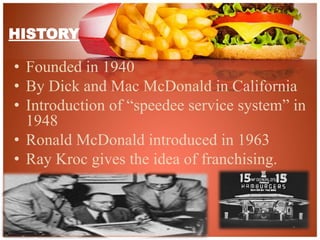
HISTORY
• Founded in 1940
• By Dick and Mac McDonald in California
• Introduction of “speedee service system” in
1948
• Ronald McDonald introduced in 1963
• Ray Kroc gives the idea of franchising.
COMPANY’S OBJECTIVE
• Achieving sustainable ,profitable growth
• Designed to increase restaurant visits and grow
brand loyalty among new & existing customers
• McDonalds is committed to maintaining and
developing the best food products in the quick
service restaurant market.
• Complete commitment to quality, service,
cleanliness and value
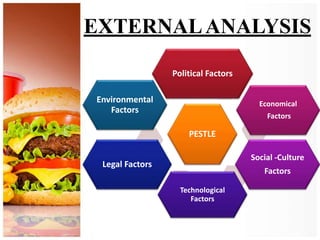
EXTERNALANALYSIS
PESTLE
Political Factors
Economical
Factors
Social -Culture
Factors
Technological
Factors
Legal Factors
Environmental
Factors
Political
factors
Religious
Laws
Tax
Obligations
Employment
Laws
Economic
factors
Inflation
Changes in
Exchange Rates
Socio-
culture
factors
Cultural
Norms
Population
Changes
Education
Levels
Consumer
Individuality
Technological
factorsAdverti
sements
Inventory
Manage
ment
Supply
Chain
Management
Daily
Operations
Legal
factors
Religious
Laws
Tax
Obligations
Labor and
employment
laws
Quality
Certification
Environmental
Factors
Green House
Effect
Slaughter of
Animals
Use of
Polystyrene
in past
Excessive
Plantation
Extinction of
Animals
Abuse of
Environment
Styrofoam
5 FORCES
FRAMEWORK
 COMPETITIVE RIVALRY: There is intense rivalry in fast food.
Although, McDonald’s, with more than 32,000 local restaurants
serving more than 60 million people in 117 countries .
 THREAT OF NEW ENTRANTS: The threat is high as there are no
legal barriers to enter. However, its difficult to enter the market
because new entrants are faced with price competition from
existing chain restaurants
 SUPPLIER BARGAINNING POWER: It is high because McDonald’s
restaurants use the same products from the same suppliers and it
doesn’t matter if you are in Rochester, MN or Beijing, China you
can get the same Big Mac everywhere.
 BUYER BARGAINNING POWER: Bargaining power of customers of
McDonald’s is low because of low customer switching costs which
are nearly zero. quality of the product or service in the fast food
industry is very important as customers have full information of
the products they buy and consume.
 THREAT OF SUBSTITUES: As there is intense competition between
rival sellers in the fast food industry, the competition between
firms selling substitute products is intense as well.
COMPETITIVE
ANALYSIS
INTERNALANALYSIS
Resources
• Tangible
• Physical - Restaurant Location
• Technological– Touch Based Screens
• Financial - CIMB and May Bank and its own sales
• Organizational Structure
• Intangible
• Human
• Innovation
• Reputation
Capabilities
• Systemization
Competencies
• Product Variety
• Unique flavors and taste
• Core Competency
• Customer oriented policy
STRATEGIES ADOPTED BY
MCDONALD
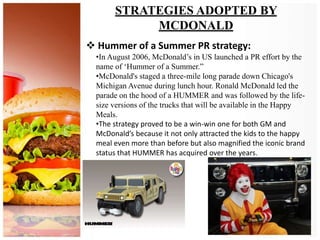
 Hummer of a Summer PR strategy:
•In August 2006, McDonald’s in US launched a PR effort by the
name of ‘Hummer of a Summer.”
•McDonald's staged a three-mile long parade down Chicago's
Michigan Avenue during lunch hour. Ronald McDonald led the
parade on the hood of a HUMMER and was followed by the life-
size versions of the trucks that will be available in the Happy
Meals.
•The strategy proved to be a win-win one for both GM and
McDonald’s because it not only attracted the kids to the happy
meal even more than before but also magnified the iconic brand
status that HUMMER has acquired over the years.
STRATEGIES ADOPTED BY
MCDONALD
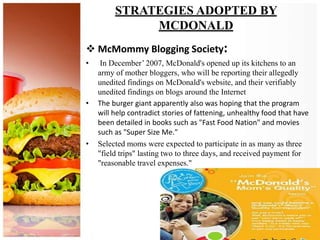
 McMommy Blogging Society:
• In December’ 2007, McDonald's opened up its kitchens to an
army of mother bloggers, who will be reporting their allegedly
unedited findings on McDonald's website, and their verifiably
unedited findings on blogs around the Internet
• The burger giant apparently also was hoping that the program
will help contradict stories of fattening, unhealthy food that have
been detailed in books such as "Fast Food Nation" and movies
such as "Super Size Me."
• Selected moms were expected to participate in as many as three
"field trips" lasting two to three days, and received payment for
"reasonable travel expenses."
STRATEGIES ADOPTED BY
MCDONALD
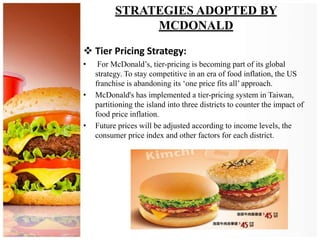
 Tier Pricing Strategy:
• For McDonald’s, tier-pricing is becoming part of its global
strategy. To stay competitive in an era of food inflation, the US
franchise is abandoning its ‘one price fits all’ approach.
• McDonald's has implemented a tier-pricing system in Taiwan,
partitioning the island into three districts to counter the impact of
food price inflation.
• Future prices will be adjusted according to income levels, the
consumer price index and other factors for each district.
STRATEGIES ADOPTED BY
MCDONALD
 Global Best of Green:
• McDonald’s has also been trying to show consumers
its “greener” side with a new institutional marketing
effort, “Global Best of Green.” McDonald’s around
the world has taken a number of initiatives around the
world as a part of this marketing effort which include
the following.
• About 80 percent of packaging used by McDonald’s
Europe comes from renewable resources.
• In Canada, switching from bleached white napkins to
plain brown has saved $1.3 million annually, while
reducing energy, wood and water use.
• U.S. restaurant locations recycle about 13,000 pounds
of used cooking oil per year, on average.
• Using a fryer that requires less oil allows restaurants to
cook the same product with 40 percent less oil, saving
4 percent in energy over other fryer models.
STRATEGIES ADOPTED BY
MCDONALD
Increasing sales at existing restaurants by
Remodelling:
•McDonald's, whose restaurants are visited by more than 40
million people every day, has moved aggressively over the past
three years to revamp its menu and attract a new breed of
customer.
•The traditional McDonald's yellow and red colors will remain,
but the red will be muted to terra cotta and olive and sage green
will be added to the mix.
•To warm up their look, the restaurants will have less plastic and
more brick and wood, with modern hanging lights to produce a
softer glow.
•The dining area will be separated into three sections with
distinct personalities.
•The "linger" zone will offer comfortable armchairs, sofas, and
Wi-Fi connections.
•The focus is on young adults who want to socialize, hang out,
and linger.
• BYE BYE SEE U AT McDonald’S

Mc donald

  • 1.
  • 2.
    HISTORY • Founded in1940 • By Dick and Mac McDonald in California • Introduction of “speedee service system” in 1948 • Ronald McDonald introduced in 1963 • Ray Kroc gives the idea of franchising.
  • 3.
    COMPANY’S OBJECTIVE • Achievingsustainable ,profitable growth • Designed to increase restaurant visits and grow brand loyalty among new & existing customers • McDonalds is committed to maintaining and developing the best food products in the quick service restaurant market. • Complete commitment to quality, service, cleanliness and value
  • 4.
  • 5.
  • 6.
  • 7.
  • 8.
  • 9.
  • 10.
    Environmental Factors Green House Effect Slaughter of Animals Useof Polystyrene in past Excessive Plantation Extinction of Animals Abuse of Environment Styrofoam
  • 11.
    5 FORCES FRAMEWORK  COMPETITIVERIVALRY: There is intense rivalry in fast food. Although, McDonald’s, with more than 32,000 local restaurants serving more than 60 million people in 117 countries .  THREAT OF NEW ENTRANTS: The threat is high as there are no legal barriers to enter. However, its difficult to enter the market because new entrants are faced with price competition from existing chain restaurants
  • 12.
     SUPPLIER BARGAINNINGPOWER: It is high because McDonald’s restaurants use the same products from the same suppliers and it doesn’t matter if you are in Rochester, MN or Beijing, China you can get the same Big Mac everywhere.  BUYER BARGAINNING POWER: Bargaining power of customers of McDonald’s is low because of low customer switching costs which are nearly zero. quality of the product or service in the fast food industry is very important as customers have full information of the products they buy and consume.  THREAT OF SUBSTITUES: As there is intense competition between rival sellers in the fast food industry, the competition between firms selling substitute products is intense as well.
  • 13.
  • 14.
    INTERNALANALYSIS Resources • Tangible • Physical- Restaurant Location • Technological– Touch Based Screens • Financial - CIMB and May Bank and its own sales • Organizational Structure • Intangible • Human • Innovation • Reputation Capabilities • Systemization Competencies • Product Variety • Unique flavors and taste • Core Competency • Customer oriented policy
  • 15.
    STRATEGIES ADOPTED BY MCDONALD Hummer of a Summer PR strategy: •In August 2006, McDonald’s in US launched a PR effort by the name of ‘Hummer of a Summer.” •McDonald's staged a three-mile long parade down Chicago's Michigan Avenue during lunch hour. Ronald McDonald led the parade on the hood of a HUMMER and was followed by the life- size versions of the trucks that will be available in the Happy Meals. •The strategy proved to be a win-win one for both GM and McDonald’s because it not only attracted the kids to the happy meal even more than before but also magnified the iconic brand status that HUMMER has acquired over the years.
  • 16.
    STRATEGIES ADOPTED BY MCDONALD McMommy Blogging Society: • In December’ 2007, McDonald's opened up its kitchens to an army of mother bloggers, who will be reporting their allegedly unedited findings on McDonald's website, and their verifiably unedited findings on blogs around the Internet • The burger giant apparently also was hoping that the program will help contradict stories of fattening, unhealthy food that have been detailed in books such as "Fast Food Nation" and movies such as "Super Size Me." • Selected moms were expected to participate in as many as three "field trips" lasting two to three days, and received payment for "reasonable travel expenses."
  • 17.
    STRATEGIES ADOPTED BY MCDONALD Tier Pricing Strategy: • For McDonald’s, tier-pricing is becoming part of its global strategy. To stay competitive in an era of food inflation, the US franchise is abandoning its ‘one price fits all’ approach. • McDonald's has implemented a tier-pricing system in Taiwan, partitioning the island into three districts to counter the impact of food price inflation. • Future prices will be adjusted according to income levels, the consumer price index and other factors for each district.
  • 18.
    STRATEGIES ADOPTED BY MCDONALD Global Best of Green: • McDonald’s has also been trying to show consumers its “greener” side with a new institutional marketing effort, “Global Best of Green.” McDonald’s around the world has taken a number of initiatives around the world as a part of this marketing effort which include the following. • About 80 percent of packaging used by McDonald’s Europe comes from renewable resources. • In Canada, switching from bleached white napkins to plain brown has saved $1.3 million annually, while reducing energy, wood and water use. • U.S. restaurant locations recycle about 13,000 pounds of used cooking oil per year, on average. • Using a fryer that requires less oil allows restaurants to cook the same product with 40 percent less oil, saving 4 percent in energy over other fryer models.
  • 19.
    STRATEGIES ADOPTED BY MCDONALD Increasingsales at existing restaurants by Remodelling: •McDonald's, whose restaurants are visited by more than 40 million people every day, has moved aggressively over the past three years to revamp its menu and attract a new breed of customer. •The traditional McDonald's yellow and red colors will remain, but the red will be muted to terra cotta and olive and sage green will be added to the mix. •To warm up their look, the restaurants will have less plastic and more brick and wood, with modern hanging lights to produce a softer glow. •The dining area will be separated into three sections with distinct personalities. •The "linger" zone will offer comfortable armchairs, sofas, and Wi-Fi connections. •The focus is on young adults who want to socialize, hang out, and linger.
  • 20.
    • BYE BYESEE U AT McDonald’S

Editor's Notes

  • #6 Political factors There is an impending legal dispute in the McDonald’s franchise in India where certain infringement of rights and violation of religious laws pertaining to the contents of the food. The existence of meat in their menus in India is apparently offensive to the Hindu religion in the said market. . There are also other studies that points to the infringement of McDonald’s Stores with reference to the existing employment laws in the target market. Like any business venture, these McDonald’s stores have to contend with the issues of employment procedures as well as their tax obligations so as to succeed in the foreign market.
  • #7 Branches and franchises of McDonald’s have the tendency to experience hardship in instances where the economy of the respective countries are hit by inflation and changes in the exchange rates, India is not an exception to it. Hence, these chains may have to put up with the issues of the effects of the economic environment. Particularly, their problem depends on the response of the consumers on these fundamentals and how it could influence their general sales. In regarding the operations of the company, McDonald’s tend to import much of their raw materials into a specific country’s territories if there is a dearth of supply. Exchange rate fluctuations will also play a significant role in the operations of the company. However in case of India the company has been able to maintain a constant level of prices for their products
  • #8 Cultural: McDonald's international restaurants satisfy local tastes and customs by offering unique products, services and other items to the menu. Customers in Norway can order McLaks – a fresh grilled salmon sandwich with dill sauce on a whole-grain bun. McDonald's fans in the Netherlands can have vegetable burger and in Italy and Greece customers can help themselves at a fresh salad bar.  Population Changes: Changes in population demographics have many potential consequences for organizations. As the total population changes, the demand for products and services also changes. When McDonald's opens restaurants in a new country, the jobs it creates stimulate the national economy and broaden the local tax base. Besides the new jobs directly linked with McDonald's restaurants, the company indirectly supports other segments of a country’s workforce by hiring local construction firms and purchasing from local suppliers, local farmers and local distributors. Educational Levels: All the staff and employees at McDonald's are given a handsome salary package and attractive incentives in accordance with the level at which the person is working. That’s why employees at McDonald’s in other countries are satisfied and motivated. Higher educational levels allow people to earn higher incomes than would have been possible otherwise.  The company uses concept of consumer individuality of a product of behaviour and decisions on purchase to its advantage. It is said, to have the main influence on understanding of prospective result of the organization in the particular market.
  • #9 The Company’s key tool for marketing is by means of television advertisements. Elements like the inventory system and the management of the value chain of the company allows for easy payments for theirs. The integration of technology in the operations of McDonalds tends to add value to their products. The improvement of the inventory system as well as its supply chain allows the company to operate in an international context 
  • #10 Religious-Halal certification
  • #11 The social responsibilities of McDonald’s on the country are influential to the operations of the company.  These involve accusations of environmental damage. Several civic groups in India have made actions to make the McDonald’s franchises in India aware of the rather abundant use of Styrofoam containers and the resultant abuse of the environment. As one of world largest consumer of beef, potatoes and chicken, McDonalds always had been critics for world environmentalist. This is because high consumption of beef causing the green house effect by methane gasses coming from the cow’s ranch. Large scale plantation has effect the environment and lost of green forest opening for plantation activities. Vegetarian environmentalist criticizes the fast-food giant for cruelty to animals and slaughtering. In Japan, once McDonalds want to introduce whale burger causing uproar because whales are endangered species. Before using paper packaging, once McDonalds also had been criticized for being insensitive to pollution because using polystyrene based packaging for its foods. Imagine millions of people purchase from fast food operator and how is the impact to world environment by throwing away those hard to recycle packaging. Our world is getting concern on environment issue and business operating here should not just care for profit, but careful usage of world resources for sustainable development and care for environment safety and health for our future generation. Critics and concern from all public or activist should be review and support if necessary to ensure we play our social responsibility better.
  • #14 . Another important feature of the Pizza Hut’s strategies are the 3 Fs (Fun, Friendly and Familiar). As compared to McDonald’s, its restaurants had virtually no lunch time sales, and neither did any of it’s pizza competitors. The reason, of course, is that it takes 20 minutes to cook a pizza from scratch in a traditional pizza oven, Pizza Hut is often referred to as ‘Pizza Innovation Leader’ because it is constantly coming up with new varieties of pizzas to appeal the different audiences and at the same time KFC has the strategic objectives of expansion along with profits and sales growth. Another weakness of KFC is that of the lack of a corporate direction because it has been a part of four different parent companies till now namely, Heublein Inc., R.J Reynolds, Pepsi Co. and Yumm! Brands Inc. The advertising campaign of KFC does not specifically appeal to any segment. very strong financial background is one of KFC’s competitive advantages. the concept of ‘healthy fast food’. Sandwiches of Subway have been included in diet plans by experts. many of the franchises are becoming a victim of internal competition or cannibalization One of the greatest competitive advantage that Subway was born with is it's healthy Menu.
  • #15 Human-rest workers, corporate staff, franchise owners Innovation- healthy mc griddles breakfast s/w, mc aloo tikki in india, mc café INNOVATION:, they remove the trans-fatty acids in the oil that is used to make french fries and salt content of its products that without changing the taste of their food. , a touch- activated screen is provided in drive-through area, permitting customers to punch in orders without queuing. Reputation McDonald’s is famous for selling hamburgers and cheeseburgers under the traditional symbol of a golden arch. REPUTATION: The website of the company is a channel for consumers to give feedbacks or comments on their services and delivery systems and this is the fastest way to receive feedbacks from consumers. Moreover, they need to put emphasize on the hygiene and safety of food to bring the best quality to customers and enhance their images.
  • #16 This was a collaborative effort of General Motors and McDonald’s and focused on HUMMER- One of General Motors’ key divisions.
  • #17 This was a collaborative effort of General Motors and McDonald’s and focused on HUMMER- One of General Motors’ key divisions.
  • #18 This was a collaborative effort of General Motors and McDonald’s and focused on HUMMER- One of General Motors’ key divisions.
  • #19 This was a collaborative effort of General Motors and McDonald’s and focused on HUMMER- One of General Motors’ key divisions.
  • #20 This was a collaborative effort of General Motors and McDonald’s and focused on HUMMER- One of General Motors’ key divisions.