Then and Now: A Look at the Shift from Traditional to Online PR1
What is Public Relations?Managing communication between an organization and its publicsPromoting goodwill between itself and its audiences/publicsProviding exposure to relevant audiences using topics of public interest and news items that provide a third-party endorsementAreas of focus include:EmployeeCustomerInvestorCommunityMediaLaborAnalystCrisis GovernmentInternal2
3
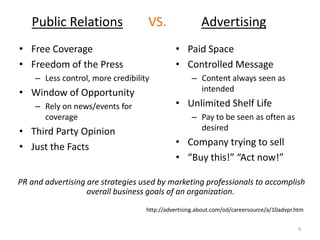
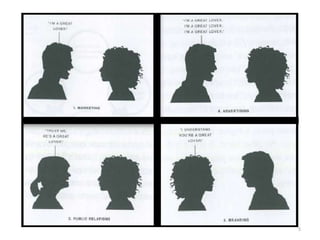
AdvertisingVS.Public RelationsFree Coverage	Freedom of the PressLess control, more credibilityWindow of OpportunityRely on news/events for coverage	Third Party OpinionJust the FactsPaid SpaceControlled MessageContent always seen as intendedUnlimited Shelf LifePay to be seen as often as desiredCompany trying to sell“Buy this!” “Act now!” PR and advertising are strategies used by marketing professionals to accomplish overall business goals of an organization.    http://advertising.about.com/od/careersource/a/10advpr.htm4
5
Then and Now: Traditional PR  Online PRThe 5 W’s (+ an “H”) of the message:When Why How (long)WhoWhatWhere 6
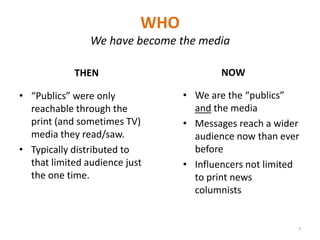
WHOWe have become the mediaNOWTHENWe are the “publics” and the mediaMessages reach a wider audience now than ever beforeInfluencers not limited to print news columnists“Publics” were only reachable through the print (and sometimes TV) media they read/saw.Typically distributed to that limited audience just the one time. 7
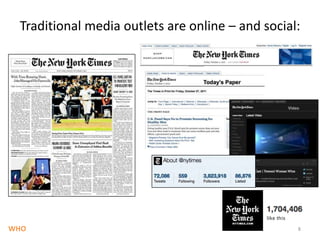
Traditional media outlets are online – and social:8WHO
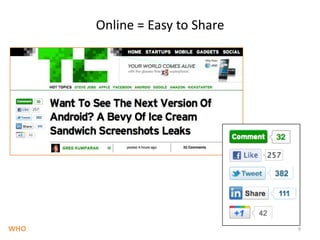
Online = Easy to Share9WHO
10WHO
11WHO
12WHO
13WHO
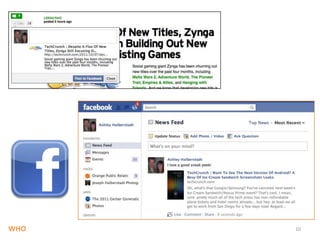
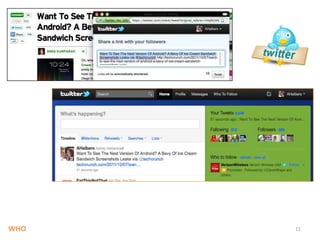
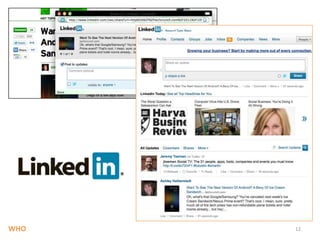
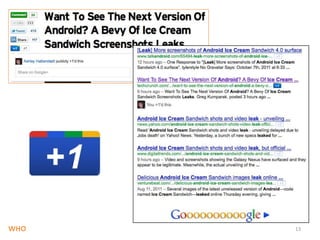
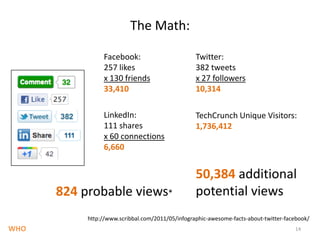
The Math:Twitter:382 tweetsx 27 followers10,314Facebook:257 likesx 130 friends33,410LinkedIn:111 sharesx 60 connections6,660TechCrunch Unique Visitors:1,736,41250,384 additional potential views824 probable views*http://www.scribbal.com/2011/05/infographic-awesome-facts-about-twitter-facebook/14WHO
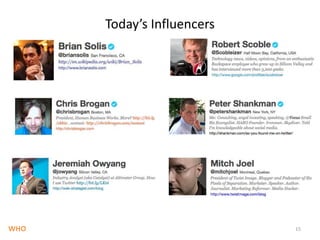
Today’s Influencers15WHO
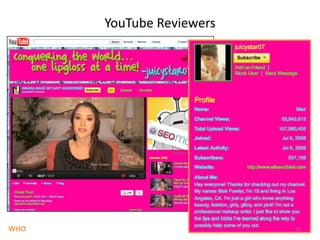
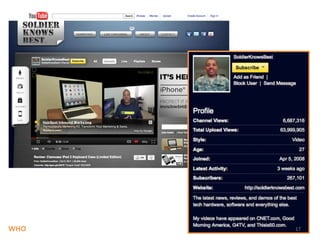
YouTube Reviewers16WHO
17WHO
WHATThemessage – make sure you can be foundNOWTHENKeywords. SEO requires us to be aware of exactly what words we useNeed to monitor- and participate - in conversations about your brandWell-crafted, clear, targeted messaging has always been the focus18
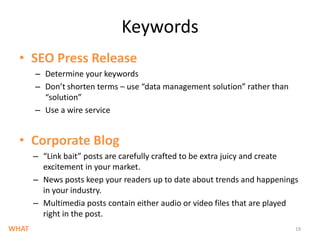
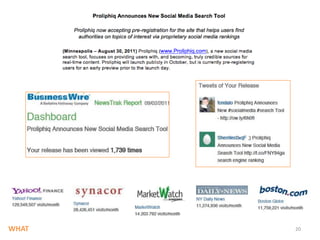
KeywordsSEO Press ReleaseDetermine your keywords Don’t shorten terms – use “data management solution” rather than “solution”Use a wire serviceCorporate Blog“Link bait” posts are carefully crafted to be extra juicy and create excitement in your market. News posts keep your readers up to date about trends and happenings in your industry.  Multimedia posts contain either audio or video files that are played right in the post. 19WHAT
20WHAT
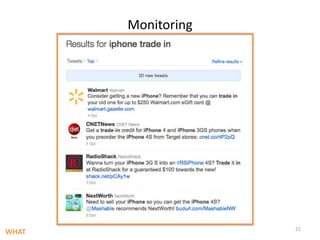
Monitoring21WHAT
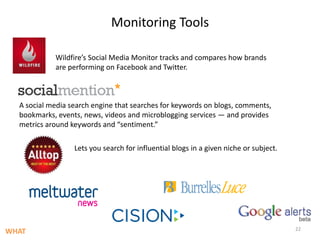
Monitoring ToolsWildfire’s Social Media Monitor tracks and compares how brands are performing on Facebook and Twitter.A social media search engine that searches for keywords on blogs, comments, bookmarks, events, news, videos and microblogging services — and provides metrics around keywords and “sentiment.”Lets you search for influential blogs in a given niche or subject.22WHAT
WHEREGlobal message distributionNOWTHENThe distribution of the message was limited to where the newspapers were circulated and where TV shows airedImmediate global distribution of messaging is possible23
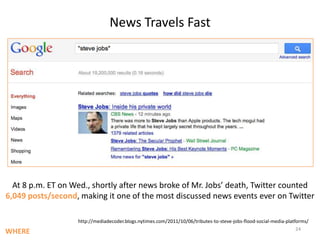
News Travels FastAt 8 p.m. ET on Wed., shortly after news broke of Mr. Jobs’ death, Twitter counted 6,049 posts/second, making it one of the most discussed news events ever on Twitterhttp://mediadecoder.blogs.nytimes.com/2011/10/06/tributes-to-steve-jobs-flood-social-media-platforms/24WHERE
25WHERE
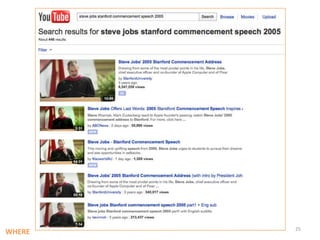
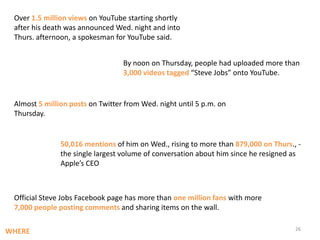
Over 1.5 million views on YouTube starting shortly after his death was announced Wed. night and into Thurs. afternoon, a spokesman for YouTube said. By noon on Thursday, people had uploaded more than 3,000 videos tagged “Steve Jobs” onto YouTube.Almost 5 million posts on Twitter from Wed. night until 5 p.m. on Thursday. 50,016 mentions of him on Wed., rising to more than 879,000 on Thurs., - the single largest volume of conversation about him since he resigned as Apple’s CEOOfficial Steve Jobs Facebook page has more than one million fans with more 7,000 people posting comments and sharing items on the wall.26WHERE
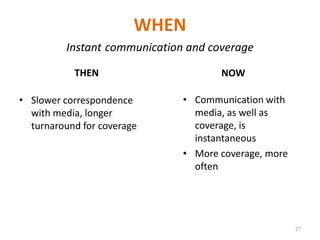
WHENInstantcommunication and coverageNOWTHENCommunication with media, as well as coverage, is instantaneousMore coverage, more oftenSlower correspondence with media, longer turnaround for coverage27
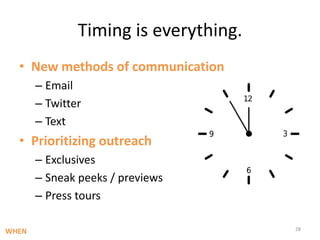
Timing is everything. New methods of communicationEmailTwitterTextPrioritizing outreachExclusivesSneak peeks / previewsPress tours28WHEN
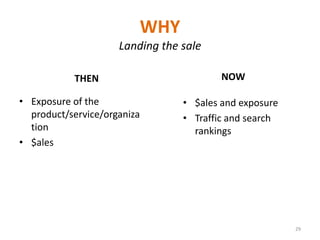
WHYLanding the saleNOWTHENExposure of the product/service/organization$ales$ales and exposure  Traffic and search rankings29
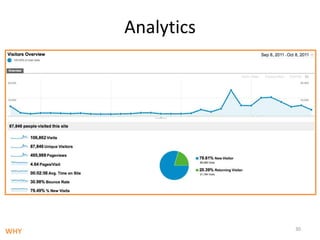
Analytics30WHY
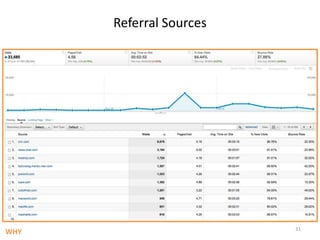
Referral Sources31WHY
HOW (long)Messages live foreverNOWTHENRead newspaper, throw it awayContent – both good and bad – lives forever online 32
SummaryWho: Us. People are sharing content via social media so messages have wider distributionWhat: The message. Keywords need to be incorporated to make messages visibleWhere:Everywhere. Messages are being distributed globallyWhen:Instantly. Communication with editors is faster, enabling more coverage more oftenWhy:Money. And Web traffic, which leads to moneyHow (long):Forever. With good SEO, content can be easily found on the Web for many years33

MBO 2011: Transition to Online PR

  • 1.
    Then and Now:A Look at the Shift from Traditional to Online PR1
  • 2.
    What is PublicRelations?Managing communication between an organization and its publicsPromoting goodwill between itself and its audiences/publicsProviding exposure to relevant audiences using topics of public interest and news items that provide a third-party endorsementAreas of focus include:EmployeeCustomerInvestorCommunityMediaLaborAnalystCrisis GovernmentInternal2
  • 3.
  • 4.
    AdvertisingVS.Public RelationsFree Coverage Freedomof the PressLess control, more credibilityWindow of OpportunityRely on news/events for coverage Third Party OpinionJust the FactsPaid SpaceControlled MessageContent always seen as intendedUnlimited Shelf LifePay to be seen as often as desiredCompany trying to sell“Buy this!” “Act now!” PR and advertising are strategies used by marketing professionals to accomplish overall business goals of an organization. http://advertising.about.com/od/careersource/a/10advpr.htm4
  • 5.
  • 6.
    Then and Now:Traditional PR  Online PRThe 5 W’s (+ an “H”) of the message:When Why How (long)WhoWhatWhere 6
  • 7.
    WHOWe have becomethe mediaNOWTHENWe are the “publics” and the mediaMessages reach a wider audience now than ever beforeInfluencers not limited to print news columnists“Publics” were only reachable through the print (and sometimes TV) media they read/saw.Typically distributed to that limited audience just the one time. 7
  • 8.
    Traditional media outletsare online – and social:8WHO
  • 9.
    Online = Easyto Share9WHO
  • 10.
  • 11.
  • 12.
  • 13.
  • 14.
    The Math:Twitter:382 tweetsx27 followers10,314Facebook:257 likesx 130 friends33,410LinkedIn:111 sharesx 60 connections6,660TechCrunch Unique Visitors:1,736,41250,384 additional potential views824 probable views*http://www.scribbal.com/2011/05/infographic-awesome-facts-about-twitter-facebook/14WHO
  • 15.
  • 16.
  • 17.
  • 18.
    WHATThemessage – makesure you can be foundNOWTHENKeywords. SEO requires us to be aware of exactly what words we useNeed to monitor- and participate - in conversations about your brandWell-crafted, clear, targeted messaging has always been the focus18
  • 19.
    KeywordsSEO Press ReleaseDetermineyour keywords Don’t shorten terms – use “data management solution” rather than “solution”Use a wire serviceCorporate Blog“Link bait” posts are carefully crafted to be extra juicy and create excitement in your market. News posts keep your readers up to date about trends and happenings in your industry.  Multimedia posts contain either audio or video files that are played right in the post. 19WHAT
  • 20.
  • 21.
  • 22.
    Monitoring ToolsWildfire’s SocialMedia Monitor tracks and compares how brands are performing on Facebook and Twitter.A social media search engine that searches for keywords on blogs, comments, bookmarks, events, news, videos and microblogging services — and provides metrics around keywords and “sentiment.”Lets you search for influential blogs in a given niche or subject.22WHAT
  • 23.
    WHEREGlobal message distributionNOWTHENThedistribution of the message was limited to where the newspapers were circulated and where TV shows airedImmediate global distribution of messaging is possible23
  • 24.
    News Travels FastAt8 p.m. ET on Wed., shortly after news broke of Mr. Jobs’ death, Twitter counted 6,049 posts/second, making it one of the most discussed news events ever on Twitterhttp://mediadecoder.blogs.nytimes.com/2011/10/06/tributes-to-steve-jobs-flood-social-media-platforms/24WHERE
  • 25.
  • 26.
    Over 1.5 millionviews on YouTube starting shortly after his death was announced Wed. night and into Thurs. afternoon, a spokesman for YouTube said. By noon on Thursday, people had uploaded more than 3,000 videos tagged “Steve Jobs” onto YouTube.Almost 5 million posts on Twitter from Wed. night until 5 p.m. on Thursday. 50,016 mentions of him on Wed., rising to more than 879,000 on Thurs., - the single largest volume of conversation about him since he resigned as Apple’s CEOOfficial Steve Jobs Facebook page has more than one million fans with more 7,000 people posting comments and sharing items on the wall.26WHERE
  • 27.
    WHENInstantcommunication and coverageNOWTHENCommunicationwith media, as well as coverage, is instantaneousMore coverage, more oftenSlower correspondence with media, longer turnaround for coverage27
  • 28.
    Timing is everything.New methods of communicationEmailTwitterTextPrioritizing outreachExclusivesSneak peeks / previewsPress tours28WHEN
  • 29.
    WHYLanding the saleNOWTHENExposureof the product/service/organization$ales$ales and exposure Traffic and search rankings29
  • 30.
  • 31.
  • 32.
    HOW (long)Messages liveforeverNOWTHENRead newspaper, throw it awayContent – both good and bad – lives forever online 32
  • 33.
    SummaryWho: Us. Peopleare sharing content via social media so messages have wider distributionWhat: The message. Keywords need to be incorporated to make messages visibleWhere:Everywhere. Messages are being distributed globallyWhen:Instantly. Communication with editors is faster, enabling more coverage more oftenWhy:Money. And Web traffic, which leads to moneyHow (long):Forever. With good SEO, content can be easily found on the Web for many years33