TOPIC
LEGAL PROTECTION OF MICRO-FINANCE
CLIENTS IN CASE OF BANKRUPTCY
(Case of Depositors)
BY
MUKAKALISA FAITH
Supervisor: Dr. Jean S. Verhadt.
AGENDA
1. Chapters Layout
2. Introduction & background
3. Short description of the problem
4. Research Objectives
5. Motives of the study
6. Research Questions
7. Research Methodology
8. Limitations
9. Most important findings of the study.
10. Conclusions and Recommendations
AGENDA
 Chapter 1: Introduction and Background
 Chapter 2: Literature review
 Chapter 3: Research Design and
methodology
 Chapter 4: Data analysis and findings
1. CHAPTERS LAYOUT
2. INTRODUCTION & BACKGROUND
 Term micro-finance (MF) refers to provision of
financial services to lower income earners
Besides, its known to be a powerful tool in
poverty alleviation.
 However, without supportive legal framework
it can never be sustainable.
Evolution:
 MF activities arose worldwide in 1980s as a
response to help the poor to save and to
access loans.
 In Rwanda MF began in a formal way with the
foundation of UBPR in 1975.
3. SHORT DESCRIPTION OF THE PROBLEM
STATEMENT
 Rwanda has pop. of 9million people & 1/3 suffer
from extreme poverty
 Immediately after the war and genocide of 1994,
the country experienced uncontrolled rapid growth
of MFIs, with significant influx of donor funds,
just to help the community that was in turmoil.
 However, in 2005-2006, sector experienced
financial crisis with NPL of 45%, and this
resulted into closure of 8 MFIs & deposits loss
was 3.2 billion frw ($ 5.9 million)
Therefore, its due to this gap that the
researcher had to carry on such kind of
research through:
 Examining and analyzing existing MF legal
and regulatory framework, then find out their
efficiency & effectiveness in protection of MFIs’
depositors in case of bankruptcy in particular
and MFIs in general, so that the resarher can
avail conclusions and recommendations for
their future profitability and sustainability.
3. SHORT DESCRIPTION OF THE PROBLEM
STATEMENT (con’t)
4. RESARCH OBJECTIVES
 General/Overall Objective:
To gain better understanding of legal and
regulatory framework in Micro-finance
sector in Rwanda in regard to
protection of MF depositors, and
propose possible measures and
recommendations to be fostered for
competitive MFIs that motivates its
clients as well as its practitioners.
5. MOTIVES OF THE STUDY
 This research book will be an additional
documentation to already existing literature
 The findings & Recommendations provided here
will be helpful to researchers & MF partners for
future research projects
 To apply knowledge and theory learnt in
practical situation
 It is in partial fulfillment of the requirement of the
award of the Master’s Degree in Business
Administration.
6. RESEARCH QUESTIONS
Some of the research questions included:
 How do majority of Rwandans save their
household incomes?
 What could be the reasons for non-repayment of
the loans?
 How are MF depositors legally protected?
 What were the major factors that influenced
bankruptcy situations in MFIs in Rwanda?
 What could be the measures to bankruptcy
situations?
7. RESEARCH METHODOLOGY
I. Data Collection Instruments:
 Primary source: (Questionnaire,
discussions)
 Secondary source: (T. books, electronic
information
 Own observation and personal
judgment
II. Data analysis and interpretation:
 Findings were organized and presented
in form of tables, figures and texts for
ease of interpretation and
understanding.
8. LIMITATIONS
 Some of the respondents were suspicious
about the study, regarded some
information as confidential
 Limited time to carry out research on a
bigger area
 Non-availability of some respondents when
required
Therefore, the sighted constraints and
limitations are some of the problems
which might have caused gaps in this
research paper
I. Rwandan financial sector Analysis
by June 2007:
 Comprises of 7 commercial Banks,
including 1 MF bank (UBPR)
 There are 233 MFIs and only 35% were
legally regestered at the time of MFI
financial crisis
 Commercial Banks finance the
economy by 76% of total financing, but
provide financial services to only 6% of
the population
9. MOST IMPORTANT FINDINGS OF THE
STUDY
 Commercial banks deposits stood at 198
billion frw ($ 350 million),
 while MFIs accounted for 102 billionfrw
($ 188 million) worthy of deposits and
Loan worthy of 77.2 billion
 The year 2005-2006 characterized by
MFIs financial crisis. NPL stood at 45%
and, 8 MFIs closed down, depositors lost
savings equivalent to 3.2billon frw
9. MOST IMPORTANT FINDINGS OF THE
STUDY (con’t)
II. Legal Analysis:
Existing Legal framework consists of 3
documents:
1. Law no 08/99 governing banks & other
financial institutions
2. Instruction no 06/2002 of the BNR on MFIs
3. Instruction no 05/2003 governing SACCOs
Others in place:
 Periodic circulars and guidelines
 National Micro-finance policy
 Two draft laws (banks, MFIs laws)
9. MOST IMPORTANT FINDINGS OF THE
STUDY (con’t)
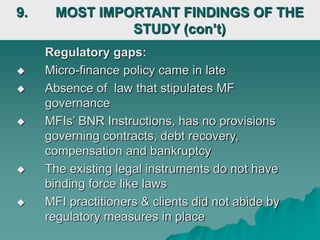
Regulatory gaps:
 Micro-finance policy came in late
 Absence of law that stipulates MF
governance
 MFIs’ BNR Instructions, has no provisions
governing contracts, debt recovery,
compensation and bankruptcy
 The existing legal instruments do not have
binding force like laws
 MFI practitioners & clients did not abide by
regulatory measures in place
9. MOST IMPORTANT FINDINGS OF THE
STUDY (con’t)
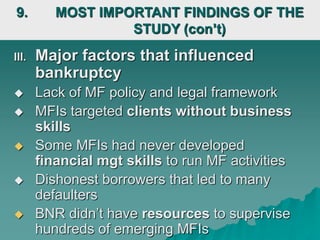
III. Major factors that influenced
bankruptcy
 Lack of MF policy and legal framework
 MFIs targeted clients without business
skills
 Some MFIs had never developed
financial mgt skills to run MF activities
 Dishonest borrowers that led to many
defaulters
 BNR didn’t have resources to supervise
hundreds of emerging MFIs
9. MOST IMPORTANT FINDINGS OF THE
STUDY (con’t)
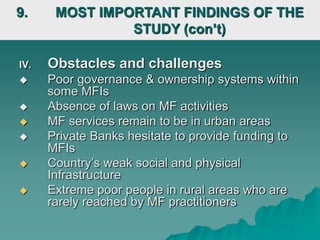
IV. Obstacles and challenges
 Poor governance & ownership systems within
some MFIs
 Absence of laws on MF activities
 MF services remain to be in urban areas
 Private Banks hesitate to provide funding to
MFIs
 Country’s weak social and physical
Infrastructure
 Extreme poor people in rural areas who are
rarely reached by MF practitioners
9. MOST IMPORTANT FINDINGS OF THE
STUDY (con’t)
10. CONCLUSIONS & RECOMMENDATIONS
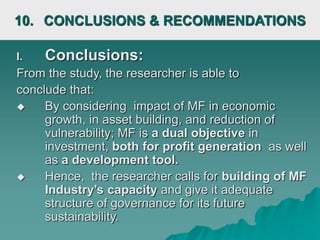
I. Conclusions:
From the study, the researcher is able to
conclude that:
 By considering impact of MF in economic
growth, in asset building, and reduction of
vulnerability; MF is a dual objective in
investment, both for profit generation as well
as a development tool.
 Hence, the researcher calls for building of MF
Industry’s capacity and give it adequate
structure of governance for its future
sustainability.
II. Recommendations:
 Government should set up binding laws
(prudential & non-prudential)
 Government should establish a system of
granting Subsides to certain MFIs
 Government to create MF Guarantee Fund
 Government to establish Deposit Insurance
plans
 Domestic saving should be encouraged
10. CONCLUSIONS & RECOMMENDATIONS
(con’t)
 BNR should strengthen off-sight and on-sight
surveillance
 MFI practitioners should observe ethical
standards
 Donors are called upon to support MF’s policy
reform
 Local gov’t and MFIs mgt should develop good
working relationship
Future Research:
1. Impact of legal and regulatory framework on
MF
2. Micro-finance and social protection
10. CONCLUSIONS & RECOMMENDATIONS
(con’t)
THANK YOU FOR YOUR ATTENTION
MAY GOD BLESS YOU
AND
HAPPY NEW YEAR 2008 !!!!

mba-thesis-presentation.ppt

  • 1.
    TOPIC LEGAL PROTECTION OFMICRO-FINANCE CLIENTS IN CASE OF BANKRUPTCY (Case of Depositors) BY MUKAKALISA FAITH Supervisor: Dr. Jean S. Verhadt.
  • 2.
    AGENDA 1. Chapters Layout 2.Introduction & background 3. Short description of the problem 4. Research Objectives 5. Motives of the study 6. Research Questions 7. Research Methodology 8. Limitations 9. Most important findings of the study. 10. Conclusions and Recommendations AGENDA
  • 3.
     Chapter 1:Introduction and Background  Chapter 2: Literature review  Chapter 3: Research Design and methodology  Chapter 4: Data analysis and findings 1. CHAPTERS LAYOUT
  • 4.
    2. INTRODUCTION &BACKGROUND  Term micro-finance (MF) refers to provision of financial services to lower income earners Besides, its known to be a powerful tool in poverty alleviation.  However, without supportive legal framework it can never be sustainable. Evolution:  MF activities arose worldwide in 1980s as a response to help the poor to save and to access loans.  In Rwanda MF began in a formal way with the foundation of UBPR in 1975.
  • 5.
    3. SHORT DESCRIPTIONOF THE PROBLEM STATEMENT  Rwanda has pop. of 9million people & 1/3 suffer from extreme poverty  Immediately after the war and genocide of 1994, the country experienced uncontrolled rapid growth of MFIs, with significant influx of donor funds, just to help the community that was in turmoil.  However, in 2005-2006, sector experienced financial crisis with NPL of 45%, and this resulted into closure of 8 MFIs & deposits loss was 3.2 billion frw ($ 5.9 million)
  • 6.
    Therefore, its dueto this gap that the researcher had to carry on such kind of research through:  Examining and analyzing existing MF legal and regulatory framework, then find out their efficiency & effectiveness in protection of MFIs’ depositors in case of bankruptcy in particular and MFIs in general, so that the resarher can avail conclusions and recommendations for their future profitability and sustainability. 3. SHORT DESCRIPTION OF THE PROBLEM STATEMENT (con’t)
  • 7.
    4. RESARCH OBJECTIVES General/Overall Objective: To gain better understanding of legal and regulatory framework in Micro-finance sector in Rwanda in regard to protection of MF depositors, and propose possible measures and recommendations to be fostered for competitive MFIs that motivates its clients as well as its practitioners.
  • 8.
    5. MOTIVES OFTHE STUDY  This research book will be an additional documentation to already existing literature  The findings & Recommendations provided here will be helpful to researchers & MF partners for future research projects  To apply knowledge and theory learnt in practical situation  It is in partial fulfillment of the requirement of the award of the Master’s Degree in Business Administration.
  • 9.
    6. RESEARCH QUESTIONS Someof the research questions included:  How do majority of Rwandans save their household incomes?  What could be the reasons for non-repayment of the loans?  How are MF depositors legally protected?  What were the major factors that influenced bankruptcy situations in MFIs in Rwanda?  What could be the measures to bankruptcy situations?
  • 10.
    7. RESEARCH METHODOLOGY I.Data Collection Instruments:  Primary source: (Questionnaire, discussions)  Secondary source: (T. books, electronic information  Own observation and personal judgment II. Data analysis and interpretation:  Findings were organized and presented in form of tables, figures and texts for ease of interpretation and understanding.
  • 11.
    8. LIMITATIONS  Someof the respondents were suspicious about the study, regarded some information as confidential  Limited time to carry out research on a bigger area  Non-availability of some respondents when required Therefore, the sighted constraints and limitations are some of the problems which might have caused gaps in this research paper
  • 12.
    I. Rwandan financialsector Analysis by June 2007:  Comprises of 7 commercial Banks, including 1 MF bank (UBPR)  There are 233 MFIs and only 35% were legally regestered at the time of MFI financial crisis  Commercial Banks finance the economy by 76% of total financing, but provide financial services to only 6% of the population 9. MOST IMPORTANT FINDINGS OF THE STUDY
  • 13.
     Commercial banksdeposits stood at 198 billion frw ($ 350 million),  while MFIs accounted for 102 billionfrw ($ 188 million) worthy of deposits and Loan worthy of 77.2 billion  The year 2005-2006 characterized by MFIs financial crisis. NPL stood at 45% and, 8 MFIs closed down, depositors lost savings equivalent to 3.2billon frw 9. MOST IMPORTANT FINDINGS OF THE STUDY (con’t)
  • 14.
    II. Legal Analysis: ExistingLegal framework consists of 3 documents: 1. Law no 08/99 governing banks & other financial institutions 2. Instruction no 06/2002 of the BNR on MFIs 3. Instruction no 05/2003 governing SACCOs Others in place:  Periodic circulars and guidelines  National Micro-finance policy  Two draft laws (banks, MFIs laws) 9. MOST IMPORTANT FINDINGS OF THE STUDY (con’t)
  • 15.
    Regulatory gaps:  Micro-financepolicy came in late  Absence of law that stipulates MF governance  MFIs’ BNR Instructions, has no provisions governing contracts, debt recovery, compensation and bankruptcy  The existing legal instruments do not have binding force like laws  MFI practitioners & clients did not abide by regulatory measures in place 9. MOST IMPORTANT FINDINGS OF THE STUDY (con’t)
  • 16.
    III. Major factorsthat influenced bankruptcy  Lack of MF policy and legal framework  MFIs targeted clients without business skills  Some MFIs had never developed financial mgt skills to run MF activities  Dishonest borrowers that led to many defaulters  BNR didn’t have resources to supervise hundreds of emerging MFIs 9. MOST IMPORTANT FINDINGS OF THE STUDY (con’t)
  • 17.
    IV. Obstacles andchallenges  Poor governance & ownership systems within some MFIs  Absence of laws on MF activities  MF services remain to be in urban areas  Private Banks hesitate to provide funding to MFIs  Country’s weak social and physical Infrastructure  Extreme poor people in rural areas who are rarely reached by MF practitioners 9. MOST IMPORTANT FINDINGS OF THE STUDY (con’t)
  • 18.
    10. CONCLUSIONS &RECOMMENDATIONS I. Conclusions: From the study, the researcher is able to conclude that:  By considering impact of MF in economic growth, in asset building, and reduction of vulnerability; MF is a dual objective in investment, both for profit generation as well as a development tool.  Hence, the researcher calls for building of MF Industry’s capacity and give it adequate structure of governance for its future sustainability.
  • 19.
    II. Recommendations:  Governmentshould set up binding laws (prudential & non-prudential)  Government should establish a system of granting Subsides to certain MFIs  Government to create MF Guarantee Fund  Government to establish Deposit Insurance plans  Domestic saving should be encouraged 10. CONCLUSIONS & RECOMMENDATIONS (con’t)
  • 20.
     BNR shouldstrengthen off-sight and on-sight surveillance  MFI practitioners should observe ethical standards  Donors are called upon to support MF’s policy reform  Local gov’t and MFIs mgt should develop good working relationship Future Research: 1. Impact of legal and regulatory framework on MF 2. Micro-finance and social protection 10. CONCLUSIONS & RECOMMENDATIONS (con’t)
  • 21.
    THANK YOU FORYOUR ATTENTION MAY GOD BLESS YOU AND HAPPY NEW YEAR 2008 !!!!