



Maurice Sendak, artist and humanist
Dave Shafer, CHJ
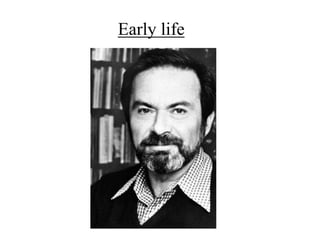
Early life
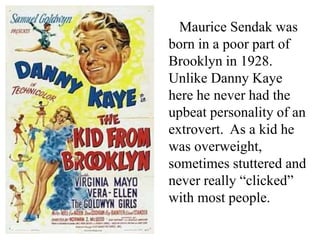
Maurice Sendak was
born in a poor part of
Brooklyn in 1928.
Unlike Danny Kaye
here he never had the
upbeat personality of an
extrovert. As a kid he
was overweight,
sometimes stuttered and
never really “clicked”
with most people.
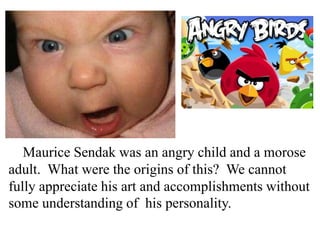
Maurice Sendak was an angry child and a morose
adult. What were the origins of this? We cannot
fully appreciate his art and accomplishments without
some understanding of his personality.
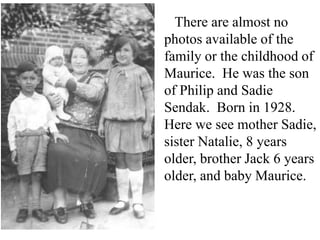
There are almost no
photos available of the
family or the childhood of
Maurice. He was the son
of Philip and Sadie
Sendak. Born in 1928.
Here we see mother Sadie,
sister Natalie, 8 years
older, brother Jack 6 years
older, and baby Maurice.
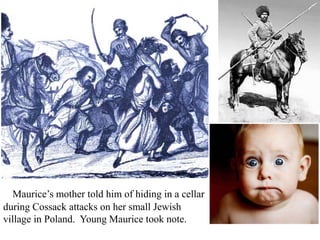
Maurice’s mother told him of hiding in a cellar
during Cossack attacks on her small Jewish
village in Poland. Young Maurice took note.
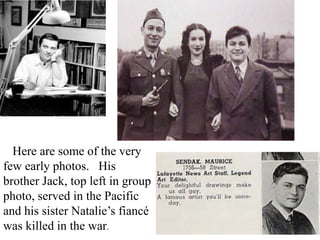
Here are some of the very
few early photos. His
brother Jack, top left in group
photo, served in the Pacific
and his sister Natalie’s fiancé
was killed in the war.
Between the ages of 2
and 4 Maurice suffered
from measles, double
pneumonia, and scarlet
fever. He rarely left the
house.
“I’m

a typical ’30s kid,’' he said in a
1988 Times interview. '‘We had
every disease. There was no
penicillin, there were no sulfa drugs,
and you almost died of any number
of what now are considered trivial
diseases. I have a memory of my
childhood of often wondering about
my mortality.’'
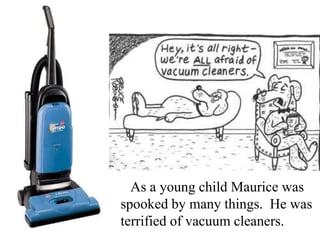
As a young child Maurice was
spooked by many things. He was
terrified of vacuum cleaners.
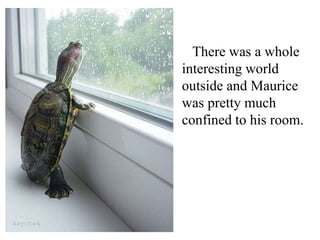
There was a whole
interesting world
outside and Maurice
was pretty much
confined to his room.
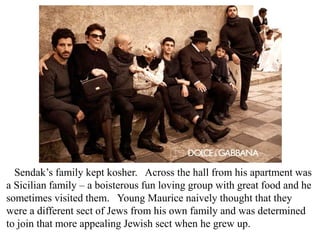
Sendak’s family kept kosher. Across the hall from his apartment was
a Sicilian family – a boisterous fun loving group with great food and he
sometimes visited them. Young Maurice naively thought that they
were a different sect of Jews from his own family and was determined
to join that more appealing Jewish sect when he grew up.
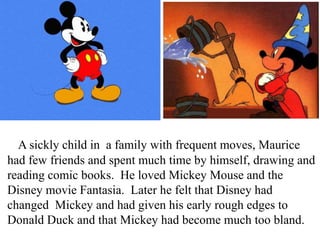
A sickly child in a family with frequent moves, Maurice
had few friends and spent much time by himself, drawing and
reading comic books. He loved Mickey Mouse and the
Disney movie Fantasia. Later he felt that Disney had
changed Mickey and had given his early rough edges to
Donald Duck and that Mickey had become much too bland.
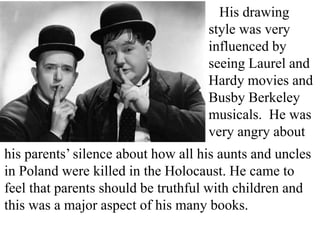
His drawing
style was very
influenced by
seeing Laurel and
Hardy movies and
Busby Berkeley
musicals. He was
very angry about
his parents’ silence about how all his aunts and uncles
in Poland were killed in the Holocaust. He came to
feel that parents should be truthful with children and
this was a major aspect of his many books.
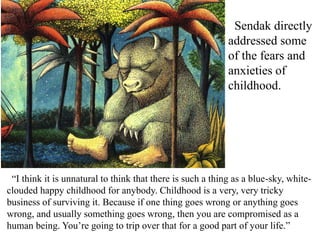
Sendak directly
addressed some
of the fears and
anxieties of
childhood.

“I think it is unnatural to think that there is such a thing as a blue-sky, whiteclouded happy childhood for anybody. Childhood is a very, very tricky
business of surviving it. Because if one thing goes wrong or anything goes
wrong, and usually something goes wrong, then you are compromised as a
human being. You’re going to trip over that for a good part of your life.”
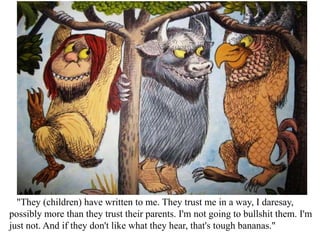
"They (children) have written to me. They trust me in a way, I daresay,
possibly more than they trust their parents. I'm not going to bullshit them. I'm
just not. And if they don't like what they hear, that's tough bananas."
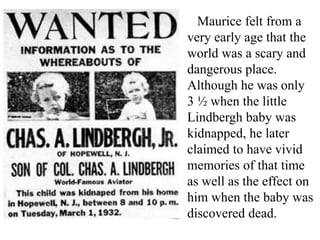
Maurice felt from a
very early age that the
world was a scary and
dangerous place.
Although he was only
3 ½ when the little
Lindbergh baby was
kidnapped, he later
claimed to have vivid
memories of that time
as well as the effect on
him when the baby was
discovered dead.
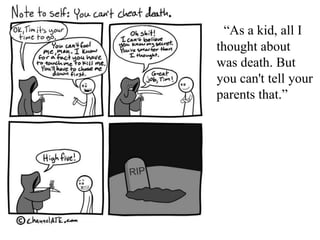
“As a kid, all I
thought about
was death. But
you can't tell your
parents that.”
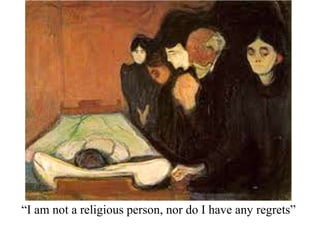
“I am not a religious person, nor do I have any regrets”
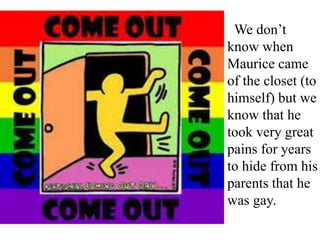
We don’t
know when
Maurice came
of the closet (to
himself) but we
know that he
took very great
pains for years
to hide from his
parents that he
was gay.
A brief digressionSexual attraction between two people has obviously been around a
long time. Romantic love? Not so much. The idea of romantic love
is completely 100% absent from the most ancient literatures of the
Near East and Mediterranean – Egypt, Sumer, Babylonian, Canaan,
Crete, etc. It was introduced to this part of the world by invading
Indo-Europeans from elsewhere. It immediately caught on, about
1500 B.C., and from then on it permeates the literatures of Egypt,
Greece, Israel, etc. We might well speculate, as did the 17th century
French sage the Duke of Rochefoucauld, that:
‘There are people who would have never fallen in love if they never
heard of love.”
This seems to have been true for whole civilizations.
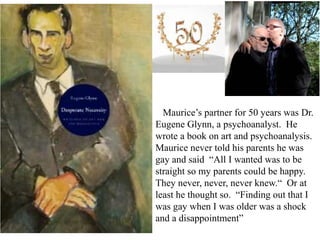
Maurice’s partner for 50 years was Dr.
Eugene Glynn, a psychoanalyst. He
wrote a book on art and psychoanalysis.
Maurice never told his parents he was
gay and said “All I wanted was to be
straight so my parents could be happy.
They never, never, never knew.“ Or at
least he thought so. “Finding out that I
was gay when I was older was a shock
and a disappointment”
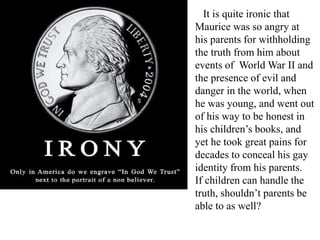
It is quite ironic that
Maurice was so angry at
his parents for withholding
the truth from him about
events of World War II and
the presence of evil and
danger in the world, when
he was young, and went out
of his way to be honest in
his children’s books, and
yet he took great pains for
decades to conceal his gay
identity from his parents.
If children can handle the
truth, shouldn’t parents be
able to as well?
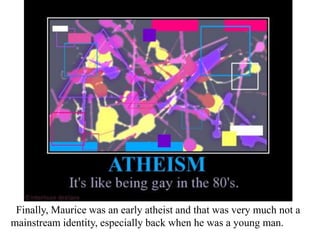
Finally, Maurice was an early atheist and that was very much not a
mainstream identity, especially back when he was a young man.
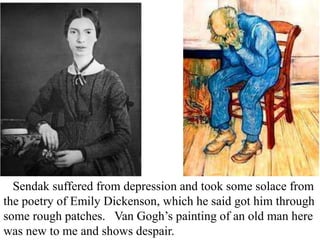
Sendak suffered from depression and took some solace from
the poetry of Emily Dickenson, which he said got him through
some rough patches. Van Gogh’s painting of an old man here
was new to me and shows despair.
Professional life
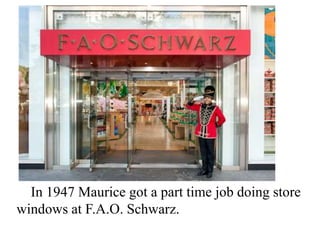
In 1947 Maurice got a part time job doing store
windows at F.A.O. Schwarz.
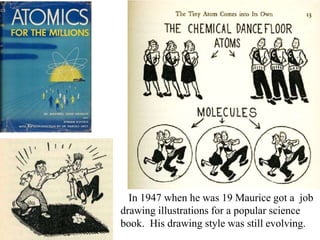
In 1947 when he was 19 Maurice got a job
drawing illustrations for a popular science
book. His drawing style was still evolving.
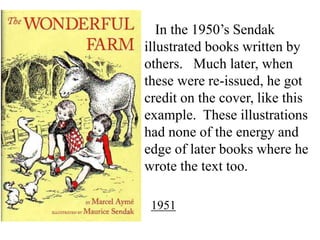
In the 1950’s Sendak
illustrated books written by
others. Much later, when
these were re-issued, he got
credit on the cover, like this
example. These illustrations
had none of the energy and
edge of later books where he
wrote the text too.
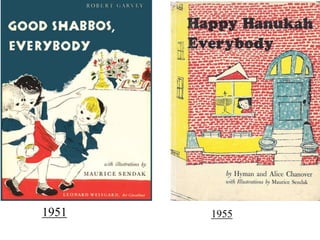
1951
1951

1955
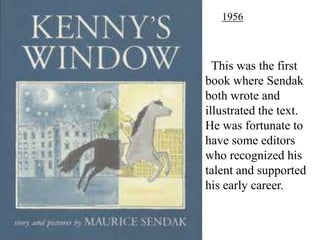
1956

This was the first
book where Sendak
both wrote and
illustrated the text.
He was fortunate to
have some editors
who recognized his
talent and supported
his early career.
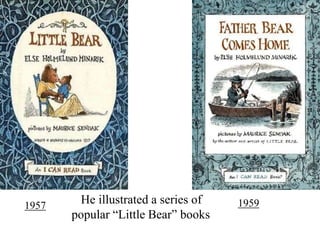
1957

He illustrated a series of
popular “Little Bear” books

1959
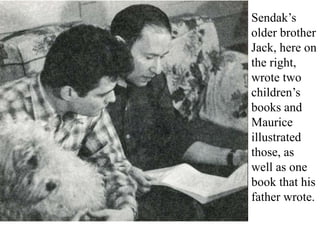
Sendak’s
older brother
Jack, here on
the right,
wrote two
children’s
books and
Maurice
illustrated
those, as
well as one
book that his
father wrote.
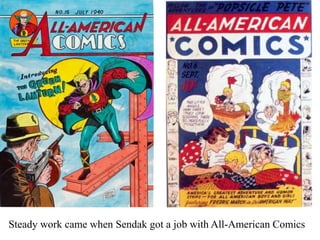
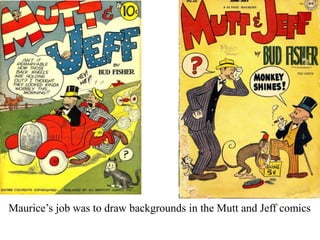
Steady work came when Sendak got a job with All-American Comics
Maurice’s job was to draw backgrounds in the Mutt and Jeff comics
1952

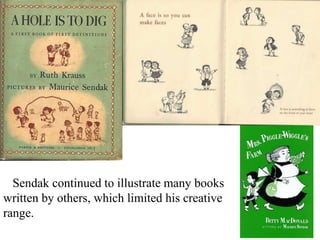
Sendak continued to illustrate many books
written by others, which limited his creative
range.
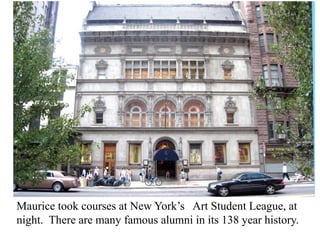
Maurice took courses at New York’s Art Student League, at
night. There are many famous alumni in its 138 year history.
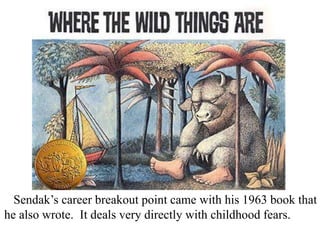
Sendak’s career breakout point came with his 1963 book that
he also wrote. It deals very directly with childhood fears.
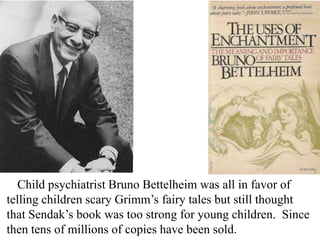
Child psychiatrist Bruno Bettelheim was all in favor of
telling children scary Grimm’s fairy tales but still thought
that Sendak’s book was too strong for young children. Since
then tens of millions of copies have been sold.
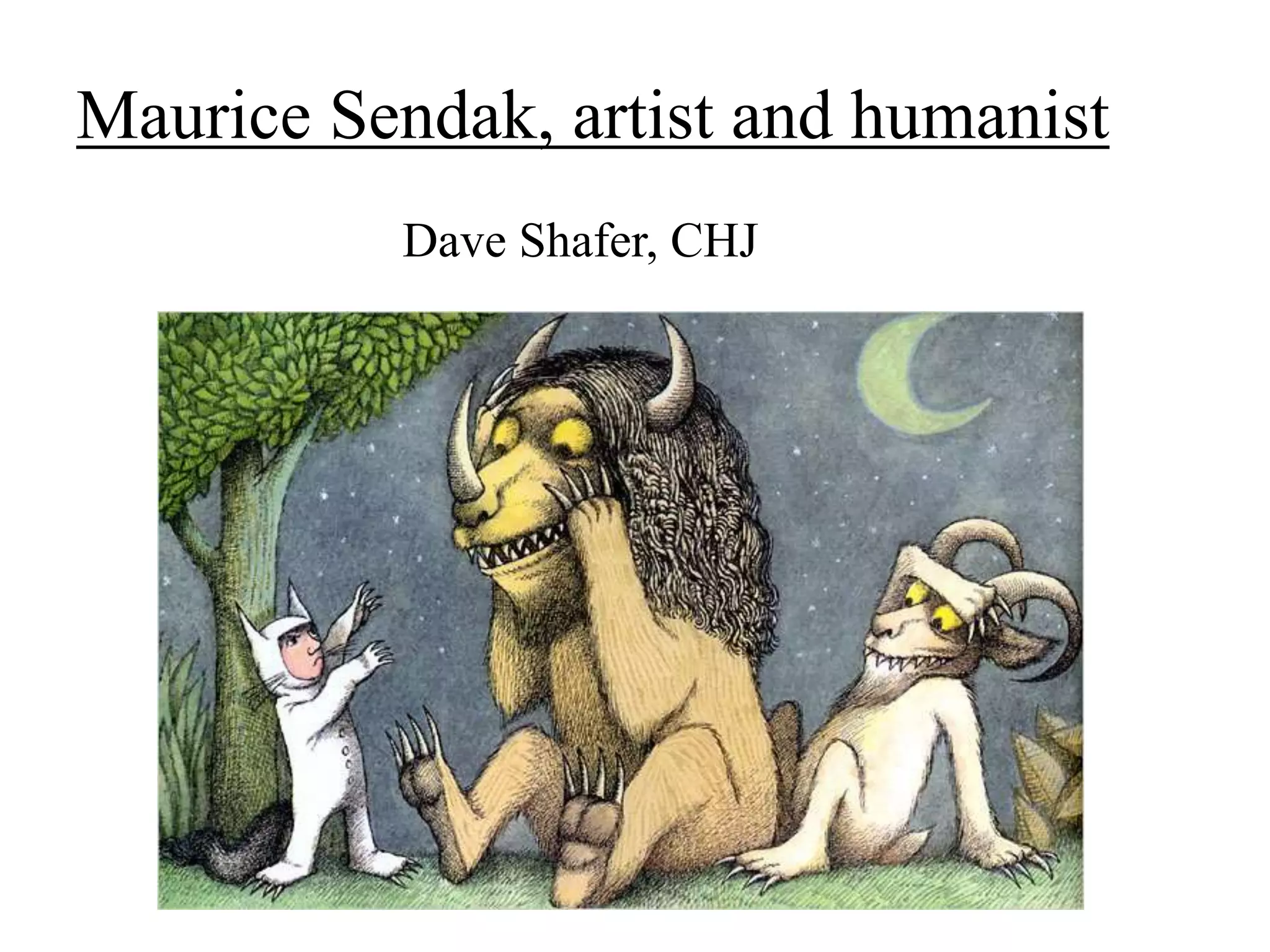
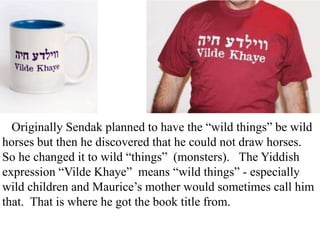
Originally Sendak planned to have the “wild things” be wild
horses but then he discovered that he could not draw horses.
So he changed it to wild “things” (monsters). The Yiddish
expression “Vilde Khaye” means “wild things” - especially
wild children and Maurice’s mother would sometimes call him
that. That is where he got the book title from.
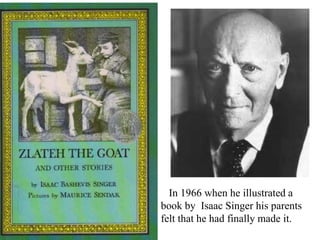
In 1966 when he illustrated a
book by Isaac Singer his parents
felt that he had finally made it.
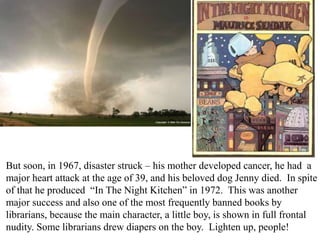
But soon, in 1967, disaster struck – his mother developed cancer, he had a
major heart attack at the age of 39, and his beloved dog Jenny died. In spite
of that he produced “In The Night Kitchen” in 1972. This was another
major success and also one of the most frequently banned books by
librarians, because the main character, a little boy, is shown in full frontal
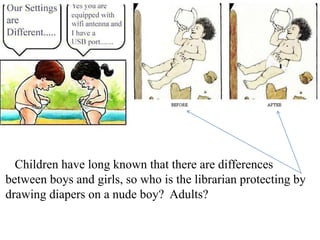
nudity. Some librarians drew diapers on the boy. Lighten up, people!
Children have long known that there are differences
between boys and girls, so who is the librarian protecting by
drawing diapers on a nude boy? Adults?
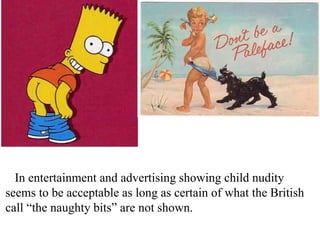
In entertainment and advertising showing child nudity
seems to be acceptable as long as certain of what the British
call “the naughty bits” are not shown.
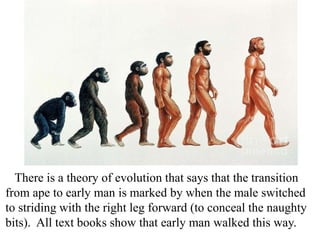
There is a theory of evolution that says that the transition
from ape to early man is marked by when the male switched
to striding with the right leg forward (to conceal the naughty
bits). All text books show that early man walked this way.
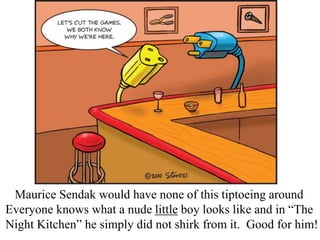
Maurice Sendak would have none of this tiptoeing around
Everyone knows what a nude little boy looks like and in “The
Night Kitchen” he simply did not shirk from it. Good for him!
In 1987 PBS had a 6 minute animated film
made based on Sendak’s art work in the
book. It was the work of the Czech based
film maker Gene Deitch, who had long
walks with Sendak in Prague to discuss the
project. The result, which we will see now,
captures well the surreal quality of a child’s
imagination that is shown in the book.
Sendak said that the Hitler-esque characters
and their attempt to bake the boy in an oven
were Holocaust references
He also told Deitch that the book reflects
his own relationship to his parents, his own
inner life, the birth of his fantasy life and his
homosexuality.
6 minute animated film

http://video.nhptv.org/video/1687937776/
.

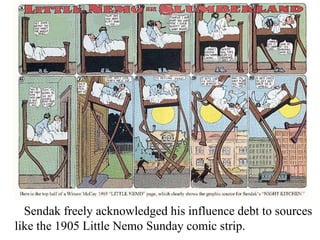
Sendak freely acknowledged his influence debt to sources
like the 1905 Little Nemo Sunday comic strip.
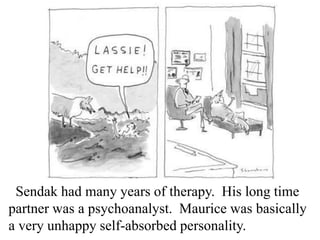
Sendak had many years of therapy. His long time
partner was a psychoanalyst. Maurice was basically
a very unhappy self-absorbed personality.
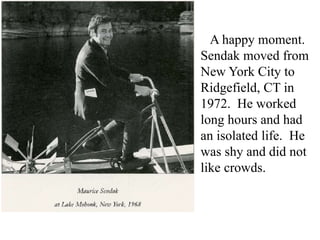
A happy moment.
Sendak moved from
New York City to
Ridgefield, CT in
1972. He worked
long hours and had
an isolated life. He
was shy and did not
like crowds.
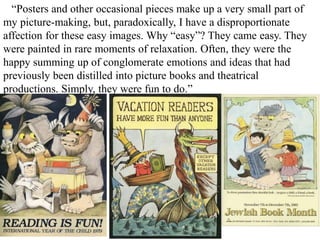
“Posters and other occasional pieces make up a very small part of
my picture-making, but, paradoxically, I have a disproportionate
affection for these easy images. Why “easy”? They came easy. They
were painted in rare moments of relaxation. Often, they were the
happy summing up of conglomerate emotions and ideas that had
previously been distilled into picture books and theatrical
productions. Simply, they were fun to do.”
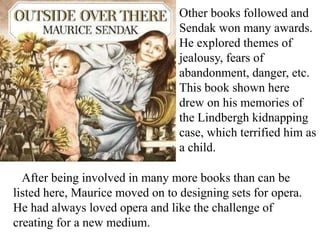
Other books followed and
Sendak won many awards.
He explored themes of
jealousy, fears of
abandonment, danger, etc.
This book shown here
drew on his memories of
the Lindbergh kidnapping
case, which terrified him as
a child.

After being involved in many more books than can be
listed here, Maurice moved on to designing sets for opera.
He had always loved opera and like the challenge of
creating for a new medium.
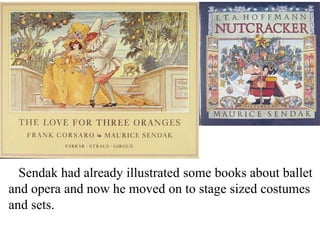
Sendak had already illustrated some books about ballet
and opera and now he moved on to stage sized costumes
and sets.
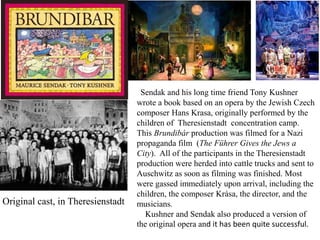
Original cast, in Theresienstadt

Sendak and his long time friend Tony Kushner
wrote a book based on an opera by the Jewish Czech
composer Hans Krasa, originally performed by the
children of Theresienstadt concentration camp.
This Brundibár production was filmed for a Nazi
propaganda film (The Führer Gives the Jews a
City). All of the participants in the Theresienstadt
production were herded into cattle trucks and sent to
Auschwitz as soon as filming was finished. Most
were gassed immediately upon arrival, including the
children, the composer Krása, the director, and the
musicians.
Kushner and Sendak also produced a version of
the original opera and it has been quite successful.
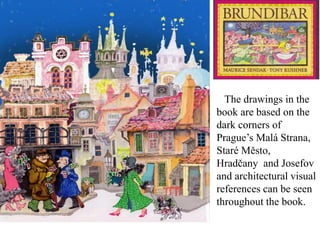
The drawings in the
book are based on the
dark corners of
Prague’s Malá Strana,
Staré Město,
Hradčany and Josefov
and architectural visual
references can be seen
throughout the book.
Sendak’s 1998 sets and costumes for the opera “Hansel and Gretel”
"My main purpose in doing this opera, and doing it now, at this age [69], is that I'm
overwhelmed by the abuse of children. Hansel and Gretel is a powerful analogy to modern day
child abandonment and cruelty, an opera about pertinent forms of neglect. To mount it in a
cutesy German forest is to limit it. Why is the fairy tale so famous? Because it's terrifying."
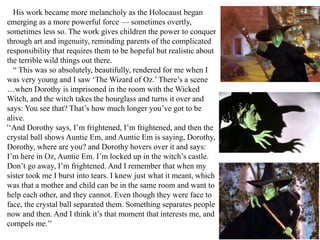
His work became more melancholy as the Holocaust began
emerging as a more powerful force — sometimes overtly,
sometimes less so. The work gives children the power to conquer
through art and ingenuity, reminding parents of the complicated
responsibility that requires them to be hopeful but realistic about
the terrible wild things out there.
“ This was so absolutely, beautifully, rendered for me when I
was very young and I saw ‘The Wizard of Oz.’ There’s a scene
…when Dorothy is imprisoned in the room with the Wicked
Witch, and the witch takes the hourglass and turns it over and
says: You see that? That’s how much longer you’ve got to be
alive.
'‘And Dorothy says, I’m frightened, I’m frightened, and then the
crystal ball shows Auntie Em, and Auntie Em is saying, Dorothy,
Dorothy, where are you? and Dorothy hovers over it and says:
I’m here in Oz, Auntie Em. I’m locked up in the witch’s castle.
Don’t go away, I’m frightened. And I remember that when my
sister took me I burst into tears. I knew just what it meant, which
was that a mother and child can be in the same room and want to
help each other, and they cannot. Even though they were face to
face, the crystal ball separated them. Something separates people
now and then. And I think it’s that moment that interests me, and
compels me.’'
Video clip from the “Wizard of Oz”

http://www.youtube.com/watch?v=HouZ5GHxlpQ
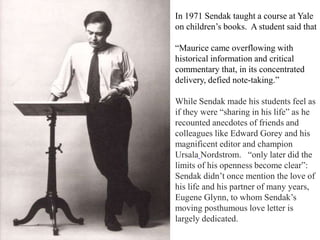
In 1971 Sendak taught a course at Yale
on children’s books. A student said that
“Maurice came overflowing with
historical information and critical
commentary that, in its concentrated
delivery, defied note-taking.”
While Sendak made his students feel as
if they were “sharing in his life” as he
recounted anecdotes of friends and
colleagues like Edward Gorey and his
magnificent editor and champion
Ursala Nordstrom. “only later did the
limits of his openness become clear”:
Sendak didn’t once mention the love of
his life and his partner of many years,
Eugene Glynn, to whom Sendak’s
moving posthumous love letter is
largely dedicated.
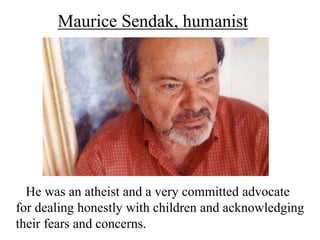
Maurice Sendak, humanist

He was an atheist and a very committed advocate
for dealing honestly with children and acknowledging
their fears and concerns.
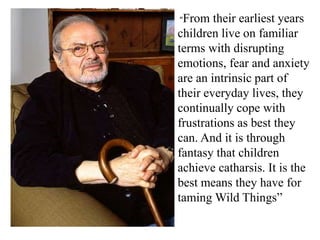
“From

their earliest years
children live on familiar
terms with disrupting
emotions, fear and anxiety
are an intrinsic part of
their everyday lives, they
continually cope with
frustrations as best they
can. And it is through
fantasy that children
achieve catharsis. It is the
best means they have for
taming Wild Things”
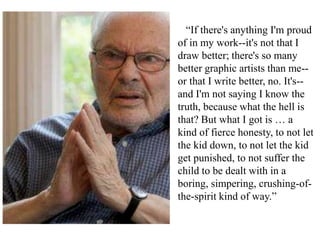
“If there's anything I'm proud
of in my work--it's not that I
draw better; there's so many
better graphic artists than me-or that I write better, no. It's-and I'm not saying I know the
truth, because what the hell is
that? But what I got is … a
kind of fierce honesty, to not let
the kid down, to not let the kid
get punished, to not suffer the
child to be dealt with in a
boring, simpering, crushing-ofthe-spirit kind of way.”
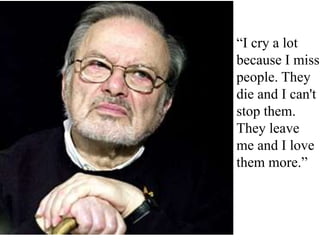
“I cry a lot
because I miss
people. They
die and I can't
stop them.
They leave
me and I love
them more.”
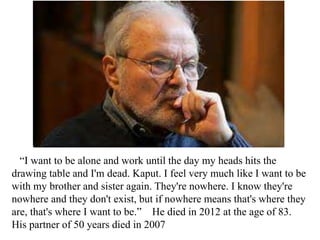
“I want to be alone and work until the day my heads hits the
drawing table and I'm dead. Kaput. I feel very much like I want to be
with my brother and sister again. They're nowhere. I know they're
nowhere and they don't exist, but if nowhere means that's where they
are, that's where I want to be.” He died in 2012 at the age of 83.
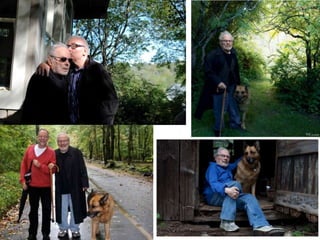
His partner of 50 years died in 2007
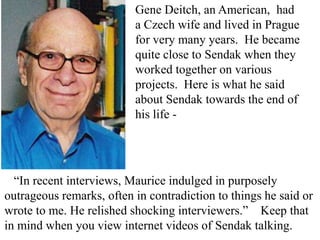
Gene Deitch, an American, had
a Czech wife and lived in Prague
for very many years. He became
quite close to Sendak when they
worked together on various
projects. Here is what he said
about Sendak towards the end of
his life -

“In recent interviews, Maurice indulged in purposely
outrageous remarks, often in contradiction to things he said or
wrote to me. He relished shocking interviewers.” Keep that
in mind when you view internet videos of Sendak talking.
5 minute interview with Sendak just before he died

http://www.wimp.com/lifedeath/

Maurice Sendak, artist and humanist, an expanded version

  • 1.
    Maurice Sendak, artistand humanist Dave Shafer, CHJ
  • 2.
  • 3.
    Maurice Sendak was bornin a poor part of Brooklyn in 1928. Unlike Danny Kaye here he never had the upbeat personality of an extrovert. As a kid he was overweight, sometimes stuttered and never really “clicked” with most people.
  • 4.
    Maurice Sendak wasan angry child and a morose adult. What were the origins of this? We cannot fully appreciate his art and accomplishments without some understanding of his personality.
  • 5.
    There are almostno photos available of the family or the childhood of Maurice. He was the son of Philip and Sadie Sendak. Born in 1928. Here we see mother Sadie, sister Natalie, 8 years older, brother Jack 6 years older, and baby Maurice.
  • 6.
    Maurice’s mother toldhim of hiding in a cellar during Cossack attacks on her small Jewish village in Poland. Young Maurice took note.
  • 7.
    Here are someof the very few early photos. His brother Jack, top left in group photo, served in the Pacific and his sister Natalie’s fiancé was killed in the war.
  • 8.
    Between the agesof 2 and 4 Maurice suffered from measles, double pneumonia, and scarlet fever. He rarely left the house. “I’m a typical ’30s kid,’' he said in a 1988 Times interview. '‘We had every disease. There was no penicillin, there were no sulfa drugs, and you almost died of any number of what now are considered trivial diseases. I have a memory of my childhood of often wondering about my mortality.’'
  • 9.
    As a youngchild Maurice was spooked by many things. He was terrified of vacuum cleaners.
  • 10.
    There was awhole interesting world outside and Maurice was pretty much confined to his room.
  • 11.
    Sendak’s family keptkosher. Across the hall from his apartment was a Sicilian family – a boisterous fun loving group with great food and he sometimes visited them. Young Maurice naively thought that they were a different sect of Jews from his own family and was determined to join that more appealing Jewish sect when he grew up.
  • 12.
    A sickly childin a family with frequent moves, Maurice had few friends and spent much time by himself, drawing and reading comic books. He loved Mickey Mouse and the Disney movie Fantasia. Later he felt that Disney had changed Mickey and had given his early rough edges to Donald Duck and that Mickey had become much too bland.
  • 13.
    His drawing style wasvery influenced by seeing Laurel and Hardy movies and Busby Berkeley musicals. He was very angry about his parents’ silence about how all his aunts and uncles in Poland were killed in the Holocaust. He came to feel that parents should be truthful with children and this was a major aspect of his many books.
  • 14.
    Sendak directly addressed some ofthe fears and anxieties of childhood. “I think it is unnatural to think that there is such a thing as a blue-sky, whiteclouded happy childhood for anybody. Childhood is a very, very tricky business of surviving it. Because if one thing goes wrong or anything goes wrong, and usually something goes wrong, then you are compromised as a human being. You’re going to trip over that for a good part of your life.”
  • 15.
    "They (children) havewritten to me. They trust me in a way, I daresay, possibly more than they trust their parents. I'm not going to bullshit them. I'm just not. And if they don't like what they hear, that's tough bananas."
  • 16.
    Maurice felt froma very early age that the world was a scary and dangerous place. Although he was only 3 ½ when the little Lindbergh baby was kidnapped, he later claimed to have vivid memories of that time as well as the effect on him when the baby was discovered dead.
  • 17.
    “As a kid,all I thought about was death. But you can't tell your parents that.”
  • 18.
    “I am nota religious person, nor do I have any regrets”
  • 19.
    We don’t know when Mauricecame of the closet (to himself) but we know that he took very great pains for years to hide from his parents that he was gay.
  • 20.
    A brief digressionSexualattraction between two people has obviously been around a long time. Romantic love? Not so much. The idea of romantic love is completely 100% absent from the most ancient literatures of the Near East and Mediterranean – Egypt, Sumer, Babylonian, Canaan, Crete, etc. It was introduced to this part of the world by invading Indo-Europeans from elsewhere. It immediately caught on, about 1500 B.C., and from then on it permeates the literatures of Egypt, Greece, Israel, etc. We might well speculate, as did the 17th century French sage the Duke of Rochefoucauld, that: ‘There are people who would have never fallen in love if they never heard of love.” This seems to have been true for whole civilizations.
  • 21.
    Maurice’s partner for50 years was Dr. Eugene Glynn, a psychoanalyst. He wrote a book on art and psychoanalysis. Maurice never told his parents he was gay and said “All I wanted was to be straight so my parents could be happy. They never, never, never knew.“ Or at least he thought so. “Finding out that I was gay when I was older was a shock and a disappointment”
  • 22.
    It is quiteironic that Maurice was so angry at his parents for withholding the truth from him about events of World War II and the presence of evil and danger in the world, when he was young, and went out of his way to be honest in his children’s books, and yet he took great pains for decades to conceal his gay identity from his parents. If children can handle the truth, shouldn’t parents be able to as well?
  • 23.
    Finally, Maurice wasan early atheist and that was very much not a mainstream identity, especially back when he was a young man.
  • 24.
    Sendak suffered fromdepression and took some solace from the poetry of Emily Dickenson, which he said got him through some rough patches. Van Gogh’s painting of an old man here was new to me and shows despair.
  • 25.
  • 26.
    In 1947 Mauricegot a part time job doing store windows at F.A.O. Schwarz.
  • 27.
    In 1947 whenhe was 19 Maurice got a job drawing illustrations for a popular science book. His drawing style was still evolving.
  • 28.
    In the 1950’sSendak illustrated books written by others. Much later, when these were re-issued, he got credit on the cover, like this example. These illustrations had none of the energy and edge of later books where he wrote the text too. 1951
  • 29.
  • 30.
    1956 This was thefirst book where Sendak both wrote and illustrated the text. He was fortunate to have some editors who recognized his talent and supported his early career.
  • 31.
    1957 He illustrated aseries of popular “Little Bear” books 1959
  • 32.
    Sendak’s older brother Jack, hereon the right, wrote two children’s books and Maurice illustrated those, as well as one book that his father wrote.
  • 33.
    Steady work camewhen Sendak got a job with All-American Comics
  • 34.
    Maurice’s job wasto draw backgrounds in the Mutt and Jeff comics
  • 35.
    1952 Sendak continued toillustrate many books written by others, which limited his creative range.
  • 36.
    Maurice took coursesat New York’s Art Student League, at night. There are many famous alumni in its 138 year history.
  • 37.
    Sendak’s career breakoutpoint came with his 1963 book that he also wrote. It deals very directly with childhood fears.
  • 38.
    Child psychiatrist BrunoBettelheim was all in favor of telling children scary Grimm’s fairy tales but still thought that Sendak’s book was too strong for young children. Since then tens of millions of copies have been sold.
  • 39.
    Originally Sendak plannedto have the “wild things” be wild horses but then he discovered that he could not draw horses. So he changed it to wild “things” (monsters). The Yiddish expression “Vilde Khaye” means “wild things” - especially wild children and Maurice’s mother would sometimes call him that. That is where he got the book title from.
  • 40.
    In 1966 whenhe illustrated a book by Isaac Singer his parents felt that he had finally made it.
  • 41.
    But soon, in1967, disaster struck – his mother developed cancer, he had a major heart attack at the age of 39, and his beloved dog Jenny died. In spite of that he produced “In The Night Kitchen” in 1972. This was another major success and also one of the most frequently banned books by librarians, because the main character, a little boy, is shown in full frontal nudity. Some librarians drew diapers on the boy. Lighten up, people!
  • 42.
    Children have longknown that there are differences between boys and girls, so who is the librarian protecting by drawing diapers on a nude boy? Adults?
  • 43.
    In entertainment andadvertising showing child nudity seems to be acceptable as long as certain of what the British call “the naughty bits” are not shown.
  • 44.
    There is atheory of evolution that says that the transition from ape to early man is marked by when the male switched to striding with the right leg forward (to conceal the naughty bits). All text books show that early man walked this way.
  • 45.
    Maurice Sendak wouldhave none of this tiptoeing around Everyone knows what a nude little boy looks like and in “The Night Kitchen” he simply did not shirk from it. Good for him!
  • 46.
    In 1987 PBShad a 6 minute animated film made based on Sendak’s art work in the book. It was the work of the Czech based film maker Gene Deitch, who had long walks with Sendak in Prague to discuss the project. The result, which we will see now, captures well the surreal quality of a child’s imagination that is shown in the book. Sendak said that the Hitler-esque characters and their attempt to bake the boy in an oven were Holocaust references He also told Deitch that the book reflects his own relationship to his parents, his own inner life, the birth of his fantasy life and his homosexuality.
  • 47.
    6 minute animatedfilm http://video.nhptv.org/video/1687937776/
  • 48.
    . Sendak freely acknowledgedhis influence debt to sources like the 1905 Little Nemo Sunday comic strip.
  • 49.
    Sendak had manyyears of therapy. His long time partner was a psychoanalyst. Maurice was basically a very unhappy self-absorbed personality.
  • 50.
    A happy moment. Sendakmoved from New York City to Ridgefield, CT in 1972. He worked long hours and had an isolated life. He was shy and did not like crowds.
  • 51.
    “Posters and otheroccasional pieces make up a very small part of my picture-making, but, paradoxically, I have a disproportionate affection for these easy images. Why “easy”? They came easy. They were painted in rare moments of relaxation. Often, they were the happy summing up of conglomerate emotions and ideas that had previously been distilled into picture books and theatrical productions. Simply, they were fun to do.”
  • 52.
    Other books followedand Sendak won many awards. He explored themes of jealousy, fears of abandonment, danger, etc. This book shown here drew on his memories of the Lindbergh kidnapping case, which terrified him as a child. After being involved in many more books than can be listed here, Maurice moved on to designing sets for opera. He had always loved opera and like the challenge of creating for a new medium.
  • 53.
    Sendak had alreadyillustrated some books about ballet and opera and now he moved on to stage sized costumes and sets.
  • 54.
    Original cast, inTheresienstadt Sendak and his long time friend Tony Kushner wrote a book based on an opera by the Jewish Czech composer Hans Krasa, originally performed by the children of Theresienstadt concentration camp. This Brundibár production was filmed for a Nazi propaganda film (The Führer Gives the Jews a City). All of the participants in the Theresienstadt production were herded into cattle trucks and sent to Auschwitz as soon as filming was finished. Most were gassed immediately upon arrival, including the children, the composer Krása, the director, and the musicians. Kushner and Sendak also produced a version of the original opera and it has been quite successful.
  • 55.
    The drawings inthe book are based on the dark corners of Prague’s Malá Strana, Staré Město, Hradčany and Josefov and architectural visual references can be seen throughout the book.
  • 56.
    Sendak’s 1998 setsand costumes for the opera “Hansel and Gretel” "My main purpose in doing this opera, and doing it now, at this age [69], is that I'm overwhelmed by the abuse of children. Hansel and Gretel is a powerful analogy to modern day child abandonment and cruelty, an opera about pertinent forms of neglect. To mount it in a cutesy German forest is to limit it. Why is the fairy tale so famous? Because it's terrifying."
  • 57.
    His work becamemore melancholy as the Holocaust began emerging as a more powerful force — sometimes overtly, sometimes less so. The work gives children the power to conquer through art and ingenuity, reminding parents of the complicated responsibility that requires them to be hopeful but realistic about the terrible wild things out there. “ This was so absolutely, beautifully, rendered for me when I was very young and I saw ‘The Wizard of Oz.’ There’s a scene …when Dorothy is imprisoned in the room with the Wicked Witch, and the witch takes the hourglass and turns it over and says: You see that? That’s how much longer you’ve got to be alive. '‘And Dorothy says, I’m frightened, I’m frightened, and then the crystal ball shows Auntie Em, and Auntie Em is saying, Dorothy, Dorothy, where are you? and Dorothy hovers over it and says: I’m here in Oz, Auntie Em. I’m locked up in the witch’s castle. Don’t go away, I’m frightened. And I remember that when my sister took me I burst into tears. I knew just what it meant, which was that a mother and child can be in the same room and want to help each other, and they cannot. Even though they were face to face, the crystal ball separated them. Something separates people now and then. And I think it’s that moment that interests me, and compels me.’'
  • 58.
    Video clip fromthe “Wizard of Oz” http://www.youtube.com/watch?v=HouZ5GHxlpQ
  • 59.
    In 1971 Sendaktaught a course at Yale on children’s books. A student said that “Maurice came overflowing with historical information and critical commentary that, in its concentrated delivery, defied note-taking.” While Sendak made his students feel as if they were “sharing in his life” as he recounted anecdotes of friends and colleagues like Edward Gorey and his magnificent editor and champion Ursala Nordstrom. “only later did the limits of his openness become clear”: Sendak didn’t once mention the love of his life and his partner of many years, Eugene Glynn, to whom Sendak’s moving posthumous love letter is largely dedicated.
  • 60.
    Maurice Sendak, humanist Hewas an atheist and a very committed advocate for dealing honestly with children and acknowledging their fears and concerns.
  • 61.
    “From their earliest years childrenlive on familiar terms with disrupting emotions, fear and anxiety are an intrinsic part of their everyday lives, they continually cope with frustrations as best they can. And it is through fantasy that children achieve catharsis. It is the best means they have for taming Wild Things”
  • 62.
    “If there's anythingI'm proud of in my work--it's not that I draw better; there's so many better graphic artists than me-or that I write better, no. It's-and I'm not saying I know the truth, because what the hell is that? But what I got is … a kind of fierce honesty, to not let the kid down, to not let the kid get punished, to not suffer the child to be dealt with in a boring, simpering, crushing-ofthe-spirit kind of way.”
  • 63.
    “I cry alot because I miss people. They die and I can't stop them. They leave me and I love them more.”
  • 65.
    “I want tobe alone and work until the day my heads hits the drawing table and I'm dead. Kaput. I feel very much like I want to be with my brother and sister again. They're nowhere. I know they're nowhere and they don't exist, but if nowhere means that's where they are, that's where I want to be.” He died in 2012 at the age of 83. His partner of 50 years died in 2007
  • 66.
    Gene Deitch, anAmerican, had a Czech wife and lived in Prague for very many years. He became quite close to Sendak when they worked together on various projects. Here is what he said about Sendak towards the end of his life - “In recent interviews, Maurice indulged in purposely outrageous remarks, often in contradiction to things he said or wrote to me. He relished shocking interviewers.” Keep that in mind when you view internet videos of Sendak talking.
  • 67.
    5 minute interviewwith Sendak just before he died http://www.wimp.com/lifedeath/