Maturity Model or Conformity Standard: CMMI or ISO 9001: Which is Better? Sophia Rouse Quality Manager November 2007
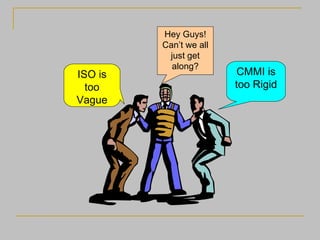
CMMI is too Rigid ISO is too Vague Hey Guys! Can’t we all just get along?
What is CMMI? Developed by Systems / Software / Defense Professionals A Process Improvement Model Determines Maturity (progressive steps) Framework contains 729 Pages Generic and specific practices More appropriate for software, systems, product development
What is ISO 9001? An International Standard Based on Conformity Standard contains 33 Pages Quality Management System Requirements only; Same for all companies, industries, disciplines Flexible and Cheaper
Differences Language ISO uses “shall” statements (prescriptive); CMMI doesn’t Compactness of statements in ISO  e.g., “determine and provide resources”; in CMMI with GP 2.2 and GP 2.3 in all Process Areas Details ISO is very sparse  There are 135 “shall” statements but over 360 “derived requirements” CMMI provides practices, subpractices, typical work products, & amplifications
Differences Institutionalization ISO requires organizations to establish QMS but does not explicitly require institutionalization building strong process infrastructure is left to the organization CMMI very strongly emphasizes institutionalization through Generic Goals and Generic Practices This is a major strength of the CMMI and is critical to overall process improvement success
SCAMPI Assessed The Standard CMMI® Appraisal Method for Process Improvement (SCAMPI SM ) A is designed to provide benchmark quality ratings relative to Capability Maturity Model® Integration (CMMI) models. SCAMPI A satisfies all of the Appraisal Requirements for CMMI (ARC) requirements for a Class A appraisal method. SCAMPI appraisals do not certify. They can provide Maturity or Capability Levels which indicate that applicable goals of CMMI models are satisfied.
ISO Registration Requires a company to submit its quality management system to an independent registrar for review, audit and acceptance as meeting the requirements of the ISO 9001 standard. ISO registered companies must have in place a continuous quality improvement objective if they are to meet the international standard and its objectives .
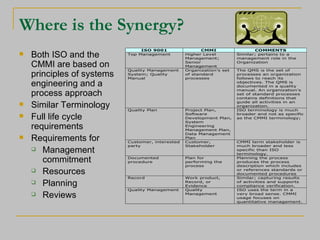
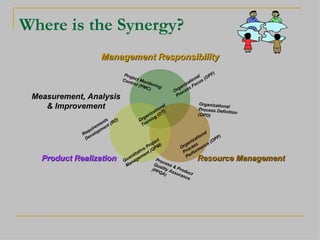
Where is the Synergy? Both ISO and the CMMI are based on principles of systems engineering and a process approach Similar Terminology Full life cycle requirements Requirements for Management commitment Resources Planning Reviews
Where is the Synergy? Process & Product Quality Assurance (PPQA) Management Responsibility Resource Management Product Realization Measurement, Analysis & Improvement Organizational Process Definition (OPD) Requirements Development (RD) Project Monitoring Control (PMC) Organizational Process Performance (OPP) Quantitative Project Management (QPM) Organizational Process Focus (OPF) Organizational Training (OT)
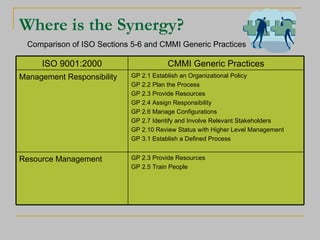
Where is the Synergy? Comparison of ISO Sections 5-6 and CMMI Generic Practices GP 2.3 Provide Resources GP 2.5 Train People  Resource Management GP 2.1 Establish an Organizational Policy GP 2.2 Plan the Process GP 2.3 Provide Resources GP 2.4 Assign Responsibility GP 2.6 Manage Configurations GP 2.7 Identify and Involve Relevant Stakeholders GP 2.10 Review Status with Higher Level Management GP 3.1 Establish a Defined Process  Management Responsibility CMMI Generic Practices ISO 9001:2000
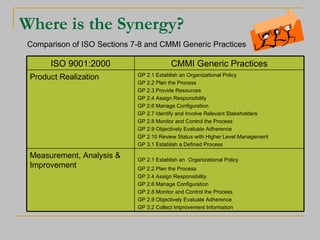
Where is the Synergy? Comparison of ISO Sections 7-8 and CMMI Generic Practices GP 2.1 Establish an   Organizational Policy GP 2.2 Plan the Process GP 2.4 Assign Responsibility GP 2.6 Manage Configuration GP 2.8 Monitor and Control the Process GP 2.9 Objectively Evaluate Adherence GP 3.2 Collect Improvement Information  Measurement, Analysis & Improvement GP 2.1 Establish an Organizational Policy GP 2.2 Plan the Process GP 2.3 Provide Resources GP 2.4 Assign Responsibility GP 2.6 Manage Configuration GP 2.7 Identify and Involve Relevant Stakeholders GP 2.8 Monitor and Control the Process GP 2.9 Objectively Evaluate Adherence GP 2.10 Review Status with Higher Level Management GP 3.1 Establish a Defined Process  Product Realization CMMI Generic Practices ISO 9001:2000
Strengths of CMMI and ISO CMMI Detailed Engineering practices Comprehensive Program Management practices Concept of increasing “Maturity Levels” ISO 9001:2000 Spotlight on Customer Satisfaction Focus on Control of Records Ensures process discipline across entire organization Annual Surveillance Audit
CMMI – ISO: The Bottom Line ISO standard is broader in scope and ensures process discipline across the entire organization. CMMI model provides greater detail and focus in Engineering and Program Management. Together, ISO and CMMI models complement each other.

Maturity Model Or Conformity Standard

  • 1.
    Maturity Model orConformity Standard: CMMI or ISO 9001: Which is Better? Sophia Rouse Quality Manager November 2007
  • 2.
    CMMI is tooRigid ISO is too Vague Hey Guys! Can’t we all just get along?
  • 3.
    What is CMMI?Developed by Systems / Software / Defense Professionals A Process Improvement Model Determines Maturity (progressive steps) Framework contains 729 Pages Generic and specific practices More appropriate for software, systems, product development
  • 4.
    What is ISO9001? An International Standard Based on Conformity Standard contains 33 Pages Quality Management System Requirements only; Same for all companies, industries, disciplines Flexible and Cheaper
  • 5.
    Differences Language ISOuses “shall” statements (prescriptive); CMMI doesn’t Compactness of statements in ISO e.g., “determine and provide resources”; in CMMI with GP 2.2 and GP 2.3 in all Process Areas Details ISO is very sparse There are 135 “shall” statements but over 360 “derived requirements” CMMI provides practices, subpractices, typical work products, & amplifications
  • 6.
    Differences Institutionalization ISOrequires organizations to establish QMS but does not explicitly require institutionalization building strong process infrastructure is left to the organization CMMI very strongly emphasizes institutionalization through Generic Goals and Generic Practices This is a major strength of the CMMI and is critical to overall process improvement success
  • 7.
    SCAMPI Assessed TheStandard CMMI® Appraisal Method for Process Improvement (SCAMPI SM ) A is designed to provide benchmark quality ratings relative to Capability Maturity Model® Integration (CMMI) models. SCAMPI A satisfies all of the Appraisal Requirements for CMMI (ARC) requirements for a Class A appraisal method. SCAMPI appraisals do not certify. They can provide Maturity or Capability Levels which indicate that applicable goals of CMMI models are satisfied.
  • 8.
    ISO Registration Requiresa company to submit its quality management system to an independent registrar for review, audit and acceptance as meeting the requirements of the ISO 9001 standard. ISO registered companies must have in place a continuous quality improvement objective if they are to meet the international standard and its objectives .
  • 9.
    Where is theSynergy? Both ISO and the CMMI are based on principles of systems engineering and a process approach Similar Terminology Full life cycle requirements Requirements for Management commitment Resources Planning Reviews
  • 10.
    Where is theSynergy? Process & Product Quality Assurance (PPQA) Management Responsibility Resource Management Product Realization Measurement, Analysis & Improvement Organizational Process Definition (OPD) Requirements Development (RD) Project Monitoring Control (PMC) Organizational Process Performance (OPP) Quantitative Project Management (QPM) Organizational Process Focus (OPF) Organizational Training (OT)
  • 11.
    Where is theSynergy? Comparison of ISO Sections 5-6 and CMMI Generic Practices GP 2.3 Provide Resources GP 2.5 Train People Resource Management GP 2.1 Establish an Organizational Policy GP 2.2 Plan the Process GP 2.3 Provide Resources GP 2.4 Assign Responsibility GP 2.6 Manage Configurations GP 2.7 Identify and Involve Relevant Stakeholders GP 2.10 Review Status with Higher Level Management GP 3.1 Establish a Defined Process Management Responsibility CMMI Generic Practices ISO 9001:2000
  • 12.
    Where is theSynergy? Comparison of ISO Sections 7-8 and CMMI Generic Practices GP 2.1 Establish an Organizational Policy GP 2.2 Plan the Process GP 2.4 Assign Responsibility GP 2.6 Manage Configuration GP 2.8 Monitor and Control the Process GP 2.9 Objectively Evaluate Adherence GP 3.2 Collect Improvement Information Measurement, Analysis & Improvement GP 2.1 Establish an Organizational Policy GP 2.2 Plan the Process GP 2.3 Provide Resources GP 2.4 Assign Responsibility GP 2.6 Manage Configuration GP 2.7 Identify and Involve Relevant Stakeholders GP 2.8 Monitor and Control the Process GP 2.9 Objectively Evaluate Adherence GP 2.10 Review Status with Higher Level Management GP 3.1 Establish a Defined Process Product Realization CMMI Generic Practices ISO 9001:2000
  • 13.
    Strengths of CMMIand ISO CMMI Detailed Engineering practices Comprehensive Program Management practices Concept of increasing “Maturity Levels” ISO 9001:2000 Spotlight on Customer Satisfaction Focus on Control of Records Ensures process discipline across entire organization Annual Surveillance Audit
  • 14.
    CMMI – ISO:The Bottom Line ISO standard is broader in scope and ensures process discipline across the entire organization. CMMI model provides greater detail and focus in Engineering and Program Management. Together, ISO and CMMI models complement each other.