MS. ALLIS G. CAÑADA R.N.
COURSE CONTENT:
I. DEFINITIONS, NAMES, STANDARDS
AND INFORMATION SOURCES
II. SOURCES AND BODILY EFFECTS OF
DRUGS
III. MEDICATION PREPARATIONS AND
SUPPLIES
IV. SAFE DOSAGE PREPARATIONS
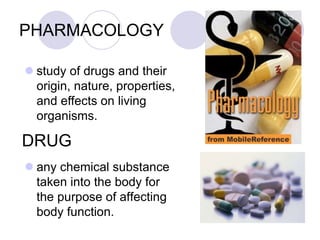
PHARMACOLOGY
 any chemical substance
taken into the body for
the purpose of affecting
body function.
DRUG
 study of drugs and their
origin, nature, properties,
and effects on living
organisms.
DRUG CLASSIFICATIONS
Each drug can be categorized under a
broad subcategory or subcategories.
Drugs that affect the body in similar ways
are listed in the same classification.
Examples of drug classifications are
antibiotics, antihypertensives,
expectorants, laxatives, tranquilizers, etc.
Identifying Names:
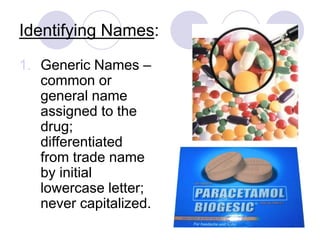
1. Generic Names –
common or
general name
assigned to the
drug;
differentiated
from trade name
by initial
lowercase letter;
never capitalized.
Identifying Names:
2. Trade Names – The name by which a
pharmaceutical company identifies its
product; is copyrighted and used
exclusively by that company; can be
distinguished from the generic name
by capitalized first letter and is often
shown on labels and references with
the symbol ® after the name (for
“registered” trademark)
Identifying Names:
3. Chemical Name – The exact molecular
formula of the drug; usually a long, very
difficult name to pronounce and of little
concern to the health care worker.
e.g. paracetamol - N-Acetyl-p-aminophenol
(Molecular formula: C8H9NO2 ;
Molecular weight: 151.2 )
Identifying Names:
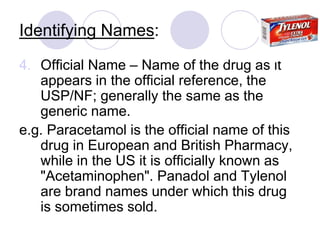
4. Official Name – Name of the drug as it
appears in the official reference, the
USP/NF; generally the same as the
generic name.
e.g. Paracetamol is the official name of this
drug in European and British Pharmacy,
while in the US it is officially known as
"Acetaminophen". Panadol and Tylenol
are brand names under which this drug
is sometimes sold.
Legal Terms Referring To Drugs:
The following terms imply the legal accessibility of
the drug:
1) OTC – over-the-counter; no purchasing
restrictions by the FDA.
2) Legend drug – prescription drug; determined
unsafe for over-the-counter purchase because
of possible harmful side effects if taken
indiscriminately; includes birth control pills,
antibiotics, cardiac drugs, hormones, etc.
3) Controlled substance – drug controlled by
prescription requirement because of the
danger of addiction or abuse; indicated in
references by schedule numbers C-I to C-IV
Terms Indicating Drug Actions:
Indications – a list of medical conditions or
diseases for which the drug is meant to be
used
e.g. diphenhydramine hydrochloride
(Benadryl), is a commonly used drug;
indications include allergic rhinitis, mild
allergic skin reactions, motion sickness,
and mild cases of parkinsonism).
Terms Indicating Drug Actions:
 Actions – a description of the cellular changes
that occur as a result of the drug. This
information tends to be very technical,
describing cellular and tissue changes. While it
is helpful to know what body system is affected
by the drug, this information is geared more for
the pharmacist.
 e.g. Benadryl, as an antihistamine, appears to
compete with histamine for cell receptor sites on
effector cells.
Terms Indicating Drug Actions:
Contraindications – A list of conditions for
which the drug should not be given
e.g. Two common contraindications for
Benadryl are pregnancy or lactating
mother.
Terms Indicating Drug Actions:
Cautions – A list of conditions or types of
patients that warrant closer observation for
specific side effects when given the drug.
e.g. Due to atropine-like activity, Benadryl
must be used cautiously with patients who
have a history of bronchial asthma or
hypertension or with older adults.
Terms Indicating Drug Actions:
 Side Effects and Adverse Reactions - a list of
possible unpleasant or dangerous secondary
effects, other than the desired effect
 e.g. Side effects of Benadryl include sedation,
dizziness, disturbed coordination, epigastric
distress, anorexia, and thickening of bronchial
secretion. There could be as many as 50 or
more side effects for one drug.
Terms Indicating Drug Actions:
Interactions – a list of other drugs or foods
that may alter the effect of the drug and
usually should not be given during the
same course of therapy
e.g. MAO (monoamine oxidase) inhibitors
will intensify the effects of Benadryl.
Terms Indicating Drug Actions:
How Supplied – lists the available forms
and strengths of the drug.
e.g. tablets (tabs): 20 mg and 40 mg;
suppository: 20 mg
Terms Indicating Drug Actions:
Usual Dosage – lists the amount of drug
considered safe for administration, the
route and the frequency of administration.
e.g. 10 mg orally every 4h (q4h)
ABBREVIATIONS
 The Institute for Safe Medication Practice (ISMP)
monitors medication administration and identifies
practices that have contributed to medication errors.
Additionally, the Joint Commission on Accreditation of
Healthcare Organizations (JCAHO) has approved a
minimum list of “dangerous” abbreviations that have
been prohibited effective January 1, 2004.
Medication orders contain six parts:
 Date
 Patient’s name
 Medication name
 Dosage or amount of medication
 Route or manner of administration (if no route is
specified, the oral route is usually the appropriate one)
 Time to be administered or frequency
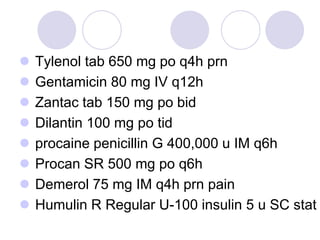
 Tylenol tab 650 mg po q4h prn
 Gentamicin 80 mg IV q12h
 Zantac tab 150 mg po bid
 Dilantin 100 mg po tid
 procaine penicillin G 400,000 u IM q6h
 Procan SR 500 mg po q6h
 Demerol 75 mg IM q4h prn pain
 Humulin R Regular U-100 insulin 5 u SC stat
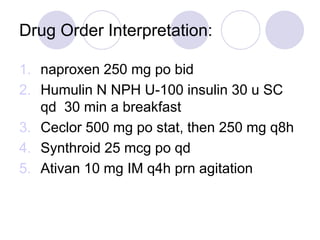
Drug Order Interpretation:
1. naproxen 250 mg po bid
2. Humulin N NPH U-100 insulin 30 u SC
qd 30 min a breakfast
3. Ceclor 500 mg po stat, then 250 mg q8h
4. Synthroid 25 mcg po qd
5. Ativan 10 mg IM q4h prn agitation
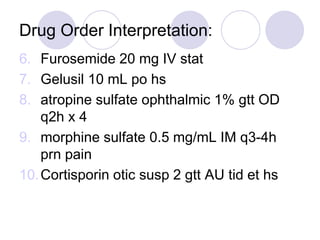
Drug Order Interpretation:
6. Furosemide 20 mg IV stat
7. Gelusil 10 mL po hs
8. atropine sulfate ophthalmic 1% gtt OD
q2h x 4
9. morphine sulfate 0.5 mg/mL IM q3-4h
prn pain
10.Cortisporin otic susp 2 gtt AU tid et hs
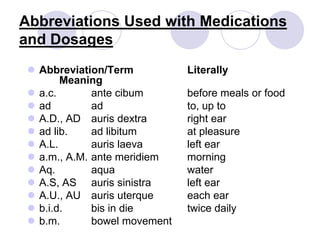
Abbreviations Used with Medications
and Dosages
 Abbreviation/Term Literally
Meaning
 a.c. ante cibum before meals or food
 ad ad to, up to
 A.D., AD auris dextra right ear
 ad lib. ad libitum at pleasure
 A.L. auris laeva left ear
 a.m., A.M. ante meridiem morning
 Aq. aqua water
 A.S, AS auris sinistra left ear
 A.U., AU auris uterque each ear
 b.i.d. bis in die twice daily
 b.m. bowel movement
Abbreviations Used with Medications
and Dosages
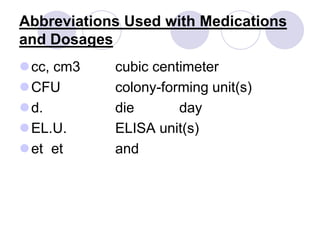
cc, cm3 cubic centimeter
CFU colony-forming unit(s)
d. die day
EL.U. ELISA unit(s)
et et and
Abbreviations Used with Medications
and Dosages
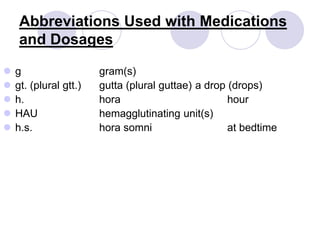
 g gram(s)
 gt. (plural gtt.) gutta (plural guttae) a drop (drops)
 h. hora hour
 HAU hemagglutinating unit(s)
 h.s. hora somni at bedtime
Abbreviations Used with Medications
and Dosages
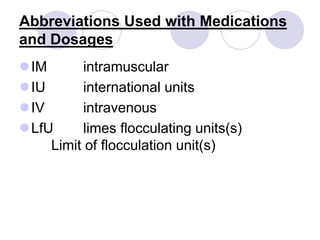
IM intramuscular
IU international units
IV intravenous
LfU limes flocculating units(s)
Limit of flocculation unit(s)
Abbreviations Used with Medications
and Dosages
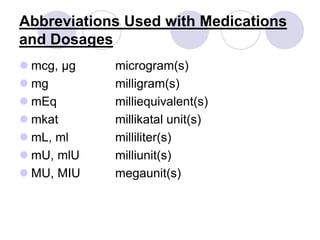
 mcg, µg microgram(s)
 mg milligram(s)
 mEq milliequivalent(s)
 mkat millikatal unit(s)
 mL, ml milliliter(s)
 mU, mlU milliunit(s)
 MU, MIU megaunit(s)
Abbreviations Used with Medications
and Dosages
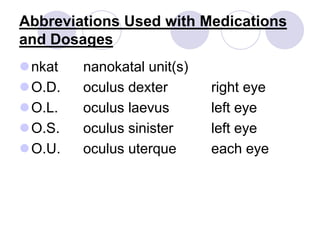
nkat nanokatal unit(s)
O.D. oculus dexter right eye
O.L. oculus laevus left eye
O.S. oculus sinister left eye
O.U. oculus uterque each eye
Abbreviations Used with Medications
and Dosages
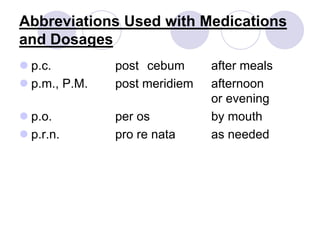
 p.c. post cebum after meals
 p.m., P.M. post meridiem afternoon
or evening
 p.o. per os by mouth
 p.r.n. pro re nata as needed
Abbreviations Used with Medications
and Dosages
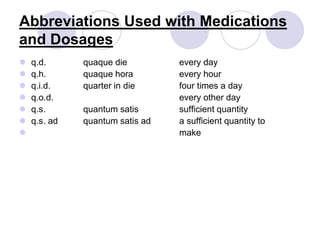
 q.d. quaque die every day
 q.h. quaque hora every hour
 q.i.d. quarter in die four times a day
 q.o.d. every other day
 q.s. quantum satis sufficient quantity
 q.s. ad quantum satis ad a sufficient quantity to
 make
Abbreviations Used with Medications
and Dosages
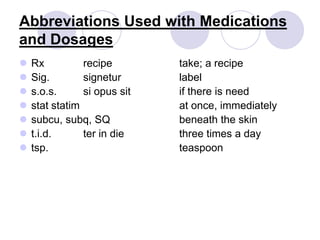
 Rx recipe take; a recipe
 Sig. signetur label
 s.o.s. si opus sit if there is need
 stat statim at once, immediately
 subcu, subq, SQ beneath the skin
 t.i.d. ter in die three times a day
 tsp. teaspoon
DRUG REGULATIONS AND DRUG LAWS
 Federal Food, Drug, and Cosmetic Act, June 25,
1938
 This law authorizes the Food and Drug
Administration (FDA) of the Department of Health
and Human Services (HHS) to determine the
safety of drugs before marketing and to ensure
that certain labeling specifications and standards
in advertising are met in the marketing of
products.
 The Food and Drug Administration (FDA) is
concerned with general safety standards in the
production of drugs, foods, and cosmetics.
Responsible for approval and removal of products
on the market.
DRUG REGULATIONS AND DRUG LAWS
 Controlled Substances Act, 1970
 This law is designed to improve the
administration and regulation of
manufacturing, distributing, and dispensing
of drugs that have been found necessary to
be controlled.
 The Drug Enforcement Administration
(DEA) is a bureau of the Department of
Justice was organized to enforce laws
against drug activities, including illegal drug
use, dealing and manufacturing.
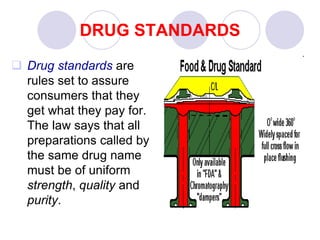
DRUG STANDARDS
 Drug standards are
rules set to assure
consumers that they
get what they pay for.
The law says that all
preparations called by
the same drug name
must be of uniform
strength, quality and
purity.
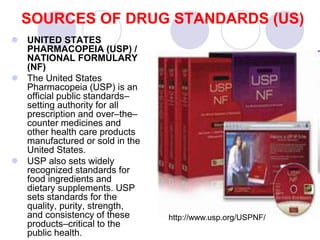
SOURCES OF DRUG STANDARDS (US)
 UNITED STATES
PHARMACOPEIA (USP) /
NATIONAL FORMULARY
(NF)
 The United States
Pharmacopeia (USP) is an
official public standards–
setting authority for all
prescription and over–the–
counter medicines and
other health care products
manufactured or sold in the
United States.
 USP also sets widely
recognized standards for
food ingredients and
dietary supplements. USP
sets standards for the
quality, purity, strength,
and consistency of these
products–critical to the
public health.
http://www.usp.org/USPNF/
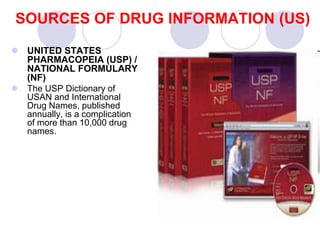
SOURCES OF DRUG INFORMATION (US)
 UNITED STATES
PHARMACOPEIA (USP) /
NATIONAL FORMULARY
(NF)
 The USP Dictionary of
USAN and International
Drug Names, published
annually, is a complication
of more than 10,000 drug
names.
SOURCES OF DRUG INFORMATION (US)
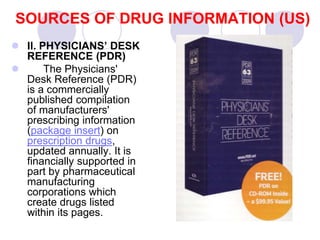
 II. PHYSICIANS’ DESK
REFERENCE (PDR)
 The Physicians'
Desk Reference (PDR)
is a commercially
published compilation
of manufacturers'
prescribing information
(package insert) on
prescription drugs,
updated annually. It is
financially supported in
part by pharmaceutical
manufacturing
corporations which
create drugs listed
within its pages.
SOURCES OF DRUG INFORMATION (US)
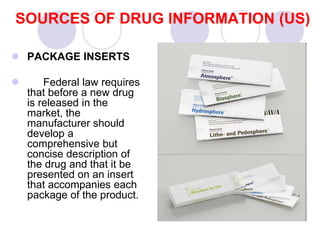
 PACKAGE INSERTS
 Federal law requires
that before a new drug
is released in the
market, the
manufacturer should
develop a
comprehensive but
concise description of
the drug and that it be
presented on an insert
that accompanies each
package of the product.
SOURCES OF DRUG INFORMATION (US)
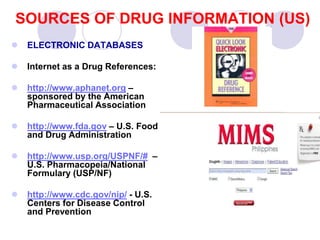
 ELECTRONIC DATABASES
 Internet as a Drug References:
 http://www.aphanet.org –
sponsored by the American
Pharmaceutical Association
 http://www.fda.gov – U.S. Food
and Drug Administration
 http://www.usp.org/USPNF/# –
U.S. Pharmacopeia/National
Formulary (USP/NF)
 http://www.cdc.gov/nip/ - U.S.
Centers for Disease Control
and Prevention
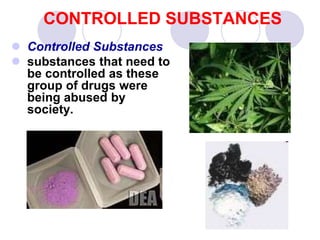
CONTROLLED SUBSTANCES
 Controlled Substances
 substances that need to
be controlled as these
group of drugs were
being abused by
society.
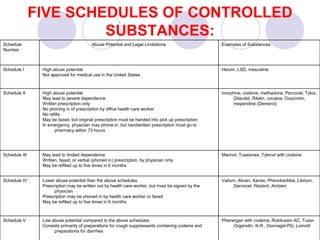
FIVE SCHEDULES OF CONTROLLED
SUBSTANCES:
Schedule
Number
Abuse Potential and Legal Limitations Examples of Substances
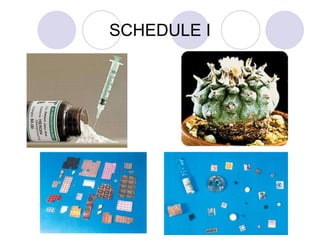
Schedule I High abuse potential
Not approved for medical use in the United States
Heroin, LSD, mescaline
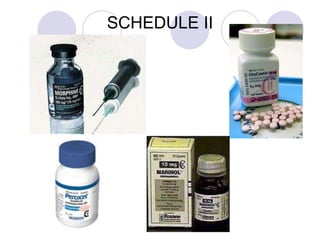
Schedule II High abuse potential
May lead to severe dependence
Written prescription only
No phoning in of prescription by office health care worker
No refills
May be faxed, but original prescription must be handed into pick up prescription
In emergency, physician may phone in, but handwritten prescription must go to
pharmacy within 72 hours
morphine, codeine, methadone, Percocet, Tylox,
Dilaudid, Ritalin, cocaine, Oxycontin,
meperidine (Demerol)
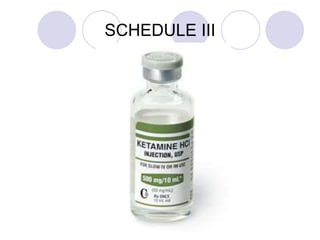
Schedule III May lead to limited dependence
Written, faxed, or verbal (phoned in) prescription, by physician only
May be refilled up to five times in 6 months
Marinol, Tussionex, Tylenol with codeine
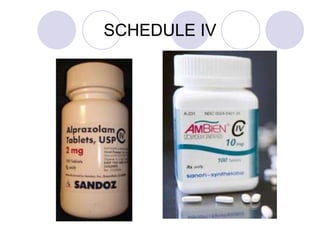
Schedule IV Lower abuse potential than the above schedules
Prescription may be written out by health care worker, but must be signed by the
physician
Prescription may be phoned in by health care worker or faxed
May be refilled up to five times in 6 months
Valium, Ativan, Xanax, Phenobarbital, Librium,
Darvocet, Restoril, Ambien
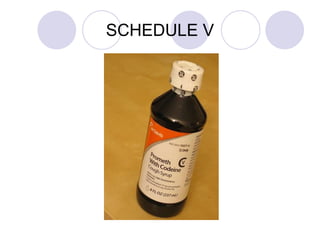
Schedule V Low abuse potential compared to the above schedules
Consists primarily of preparations for cough suppressants containing codeine and
preparations for diarrhea
Phenergan with codeine, Robitussin AC, Tussi-
Organidin, N.R., Donnagel-PG, Lomotil
SCHEDULE I
SCHEDULE II
SCHEDULE III
SCHEDULE IV
SCHEDULE V
PRESCRIPTION
A prescription order is written for
diagnosis, prevention of treatment of a
specific patient’s disease
Is written by a licensed practitioner
Is written as part of a proper physician-patient
relationship
Is a legal document, “prima facie”evidence in a
court of law
DRUG ORDER
 A drug order (prescription) includes the
patient’s name, name of the drug, the
dose, route of administration, and
frequency of administration.
This order must be written by a health
professional licensed by the state to
practice as a physician, dentist, advance
nurse practitioner or physician’s assistant.
DRUG ORDER
 The pharmacist who fills the order by
providing the medication ordered by the
prescriber is also licensed by the state.
A pharmacist cannot write an order or
administer medications to patients.
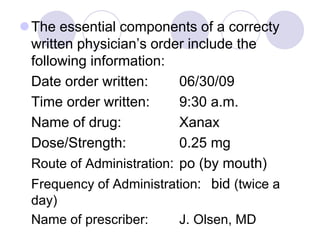
The essential components of a correcty
written physician’s order include the
following information:
Date order written: 06/30/09
Time order written: 9:30 a.m.
Name of drug: Xanax
Dose/Strength: 0.25 mg
Route of Administration: po (by mouth)
Frequency of Administration: bid (twice a
day)
Name of prescriber: J. Olsen, MD
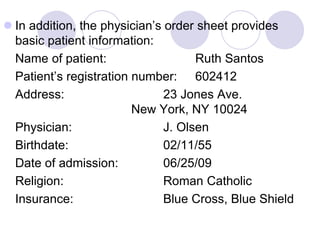
 In addition, the physician’s order sheet provides
basic patient information:
Name of patient: Ruth Santos
Patient’s registration number: 602412
Address: 23 Jones Ave.
New York, NY 10024
Physician: J. Olsen
Birthdate: 02/11/55
Date of admission: 06/25/09
Religion: Roman Catholic
Insurance: Blue Cross, Blue Shield
DRUG LABELS
 You will need to understand the
information found on drug labels in order
to calculate drug dosages and to ensure
that a drug is prepared and administered
safely.
 Every drug label provides the same kinds
of information.
1. The manufacturer: The company that made
the drug.
2. National drug code (NDC) number: An
identifying number assigned to this drug by the
Drug Enforcement agency.
3. Name and form of drug.
4. Directions for mixing.
5. Dosage recommendations:
6. USP: This means that the drug is prepared
according to the standards set by the United
States Pharmacopeia, which specifies the
accepted formulations for drugs available in
the US.
7. Amount of drug per dose.
8. Volume of the reconstituted drug..
9. Storage directions.
10. Expiration date.
Warning: Always read the expiration date.
after the expiration date, the drug may
lose its potency or act differently in the
patient’s body. Discard expired drugs.
Never give them to patients.
DRUG PACKAGE INSERTS
 It contains complex descriptions of a
drug’s chemistry and how it acts in the
body.
 The pharmaceutical manufacturer
includes a package insert with each
container of a prescription drug.
 The information on a drug package insert
is intended for the physician, pharmacist,
or drug administrator.
DRUG PACKAGE INSERTS
 Consult the package insert when you
need detailed information about:
Mixing and storing a drug
Preparing a drug dose
When the drug should not be used
Side effects and adverse reactions
Types of Information on Drug Package
Inserts
 Name of pharmaceutical company
 Name of the drug
 Strength of drug and clinical formulation
 Clinical pharmacology
 How the drug acts in the body
 Indications for using the drug
 The conditions the drug is approved to treat.
 Contraindications
 Conditions under which the drug must not be
given.

Math_Part 1.ppt

  • 1.
    MS. ALLIS G.CAÑADA R.N.
  • 2.
    COURSE CONTENT: I. DEFINITIONS,NAMES, STANDARDS AND INFORMATION SOURCES II. SOURCES AND BODILY EFFECTS OF DRUGS III. MEDICATION PREPARATIONS AND SUPPLIES IV. SAFE DOSAGE PREPARATIONS
  • 3.
    PHARMACOLOGY  any chemicalsubstance taken into the body for the purpose of affecting body function. DRUG  study of drugs and their origin, nature, properties, and effects on living organisms.
  • 4.
    DRUG CLASSIFICATIONS Each drugcan be categorized under a broad subcategory or subcategories. Drugs that affect the body in similar ways are listed in the same classification. Examples of drug classifications are antibiotics, antihypertensives, expectorants, laxatives, tranquilizers, etc.
  • 5.
    Identifying Names: 1. GenericNames – common or general name assigned to the drug; differentiated from trade name by initial lowercase letter; never capitalized.
  • 6.
    Identifying Names: 2. TradeNames – The name by which a pharmaceutical company identifies its product; is copyrighted and used exclusively by that company; can be distinguished from the generic name by capitalized first letter and is often shown on labels and references with the symbol ® after the name (for “registered” trademark)
  • 7.
    Identifying Names: 3. ChemicalName – The exact molecular formula of the drug; usually a long, very difficult name to pronounce and of little concern to the health care worker. e.g. paracetamol - N-Acetyl-p-aminophenol (Molecular formula: C8H9NO2 ; Molecular weight: 151.2 )
  • 8.
    Identifying Names: 4. OfficialName – Name of the drug as it appears in the official reference, the USP/NF; generally the same as the generic name. e.g. Paracetamol is the official name of this drug in European and British Pharmacy, while in the US it is officially known as "Acetaminophen". Panadol and Tylenol are brand names under which this drug is sometimes sold.
  • 9.
    Legal Terms ReferringTo Drugs: The following terms imply the legal accessibility of the drug: 1) OTC – over-the-counter; no purchasing restrictions by the FDA. 2) Legend drug – prescription drug; determined unsafe for over-the-counter purchase because of possible harmful side effects if taken indiscriminately; includes birth control pills, antibiotics, cardiac drugs, hormones, etc. 3) Controlled substance – drug controlled by prescription requirement because of the danger of addiction or abuse; indicated in references by schedule numbers C-I to C-IV
  • 11.
    Terms Indicating DrugActions: Indications – a list of medical conditions or diseases for which the drug is meant to be used e.g. diphenhydramine hydrochloride (Benadryl), is a commonly used drug; indications include allergic rhinitis, mild allergic skin reactions, motion sickness, and mild cases of parkinsonism).
  • 12.
    Terms Indicating DrugActions:  Actions – a description of the cellular changes that occur as a result of the drug. This information tends to be very technical, describing cellular and tissue changes. While it is helpful to know what body system is affected by the drug, this information is geared more for the pharmacist.  e.g. Benadryl, as an antihistamine, appears to compete with histamine for cell receptor sites on effector cells.
  • 13.
    Terms Indicating DrugActions: Contraindications – A list of conditions for which the drug should not be given e.g. Two common contraindications for Benadryl are pregnancy or lactating mother.
  • 14.
    Terms Indicating DrugActions: Cautions – A list of conditions or types of patients that warrant closer observation for specific side effects when given the drug. e.g. Due to atropine-like activity, Benadryl must be used cautiously with patients who have a history of bronchial asthma or hypertension or with older adults.
  • 15.
    Terms Indicating DrugActions:  Side Effects and Adverse Reactions - a list of possible unpleasant or dangerous secondary effects, other than the desired effect  e.g. Side effects of Benadryl include sedation, dizziness, disturbed coordination, epigastric distress, anorexia, and thickening of bronchial secretion. There could be as many as 50 or more side effects for one drug.
  • 16.
    Terms Indicating DrugActions: Interactions – a list of other drugs or foods that may alter the effect of the drug and usually should not be given during the same course of therapy e.g. MAO (monoamine oxidase) inhibitors will intensify the effects of Benadryl.
  • 17.
    Terms Indicating DrugActions: How Supplied – lists the available forms and strengths of the drug. e.g. tablets (tabs): 20 mg and 40 mg; suppository: 20 mg
  • 18.
    Terms Indicating DrugActions: Usual Dosage – lists the amount of drug considered safe for administration, the route and the frequency of administration. e.g. 10 mg orally every 4h (q4h)
  • 19.
    ABBREVIATIONS  The Institutefor Safe Medication Practice (ISMP) monitors medication administration and identifies practices that have contributed to medication errors. Additionally, the Joint Commission on Accreditation of Healthcare Organizations (JCAHO) has approved a minimum list of “dangerous” abbreviations that have been prohibited effective January 1, 2004. Medication orders contain six parts:  Date  Patient’s name  Medication name  Dosage or amount of medication  Route or manner of administration (if no route is specified, the oral route is usually the appropriate one)  Time to be administered or frequency
  • 20.
     Tylenol tab650 mg po q4h prn  Gentamicin 80 mg IV q12h  Zantac tab 150 mg po bid  Dilantin 100 mg po tid  procaine penicillin G 400,000 u IM q6h  Procan SR 500 mg po q6h  Demerol 75 mg IM q4h prn pain  Humulin R Regular U-100 insulin 5 u SC stat
  • 21.
    Drug Order Interpretation: 1.naproxen 250 mg po bid 2. Humulin N NPH U-100 insulin 30 u SC qd 30 min a breakfast 3. Ceclor 500 mg po stat, then 250 mg q8h 4. Synthroid 25 mcg po qd 5. Ativan 10 mg IM q4h prn agitation
  • 22.
    Drug Order Interpretation: 6.Furosemide 20 mg IV stat 7. Gelusil 10 mL po hs 8. atropine sulfate ophthalmic 1% gtt OD q2h x 4 9. morphine sulfate 0.5 mg/mL IM q3-4h prn pain 10.Cortisporin otic susp 2 gtt AU tid et hs
  • 23.
    Abbreviations Used withMedications and Dosages  Abbreviation/Term Literally Meaning  a.c. ante cibum before meals or food  ad ad to, up to  A.D., AD auris dextra right ear  ad lib. ad libitum at pleasure  A.L. auris laeva left ear  a.m., A.M. ante meridiem morning  Aq. aqua water  A.S, AS auris sinistra left ear  A.U., AU auris uterque each ear  b.i.d. bis in die twice daily  b.m. bowel movement
  • 24.
    Abbreviations Used withMedications and Dosages cc, cm3 cubic centimeter CFU colony-forming unit(s) d. die day EL.U. ELISA unit(s) et et and
  • 25.
    Abbreviations Used withMedications and Dosages  g gram(s)  gt. (plural gtt.) gutta (plural guttae) a drop (drops)  h. hora hour  HAU hemagglutinating unit(s)  h.s. hora somni at bedtime
  • 26.
    Abbreviations Used withMedications and Dosages IM intramuscular IU international units IV intravenous LfU limes flocculating units(s) Limit of flocculation unit(s)
  • 27.
    Abbreviations Used withMedications and Dosages  mcg, µg microgram(s)  mg milligram(s)  mEq milliequivalent(s)  mkat millikatal unit(s)  mL, ml milliliter(s)  mU, mlU milliunit(s)  MU, MIU megaunit(s)
  • 28.
    Abbreviations Used withMedications and Dosages nkat nanokatal unit(s) O.D. oculus dexter right eye O.L. oculus laevus left eye O.S. oculus sinister left eye O.U. oculus uterque each eye
  • 29.
    Abbreviations Used withMedications and Dosages  p.c. post cebum after meals  p.m., P.M. post meridiem afternoon or evening  p.o. per os by mouth  p.r.n. pro re nata as needed
  • 30.
    Abbreviations Used withMedications and Dosages  q.d. quaque die every day  q.h. quaque hora every hour  q.i.d. quarter in die four times a day  q.o.d. every other day  q.s. quantum satis sufficient quantity  q.s. ad quantum satis ad a sufficient quantity to  make
  • 31.
    Abbreviations Used withMedications and Dosages  Rx recipe take; a recipe  Sig. signetur label  s.o.s. si opus sit if there is need  stat statim at once, immediately  subcu, subq, SQ beneath the skin  t.i.d. ter in die three times a day  tsp. teaspoon
  • 32.
    DRUG REGULATIONS ANDDRUG LAWS  Federal Food, Drug, and Cosmetic Act, June 25, 1938  This law authorizes the Food and Drug Administration (FDA) of the Department of Health and Human Services (HHS) to determine the safety of drugs before marketing and to ensure that certain labeling specifications and standards in advertising are met in the marketing of products.  The Food and Drug Administration (FDA) is concerned with general safety standards in the production of drugs, foods, and cosmetics. Responsible for approval and removal of products on the market.
  • 33.
    DRUG REGULATIONS ANDDRUG LAWS  Controlled Substances Act, 1970  This law is designed to improve the administration and regulation of manufacturing, distributing, and dispensing of drugs that have been found necessary to be controlled.  The Drug Enforcement Administration (DEA) is a bureau of the Department of Justice was organized to enforce laws against drug activities, including illegal drug use, dealing and manufacturing.
  • 34.
    DRUG STANDARDS  Drugstandards are rules set to assure consumers that they get what they pay for. The law says that all preparations called by the same drug name must be of uniform strength, quality and purity.
  • 35.
    SOURCES OF DRUGSTANDARDS (US)  UNITED STATES PHARMACOPEIA (USP) / NATIONAL FORMULARY (NF)  The United States Pharmacopeia (USP) is an official public standards– setting authority for all prescription and over–the– counter medicines and other health care products manufactured or sold in the United States.  USP also sets widely recognized standards for food ingredients and dietary supplements. USP sets standards for the quality, purity, strength, and consistency of these products–critical to the public health. http://www.usp.org/USPNF/
  • 36.
    SOURCES OF DRUGINFORMATION (US)  UNITED STATES PHARMACOPEIA (USP) / NATIONAL FORMULARY (NF)  The USP Dictionary of USAN and International Drug Names, published annually, is a complication of more than 10,000 drug names.
  • 37.
    SOURCES OF DRUGINFORMATION (US)  II. PHYSICIANS’ DESK REFERENCE (PDR)  The Physicians' Desk Reference (PDR) is a commercially published compilation of manufacturers' prescribing information (package insert) on prescription drugs, updated annually. It is financially supported in part by pharmaceutical manufacturing corporations which create drugs listed within its pages.
  • 38.
    SOURCES OF DRUGINFORMATION (US)  PACKAGE INSERTS  Federal law requires that before a new drug is released in the market, the manufacturer should develop a comprehensive but concise description of the drug and that it be presented on an insert that accompanies each package of the product.
  • 39.
    SOURCES OF DRUGINFORMATION (US)  ELECTRONIC DATABASES  Internet as a Drug References:  http://www.aphanet.org – sponsored by the American Pharmaceutical Association  http://www.fda.gov – U.S. Food and Drug Administration  http://www.usp.org/USPNF/# – U.S. Pharmacopeia/National Formulary (USP/NF)  http://www.cdc.gov/nip/ - U.S. Centers for Disease Control and Prevention
  • 40.
    CONTROLLED SUBSTANCES  ControlledSubstances  substances that need to be controlled as these group of drugs were being abused by society.
  • 41.
    FIVE SCHEDULES OFCONTROLLED SUBSTANCES: Schedule Number Abuse Potential and Legal Limitations Examples of Substances Schedule I High abuse potential Not approved for medical use in the United States Heroin, LSD, mescaline Schedule II High abuse potential May lead to severe dependence Written prescription only No phoning in of prescription by office health care worker No refills May be faxed, but original prescription must be handed into pick up prescription In emergency, physician may phone in, but handwritten prescription must go to pharmacy within 72 hours morphine, codeine, methadone, Percocet, Tylox, Dilaudid, Ritalin, cocaine, Oxycontin, meperidine (Demerol) Schedule III May lead to limited dependence Written, faxed, or verbal (phoned in) prescription, by physician only May be refilled up to five times in 6 months Marinol, Tussionex, Tylenol with codeine Schedule IV Lower abuse potential than the above schedules Prescription may be written out by health care worker, but must be signed by the physician Prescription may be phoned in by health care worker or faxed May be refilled up to five times in 6 months Valium, Ativan, Xanax, Phenobarbital, Librium, Darvocet, Restoril, Ambien Schedule V Low abuse potential compared to the above schedules Consists primarily of preparations for cough suppressants containing codeine and preparations for diarrhea Phenergan with codeine, Robitussin AC, Tussi- Organidin, N.R., Donnagel-PG, Lomotil
  • 42.
  • 43.
  • 44.
  • 45.
  • 46.
  • 47.
    PRESCRIPTION A prescription orderis written for diagnosis, prevention of treatment of a specific patient’s disease Is written by a licensed practitioner Is written as part of a proper physician-patient relationship Is a legal document, “prima facie”evidence in a court of law
  • 48.
    DRUG ORDER  Adrug order (prescription) includes the patient’s name, name of the drug, the dose, route of administration, and frequency of administration. This order must be written by a health professional licensed by the state to practice as a physician, dentist, advance nurse practitioner or physician’s assistant.
  • 49.
    DRUG ORDER  Thepharmacist who fills the order by providing the medication ordered by the prescriber is also licensed by the state. A pharmacist cannot write an order or administer medications to patients.
  • 50.
    The essential componentsof a correcty written physician’s order include the following information: Date order written: 06/30/09 Time order written: 9:30 a.m. Name of drug: Xanax Dose/Strength: 0.25 mg Route of Administration: po (by mouth) Frequency of Administration: bid (twice a day) Name of prescriber: J. Olsen, MD
  • 51.
     In addition,the physician’s order sheet provides basic patient information: Name of patient: Ruth Santos Patient’s registration number: 602412 Address: 23 Jones Ave. New York, NY 10024 Physician: J. Olsen Birthdate: 02/11/55 Date of admission: 06/25/09 Religion: Roman Catholic Insurance: Blue Cross, Blue Shield
  • 52.
    DRUG LABELS  Youwill need to understand the information found on drug labels in order to calculate drug dosages and to ensure that a drug is prepared and administered safely.  Every drug label provides the same kinds of information.
  • 53.
    1. The manufacturer:The company that made the drug. 2. National drug code (NDC) number: An identifying number assigned to this drug by the Drug Enforcement agency. 3. Name and form of drug. 4. Directions for mixing. 5. Dosage recommendations: 6. USP: This means that the drug is prepared according to the standards set by the United States Pharmacopeia, which specifies the accepted formulations for drugs available in the US.
  • 54.
    7. Amount ofdrug per dose. 8. Volume of the reconstituted drug.. 9. Storage directions. 10. Expiration date. Warning: Always read the expiration date. after the expiration date, the drug may lose its potency or act differently in the patient’s body. Discard expired drugs. Never give them to patients.
  • 55.
    DRUG PACKAGE INSERTS It contains complex descriptions of a drug’s chemistry and how it acts in the body.  The pharmaceutical manufacturer includes a package insert with each container of a prescription drug.  The information on a drug package insert is intended for the physician, pharmacist, or drug administrator.
  • 56.
    DRUG PACKAGE INSERTS Consult the package insert when you need detailed information about: Mixing and storing a drug Preparing a drug dose When the drug should not be used Side effects and adverse reactions
  • 57.
    Types of Informationon Drug Package Inserts  Name of pharmaceutical company  Name of the drug  Strength of drug and clinical formulation  Clinical pharmacology  How the drug acts in the body  Indications for using the drug  The conditions the drug is approved to treat.  Contraindications  Conditions under which the drug must not be given.