What is apolynomial?
It is a kind of algebraic expression where each
term is a constant, a variable or a product of a
constant and a variable in which the variable has
a whole number (non-negative number)
exponent.
3.
Polynomials
• The variablesin
the terms of any
polynomial must
be raised to a
whole number;
that means no
square roots, no
fraction exponents,
and no negative
exponents.
• Also, there must
not be any
variables in the
denominator.
4.
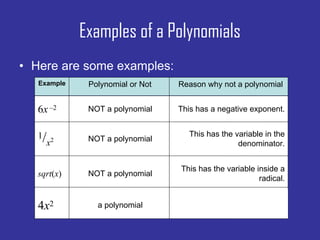
Examples of aPolynomials
• Here are some examples:
a polynomial
4x2
This has the variable inside a
radical.
NOT a polynomial
sqrt(x)
This has the variable in the
denominator.
NOT a polynomial
1/x2
This has a negative exponent.
NOT a polynomial
6x –2
Example Polynomial or Not Reason why not a polynomial
5.
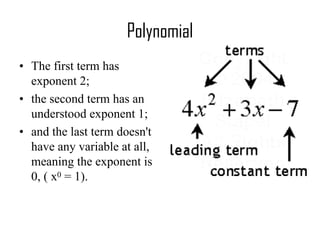
Polynomial
• The firstterm has
exponent 2;
• the second term has an
understood exponent 1;
• and the last term doesn't
have any variable at all,
meaning the exponent is
0, ( x0 = 1).
6.
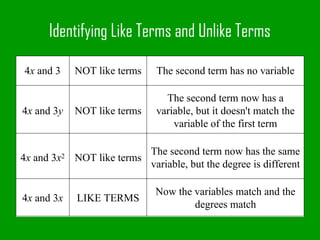
Identifying Like Termsand Unlike Terms
Now the variables match and the
degrees match
LIKE TERMS
4x and 3x
The second term now has the same
variable, but the degree is different
NOT like terms
4x and 3x2
The second term now has a
variable, but it doesn't match the
variable of the first term
NOT like terms
4x and 3y
The second term has no variable
NOT like terms
4x and 3
7.
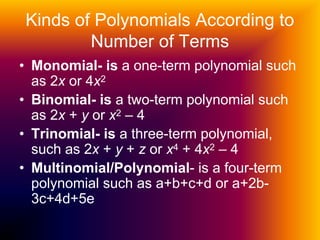
Kinds of PolynomialsAccording to
Number of Terms
• Monomial- is a one-term polynomial such
as 2x or 4x2
• Binomial- is a two-term polynomial such
as 2x + y or x2 – 4
• Trinomial- is a three-term polynomial,
such as 2x + y + z or x4 + 4x2 – 4
• Multinomial/Polynomial- is a four-term
polynomial such as a+b+c+d or a+2b-
3c+4d+5e
8.
Order of aPolynomial
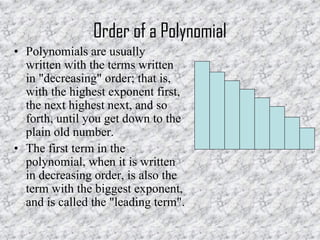
• Polynomials are usually
written with the terms written
in "decreasing" order; that is,
with the highest exponent first,
the next highest next, and so
forth, until you get down to the
plain old number.
• The first term in the
polynomial, when it is written
in decreasing order, is also the
term with the biggest exponent,
and is called the "leading term".
9.
Degree of aPolynomial
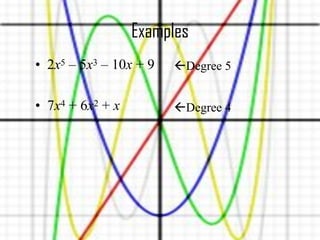
• The exponent on a term tells you the "degree"
of the term.
• The degree of the leading term tells you the
degree of the whole polynomial;
Coefficient vs. LeadingCoefficient
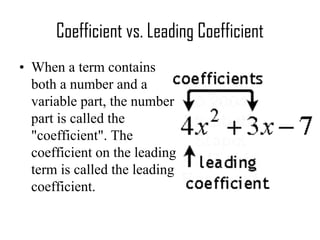
• When a term contains
both a number and a
variable part, the number
part is called the
"coefficient". The
coefficient on the leading
term is called the leading
coefficient.
12.
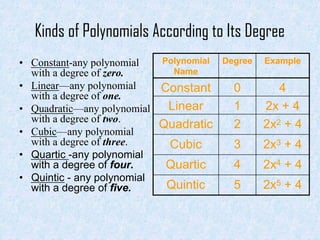
Kinds of PolynomialsAccording to Its Degree
• Constant-any polynomial
with a degree of zero.
• Linear—any polynomial
with a degree of one.
• Quadratic—any polynomial
with a degree of two.
• Cubic—any polynomial
with a degree of three.
• Quartic -any polynomial
with a degree of four.
• Quintic - any polynomial
with a degree of five.
2x3 + 4
3
Cubic
2x2 + 4
2
Quadratic
2x + 4
1
Linear
Example
Degree
Polynomial
Name
Constant 0 4
Quartic 4 2x4 + 4
Quintic 5 2x5 + 4