MATHEMATICAL
SYSTEM
- DESCRIBE AMATHEMATICAL SYSTEM; AND
- ILLUSTRATES THE NEED FOR AN AXIOMATIC STRUCTURE OF A MATHEMATICAL
SYSTEM IN GENERAL,AND IN GEOMETRY IN PARTICULAR: (A) DEFINED TERMS;
(B) UNDEFINED TERMS; (C) POSTULATES;AND (D)THEOREMS.
3.
MATHEMATICAL SYSTEM
The MathematicalSystem helps students learn the essential math
lesson of geometric proofs and congruence. The branch of
mathematics called geometry is a mathematical system. It begins
with its four classifications: undefined terms, defined terms,
postulates, and theorems. These are the building foundation in
geometry’s logical structure.
4.
FOUR CLASSIFICATIONS OFMATHEMATICAL
SYSTEM
1. UNDEFINEDTERMS
2. DEFINEDTERMS
3. POSTULATE
4. THEOREM
5.
UNDEFINED TERMS
• UndefinedTerms
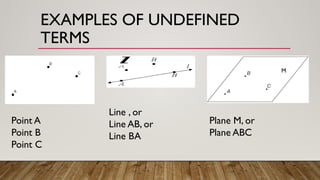
•Point: Has no dimension. Represented by a dot.
• Line: Has one dimension. Represented by a line with two arrowheads, but it
extends without end.
• Through any two points there is one distinct line.You can use any two points on a
line to name it.
• Plane: Has two dimensions. Represented by a shape that looks like a floor, but it
extends without end.
• Through any three points not on the same line, there is exactly one plane.You can
use any three points on a plane to name it (as long as they are not on the same line).
DEFINED TERMS
• DefinedTermscan be described using known words such as point
or line.
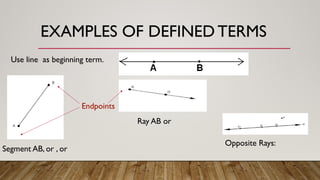
• Segment (AKA Line Segment): Consist of two endpoints and all
points on the line between those two points, and whose length is fixed.
• Ray: Consists of one endpoint and all the points in one direction on
its line, and can extends in only one-direction indefinitely.
• Angle: is a union of two rays with a common endpoint called vertex.
8.
EXAMPLES OF DEFINEDTERMS
Use line as beginning term.
Segment AB, or , or
Endpoints
Ray AB or
Opposite Rays:
DEFINED TERMS
• CollinearPoints: points that all lie on the same line
• Non-collinear Points: points not on the same line
• Coplanar Points: points in the same plane
• Non-coplanar Points: points not on the same plane
11.
EXAMPLE
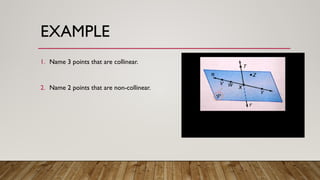
1. Name 3points that are collinear.
2. Name 2 points that are non-collinear.
12.
EXAMPLE
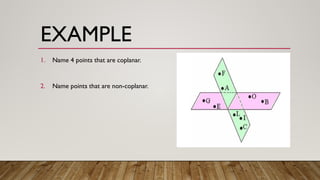
1. Name 4points that are coplanar.
2. Name points that are non-coplanar.
13.
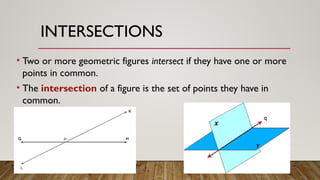
INTERSECTIONS
• Two ormore geometric figures intersect if they have one or more
points in common.
• The intersection of a figure is the set of points they have in
common.
q
PRACTICE EXERCISES
1. Nameall the points in the figure.
2. Name all the lines formed in the
figure.
3. Name the plane.
16.
PRACTICE EXERCISES
1. Nameall rays with endpoint D.Which
of these rays are opposite rays?
2. Name all the angles formed in the
figure.
3. Name all the segments in the figure.
17.
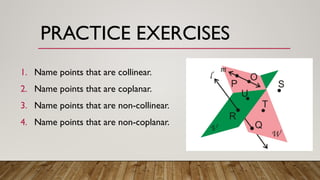
PRACTICE EXERCISES
1. Namepoints that are collinear.
2. Name points that are coplanar.
3. Name points that are non-collinear.
4. Name points that are non-coplanar.