Control System Engineering
Mathematical Modelling of Mechanical Systems
Enrollment no:-
130870111005,
130870111016,
130870111017
Guided by:
Asst.Prof. Vishal Shah
2
Model
• A model is a simplified representation or
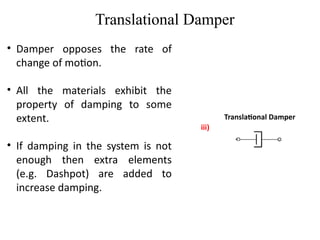
abstraction of reality.
• Reality is generally too complex to copy exactly.
• Much of the complexity is actually irrelevant in
problem solving.
What is Mathematical Model?
A set of mathematical equations (e.g., differential eqs.) that
describes the input-output behavior of a system.
What is a model used for?
• Simulation
• Prediction/Forecasting
• Prognostics/Diagnostics
• Design/Performance Evaluation
• Control System Design
4
Grey Box Model
• When input and output and some information
about the internal dynamics of the system are
known.
• Easier than white box Modelling.
u(t) y(t)
y[u(t), t]
5
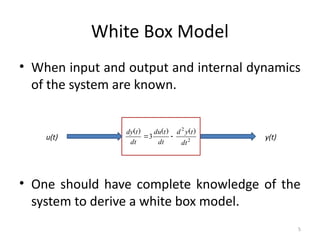
White Box Model
• When input and output and internal dynamics
of the system are known.
• One should have complete knowledge of the
system to derive a white box model.
u(t) y(t)
2
2
3
dt
t
y
d
dt
t
du
dt
t
dy )
(
)
(
)
(


6
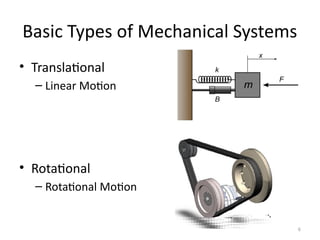
Basic Types of Mechanical Systems
• Translational
– Linear Motion
• Rotational
– Rotational Motion
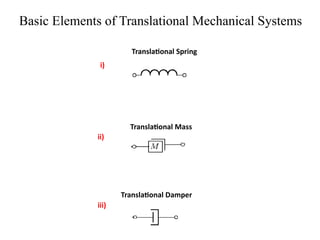
Basic Elements of Translational Mechanical Systems
Translational Spring
i)
Translational Mass
ii)
Translational Damper
iii)
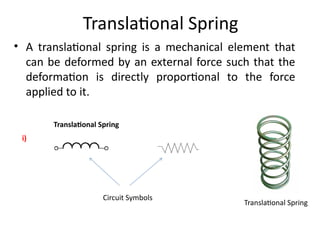
Translational Spring
i)
Circuit Symbols
Translational Spring
• A translational spring is a mechanical element that
can be deformed by an external force such that the
deformation is directly proportional to the force
applied to it.
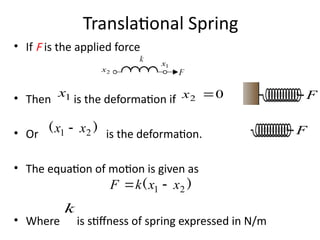
Translational Spring
• If F is the applied force
• Then is the deformation if
• Or is the deformation.
• The equation of motion is given as
• Where is stiffness of spring expressed in N/m
2
x
1
x
0
2 
x
1
x
)
( 2
1 x
x 
)
( 2
1 x
x
k
F 

k
F
F
Translational Mass
Translational Mass
ii)
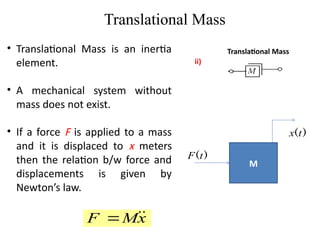
• Translational Mass is an inertia
element.
• A mechanical system without
mass does not exist.
• If a force F is applied to a mass
and it is displaced to x meters
then the relation b/w force and
displacements is given by
Newton’s law.
M
)
(t
F
)
(t
x
x
M
F 


Translational Damper
iii)
• Damper opposes the rate of
change of motion.
• All the materials exhibit the
property of damping to some
extent.
• If damping in the system is not
enough then extra elements
(e.g. Dashpot) are added to
increase damping.
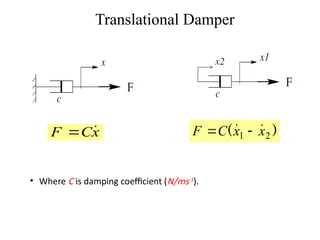
Translational Damper
x
C
F 

• Where C is damping coefficient (N/ms-1).
)
( 2
1 x
x
C
F 
 

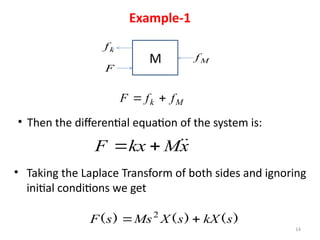
Example-1
• Consider the following system (friction is negligible)
13
• Free Body Diagram
M
F
k
f
M
f
k
F
x
M
• Where and are force applied by the spring and
inertial force respectively.
k
f M
f
14
Example-1
• Then the differential equation of the system is:
x
M
kx
F 



• Taking the Laplace Transform of both sides and ignoring
initial conditions we get
M
F
k
f
M
f
M
k f
f
F 

)
(
)
(
)
( s
kX
s
X
Ms
s
F 
 2
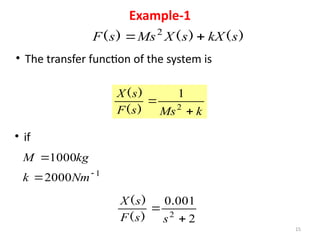
15
)
(
)
(
)
( s
kX
s
X
Ms
s
F 
 2
• The transfer function of the system is
k
Ms
s
F
s
X

 2
1
)
(
)
(
• if
1
2000
1000



Nm
k
kg
M
2
001
0
2


s
s
F
s
X .
)
(
)
(
Example-1

Mathematical MODELLING OF CONTROL SYSTEM

  • 1.
    Control System Engineering MathematicalModelling of Mechanical Systems Enrollment no:- 130870111005, 130870111016, 130870111017 Guided by: Asst.Prof. Vishal Shah
  • 2.
    2 Model • A modelis a simplified representation or abstraction of reality. • Reality is generally too complex to copy exactly. • Much of the complexity is actually irrelevant in problem solving.
  • 3.
    What is MathematicalModel? A set of mathematical equations (e.g., differential eqs.) that describes the input-output behavior of a system. What is a model used for? • Simulation • Prediction/Forecasting • Prognostics/Diagnostics • Design/Performance Evaluation • Control System Design
  • 4.
    4 Grey Box Model •When input and output and some information about the internal dynamics of the system are known. • Easier than white box Modelling. u(t) y(t) y[u(t), t]
  • 5.
    5 White Box Model •When input and output and internal dynamics of the system are known. • One should have complete knowledge of the system to derive a white box model. u(t) y(t) 2 2 3 dt t y d dt t du dt t dy ) ( ) ( ) (  
  • 6.
    6 Basic Types ofMechanical Systems • Translational – Linear Motion • Rotational – Rotational Motion
  • 7.
    Basic Elements ofTranslational Mechanical Systems Translational Spring i) Translational Mass ii) Translational Damper iii)
  • 8.
    Translational Spring i) Circuit Symbols TranslationalSpring • A translational spring is a mechanical element that can be deformed by an external force such that the deformation is directly proportional to the force applied to it. Translational Spring
  • 9.
    Translational Spring • IfF is the applied force • Then is the deformation if • Or is the deformation. • The equation of motion is given as • Where is stiffness of spring expressed in N/m 2 x 1 x 0 2  x 1 x ) ( 2 1 x x  ) ( 2 1 x x k F   k F F
  • 10.
    Translational Mass Translational Mass ii) •Translational Mass is an inertia element. • A mechanical system without mass does not exist. • If a force F is applied to a mass and it is displaced to x meters then the relation b/w force and displacements is given by Newton’s law. M ) (t F ) (t x x M F   
  • 11.
    Translational Damper Translational Damper iii) •Damper opposes the rate of change of motion. • All the materials exhibit the property of damping to some extent. • If damping in the system is not enough then extra elements (e.g. Dashpot) are added to increase damping.
  • 12.
    Translational Damper x C F   •Where C is damping coefficient (N/ms-1). ) ( 2 1 x x C F    
  • 13.
    Example-1 • Consider thefollowing system (friction is negligible) 13 • Free Body Diagram M F k f M f k F x M • Where and are force applied by the spring and inertial force respectively. k f M f
  • 14.
    14 Example-1 • Then thedifferential equation of the system is: x M kx F     • Taking the Laplace Transform of both sides and ignoring initial conditions we get M F k f M f M k f f F   ) ( ) ( ) ( s kX s X Ms s F   2
  • 15.
    15 ) ( ) ( ) ( s kX s X Ms s F  2 • The transfer function of the system is k Ms s F s X   2 1 ) ( ) ( • if 1 2000 1000    Nm k kg M 2 001 0 2   s s F s X . ) ( ) ( Example-1