Dividing
Decimals
Keys to Learn:
Division - The division is the process of
repetitive subtraction. It is the inverse of the
multiplication operation.
Decimal - A decimal is a fraction written in a special form.
A decimal is a number that consists of a whole and a
fractional part. Decimal numbers lie between integers and
represent numerical value for quantities that are whole
plus some part of a whole.
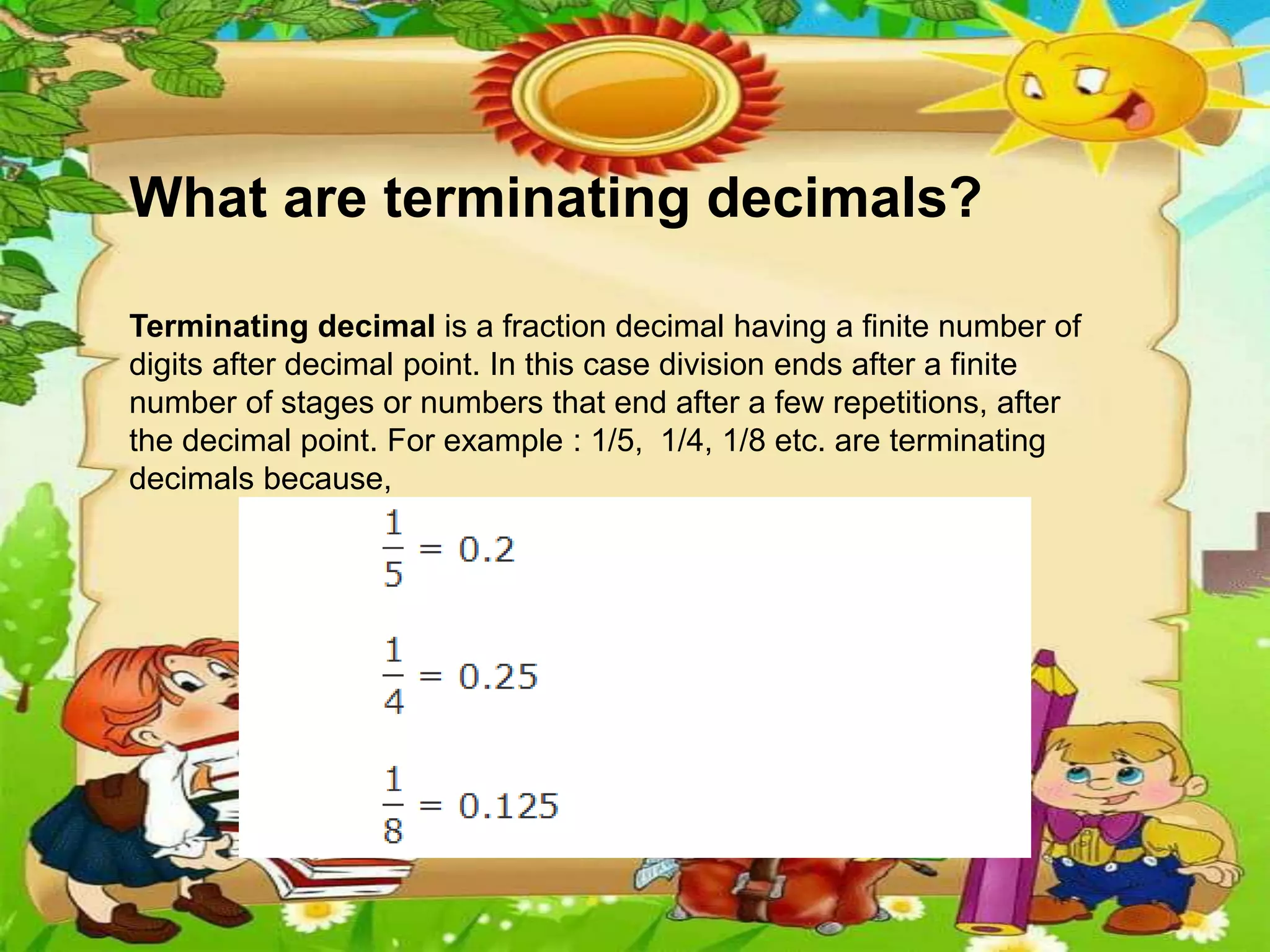
What are terminating decimals?
Terminating decimal is a fraction decimal having a finite number of
digits after decimal point. In this case division ends after a finite
number of stages or numbers that end after a few repetitions, after
the decimal point. For example : 1/5, 1/4, 1/8 etc. are terminating
decimals because,
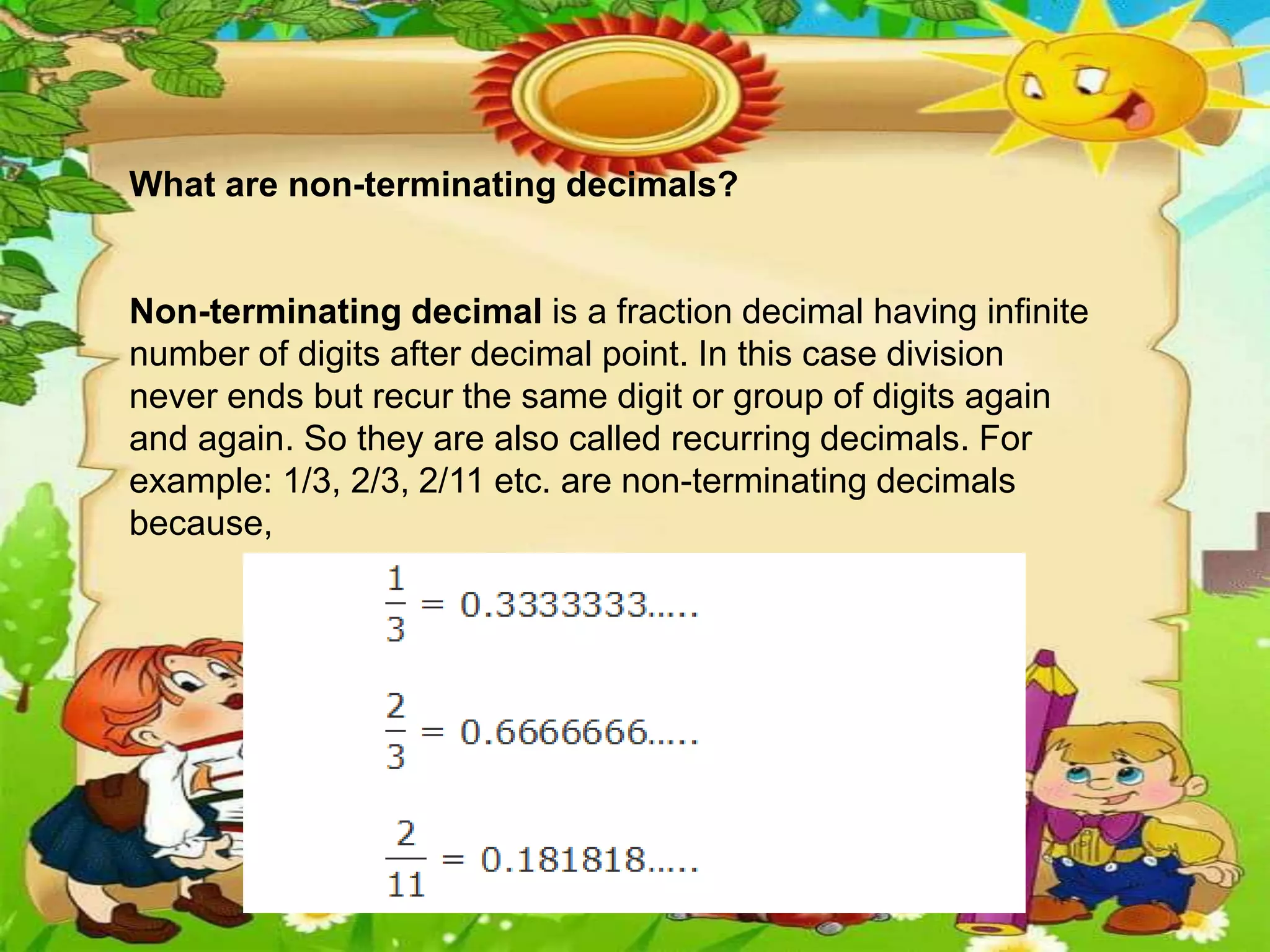
What are non-terminating decimals?
Non-terminating decimal is a fraction decimal having infinite
number of digits after decimal point. In this case division
never ends but recur the same digit or group of digits again
and again. So they are also called recurring decimals. For
example: 1/3, 2/3, 2/11 etc. are non-terminating decimals
because,
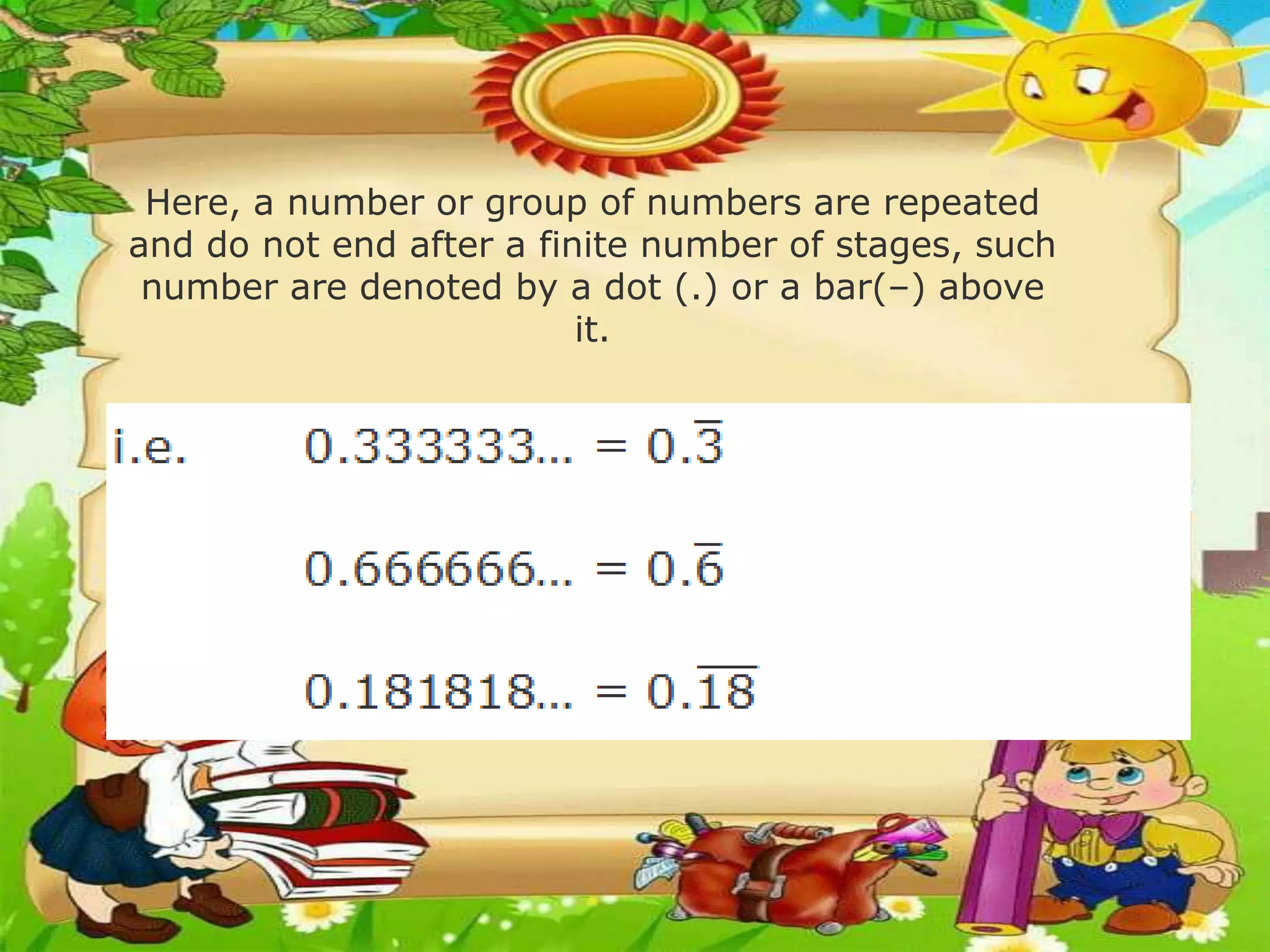
Here, a number or group of numbers are repeated
and do not end after a finite number of stages, such
number are denoted by a dot (.) or a bar(–) above
it.
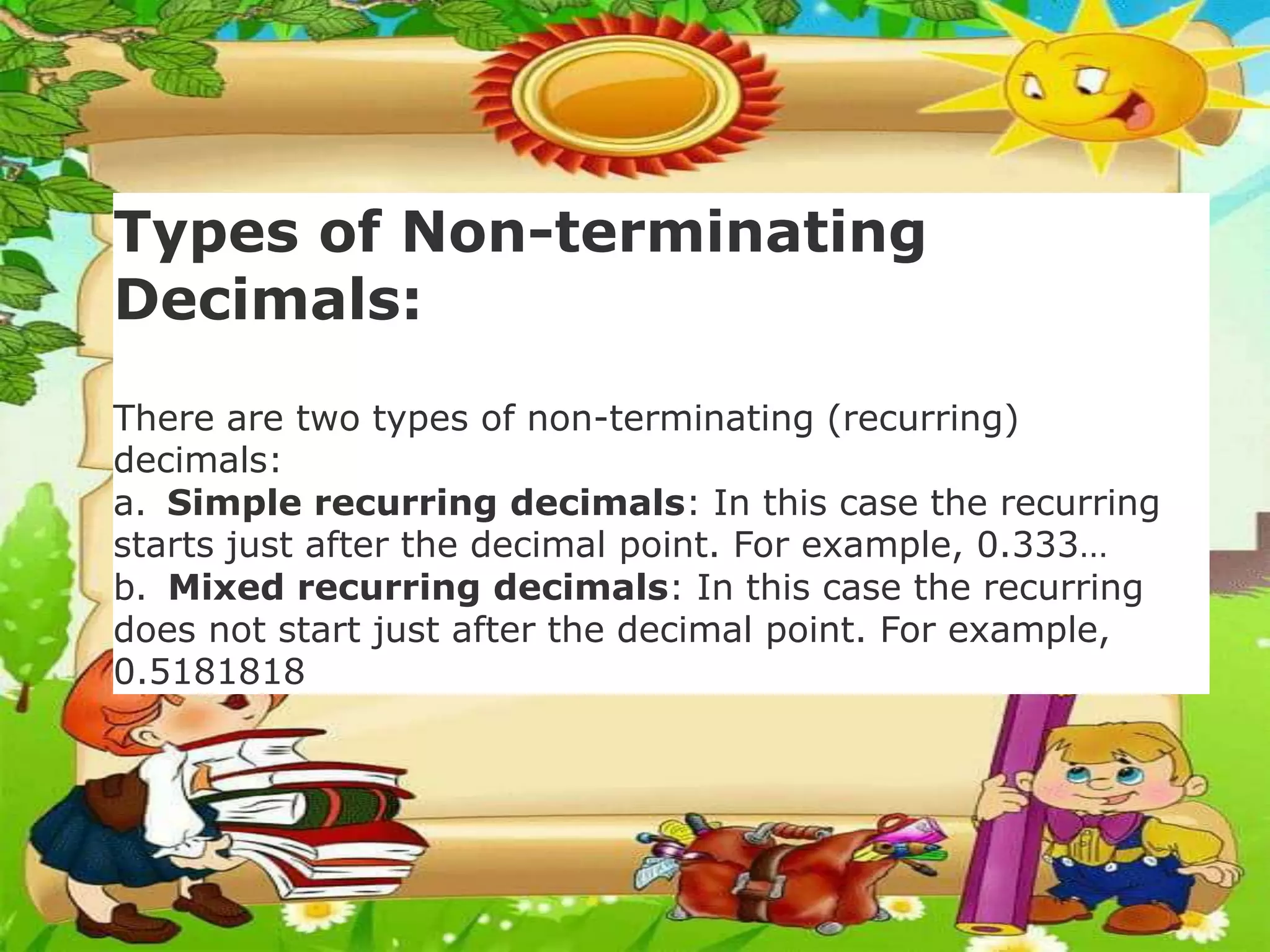
Types of Non-terminating
Decimals:
There are two types of non-terminating (recurring)
decimals:
a. Simple recurring decimals: In this case the recurring
starts just after the decimal point. For example, 0.333…
b. Mixed recurring decimals: In this case the recurring
does not start just after the decimal point. For example,
0.5181818
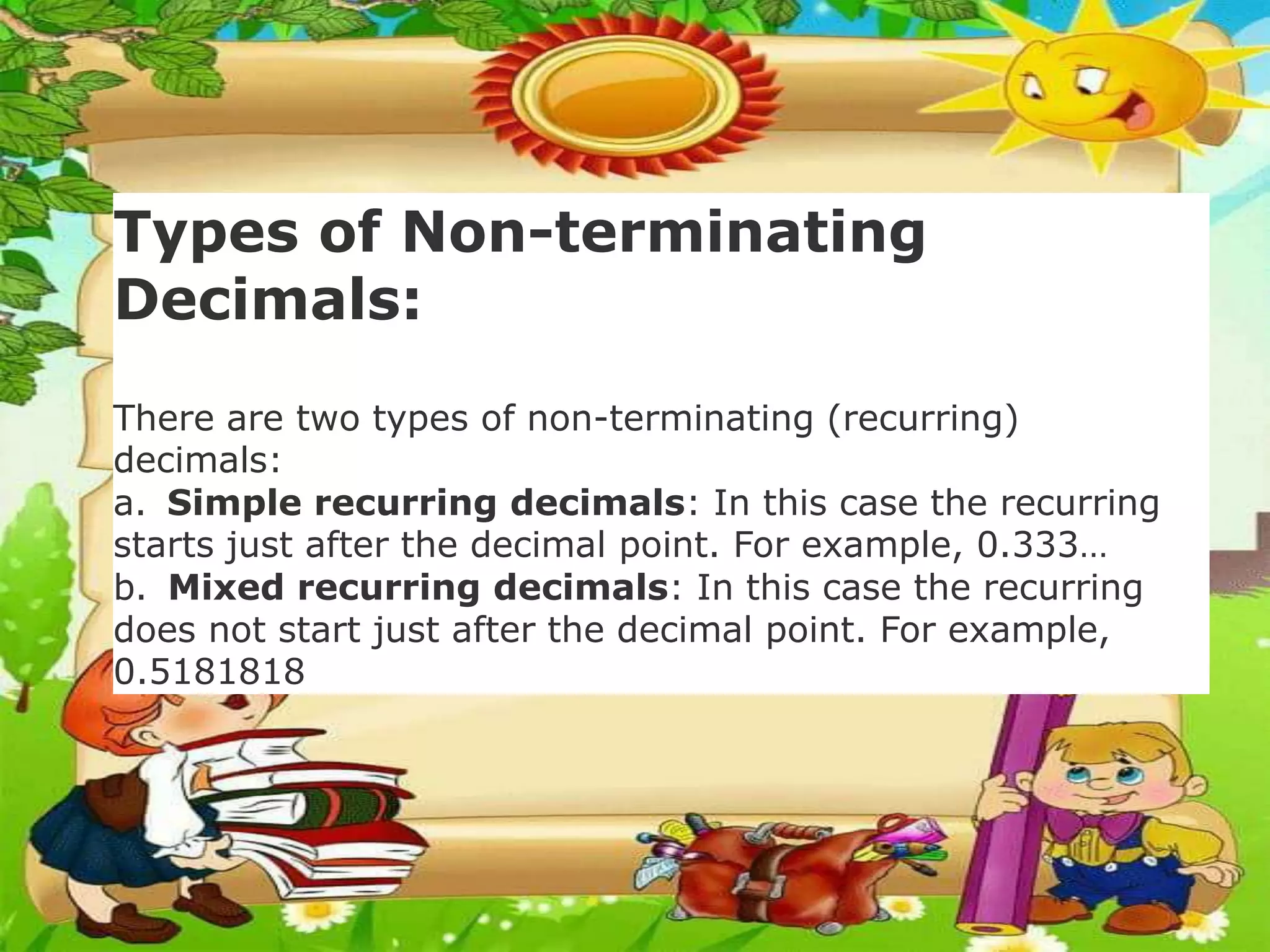
Types of Non-terminating
Decimals:
There are two types of non-terminating (recurring)
decimals:
a. Simple recurring decimals: In this case the recurring
starts just after the decimal point. For example, 0.333…
b. Mixed recurring decimals: In this case the recurring
does not start just after the decimal point. For example,
0.5181818
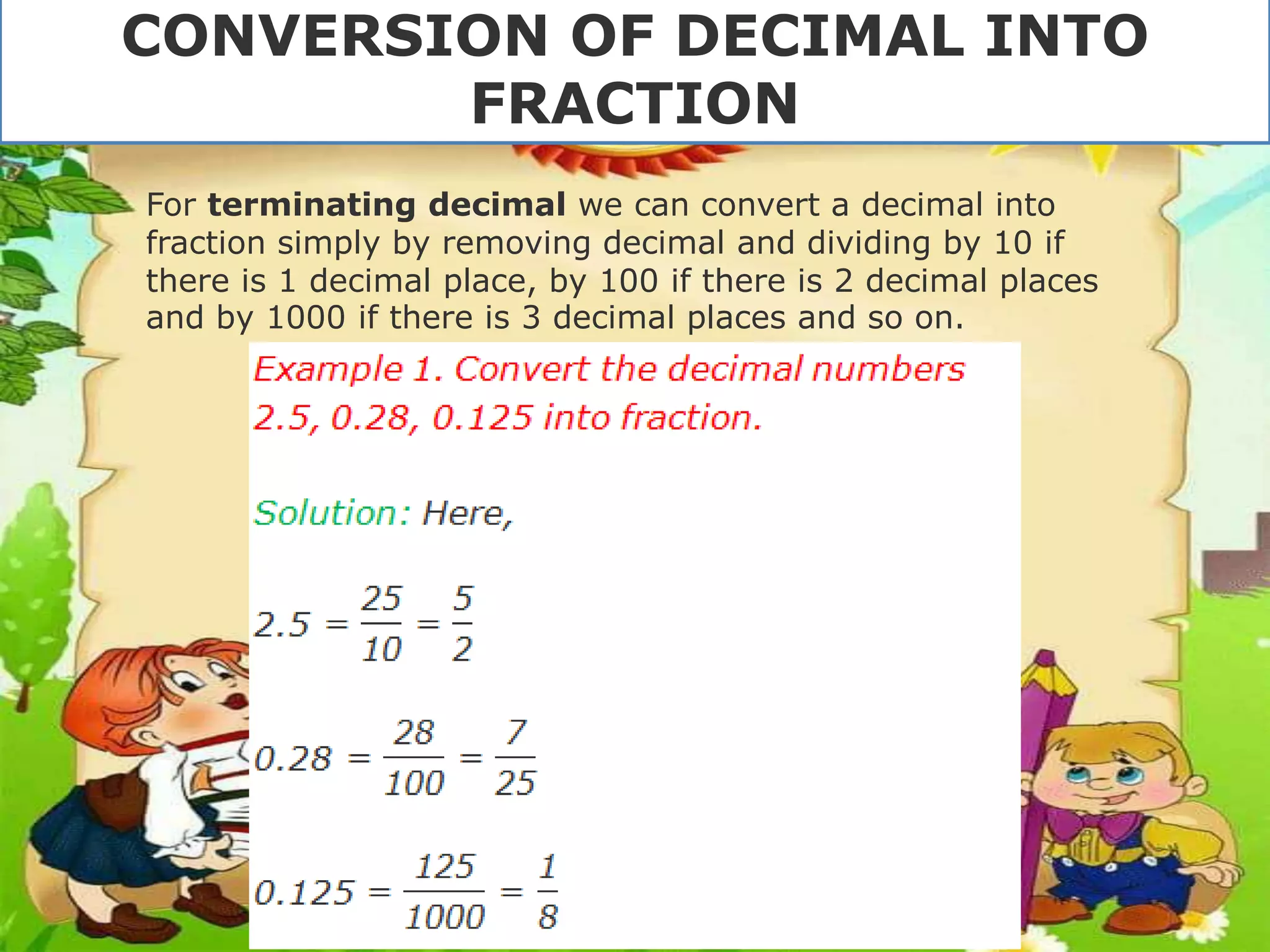
For terminating decimal we can convert a decimal into
fraction simply by removing decimal and dividing by 10 if
there is 1 decimal place, by 100 if there is 2 decimal places
and by 1000 if there is 3 decimal places and so on.
CONVERSION OF DECIMAL INTO
FRACTION
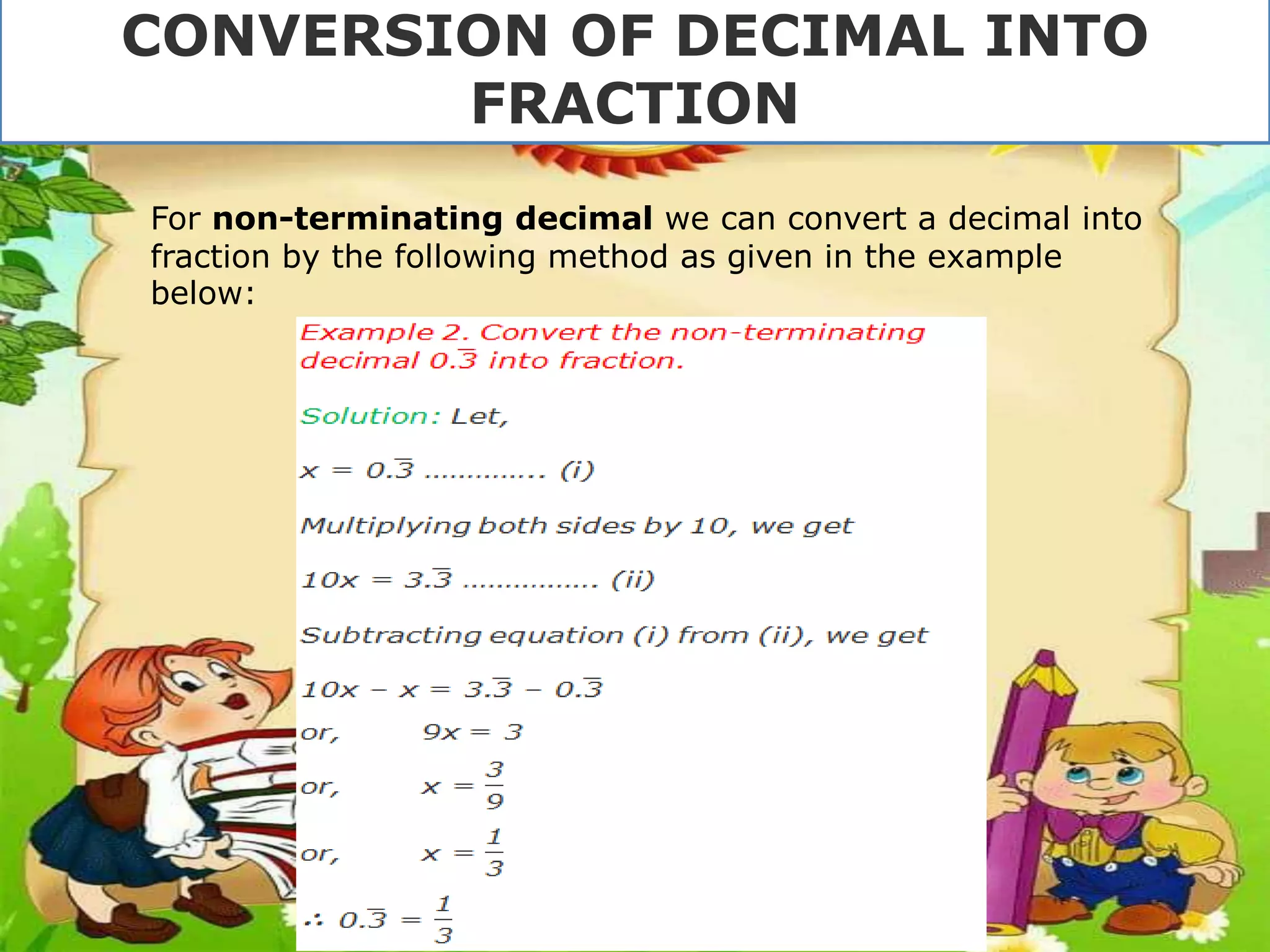
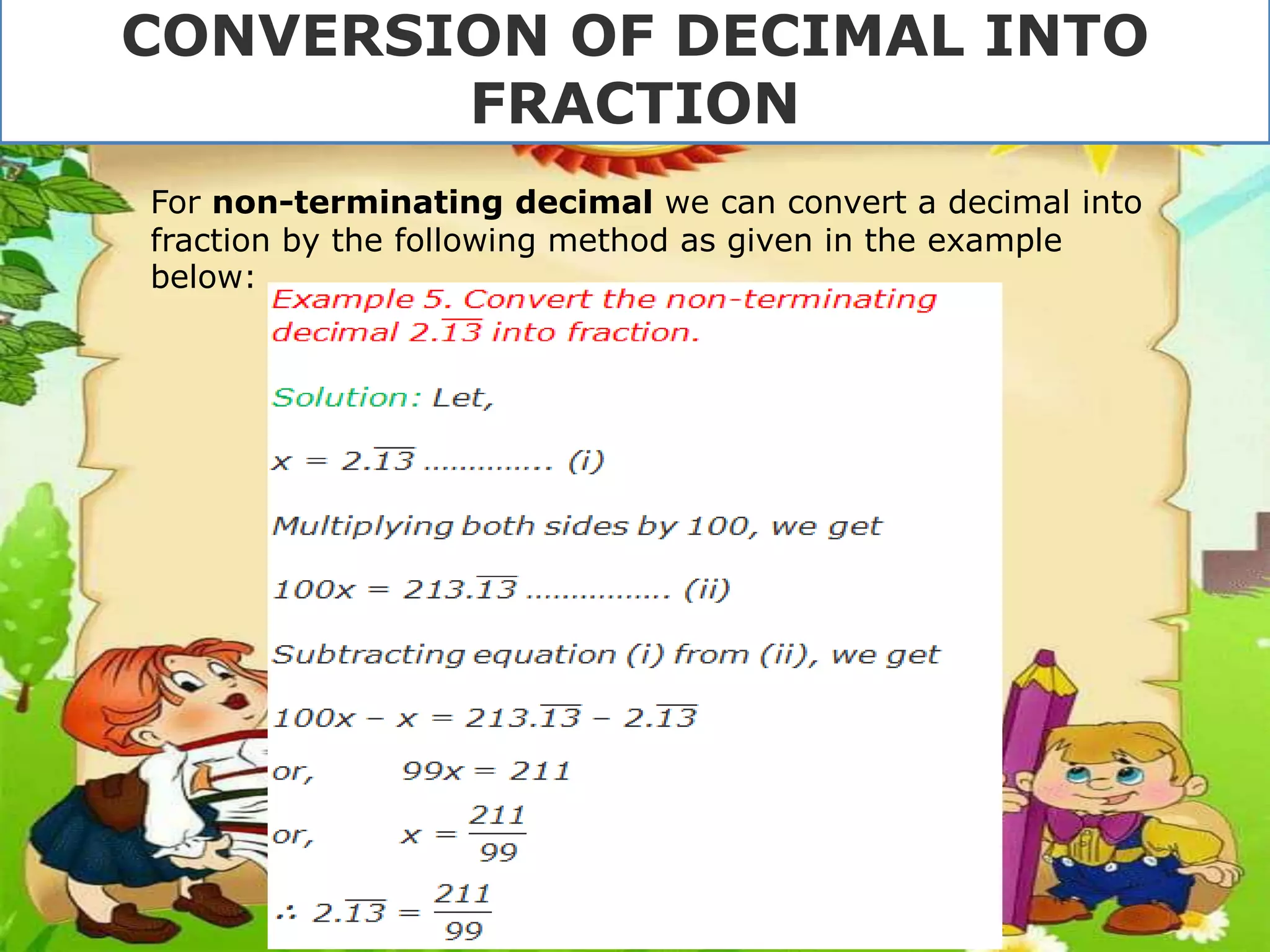
For non-terminating decimal we can convert a decimal into
fraction by the following method as given in the example
below:
CONVERSION OF DECIMAL INTO
FRACTION
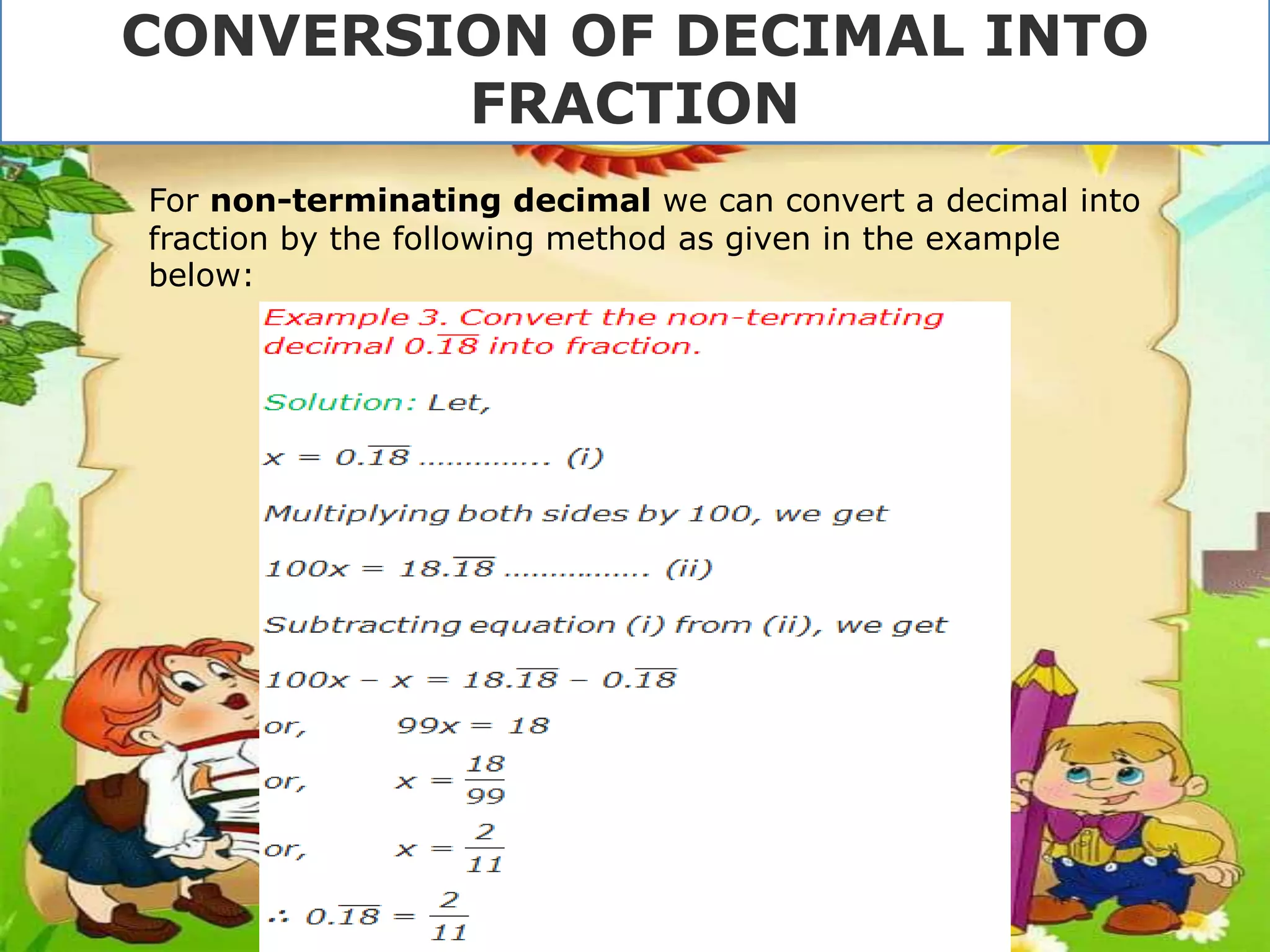
For non-terminating decimal we can convert a decimal into
fraction by the following method as given in the example
below:
CONVERSION OF DECIMAL INTO
FRACTION
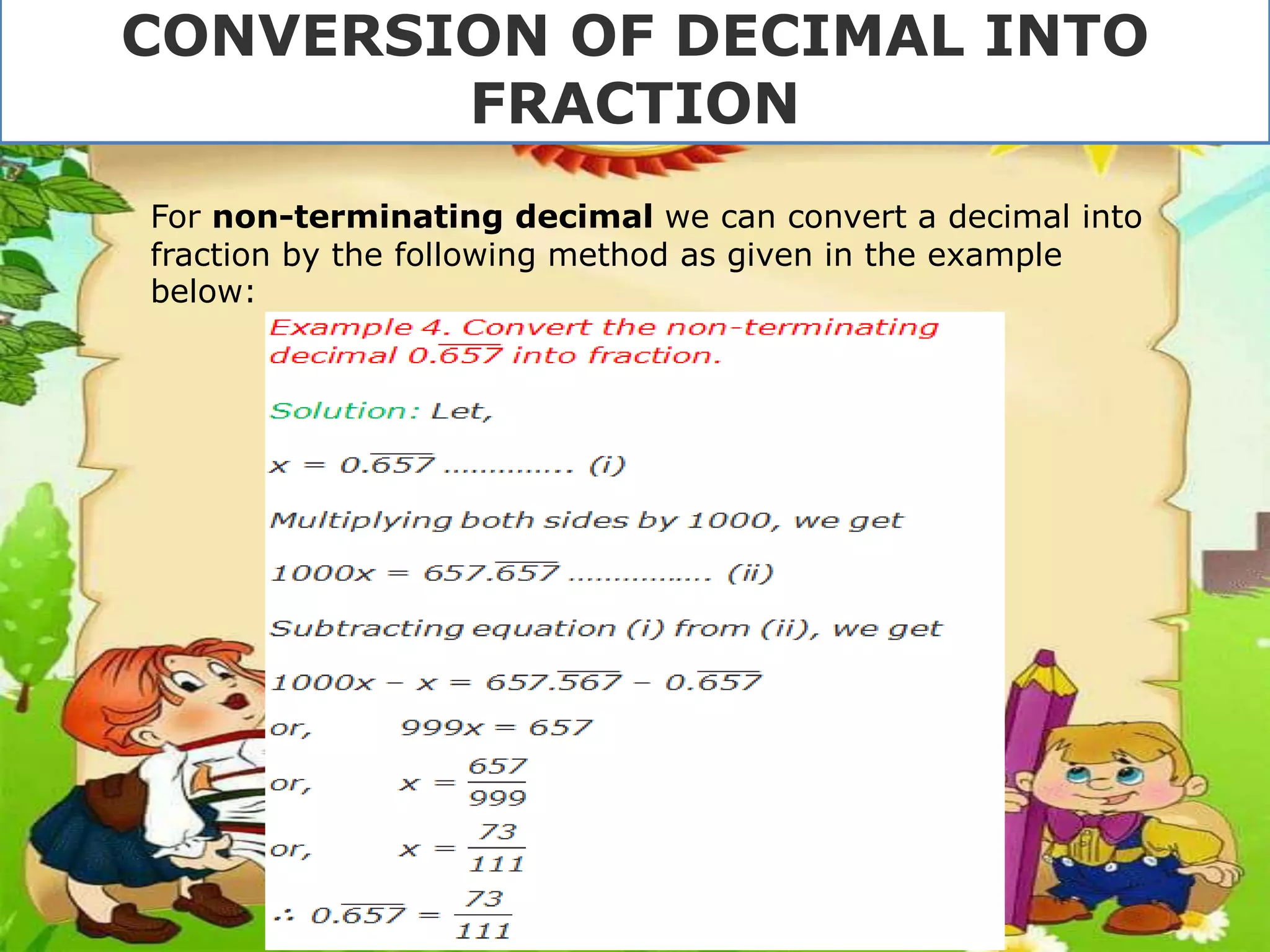
For non-terminating decimal we can convert a decimal into
fraction by the following method as given in the example
below:
CONVERSION OF DECIMAL INTO
FRACTION
CONVERSION OF DECIMAL INTO
FRACTION
For non-terminating decimal we can convert a decimal into
fraction by the following method as given in the example
below:
ACTIVITY
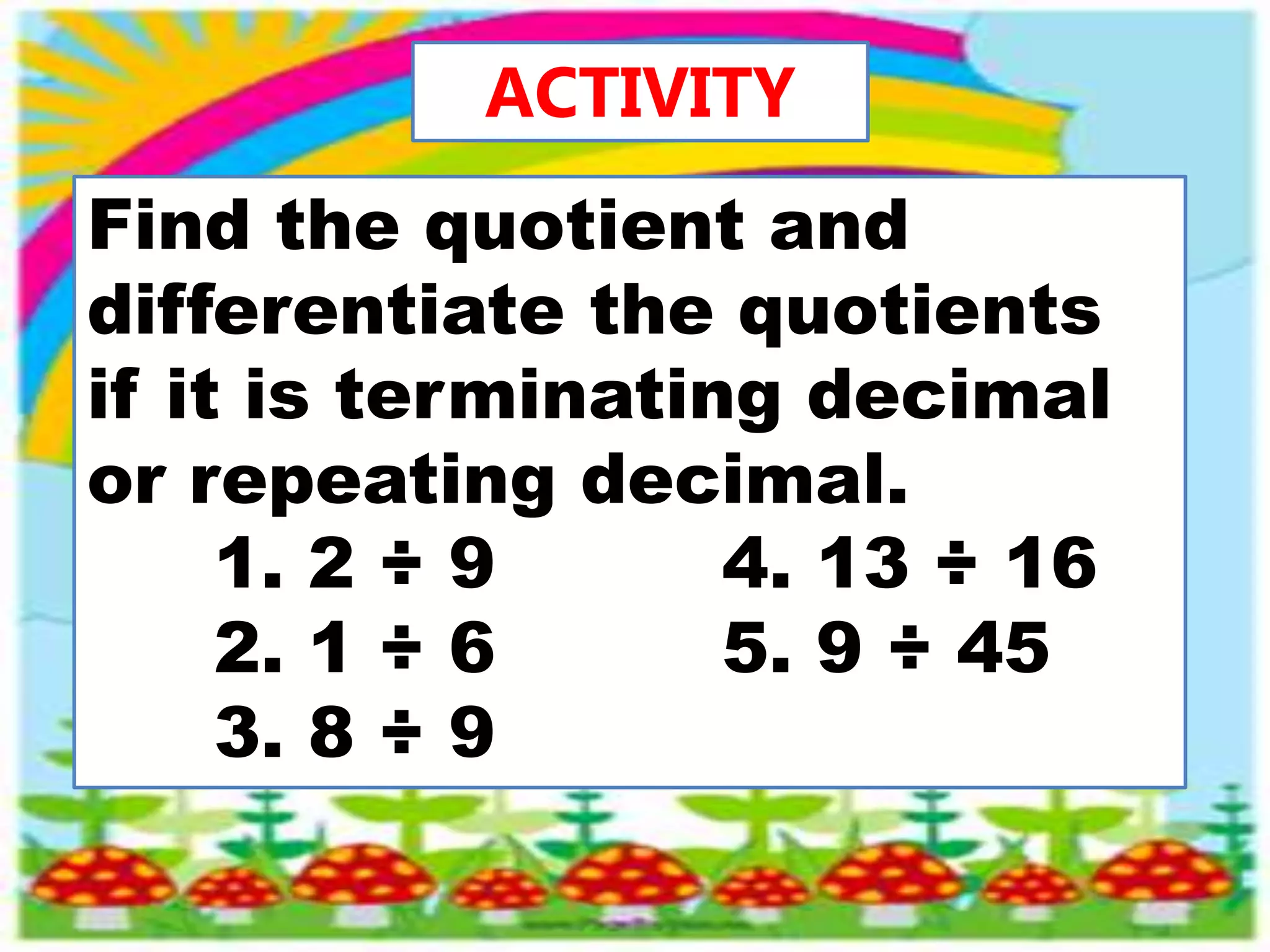
Find the quotient and
differentiate the quotients
if it is terminating decimal
or repeating decimal.
1. 2 ÷ 9 4. 13 ÷ 16
2. 1 ÷ 6 5. 9 ÷ 45
3. 8 ÷ 9
A. Dividing Whole Number
by Decimal
B. Dividing Decimal by
Whole Number
C. Dividing Decimal by
another Decimal
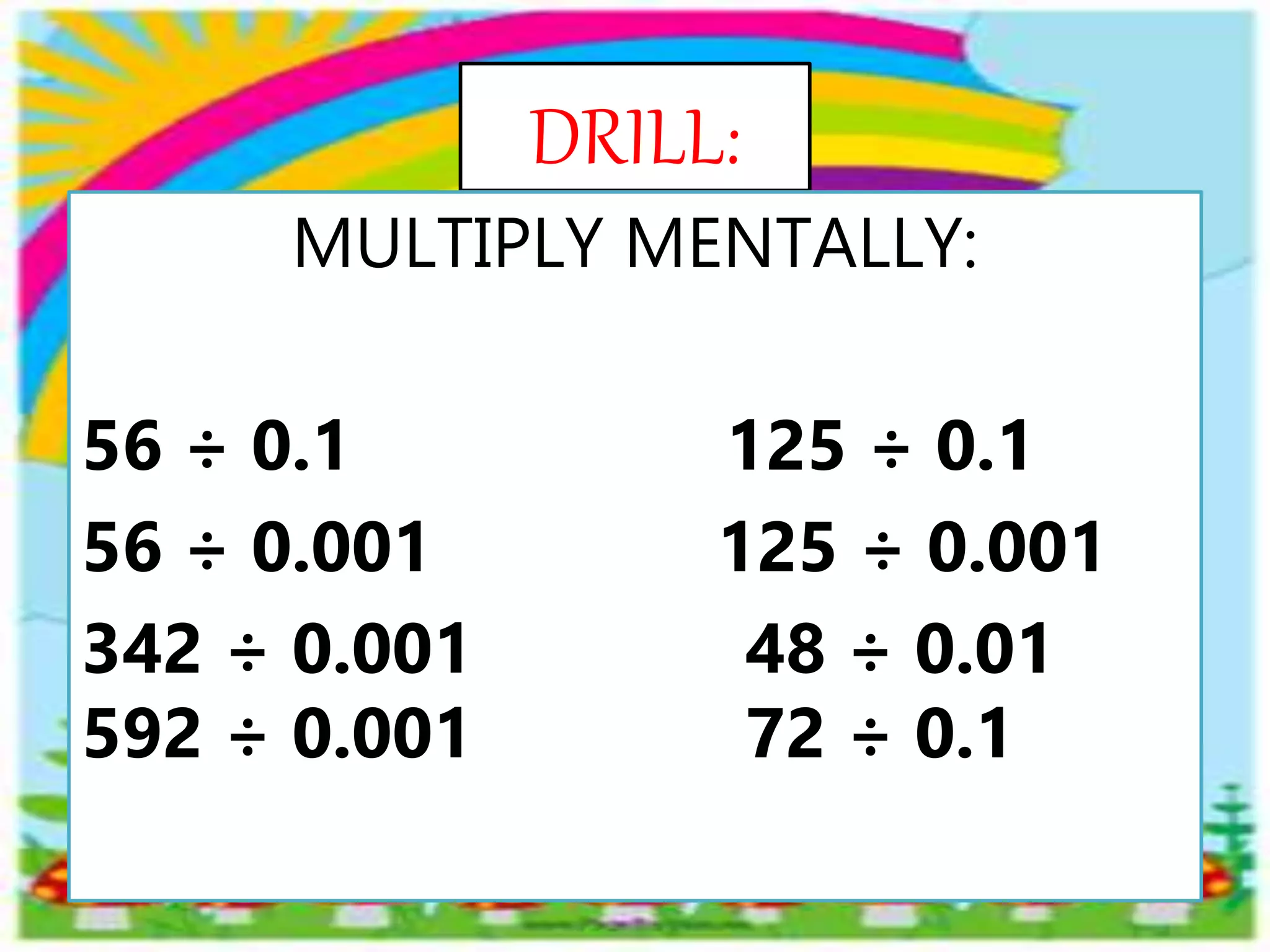
DRILL:
MULTIPLY MENTALLY:
56 ÷ 0.1 125 ÷ 0.1
56 ÷ 0.001 125 ÷ 0.001
342 ÷ 0.001 48 ÷ 0.01
592 ÷ 0.001 72 ÷ 0.1
Dividing Whole
Number by
Decimal
Dividing Whole Number by
Decimal
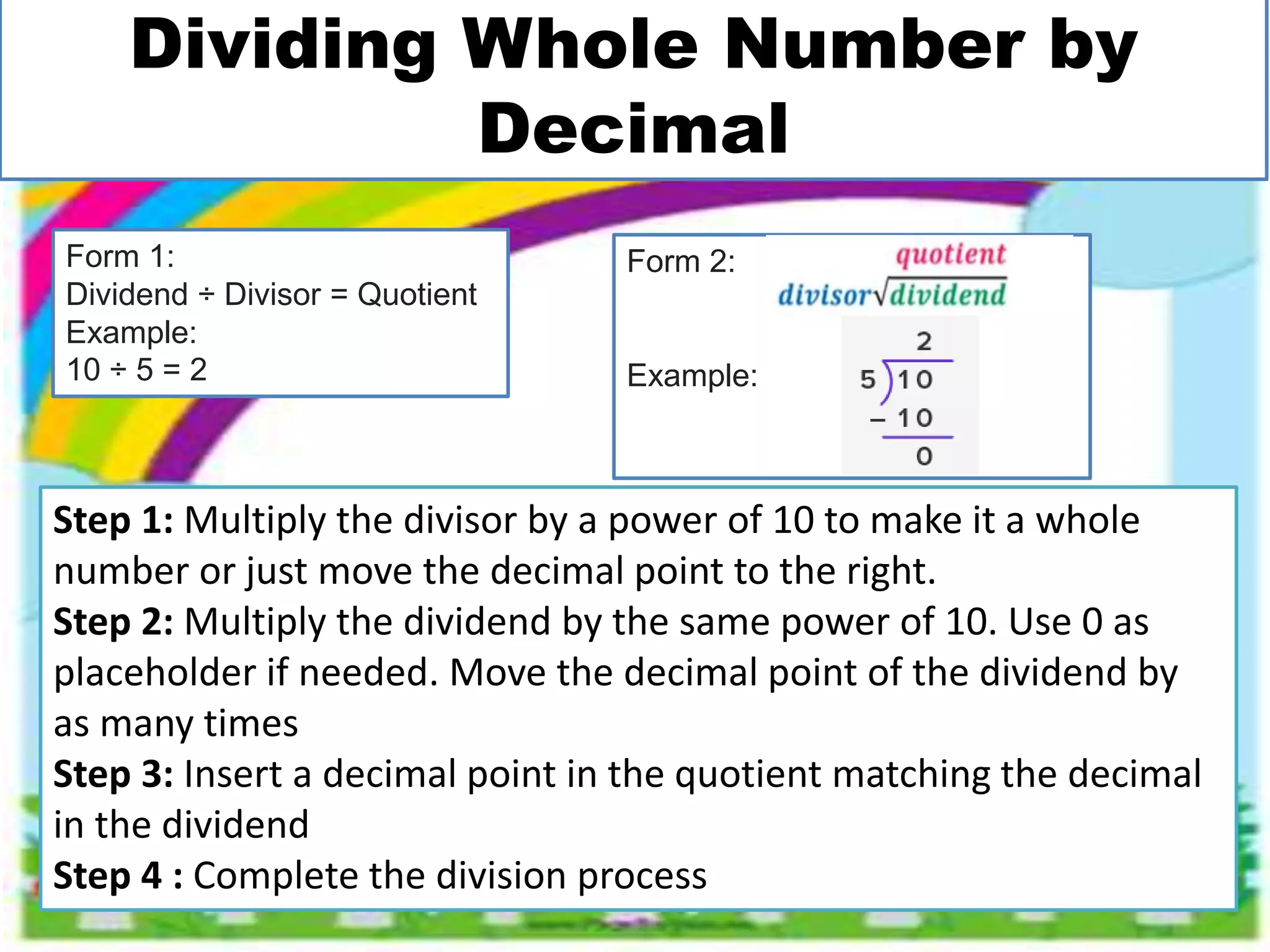
Step 1: Multiply the divisor by a power of 10 to make it a whole
number or just move the decimal point to the right.
Step 2: Multiply the dividend by the same power of 10. Use 0 as
placeholder if needed. Move the decimal point of the dividend by
as many times
Step 3: Insert a decimal point in the quotient matching the decimal
in the dividend
Step 4 : Complete the division process
Form 1:
Dividend ÷ Divisor = Quotient
Example:
10 ÷ 5 = 2
Form 2:
Example:
Dividing Whole Number by
Decimal
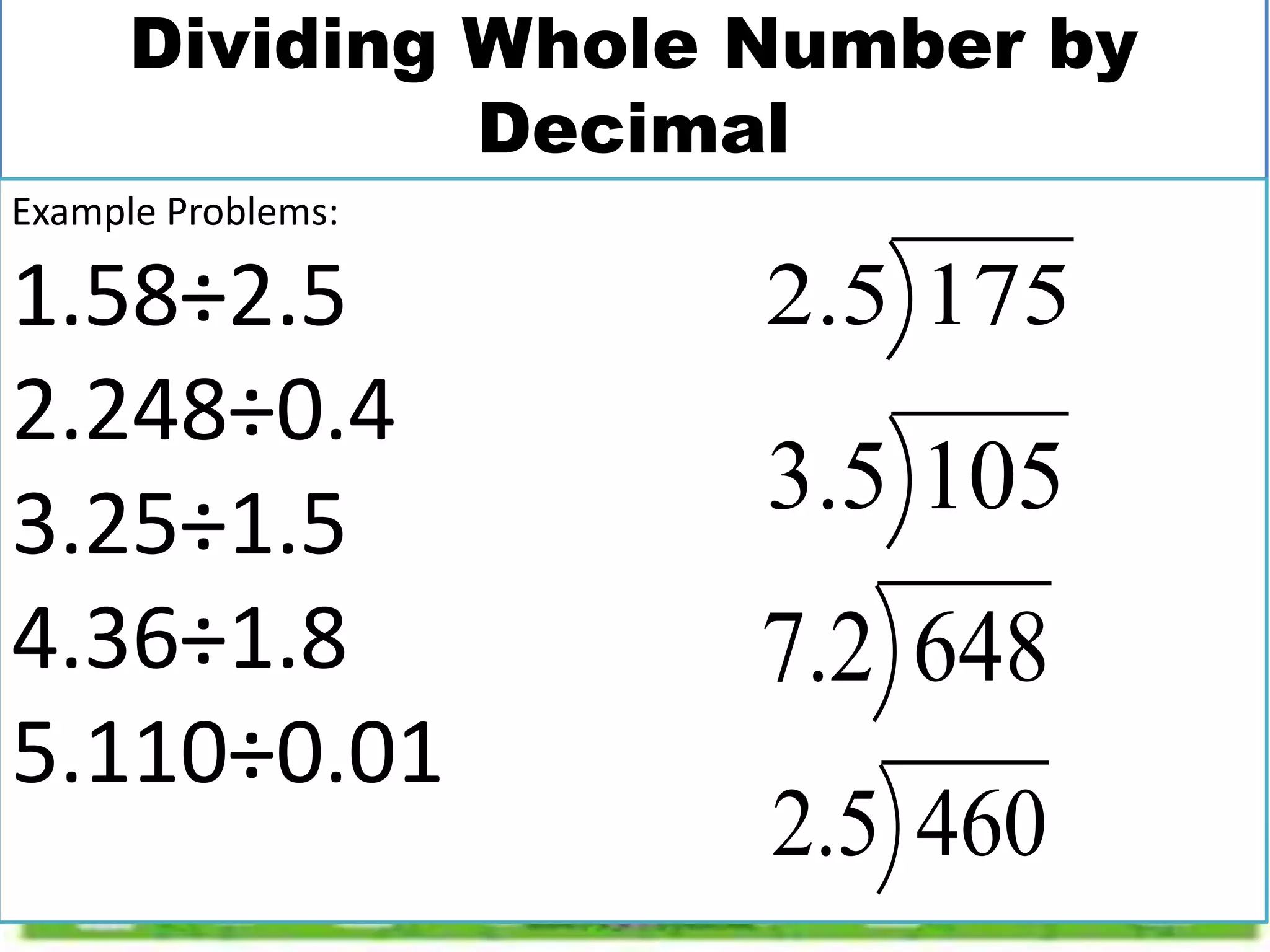
Example Problems:
1.58÷2.5
2.248÷0.4
3.25÷1.5
4.36÷1.8
5.110÷0.01
175
5
.
2
105
5
.
3
648
2
.
7
460
5
.
2
Dividing
Decimal by
Whole Number
Dividing Decimal by Whole
Number
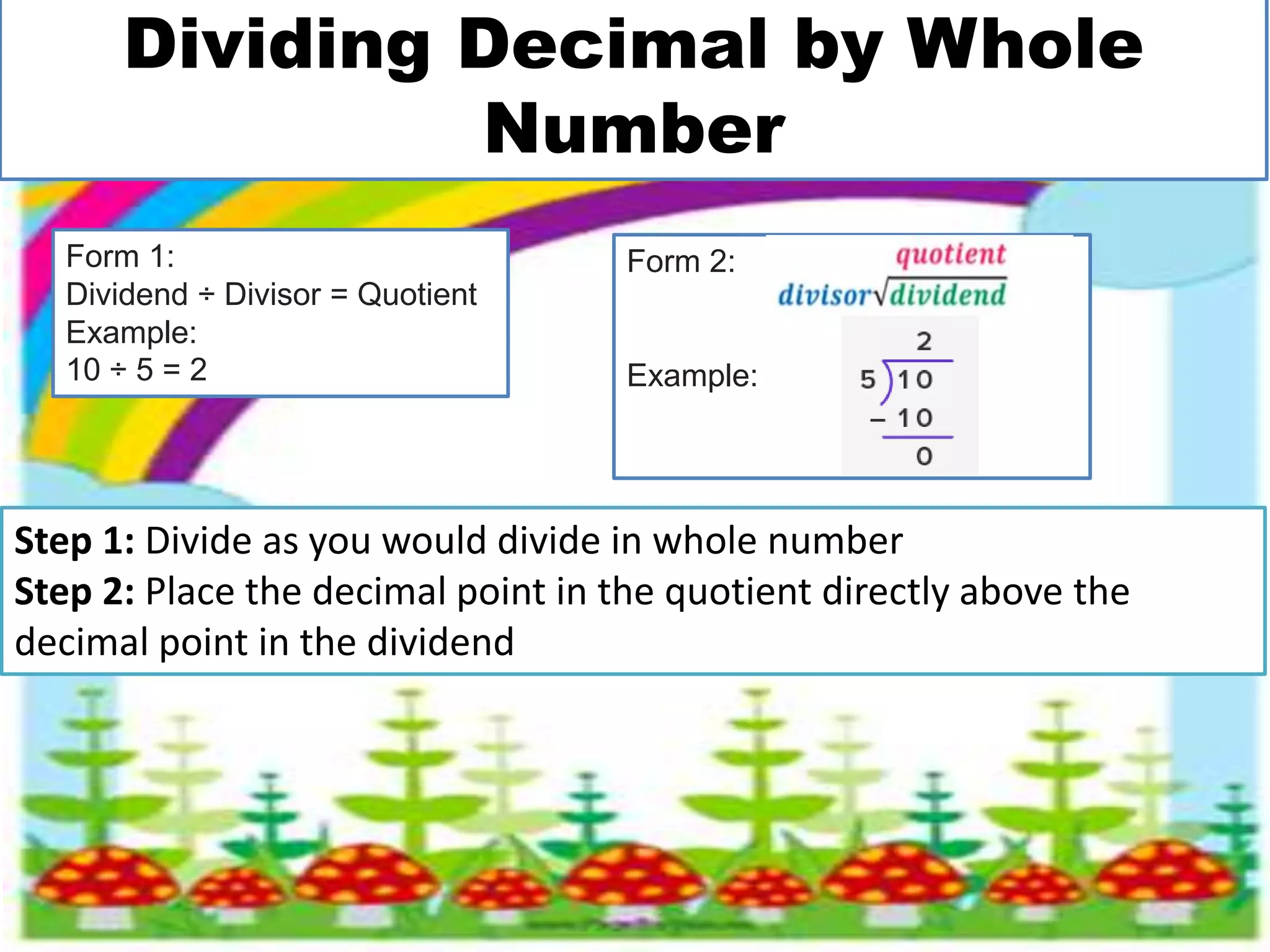
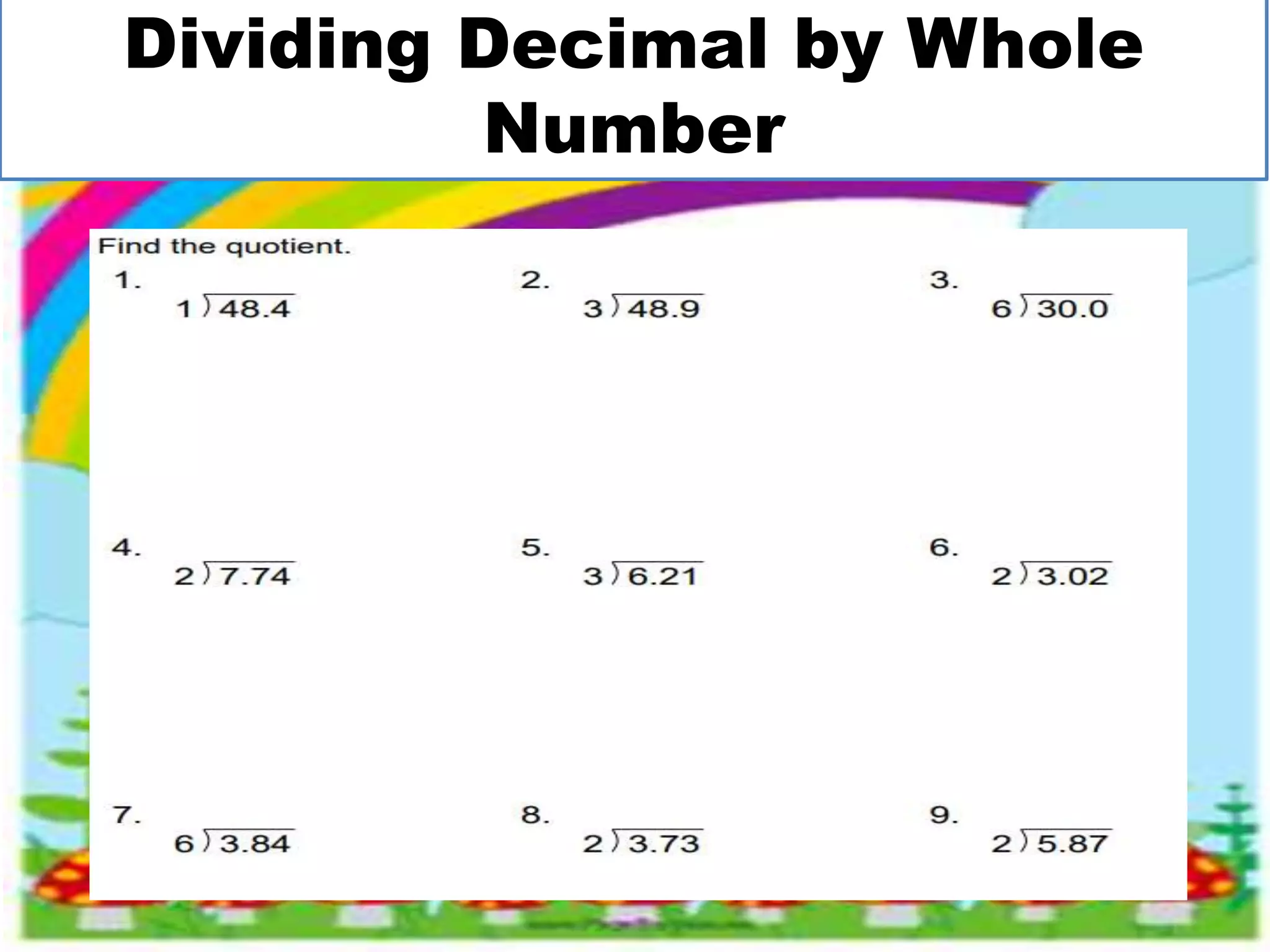
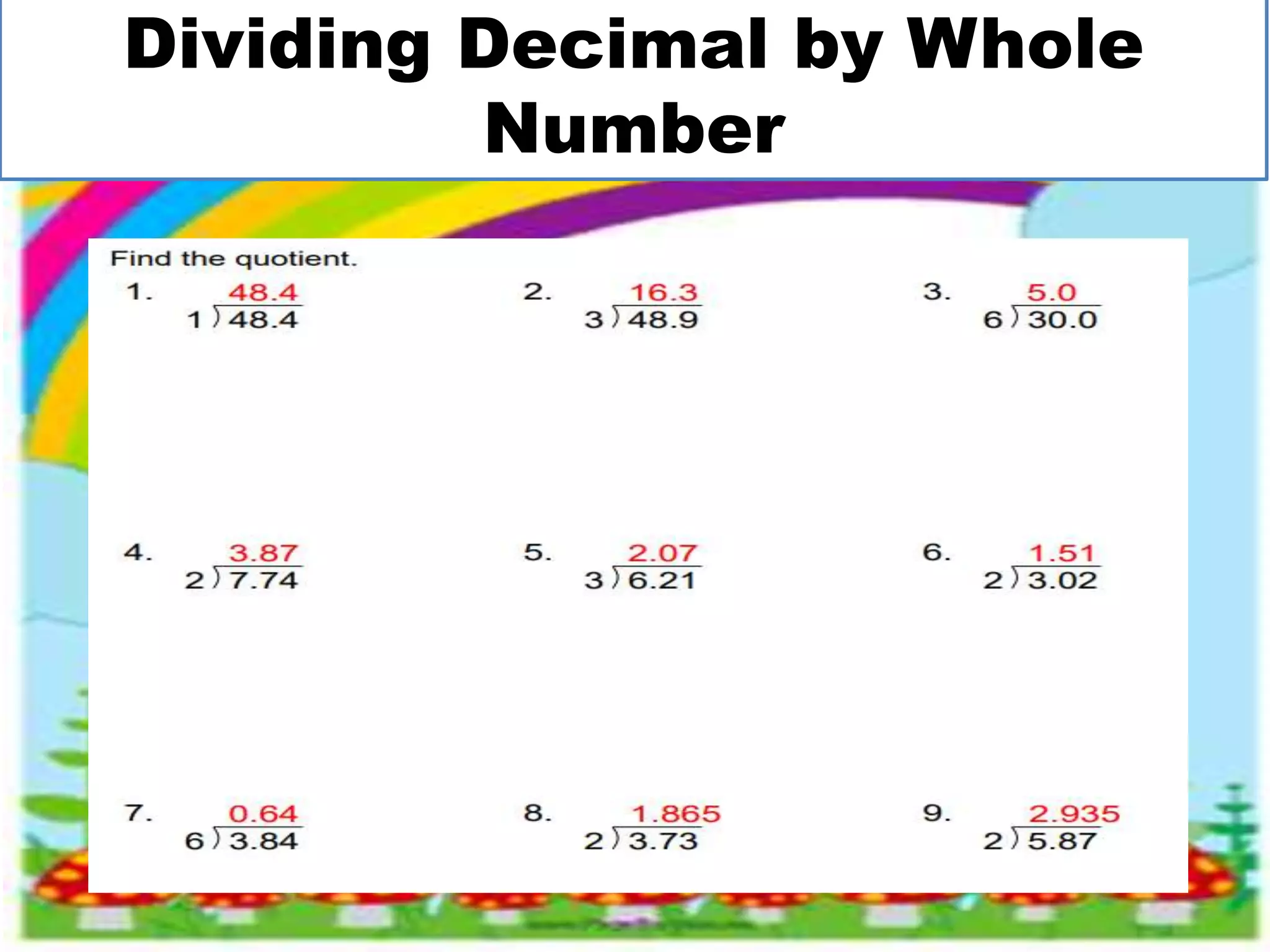
Step 1: Divide as you would divide in whole number
Step 2: Place the decimal point in the quotient directly above the
decimal point in the dividend
Form 1:
Dividend ÷ Divisor = Quotient
Example:
10 ÷ 5 = 2
Form 2:
Example:
Dividing Decimal by Whole
Number
Dividing Decimal by Whole
Number
Dividing
Decimal by
another
Decimal
Dividing Decimal by Whole
Number
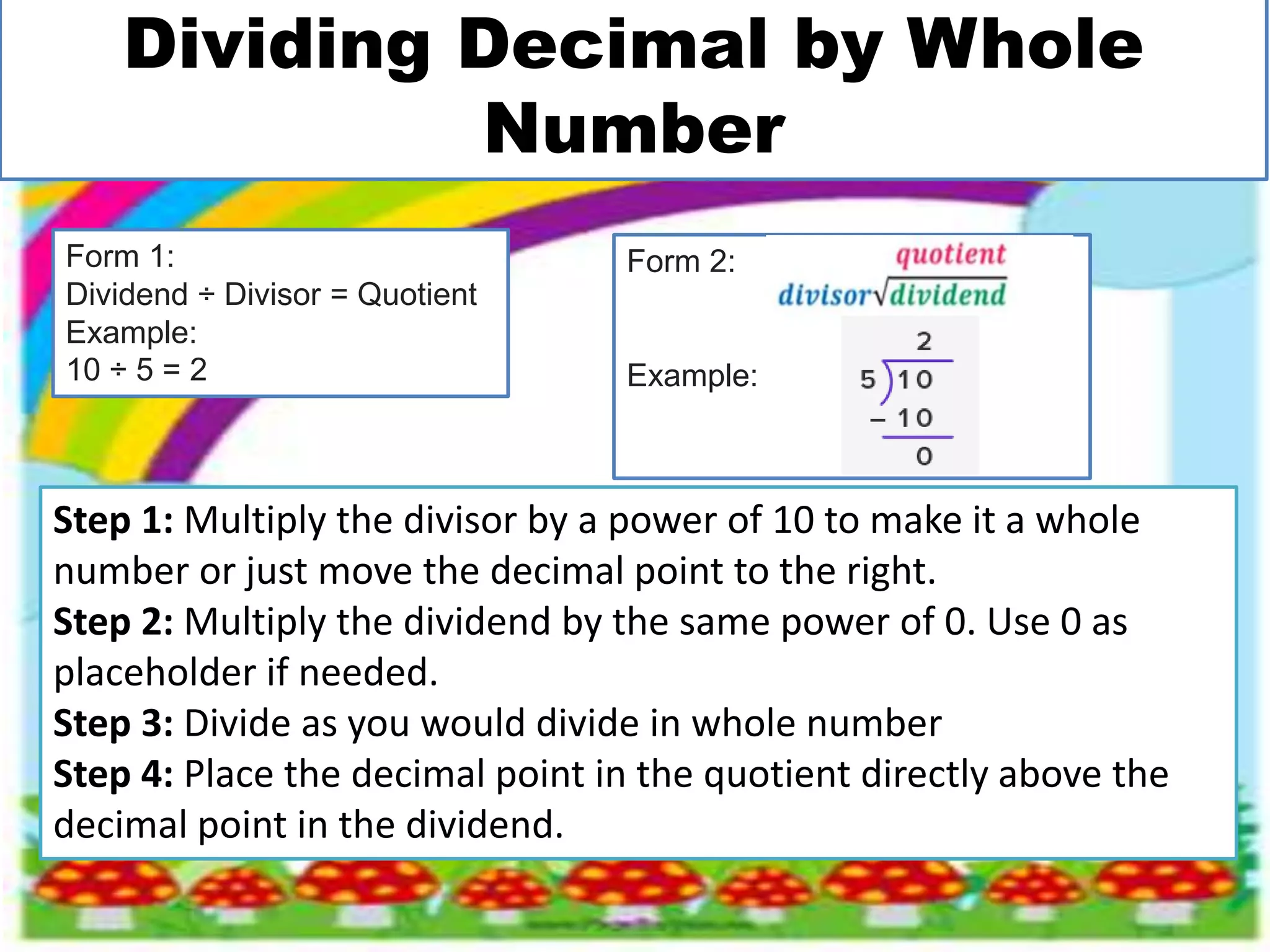
Step 1: Multiply the divisor by a power of 10 to make it a whole
number or just move the decimal point to the right.
Step 2: Multiply the dividend by the same power of 0. Use 0 as
placeholder if needed.
Step 3: Divide as you would divide in whole number
Step 4: Place the decimal point in the quotient directly above the
decimal point in the dividend.
Form 1:
Dividend ÷ Divisor = Quotient
Example:
10 ÷ 5 = 2
Form 2:
Example:
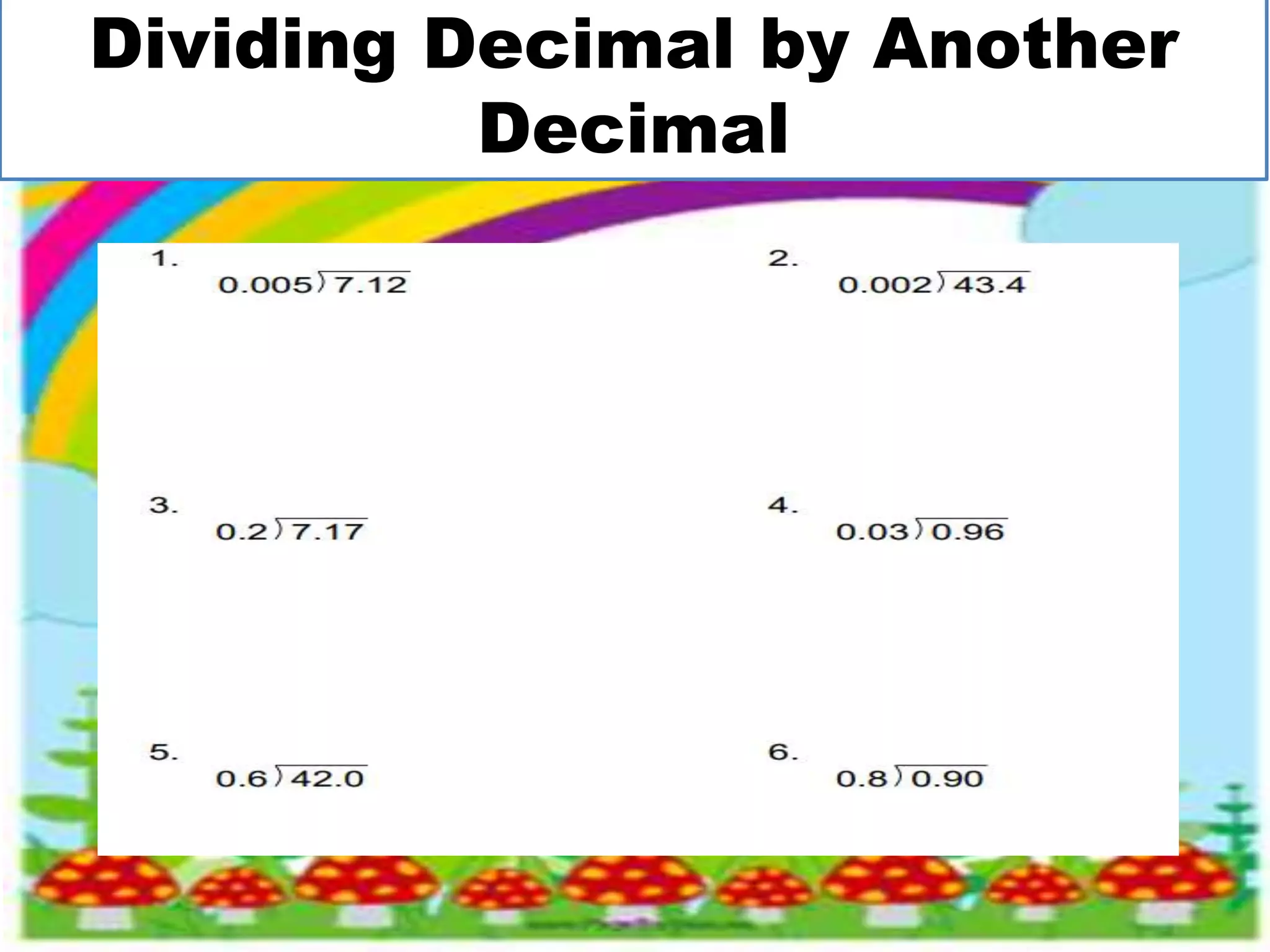
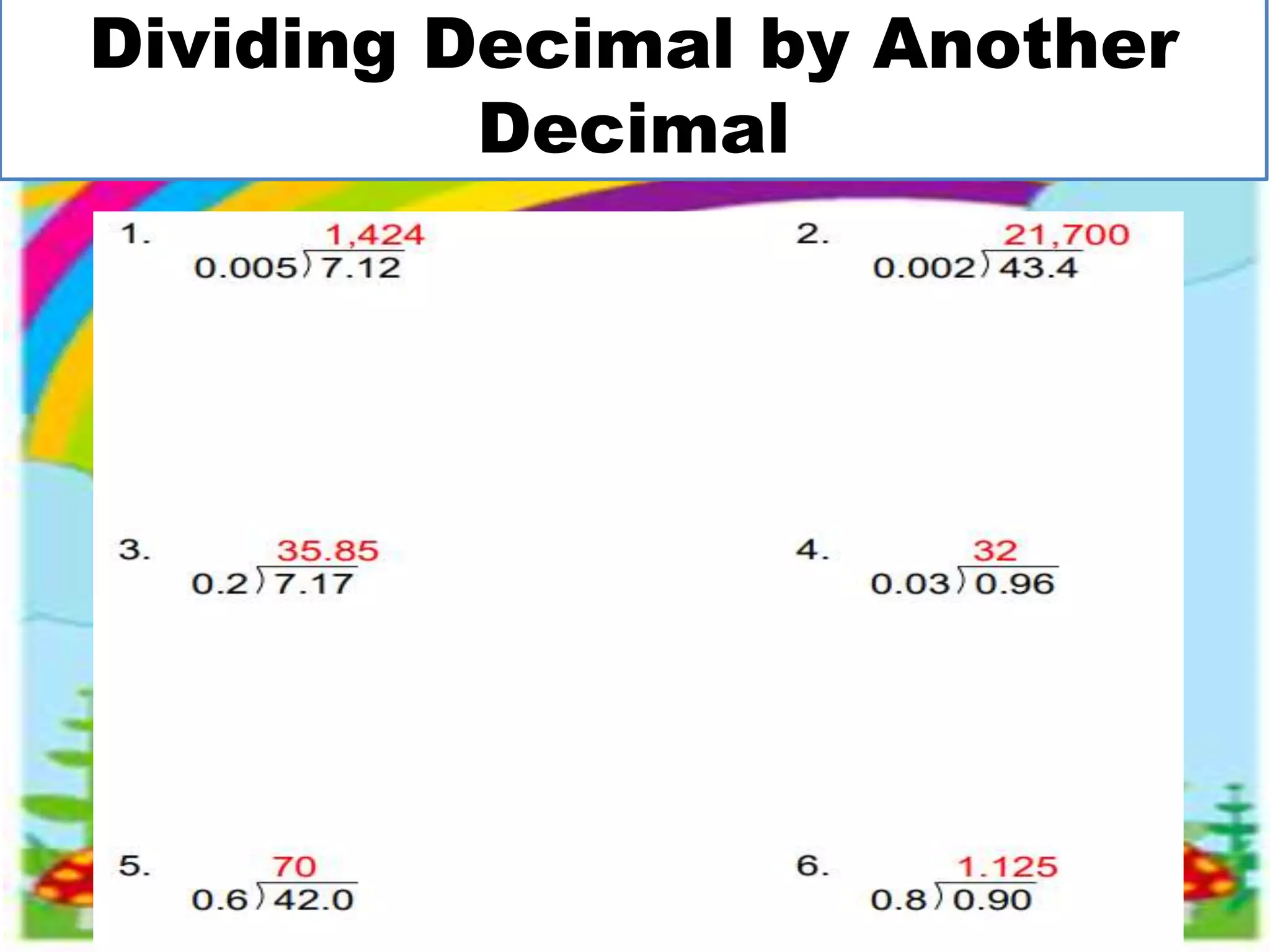
Dividing Decimal by Another
Decimal
Dividing Decimal by Another
Decimal
Solve routine and non-
routine problems
involving division of
decimals, mixed
decimals and whole
numbers
Comprehension questions:
• What is asked?
• What are given?
• b. What operation should you use
to solve the problem? Why?
• c. Let the pupils write the number
sentence on the board.
MOTIVATION
Samuel’s daily allowance is
P20. He is saving P5 a day
and puts it in his piggy bank.
How would you describe
Samuel?
Would you do the same? Why?
Kenneth is saving P2.50 each
day. How many days
will it take him to save P50.00?
PRESENTATION
What does the
problem ask you to
find?
How will you find the
answer to the
problem?
PERFORMING
THE
ACTIVITY
PROBLEM SOLVING
UNDERSTAND: Find the number
of days it will take Kenneth to
save P50.00
PLAN: To solve the problem,
divide P50.00 by P2.50
SOLVE: Show your solution
Move the decimal point in the
divisor to make it a whole
number.
(Multiply it by 100)
a. x 100 = 250
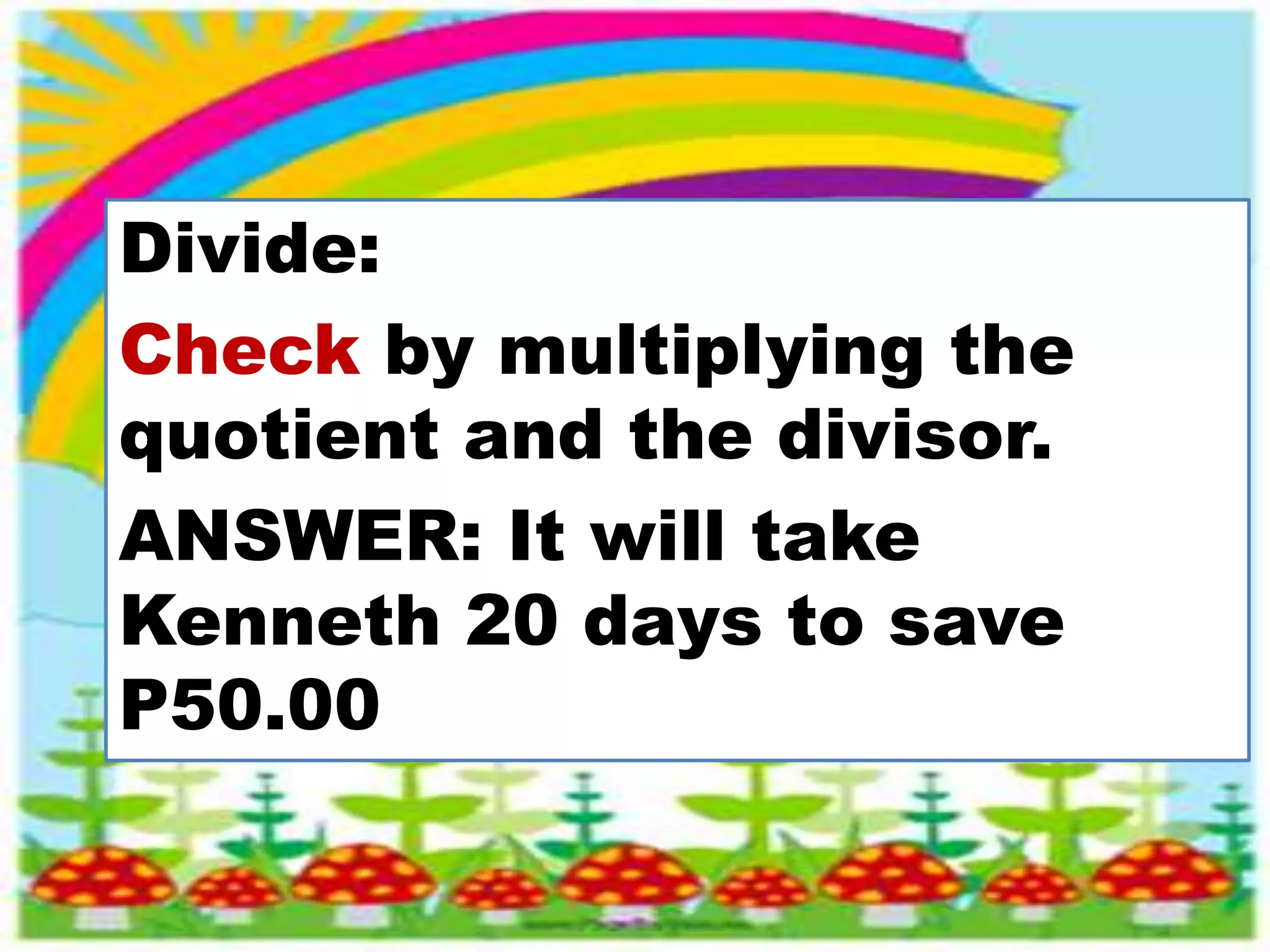
Divide:
Check by multiplying the
quotient and the divisor.
ANSWER: It will take
Kenneth 20 days to save
P50.00
PROCESSING THE
ACTIVITY:
How did you SOLVE
THE PROBLEM?
REINFORCING THE CONCEPT
Read, analyze and solve
a. Lily earned P618.76 in 2.75
hours. How much did she earn
per hour?
B. Mirabela paid P783.75 for
4.75 kg of grapes. What was
the price per kilo?
C. Olive needs to repack
141 kg of rice in plastic
bags containing 2.4 kg of
rice sack. How many
plastic bags of rice will
she be able to make?
Summarizing the lesson:
How do we solve routine
and non-routine problems
involving division of
decimals, mixed decimals
and whole numbers
including money?
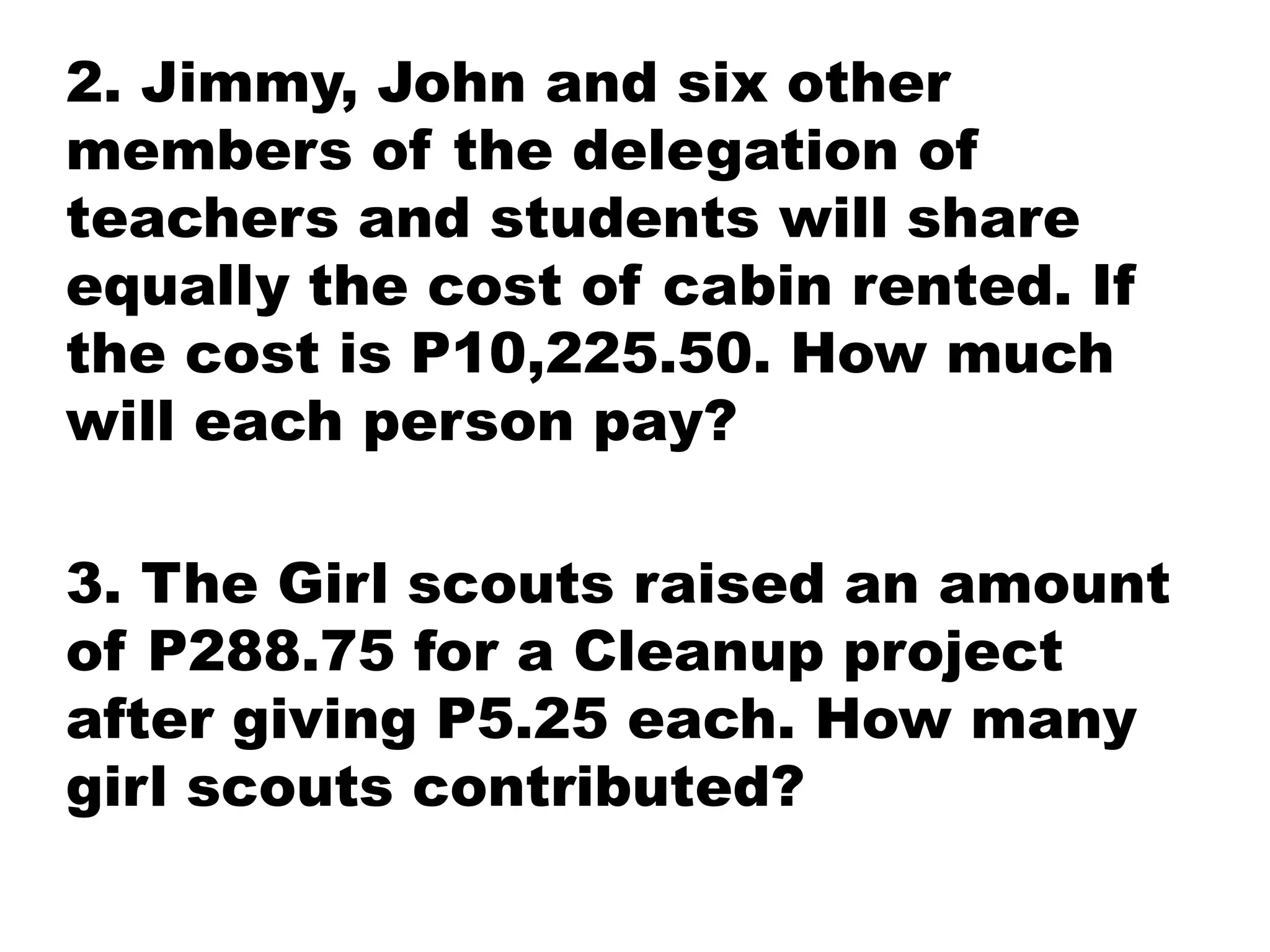
2. Jimmy, John and six other
members of the delegation of
teachers and students will share
equally the cost of cabin rented. If
the cost is P10,225.50. How much
will each person pay?
3. The Girl scouts raised an amount
of P288.75 for a Cleanup project
after giving P5.25 each. How many
girl scouts contributed?
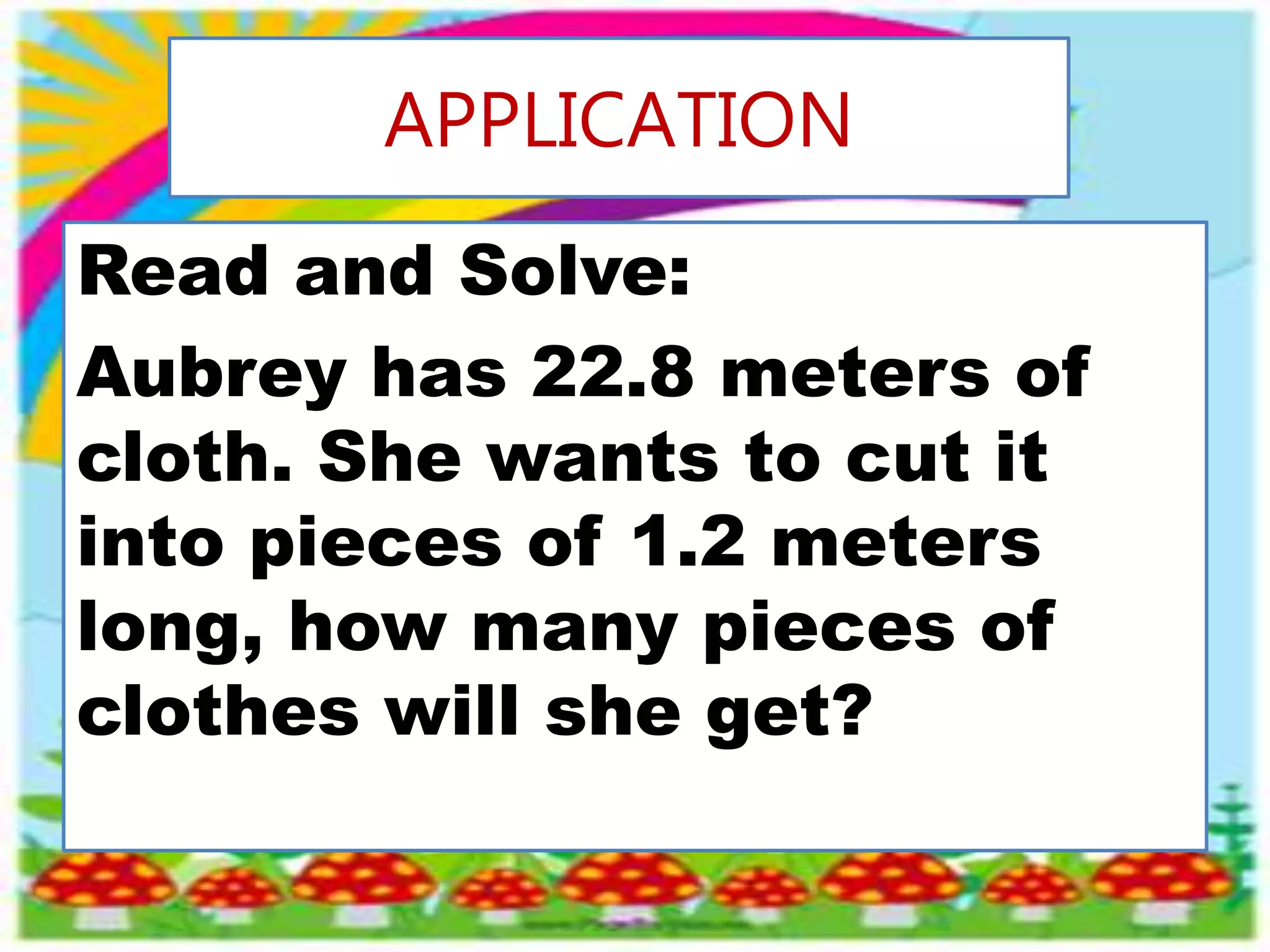
APPLICATION
Read and Solve:
Aubrey has 22.8 meters of
cloth. She wants to cut it
into pieces of 1.2 meters
long, how many pieces of
clothes will she get?
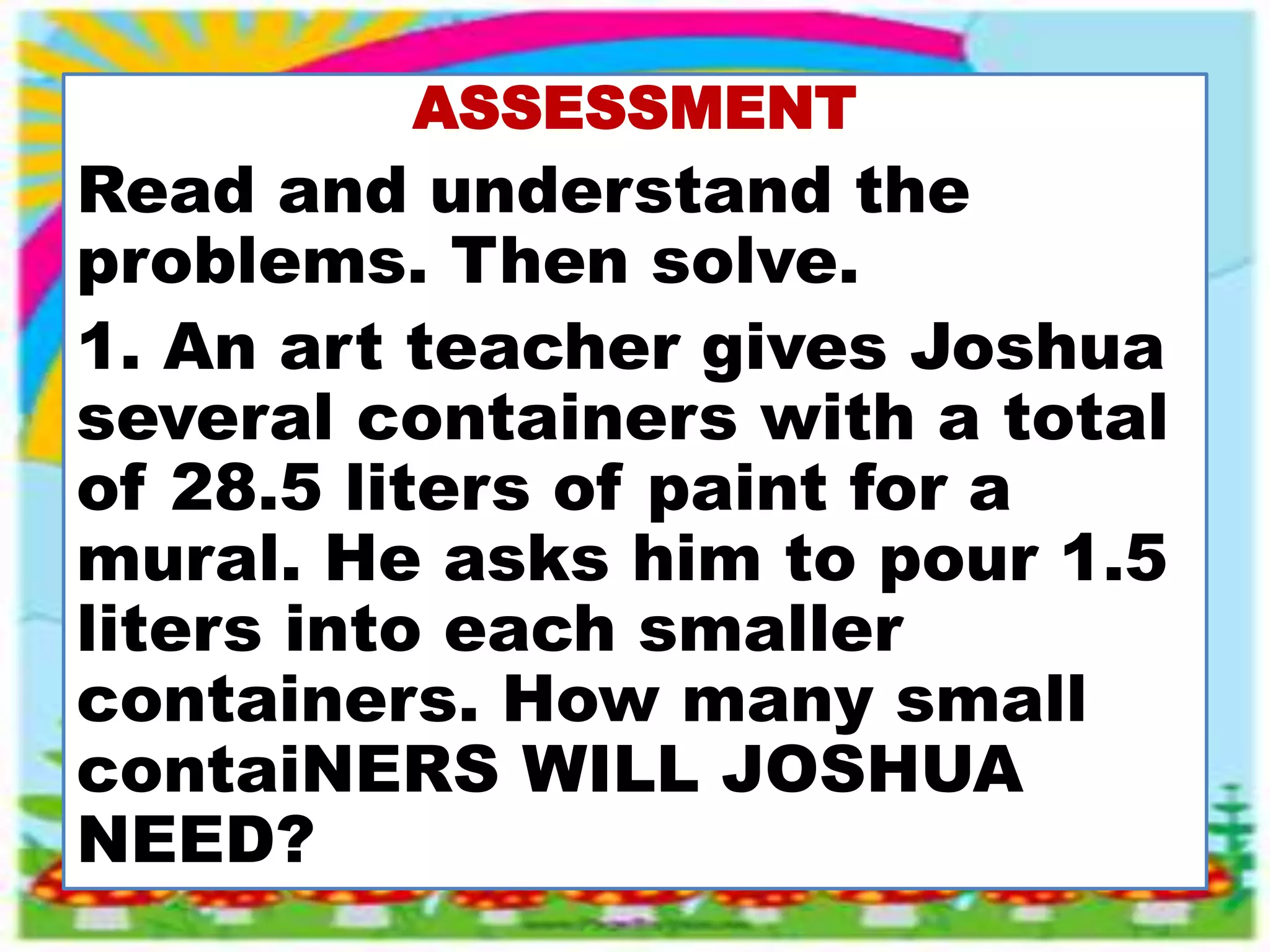
ASSESSMENT
Read and understand the
problems. Then solve.
1. An art teacher gives Joshua
several containers with a total
of 28.5 liters of paint for a
mural. He asks him to pour 1.5
liters into each smaller
containers. How many small
contaiNERS WILL JOSHUA
NEED?
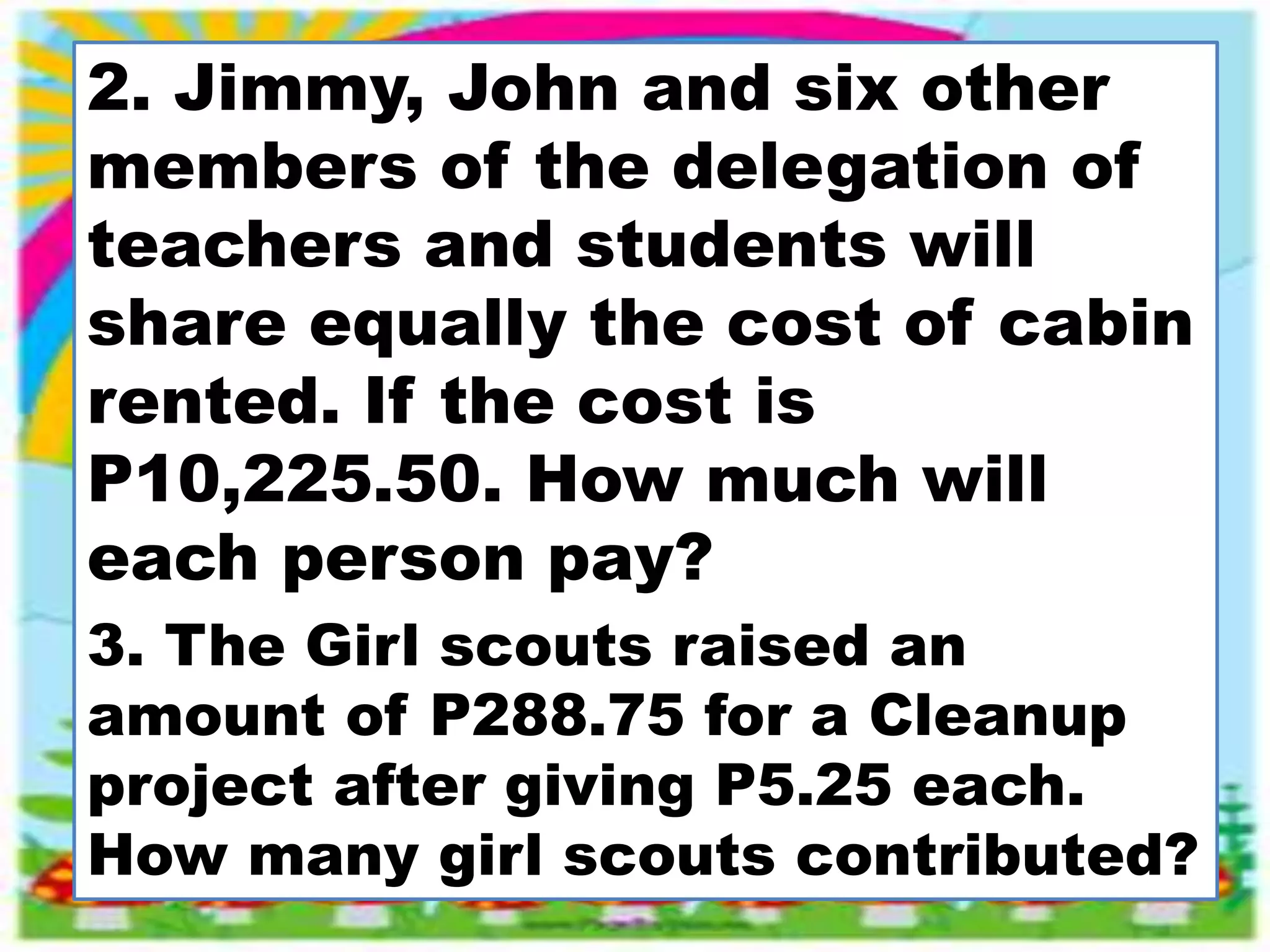
2. Jimmy, John and six other
members of the delegation of
teachers and students will
share equally the cost of cabin
rented. If the cost is
P10,225.50. How much will
each person pay?
3. The Girl scouts raised an
amount of P288.75 for a Cleanup
project after giving P5.25 each.
How many girl scouts contributed?
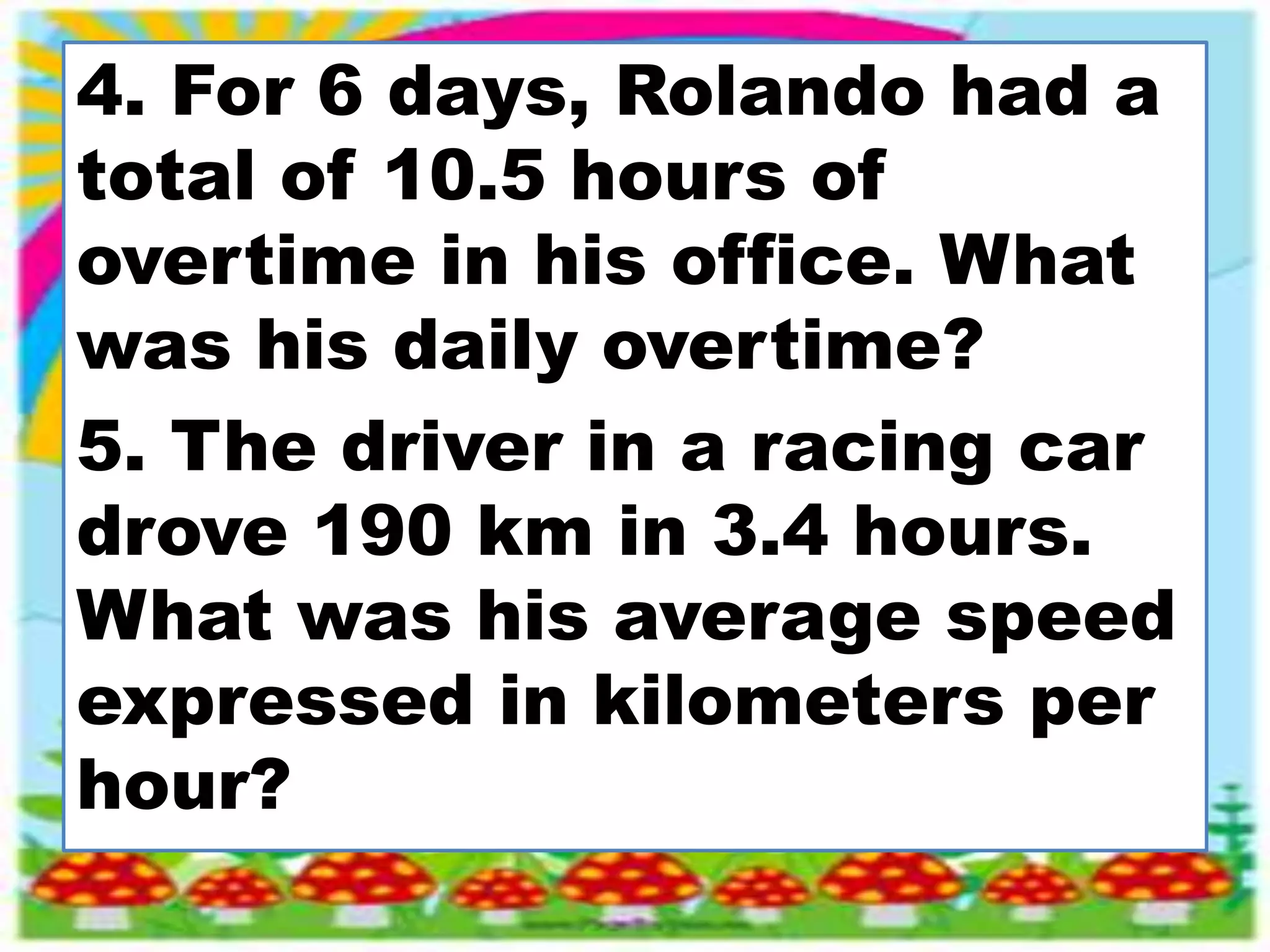
4. For 6 days, Rolando had a
total of 10.5 hours of
overtime in his office. What
was his daily overtime?
5. The driver in a racing car
drove 190 km in 3.4 hours.
What was his average speed
expressed in kilometers per
hour?
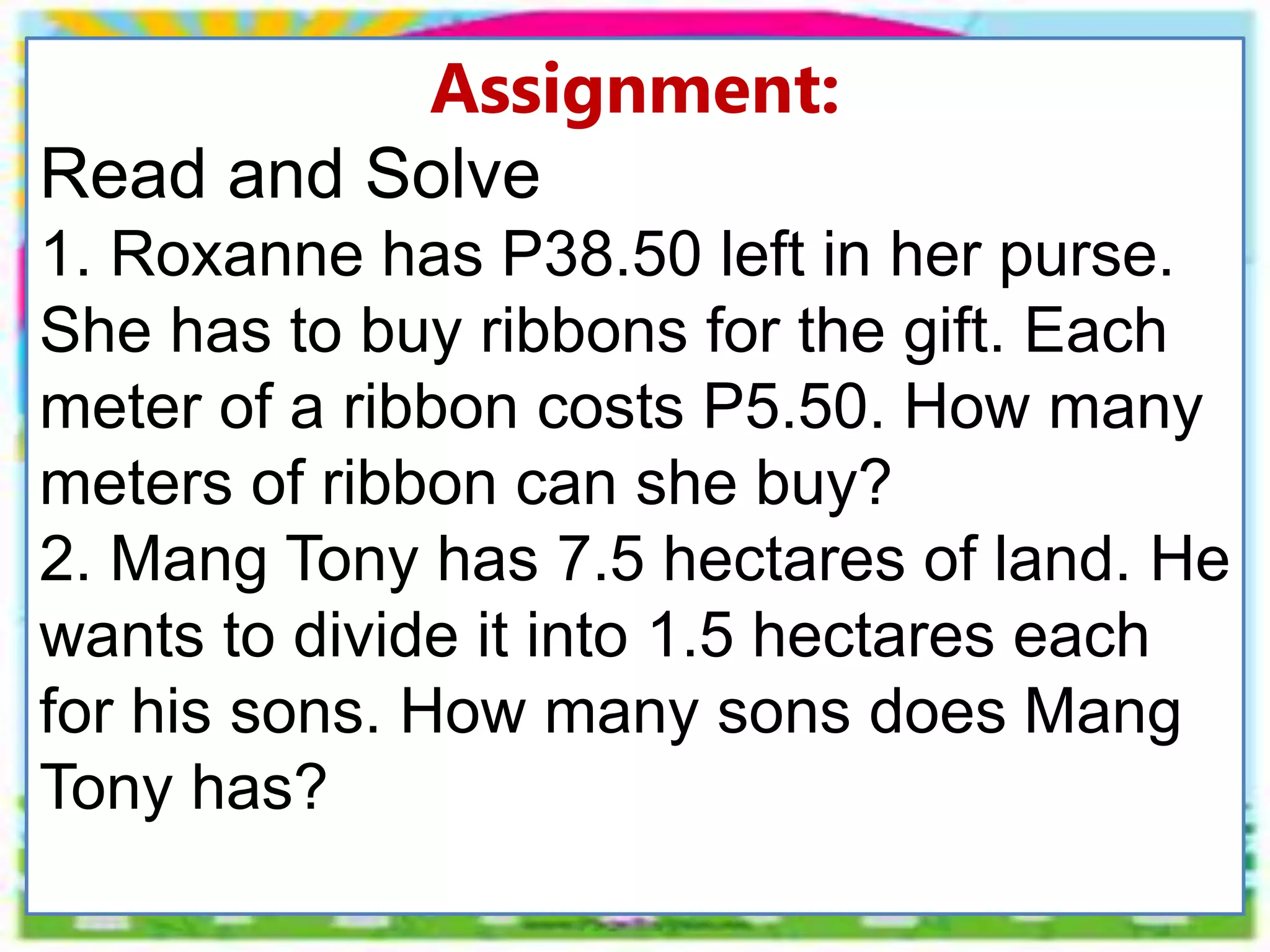
Assignment:
Read and Solve
1. Roxanne has P38.50 left in her purse.
She has to buy ribbons for the gift. Each
meter of a ribbon costs P5.50. How many
meters of ribbon can she buy?
2. Mang Tony has 7.5 hectares of land. He
wants to divide it into 1.5 hectares each
for his sons. How many sons does Mang
Tony has?

MATH 6 Q1 WK 9 D3-4-C.pptx

  • 1.
  • 2.
    Keys to Learn: Division- The division is the process of repetitive subtraction. It is the inverse of the multiplication operation. Decimal - A decimal is a fraction written in a special form. A decimal is a number that consists of a whole and a fractional part. Decimal numbers lie between integers and represent numerical value for quantities that are whole plus some part of a whole.
  • 4.
    What are terminatingdecimals? Terminating decimal is a fraction decimal having a finite number of digits after decimal point. In this case division ends after a finite number of stages or numbers that end after a few repetitions, after the decimal point. For example : 1/5, 1/4, 1/8 etc. are terminating decimals because,
  • 5.
    What are non-terminatingdecimals? Non-terminating decimal is a fraction decimal having infinite number of digits after decimal point. In this case division never ends but recur the same digit or group of digits again and again. So they are also called recurring decimals. For example: 1/3, 2/3, 2/11 etc. are non-terminating decimals because,
  • 6.
    Here, a numberor group of numbers are repeated and do not end after a finite number of stages, such number are denoted by a dot (.) or a bar(–) above it.
  • 7.
    Types of Non-terminating Decimals: Thereare two types of non-terminating (recurring) decimals: a. Simple recurring decimals: In this case the recurring starts just after the decimal point. For example, 0.333… b. Mixed recurring decimals: In this case the recurring does not start just after the decimal point. For example, 0.5181818
  • 8.
    Types of Non-terminating Decimals: Thereare two types of non-terminating (recurring) decimals: a. Simple recurring decimals: In this case the recurring starts just after the decimal point. For example, 0.333… b. Mixed recurring decimals: In this case the recurring does not start just after the decimal point. For example, 0.5181818
  • 9.
    For terminating decimalwe can convert a decimal into fraction simply by removing decimal and dividing by 10 if there is 1 decimal place, by 100 if there is 2 decimal places and by 1000 if there is 3 decimal places and so on. CONVERSION OF DECIMAL INTO FRACTION
  • 10.
    For non-terminating decimalwe can convert a decimal into fraction by the following method as given in the example below: CONVERSION OF DECIMAL INTO FRACTION
  • 11.
    For non-terminating decimalwe can convert a decimal into fraction by the following method as given in the example below: CONVERSION OF DECIMAL INTO FRACTION
  • 12.
    For non-terminating decimalwe can convert a decimal into fraction by the following method as given in the example below: CONVERSION OF DECIMAL INTO FRACTION
  • 13.
    CONVERSION OF DECIMALINTO FRACTION For non-terminating decimal we can convert a decimal into fraction by the following method as given in the example below:
  • 14.
    ACTIVITY Find the quotientand differentiate the quotients if it is terminating decimal or repeating decimal. 1. 2 ÷ 9 4. 13 ÷ 16 2. 1 ÷ 6 5. 9 ÷ 45 3. 8 ÷ 9
  • 15.
    A. Dividing WholeNumber by Decimal B. Dividing Decimal by Whole Number C. Dividing Decimal by another Decimal
  • 17.
    DRILL: MULTIPLY MENTALLY: 56 ÷0.1 125 ÷ 0.1 56 ÷ 0.001 125 ÷ 0.001 342 ÷ 0.001 48 ÷ 0.01 592 ÷ 0.001 72 ÷ 0.1
  • 18.
  • 19.
    Dividing Whole Numberby Decimal Step 1: Multiply the divisor by a power of 10 to make it a whole number or just move the decimal point to the right. Step 2: Multiply the dividend by the same power of 10. Use 0 as placeholder if needed. Move the decimal point of the dividend by as many times Step 3: Insert a decimal point in the quotient matching the decimal in the dividend Step 4 : Complete the division process Form 1: Dividend ÷ Divisor = Quotient Example: 10 ÷ 5 = 2 Form 2: Example:
  • 20.
    Dividing Whole Numberby Decimal Example Problems: 1.58÷2.5 2.248÷0.4 3.25÷1.5 4.36÷1.8 5.110÷0.01 175 5 . 2 105 5 . 3 648 2 . 7 460 5 . 2
  • 21.
  • 22.
    Dividing Decimal byWhole Number Step 1: Divide as you would divide in whole number Step 2: Place the decimal point in the quotient directly above the decimal point in the dividend Form 1: Dividend ÷ Divisor = Quotient Example: 10 ÷ 5 = 2 Form 2: Example:
  • 23.
    Dividing Decimal byWhole Number
  • 24.
    Dividing Decimal byWhole Number
  • 25.
  • 26.
    Dividing Decimal byWhole Number Step 1: Multiply the divisor by a power of 10 to make it a whole number or just move the decimal point to the right. Step 2: Multiply the dividend by the same power of 0. Use 0 as placeholder if needed. Step 3: Divide as you would divide in whole number Step 4: Place the decimal point in the quotient directly above the decimal point in the dividend. Form 1: Dividend ÷ Divisor = Quotient Example: 10 ÷ 5 = 2 Form 2: Example:
  • 27.
    Dividing Decimal byAnother Decimal
  • 28.
    Dividing Decimal byAnother Decimal
  • 29.
    Solve routine andnon- routine problems involving division of decimals, mixed decimals and whole numbers
  • 30.
    Comprehension questions: • Whatis asked? • What are given? • b. What operation should you use to solve the problem? Why? • c. Let the pupils write the number sentence on the board.
  • 31.
    MOTIVATION Samuel’s daily allowanceis P20. He is saving P5 a day and puts it in his piggy bank. How would you describe Samuel? Would you do the same? Why?
  • 32.
    Kenneth is savingP2.50 each day. How many days will it take him to save P50.00? PRESENTATION
  • 33.
    What does the problemask you to find? How will you find the answer to the problem?
  • 34.
  • 35.
    PROBLEM SOLVING UNDERSTAND: Findthe number of days it will take Kenneth to save P50.00 PLAN: To solve the problem, divide P50.00 by P2.50 SOLVE: Show your solution Move the decimal point in the divisor to make it a whole number. (Multiply it by 100) a. x 100 = 250
  • 36.
    Divide: Check by multiplyingthe quotient and the divisor. ANSWER: It will take Kenneth 20 days to save P50.00
  • 37.
    PROCESSING THE ACTIVITY: How didyou SOLVE THE PROBLEM?
  • 38.
    REINFORCING THE CONCEPT Read,analyze and solve a. Lily earned P618.76 in 2.75 hours. How much did she earn per hour? B. Mirabela paid P783.75 for 4.75 kg of grapes. What was the price per kilo?
  • 39.
    C. Olive needsto repack 141 kg of rice in plastic bags containing 2.4 kg of rice sack. How many plastic bags of rice will she be able to make?
  • 40.
    Summarizing the lesson: Howdo we solve routine and non-routine problems involving division of decimals, mixed decimals and whole numbers including money?
  • 41.
    2. Jimmy, Johnand six other members of the delegation of teachers and students will share equally the cost of cabin rented. If the cost is P10,225.50. How much will each person pay? 3. The Girl scouts raised an amount of P288.75 for a Cleanup project after giving P5.25 each. How many girl scouts contributed?
  • 42.
    APPLICATION Read and Solve: Aubreyhas 22.8 meters of cloth. She wants to cut it into pieces of 1.2 meters long, how many pieces of clothes will she get?
  • 43.
    ASSESSMENT Read and understandthe problems. Then solve. 1. An art teacher gives Joshua several containers with a total of 28.5 liters of paint for a mural. He asks him to pour 1.5 liters into each smaller containers. How many small contaiNERS WILL JOSHUA NEED?
  • 44.
    2. Jimmy, Johnand six other members of the delegation of teachers and students will share equally the cost of cabin rented. If the cost is P10,225.50. How much will each person pay? 3. The Girl scouts raised an amount of P288.75 for a Cleanup project after giving P5.25 each. How many girl scouts contributed?
  • 45.
    4. For 6days, Rolando had a total of 10.5 hours of overtime in his office. What was his daily overtime? 5. The driver in a racing car drove 190 km in 3.4 hours. What was his average speed expressed in kilometers per hour?
  • 46.
    Assignment: Read and Solve 1.Roxanne has P38.50 left in her purse. She has to buy ribbons for the gift. Each meter of a ribbon costs P5.50. How many meters of ribbon can she buy? 2. Mang Tony has 7.5 hectares of land. He wants to divide it into 1.5 hectares each for his sons. How many sons does Mang Tony has?