MATH 4
Quarter 3 Week 6
1. Solve word problems
involving the addition of
dissimilar fractions.
2. Subtract dissimilar
fractions using models.
Learning Competencies
At the end of the lesson,
the learners shall be
able to solve word
problems involving the
addition of dissimilar
fractions.
Learning Objectives
1
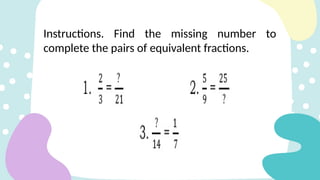
Instructions. Find the missing number to
complete the pairs of equivalent fractions.
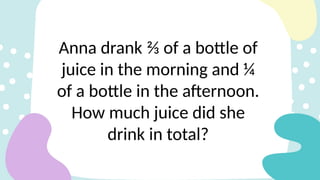
Anna drank ⅔ of a bottle of
juice in the morning and ¼
of a bottle in the afternoon.
How much juice did she
drink in total?
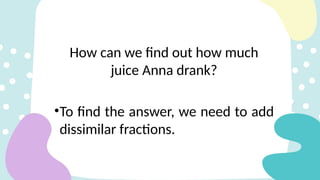
How can we find out how much
juice Anna drank?
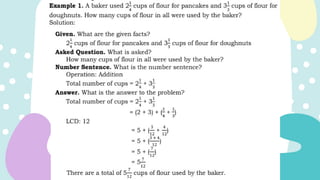
•To find the answer, we need to add
dissimilar fractions.
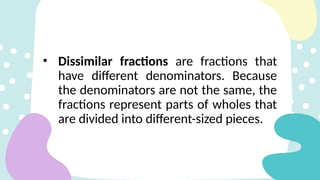
• Dissimilar fractions are fractions that
have different denominators. Because
the denominators are not the same, the
fractions represent parts of wholes that
are divided into different-sized pieces.
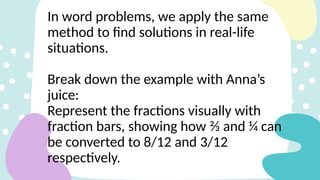
In word problems, we apply the same
method to find solutions in real-life
situations.
Break down the example with Anna’s
juice:
Represent the fractions visually with
fraction bars, showing how ⅔ and ¼ can
be converted to 8/12 and 3/12
respectively.
Solve a Word Problem Together:
"Mark has ⅗ of a chocolate bar. He buys
another ⅖ of a chocolate bar. How much
chocolate does he have now?"
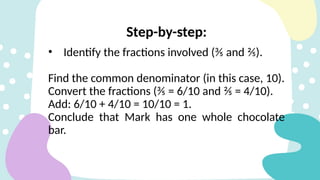
Step-by-step:
• Identify the fractions involved (⅗ and ⅖).
Find the common denominator (in this case, 10).
Convert the fractions (⅗ = 6/10 and ⅖ = 4/10).
Add: 6/10 + 4/10 = 10/10 = 1.
Conclude that Mark has one whole chocolate
bar.
Group Activity:
1. Lucy read ⅗ of a book on Monday and ²/₄ on
Tuesday. How much of the book has she read in
total?
2. In a garden, ⅜ of the flowers are red, and ¼
are yellow. What fraction of the flowers are
either red or yellow?
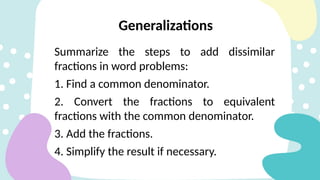
Summarize the steps to add dissimilar
fractions in word problems:
1. Find a common denominator.
2. Convert the fractions to equivalent
fractions with the common denominator.
3. Add the fractions.
4. Simplify the result if necessary.
Generalizations
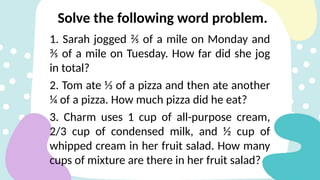
1. Sarah jogged ⅖ of a mile on Monday and
⅗ of a mile on Tuesday. How far did she jog
in total?
2. Tom ate ⅓ of a pizza and then ate another
¼ of a pizza. How much pizza did he eat?
3. Charm uses 1 cup of all-purpose cream,
2/3 cup of condensed milk, and ½ cup of
whipped cream in her fruit salad. How many
cups of mixture are there in her fruit salad?
Solve the following word problem.
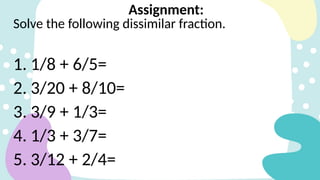
Solve the following dissimilar fraction.
1. 1/8 + 6/5=
2. 3/20 + 8/10=
3. 3/9 + 1/3=
4. 1/3 + 3/7=
5. 3/12 + 2/4=
Assignment:
2
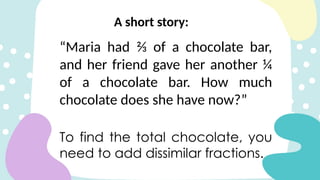
A short story:
“Maria had ⅔ of a chocolate bar,
and her friend gave her another ¼
of a chocolate bar. How much
chocolate does she have now?”
To find the total chocolate, you
need to add dissimilar fractions.
•The Least Common Multiple (LCM) of
two or more numbers is the smallest
multiple that is exactly divisible by
each of those numbers. In other
words, it is the smallest positive
number that all the numbers in a set
divide into without leaving a
remainder.
• When adding fractions with
different denominators, we must
first find a common denominator.
• Review finding the Least Common
Multiple (LCM) as the common
denominator for simple fractions.
Step 1:
Identify the fractions (e.g., ⅔ and ¼).
Step 2:
Find the LCM of the denominators (in
this case, 3 and 4, which is 12).
Steps in Adding Dissimilar Fractions
Step 3:
Convert each fraction to an equivalent
fraction with the common denominator (⅔
becomes ⁸/₁₂, and ¼ becomes ³/₁₂).
Step 4:
Add the numerators of the equivalent
fractions (⁸/₁₂ + ³/₁₂ = ¹¹/₁₂).
Step 5:
Simplify the answer if needed.
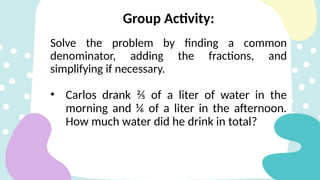
Group Activity:
Solve the problem by finding a common
denominator, adding the fractions, and
simplifying if necessary.
• Carlos drank ⅖ of a liter of water in the
morning and ⅙ of a liter in the afternoon.
How much water did he drink in total?
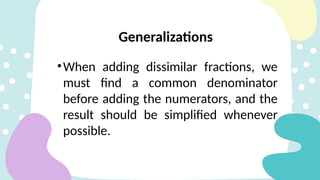
•When adding dissimilar fractions, we
must find a common denominator
before adding the numerators, and the
result should be simplified whenever
possible.
Generalizations
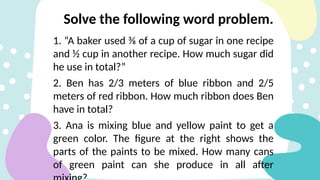
1. “A baker used ⅜ of a cup of sugar in one recipe
and ½ cup in another recipe. How much sugar did
he use in total?”
2. Ben has 2/3 meters of blue ribbon and 2/5
meters of red ribbon. How much ribbon does Ben
have in total?
3. Ana is mixing blue and yellow paint to get a
green color. The figure at the right shows the
parts of the paints to be mixed. How many cans
of green paint can she produce in all after
Solve the following word problem.
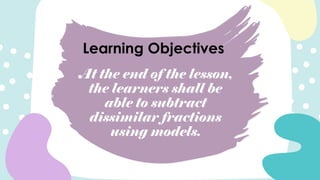
At the end of the lesson,
the learners shall be
able to subtract
dissimilar fractions
using models.
Learning Objectives
3
What makes fractions “dissimilar” and
why they need to have a common
denominator to be subtracted?
Short Review:
Scenario:
If Tom ate ¾ of a pizza and he decided
to share ⅓ of it with his friend, how
much pizza does he have left?
“How can we subtract fractions when
their denominators are different?”
• Dissimilar fractions, also known as
dissimilar fractions, are fractions that
have different denominators.
• Dissimilar fractions have different
denominators, making it difficult to
subtract directly.
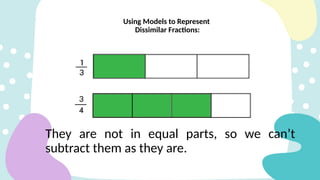
Using Models to Represent
Dissimilar Fractions:
They are not in equal parts, so we can’t
subtract them as they are.
Finding a Common Denominator with Models:
• To subtract fractions with different
denominators, we need a common
denominator.
• For example, to subtract ¾ and ⅓, find
the least common multiple (LCM) of 4
and 3, which is 12.
• Convert ¾ to 9/12 and ⅓ to 4/12 by
dividing each fraction into twelfths.
Subtracting Using Models:
• Now, subtract 4/12 from 9/12 by
shading parts of the models or drawing
to show what is left.
• This gives 5/12, showing that Tom has
5/12 of the pizza left.
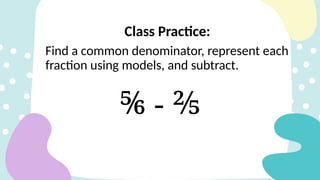
Class Practice:
Find a common denominator, represent each
fraction using models, and subtract.
⅚ - ⅖
To subtract dissimilar fractions, we find a
common denominator, convert each
fraction, and then subtract. Using
models helps us visualize each step.
Generalizations
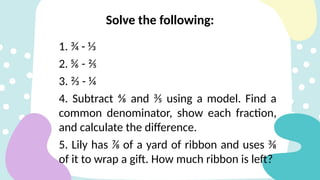
1. ¾ - ⅓
2. ⅚ - ⅖
3. ⅔ - ¼
4. Subtract ⅘ and ⅗ using a model. Find a
common denominator, show each fraction,
and calculate the difference.
5. Lily has ⅞ of a yard of ribbon and uses ⅜
of it to wrap a gift. How much ribbon is left?
Solve the following:
4
Review subtraction of similar fractions.
Highlight the importance of having the
same denominator when subtracting.
Short Review:
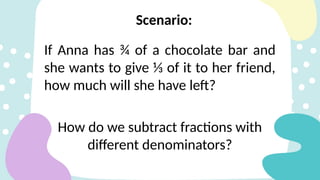
If Anna has ¾ of a chocolate bar and
she wants to give ⅓ of it to her friend,
how much will she have left?
How do we subtract fractions with
different denominators?
Scenario:
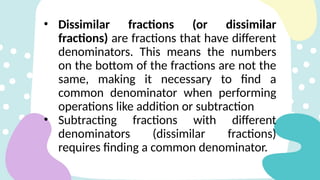
• Dissimilar fractions (or dissimilar
fractions) are fractions that have different
denominators. This means the numbers
on the bottom of the fractions are not the
same, making it necessary to find a
common denominator when performing
operations like addition or subtraction
• Subtracting fractions with different
denominators (dissimilar fractions)
requires finding a common denominator.
Demonstration with Visual Models:
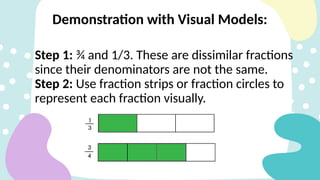
Step 1: ¾ and 1/3. These are dissimilar fractions
since their denominators are not the same.
Step 2: Use fraction strips or fraction circles to
represent each fraction visually.
Step 3: Show students how to convert these
fractions into similar fractions by finding a
common denominator. Demonstrate this by
“cutting” the models to match the new
denominator.
Step 4: Subtract the fractions using the
converted models, then verify the answer by
adding the fraction back.
5/6- ¼
1. Have students find the least common
denominator (LCD) of 6 and 4, which is 12.
2. Show how 5/6 becomes 10/12 and ¼
becomes 3/12.
3. Subtract the fractions using the new
denominators and models.
Example Problem:
Summarize the key steps to subtract
dissimilar fractions using models:
•Find the least common denominator.
•Convert fractions to similar fractions.
•Use models to visualize subtraction.
Generalizations
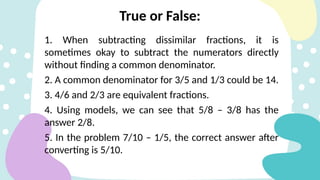
1. When subtracting dissimilar fractions, it is
sometimes okay to subtract the numerators directly
without finding a common denominator.
2. A common denominator for 3/5 and 1/3 could be 14.
3. 4/6 and 2/3 are equivalent fractions.
4. Using models, we can see that 5/8 – 3/8 has the
answer 2/8.
5. In the problem 7/10 – 1/5, the correct answer after
converting is 5/10.
True or False:
5
• The numerator is the top part of a
fraction. It indicates how many parts
of the whole are being considered.
• The denominator is the bottom part of
a fraction. It indicates the total number
of equal parts that make up a whole.
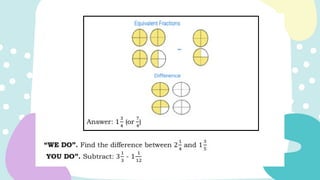
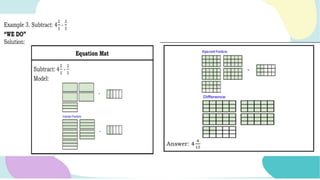
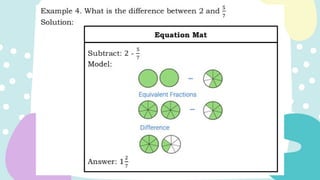
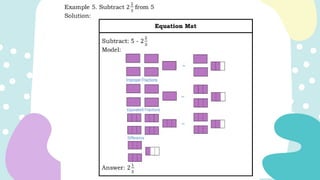
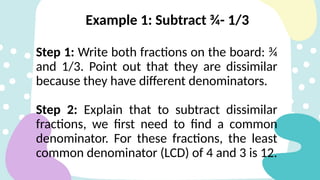
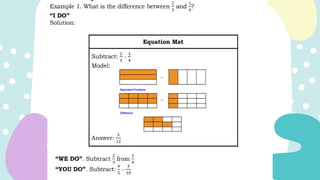
Example 1: Subtract ¾- 1/3
Step 1: Write both fractions on the board: ¾
and 1/3. Point out that they are dissimilar
because they have different denominators.
Step 2: Explain that to subtract dissimilar
fractions, we first need to find a common
denominator. For these fractions, the least
common denominator (LCD) of 4 and 3 is 12.
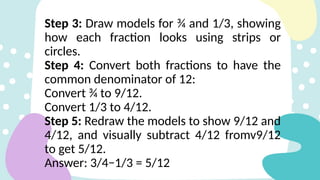
Step 3: Draw models for ¾ and 1/3, showing
how each fraction looks using strips or
circles.
Step 4: Convert both fractions to have the
common denominator of 12:
Convert ¾ to 9/12.
Convert 1/3 to 4/12.
Step 5: Redraw the models to show 9/12 and
4/12, and visually subtract 4/12 fromv9/12
to get 5/12.
Answer: 3/4−1/3 = 5/12
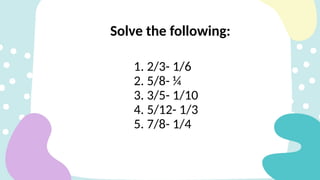
Solve the following:
1. 2/3- 1/6
2. 5/8- ¼
3. 3/5- 1/10
4. 5/12- 1/3
5. 7/8- 1/4
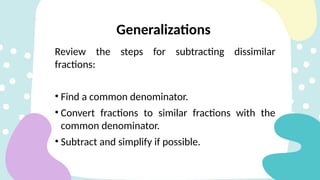
Review the steps for subtracting dissimilar
fractions:
• Find a common denominator.
• Convert fractions to similar fractions with the
common denominator.
• Subtract and simplify if possible.
Generalizations
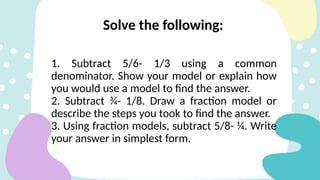
Solve the following:
1. Subtract 5/6- 1/3 using a common
denominator. Show your model or explain how
you would use a model to find the answer.
2. Subtract ¾- 1/8. Draw a fraction model or
describe the steps you took to find the answer.
3. Using fraction models, subtract 5/8- ¼. Write
your answer in simplest form.


MATH-4_Week-6.pptxbhdhhhhahahahhadjhhjkjsjja

  • 1.
  • 2.
    1. Solve wordproblems involving the addition of dissimilar fractions. 2. Subtract dissimilar fractions using models. Learning Competencies
  • 3.
    At the endof the lesson, the learners shall be able to solve word problems involving the addition of dissimilar fractions. Learning Objectives
  • 4.
  • 5.
    Instructions. Find themissing number to complete the pairs of equivalent fractions.
  • 6.
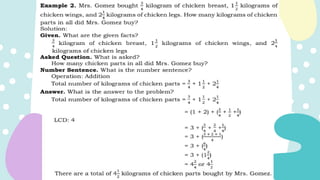
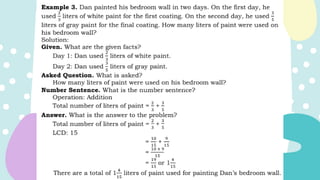
    Anna drank ⅔of a bottle of juice in the morning and ¼ of a bottle in the afternoon. How much juice did she drink in total?
  • 7.
    How can wefind out how much juice Anna drank? •To find the answer, we need to add dissimilar fractions.
  • 8.
    • Dissimilar fractionsare fractions that have different denominators. Because the denominators are not the same, the fractions represent parts of wholes that are divided into different-sized pieces.
  • 9.
    In word problems,we apply the same method to find solutions in real-life situations. Break down the example with Anna’s juice: Represent the fractions visually with fraction bars, showing how ⅔ and ¼ can be converted to 8/12 and 3/12 respectively.
  • 10.
    Solve a WordProblem Together: "Mark has ⅗ of a chocolate bar. He buys another ⅖ of a chocolate bar. How much chocolate does he have now?"
  • 11.
    Step-by-step: • Identify thefractions involved (⅗ and ⅖). Find the common denominator (in this case, 10). Convert the fractions (⅗ = 6/10 and ⅖ = 4/10). Add: 6/10 + 4/10 = 10/10 = 1. Conclude that Mark has one whole chocolate bar.
  • 16.
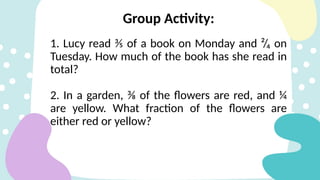
    Group Activity: 1. Lucyread ⅗ of a book on Monday and ²/₄ on Tuesday. How much of the book has she read in total? 2. In a garden, ⅜ of the flowers are red, and ¼ are yellow. What fraction of the flowers are either red or yellow?
  • 17.
    Summarize the stepsto add dissimilar fractions in word problems: 1. Find a common denominator. 2. Convert the fractions to equivalent fractions with the common denominator. 3. Add the fractions. 4. Simplify the result if necessary. Generalizations
  • 18.
    1. Sarah jogged⅖ of a mile on Monday and ⅗ of a mile on Tuesday. How far did she jog in total? 2. Tom ate ⅓ of a pizza and then ate another ¼ of a pizza. How much pizza did he eat? 3. Charm uses 1 cup of all-purpose cream, 2/3 cup of condensed milk, and ½ cup of whipped cream in her fruit salad. How many cups of mixture are there in her fruit salad? Solve the following word problem.
  • 19.
    Solve the followingdissimilar fraction. 1. 1/8 + 6/5= 2. 3/20 + 8/10= 3. 3/9 + 1/3= 4. 1/3 + 3/7= 5. 3/12 + 2/4= Assignment:
  • 20.
  • 21.
    A short story: “Mariahad ⅔ of a chocolate bar, and her friend gave her another ¼ of a chocolate bar. How much chocolate does she have now?” To find the total chocolate, you need to add dissimilar fractions.
  • 22.
    •The Least CommonMultiple (LCM) of two or more numbers is the smallest multiple that is exactly divisible by each of those numbers. In other words, it is the smallest positive number that all the numbers in a set divide into without leaving a remainder.
  • 23.
    • When addingfractions with different denominators, we must first find a common denominator. • Review finding the Least Common Multiple (LCM) as the common denominator for simple fractions.
  • 24.
    Step 1: Identify thefractions (e.g., ⅔ and ¼). Step 2: Find the LCM of the denominators (in this case, 3 and 4, which is 12). Steps in Adding Dissimilar Fractions
  • 25.
    Step 3: Convert eachfraction to an equivalent fraction with the common denominator (⅔ becomes ⁸/₁₂, and ¼ becomes ³/₁₂). Step 4: Add the numerators of the equivalent fractions (⁸/₁₂ + ³/₁₂ = ¹¹/₁₂). Step 5: Simplify the answer if needed.
  • 26.
    Group Activity: Solve theproblem by finding a common denominator, adding the fractions, and simplifying if necessary. • Carlos drank ⅖ of a liter of water in the morning and ⅙ of a liter in the afternoon. How much water did he drink in total?
  • 27.
    •When adding dissimilarfractions, we must find a common denominator before adding the numerators, and the result should be simplified whenever possible. Generalizations
  • 28.
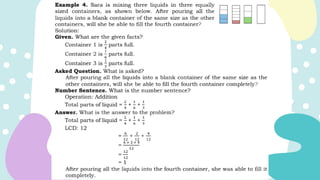
    1. “A bakerused ⅜ of a cup of sugar in one recipe and ½ cup in another recipe. How much sugar did he use in total?” 2. Ben has 2/3 meters of blue ribbon and 2/5 meters of red ribbon. How much ribbon does Ben have in total? 3. Ana is mixing blue and yellow paint to get a green color. The figure at the right shows the parts of the paints to be mixed. How many cans of green paint can she produce in all after Solve the following word problem.
  • 29.
    At the endof the lesson, the learners shall be able to subtract dissimilar fractions using models. Learning Objectives
  • 30.
  • 31.
    What makes fractions“dissimilar” and why they need to have a common denominator to be subtracted? Short Review:
  • 32.
    Scenario: If Tom ate¾ of a pizza and he decided to share ⅓ of it with his friend, how much pizza does he have left? “How can we subtract fractions when their denominators are different?”
  • 33.
    • Dissimilar fractions,also known as dissimilar fractions, are fractions that have different denominators. • Dissimilar fractions have different denominators, making it difficult to subtract directly.
  • 34.
    Using Models toRepresent Dissimilar Fractions: They are not in equal parts, so we can’t subtract them as they are.
  • 35.
    Finding a CommonDenominator with Models: • To subtract fractions with different denominators, we need a common denominator. • For example, to subtract ¾ and ⅓, find the least common multiple (LCM) of 4 and 3, which is 12. • Convert ¾ to 9/12 and ⅓ to 4/12 by dividing each fraction into twelfths.
  • 36.
    Subtracting Using Models: •Now, subtract 4/12 from 9/12 by shading parts of the models or drawing to show what is left. • This gives 5/12, showing that Tom has 5/12 of the pizza left.
  • 43.
    Class Practice: Find acommon denominator, represent each fraction using models, and subtract. ⅚ - ⅖
  • 44.
    To subtract dissimilarfractions, we find a common denominator, convert each fraction, and then subtract. Using models helps us visualize each step. Generalizations
  • 45.
    1. ¾ -⅓ 2. ⅚ - ⅖ 3. ⅔ - ¼ 4. Subtract ⅘ and ⅗ using a model. Find a common denominator, show each fraction, and calculate the difference. 5. Lily has ⅞ of a yard of ribbon and uses ⅜ of it to wrap a gift. How much ribbon is left? Solve the following:
  • 46.
  • 47.
    Review subtraction ofsimilar fractions. Highlight the importance of having the same denominator when subtracting. Short Review:
  • 48.
    If Anna has¾ of a chocolate bar and she wants to give ⅓ of it to her friend, how much will she have left? How do we subtract fractions with different denominators? Scenario:
  • 49.
    • Dissimilar fractions(or dissimilar fractions) are fractions that have different denominators. This means the numbers on the bottom of the fractions are not the same, making it necessary to find a common denominator when performing operations like addition or subtraction • Subtracting fractions with different denominators (dissimilar fractions) requires finding a common denominator.
  • 50.
    Demonstration with VisualModels: Step 1: ¾ and 1/3. These are dissimilar fractions since their denominators are not the same. Step 2: Use fraction strips or fraction circles to represent each fraction visually.
  • 51.
    Step 3: Showstudents how to convert these fractions into similar fractions by finding a common denominator. Demonstrate this by “cutting” the models to match the new denominator. Step 4: Subtract the fractions using the converted models, then verify the answer by adding the fraction back.
  • 52.
    5/6- ¼ 1. Havestudents find the least common denominator (LCD) of 6 and 4, which is 12. 2. Show how 5/6 becomes 10/12 and ¼ becomes 3/12. 3. Subtract the fractions using the new denominators and models. Example Problem:
  • 53.
    Summarize the keysteps to subtract dissimilar fractions using models: •Find the least common denominator. •Convert fractions to similar fractions. •Use models to visualize subtraction. Generalizations
  • 54.
    1. When subtractingdissimilar fractions, it is sometimes okay to subtract the numerators directly without finding a common denominator. 2. A common denominator for 3/5 and 1/3 could be 14. 3. 4/6 and 2/3 are equivalent fractions. 4. Using models, we can see that 5/8 – 3/8 has the answer 2/8. 5. In the problem 7/10 – 1/5, the correct answer after converting is 5/10. True or False:
  • 55.
  • 56.
    • The numeratoris the top part of a fraction. It indicates how many parts of the whole are being considered. • The denominator is the bottom part of a fraction. It indicates the total number of equal parts that make up a whole.
  • 57.
    Example 1: Subtract¾- 1/3 Step 1: Write both fractions on the board: ¾ and 1/3. Point out that they are dissimilar because they have different denominators. Step 2: Explain that to subtract dissimilar fractions, we first need to find a common denominator. For these fractions, the least common denominator (LCD) of 4 and 3 is 12.
  • 58.
    Step 3: Drawmodels for ¾ and 1/3, showing how each fraction looks using strips or circles. Step 4: Convert both fractions to have the common denominator of 12: Convert ¾ to 9/12. Convert 1/3 to 4/12. Step 5: Redraw the models to show 9/12 and 4/12, and visually subtract 4/12 fromv9/12 to get 5/12. Answer: 3/4−1/3 = 5/12
  • 59.
    Solve the following: 1.2/3- 1/6 2. 5/8- ¼ 3. 3/5- 1/10 4. 5/12- 1/3 5. 7/8- 1/4
  • 60.
    Review the stepsfor subtracting dissimilar fractions: • Find a common denominator. • Convert fractions to similar fractions with the common denominator. • Subtract and simplify if possible. Generalizations
  • 61.
    Solve the following: 1.Subtract 5/6- 1/3 using a common denominator. Show your model or explain how you would use a model to find the answer. 2. Subtract ¾- 1/8. Draw a fraction model or describe the steps you took to find the answer. 3. Using fraction models, subtract 5/8- ¼. Write your answer in simplest form.