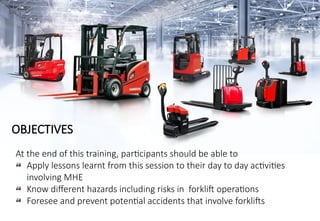
At the endof this training, participants should be able to
Apply lessons learnt from this session to their day to day activities
involving MHE
Know different hazards including risks in forklift operations
Foresee and prevent potential accidents that involve forklifts
OBJECTIVES
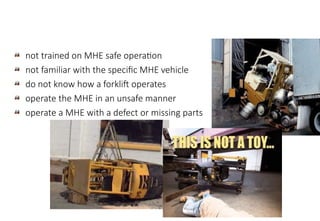
not trained onMHE safe operation
not familiar with the specific MHE vehicle
do not know how a forklift operates
operate the MHE in an unsafe manner
operate a MHE with a defect or missing parts
MHE Safe Operation
7.
MHE Safe Operation
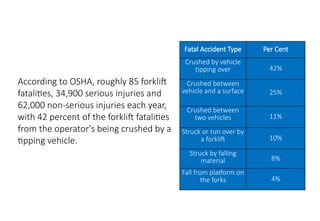
FatalAccident Type Per Cent
Crushed by vehicle
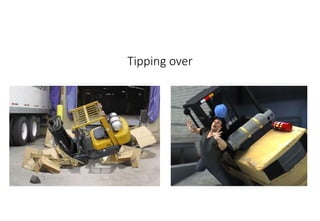
tipping over 42%
Crushed between
vehicle and a surface 25%
Crushed between
two vehicles 11%
Struck or run over by
a forklift 10%
Struck by falling
material 8%
Fall from platform on
the forks 4%
According to OSHA, roughly 85 forklift
fatalities, 34,900 serious injuries and
62,000 non-serious injuries each year,
with 42 percent of the forklift fatalities
from the operator's being crushed by a
tipping vehicle.
8.
MHE Safe Operation
InJanuary 31, 2013 a worker died after being hit by a forklift inside the
shipyard of the Korean firm Hanjin Heavy Industries and Construction
Philippines in Subic Bay Freeport. The victim sustained a crushing injury
in his abdomen – published by INQUIRER on February 04, 2013.
A South Korean expat was killed Sunday when a forklift ran over him at
an assembly facility of the Hanjin Heavy Industries Corp. Philippines –
published by GMA NEWS on January 25, 2009.
MHE Safe Operation
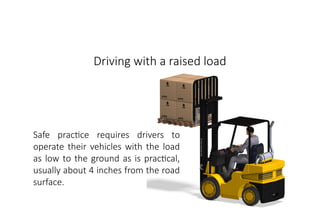
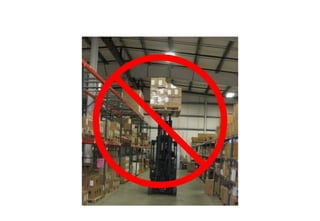
Drivingwith a raised load
Safe practice requires drivers to
operate their vehicles with the load
as low to the ground as is practical,
usually about 4 inches from the road
surface.
12.
MHE Safe Operation
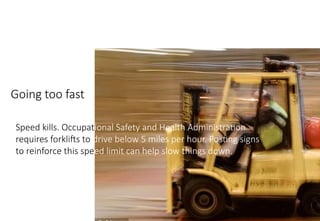
Goingtoo fast
Speed kills. Occupational Safety and Health Administration
requires forklifts to drive below 5 miles per hour. Posting signs
to reinforce this speed limit can help slow things down.
13.
MHE Safe Operation
Inadequatetraining
Don't allow any of your operators to get
behind the wheel until they have
successfully completed a certified forklift
training course. Then re-certify drivers at
least once every five years.
It's not just a good idea, it's also the law.
MHE Safe Operation
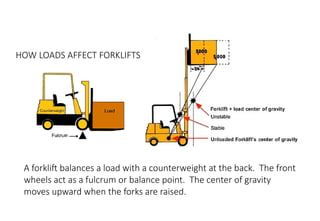
HOWLOADS AFFECT FORKLIFTS
A forklift balances a load with a counterweight at the back. The front
wheels act as a fulcrum or balance point. The center of gravity
moves upward when the forks are raised.
MHE Safe Operation
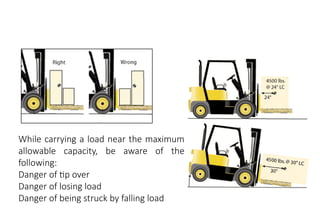
Whilecarrying a load near the maximum
allowable capacity, be aware of the
following:
Danger of tip over
Danger of losing load
Danger of being struck by falling load
18.
MHE Safe Operation
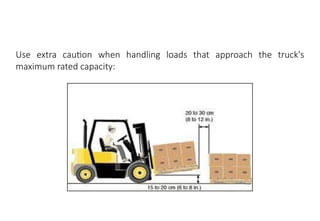
Useextra caution when handling loads that approach the truck's
maximum rated capacity:
19.
MHE Safe Operation
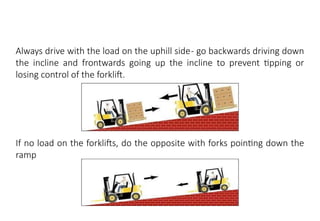
Alwaysdrive with the load on the uphill side- go backwards driving down
the incline and frontwards going up the incline to prevent tipping or
losing control of the forklift.
If no load on the forklifts, do the opposite with forks pointing down the
ramp
20.
MHE Safe Operation
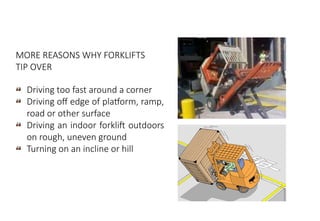
Drivingtoo fast around a corner
Driving off edge of platform, ramp,
road or other surface
Driving an indoor forklift outdoors
on rough, uneven ground
Turning on an incline or hill
MORE REASONS WHY FORKLIFTS
TIP OVER
21.
MHE Safe Operation
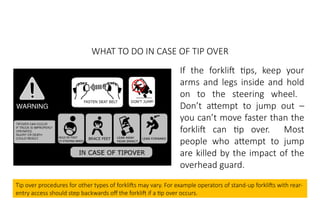
WHATTO DO IN CASE OF TIP OVER
If the forklift tips, keep your
arms and legs inside and hold
on to the steering wheel.
Don’t attempt to jump out –
you can’t move faster than the
forklift can tip over. Most
people who attempt to jump
are killed by the impact of the
overhead guard.
Tip over procedures for other types of forklifts may vary. For example operators of stand-up forklifts with rear-
entry access should step backwards off the forklift if a tip over occurs.
22.
MHE Safe Operation
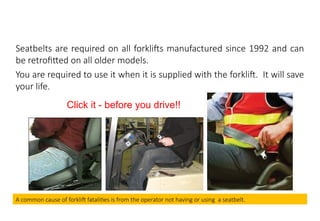
Seatbeltsare required on all forklifts manufactured since 1992 and can
be retrofitted on all older models.
You are required to use it when it is supplied with the forklift. It will save
your life.
Click it - before you drive!!
A common cause of forklift fatalities is from the operator not having or using a seatbelt.
23.
MHE Safe Operation
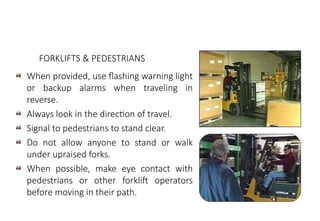
Whenprovided, use flashing warning light
or backup alarms when traveling in
reverse.
Always look in the direction of travel.
Signal to pedestrians to stand clear.
Do not allow anyone to stand or walk
under upraised forks.
When possible, make eye contact with
pedestrians or other forklift operators
before moving in their path.
FORKLIFTS & PEDESTRIANS
24.
MHE Safe Operation
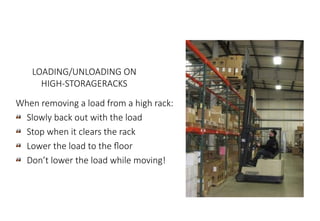
LOADING/UNLOADINGON
HIGH-STORAGERACKS
When removing a load from a high rack:
Slowly back out with the load
Stop when it clears the rack
Lower the load to the floor
Don’t lower the load while moving!
25.
MHE Safe Operation
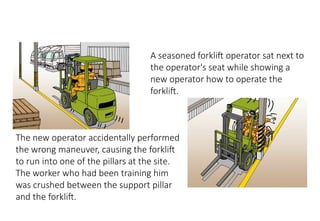
Aseasoned forklift operator sat next to
the operator's seat while showing a
new operator how to operate the
forklift.
The new operator accidentally performed
the wrong maneuver, causing the forklift
to run into one of the pillars at the site.
The worker who had been training him
was crushed between the support pillar
and the forklift.
26.
MHE Safe Operation
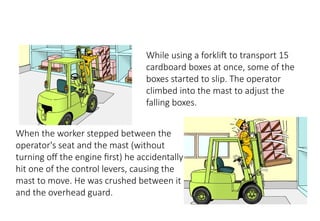
Whileusing a forklift to transport 15
cardboard boxes at once, some of the
boxes started to slip. The operator
climbed into the mast to adjust the
falling boxes.
When the worker stepped between the
operator's seat and the mast (without
turning off the engine first) he accidentally
hit one of the control levers, causing the
mast to move. He was crushed between it
and the overhead guard.