AN INTRODUCTION TO
MATERIALS DEVELOPMENT
W E E K 1
WARM UP!
•Where do you see yourself in one
year?
BRIAN TOMLINSON –PIONEER IN THE
FILED OF MD
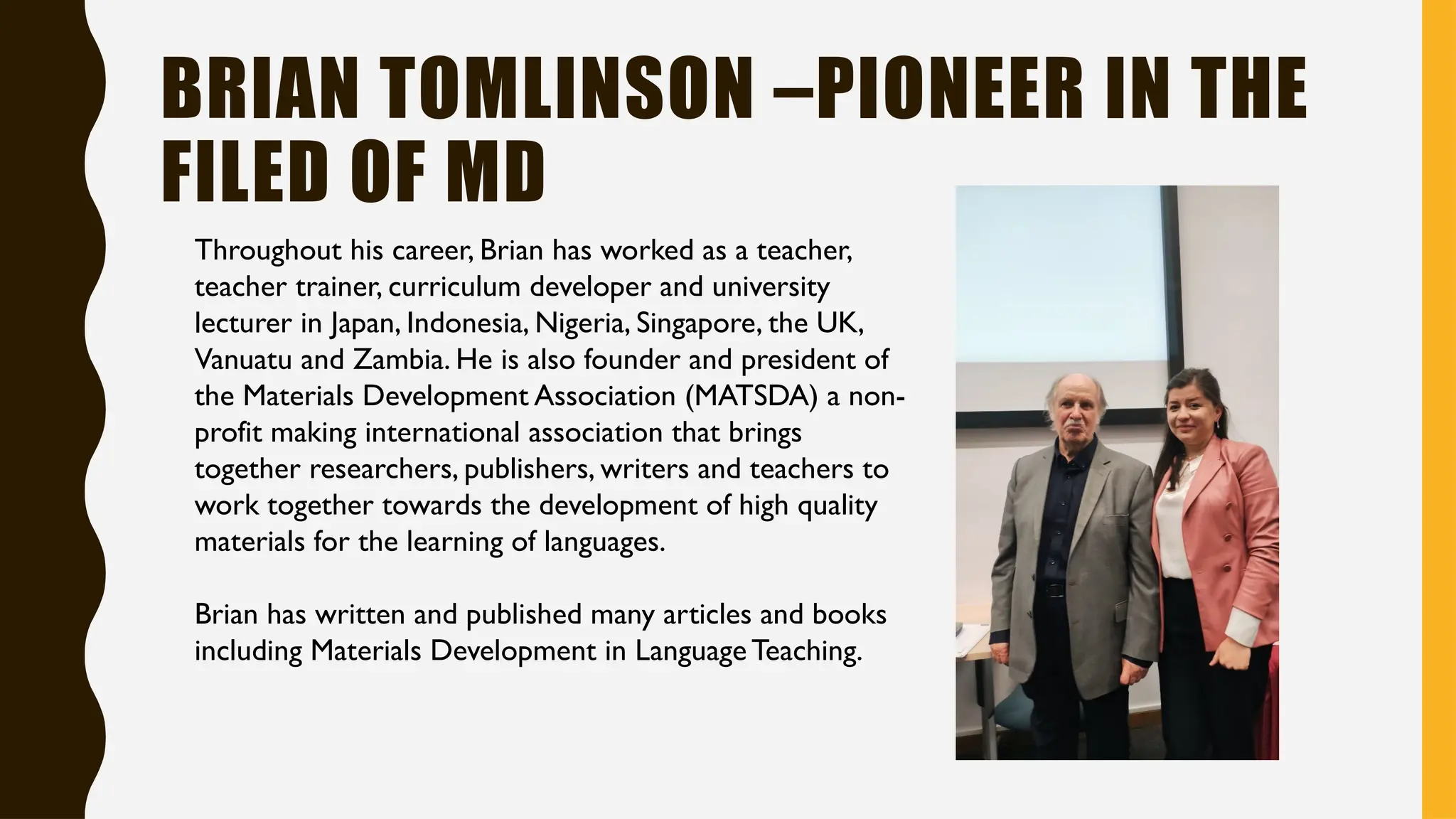
Throughout his career, Brian has worked as a teacher,
teacher trainer, curriculum developer and university
lecturer in Japan, Indonesia, Nigeria, Singapore, the UK,
Vanuatu and Zambia. He is also founder and president of
the Materials Development Association (MATSDA) a non-
profit making international association that brings
together researchers, publishers, writers and teachers to
work together towards the development of high quality
materials for the learning of languages.
Brian has written and published many articles and books
including Materials Development in LanguageTeaching.
ACTIVITY 1-1 THINK-PAIR-SHARE
• What is your concept of “materials development”?
• Are you more comfortable teaching using a textbook or creating your own materials? (And
why?)
• What is your experience with using materials found on the internet or in books? How reliable
are they? Do they really meet the needs of your learners?
Based on the reading by Tomlinson
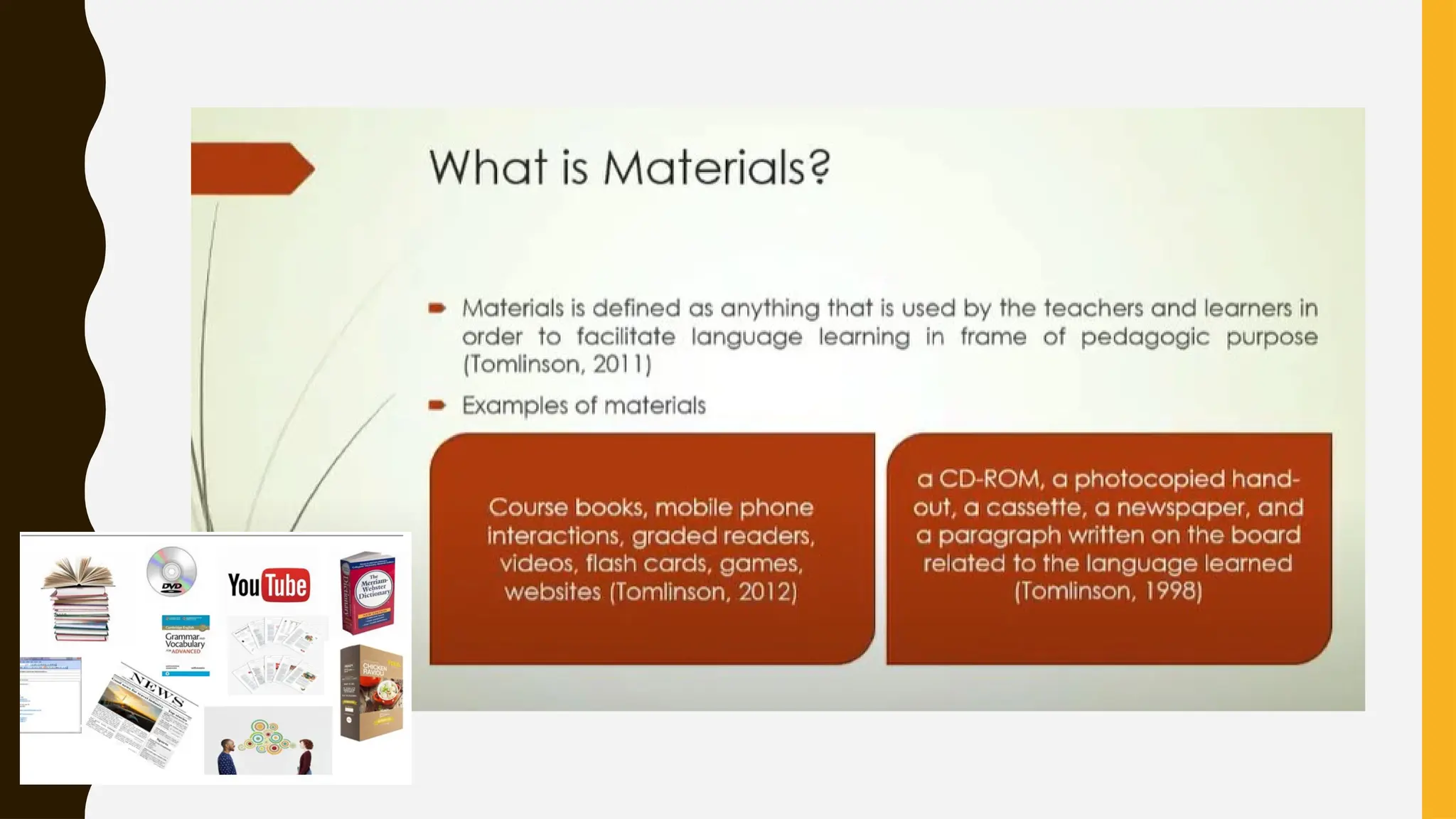
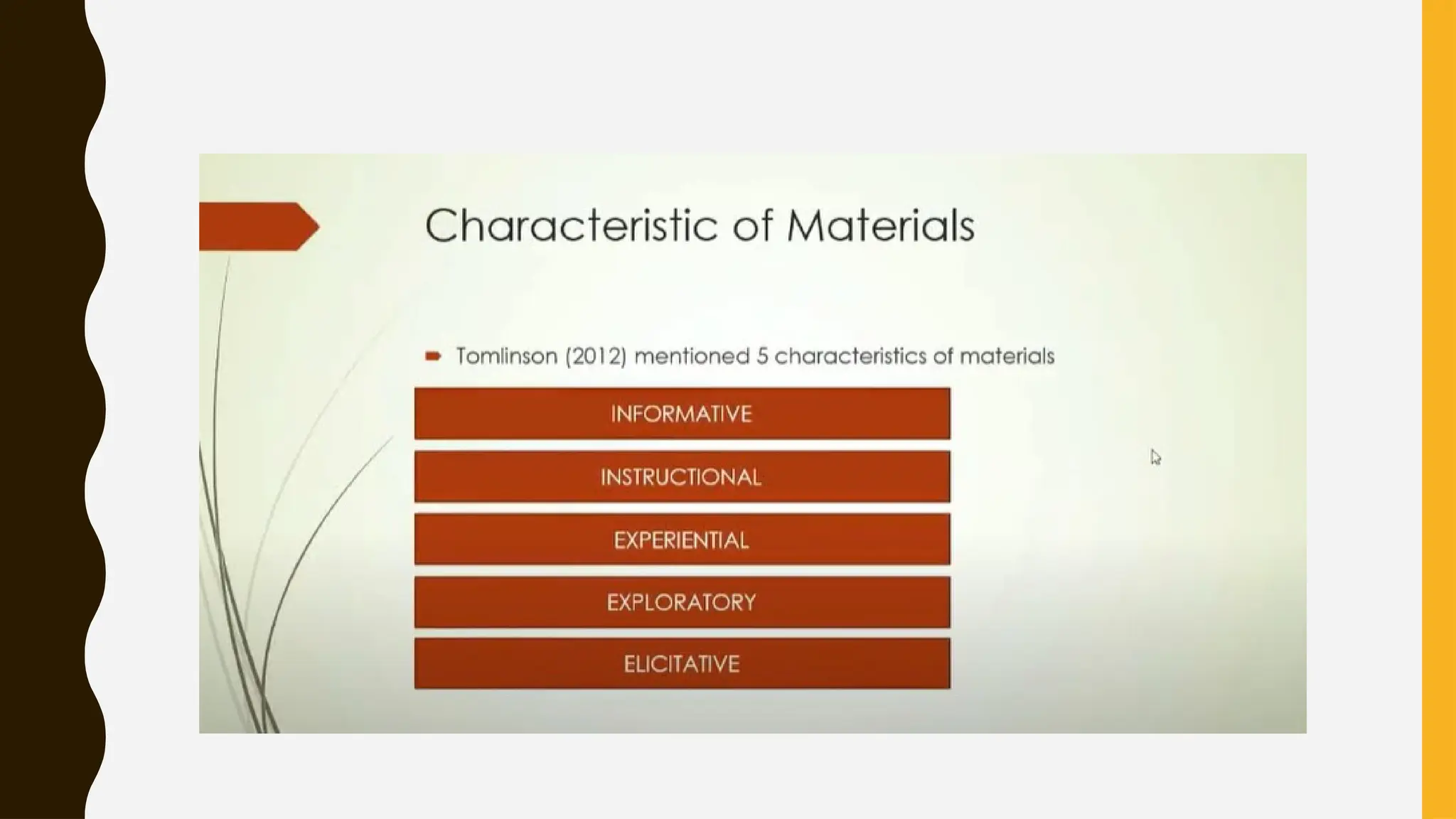
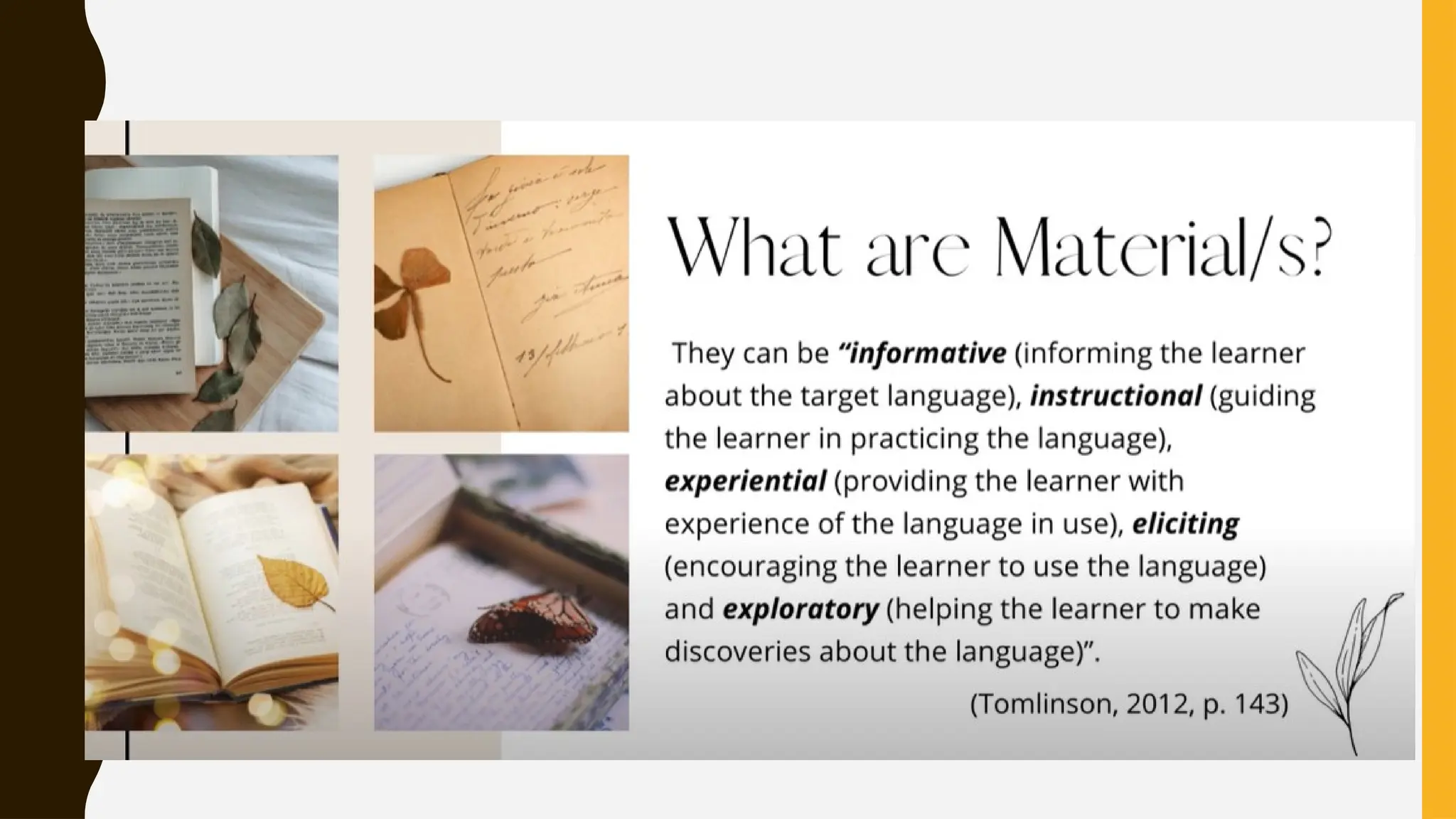
• Materials
• Materials development
• Materials evaluation
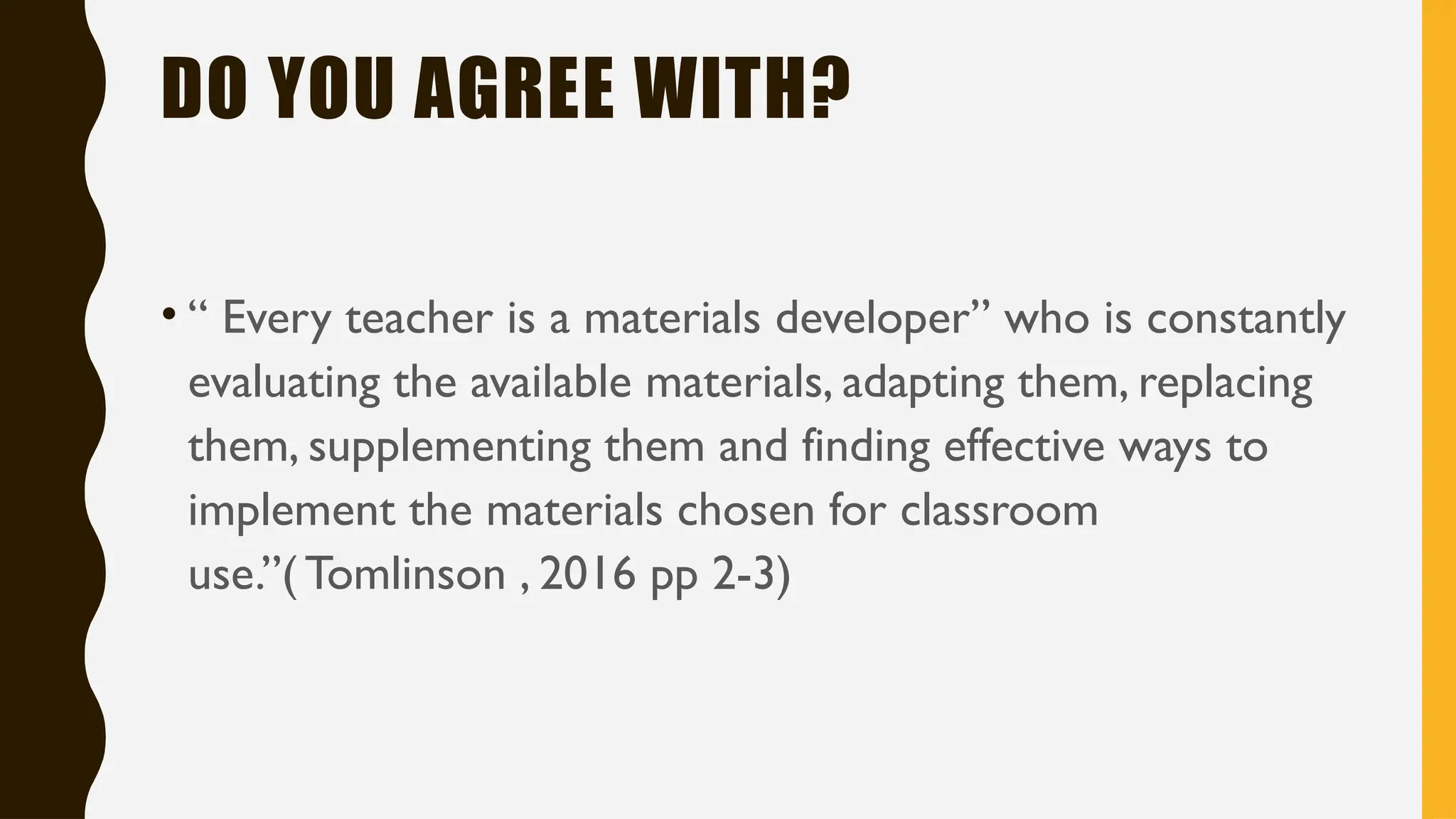
DO YOU AGREE WITH?
• “ Every teacher is a materials developer” who is constantly
evaluating the available materials, adapting them, replacing
them, supplementing them and finding effective ways to
implement the materials chosen for classroom
use.”( Tomlinson , 2016 pp 2-3)
GOALS OF MATERIALS DEVELOPMENT
• The Week 1 readings include some lists and discussions of goals of
materials for language learning
• In groups, and without copying, make a list of five to seven goals for
materials to be used in language classrooms
• These lists should be informed by the readings, but students should
not simply copy
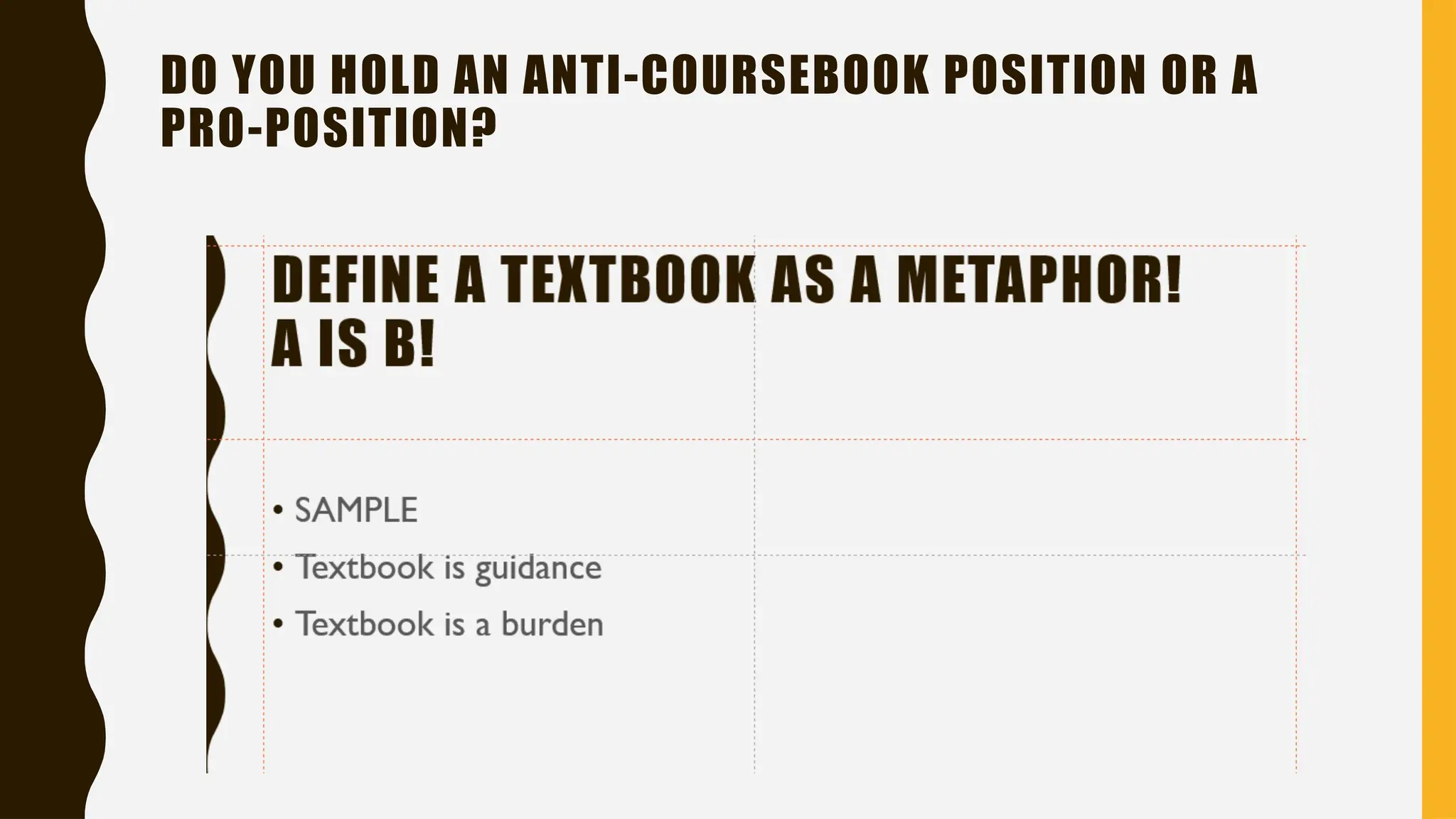
DO YOU HOLD AN ANTI-COURSEBOOK POSITION OR A
PRO-POSITION?
• Anti-textbook position: language taught in textbooks does not reflect
the authentic ;language in AW; textbook writers lack theoretical and
practical background, textbooks concerned with marketing success,
unlikely to meet specific needs
• Pro textbook position: textbooks save time, ease burden of preparation,
provide material on a weekly basis, teachers adopt details
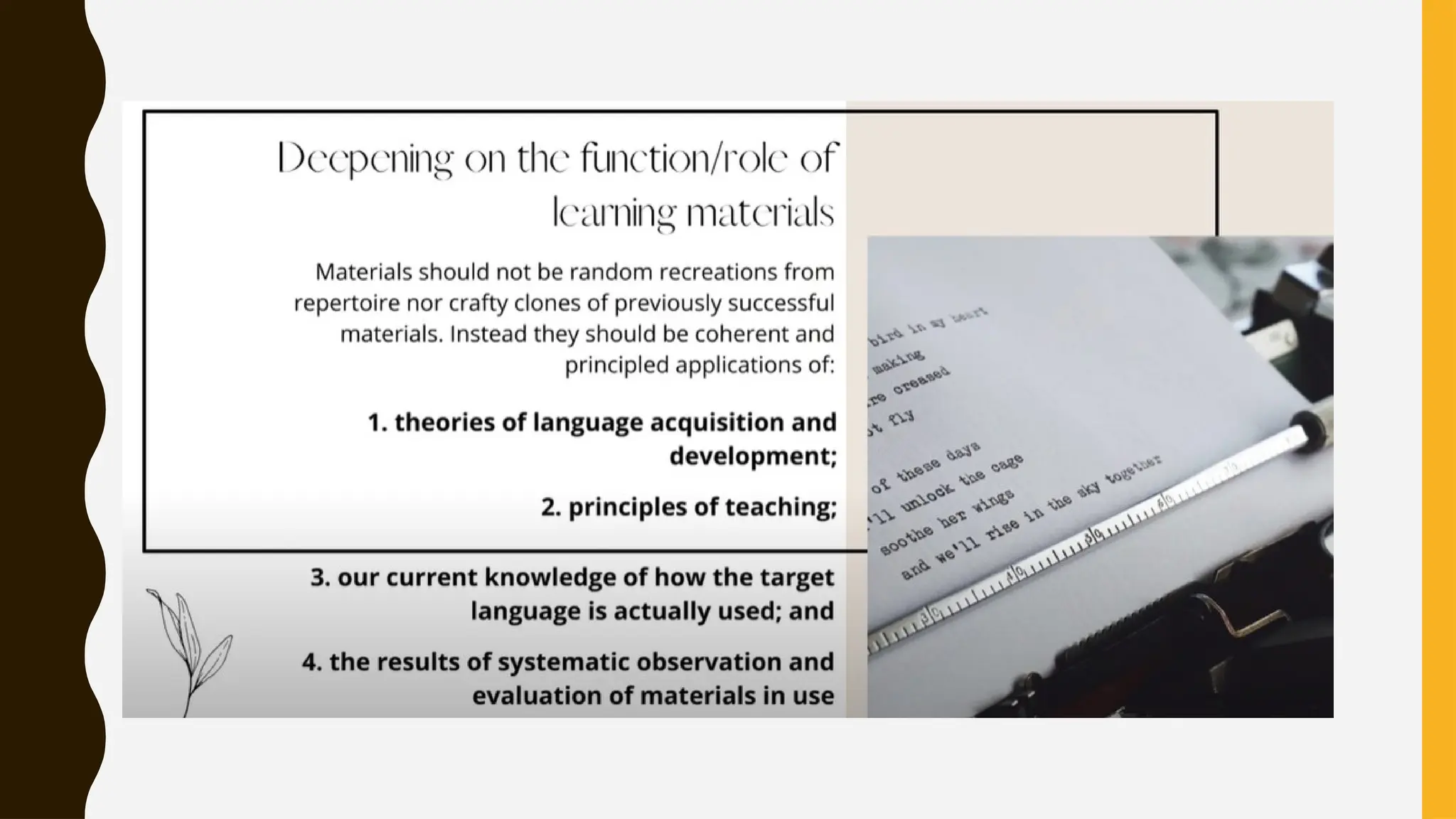
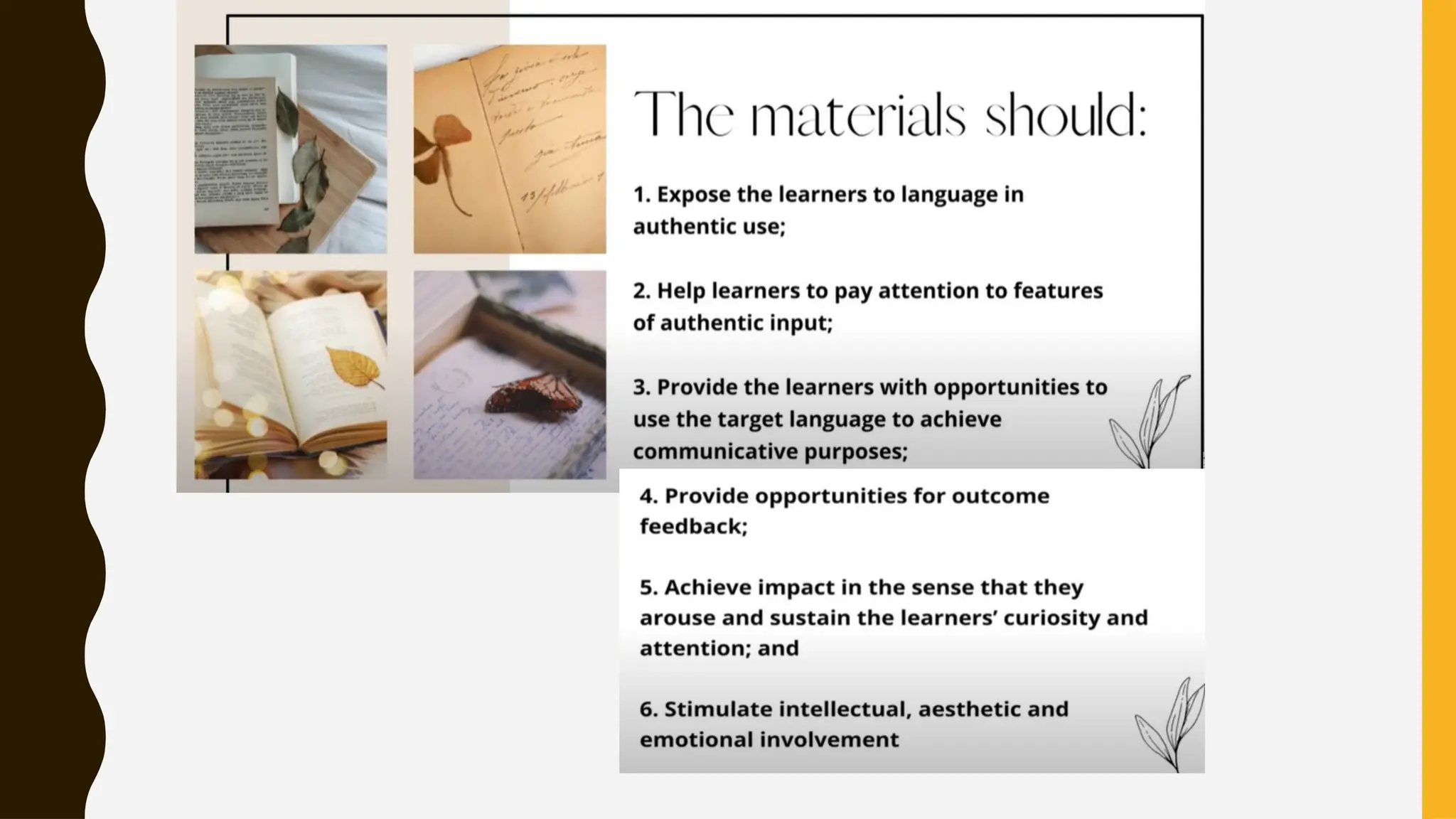
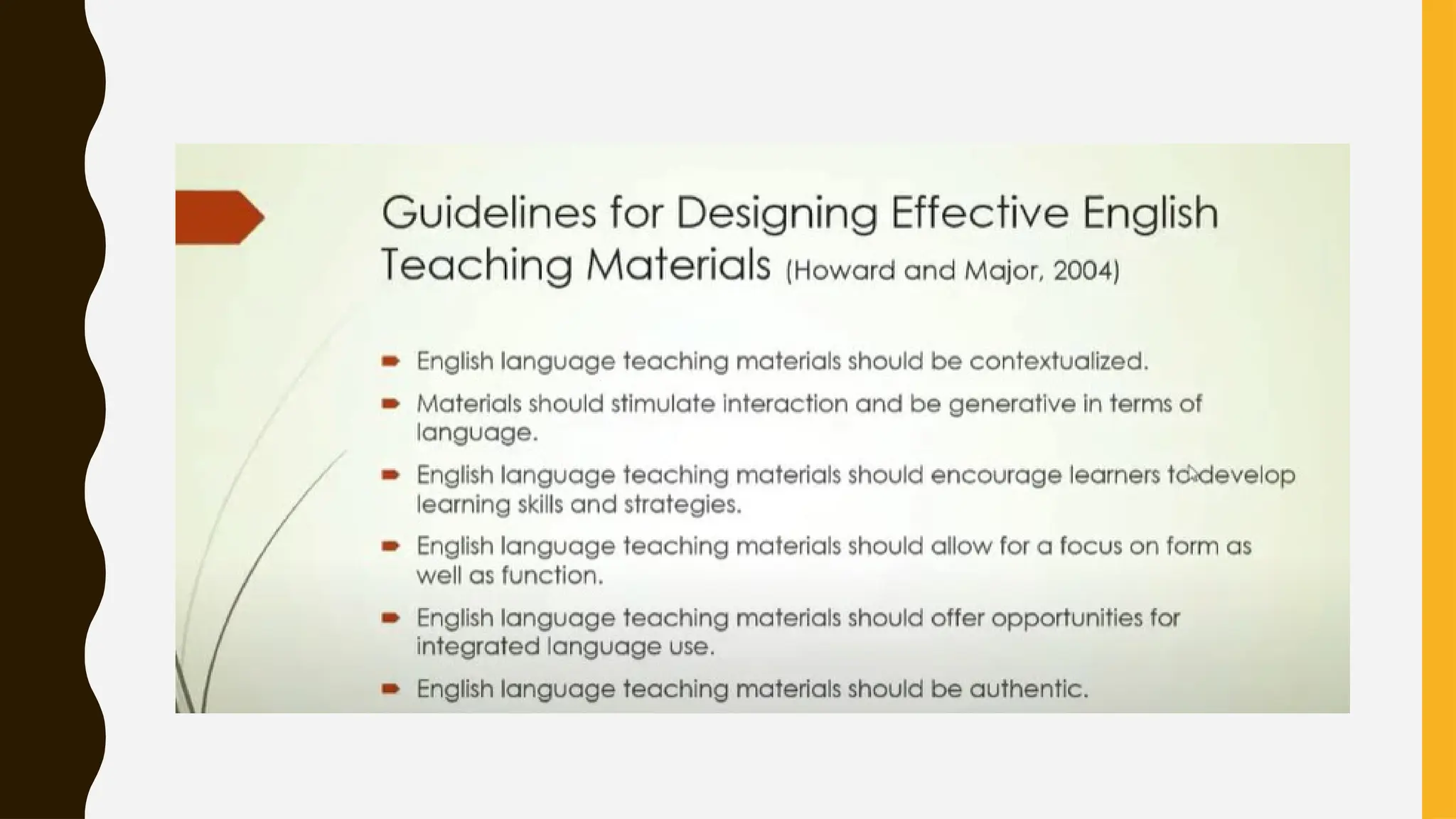
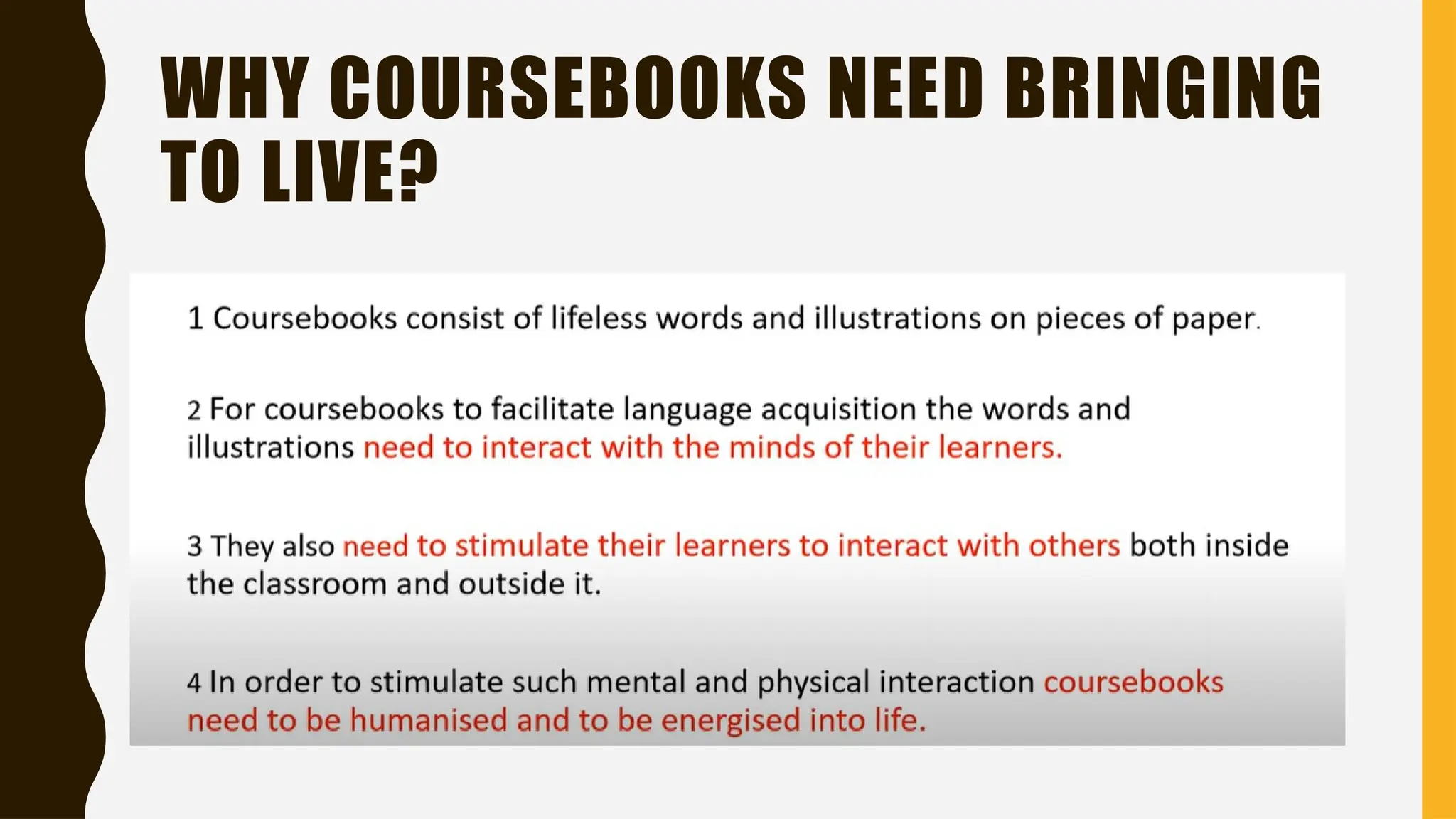
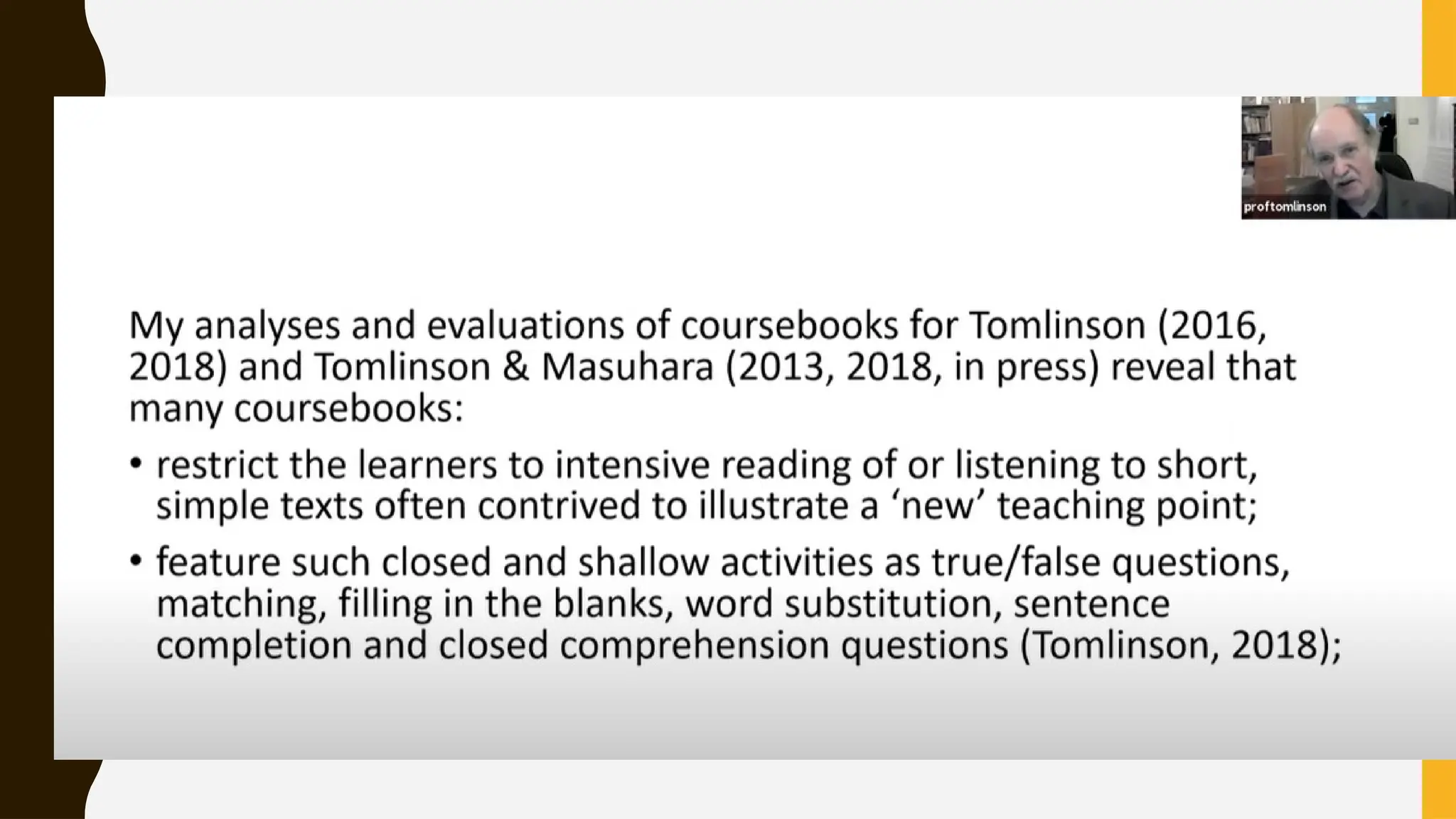
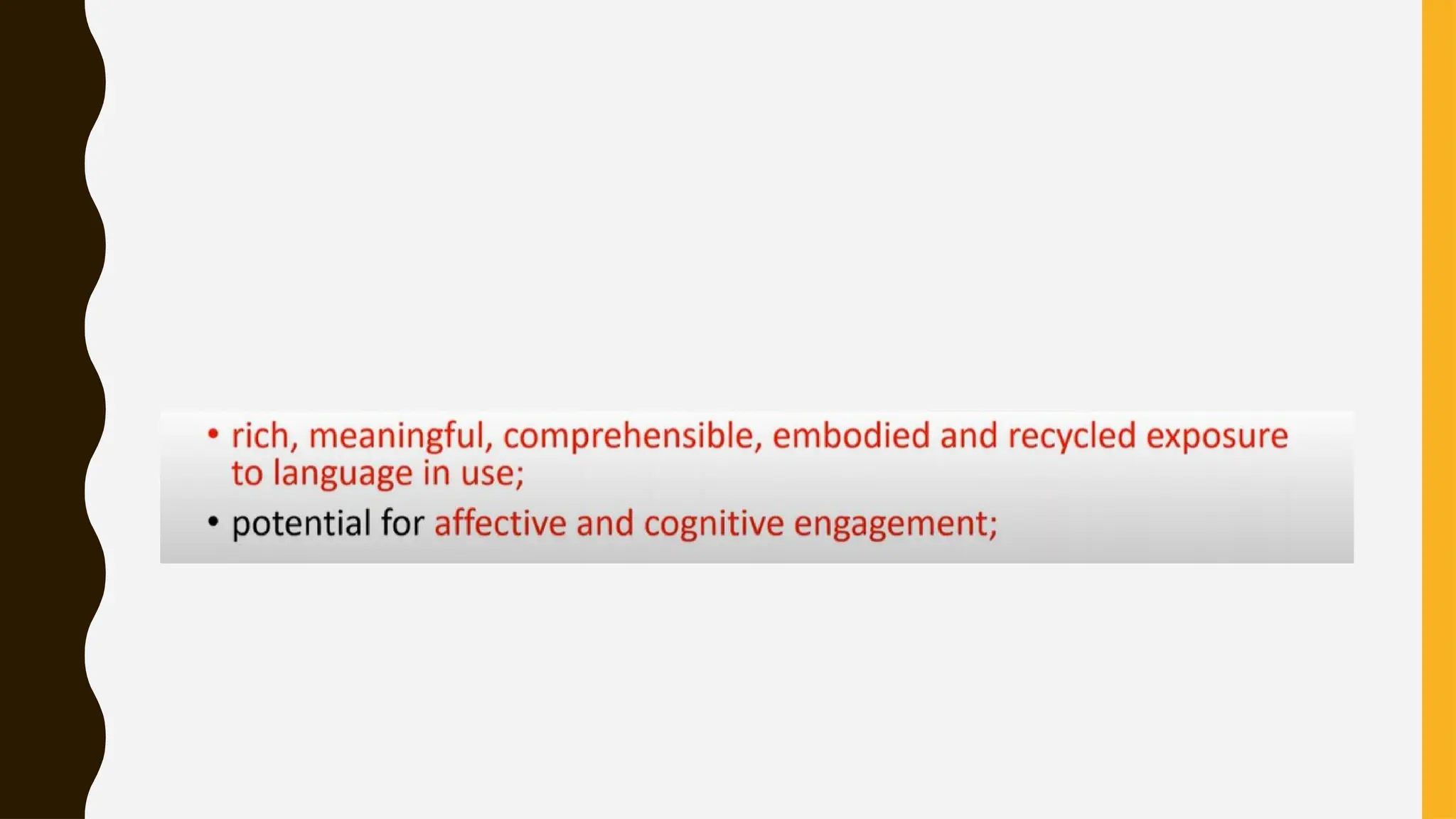
WHY COURSEBOOKS NEED BRINGING
TO LIVE?
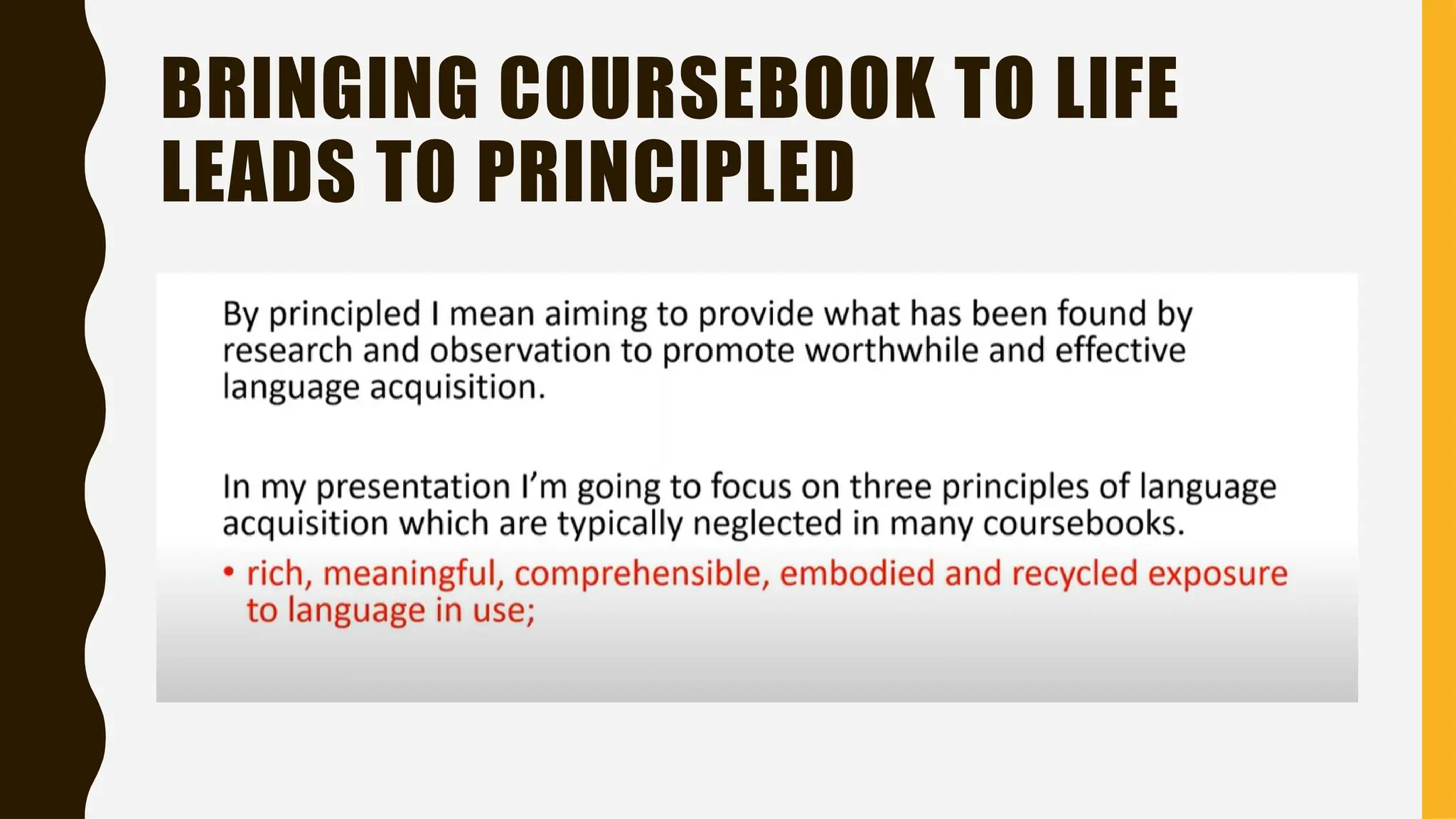
BRINGING COURSEBOOK TO LIFE
LEADS TO PRINCIPLED
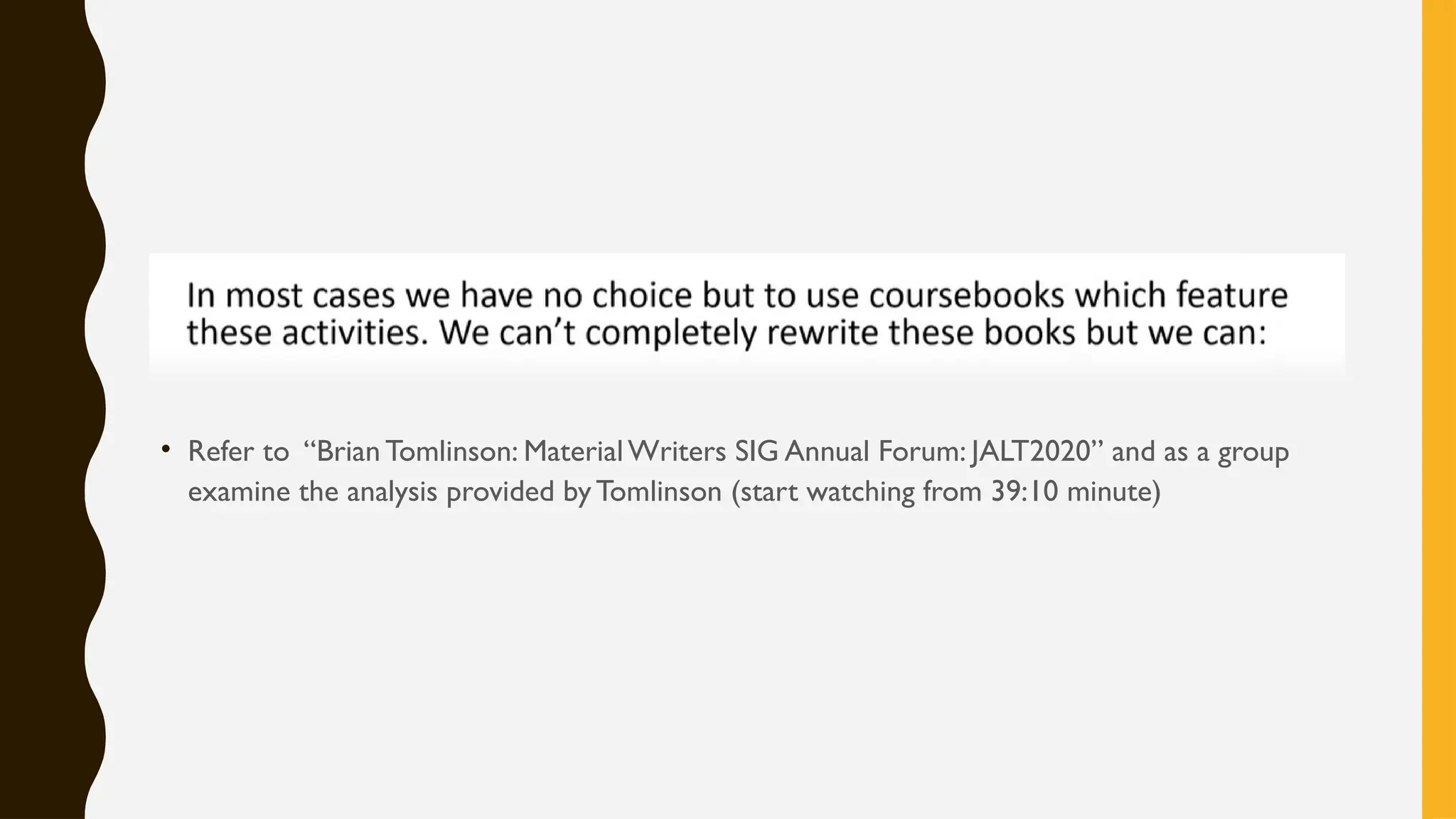
• Refer to “Brian Tomlinson: MaterialWriters SIG Annual Forum: JALT2020” and as a group
examine the analysis provided by Tomlinson (start watching from 39:10 minute)
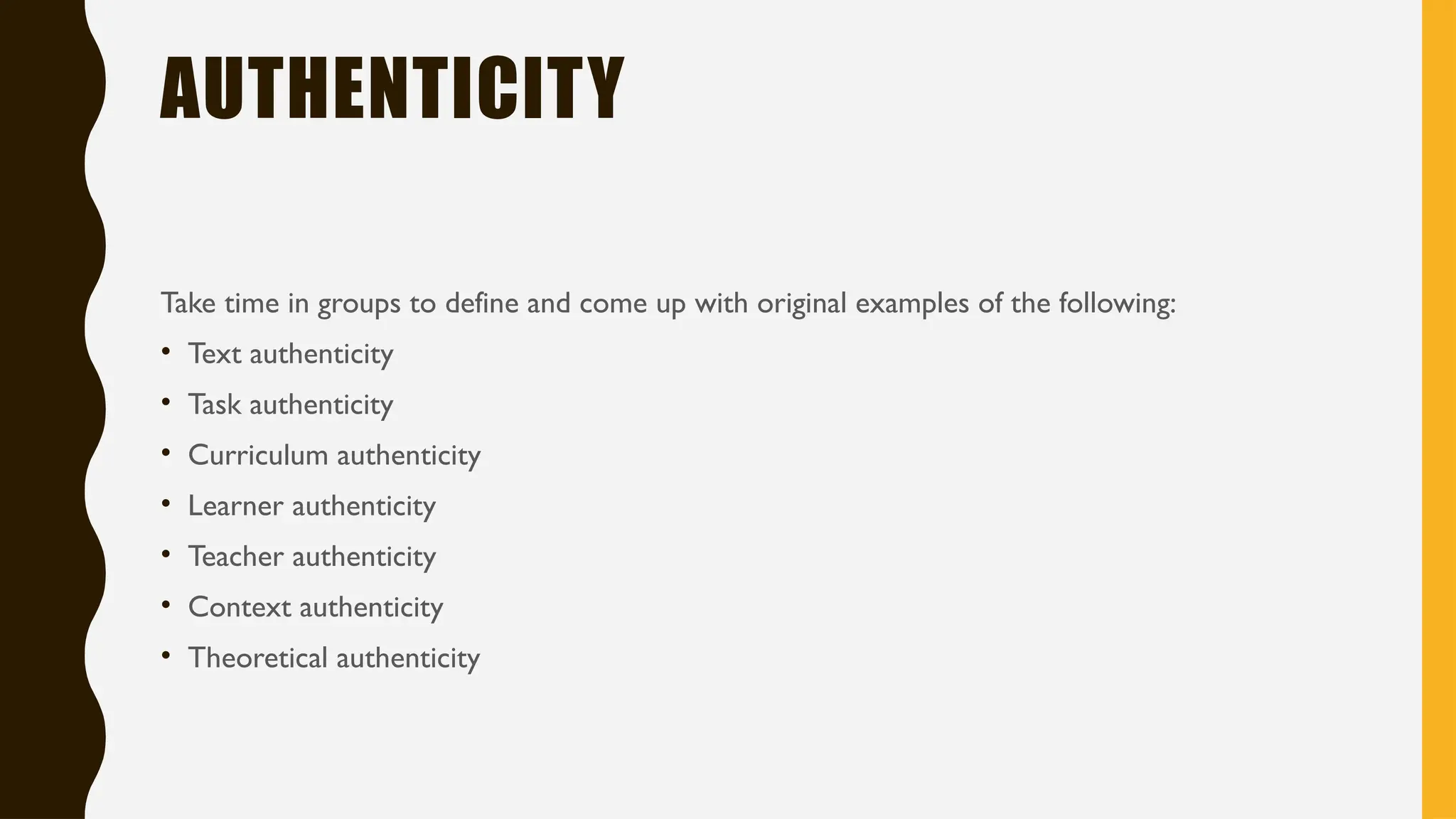
AUTHENTICITY
Take time in groups to define and come up with original examples of the following:
• Text authenticity
• Task authenticity
• Curriculum authenticity
• Learner authenticity
• Teacher authenticity
• Context authenticity
• Theoretical authenticity
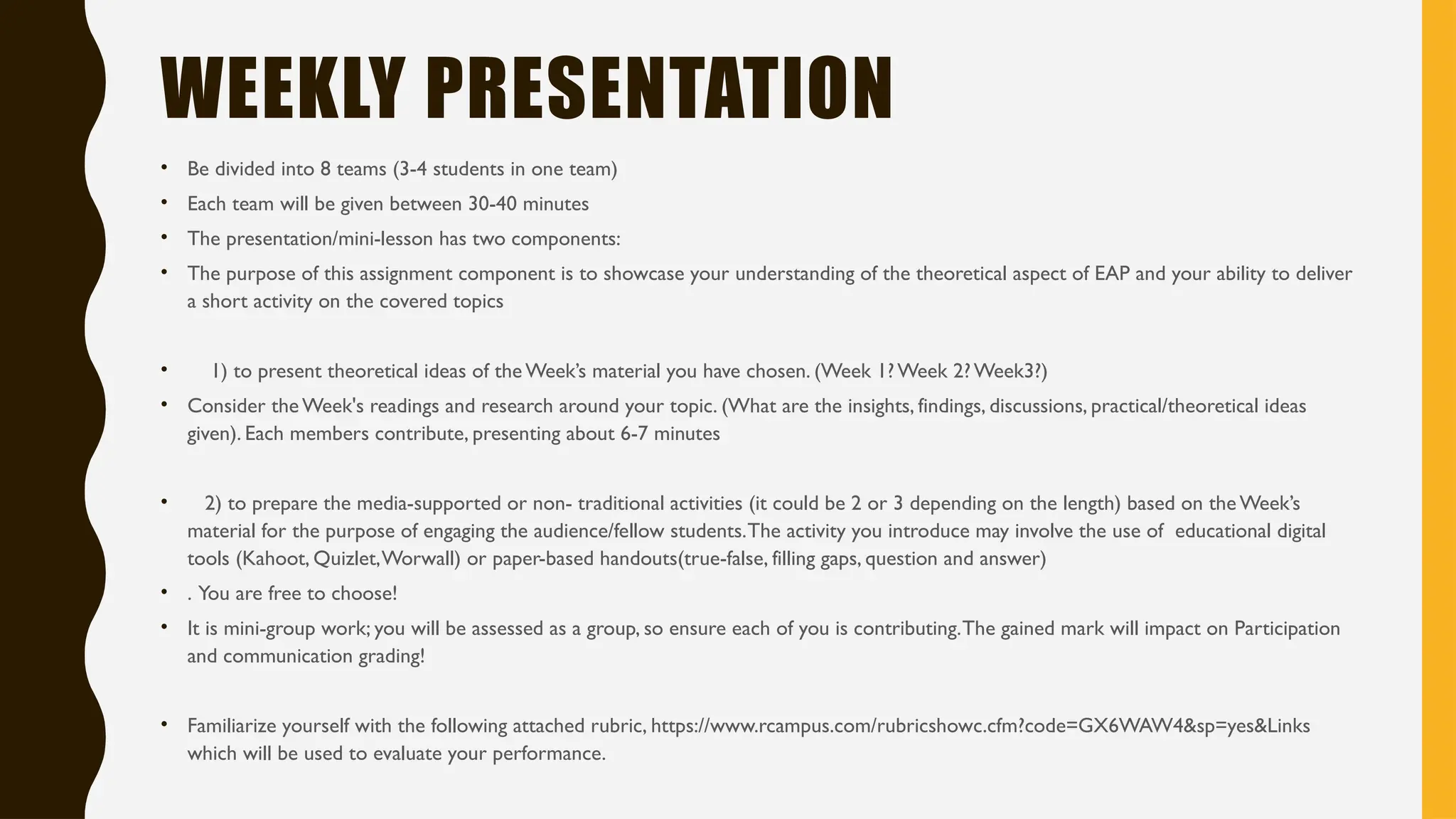
WEEKLY PRESENTATION
• Be divided into 8 teams (3-4 students in one team)
• Each team will be given between 30-40 minutes
• The presentation/mini-lesson has two components:
• The purpose of this assignment component is to showcase your understanding of the theoretical aspect of EAP and your ability to deliver
a short activity on the covered topics
• 1) to present theoretical ideas of the Week’s material you have chosen. (Week 1?Week 2?Week3?)
• Consider the Week's readings and research around your topic. (What are the insights, findings, discussions, practical/theoretical ideas
given). Each members contribute, presenting about 6-7 minutes
• 2) to prepare the media-supported or non- traditional activities (it could be 2 or 3 depending on the length) based on the Week’s
material for the purpose of engaging the audience/fellow students.The activity you introduce may involve the use of educational digital
tools (Kahoot, Quizlet,Worwall) or paper-based handouts(true-false, filling gaps, question and answer)
• . You are free to choose!
• It is mini-group work; you will be assessed as a group, so ensure each of you is contributing.The gained mark will impact on Participation
and communication grading!
• Familiarize yourself with the following attached rubric, https://www.rcampus.com/rubricshowc.cfm?code=GX6WAW4&sp=yes&Links
which will be used to evaluate your performance.

MATERIAL DESIGN THAT CAN HELP STUDENTS TO DEVELOP TEXTBOOKS AND HANDOUTS TO THEIR LESSON

  • 1.
    AN INTRODUCTION TO MATERIALSDEVELOPMENT W E E K 1
  • 3.
    WARM UP! •Where doyou see yourself in one year?
  • 4.
    BRIAN TOMLINSON –PIONEERIN THE FILED OF MD Throughout his career, Brian has worked as a teacher, teacher trainer, curriculum developer and university lecturer in Japan, Indonesia, Nigeria, Singapore, the UK, Vanuatu and Zambia. He is also founder and president of the Materials Development Association (MATSDA) a non- profit making international association that brings together researchers, publishers, writers and teachers to work together towards the development of high quality materials for the learning of languages. Brian has written and published many articles and books including Materials Development in LanguageTeaching.
  • 5.
    ACTIVITY 1-1 THINK-PAIR-SHARE •What is your concept of “materials development”? • Are you more comfortable teaching using a textbook or creating your own materials? (And why?) • What is your experience with using materials found on the internet or in books? How reliable are they? Do they really meet the needs of your learners? Based on the reading by Tomlinson • Materials • Materials development • Materials evaluation
  • 17.
    DO YOU AGREEWITH? • “ Every teacher is a materials developer” who is constantly evaluating the available materials, adapting them, replacing them, supplementing them and finding effective ways to implement the materials chosen for classroom use.”( Tomlinson , 2016 pp 2-3)
  • 18.
    GOALS OF MATERIALSDEVELOPMENT • The Week 1 readings include some lists and discussions of goals of materials for language learning • In groups, and without copying, make a list of five to seven goals for materials to be used in language classrooms • These lists should be informed by the readings, but students should not simply copy
  • 19.
    DO YOU HOLDAN ANTI-COURSEBOOK POSITION OR A PRO-POSITION?
  • 20.
    • Anti-textbook position:language taught in textbooks does not reflect the authentic ;language in AW; textbook writers lack theoretical and practical background, textbooks concerned with marketing success, unlikely to meet specific needs • Pro textbook position: textbooks save time, ease burden of preparation, provide material on a weekly basis, teachers adopt details
  • 21.
    WHY COURSEBOOKS NEEDBRINGING TO LIVE?
  • 22.
    BRINGING COURSEBOOK TOLIFE LEADS TO PRINCIPLED
  • 24.
    • Refer to“Brian Tomlinson: MaterialWriters SIG Annual Forum: JALT2020” and as a group examine the analysis provided by Tomlinson (start watching from 39:10 minute)
  • 29.
    AUTHENTICITY Take time ingroups to define and come up with original examples of the following: • Text authenticity • Task authenticity • Curriculum authenticity • Learner authenticity • Teacher authenticity • Context authenticity • Theoretical authenticity
  • 30.
    WEEKLY PRESENTATION • Bedivided into 8 teams (3-4 students in one team) • Each team will be given between 30-40 minutes • The presentation/mini-lesson has two components: • The purpose of this assignment component is to showcase your understanding of the theoretical aspect of EAP and your ability to deliver a short activity on the covered topics • 1) to present theoretical ideas of the Week’s material you have chosen. (Week 1?Week 2?Week3?) • Consider the Week's readings and research around your topic. (What are the insights, findings, discussions, practical/theoretical ideas given). Each members contribute, presenting about 6-7 minutes • 2) to prepare the media-supported or non- traditional activities (it could be 2 or 3 depending on the length) based on the Week’s material for the purpose of engaging the audience/fellow students.The activity you introduce may involve the use of educational digital tools (Kahoot, Quizlet,Worwall) or paper-based handouts(true-false, filling gaps, question and answer) • . You are free to choose! • It is mini-group work; you will be assessed as a group, so ensure each of you is contributing.The gained mark will impact on Participation and communication grading! • Familiarize yourself with the following attached rubric, https://www.rcampus.com/rubricshowc.cfm?code=GX6WAW4&sp=yes&Links which will be used to evaluate your performance.