Overview: Exploring the
MATATAG and Revisiting the
2016 Curriculum Guides Prior to
Designing a Standards-Based
Curriculum Map and Learning
Plan
SESSION 1
“Education is no longer about
teaching students something alone; it is
more important to be teaching them to
develop a reliable compass and
navigation tools (transversal
competencies) to find their own way in
a world that is increasingly complex,
volatile, and uncertain.”
CURRICULUM REVIEW FINDINGS
1
Curriculum
Content is
Congested
2
Misplaced
Prerequisite Learning
Competencies
3
Imbalance of
Cognitive
Demand
MATATAG: Bansang Makabata,
Bansang Makabansa
The education agenda of the current
administration is known as MATATAG:
Bansang Makabata, Batang Makabansa,
which sets the new direction of the
agency and stakeholders in resolving
basic education challenges.
The MATATAG Agenda has four
critical components:
 Make the curriculum relevant to produce competent
and job-ready, active, and responsible citizens;
 Take steps to accelerate delivery of basic education
facilities and services;
 Take good care of learners by promoting learner well-
being, inclusive education, and a positive learning
environment; and
 Give support to teachers to teach better.
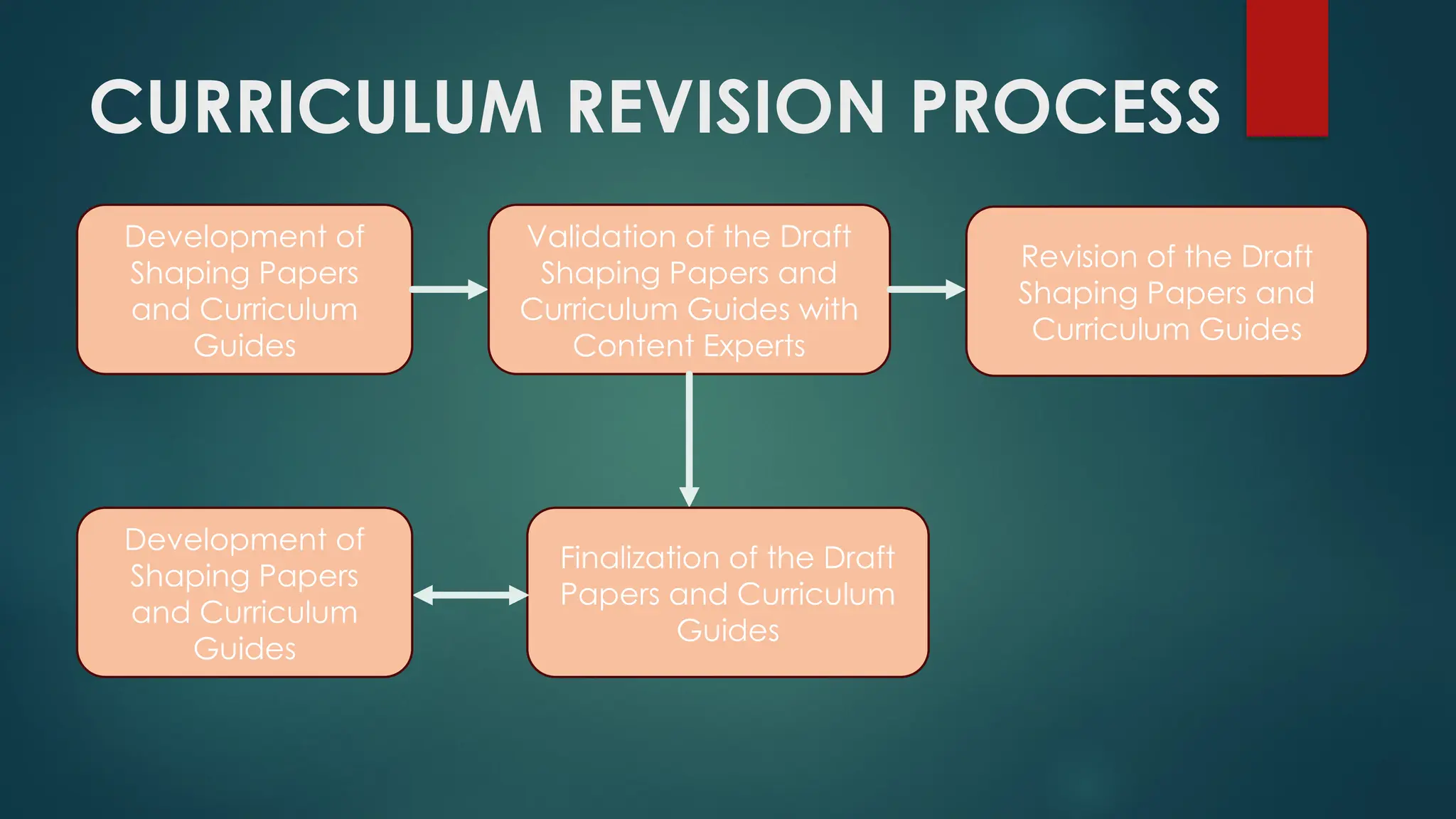
CURRICULUM REVISION PROCESS
Development of
Shaping Papers
and Curriculum
Guides
Validation of the Draft
Shaping Papers and
Curriculum Guides with
Content Experts
Revision of the Draft
Shaping Papers and
Curriculum Guides
Finalization of the Draft
Papers and Curriculum
Guides
Development of
Shaping Papers
and Curriculum
Guides
The 2016 Curriculum Guide was introduced under the K-12
Basic Education Program. It outlines the learning
competencies for each subject area from Kindergarten to
Grade 12. The curriculum guide aims to:
 Provide a comprehensive and coherent sequence
of learning competencies across all grade levels.
 Promote holistic development by focusing on 21st-
century skills such as critical thinking, problem-
solving, and collaboration.
 Localize and contextualize learning to ensure
relevance to Filipino culture and values.
Parts of the 2016 Curriculum
Guide:
1. Learning Competencies– Specific skills,
knowledge, and abilities that students must develop.
2. Content Standards – Benchmarks that define what
students should know.
3. Performance Standards – Descriptions of how
students demonstrate their understanding.
4. Curriculum Framework – Provides structure to the
sequence of teaching and learning activities.
STANDARDS-BASED MODEL
 STAGE 1 Identify Desired Results
What do I want my students to know and be able to do?
 STAGE 2 Determine Acceptable Evidence (Design Balanced Assessments)
How will I know whether my students have acquired the requisite knowledge,
skills, and understandings?
 STAGE 3 Planning Learning Experiences & Instructions
What's needed to be done to provide my students with multiple opportunities to
acquire knowledge, skills, and understandings?
Preparing A Standards-Based
Unit Curriculum Map
 PRIORITIZE
Select and cluster priority competency
 UNPACK
Specify coverage in priority competencies
 ALIGN
State activities and assessments that match with priority
competencies
DESIGNING AND ASSESSING
PERFORMANCE TASKS FOR
MASTERY OF TRANSFER AND
APPLICATION OF 21ST
CENTURY
SKILLS
SESSION 2
MEMORIZE &
RECALL
Facts vocabulary
definitions.
Ex.
Compare
Identify
Describe
Report
Definition
Clarify
ANALYZE &
REASON
Principles and
generalizations of big
ideas of the discipline
Ex.
Analyze
Discuss
Predict
Elaborate
Formulate
Explain
CREATE &
PRESENT
Performance product
Ex.
Show
Compose
Prepare
Promote
Portray
Design
create
LEARNING GOALS
ACQUISITION MAKE-MEANING TRANSFER
GRASPS
 GOAL – The purpose of the product or objective of the solution to the
problem in the scenario or cases.
 ROLE – The real life professional or worker who develops or provides the
answer.
 AUDIENCE – The group that will be viewing, using of benefiting from the
output.
 SITUATION – The setting of the scenario and the problem, issue or
challenge people face.
 PRODUCT – The output done by the professional or worker that answer the
problem or goal.
 STANDARDS – The criteria ( also stated in the rubric) that will be used to
assess the product.
PERFORMANCE TASK GRASPS CHECKLIST (ONE-PRODUCT)
1. The unit performance standard is stated. The performance task is aligned
with the performance standard.
2. A real life problem situation is presented.
3. The situation indicates the need or the goal that has to be addressed. The
goal states the purpose of the product ( it is not the product itself).
4. The situation tells the students his or her role in answering the need or goal or
solving the problem.
5. The students is asked to make an output or a product that answers the need
or the goal or solution. The product is aligned with the performance standard.
6. The situation informs the student the audience or group of people that will be
using or benefiting from the product.
7. To assess the quality of the product, a set of standards are given. ( these
standards become the rubric criteria). The standards are consistent with the
unit performance standards.
PERFORMANCE TASK (ONE-PRODUCT)
PERFORMANCE
STANDARD
Illustrates sets and subsets and union and
intersection of sets using Venn diagram.
TRANSFER GOAL Students will construct precise and detailed Venn
diagrams to illustrate the relationships between sets,
subsets, and their union and intersection in order to
clarify and communicate these mathematical
concepts effectively to peers and educators, fostering
a deeper understanding.
GOAL
(Critical thinking)
Students will demonstrates their understanding of
sets, subsets, union and intersection of set by
creating and interpreting the diagram.
ROLE
(Communication)
Human Geography (cultural Geography)
PERFORMANCE TASK (ONE-PRODUCT)
AUDIENCE
(Communication)
your audience will be high school students who are still learning about
sets for the first time.
SITUATION
(Critical thinking)
you are task to explores different cultural elements overlap and
intersect in asean countries. Your task is to use Venn diagrams to
illustrate sets and subset as well as union and intersection of these
sets. This project will help you understand the mathematical concepts
of sets while also appreciating the cultural diversity of the asean
region.
PRODUCT
(7C’s)
A detailed and comprehensive presentation about the
relationship between two or more elements.
STANDARDS
( Critical thinking;
communication;
creativity &
computing)
Original
Purposeful
Meaningful
Creative
QUALITY RUBRIC
CLEAR ESSENTIAL
CRITERIA
REALISTIC NUMBER OF
CRITERIA
EXPLICIT OBSERVABLE
INDICATORS
NO OVERLAPS IN
LEVELS
REAL-WORLD CRITERIA
HIGH INTERJUDE
RELIABILITY
TESTED OUT WIH
STUDENTS
AVOID DEGREE
MODIFIERS
PERFORMANCE TASK RUBRIC (ONE-PRODUCT)
CRITERIA EXCEEDS
REQUIREMENT
(4)
MEETS
REQUIREMENTS
(3)
APPROACHES
REQUIREMENTS
(2)
LACK OF
REQUIREMENTS
(1)
ORIGINAL Work displays an
exceptional level
of originality and
fresh perspective;
ideas are unique
and inventive.
Work displays
some originality
with ideas that are
interesting, though
somewhat
familiar.
Work shows limited
originality; ideas
are somewhat
predictable or
derivative.
Work lacks
originality; ideas
are entirely
copied or
unoriginal.
PURPOSEFUL The work is
focused and
aligns perfectly
with the intended
purpose; all parts
clearly support the
overall goal.
The work aligns
well with the
intended purpose,
though some parts
may slightly stray
from the goal.
The work loosely
aligns with the
intended purpose
but lacks focus or
coherence in
some parts.
The work lacks a
clear purpose and
does not support
the intended goal.
PERFORMANCE TASK RUBRIC (ONE-PRODUCT)
MEANINGFUL Work
demonstrates a
deep and
thoughtful
understanding of
the topic; ideas
are well-
developed and
insightful.
Work
demonstrates an
adequate
understanding of
the topic; ideas
are clear and
relevant.
Work
demonstrates a
basic
understanding,
but lacks depth or
complexity.
Work
demonstrates little
to no
understanding of
the topic; ideas
are
underdeveloped
or unclear.
CREATIVE Demonstrates
exceptional
creativity, using
innovative
techniques or
approaches that
greatly enhance
the work.
Demonstrates
creativity, with
some interesting
techniques or
approaches that
enhance the
work.
Shows minimal
creativity; relies on
conventional
techniques or
approaches.
Lacks creativity;
shows no attempt
to use different or
interesting
techniques or
approaches.
We can tell students have
achieved the performance
standards when…
We can tell students are
applying 21st
century skills
when…
They transfer their learning to
real-life situation outside the
school.
They can give specific and
concrete examples of how to
apply their learning.
They go beyond stating facts
and information about the
topic or discussing what they
know.
When they demonstrate the
following..
1. Critical thinking
2. Creativity
3. Collaboration
4. Communication
5. computing/ICT
6. Cross-cultural understanding
7. Career and lifelong learning
Mastering Factual and
Procedural Knowledge
in Acquisition Learning
Competencies
SESSION 3
Acquisition Learning
Competencies
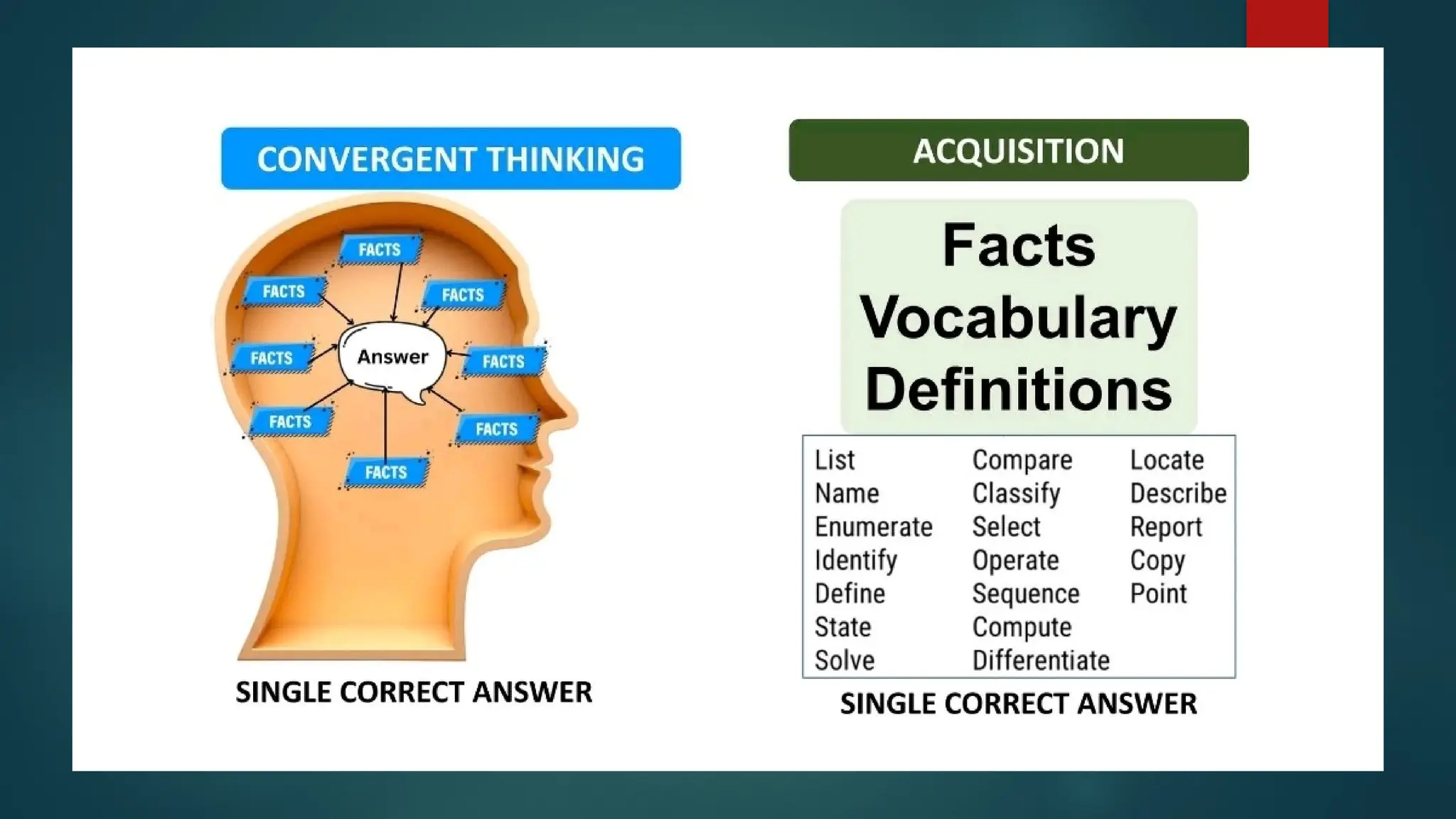
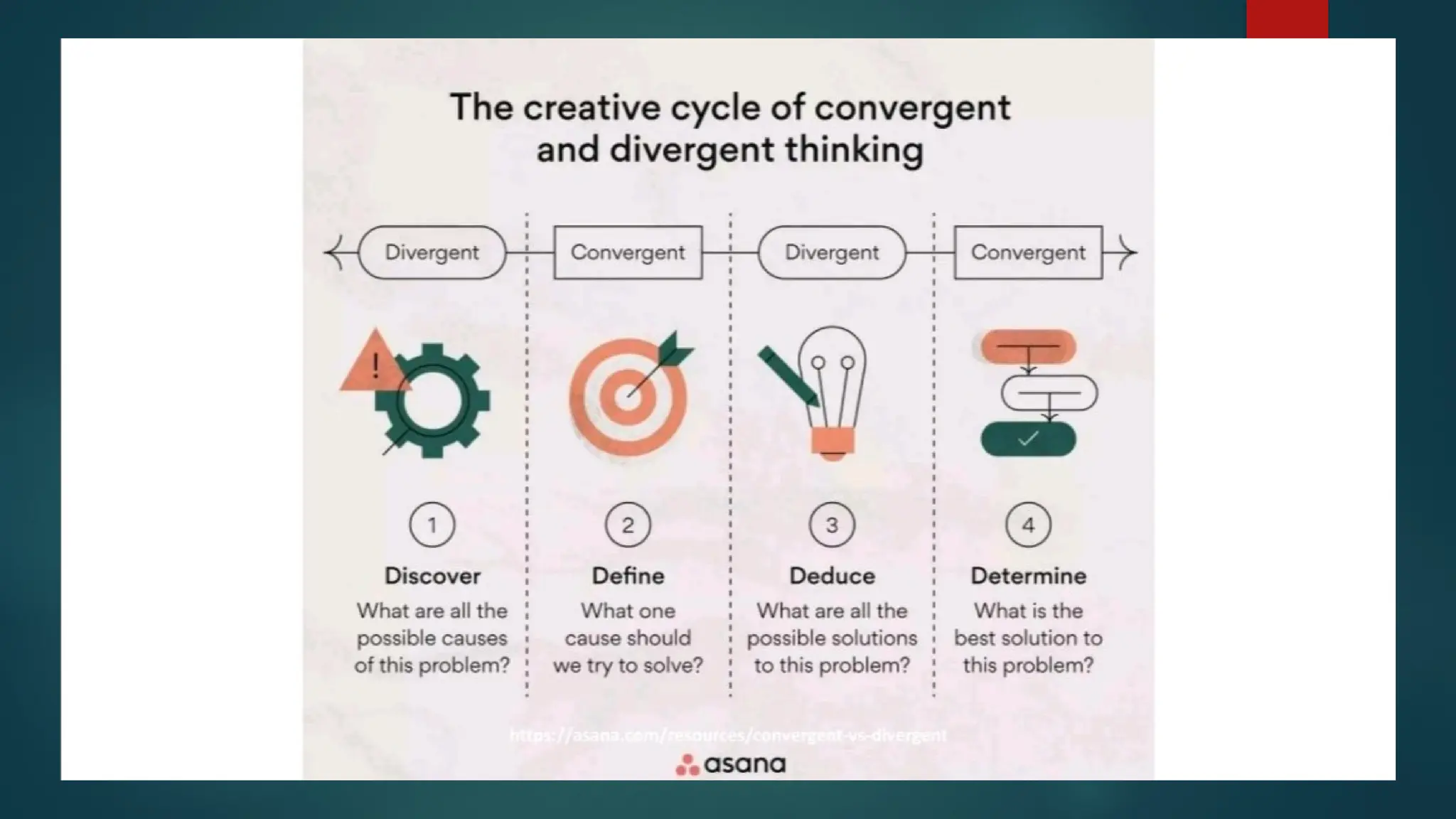
Usually related to convergent
thinking.
Students have to recall an
established fact.
Convergent Thinking
Is the type of thinking that focuses
on coming up with a single and
correct or well-established answer
to a question or solution to a
problem.
J.P Guilford
Divergent Thinking
Is the opposite involving the
generation of many ideas,
solutions, or perspectives to a
question or problem.
J.P Guilford
Since both divergent and convergent thinking are needed,
how do we enable to do both?
CONVERGENT THINKING
 Chunking Information
 Retrieval with mnemonic
 Noting Details with a
Graphic Organizer
 Gamification
DIVERGENT THINKING
 Four Corners
 Compass Point
 Stick-it-together
 Claim-Evidence-Reasoning
Mastering Text
Analysis in Making
Meaning
Competencies
SESSION 4
Make Meaning Learning
Competencies
involves developing students’
divergent thinking. In the process,
students deepen their learning
and become more analytical.
Divergent Thinking
is the process of generating
multiple ideas to maximize the
range of possible solutions,
applications, examples, etc.
DIFFERENCES BETWEEN DEEP AND
SHALLOW LEARNING
SHALLOW LEARNER
 Memorizes for assessments
 Fails to distinguish principles
from examples
 Focuses on discrete facts
without integration
 Does not reflect on purpose,
goals, strategies
 Anxiety
 Poor long-term retention
DEEP LEARNER
 Actively searching for meaning
 Vigorously interacting with content
 Relates new ideas to previous knowledge
 Relates concepts to everyday
experience
 Relates evidence to conclusions
 Examines the argument’s logic
 Confidence
 Stronger long-term retention
Since both divergent and convergent thinking are needed,
how do we enable to do both?
CONVERGENT THINKING
 Chunking Information
 Retrieval with mnemonic
 Noting Details with a
Graphic Organizer
 Gamification
DIVERGENT THINKING
 Four Corners
 Compass Point
 Stick-it-together
 Claim-Evidence-Reasoning
FOUR CORNERS
a simple verbal strategy to help
engage your students and
improve discussion and discourse.
The Four Corners Strategy is a
wonderful way to encourage
debate and discourse in the
classroom while also visualizing
students’ differences in ideas
COMPASS
POINTS
 examine an idea or
proposition from different
angles of perspectives.
 Identify areas where more
information is needed.
 Evaluate and make
judgements about the
topic.
 This strategy helps
students examine
different perspectives
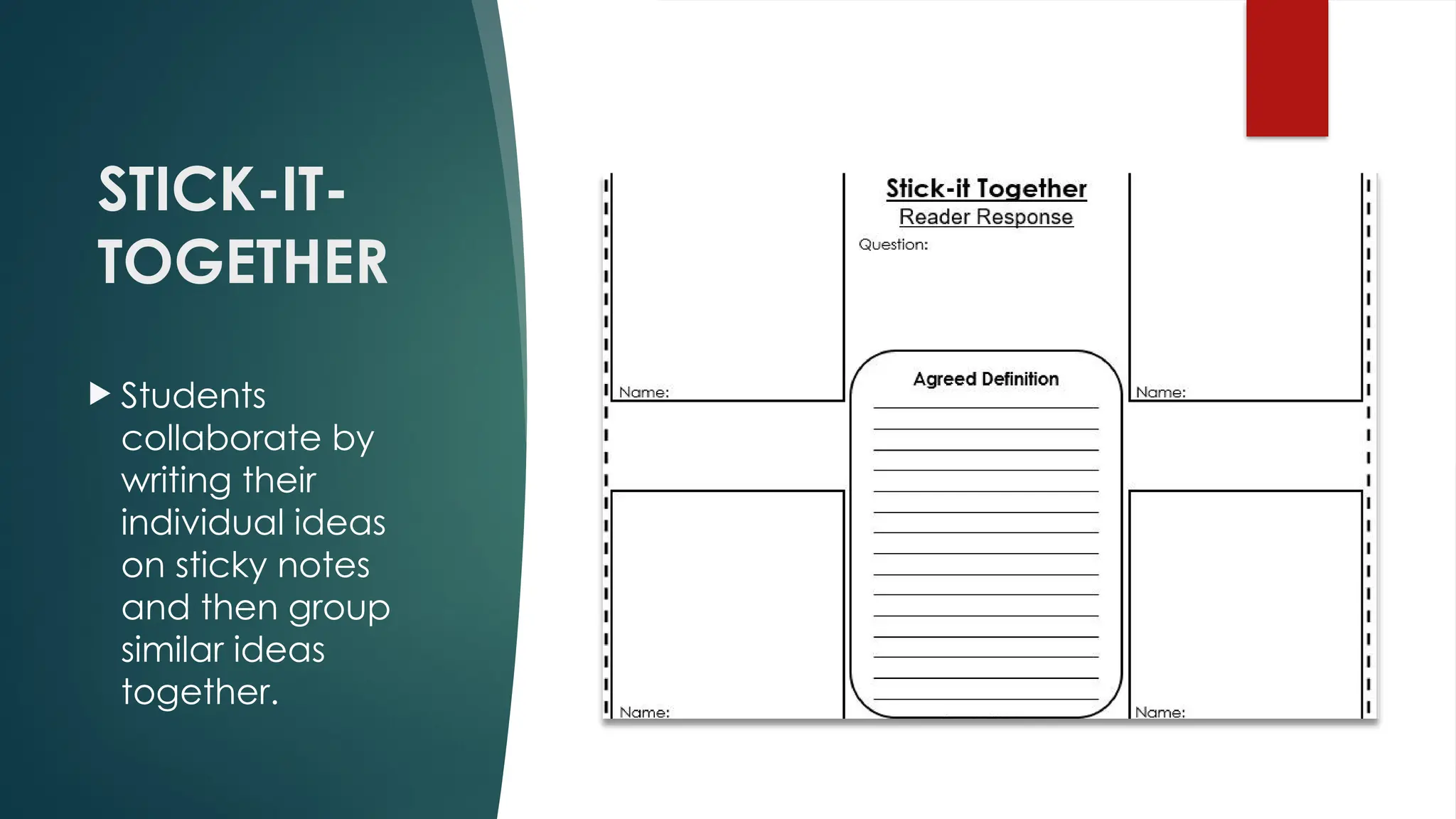
STICK-IT-
TOGETHER
 Students
collaborate by
writing their
individual ideas
on sticky notes
and then group
similar ideas
together.
CLAIM-
EVIDENCE-
REASONING
 The CER (claim,
evidence, reasoning)
writing strategy
consists of making a
claim statement and
providing evidence
and reasoning to
support that claim.
Writing Learning Targets
and Achieving Students
Success with Formative
Assessments and
Feedback
SESSION 5
LEARNING TARGETS
Learning
targets are the
statements of
the intended
learning based
on standards
Learning targets are
stated in a kid-friendly
language and are
specific to the lesson
of the day and
directly connected to
assessment.
SUCCESS CRITERIA
Promotes self-reflection, allowing students to think
critically about their learning process and identify
strategies for improvement.
Encourages a growth mindset by emphasizing the
belief that abilities and intelligence can be develop
through effort and dedication.
Empowers student to assess their own progress and set
goals thereby fostering a sense of ownership and
responsibility for their learning journey.
SESSION 6
Putting Together a
Standard-Based
Unit Learning Plan
Standard-Based Unit
Learning Plan
A Standards-Based Unit Learning Plan is
designed to align teaching, learning,
and assessment with academic
standards, ensuring that students meet
specific learning objectives.
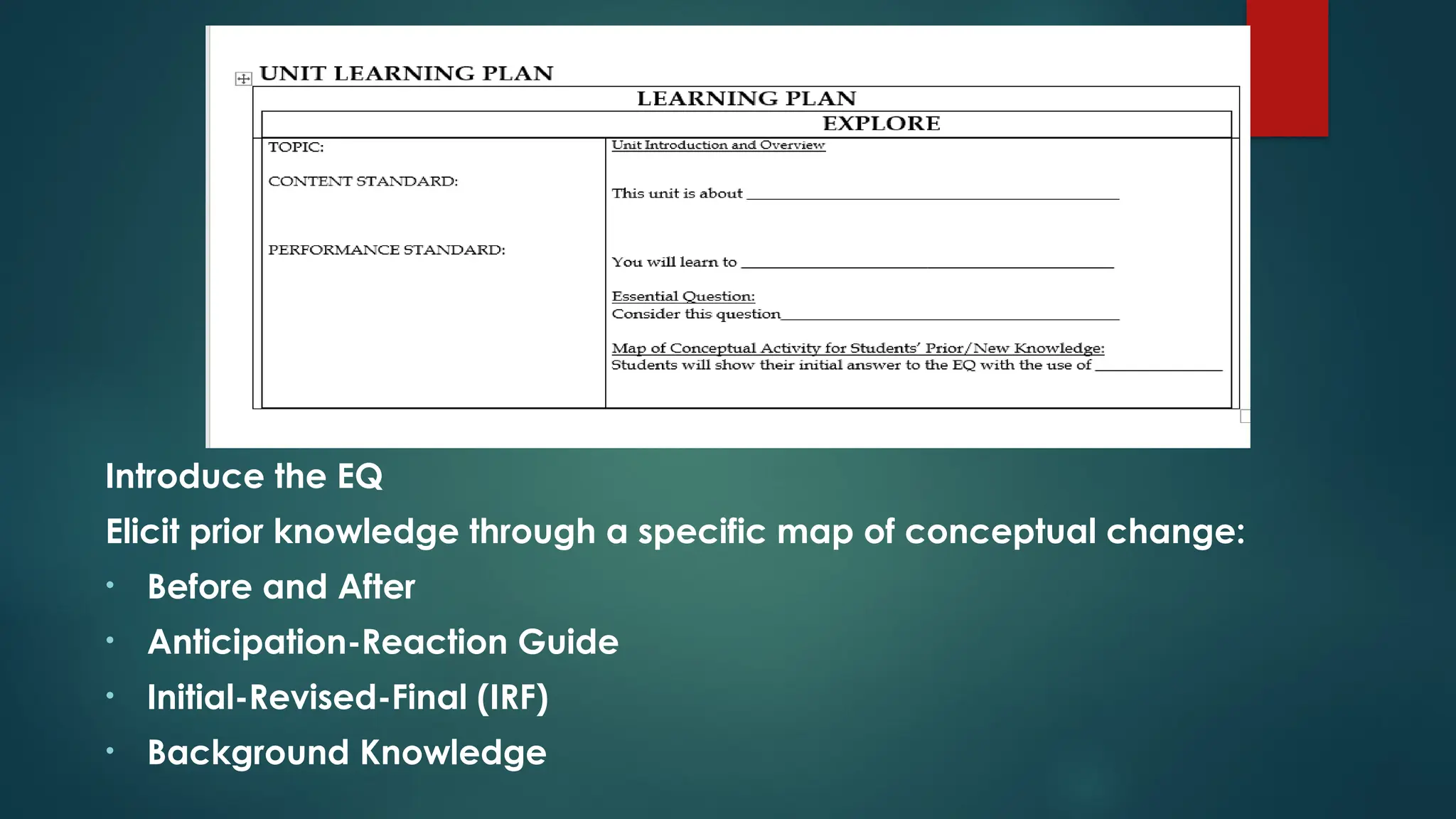
Introduce the EQ
Elicit prior knowledge through a specific map of conceptual change:
• Before and After
• Anticipation-Reaction Guide
• Initial-Revised-Final (IRF)
• Background Knowledge
EXPLORE
is the initial phase where students are
introduced to a new concept or topic. It's
like opening a door to a new world of
knowledge. In the context of
mathematics, students are given an open-
ended problem solving task or short
mathematical investigation and they are
given opportunity to show different ways of
solving it.
ESSENTIAL QUESTIONS
foster the kinds of inquiries,
discussions, and reflections that help
learners find meaning in their learning
and achieve deeper thought and
better quality in their work.
HOW CAN WE TELL A QUESTION IS ESSENTIAL?
1. Is open-ended; that is, it typically will not have a
single, final, and correct answer.
2. Is thought-provoking and intellectually engaging,
often sparking discussion and debate.
3. Calls for higher-order thinking, such as analysis,
inference, evaluation, prediction. It cannot be
effectively answered by recall alone.
4. Points toward important, transferable ideas within
(and sometimes across) disciplines.
5. Raises additional questions and sparks further inquiry.
6. Requires support and justification, not just an answer.
7. Recurs over time; that is, the question can and should
be revisited again and again.
FIRM-UP (ACQUISITION)
the teacher helps the students
make connections by asking them to
explain their solutions and
reasoning, comment on other’s
solutions, identify those solutions
that uses the same concepts, same
reasoning, same representation, etc.
FIRM-UP(AQUISITION)
to make arrangements more final and fixed. It involves acquiring
basic knowledge and skills, and constructing understanding.
Claim-Evidence-Reasoning (CER)
 It all starts with a question asked by the teacher.
This question is based on a phenomena or experience.
The student’s explanation or answer, as you may have
guessed, will consist of three parts: a claim, the
evidence, and the student’s reasoning.
 CLAIM -a statement that answers the question. It will usually only be one
sentence in length. The claim does not include any explanation,
reasoning, or evidence so it should not include any transition words such
as “because.”
 EVIDENCE -the data used to support the claim. It can be either
quantitative or qualitive depending on the question and/or lab. The
evidence could even be a data table the student creates. Students should
only use data within their evidence that directly supports the claim.
 REASONING -the explanation of “why and how” the evidence supports the
claim. It should include an explanation of the underlying science concept
that produced the evidence or data.
DEEPEN (MAKE MEANING)
the teacher consolidates ideas and facilitates
students construction of new concept or meaning,
linking it to previously learned concepts; helps students
to find new representations of ideas
TRANSFER
The teacher challenges students to extend the problem given by
changing aspects of the original problem or, construct similar problems
and then begin to explore again.
THANK YOU
FOR
LISTENING!!!

MATATAG-PRESENTATION for teachers and students.pptx

  • 1.
    Overview: Exploring the MATATAGand Revisiting the 2016 Curriculum Guides Prior to Designing a Standards-Based Curriculum Map and Learning Plan SESSION 1
  • 2.
    “Education is nolonger about teaching students something alone; it is more important to be teaching them to develop a reliable compass and navigation tools (transversal competencies) to find their own way in a world that is increasingly complex, volatile, and uncertain.”
  • 3.
    CURRICULUM REVIEW FINDINGS 1 Curriculum Contentis Congested 2 Misplaced Prerequisite Learning Competencies 3 Imbalance of Cognitive Demand
  • 4.
    MATATAG: Bansang Makabata, BansangMakabansa The education agenda of the current administration is known as MATATAG: Bansang Makabata, Batang Makabansa, which sets the new direction of the agency and stakeholders in resolving basic education challenges.
  • 5.
    The MATATAG Agendahas four critical components:  Make the curriculum relevant to produce competent and job-ready, active, and responsible citizens;  Take steps to accelerate delivery of basic education facilities and services;  Take good care of learners by promoting learner well- being, inclusive education, and a positive learning environment; and  Give support to teachers to teach better.
  • 6.
    CURRICULUM REVISION PROCESS Developmentof Shaping Papers and Curriculum Guides Validation of the Draft Shaping Papers and Curriculum Guides with Content Experts Revision of the Draft Shaping Papers and Curriculum Guides Finalization of the Draft Papers and Curriculum Guides Development of Shaping Papers and Curriculum Guides
  • 7.
    The 2016 CurriculumGuide was introduced under the K-12 Basic Education Program. It outlines the learning competencies for each subject area from Kindergarten to Grade 12. The curriculum guide aims to:  Provide a comprehensive and coherent sequence of learning competencies across all grade levels.  Promote holistic development by focusing on 21st- century skills such as critical thinking, problem- solving, and collaboration.  Localize and contextualize learning to ensure relevance to Filipino culture and values.
  • 8.
    Parts of the2016 Curriculum Guide: 1. Learning Competencies– Specific skills, knowledge, and abilities that students must develop. 2. Content Standards – Benchmarks that define what students should know. 3. Performance Standards – Descriptions of how students demonstrate their understanding. 4. Curriculum Framework – Provides structure to the sequence of teaching and learning activities.
  • 9.
    STANDARDS-BASED MODEL  STAGE1 Identify Desired Results What do I want my students to know and be able to do?  STAGE 2 Determine Acceptable Evidence (Design Balanced Assessments) How will I know whether my students have acquired the requisite knowledge, skills, and understandings?  STAGE 3 Planning Learning Experiences & Instructions What's needed to be done to provide my students with multiple opportunities to acquire knowledge, skills, and understandings?
  • 11.
    Preparing A Standards-Based UnitCurriculum Map  PRIORITIZE Select and cluster priority competency  UNPACK Specify coverage in priority competencies  ALIGN State activities and assessments that match with priority competencies
  • 23.
    DESIGNING AND ASSESSING PERFORMANCETASKS FOR MASTERY OF TRANSFER AND APPLICATION OF 21ST CENTURY SKILLS SESSION 2
  • 24.
    MEMORIZE & RECALL Facts vocabulary definitions. Ex. Compare Identify Describe Report Definition Clarify ANALYZE& REASON Principles and generalizations of big ideas of the discipline Ex. Analyze Discuss Predict Elaborate Formulate Explain CREATE & PRESENT Performance product Ex. Show Compose Prepare Promote Portray Design create LEARNING GOALS ACQUISITION MAKE-MEANING TRANSFER
  • 25.
    GRASPS  GOAL –The purpose of the product or objective of the solution to the problem in the scenario or cases.  ROLE – The real life professional or worker who develops or provides the answer.  AUDIENCE – The group that will be viewing, using of benefiting from the output.  SITUATION – The setting of the scenario and the problem, issue or challenge people face.  PRODUCT – The output done by the professional or worker that answer the problem or goal.  STANDARDS – The criteria ( also stated in the rubric) that will be used to assess the product.
  • 26.
    PERFORMANCE TASK GRASPSCHECKLIST (ONE-PRODUCT) 1. The unit performance standard is stated. The performance task is aligned with the performance standard. 2. A real life problem situation is presented. 3. The situation indicates the need or the goal that has to be addressed. The goal states the purpose of the product ( it is not the product itself). 4. The situation tells the students his or her role in answering the need or goal or solving the problem. 5. The students is asked to make an output or a product that answers the need or the goal or solution. The product is aligned with the performance standard. 6. The situation informs the student the audience or group of people that will be using or benefiting from the product. 7. To assess the quality of the product, a set of standards are given. ( these standards become the rubric criteria). The standards are consistent with the unit performance standards.
  • 27.
    PERFORMANCE TASK (ONE-PRODUCT) PERFORMANCE STANDARD Illustratessets and subsets and union and intersection of sets using Venn diagram. TRANSFER GOAL Students will construct precise and detailed Venn diagrams to illustrate the relationships between sets, subsets, and their union and intersection in order to clarify and communicate these mathematical concepts effectively to peers and educators, fostering a deeper understanding. GOAL (Critical thinking) Students will demonstrates their understanding of sets, subsets, union and intersection of set by creating and interpreting the diagram. ROLE (Communication) Human Geography (cultural Geography)
  • 28.
    PERFORMANCE TASK (ONE-PRODUCT) AUDIENCE (Communication) youraudience will be high school students who are still learning about sets for the first time. SITUATION (Critical thinking) you are task to explores different cultural elements overlap and intersect in asean countries. Your task is to use Venn diagrams to illustrate sets and subset as well as union and intersection of these sets. This project will help you understand the mathematical concepts of sets while also appreciating the cultural diversity of the asean region. PRODUCT (7C’s) A detailed and comprehensive presentation about the relationship between two or more elements. STANDARDS ( Critical thinking; communication; creativity & computing) Original Purposeful Meaningful Creative
  • 29.
    QUALITY RUBRIC CLEAR ESSENTIAL CRITERIA REALISTICNUMBER OF CRITERIA EXPLICIT OBSERVABLE INDICATORS NO OVERLAPS IN LEVELS REAL-WORLD CRITERIA HIGH INTERJUDE RELIABILITY TESTED OUT WIH STUDENTS AVOID DEGREE MODIFIERS
  • 30.
    PERFORMANCE TASK RUBRIC(ONE-PRODUCT) CRITERIA EXCEEDS REQUIREMENT (4) MEETS REQUIREMENTS (3) APPROACHES REQUIREMENTS (2) LACK OF REQUIREMENTS (1) ORIGINAL Work displays an exceptional level of originality and fresh perspective; ideas are unique and inventive. Work displays some originality with ideas that are interesting, though somewhat familiar. Work shows limited originality; ideas are somewhat predictable or derivative. Work lacks originality; ideas are entirely copied or unoriginal. PURPOSEFUL The work is focused and aligns perfectly with the intended purpose; all parts clearly support the overall goal. The work aligns well with the intended purpose, though some parts may slightly stray from the goal. The work loosely aligns with the intended purpose but lacks focus or coherence in some parts. The work lacks a clear purpose and does not support the intended goal.
  • 31.
    PERFORMANCE TASK RUBRIC(ONE-PRODUCT) MEANINGFUL Work demonstrates a deep and thoughtful understanding of the topic; ideas are well- developed and insightful. Work demonstrates an adequate understanding of the topic; ideas are clear and relevant. Work demonstrates a basic understanding, but lacks depth or complexity. Work demonstrates little to no understanding of the topic; ideas are underdeveloped or unclear. CREATIVE Demonstrates exceptional creativity, using innovative techniques or approaches that greatly enhance the work. Demonstrates creativity, with some interesting techniques or approaches that enhance the work. Shows minimal creativity; relies on conventional techniques or approaches. Lacks creativity; shows no attempt to use different or interesting techniques or approaches.
  • 32.
    We can tellstudents have achieved the performance standards when… We can tell students are applying 21st century skills when… They transfer their learning to real-life situation outside the school. They can give specific and concrete examples of how to apply their learning. They go beyond stating facts and information about the topic or discussing what they know. When they demonstrate the following.. 1. Critical thinking 2. Creativity 3. Collaboration 4. Communication 5. computing/ICT 6. Cross-cultural understanding 7. Career and lifelong learning
  • 33.
    Mastering Factual and ProceduralKnowledge in Acquisition Learning Competencies SESSION 3
  • 34.
    Acquisition Learning Competencies Usually relatedto convergent thinking. Students have to recall an established fact.
  • 35.
    Convergent Thinking Is thetype of thinking that focuses on coming up with a single and correct or well-established answer to a question or solution to a problem. J.P Guilford
  • 36.
    Divergent Thinking Is theopposite involving the generation of many ideas, solutions, or perspectives to a question or problem. J.P Guilford
  • 42.
    Since both divergentand convergent thinking are needed, how do we enable to do both? CONVERGENT THINKING  Chunking Information  Retrieval with mnemonic  Noting Details with a Graphic Organizer  Gamification DIVERGENT THINKING  Four Corners  Compass Point  Stick-it-together  Claim-Evidence-Reasoning
  • 48.
    Mastering Text Analysis inMaking Meaning Competencies SESSION 4
  • 49.
    Make Meaning Learning Competencies involvesdeveloping students’ divergent thinking. In the process, students deepen their learning and become more analytical.
  • 50.
    Divergent Thinking is theprocess of generating multiple ideas to maximize the range of possible solutions, applications, examples, etc.
  • 51.
    DIFFERENCES BETWEEN DEEPAND SHALLOW LEARNING SHALLOW LEARNER  Memorizes for assessments  Fails to distinguish principles from examples  Focuses on discrete facts without integration  Does not reflect on purpose, goals, strategies  Anxiety  Poor long-term retention DEEP LEARNER  Actively searching for meaning  Vigorously interacting with content  Relates new ideas to previous knowledge  Relates concepts to everyday experience  Relates evidence to conclusions  Examines the argument’s logic  Confidence  Stronger long-term retention
  • 52.
    Since both divergentand convergent thinking are needed, how do we enable to do both? CONVERGENT THINKING  Chunking Information  Retrieval with mnemonic  Noting Details with a Graphic Organizer  Gamification DIVERGENT THINKING  Four Corners  Compass Point  Stick-it-together  Claim-Evidence-Reasoning
  • 53.
    FOUR CORNERS a simpleverbal strategy to help engage your students and improve discussion and discourse. The Four Corners Strategy is a wonderful way to encourage debate and discourse in the classroom while also visualizing students’ differences in ideas
  • 54.
    COMPASS POINTS  examine anidea or proposition from different angles of perspectives.  Identify areas where more information is needed.  Evaluate and make judgements about the topic.  This strategy helps students examine different perspectives
  • 55.
    STICK-IT- TOGETHER  Students collaborate by writingtheir individual ideas on sticky notes and then group similar ideas together.
  • 56.
    CLAIM- EVIDENCE- REASONING  The CER(claim, evidence, reasoning) writing strategy consists of making a claim statement and providing evidence and reasoning to support that claim.
  • 57.
    Writing Learning Targets andAchieving Students Success with Formative Assessments and Feedback SESSION 5
  • 58.
    LEARNING TARGETS Learning targets arethe statements of the intended learning based on standards Learning targets are stated in a kid-friendly language and are specific to the lesson of the day and directly connected to assessment.
  • 61.
    SUCCESS CRITERIA Promotes self-reflection,allowing students to think critically about their learning process and identify strategies for improvement. Encourages a growth mindset by emphasizing the belief that abilities and intelligence can be develop through effort and dedication. Empowers student to assess their own progress and set goals thereby fostering a sense of ownership and responsibility for their learning journey.
  • 65.
    SESSION 6 Putting Togethera Standard-Based Unit Learning Plan
  • 66.
    Standard-Based Unit Learning Plan AStandards-Based Unit Learning Plan is designed to align teaching, learning, and assessment with academic standards, ensuring that students meet specific learning objectives.
  • 67.
    Introduce the EQ Elicitprior knowledge through a specific map of conceptual change: • Before and After • Anticipation-Reaction Guide • Initial-Revised-Final (IRF) • Background Knowledge
  • 68.
    EXPLORE is the initialphase where students are introduced to a new concept or topic. It's like opening a door to a new world of knowledge. In the context of mathematics, students are given an open- ended problem solving task or short mathematical investigation and they are given opportunity to show different ways of solving it.
  • 69.
    ESSENTIAL QUESTIONS foster thekinds of inquiries, discussions, and reflections that help learners find meaning in their learning and achieve deeper thought and better quality in their work.
  • 70.
    HOW CAN WETELL A QUESTION IS ESSENTIAL? 1. Is open-ended; that is, it typically will not have a single, final, and correct answer. 2. Is thought-provoking and intellectually engaging, often sparking discussion and debate. 3. Calls for higher-order thinking, such as analysis, inference, evaluation, prediction. It cannot be effectively answered by recall alone. 4. Points toward important, transferable ideas within (and sometimes across) disciplines. 5. Raises additional questions and sparks further inquiry. 6. Requires support and justification, not just an answer. 7. Recurs over time; that is, the question can and should be revisited again and again.
  • 71.
    FIRM-UP (ACQUISITION) the teacherhelps the students make connections by asking them to explain their solutions and reasoning, comment on other’s solutions, identify those solutions that uses the same concepts, same reasoning, same representation, etc.
  • 72.
    FIRM-UP(AQUISITION) to make arrangementsmore final and fixed. It involves acquiring basic knowledge and skills, and constructing understanding.
  • 73.
    Claim-Evidence-Reasoning (CER)  Itall starts with a question asked by the teacher. This question is based on a phenomena or experience. The student’s explanation or answer, as you may have guessed, will consist of three parts: a claim, the evidence, and the student’s reasoning.
  • 74.
     CLAIM -astatement that answers the question. It will usually only be one sentence in length. The claim does not include any explanation, reasoning, or evidence so it should not include any transition words such as “because.”  EVIDENCE -the data used to support the claim. It can be either quantitative or qualitive depending on the question and/or lab. The evidence could even be a data table the student creates. Students should only use data within their evidence that directly supports the claim.  REASONING -the explanation of “why and how” the evidence supports the claim. It should include an explanation of the underlying science concept that produced the evidence or data.
  • 75.
    DEEPEN (MAKE MEANING) theteacher consolidates ideas and facilitates students construction of new concept or meaning, linking it to previously learned concepts; helps students to find new representations of ideas
  • 76.
    TRANSFER The teacher challengesstudents to extend the problem given by changing aspects of the original problem or, construct similar problems and then begin to explore again.
  • 77.