said.sadik.fsb@gmail.com
Mastering Spring 5.0
Evolution to Spring Framework 5.0
SAIDSADIK–said.sadik.fsb@gmail.com
Spring Framework
“The Spring Framework provides a comprehensive
programming and configuration model for modern
Java-based enterprise applications”
Used to wire enterprise Java applications,
Take care of all the technical plumbing that is needed in order
to connect the different parts of an application,
Allows programmers to focus on the crux of their jobs--writing
business logic
SAIDSADIK–said.sadik.fsb@gmail.com
Problems with EJB
Developing and deploying EJBs was a cumbersome process
Difficult to unit test. Actually, difficult to test outside the EJB
Container.
Multiple interfaces need to be implemented with a number of
unnecessary methods.
Cumbersome and tedious exception handling.
Inconvenient deployment descriptors.
Spring Framework was introduced as a lightweight framework
aimed at making developing Java EE applications simpler.
SAIDSADIK–said.sadik.fsb@gmail.com
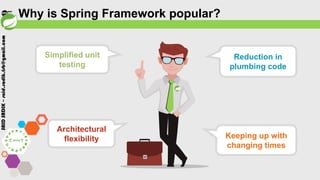
Why is Spring Framework popular?
Simplified unit
testing
Architectural
flexibility
Reduction in
plumbing code
Keeping up with
changing times
SAIDSADIK–said.sadik.fsb@gmail.com
Simplified unit testing
Spring Framework brought in the concept of Dependency
Injection (DI).
The dependency injection enables unit testing by making it easy
to replace the dependencies with their mocks. We do not need to
deploy the entire application to unit test it.
Programmers are more productive.
Defects are found earlier so they are less costly to fix.
Applications have automated unit tests, which can run in
Continuous Integration builds, preventing future defects.
SAIDSADIK–said.sadik.fsb@gmail.com
Reduction in plumbing code
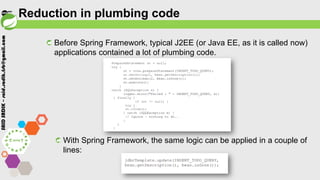
Before Spring Framework, typical J2EE (or Java EE, as it is called now)
applications contained a lot of plumbing code.
With Spring Framework, the same logic can be applied in a couple of
lines:
SAIDSADIK–said.sadik.fsb@gmail.com
Keep up with changing times
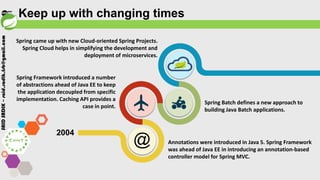
Spring came up with new Cloud-oriented Spring Projects.
Spring Cloud helps in simplifying the development and
deployment of microservices.
Spring Batch defines a new approach to
building Java Batch applications.
Spring Framework introduced a number
of abstractions ahead of Java EE to keep
the application decoupled from specific
implementation. Caching API provides a
case in point.
Annotations were introduced in Java 5. Spring Framework
was ahead of Java EE in introducing an annotation-based
controller model for Spring MVC.
2004
For More :
said.sadik.fsb@gmail.com

Mastering spring 5.0 - By SADIK SAID

  • 1.
  • 2.
    Evolution to SpringFramework 5.0
  • 3.
    SAIDSADIK–said.sadik.fsb@gmail.com Spring Framework “The SpringFramework provides a comprehensive programming and configuration model for modern Java-based enterprise applications” Used to wire enterprise Java applications, Take care of all the technical plumbing that is needed in order to connect the different parts of an application, Allows programmers to focus on the crux of their jobs--writing business logic
  • 4.
    SAIDSADIK–said.sadik.fsb@gmail.com Problems with EJB Developingand deploying EJBs was a cumbersome process Difficult to unit test. Actually, difficult to test outside the EJB Container. Multiple interfaces need to be implemented with a number of unnecessary methods. Cumbersome and tedious exception handling. Inconvenient deployment descriptors. Spring Framework was introduced as a lightweight framework aimed at making developing Java EE applications simpler.
  • 5.
    SAIDSADIK–said.sadik.fsb@gmail.com Why is SpringFramework popular? Simplified unit testing Architectural flexibility Reduction in plumbing code Keeping up with changing times
  • 6.
    SAIDSADIK–said.sadik.fsb@gmail.com Simplified unit testing SpringFramework brought in the concept of Dependency Injection (DI). The dependency injection enables unit testing by making it easy to replace the dependencies with their mocks. We do not need to deploy the entire application to unit test it. Programmers are more productive. Defects are found earlier so they are less costly to fix. Applications have automated unit tests, which can run in Continuous Integration builds, preventing future defects.
  • 7.
    SAIDSADIK–said.sadik.fsb@gmail.com Reduction in plumbingcode Before Spring Framework, typical J2EE (or Java EE, as it is called now) applications contained a lot of plumbing code. With Spring Framework, the same logic can be applied in a couple of lines:
  • 8.
    SAIDSADIK–said.sadik.fsb@gmail.com Keep up withchanging times Spring came up with new Cloud-oriented Spring Projects. Spring Cloud helps in simplifying the development and deployment of microservices. Spring Batch defines a new approach to building Java Batch applications. Spring Framework introduced a number of abstractions ahead of Java EE to keep the application decoupled from specific implementation. Caching API provides a case in point. Annotations were introduced in Java 5. Spring Framework was ahead of Java EE in introducing an annotation-based controller model for Spring MVC. 2004
  • 9.