Mastering Data Containerization And Orchestration Cybellium Ltd
Mastering Data Containerization And Orchestration Cybellium Ltd
Mastering Data Containerization And Orchestration Cybellium Ltd
Mastering Data Containerization And Orchestration Cybellium Ltd
Mastering Data Containerization And Orchestration Cybellium Ltd
1.
Mastering Data ContainerizationAnd
Orchestration Cybellium Ltd download
https://ebookbell.com/product/mastering-data-containerization-
and-orchestration-cybellium-ltd-55862338
Explore and download more ebooks at ebookbell.com
2.
Here are somerecommended products that we believe you will be
interested in. You can click the link to download.
Mastering Data Containerization And Orchestration A Comprehensive
Guide To Learn Data Containerization And Orchestration Hermans
https://ebookbell.com/product/mastering-data-containerization-and-
orchestration-a-comprehensive-guide-to-learn-data-containerization-
and-orchestration-hermans-55748490
Mastering Data Analysis With Python A Comprehensive Guide To Numpy
Pandas And Matplotlib Rajender Kumar
https://ebookbell.com/product/mastering-data-analysis-with-python-a-
comprehensive-guide-to-numpy-pandas-and-matplotlib-rajender-
kumar-48372746
Mastering Data Visualization With Microsoft Visio Professional 2016
David J Parker
https://ebookbell.com/product/mastering-data-visualization-with-
microsoft-visio-professional-2016-david-j-parker-56344300
Mastering Data Mining With Python Find Patterns Hidden In Your Data
Megan Squire
https://ebookbell.com/product/mastering-data-mining-with-python-find-
patterns-hidden-in-your-data-megan-squire-36155322
3.
Mastering Dataintensive CollaborationAnd Decision Making Research And
Practical Applications In The Dicode Project 1st Edition Nikos
Karacapilidis Eds
https://ebookbell.com/product/mastering-dataintensive-collaboration-
and-decision-making-research-and-practical-applications-in-the-dicode-
project-1st-edition-nikos-karacapilidis-eds-4662332
Mastering Data Analysis With R Gergely Daroczi
https://ebookbell.com/product/mastering-data-analysis-with-r-gergely-
daroczi-5220628
Mastering Data Warehouse Aggregates Solutions For Star Schema
Performance Christopher Adamson
https://ebookbell.com/product/mastering-data-warehouse-aggregates-
solutions-for-star-schema-performance-christopher-adamson-916754
Mastering Data Warehouse Design Relational And Dimensional Techniques
Claudia Imhoff
https://ebookbell.com/product/mastering-data-warehouse-design-
relational-and-dimensional-techniques-claudia-imhoff-977656
Mastering Data Science A Comprehensive Guide To Learn Data Science
Hermans
https://ebookbell.com/product/mastering-data-science-a-comprehensive-
guide-to-learn-data-science-hermans-55749496
Table of Contents
1.Introduction to Data Containerization and
Orchestration
1.1. Understanding the Role of Containerization and
Orchestration
1.2. Benefits and Challenges in Modern Data
Management
1.3. Overview of Chapters and Learning Objectives
2. Fundamentals of Containerization
2.1. What are Containers?
2.2. Docker and Containerization Basics
2.3. Container Images and Registries
2.4. Containerization vs. Virtualization
3. Containerization Tools and Technologies
3.1. Docker Engine and Architecture
3.2. Container Runtimes: rkt, containerd, and more
3.3. Container Networking and Storage
3.4. Exploring the Container Ecosystem
4. Orchestrating Containers with Kubernetes
4.1. Introduction to Kubernetes
4.2. Kubernetes Architecture and Components
4.3. Deploying and Managing Applications with
Kubernetes
4.4. Scaling, Load Balancing, and High Availability
5. Kubernetes Pods and Services
5.1. Creating and Managing Pods
5.2. Service Discovery and Load Balancing
5.3. Networking Models in Kubernetes
5.4. Ingress Controllers and Traffic Management
6. Kubernetes Configurations and Deployments
6.1. Working with Kubernetes Configurations
6.2. Declarative Deployments with Deployments and
StatefulSets
6.3. Managing Rolling Updates and Rollbacks
8.
6.4. Blue-Green andCanary Deployments
7. Data Management in Kubernetes
7.1. Stateful Applications in Kubernetes
7.2. Persistent Storage Solutions
7.3. Data Backup and Disaster Recovery Strategies
7.4. Ensuring Data Consistency in Distributed Systems
8. Kubernetes Security and Compliance
8.1. Securing Kubernetes Clusters
8.2. Role-Based Access Control (RBAC)
8.3. Network Policies and Pod Security Policies
8.4. Compliance with Industry Standards
9. Monitoring, Logging, and Debugging in Kubernetes
9.1. Monitoring Cluster Health and Performance
9.2. Logging Best Practices
9.3. Debugging Techniques and Tools
9.4. Tracing and Distributed Debugging
10. Beyond Kubernetes: Alternative Orchestration
Solutions
10.1. Apache Mesos and Marathon
10.2. Docker Swarm
10.3. OpenShift by Red Hat
10.4. Comparison of Orchestrators
11. Integrating Containers and Serverless Architectures
11.1. Serverless Computing Overview
11.2. Kubernetes and Serverless Integration
11.3. Knative and OpenFaaS for Serverless Containers
11.4. Pros and Cons of Serverless Containerization
12. CI/CD Pipelines and Continuous Deployment with
Containers
12.1. Building CI/CD Pipelines for Containers
12.2. Integrating Testing and Security Scans
12.3. Automated Deployment Strategies
12.4. Achieving Continuous Delivery with Containers
13. Multi-Cloud and Hybrid Cloud Strategies
9.
13.1. Multi-Cloud Considerations
13.2.Kubernetes Federation and Cross-Cloud
Deployment
13.3. Hybrid Cloud Deployments
13.4. Managing Data Across Cloud Environments
14. DevOps Practices and Containerization
14.1. DevOps Principles and Containerization
14.2. Collaboration between Development and
Operations
14.3. Infrastructure as Code with Containers
14.4. Automating Infrastructure Provisioning and
Management
15. Containerization for Microservices Architectures
15.1. Microservices Architecture Fundamentals
15.2. Building and Scaling Microservices with
Containers
15.3. Benefits and Challenges of Containerized
Microservices
15.4. Service Meshes and Microservices
Communication
16. Case Studies in Containerization and Orchestration
16.1. Containerization in E-Commerce and Retail
16.2. Data Streaming with Containerized Microservices
16.3. Scaling Healthcare Applications with Kubernetes
16.4. Financial Services and Secure Container
Deployment
17. Future Trends in Containerization and Orchestration
17.1. Serverless Containers and Beyond
17.2. Edge Computing and Containerization
17.3. AI and ML Integration with Containers
17.4. Evolving Landscape of Container Orchestration
18. Containerization and Orchestration Tools and
Ecosystem
18.1. Docker and Kubernetes Tools
10.
18.2. Helm forPackage Management
18.3. Monitoring and Observability Tools
18.4. Security and Compliance Solutions
19. Building a Successful Containerization Strategy
19.1. Assessing Business and Technical Goals
19.2. Designing Containerization and Orchestration
Strategy
19.3. Integration with Existing Infrastructure
19.4. Adapting and Scaling the Strategy Over Time
20. Conclusion
20.1. Mastery of Data Containerization and
Orchestration
20.2. Recap of Key Concepts
20.3. Looking Ahead in the Containerization Landscape
20.4. About the author
11.
1. Introduction toData
Containerization and Orchestration
In today's digital age, the speed, agility, and reliability with
which applications are deployed and managed can
determine the success or failure of a business. As industries
12.
have grown morereliant on intricate software systems, the
quest for a more efficient method of developing, testing,
deploying, and scaling applications has been perpetual.
Enter the world of data containerization and orchestration,
twin pillars of modern-day infrastructure management that
have revolutionized the software industry.
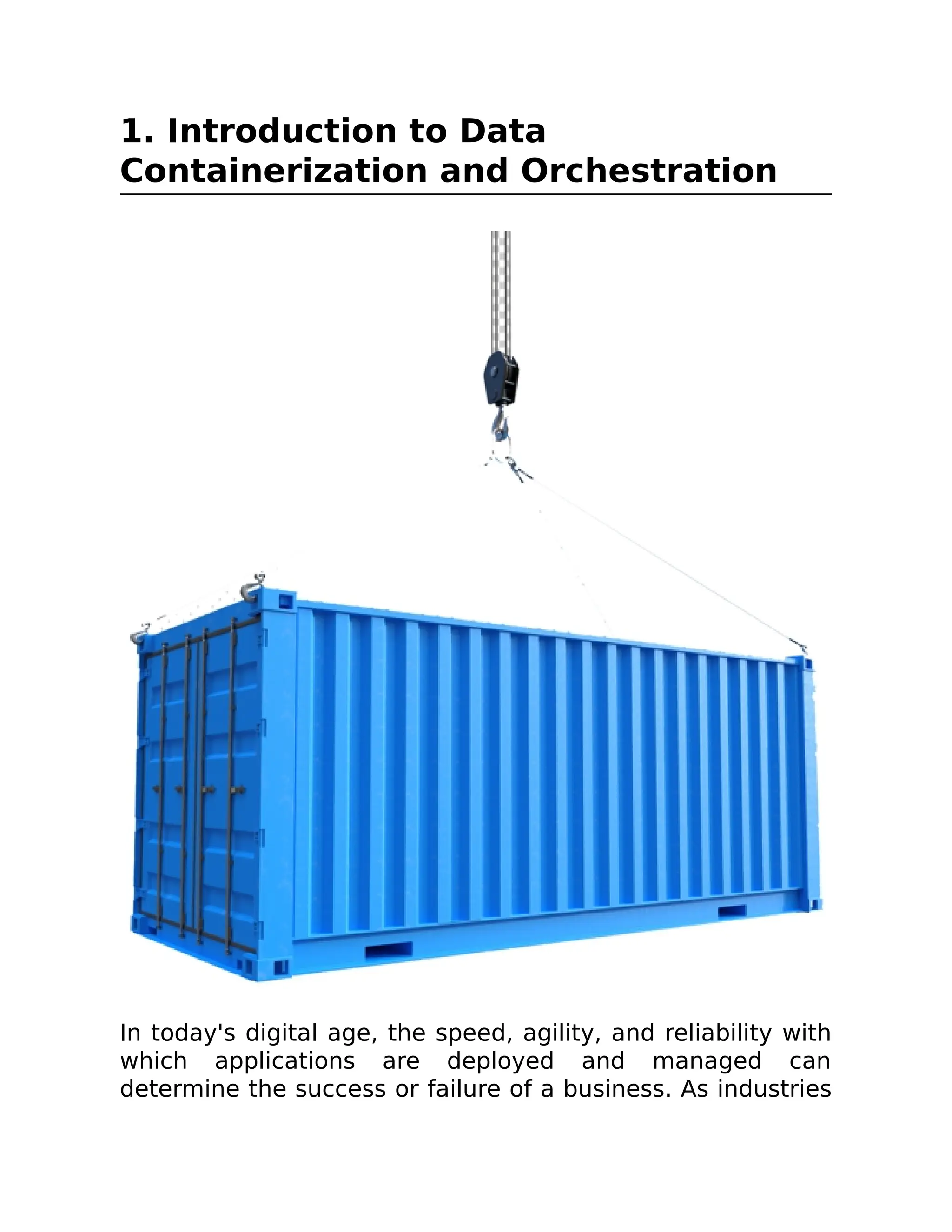
At its heart, containerization encapsulates software in a
standardized unit, ensuring consistency from development
to deployment. Think of a container as a box; inside this
box, you have everything the software needs to run: code,
runtime, system libraries, and settings. Because of this
encapsulation, developers have a consistent environment,
reducing the classic "it works on my machine" conundrum.
However, while containers resolve many issues related to
software consistency and portability, they introduce new
challenges of management at scale. If you've ever tried
juggling, you'll know that handling one or two balls might be
easy, but what happens when you have tens, hundreds, or
thousands? Similarly, how does one manage multiple
containers, ensuring they interact, scale, and heal when
needed? This is where orchestration steps in.
Orchestration automates the deployment, scaling, and
management of containerized applications. It’s akin to a
symphony conductor ensuring each instrument (or
container, in our case) plays in harmony, producing a
coherent performance no matter the scale of the orchestra.
In this chapter, we'll delve deep into the fundamental
principles behind these transformative technologies,
unpacking the benefits they offer and the challenges they
pose. By the end of it, you'll have a holistic understanding of
what containerization and orchestration are, why they
matter, and the pivotal role they play in modern data
management.
13.
Whether you're aseasoned developer, an IT manager, or
someone just curious about the latest trends in software
deployment, this chapter promises to lay a strong
foundation for the chapters ahead. Let's embark on this
journey of exploration, understanding, and mastery of data
containerization and orchestration.
1.1. Understanding the Role of Containerization
and Orchestration
Containerization and orchestration, though seemingly
technical and niche at first glance, play pivotal roles in the
current technology and business landscapes. As the demand
for digital transformation accelerates, understanding these
terms and their implications is essential for anyone involved
in software development, IT operations, and even business
strategy. In this section, we'll unpack the roles of
containerization and orchestration and explore why they are
so transformative.
The Genesis of Containerization
To appreciate containerization, we must first understand the
challenges that plagued developers and IT professionals in
the pre-container era. Developers would write code on their
local machines, which were set up according to their
preferences. Once the code was written and tested locally, it
was then sent to a production environment. However, the
production environment, being different from the
developer's local setup, often led to the infamous phrase: "It
works on my machine!" This inconsistency between
environments was a significant pain point.
Containerization emerged as a solution to this very problem.
At its core, containerization is about packaging an
application and its dependencies together into a 'container'.
This container acts as a standalone unit, ensuring that the
software inside it will run consistently across any
14.
environment - beit a developer's local machine, a test
server, or a production cloud environment.
Imagine if you had a special box, and anything you placed
inside this box would work exactly the same way regardless
of where you took it. That's essentially what a container
offers for software. Containers encapsulate software in a
consistent environment, abstracting it from system
differences and underlying infrastructural variations.
Role of Containerization
The rise of containerization heralded several benefits:
1. Consistency: As highlighted, the primary
advantage of containerization is the consistent
environment it offers. Applications packaged into
containers are insulated from the host system and
other containers. This ensures that the application
behaves the same regardless of where the
container is run.
2. Portability: Containers are lightweight and can be
easily transferred across different systems. This
means that an application packaged in a container
on a developer's machine can be effortlessly
moved to a test environment, a cloud server, or
even another developer's machine.
3. Scalability: Containers can be quickly started or
stopped, which means applications can be scaled
up or down with ease, responding to user demand
in real-time.
4. Efficiency: Containers share the host system's OS
kernel, unlike traditional virtual machines that
have their own full OS stack. This means
containers require fewer resources, can start
faster, and have less overhead.
15.
5. Isolation: Containersensure that applications are
isolated from each other, which enhances security.
If one application is compromised, the issue
doesn't spill over to others.
Introducing Orchestration
With all the advantages that containers brought, they also
introduced new challenges, especially when deployed at
scale. Imagine having to manage hundreds or even
thousands of containers, ensuring they communicate, scale,
stay updated, and recover from failures. Doing this manually
would be an enormous task.
This is where orchestration comes into play. Orchestration is
about automating the management of containers. It takes
care of deploying containers, ensuring they communicate,
scaling them up or down based on demand, updating or
replacing them as needed, and recovering them in case of
failure.
Role of Orchestration
1. Automated Deployments: Orchestration tools
can deploy containers on a cluster of machines
based on pre-defined configurations, ensuring the
right application versions are running.
2. Service Discovery and Load Balancing: With
multiple containers running, orchestration handles
the task of ensuring they discover each other. It
also balances the load among different containers
to ensure optimal performance.
3. Scaling: Orchestration can automatically scale
applications by adding or removing containers
based on real-time demands.
4. Self-healing: If a container fails, orchestration
tools can detect this and replace the failed
16.
container, ensuring highavailability.
5. Updates and Rollbacks: Orchestration tools can
roll out updates gradually, ensuring that if any
issues arise, the system can be quickly rolled back
to its previous stable state.
Kubernetes, Docker Swarm, and Apache Mesos are some of
the popular orchestration solutions in the market today, with
Kubernetes being the most widely adopted.
The Symbiotic Relationship
Containerization and orchestration, while valuable
individually, truly shine when combined. Containerization
provides the consistency, portability, and isolation needed
to develop and deploy applications, while orchestration
ensures that these applications run smoothly, scale
efficiently, and remain resilient in the face of challenges.
In Conclusion
Understanding the roles of containerization and
orchestration is crucial in today's digital landscape. These
technologies have redefined how applications are
developed, deployed, and managed, leading to faster
innovation cycles, improved resource utilization, and higher
resilience.
For businesses, embracing containerization and
orchestration is no longer a luxury but a necessity to remain
competitive. It streamlines operations, reduces costs, and
ensures a seamless user experience. For developers and IT
professionals, mastering these concepts is essential to stay
relevant and drive technological advancements.
As we dive deeper into subsequent chapters, keep in mind
the foundational roles these technologies play, for they form
the bedrock upon which modern software infrastructure
stands.
17.
1.2. Benefits andChallenges in Modern Data
Management
In the fast-paced world of technological innovation, data
stands tall as the most vital asset for businesses and
organizations. It powers everything from decision-making
and user experience optimization to artificial intelligence
and machine learning applications. The vast increase in data
generation and consumption has necessitated the evolution
of data management practices. While modern solutions
bring a multitude of benefits, they are not devoid of
challenges. Let's explore the benefits and hurdles of
contemporary data management.
Benefits of Modern Data Management
1. Enhanced Data Accessibility and
Collaboration: Modern data management
platforms have moved from on-premises servers to
cloud-based solutions. This transition facilitates
remote access to data, making collaboration easier
across globally distributed teams. Tools like Google
Cloud's BigQuery or Amazon's Redshift allow users
to query vast data sets from anywhere in the
world.
2. Scalability: As organizations grow, so does their
data. Cloud-native solutions offer the flexibility to
scale resources up or down based on the demand,
ensuring efficient use of resources without
compromising performance.
3. Data Integration: Modern data management
platforms support integrations with a variety of
data sources, be it structured databases,
unstructured logs, or real-time streaming data.
This capability enables organizations to have a
unified view of their data landscape.
18.
4. Real-time DataProcessing: With the rise of IoT
devices and real-time user interactions, the need
for real-time data processing has skyrocketed.
Modern platforms, such as Apache Kafka or Apache
Flink, enable real-time data ingestion and
processing, facilitating immediate insights and
actions.
5. Advanced Analytics and AI Integration:
Advanced analytics tools can seamlessly integrate
with modern data platforms. Machine Learning
models can be trained directly using data stored in
these platforms, making the process of deriving
insights and predictions faster and more efficient.
6. Enhanced Data Security: Cloud providers invest
heavily in securing their infrastructure. Features
like encryption at rest and in transit, access
controls, and regular audits ensure data remains
secure.
7. Cost Efficiency: Pay-as-you-go models in cloud
data management mean organizations only pay for
the resources they use. This approach is often
more cost-effective than maintaining on-premises
infrastructure.
Challenges in Modern Data Management
1. Data Fragmentation: With a plethora of tools
and platforms available, data can end up being
siloed in different systems. This fragmentation can
hinder the organization's ability to derive holistic
insights from their data.
2. Data Quality and Consistency: As data sources
multiply, maintaining data quality and consistency
becomes challenging. Dirty or inconsistent data
19.
can lead toerroneous insights, which can have
significant repercussions for decision-making.
3. Data Security and Compliance: With the
benefits of cloud storage come challenges related
to data security. Ensuring compliance with
regulations like GDPR or HIPAA requires meticulous
data handling and storage practices.
4. Data Governance: Determining who has access
to what data, tracking data lineage, and ensuring
proper data usage practices are vital for effective
data management. Setting up a robust data
governance framework is complex but crucial.
5. Integration Complexities: Integrating disparate
data sources, especially legacy systems, with
modern platforms can be challenging. It requires
middleware solutions and can sometimes lead to
data transfer delays.
6. Resource Management and Cost Overruns:
While cloud solutions offer scalability, improperly
configured resources can lead to cost overruns.
Monitoring and managing cloud resource
consumption efficiently is a necessity.
7. Talent Shortage: Modern data management tools
and platforms require specialized skills. There's a
notable talent gap in the market, with a shortage
of professionals well-versed in these modern
systems.
Balancing the Scales: Meeting the Challenges
Head-On
Modern data management's challenges aren't
insurmountable. Many organizations are actively devising
20.
strategies to addressthese issues. Some of the measures
include:
● Unified Data Platforms: Platforms like Databricks
aim to provide a unified analytics platform,
reducing data fragmentation by bringing analytics
and AI together.
● Data Quality Tools: Tools like Talend or
Informatica provide data quality assurance,
ensuring data consistency and reliability.
● Robust Data Governance Frameworks:
Implementing data governance tools like Collibra or
Alation helps in defining data access, lineage, and
usage policies.
● Continuous Training and Upskilling: Investing in
employee training ensures that they remain
updated with the latest in data management
practices.
● Cost Management Solutions: Tools like
CloudHealth or Cloudability provide insights into
cloud resource consumption, helping organizations
optimize costs.
Conclusion
Modern data management, with its array of benefits, has
transformed how organizations perceive and work with data.
It's a dynamic realm, where the speed of innovation is rapid.
While the challenges are real, they also represent
opportunities. Opportunities to streamline operations, to
innovate, and to derive deeper insights.
As data continues to grow both in volume and importance,
mastering the nuances of modern data management
becomes imperative. Organizations that skillfully navigate
the benefits and challenges are the ones that will stay
ahead in the data-driven future.
21.
1.3. Overview ofChapters and Learning
Objectives
In the expansive world of data containerization and
orchestration, it is crucial to embark on this learning journey
with a clear roadmap. The chapters that follow are
meticulously structured to guide both beginners and
advanced readers through the multifaceted landscape of
container technologies, their orchestration, and their
profound implications for modern data management. Let’s
delve into the layout of this book and the objectives we
hope to achieve with each chapter.
Chapter 2: Fundamentals of Containerization
This chapter demystifies the core concepts of containers. By
understanding the rudiments, readers will lay a solid
foundation upon which the more advanced topics can be
built.
Objectives:
● Grasp the fundamental concepts of containers.
● Differentiate between containerization and
virtualization.
● Understand the significance of container images
and registries.
Chapter 3: Containerization Tools and Technologies
Beyond the basics, the world of containers is rich with
various tools and technologies that facilitate the creation,
management, and operation of containers.
Objectives:
22.
● Get acquaintedwith Docker's architecture.
● Explore different container runtimes.
● Learn about container networking and storage
solutions.
Chapter 4: Orchestrating Containers with Kubernetes
Kubernetes has emerged as the frontrunner in container
orchestration. This chapter dives deep into its architecture,
components, and operation.
Objectives:
● Understand Kubernetes' significance in container
orchestration.
● Grasp Kubernetes' architecture and its fundamental
components.
● Learn to deploy and manage applications using
Kubernetes.
Chapter 5: Kubernetes Pods and Services
Kubernetes introduces several abstractions, the most
foundational of which are Pods and Services. This chapter
elucidates these concepts.
Objectives:
● Master the art of creating and managing pods.
● Delve into service discovery and load balancing.
● Understand networking models within Kubernetes.
Chapter 6: Kubernetes Configurations and
Deployments
A significant advantage of Kubernetes is its capability to
manage configurations and automate deployments.
Objectives:
23.
● Navigate throughKubernetes configurations.
● Understand the lifecycle of deployments, including
updates and rollbacks.
● Explore advanced deployment strategies.
Chapter 7: Data Management in Kubernetes
Handling stateful applications and persistent data in
Kubernetes is a vast domain. This chapter offers insights
into these areas.
Objectives:
● Explore strategies for managing stateful
applications.
● Delve into persistent storage solutions in
Kubernetes.
● Understand backup, disaster recovery, and data
consistency in distributed systems.
Chapter 8: Kubernetes Security and Compliance
Security in Kubernetes isn't an afterthought; it's integral.
This chapter equips readers with tools and best practices to
secure their Kubernetes deployments.
Objectives:
● Master the techniques of securing Kubernetes
clusters.
● Understand Role-Based Access Control and other
security policies.
● Ensure compliance with industry standards.
Chapter 9: Monitoring, Logging, and Debugging in
Kubernetes
Operational excellence in Kubernetes requires robust
monitoring, efficient logging, and effective debugging
techniques.
24.
Objectives:
● Learn tomonitor cluster health and performance.
● Implement logging best practices.
● Master debugging techniques for Kubernetes
applications.
Chapter 10: Beyond Kubernetes: Alternative
Orchestration Solutions
Kubernetes, while dominant, isn't the only player. This
chapter explores alternatives in the container orchestration
space.
Objectives:
● Get introduced to tools like Apache Mesos, Docker
Swarm, and OpenShift.
● Compare the features and capabilities of various
orchestrators.
Chapters 11-18: Advanced Concepts
These chapters dive deeper into specialized topics, from
serverless architectures and CI/CD pipelines to DevOps
practices and microservices. The primary aim is to expand
the reader's horizon and explore the full potential of
containerization.
Chapter 19: Building a Successful Containerization
Strategy
Before diving headfirst into containerization, businesses
need a robust strategy. This chapter guides organizations
through the creation of this roadmap.
Objectives:
25.
● Assess thetechnical and business goals vis-a-vis
containerization.
● Design a comprehensive containerization and
orchestration strategy.
● Learn to adapt and scale this strategy as the
business grows.
Chapter 20: Conclusion
This chapter serves as a recap of the immense knowledge
journey, offering a moment of reflection on the key concepts
grasped and a forward-looking view into the future of
containerization and orchestration.
Objectives:
● Recap and consolidate key learnings.
● Gain insights into the potential future trends in
containerization.
In Summary
This book's layout is structured to progress from the
elementary concepts to the intricacies of containerization
and orchestration. By the end, readers will not only have
comprehended the technical aspects but will also be
equipped to implement and strategize containerization
effectively within their organizations. Happy learning!
26.
2. Fundamentals ofContainerization
In an era where technology demands agility, scalability, and
consistency, the need for an efficient way to package,
distribute, and run applications has never been more
palpable. Enter the world of containerization—a
transformative approach to software delivery that promises
to revolutionize the way we think about development,
deployment, and operations.
Imagine for a moment that you're trying to ship a fragile
item across the world. You wouldn’t merely wrap it in some
paper and hope it gets there in one piece. Instead, you
would place it inside a sturdy box, cushioned with padding,
ensuring that no matter the bumps along the way, the item
remains intact. This box, in essence, mirrors what
containerization does for software. It encapsulates an
application and its environment into a self-sufficient
package, ensuring that it runs uniformly across varying host
environments.
The ensuing chapter aims to break down the core concepts
of containerization, stripping away the jargon and diving
deep into its foundational principles. By traversing this
chapter, you will:
1. Understand What Containers Are: Much like
our shipping analogy, we’ll begin by understanding
the essence of a software container. What is it?
How is it different from the traditional methods of
software deployment? Why is it likened to the
revolutionary impact of virtualization?
2. Dive into Docker: As one of the pioneering
platforms for containerization, Docker serves as an
exemplary starting point to delve into the world of
containers. We’ll walk you through its
27.
fundamentals and showcasehow it has shaped the
containerization landscape.
3. Decipher Container Images and Registries:
Building on our understanding of Docker, we'll
explore how container images act as blueprints for
containers and how registries play a pivotal role in
storing and distributing these images.
4. Contrast Containerization and Virtualization:
To truly appreciate the innovation behind
containerization, it's essential to compare it with
its predecessor—virtualization. By understanding
their distinctions and intersections, you’ll gain a
clearer picture of why containerization is heralded
as the next step in the evolution of software
delivery.
As we embark on this journey, it’s crucial to approach
containerization not just as a technological tool but as a
philosophy—a new way to conceptualize, structure, and
deploy applications in the digital age. Whether you’re a
developer eager to streamline your code deployment, an
operations professional seeking consistency in application
delivery, or an executive aiming for business agility,
understanding the fundamentals of containerization will be
instrumental in navigating the evolving technological
landscape.
So, fasten your seatbelts, and let’s embark on this
exploratory voyage into the world of containerization!
2.1. What are Containers?
At its essence, the technology landscape is a continuum,
always evolving and advancing. The innovation of
containers is a testament to this progression. But before
delving into the intricacies, let's start with a fundamental
question: What exactly are containers?
28.
Containers: The BasicDefinition
Containers are lightweight, standalone executable software
packages that encapsulate an application along with
everything it needs to run: code, runtime, system tools,
system libraries, and settings. These components are
isolated from each other and the host system. As a result,
containers guarantee consistent operation across diverse
environments, from a developer's local machine to testing
setups and production deployments on-premises or in the
cloud.
The Analogy: Containers as Shipping
Containers
To visualize the concept better, let's draw a parallel to the
world of physical goods. The invention of the standardized
shipping container revolutionized global trade. Before its
introduction, goods were individually loaded onto ships, a
process that was time-consuming, inefficient, and prone to
errors. With standardized containers, goods could be packed
into a consistent size and shape, making loading, unloading,
and transporting vastly more efficient.
Similarly, in the software realm, containers standardize the
"packaging" of applications. No matter the contents (or in
software terms, dependencies), the container ensures that it
can be uniformly handled across various stages of
development and deployment.
Containers vs. Traditional Deployment
Historically, deploying applications was fraught with
challenges. Developers would write code on their local
machines, which would then get tested in different
environments and finally moved to production.
Inconsistencies between these environments led to the
infamous "it works on my machine" syndrome, where code
29.
that ran perfectlyin one environment would break in
another due to varying system configurations, library
versions, and other factors.
Containers mitigate this problem. Since they encompass the
application and all its dependencies, the environment is
consistent, irrespective of where the container is running.
This uniformity eliminates discrepancies between
development, testing, and production setups, leading to
smoother deployments and fewer "it works on my machine"
incidents.
The Underpinnings: How Do Containers Work?
At their core, containers leverage features of the host
operating system, primarily:
1. Namespaces: This is what provides the isolation.
When you run a container, it gets its own set of
system resources (like network interfaces, process
IDs) separate from the host and other containers.
2. Control Groups (cgroups): These ensure that
each container gets its fair share of memory, CPU,
disk I/O, and other system resources. It's what
prevents a single container from hogging all
available resources.
3. Union File Systems: This is a layered system
that allows containers to be lightweight. When a
container is modified, only the changes (in a new
layer) are saved, ensuring efficiency and speed.
These components allow multiple containers to run on a
single host machine, all sharing the host OS kernel but
operating in isolated user spaces. This setup contrasts with
traditional virtualization, where each application requires a
separate OS copy to run, resulting in substantial overhead.
30.
Containers: The Benefits
Embracingcontainers brings forth a plethora of advantages:
1. Consistency: Containers ensure that applications
run the same regardless of where they're
deployed, bridging the gap between development
and operations teams.
2. Lightweight: Containers share the host system's
OS kernel, eliminating the need for a full OS stack
for each application, as seen with virtual machines
(VMs). This makes them faster and more efficient.
3. Portability: An application and its dependencies,
encapsulated in a container, can seamlessly move
across a developer’s local machine, test
environments, and different cloud providers.
4. Scalability: Containers can be quickly started,
cloned, or stopped, making it easier to scale
applications up or down as needed.
5. Isolation: Each container operates in its own user
space, ensuring that processes in one container
remain invisible and isolated from others.
6. Resource Efficiency: Containers leverage system
resources efficiently, allowing for higher density
(more containers per host) than traditional
virtualization.
Use Cases of Containers
Containers have been pivotal across numerous scenarios:
1. Microservices: Containers provide a natural fit for
microservices architectures. Each microservice,
with its specific functionality, can be encapsulated
31.
in a container,ensuring independence, scalability,
and resilience.
2. Dev/Test environments: Developers can
instantiate a replica of the production environment
on their local machines using containers, ensuring
consistency throughout the development cycle.
3. Continuous Integration/Continuous
Deployment (CI/CD): Containers facilitate
consistent environments across CI/CD pipelines,
ensuring code is tested and deployed in a uniform
setup.
4. Legacy Applications: Containers can breathe
new life into older applications, allowing them to
be packaged with all their dependencies and run
on modern infrastructure without requiring
extensive refactoring.
Closing Thoughts
In the vast realm of software development and deployment,
containers have emerged as a groundbreaking innovation,
promising consistency, efficiency, and agility. They
symbolize a paradigm shift in how we conceptualize,
package, and deliver applications, laying the groundwork for
many advanced practices, from microservices to serverless
computing.
However, as with any technology, understanding containers
requires peeling back the layers, diving into their
mechanics, and appreciating the challenges they aim to
address. Through this deep dive into the essence of
containers, we hope to have provided you with a
comprehensive understanding of their significance in the
modern technology landscape.
32.
In the followingsections, we'll delve deeper into the
intricacies of container tools, the vibrant ecosystem, and the
orchestration paradigms that make managing containers at
scale possible.
2.2. Docker and Containerization Basics
In any discourse about containerization, the term 'Docker'
invariably takes center stage. Since its inception, Docker
has played a pivotal role in popularizing container
technology, simplifying its complexities, and crafting a
vibrant ecosystem around it. This section delves deep into
Docker, unraveling its fundamental concepts and
understanding its indispensable role in the world of
containerization.
The Genesis of Docker
Docker was introduced in 2013 by a company called
dotCloud, initially developed as an internal project. Its
transformative potential was evident from the get-go. While
containerization technologies had existed before (like LXC),
Docker's simplicity, user-friendliness, and the ability to
create reproducible environments quickly caught the
attention of developers and system administrators.
What Exactly is Docker?
Docker is an open-source platform designed to automate
the development, shipment, and running of applications
inside lightweight, portable containers. These containers
encapsulate an application and its dependencies into a
standardized unit, ensuring it functions uniformly across
diverse environments.
Docker’s Core Components
To comprehend Docker's inner workings, it's imperative to
familiarize oneself with its primary components:
33.
1. Docker Engine:This is the heart of the Docker
system. It's a runtime that manages Docker
containers on a system. The Docker engine
comprises a server, a REST API, and a command-
line interface (CLI).
2. Docker Images: Think of these as blueprints for
containers. An image defines everything an
application requires to run. Once an image is
created, it's immutable, meaning it doesn't
change. You run instances of images, which are
called containers.
3. Docker Containers: These are live, running
instances of Docker images. Containers
encapsulate an application and all its
dependencies but share the same OS kernel.
4. Docker Hub: This is a cloud-based registry service
where you can link code repositories, build images,
test them, store them, or distribute them to others.
It offers both public and private storage for
images.
The Docker Workflow
The standard Docker workflow is straightforward:
1. Develop: Write your application, typically on your
local machine.
2. Build: Use Docker to create a Docker image from
your application. This is done using a Dockerfile,
which is a script containing instructions on how to
construct the image.
3. Ship: Push your Docker image to a registry like
Docker Hub or any other registry you prefer.
34.
4. Run: Deployyour application in any environment
using Docker, which pulls the image from the
registry and runs it as a container.
Benefits of Using Docker
Docker has catalyzed the containerization movement for a
variety of reasons:
1. Consistency: By packaging applications and their
dependencies together, Docker eliminates the "it
works on my machine" syndrome, ensuring
applications work uniformly across all stages of the
development cycle.
2. Isolation: Each Docker container runs
independently, ensuring that if one crashes, it
doesn't affect others.
3. Portability: Docker images are universal,
meaning you can build locally, deploy to the cloud,
and run anywhere you wish.
4. Version Control for Environments: Docker
images can be versioned, allowing easy rollback to
previous versions and ensuring that every team
member works with the exact setup.
5. Optimized Resource Usage: Docker containers
share the host OS kernel, reducing overhead and
maximizing system resource utilization.
6. Rapid Deployment and Scaling: Docker
containers can be started or stopped in seconds,
allowing for quick scaling in response to demand.
7. Ecosystem and Community: Docker’s expansive
ecosystem, with a plethora of tools and
integrations, combined with a robust community,
ensures continuous innovation and support.
35.
Challenges and Considerationswith Docker
While Docker offers numerous advantages, it's essential to
understand its limitations and challenges:
1. State Management: Containers are ephemeral
by nature, meaning any data saved in a container
will be lost once it's terminated unless managed
properly with volumes or other persistent storage
solutions.
2. Security: Container isolation isn't as strong as
traditional virtualization. It's essential to ensure
best practices like running containers with non-root
privileges, keeping images updated, and using
trusted base images.
3. Complexity: As applications grow and services
get decomposed into numerous containers,
managing inter-container communication,
networking, and orchestration can become
complex. This has led to the rise of orchestration
tools like Kubernetes.
4. Image Size: It's crucial to optimize Docker images
to prevent them from becoming bloated, which can
slow down deployment times and increase
resource usage.
Exploring Further: Docker’s Expanding
Landscape
Docker's influence extends beyond the basics. There are
tools like Docker Compose for defining and running multi-
container applications, Docker Swarm for native clustering,
and integrations with prominent CI/CD tools to streamline
the DevOps pipeline.
Closing Remarks
36.
Docker has usheredin a new era in software development
and deployment, making containerization a cornerstone of
modern IT strategies. Its influence resonates not just in its
technology but also in the cultural shift it has induced,
bringing development and operations teams closer together
and championing the principles of DevOps.
As we proceed, we'll delve into more nuanced aspects of
containerization, exploring various tools in the Docker
ecosystem, understanding the fine line between
containerization and virtualization, and ultimately
appreciating how container orchestration frameworks
extend Docker's capabilities to manage large-scale,
distributed applications.
2.3. Container Images and Registries
Containerization’s power and flexibility primarily arise from
the concepts of container images and registries. These
concepts have revolutionized the software delivery pipeline,
enabling developers to encapsulate their applications and
dependencies in a standardized manner, facilitating swift
deployments and version control. Let’s embark on a journey
to unravel the intricacies of container images and explore
the vital role of registries in the broader container
ecosystem.
Understanding Container Images
At its core, a container image is a lightweight, standalone,
and executable software package that encompasses an
application and all its requisite runtime components:
libraries, binaries, and configuration files. This encapsulation
ensures that the application will always run the same,
irrespective of the environment in which the container is
deployed.
Key Characteristics of Container Images:
37.
1. Immutability: Onceconstructed, container
images cannot be altered. This property ensures
that the deployed application’s behavior remains
consistent across different stages and
environments.
2. Layering: Images are constructed in layers. Every
instruction in a Dockerfile (or similar container
specification file) creates a new layer. This layered
structure facilitates efficient storage, as only
changed layers need to be rebuilt or stored.
3. Size-efficiency: Images are typically compressed,
ensuring they occupy minimal storage space.
Moreover, the shared-layer design means that
even if multiple images use the same base layer
(e.g., a base OS layer), that layer is stored just
once.
4. Versioning: Images can be version-tagged,
allowing developers to utilize specific versions of
an application or rollback to previous versions if
necessary.
Diving into Container Registries
Container registries are centralized repositories where
container images are stored and distributed. Think of them
as the equivalent of app stores for containerized
applications. Once a developer builds a container image, it
can be pushed to a registry, making it accessible to others
for pull and deployment.
Notable Features of Container Registries:
1. Access Control: Most registries support access
control mechanisms, ensuring that only authorized
users can push or pull images.
38.
2. Image Scanning:Some advanced registries
provide automated scanning of images for
vulnerabilities, ensuring that the containers
deployed from these images are secure.
3. Automated Builds: Certain registries can be
integrated with source code repositories to trigger
automated image builds whenever the source code
changes.
4. Replication and Distribution: For global
enterprises, registries often support the replication
of images across multiple geographic locations,
ensuring fast image pull times irrespective of
where the deployment occurs.
Popular Container Registries
1. Docker Hub: Operated by Docker Inc., Docker
Hub is perhaps the most well-known public
container registry. It offers both free and premium
plans, with the latter providing additional features
such as private repositories.
2. Google Container Registry (GCR): A managed
registry service by Google Cloud, GCR offers fast
and reliable image pulls due to Google's robust
infrastructure.
3. Amazon Elastic Container Registry (ECR): A
fully-managed docker container registry by AWS,
ECR integrates seamlessly with Amazon’s suite of
container management services.
4. Azure Container Registry (ACR): Microsoft’s
managed Docker container registry service that
facilitates Azure integrations and deployments.
5. Quay.io: Originally developed by CoreOS and now
managed by Red Hat, Quay.io provides a
39.
comprehensive set offeatures, including security
scanning and automated builds.
Crafting and Managing Container Images
While container registries play a pivotal role in the storage
and distribution of images, the onus of crafting efficient,
secure, and small container images rests with developers.
1. Optimized Base Images: Using minimalist base
images, tailored just for the application needs, can
considerably reduce the resultant image size.
2. Single Responsibility Principle: Each container
should serve a singular purpose. For instance, if an
application requires a web server and a database,
these should be packaged into separate
containers, not lumped together in one.
3. Regular Updates: Container images should be
periodically updated to incorporate security
patches, especially for critical runtime
components.
4. Scanning for Vulnerabilities: Utilize tools like
Clair, Anchore, or those provided by container
registries to scan images for known vulnerabilities.
5. Avoid Storing Secrets: Secrets, such as API keys
or database credentials, should never be
embedded within container images. Instead,
leverage secure solutions like Kubernetes Secrets
or HashiCorp Vault.
The Interplay of Images and Registries in CI/CD
The CI/CD (Continuous Integration/Continuous Deployment)
pipeline's efficiency is considerably enhanced by container
images and registries. Post the integration testing phase,
application images can be built and pushed to a registry.
40.
Subsequent deployment stagescan pull this image,
ensuring that the exact tested application version is what
gets deployed in production.
Furthermore, with blue-green or canary deployment
strategies, newer versions of applications can be
incrementally rolled out, and if any issues arise, rollbacks
are merely a matter of deploying containers from previous
image versions.
Concluding Thoughts
Container images and registries form the bedrock upon
which the edifice of containerization stands. Their
synergetic relationship ensures that developers can
seamlessly build, store, share, and deploy applications
across diverse infrastructures. As we advance in our
exploration of containerization, we’ll see how these
foundational concepts interface with advanced topics like
networking, storage, and orchestration, weaving the
intricate tapestry of modern container ecosystems.
2.4. Containerization vs. Virtualization
In today's digital age, the ability to run multiple
applications, often on varied environments, is paramount for
businesses. Both containerization and virtualization are
technologies that enable such possibilities. However, they
differ in fundamental ways, and each has its unique
advantages and limitations. This chapter delves deep into
the contrasts between containerization and virtualization,
aiming to provide a comprehensive understanding of their
roles and purposes in modern computing.
Virtualization: An Overview
Virtualization, which has been around for a few decades
now, allows multiple operating systems to run concurrently
on a single physical machine. At its core is the 'hypervisor',
41.
a software layer(or occasionally a hardware component)
that creates and manages virtual machines (VMs). Each VM
has its full operating system, applications, binaries, and
libraries.
Types of Hypervisors:
1. Type 1 Hypervisor (Bare Metal): Runs directly
on the host's hardware to control hardware and
manage guest operating systems. Examples
include Microsoft Hyper-V, VMware vSphere/ESXi,
and Oracle VM Server for x86.
2. Type 2 Hypervisor (Hosted): Runs atop a
conventional operating system environment. The
underlying OS interacts with the hardware. VMware
Workstation and Oracle VirtualBox are prime
examples.
Containerization: An Overview
Containerization, while more recent than virtualization, has
taken the DevOps and cloud computing worlds by storm.
Containers package an application along with its
environment - libraries, binaries, and configuration files -
into a single unit. Unlike VMs, containers don’t encapsulate
a full OS, but share the OS kernel with other containers,
making them considerably lightweight. Docker and
containerd are prevalent container technologies.
Containerization vs. Virtualization: Key Differences
1. Resource Overhead:
42.
● Virtualization: EachVM has its OS, which
demands a significant amount of system
resources. Thus, hosting multiple VMs can be
resource-intensive.
● Containerization: Containers share the host
system’s OS kernel and consume only the
resources required by the isolated application
environment they carry. They’re significantly
more lightweight and efficient.
2. Startup Time:
● Virtualization: VMs generally have longer
startup times as they need to boot an entire
OS.
● Containerization: Containers can start
almost instantly since they run atop the host
OS and don't require a separate boot process.
3. Portability:
● Virtualization: VMs are bulkier due to their
embedded OS, making them less ideal for
fast, iterative deployment cycles or easy
portability across platforms.
● Containerization: Given the encapsulated
nature of containers (with both the
application and its environment), they can be
moved seamlessly across a developer's local
machine, test environments, and different
cloud providers.
4. Isolation:
43.
● Virtualization: VMsprovide strong isolation
since they run separate OS instances. A
failure or security breach in one VM doesn’t
jeopardize others.
● Containerization: While containers are
isolated, they share the same OS kernel.
Kernel vulnerabilities could potentially affect
all containers on the host.
5. Management Tools:
● Virtualization: VMs are often managed using
tools like VMware vCenter or Microsoft System
Center.
● Containerization: Containers leverage
orchestrators like Kubernetes, Docker Swarm,
or OpenShift for management, scaling, and
deployment.
6. Performance:
● Virtualization: While VMs can deliver robust
performance, there is an undeniable overhead
due to running full-fledged OS instances.
● Containerization: Containers, being
lightweight and avoiding the OS booting
overhead, often deliver superior performance,
especially when scaling out applications.
7. Scaling:
44.
● Virtualization: Scalinginvolves either
increasing the resources of a VM or spinning
up additional VMs, both of which can be time-
consuming.
● Containerization: Containers can be rapidly
instantiated, making the scaling of
applications incredibly fast and efficient.
8. Use Cases:
● Virtualization: Ideal for scenarios where
complete OS-level separation is required, like
running applications on different OS versions
or segregating different organizational units
or customers.
● Containerization: Best suited for
microservices architectures, cloud-native
applications, and scenarios demanding rapid
scaling and deployment.
Harmonizing Containerization and Virtualization
While they might seem at odds, containerization and
virtualization can coexist harmoniously. Several
organizations use VMs to run container orchestrators like
Kubernetes. The VMs provide an additional security and
isolation layer, while containers within them offer the agility
and efficiency businesses seek. Solutions like VMware’s
vSphere integrated containers or Azure’s AKS-HCI (Azure
Kubernetes Service on Azure Stack HCI) typify this
synthesis.
Deciding Between Containerization and Virtualization
The choice isn't necessarily binary. Factors influencing the
decision include:
45.
● Application Architecture:Microservices-based
applications benefit immensely from
containerization due to its lightweight nature and
rapid scaling capabilities.
● Security Needs: If kernel-level isolation is a
paramount concern, then VMs or a combination of
VMs and containers might be preferable.
● Resource Availability: For infrastructure-
constrained environments, containers might be a
more viable solution given their minimal overhead.
● Deployment Frequency: Continuous deployment
and integration environments, where frequent and
consistent deployments are the norm, benefit from
containerization.
Conclusion
Both containerization and virtualization have revolutionized
the way we think about, develop, and deploy applications.
Virtualization's robust isolation is unparalleled, while
containerization's agility is groundbreaking. The decision to
adopt one over the other (or a blend of both) should be
based on a careful consideration of business needs,
application architecture, and strategic objectives. As the
digital landscape evolves, it's likely that both these
technologies will continue to adapt and offer even more
tailored solutions to modern computing challenges.
46.
3. Containerization Toolsand
Technologies
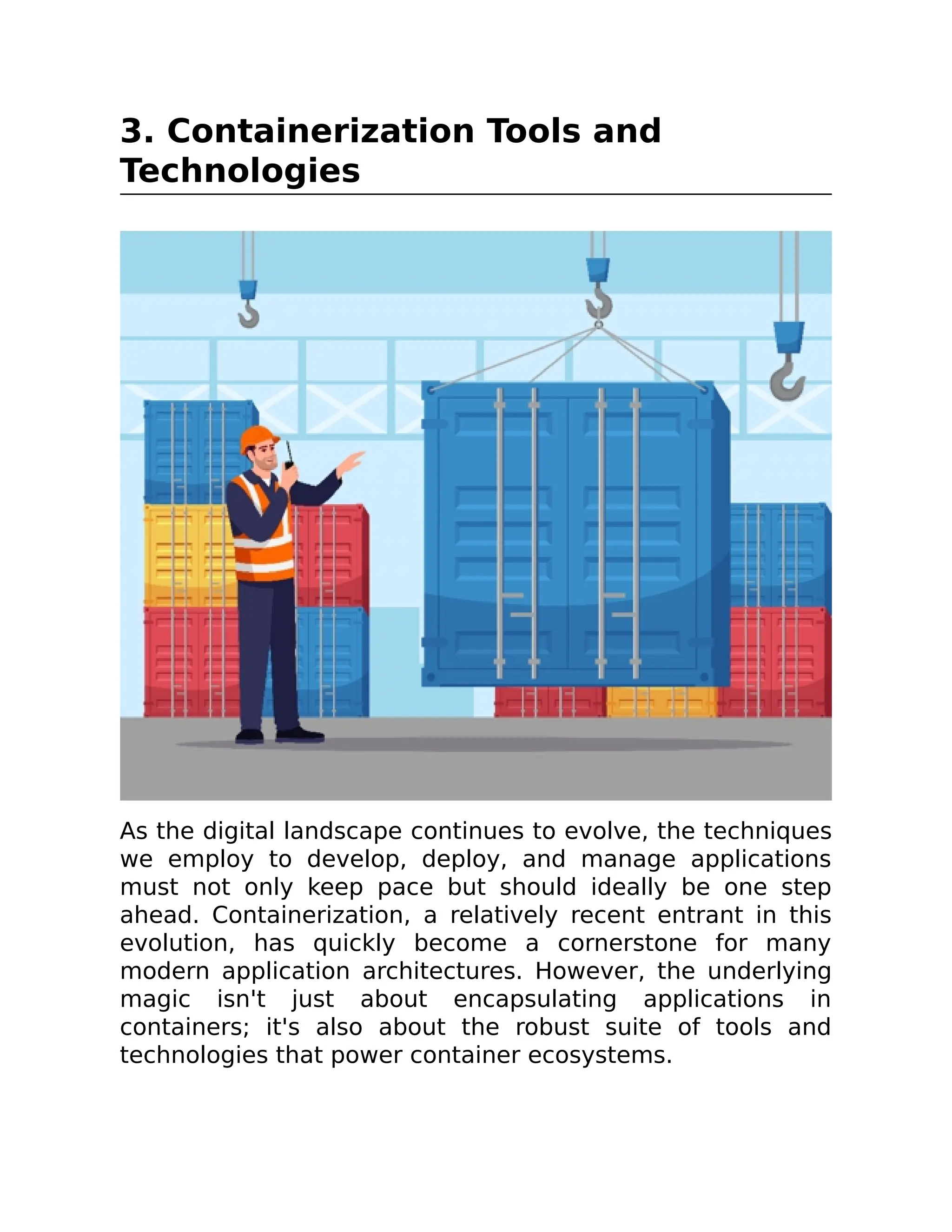
As the digital landscape continues to evolve, the techniques
we employ to develop, deploy, and manage applications
must not only keep pace but should ideally be one step
ahead. Containerization, a relatively recent entrant in this
evolution, has quickly become a cornerstone for many
modern application architectures. However, the underlying
magic isn't just about encapsulating applications in
containers; it's also about the robust suite of tools and
technologies that power container ecosystems.
47.
While the term"container" might evoke imagery of a
simplistic box, the reality is a rich tapestry of interconnected
tools and technologies. From the moment an application is
transformed into a containerized format to the point it's
running in a production cluster, multiple tools play their
parts in ensuring everything goes smoothly. Whether it's
about creating a container, storing it, networking between
containers, or managing a horde of containers in a cluster,
each task has specific tools crafted for it.
This chapter is dedicated to unraveling the intricate web of
containerization tools and technologies. By its end, readers
will not only understand the role of each tool but also how
they harmoniously coalesce, ensuring containerized
applications run efficiently, securely, and scalably. So, let's
embark on this journey, exploring the engines, runtimes,
networking quirks, and the thriving ecosystem that sustains
the world of containers.
3.1. Docker Engine and Architecture
In the realm of containerization, few names stand out as
prominently as Docker. It has revolutionized the way
developers think about application deployment, scaling, and
management. A deep dive into Docker's engine and its
architecture provides insights into its widespread adoption
and underlying efficacy. This section is dedicated to
understanding Docker's magic, from its engine to the
architectural decisions that power it.
Docker Engine: The Heartbeat
Docker Engine is the core component that facilitates the
functioning of containers. In essence, it's a client-server
application with three major components:
1. Docker CLI (Command Line Interface): This is
the primary interface through which developers
48.
and sysadmins interactwith Docker. Commands
such as docker build, docker run, and docker
push are part and parcel of a Docker user's
lexicon.
2. Docker API: While the CLI is the interface for
humans, the API serves as an interface for
applications. Software solutions can interact with
Docker Engine, control its behavior, and fetch
information through this API.
3. Docker Daemon: Often just referred to as
'Dockerd', the Daemon runs on the host machine
and does the heavy lifting. It's responsible for
building, running, and managing containers. It can
communicate with other Docker Daemons to
synchronize container services across multiple
machines.
Understanding Docker's Architecture
Docker's architecture is fundamentally client-server based,
but with intricacies tailored for container management.
1. Docker Client: When you use the Docker CLI,
you're interacting with the Docker Client. It
communicates with the Docker Daemon to execute
commands. The beauty lies in its flexibility – the
client and daemon can run on the same host or
different hosts, communicating over sockets or a
RESTful API.
2. Docker Host: This encompasses the Docker
Daemon, containers, and container images. The
host manages the container's lifecycle and
responds to the Docker API requests, orchestrating
container creation, operation, and destruction.
49.
3. Docker Registry:Docker's architecture isn't
limited to running containers; it also needs a
mechanism to distribute container images. Docker
Registries fulfill this role. Docker Hub, the public
registry that anyone can use, is often the first
interaction point for many Docker users. However,
for enterprise use-cases, Docker also offers trusted
private registries.
4. Docker Images: At its core, an image is a
lightweight, standalone executable software
package that encapsulates all essentials required
to run a piece of software, including the code,
runtime, libraries, and system tools. Images
become containers when they run on the Docker
Engine.
5. Docker Containers: Containers are the live
instances of Docker images. They encapsulate the
application and its environment, ensuring
consistency across various stages of the
development lifecycle.
Deeper Dive: Inside the Docker Daemon
The Docker Daemon is where a lot of the container magic
happens. A closer look reveals a plethora of components
and functionalities:
1. Containerd: An industry-standard core container
runtime, it takes care of the basic functionalities of
container execution, like managing the container's
lifecycle, supervising the container's process, and
storing container images.
2. runc: A lightweight, OS-specific container runtime,
runc is responsible for running containers in
accordance with the Open Container Initiative
50.
(OCI) specifications. Docker'sDaemon uses runc
to run containers but can also support other
runtimes.
3. Networking: Docker employs a bridge-network by
default, allowing containers to communicate while
isolating them from the external world. However,
Docker's architecture is flexible enough to support
host networking, overlay networks, and even third-
party plugins to customize networking behaviors.
4. Storage: Docker's layered approach to images is
not just for efficient distribution. It also aids in
optimizing storage. Docker uses storage drivers to
manage the contents of image layers and the
writable container layer. Commonly used storage
drivers include Overlay2, aufs, and btrfs.
The Lifecycle of a Docker Container
Understanding Docker's architecture wouldn't be complete
without visualizing a container's lifecycle:
1. Creation: Initiated by the docker create
command, a container is born. It's essentially a
writeable layer atop the image.
2. Starting: With docker start, the container begins
its execution and continues until stopped or its
main process completes.
3. Pausing & Resuming: Docker can pause the
processes in a container (docker pause) and
subsequently resume them (docker unpause).
4. Stopping: When a container's processes are
halted (either manually using docker stop or
when they naturally complete), the container
transitions to a stopped state.
51.
5. Restarting: Stoppedcontainers can be revived
using docker restart.
6. Removal: Once done with, containers can be
removed from the system using docker rm.
Conclusion
Docker, with its intricate but efficient architecture, has
paved the way for containerization to become a dominant
force in today's software development and deployment
paradigms. While its components and operations might
seem complex at first, they cohesively work together,
ensuring that software can be consistently developed,
deployed, and scaled across diverse environments. As we
proceed to delve deeper into the world of containerization
tools and technologies, this foundational knowledge of
Docker's architecture will serve as a compass, guiding us
through the vast seas of the container ecosystem.
3.2. Container Runtimes: rkt, containerd, and
more
Containerization, a transformative technology in the IT
landscape, owes its dynamism and flexibility to underlying
components known as container runtimes. These runtimes
are the engines that create, launch, and manage containers.
With Docker taking center stage in many conversations
about containerization, one could easily overlook the vast
variety of other container runtimes that have emerged,
each bringing its own flavor and capabilities to the table.
In this section, we'll dive deep into the world of container
runtimes, shedding light on renowned names such as rkt
and containerd, and exploring how they differ from and
complement each other.
A Primer on Container Runtimes
52.
Before delving intospecifics, it's pivotal to understand what
a container runtime fundamentally does. At its core, a
container runtime is responsible for setting up the entire
container before executing the user-defined process. This
includes arranging namespaces, control groups (cgroups),
filesystem setups, and network interfaces.
Two layers of container runtimes generally coexist:
1. High-Level Runtimes: These are responsible for
image distribution, container orchestration, and
API exposure. Docker and containerd fall into this
category.
2. Low-Level Runtimes: These directly interact with
the operating system for resource isolation and
namespace encapsulation. runc (an industry
standard) and railcar (by Oracle) are examples.
Rkt (pronounced “Rocket”)
Developed by CoreOS, rkt is an application container engine
that was designed as an alternative to Docker. Some
highlights and features of rkt include:
1. Distinct Execution Model: Unlike Docker, rkt
doesn't rely on a central daemon. Each rkt
command is a standalone execution, which
reduces complexity and enhances security by
eliminating a long-running daemon.
2. Integrated with Systemd: rkt's integration with
systemd (an init system for bootstrapping use
space and managing user processes) ensures
seamless management and monitoring of
containers as system services.
3. Modularity and Pluggability: rkt was developed
with modularity in mind. This design facilitates
53.
various flavors ofcontainer runtime execution and
networking through a plug-in architecture.
4. Security: rkt emphasizes security by supporting
SELinux, hardware virtualization through KVM, and
image signature verification.
5. OCI Compatibility: While rkt started with its
image format called ACI (App Container Images), it
later embraced OCI (Open Container Initiative)
specifications, ensuring compatibility with other
container tools.
Containerd
An outcome of Docker's evolution and modularization,
containerd was carved out as a high-level container runtime
with an emphasis on simplicity, robustness, and portability.
Some salient features include:
1. OCI Compatibility: containerd is fully aligned
with OCI standards, ensuring consistency and
interoperability.
2. Core Functionalities: It handles core container
functionalities like image transfer and storage,
container execution and supervision, and network
interface management.
3. gRPC API: containerd exposes its functions via a
gRPC API, enabling integrations with other tools
and systems.
4. Efficient Performance: By focusing solely on
core container tasks, containerd offers a
lightweight and performant runtime solution.
5. Built for Extensibility: With a rich plugin
architecture, containerd can be extended to
54.
support additional storage,image distribution
protocols, and more.
Others in the Fray
While rkt and containerd are notable, the container runtime
ecosystem is rich and varied:
1. runc: As the reference implementation of the OCI
runtime specification, runc forms the foundation
for several high-level runtimes, including Docker
and containerd.
2. CRI-O: Tailored for Kubernetes, CRI-O is a
lightweight container runtime that directly
implements the Kubernetes Container Runtime
Interface (CRI). This ensures Kubernetes
orchestrates containers without any third-party
layers in between.
3. Kata Containers: Merging the best of containers
and virtual machines, Kata Containers offer the
lightweight nature of containers while providing
the isolation of VMs.
4. gVisor: Developed by Google, gVisor is a unique
runtime that provides a sandboxed environment
for containers, ensuring enhanced isolation by
intercepting system calls and processing them in
user space.
5. LXC/LXD: LXC, which predates Docker, is a low-
level runtime that deals with OS-level
virtualization. LXD is its extension, offering a more
intuitive experience with daemon-based
management.
Choosing the Right Runtime
Welcome to ourwebsite – the perfect destination for book lovers and
knowledge seekers. We believe that every book holds a new world,
offering opportunities for learning, discovery, and personal growth.
That’s why we are dedicated to bringing you a diverse collection of
books, ranging from classic literature and specialized publications to
self-development guides and children's books.
More than just a book-buying platform, we strive to be a bridge
connecting you with timeless cultural and intellectual values. With an
elegant, user-friendly interface and a smart search system, you can
quickly find the books that best suit your interests. Additionally,
our special promotions and home delivery services help you save time
and fully enjoy the joy of reading.
Join us on a journey of knowledge exploration, passion nurturing, and
personal growth every day!
ebookbell.com