
www.Open-RE.org
Mastering CPRE®
The essential guide to succeed in Certified Professional in
Requirements Engineering examination
2
Mastering CPRE
Acknowledgements and Bibliography
Syllabus for CPRE Foundation Level examination, IREB, Germany
Rupp, Klaus Pohl and Chris. A Study Guide for the Certified Professional
for Requirements Engineering Exam Foundation Level 2nd Edition. Rocky Nook
Inc., 2015. Kindle and Paperback.
A Guide to Business Analysis Body of Knowledge v2.0. International
Institute of Business Analysis. Toronto: IIBA, 2009. PDF and EBook.
A Guide to Business Analysis Body of Knowledge v3.0. International
Institute of Business Analysis. Toronto: IIBA, 2009. PDF and EBook.
Business Analysis, Debra and Paul, British Computer Society
Podeswa, Howard. The Business Analyst's Handbook. Boston: Course
Technology, 2009. Paperback.
UML for the IT Business Analyst, Second Edition. Boston: Course Technology,
2010. Paperback.
Mastering CPRE®
The essential guide to succeed in Certified Professional in
Requirements Engineering examination
3
Copyright notice
CPRE® is registered Trademarks of International Requirements
Engineering Board, Germany.
All trademarks of copyrights mentioned herein are the
possession of their respective owners.
We make no claim of ownership by the mention of products that
contain these marks.
Contents of this document should not be disclosed to any
unauthorized person.
This document may not, in whole or in part, be reduced,
reproduced, stored in a retrieval system, translated, or
transmitted in any form or by any means, electronic or
mechanical.
This publication may be used in assisting aspirants for CPRE®
examination. It does not warrant that use of this publication
will ensure passing the CPRE® examination.
Mastering CPRE®
The essential guide to succeed in Certified Professional in
Requirements Engineering examination
4
Preface and Introduction
As the book title suggests, this book is a guidebook for
the aspirants of the CPRE examination from IREB, Germany.
We value your time and hence the book is designed to be
extremely specific – Help you pass the certification
examination with least possible effort.
This book is authored by a qualified CPRE trainer who has
helped many other participants clear the CPRE examination
in the very first attempt. He is also trainer for CPRE
preparations in both corporate and public workshops and
have trained thousands of participants across the world –
USA, Australia, Middle East, South East Asia, Europe and
Africa.
The book will soon be followed by an exhaustive question
bank and audio book to further assist participants.
Feedbacks and suggestions on the book
We will be glad and thankful if you can share your
feedbacks and suggestions on the book. Please your
feedbacks and suggestions to LNMishra@AdaptiveProcesses.com
Mastering CPRE®
The essential guide to succeed in Certified Professional in
Requirements Engineering examination
5
About the Author
LN Mishra (LN) has 22 years of professional experience in
software product development, requirements analysis,
business analysis, governance, risk and compliance
management (CMMI, ISO9001, ISO27001, HIPAA and Six-Sigma).
LN is a practicing requirements engineer and business
analyst for more than 15 years. He was involved in multiple
multi-country large ERP implementation projects. He
currently consults in development of 2 large systems - one
of the largest paint companies in the world to develop
their next generation color management system and
development of a GRC system. He is also the product manager
for an enterprise Governance, Risk and Compliance
management system (GRCPerfect) which is operational in
multiple client places.
He was involved in one of the world’s change management
program in PricewaterhouseCoopers, a leading management
consulting firm, in one of the largest privatization effort
in India for a public sector utility agency.
LN has conducted more than 100 workshops, both public and
in house in the areas of Business Analysis, Requirements
Management, Agile Project Management, software Project
Mastering CPRE®
The essential guide to succeed in Certified Professional in
Requirements Engineering examination
6
Management, Six Sigma, CMM, ISO 9001 and ISO 27001. He has
also guided 30+ six sigma green belt projects in iGate,
MACH and Akzo Nobel.
LN holds a Post Graduate Diploma in Management (PGDM) from
IIM Ahmedabad, the too-most business management school in
India and Bachelor in Engineering (Honors) in Electronics
and Telecommunication from University College of
Engineering, Burla, India.
Major Awards/Recognitions:
 Certified Requirements Engineering Professional (CPRE)
from IREB, Germany
 Certified Business Analyst Professional (CBAP) from
IIBA, Canada.
 Certified Project Management Professional (PMP) from
PMI, USA
 Certified Scrum Master from Good Agile, USA
 World Topper Certified software Quality Analyst (CSQA),
2000
 Certified Lead Auditor for ISO 9001, ISO 27001, ISO
20000 and BS 25999
Mastering CPRE®
The essential guide to succeed in Certified Professional in
Requirements Engineering examination
7
Clients for whom LN has consulted and mentored
LN lives with his wife, Ananya, son, Siddharth and
daughter, Saianshee in Bangalore, the IT capital of India.
Mastering CPRE®
The essential guide to succeed in Certified Professional in
Requirements Engineering examination
8
TABLE OF CONTENTS
1. All about CPRE....................................................... 14
What and why of CPRE.................................................... 14
What is IREB?........................................................... 14
Prerequisite for CPRE................................................... 15
Preparation............................................................. 15
Certification examination............................................... 16
Examination results..................................................... 16
2. Introduction and foundation.......................................... 18
2.1. Symptoms of and reasons for inadequate re.......................... 18
Need for good requirements engineering.................................. 18
Costs of requirements error fixing...................................... 19
Defining requirements................................................... 19
Defining requirements engineering....................................... 20
Symptoms of poor requirements engineering............................... 21
Causes of poor requirements engineering................................. 21
2.2. Four major activities of requirements engineers.................... 23
Different levels of requirements........................................ 24
2.3. Role of communication in requirements engineering.................. 28
Impact of communication mediums in requirements engineering............. 29
2.4. Skills of requirements engineers................................... 30
Responsibilities of requirements engineers.............................. 30
Skills of requirements engineers........................................ 31
2.5. Three (3) types of requirements.................................... 35
Functional requirements................................................. 35
Mastering CPRE®
The essential guide to succeed in Certified Professional in
Requirements Engineering examination
9
Non-functional (quality, supplementary) requirements.................... 37
Constraints............................................................. 39
3. Systems and system contexts.......................................... 41
3.1. System, system context and boundaries.............................. 41
What is a system?....................................................... 41
What is context?........................................................ 42
What is system context?................................................. 42
3.2. Determining system and context boundaries.......................... 46
System boundary and it’s gray zone..................................... 46
Context boundary and it’s gray zone.................................... 48
Gray zone in system boundary............................................ 49
Gray zone in context boundary........................................... 50
4. Requirements elicitation............................................. 52
4.1. Requirements sources............................................... 52
Significance of requirements sources.................................... 52
Consequences of unconsidered sources.................................... 52
Types of requirements sources........................................... 53
Important information of the stakeholder documentation.................. 54
Stakeholder management process.......................................... 56
Ensuring agreement with stakeholders.................................... 57
Principles in dealing with stakeholders................................. 58
Stakeholders rights and duties.......................................... 59
4.2. Requirements categorization according to kano model................ 61
4.3. Elicitation techniques............................................. 63
Factors influencing choice of elicitation techniques.................... 63
Mastering CPRE®
The essential guide to succeed in Certified Professional in
Requirements Engineering examination
10
RE techniques based on type of requirements............................. 64
RE techniques based on level of detail required......................... 64
RE techniques based on availability of stakeholders..................... 66
RE techniques based on risks of project................................. 66
RE techniques based on complexity of the project........................ 66
Survey techniques (interviews, workshops, questionnaires)............... 67
Creativity techniques (brainstorming, brainstorming paradox, change of
perspective, analogy techniques)........................................ 70
Document-centric techniques............................................. 76
Observation techniques.................................................. 80
Support techniques...................................................... 83
5. Documenting requirements............................................ 101
5.1. Document design................................................... 101
Reasons for documentation.............................................. 101
5.2. Documentation types............................................... 103
Three perspectives of functional requirements.......................... 103
Requirements documentation using natural language...................... 105
Requirements documentation using conceptual models..................... 105
Hybrid requirements documents.......................................... 106
5.3. Document structures............................................... 107
Standardized document structures....................................... 107
Customized standard contents........................................... 109
5.4. Use of requirements documents..................................... 112
5.5. Quality criteria for requirements documents....................... 114
5.6. Quality criteria for requirements................................. 116
Basic rules to enhance readability of requirements..................... 118
Mastering CPRE®
The essential guide to succeed in Certified Professional in
Requirements Engineering examination
11
5.7. Glossary.......................................................... 120
Benefits of glossary:.................................................. 120
Rules for using a glossary............................................. 121
6. Documenting requirements in natural languages....................... 123
6.1. Language effects.................................................. 123
Mastering and using five transformational effects...................... 123
Transformational effects............................................... 124
6.2. Requirement construction using templates.......................... 128
7. Model-based requirements documentation.............................. 133
7.1. The term model.................................................... 135
Model and its properties............................................... 135
Elements of a conceptual modelling language............................ 137
7.2. Modeling requirement using “goals”.............................. 138
7.3. Use cases......................................................... 140
Modelling using use case diagrams...................................... 140
Use case specifications................................................ 143
7.4. Three modeling perspectives on requirements....................... 147
7.5. Requirements modeling in data perspective......................... 147
7.6. Requirements modeling in functional perspective................... 151
Data flow diagrams..................................................... 151
UML activity diagrams.................................................. 153
7.7. Requirements modeling in behavioral perspective................... 156
UML state diagrams..................................................... 156
8. Requirements validation and negotiation............................. 158
8.1. Fundamentals of requirements validations.......................... 159
Mastering CPRE®
The essential guide to succeed in Certified Professional in
Requirements Engineering examination
12
Significance of validating requirements................................ 159
8.2. Fundamentals of requirements negotiations......................... 161
Significance of requirements conflicts................................. 161
8.3. Quality aspects of requirements................................... 162
3 quality aspects of requirements...................................... 162
Using validation criteria for the quality aspects...................... 162
8.4. Principles of requirements validation............................. 165
Six principles of requirements validations............................. 165
Using principles of requirements validations........................... 165
8.5. Techniques for requirements validations........................... 168
Techniques for requirements validations................................ 168
Using techniques for requirements validations.......................... 168
8.6. Requirements negotiation.......................................... 173
Activities for requirements negotiation................................ 173
Types of requirements conflicts........................................ 173
Conflict resolution techniques......................................... 175
Documentation of conflict resolution techniques........................ 177
9. Requirements management............................................. 179
9.1. Assigning attributes to requirements.............................. 180
Attribute schemes...................................................... 180
Purpose and definition of attribute schemes............................ 180
Template for attribute scheme.......................................... 181
Project-specific tailoring of attribute scheme......................... 181
Important attribute types for requirements............................. 182
9.2. Views on requirements............................................. 185
Mastering CPRE®
The essential guide to succeed in Certified Professional in
Requirements Engineering examination
13
9.3. Prioritizing requirements......................................... 187
Methods for requirements prioritization................................ 187
Requirements prioritization techniques................................. 188
Ranking and top-ten technique.......................................... 188
Single-criterion classification........................................ 188
Kano classification.................................................... 189
Prioritization matrix (wiegers matrix)................................. 190
9.4. Requirements traceability......................................... 191
Benefits of requirements traceability.................................. 191
Three types of traceability relationships.............................. 192
Representing requirements traceability................................. 193
9.5. Versioning of requirements........................................ 195
Requirements versions.................................................. 195
Requirements configurations............................................ 196
Properties of requirements configurations.............................. 196
Requirements baselines................................................. 197
9.6. Management of requirements changes................................ 198
Importance of requirements changes..................................... 198
Change control board................................................... 198
Change request (CR).................................................... 199
Classification of incoming change requests............................. 200
Basic method for CRs................................................... 201
9.7. Measurement for requirements...................................... 203
10. Requirements tools................................................. 205
10.1. Types of tools................................................... 205
Mastering CPRE®
The essential guide to succeed in Certified Professional in
Requirements Engineering examination
14
Tools during system development........................................ 205
Tools to structure, present, visualize and simulate requirements models 206
Features of requirements management tools.............................. 207
Standard office tools.................................................. 208
Specialized requirements management tools.............................. 209
10.2. Introducing tools................................................ 209
10.3. Evaluating tools................................................. 211
Project view........................................................... 211
User view.............................................................. 211
Product view........................................................... 212
Process view........................................................... 212
Provider view.......................................................... 212
Technical view......................................................... 212
Economic view.......................................................... 212
Mastering CPRE®
The essential guide to succeed in Certified Professional in
Requirements Engineering examination
15
1. All about CPRE
What and Why of CPRE
CPRE stands for Certified Professional in Requirements
Engineering, a certification provided by International
requirements Engineering Board (IREB), Germany
(www.IREB.org). This is the most widely acknowledged
certification for requirements engineers. There are more
than 20000 requirements engineering professionals certified
in CPRE Foundation Level examination world-wide.
Following are some of the benefits of becoming a CPRE
 Be recognized for your competency in requirements
engineering.
 Requirements engineering is a growing career
opportunity for IT professionals.
 Stakeholders with domain experience can join IT sector
by becoming requirements engineers.
 Better job prospects.
 Better salary.
What is IREB?
International requirements Engineering Board (IREB) was
founded in Germany in to support the requirements
engineering community by:
 Creating and developing awareness and recognition of
Mastering CPRE®
The essential guide to succeed in Certified Professional in
Requirements Engineering examination
16
the value and contribution of the requirements
engineers.
 Providing a forum for knowledge sharing and
contribution to the requirements engineering
profession.
 Publicly recognizing and certifying qualified
practitioners through an internationally acknowledged
certification programs such as CPRE – foundation
Level, CPRE-Advanced Level and CPRE-Expert Level.
Prerequisite for CPRE
The only formal prerequisite for admission to the
Foundation Level Exam is having a valid identity card or
passport. Please take your ID document to the exam for
proof of identity. For answering the exam questions
correctly, you need to know the content of the
defined Foundation Level syllabus. Taking a training
course is not a requirement for admission to the test but
is recommended by the IREB.
Preparation
One can prepare for the exam
 By attending a CPRE training with a training provider.
The training should take at least three days and be
conducted by a training provider recognized by IREB.
 By preparing individually in self-study.
Mastering CPRE®
The essential guide to succeed in Certified Professional in
Requirements Engineering examination
17
 By downloading the practice exam from IREB.org. The
practice examination contains 34 questions in the same
format as the live examination. Additionally to the
questionnaire the download contains solutions and
correction aids as well.
 By having a look at the exam regulations for the
Foundation Level. Please notice the regulations
regarding negative scoring for incorrect answers!
Certification examination
The exam takes 75 minutes. In this time, one has to answer
45 multiple choice questions. The questions are of
differing difficulty and therefore assigned differing
amounts of points. The exam is closed-book, i.e. no
materials are allowed to be used. To pass the exam, one
must achieve at least than 60% of the total score possible.
The exam is conducted by a licensed certification body.
The exam can be taken in Chinese (Mandarin), Dutch,
English, French, German, Spanish and Portuguese (Brazil).
Examination results
Exam results are checked by the certification body. Results
are dispatched to the personal address stated on the
application. If one has passed the exam, one will receive
the certificate together with the results. If one takes the
exam online, one gets the results right after the
Mastering CPRE®
The essential guide to succeed in Certified Professional in
Requirements Engineering examination
18
examination. The certificate is delivered via post. The
certificates achieved via online exam are dispatched within
the same period of time the results of conventional exams
are sent.
Mastering CPRE®
The essential guide to succeed in Certified Professional in
Requirements Engineering examination
19
2. Introduction and foundation
2.1. Symptoms of and reasons for inadequate RE
Need for good requirements engineering
As per a study by TechRepublic
(http://www.techrepublic.com/blog/tech-decision-
maker/study-68-percent-of-it-projects-fail/), it is
estimated that around 68% of projects fail due to poor
requirements engineering. Majority of customer expectation
mismatches can be attributed to poor requirements.
Hence, it is extremely essential that we focus on
identifying and documenting complete requirements for all
projects.
As per the TechRepublic study mentioned above, two third of
system errors in production are due to requirements errors.
Developers develop solutions as per their understanding of
requirements. Unclear, incomplete, or wrong requirements
lead to development of wrong solutions.
Complete and correct requirements are the basis for
successful system development. Discovering gaps in
requirements early avoids tedious change control processes.
Mastering CPRE®
The essential guide to succeed in Certified Professional in
Requirements Engineering examination
20
Costs of requirements error fixing
Costs of fixing requirements defects usually increase
exponentially with each passing project phase. For
instance, the effort to fix a requirements defect is up to
20 times higher if the correction is done during
programming as opposed to fixing the same defect during
requirements engineering phase. If the defect is fixed
during acceptance testing, effort involved may be 100 times
higher. This is especially true of non-functional
requirements as non-functional requirements tend to affect
system architecture more than functional requirements.
Before we delve into why poor requirements are developed,
let us understand “Requirements” first.
Defining requirements
IEEE defines requirements as:
 A condition or capability needed by a stakeholder to
solve a problem or achieve an objective.
 A condition or capability to be met or possessed by a
solution or solution component to satisfy a contract,
standard, specification, or other formally imposed
documents.
 A requirement may be unstated, implied by or derived
from other requirements, or directly stated and managed.
One of the key objectives of requirements engineering is
to ensure requirements are visible to and understood by
Mastering CPRE®
The essential guide to succeed in Certified Professional in
Requirements Engineering examination
21
all stakeholders.
Requirements describe, but not limited to, past, present
and future conditions or capabilities in an enterprise,
organizational structures, roles, processes, policies,
rules and information systems. Requirements should be at
the level of depth necessary for clarity and
implementation.
A domain is the area undergoing analysis, boundaries of an
organization and external stake-holders and their
interactions.
Defining requirements engineering
Requirements engineering is a systematic and disciplined
approach to the specification and management of
requirements with the following goals:
1. Identifying relevant requirements,
2. Achieving stakeholder consensus on requirements,
3. Documenting requirements according to given standards
and
4. Manage requirements systematically.
Source: [Rupp, Klaus Pohl and Chris 2015]
Mastering CPRE®
The essential guide to succeed in Certified Professional in
Requirements Engineering examination
22
Requirements engineers analyze and synthesize information
provided by customers, staff, IT professionals and
executives. They elicit the actual needs of stakeholders,
not simply capture their expressed desires. Requirements
engineering activities may be performed in many job titles
or organizational roles.
Requirements engineering practitioners include requirements
engineers, business systems analysts, systems analysts,
product managers, product owners, enterprise analysts,
business architects, management consultants and interaction
design professionals.
Symptoms of poor requirements engineering
Key symptoms for inadequate requirements engineering are:
 System not used,
 User dissatisfaction with developed system,
 System not meeting stakeholder needs,
 Features needed by stakeholder not needed getting
implemented.
 Work executed though workarounds.
Causes of poor requirements engineering
Most common reason for poor requirements are:
 Assumption that requirements are obvious and hence need
not be stated explicitly,
 Improper communication from stakeholders to business
Mastering CPRE®
The essential guide to succeed in Certified Professional in
Requirements Engineering examination
23
analysts and then to designers and developers,
 Tendency to begin design and coding to speed-up the
project implementation without proper requirements
gathering,
 Inadequate time allotted for requirements engineering,
 Lack of appropriate skills for requirements elicitation,
 Inadequate templates available for requirements
elicitation,
 Inadequate level of detailing needed for solution
requirements.
Please watch a very interesting video on problems with
requirementshttps://www.youtube.com/watch?v=FqkQrPmsP2w
Mastering CPRE®
The essential guide to succeed in Certified Professional in
Requirements Engineering examination
24
2.2. Four major activities of requirements
engineers
Elicitation
Elicitation means to “Understand underlying needs” and
“To draw forth – to enquire till all necessary
information are obtained”.
Key objectives for elicitation are:
 Elicit requirements from stakeholders and other sources
using different elicitation techniques.
 Elicit various attributes of requirements.
Documentation
Key objective for documentation is to document elicited
requirements correctly reflecting stakeholders needs.
Mastering CPRE®
The essential guide to succeed in Certified Professional in
Requirements Engineering examination
25
Validation and negotiation
Key objective for Validation and negotiation is to ensure
documented requirements meet requirements quality criteria.
Requirements management
Requirements management is an ongoing activity which spans
across all other requirements activities, such as
elicitation, documentation and validation.
Key objectives for requirements management are:
 Manage requirements from creation till decommissioning
of requirements,
 Prioritize requirements,
 Structure requirements,
 Manage requirements changes.
Source: [Rupp, Klaus Pohl and Chris 2015]
Different levels of requirements
Requirements are usually provided at 3 levels:
Business, Stakeholder and System.
Requirements
classification
Description
Business
requirements
Higher-level statements of needs, goals
or objectives, why a project has been
Mastering CPRE®
The essential guide to succeed in Certified Professional in
Requirements Engineering examination
26
initiated; its objectives, metrics,
needs of the organization as a whole.
For example: Adaptive to introduce
trainings for global customers.
Stakeholder
requirements
Needs of a particular stakeholder or
class of stakeholders and how they
interact with a solution. A bridge
between business requirements and
solution requirements. For example,
requirements from Trainer: An web-based
platform to conduct web-based training.
Solution
requirements
Characteristics of the solution that
meets business requirements and
stakeholder requirements. Categorized
into be functional and non-functional.
Functional requirements describe
behavior and information that the
solution will manage, capabilities that
the system will be able to perform in
terms of its behaviors or operations,
specific IT application actions or
responses. Typically linked to business
processes or operations that the
organization manages.
Must provide video, audio and text
based interaction between trainer and
Mastering CPRE®
The essential guide to succeed in Certified Professional in
Requirements Engineering examination
27
participants.
Must have provision for both online
and off-line interactions.
Non-functional requirements, also known
as quality or supplementary
requirements, capture environmental
conditions under which the solution must
remain effective, or qualities that the
systems must have rather than the
behavior or functionality of the
solution. For example, requirements
related to capacity, speed, security,
availability, information architecture
and UI presentation.
Must have availability of more than
99.9% time for the workshop duration.
Transition
requirements
Capabilities needed to facilitate
transition from current state of the
enterprise to a desired future state,
but not be needed once the transition is
complete. These requirements are
temporary in nature and cannot be
developed until both an existing and new
solution are defined. Typical transition
requirements include data conversion
from existing systems, skill gaps to be
Mastering CPRE®
The essential guide to succeed in Certified Professional in
Requirements Engineering examination
28
addressed etc.
Training of trainers on the new web-
based platform.
[Source: Business Analysis Body of
Knowledge, IIBA Canada, v2.0]
Mastering CPRE®
The essential guide to succeed in Certified Professional in
Requirements Engineering examination
29
2.3. Role of communication in requirements
engineering
Natural languages are the most common and important means
to communicate requirements. However, stakeholders
understand natural language requirements differently due to
their knowledge and background. Natural language
communication effectiveness depends on familiarity of
stakeholders on the subject, their past experiences,
cultural and educational backgrounds, etc.
Hence, it is important to develop common terminology
(glossary) and defined requirements constructs, i.e.
describe requirements using a standard structure, while
communicating in natural language. Expressing requirements
using standard constructs helps in not forgetting essential
information while using natural languages.
Requirements engineers can take help of modeling languages
such as Unified Modeling Language (UML) and Business
Process Modeling Notation (BPMN) which reduces ambiguity in
communication using natural language.
[Rupp, Klaus Pohl and Chris 2015]
Mastering CPRE®
The essential guide to succeed in Certified Professional in
Requirements Engineering examination
30
Impact of communication mediums in requirements
engineering
Communication mediums (written or spoken) have significant
effect in requirements communication (or miscommunication).
When communicating in natural languages, all stakeholders
MUST consciously focus on direct and simple communication.
In verbal communication, success of the communication
relies on expressed language, gestures and feedbacks. But
in written communication, these are absent. Many often,
requirements may be communicated incorrectly due to natural
transformations that occur during human perceptions
[Rupp, Klaus Pohl and Chris 2015]
Mastering CPRE®
The essential guide to succeed in Certified Professional in
Requirements Engineering examination
31
2.4. Skills of requirements engineers
Responsibilities of requirements engineers
Before we understand skills for requirements engineers, it
is essential to understand responsibilities for
requirements engineers. Following are the key
responsibilities for requirements engineers:
 Understand business domain as well as technology
domain,
 Act as the connecting links between business
stakeholders and technology implementation
stakeholders,
 Plan requirements engineering activities in
collaboration with stakeholders,
 Speak the language of the stakeholders,
 Be able to communicate requirements (e.g., by means
of diagrams and graphs),
 Create requirements documents,
 Maintain respectful relationships with stakeholders,
 Present ideas and alternatives as well as their
realizations,
 Make systems user-friendly and simple,
 Ensure systems satisfy functional and non-functional
requirements,
 Plan and organize requirements communications,
 Take additional responsibilities towards Domain SME,
Mastering CPRE®
The essential guide to succeed in Certified Professional in
Requirements Engineering examination
32
Project Manager and Tester if needed.
Skills of requirements engineers
Requirements engineer is a key project role. Usually they
are the ONLY ones who are in contact with all the
stakeholders, from sponsor, to Domain SMEs and
Implementation SMEs. Requirements engineers need more than
only requirements engineering process knowledge. 3 key
skill areas for REs are behavioral, process and technical.
Mastering CPRE®
The essential guide to succeed in Certified Professional in
Requirements Engineering examination
33
Requirements engineers MUST acquire following skills:
Communication skills
Good communication skills are essential to elicit
requirements and communicate them in a suitable manner.
Requirements engineers must be able to listen, ask right
questions at right time, notice when a statement does not
contain desired information and make further inquiries when
necessary.
Knowledge of documentation and presentation tools
Requirements engineers MUST become familiar with
documentation and presentation tools.
Knowledge of modeling tools
Requirements engineers MUST become familiar requirements
modeling tools and techniques. Requirements modeling
Mastering CPRE®
The essential guide to succeed in Certified Professional in
Requirements Engineering examination
34
techniques help in reducing requirements ambiguity.
Analytical thinking
Analytical thinking allows requirements engineers to group
and analyze requirements at the right level.
Empathy
Empathy for stakeholders helps in building personal
connects with stakeholders.
Conflict resolution skills
Conflicts are common during requirements engineering. They
could be due to differing opinions among stakeholders with
respect to value, priority of requirements. Requirements
engineers MUST identify and record conflicts and use
suitable techniques to resolve conflicts.
Moderation / Facilitation skills
Requirements engineers must be able to mediate between
different opinions and lead discussions during individual
and group conversations. They should anticipate problems
that might arise in such situations and act accordingly.
Requirements engineers MUST be able to represent
requirements in different fora. They MUST consolidate
differing opinions, facilitate a decision in case of
disagreements and create consensus among the stakeholders.
Mastering CPRE®
The essential guide to succeed in Certified Professional in
Requirements Engineering examination
35
Self-confidence
Requirements engineers are exposed to criticisms as well.
Requirements engineers need high level of self-confidence
and should have the ability to defend themselves. They
should NEVER take criticism personally.
Ability to convince
Requirements engineers should be able to convince
stakeholders the need to prioritize requirements as per
agreed upon criteria and need for realizing maximum value
from requirements in shortest possible time.
Mastering CPRE®
The essential guide to succeed in Certified Professional in
Requirements Engineering examination
36
2.5. Three(3) types of requirements
Functional requirements
Functional requirements (FRs) describe abilities of a system
that are important to user community. These are
functionalities offered by the system. Sample examples of
functional requirements are “Manage customer”, “Manage
order”, “Manage employees” etc.
Categories of functional requirements are:
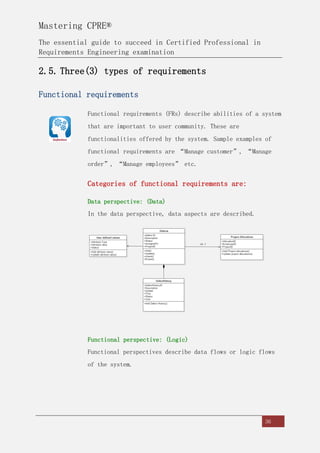
Data perspective: (Data)
In the data perspective, data aspects are described.
Functional perspective: (Logic)
Functional perspectives describe data flows or logic flows
of the system.
Mastering CPRE®
The essential guide to succeed in Certified Professional in
Requirements Engineering examination
37
Behavioral perspective:(State)
In the behavioral perspective, statuses of data elements are
described.
Mastering CPRE®
The essential guide to succeed in Certified Professional in
Requirements Engineering examination
38
Non-Functional (Quality, Supplementary) requirements
The umbrella term “non-functional requirement” is often
used for quality requirements and constraints. Quality
requirements describe qualities of a system that are
important to:
 User community, such as usability, learnability,
reliability, etc.
 Development community, such as scalability,
maintainability, reusability, etc.
Quality requirements often influence the system
architecture more than functional requirements do. Quality
requirements must be documented explicitly. Quality
requirements should be traceable to business needs and
other requirements. Include appropriate measures for NFRs
to be testable.
Quality requirements are mostly documented using natural
language.For example:
 90% of users shall be able to use basic functions of the
system within 6 hours of training.
 The system shall provide 90% of responses in less than 5
seconds.
Performance
Time taken to perform activities and resource utilization
levels.
Mastering CPRE®
The essential guide to succeed in Certified Professional in
Requirements Engineering examination
39
Security
Ability to ensure appropriate confidentiality and integrity
of information, to verify when actions were taken and by
whom and to authenticate users.
Reliability
Measure of application being available when needed.
Includes ability of the application to recover from errors,
uptime, or failures in interfaces.
Usability
The system being usable by target audience with specified
duration of training.
Maintainability
Ability to change one component without affecting others
and without causing unexpected failures, ability to re-use
components and testability.
Portability, also known as Transferability
Ease of installing and uninstalling the application,
different environments it can run and ease of migrating it
to a new environment.
A useful mnemonic: CRM POST (Compatibility, Reliability,
Maintainability, Performance efficiency, Operability,
Security and Transferability)
Mastering CPRE®
The essential guide to succeed in Certified Professional in
Requirements Engineering examination
40
Constraints
Constraints are aspects which project team cannot influence
or modify. (e.g., “The system shall be implemented using
.net”) or the time frame (“The system shall be available
by fourth quarter of 2015”). Constraints are not
implemented; they are adhered to. Constraints limit the
solution options (which is actually a good thing else we
will have large number of solution options to deal with).
Constraints influence requirements engineering planning,
execution and techniques.
In addition to the above classifications, requirements may
be classified based on requirement attributes, such as the
levels of detail, priorities, or legal obligations.

Mastering CPRE - Sample chapter

  • 1.
  • 2.
    Mastering CPRE® The essentialguide to succeed in Certified Professional in Requirements Engineering examination 2 Mastering CPRE Acknowledgements and Bibliography Syllabus for CPRE Foundation Level examination, IREB, Germany Rupp, Klaus Pohl and Chris. A Study Guide for the Certified Professional for Requirements Engineering Exam Foundation Level 2nd Edition. Rocky Nook Inc., 2015. Kindle and Paperback. A Guide to Business Analysis Body of Knowledge v2.0. International Institute of Business Analysis. Toronto: IIBA, 2009. PDF and EBook. A Guide to Business Analysis Body of Knowledge v3.0. International Institute of Business Analysis. Toronto: IIBA, 2009. PDF and EBook. Business Analysis, Debra and Paul, British Computer Society Podeswa, Howard. The Business Analyst's Handbook. Boston: Course Technology, 2009. Paperback. UML for the IT Business Analyst, Second Edition. Boston: Course Technology, 2010. Paperback.
  • 3.
    Mastering CPRE® The essentialguide to succeed in Certified Professional in Requirements Engineering examination 3 Copyright notice CPRE® is registered Trademarks of International Requirements Engineering Board, Germany. All trademarks of copyrights mentioned herein are the possession of their respective owners. We make no claim of ownership by the mention of products that contain these marks. Contents of this document should not be disclosed to any unauthorized person. This document may not, in whole or in part, be reduced, reproduced, stored in a retrieval system, translated, or transmitted in any form or by any means, electronic or mechanical. This publication may be used in assisting aspirants for CPRE® examination. It does not warrant that use of this publication will ensure passing the CPRE® examination.
  • 4.
    Mastering CPRE® The essentialguide to succeed in Certified Professional in Requirements Engineering examination 4 Preface and Introduction As the book title suggests, this book is a guidebook for the aspirants of the CPRE examination from IREB, Germany. We value your time and hence the book is designed to be extremely specific – Help you pass the certification examination with least possible effort. This book is authored by a qualified CPRE trainer who has helped many other participants clear the CPRE examination in the very first attempt. He is also trainer for CPRE preparations in both corporate and public workshops and have trained thousands of participants across the world – USA, Australia, Middle East, South East Asia, Europe and Africa. The book will soon be followed by an exhaustive question bank and audio book to further assist participants. Feedbacks and suggestions on the book We will be glad and thankful if you can share your feedbacks and suggestions on the book. Please your feedbacks and suggestions to LNMishra@AdaptiveProcesses.com
  • 5.
    Mastering CPRE® The essentialguide to succeed in Certified Professional in Requirements Engineering examination 5 About the Author LN Mishra (LN) has 22 years of professional experience in software product development, requirements analysis, business analysis, governance, risk and compliance management (CMMI, ISO9001, ISO27001, HIPAA and Six-Sigma). LN is a practicing requirements engineer and business analyst for more than 15 years. He was involved in multiple multi-country large ERP implementation projects. He currently consults in development of 2 large systems - one of the largest paint companies in the world to develop their next generation color management system and development of a GRC system. He is also the product manager for an enterprise Governance, Risk and Compliance management system (GRCPerfect) which is operational in multiple client places. He was involved in one of the world’s change management program in PricewaterhouseCoopers, a leading management consulting firm, in one of the largest privatization effort in India for a public sector utility agency. LN has conducted more than 100 workshops, both public and in house in the areas of Business Analysis, Requirements Management, Agile Project Management, software Project
  • 6.
    Mastering CPRE® The essentialguide to succeed in Certified Professional in Requirements Engineering examination 6 Management, Six Sigma, CMM, ISO 9001 and ISO 27001. He has also guided 30+ six sigma green belt projects in iGate, MACH and Akzo Nobel. LN holds a Post Graduate Diploma in Management (PGDM) from IIM Ahmedabad, the too-most business management school in India and Bachelor in Engineering (Honors) in Electronics and Telecommunication from University College of Engineering, Burla, India. Major Awards/Recognitions:  Certified Requirements Engineering Professional (CPRE) from IREB, Germany  Certified Business Analyst Professional (CBAP) from IIBA, Canada.  Certified Project Management Professional (PMP) from PMI, USA  Certified Scrum Master from Good Agile, USA  World Topper Certified software Quality Analyst (CSQA), 2000  Certified Lead Auditor for ISO 9001, ISO 27001, ISO 20000 and BS 25999
  • 7.
    Mastering CPRE® The essentialguide to succeed in Certified Professional in Requirements Engineering examination 7 Clients for whom LN has consulted and mentored LN lives with his wife, Ananya, son, Siddharth and daughter, Saianshee in Bangalore, the IT capital of India.
  • 8.
    Mastering CPRE® The essentialguide to succeed in Certified Professional in Requirements Engineering examination 8 TABLE OF CONTENTS 1. All about CPRE....................................................... 14 What and why of CPRE.................................................... 14 What is IREB?........................................................... 14 Prerequisite for CPRE................................................... 15 Preparation............................................................. 15 Certification examination............................................... 16 Examination results..................................................... 16 2. Introduction and foundation.......................................... 18 2.1. Symptoms of and reasons for inadequate re.......................... 18 Need for good requirements engineering.................................. 18 Costs of requirements error fixing...................................... 19 Defining requirements................................................... 19 Defining requirements engineering....................................... 20 Symptoms of poor requirements engineering............................... 21 Causes of poor requirements engineering................................. 21 2.2. Four major activities of requirements engineers.................... 23 Different levels of requirements........................................ 24 2.3. Role of communication in requirements engineering.................. 28 Impact of communication mediums in requirements engineering............. 29 2.4. Skills of requirements engineers................................... 30 Responsibilities of requirements engineers.............................. 30 Skills of requirements engineers........................................ 31 2.5. Three (3) types of requirements.................................... 35 Functional requirements................................................. 35
  • 9.
    Mastering CPRE® The essentialguide to succeed in Certified Professional in Requirements Engineering examination 9 Non-functional (quality, supplementary) requirements.................... 37 Constraints............................................................. 39 3. Systems and system contexts.......................................... 41 3.1. System, system context and boundaries.............................. 41 What is a system?....................................................... 41 What is context?........................................................ 42 What is system context?................................................. 42 3.2. Determining system and context boundaries.......................... 46 System boundary and it’s gray zone..................................... 46 Context boundary and it’s gray zone.................................... 48 Gray zone in system boundary............................................ 49 Gray zone in context boundary........................................... 50 4. Requirements elicitation............................................. 52 4.1. Requirements sources............................................... 52 Significance of requirements sources.................................... 52 Consequences of unconsidered sources.................................... 52 Types of requirements sources........................................... 53 Important information of the stakeholder documentation.................. 54 Stakeholder management process.......................................... 56 Ensuring agreement with stakeholders.................................... 57 Principles in dealing with stakeholders................................. 58 Stakeholders rights and duties.......................................... 59 4.2. Requirements categorization according to kano model................ 61 4.3. Elicitation techniques............................................. 63 Factors influencing choice of elicitation techniques.................... 63
  • 10.
    Mastering CPRE® The essentialguide to succeed in Certified Professional in Requirements Engineering examination 10 RE techniques based on type of requirements............................. 64 RE techniques based on level of detail required......................... 64 RE techniques based on availability of stakeholders..................... 66 RE techniques based on risks of project................................. 66 RE techniques based on complexity of the project........................ 66 Survey techniques (interviews, workshops, questionnaires)............... 67 Creativity techniques (brainstorming, brainstorming paradox, change of perspective, analogy techniques)........................................ 70 Document-centric techniques............................................. 76 Observation techniques.................................................. 80 Support techniques...................................................... 83 5. Documenting requirements............................................ 101 5.1. Document design................................................... 101 Reasons for documentation.............................................. 101 5.2. Documentation types............................................... 103 Three perspectives of functional requirements.......................... 103 Requirements documentation using natural language...................... 105 Requirements documentation using conceptual models..................... 105 Hybrid requirements documents.......................................... 106 5.3. Document structures............................................... 107 Standardized document structures....................................... 107 Customized standard contents........................................... 109 5.4. Use of requirements documents..................................... 112 5.5. Quality criteria for requirements documents....................... 114 5.6. Quality criteria for requirements................................. 116 Basic rules to enhance readability of requirements..................... 118
  • 11.
    Mastering CPRE® The essentialguide to succeed in Certified Professional in Requirements Engineering examination 11 5.7. Glossary.......................................................... 120 Benefits of glossary:.................................................. 120 Rules for using a glossary............................................. 121 6. Documenting requirements in natural languages....................... 123 6.1. Language effects.................................................. 123 Mastering and using five transformational effects...................... 123 Transformational effects............................................... 124 6.2. Requirement construction using templates.......................... 128 7. Model-based requirements documentation.............................. 133 7.1. The term model.................................................... 135 Model and its properties............................................... 135 Elements of a conceptual modelling language............................ 137 7.2. Modeling requirement using “goals”.............................. 138 7.3. Use cases......................................................... 140 Modelling using use case diagrams...................................... 140 Use case specifications................................................ 143 7.4. Three modeling perspectives on requirements....................... 147 7.5. Requirements modeling in data perspective......................... 147 7.6. Requirements modeling in functional perspective................... 151 Data flow diagrams..................................................... 151 UML activity diagrams.................................................. 153 7.7. Requirements modeling in behavioral perspective................... 156 UML state diagrams..................................................... 156 8. Requirements validation and negotiation............................. 158 8.1. Fundamentals of requirements validations.......................... 159
  • 12.
    Mastering CPRE® The essentialguide to succeed in Certified Professional in Requirements Engineering examination 12 Significance of validating requirements................................ 159 8.2. Fundamentals of requirements negotiations......................... 161 Significance of requirements conflicts................................. 161 8.3. Quality aspects of requirements................................... 162 3 quality aspects of requirements...................................... 162 Using validation criteria for the quality aspects...................... 162 8.4. Principles of requirements validation............................. 165 Six principles of requirements validations............................. 165 Using principles of requirements validations........................... 165 8.5. Techniques for requirements validations........................... 168 Techniques for requirements validations................................ 168 Using techniques for requirements validations.......................... 168 8.6. Requirements negotiation.......................................... 173 Activities for requirements negotiation................................ 173 Types of requirements conflicts........................................ 173 Conflict resolution techniques......................................... 175 Documentation of conflict resolution techniques........................ 177 9. Requirements management............................................. 179 9.1. Assigning attributes to requirements.............................. 180 Attribute schemes...................................................... 180 Purpose and definition of attribute schemes............................ 180 Template for attribute scheme.......................................... 181 Project-specific tailoring of attribute scheme......................... 181 Important attribute types for requirements............................. 182 9.2. Views on requirements............................................. 185
  • 13.
    Mastering CPRE® The essentialguide to succeed in Certified Professional in Requirements Engineering examination 13 9.3. Prioritizing requirements......................................... 187 Methods for requirements prioritization................................ 187 Requirements prioritization techniques................................. 188 Ranking and top-ten technique.......................................... 188 Single-criterion classification........................................ 188 Kano classification.................................................... 189 Prioritization matrix (wiegers matrix)................................. 190 9.4. Requirements traceability......................................... 191 Benefits of requirements traceability.................................. 191 Three types of traceability relationships.............................. 192 Representing requirements traceability................................. 193 9.5. Versioning of requirements........................................ 195 Requirements versions.................................................. 195 Requirements configurations............................................ 196 Properties of requirements configurations.............................. 196 Requirements baselines................................................. 197 9.6. Management of requirements changes................................ 198 Importance of requirements changes..................................... 198 Change control board................................................... 198 Change request (CR).................................................... 199 Classification of incoming change requests............................. 200 Basic method for CRs................................................... 201 9.7. Measurement for requirements...................................... 203 10. Requirements tools................................................. 205 10.1. Types of tools................................................... 205
  • 14.
    Mastering CPRE® The essentialguide to succeed in Certified Professional in Requirements Engineering examination 14 Tools during system development........................................ 205 Tools to structure, present, visualize and simulate requirements models 206 Features of requirements management tools.............................. 207 Standard office tools.................................................. 208 Specialized requirements management tools.............................. 209 10.2. Introducing tools................................................ 209 10.3. Evaluating tools................................................. 211 Project view........................................................... 211 User view.............................................................. 211 Product view........................................................... 212 Process view........................................................... 212 Provider view.......................................................... 212 Technical view......................................................... 212 Economic view.......................................................... 212
  • 15.
    Mastering CPRE® The essentialguide to succeed in Certified Professional in Requirements Engineering examination 15 1. All about CPRE What and Why of CPRE CPRE stands for Certified Professional in Requirements Engineering, a certification provided by International requirements Engineering Board (IREB), Germany (www.IREB.org). This is the most widely acknowledged certification for requirements engineers. There are more than 20000 requirements engineering professionals certified in CPRE Foundation Level examination world-wide. Following are some of the benefits of becoming a CPRE  Be recognized for your competency in requirements engineering.  Requirements engineering is a growing career opportunity for IT professionals.  Stakeholders with domain experience can join IT sector by becoming requirements engineers.  Better job prospects.  Better salary. What is IREB? International requirements Engineering Board (IREB) was founded in Germany in to support the requirements engineering community by:  Creating and developing awareness and recognition of
  • 16.
    Mastering CPRE® The essentialguide to succeed in Certified Professional in Requirements Engineering examination 16 the value and contribution of the requirements engineers.  Providing a forum for knowledge sharing and contribution to the requirements engineering profession.  Publicly recognizing and certifying qualified practitioners through an internationally acknowledged certification programs such as CPRE – foundation Level, CPRE-Advanced Level and CPRE-Expert Level. Prerequisite for CPRE The only formal prerequisite for admission to the Foundation Level Exam is having a valid identity card or passport. Please take your ID document to the exam for proof of identity. For answering the exam questions correctly, you need to know the content of the defined Foundation Level syllabus. Taking a training course is not a requirement for admission to the test but is recommended by the IREB. Preparation One can prepare for the exam  By attending a CPRE training with a training provider. The training should take at least three days and be conducted by a training provider recognized by IREB.  By preparing individually in self-study.
  • 17.
    Mastering CPRE® The essentialguide to succeed in Certified Professional in Requirements Engineering examination 17  By downloading the practice exam from IREB.org. The practice examination contains 34 questions in the same format as the live examination. Additionally to the questionnaire the download contains solutions and correction aids as well.  By having a look at the exam regulations for the Foundation Level. Please notice the regulations regarding negative scoring for incorrect answers! Certification examination The exam takes 75 minutes. In this time, one has to answer 45 multiple choice questions. The questions are of differing difficulty and therefore assigned differing amounts of points. The exam is closed-book, i.e. no materials are allowed to be used. To pass the exam, one must achieve at least than 60% of the total score possible. The exam is conducted by a licensed certification body. The exam can be taken in Chinese (Mandarin), Dutch, English, French, German, Spanish and Portuguese (Brazil). Examination results Exam results are checked by the certification body. Results are dispatched to the personal address stated on the application. If one has passed the exam, one will receive the certificate together with the results. If one takes the exam online, one gets the results right after the
  • 18.
    Mastering CPRE® The essentialguide to succeed in Certified Professional in Requirements Engineering examination 18 examination. The certificate is delivered via post. The certificates achieved via online exam are dispatched within the same period of time the results of conventional exams are sent.
  • 19.
    Mastering CPRE® The essentialguide to succeed in Certified Professional in Requirements Engineering examination 19 2. Introduction and foundation 2.1. Symptoms of and reasons for inadequate RE Need for good requirements engineering As per a study by TechRepublic (http://www.techrepublic.com/blog/tech-decision- maker/study-68-percent-of-it-projects-fail/), it is estimated that around 68% of projects fail due to poor requirements engineering. Majority of customer expectation mismatches can be attributed to poor requirements. Hence, it is extremely essential that we focus on identifying and documenting complete requirements for all projects. As per the TechRepublic study mentioned above, two third of system errors in production are due to requirements errors. Developers develop solutions as per their understanding of requirements. Unclear, incomplete, or wrong requirements lead to development of wrong solutions. Complete and correct requirements are the basis for successful system development. Discovering gaps in requirements early avoids tedious change control processes.
  • 20.
    Mastering CPRE® The essentialguide to succeed in Certified Professional in Requirements Engineering examination 20 Costs of requirements error fixing Costs of fixing requirements defects usually increase exponentially with each passing project phase. For instance, the effort to fix a requirements defect is up to 20 times higher if the correction is done during programming as opposed to fixing the same defect during requirements engineering phase. If the defect is fixed during acceptance testing, effort involved may be 100 times higher. This is especially true of non-functional requirements as non-functional requirements tend to affect system architecture more than functional requirements. Before we delve into why poor requirements are developed, let us understand “Requirements” first. Defining requirements IEEE defines requirements as:  A condition or capability needed by a stakeholder to solve a problem or achieve an objective.  A condition or capability to be met or possessed by a solution or solution component to satisfy a contract, standard, specification, or other formally imposed documents.  A requirement may be unstated, implied by or derived from other requirements, or directly stated and managed. One of the key objectives of requirements engineering is to ensure requirements are visible to and understood by
  • 21.
    Mastering CPRE® The essentialguide to succeed in Certified Professional in Requirements Engineering examination 21 all stakeholders. Requirements describe, but not limited to, past, present and future conditions or capabilities in an enterprise, organizational structures, roles, processes, policies, rules and information systems. Requirements should be at the level of depth necessary for clarity and implementation. A domain is the area undergoing analysis, boundaries of an organization and external stake-holders and their interactions. Defining requirements engineering Requirements engineering is a systematic and disciplined approach to the specification and management of requirements with the following goals: 1. Identifying relevant requirements, 2. Achieving stakeholder consensus on requirements, 3. Documenting requirements according to given standards and 4. Manage requirements systematically. Source: [Rupp, Klaus Pohl and Chris 2015]
  • 22.
    Mastering CPRE® The essentialguide to succeed in Certified Professional in Requirements Engineering examination 22 Requirements engineers analyze and synthesize information provided by customers, staff, IT professionals and executives. They elicit the actual needs of stakeholders, not simply capture their expressed desires. Requirements engineering activities may be performed in many job titles or organizational roles. Requirements engineering practitioners include requirements engineers, business systems analysts, systems analysts, product managers, product owners, enterprise analysts, business architects, management consultants and interaction design professionals. Symptoms of poor requirements engineering Key symptoms for inadequate requirements engineering are:  System not used,  User dissatisfaction with developed system,  System not meeting stakeholder needs,  Features needed by stakeholder not needed getting implemented.  Work executed though workarounds. Causes of poor requirements engineering Most common reason for poor requirements are:  Assumption that requirements are obvious and hence need not be stated explicitly,  Improper communication from stakeholders to business
  • 23.
    Mastering CPRE® The essentialguide to succeed in Certified Professional in Requirements Engineering examination 23 analysts and then to designers and developers,  Tendency to begin design and coding to speed-up the project implementation without proper requirements gathering,  Inadequate time allotted for requirements engineering,  Lack of appropriate skills for requirements elicitation,  Inadequate templates available for requirements elicitation,  Inadequate level of detailing needed for solution requirements. Please watch a very interesting video on problems with requirementshttps://www.youtube.com/watch?v=FqkQrPmsP2w
  • 24.
    Mastering CPRE® The essentialguide to succeed in Certified Professional in Requirements Engineering examination 24 2.2. Four major activities of requirements engineers Elicitation Elicitation means to “Understand underlying needs” and “To draw forth – to enquire till all necessary information are obtained”. Key objectives for elicitation are:  Elicit requirements from stakeholders and other sources using different elicitation techniques.  Elicit various attributes of requirements. Documentation Key objective for documentation is to document elicited requirements correctly reflecting stakeholders needs.
  • 25.
    Mastering CPRE® The essentialguide to succeed in Certified Professional in Requirements Engineering examination 25 Validation and negotiation Key objective for Validation and negotiation is to ensure documented requirements meet requirements quality criteria. Requirements management Requirements management is an ongoing activity which spans across all other requirements activities, such as elicitation, documentation and validation. Key objectives for requirements management are:  Manage requirements from creation till decommissioning of requirements,  Prioritize requirements,  Structure requirements,  Manage requirements changes. Source: [Rupp, Klaus Pohl and Chris 2015] Different levels of requirements Requirements are usually provided at 3 levels: Business, Stakeholder and System. Requirements classification Description Business requirements Higher-level statements of needs, goals or objectives, why a project has been
  • 26.
    Mastering CPRE® The essentialguide to succeed in Certified Professional in Requirements Engineering examination 26 initiated; its objectives, metrics, needs of the organization as a whole. For example: Adaptive to introduce trainings for global customers. Stakeholder requirements Needs of a particular stakeholder or class of stakeholders and how they interact with a solution. A bridge between business requirements and solution requirements. For example, requirements from Trainer: An web-based platform to conduct web-based training. Solution requirements Characteristics of the solution that meets business requirements and stakeholder requirements. Categorized into be functional and non-functional. Functional requirements describe behavior and information that the solution will manage, capabilities that the system will be able to perform in terms of its behaviors or operations, specific IT application actions or responses. Typically linked to business processes or operations that the organization manages. Must provide video, audio and text based interaction between trainer and
  • 27.
    Mastering CPRE® The essentialguide to succeed in Certified Professional in Requirements Engineering examination 27 participants. Must have provision for both online and off-line interactions. Non-functional requirements, also known as quality or supplementary requirements, capture environmental conditions under which the solution must remain effective, or qualities that the systems must have rather than the behavior or functionality of the solution. For example, requirements related to capacity, speed, security, availability, information architecture and UI presentation. Must have availability of more than 99.9% time for the workshop duration. Transition requirements Capabilities needed to facilitate transition from current state of the enterprise to a desired future state, but not be needed once the transition is complete. These requirements are temporary in nature and cannot be developed until both an existing and new solution are defined. Typical transition requirements include data conversion from existing systems, skill gaps to be
  • 28.
    Mastering CPRE® The essentialguide to succeed in Certified Professional in Requirements Engineering examination 28 addressed etc. Training of trainers on the new web- based platform. [Source: Business Analysis Body of Knowledge, IIBA Canada, v2.0]
  • 29.
    Mastering CPRE® The essentialguide to succeed in Certified Professional in Requirements Engineering examination 29 2.3. Role of communication in requirements engineering Natural languages are the most common and important means to communicate requirements. However, stakeholders understand natural language requirements differently due to their knowledge and background. Natural language communication effectiveness depends on familiarity of stakeholders on the subject, their past experiences, cultural and educational backgrounds, etc. Hence, it is important to develop common terminology (glossary) and defined requirements constructs, i.e. describe requirements using a standard structure, while communicating in natural language. Expressing requirements using standard constructs helps in not forgetting essential information while using natural languages. Requirements engineers can take help of modeling languages such as Unified Modeling Language (UML) and Business Process Modeling Notation (BPMN) which reduces ambiguity in communication using natural language. [Rupp, Klaus Pohl and Chris 2015]
  • 30.
    Mastering CPRE® The essentialguide to succeed in Certified Professional in Requirements Engineering examination 30 Impact of communication mediums in requirements engineering Communication mediums (written or spoken) have significant effect in requirements communication (or miscommunication). When communicating in natural languages, all stakeholders MUST consciously focus on direct and simple communication. In verbal communication, success of the communication relies on expressed language, gestures and feedbacks. But in written communication, these are absent. Many often, requirements may be communicated incorrectly due to natural transformations that occur during human perceptions [Rupp, Klaus Pohl and Chris 2015]
  • 31.
    Mastering CPRE® The essentialguide to succeed in Certified Professional in Requirements Engineering examination 31 2.4. Skills of requirements engineers Responsibilities of requirements engineers Before we understand skills for requirements engineers, it is essential to understand responsibilities for requirements engineers. Following are the key responsibilities for requirements engineers:  Understand business domain as well as technology domain,  Act as the connecting links between business stakeholders and technology implementation stakeholders,  Plan requirements engineering activities in collaboration with stakeholders,  Speak the language of the stakeholders,  Be able to communicate requirements (e.g., by means of diagrams and graphs),  Create requirements documents,  Maintain respectful relationships with stakeholders,  Present ideas and alternatives as well as their realizations,  Make systems user-friendly and simple,  Ensure systems satisfy functional and non-functional requirements,  Plan and organize requirements communications,  Take additional responsibilities towards Domain SME,
  • 32.
    Mastering CPRE® The essentialguide to succeed in Certified Professional in Requirements Engineering examination 32 Project Manager and Tester if needed. Skills of requirements engineers Requirements engineer is a key project role. Usually they are the ONLY ones who are in contact with all the stakeholders, from sponsor, to Domain SMEs and Implementation SMEs. Requirements engineers need more than only requirements engineering process knowledge. 3 key skill areas for REs are behavioral, process and technical.
  • 33.
    Mastering CPRE® The essentialguide to succeed in Certified Professional in Requirements Engineering examination 33 Requirements engineers MUST acquire following skills: Communication skills Good communication skills are essential to elicit requirements and communicate them in a suitable manner. Requirements engineers must be able to listen, ask right questions at right time, notice when a statement does not contain desired information and make further inquiries when necessary. Knowledge of documentation and presentation tools Requirements engineers MUST become familiar with documentation and presentation tools. Knowledge of modeling tools Requirements engineers MUST become familiar requirements modeling tools and techniques. Requirements modeling
  • 34.
    Mastering CPRE® The essentialguide to succeed in Certified Professional in Requirements Engineering examination 34 techniques help in reducing requirements ambiguity. Analytical thinking Analytical thinking allows requirements engineers to group and analyze requirements at the right level. Empathy Empathy for stakeholders helps in building personal connects with stakeholders. Conflict resolution skills Conflicts are common during requirements engineering. They could be due to differing opinions among stakeholders with respect to value, priority of requirements. Requirements engineers MUST identify and record conflicts and use suitable techniques to resolve conflicts. Moderation / Facilitation skills Requirements engineers must be able to mediate between different opinions and lead discussions during individual and group conversations. They should anticipate problems that might arise in such situations and act accordingly. Requirements engineers MUST be able to represent requirements in different fora. They MUST consolidate differing opinions, facilitate a decision in case of disagreements and create consensus among the stakeholders.
  • 35.
    Mastering CPRE® The essentialguide to succeed in Certified Professional in Requirements Engineering examination 35 Self-confidence Requirements engineers are exposed to criticisms as well. Requirements engineers need high level of self-confidence and should have the ability to defend themselves. They should NEVER take criticism personally. Ability to convince Requirements engineers should be able to convince stakeholders the need to prioritize requirements as per agreed upon criteria and need for realizing maximum value from requirements in shortest possible time.
  • 36.
    Mastering CPRE® The essentialguide to succeed in Certified Professional in Requirements Engineering examination 36 2.5. Three(3) types of requirements Functional requirements Functional requirements (FRs) describe abilities of a system that are important to user community. These are functionalities offered by the system. Sample examples of functional requirements are “Manage customer”, “Manage order”, “Manage employees” etc. Categories of functional requirements are: Data perspective: (Data) In the data perspective, data aspects are described. Functional perspective: (Logic) Functional perspectives describe data flows or logic flows of the system.
  • 37.
    Mastering CPRE® The essentialguide to succeed in Certified Professional in Requirements Engineering examination 37 Behavioral perspective:(State) In the behavioral perspective, statuses of data elements are described.
  • 38.
    Mastering CPRE® The essentialguide to succeed in Certified Professional in Requirements Engineering examination 38 Non-Functional (Quality, Supplementary) requirements The umbrella term “non-functional requirement” is often used for quality requirements and constraints. Quality requirements describe qualities of a system that are important to:  User community, such as usability, learnability, reliability, etc.  Development community, such as scalability, maintainability, reusability, etc. Quality requirements often influence the system architecture more than functional requirements do. Quality requirements must be documented explicitly. Quality requirements should be traceable to business needs and other requirements. Include appropriate measures for NFRs to be testable. Quality requirements are mostly documented using natural language.For example:  90% of users shall be able to use basic functions of the system within 6 hours of training.  The system shall provide 90% of responses in less than 5 seconds. Performance Time taken to perform activities and resource utilization levels.
  • 39.
    Mastering CPRE® The essentialguide to succeed in Certified Professional in Requirements Engineering examination 39 Security Ability to ensure appropriate confidentiality and integrity of information, to verify when actions were taken and by whom and to authenticate users. Reliability Measure of application being available when needed. Includes ability of the application to recover from errors, uptime, or failures in interfaces. Usability The system being usable by target audience with specified duration of training. Maintainability Ability to change one component without affecting others and without causing unexpected failures, ability to re-use components and testability. Portability, also known as Transferability Ease of installing and uninstalling the application, different environments it can run and ease of migrating it to a new environment. A useful mnemonic: CRM POST (Compatibility, Reliability, Maintainability, Performance efficiency, Operability, Security and Transferability)
  • 40.
    Mastering CPRE® The essentialguide to succeed in Certified Professional in Requirements Engineering examination 40 Constraints Constraints are aspects which project team cannot influence or modify. (e.g., “The system shall be implemented using .net”) or the time frame (“The system shall be available by fourth quarter of 2015”). Constraints are not implemented; they are adhered to. Constraints limit the solution options (which is actually a good thing else we will have large number of solution options to deal with). Constraints influence requirements engineering planning, execution and techniques. In addition to the above classifications, requirements may be classified based on requirement attributes, such as the levels of detail, priorities, or legal obligations.