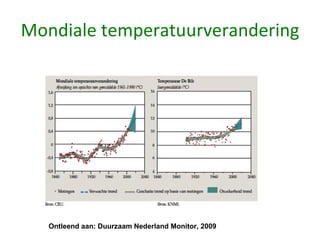
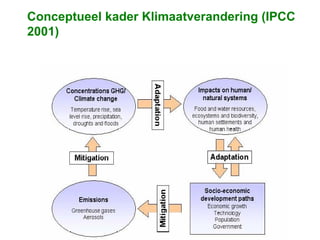
Masterclass Climate Change - Hans Opschoor (VU en ISS)
1.
Royal Haskoning Masterclass Klimaatverandering, Rotterdam, 17 sept 2009 Klimaatverandering en Maatschappelijke Reacties: economische aspecten Prof dr J.(Hans) B. Opschoor, VU en ISS [email_address]
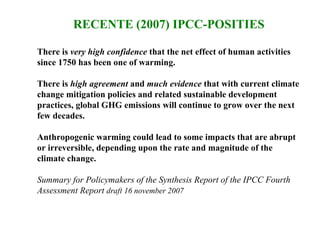
RECENTE (2007) IPCC-POSITIESThere is very high confidence that the net effect of human activities since 1750 has been one of warming. There is high agreement and much evidence that with current climate change mitigation policies and related sustainable development practices, global GHG emissions will continue to grow over the next few decades. Anthropogenic warming could lead to some impacts that are abrupt or irreversible, depending upon the rate and magnitude of the climate change. Summary for Policymakers of the Synthesis Report of the IPCC Fourth Assessment Report draft 16 november 2007
5.
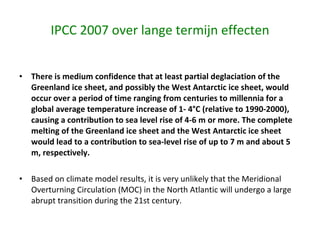
IPCC 2007 overlange termijn effecten There is medium confidence that at least partial deglaciation of the Greenland ice sheet, and possibly the West Antarctic ice sheet, would occur over a period of time ranging from centuries to millennia for a global average temperature increase of 1- 4°C (relative to 1990-2000), causing a contribution to sea level rise of 4-6 m or more. The complete melting of the Greenland ice sheet and the West Antarctic ice sheet would lead to a contribution to sea-level rise of up to 7 m and about 5 m, respectively. Based on climate model results, it is very unlikely that the Meridional Overturning Circulation (MOC) in the North Atlantic will undergo a large abrupt transition during the 21st century.
6.
7.
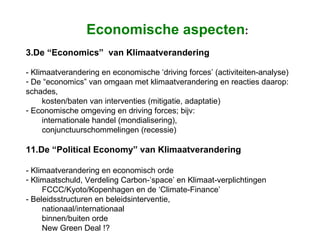
Economische aspecten :De “Economics” van Klimaatverandering - Klimaatverandering en economische ‘driving forces’ (activiteiten-analyse) De “economics” van omgaan met klimaatverandering en reacties daarop: schades, kosten/baten van interventies (mitigatie, adaptatie) Economische omgeving en driving forces; bijv: internationale handel (mondialisering), conjunctuurschommelingen (recessie) De “Political Economy” van Klimaatverandering - Klimaatverandering en economisch orde Klimaatschuld, Verdeling Carbon-’space’ en Klimaat-verplichtingen FCCC/Kyoto/Kopenhagen en de ‘Climate-Finance’ - Beleidsstructuren en beleidsinterventie, nationaal/internationaal binnen/buiten orde New Green Deal !?
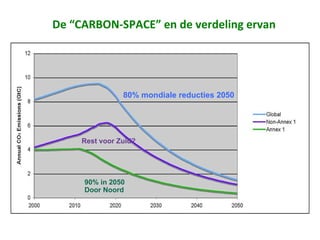
De “CARBON-SPACE” ende verdeling ervan 80% mondiale reducties 2050 90% in 2050 Door Noord Rest voor Zuid?
11.
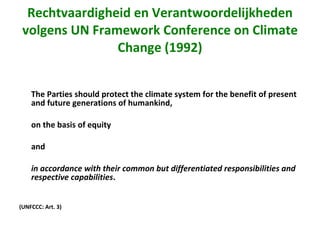
Rechtvaardigheid en Verantwoordelijkhedenvolgens UN Framework Conference on Climate Change (1992) The Parties should protect the climate system for the benefit of present and future generations of humankind, on the basis of equity and in accordance with their common but differentiated responsibilities and respective capabilities . (UNFCCC: Art. 3)
12.
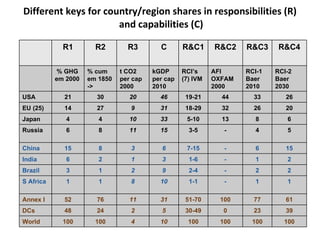
Different keys forcountry/region shares in responsibilities (R) and capabilities (C) R1 R2 R3 C R&C1 R&C2 R&C3 R&C4 % GHG em 2000 % cum em 1850 -> t CO2 per cap 2000 kGDP per cap 2010 RCI’s (7) IVM AFI OXFAM 2000 RCI-1 Baer 2010 RCI-2 Baer 2030 USA 21 30 20 46 19-21 44 33 26 EU (25) 14 27 9 31 18-29 32 26 20 Japan 4 4 10 33 5-10 13 8 6 Russia 6 8 11 15 3-5 - 4 5 China 15 8 3 6 7-15 - 6 15 India 6 2 1 3 1-6 - 1 2 Brazil 3 1 2 9 2-4 - 2 2 S Africa 1 1 8 10 1-1 - 1 1 Annex I 52 76 11 31 51-70 100 77 61 DCs 48 24 2 5 30-49 0 23 39 World 100 100 4 10 100 100 100 100
13.
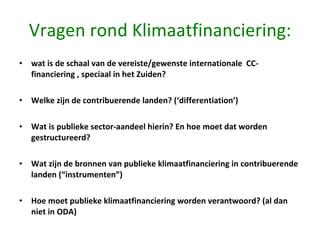
Vragen rond Klimaatfinanciering:wat is de schaal van de vereiste/gewenste internationale CC-financiering , speciaal in het Zuiden? Welke zijn de contribuerende landen? (‘differentiation’) Wat is publieke sector-aandeel hierin? En hoe moet dat worden gestructureerd? Wat zijn de bronnen van publieke klimaatfinanciering in contribuerende landen (“instrumenten”) Hoe moet publieke klimaatfinanciering worden verantwoord? (al dan niet in ODA)
14.
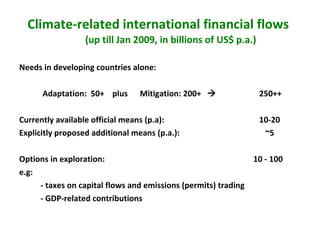
Climate-related international financialflows (up till Jan 2009, in billions of US$ p.a.) Needs in developing countries alone: Adaptation: 50+ plus Mitigation: 200+ 250++ Currently available official means (p.a): 10-20 Explicitly proposed additional means (p.a.): ~5 Options in exploration: 10 - 100 e.g: - taxes on capital flows and emissions (permits) trading - GDP-related contributions
15.
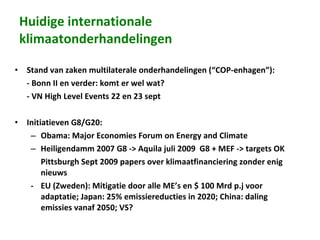
Huidige internationale klimaatonderhandelingenStand van zaken multilaterale onderhandelingen (“COP-enhagen”): - Bonn II en verder: komt er wel wat? - VN High Level Events 22 en 23 sept Initiatieven G8/G20: Obama: Major Economies Forum on Energy and Climate Heiligendamm 2007 G8 -> Aquila juli 2009 G8 + MEF -> targets OK Pittsburgh Sept 2009 papers over klimaatfinanciering zonder enig nieuws - EU (Zweden): Mitigatie door alle ME’s en $ 100 Mrd p.j voor adaptatie; Japan: 25% emissiereducties in 2020; China: daling emissies vanaf 2050; VS?
16.
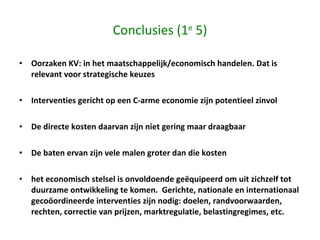
Conclusies (1 e 5) Oorzaken KV: in het maatschappelijk/economisch handelen. Dat is relevant voor strategische keuzes Interventies gericht op een C-arme economie zijn potentieel zinvol De directe kosten daarvan zijn niet gering maar draagbaar De baten ervan zijn vele malen groter dan die kosten het economisch stelsel is onvoldoende geëquipeerd om uit zichzelf tot duurzame ontwikkeling te komen. Gerichte, nationale en internationaal gecoöordineerde interventies zijn nodig: doelen, randvoorwaarden, rechten, correctie van prijzen, marktregulatie, belastingregimes, etc.
17.
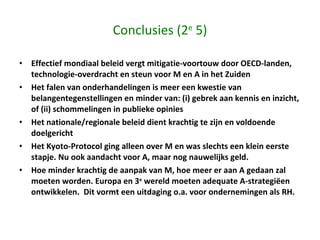
Conclusies (2 e 5) Effectief mondiaal beleid vergt mitigatie-voortouw door OECD-landen, technologie-overdracht en steun voor M en A in het Zuiden Het falen van onderhandelingen is meer een kwestie van belangentegenstellingen en minder van: (i) gebrek aan kennis en inzicht, of (ii) schommelingen in publieke opinies Het nationale/regionale beleid dient krachtig te zijn en voldoende doelgericht Het Kyoto-Protocol ging alleen over M en was slechts een klein eerste stapje. Nu ook aandacht voor A, maar nog nauwelijks geld. Hoe minder krachtig de aanpak van M, hoe meer er aan A gedaan zal moeten worden. Europa en 3 e wereld moeten adequate A-strategiëen ontwikkelen. Dit vormt een uitdaging o.a. voor ondernemingen als RH.
18.
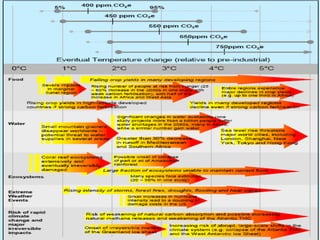
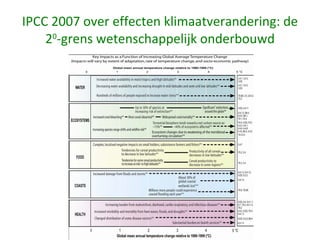
IPCC 2007 overeffecten klimaatverandering: de 2 0 -grens wetenschappelijk onderbouwd
Editor's Notes
#11 The blue line is our global emergency pathway – the most most stringent of the three from the previous slide The green line is 90% (below 1990) by 2050, Gore’s trajectory, but across all of the A1 countries rather than just the US The purple line is the problem. This is where the tension between climate protection and development comes in. This is where the global climate policy impasse resides. NOTE: Relaxing the blue pathway doesn’t really change our results – unless you really relax it to blow off stringency Quick CYA: This slide approximates the North with A1 and the South with NA1
![Royal Haskoning Masterclass Klimaatverandering, Rotterdam, 17 sept 2009 Klimaatverandering en Maatschappelijke Reacties: economische aspecten Prof dr J.(Hans) B. Opschoor, VU en ISS [email_address]](https://image.slidesharecdn.com/rhmasterclass2009-090912032321-phpapp01/85/Masterclass-Climate-Change-Hans-Opschoor-VU-en-ISS-1-320.jpg)