3
BACKGROUND
There arepatches of waste or unused land laying
vacant in every cantonment
Every cantonment has a horticulture branch and is self
sufficient in this field
The idea is to grow such crops which are commercially
viable and sell high in the market
This will fetch revenue for the CBs by spending less
and earning profits which is exponentially higher than
traditional crops
4.
4
COMMERCIAL
HORTICULTURE
Horticulture Branches ofCB’s under RHQ Rwp have
successfully executed commercial farming projects of
following crops
Mushrooms
Stevia
Moringa
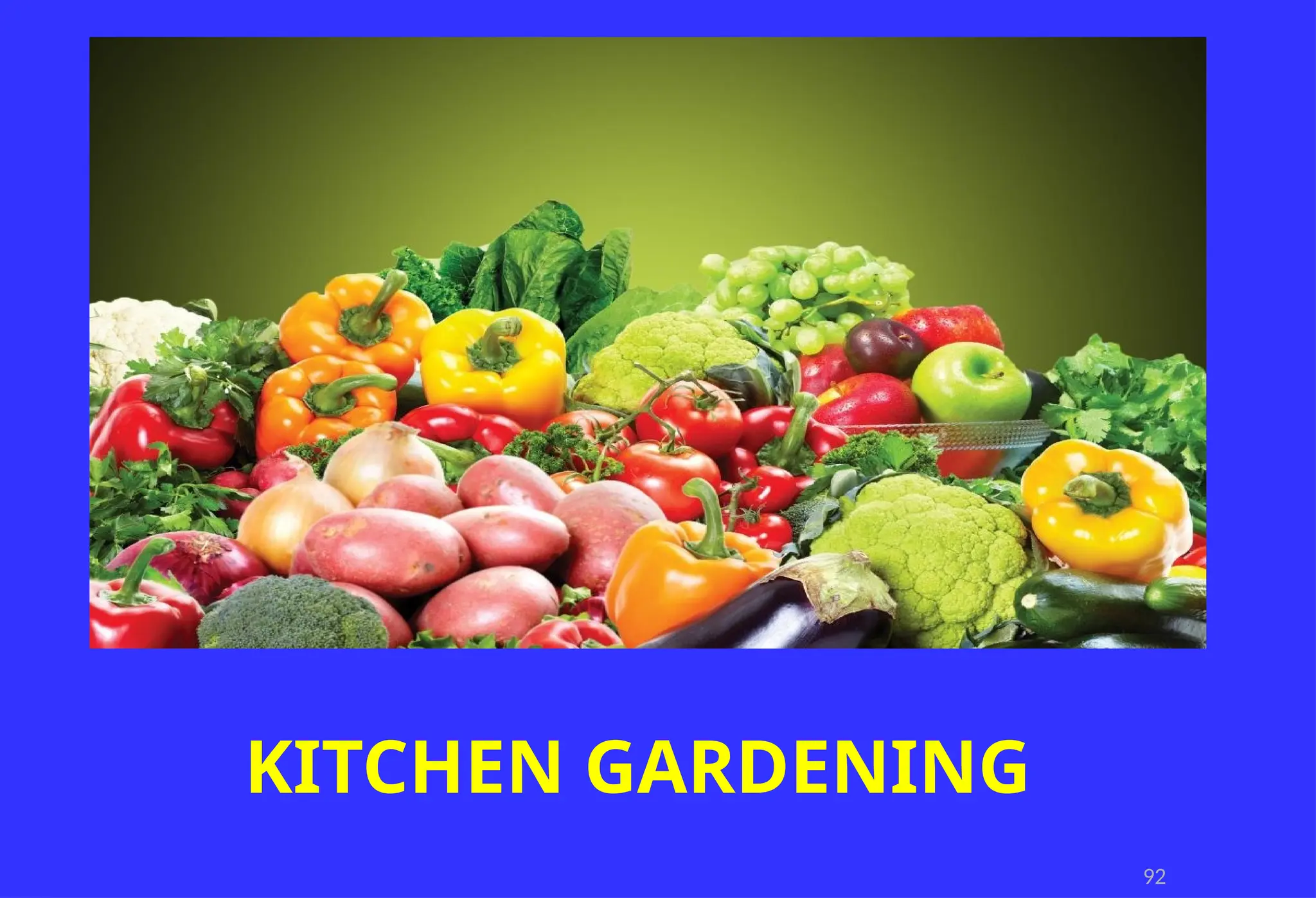
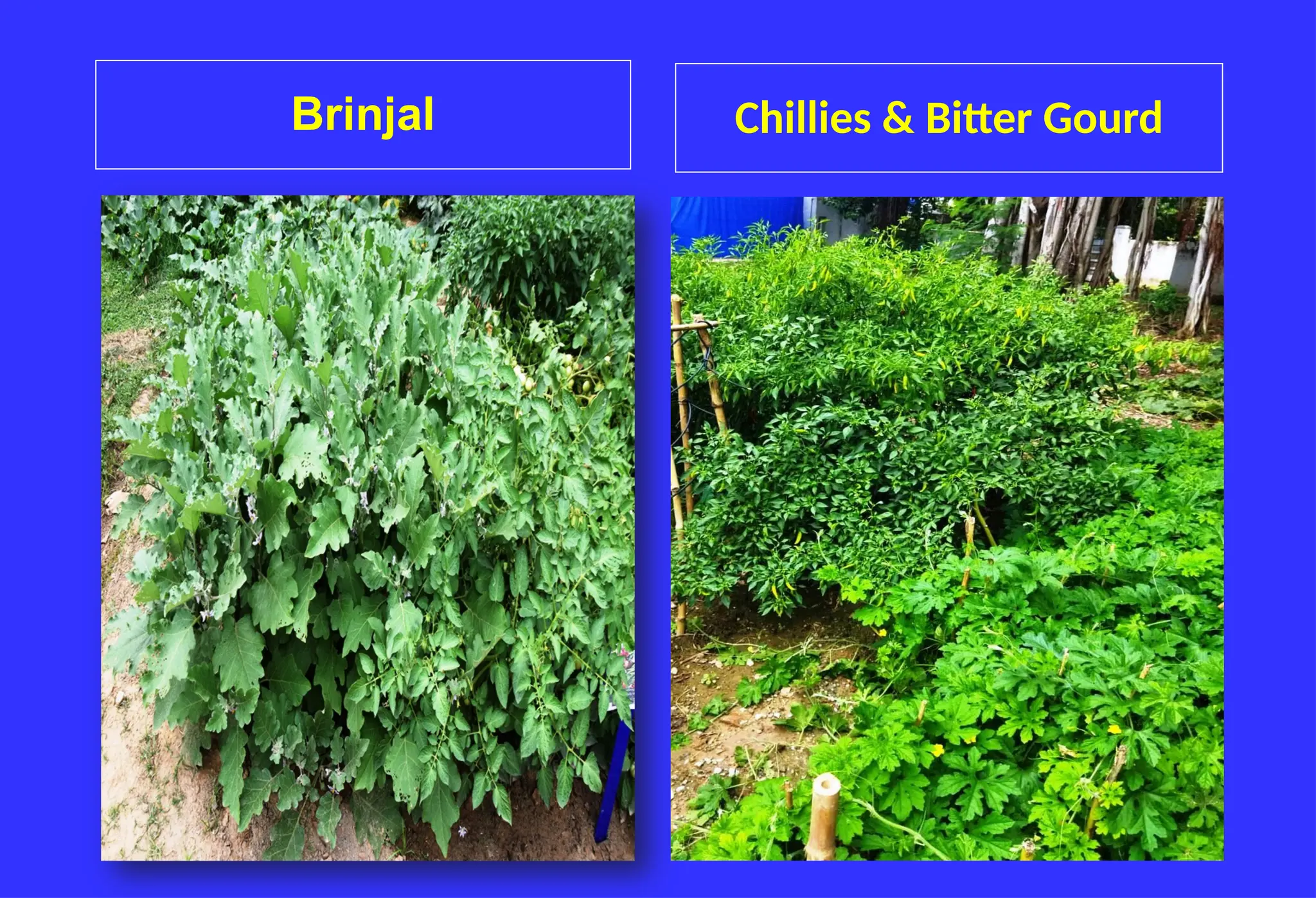
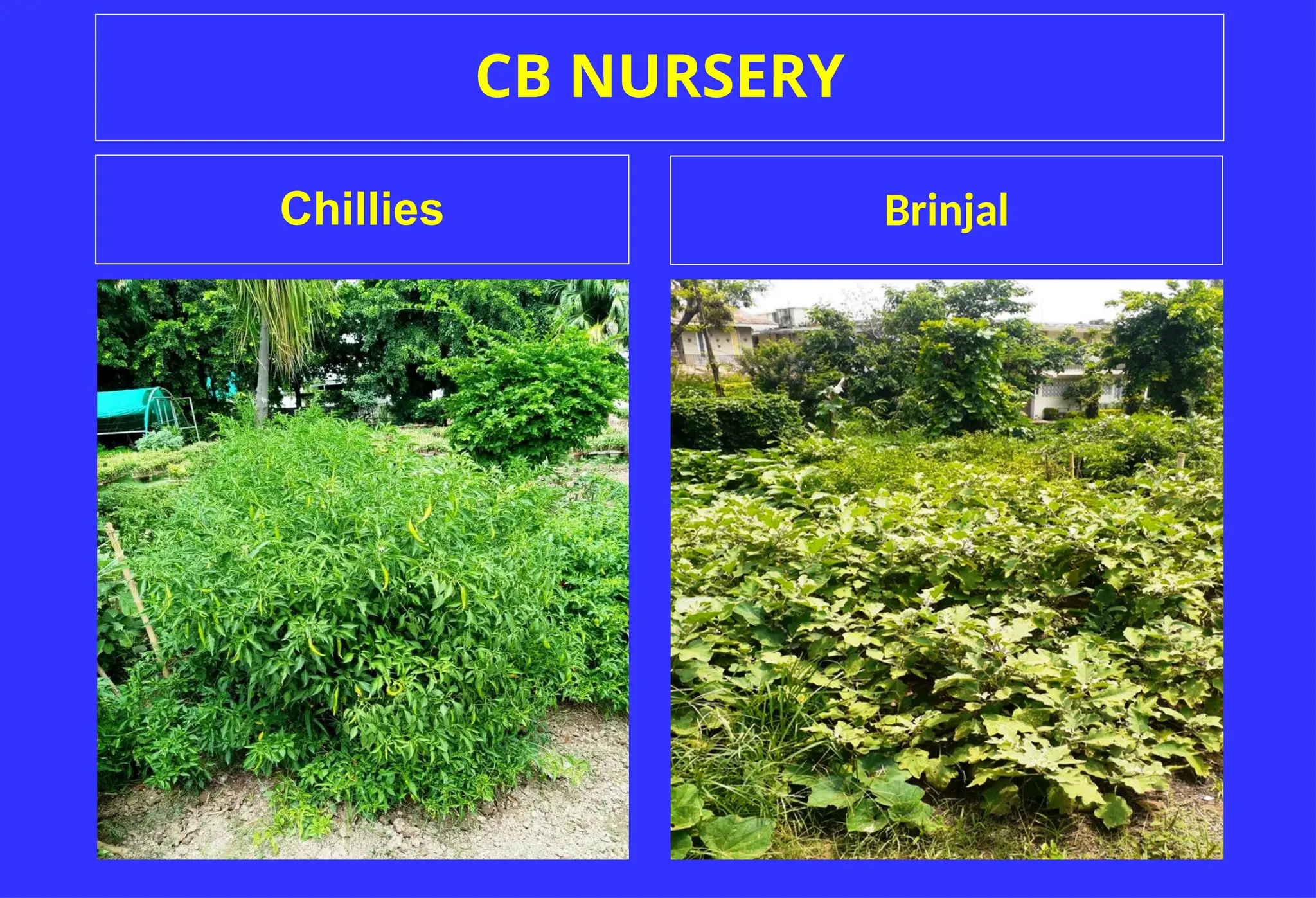
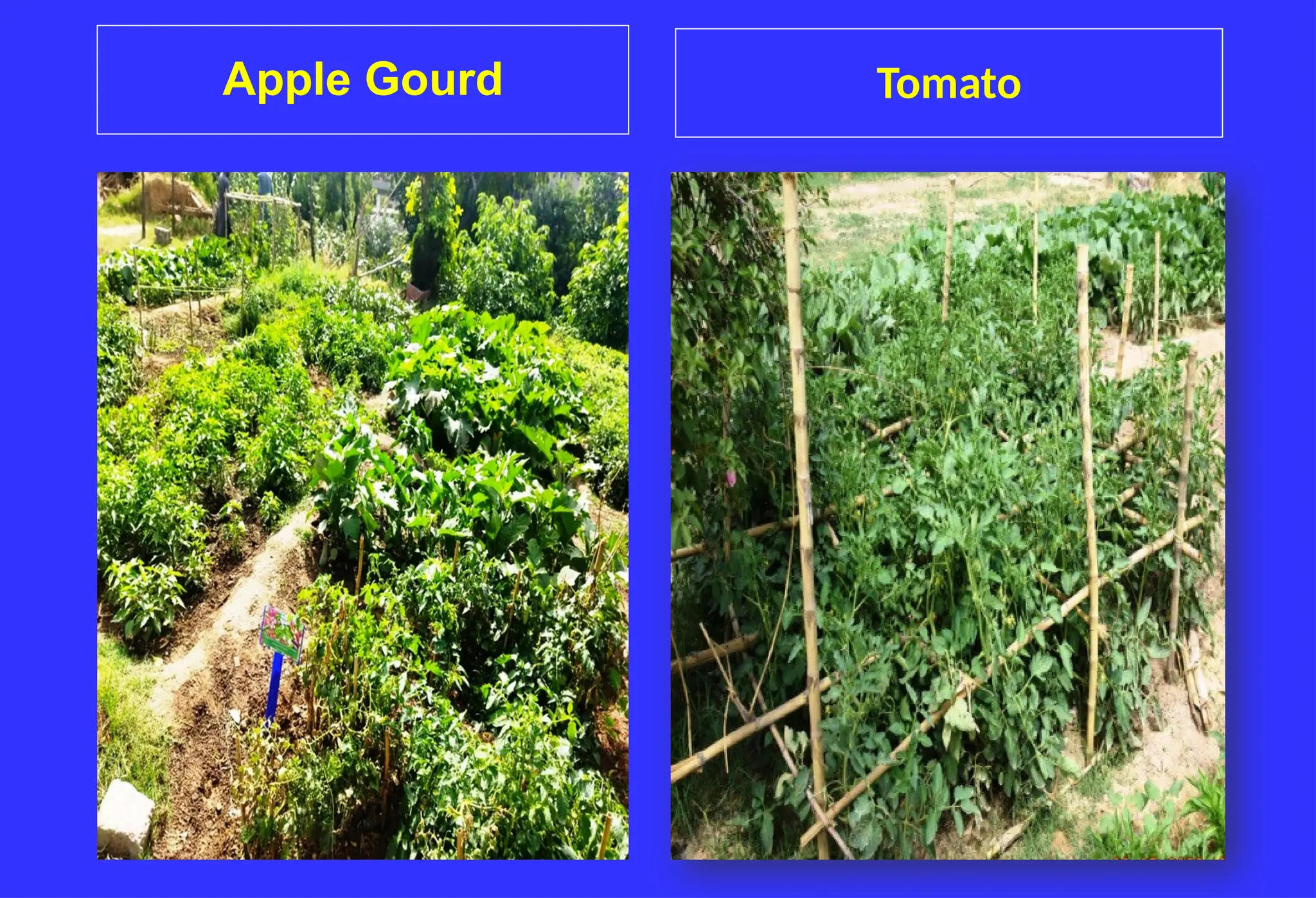
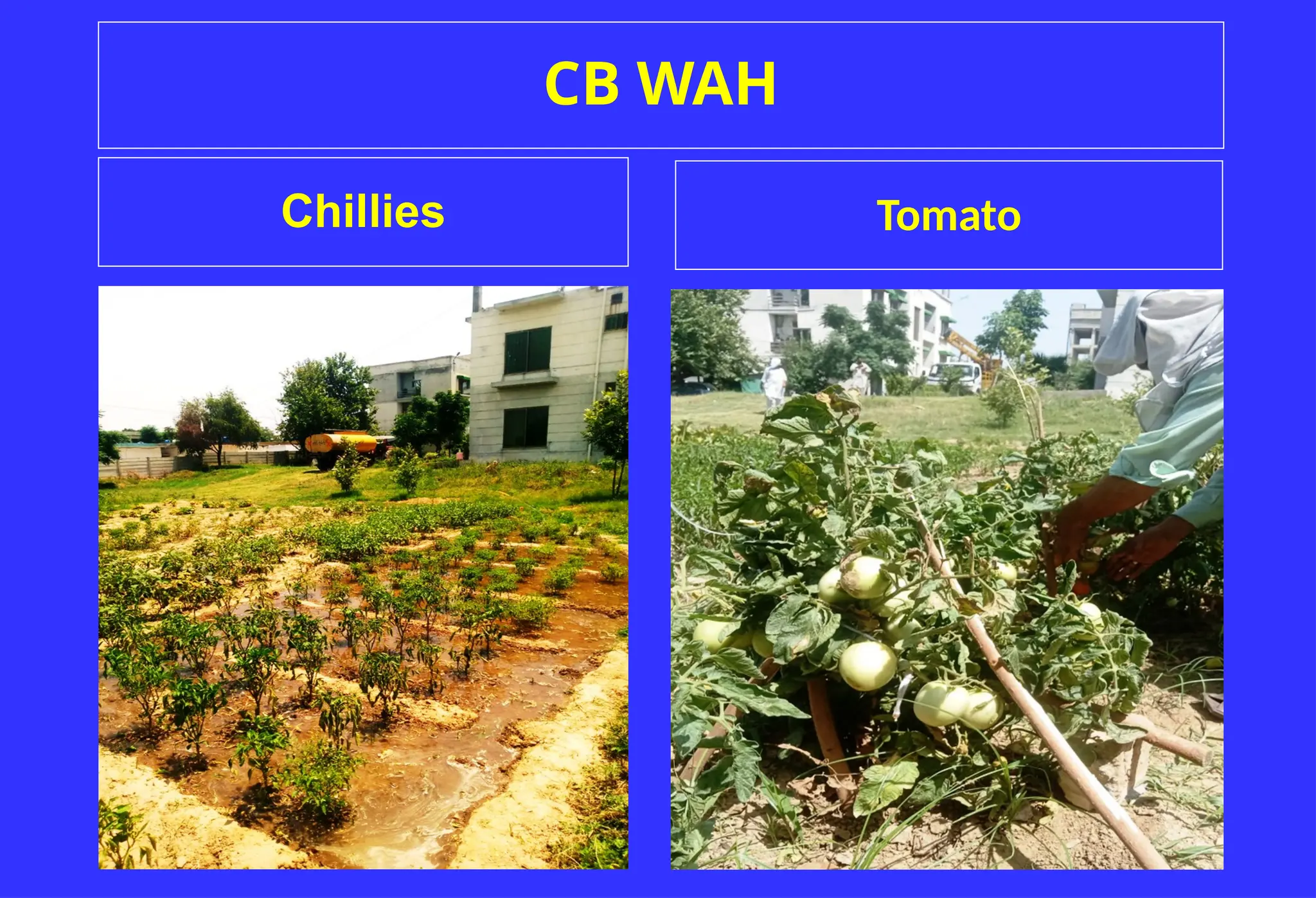
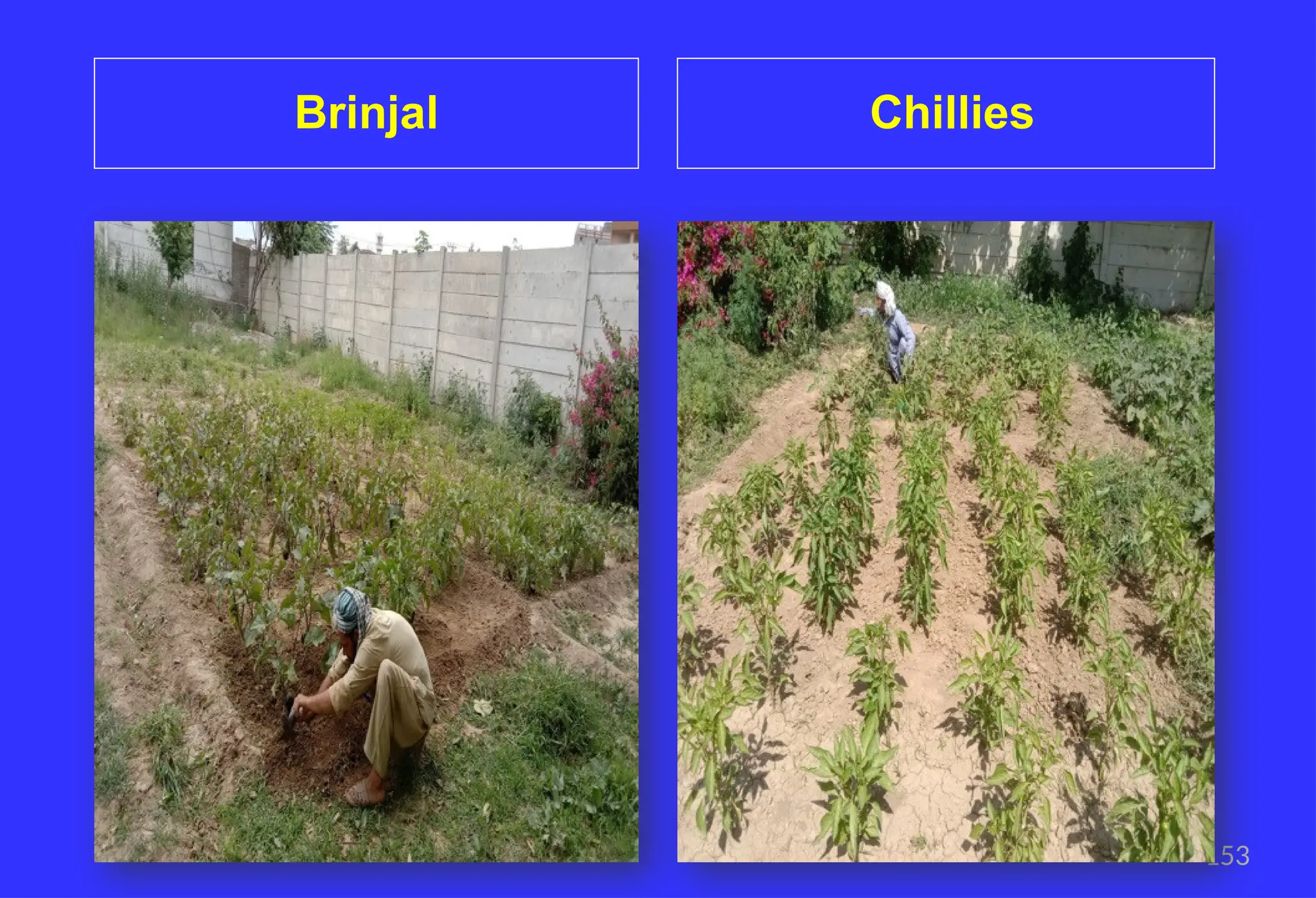
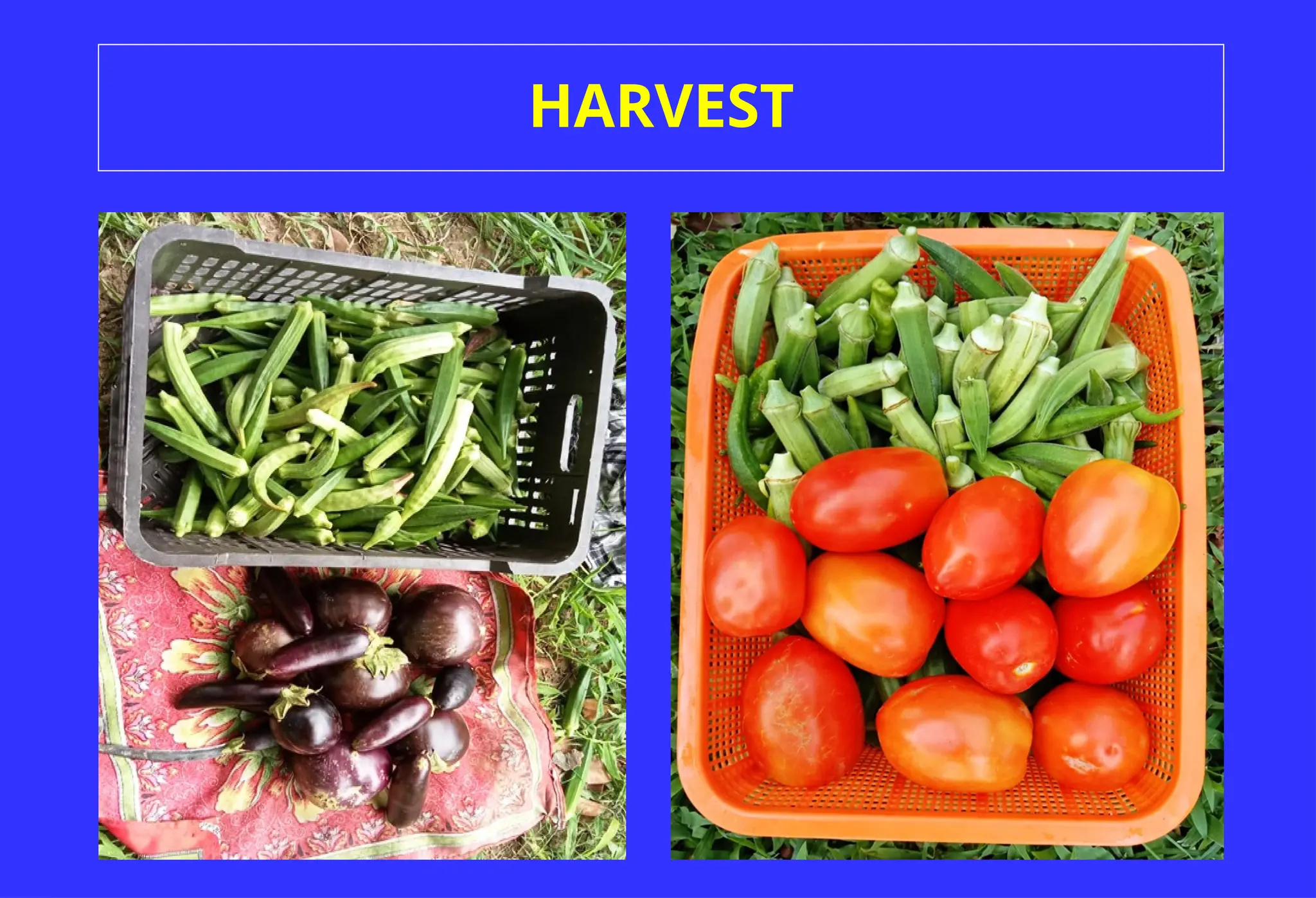
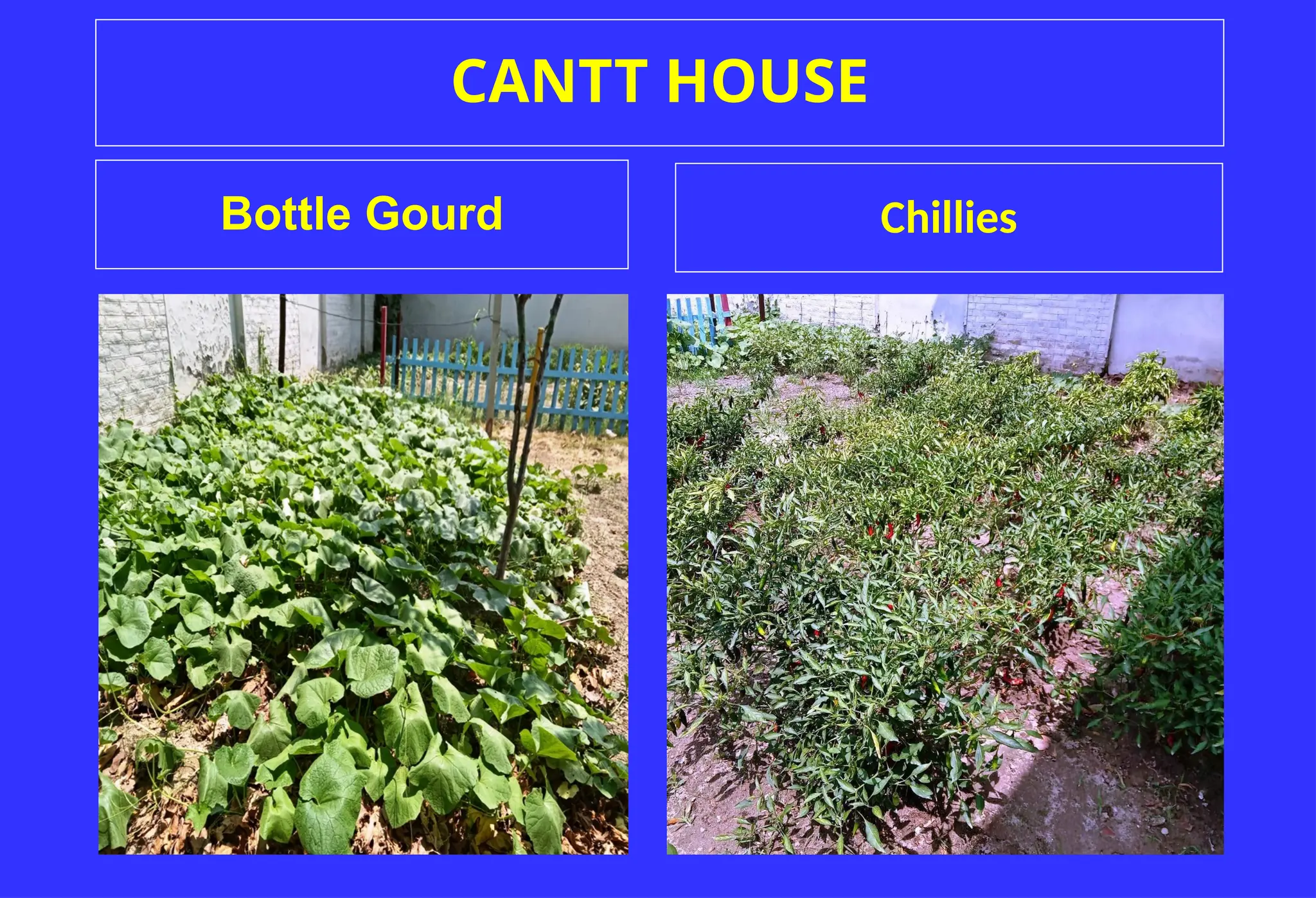
Kitchen Gardening has also been started in every
cantonment to grow and make available organic
vegetables free of cost
6
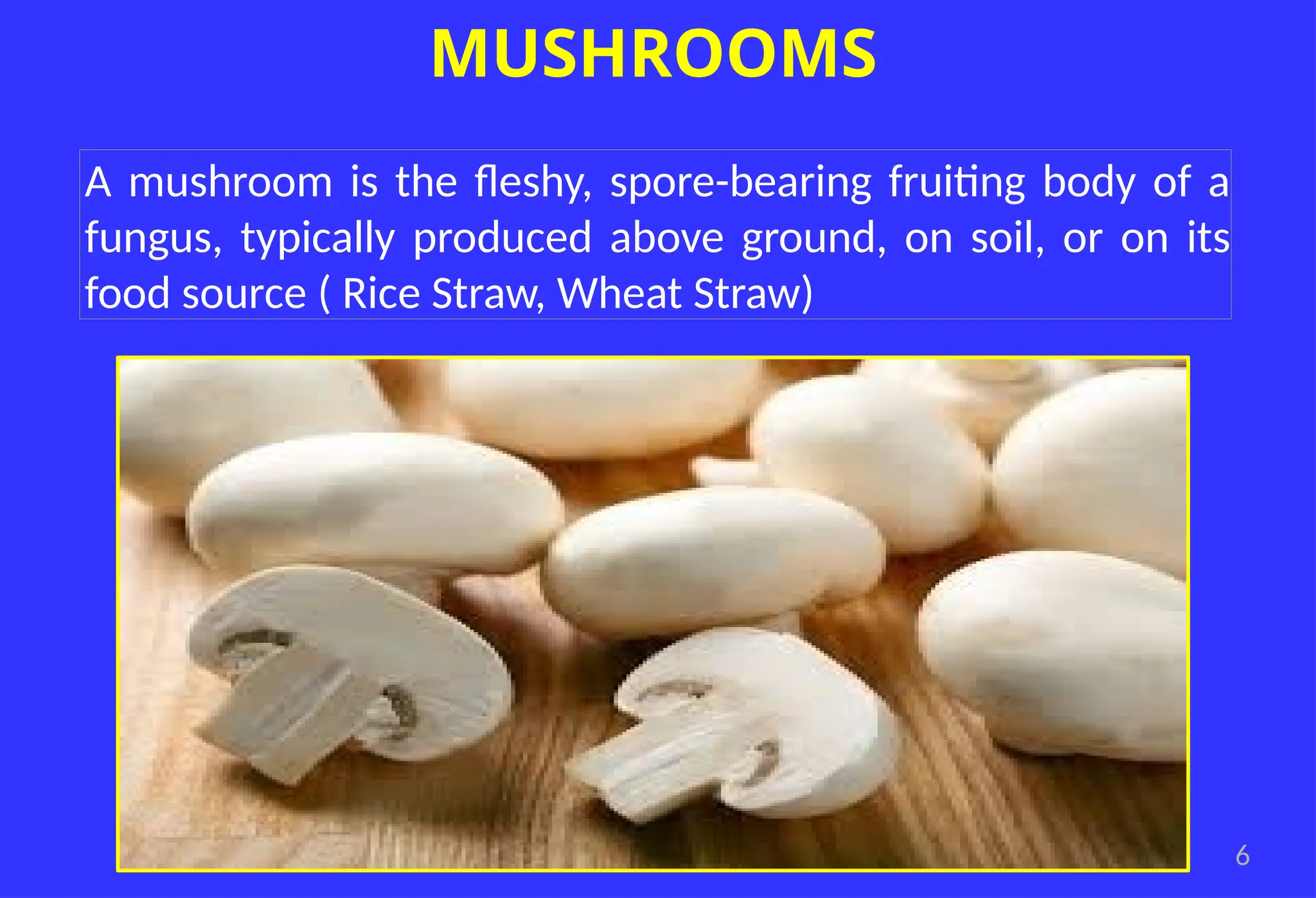
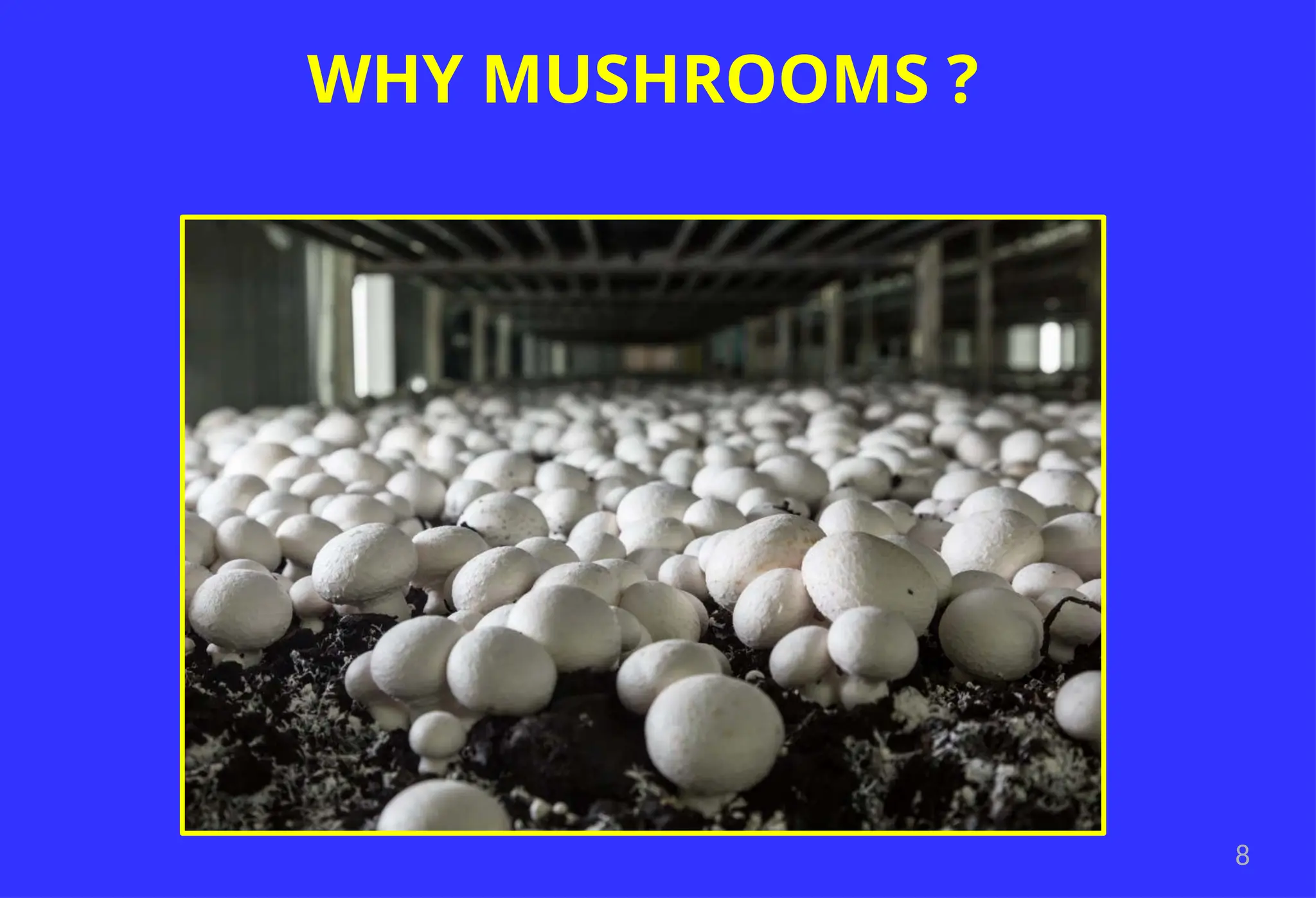
MUSHROOMS
A mushroom isthe fleshy, spore-bearing fruiting body of a
fungus, typically produced above ground, on soil, or on its
food source ( Rice Straw, Wheat Straw)
7.
7
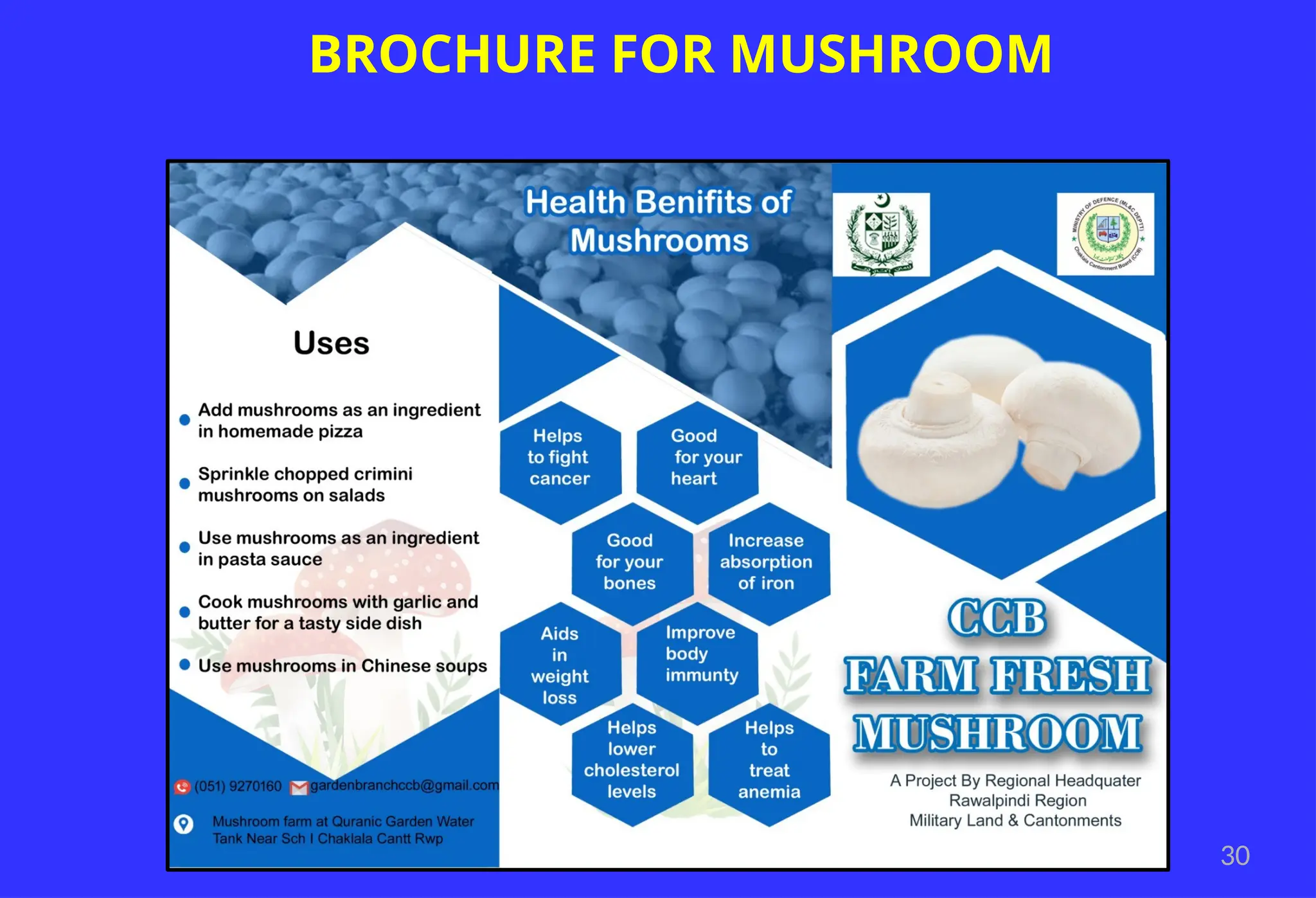
BENEFITS OF MUSHROOMS
There are lots of protein and other essential nutrients
present in it like Vitamin D
Mushrooms help in building a strong immune system
and help in prevention of heart diseases and cancers
Mushrooms are rich in protein, vitamins, & fibers. So,
mushrooms are also beneficial to the diabetic patients
Mushrooms are also a good source of folic acid that
found only in non-veg & is helpful in increasing the
hemoglobin level in the body.
9
WHY MUSHROOM ?
It is a very profitable business idea that has been growing
traditionally but can be turned into a revenue-generating
business
It’s has high marketplace for the PAKISTAN as well as abroad
Mushroom Business requires little space or land
It grows independent of sunlight, feeds on organic matter and
does not require fertile soil
In addition to the floor, air space can also be utilized resulting in
higher productivity
Mushrooms are grown during winters as it requires lower
11
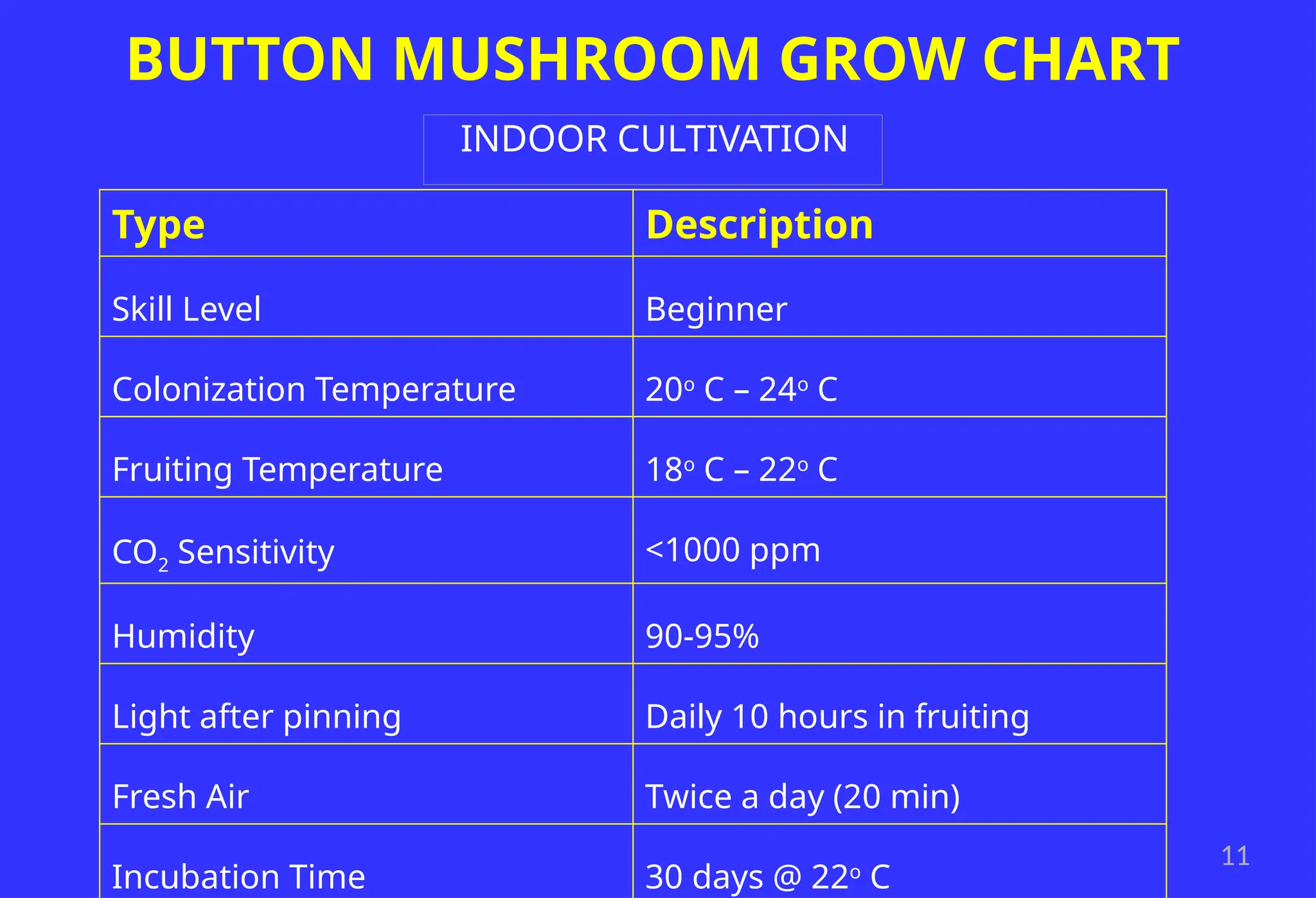
BUTTON MUSHROOM GROWCHART
INDOOR CULTIVATION
Type Description
Skill Level Beginner
Colonization Temperature 20o
C – 24o
C
Fruiting Temperature 18o
C – 22o
C
CO2 Sensitivity <1000 ppm
Humidity 90-95%
Light after pinning Daily 10 hours in fruiting
Fresh Air Twice a day (20 min)
Incubation Time 30 days @ 22o
C
12.
12
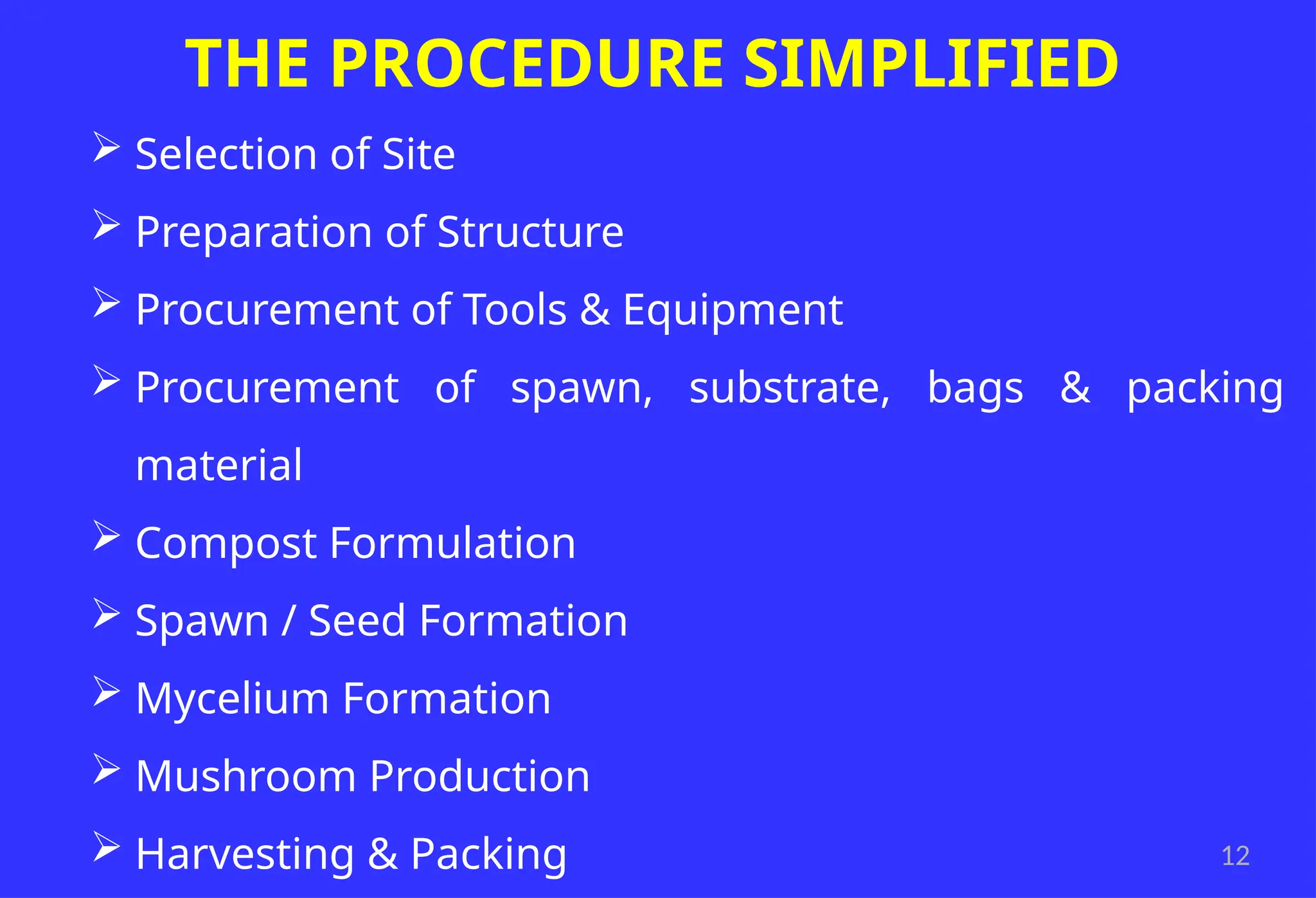
THE PROCEDURE SIMPLIFIED
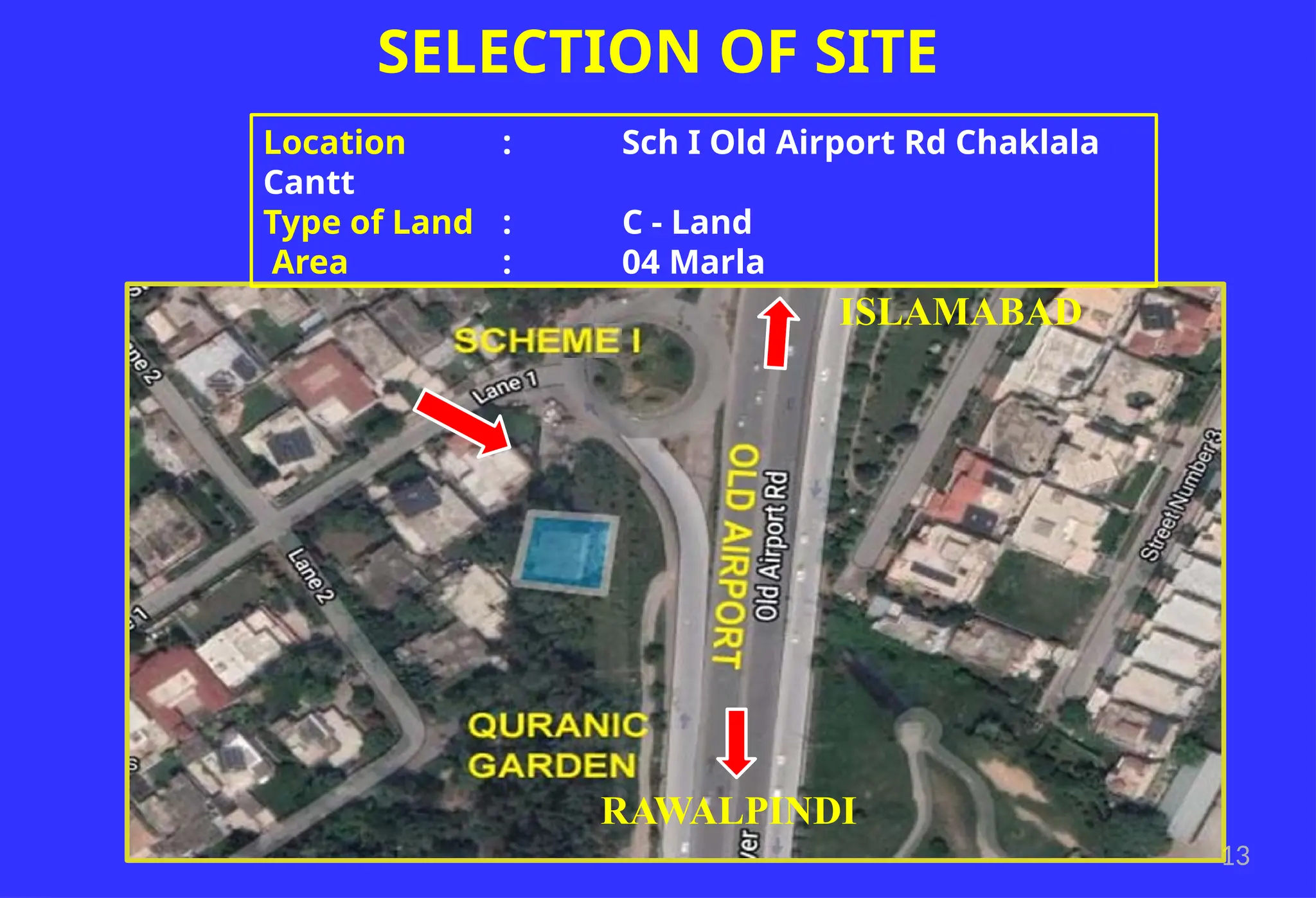
Selection of Site
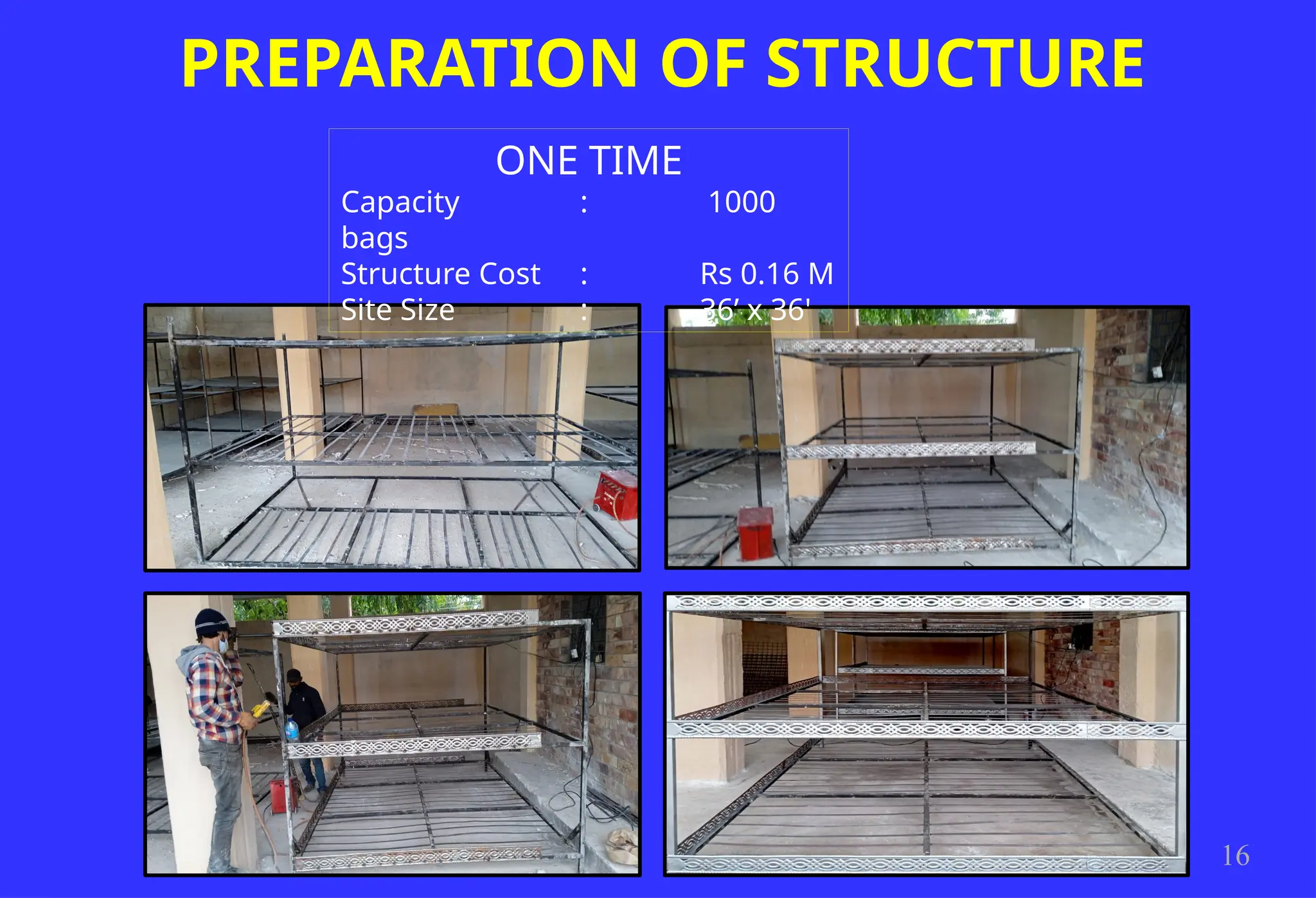
Preparation of Structure
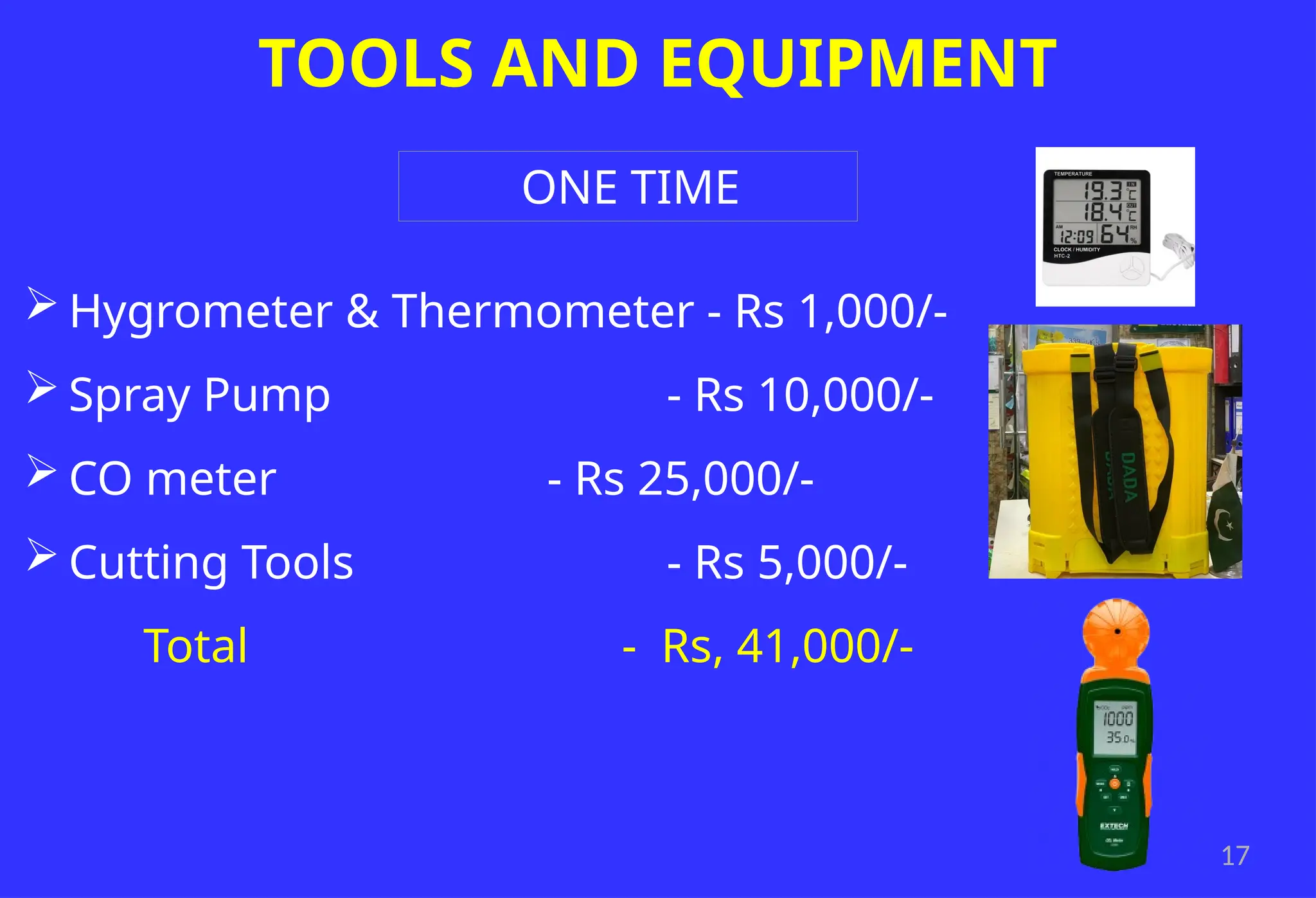
Procurement of Tools & Equipment
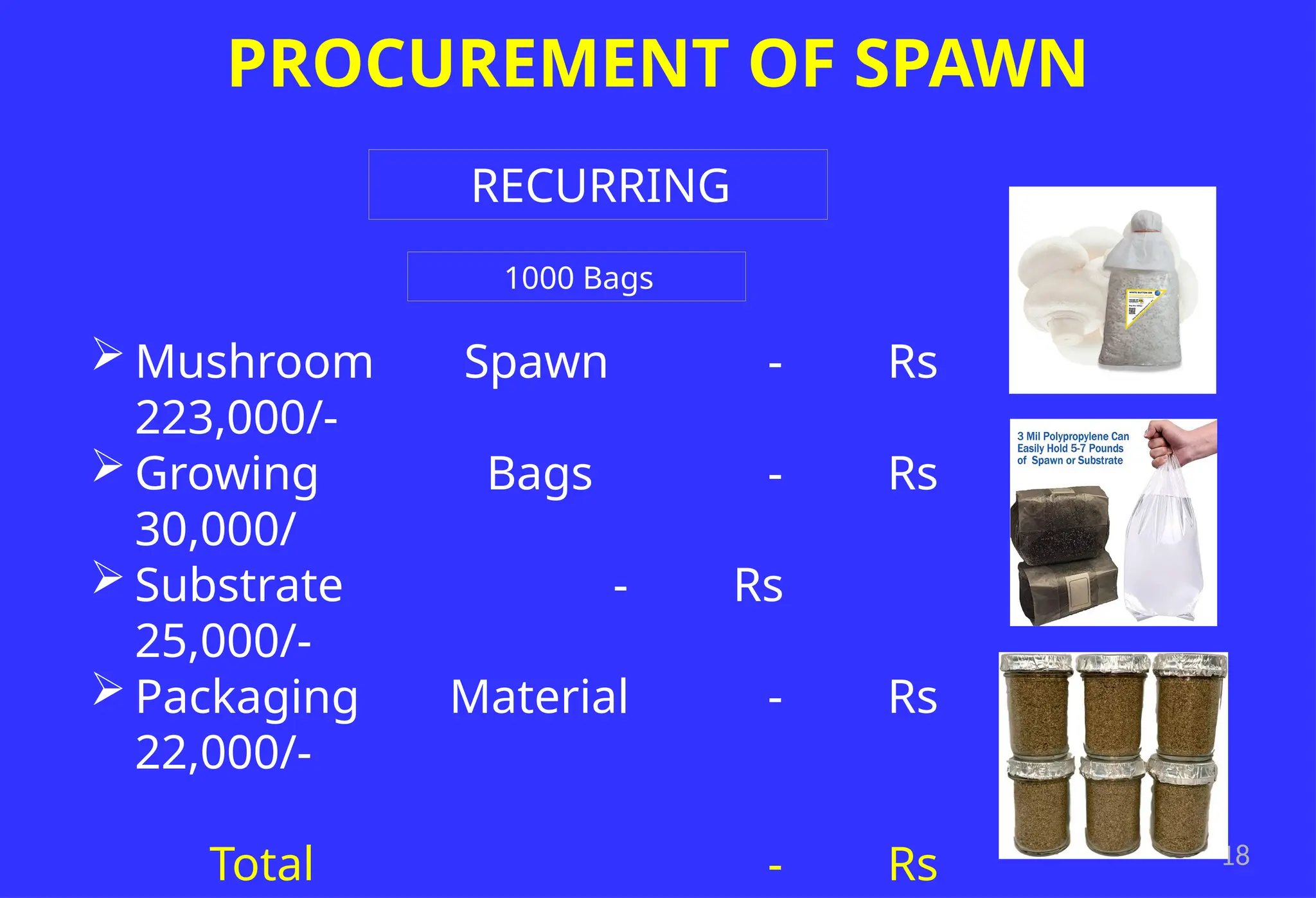
Procurement of spawn, substrate, bags & packing
material
Compost Formulation
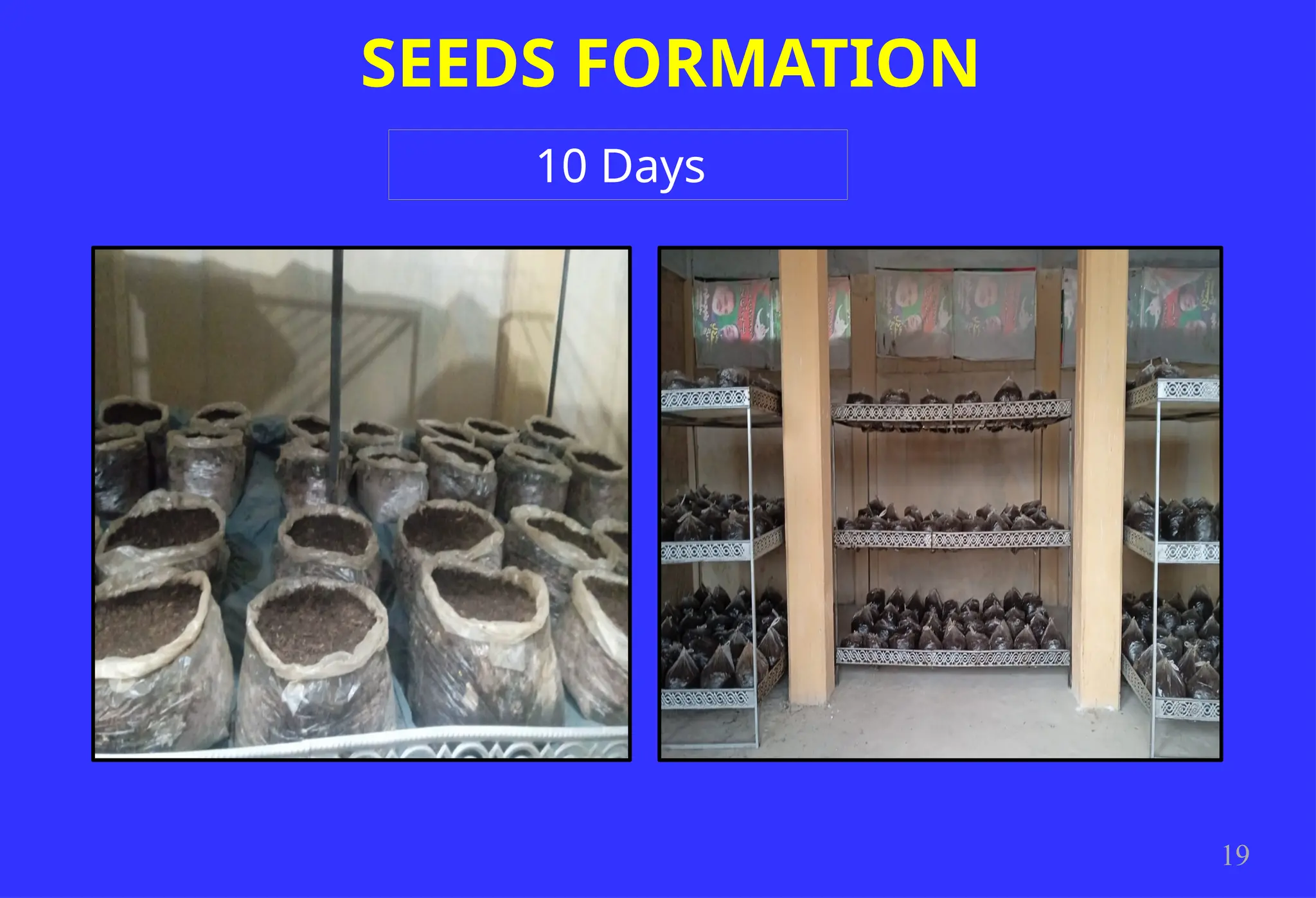
Spawn / Seed Formation
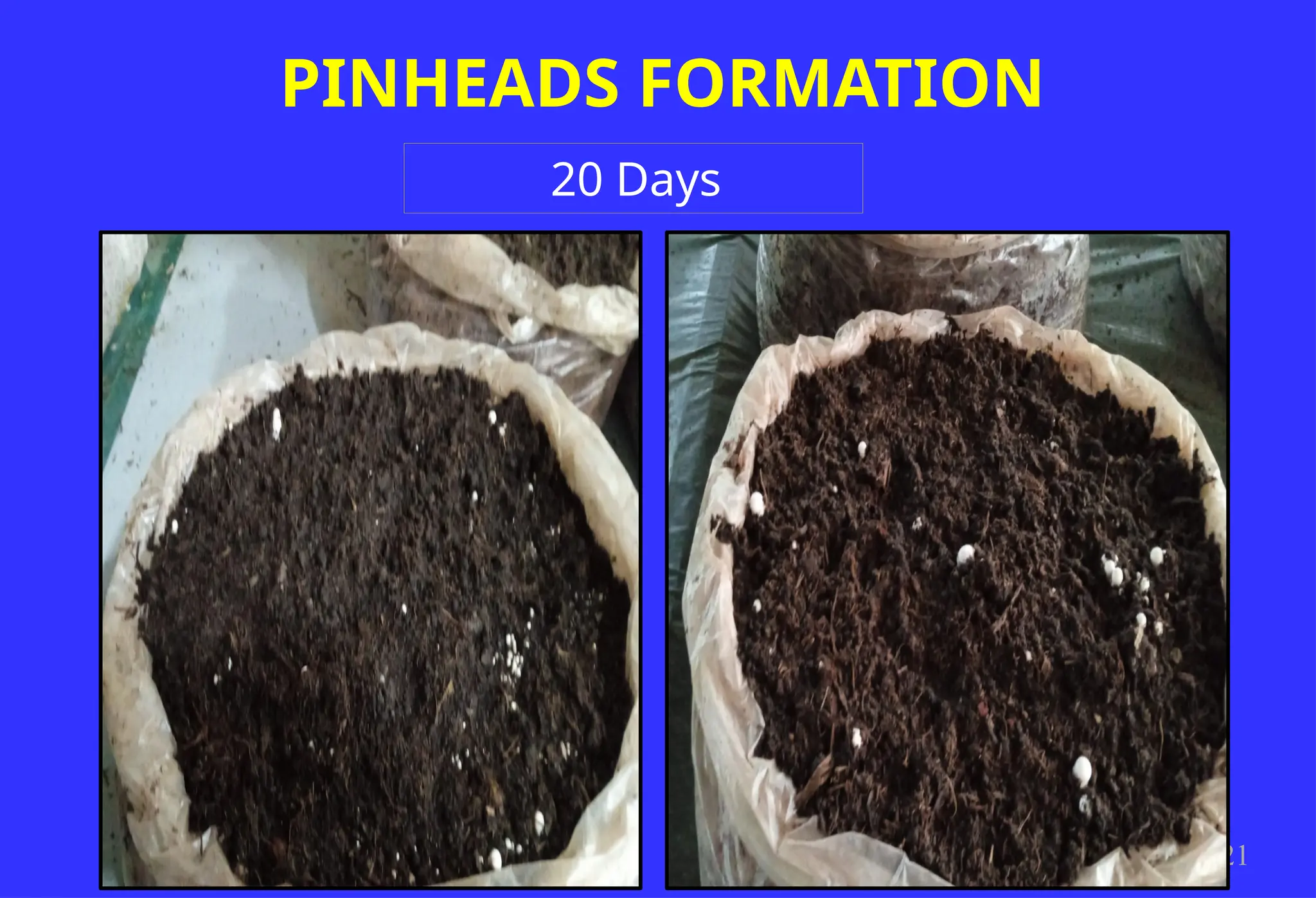
Mycelium Formation
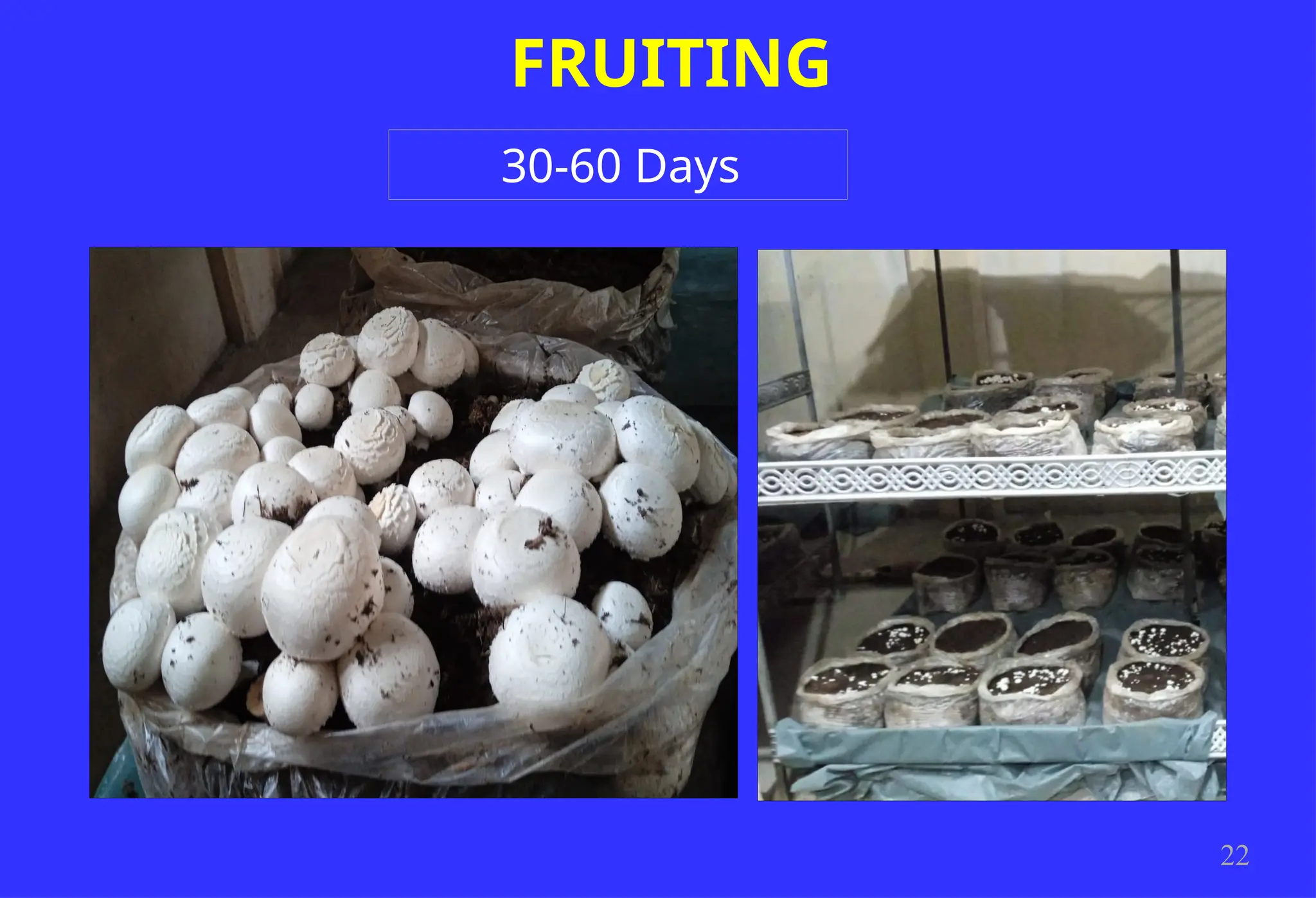
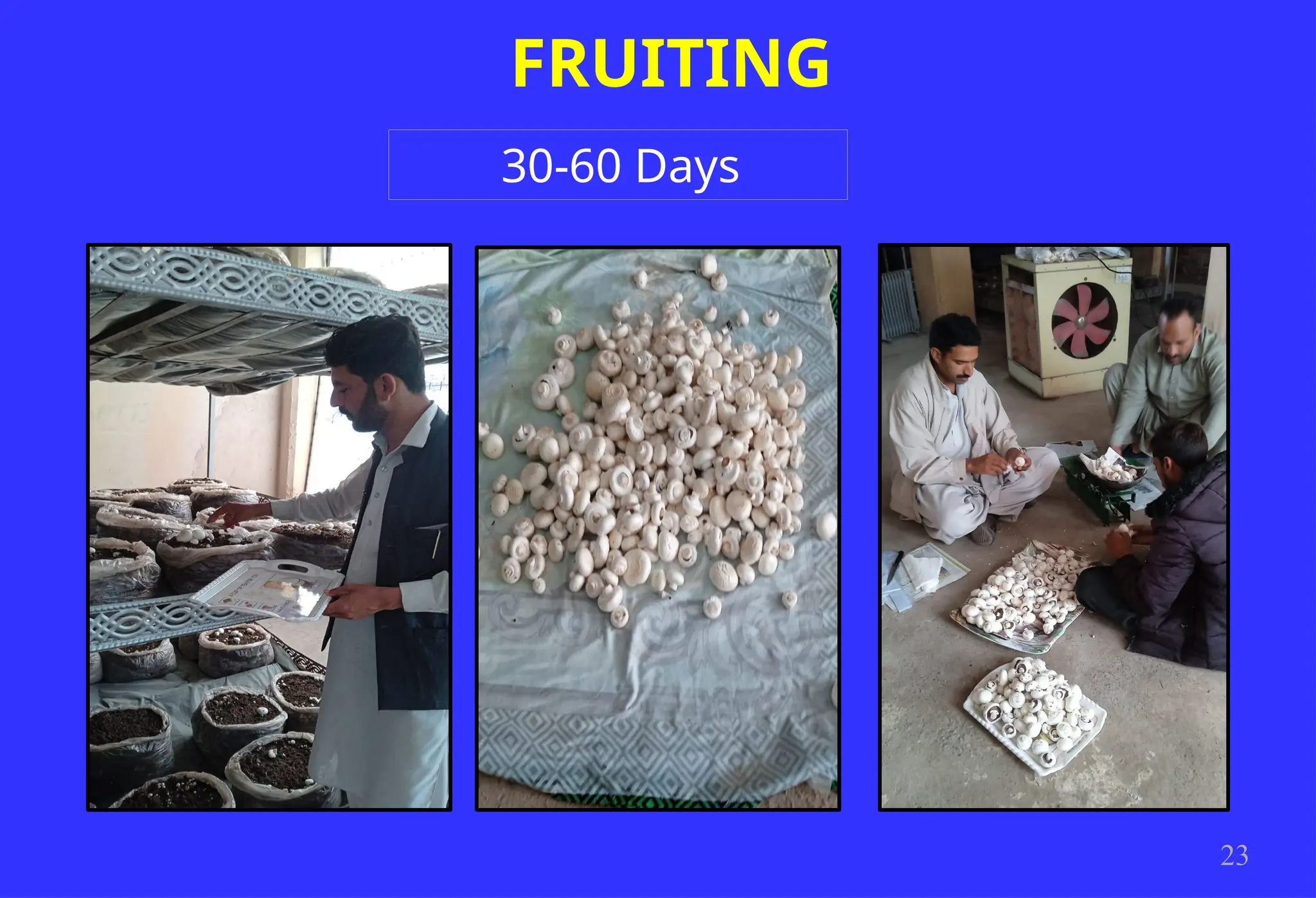
Mushroom Production
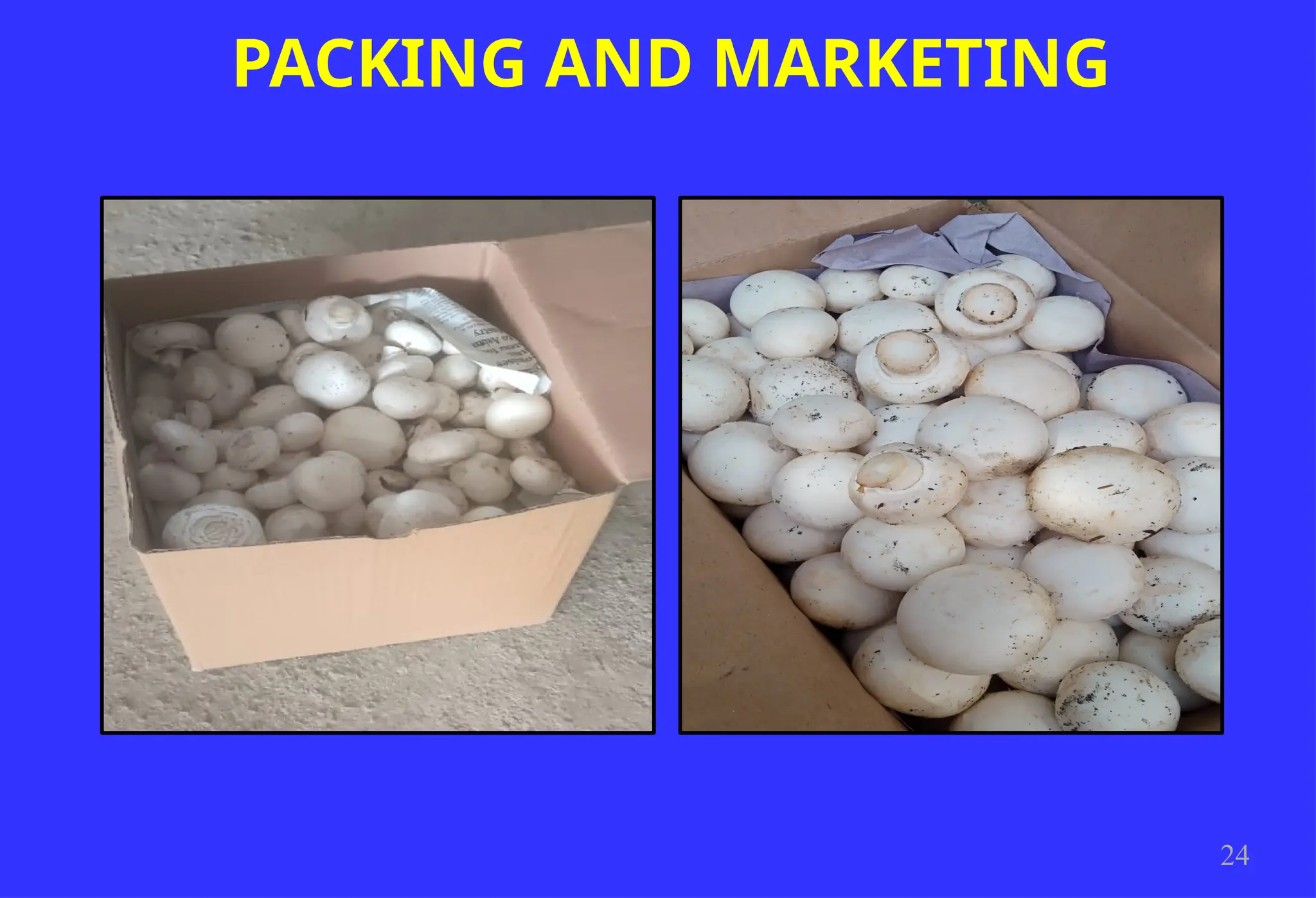
Harvesting & Packing
26
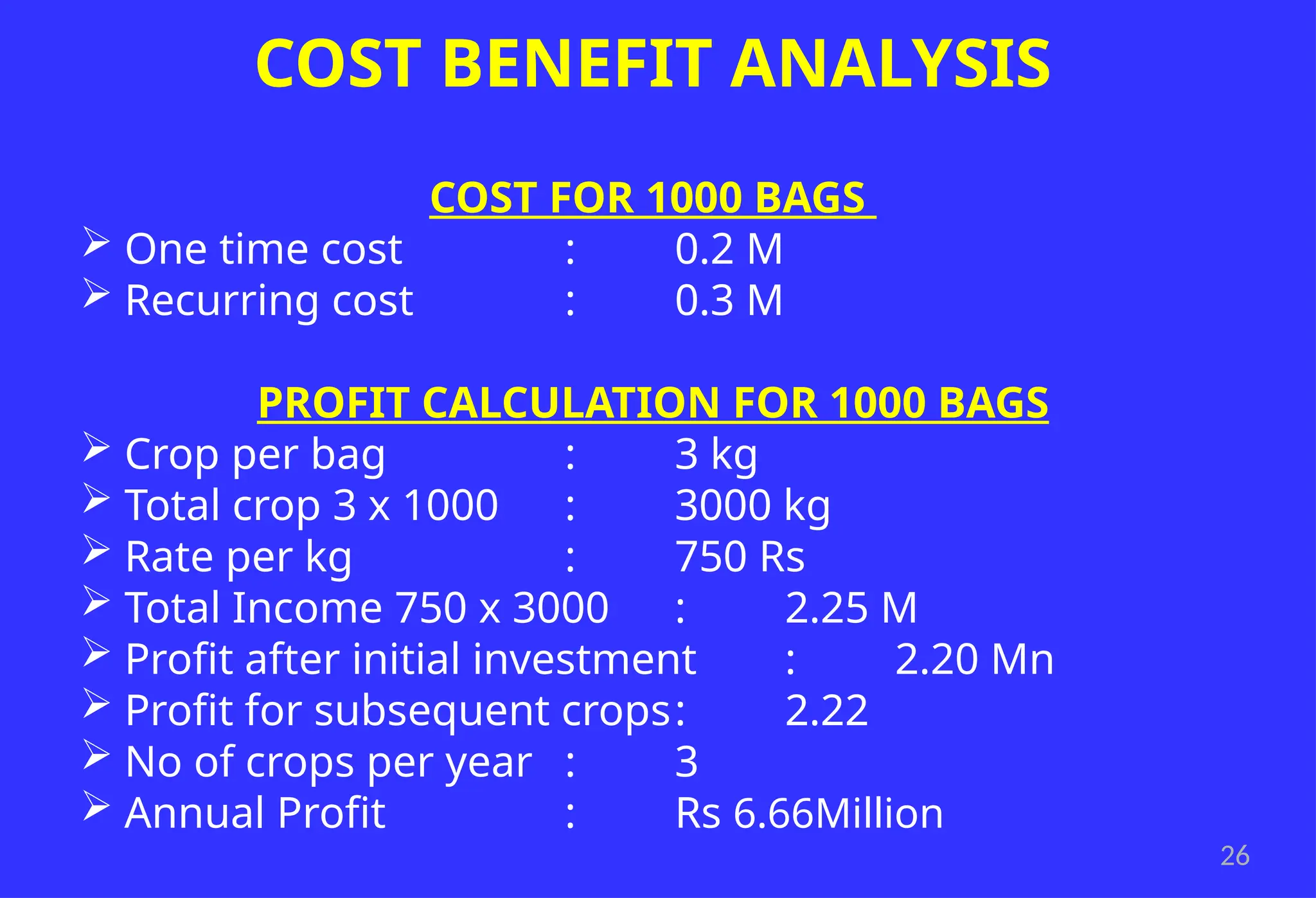
COST BENEFIT ANALYSIS
COSTFOR 1000 BAGS
One time cost : 0.2 M
Recurring cost : 0.3 M
PROFIT CALCULATION FOR 1000 BAGS
Crop per bag : 3 kg
Total crop 3 x 1000 : 3000 kg
Rate per kg : 750 Rs
Total Income 750 x 3000 : 2.25 M
Profit after initial investment : 2.20 Mn
Profit for subsequent crops: 2.22
No of crops per year : 3
Annual Profit : Rs 6.66Million
27.
27
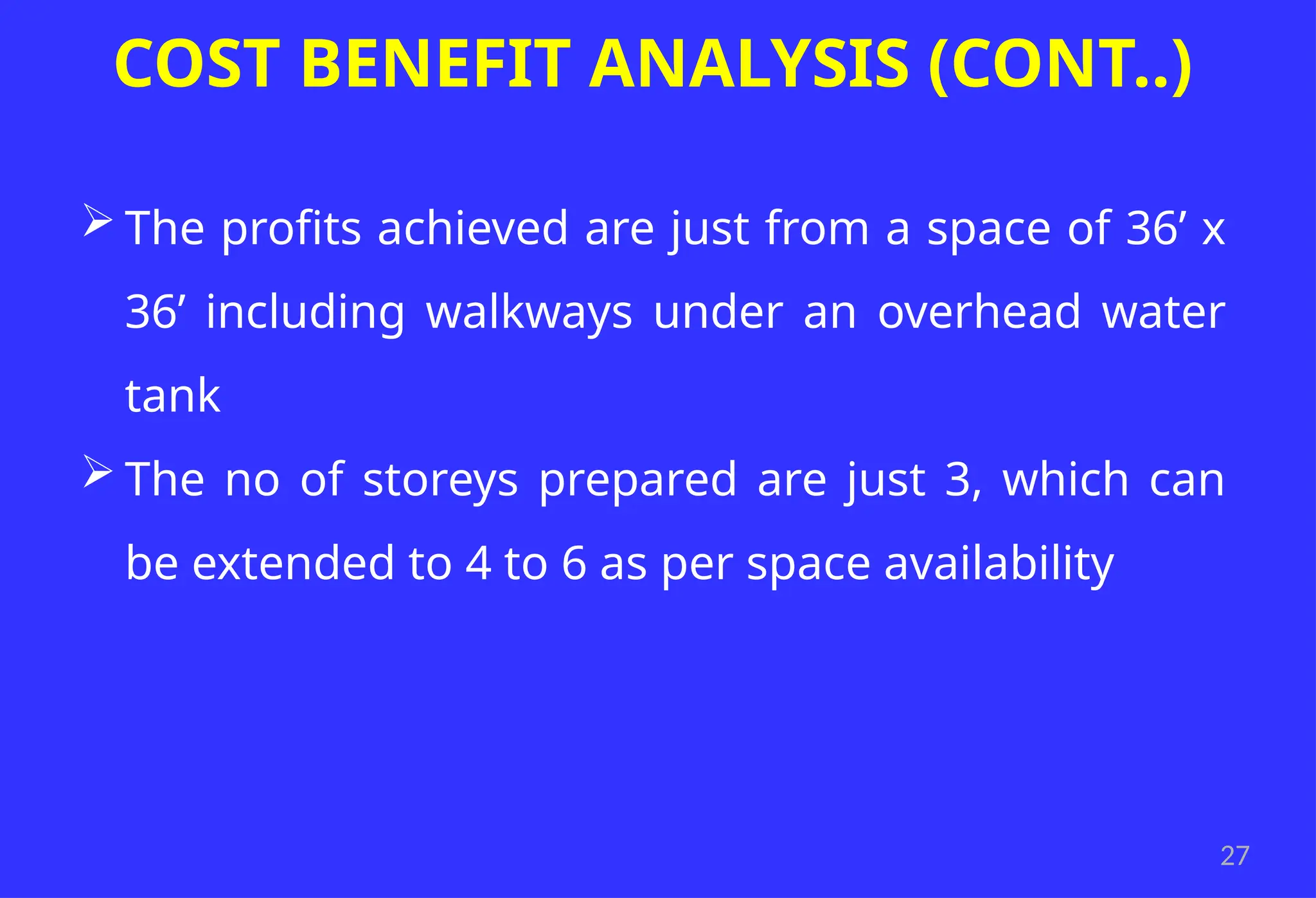
COST BENEFIT ANALYSIS(CONT..)
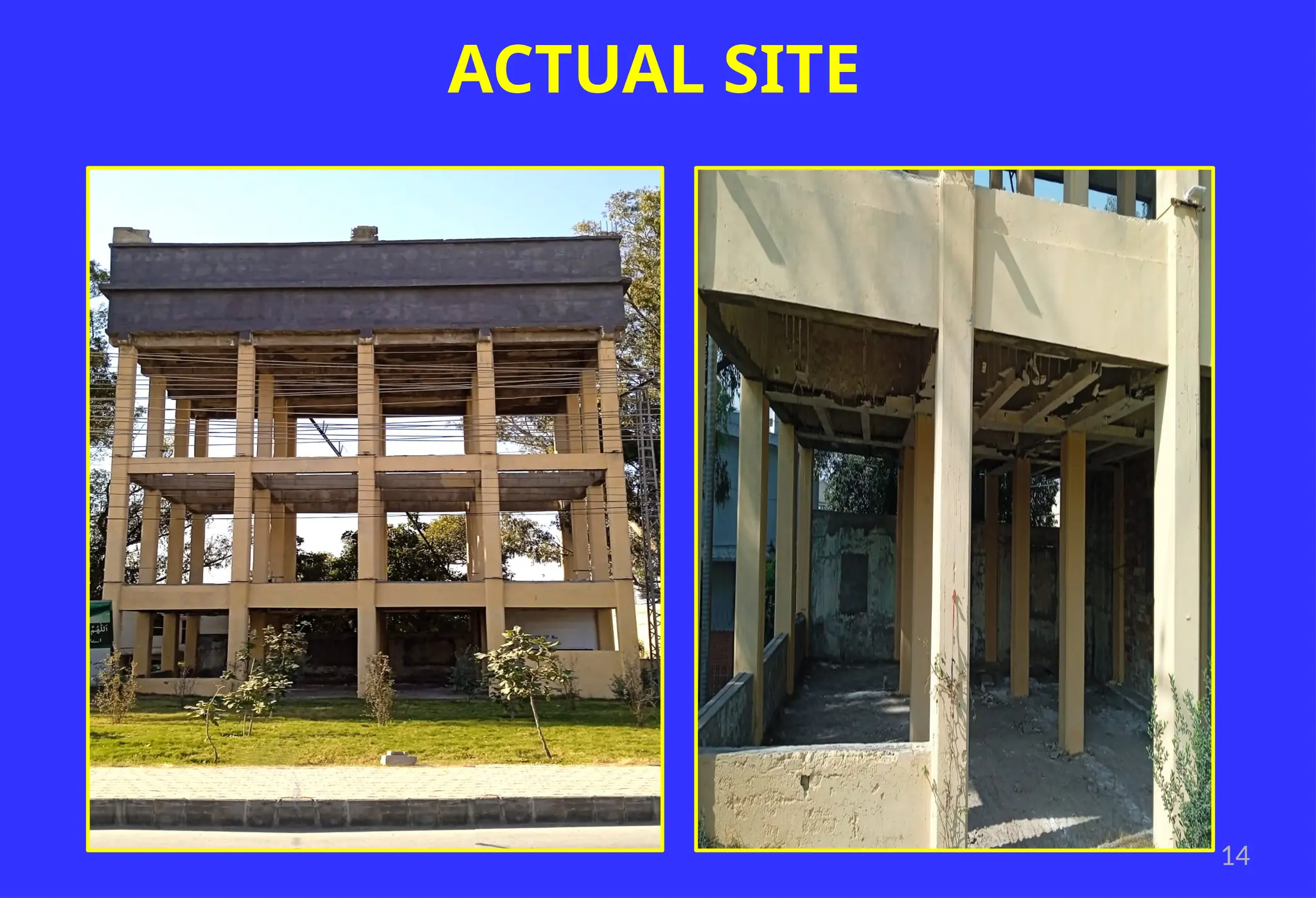
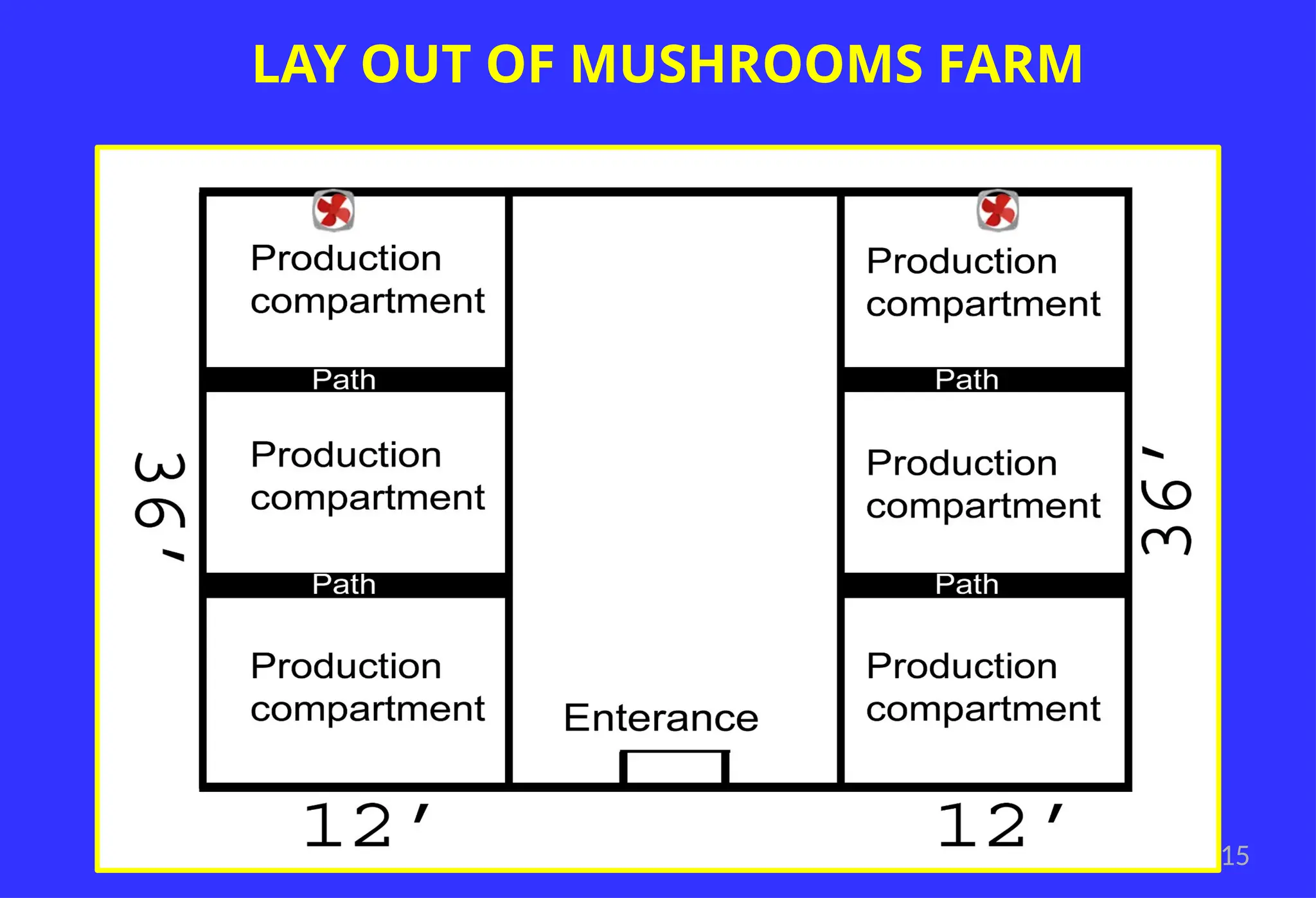
The profits achieved are just from a space of 36’ x
36’ including walkways under an overhead water
tank
The no of storeys prepared are just 3, which can
be extended to 4 to 6 as per space availability
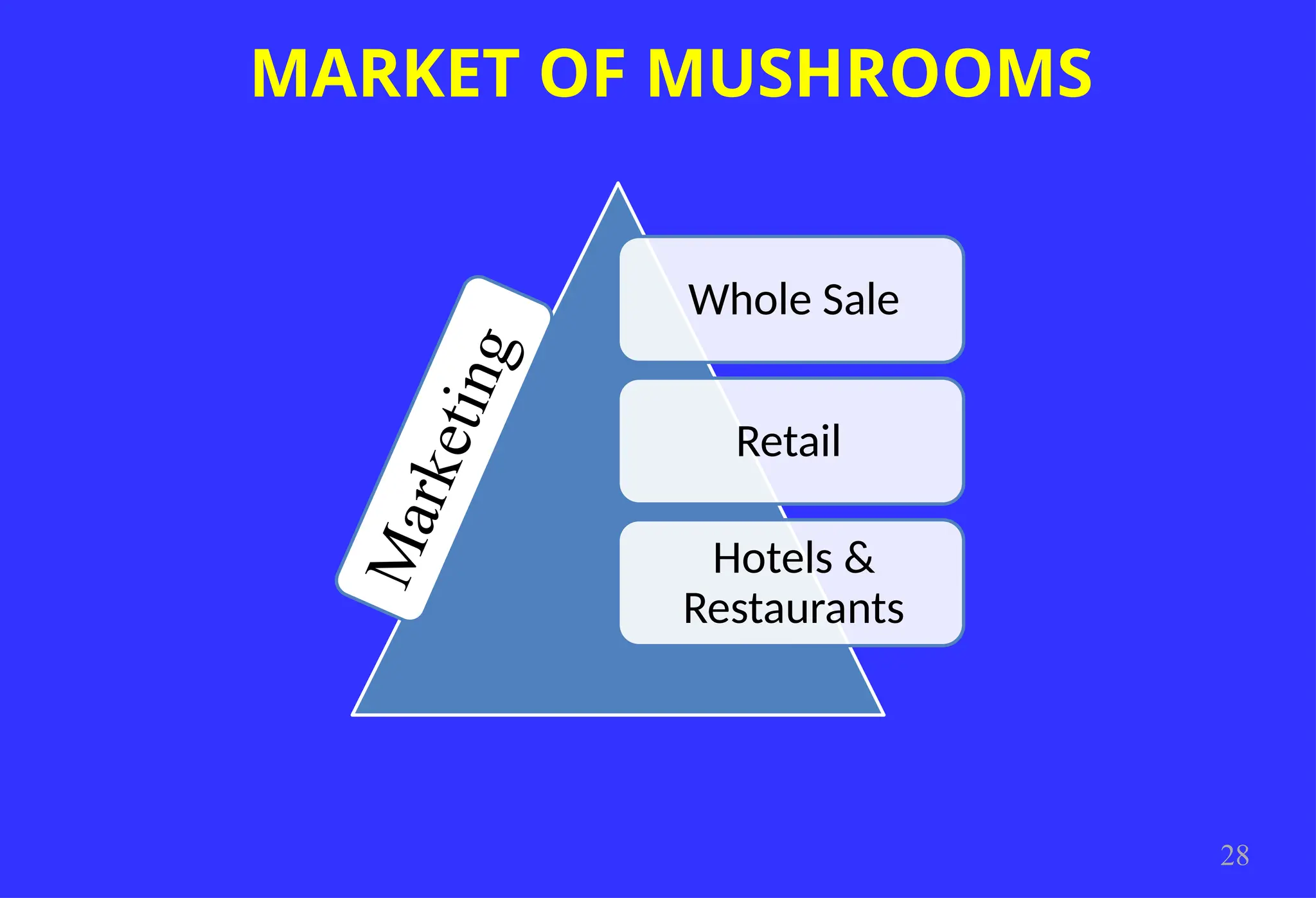
MARKET OF MUSHROOMS
Mushrooms are sold like hot cakes in market. There are
a number of wholesale dealers who pick the whole crop
giving rate of Rs 500-600 per kg as per size and quality
Retail market of mushrooms includes all the Hotels &
Restaurants as well as grocery stores & marts that buy
at the rate of Rs 700-1000 per kg
Team Chaklala has established contact with PC,
Mekong, The Monal, CSD, Hatim Store, Green Valley
and many more, whose demand is tons of mushrooms
Brochure were also printed & distributed 29
RECOMMENDATIONS
Production ofmushrooms should be immediately
replicated in all cantonments at available enclosed
spaces
All the guidelines and expertise can be taken from
team Chaklala. CB Panu Aqil has already started the
project
During summer season this project could be
implemented in hilly (cool ) areas i.e Murree Hills,
Abbottabad, Murree Gallies. The team has also
31
33
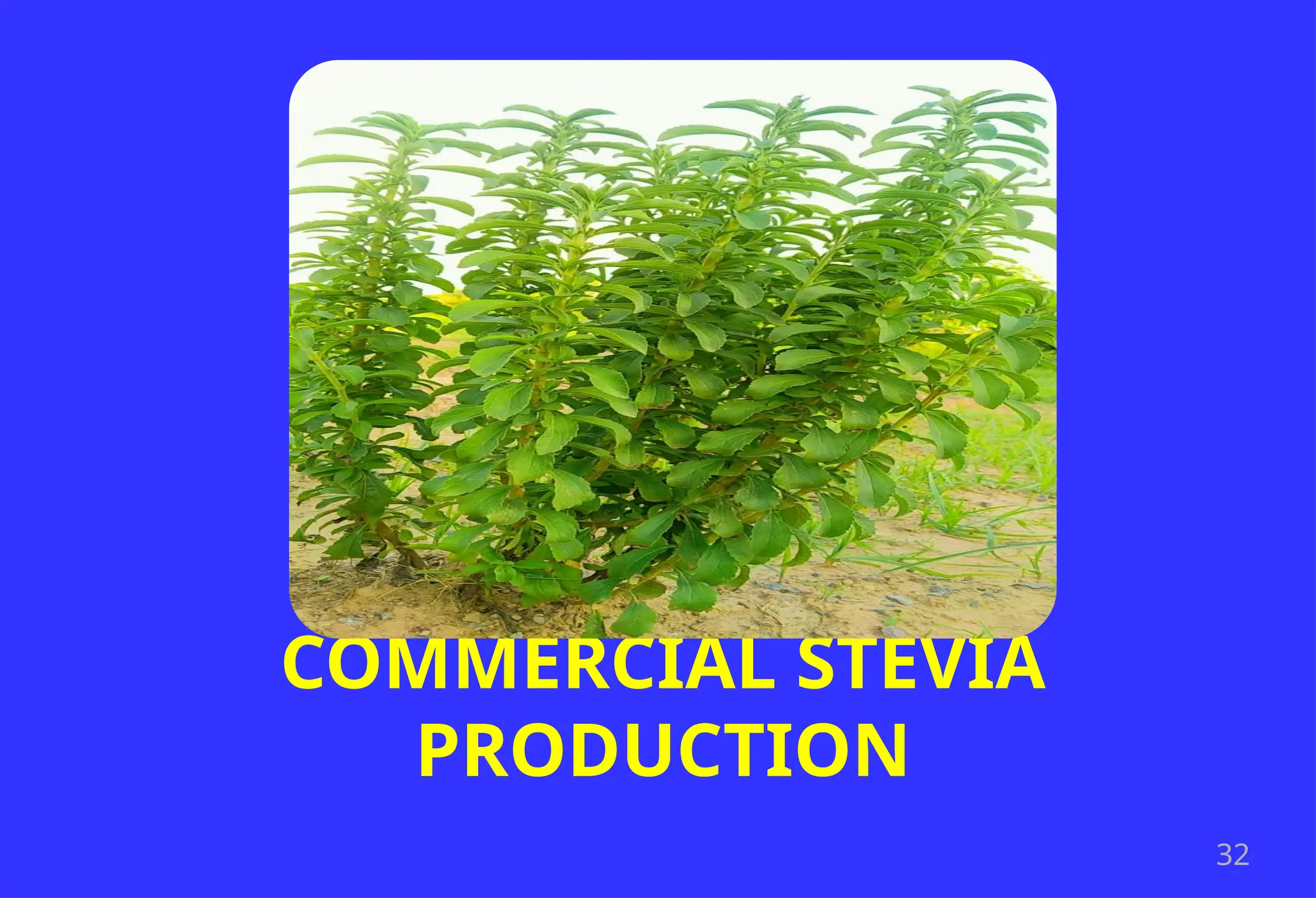
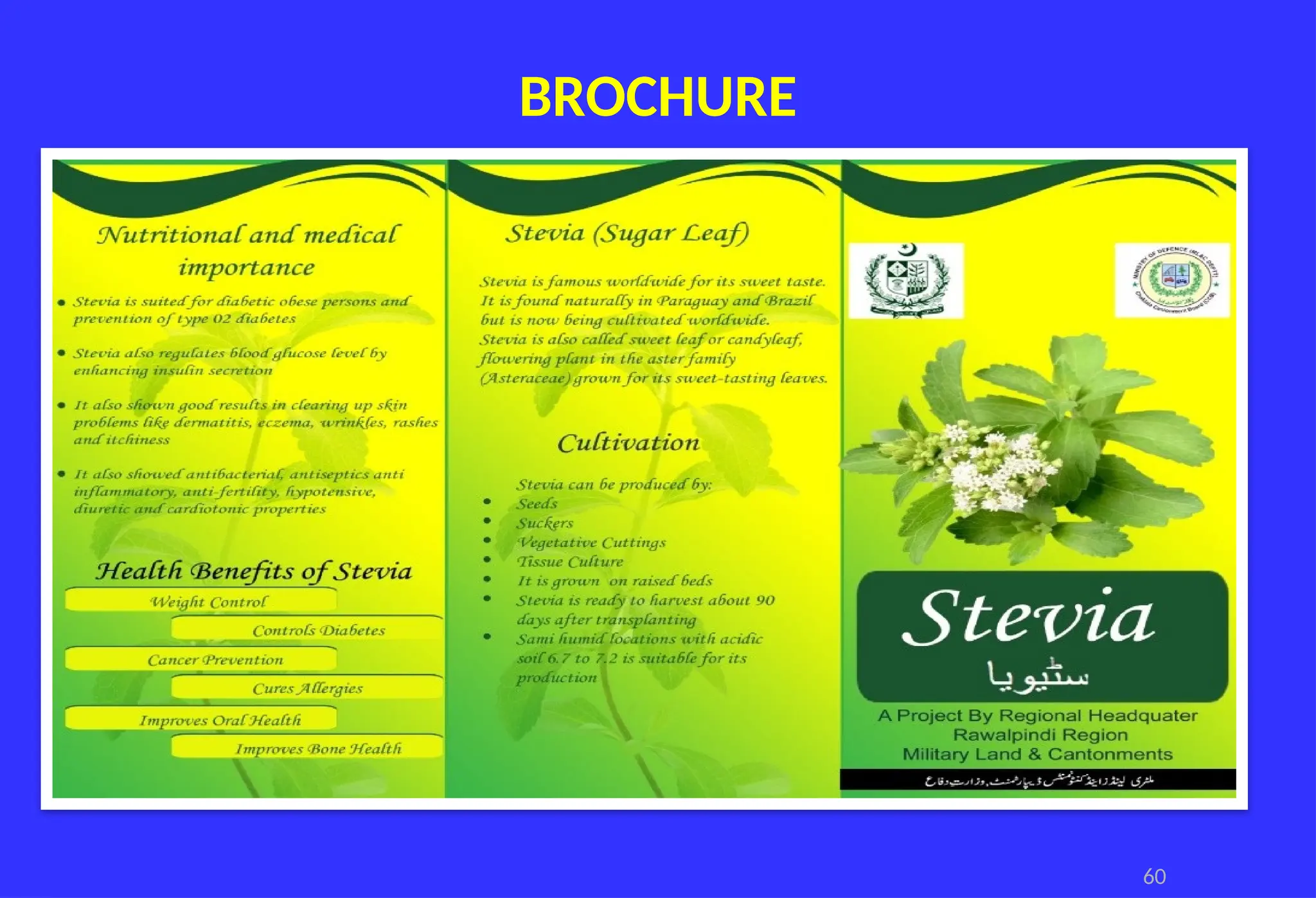
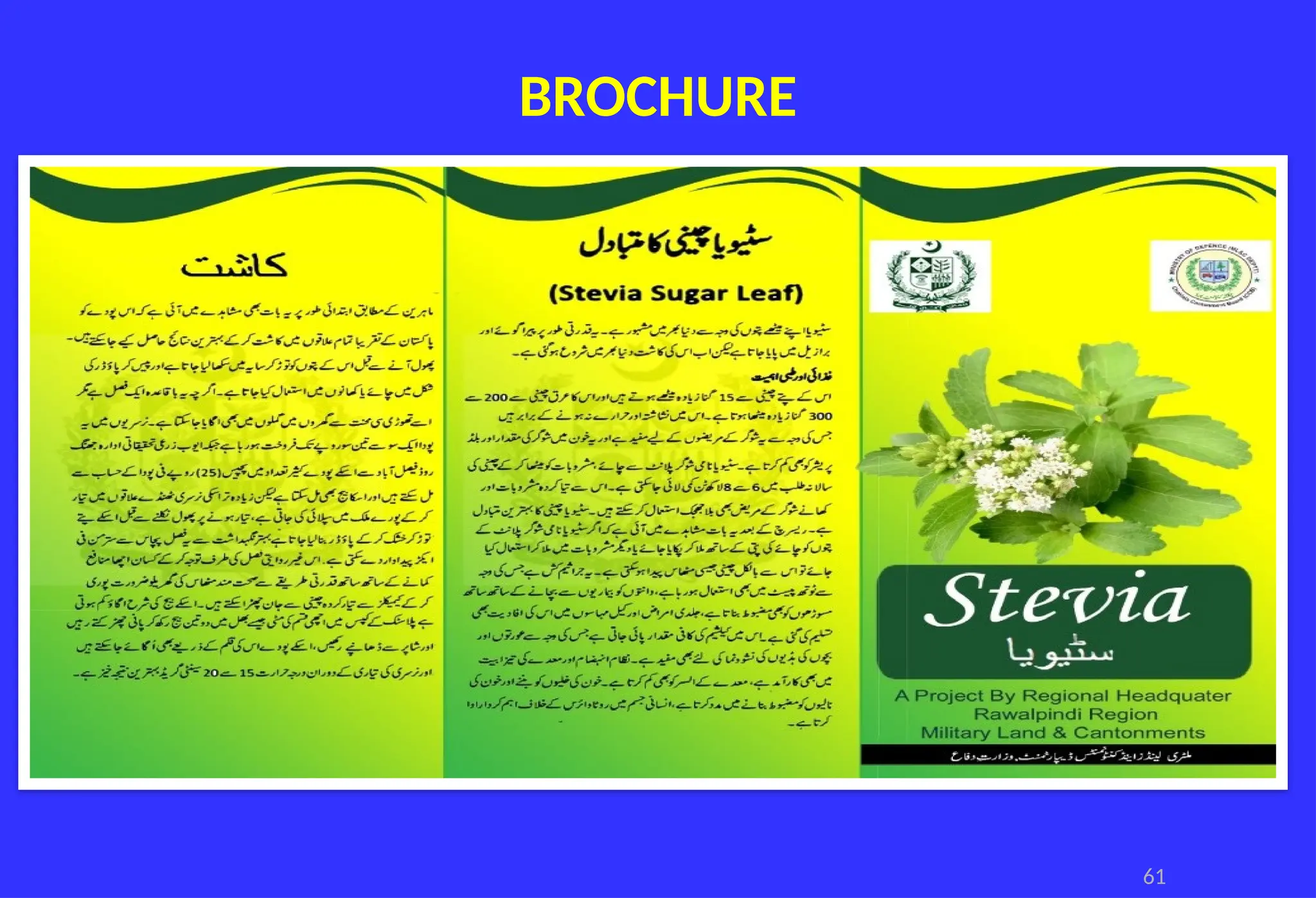
STEVIA – ASUGAR PLANT
Originated from South
America
It was consumed 200 years
back
Stevia is also called sweet
leaf or candyleaf
Grown for its sweet-tasting
leaves
34.
34
MEDICINAL BENEFITS OF
STEVIA
Steviais suited for diabetic obese persons and
prevention of type 02 diabetes
Stevia also regulates blood glucose level by enhancing
insulin secretion
It also shows good results in clearing up skin
problems like dermatitis, eczema, wrinkles, rashes
and itchiness
It also showed antibacterial, antiseptics anti
inflammatory, anti-fertility, hypotensive, diuretic and
35.
35
STEVIA GROW CHART
OUTDOOR
CULTIVATION
SkillLevel Beginner
Colonization Temperature 20°C to 35 °C
Fruiting Temperature 28°C to 32°C
Humidity 65% to 80%
Irrigation Mist irrigation on daily basis
(Evening)
Incubation Time 6 months (from Seeds)
3 months (from Cuttings)
36.
36
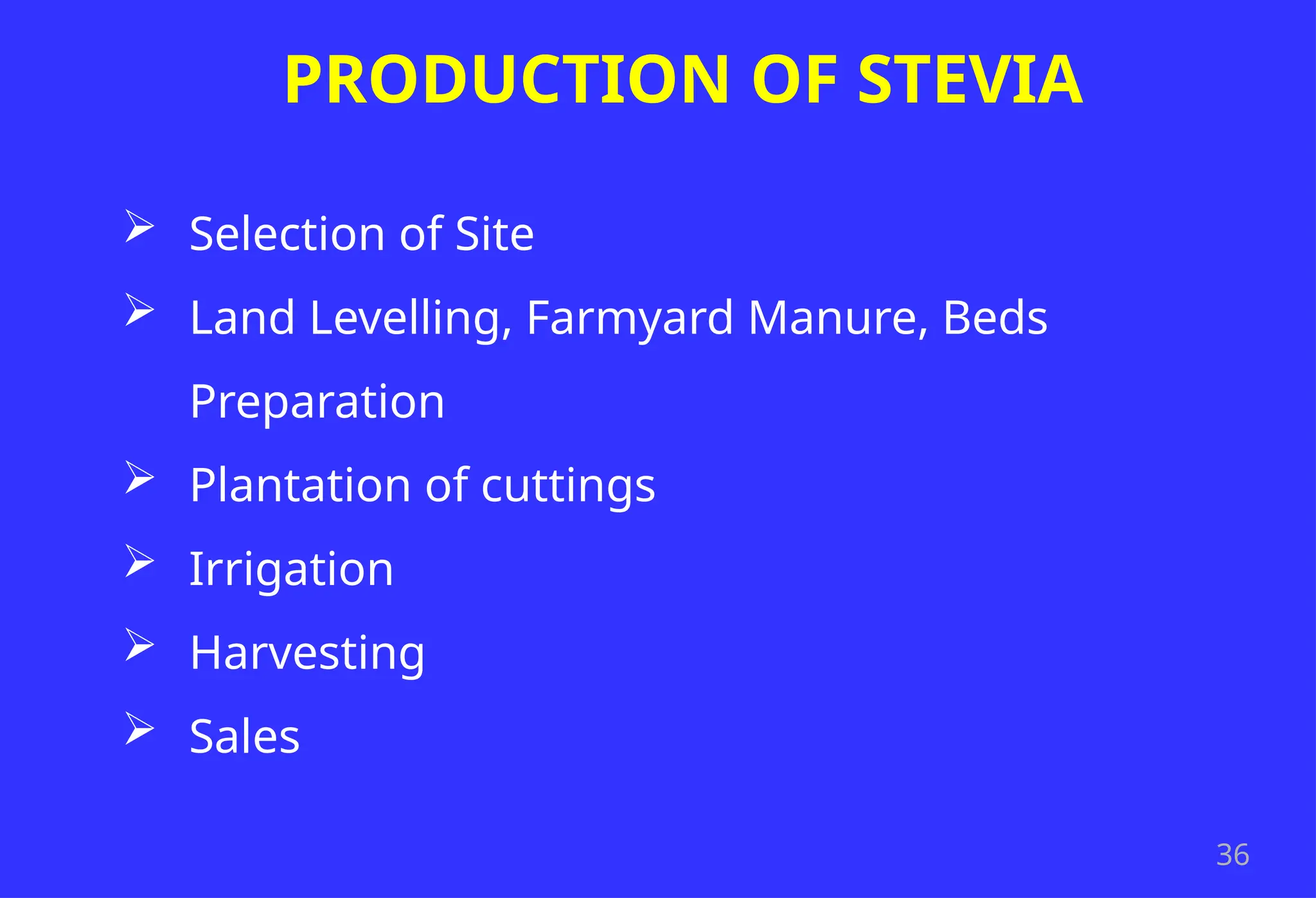
PRODUCTION OF STEVIA
Selection of Site
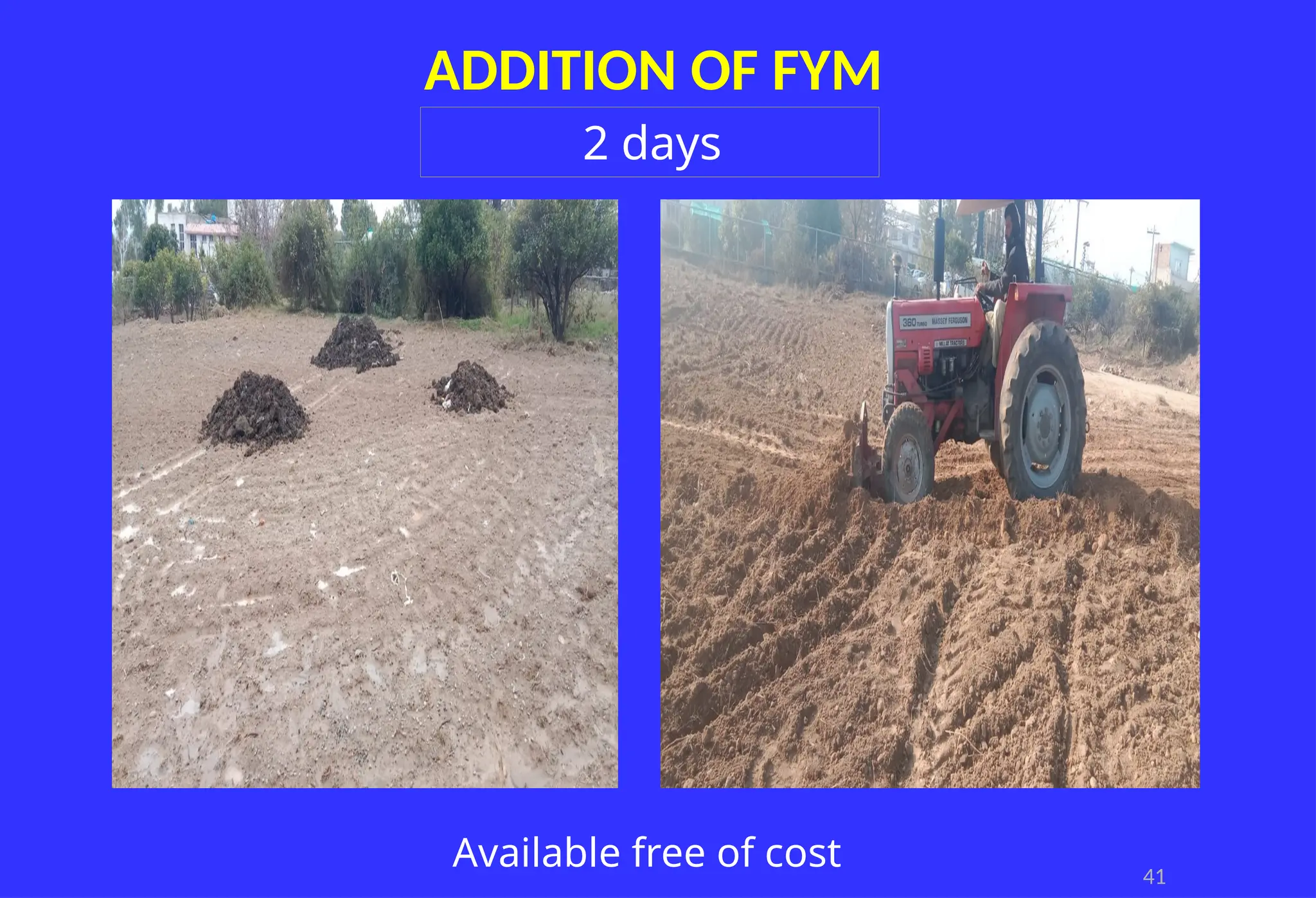
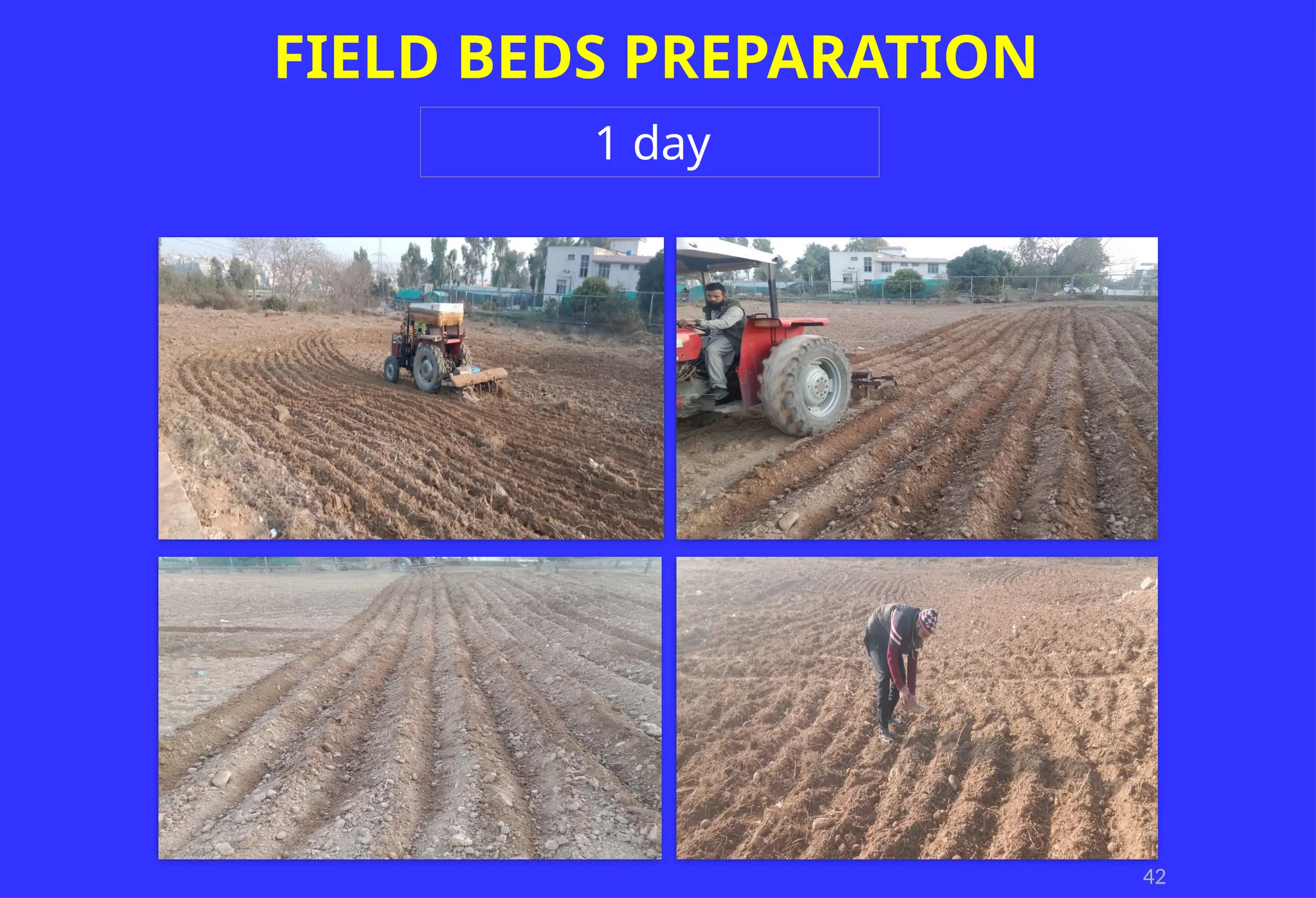
Land Levelling, Farmyard Manure, Beds
Preparation
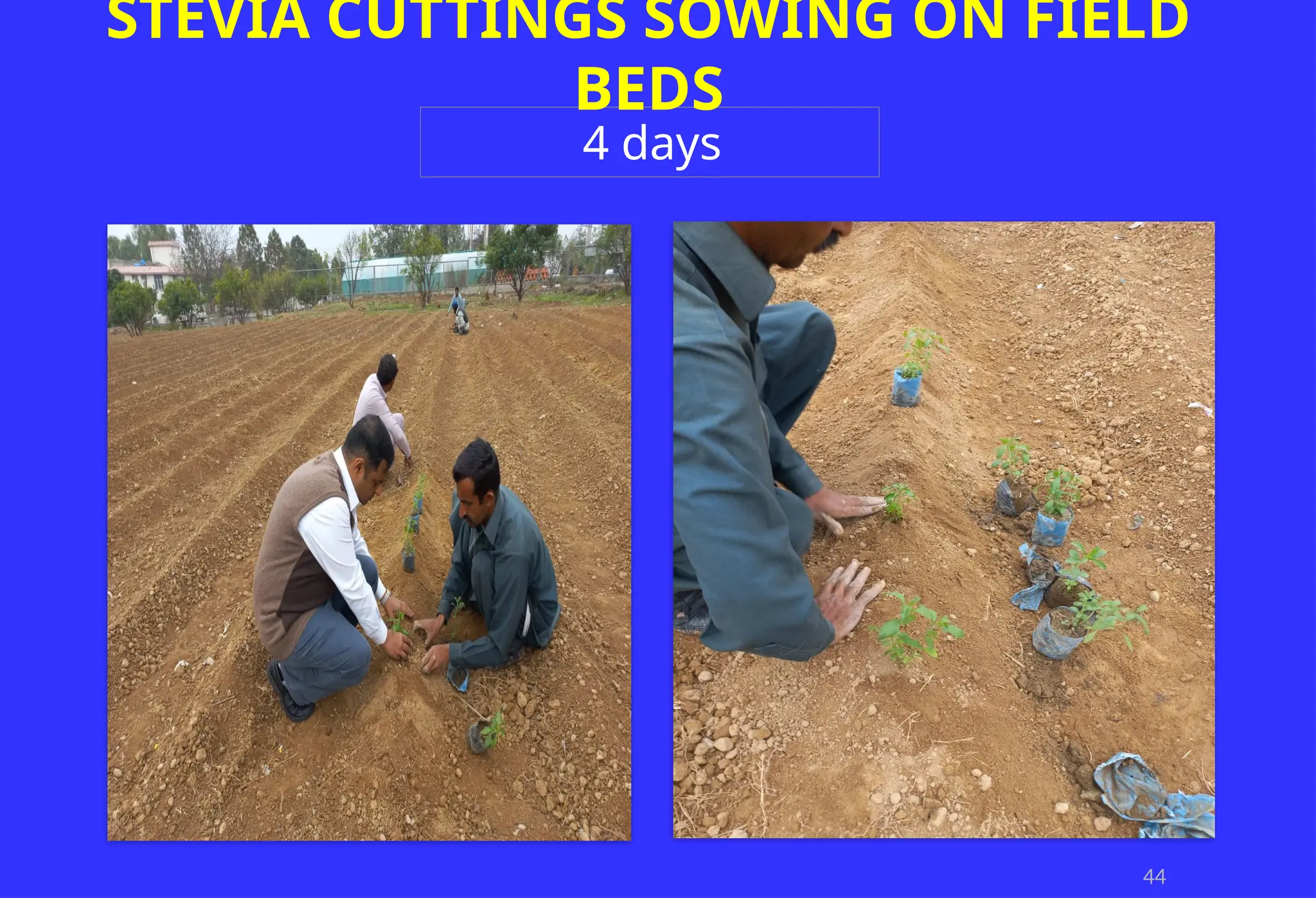
Plantation of cuttings
Irrigation
Harvesting
Sales
43
PROCUREMENT OF STEVIACUTTINGS
RECURRING COST
Plants per acre 1400
Price per plant Rs 50
Total Cost Rs 70,000/-
Note:
The saplings can be produced in
nursery to save cost
45
IRRIGATION
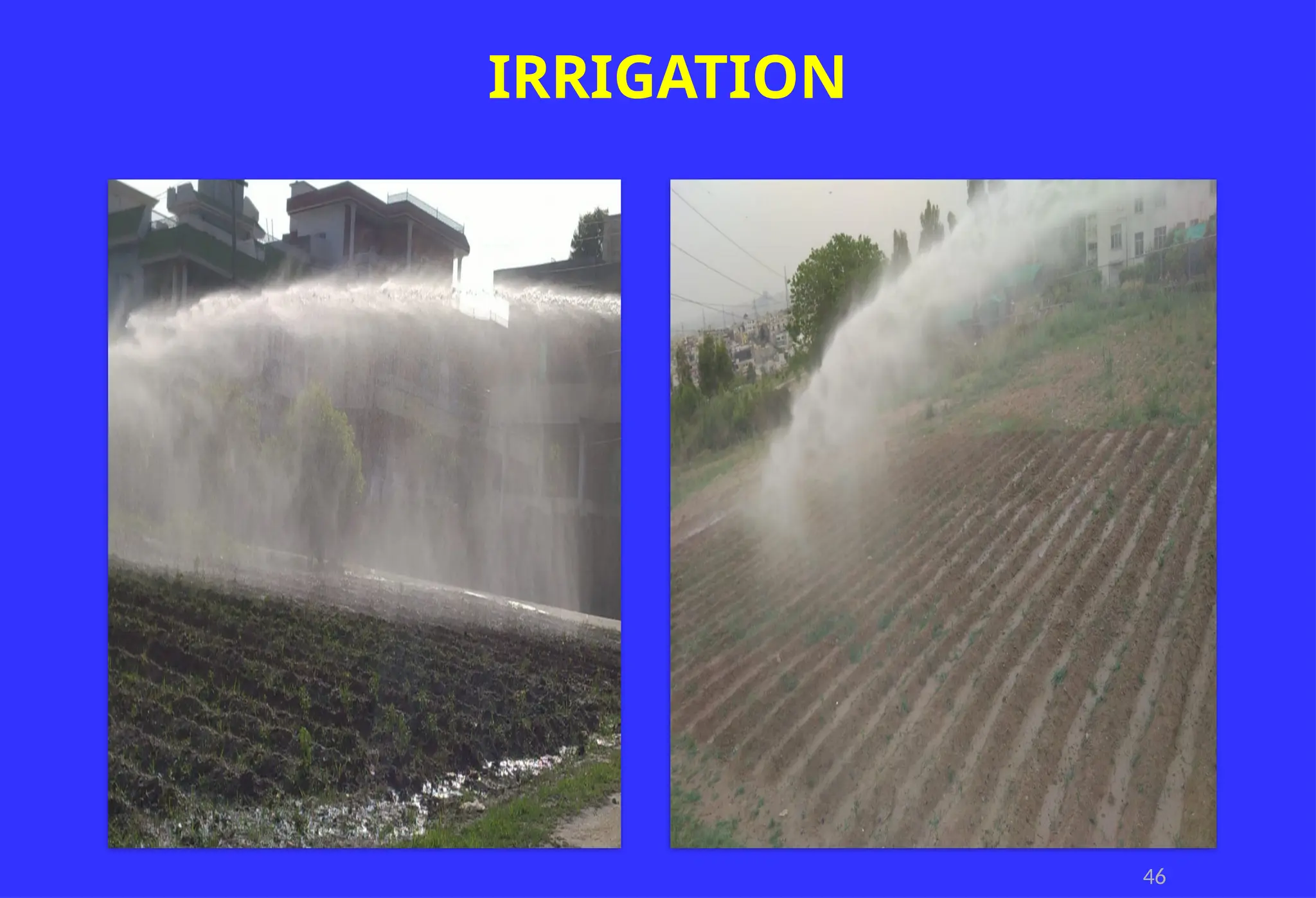
Mist irrigationwas applied to Stevia plants on
daily basis (Evening time).
Fertigation of Stevia plants is also applied for
proper growth and development.
51
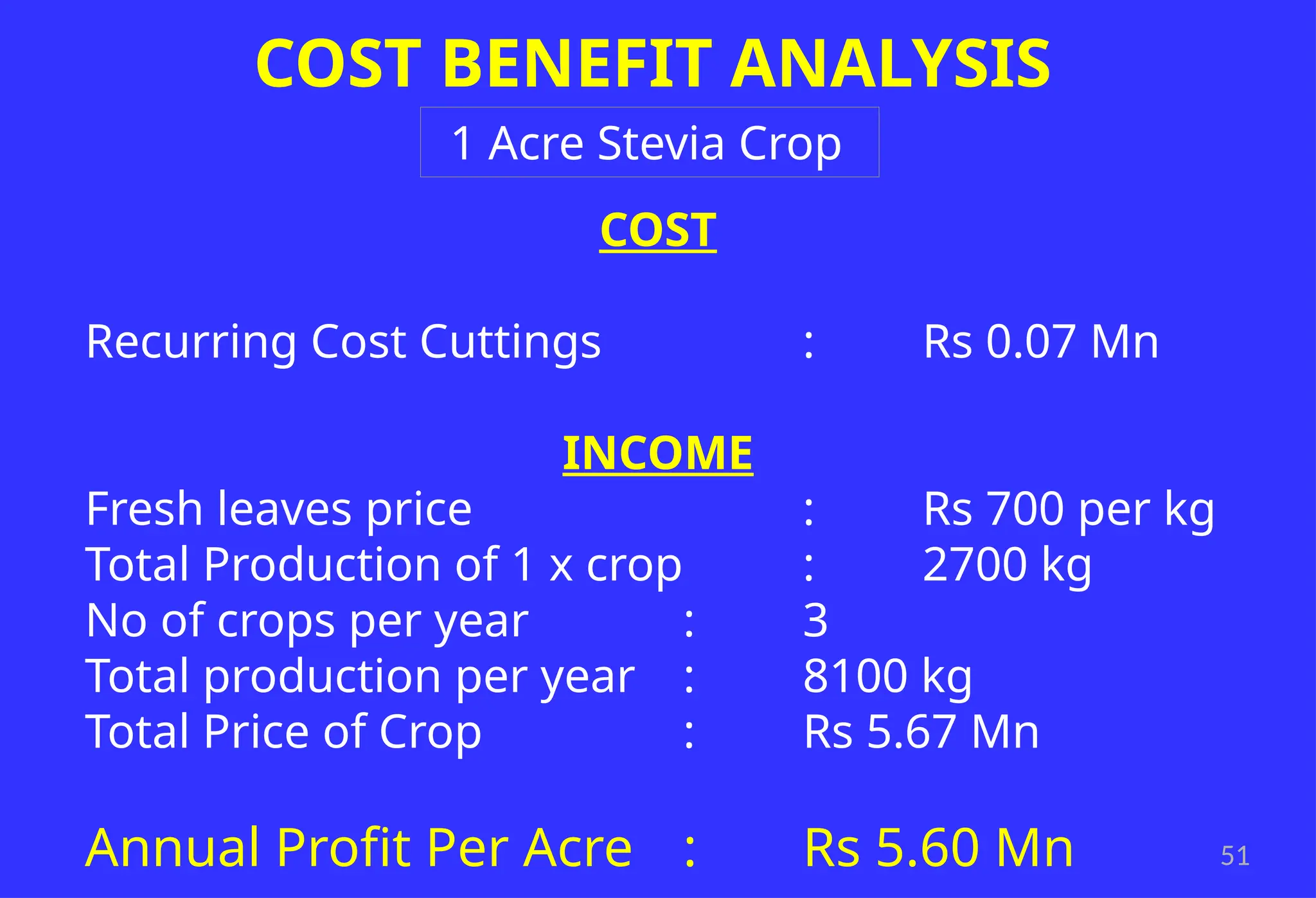
COST BENEFIT ANALYSIS
COST
RecurringCost Cuttings : Rs 0.07 Mn
INCOME
Fresh leaves price : Rs 700 per kg
Total Production of 1 x crop : 2700 kg
No of crops per year : 3
Total production per year : 8100 kg
Total Price of Crop : Rs 5.67 Mn
Annual Profit Per Acre : Rs 5.60 Mn
1 Acre Stevia Crop
52.
52
COST BENEFIT ANALYSIS(CONT..)
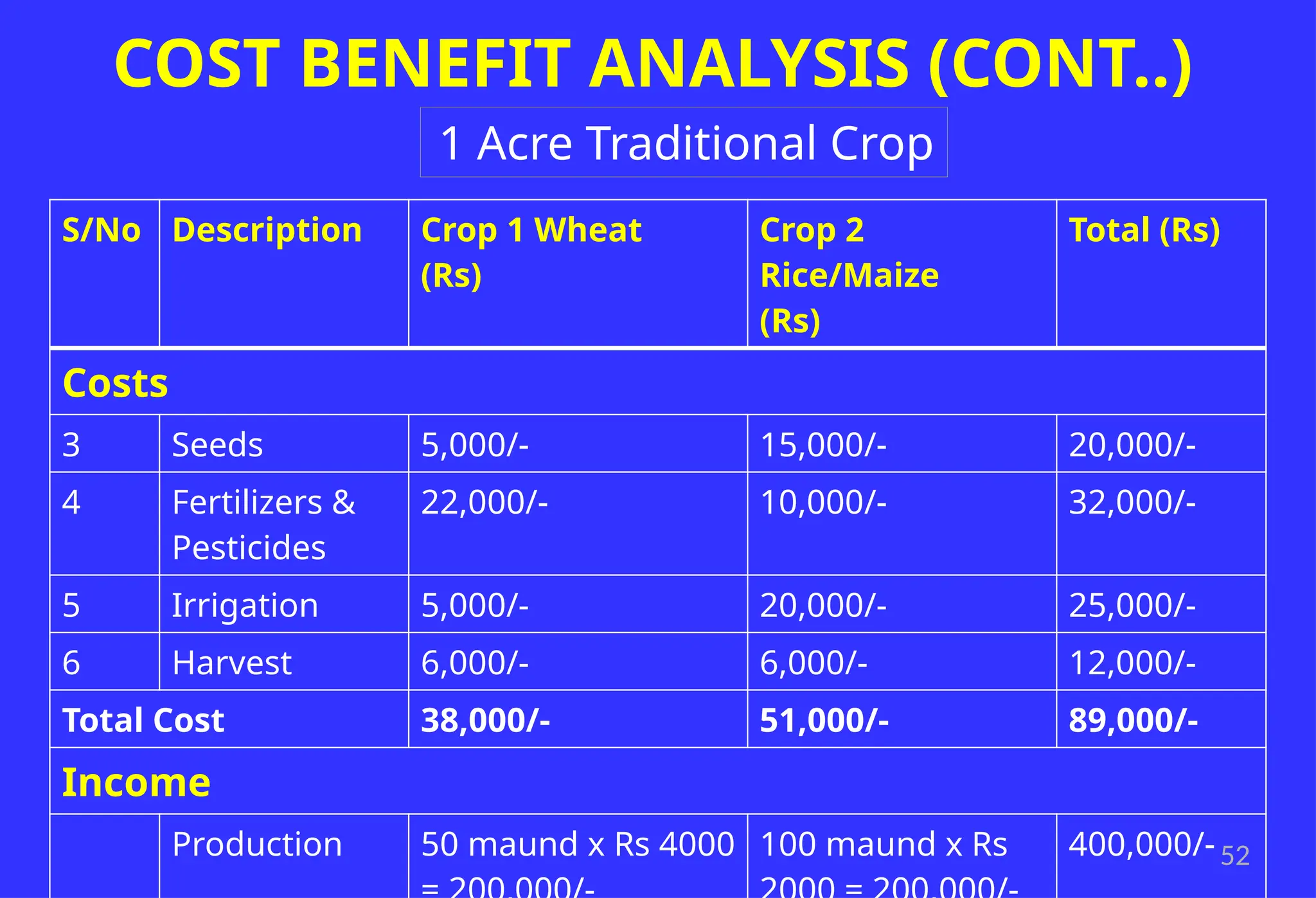
1 Acre Traditional Crop
S/No Description Crop 1 Wheat
(Rs)
Crop 2
Rice/Maize
(Rs)
Total (Rs)
Costs
3 Seeds 5,000/- 15,000/- 20,000/-
4 Fertilizers &
Pesticides
22,000/- 10,000/- 32,000/-
5 Irrigation 5,000/- 20,000/- 25,000/-
6 Harvest 6,000/- 6,000/- 12,000/-
Total Cost 38,000/- 51,000/- 89,000/-
Income
Production 50 maund x Rs 4000 100 maund x Rs 400,000/-
53.
53
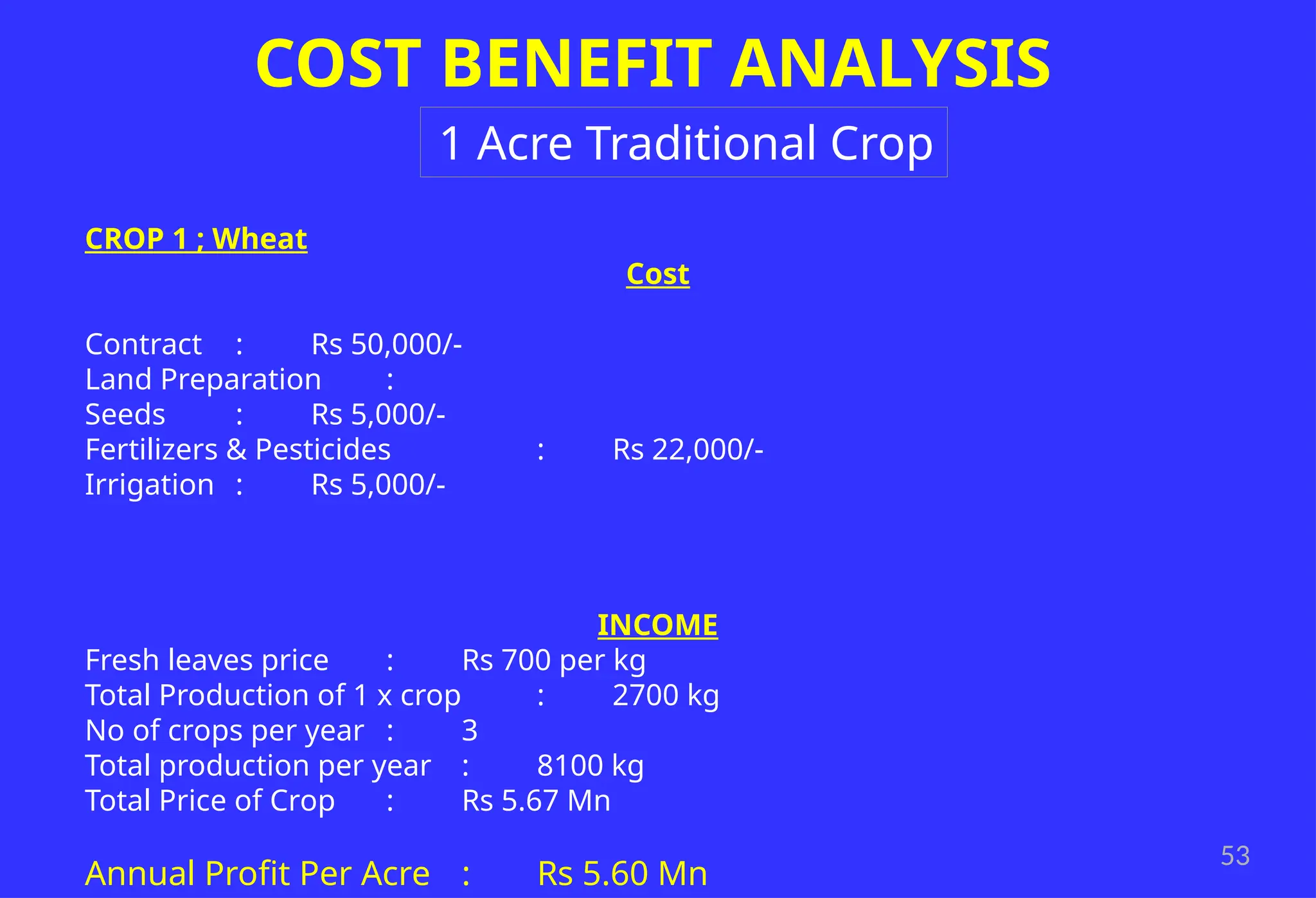
COST BENEFIT ANALYSIS
CROP1 ; Wheat
Cost
Contract : Rs 50,000/-
Land Preparation :
Seeds : Rs 5,000/-
Fertilizers & Pesticides : Rs 22,000/-
Irrigation : Rs 5,000/-
INCOME
Fresh leaves price : Rs 700 per kg
Total Production of 1 x crop : 2700 kg
No of crops per year : 3
Total production per year : 8100 kg
Total Price of Crop : Rs 5.67 Mn
Annual Profit Per Acre : Rs 5.60 Mn
1 Acre Traditional Crop
54.
54
COST BENEFIT ANALYSIS(CONT..)
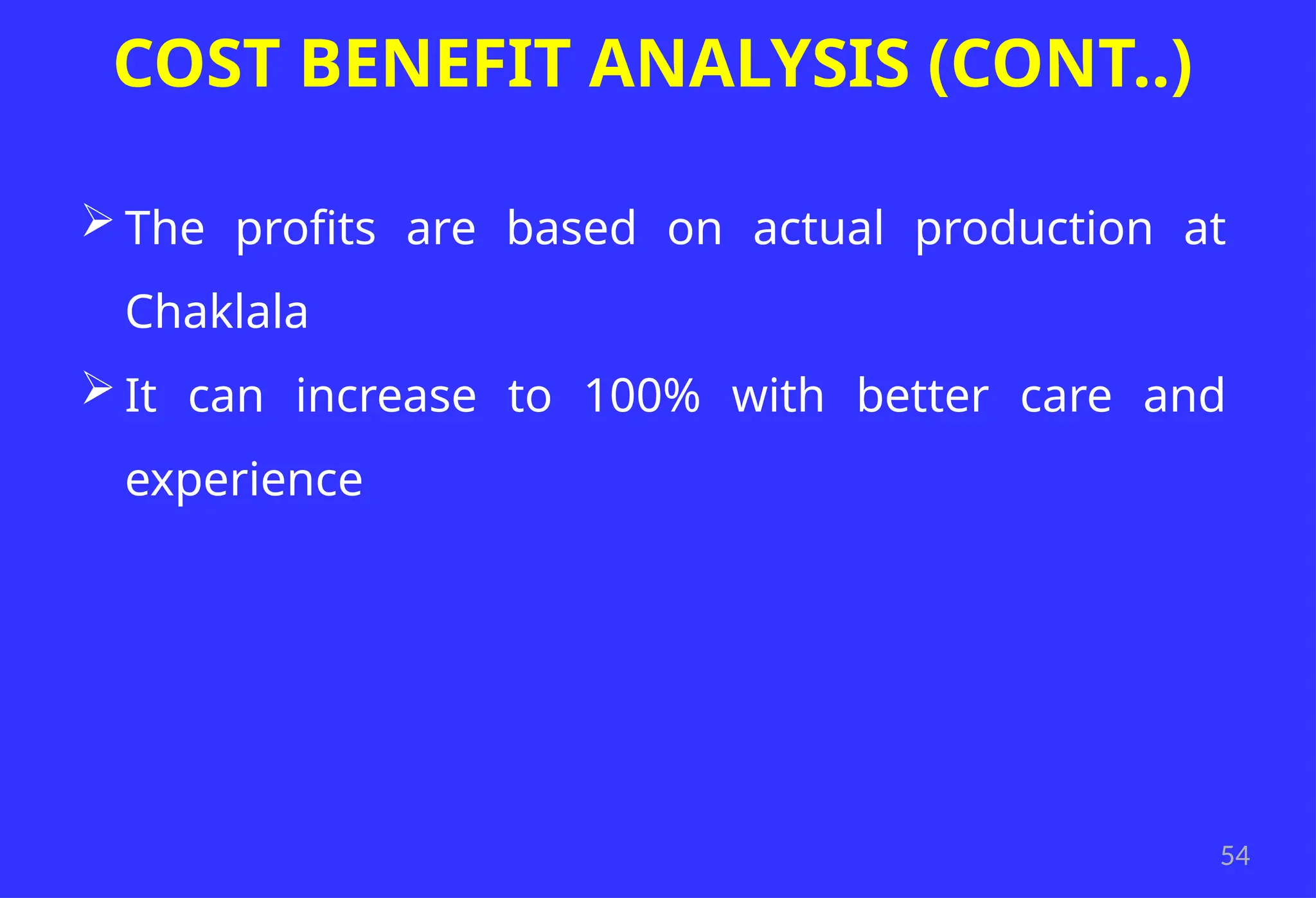
The profits are based on actual production at
Chaklala
It can increase to 100% with better care and
experience
56
SALES & MARKETING
The growth of the stevia market is driven by several
factors, including increasing demand from the beverages,
pharmaceutical and confectionary sector, growing
concerns over diabetes and obesity and regulatory
restrictions on certain artificial sweeteners
By application, the stevia market is segmented into bakery,
dairy food products, beverages, dietary supplements,
confectionery and herbal medicines
CCB has approached market with 2-pronged strategy
Fresh Leaves sale directly to companies
57.
57
SALE OF FRESHLEAVES
The first crop of CCB has been sold to Nawab Foods –
Bhara Kahu as fresh leaves standing crop at the rate of
Rs 500 per kg
Quality assurance certificate has been obtained from
(NARC , PARC) for its proper marketing
There are many a companies showing interest in buying
fresh leaves whole crop which include
Qarshi Industries - Hattar
Marhaba Industries - Lahore
Hamdard Food Laboratories – Marir Hassan
58.
58
OWN PRODUCT :“STEVIA - A SUGAR
PLANT”
Team CCB will dry the leaves and make
powder using a machine
Salesmen will be hired to reach retail to
retail
The bags of product will be placed at all
retail shops , food industries and
pharmaceuticals
Team CCB will provide a centralized
platform for sale of product of all
neighbouring cantonments, whoever can
transport the product to Rawalpindi
62
RECOMENDATIONS
Production ofStevia should be immediately replicated in
all cantonments at available un-used, waste lands
All the guidelines and expertise can be taken from RHQ,
Rawalpindi
During summer season this project could be
implemented in all Cantonments except hilly areas. The
team will also conducted survey of these stations and
recommended sites for growth of Stevia
Stevia cultivation project has also been started in Pano
Aqil
64
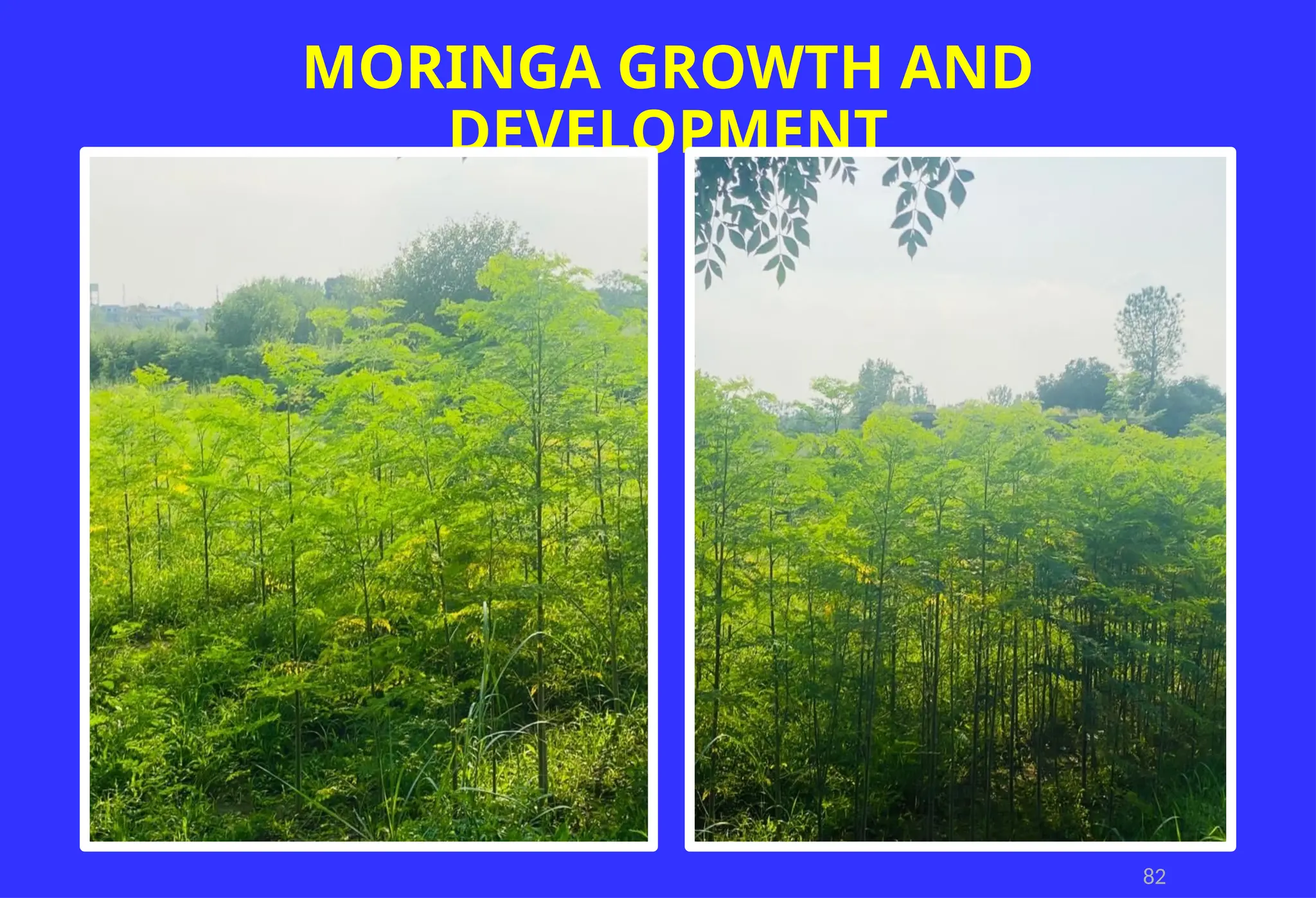
MORINGA – AMIRACLE
PLANT
Moringa, also known as sohanjna or miracle plant is a
tree native to sub-himaliyan tracts of sub-continent
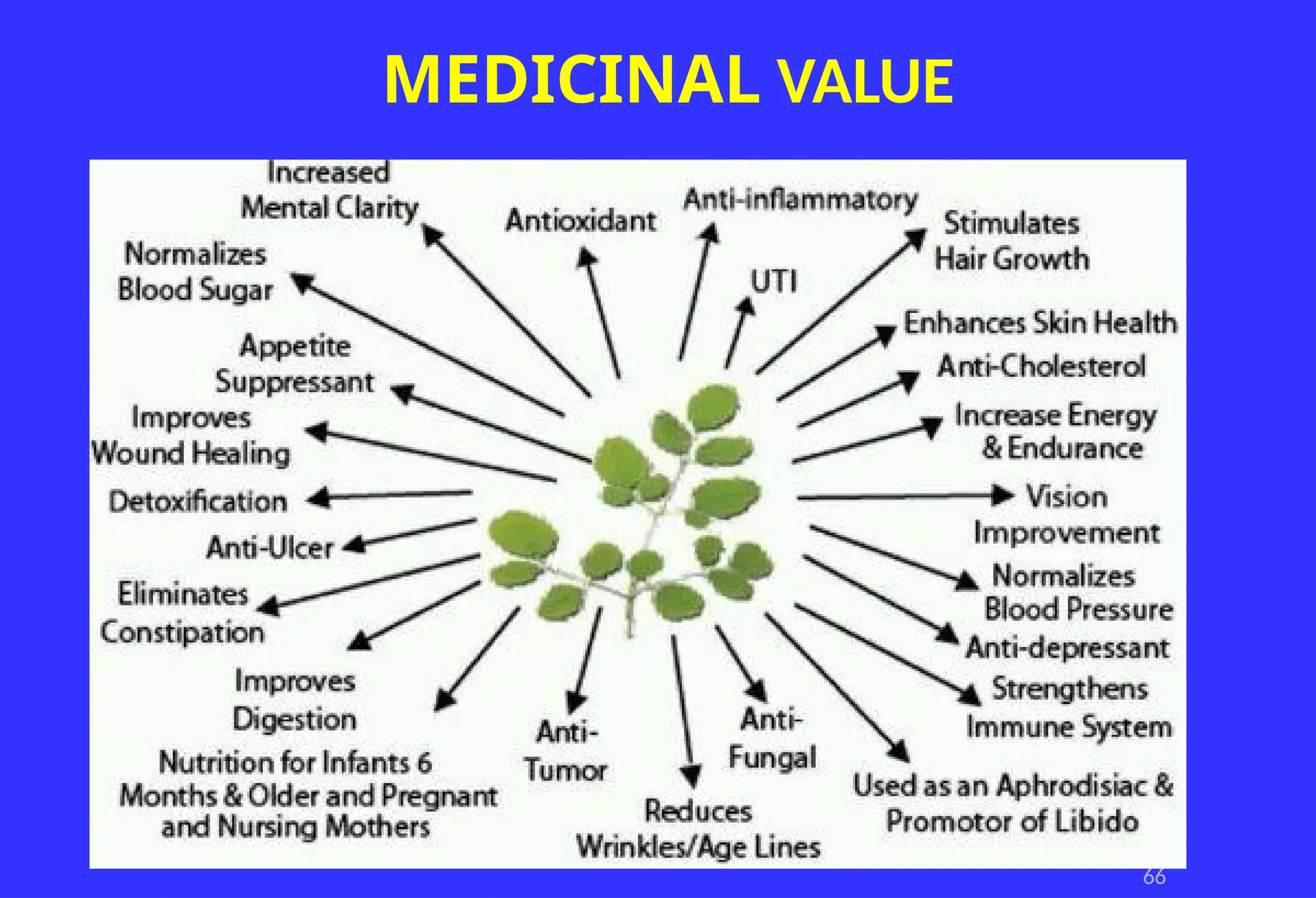
It has phenomenal nutritional and medicinal values
and has vast uses ranging from cosmetic industry to
animal fodder
Its market value is high, being sold in the form of dry
leaves, tablets and powder
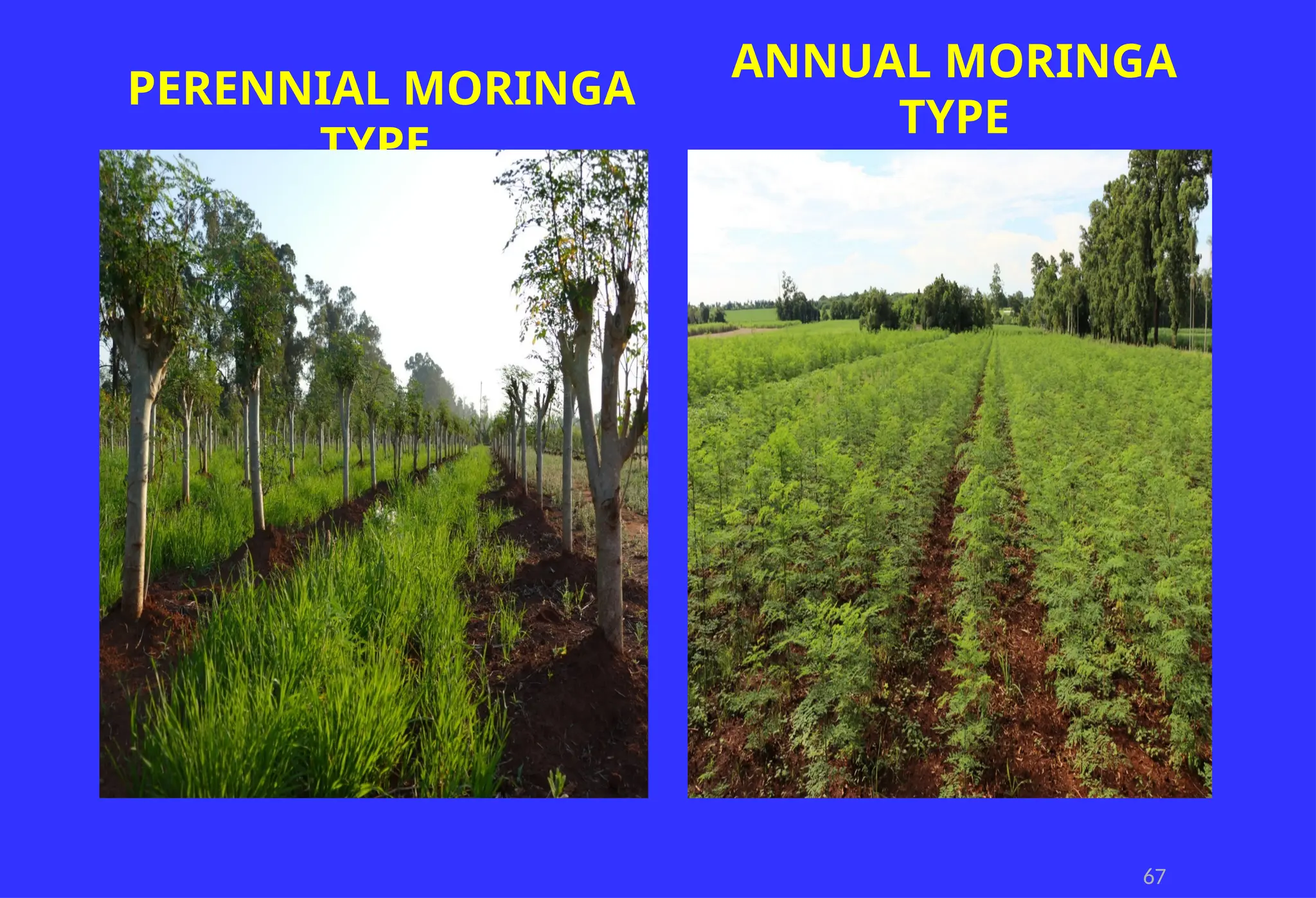
Moringa is grown as perennial crop of big trees as well
68
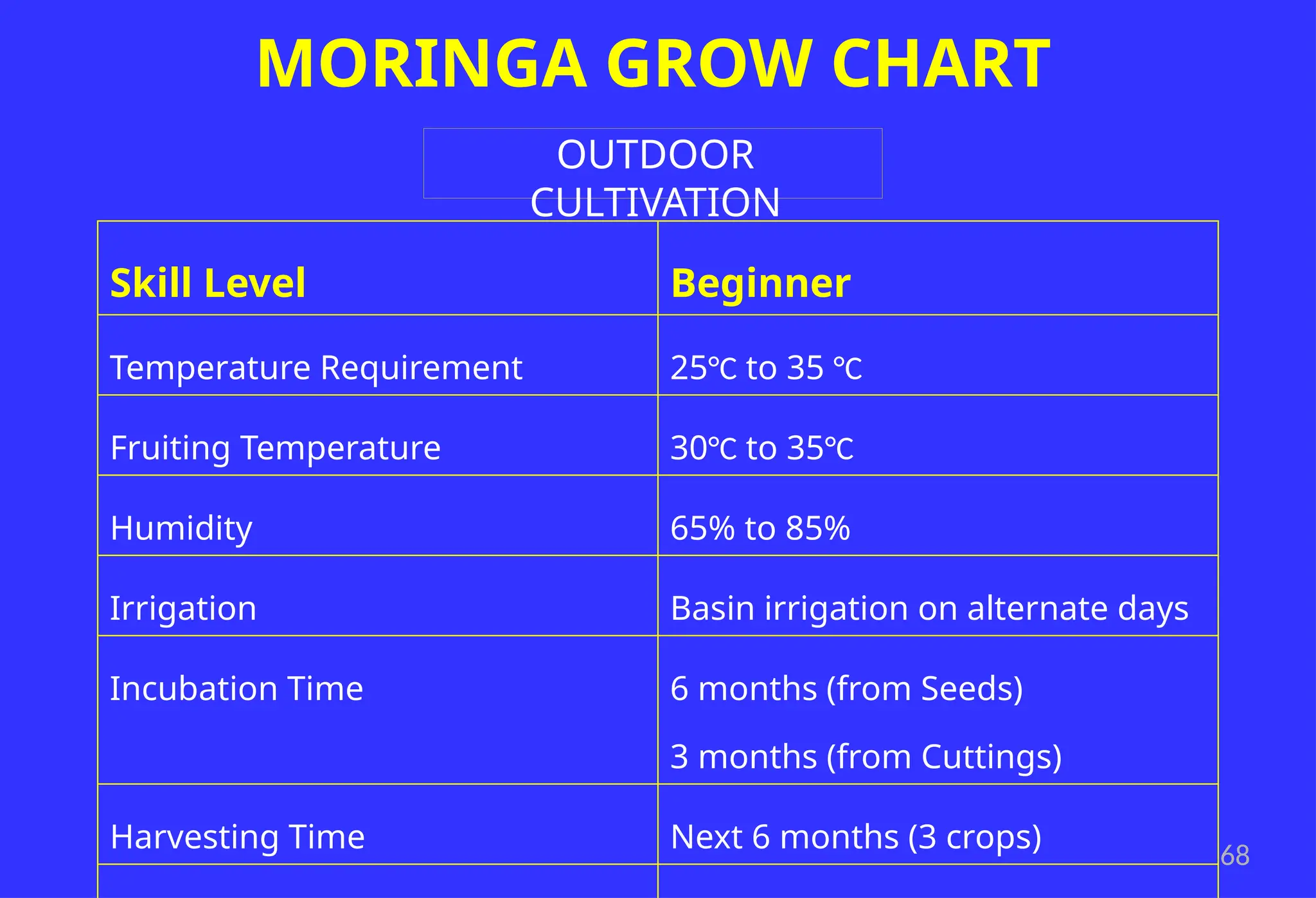
MORINGA GROW CHART
OUTDOOR
CULTIVATION
SkillLevel Beginner
Temperature Requirement 25°C to 35 °C
Fruiting Temperature 30°C to 35°C
Humidity 65% to 85%
Irrigation Basin irrigation on alternate days
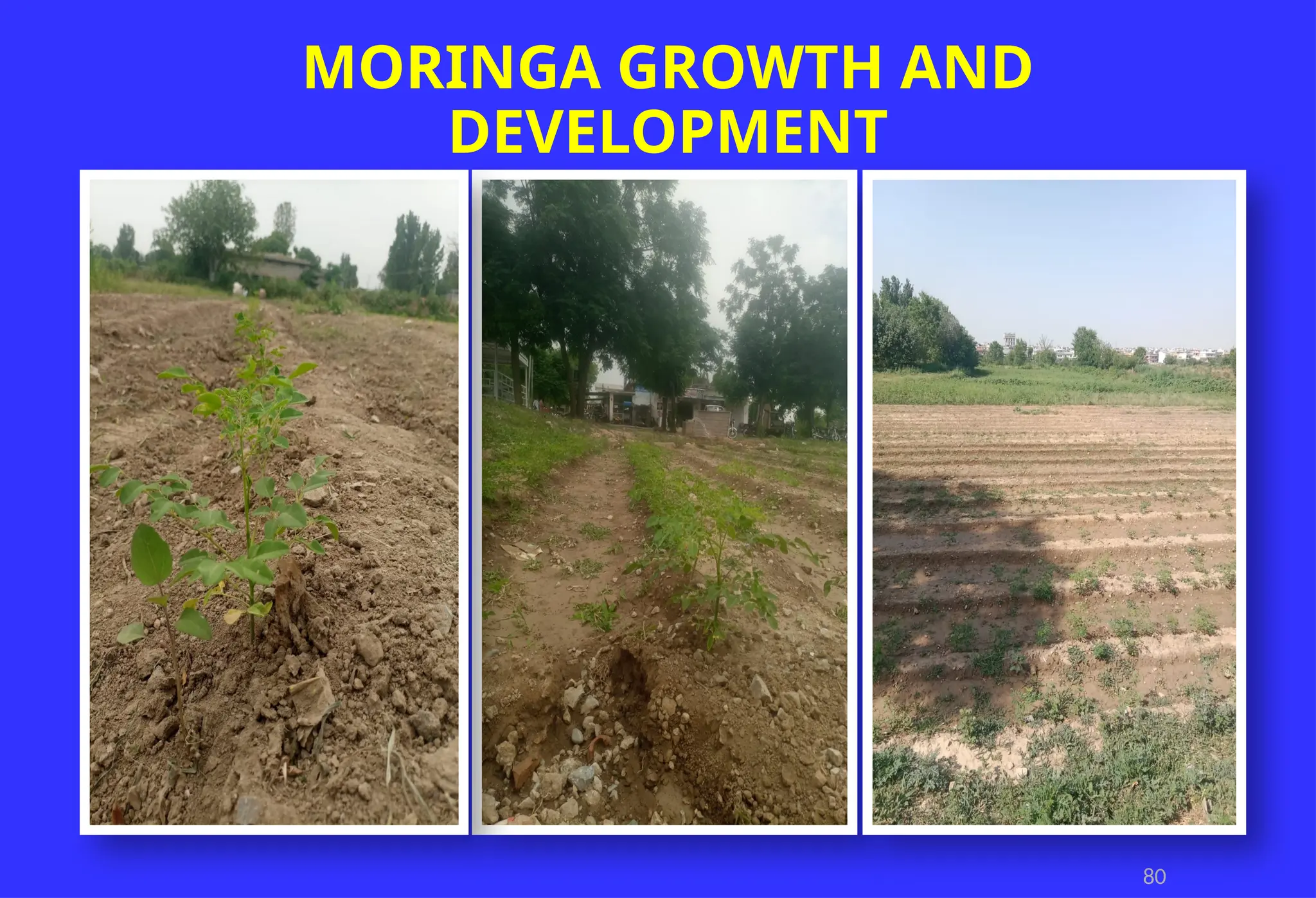
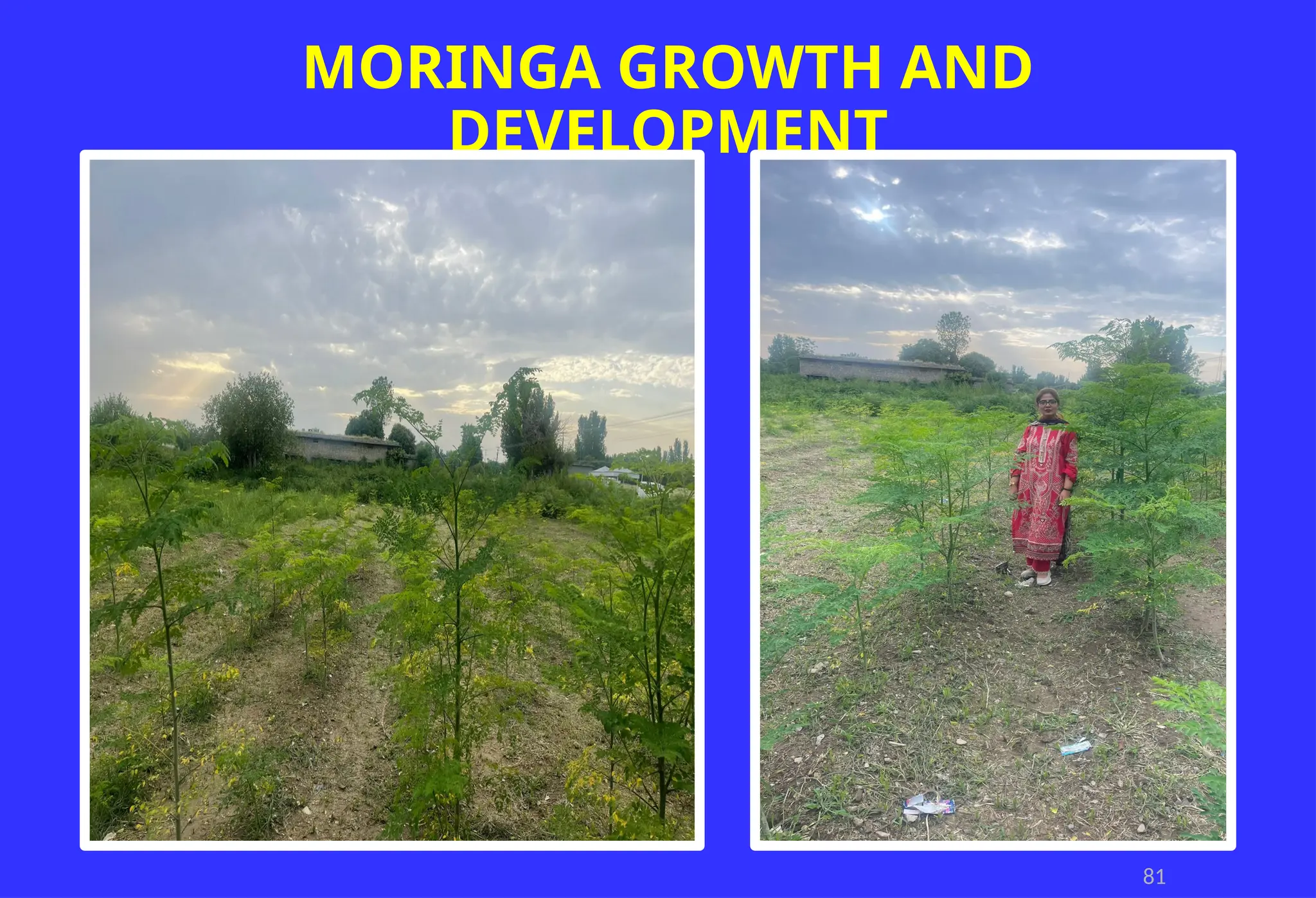
Incubation Time 6 months (from Seeds)
3 months (from Cuttings)
Harvesting Time Next 6 months (3 crops)
69.
69
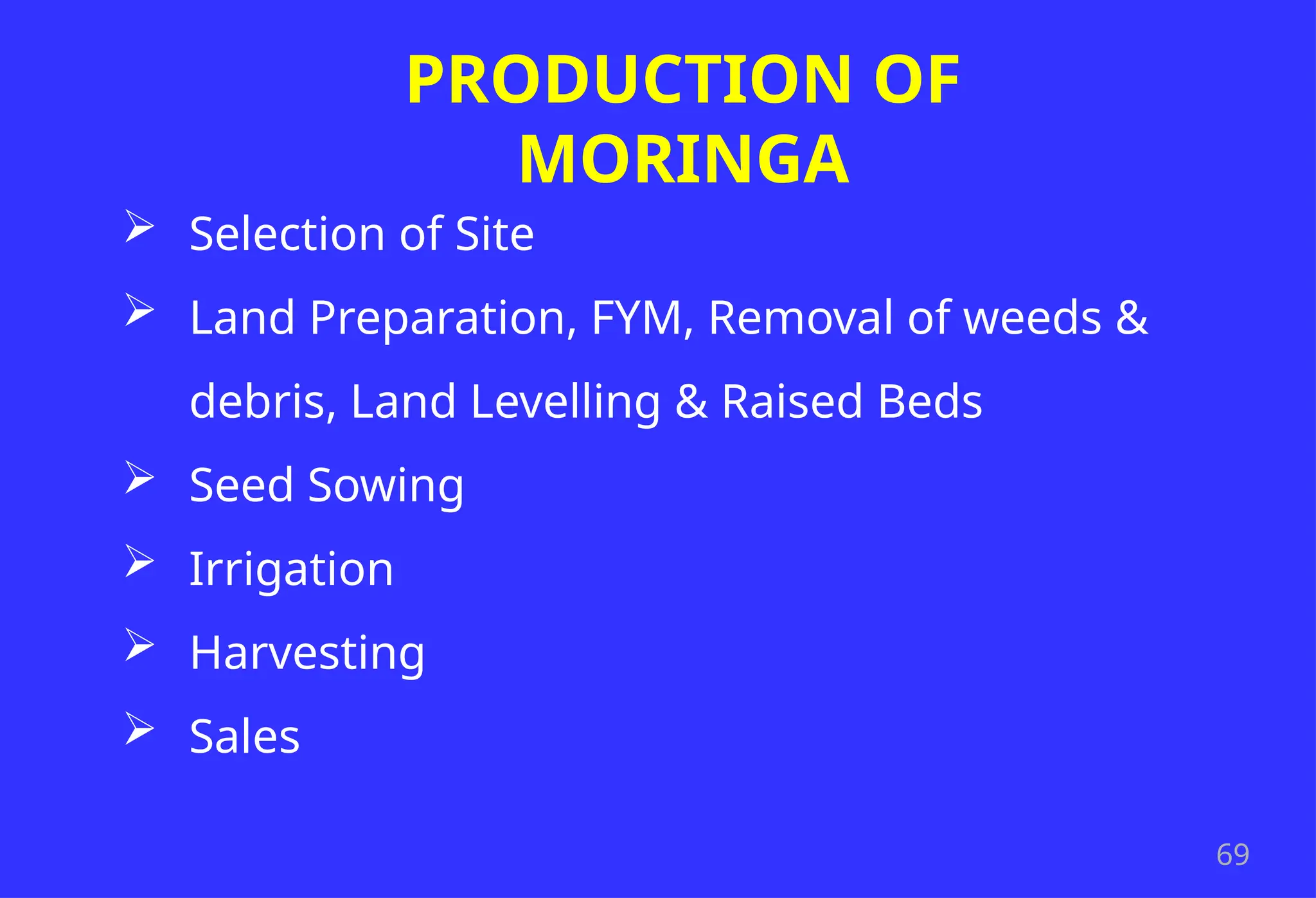
PRODUCTION OF
MORINGA
Selectionof Site
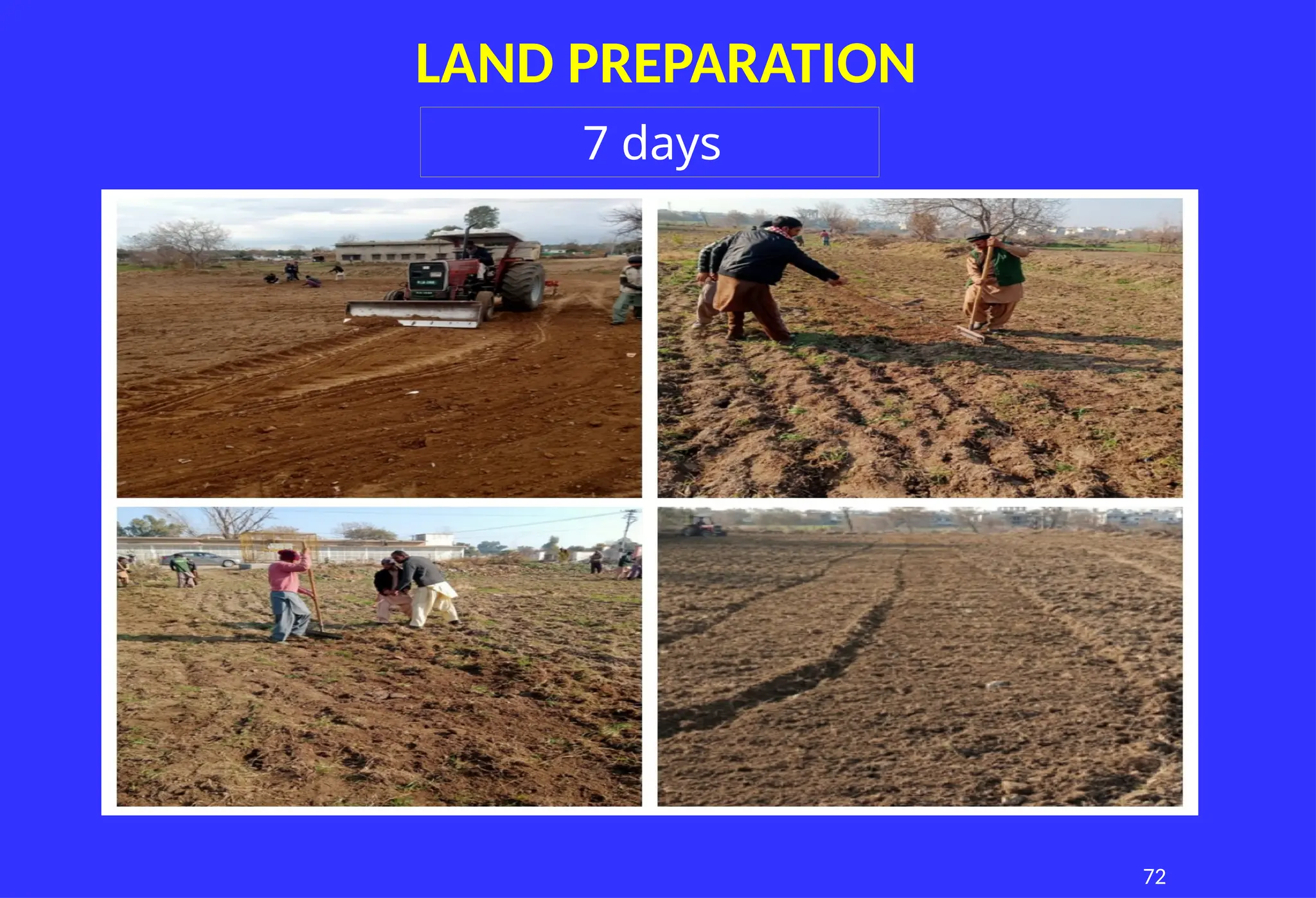
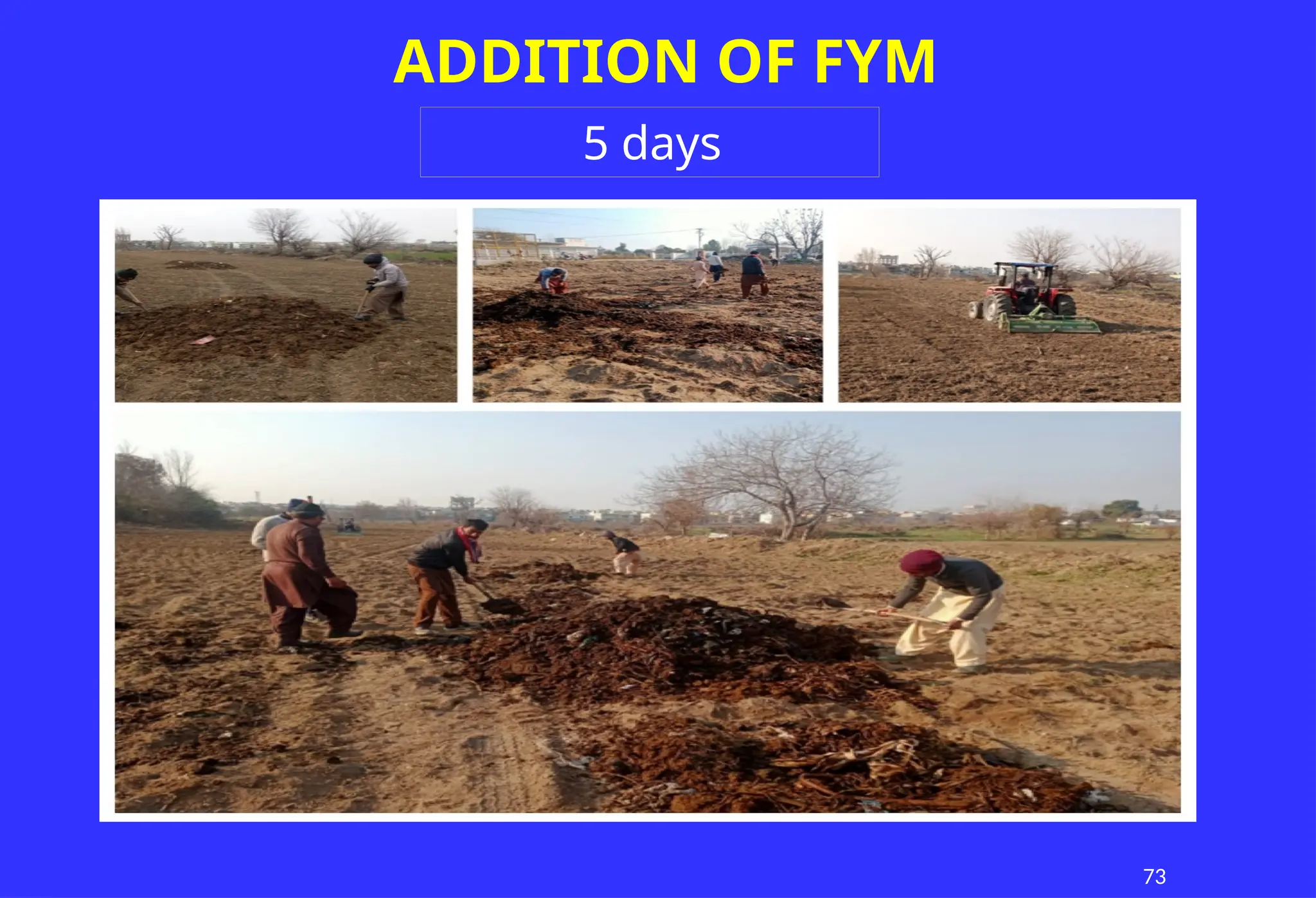
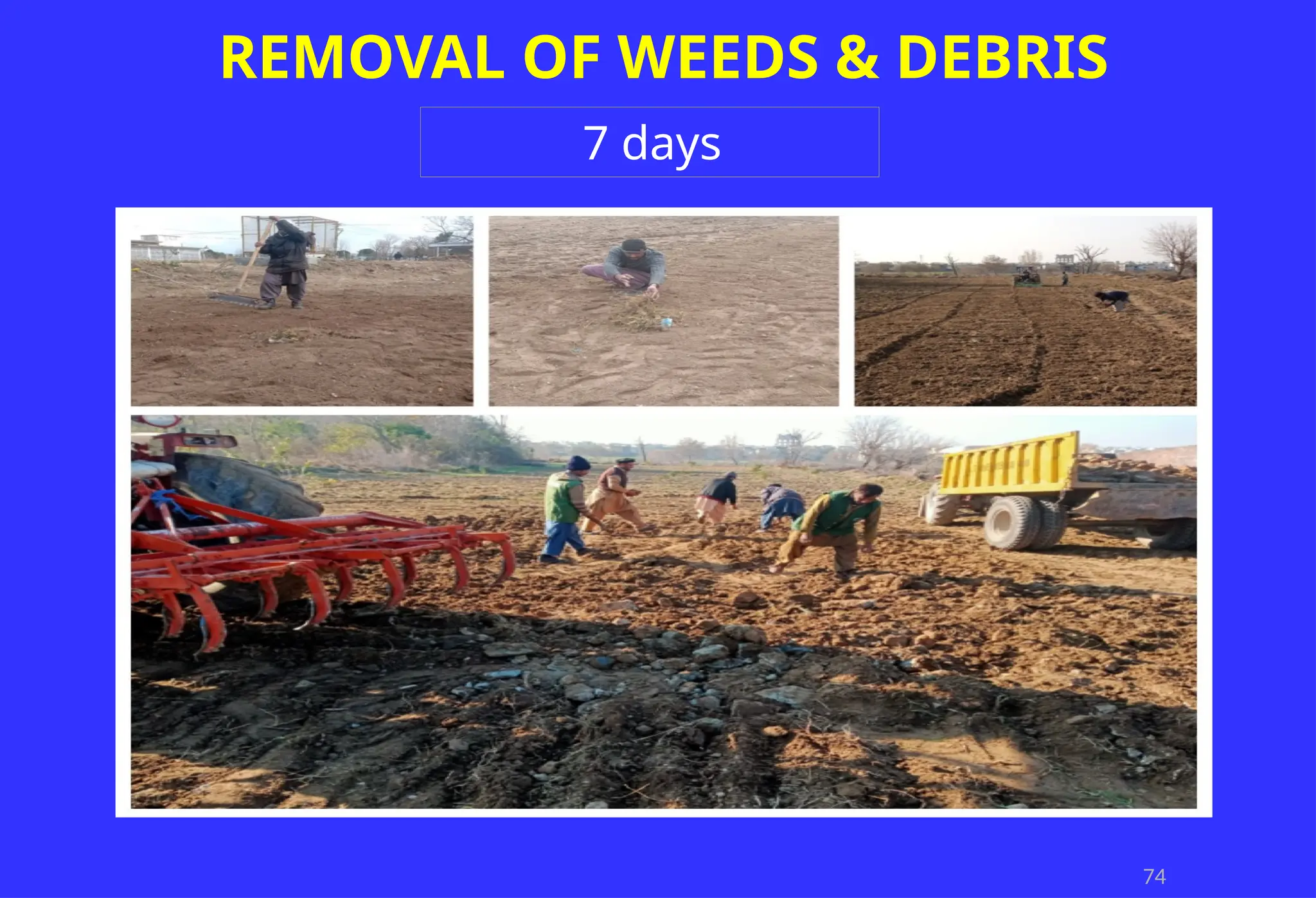
Land Preparation, FYM, Removal of weeds &
debris, Land Levelling & Raised Beds
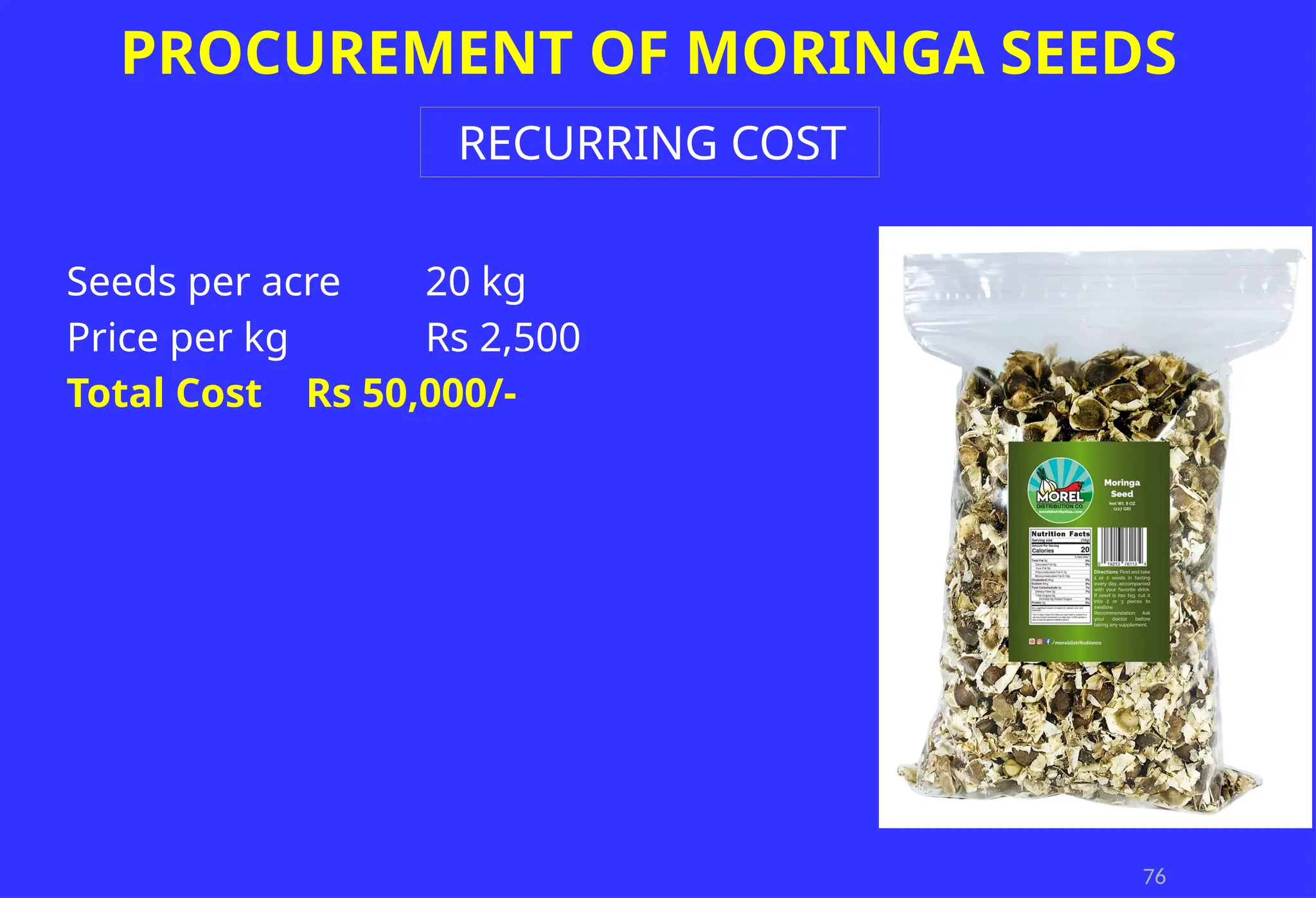
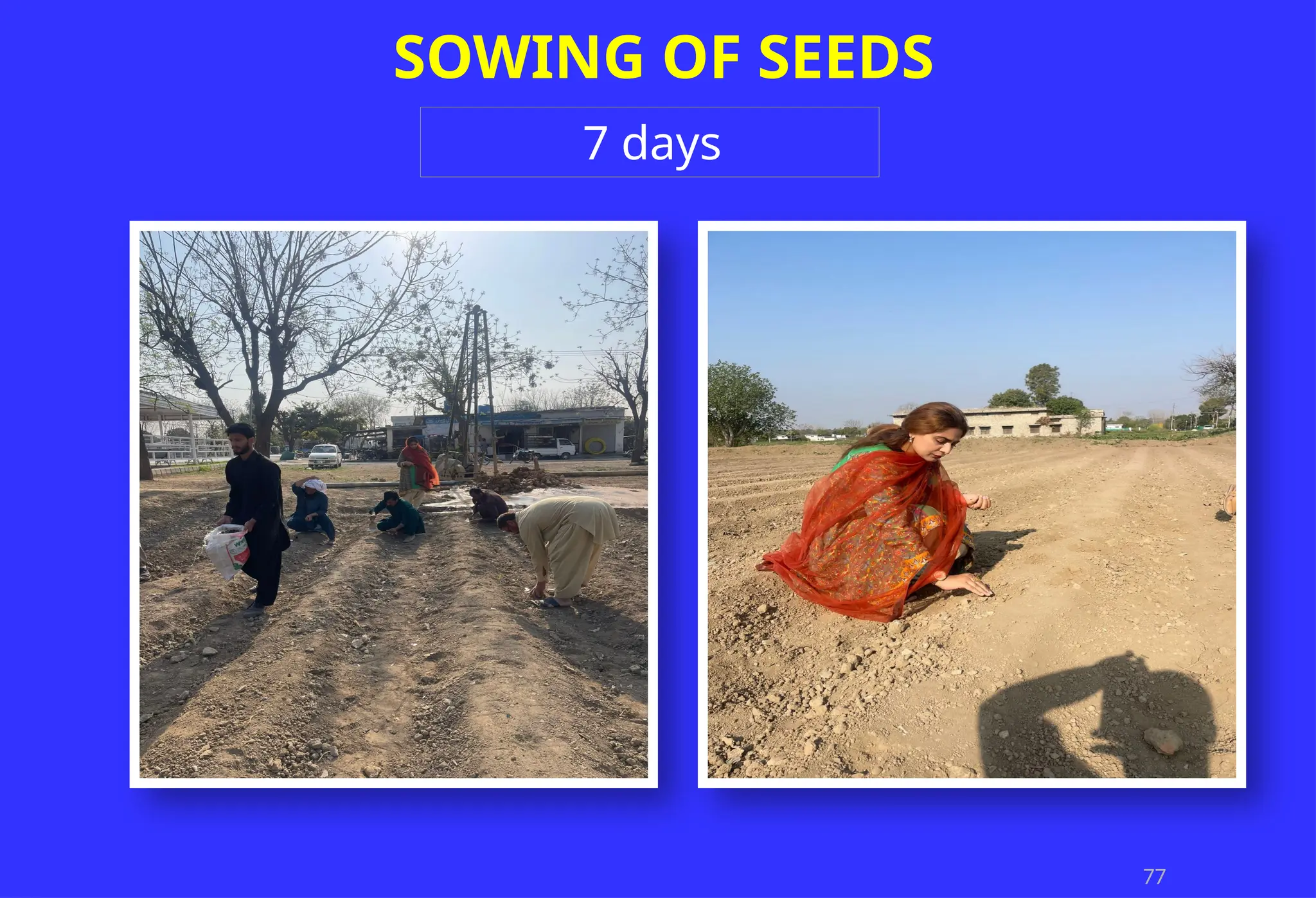
Seed Sowing
Irrigation
Harvesting
Sales
78
IRRIGATION
Basin irrigationwas applied to Moringa seeds on
daily basis.
Fertigation of Moringa plants is also applied for
proper growth and development.
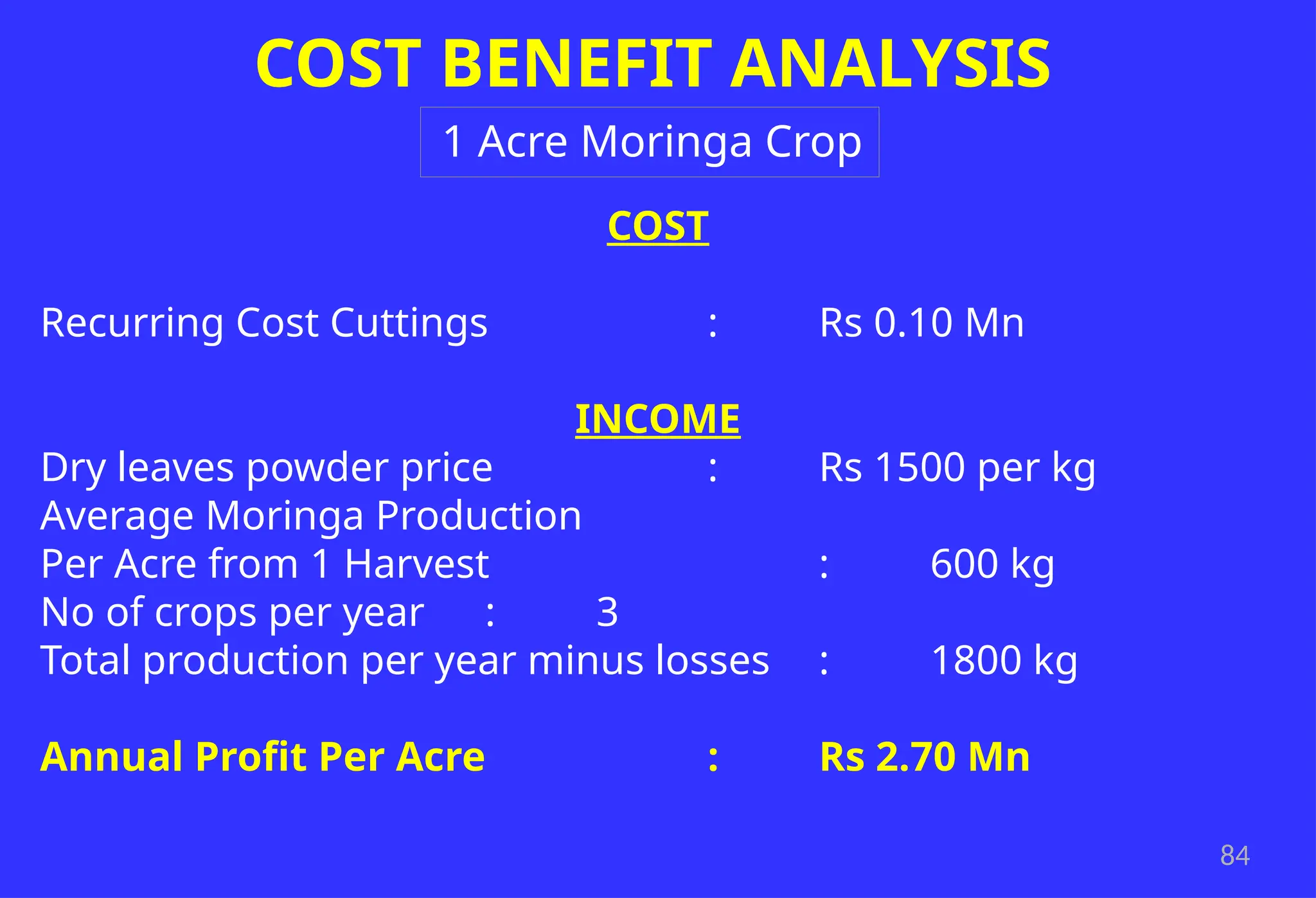
84
COST BENEFIT ANALYSIS
COST
RecurringCost Cuttings : Rs 0.10 Mn
INCOME
Dry leaves powder price : Rs 1500 per kg
Average Moringa Production
Per Acre from 1 Harvest : 600 kg
No of crops per year : 3
Total production per year minus losses : 1800 kg
Annual Profit Per Acre : Rs 2.70 Mn
1 Acre Moringa Crop
86
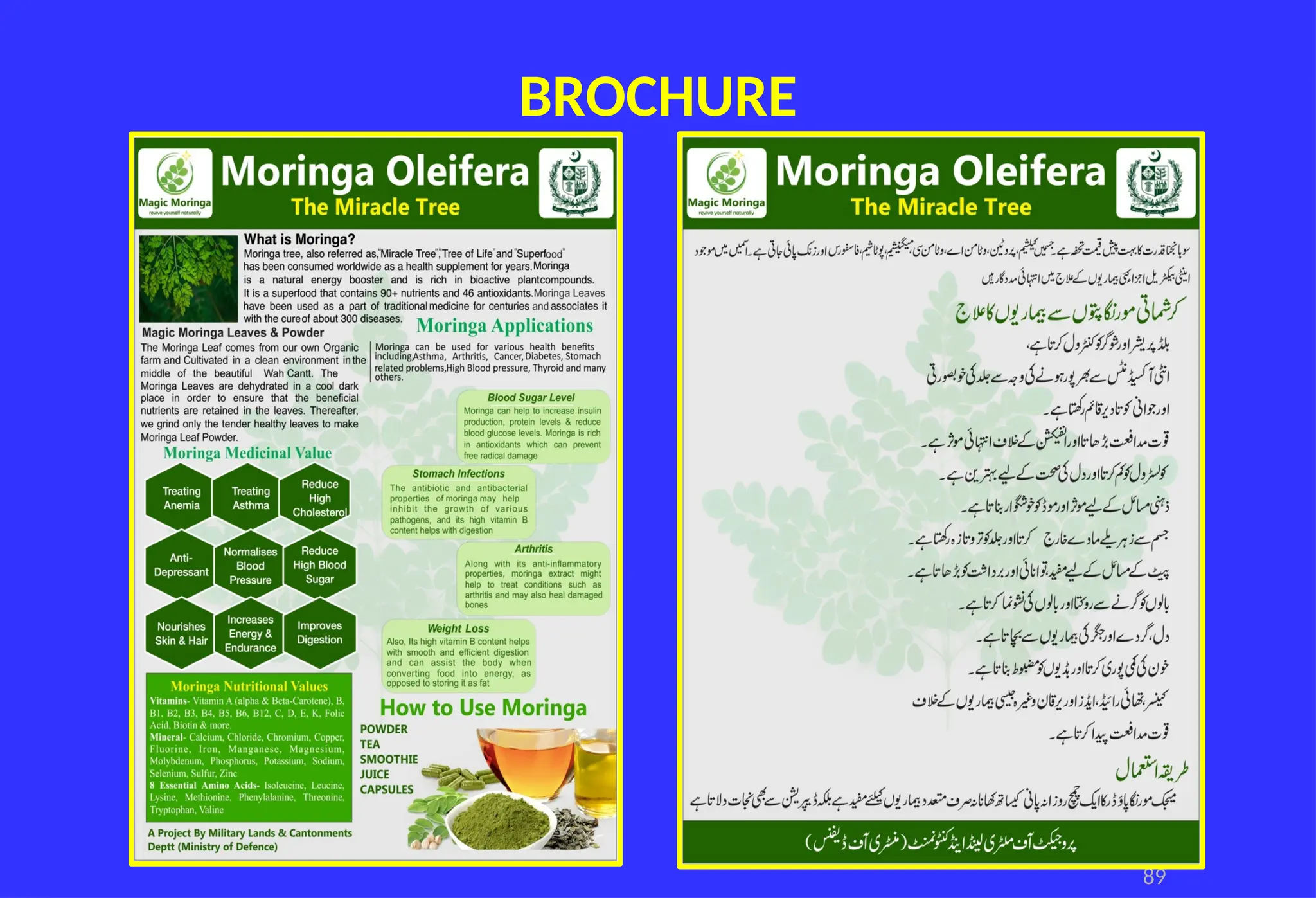
SALES & MARKETING
After first harvest leaves will be dried in a special
dryer unit
Dry leaves will be processed in powder form
Moringa powder will be sold in the market by
product name Magic Moringa
Moringa radish bags will be sold in the vegetable
market
Central moringa stem will be sold to dairy farms
87.
87
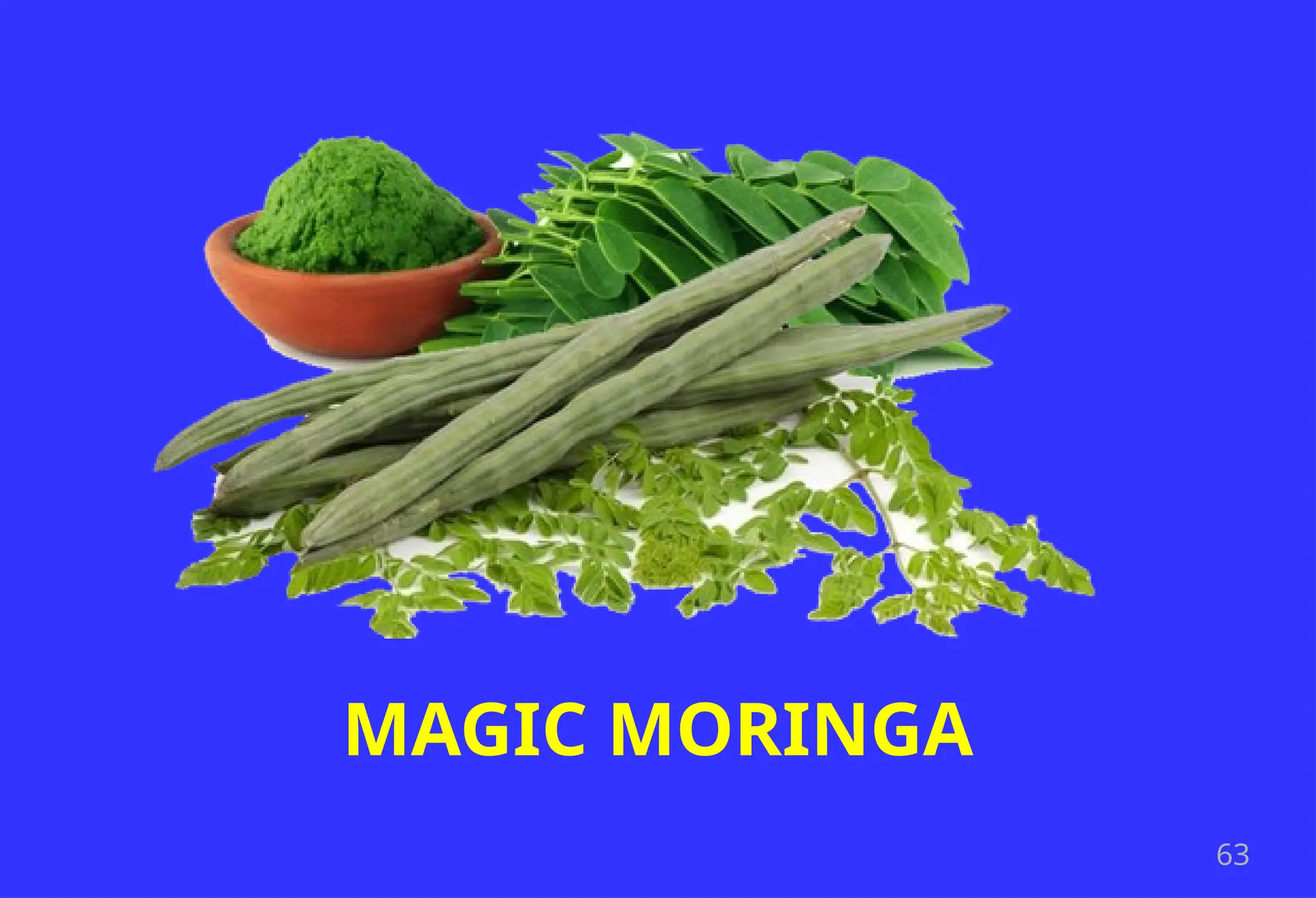
OWN PRODUCT :“MAGIC MORINGA”
Team CBW will dry the leaves and make
powder using a machine
Salesmen will be hired to reach retail to
retail
The bags of product will be placed at all
retail shops , food industries and
pharmaceuticals
Team CBW will provide a centralized
platform for sale of product of all
90
RECOMENDATIONS
It isrecommended Moringa cultivation for other
regions
Central Punjab : Lahore Cantt, Gujranwala Cantt,
Sargodha Cantt
South Region Cantonments : Multan Cantt,
Bahawalpur Cantt, Okara Cantt, Shorkot Cantt
Sindh Region : Hyderabad Cantt, Pano Aqil
KPK Region : D.I Khan Cantt, Bannu
All the guidelines and expertise can be taken from team
Wah
91.
91
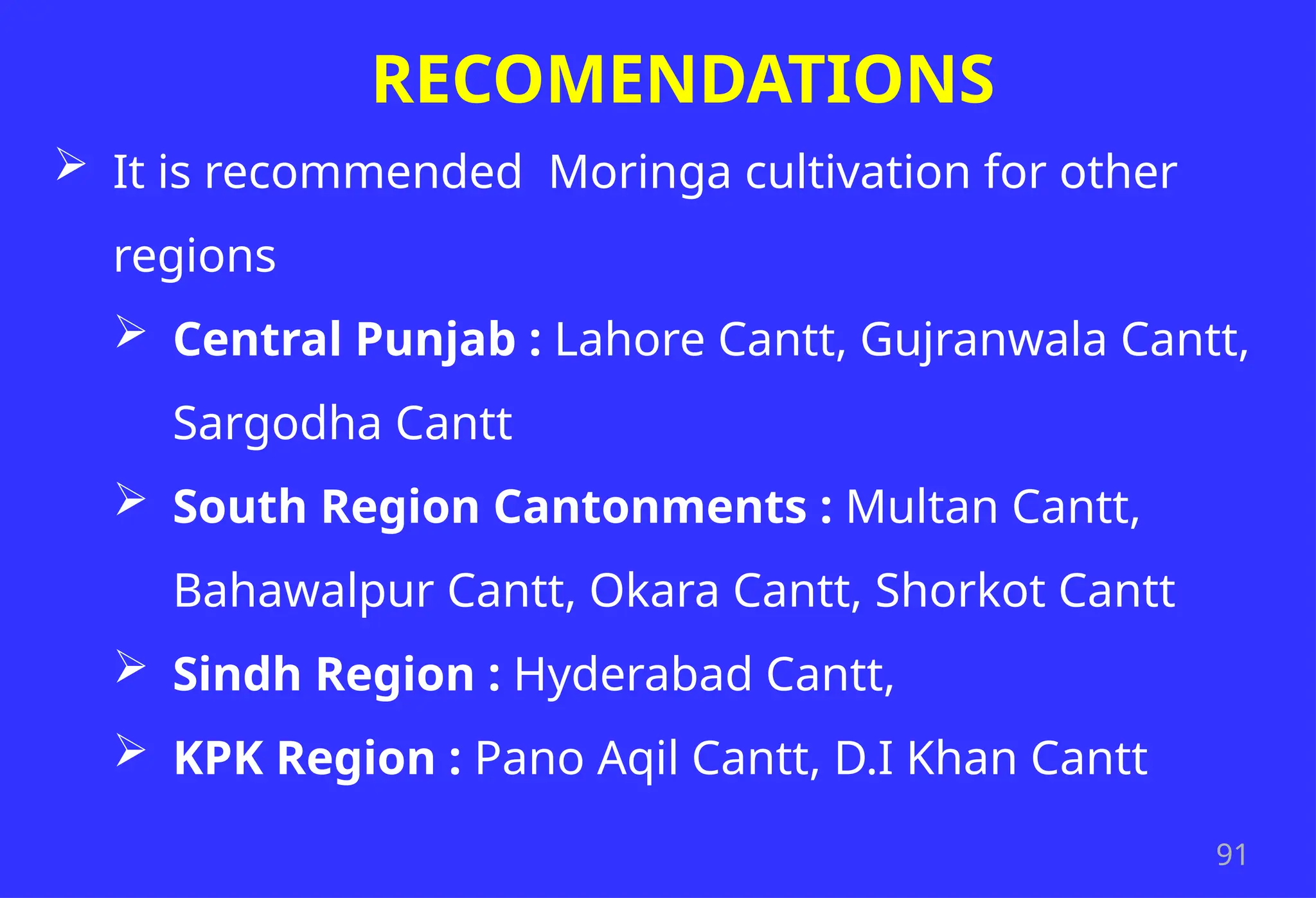
RECOMENDATIONS
It isrecommended Moringa cultivation for other
regions
Central Punjab : Lahore Cantt, Gujranwala Cantt,
Sargodha Cantt
South Region Cantonments : Multan Cantt,
Bahawalpur Cantt, Okara Cantt, Shorkot Cantt
Sindh Region : Hyderabad Cantt,
KPK Region : Pano Aqil Cantt, D.I Khan Cantt
BACKGROUND
93
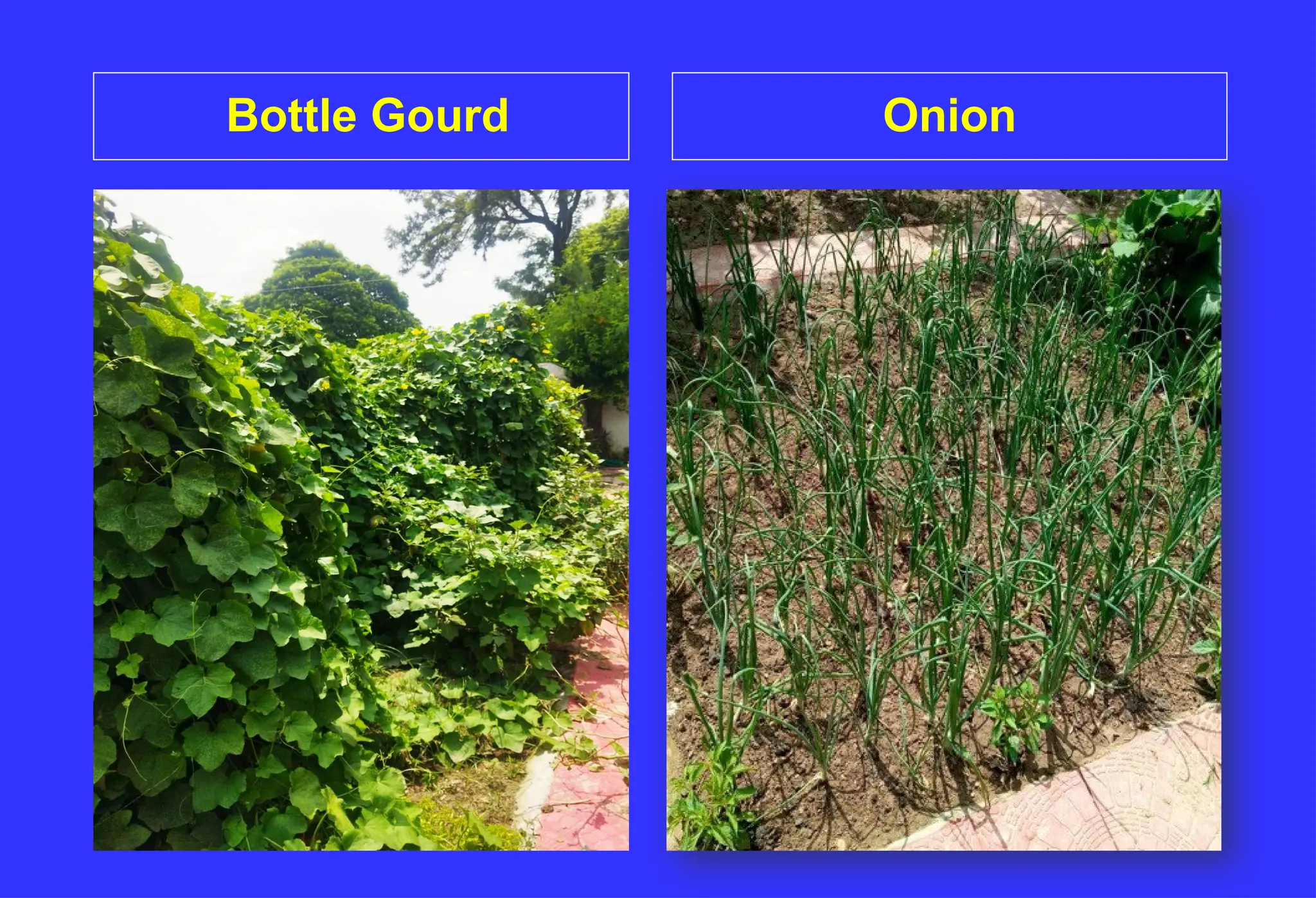
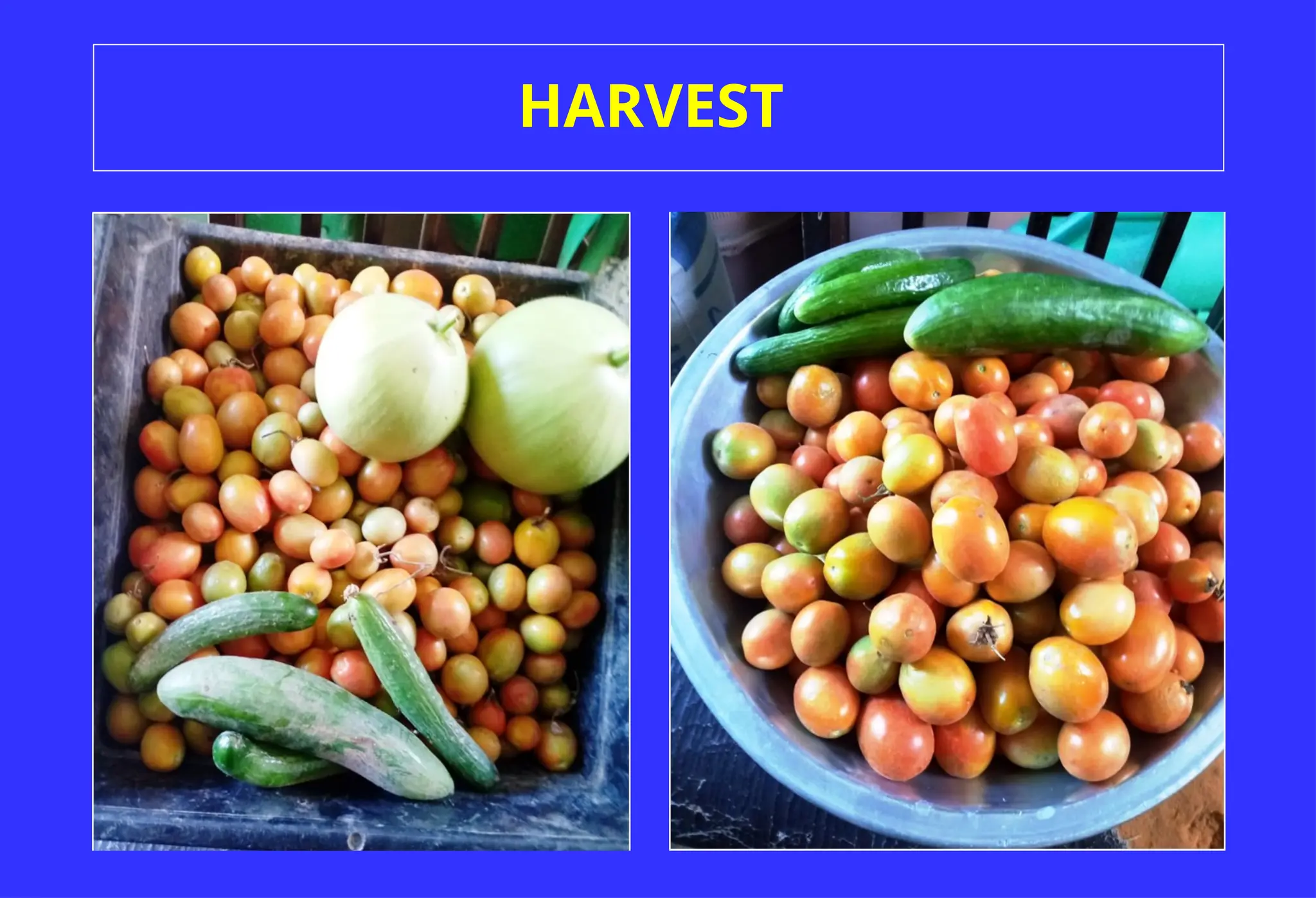
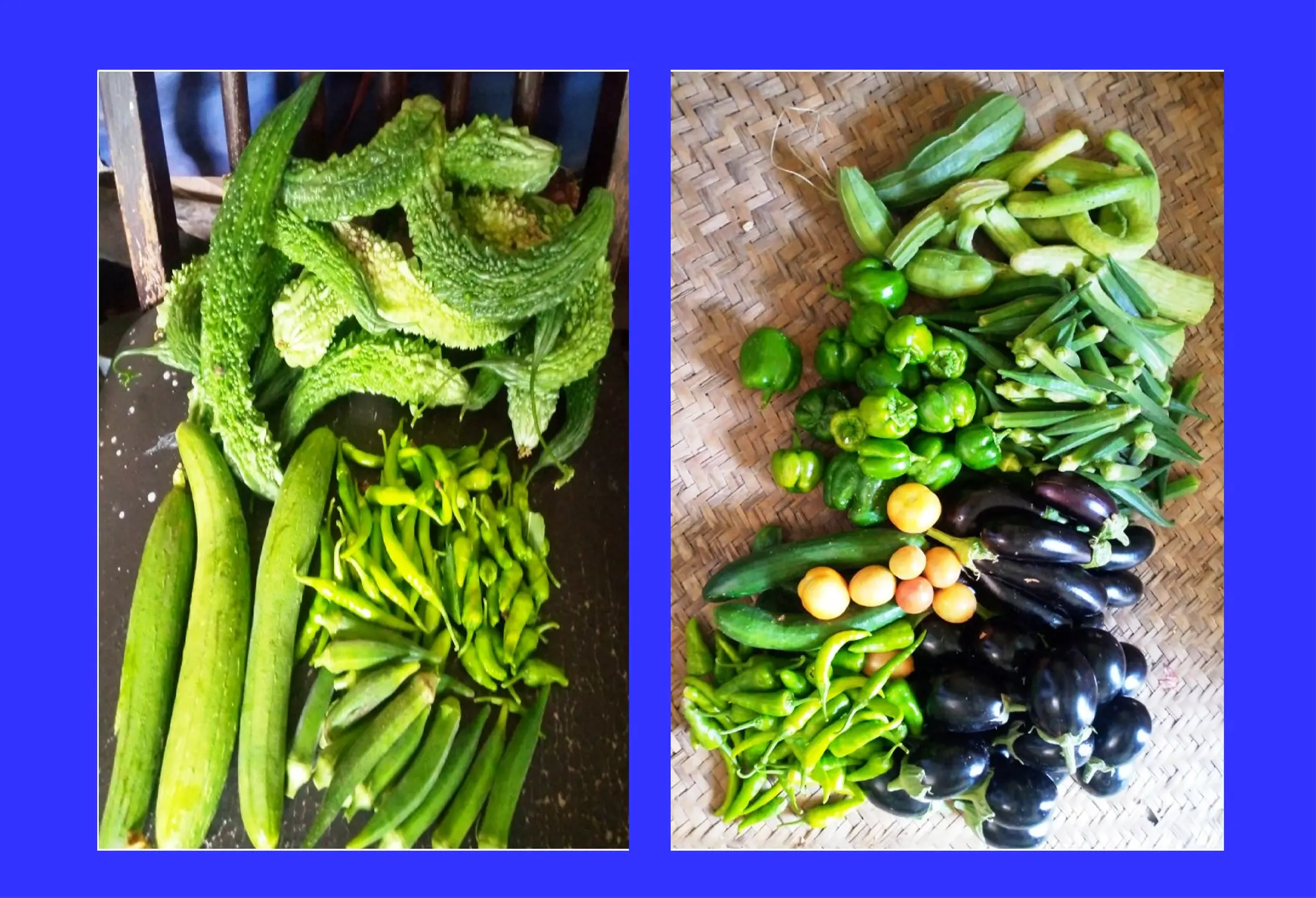
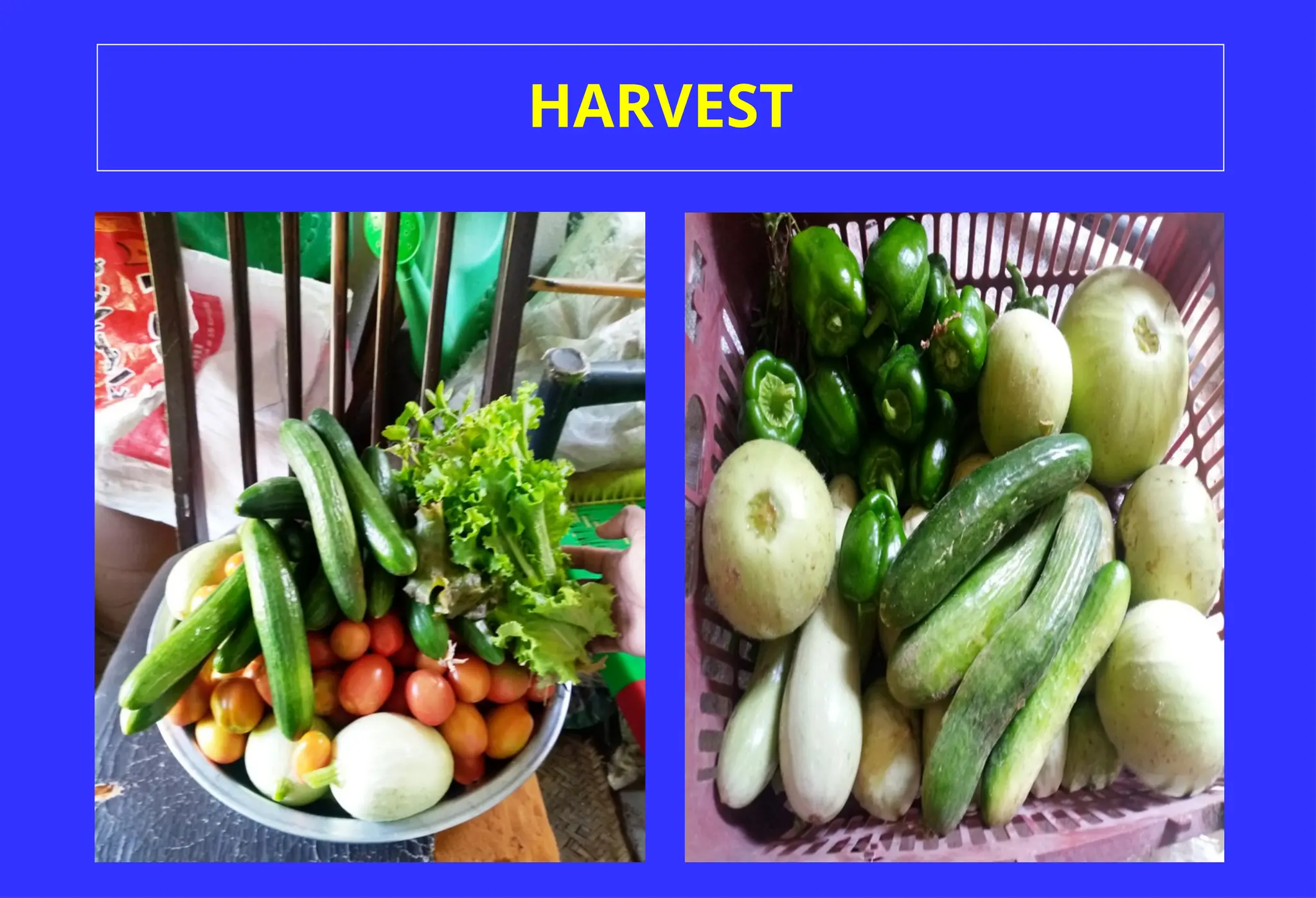
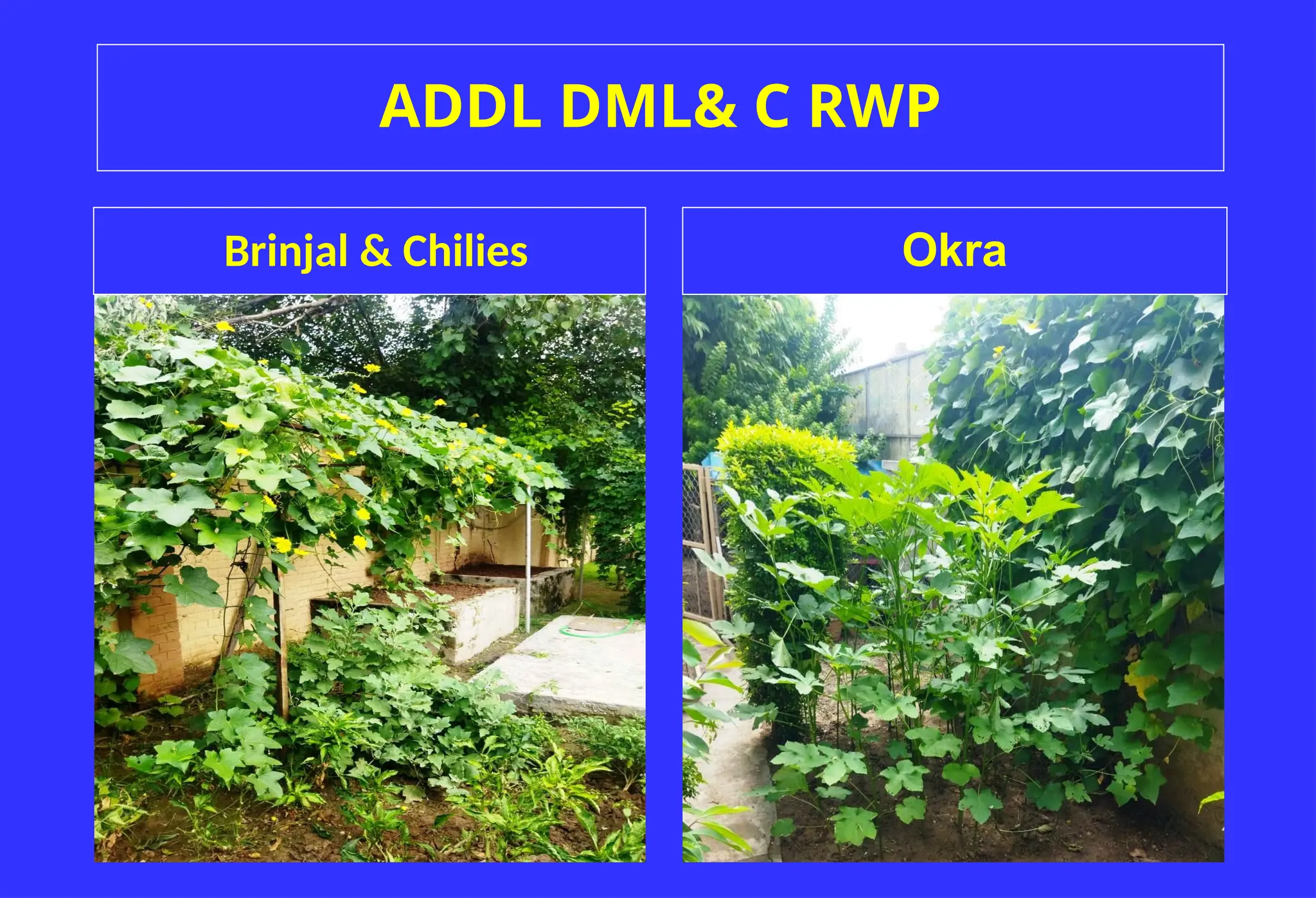
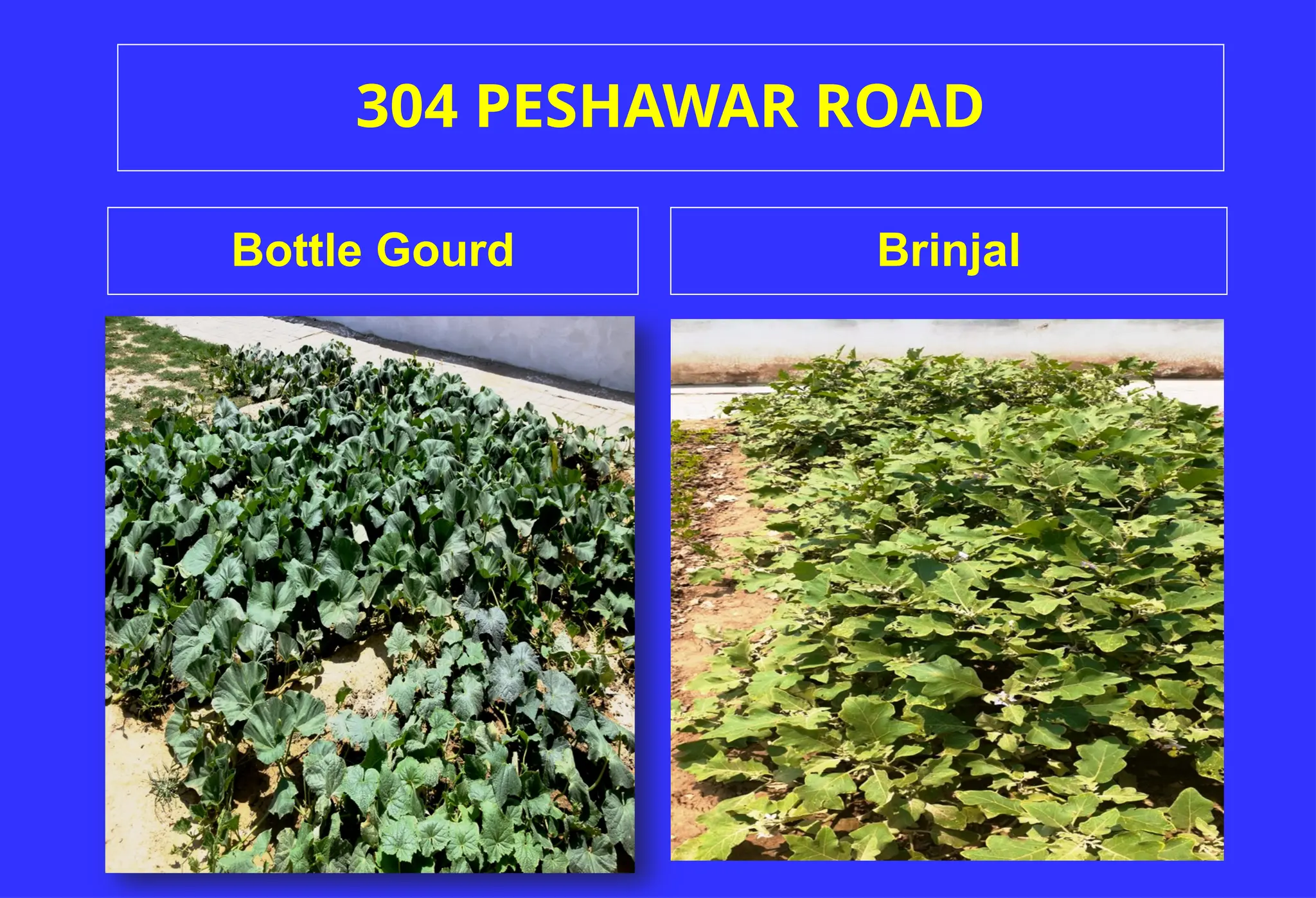
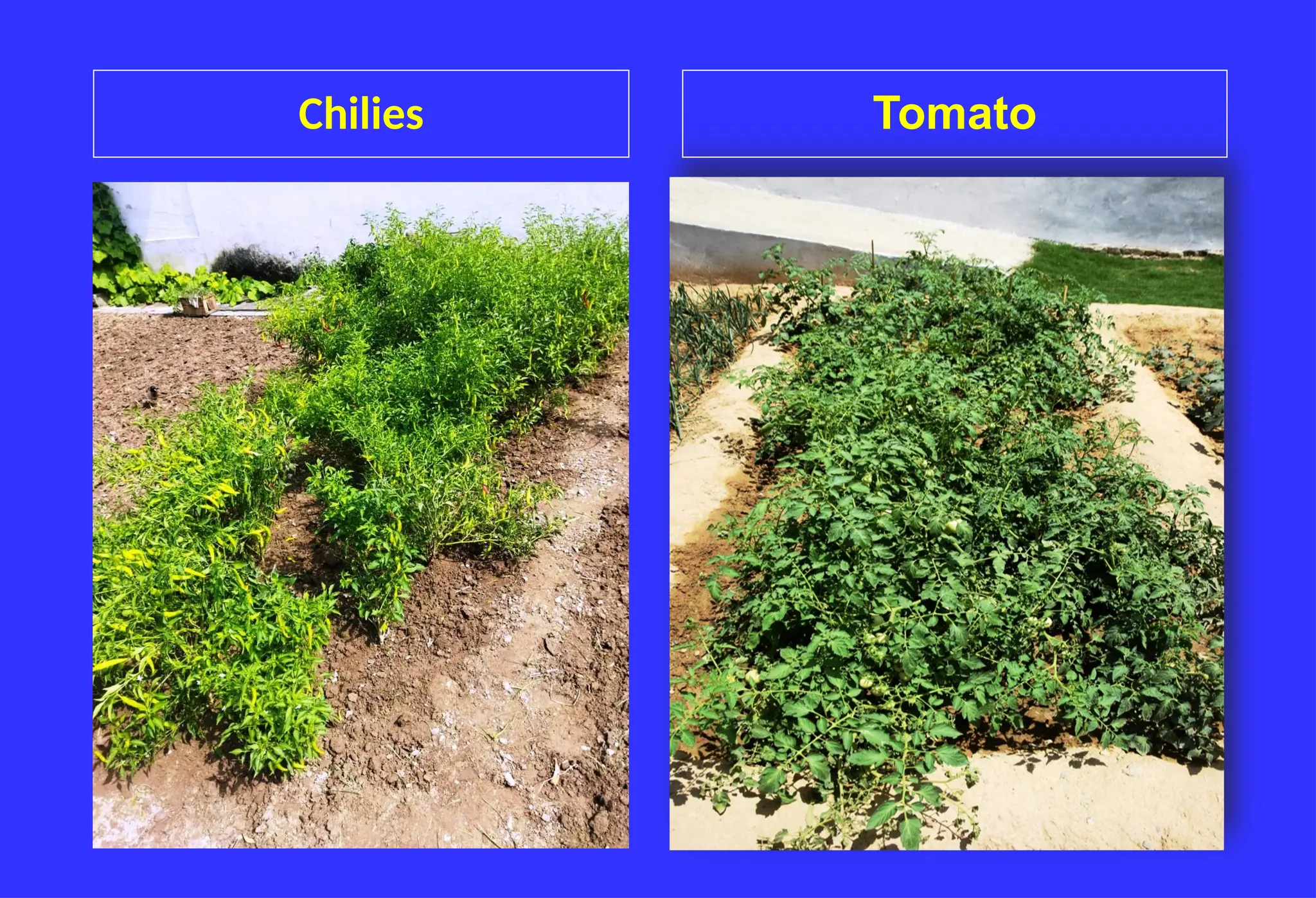
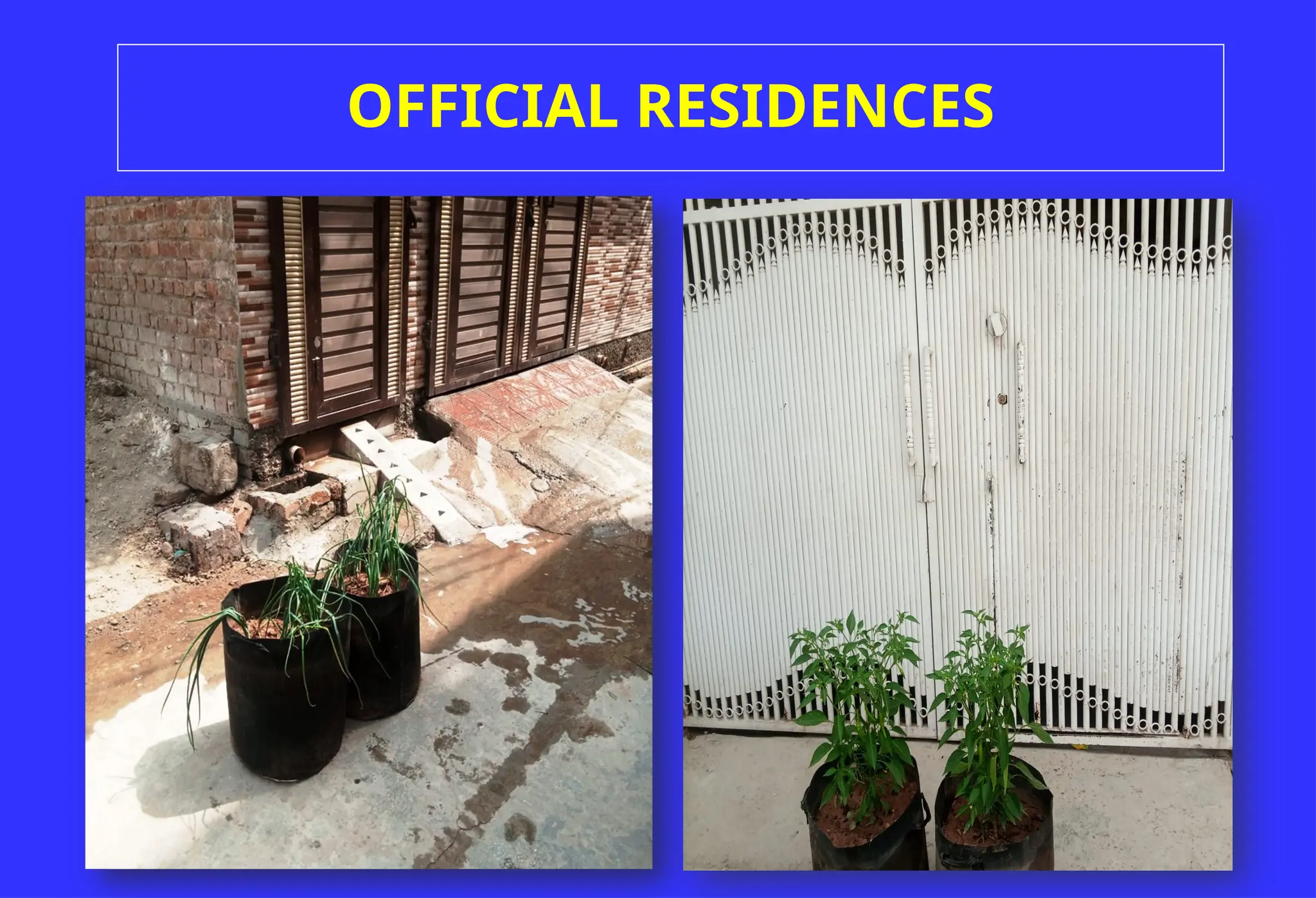
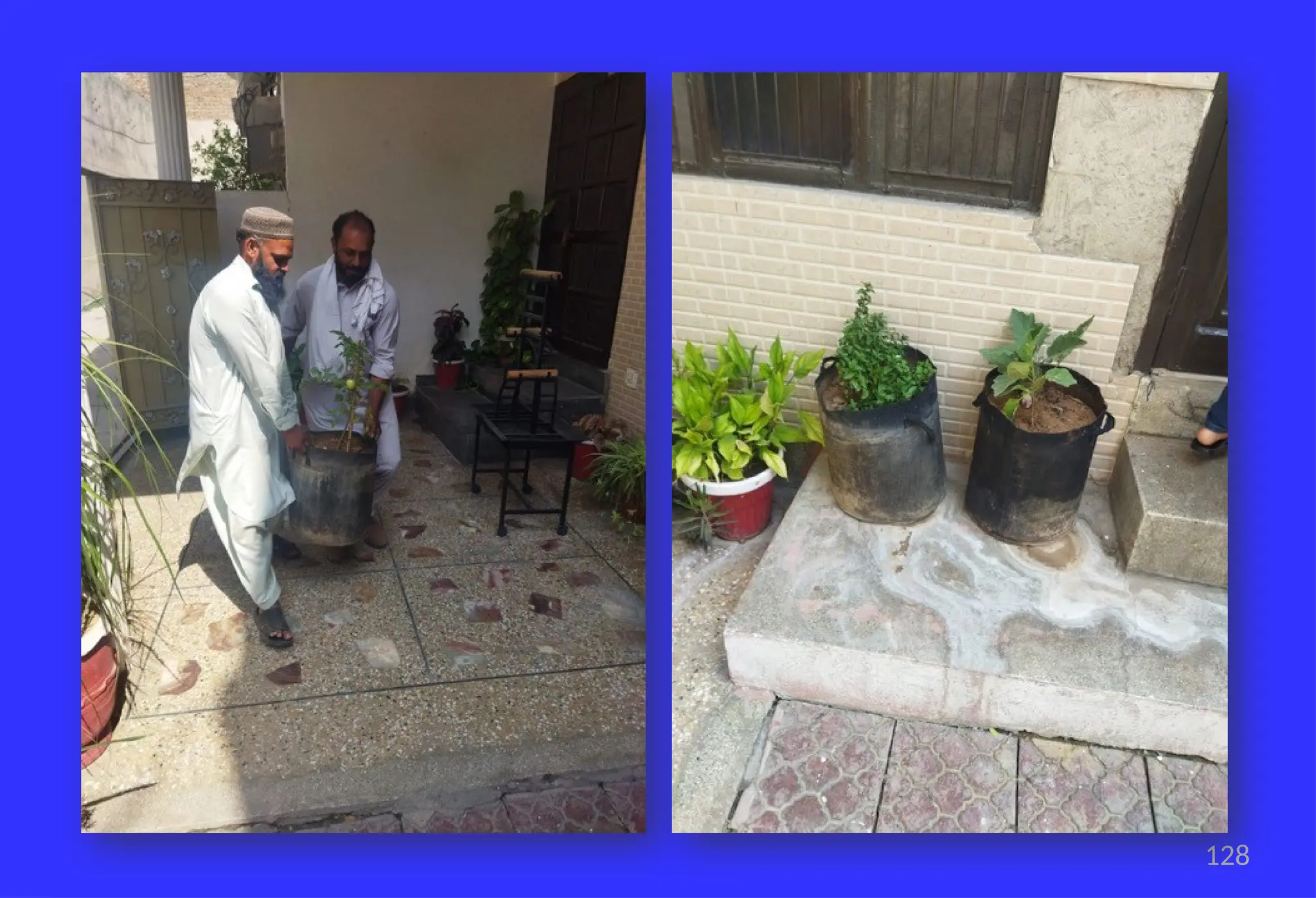
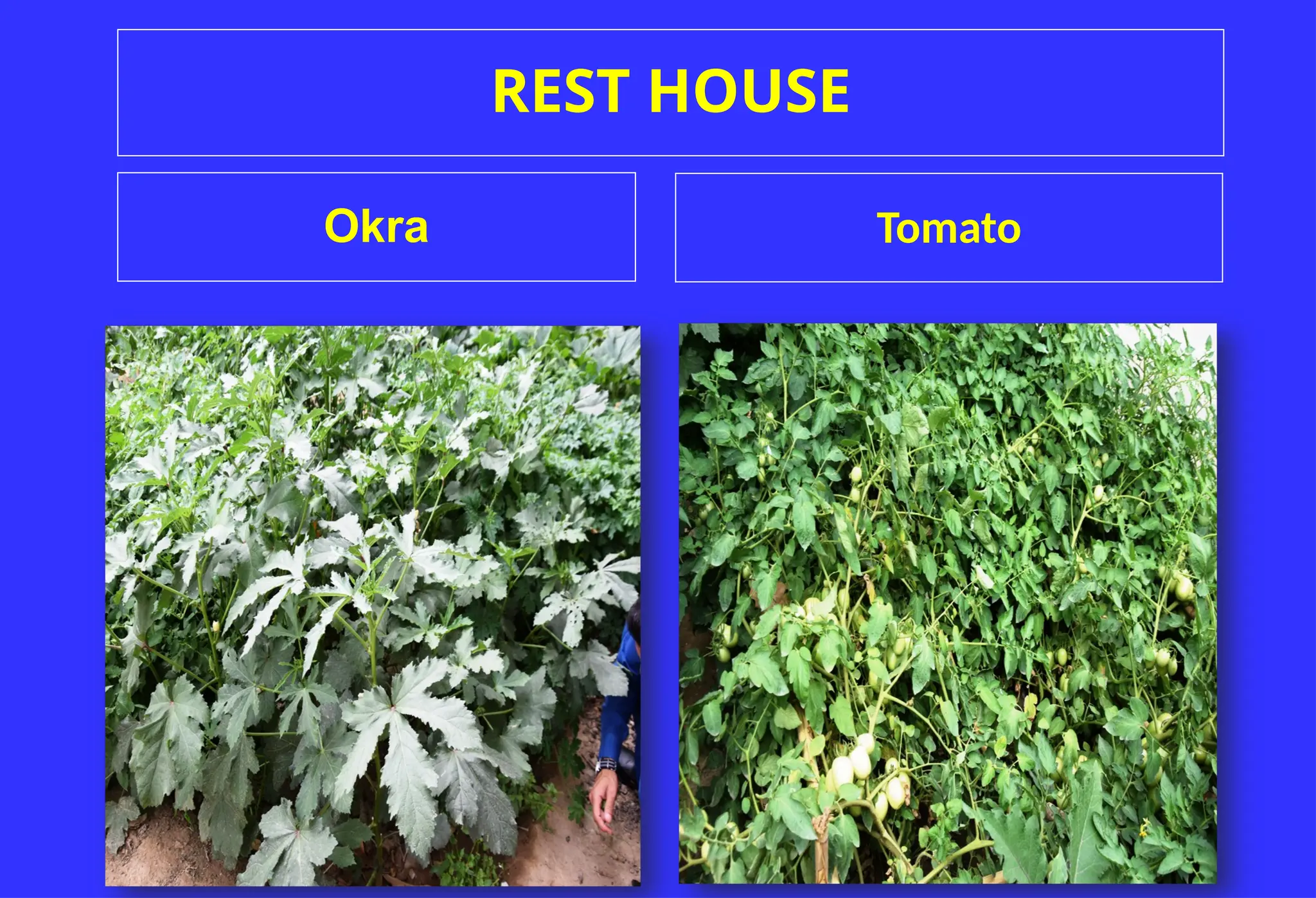
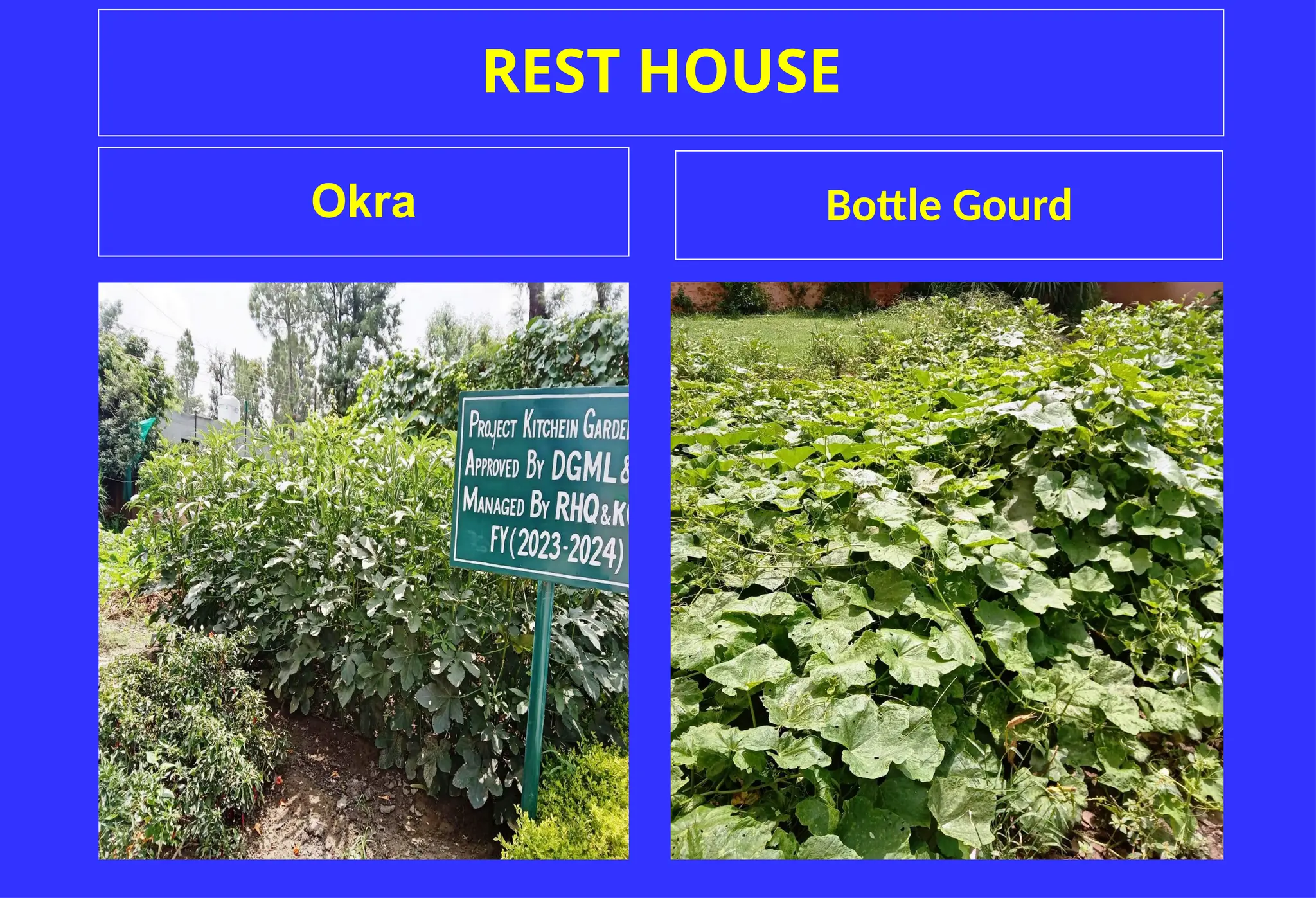
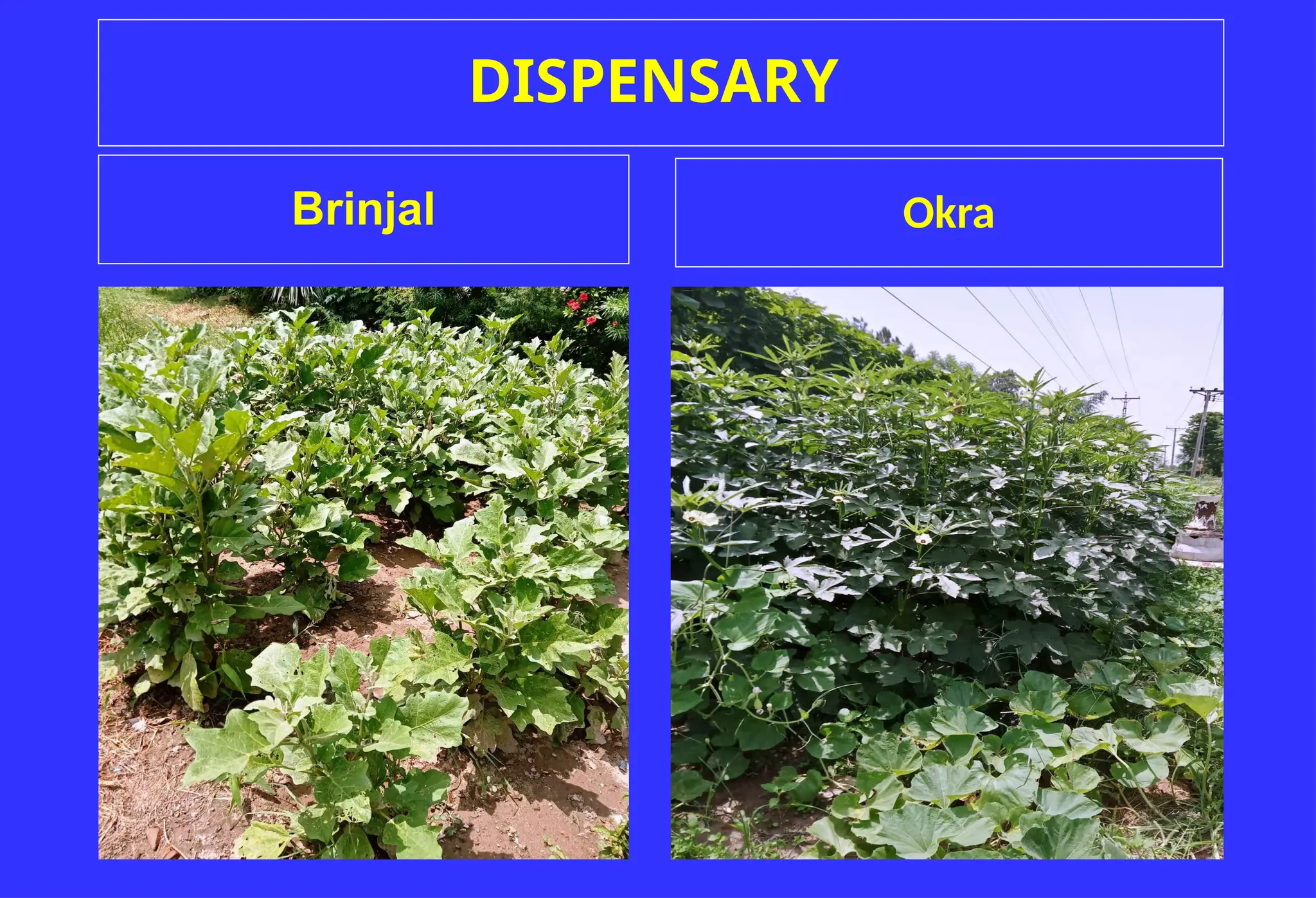
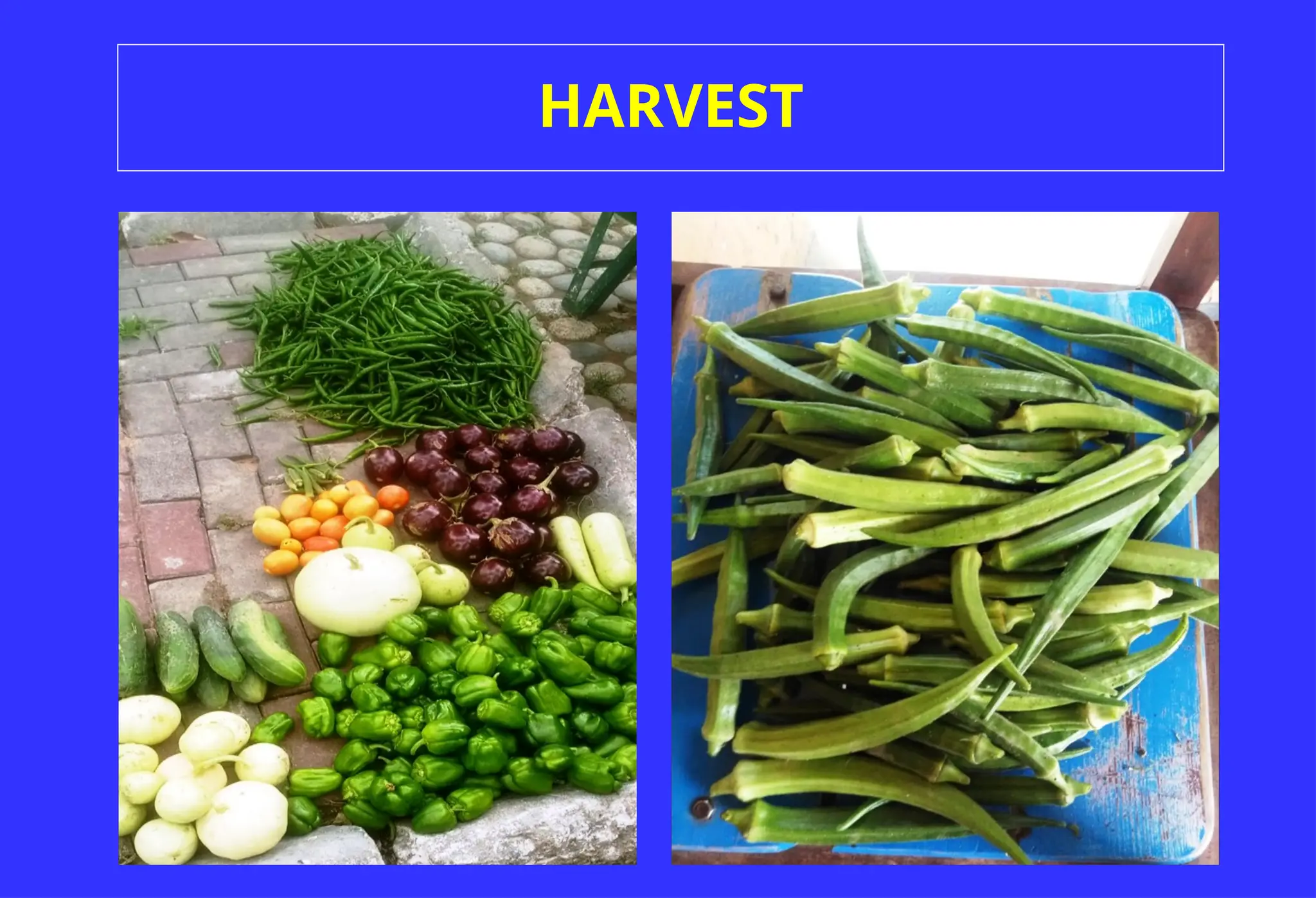
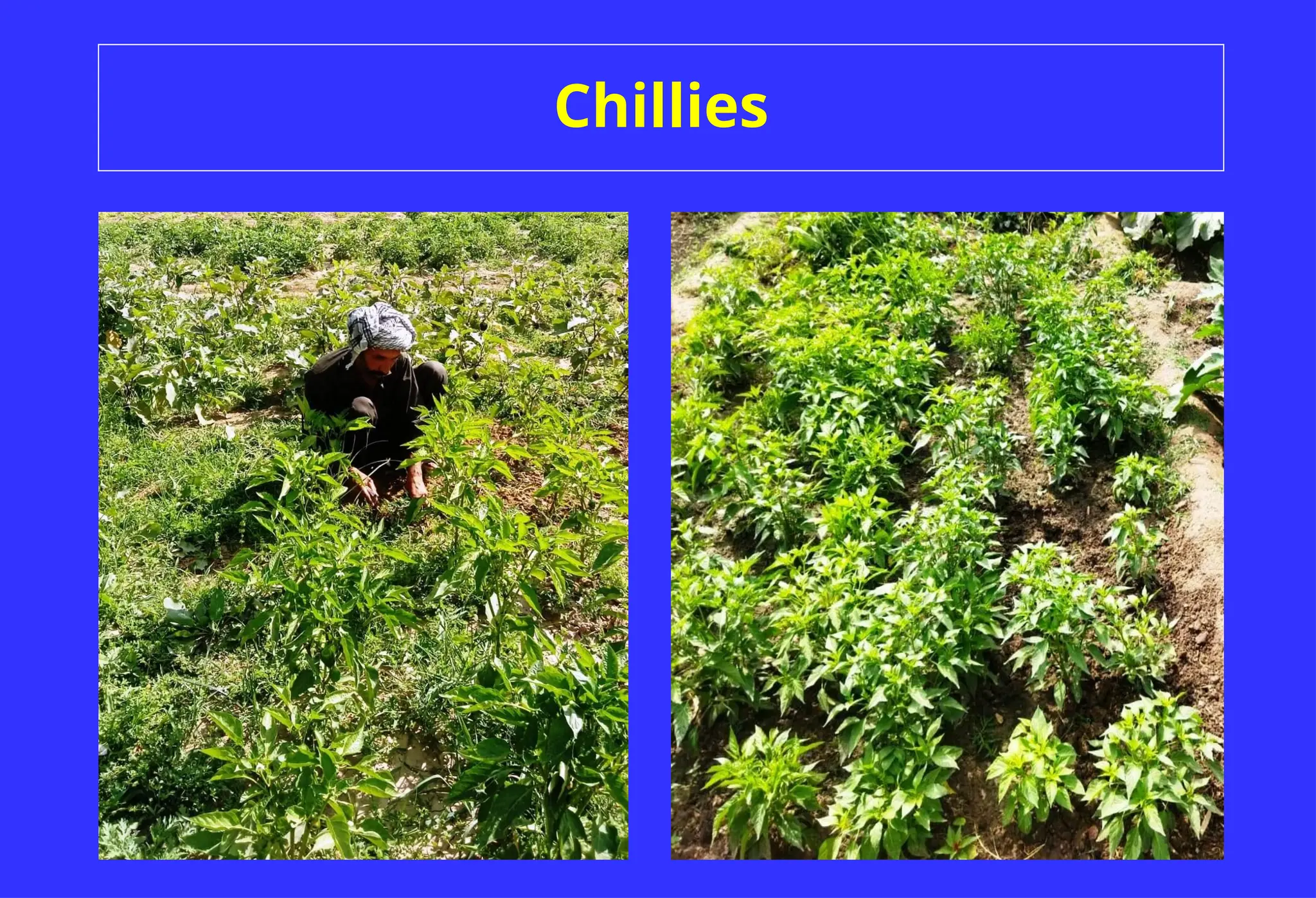
Project of kitchengardening was initiated by
RHQ RWP for provision of healthy organic
vegetables at doorstep level with futuristic
approach of vegetables farming in ML&C Deptt
and other valuable army lands
The second aim of this project was to aspire
general public regarding socio economic
benefits of kitchen gardening and how to use
94.
Kitchen gardening isintegral part of each house hold now a days to get
food sustainability & provision of healthy & fresh vegetables at door
step. According to international nutritional standards the basic
requirement per capita of vegetables is 300 gram per day which is 100
grams per day in our conditions.
Winter / Rabi Vegetables
These vegetables are sown in Sept- Oct & Yield in Feb- March e.g.
Carrots Radish, turnip, cabbage, cauliflowers, broccoli, spinach, mint,
Coriander, Lettuce, Potato, peas, Garlic, beet root and Fenugreek
Summer / Kharif vegetables
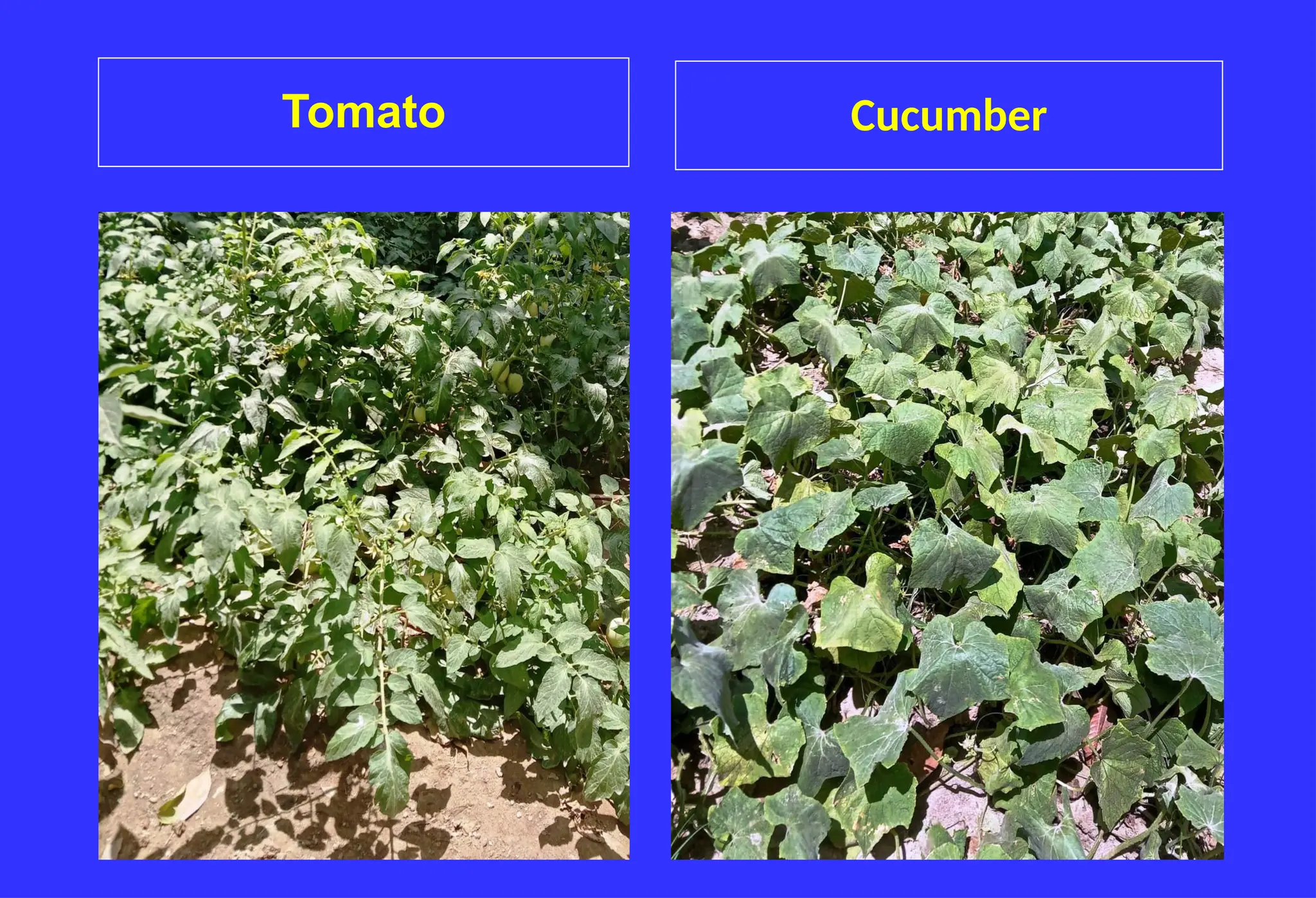
These vegetables are sown in March –April & yield till Sep. Oct. e.g.
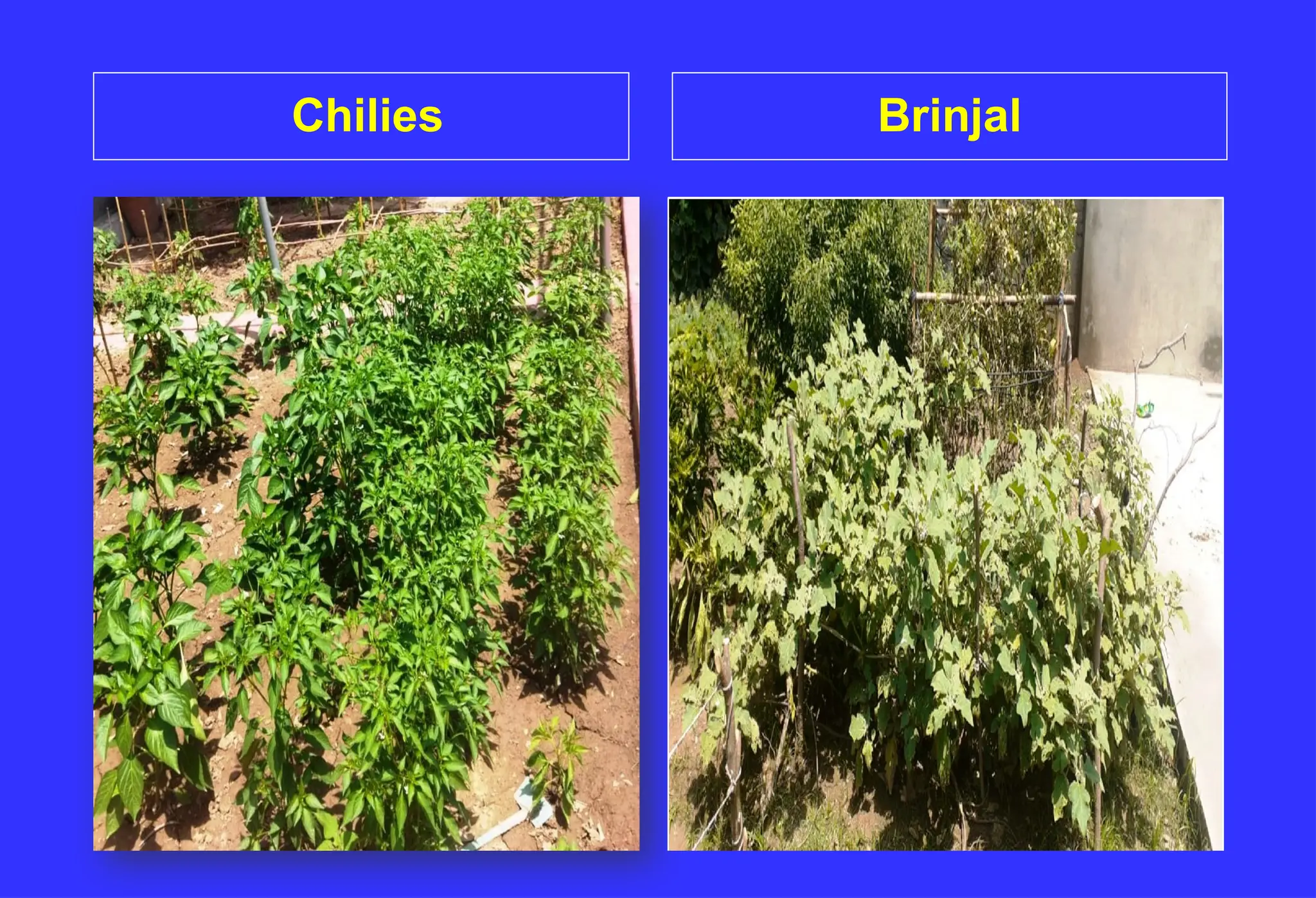
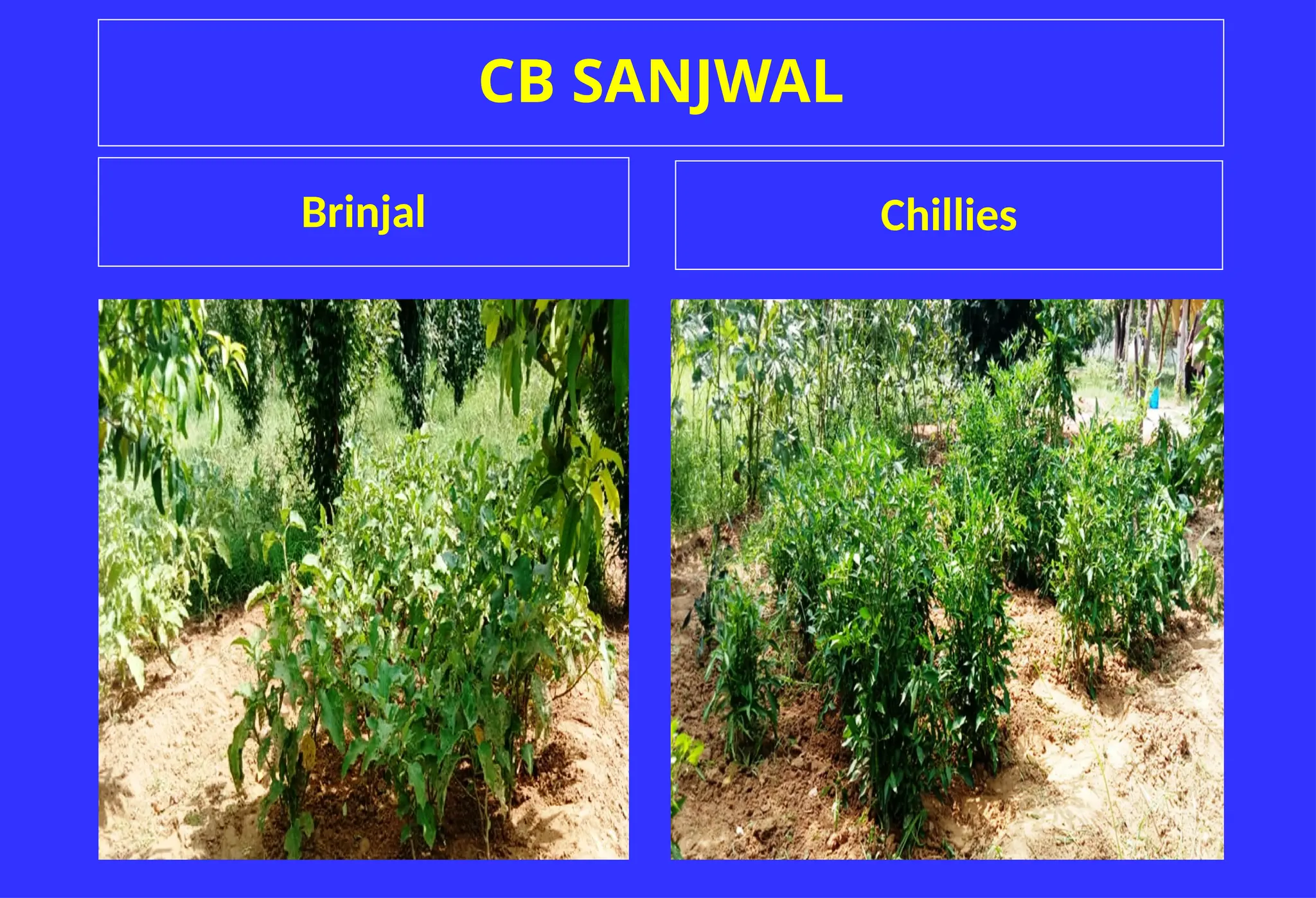
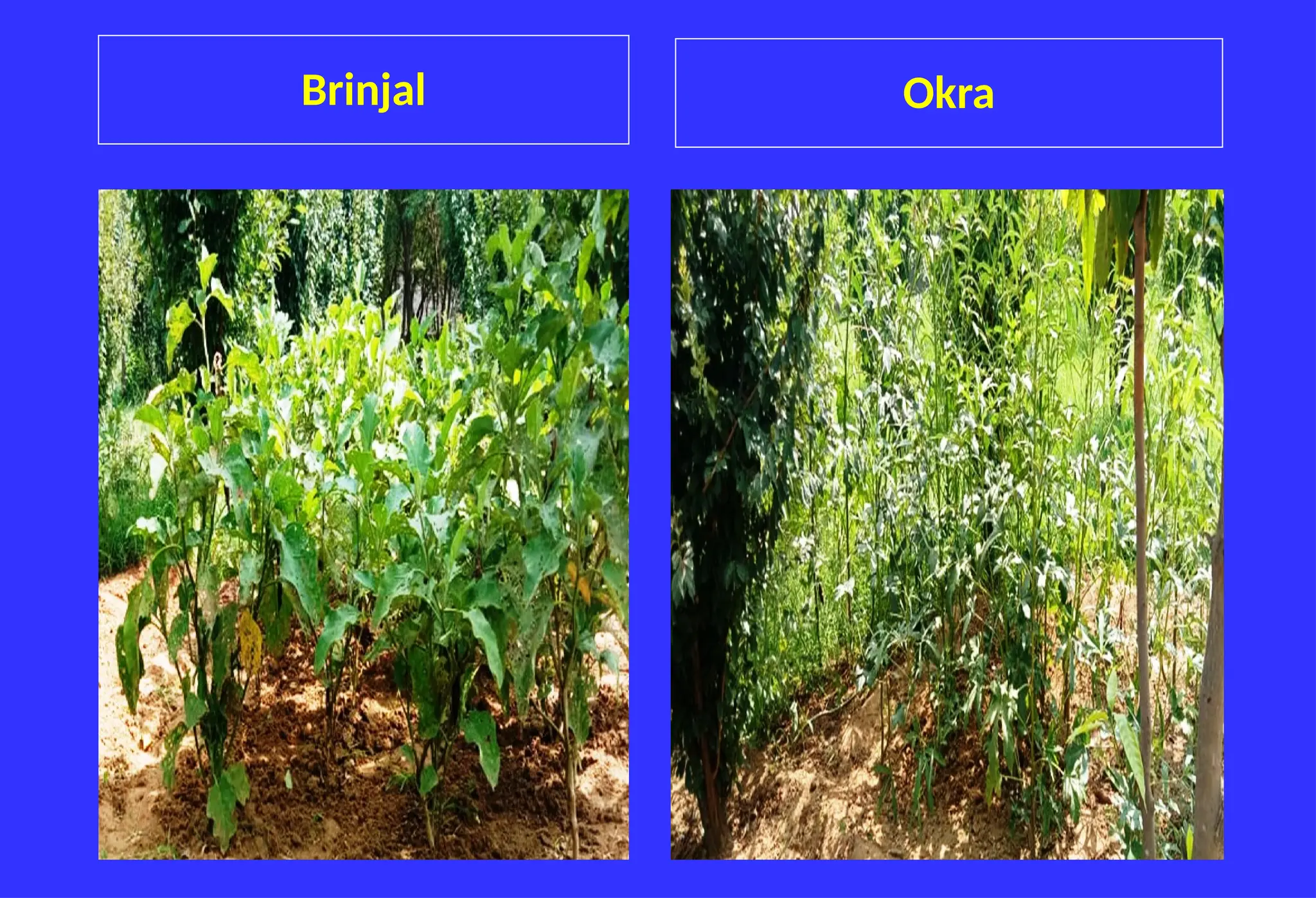
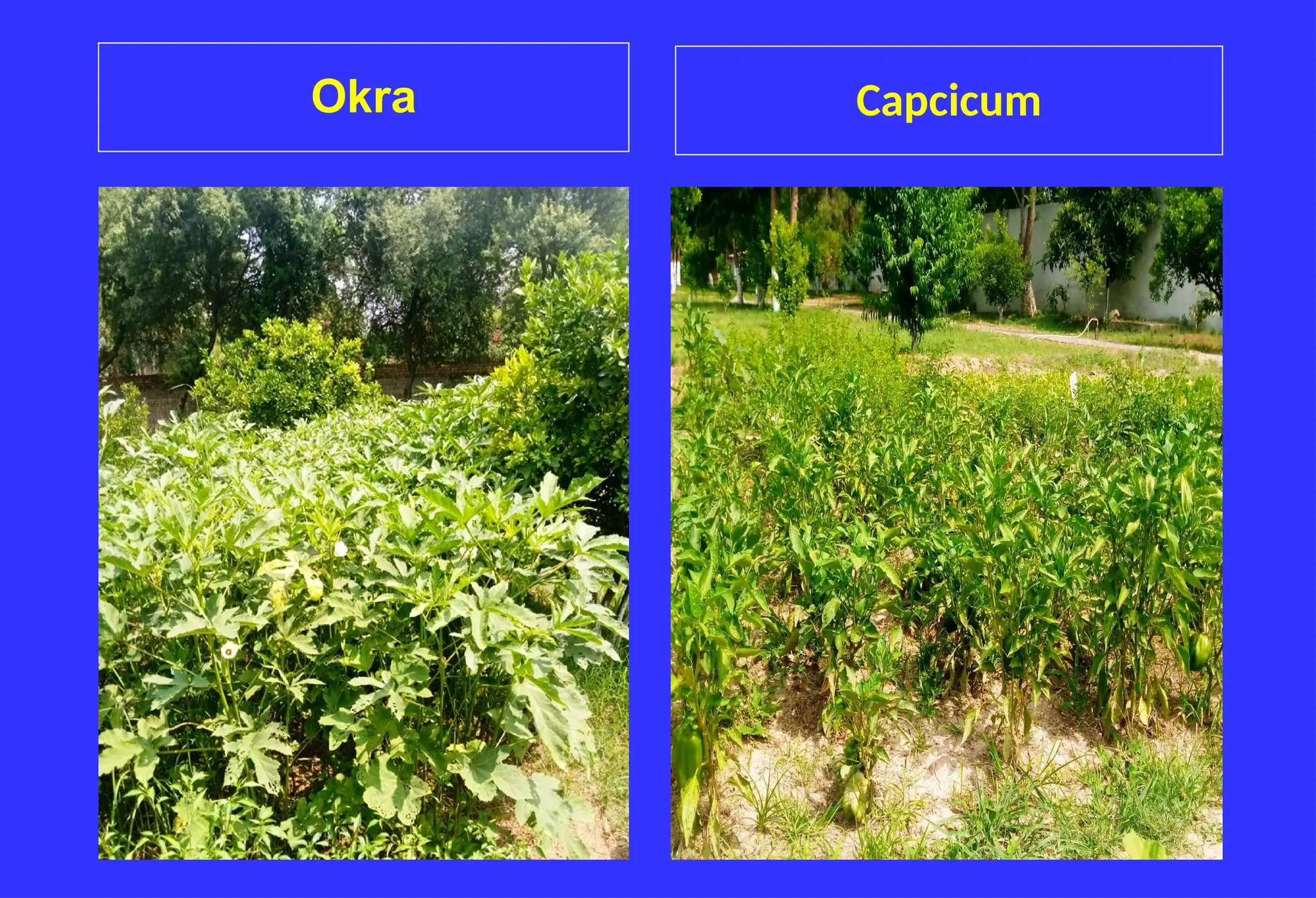
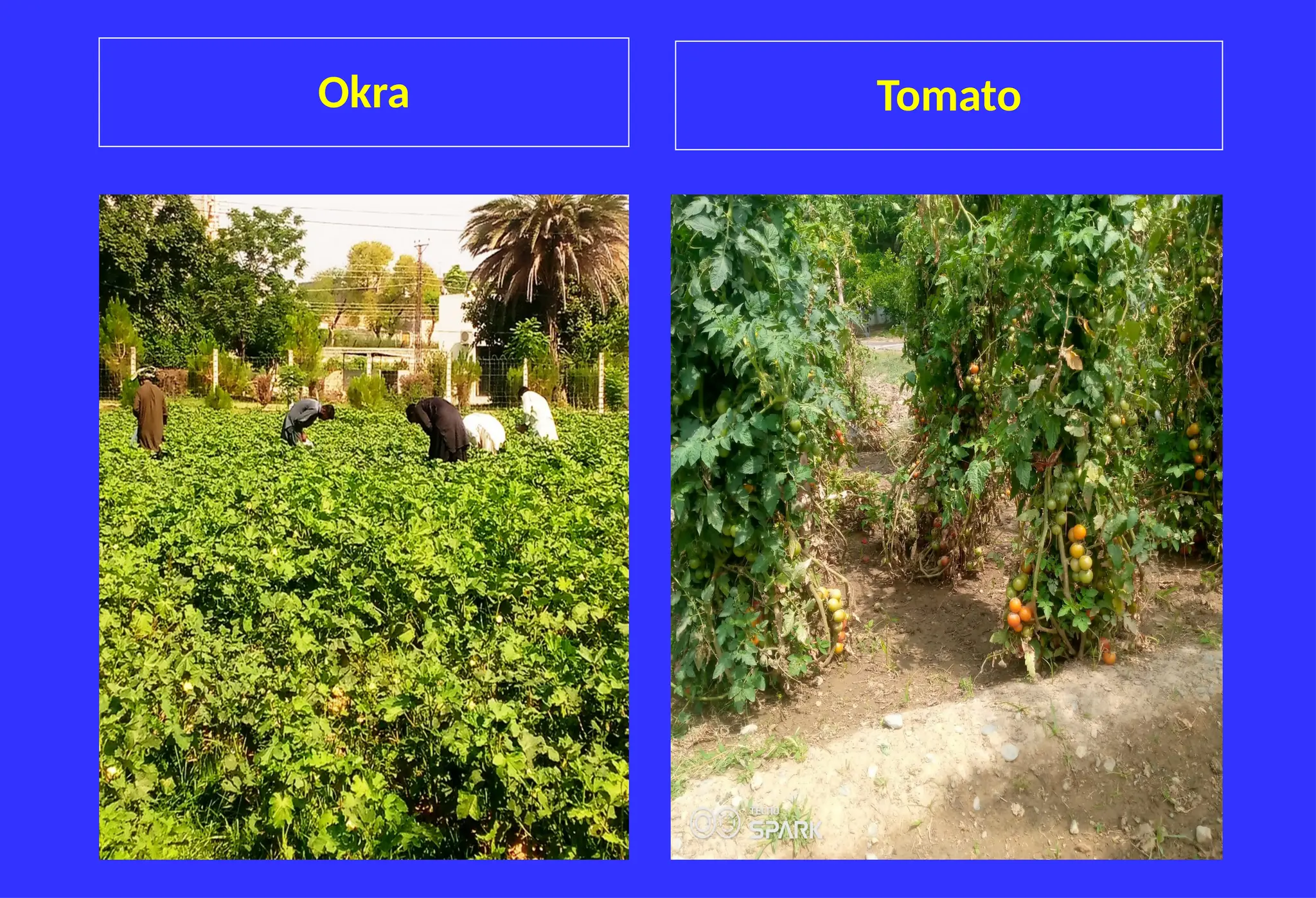
Tomato, Capsicum, pepper, Brinjal, cucumber, Okra, Cucurbits, Musk
94
INTRODUCTION OF PROJECT
95.
For thebetter vegetable production the fertility
of soil is very important.
For home gardening no synthetic fertilizer has
been used
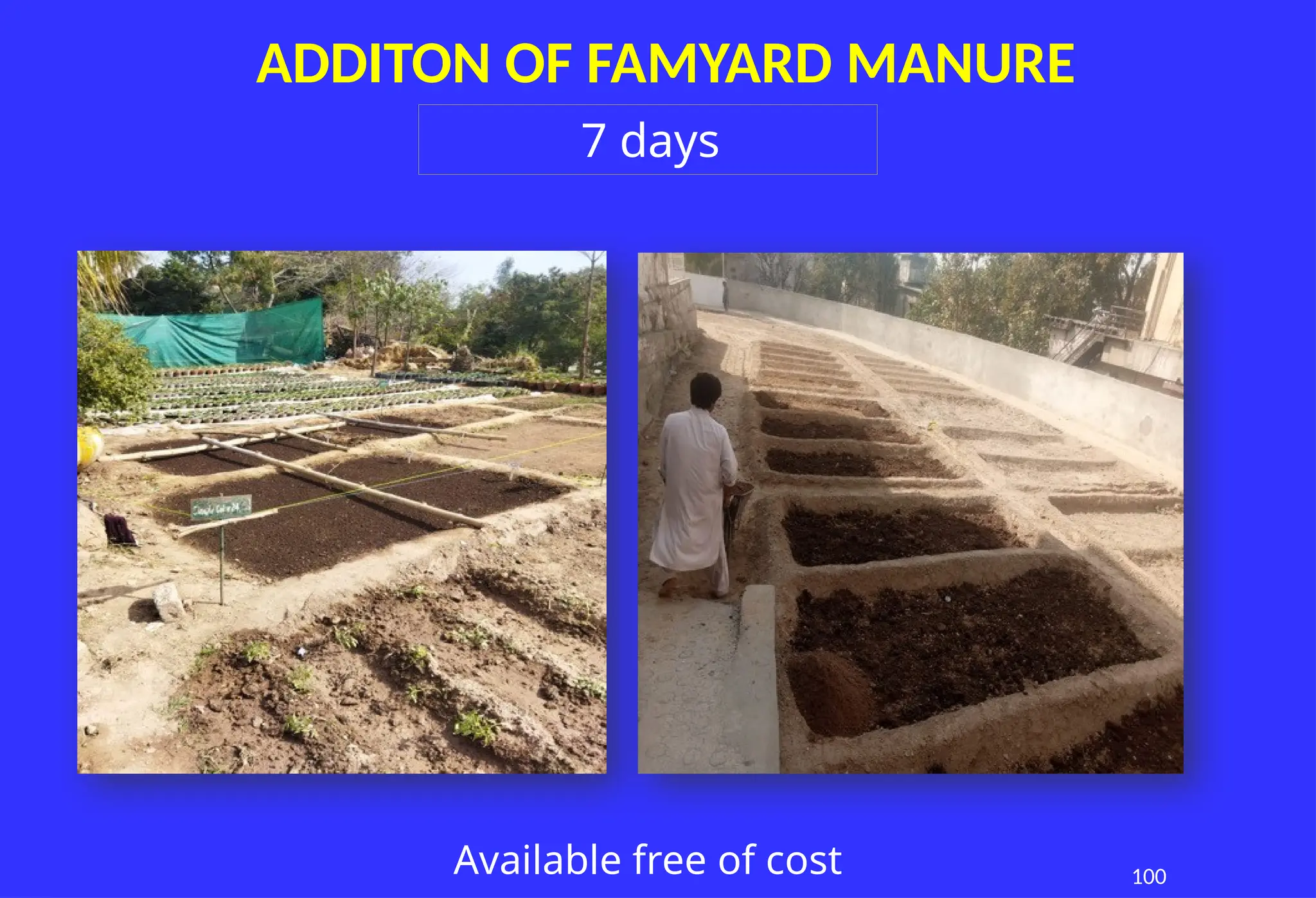
Farmyard manure leaf manure, organic
compost, peat, coconut husk
95
ORGANIC FERTILIZER
97
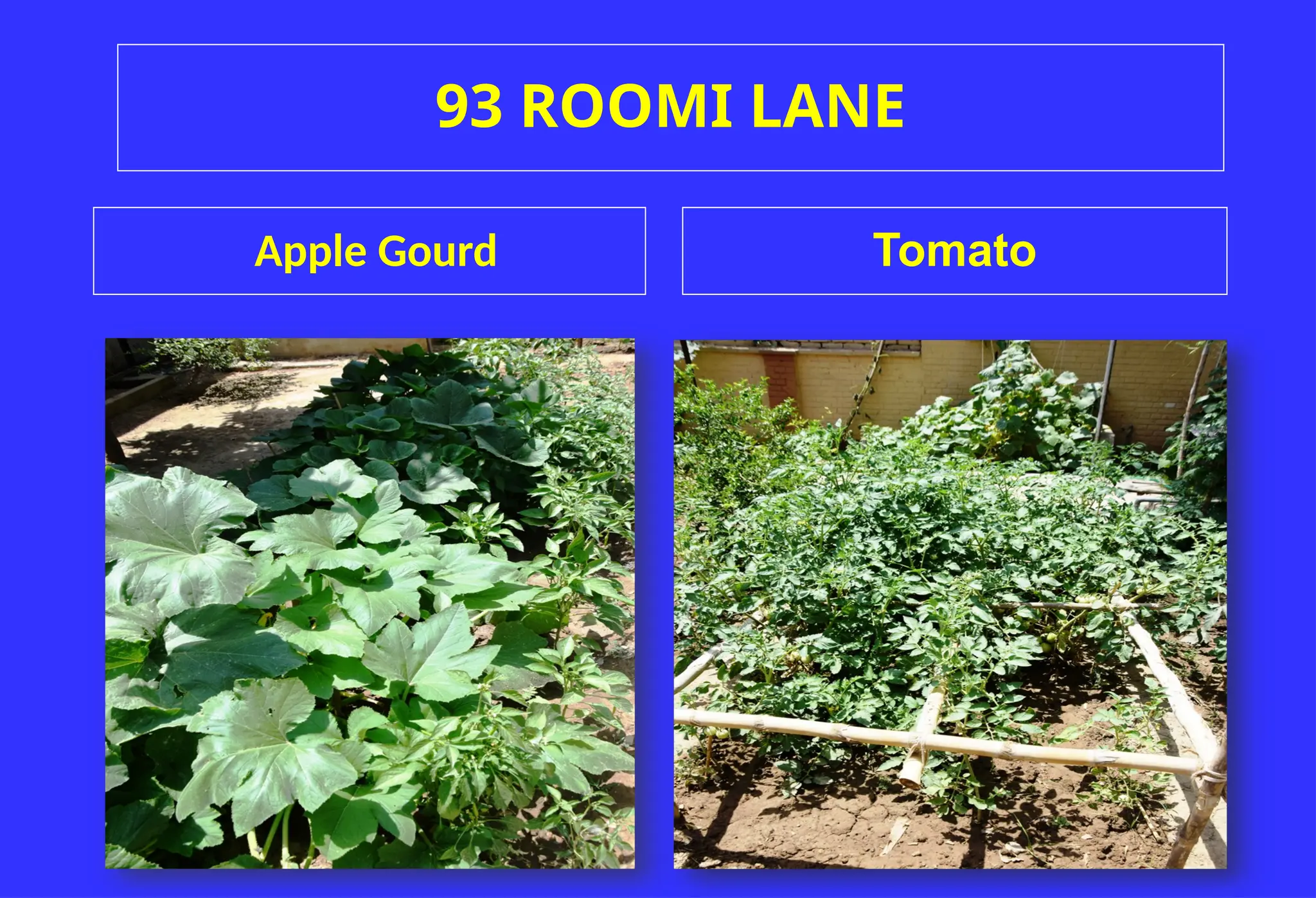
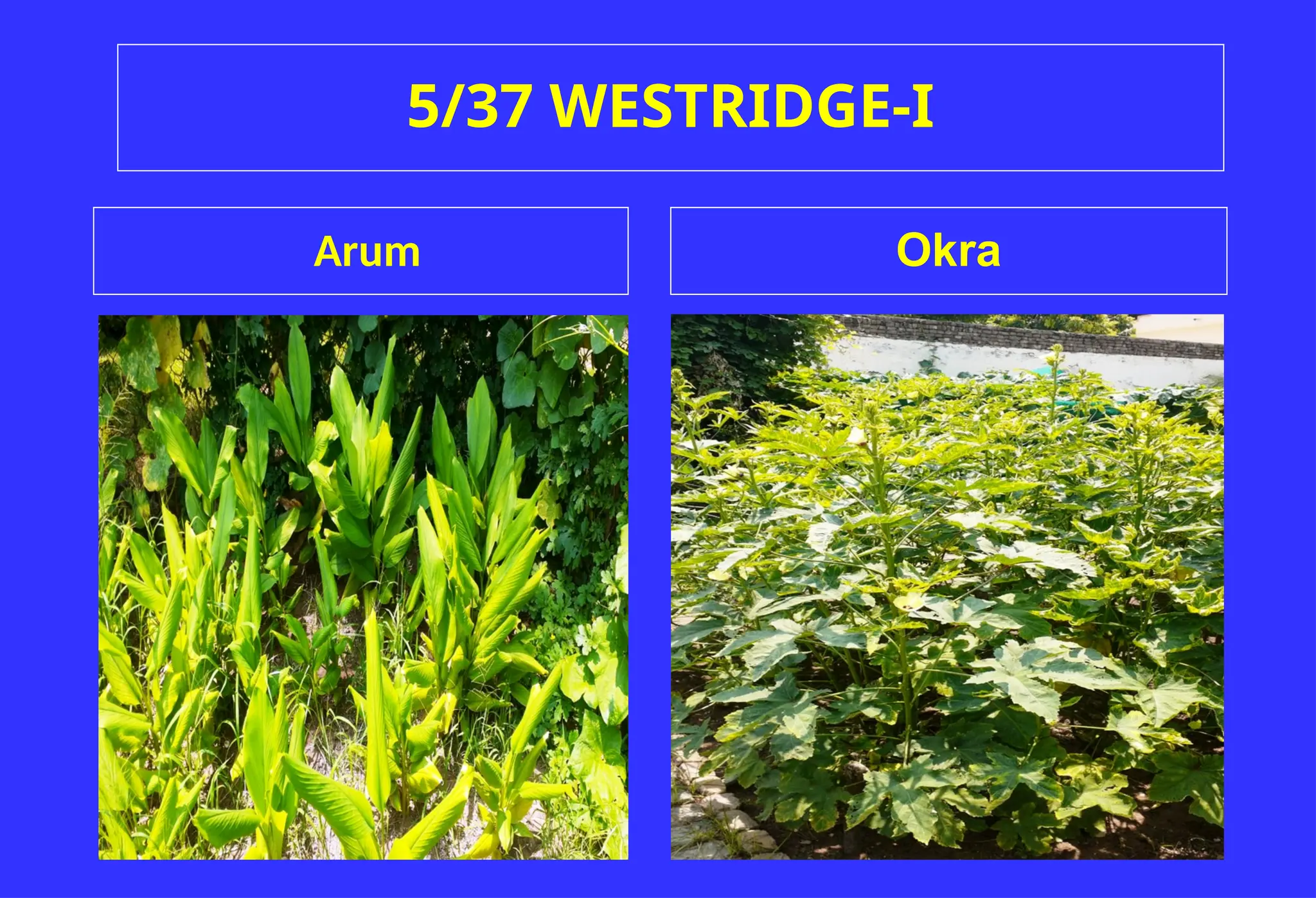
ALLOCATION OF SPACE
Datawas collected from all the CBs through
RHQ
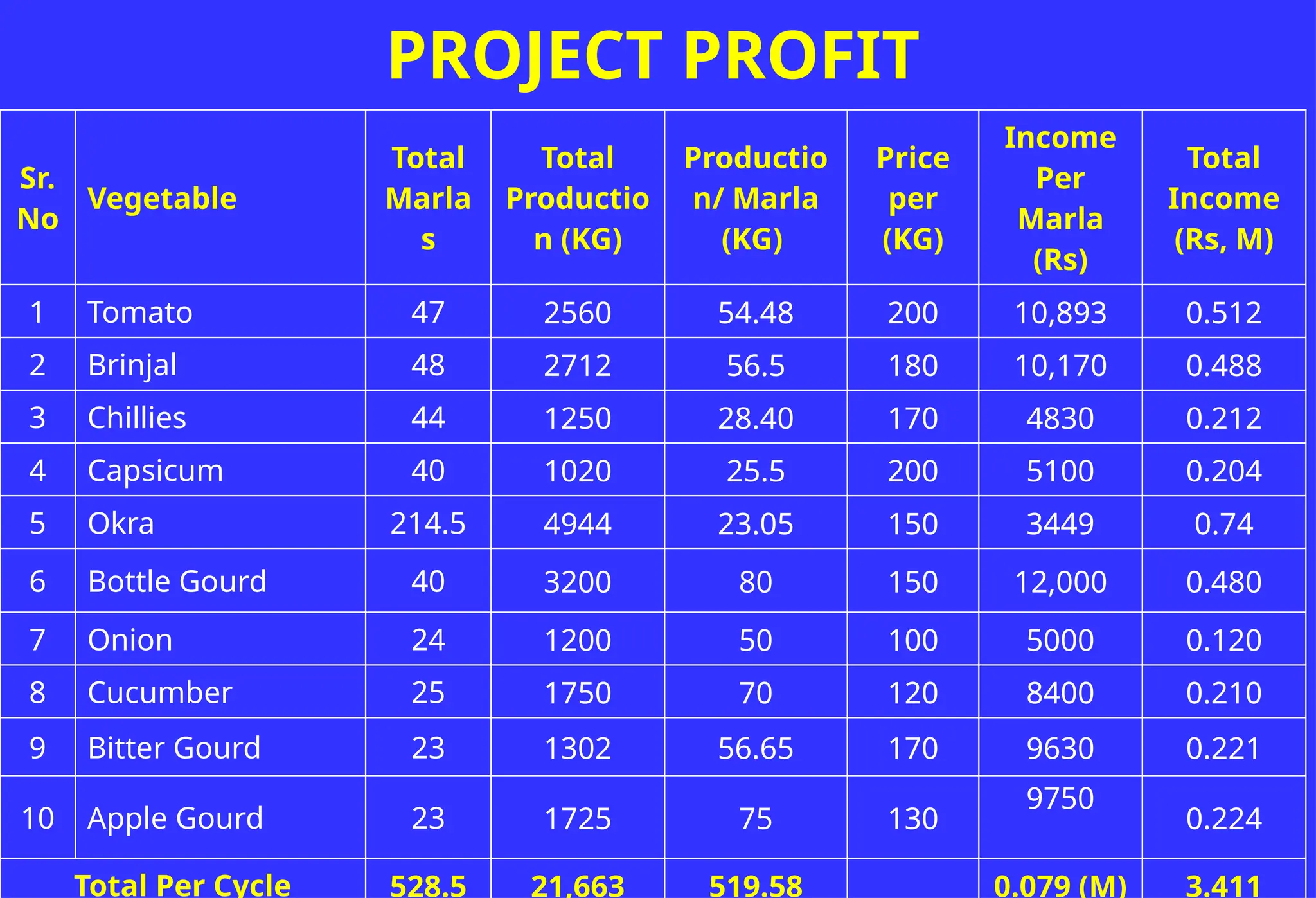
Total space allocated in the region was 528.5
Marlas
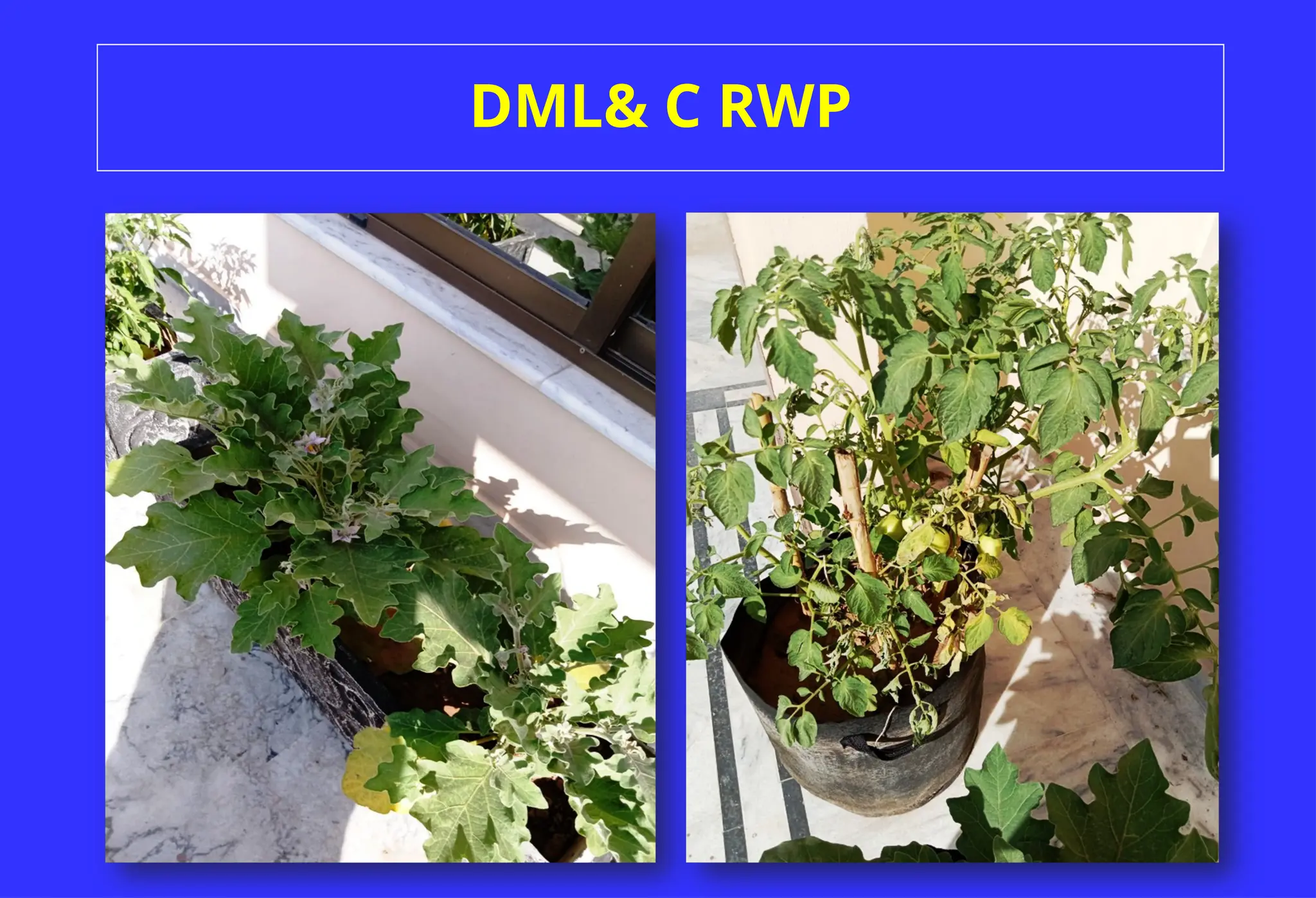
Secondly in official accommodation where
there is no space vegetables were provided
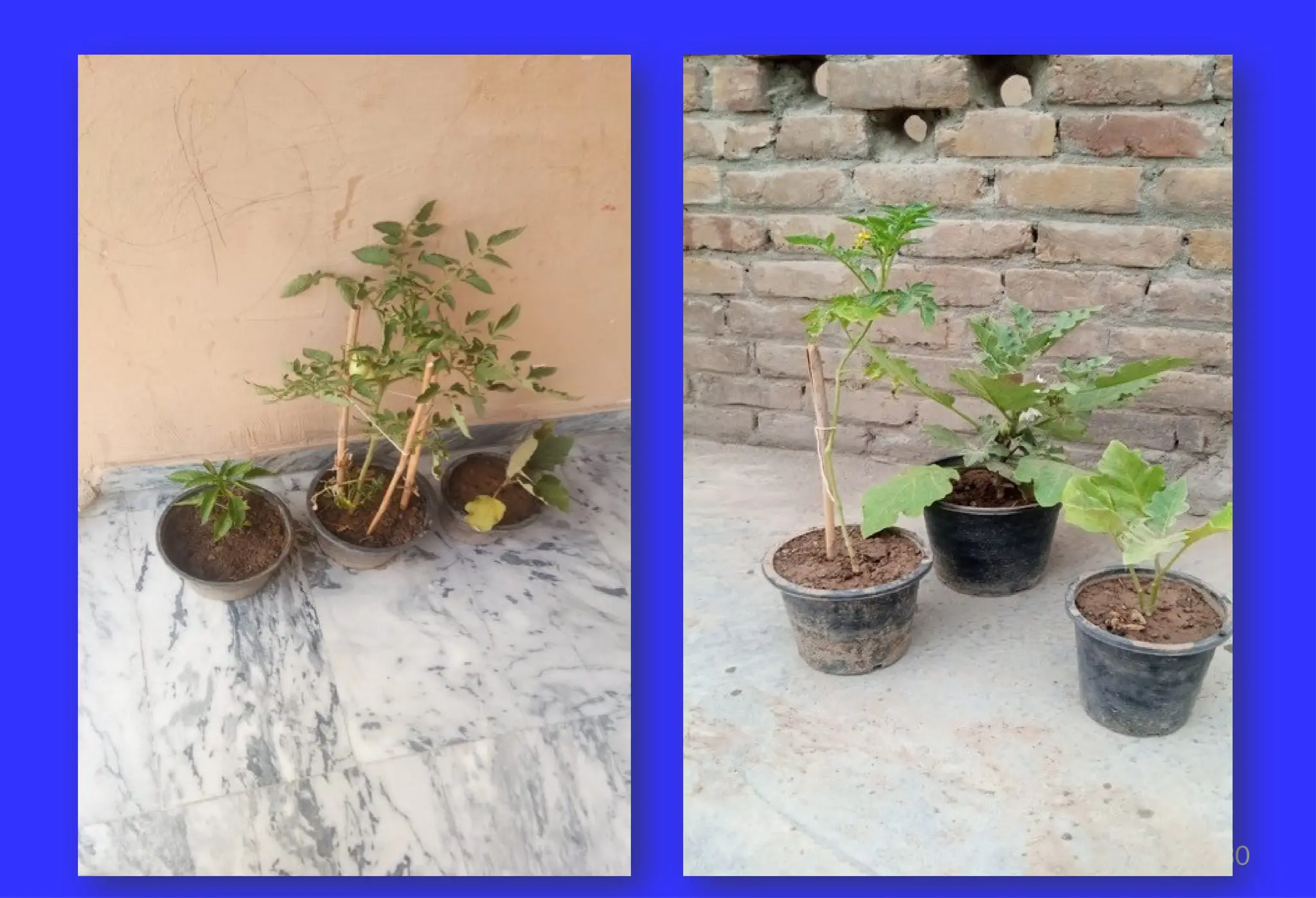
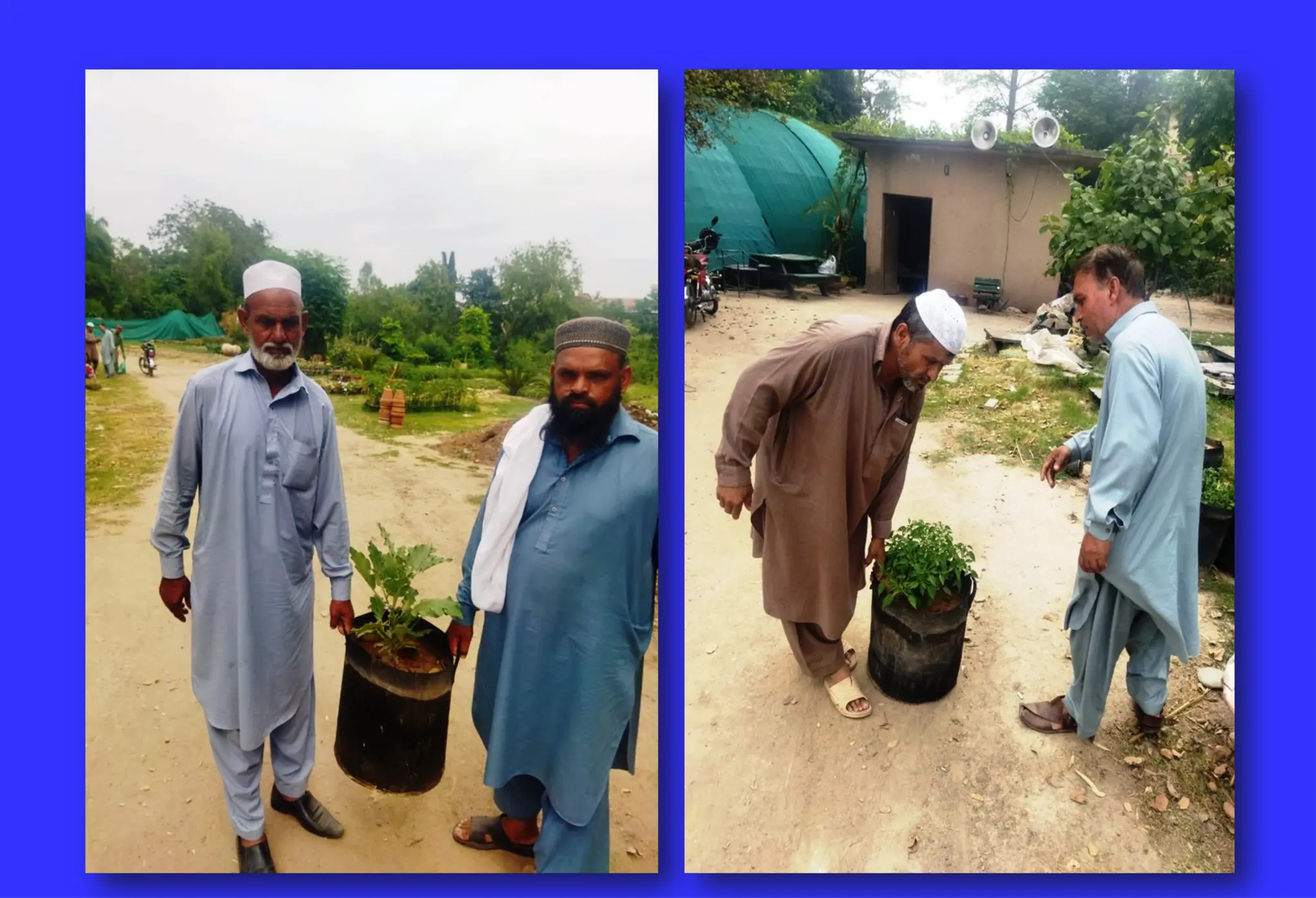
in pots for roof gardening and pot growing
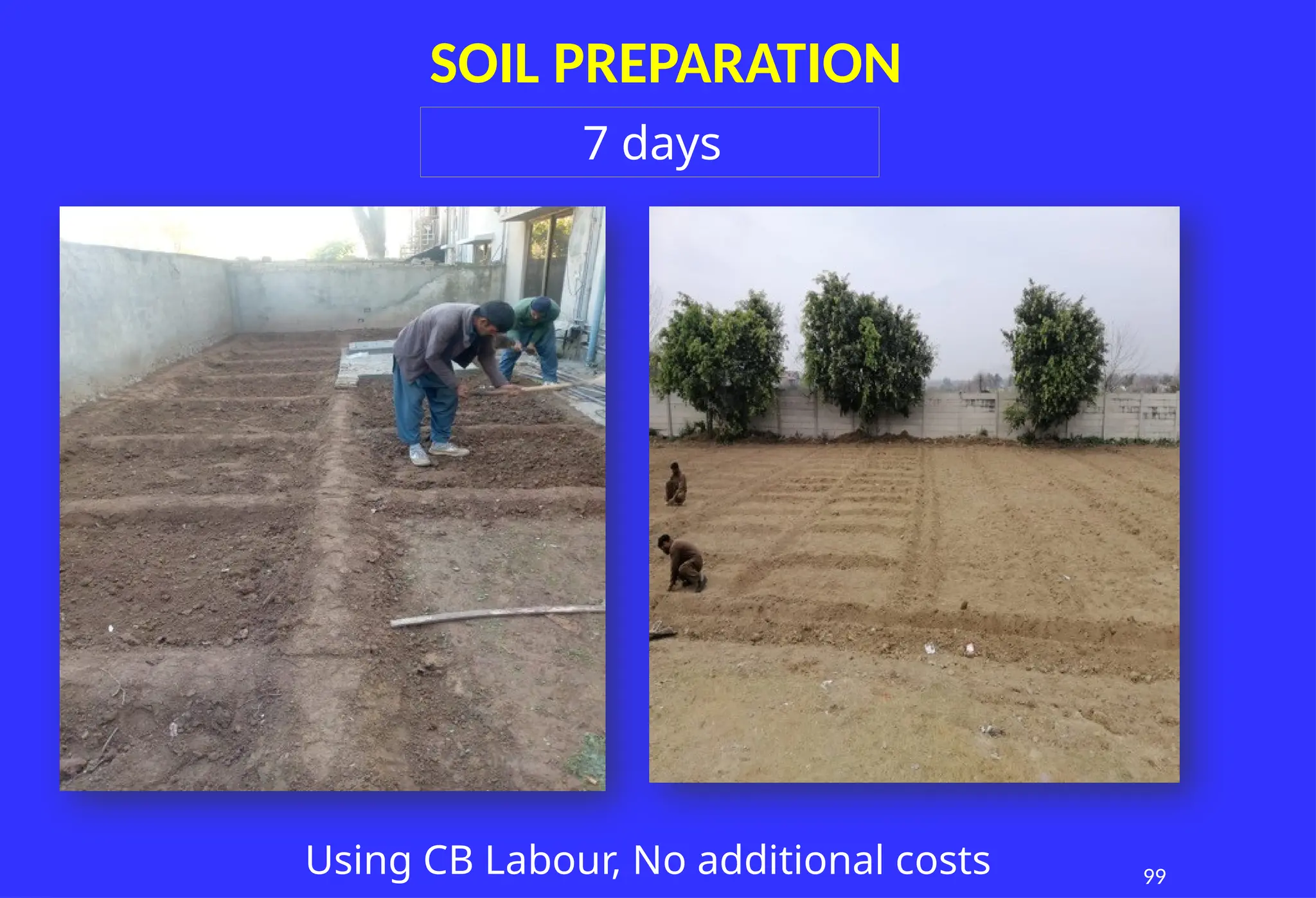
7 days
98.
CANTONMENT WISE AREA
ALLOCATION
98
Only10% of waste lands were provided. The on ground lands available are
S.
#
Name
of CB
Tomat
o
Brinj
al
Chilli
es
Capci
cum
Okr
a
Bottle
gourd
Onio
n
cucu
mber
Bitter
gour
d
Apple
Gour
d
Tot
al
Mar
las
1 RCB 5 5 5 4.5 8 4 3 4 4 2.5 45
2 Taxila 5 5 5 4 164 6 2 4 3 2 200
3 CCB 5 5 6 4 6 6 3 4 2 4 45
4
Wah
Cantt
10 7 9 11 13.5 6 4.5 3.5 3 2.5 70
5 Kamra 2 2 2 3 2 2 2 1 1 3 20
6
Sanjw
al
8 8 8 6 8 7 3 3 4.5 4.5 60
7 Attock 2 2 2 2 2 2 1 1 0.5 0.5 15
8
Havali
an
1 - 1 0 1 - 0.5 0.5 0.5 1 5.5
9 Atd 9 14 6 5.5 10 7 5 4 4.5 3 68
Total 47 48 44 40 214.5 40 24 25 23 23
528.
5
101
PROCUREMENT OF SEEDS
RECURRINGCOST
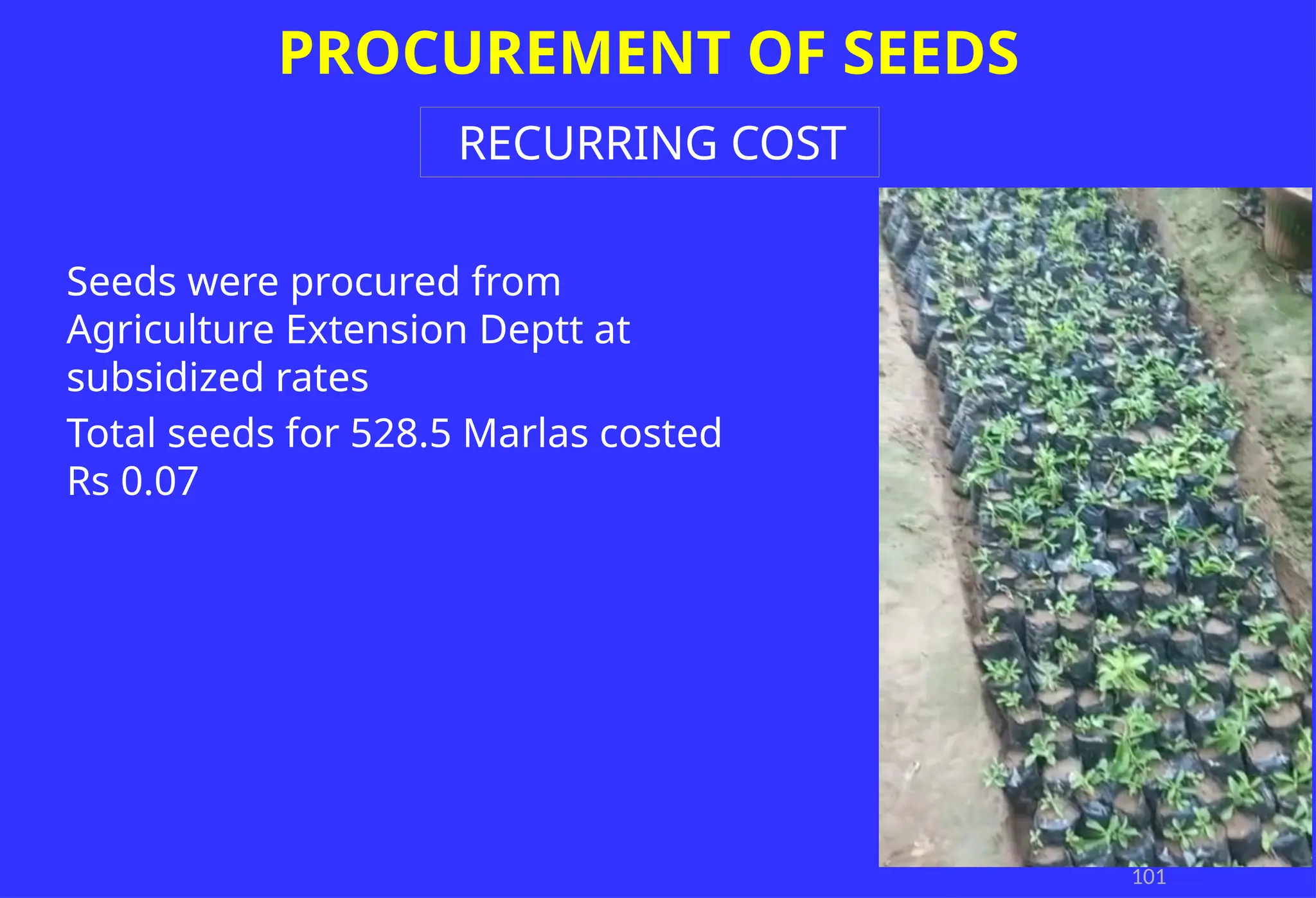
Seeds were procured from
Agriculture Extension Deptt at
subsidized rates
Total seeds for 528.5 Marlas costed
Rs 0.07
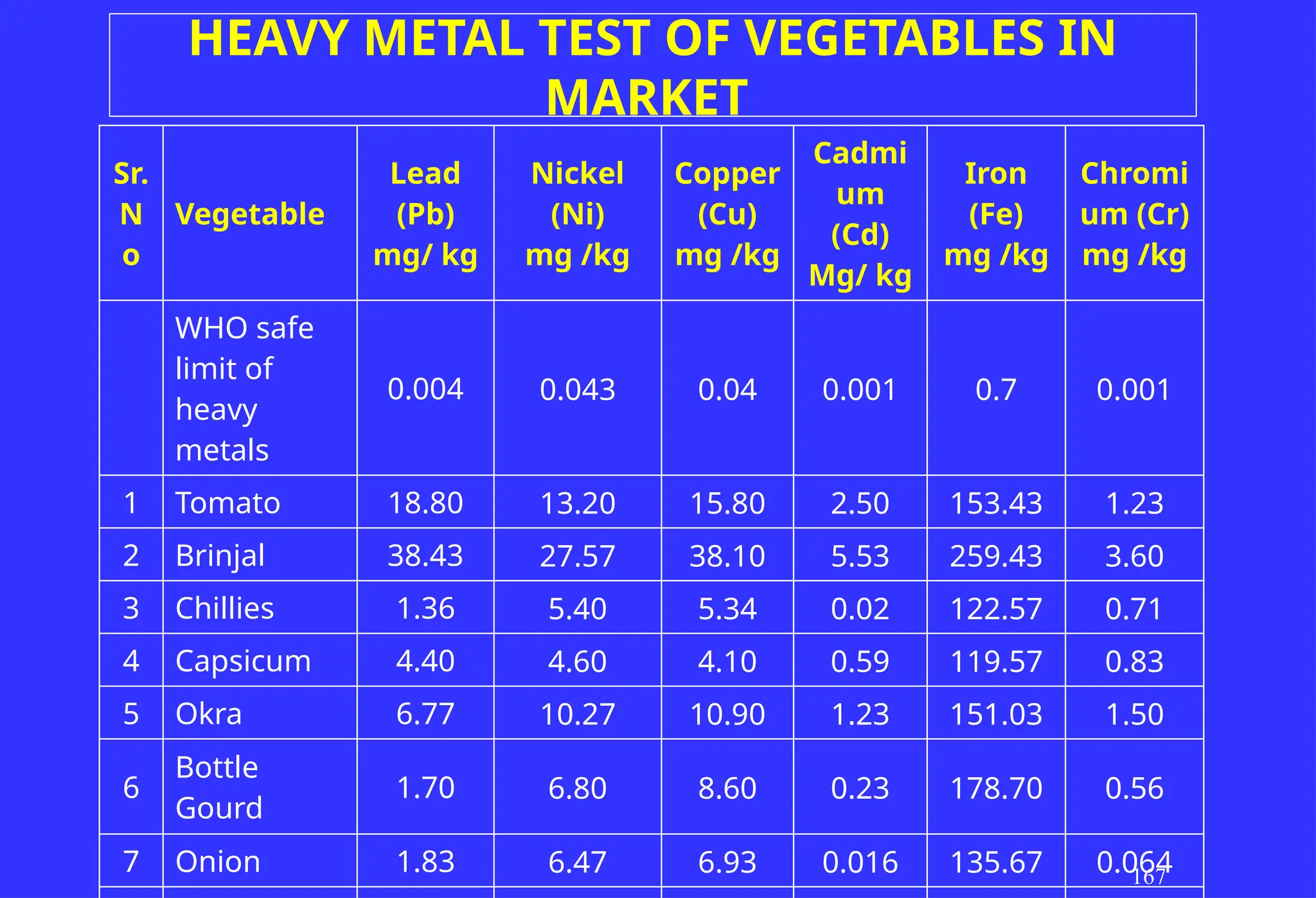
Sr.
N
o
Vegetable
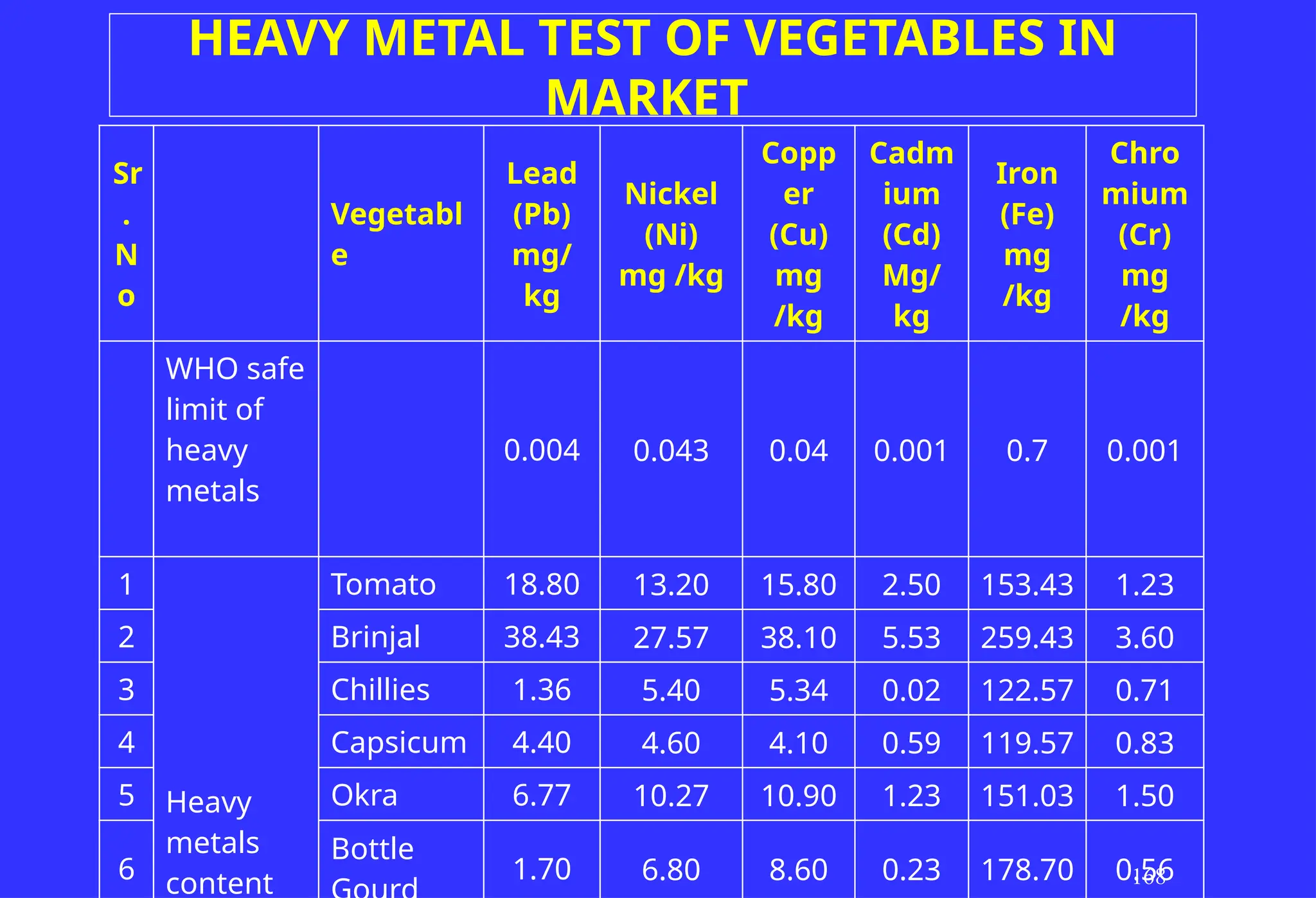
Lead
(Pb)
Mg/kg
Nickel
(Ni)
mg /kg
Copper
(Cu)
Mg/ kg
Cadmi
um
(Cd)
mg/kg
Iron
(Fe)
mg /kg
Chromi
um (Cr)
mg /kg
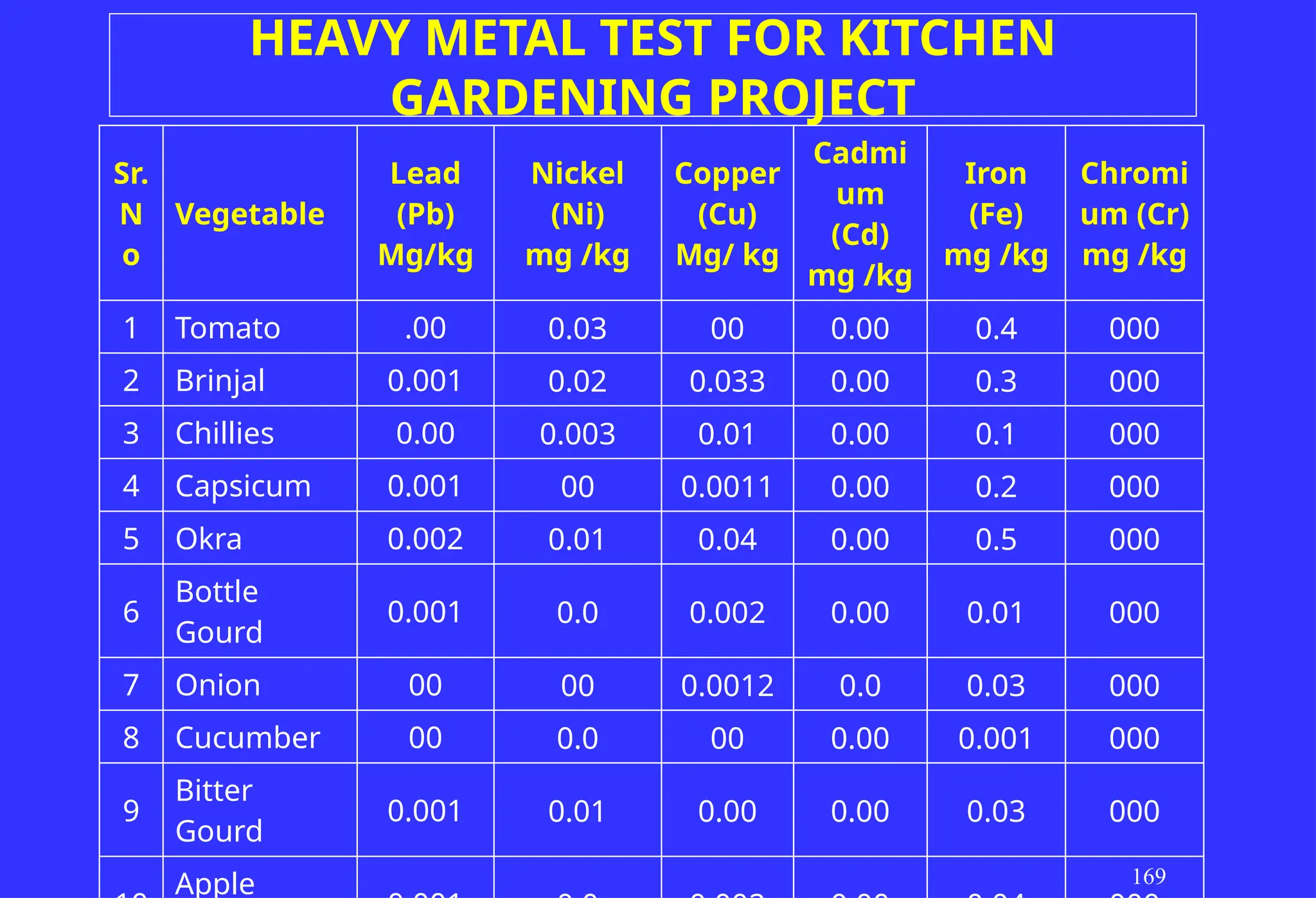
1 Tomato .00 0.03 00 0.00 0.4 000
2 Brinjal 0.001 0.02 0.033 0.00 0.3 000
3 Chillies 0.00 0.003 0.01 0.00 0.1 000
4 Capsicum 0.001 00 0.0011 0.00 0.2 000
5 Okra 0.002 0.01 0.04 0.00 0.5 000
6
Bottle
Gourd
0.001 0.0 0.002 0.00 0.01 000
7 Onion 00 00 0.0012 0.0 0.03 000
8 Cucumber 00 0.0 00 0.00 0.001 000
9
Bitter
Gourd
0.001 0.01 0.00 0.00 0.03 000
Apple 169
HEAVY METAL TEST FOR KITCHEN
GARDENING PROJECT
170.
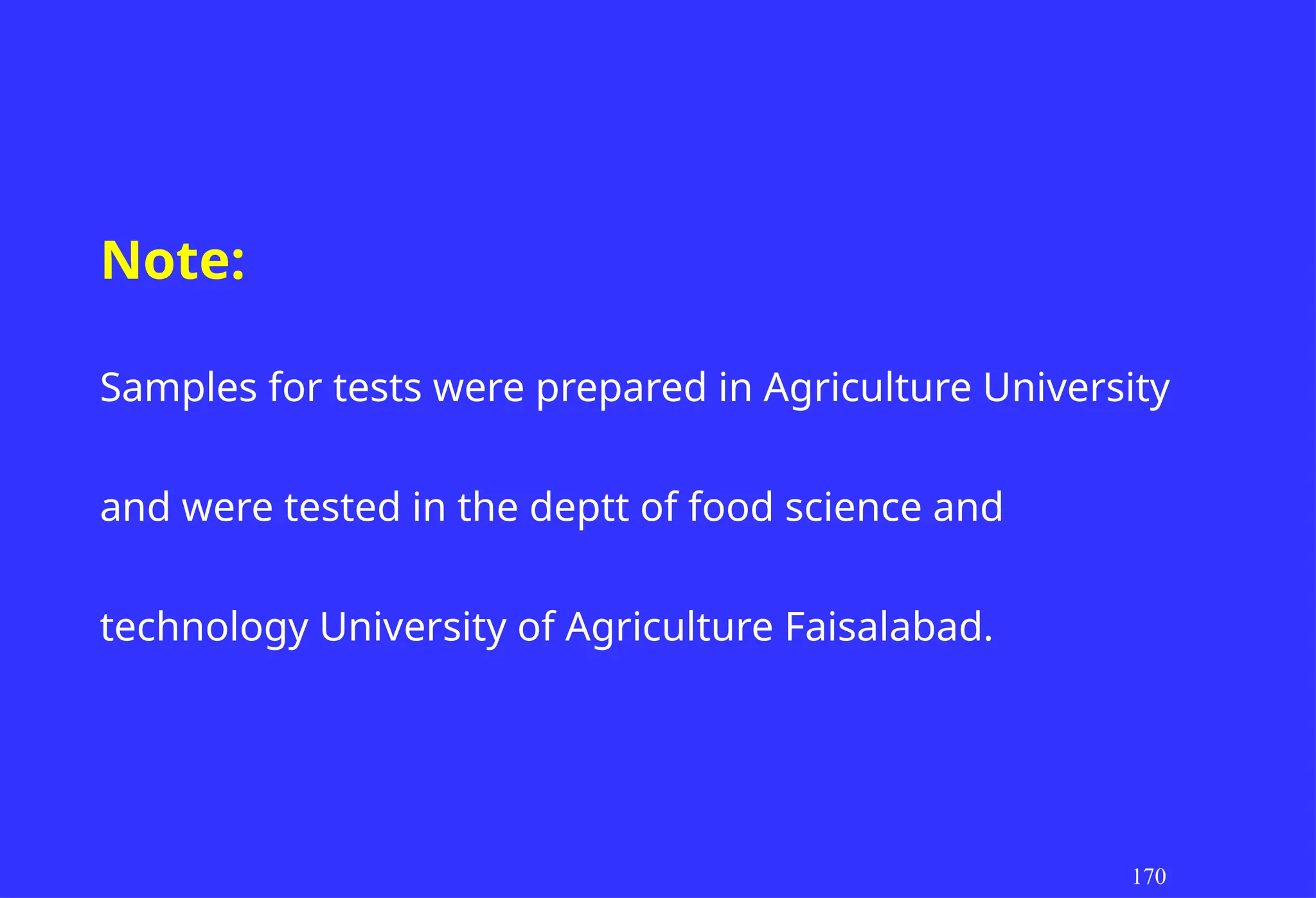
Note:
Samples for testswere prepared in Agriculture University
and were tested in the deptt of food science and
technology University of Agriculture Faisalabad.
170
171.
RECOMMENDATIONS
171
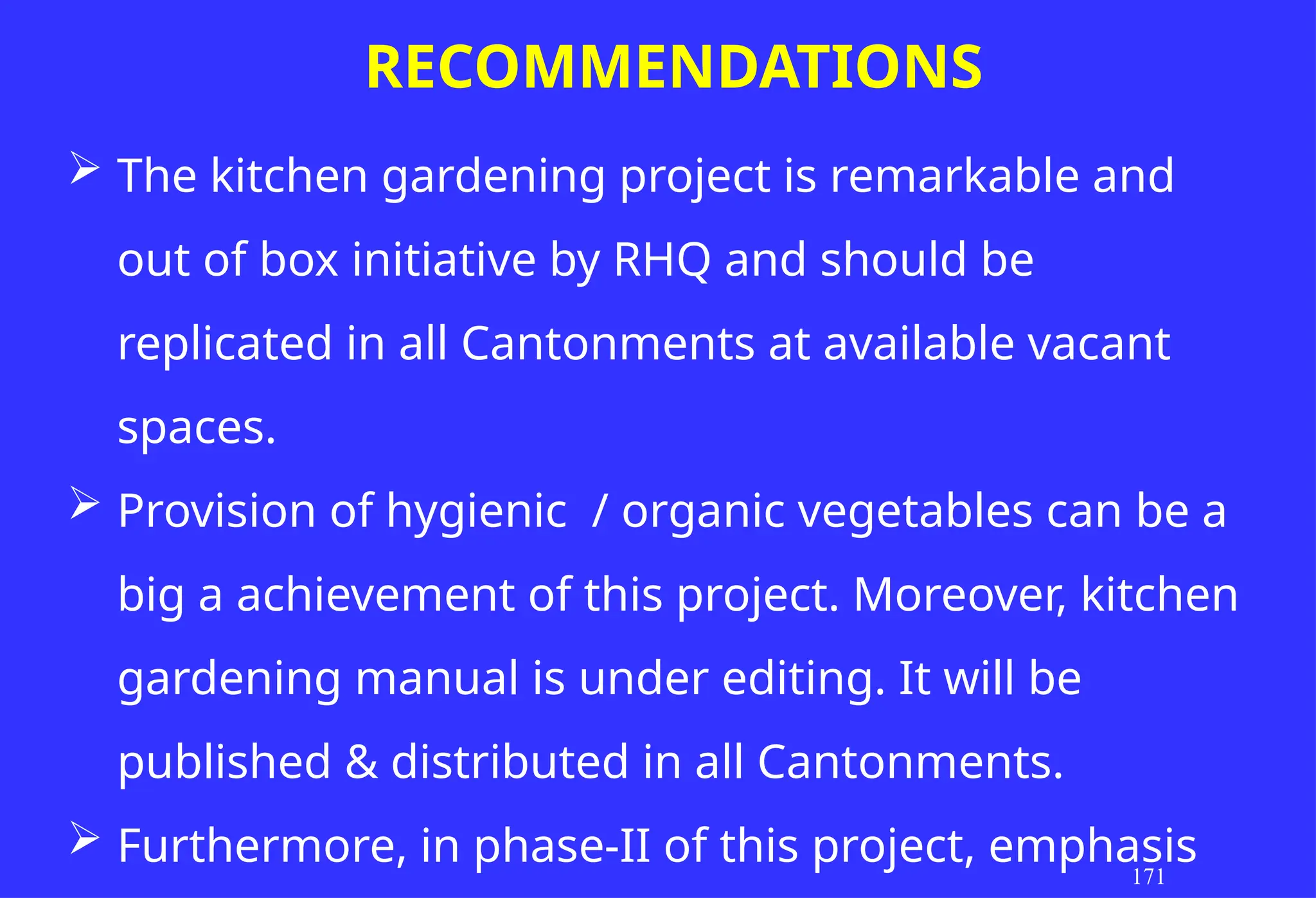
The kitchengardening project is remarkable and
out of box initiative by RHQ and should be
replicated in all Cantonments at available vacant
spaces.
Provision of hygienic / organic vegetables can be a
big a achievement of this project. Moreover, kitchen
gardening manual is under editing. It will be
published & distributed in all Cantonments.
Furthermore, in phase-II of this project, emphasis
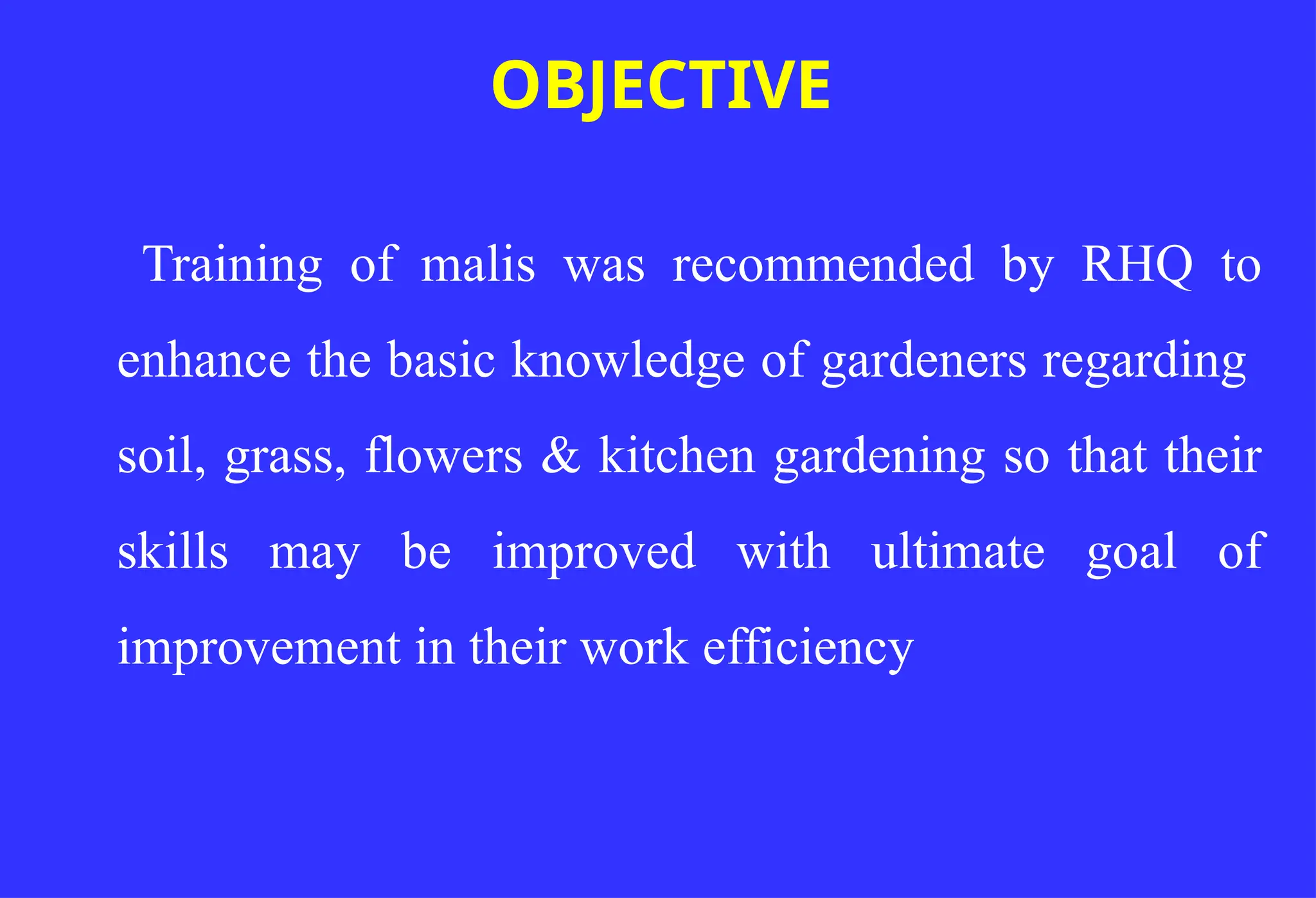
Training of maliswas recommended by RHQ to
enhance the basic knowledge of gardeners regarding
soil, grass, flowers & kitchen gardening so that their
skills may be improved with ultimate goal of
improvement in their work efficiency
OBJECTIVE
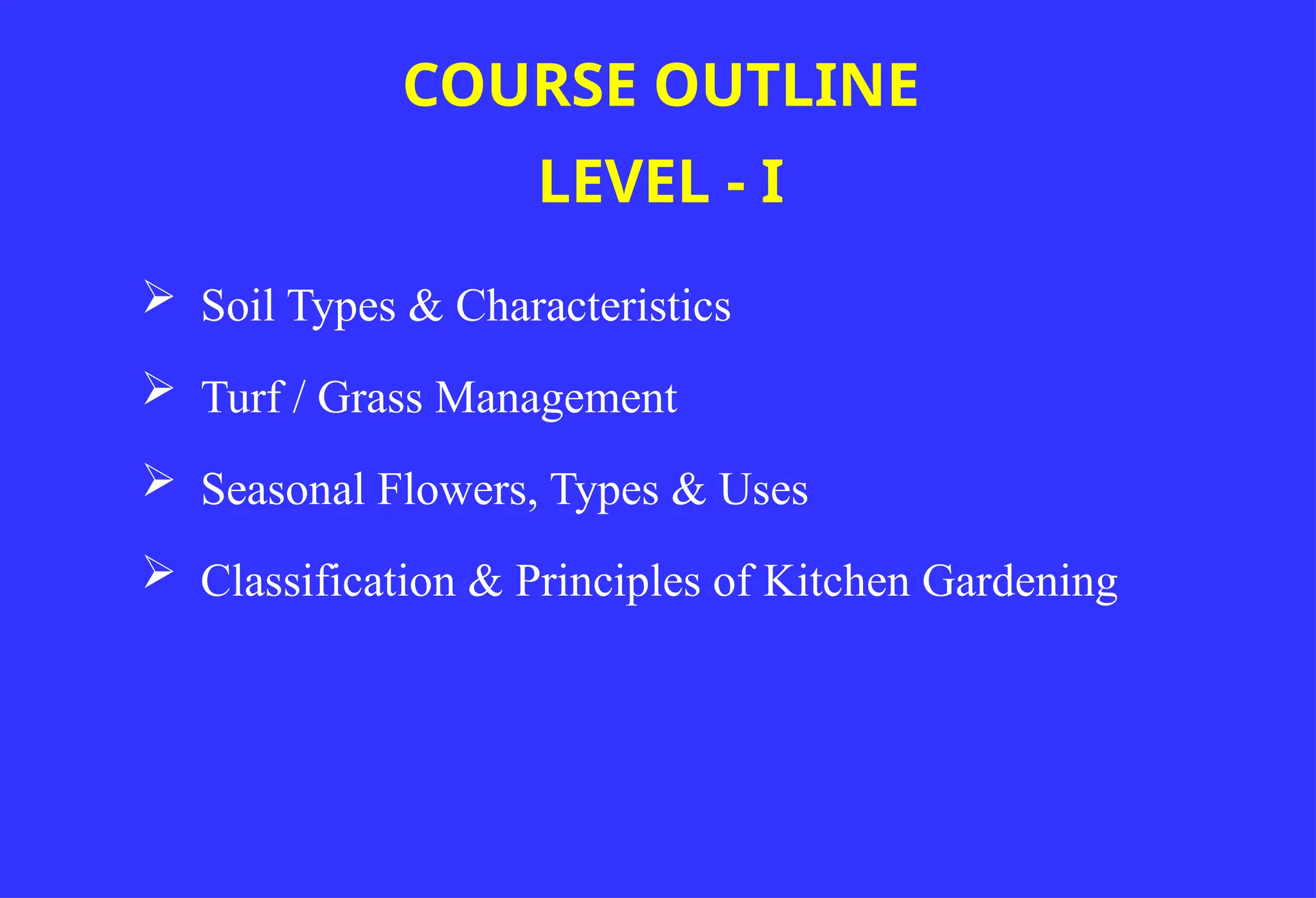
Basic plants types& their selection
Plants propagation methods
Pruning and trimming of Plants
Insect/pest Management
Growing Medias and Composting
Nursery Management
COURSE OUTLINE
LEVEL - II
176.
176
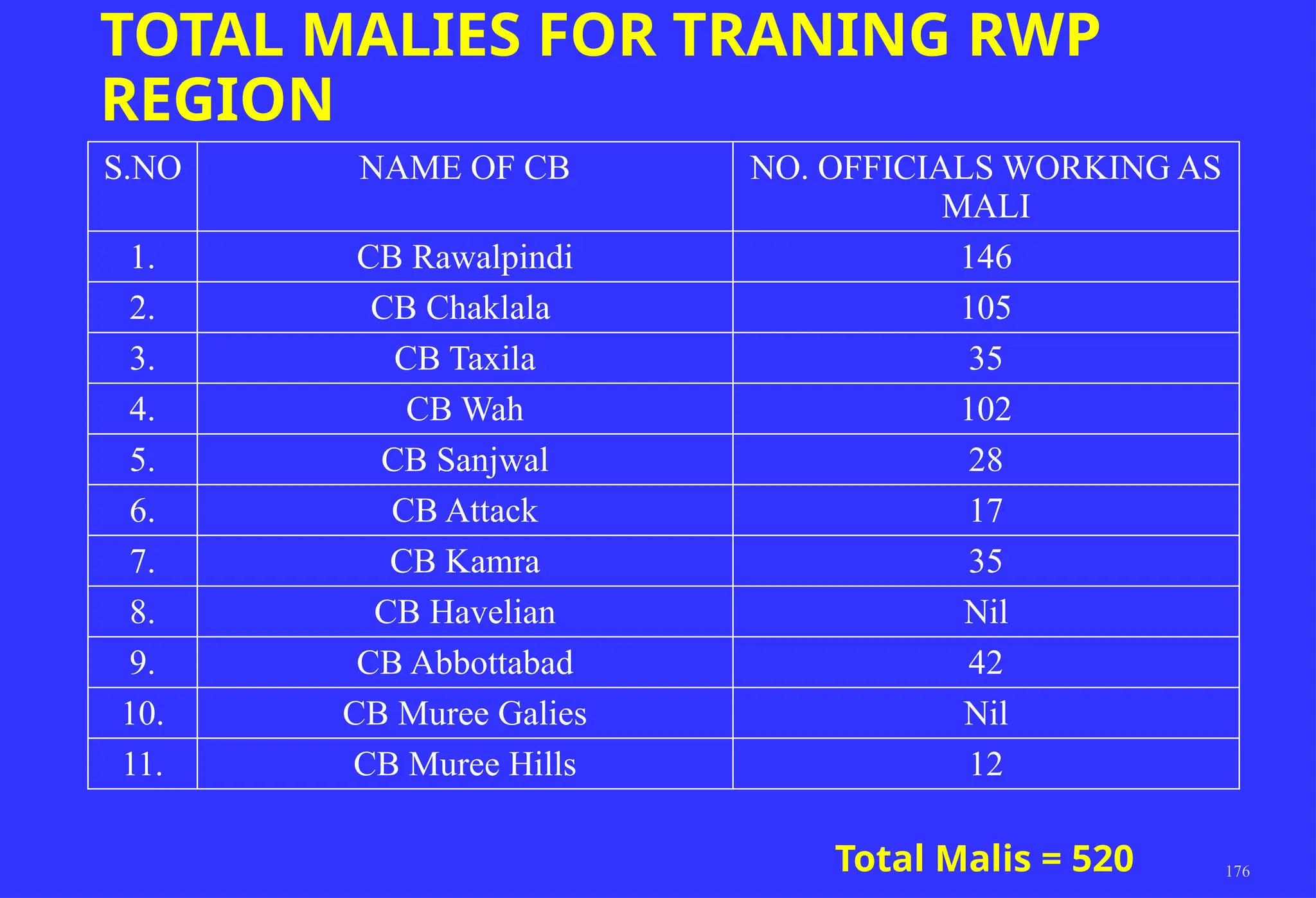
S.NO NAME OFCB NO. OFFICIALS WORKING AS
MALI
1. CB Rawalpindi 146
2. CB Chaklala 105
3. CB Taxila 35
4. CB Wah 102
5. CB Sanjwal 28
6. CB Attack 17
7. CB Kamra 35
8. CB Havelian Nil
9. CB Abbottabad 42
10. CB Muree Galies Nil
11. CB Muree Hills 12
Total Malis = 520
TOTAL MALIES FOR TRANING RWP
REGION
177.
177
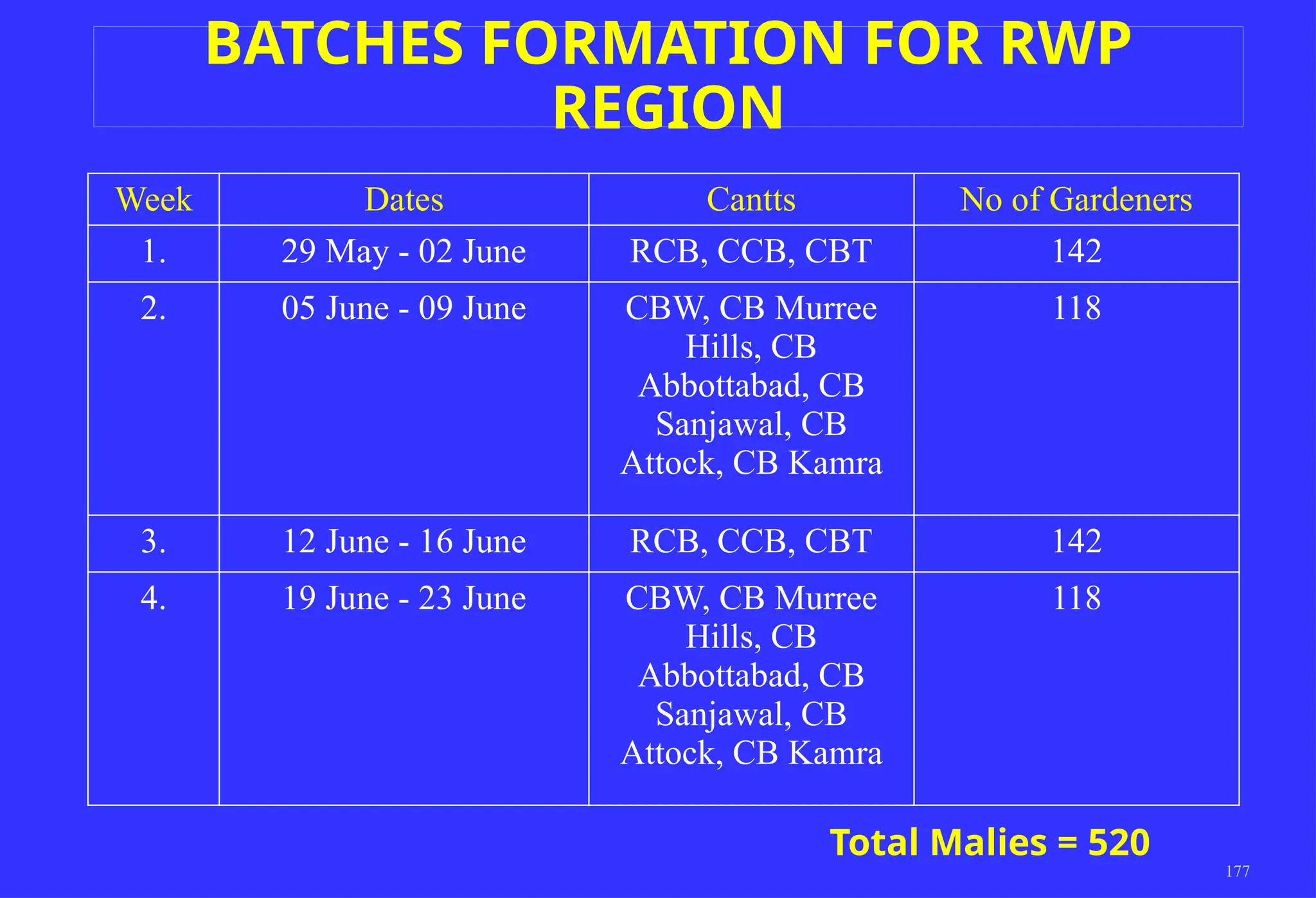
Week Dates CanttsNo of Gardeners
1. 29 May - 02 June RCB, CCB, CBT 142
2. 05 June - 09 June CBW, CB Murree
Hills, CB
Abbottabad, CB
Sanjawal, CB
Attock, CB Kamra
118
3. 12 June - 16 June RCB, CCB, CBT 142
4. 19 June - 23 June CBW, CB Murree
Hills, CB
Abbottabad, CB
Sanjawal, CB
Attock, CB Kamra
118
Total Malies = 520
BATCHES FORMATION FOR RWP
REGION
178.
178
Day Session 1
(8:30-
10:00)
Break
(10:00 –
10:30)
Session 2
(10:30 –
12:00)
Break
(12:00 -
12:30)
Session 3
(12:30 –
02:00)
Session 4
(02:00 –
03:00)
Mon
Opening
remarks by
DML&C.
Soil types
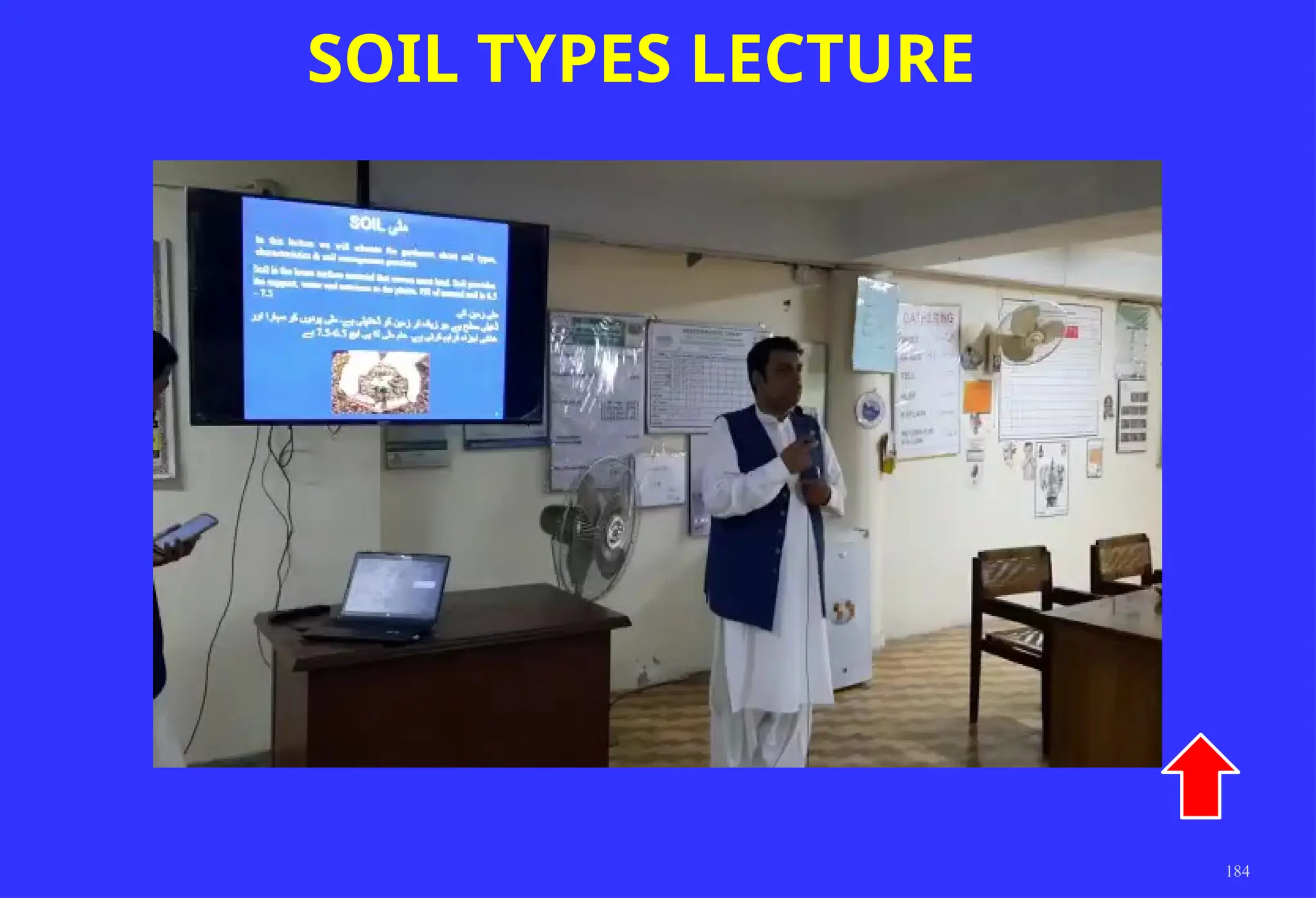
&
characteris
tics
Turf
grasses,
types &
Propagation
methods
Turf / Grass
management
Activity of
the Day
Trainer
Mr
Amanullah
(Sr
Horticultur
ist CBW)
Mrs Aatiqa
Nadeem (Sr
Horticulturi
st )
Mrs Aatiqa
Nadeem (Sr
Horticulturist
)
SCHEDULE FOR THE TRAINING LEVEL -
I
179.
179
Day Session 1
(8:30-
10:00)
Break
(10:00 –
10:30)
Session 2
(10:30 –
12:00)
Break
(12:00 -
12:30)
Session 3
(12:30 –
02:00)
Session 4
(02:00 –
03:00)
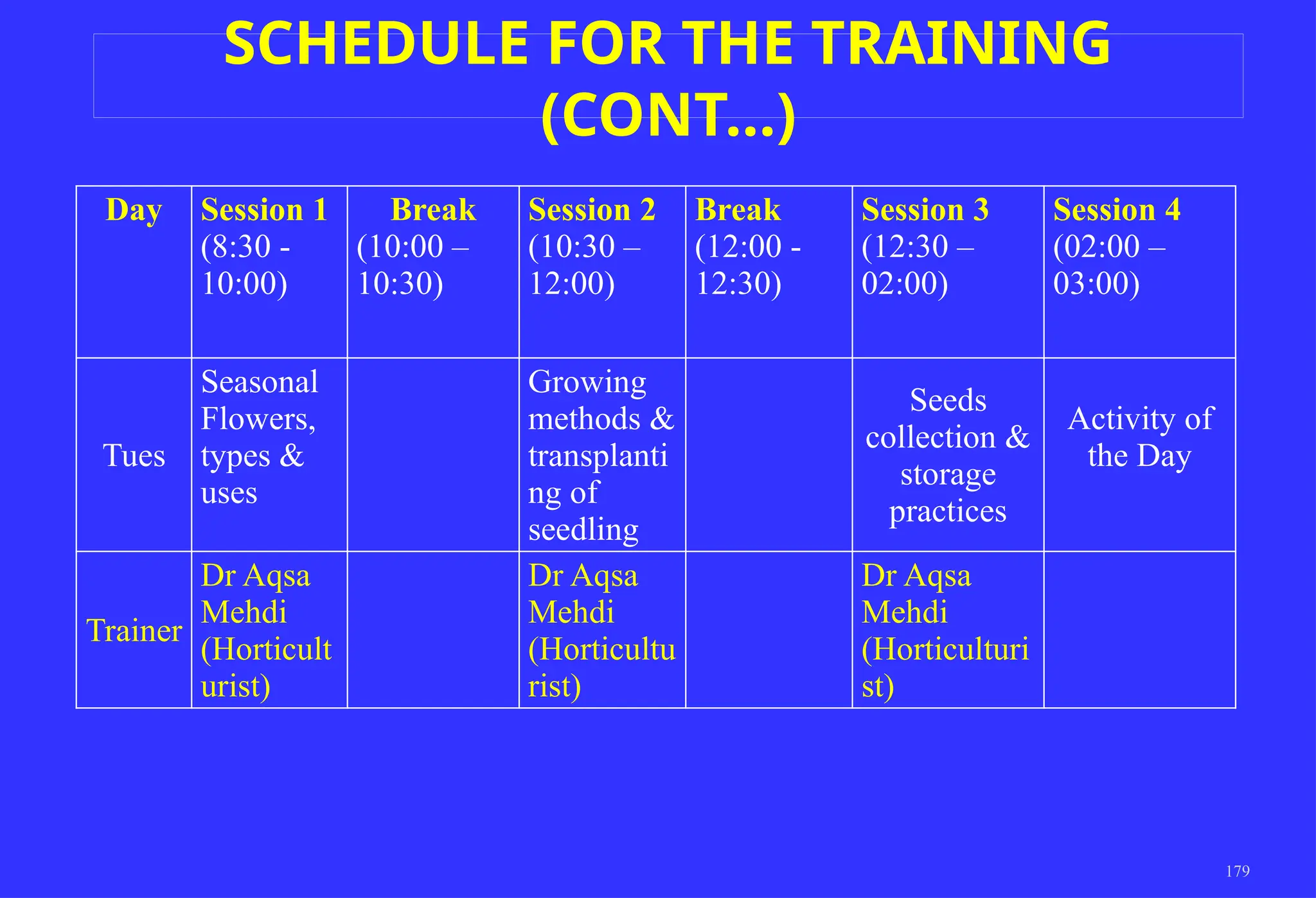
Tues
Seasonal
Flowers,
types &
uses
Growing
methods &
transplanti
ng of
seedling
Seeds
collection &
storage
practices
Activity of
the Day
Trainer
Dr Aqsa
Mehdi
(Horticult
urist)
Dr Aqsa
Mehdi
(Horticultu
rist)
Dr Aqsa
Mehdi
(Horticulturi
st)
SCHEDULE FOR THE TRAINING
(CONT…)
180.
180
Day Session 1
(8:30-
10:00)
Break
(10:00 –
10:30)
Session 2
(10:30 –
12:00)
Break
(12:00 -
12:30)
Session 3
(12:30 –
02:00)
Session 4
(02:00 –
03:00)
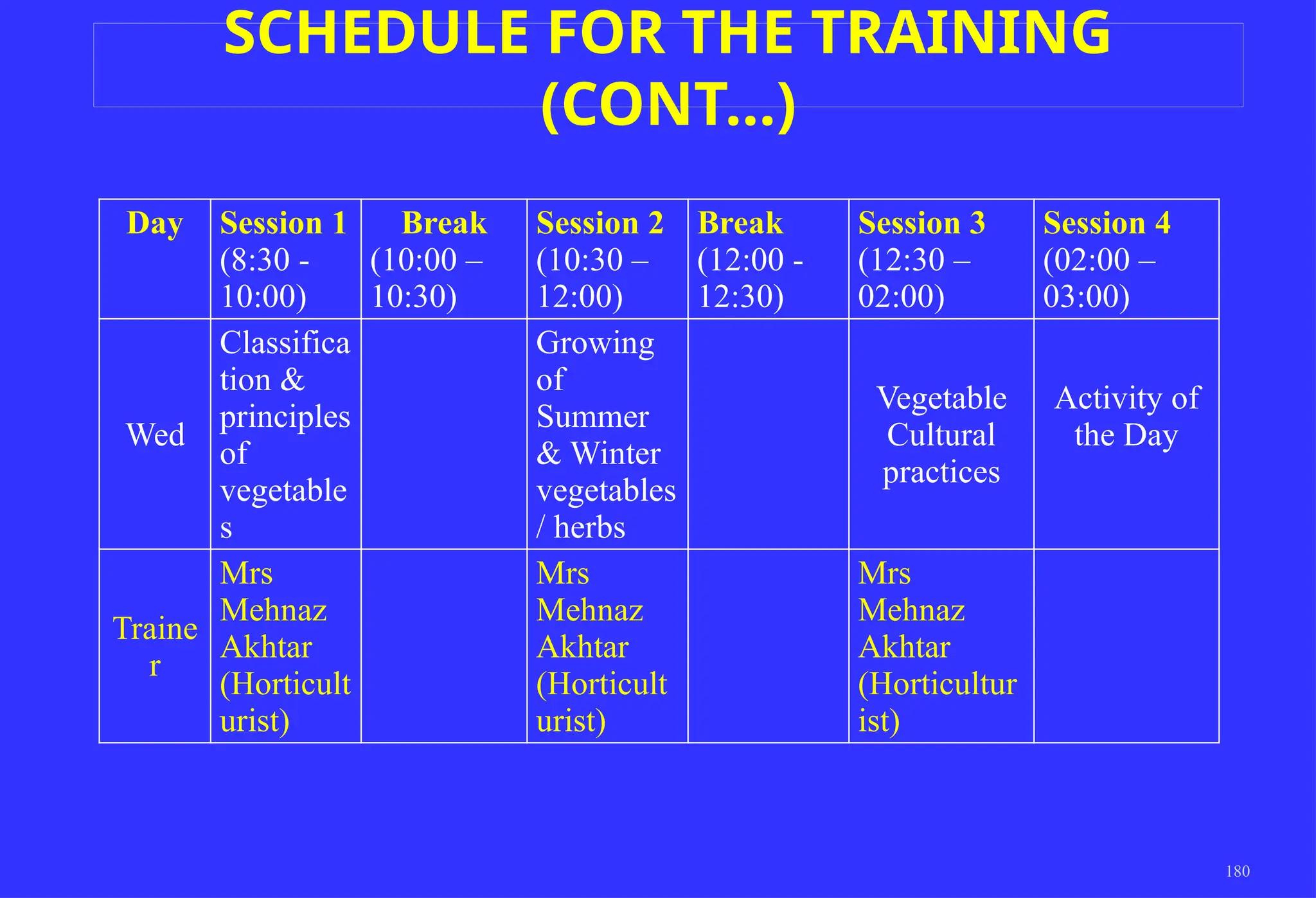
Wed
Classifica
tion &
principles
of
vegetable
s
Growing
of
Summer
& Winter
vegetables
/ herbs
Vegetable
Cultural
practices
Activity of
the Day
Traine
r
Mrs
Mehnaz
Akhtar
(Horticult
urist)
Mrs
Mehnaz
Akhtar
(Horticult
urist)
Mrs
Mehnaz
Akhtar
(Horticultur
ist)
SCHEDULE FOR THE TRAINING
(CONT…)
181.
181
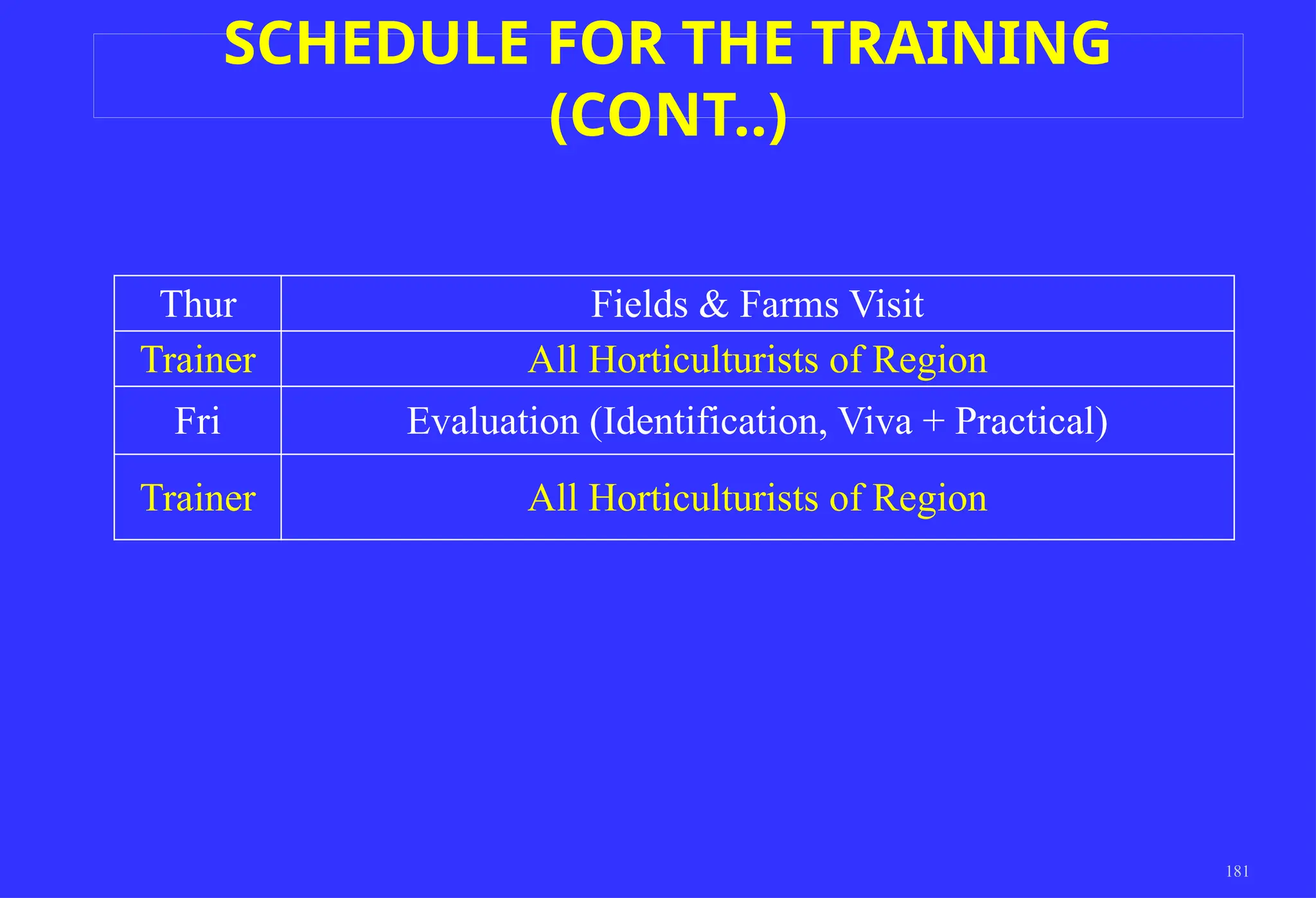
Thur Fields &Farms Visit
Trainer All Horticulturists of Region
Fri Evaluation (Identification, Viva + Practical)
Trainer All Horticulturists of Region
SCHEDULE FOR THE TRAINING
(CONT..)
187
FUTURE PLANS
CBs’Horticulture Branches will executed commercial farming projects
of following crops
Roses for Essential Oils - Mr Amanullah
Trees for Essential Oils – Sagwan, Loban, Cedar Wood, Agarwood –
Mr Amanullah
Bee keeping in forest area of Murree – Mrs Aatiqa
Soyabean Production – Mrs Aatiqa
Wild Mushroom Production in Murree Hills– Mrs Aatiqa
Avocado Farming – Dr Aqsa
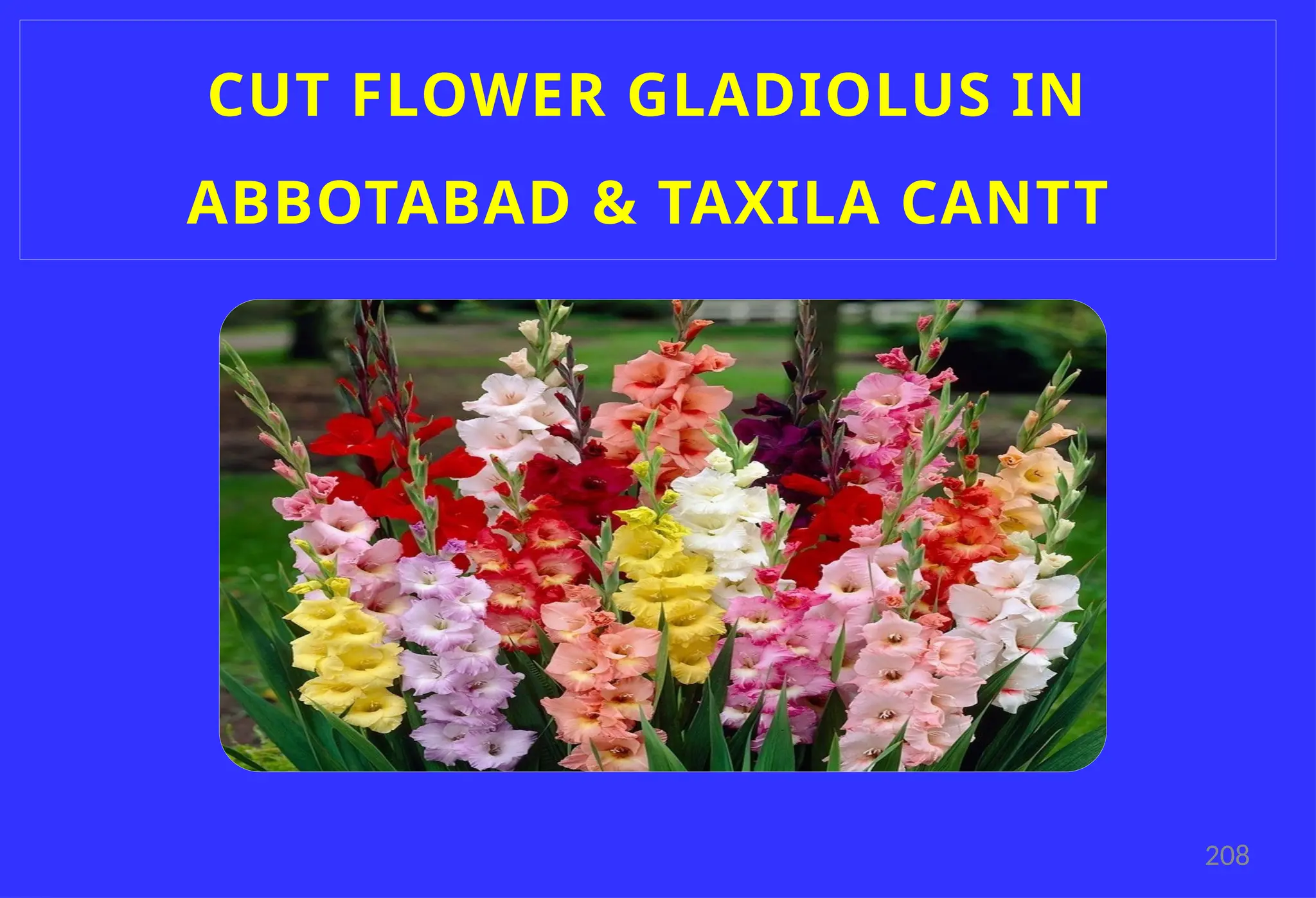
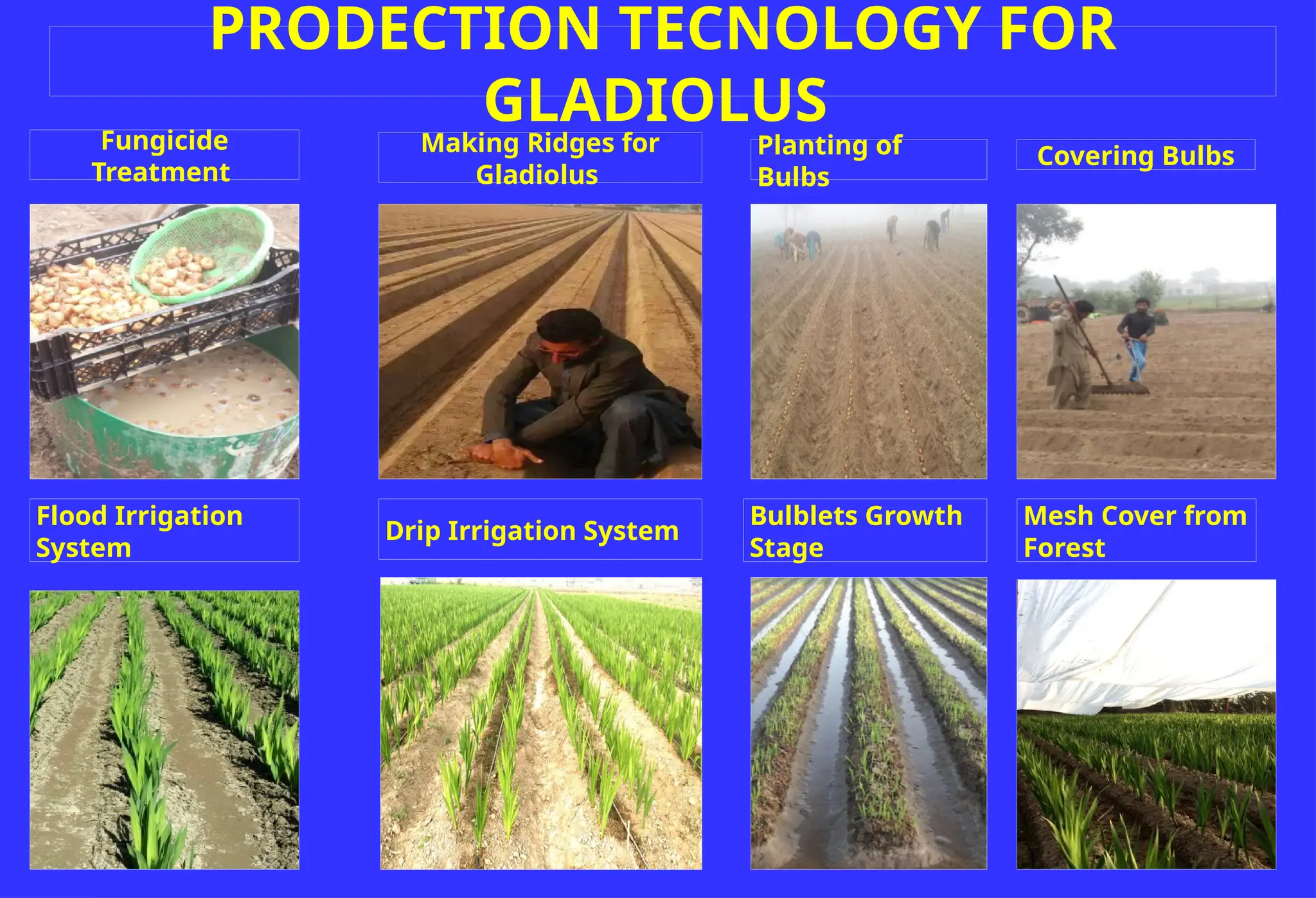
Gladiolus Farming for Cut flowers – Dr Aqsa
G1 Garlic – Mrs Mehnaz
188.
188
ROSES FOR ESSENTIALOILS
Rose petals of Rosa centifolia, Rosa damascene, Rosa
bourborniana and Rosa gruss-an-teplitz yield highly aromatic
essential oil which is very expensive and high in demand in
cosmetic industry
Results indicate that essential oils of these flowers could
reach phenomenal revenue generation of Rs 10M (per acre)
against an expenditure of Rs 0.4M (per acre) of these Rose
cultivars
The project will be executed after 3 months
189.
189
ROSES FOR ESSENTIALOILS
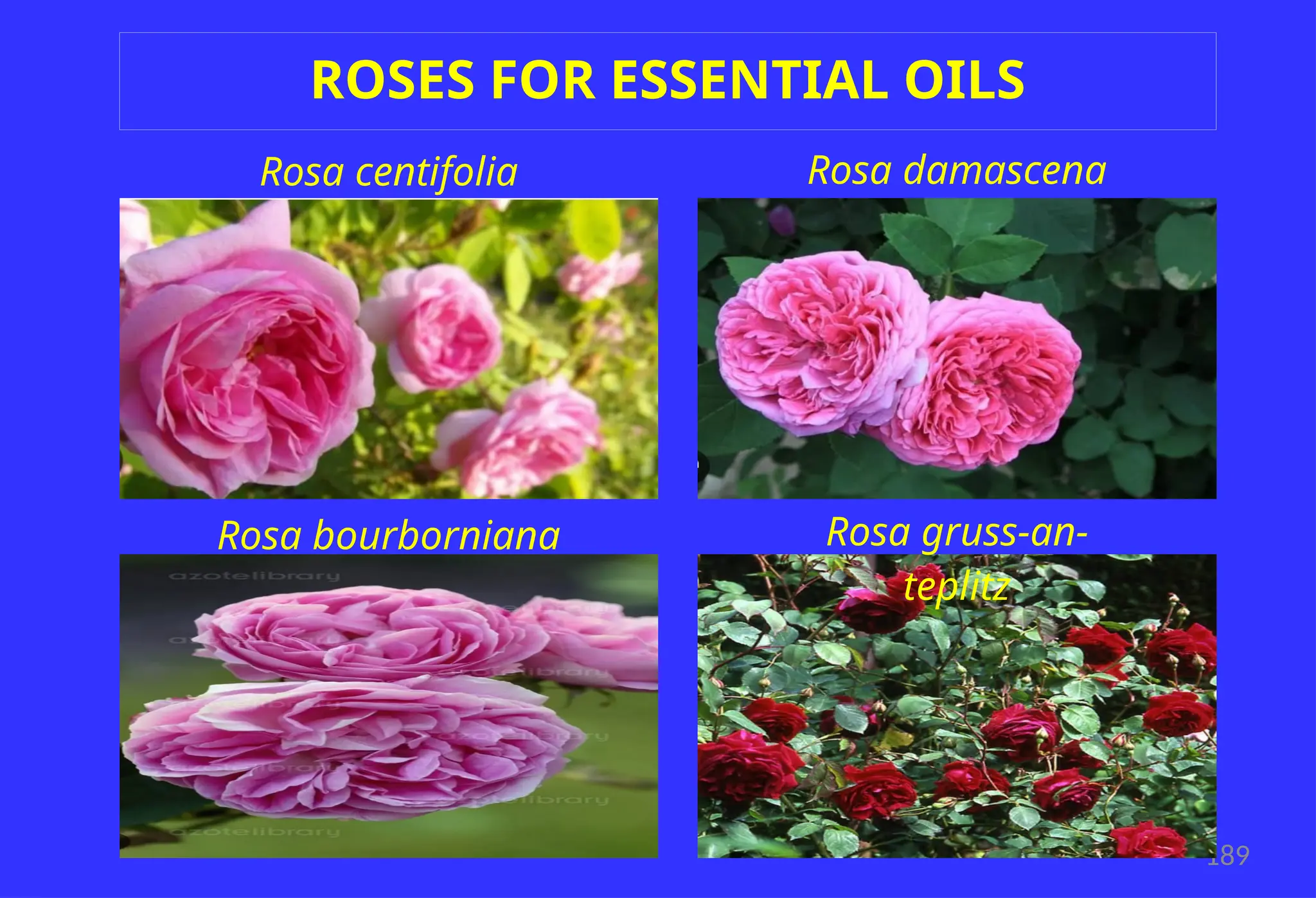
Rosa centifolia Rosa damascena
Rosa bourborniana Rosa gruss-an-
teplitz
191
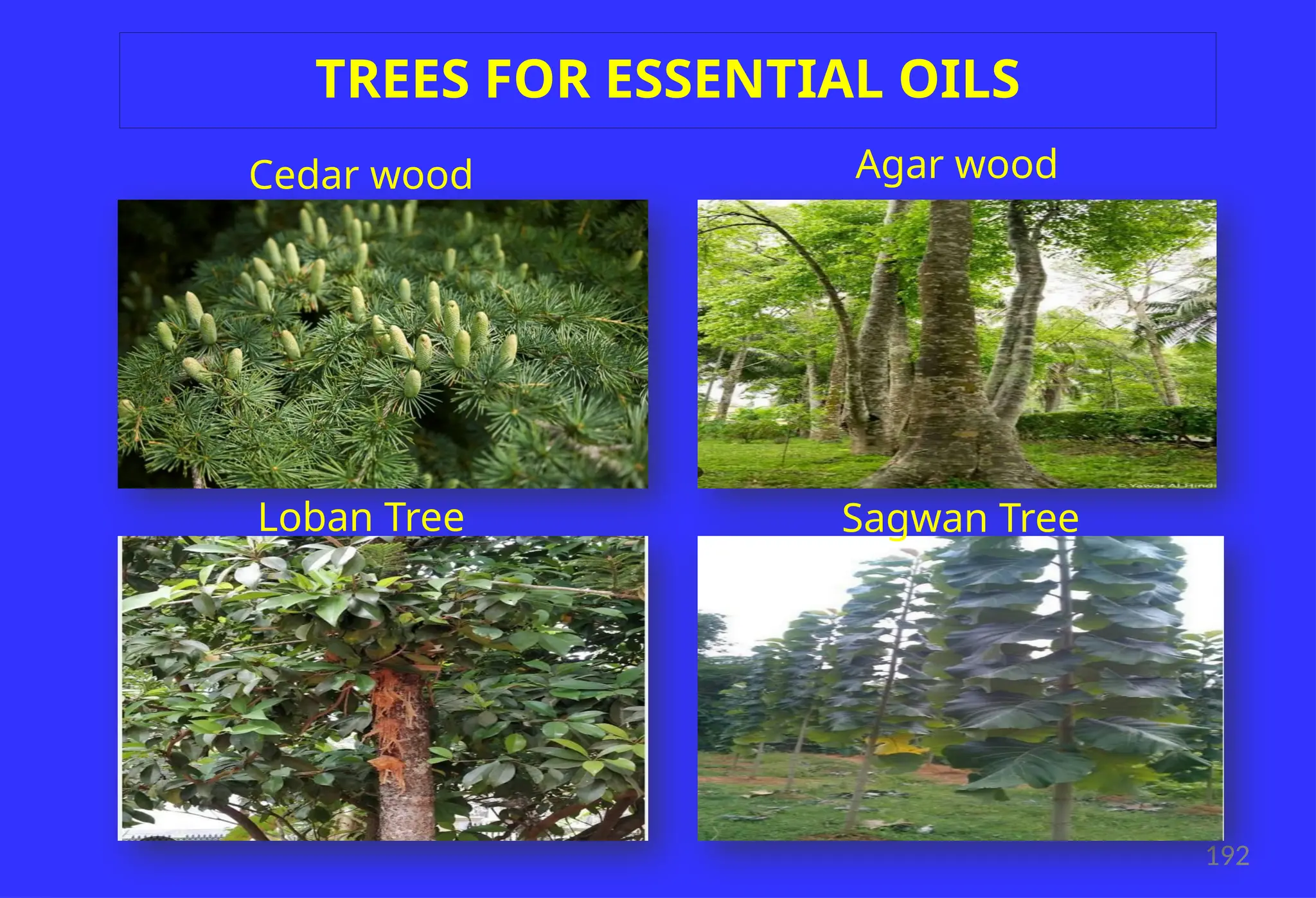
TREES FOR ESSENTIALOILS
To establish an essential oil extraction project of Cedar wood
tree, Agar wood tree in Murree hills and Loban, Sagwan trees in
Wah Cantt
These trees have a highly aromatic bark and highly commercial
value
It has conveniently sold in the local market through out the year
Results indicate that essential oils of these trees could reach
phenomenal revenue generation of Rs 6M to 7M (per acre)
against an expenditure of Rs 0.27 M (per acre) of Cedar wood
and Agar wood trees
194
BEE KEEPING INFOREST AREA OF
MURREE
Bee varieties Apis melifera, Apis cerana, Apis florea & Apis
dorsata will be used for natural honey production which is
very expensive and rare
Pure natural honey of these Bees could generate revenue
of about minimum Rs 1.25M with the expenditure of Rs
0.25M
The project will be executed next month
195.
195
BEE KEEPING INFOREST AREA OF MURREE
Apis Melifera Apis Cerana
Apis Florea Apis Dorsata
197
WILD MUSHROOMS PRODUCTIONIN FOREST
AREA OF MURREE BHUR BUND TRACK KASHMIRI
BAZAR
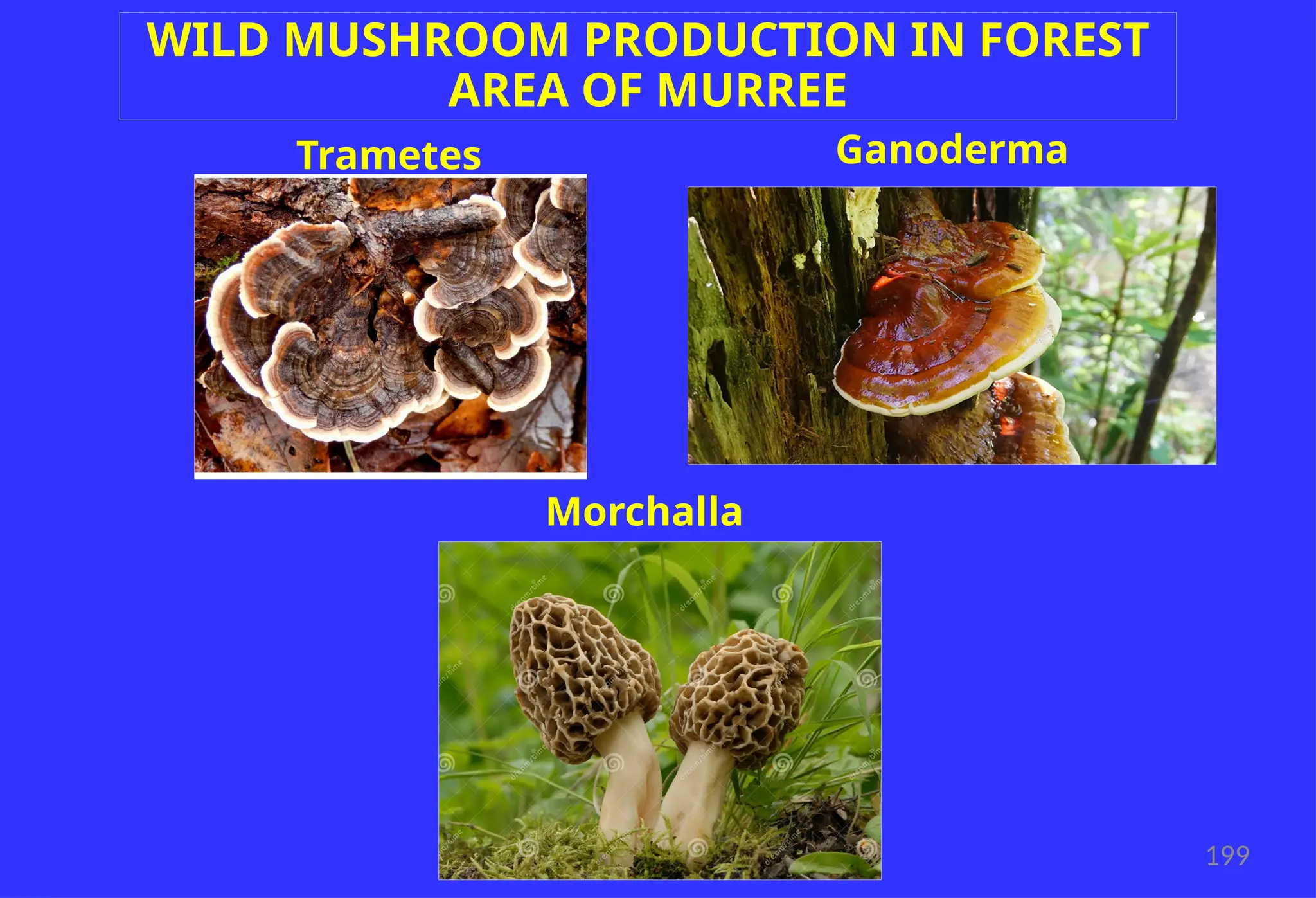
Wild mushrooms varieties Ganoderma (Reisha Mushrooms),
Morchalla (Moral Mushrooms), Trametes Versicolor(Turkey
tail) will be used for wild mushroom production which are
very expensive, having highly medicinal values
Wild varieties of mushrooms are vary rare and expensive due
to medicinal values
1 kg dried wild mushrooms of ganoderma could generate
revenue of about minimum Rs 70,000/kg without any
expenditure
1 kg of dried moral mushrooms could generate the revenue
198.
198
WILD MUSHROOMS PRODUCTIONSIN FOREST
AREA OF MURREE BHUR BUND TRACK KASHMIRI
BAZAR
Aug/Sep & March/April are the best seasons for its production
Spores of these mushrooms will be spreadid there on their
natural habitat for the next season crop
Spores of these verities produced through lab will be spreadid
at the end of novembor for their commercial production
(CONT…)
201
SOYABEAN PRODUCTION
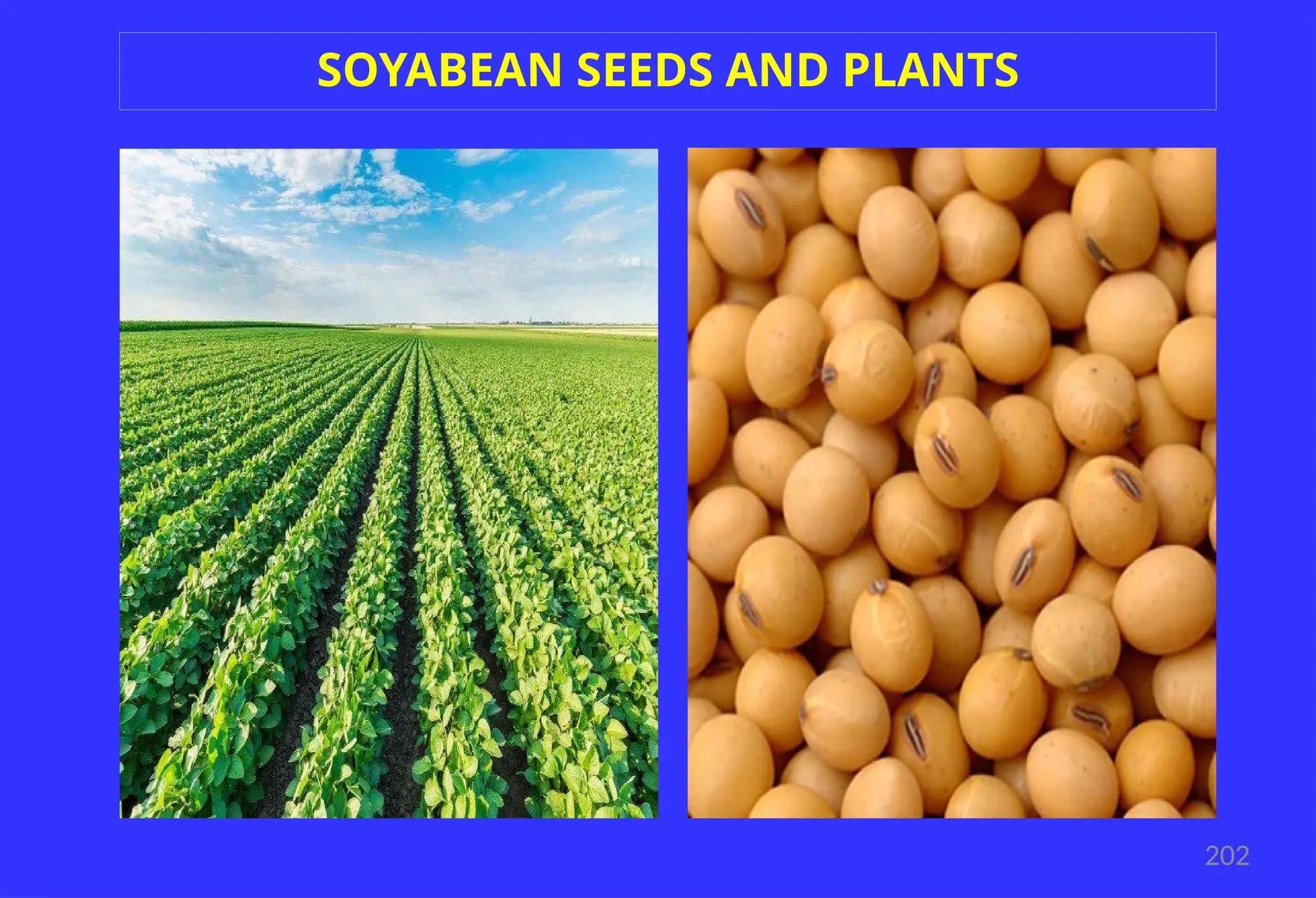
Soyabean(Glycine max) is an annual legume of the pea family having
edible seeds
The Soyabean is economically the most important bean in the world,
providing vegetable protein
Soyabean cultivation is possible in all seasons but kharif crop will give
higher yields compared to the other season crops
It is very economical crop as 25 kg seed is required for one acre (100-
125/- Rs per kg) and with addition of FYM it will be 50-60/- thousand
expenditure per acre
Soyabean is a highly revenue generating crop which gives Rs 0.5-0.7 M
(per acre) against an expenditure of 0.5-0.6 M (per acre)
204
INTRODUCTION OF AVOCADO
Avocado is a pulpy fruit tree of tropical America
t is about the size and shape of large pear (is also called Avocado
Pear, Alligator Pear)
In Pakistan Chara pani & Tret (Murree) producing Avocado
California & Seloon are famous varieties
Avocado provide nearly 20 essential nutrients, including fiber,
potassium, Vitamin E, B-vitamins and folic acid
Avocado is also act as a “Nutrient Booster” by enabling the body
to absorb more fat-soluble nutrients, such as alpha and beta-
carotene, in food that are eaten with the fruit
PRODUCTION TECHNOLOGY OF
AVOCADO
Avocadopropagated by seeds
The off-spring is unlikely to resemble the parent cultivar in fruit
quality
While commercial orchards are planted using grafting and budding
methods
PXP distance 5 meter so = 150 plants in One Acre
A mature plant requires FYM every year in January
Chemical fertilizers can be applied according to need
In summer season irrigation should be given after 10 days while in
winter irrigation should be applied after 20 days
The Avocado fruit does not ripen on the tree, but will fall off or be
picked in a hard green state, then it will ripen quickly on the ground
207.
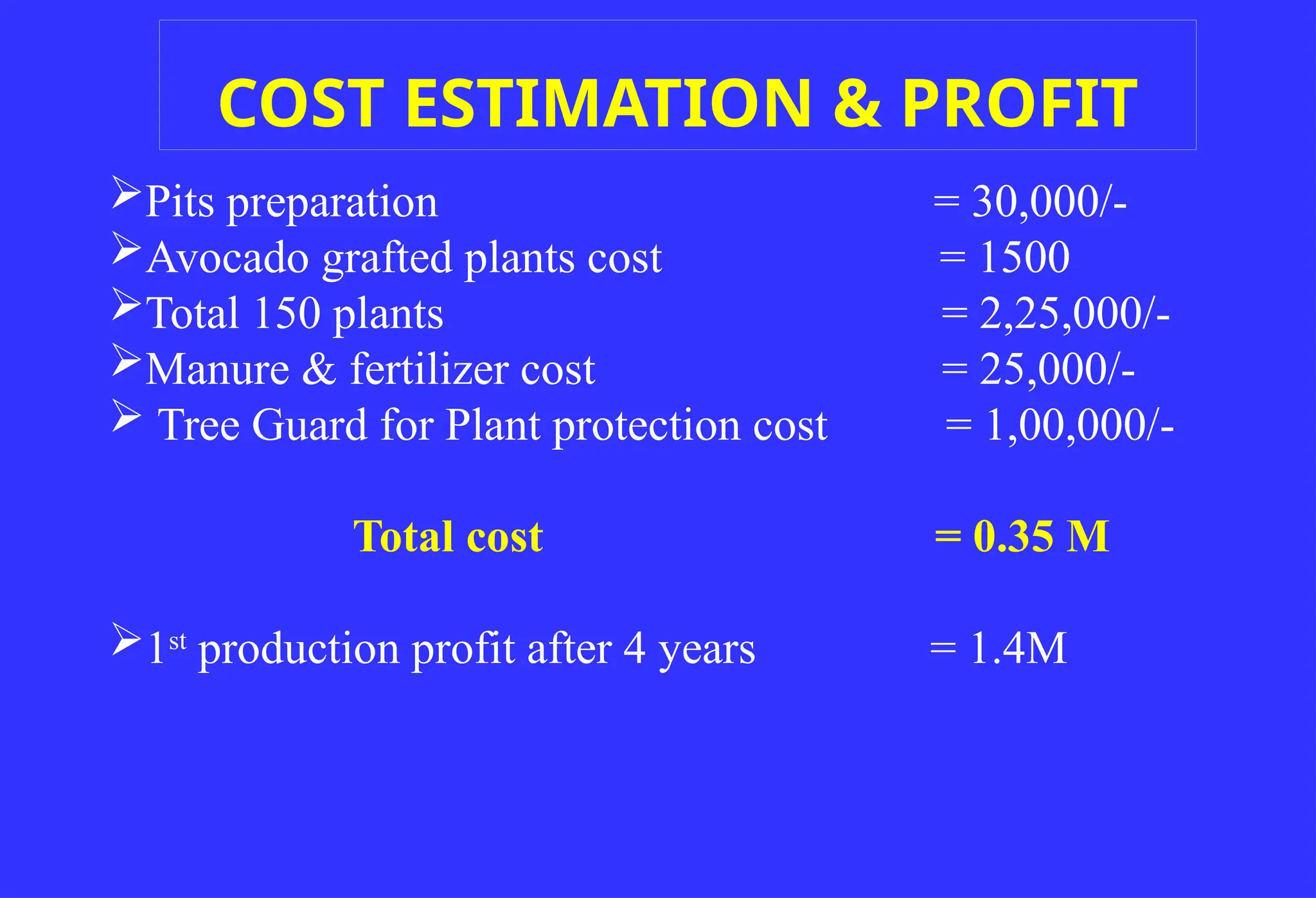
COST ESTIMATION &PROFIT
Pits preparation = 30,000/-
Avocado grafted plants cost = 1500
Total 150 plants = 2,25,000/-
Manure & fertilizer cost = 25,000/-
Tree Guard for Plant protection cost = 1,00,000/-
Total cost = 0.35 M
1st
production profit after 4 years = 1.4M
INTRODUCTION
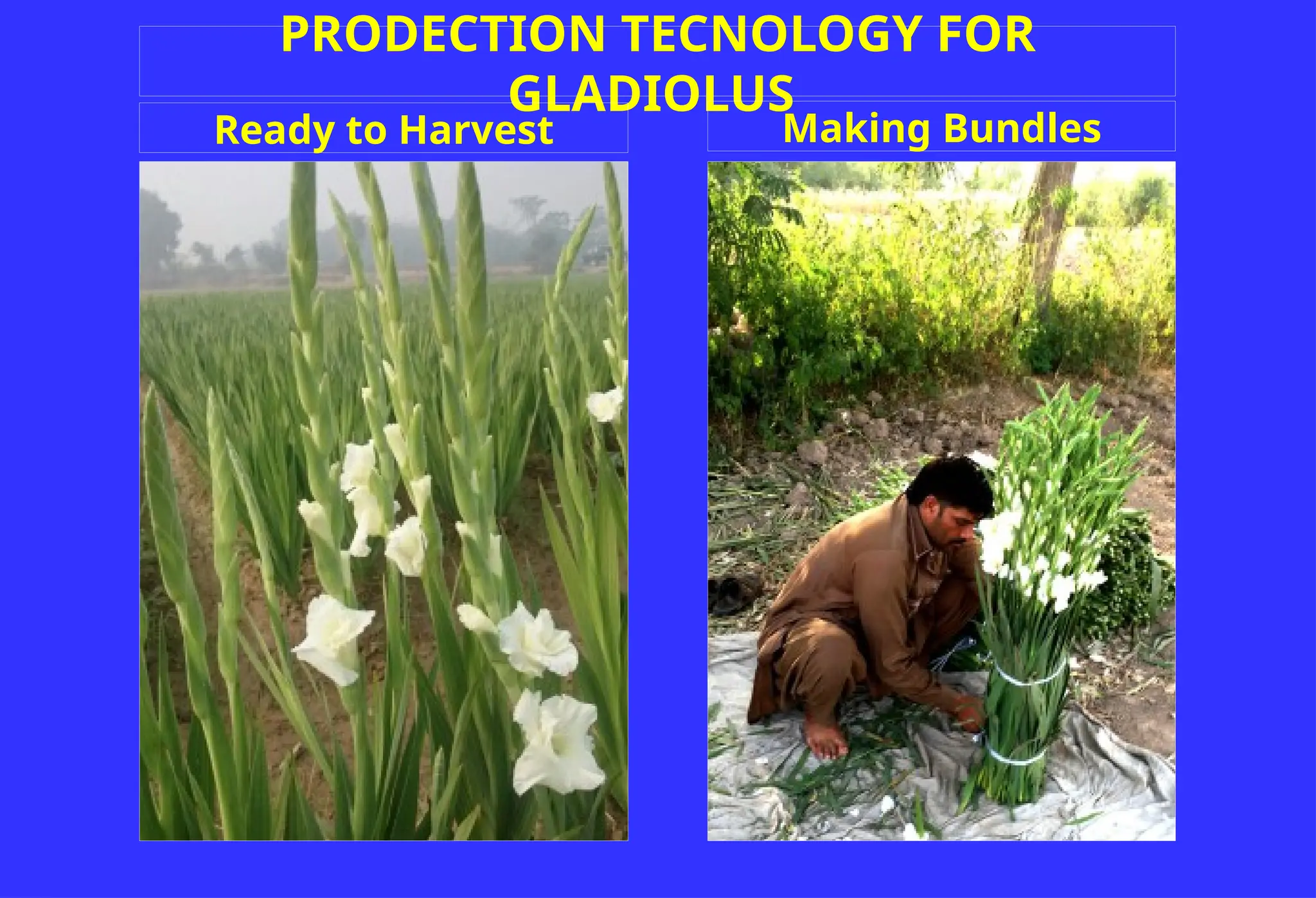
Known forits tall flower spikes and large, colorful blooms Therefor also
Called ‘SWORDY LILY’
Important commercial cut flower. Used for flower arrangement
Usually propagated by vegetative means ( Corms & Cormels)
For breaking corm dormancy Cold storage of corms at 3-70
c for 3 months
Planting time in October for plains & in March-April for Hills
Corms are planted ridges at depth of 5 cm
Watering at 7-10 days intervals, over watering should be
avoided
210.
For local marketgladiolus is harvested when the lower most pair of
floret is fully opened
For distant market harvesting is usually done when the lower most pair
of floret has just shown the colour
Yield of flowers:
The flower spike yield in gladiolus is very according to the cultivar,
corm size, planting density and management practices etc
Approximate yield of flower spike would be around 50,000 per Acre
210
HARVESTING AND YIELD
211.
Corms are storedin single layers in wooden trays having a wire
bottom
The scales over the corms are not removed during storage
Before storage corm / cormels should be treated with fungicides,
than air dried and stored
For gladiolus 4-10 0
C cold temperature are required
211
STORAGE OF CORMS
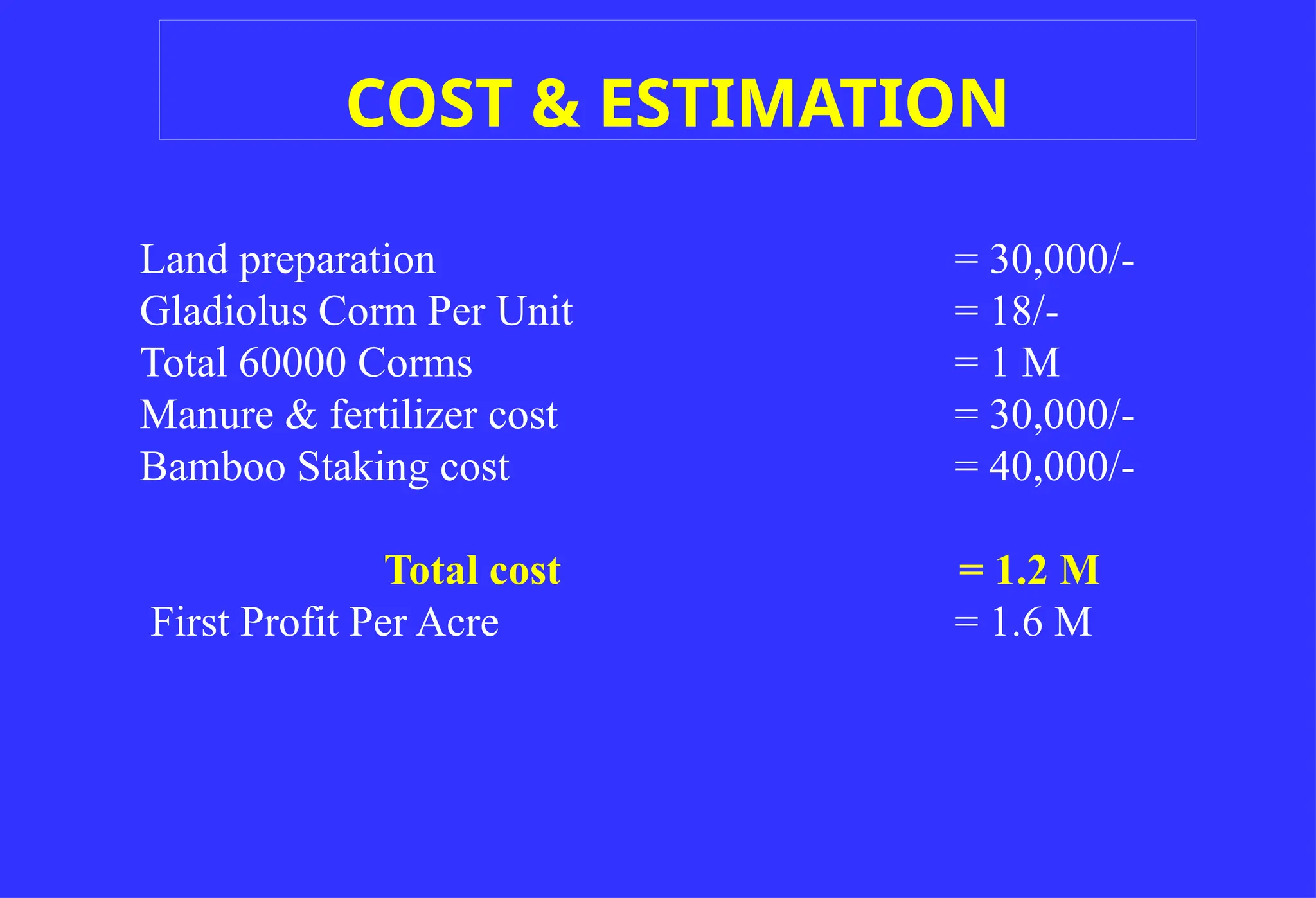
COST & ESTIMATION
Landpreparation = 30,000/-
Gladiolus Corm Per Unit = 18/-
Total 60000 Corms = 1 M
Manure & fertilizer cost = 30,000/-
Bamboo Staking cost = 40,000/-
Total cost = 1.2 M
First Profit Per Acre = 1.6 M
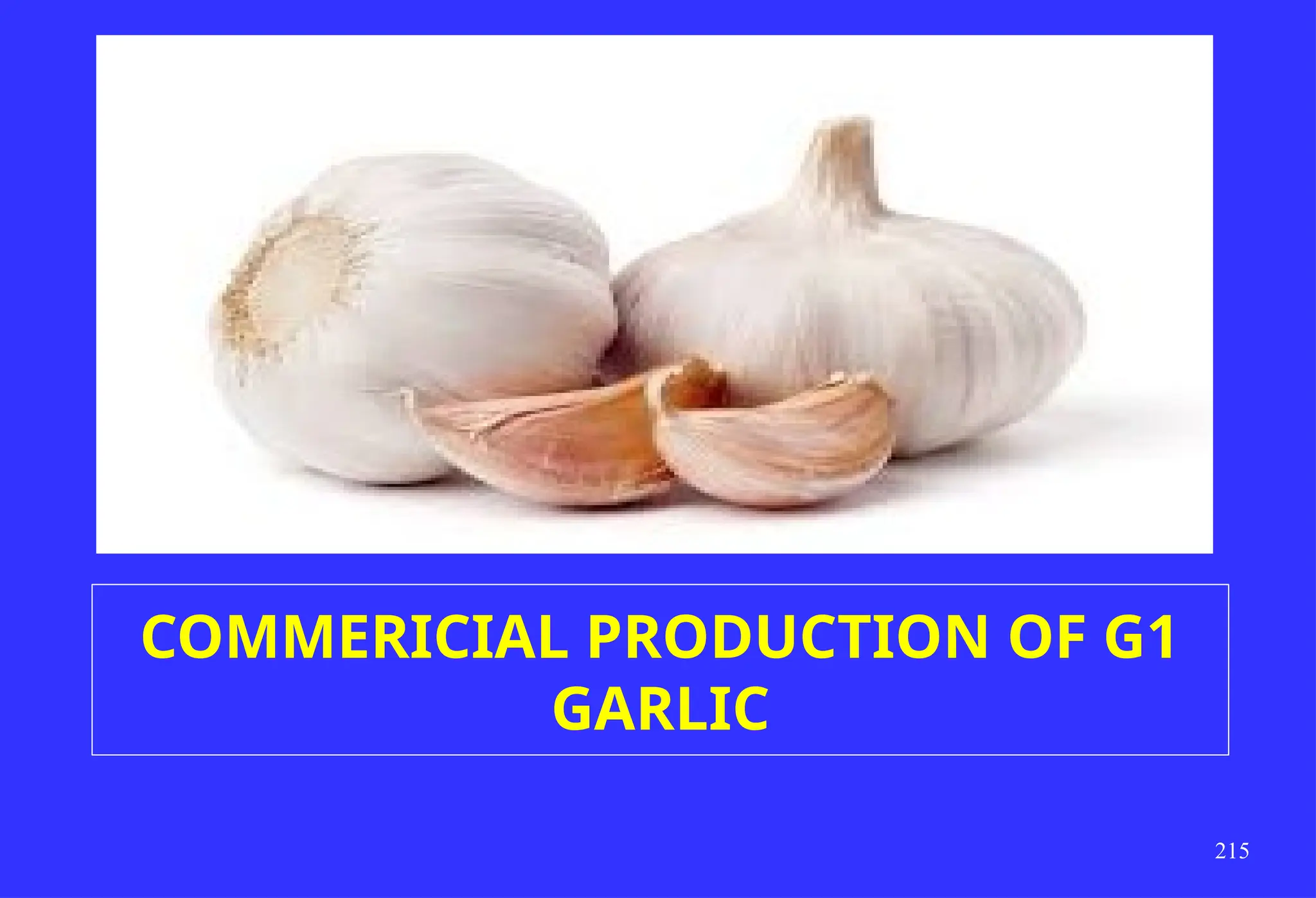
COMMERICIAL PRODUCTION OFG1
GARLIC
217
Introduction :
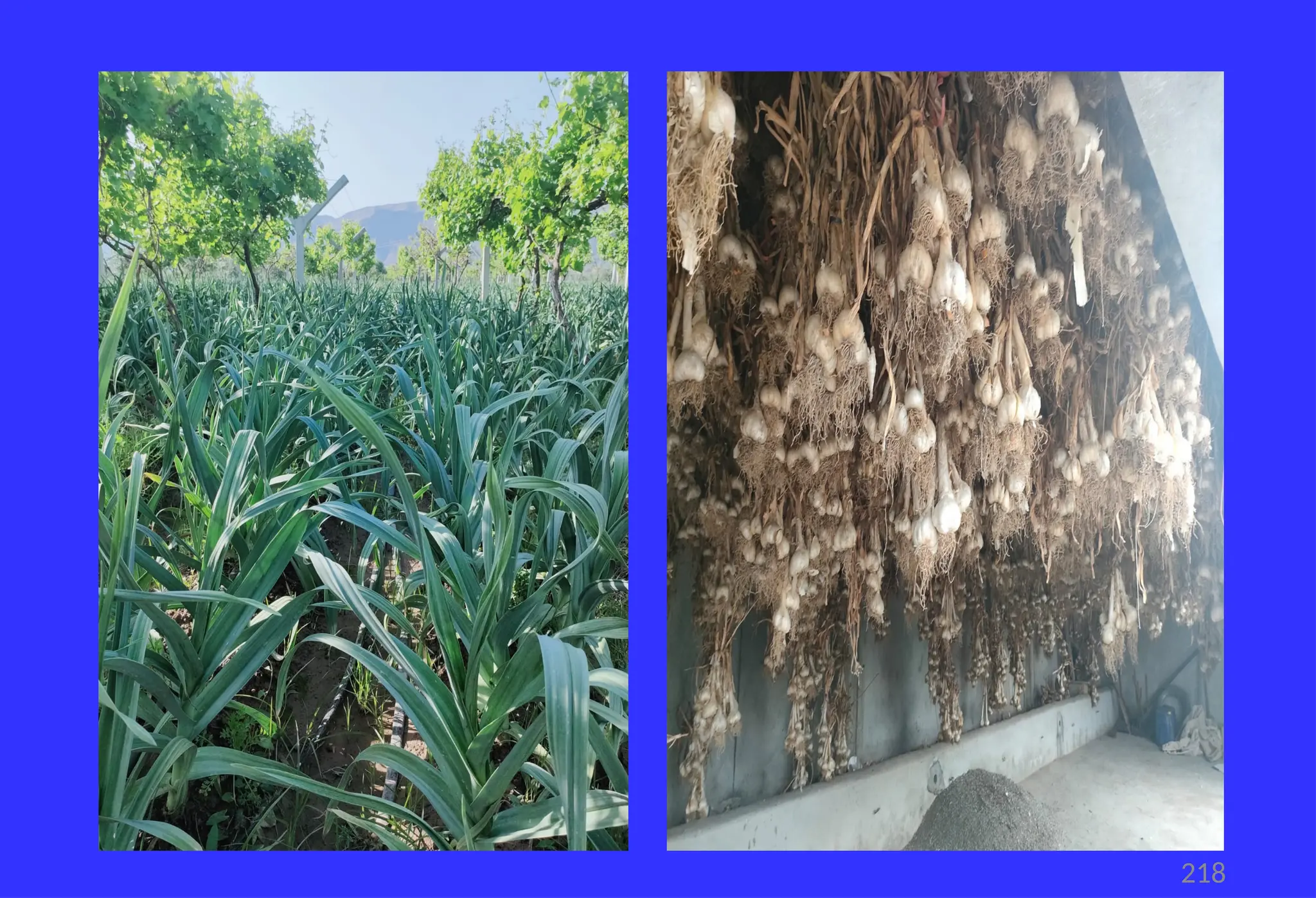
It is commonly called Elephant Garlic.
It is hardy bulb with massive blue green leaves.
It consisting of 5-6 large cloves enclosed by smaller bulblets.
It originates in Pakistan.
Medical Uses:
Natural prebiotic which control different disease .
It strength immunity & inhabits the bacterial growth.
Just eat one clove of garlic each day keep cholesterol in
control.
COMMERICIAL PRODUCTION OFG1
GARLIC
219
Crop Cycle : It is planted in two cycles as
Spring Crop
Autumn Crop
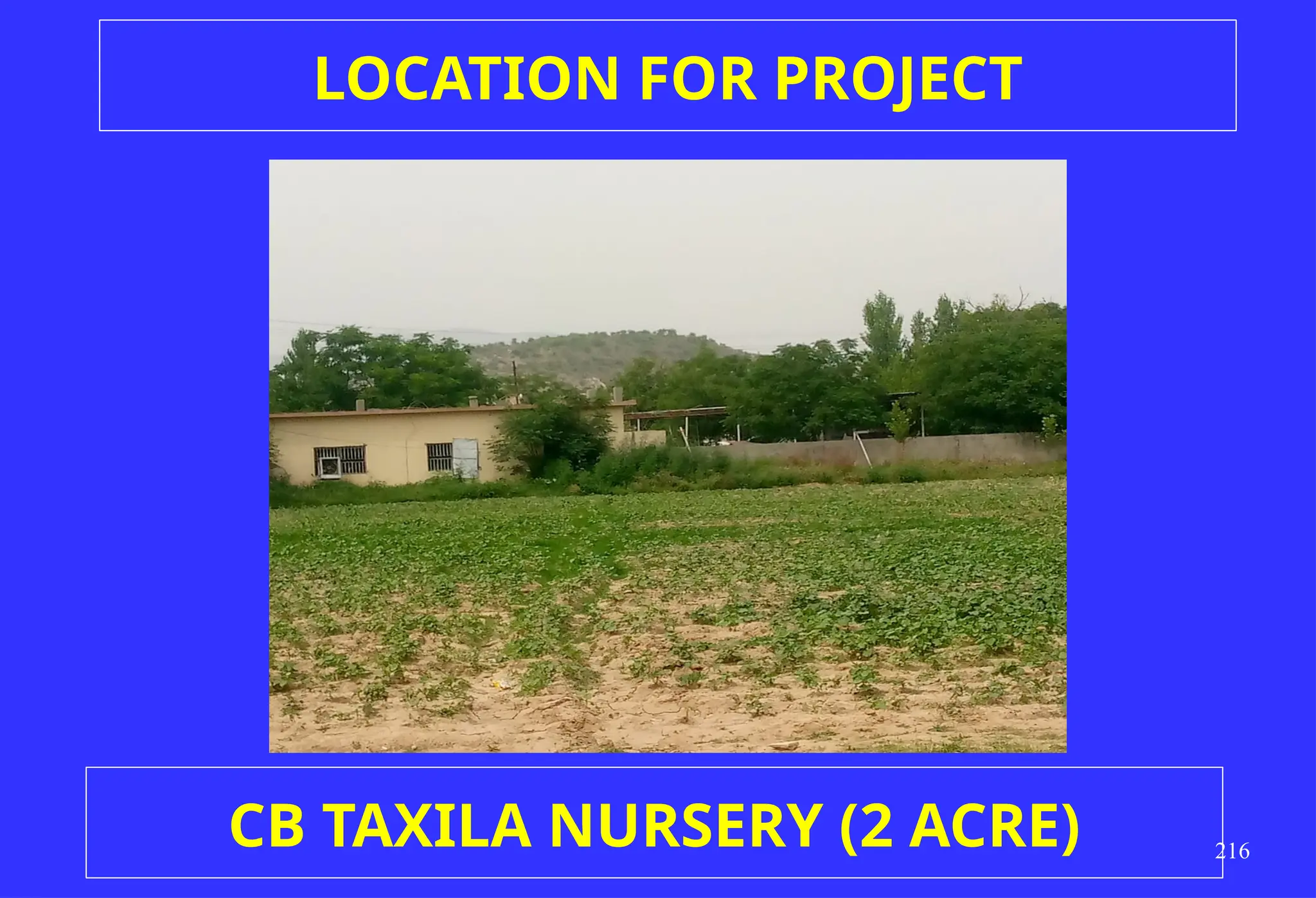
Location of Project: Taxila Cantonment Board
Total Area : 2 Acre
Variety: NARC – G1
It perform well in all four provinces ,GB & Kashmir.
Govt. planning to introduce it as national crop in 5
years.
220.
220
Commercial Value:
Itis high yield & very popular variety now a days.
It gives 24 ton per hec production, It is highest ever as
compared to other garlic varieties.
It is sold at price ranging from Rs.1200-2500/ Kg.
#1 javed ch effect
start should be captive
theme of the presentation
blue ocean red ocean
15% inherited wealth
ignored area
exploiting agricultural potentail
who is earning how much in forex in mushroom, moringa, stevia. gworth potential of pakistan
kitchen gardening:
potential areas: show all
how much revenue national level
introduction to domain
international to national to our projects to pilot projects to way forward
show big canvas instead of miniature
presentation secrets of steve jobs
give your narative a story shape
homosapians
first slide: theme

































































![MUSHROOM_PRODUCTION_UNITS and mechanism 1][1].pptx](https://cdn.slidesharecdn.com/ss_thumbnails/mushroomproductionunits11-251106185651-32f95ca8-thumbnail.jpg?width=640&height=640&fit=bounds)


