Panagiotis Ilia, Michalis Polychronakis, Evangelos Markatos,
Sotiris Ioannidis, Giorgos Vasiliadis
Panagiotis Papadopoulos
Abusing Web Browsers for Persistent and
Stealthy Computation
WEB
Our paper in 1 slide
● We show that malicious JS execution is not any more constrained to the
lifetime of the browser window or tab
● We show that features of HTML5 API can be used for malicious purposes
● We present and implement MarioNet: a multi-attack framework
○ persistent and stealthy bot operation through web browsers
(e.g., DDoS, crypto-jacking, malicious file hosting and sharing).
○ malicious activity is not attached to any browsing session and thus withstands tab
crash/closing.
Now you are free to go
back to your emails!
2Panagiotis Papadopoulos ~ panpap@csd.uoc.gr
Panagiotis Ilia, Michalis Polychronakis, Evangelos Markatos,
Sotiris Ioannidis, Giorgos Vasiliadis
Panagiotis Papadopoulos
Abusing Web Browsers for Persistent and
Stealthy Computation
WEB
Nowadays...
increasing reliance on the web
sophisticated web browsing software
integrated operating system for web applications
abundance of JS APIs and sensors (e.g., gyroscope, location, battery status)
publishers transfer parts of the critical computations on the user side
(minimizes latency, better user experience and usability, scalability of the service)
4Panagiotis Papadopoulos ~ panpap@csd.uoc.gr
Nowadays...
in-browser running malicious code (e.g., cryptojacking)
users remain oblivious to the performed operations
publishers are considered by default trusted to run any JS code
on the user-side without restrictions (even from third-parties)
publishers transfer parts of the critical computations on the user side
(minimize latency, better user experience and usability, scalability of the service)
5Panagiotis Papadopoulos ~ panpap@csd.uoc.gr
Threat Model
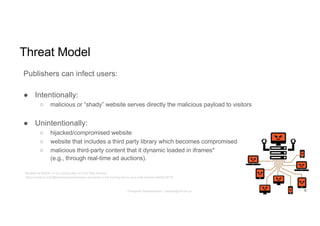
Publishers can infect users:
● Intentionally:
○ malicious or “shady” website serves directly the malicious payload to visitors
● Unintentionally:
○ hijacked/compromised website
○ website that includes a third party library which becomes compromised
○ malicious third-party content that it dynamic loaded in iframes*
(e.g., through real-time ad auctions).
* Browser as Botnet, or the Coming War on Your Web Browser
https://medium.com/@brannondorsey/browser-as-botnet-or-the-coming-war-on-your-web-browser-be920c4f718
6Panagiotis Papadopoulos ~ panpap@csd.uoc.gr
On the bright side...
malicious JS execution is constrained chronologically to the
lifetime of the browser window or tab
Panagiotis Papadopoulos ~ panpap@csd.uoc.gr
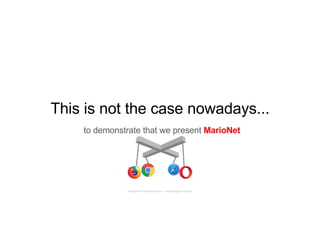
This is not the case nowadays...
to demonstrate that we present MarioNet
Panagiotis Papadopoulos ~ panpap@csd.uoc.gr
MarioNet
● a system that enables a remote attacker to control
users’ browsers and hijack device resources
● infected browser joins a centrally orchestrated botnet which can
launch a wide variety of distributed attacks
● persistent and stealthy: attackers continue having control of the victim’s browser
even after the user browses away from the website
● leverages only off-the-shelf technologies provided by HTML5
9Panagiotis Papadopoulos ~ panpap@csd.uoc.gr
MarioNet: Basic ingredients
● Service Worker:
○ non-blocking (i.e., fully asynchronous) module,
○ resides between the webpage and the publisher’s web server:
○ once registered and activated, runs in a separate thread in the background (no DOM access)
○ can intercept and handle network requests
(e.g., is used for programmatically managing the caching of responses)
● WebSocket:
○ persistent full-duplex communication channel over a single TCP connection.
● Depending on the attack scenario:
○ WebRTC, high-resolution performance timers, Cross-Origin Resource Sharing (CORS)
10Panagiotis Papadopoulos ~ panpap@csd.uoc.gr
MarioNet: Key roles
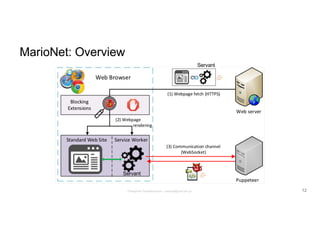
1. Distributor:
○ a website under the attacker’s control that delivers to users along with the regular content of
the webpage, the Servant component
2. Servant:
○ the in-browser component embedded in a Service Worker
○ runs in a separate process: continues to operate even after its parent tab closes
○ establishes a connection with Puppeteer for heartbeats and receiving malicious tasks
3. Puppeteer:
○ the remote C&C component that sends tasks to the Servant to be executed
○ sets the attack’s target, orchestrates the botnet
11Panagiotis Papadopoulos ~ panpap@csd.uoc.gr
MarioNet: Overview
12Panagiotis Papadopoulos ~ panpap@csd.uoc.gr
Servant
Servant
Basic Characteristics
1. Isolation:
○ MarioNet's operations are independent from the browsing session's thread/process
○ heavyweight malicious computations cannot affect tab's functionality
2. Persistence:
○ MarioNet’s operations are detached from any ephemeral browser tabs
○ browser remains under attacker’s control for longer than a website visit (<1 min*)
3. Stealthiness:
○ Servant-Puppeteer communication channel is not-detectable by browser extensions**
○ operations are throttled based on system's recourse utilization (not-detectable by user)
*How long do users stay on web pages? https://www.nngroup.com/articles/how-long-do-users-stay-on-web-pages/
** Bashir et al., How Tracking Companies Circumvented Ad Blockers Using WebSockets
13
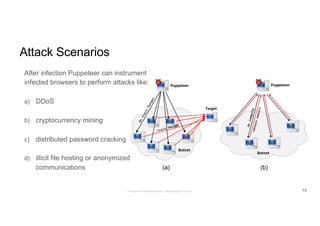
Attack Scenarios
After infection Puppeteer can instrument
infected browsers to perform attacks like:
a) DDoS
b) cryptocurrency mining
c) distributed password cracking
d) illicit file hosting or anonymized
communications
14Panagiotis Papadopoulos ~ panpap@csd.uoc.gr
Target
Puppeteer
Botnet
do
visit
Target
visit Target
Botnet
docomputereturnresult
Puppeteer
(a) (b)
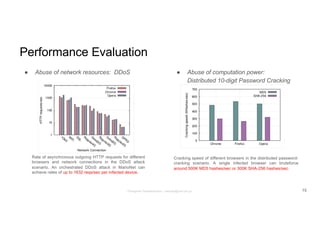
Performance Evaluation
● Abuse of network resources: DDoS ● Abuse of computation power:
Distributed 10-digit Password Cracking
Rate of asynchronous outgoing HTTP requests for different
browsers and network connections in the DDoS attack
scenario. An orchestrated DDoS attack in MarioNet can
achieve rates of up to 1632 reqs/sec per infected device.
Cracking speed of different browsers in the distributed password-
cracking scenario. A single infected browser can bruteforce
around 500K MD5 hashes/sec or 300K SHA-256 hashes/sec.
15Panagiotis Papadopoulos ~ panpap@csd.uoc.gr
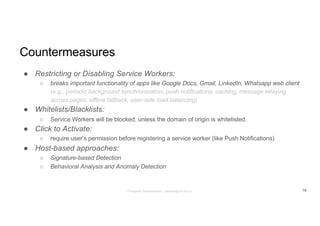
Countermeasures
● Restricting or Disabling Service Workers:
○ breaks important functionality of apps like Google Docs, Gmail, LinkedIn, Whatsapp web client
(e.g., periodic background synchronization, push notifications, caching, message relaying
across pages, offline fallback, user-side load balancing)
● Whitelists/Blacklists:
○ Service Workers will be blocked, unless the domain of origin is whitelisted.
● Click to Activate:
○ require user’s permission before registering a service worker (like Push Notifications)
● Host-based approaches:
○ Signature-based Detection
○ Behavioral Analysis and Anomaly Detection
16Panagiotis Papadopoulos ~ panpap@csd.uoc.gr
Conclusion
● Malicious code execution is not constrained to the lifetime of the browser session
● We present MarioNet:
○ Ingredients: Service Workers, WebRTC, WebSockets, CORS
○ a multi-attack framework
○ allows persistent and stealthy bot operation through web browsers
○ Malicious payload is not attached to any browsing session
and thus withstands tab crash/closing.
● We launch and evaluate various possible attack scenarios on top of MarioNet:
(e.g., DDoS, Distributed password cracking, cryptomining)
17Panagiotis Papadopoulos ~ panpap@csd.uoc.gr
Panagiotis Papadopoulos
Abusing Web Browsers for Persistent and
Stealthy Computation
WEB
Backup Slides
19Panagiotis Papadopoulos ~ panpap@csd.uoc.gr
Detectability of MarioNet
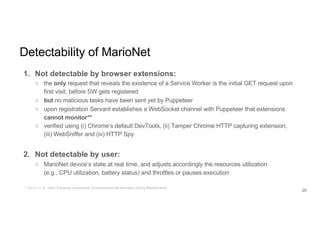
1. Not detectable by browser extensions:
○ the only request that reveals the existence of a Service Worker is the initial GET request upon
first visit, before SW gets registered
○ but no malicious tasks have been sent yet by Puppeteer
○ upon registration Servant establishes a WebSocket channel with Puppeteer that extensions
cannot monitor**
○ verified using (i) Chrome’s default DevTools, (ii) Tamper Chrome HTTP capturing extension,
(iii) WebSniffer and (iv) HTTP Spy
2. Not detectable by user:
○ MarioNet device’s state at real time, and adjusts accordingly the resources utilization
(e.g., CPU utilization, battery status) and throttles or pauses execution
** Bashir et al., How Tracking Companies Circumvented Ad Blockers Using WebSockets
20
Characteristics of various APIs of interest
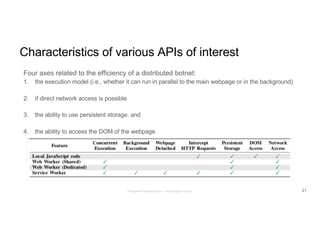
Four axes related to the efficiency of a distributed botnet:
1. the execution model (i.e., whether it can run in parallel to the main webpage or in the background)
2. if direct network access is possible
3. the ability to use persistent storage, and
4. the ability to access the DOM of the webpage.
21Panagiotis Papadopoulos ~ panpap@csd.uoc.gr
Need more persistence?
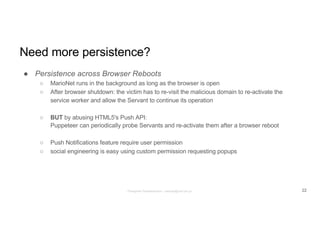
● Persistence across Browser Reboots
○ MarioNet runs in the background as long as the browser is open
○ After browser shutdown: the victim has to re-visit the malicious domain to re-activate the
service worker and allow the Servant to continue its operation
○ BUT by abusing HTML5's Push API:
Puppeteer can periodically probe Servants and re-activate them after a browser reboot
○ Push Notifications feature require user permission
○ social engineering is easy using custom permission requesting popups
22Panagiotis Papadopoulos ~ panpap@csd.uoc.gr
MarioNet Vs Traditional Botnets
MarioNet:
● does not exploit any implementation flaw on the victim’s system and does not
require the installation of any software.
● leverages provided capabilities of JS relying on existing HTML5 compatible
with the vast majority of both desktop and mobile browsers.
● remains operational even after the user browses away from the malicious
webpage
23Panagiotis Papadopoulos ~ panpap@csd.uoc.gr
Threat Model (detailed)
● websites that deliver malicious intentionally,
○ to gain profit by infecting as many user browsers as possible to carry out distributed
(malicious) computations or mount large-scale attacks.
● websites that host such malicious content unintentionally:
○ the website registers a benign service worker that includes untrusted dynamic third-party
scripts, which in turn possibly load malicious code;
○ the website includes third-party libraries, one of which can turn rogue or be compromised, and
then divert the user to a new tab (e.g., using popunders or clickjacking) where it can register
its own service worker bound to a third-party domain;
○ the website is compromised and attackers plant their malicious JavaScript code directly into
the page, thus registering their malicious service worker or the website includes iframes with
dynamic content, which are typically auctioned at real-time and loaded with content from third
parties.
24Panagiotis Papadopoulos ~ panpap@csd.uoc.gr

Master of Web Puppets: Abusing Web Browsers for Persistent and Stealthy Computation

  • 1.
    Panagiotis Ilia, MichalisPolychronakis, Evangelos Markatos, Sotiris Ioannidis, Giorgos Vasiliadis Panagiotis Papadopoulos Abusing Web Browsers for Persistent and Stealthy Computation WEB
  • 2.
    Our paper in1 slide ● We show that malicious JS execution is not any more constrained to the lifetime of the browser window or tab ● We show that features of HTML5 API can be used for malicious purposes ● We present and implement MarioNet: a multi-attack framework ○ persistent and stealthy bot operation through web browsers (e.g., DDoS, crypto-jacking, malicious file hosting and sharing). ○ malicious activity is not attached to any browsing session and thus withstands tab crash/closing. Now you are free to go back to your emails! 2Panagiotis Papadopoulos ~ panpap@csd.uoc.gr
  • 3.
    Panagiotis Ilia, MichalisPolychronakis, Evangelos Markatos, Sotiris Ioannidis, Giorgos Vasiliadis Panagiotis Papadopoulos Abusing Web Browsers for Persistent and Stealthy Computation WEB
  • 4.
    Nowadays... increasing reliance onthe web sophisticated web browsing software integrated operating system for web applications abundance of JS APIs and sensors (e.g., gyroscope, location, battery status) publishers transfer parts of the critical computations on the user side (minimizes latency, better user experience and usability, scalability of the service) 4Panagiotis Papadopoulos ~ panpap@csd.uoc.gr
  • 5.
    Nowadays... in-browser running maliciouscode (e.g., cryptojacking) users remain oblivious to the performed operations publishers are considered by default trusted to run any JS code on the user-side without restrictions (even from third-parties) publishers transfer parts of the critical computations on the user side (minimize latency, better user experience and usability, scalability of the service) 5Panagiotis Papadopoulos ~ panpap@csd.uoc.gr
  • 6.
    Threat Model Publishers caninfect users: ● Intentionally: ○ malicious or “shady” website serves directly the malicious payload to visitors ● Unintentionally: ○ hijacked/compromised website ○ website that includes a third party library which becomes compromised ○ malicious third-party content that it dynamic loaded in iframes* (e.g., through real-time ad auctions). * Browser as Botnet, or the Coming War on Your Web Browser https://medium.com/@brannondorsey/browser-as-botnet-or-the-coming-war-on-your-web-browser-be920c4f718 6Panagiotis Papadopoulos ~ panpap@csd.uoc.gr
  • 7.
    On the brightside... malicious JS execution is constrained chronologically to the lifetime of the browser window or tab Panagiotis Papadopoulos ~ panpap@csd.uoc.gr
  • 8.
    This is notthe case nowadays... to demonstrate that we present MarioNet Panagiotis Papadopoulos ~ panpap@csd.uoc.gr
  • 9.
    MarioNet ● a systemthat enables a remote attacker to control users’ browsers and hijack device resources ● infected browser joins a centrally orchestrated botnet which can launch a wide variety of distributed attacks ● persistent and stealthy: attackers continue having control of the victim’s browser even after the user browses away from the website ● leverages only off-the-shelf technologies provided by HTML5 9Panagiotis Papadopoulos ~ panpap@csd.uoc.gr
  • 10.
    MarioNet: Basic ingredients ●Service Worker: ○ non-blocking (i.e., fully asynchronous) module, ○ resides between the webpage and the publisher’s web server: ○ once registered and activated, runs in a separate thread in the background (no DOM access) ○ can intercept and handle network requests (e.g., is used for programmatically managing the caching of responses) ● WebSocket: ○ persistent full-duplex communication channel over a single TCP connection. ● Depending on the attack scenario: ○ WebRTC, high-resolution performance timers, Cross-Origin Resource Sharing (CORS) 10Panagiotis Papadopoulos ~ panpap@csd.uoc.gr
  • 11.
    MarioNet: Key roles 1.Distributor: ○ a website under the attacker’s control that delivers to users along with the regular content of the webpage, the Servant component 2. Servant: ○ the in-browser component embedded in a Service Worker ○ runs in a separate process: continues to operate even after its parent tab closes ○ establishes a connection with Puppeteer for heartbeats and receiving malicious tasks 3. Puppeteer: ○ the remote C&C component that sends tasks to the Servant to be executed ○ sets the attack’s target, orchestrates the botnet 11Panagiotis Papadopoulos ~ panpap@csd.uoc.gr
  • 12.
    MarioNet: Overview 12Panagiotis Papadopoulos~ panpap@csd.uoc.gr Servant Servant
  • 13.
    Basic Characteristics 1. Isolation: ○MarioNet's operations are independent from the browsing session's thread/process ○ heavyweight malicious computations cannot affect tab's functionality 2. Persistence: ○ MarioNet’s operations are detached from any ephemeral browser tabs ○ browser remains under attacker’s control for longer than a website visit (<1 min*) 3. Stealthiness: ○ Servant-Puppeteer communication channel is not-detectable by browser extensions** ○ operations are throttled based on system's recourse utilization (not-detectable by user) *How long do users stay on web pages? https://www.nngroup.com/articles/how-long-do-users-stay-on-web-pages/ ** Bashir et al., How Tracking Companies Circumvented Ad Blockers Using WebSockets 13
  • 14.
    Attack Scenarios After infectionPuppeteer can instrument infected browsers to perform attacks like: a) DDoS b) cryptocurrency mining c) distributed password cracking d) illicit file hosting or anonymized communications 14Panagiotis Papadopoulos ~ panpap@csd.uoc.gr Target Puppeteer Botnet do visit Target visit Target Botnet docomputereturnresult Puppeteer (a) (b)
  • 15.
    Performance Evaluation ● Abuseof network resources: DDoS ● Abuse of computation power: Distributed 10-digit Password Cracking Rate of asynchronous outgoing HTTP requests for different browsers and network connections in the DDoS attack scenario. An orchestrated DDoS attack in MarioNet can achieve rates of up to 1632 reqs/sec per infected device. Cracking speed of different browsers in the distributed password- cracking scenario. A single infected browser can bruteforce around 500K MD5 hashes/sec or 300K SHA-256 hashes/sec. 15Panagiotis Papadopoulos ~ panpap@csd.uoc.gr
  • 16.
    Countermeasures ● Restricting orDisabling Service Workers: ○ breaks important functionality of apps like Google Docs, Gmail, LinkedIn, Whatsapp web client (e.g., periodic background synchronization, push notifications, caching, message relaying across pages, offline fallback, user-side load balancing) ● Whitelists/Blacklists: ○ Service Workers will be blocked, unless the domain of origin is whitelisted. ● Click to Activate: ○ require user’s permission before registering a service worker (like Push Notifications) ● Host-based approaches: ○ Signature-based Detection ○ Behavioral Analysis and Anomaly Detection 16Panagiotis Papadopoulos ~ panpap@csd.uoc.gr
  • 17.
    Conclusion ● Malicious codeexecution is not constrained to the lifetime of the browser session ● We present MarioNet: ○ Ingredients: Service Workers, WebRTC, WebSockets, CORS ○ a multi-attack framework ○ allows persistent and stealthy bot operation through web browsers ○ Malicious payload is not attached to any browsing session and thus withstands tab crash/closing. ● We launch and evaluate various possible attack scenarios on top of MarioNet: (e.g., DDoS, Distributed password cracking, cryptomining) 17Panagiotis Papadopoulos ~ panpap@csd.uoc.gr
  • 18.
    Panagiotis Papadopoulos Abusing WebBrowsers for Persistent and Stealthy Computation WEB
  • 19.
  • 20.
    Detectability of MarioNet 1.Not detectable by browser extensions: ○ the only request that reveals the existence of a Service Worker is the initial GET request upon first visit, before SW gets registered ○ but no malicious tasks have been sent yet by Puppeteer ○ upon registration Servant establishes a WebSocket channel with Puppeteer that extensions cannot monitor** ○ verified using (i) Chrome’s default DevTools, (ii) Tamper Chrome HTTP capturing extension, (iii) WebSniffer and (iv) HTTP Spy 2. Not detectable by user: ○ MarioNet device’s state at real time, and adjusts accordingly the resources utilization (e.g., CPU utilization, battery status) and throttles or pauses execution ** Bashir et al., How Tracking Companies Circumvented Ad Blockers Using WebSockets 20
  • 21.
    Characteristics of variousAPIs of interest Four axes related to the efficiency of a distributed botnet: 1. the execution model (i.e., whether it can run in parallel to the main webpage or in the background) 2. if direct network access is possible 3. the ability to use persistent storage, and 4. the ability to access the DOM of the webpage. 21Panagiotis Papadopoulos ~ panpap@csd.uoc.gr
  • 22.
    Need more persistence? ●Persistence across Browser Reboots ○ MarioNet runs in the background as long as the browser is open ○ After browser shutdown: the victim has to re-visit the malicious domain to re-activate the service worker and allow the Servant to continue its operation ○ BUT by abusing HTML5's Push API: Puppeteer can periodically probe Servants and re-activate them after a browser reboot ○ Push Notifications feature require user permission ○ social engineering is easy using custom permission requesting popups 22Panagiotis Papadopoulos ~ panpap@csd.uoc.gr
  • 23.
    MarioNet Vs TraditionalBotnets MarioNet: ● does not exploit any implementation flaw on the victim’s system and does not require the installation of any software. ● leverages provided capabilities of JS relying on existing HTML5 compatible with the vast majority of both desktop and mobile browsers. ● remains operational even after the user browses away from the malicious webpage 23Panagiotis Papadopoulos ~ panpap@csd.uoc.gr
  • 24.
    Threat Model (detailed) ●websites that deliver malicious intentionally, ○ to gain profit by infecting as many user browsers as possible to carry out distributed (malicious) computations or mount large-scale attacks. ● websites that host such malicious content unintentionally: ○ the website registers a benign service worker that includes untrusted dynamic third-party scripts, which in turn possibly load malicious code; ○ the website includes third-party libraries, one of which can turn rogue or be compromised, and then divert the user to a new tab (e.g., using popunders or clickjacking) where it can register its own service worker bound to a third-party domain; ○ the website is compromised and attackers plant their malicious JavaScript code directly into the page, thus registering their malicious service worker or the website includes iframes with dynamic content, which are typically auctioned at real-time and loaded with content from third parties. 24Panagiotis Papadopoulos ~ panpap@csd.uoc.gr