Mass damper – vibration absorber
Eidos Engineering SRL
Mass damper development
A mass damper is a vibration absorber able to attenuate significantly the
vibrations of a structure or a machine.
In the graph we report the frequency response of a machine with and
without mass damper. The application of a mass damper gives an
important increment of the global damping.
Mass damper action
0.9

without mass damper
with mass damper

0.8

Displacement [mm]

0.7
0.6
0.5
0.4
0.3
0.2
0.1
0.0
0

300

600

900

1200

1500

Rotor speed [rpm]

Frequency response measured on a vibrating machine

1800
Fields of application
• Tool machines
• Machine frames and chassis
• Gears and transmissions
• Stacks
• Bridges and footbridges
• Constructions
• Energy generation plants
• Wind turbines
Mass damper examples
Eidos Engineering develops and
supply new generation vibration
absorbers, designed according
to customer’s specifications.

Mass damper for a stack

Mass damper for a wind turbine

A wide range of sizes is possible, starting
from few grams for electronic devices, up to
Mass damper for a tool machine

some tons, for structures such as bridges or
buildings.
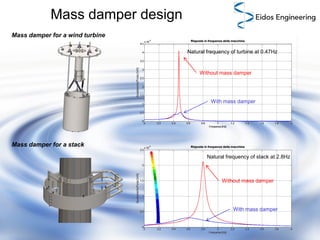
Mass damper design
Mass damper for a wind turbine
Natural frequency of turbine at 0.47Hz

Without mass damper

With mass damper

Mass damper for a stack
Natural frequency of stack at 2.8Hz

Without mass damper

With mass damper
Assembling and testing
Mass damper during testing on bench test

Wire rope spring assembly
Mass damper for structures

Displacement [m]

without tuned mass damper

Time [s]

Dynamic analysis of a three
stories structure.
The
graphs
show
the
displacements
of
the
structure under the 1976
Friuli earthquake without the
application of a mass damper
and with a mass damper
placed at top.

Displacement [m]

with tuned mass damper

Time [s]

Friuli 1976 – Buja seismic station
Displacement of the structure at top
Advantages
• Up to 70% vibration reduction
• Up to 70% stress reduction
• Noise attenuation
• Increased security
• Opportunity to reduce weight and dimensions of
mechanical structures
• Simplicity and reliability
Main contact
Eng. Stefano Galassi, Ph.D.


e-mail: stefano.galassi@eidosengine.com



mobile: +39 333 6907275



tel.: +39 0434 507547



fax: +39 0434 507546



web: www.eidosengineering.com



headquarters: via Roveredo 20/b 33170
Pordenone, Italy

Mass damper - vibration absorber

  • 1.
    Mass damper –vibration absorber Eidos Engineering SRL
  • 2.
    Mass damper development Amass damper is a vibration absorber able to attenuate significantly the vibrations of a structure or a machine. In the graph we report the frequency response of a machine with and without mass damper. The application of a mass damper gives an important increment of the global damping. Mass damper action 0.9 without mass damper with mass damper 0.8 Displacement [mm] 0.7 0.6 0.5 0.4 0.3 0.2 0.1 0.0 0 300 600 900 1200 1500 Rotor speed [rpm] Frequency response measured on a vibrating machine 1800
  • 3.
    Fields of application •Tool machines • Machine frames and chassis • Gears and transmissions • Stacks • Bridges and footbridges • Constructions • Energy generation plants • Wind turbines
  • 4.
    Mass damper examples EidosEngineering develops and supply new generation vibration absorbers, designed according to customer’s specifications. Mass damper for a stack Mass damper for a wind turbine A wide range of sizes is possible, starting from few grams for electronic devices, up to Mass damper for a tool machine some tons, for structures such as bridges or buildings.
  • 5.
    Mass damper design Massdamper for a wind turbine Natural frequency of turbine at 0.47Hz Without mass damper With mass damper Mass damper for a stack Natural frequency of stack at 2.8Hz Without mass damper With mass damper
  • 6.
    Assembling and testing Massdamper during testing on bench test Wire rope spring assembly
  • 7.
    Mass damper forstructures Displacement [m] without tuned mass damper Time [s] Dynamic analysis of a three stories structure. The graphs show the displacements of the structure under the 1976 Friuli earthquake without the application of a mass damper and with a mass damper placed at top. Displacement [m] with tuned mass damper Time [s] Friuli 1976 – Buja seismic station Displacement of the structure at top
  • 8.
    Advantages • Up to70% vibration reduction • Up to 70% stress reduction • Noise attenuation • Increased security • Opportunity to reduce weight and dimensions of mechanical structures • Simplicity and reliability
  • 9.
    Main contact Eng. StefanoGalassi, Ph.D.  e-mail: stefano.galassi@eidosengine.com  mobile: +39 333 6907275  tel.: +39 0434 507547  fax: +39 0434 507546  web: www.eidosengineering.com  headquarters: via Roveredo 20/b 33170 Pordenone, Italy