‘Those characteristics of the market that
significantly affect the behavior and
interaction of buyers and sellers.’
According to J.C. Edwards, “ A market is
that mechanism by which buyers and
sellers are bought together. It is not
necessarily a fixed place.”
Number and size of sellers and buyers
Type of the product
Conditions of entry and exit
Transparency of information
(i) An Area:
In economics, a market does not mean a particular place but the
whole region where sellers and buyers of a product ate spread.
Modem modes of communication and transport have made the
market area for a product very wide.
(ii) One Commodity:
In economics, a market is not related to a place but to a particular
product. Hence, there are separate markets for various
commodities. For example, there are separate markets for
clothes, grains, jewellery, etc.
(iii) Buyers and Sellers:
The presence of buyers and sellers is necessary for the sale
and purchase of a product in the market.
(iv) Free Competition:
There should be free competition among buyers and sellers
in the market. This competition is in relation to the price
determination of a product among buyers and sellers.
(v) One Price:
The price of a product is the same in the market because of
free competition among buyers and sellers.
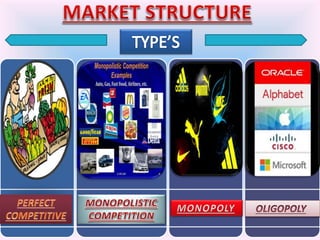
Perfectly
Competitive
• Less market
power
• Price takers
• Goods are
homogenous
• Free entry and
exit
• Perfect
Information
Monopolistic
Competition
• Many firms
• Free entry and
exit
• Differentiated
but highly
substitutable
product
Oligopoly
• Small number
of firms
• Product
differentiation
may or may
not exist
• Barriers to
entry
Monopoly
• There is market
power
• Single seller
• One product
(limited or no
good
substitutes)
• Barriers to
entry
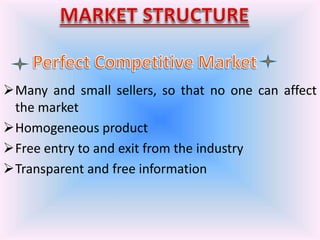
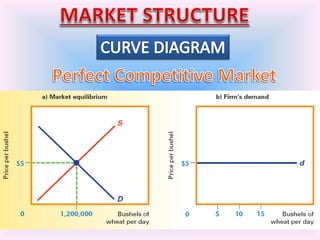
Many and small sellers, so that no one can affect
the market
Homogeneous product
Free entry to and exit from the industry
Transparent and free information
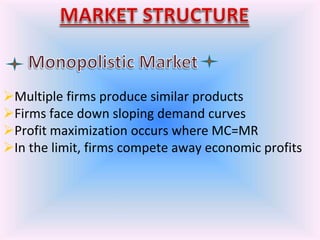
Multiple firms produce similar products
Firms face down sloping demand curves
Profit maximization occurs where MC=MR
In the limit, firms compete away economic profits
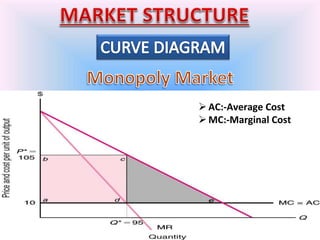
1. A single seller: the firm and industry are
synonymous.
2. Unique product: no close substitutes for the firm’s
product.
3. The firm is the price maker: the firm has
considerable control over the price because it can
control the quantity supplied.
4. Entry or exit is blocked.
AC:-Average Cost
MC:-Marginal Cost
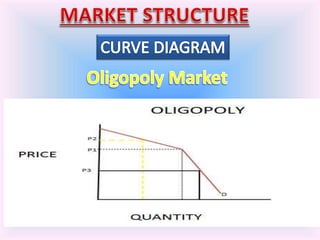
 Few large firms: each must consider its rivals’
reactions in response to its decisions about prices,
output, and advertising.
 Standardized or differentiated products
 Entry is hard: economies of scale, huge capital
investment may be the barriers to enter.
This Presentation was prepared by
MEETSHAH
Mail id : meet.shah134@gmail.com

Market structure

  • 2.
    ‘Those characteristics ofthe market that significantly affect the behavior and interaction of buyers and sellers.’ According to J.C. Edwards, “ A market is that mechanism by which buyers and sellers are bought together. It is not necessarily a fixed place.”
  • 3.
    Number and sizeof sellers and buyers Type of the product Conditions of entry and exit Transparency of information
  • 4.
    (i) An Area: Ineconomics, a market does not mean a particular place but the whole region where sellers and buyers of a product ate spread. Modem modes of communication and transport have made the market area for a product very wide. (ii) One Commodity: In economics, a market is not related to a place but to a particular product. Hence, there are separate markets for various commodities. For example, there are separate markets for clothes, grains, jewellery, etc.
  • 5.
    (iii) Buyers andSellers: The presence of buyers and sellers is necessary for the sale and purchase of a product in the market. (iv) Free Competition: There should be free competition among buyers and sellers in the market. This competition is in relation to the price determination of a product among buyers and sellers. (v) One Price: The price of a product is the same in the market because of free competition among buyers and sellers.
  • 7.
    Perfectly Competitive • Less market power •Price takers • Goods are homogenous • Free entry and exit • Perfect Information Monopolistic Competition • Many firms • Free entry and exit • Differentiated but highly substitutable product Oligopoly • Small number of firms • Product differentiation may or may not exist • Barriers to entry Monopoly • There is market power • Single seller • One product (limited or no good substitutes) • Barriers to entry
  • 8.
    Many and smallsellers, so that no one can affect the market Homogeneous product Free entry to and exit from the industry Transparent and free information
  • 10.
    Multiple firms producesimilar products Firms face down sloping demand curves Profit maximization occurs where MC=MR In the limit, firms compete away economic profits
  • 12.
    1. A singleseller: the firm and industry are synonymous. 2. Unique product: no close substitutes for the firm’s product. 3. The firm is the price maker: the firm has considerable control over the price because it can control the quantity supplied. 4. Entry or exit is blocked.
  • 13.
  • 14.
     Few largefirms: each must consider its rivals’ reactions in response to its decisions about prices, output, and advertising.  Standardized or differentiated products  Entry is hard: economies of scale, huge capital investment may be the barriers to enter.
  • 16.
    This Presentation wasprepared by MEETSHAH Mail id : meet.shah134@gmail.com