Best Practices and
      Opportunities for Collaboration:
Ocean Business Community Leadership


Paul Holthus
Executive Director
World Ocean Council
p
paul.holthus@oceancouncil.org
            @               g
World Ocean Council
International, Cross-Sectoral Business Alliance
•   Bringing
    B i i ocean i d t i t
                    industries together, e.g. shipping, oil/gas,
                                   th          hi i      il/
    fisheries, aquaculture, tourism, offshore renewables, etc.
•   Catalyzing leadership and collaboration in addressing
    ocean sustainability - “Corporate Ocean Responsibility”
Goal A healthy and p
             y     productive g
                              global ocean and its
     sustainable use, development and stewardship by a
     responsible ocean business community
Creating b i
C    i business value for responsible operators
                      l f               ibl
• Access and social license for responsible ocean use
• Synergies and economies of scale in addressing issues
    y g                                            g
• Stability and predictability in ocean operations
Leadership companies are joining as Founding Members
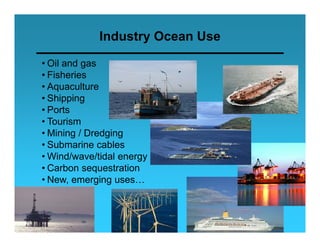
Industry Ocean Use

• Oil and gas
• Fisheries
• Aquaculture
• Shipping
•P t
  Ports
• Tourism
• Mining / Dredging
• Submarine cables
• Wind/wave/tidal energy
• Carbon sequestration
• New, emerging uses…
The Ocean Business Community

Tier 1: Direct Ocean Users
• I d t i th t depend on th ocean f the
   Industries that d      d     the        for th
   extraction or production of goods (living, non-living,
   energy) and the p
         gy)          provision of services ((transport,
                                                   p
   tourism, etc.)
Tier 2: Ocean User Support Industries
• Industries that depend on direct users for their
   existence (e.g. shipbuilders) or drive the need for
   ocean industry (e.g. extractors, manufacturers,
   retailers th t transport materials or products by sea)
      t il   that t       t    t i l         d t b       )
Tier 3: Ocean Use “Infrastructure” Providers
• Financial, insurance, legal and other services that
                            g
   enable ocean industries to operate
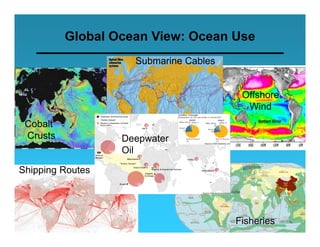
Global Ocean View: Ocean Use
                    Submarine Cables


                                        Offshore
                                         Wind
 Cobalt
 Crusts           Deepwater
                  Oil

Shipping Routes


                                       Fisheries
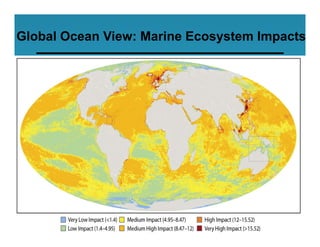
Global Ocean View: Marine Ecosystem Impacts
World Ocean Council: Initiatives
• Catalyze improvements to environmental performance
  through developing and sharing best practices
• Organize constructive, coordinated ocean business
  engagement in marine spatial planning, MPAs, etc.
    g g                   p    p      g
• Improve ocean science through industry involvement in
  ocean observations, data sharing
• Catalyze collaboration on science-based solutions to
  shared issues, e.g. ocean noise, invasive species
• Engage industry in key policy processes that are not
  sector specific, e.g. Biodiversity Convention
• D
  Develop cross-sectoral leadership in key regions, e.g.
       l             t    l l d hi i k        i
  Arctic, Gulf of Mexico, Mediterranean
World Ocean Council: Members
Exxon Mobil                              Transocean
Det Norske Veritas (DNV)                 Rio Tinto
Lloyds Register                          Athens Group
North America Marine Environment         Batelle Memorial Institute
Protection Ass’n (NAMEPA)                Beveridge & Diamond, P.C.
Int’l Chamber f Shi i
I t’l Ch b of Shipping (ICS)             Global T t C tifi ti
                                         Gl b l Trust Certification
Cruise Line International Ass’n (CLIA)   Golder Associates
TORM USA                                 Nautilus Minerals, Inc.
Heidmar, Inc
Heidmar Inc.                             Ocean Education Technology and
                                                 Education,
Almi Tankers S.A.                        Sciences Partnership (OETSP)
RightShip                                PanGeo Subsea
EPJ Consulting                           Professional Marine Explorers
Blank Rome                               Society
Holman Fenwick Willan LLP                Sea Research Foundation, Inc
Center for Energy Marine
                gy                       Sinclair Knight Merz
                                                     g
Transportation & Public Policy -         Sustainable Oceans International
Columbia University                      Twin Dolphins

Session 2. E. World Ocean Council

  • 1.
    Best Practices and Opportunities for Collaboration: Ocean Business Community Leadership Paul Holthus Executive Director World Ocean Council p paul.holthus@oceancouncil.org @ g
  • 2.
    World Ocean Council International,Cross-Sectoral Business Alliance • Bringing B i i ocean i d t i t industries together, e.g. shipping, oil/gas, th hi i il/ fisheries, aquaculture, tourism, offshore renewables, etc. • Catalyzing leadership and collaboration in addressing ocean sustainability - “Corporate Ocean Responsibility” Goal A healthy and p y productive g global ocean and its sustainable use, development and stewardship by a responsible ocean business community Creating b i C i business value for responsible operators l f ibl • Access and social license for responsible ocean use • Synergies and economies of scale in addressing issues y g g • Stability and predictability in ocean operations Leadership companies are joining as Founding Members
  • 3.
    Industry Ocean Use •Oil and gas • Fisheries • Aquaculture • Shipping •P t Ports • Tourism • Mining / Dredging • Submarine cables • Wind/wave/tidal energy • Carbon sequestration • New, emerging uses…
  • 4.
    The Ocean BusinessCommunity Tier 1: Direct Ocean Users • I d t i th t depend on th ocean f the Industries that d d the for th extraction or production of goods (living, non-living, energy) and the p gy) provision of services ((transport, p tourism, etc.) Tier 2: Ocean User Support Industries • Industries that depend on direct users for their existence (e.g. shipbuilders) or drive the need for ocean industry (e.g. extractors, manufacturers, retailers th t transport materials or products by sea) t il that t t t i l d t b ) Tier 3: Ocean Use “Infrastructure” Providers • Financial, insurance, legal and other services that g enable ocean industries to operate
  • 5.
    Global Ocean View:Ocean Use Submarine Cables Offshore Wind Cobalt Crusts Deepwater Oil Shipping Routes Fisheries
  • 6.
    Global Ocean View:Marine Ecosystem Impacts
  • 7.
    World Ocean Council:Initiatives • Catalyze improvements to environmental performance through developing and sharing best practices • Organize constructive, coordinated ocean business engagement in marine spatial planning, MPAs, etc. g g p p g • Improve ocean science through industry involvement in ocean observations, data sharing • Catalyze collaboration on science-based solutions to shared issues, e.g. ocean noise, invasive species • Engage industry in key policy processes that are not sector specific, e.g. Biodiversity Convention • D Develop cross-sectoral leadership in key regions, e.g. l t l l d hi i k i Arctic, Gulf of Mexico, Mediterranean
  • 8.
    World Ocean Council:Members Exxon Mobil Transocean Det Norske Veritas (DNV) Rio Tinto Lloyds Register Athens Group North America Marine Environment Batelle Memorial Institute Protection Ass’n (NAMEPA) Beveridge & Diamond, P.C. Int’l Chamber f Shi i I t’l Ch b of Shipping (ICS) Global T t C tifi ti Gl b l Trust Certification Cruise Line International Ass’n (CLIA) Golder Associates TORM USA Nautilus Minerals, Inc. Heidmar, Inc Heidmar Inc. Ocean Education Technology and Education, Almi Tankers S.A. Sciences Partnership (OETSP) RightShip PanGeo Subsea EPJ Consulting Professional Marine Explorers Blank Rome Society Holman Fenwick Willan LLP Sea Research Foundation, Inc Center for Energy Marine gy Sinclair Knight Merz g Transportation & Public Policy - Sustainable Oceans International Columbia University Twin Dolphins