1
NATURAL ZEOLITES AS MULTIFUNCTIONAL
ENVIRONMENTAL FRIENDLY MATERIALS
THEIR APPLICATION FOR REMOVAL OF Pb AND Zn FROM BINARY
SOLUTIONS
Marina Trgo
Faculty of Chemistry and Technology
University of Split
Croatia
2nd Slovenian-Croatian Symposium on Zeolites
Ljubljana, 2009
2
 natural aluminosilicate minerals with crystal three-dimensional structure
 hydrated cations are located inside framework structure and weakly bound
with structure
 advantages of these natural minerals are their large deposits on the Earth,
easiness of exploitation and mostly unnecessary treatment for practical
application
 the most important deposits are in the United States, Mexico, Ukraine,
Slovakia, Italy, Greece, Turkey, Russia, Serbia, Romania, Bulgaria, Georgia,
Armenia, Cuba and Croatia
 discovered more than 260 years ago by the Swedish mineralogist A.A.F.
Cronstedt, commercial exploitation started ~30 years ago
 the end of 70-ties is proclaimed as "new discovery" of natural zeolites
 about 50 different minerals of zeolites are discovered in nature, but some of
them have commercial valuable
 currently, the world’s annual production of natural zeolite is about 4 million
tons
NATURAL ZEOLITES - deposits and properties
3
NATURAL ZEOLITES - physical and chemical properties
 many natural zeolites are synthesized in laboratory
 difference between natural zeolite minerals is manifested in content of
hydrated cations which occupied pores and channels, ratio of Si/Al in
structure and number of water molecules
 zeolites have different dimensions of pores and channels responsible for their
physical and chemical properties
 each examined sample is mineralogical heterogeneous, and quantification of
its mineralogical composition in mostly complex procedure.
APPLICATION of natural zeolites is based on or more of the following
properties:
- cation exchange
- adsorption and related molecular sieving
- dehydration and rehydration
- biological activity
- catalytic
All of these properties have been intensively investigating.
4
Cation exchange
- the ability to exchange inherent cations for other cations on a basis of
ion selectivity
- high cation exchange capacity for heavy metal cations that can be
removed from liquid effluents through the process of ion-exchange.
These cations include lead, silver, cadmium, cobalt, zinc, copper,
mercury, magnesium, iron, aluminium, chromium and others. Some
natural zeolites are applicable in industries such as mining,
electroplating and electronics. Giant industrial houses, like IBM, have
deployed this application for treatment of wastewater containing heavy
metals.
-selectivity for ammonium cations, the natural zeolites lower the level
of ammonium in wastewaters and sewages to non-toxic, acceptable
levels. The zeolite beds can be regenerated and recycled indefinitely.
5
Adsorption and related molecular sieving
The adsorption on molecular sieves is therefore dependent on the
following physical molecular properties:
- Size and Shape; molecules or ions larger than the pore opening of
the zeolite can not be adsorbed, smaller molecules or ions can.
-Molecular Polarity; due the charge on outer and inner zeolitic
surface particle, molecules with large polarity or polarisability can
be adsorbed preferentially under identical conditions.
The adsorption process is fully reversible and of purely physical
nature. The structure of the zeolite is unchanged during the
adsorption process and its later regeneration.
6
- this property is used for selective absorption of organic molecules and for
absorption of radioactive ions (absorber of Sr and Cs radioisotopes in the
nuclear industry and for clean up of nuclear accidents - applied in the
Chernobyl disaster).
Adsorption and related molecular sieving
- adsorption process on zeolite is used to remove polar H2O, H2S, and CO2
from natural gas and developed a zeolite-adsorption process for purifying
methane produced in a landfill.
7
Dehydration and rehydration
Natural zeolites may hold water up to 60% of their weight due to a high
porosity of the crystalline structure. Water molecules in the pores could
be easily evaporated or reabsorbed without damage to such structures.
Zeolites assure a permanent water reservoir, providing prolonged
moisture during dry periods; they also promote a rapid rewetting and
improve the lateral spread of water into the root zone during irrigation.
This results in a saving in the quantity of water needed for irrigation.
8
Biological activity
- natural zeolite has been shown to exhibit diverse biological activities and
has been used successfully for the treatment in medical therapy
- promotes better plant growth by improving the value of fertilizer, helps
preventing the plant from burning, that can be caused by over use of
fertilizer, by trapping and slowly releasing valuable nutrients
- as additive in concentrated animal growing facilities improve feed
conversion, reduce airborne ammonia up to 80%, act as a mycotoxin
binder, and improve bone density, it can be used in general odour
elimination for all animal odours
9
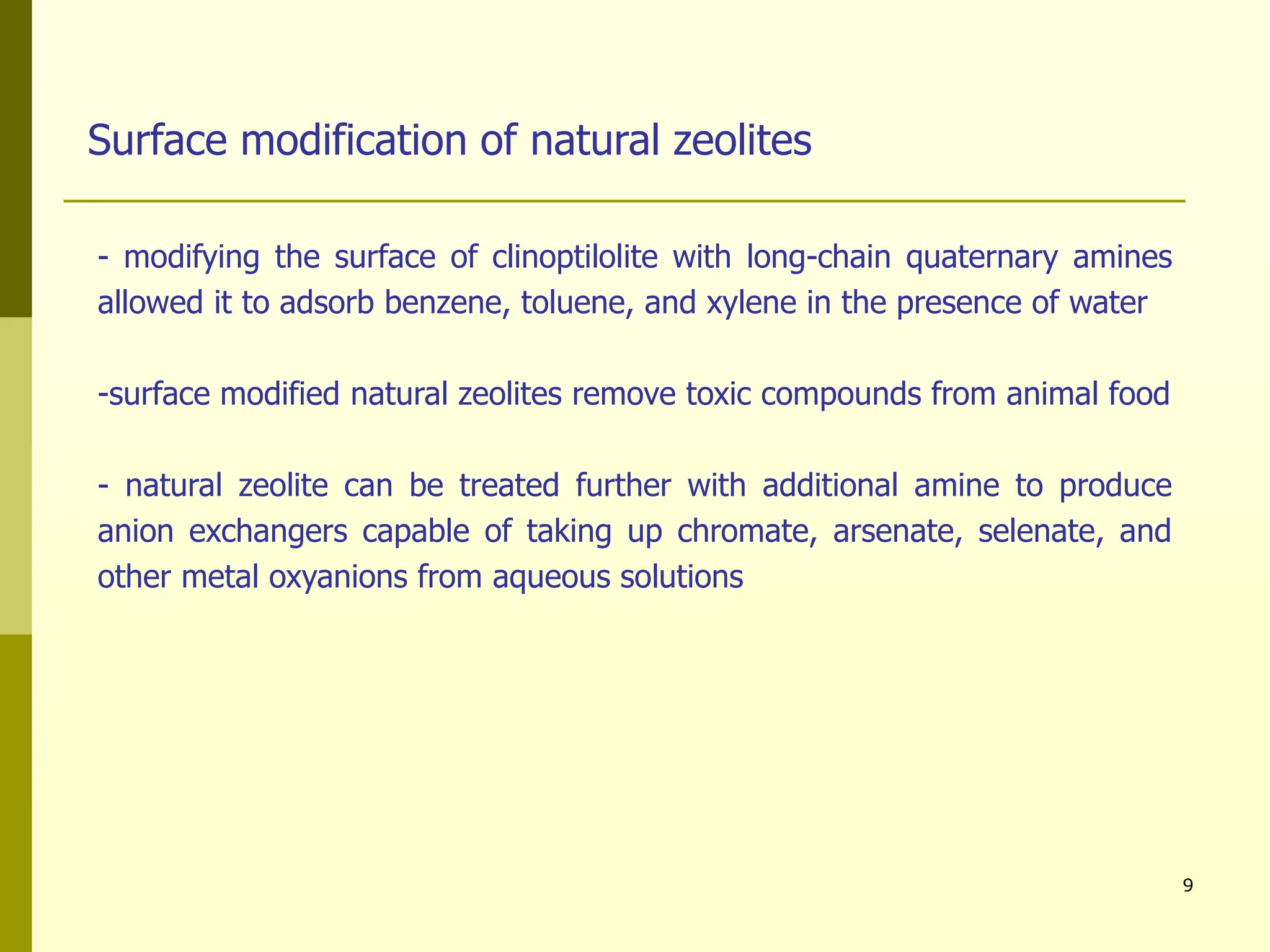
- modifying the surface of clinoptilolite with long-chain quaternary amines
allowed it to adsorb benzene, toluene, and xylene in the presence of water
-surface modified natural zeolites remove toxic compounds from animal food
- natural zeolite can be treated further with additional amine to produce
anion exchangers capable of taking up chromate, arsenate, selenate, and
other metal oxyanions from aqueous solutions
Surface modification of natural zeolites
10
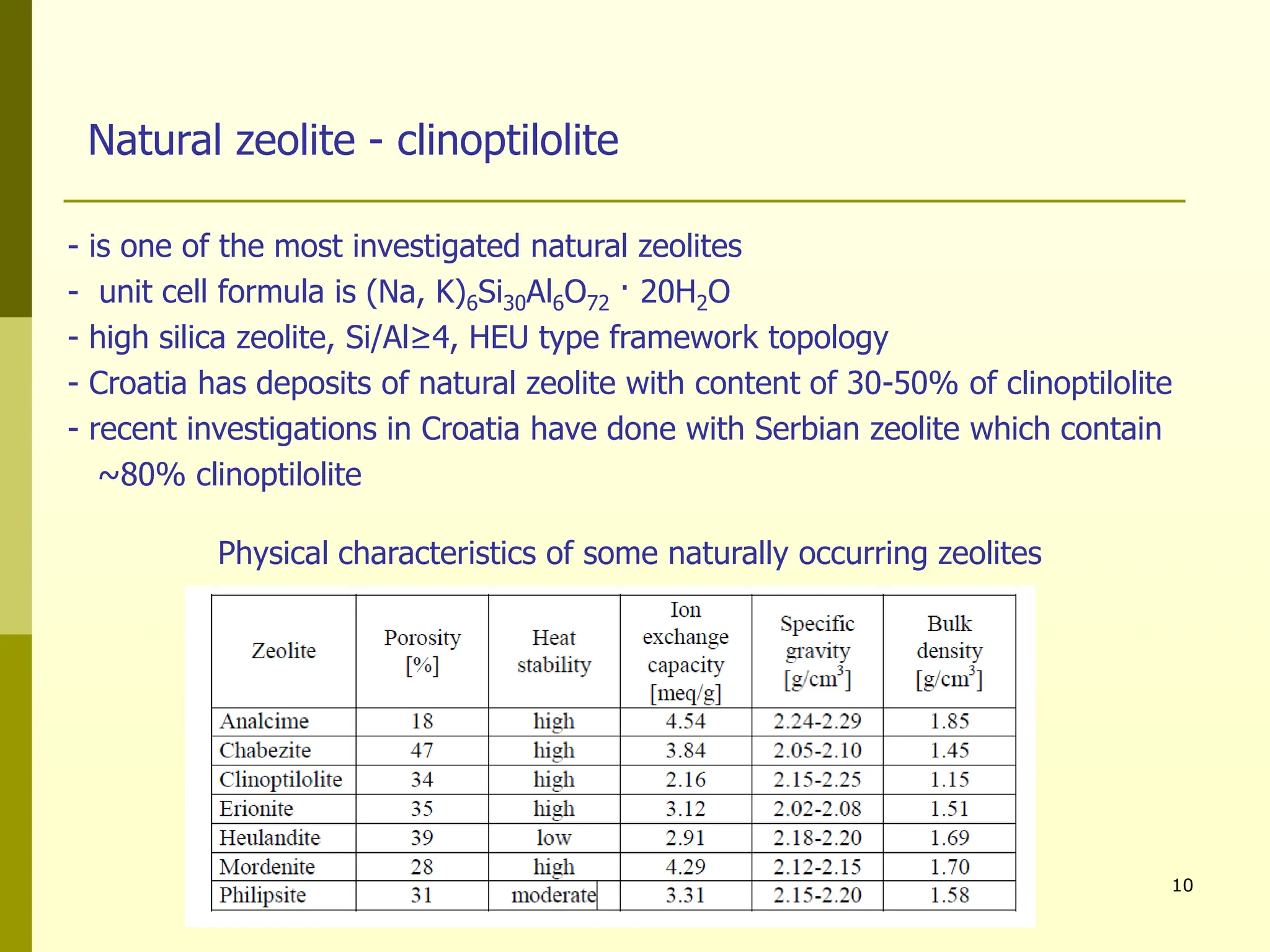
Physical characteristics of some naturally occurring zeolites
Natural zeolite - clinoptilolite
- is one of the most investigated natural zeolites
- unit cell formula is (Na, K)6Si30Al6O72 · 20H2O
- high silica zeolite, Si/Al≥4, HEU type framework topology
- Croatia has deposits of natural zeolite with content of 30-50% of clinoptilolite
- recent investigations in Croatia have done with Serbian zeolite which contain
~80% clinoptilolite
11
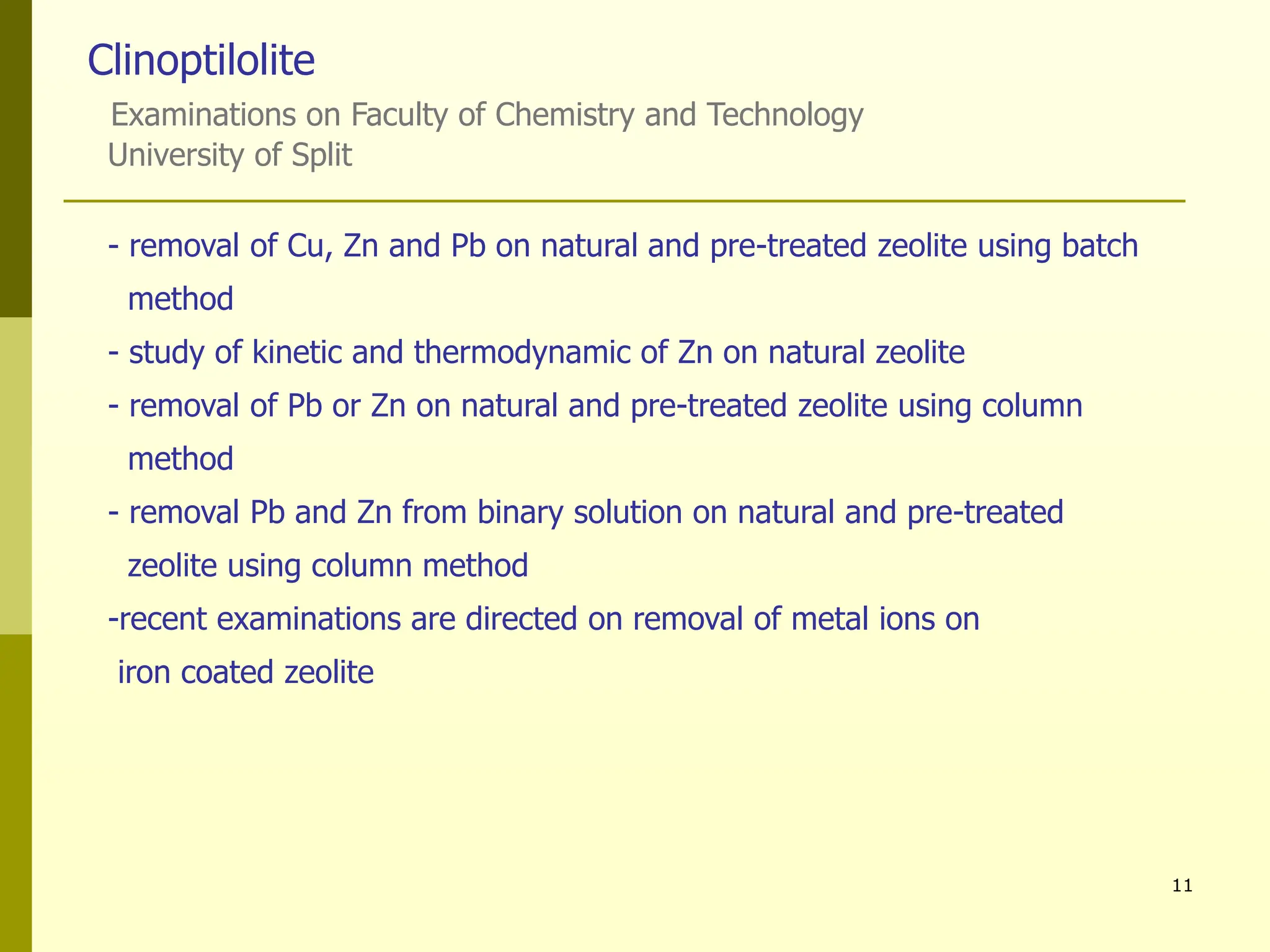
Clinoptilolite
Examinations on Faculty of Chemistry and Technology
University of Split
- removal of Cu, Zn and Pb on natural and pre-treated zeolite using batch
method
- study of kinetic and thermodynamic of Zn on natural zeolite
- removal of Pb or Zn on natural and pre-treated zeolite using column
method
- removal Pb and Zn from binary solution on natural and pre-treated
zeolite using column method
-recent examinations are directed on removal of metal ions on
iron coated zeolite
12
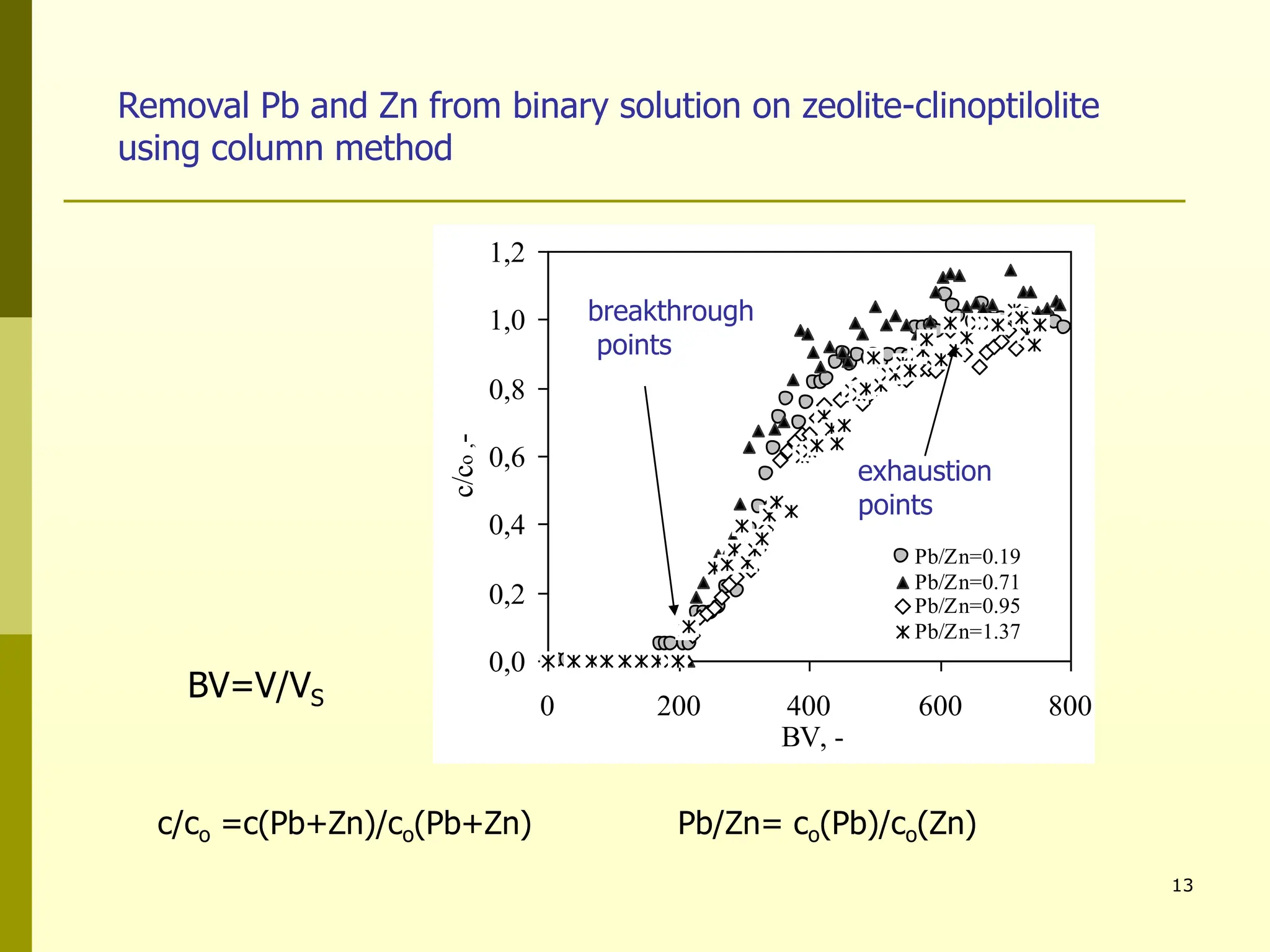
Removal Pb and Zn from binary solution on zeolite-clinoptilolite
using column method
SERVICE CYCLE
- experiments were performed in glass columns, d=12mm, H=40mm
- binary aqueous solutions of lead and zinc ions have been prepared by
dissolving of Pb(NO3)2 and Zn(NO3)2 in doubly distilled water
- flowrate was 1 ml/min
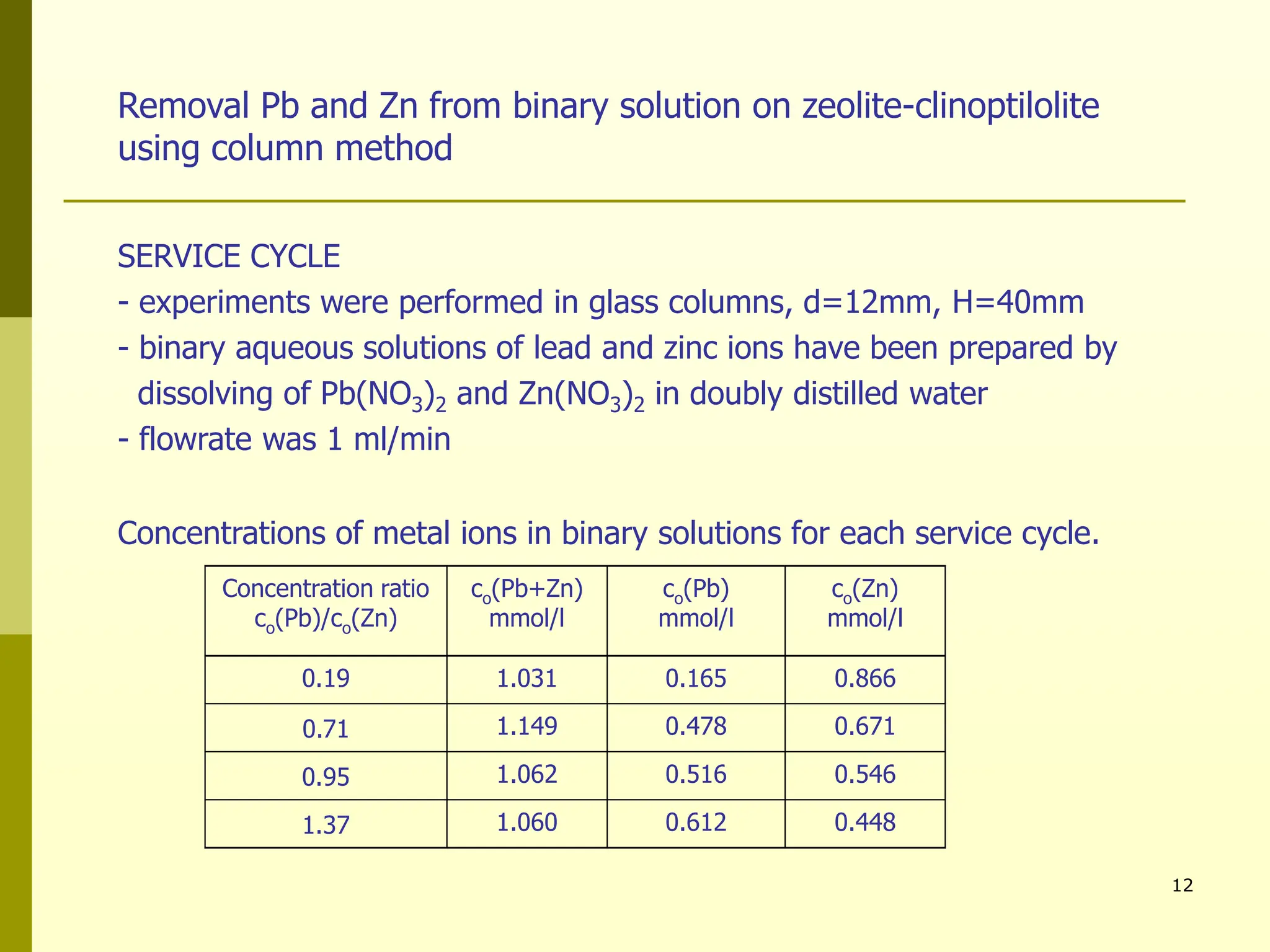
Concentrations of metal ions in binary solutions for each service cycle.
Concentration ratio
co(Pb)/co(Zn)
co(Pb+Zn)
mmol/l
co(Pb)
mmol/l
co(Zn)
mmol/l
0.19 1.031 0.165 0.866
0.71 1.149 0.478 0.671
0.95 1.062 0.516 0.546
1.37 1.060 0.612 0.448
13
0,0
0,2
0,4
0,6
0,8
1,0
1,2
0 200 400 600 800
BV, -
c/c
o
,
-
Pb/Zn=0.19
Pb/Zn=0.71
Pb/Zn=0.95
Pb/Zn=1.37
c/co =c(Pb+Zn)/co(Pb+Zn) Pb/Zn= co(Pb)/co(Zn)
Removal Pb and Zn from binary solution on zeolite-clinoptilolite
using column method
exhaustion
points
breakthrough
points
BV=V/VS
14
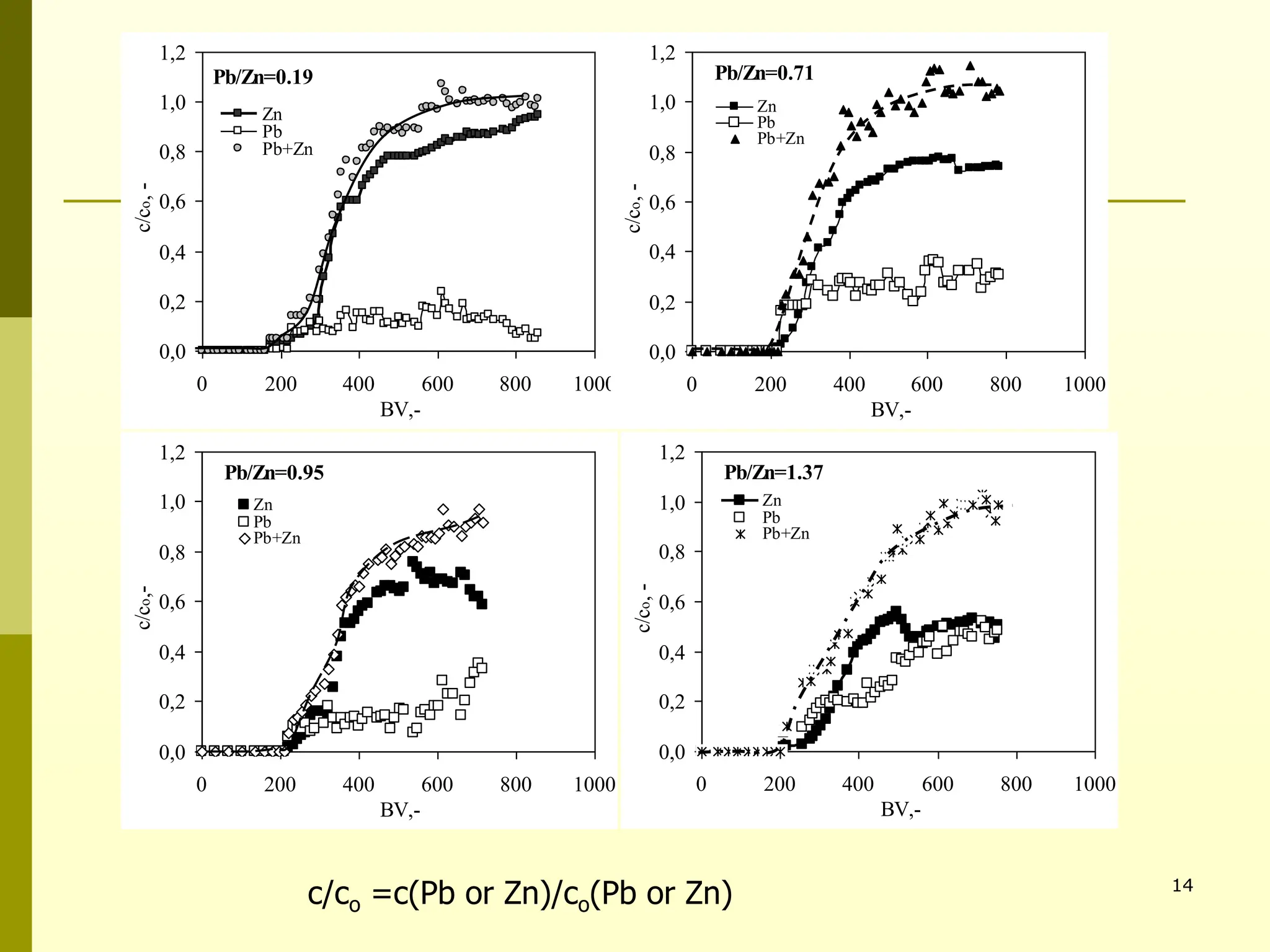
c/co =c(Pb or Zn)/co(Pb or Zn)
Pb/Zn=0.19
0,0
0,2
0,4
0,6
0,8
1,0
1,2
0 200 400 600 800 1000
BV,-
c/c
o
,
-
Zn
Pb
Pb+Zn
Pb/Zn=0.71
0,0
0,2
0,4
0,6
0,8
1,0
1,2
0 200 400 600 800 1000
BV,-
c/c
o
,
-
Zn
Pb
Pb+Zn
Pb/Zn=0.95
0,0
0,2
0,4
0,6
0,8
1,0
1,2
0 200 400 600 800 1000
BV,-
c/c
o
,-
Zn
Pb
Pb+Zn
Pb/Zn=1.37
0,0
0,2
0,4
0,6
0,8
1,0
1,2
0 200 400 600 800 1000
BV,-
c/c
o
,
-
Zn
Pb
Pb+Zn
15
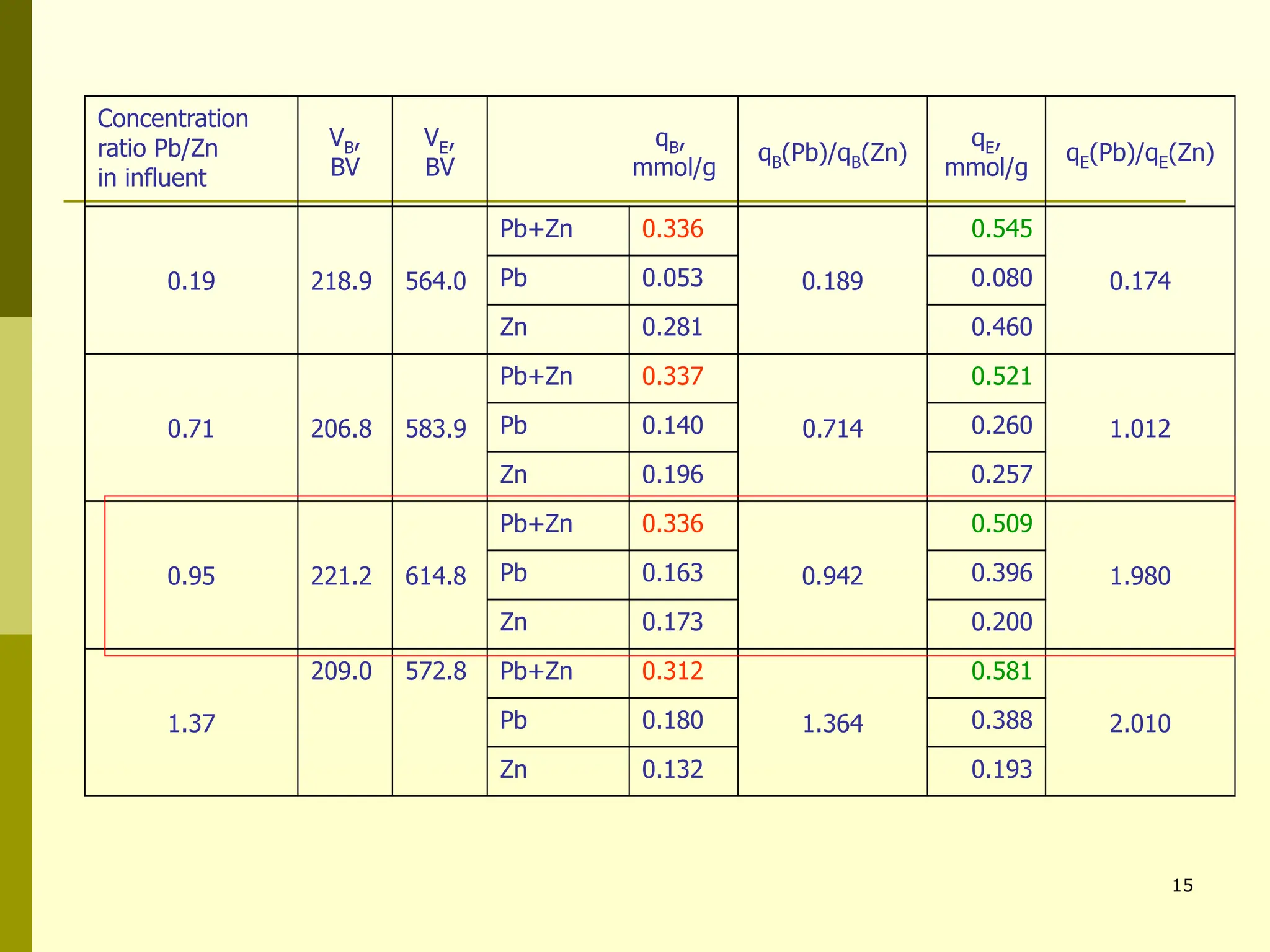
Concentration
ratio Pb/Zn
in influent
VB,
BV
VE,
BV
qB,
mmol/g
qB(Pb)/qB(Zn)
qE,
mmol/g
qE(Pb)/qE(Zn)
0.19 218.9 564.0
Pb+Zn 0.336
0.189
0.545
0.174
Pb 0.053 0.080
Zn 0.281 0.460
0.71 206.8 583.9
Pb+Zn 0.337
0.714
0.521
1.012
Pb 0.140 0.260
Zn 0.196 0.257
0.95 221.2 614.8
Pb+Zn 0.336
0.942
0.509
1.980
Pb 0.163 0.396
Zn 0.173 0.200
1.37
209.0 572.8 Pb+Zn 0.312
1.364
0.581
2.010
Pb 0.180 0.388
Zn 0.132 0.193
16
Removal Pb and Zn from binary solution on zeolite-clinoptilolite
using column method
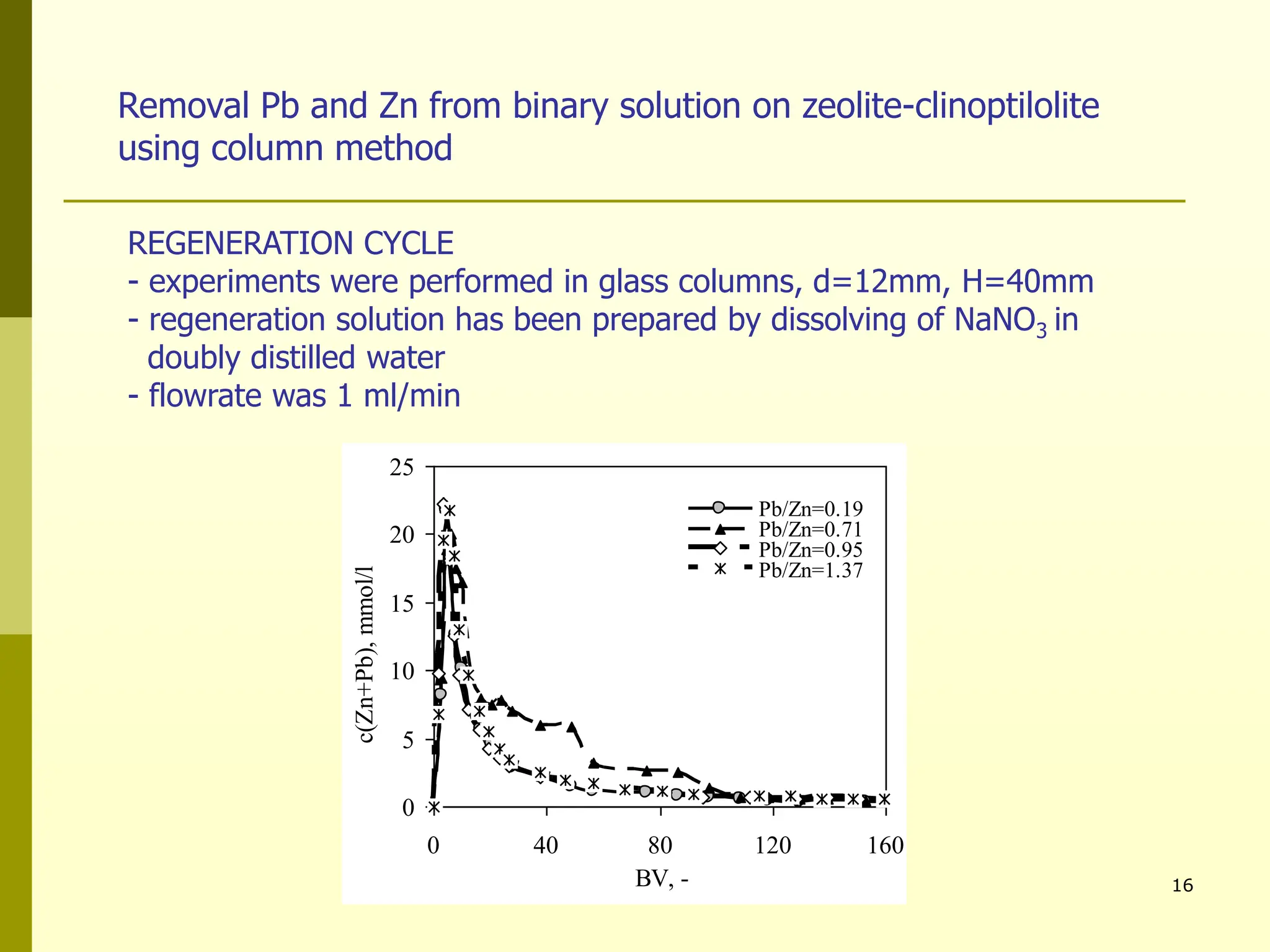
REGENERATION CYCLE
- experiments were performed in glass columns, d=12mm, H=40mm
- regeneration solution has been prepared by dissolving of NaNO3 in
doubly distilled water
- flowrate was 1 ml/min
0
5
10
15
20
25
0 40 80 120 160
BV, -
c(Zn+Pb),
mmol/l
.
Pb/Zn=0.19
Pb/Zn=0.71
Pb/Zn=0.95
Pb/Zn=1.37
17
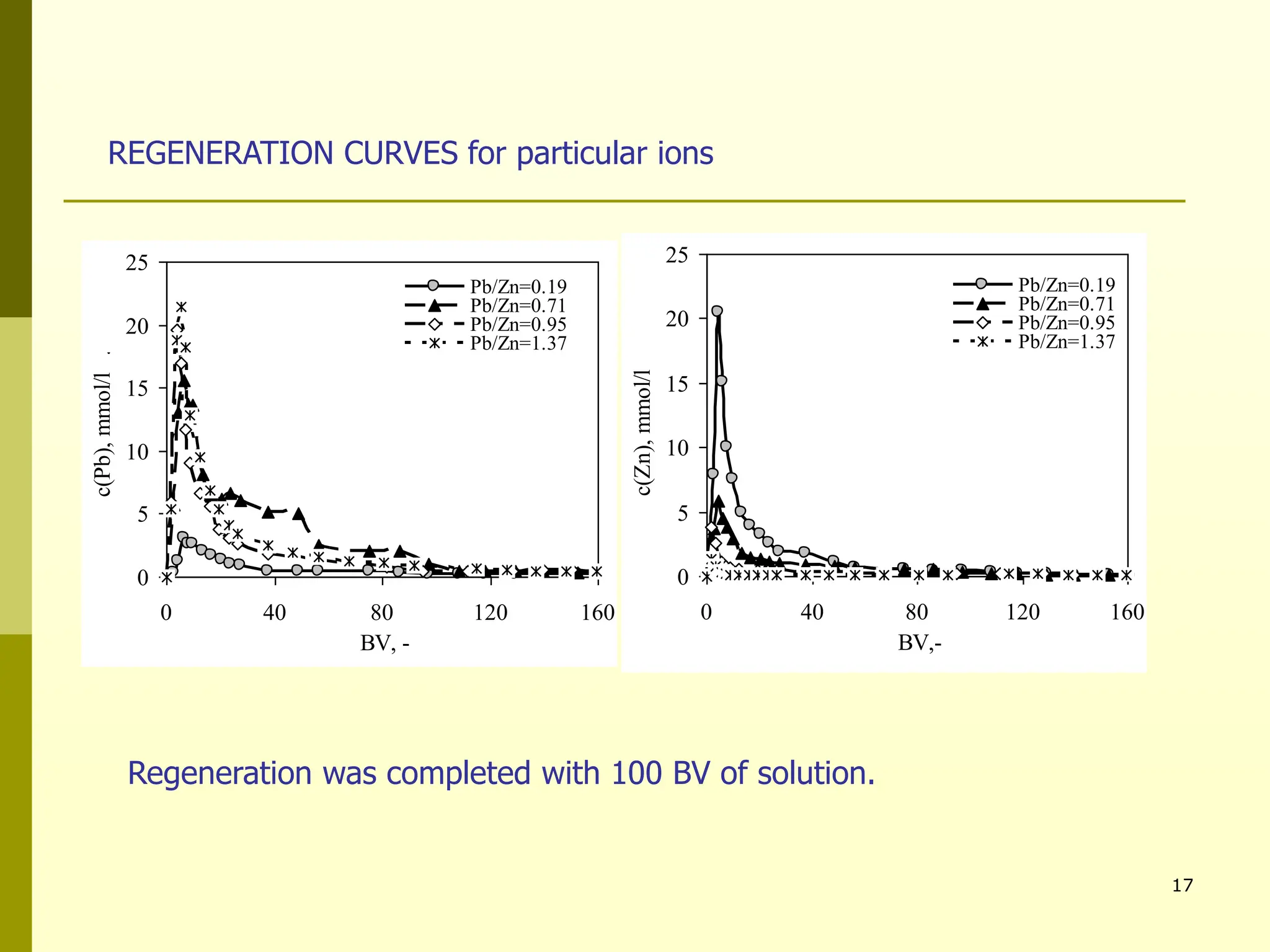
REGENERATION CURVES for particular ions
Regeneration was completed with 100 BV of solution.
0
5
10
15
20
25
0 40 80 120 160
BV, -
c(Pb),
mmol/l
.
Pb/Zn=0.19
Pb/Zn=0.71
Pb/Zn=0.95
Pb/Zn=1.37
0
5
10
15
20
25
0 40 80 120 160
BV,-
c(Zn),
mmol/l
.
Pb/Zn=0.19
Pb/Zn=0.71
Pb/Zn=0.95
Pb/Zn=1.37
18
Removal of lead and zinc on zeolite using column method is applicable in
practice.
CEC of zeolite doesn't depend of concentration ratio in feeding solution.
The quantity of regenerated zinc is significantly lower compared to the
lead. The only exception is the binary solution with a small Pb/Zn ratio.
This confirms that lead was mostly bound onto zeolite, possible due to
replacement of zinc ions with lead ions during the service cycle.
This replacement is due to higher selectivity of natural zeolite for lead ions.
Lower radius of the hydrated Pb2+ ion in comparison to Zn2+ provides for
its better mobility through the framework structure.
Advantage of column method is regeneration of zeolite what enables
unlimited use of the same bed.
CONCLUSIONS
19
Presented investigations are part of the scientific project
"Natural zeolites in water protection"
which has been financing by Ministry of Science, Education and
Sports of the Republic of Croatia
Researchers on the project:
Jelena Perić, full professor - senior researcher
Marina Trgo - assistant professor
Nediljka Vukojević Medvidović- assistant professor
Ivona Nuić - assistant
Marin Ugrina - assistant
Thank you!
20
Thank you!

Marina_Trgo_lecture for zeolite and application

  • 1.
    1 NATURAL ZEOLITES ASMULTIFUNCTIONAL ENVIRONMENTAL FRIENDLY MATERIALS THEIR APPLICATION FOR REMOVAL OF Pb AND Zn FROM BINARY SOLUTIONS Marina Trgo Faculty of Chemistry and Technology University of Split Croatia 2nd Slovenian-Croatian Symposium on Zeolites Ljubljana, 2009
  • 2.
    2  natural aluminosilicateminerals with crystal three-dimensional structure  hydrated cations are located inside framework structure and weakly bound with structure  advantages of these natural minerals are their large deposits on the Earth, easiness of exploitation and mostly unnecessary treatment for practical application  the most important deposits are in the United States, Mexico, Ukraine, Slovakia, Italy, Greece, Turkey, Russia, Serbia, Romania, Bulgaria, Georgia, Armenia, Cuba and Croatia  discovered more than 260 years ago by the Swedish mineralogist A.A.F. Cronstedt, commercial exploitation started ~30 years ago  the end of 70-ties is proclaimed as "new discovery" of natural zeolites  about 50 different minerals of zeolites are discovered in nature, but some of them have commercial valuable  currently, the world’s annual production of natural zeolite is about 4 million tons NATURAL ZEOLITES - deposits and properties
  • 3.
    3 NATURAL ZEOLITES -physical and chemical properties  many natural zeolites are synthesized in laboratory  difference between natural zeolite minerals is manifested in content of hydrated cations which occupied pores and channels, ratio of Si/Al in structure and number of water molecules  zeolites have different dimensions of pores and channels responsible for their physical and chemical properties  each examined sample is mineralogical heterogeneous, and quantification of its mineralogical composition in mostly complex procedure. APPLICATION of natural zeolites is based on or more of the following properties: - cation exchange - adsorption and related molecular sieving - dehydration and rehydration - biological activity - catalytic All of these properties have been intensively investigating.
  • 4.
    4 Cation exchange - theability to exchange inherent cations for other cations on a basis of ion selectivity - high cation exchange capacity for heavy metal cations that can be removed from liquid effluents through the process of ion-exchange. These cations include lead, silver, cadmium, cobalt, zinc, copper, mercury, magnesium, iron, aluminium, chromium and others. Some natural zeolites are applicable in industries such as mining, electroplating and electronics. Giant industrial houses, like IBM, have deployed this application for treatment of wastewater containing heavy metals. -selectivity for ammonium cations, the natural zeolites lower the level of ammonium in wastewaters and sewages to non-toxic, acceptable levels. The zeolite beds can be regenerated and recycled indefinitely.
  • 5.
    5 Adsorption and relatedmolecular sieving The adsorption on molecular sieves is therefore dependent on the following physical molecular properties: - Size and Shape; molecules or ions larger than the pore opening of the zeolite can not be adsorbed, smaller molecules or ions can. -Molecular Polarity; due the charge on outer and inner zeolitic surface particle, molecules with large polarity or polarisability can be adsorbed preferentially under identical conditions. The adsorption process is fully reversible and of purely physical nature. The structure of the zeolite is unchanged during the adsorption process and its later regeneration.
  • 6.
    6 - this propertyis used for selective absorption of organic molecules and for absorption of radioactive ions (absorber of Sr and Cs radioisotopes in the nuclear industry and for clean up of nuclear accidents - applied in the Chernobyl disaster). Adsorption and related molecular sieving - adsorption process on zeolite is used to remove polar H2O, H2S, and CO2 from natural gas and developed a zeolite-adsorption process for purifying methane produced in a landfill.
  • 7.
    7 Dehydration and rehydration Naturalzeolites may hold water up to 60% of their weight due to a high porosity of the crystalline structure. Water molecules in the pores could be easily evaporated or reabsorbed without damage to such structures. Zeolites assure a permanent water reservoir, providing prolonged moisture during dry periods; they also promote a rapid rewetting and improve the lateral spread of water into the root zone during irrigation. This results in a saving in the quantity of water needed for irrigation.
  • 8.
    8 Biological activity - naturalzeolite has been shown to exhibit diverse biological activities and has been used successfully for the treatment in medical therapy - promotes better plant growth by improving the value of fertilizer, helps preventing the plant from burning, that can be caused by over use of fertilizer, by trapping and slowly releasing valuable nutrients - as additive in concentrated animal growing facilities improve feed conversion, reduce airborne ammonia up to 80%, act as a mycotoxin binder, and improve bone density, it can be used in general odour elimination for all animal odours
  • 9.
    9 - modifying thesurface of clinoptilolite with long-chain quaternary amines allowed it to adsorb benzene, toluene, and xylene in the presence of water -surface modified natural zeolites remove toxic compounds from animal food - natural zeolite can be treated further with additional amine to produce anion exchangers capable of taking up chromate, arsenate, selenate, and other metal oxyanions from aqueous solutions Surface modification of natural zeolites
  • 10.
    10 Physical characteristics ofsome naturally occurring zeolites Natural zeolite - clinoptilolite - is one of the most investigated natural zeolites - unit cell formula is (Na, K)6Si30Al6O72 · 20H2O - high silica zeolite, Si/Al≥4, HEU type framework topology - Croatia has deposits of natural zeolite with content of 30-50% of clinoptilolite - recent investigations in Croatia have done with Serbian zeolite which contain ~80% clinoptilolite
  • 11.
    11 Clinoptilolite Examinations on Facultyof Chemistry and Technology University of Split - removal of Cu, Zn and Pb on natural and pre-treated zeolite using batch method - study of kinetic and thermodynamic of Zn on natural zeolite - removal of Pb or Zn on natural and pre-treated zeolite using column method - removal Pb and Zn from binary solution on natural and pre-treated zeolite using column method -recent examinations are directed on removal of metal ions on iron coated zeolite
  • 12.
    12 Removal Pb andZn from binary solution on zeolite-clinoptilolite using column method SERVICE CYCLE - experiments were performed in glass columns, d=12mm, H=40mm - binary aqueous solutions of lead and zinc ions have been prepared by dissolving of Pb(NO3)2 and Zn(NO3)2 in doubly distilled water - flowrate was 1 ml/min Concentrations of metal ions in binary solutions for each service cycle. Concentration ratio co(Pb)/co(Zn) co(Pb+Zn) mmol/l co(Pb) mmol/l co(Zn) mmol/l 0.19 1.031 0.165 0.866 0.71 1.149 0.478 0.671 0.95 1.062 0.516 0.546 1.37 1.060 0.612 0.448
  • 13.
    13 0,0 0,2 0,4 0,6 0,8 1,0 1,2 0 200 400600 800 BV, - c/c o , - Pb/Zn=0.19 Pb/Zn=0.71 Pb/Zn=0.95 Pb/Zn=1.37 c/co =c(Pb+Zn)/co(Pb+Zn) Pb/Zn= co(Pb)/co(Zn) Removal Pb and Zn from binary solution on zeolite-clinoptilolite using column method exhaustion points breakthrough points BV=V/VS
  • 14.
    14 c/co =c(Pb orZn)/co(Pb or Zn) Pb/Zn=0.19 0,0 0,2 0,4 0,6 0,8 1,0 1,2 0 200 400 600 800 1000 BV,- c/c o , - Zn Pb Pb+Zn Pb/Zn=0.71 0,0 0,2 0,4 0,6 0,8 1,0 1,2 0 200 400 600 800 1000 BV,- c/c o , - Zn Pb Pb+Zn Pb/Zn=0.95 0,0 0,2 0,4 0,6 0,8 1,0 1,2 0 200 400 600 800 1000 BV,- c/c o ,- Zn Pb Pb+Zn Pb/Zn=1.37 0,0 0,2 0,4 0,6 0,8 1,0 1,2 0 200 400 600 800 1000 BV,- c/c o , - Zn Pb Pb+Zn
  • 15.
    15 Concentration ratio Pb/Zn in influent VB, BV VE, BV qB, mmol/g qB(Pb)/qB(Zn) qE, mmol/g qE(Pb)/qE(Zn) 0.19218.9 564.0 Pb+Zn 0.336 0.189 0.545 0.174 Pb 0.053 0.080 Zn 0.281 0.460 0.71 206.8 583.9 Pb+Zn 0.337 0.714 0.521 1.012 Pb 0.140 0.260 Zn 0.196 0.257 0.95 221.2 614.8 Pb+Zn 0.336 0.942 0.509 1.980 Pb 0.163 0.396 Zn 0.173 0.200 1.37 209.0 572.8 Pb+Zn 0.312 1.364 0.581 2.010 Pb 0.180 0.388 Zn 0.132 0.193
  • 16.
    16 Removal Pb andZn from binary solution on zeolite-clinoptilolite using column method REGENERATION CYCLE - experiments were performed in glass columns, d=12mm, H=40mm - regeneration solution has been prepared by dissolving of NaNO3 in doubly distilled water - flowrate was 1 ml/min 0 5 10 15 20 25 0 40 80 120 160 BV, - c(Zn+Pb), mmol/l . Pb/Zn=0.19 Pb/Zn=0.71 Pb/Zn=0.95 Pb/Zn=1.37
  • 17.
    17 REGENERATION CURVES forparticular ions Regeneration was completed with 100 BV of solution. 0 5 10 15 20 25 0 40 80 120 160 BV, - c(Pb), mmol/l . Pb/Zn=0.19 Pb/Zn=0.71 Pb/Zn=0.95 Pb/Zn=1.37 0 5 10 15 20 25 0 40 80 120 160 BV,- c(Zn), mmol/l . Pb/Zn=0.19 Pb/Zn=0.71 Pb/Zn=0.95 Pb/Zn=1.37
  • 18.
    18 Removal of leadand zinc on zeolite using column method is applicable in practice. CEC of zeolite doesn't depend of concentration ratio in feeding solution. The quantity of regenerated zinc is significantly lower compared to the lead. The only exception is the binary solution with a small Pb/Zn ratio. This confirms that lead was mostly bound onto zeolite, possible due to replacement of zinc ions with lead ions during the service cycle. This replacement is due to higher selectivity of natural zeolite for lead ions. Lower radius of the hydrated Pb2+ ion in comparison to Zn2+ provides for its better mobility through the framework structure. Advantage of column method is regeneration of zeolite what enables unlimited use of the same bed. CONCLUSIONS
  • 19.
    19 Presented investigations arepart of the scientific project "Natural zeolites in water protection" which has been financing by Ministry of Science, Education and Sports of the Republic of Croatia Researchers on the project: Jelena Perić, full professor - senior researcher Marina Trgo - assistant professor Nediljka Vukojević Medvidović- assistant professor Ivona Nuić - assistant Marin Ugrina - assistant Thank you!
  • 20.