E.coli O157:H7
Marie Schneiders| VM 811 | Michigan State University
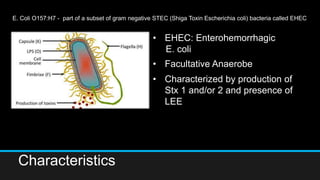
E. Coli O157:H7 - part of a subset of gram negative STEC (Shiga Toxin Escherichia coli) bacteria called EHEC
Characteristics
• EHEC: Enterohemorrhagic
E. coli
• Characterized by production of
Stx 1 and/or 2 and presence of
LEE
• Facultative Anaerobe
Jack in the Box Incident of 1993
• Implicated in a McDonald’s out break in 1982 - at this time the organism was
considered rare
• 1993: 732 people infected after eating hamburgers at 73 Jack in the Box
restaurants in California, Idaho, Washington, and Nevada
• The majority of victims were children under the age of 10
• 4 children died
• 178 other victims were left permanently damaged
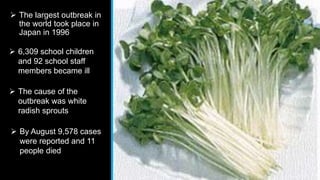
 The largest outbreak in
the world took place in
Japan in 1996
 The cause of the
outbreak was white
radish sprouts
 6,309 school children
and 92 school staff
members became ill
 By August 9,578 cases
were reported and 11
people died
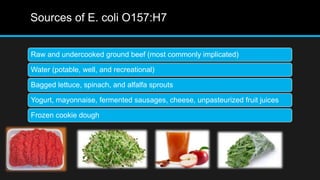
Sources of E. coli O157:H7
Raw and undercooked ground beef (most commonly implicated)
Water (potable, well, and recreational)
Bagged lettuce, spinach, and alfalfa sprouts
Yogurt, mayonnaise, fermented sausages, cheese, unpasteurized fruit juices
Frozen cookie dough
Virulence Factors
Shiga Toxin
• Stx 1 nearly identical to that
produced by Shigella
dysenteriae Type I
• Stx 2 most often associated
with HUS (hemolytic uremic
syndrome) – characterized by
renal failure
Presence of
LEE
• “Locus for enterocyte
effacement”
• Encodes for intimin – a
protein that enables bacterial
attachment to epithelial cells
Other
• Horizontal gene transfer
• Several other putative
virulence factors, including
enterohemolysin
• role of these factors in
pathogenesis remains
undetermined
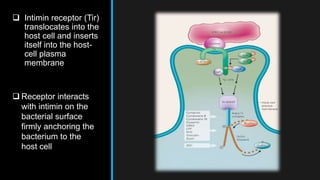
 Intimin receptor (Tir)
translocates into the
host cell and inserts
itself into the host-
cell plasma
membrane
 Receptor interacts
with intimin on the
bacterial surface
firmly anchoring the
bacterium to the
host cell
Human Exposure to E.coli O157:H7
• FSIS (Food Safety & Inspection
Service) estimates that 99.993% and
99.982% of cooked ground beef in
low and high prevalence seasons
respectively are not expected to have
surviving E. coli O157:H7 organisms
present
• FSIS estimates that in grinder loads
consisting of 2,000 lbs. raw trim
(combo) between 40% and 88% of
these loads contained one or more E.
coli O157:H7 in the low prevalence
season and 61% to 94% in the high
prevalence season
Frequency
• ~63,000 cases of EHEC infections in
the U.S. yearly according to the CDC
• Ground beef continues to be
implicated in most infections
• Contaminated produce is on the rise
as a cause of infection
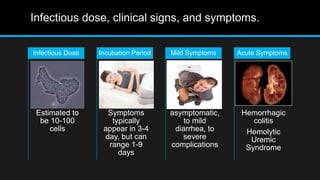
Infectious dose, clinical signs, and symptoms.
Estimated to
be 10-100
cells
Infectious Dose
Symptoms
typically
appear in 3-4
day, but can
range 1-9
days
Incubation Period
asymptomatic,
to mild
diarrhea, to
severe
complications
Mild Symptoms
Hemorrhagic
colitis
Hemolytic
Uremic
Syndrome
Acute Symptoms
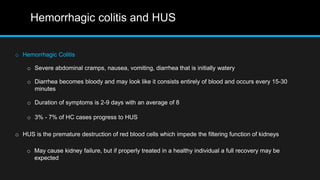
Hemorrhagic colitis and HUS
o Hemorrhagic Colitis
o Severe abdominal cramps, nausea, vomiting, diarrhea that is initially watery
o Diarrhea becomes bloody and may look like it consists entirely of blood and occurs every 15-30
minutes
o 3% - 7% of HC cases progress to HUS
o Duration of symptoms is 2-9 days with an average of 8
o HUS is the premature destruction of red blood cells which impede the filtering function of kidneys
o May cause kidney failure, but if properly treated in a healthy individual a full recovery may be
expected
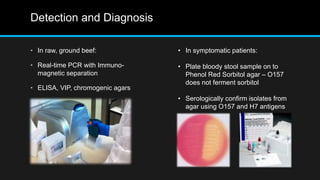
Detection and Diagnosis
• In raw, ground beef:
• Real-time PCR with Immuno-
magnetic separation
• ELISA, VIP, chromogenic agars
• In symptomatic patients:
• Plate bloody stool sample on to
Phenol Red Sorbitol agar – O157
does not ferment sorbitol
• Serologically confirm isolates from
agar using O157 and H7 antigens
Host Defense
• Mucins, AMPs, and members of the intestinal microbiota
• Mucins create a dynamic physical barrier
• Anti-microbial peptites are effectors of the innate immune response
• Resident microbiota provide a microbial barrier against pathogens
• Bacteria that originated from the intestinal microbiota have the capacity for
interfering with or block the process of pathogenicity of enteric bacterial pathogens
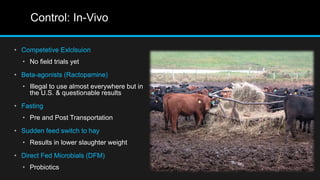
Control: In-Vivo
• Competetive Exlclsuion
• No field trials yet
• Beta-agonists (Ractopamine)
• Illegal to use almost everywhere but in
the U.S. & questionable results
• Fasting
• Pre and Post Transportation
• Sudden feed switch to hay
• Results in lower slaughter weight
• Direct Fed Microbials (DFM)
• Probiotics
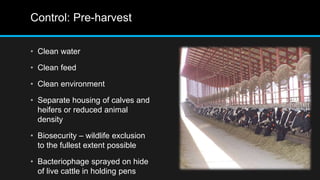
Control: Pre-harvest
• Clean water
• Clean feed
• Clean environment
• Separate housing of calves and
heifers or reduced animal
density
• Biosecurity – wildlife exclusion
to the fullest extent possible
• Bacteriophage sprayed on hide
of live cattle in holding pens
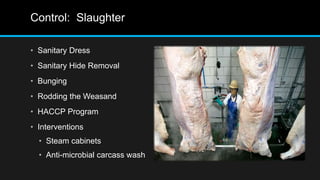
Control: Slaughter
• Sanitary Dress
• Sanitary Hide Removal
• Bunging
• Rodding the Weasand
• HACCP Program
• Interventions
• Steam cabinets
• Anti-microbial carcass wash
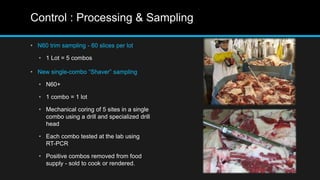
Control : Processing & Sampling
• N60 trim sampling - 60 slices per lot
• 1 Lot = 5 combos
• New single-combo “Shaver” sampling
• N60+
• 1 combo = 1 lot
• Mechanical coring of 5 sites in a single
combo using a drill and specialized drill
head
• Each combo tested at the lab using
RT-PCR
• Positive combos removed from food
supply - sold to cook or rendered.
Control: Consumer End
• Practice proper hygiene
• Cook meats thoroughly
• Prevent cross-
contamination
• Avoid consuming raw
or unpasteurized dairy
products or juices
References
• http://en.wikipedia.org/wiki/1993_Jack_in_the_Box_E._coli_outbreak
• http://www.mayoclinic.org/diseases-conditions/hemolytic-uremic-syndrome/basics/definition/con-20029487
• http://www.nature.com/nature/journal/v449/n7164/fig_tab/nature06247_F2.html
• http://www.ncbi.nlm.nih.gov/pmc/articles/PMC1471992/
• http://www.fsis.usda.gov/OPPDE/rdad/FRPubs/00-023N/00-023NReport.pdf
• http://www.fsis.usda.gov/wps/wcm/connect/d5314cc7-1ef7-4586-bca2-f2ed86d9532f/Reducing-Ecoli-Shedding-
in-Cattle.pdf?MOD=AJPERES
• http://www.fsis.usda.gov/OPPDE/rdad/FSISDirectives/6410.1.pdf
• http://www.ncbi.nlm.nih.gov/pubmed/24751204
• http://www.cdc.gov/Features/EcoliInfection/

Marie Schneiders VM811 Final Project

  • 1.
    E.coli O157:H7 Marie Schneiders|VM 811 | Michigan State University
  • 2.
    E. Coli O157:H7- part of a subset of gram negative STEC (Shiga Toxin Escherichia coli) bacteria called EHEC Characteristics • EHEC: Enterohemorrhagic E. coli • Characterized by production of Stx 1 and/or 2 and presence of LEE • Facultative Anaerobe
  • 3.
    Jack in theBox Incident of 1993 • Implicated in a McDonald’s out break in 1982 - at this time the organism was considered rare • 1993: 732 people infected after eating hamburgers at 73 Jack in the Box restaurants in California, Idaho, Washington, and Nevada • The majority of victims were children under the age of 10 • 4 children died • 178 other victims were left permanently damaged
  • 4.
     The largestoutbreak in the world took place in Japan in 1996  The cause of the outbreak was white radish sprouts  6,309 school children and 92 school staff members became ill  By August 9,578 cases were reported and 11 people died
  • 5.
    Sources of E.coli O157:H7 Raw and undercooked ground beef (most commonly implicated) Water (potable, well, and recreational) Bagged lettuce, spinach, and alfalfa sprouts Yogurt, mayonnaise, fermented sausages, cheese, unpasteurized fruit juices Frozen cookie dough
  • 6.
    Virulence Factors Shiga Toxin •Stx 1 nearly identical to that produced by Shigella dysenteriae Type I • Stx 2 most often associated with HUS (hemolytic uremic syndrome) – characterized by renal failure Presence of LEE • “Locus for enterocyte effacement” • Encodes for intimin – a protein that enables bacterial attachment to epithelial cells Other • Horizontal gene transfer • Several other putative virulence factors, including enterohemolysin • role of these factors in pathogenesis remains undetermined
  • 7.
     Intimin receptor(Tir) translocates into the host cell and inserts itself into the host- cell plasma membrane  Receptor interacts with intimin on the bacterial surface firmly anchoring the bacterium to the host cell
  • 8.
    Human Exposure toE.coli O157:H7 • FSIS (Food Safety & Inspection Service) estimates that 99.993% and 99.982% of cooked ground beef in low and high prevalence seasons respectively are not expected to have surviving E. coli O157:H7 organisms present • FSIS estimates that in grinder loads consisting of 2,000 lbs. raw trim (combo) between 40% and 88% of these loads contained one or more E. coli O157:H7 in the low prevalence season and 61% to 94% in the high prevalence season
  • 9.
    Frequency • ~63,000 casesof EHEC infections in the U.S. yearly according to the CDC • Ground beef continues to be implicated in most infections • Contaminated produce is on the rise as a cause of infection
  • 10.
    Infectious dose, clinicalsigns, and symptoms. Estimated to be 10-100 cells Infectious Dose Symptoms typically appear in 3-4 day, but can range 1-9 days Incubation Period asymptomatic, to mild diarrhea, to severe complications Mild Symptoms Hemorrhagic colitis Hemolytic Uremic Syndrome Acute Symptoms
  • 11.
    Hemorrhagic colitis andHUS o Hemorrhagic Colitis o Severe abdominal cramps, nausea, vomiting, diarrhea that is initially watery o Diarrhea becomes bloody and may look like it consists entirely of blood and occurs every 15-30 minutes o 3% - 7% of HC cases progress to HUS o Duration of symptoms is 2-9 days with an average of 8 o HUS is the premature destruction of red blood cells which impede the filtering function of kidneys o May cause kidney failure, but if properly treated in a healthy individual a full recovery may be expected
  • 12.
    Detection and Diagnosis •In raw, ground beef: • Real-time PCR with Immuno- magnetic separation • ELISA, VIP, chromogenic agars • In symptomatic patients: • Plate bloody stool sample on to Phenol Red Sorbitol agar – O157 does not ferment sorbitol • Serologically confirm isolates from agar using O157 and H7 antigens
  • 13.
    Host Defense • Mucins,AMPs, and members of the intestinal microbiota • Mucins create a dynamic physical barrier • Anti-microbial peptites are effectors of the innate immune response • Resident microbiota provide a microbial barrier against pathogens • Bacteria that originated from the intestinal microbiota have the capacity for interfering with or block the process of pathogenicity of enteric bacterial pathogens
  • 14.
    Control: In-Vivo • CompetetiveExlclsuion • No field trials yet • Beta-agonists (Ractopamine) • Illegal to use almost everywhere but in the U.S. & questionable results • Fasting • Pre and Post Transportation • Sudden feed switch to hay • Results in lower slaughter weight • Direct Fed Microbials (DFM) • Probiotics
  • 15.
    Control: Pre-harvest • Cleanwater • Clean feed • Clean environment • Separate housing of calves and heifers or reduced animal density • Biosecurity – wildlife exclusion to the fullest extent possible • Bacteriophage sprayed on hide of live cattle in holding pens
  • 16.
    Control: Slaughter • SanitaryDress • Sanitary Hide Removal • Bunging • Rodding the Weasand • HACCP Program • Interventions • Steam cabinets • Anti-microbial carcass wash
  • 17.
    Control : Processing& Sampling • N60 trim sampling - 60 slices per lot • 1 Lot = 5 combos • New single-combo “Shaver” sampling • N60+ • 1 combo = 1 lot • Mechanical coring of 5 sites in a single combo using a drill and specialized drill head • Each combo tested at the lab using RT-PCR • Positive combos removed from food supply - sold to cook or rendered.
  • 18.
    Control: Consumer End •Practice proper hygiene • Cook meats thoroughly • Prevent cross- contamination • Avoid consuming raw or unpasteurized dairy products or juices
  • 19.
    References • http://en.wikipedia.org/wiki/1993_Jack_in_the_Box_E._coli_outbreak • http://www.mayoclinic.org/diseases-conditions/hemolytic-uremic-syndrome/basics/definition/con-20029487 •http://www.nature.com/nature/journal/v449/n7164/fig_tab/nature06247_F2.html • http://www.ncbi.nlm.nih.gov/pmc/articles/PMC1471992/ • http://www.fsis.usda.gov/OPPDE/rdad/FRPubs/00-023N/00-023NReport.pdf • http://www.fsis.usda.gov/wps/wcm/connect/d5314cc7-1ef7-4586-bca2-f2ed86d9532f/Reducing-Ecoli-Shedding- in-Cattle.pdf?MOD=AJPERES • http://www.fsis.usda.gov/OPPDE/rdad/FSISDirectives/6410.1.pdf • http://www.ncbi.nlm.nih.gov/pubmed/24751204 • http://www.cdc.gov/Features/EcoliInfection/

Editor's Notes

  • #3 This is the question that your experiment answers
  • #6 Summarize your research in three to five points.
  • #11 List all of the steps used in completing your experiment. Remember to number your steps. Include photos of your experiment.