POLICY	
  PAPER	


  IMPROVING	
  MED	
  TRANSNATIONAL	
  COOPERATION	
  
ANSWERS	
  TO	
  ENERGY	
  EFFICIENCY	
  CHALLENGES	
  IN	
  
BUILDINGS	


Finalized	
  version	
  prepared	
  by	
  the	
  DTES	
  Generalitat	
  of	
  Catalonia	
  and	
  the	
  
Mediterranean	
  Institute	
  (France)	
  –	
  11th	
  January	
  2013	


1	


2	
  
 
For	
  readers	
  
MARIE	
   and	
   ELIH-­‐MED	
   strategic	
   projects	
   were	
   approved	
   within	
   the	
   MED	
   transnational	
  
cooperation	
  programme	
  early	
  2011.	
  As	
  strategic	
  projects,	
  they	
  have	
  a	
  key	
  capitalization	
  role	
  to	
  
play	
   in	
   order	
   to	
   allow	
   the	
   European	
   community	
   to	
   take	
   benefit	
   of	
   the	
   main	
   experiences,	
  
outputs	
   and	
   results	
   of	
   these	
   two	
   projects,	
   as	
   well	
   as	
   of	
   the	
   transnational	
   projects	
   related	
   to	
  
energy	
  efficiency	
  in	
  buildings	
  in	
  the	
  Mediterranean	
  area.	
  	
  
After	
   several	
   meetings,	
   MARIE	
   and	
   ELIH-­‐MED	
   decided	
   to	
   develop	
   a	
   common	
   capitalization	
  
based	
  on	
  a	
  close	
  collaboration	
  in	
  the	
  elaboration	
  of	
  this	
  policy	
  paper.	
  During	
  several	
  months,	
  
projects	
  teams	
  from	
  the	
  Department	
  of	
  Housing	
  of	
  the	
  Generalitat	
  of	
  Catalonia	
  and	
  from	
  the	
  
Mediterranean	
   Institute	
   (based	
   in	
   Marseille,	
   France)	
   have	
   gathered	
   data	
   and	
   analyses	
   on	
  
energy	
   efficiency	
   of	
   buildings	
   in	
   the	
   Mediterranean.	
   Furthermore,	
   the	
   parallel	
   implementation	
  
of	
  their	
  project	
  activities	
  has	
  constituted	
  a	
  substantial	
  resource	
  which	
  has	
  been	
  the	
  basis	
  for	
  
the	
  elaboration	
  of	
  the	
  priorities	
  and	
  recommendations	
  presented	
  in	
  this	
  policy	
  paper.	
  	
  
PROFORBIOMED,	
  a	
  strategic	
  MED	
  project	
  also	
  approved	
  in	
  early	
  2011,	
  and	
  which	
  pursues	
  the	
  
promotion	
   of	
   the	
   residual	
   forest	
   biomass	
   for	
   energy,	
   sustains	
   the	
   policy	
   paper	
   engaged	
   by	
  
ELIH-­‐MED	
   and	
   MARIE	
   projects.	
   PROFORBIOMED	
   will	
   use	
   their	
   experiences	
   with	
   bio-­‐energy	
  
(wooden	
  biomass)	
  and	
  the	
  network	
  of	
  contacts	
  at	
  MED	
  and	
  international	
  level	
  to	
  support	
  the	
  
present	
  paper.	


A	
  first	
  draft	
  version	
  of	
  the	
  policy	
  paper	
  has	
  been	
  submitted	
  in	
  priority	
  to	
  the	
  partners	
  of	
  ELIH-­‐
MED	
   and	
   MARIE	
   projects,	
   who	
   have	
   been	
   invited	
   to	
   bring	
   their	
   contributions.	
   Associated	
  
partners,	
   local	
   and	
   regional	
   actors	
   involved	
   in	
   pilots,	
   institutions	
   dealing	
   with	
   energy	
   issues,	
  
European	
  projects	
  and	
  cooperation	
  programmes	
  have	
  also	
  been	
  invited	
  to	
  read	
  and	
  comment	
  
this	
  draft.	
  	
  
The	
   policy	
   paper	
   was	
   presented	
   at	
   the	
   MEDBEE	
   Forum	
   (Med	
   Buildings	
   Energy	
   Efficiency)	
   in	
  
Brussels	
   on	
   the	
   22nd	
   of	
   November	
   2012.	
   The	
   on-­‐going	
   capitalization	
   workshop	
   cycle	
   and	
  
planned	
  conferences	
  (Malaga,	
  Cyprus,	
  Brussels)	
  were	
  the	
  main	
  tools	
  to	
  facilitate	
  the	
  diffusion	
  
of	
  the	
  first	
  results	
  of	
  the	
  policy	
  paper.	
  
This	
  is	
  now	
  the	
  finalized	
  version	
  of	
  the	
  policy	
  paper,	
  which	
  will	
  be	
  addressed	
  in	
  priority	
  to	
  the	
  
MED	
   programme	
   authorities	
   and	
   European	
   Commission	
   at	
   the	
   beginning	
   of	
   2013	
   and,	
   in	
   a	
  
second	
  step,	
  largely	
  disseminated	
  throughout	
  the	
  Mediterranean	
  space.	


3	
  
 Summary	


1.	
  INTRODUCTION	
  .....................................................................................................	
  6	
  
1.1	
  Scope	
  of	
  the	
  Policy	
  Paper	
  ................................................................................................	
  6	
  
1.2	
  Potential	
  Impact	
  of	
  energy	
  efficiency	
  in	
  buildings	
  ..........................................................	
  7	
  
1.3	
  Objectives	
  of	
  the	
  Policy	
  Paper	
  on	
  energy	
  efficiency	
  in	
  buildings	
  ....................................	
  9	


2.	
  MED	
  CONTEXT	
  ANALYSIS/STATE	
  OF	
  THE	
  ART	
  ....................................	
  10	
  
2.1	
  EEB	
  state	
  of	
  the	
  art	
  in	
  the	
  Mediterranean	
  area	
  and	
  identified	
  barriers	
  to	
  reach	
  the	
  EU	
  
2020	
  targets	
  ........................................................................................................................	
  10	
  
2.1.1.	
  European	
  level	
  
...........................................................................................	
  10	
  
2.1.2.	
  National	
  level	
  ............................................................................................	
  11	
  
2.1.3.	
  Transnational/	
  transregional	
  level	
  ............................................................	
  12	
  
2.1.4.	
  Mediterranean	
  level	
  ..................................................................................	
  13	
  
2.2	
  Identified	
  barriers	
  .........................................................................................................	
  17	


3.	
  IMPROVING	
  ENERGY	
  EFFICIENCY	
  IN	
  BUILDINGS	
  IN	
  THE	
  MED	
  SPACE	
  ..	
  22	
  
3.1	
  Main	
  strategic	
  lines	
  to	
  achieve	
  EU	
  2020	
  targets	
  in	
  Energy	
  Efficiency	
  in	
  Buildings	
  (EEB)	
  
in	
  the	
  Mediterranean	
  ..........................................................................................................	
  22	
  
1.	
  Territorial	
  and	
  financial	
  governance	
  ...............................................................	
  22	
  
2.	
  	
  Competitiveness,	
  economic	
  activities	
  and	
  employment	
  ................................	
  24	
  
3.	
  	
  Market	
  activation	
  ...........................................................................................	
  27	
  
4.	
  	
  Smart	
  energy	
  management	
  systems	
  and	
  services	
  .........................................	
  28	
  
3.2	
  Identification	
  of	
  the	
  Resources	
  needed	
  ........................................................................	
  29	


4.	
  RECOMMENDATIONS	
  FOR	
  NEXT	
  EU	
  PROGRAMMING	
  IN	
  MED	
  SPACE	
  30	
  
4.1	
  Coordination	
  between	
  MED	
  program	
  and	
  other	
  EU	
  programs	
  related	
  to	
  EEB	
  .............	
  31	
  
4.2	
  Towards	
  the	
  implementation	
  of	
  a	
  macro-­‐regional	
  approach	
  .......................................	
  31	
  
4.2.1	
  What	
  will	
  a	
  macroregional	
  approach	
  be	
  useful	
  for?	
  ..................................	
  32	
  
4.2.2	
  Our	
  Mediterranean	
  approach	
  ....................................................................	
  33	
  
4.2.3	
  Steps	
  towards	
  a	
  Mediterranean	
  macroregional	
  strategy	
  
...........................	
  34	


4	


5.	
  EEB	
  priority	
  and	
  cooperation	
  innovations	
  .........................................	
  34	
  
5.1	
  Energy	
  efficiency	
  priority	
  at	
  European	
  level	
  .................................................................	
  34	
  
5.2	
  Recommendations	
  and	
  propositions	
  regarding	
  the	
  structure	
  and	
  contents	
  of	
  the	
  next	
  
period	
  program	
  ...................................................................................................................	
  36	
  
Strategic	
  objective	
  
.......................................................................................................	
  36	
  
General	
  objective	
  ........................................................................................................	
  36	
  
Specific	
  objectives	
  in	
  the	
  Mediterranean	
  area	
  context	
  ..............................................	
  36	
  
Priority	
  axis	
  of	
  intervention	
  
.........................................................................................	
  37	
  
Flagship	
  projects	
  .........................................................................................................	
  37	
  
Categories	
  of	
  projects	
  .................................................................................................	
  39	
  
Transverse	
  dimensions	
  in	
  EEB	
  projects	
  .......................................................................	
  40	
  
Principles	
  to	
  strengthen	
  governance	
  and	
  generate	
  good	
  quality	
  projects	
  .................	
  40	
  
Indicators	
  ....................................................................................................................	
  41	
  
Coherence	
  with	
  national,	
  regional	
  and	
  local	
  strategies	
  ..............................................	
  42	


6.	
  Conclusions	
  .......................................................................................	
  43	


ANNEX	
  1	
  –	
  Contributions	
  .............................................	
  Erreur	
  !	
  Signet	
  non	
  défini.	
  
ANNEX	
  2	
  –	
  Need	
  of	
  resources	
  ....................................	
  Erreur	
  !	
  Signet	
  non	
  défini.5	
  
ANNEX	
  3	
  -­‐	
  Project	
  bibliography	
  ...........................................................................	
  58	
  
ANNEX	
  4	
  -­‐	
  CESBA	
  Initiative	
  for	
  Capitalisation	
  .....................................................	
  60	


5	
  
1.	
  INTRODUCTION	
  	
  
This	
  introduction	
  highlights	
  the	
  importance	
  of	
  the	
  improvement	
  of	
  the	
  Energy	
  Efficiency	
  (EE)	
  in	
  the	
  existing	
  
buildings	
  in	
  the	
  Mediterranean.	
  It	
  is	
  divided	
  in	
  three	
  points,	
  the	
  scope	
  of	
  the	
  Policy	
  Paper,	
  a	
  consideration	
  of	
  the	
  
potential	
  impact	
  of	
  the	
  EE	
  in	
  buildings	
  and	
  finally,	
  a	
  description	
  of	
  the	
  objectives	
  of	
  the	
  Policy	
  Paper	
  with	
  respect	
  
to	
  the	
  above.


1.1	
  Scope	
  of	
  the	
  Policy	
  Paper	


Economic,	
   social	
   and	
   environmental	
   urgencies	
   are	
   today,	
   maybe	
   more	
   than	
   ever,	
   strongly	
  
interrelated.	
   In	
   this	
   stressful	
   context,	
   energy	
   efficiency	
   is	
   a	
   point	
   of	
   convergence.	
   Whereas	
   the	
  
economic	
   perspectives	
   are	
   depressing	
   and	
   the	
   invoice	
   of	
   oil	
   importations	
   is	
   increasing	
   for	
  
Europe,	
  scientists	
  agree	
  to	
  alert	
  decision-­‐makers	
  on	
  greenhouse	
  gases	
  impacts	
  on	
  climate	
  and	
  
environment.	
   In	
   consequence,	
   a	
   broad	
   consensus	
   exists	
   on	
   the	
   necessity	
   of	
   developing	
   new	
  
economic	
  models	
  and	
  standards	
  of	
  living	
  based	
  on	
  energy	
  efficiency	
  and	
  the	
  European	
  Union	
  
adopted	
  common	
  patterns	
  to	
  achieve	
  the	
  ambitious	
  target	
  of	
  an	
  increase	
  in	
  energy	
  efficiency	
  
of	
  20%	
  up	
  to	
  2020.	
  
This	
   challenge,	
   common	
   to	
   all	
   the	
   European	
   countries,	
   has	
   a	
   specific	
   resonance	
   in	
   the	
  
Mediterranean	
  space,	
  where	
  the	
  economic	
  crisis	
  is	
  stronger	
  than	
  elsewhere	
  in	
  Europe	
  with	
  a	
  
greater	
   rate	
   of	
   unemployment.	
   Households,	
   enterprises	
   and	
   also	
   public	
   bodies	
   have	
   little	
  
solvability	
  and	
  need	
  to	
  reduce	
  substantially	
  their	
  expenses,	
  including	
  the	
  energy	
  bills.	
  
The	
   second	
   common	
   characteristic	
   is	
   the	
   connection	
   between	
   climatic	
   conditions	
   and	
   an	
  
important	
  and	
  ancient	
  existing	
  building	
  stock.	
  Energy	
  efficiency	
  renovation	
  of	
  buildings	
  in	
  the	
  
Mediterranean	
   face	
   expensive	
   investments	
   in	
   the	
   context	
   of	
   a	
   lower	
   potential	
   of	
   savings	
  
(particularly	
  concerning	
  heating),	
  older	
  building	
  stock	
  and	
  poorest	
  population	
  than	
  in	
  Northern	
  
Europe.	
  Moreover,	
  the	
  Mediterranean	
  space	
  faces	
  a	
  specific	
  issue,	
  not	
  taken	
  into	
  account	
  till	
  
now:	
  the	
  summer	
  comfort	
  challenge.	
  
In	
  this	
  complex	
  Mediterranean	
  framework,	
  it	
  makes	
  sense	
  to	
  test,	
  at	
  a	
  transnational	
  level,	
  new	
  
approaches	
  and	
  tools	
  that	
  may	
  contribute	
  to	
  overcome	
  the	
  main	
  barriers	
  that	
  today	
  prevent	
  
from	
   a	
   clear	
   improvement	
   of	
   energy	
   efficiency	
   in	
   buildings.	
   It	
   is	
   one	
   of	
   the	
   topics	
   that	
   have	
  
achieved	
   legitimacy	
   as	
   an	
   essential	
   axis	
   of	
   the	
   territorial	
   cooperation,	
   because	
   it	
   requires,	
  
more	
  than	
  other	
  topics,	
  a	
  multilevel	
  coordination.	
  
This	
   policy	
   paper	
   will	
   consider	
   both:	
   energy	
   efficiency	
   policies	
   and	
   territorial	
   cooperation,	
  
trying	
   to	
   pave	
   the	
   way	
   for	
   an	
   empowerment	
   of	
   them	
   as	
   central	
   topics	
   at	
   the	
   next	
  
programming	
  period	
  operational	
  programs.	
  
It	
   also	
   aims	
   to	
   reinforce	
   the	
   linkage	
   between	
   territorial	
   cooperation	
   initiatives	
   on	
   energy	
  
efficiency,	
   public	
   policies	
   and	
   access	
   to	
   new	
   sources	
   of	
   funding.	
   A	
   greater	
   cooperation	
   on	
  
energy	
  efficiency	
  issues	
  and	
  specific	
  efforts	
  to	
  test,	
  innovate	
  and	
  fundraise	
  ambitious	
  projects	
  
and	
   policies	
   are	
   necessary	
   if	
   we	
   want	
   to	
   make	
   the	
   20%	
   energy	
   efficiency	
   increase	
   objective	
  
more	
  realistic.	


6	


1.2	
  Potential	
  Impact	
  of	
  energy	
  efficiency	
  in	
  buildings	


Energy	
   efficiency	
   in	
   buildings	
   (EEB)	
   is	
   today	
   a	
   common	
   challenge	
   to	
   all	
   the	
   Mediterranean	
  
territories.	
  As	
  the	
  EU	
  Consultation	
  Paper	
  (Financial	
  support	
  for	
  Energy	
  Efficiency	
  in	
  Buildings,	
  
released	
  in	
  February	
  2012)	
  says,	
  “buildings	
  must	
  be	
  central	
  to	
  the	
  EU	
  energy	
  efficiency	
  policies	
  
as	
  nearly	
  the	
  40%	
  of	
  final	
  energy	
  consumption	
  (and	
  36%	
  of	
  the	
  greenhouse	
  gas	
  emissions)	
  is	
  in	
  
houses,	
   offices	
   and	
   shops”.	
   Now,	
   the	
   increase	
   of	
   the	
   global	
   sustainability	
   of	
   building	
   stock	
   and	
  
construction	
   sector	
   will	
   depend	
   on	
   the	
   ability	
   of	
   energy	
   efficiency	
   policies	
   to	
   deal	
   with	
   the	
  
diversity	
   of	
   the	
   building	
   stock	
   (residential	
   buildings,	
   shops	
   and	
   commercial	
   buildings,	
   offices,	
  
restaurants	
  and	
  hotels,	
  hospitals	
  and	
  health	
  care	
  buildings,	
  schools).	
  	
  
Furthermore,	
   the	
   ancient	
   building	
   stock	
   in	
   the	
   Mediterranean	
   is	
   characterized	
   by	
   low	
  
renovation	
   rates	
   (2-­‐3	
   times	
   lower	
   than	
   the	
   average	
   energy	
   refurbishment	
   rate	
   in	
   north-­‐
western	
   EU	
   countries;	
   BPIE	
   and	
   FI	
   2011).	
   To	
   transform	
   this	
   energy	
   saving	
   potential	
   in	
   real	
  
energy	
   and	
   economic	
   savings,	
   the	
   ancient	
   building	
   stock	
   has	
   to	
   become	
   a	
   priority	
   topic	
   in	
  
policies	
  and	
  strategies,	
  which	
  have	
  to	
  target	
  all	
  the	
  relevant	
  public	
  and	
  private	
  stakeholders.	
  	
  
In	
   the	
   Mediterranean	
   area,	
   there	
   is	
   energy	
   saving	
   potential	
   in	
   ancient	
   building	
   stock,	
   in	
   low-­‐
income	
   housing,	
   but	
   also	
   in	
   tertiary	
   buildings	
   considering	
   the	
   increase	
   of	
   cooling	
   demand.	
  
Nowadays,	
   policies	
   mainly	
   impact	
   public	
   social	
   housing,	
   through	
   specific	
   credit	
   lines,	
   ERDF	
  
funds	
  and	
  ambitious	
  objectives	
  of	
  renovation.	
  Nevertheless,	
  the	
  low-­‐income	
  housing	
  sector	
  in	
  
the	
  MED	
  space	
  is	
  characterized	
  by	
  the	
  importance	
  of	
  the	
  private	
  housing.	
  Now,	
  private	
  owners	
  
are	
   “far	
   to	
   reach”	
   by	
   existing	
   policies:	
   a	
   particular	
   effort	
   has	
   to	
   be	
   made,	
   in	
   awareness	
   and	
  
financial	
  formulas,	
  as	
  a	
  priority	
  to	
  adapt	
  policies	
  to	
  low-­‐income	
  owners	
  and	
  create	
  innovative	
  
incentives.	
  
Apart	
   from	
   the	
   direct	
   impact	
   foreseen	
   in	
   energy	
   and	
   monetary	
   terms	
   for	
   users,	
   large	
   scale	
  
energy	
  refurbishment	
  operations	
  should	
  also	
  create	
  positive	
  economic	
  and	
  social	
  externalities.	


Several	
   studies	
   and	
   analysis	
   from	
   the	
   European	
   Commission	
   and	
   other	
   European	
   institutions	
  
have	
  demonstrated	
  the	
  enormous	
  potential	
  of	
  buildings	
  energy	
  efficiency	
  improvement	
  in	
  the	
  
MED	
  space	
  economy.	
  The	
  investment	
  needs	
  per	
  year	
  for	
  EU	
  27	
  countries,	
  indeed,	
  are	
  valued	
  at	
  
60	
  billion	
  Euros	
  and	
  the	
  related	
  job	
  creation	
  is	
  estimated	
  at	
  800.000.	
  However,	
  actually	
  there	
  
are	
   important	
   barriers	
   that	
   impede	
   the	
   development	
   of	
   this	
   captive	
   market.	
   The	
  
Mediterranean	
  countries	
  should	
  understand	
  how	
  these	
  barriers	
  can	
  be	
  unblocked	
  according	
  to	
  
other	
  countries	
  and	
  sectors’	
  experiences.	


Currently,	
  the	
  energy	
  renovation	
  of	
  buildings	
  is	
  considered	
  by	
  investors	
  as	
  a	
  difficult	
  question,	
  
with	
   unclear	
   profitability	
   and	
   with	
   a	
   long	
   administrative	
   process	
   to	
   reach	
   public	
   subsidies	
   or	
  
grants.	
   More	
   than	
   the	
   context	
   of	
   economic	
   crisis	
   and	
   environmental	
   pressure,	
   the	
   EPBD	
  
Directives	
   implementation	
   starts	
   nevertheless	
   to	
   open	
   the	
   mind	
   of	
   the	
   main	
   stakeholders	
   in	
  
considering	
   energy	
   efficiency	
   improvement	
   of	
   buildings	
   as	
   an	
   important	
   and	
   mandatory	
  
challenge.	


7	
  
However,	
   important	
   gaps	
   still	
   remain	
   between	
   countries	
   and	
   regions	
   in	
   the	
  
implementation	
   of	
   the	
   European	
   legal	
   framework.	
   And	
   this	
   framework	
   will	
   not	
   be	
   sufficient	
   to	
  
compel	
   all	
   the	
   stakeholders	
   to	
   endorse	
   their	
   responsibilities.	
   In	
   this	
   context,	
   transnational	
  
cooperation	
   projects	
   could	
   actively	
   contribute	
   to	
   create	
   a	
   local	
   and	
   regional	
   movement	
  
towards	
  a	
  better	
  implementation	
  of	
  this	
  framework	
  and	
  an	
  involvement	
  in	
  EE	
  policies,	
  which	
  
could	
   encourage	
   investment,	
   and,	
   on	
   the	
   long	
   run,	
   jobs	
   creation.	
   Moreover,	
   cooperation	
  
projects	
   should	
   also	
   facilitate	
   citizens’	
   awareness	
   concerning	
   the	
   importance	
   of	
   energy	
  
renovation	
  and	
  buildings	
  opportunities.	
  
Territorial	
   cooperation	
   is	
   a	
   key	
   option	
   to	
   overcome	
   as	
   quickly	
   as	
   possible	
   the	
   enormous	
  
barriers	
   that	
   prevent	
   from	
   developing	
   the	
   energy	
   renovation	
   of	
   buildings	
   in	
   MED	
   space.	
  
Territorial	
  Cooperation	
  would	
  facilitate:	
  
-­‐

Benchmark	
   and	
   comparative	
   analysis	
   between	
   different	
   realities.	
   In	
   this	
   sense,	
  
territorial	
   cooperation	
   can	
   facilitate	
   the	
   production	
   of	
   more	
   complete	
   analysis	
   and	
  
knowledge	
  of	
  reality.	


-­‐

Create	
   uniform	
   criteria	
   for	
   assessing	
   the	
   effects	
   of	
   EE	
   measures	
   and	
   evaluation	
   of	
  
achieved	
  savings.	
  

-­‐

Share	
   of	
   solutions	
   and	
   measures	
   and	
   integration	
   of	
   the	
   achieved	
   experience-­‐based	
  
knowledge	
  

-­‐

Generation	
  and	
  share	
  of	
  common	
  approaches	
  to	
  overcome	
  common	
  barriers	
  

-­‐

Achievement	
  of	
  economies	
  of	
  scale	
  in	
  investment	
  and	
  efforts	
  development	
  

-­‐

More	
  dynamic	
  markets	
  in	
  quantitative	
  and	
  qualitative	
  terms	


Energy	
   efficiency	
   in	
   buildings	
   could	
   become	
   a	
   strong	
   pilot	
   sector	
   for	
   transnational	
   cooperation	
  
in	
  the	
  Mediterranean.	
  This	
  topic	
  is	
  particularly	
  relevant	
  not	
  only	
  because	
  it	
  is	
  in	
  line	
  with	
  the	
  
EU2020	
   strategy	
   and	
   priorities,	
   but	
   also	
   because	
   experience-­‐sharing	
   opportunities	
   are	
  
numerous	
   and	
   policy	
   development	
   in	
   this	
   sector	
   is	
   complex	
   and	
   requires	
   pilot	
   action	
   and	
  
innovation.	
   In	
   this	
   domain,	
   multilevel	
   coordination	
   and	
   governance	
   issues	
   are	
   the	
   main	
  
barriers	
  and	
  transnational	
  cooperation	
  can	
  facilitate	
  this	
  multilevel	
  dialogue.	
  
Nevertheless,	
  transnational	
  cooperation	
  is	
  still	
  a	
  marginal	
  source	
  of	
  funding	
  and	
  projects	
  have	
  
difficulties	
  to	
  directly	
  innervate	
  policies	
  at	
  local	
  and	
  regional	
  level.	
  	
  
In	
   this	
   sense,	
   preparing,	
   sharing	
   and	
   developing	
   a	
   common	
   MED	
   strategy	
   to	
   improve	
   energy	
  
efficiency	
   of	
   buildings	
   is	
   a	
   clear	
   positive	
   example	
   of	
   the	
   usefulness	
   of	
   territorial	
   cooperation	
  
approach,	
  even	
  if	
  efforts	
  should	
  be	
  continually	
  done	
  to	
  combine	
  transnational	
  projects	
  with	
  an	
  
efficient	
   multilevel	
   governance	
   system	
   able	
   to	
   generate	
   consequent	
   impacts	
   up	
   to	
   the	
   EU2020	
  
objectives.	
   This	
   Policy	
   Paper	
   is	
   a	
   key	
   tool	
   to	
   combine	
   both	
   vertical	
   (multilevel	
   governance)	
   and	
  
horizontal	
   (territorial	
   cooperation	
   and	
   policies)	
   approaches	
   and	
   to	
   avoid	
   the	
   usual	
  
fragmentation	
  and	
  barriers	
  in	
  EU	
  policies	
  implementation.	


8	


1.3	
  Objectives	
  of	
  the	
  Policy	
  Paper	
  on	
  energy	
  efficiency	
  in	
  buildings	


As	
  the	
  ongoing	
  programming	
  period	
  for	
  European	
  territorial	
  cooperation	
  is	
  coming	
  to	
  an	
  end,	
  
the	
  preparation	
  of	
  the	
  next	
  programming	
  period	
  for	
  2014-­‐2020	
  is	
  currently	
  in	
  discussion.	
  Now,	
  
ELIH-­‐Med	
   and	
   MARIE	
   are	
   persuaded	
   that	
   both	
   projects,	
   as	
   well	
   as	
   PROFORBIOMED	
   and	
   others	
  
belonging	
  to	
  European	
  programs	
  related	
  to	
  these	
  issues,	
  can	
  bring	
  results	
  and	
  lessons	
  of	
  their	
  
experiences	
   as	
   a	
   real	
   added	
   value	
   to	
   the	
   next	
   programming	
   period.	
   This	
   is	
   the	
   object	
   of	
   this	
  
Policy	
   Paper	
   that	
   aims	
   to	
   propose	
   to	
   the	
   Managing	
   Authority	
   of	
   the	
   MED	
   programme	
   a	
  
consensus-­‐based	
   set	
   of	
   recommendations	
   to	
   contribute	
   to	
   the	
   next	
   programming	
   period	
  
preparation,	
   providing	
   answers	
   to	
   the	
   challenges	
   related	
   to	
   energy	
   efficiency	
   in	
   buildings	
  
shared	
  by	
  the	
  Northern	
  Med	
  regions	
  and	
  countries.	
  	
  
This	
  document	
  presents	
  a	
  review	
  of	
  the	
  current	
  situation	
  in	
  the	
  Med	
  area,	
  which	
  analyses	
  the	
  
gap	
   between	
   the	
   objectives	
   and	
   the	
   real	
   ongoing	
   investments	
   and	
   mutations.	
   Investigations	
  
have	
   allowed	
   MARIE	
   and	
   ELIH-­‐MED	
   partners	
   to	
   agree	
   on	
   strategic	
   lines	
   aiming	
   to	
   improve	
  
energy	
  efficiency	
  in	
  buildings	
  that	
  are	
  the	
  skeleton	
  of	
  the	
  shared	
  vision	
  both	
  projects	
  advocate	
  
for.	
  In	
  addition,	
  the	
  last	
  part	
  of	
  the	
  document	
  focuses	
  on	
  macro	
  regional	
  perspectives	
  for	
  the	
  
territorial	
  cooperation	
  process	
  and	
  proposes	
  recommendations	
  on	
  improving	
  cooperation	
  on	
  
energy	
  efficiency	
  issues	
  in	
  the	
  Mediterranean	
  area.	
  
PROFORBIOMED,	
   a	
   strategic	
   MED	
   project	
   that	
   pursues	
   the	
   promotion	
   of	
   the	
   residual	
   forest	
  
biomass	
  for	
  energy,	
  sustains	
  the	
  present	
  Policy	
  Paper	
  and	
  the	
  conclusions	
  elaborated	
  by	
  ELIH-­‐
MED	
  and	
  MARIE	
  projects.	


9	


2.	
  MED	
  CONTEXT	
  ANALYSIS/STATE	
  OF	
  THE	
  ART	
  
A	
  diagnosis	
  of	
  the	
  situation	
  related	
  to	
  the	
  EE	
  in	
  the	
  Med	
  area	
  is	
  provided	
  with	
  a	
  further	
  definition	
  of	
  the	
  barriers	
  
associated	
  to	
  each	
  one	
  of	
  the	
  main	
  strategic	
  lines	
  for	
  improvement.


2.1	
  EEB	
  state	
  of	
  the	
  art	
  in	
  the	
  Mediterranean	
  area	
  and	
  identified	
  barriers	
  
to	
  reach	
  the	
  EU	
  2020	
  targets	


2.1.1.	
  European	
  level	
  
The	
   European	
   legislation	
   framework	
   concerning	
   the	
   energy	
   efficiency	
   in	
   buildings	
   mainly	
  
consists	
  in	
  the	
  European	
  directive	
  2002/91/EC	
  on	
  the	
  Energy	
  Performance	
  of	
  Buildings	
  (EPBD)	
  
and	
  its	
  recast,	
  directive	
  2010/31/EU:	
  
§

§

The	
   2002/91/EC	
   introduces	
   an	
   energy	
   certification	
   scheme,	
   a	
   methodology	
   for	
   the	
  
calculation	
   of	
   the	
   energy	
   performance	
   of	
   buildings,	
   applying	
   in	
   the	
   same	
   time	
  
minimum	
   requirements	
   on	
   the	
   energy	
   performance	
   of	
   new	
   buildings,	
   and	
   of	
   existing	
  
buildings	
  that	
  are	
  subject	
  to	
  major	
  renovation.	
  	
  
Its	
   recast,	
   directive	
   2010/31/EU,	
   comes	
   to	
   reduce	
   the	
   large	
   differences	
   between	
  
Member	
  States'	
  practices	
  in	
  this	
  sector.	


Other	
  relevant	
  directives	
  related	
  with	
  energy	
  efficiency	
  in	
  buildings	
  are	
  the	
  following:	
  	
  
•

The	
  co-­‐generation	
  directive	
  2004/8/EC	
  establishes	
  a	
  general	
  transparent	
  framework	
  to	
  
promote	
  and	
  facilitate	
  the	
  installation	
  of	
  cogeneration	
  facilities.	


•

The	
   directive	
   2006/32/EC	
   on	
   energy	
   end-­‐use	
   efficiency	
   and	
   energy	
   services	
   aims	
   to	
  
make	
   the	
   end	
   use	
   of	
   energy	
   more	
   economic	
   and	
   efficient	
   in	
   Member	
   States:	
   on	
   the	
  
one	
   hand	
   by	
   providing	
   mechanisms,	
   incentives	
   and	
   general	
   (institutional,	
   financial	
   and	
  
legal)	
   regulations,	
   in	
   order	
   to	
   eliminate	
   current	
   obstacles	
   in	
   the	
   market;	
   and	
   on	
   the	
  
other	
  hand	
  by	
  creating	
  the	
  conditions	
  necessary	
  for	
  the	
  development	
  and	
  promotion	
  
of	
   an	
   energy	
   services	
   market	
   and	
   for	
   the	
   provision	
   of	
   other	
   energy	
   efficiency	
  
improvement	
  measures	
  aimed	
  at	
  final	
  consumers.	


•

The	
   directive	
   2009/28/EC	
   could	
   also	
   be	
   a	
   useful	
   instrument	
   for	
   improving	
   energy	
  
efficiency	
   in	
   buildings,	
   by	
   promoting	
   the	
   use	
   of	
   energy	
   from	
   renewable	
   sources.	
  
According	
   to	
   this	
   directive,	
   each	
   member	
   State	
   should	
   establish	
   national	
   plans	
  
including	
   compulsory	
   objectives	
   regarding	
   the	
   use	
   of	
   renewable	
   energy	
   sources	
   in	
  
transport,	
  electricity	
  and	
  production	
  of	
  heating	
  and	
  refrigeration	
  for	
  2020.	


10	
  
The	
   directive	
   on	
   energy	
   efficiency	
   2012/27/UE,	
   in	
   discussion	
   for	
   long	
   months,	
   was	
  
adopted	
  in	
  October	
  and	
  published	
  in	
  November	
  2012.	
  It	
  repeals	
  the	
  directives	
  2004/8/EC	
  and	
  
2006/32/EC,	
   with	
   the	
   aim	
   to	
   ensure	
   the	
   achievement	
   of	
   the	
   20%	
   primary	
   energy	
   consumption	
  
saving	
   target	
   by	
   2020	
   and	
   pave	
   the	
   way	
   for	
   further	
   energy	
   efficiency	
   improvements	
   beyond	
  
that	
   date	
   in	
   transport,	
   residential,	
   tertiary	
   sector	
   and	
   industry.	
   The	
   means	
   used	
   are	
   simple	
   but	
  
it	
   introduces	
   ambitious	
   measures	
   such	
   as	
   national	
   obligations	
   of	
   energy	
   saving	
   set	
   by	
   member	
  
States,	
   initiation	
   of	
   energy	
   efficiency	
   projects	
   from	
   public	
   sector	
   and	
   incentives	
   for	
   the	
  
achievement	
  of	
  major	
  energy	
  savings	
  from	
  consumers.	
  	
  
In	
   particular,	
   the	
   directive	
   states	
   that	
   member	
   States	
   will	
   have	
   to	
   “establish	
   a	
   long-­‐term	
  
strategy	
   for	
   mobilising	
   investment	
   in	
   the	
   renovation	
   of	
   the	
   national	
   stock	
   of	
   residential	
   and	
  
commercial	
   buildings,	
   both	
   public	
   and	
   private”.	
   This	
   roadmap	
   will	
   have	
   to	
   be	
   ready	
   for	
   April	
  
2014.	
   Nevertheless,	
   the	
   question	
   of	
   financing	
   remains	
   one	
   of	
   the	
   main	
   barriers	
   to	
   the	
  
implementation	
   of	
   energy	
   efficiency	
   measures,	
  and	
   in	
   particular,	
   mobilising	
   the	
   initial	
   up-­‐
front	
  capital	
  is	
  a	
  recurring	
  sticking	
  point.	
  	
  Now,	
  even	
  though	
  emphasis	
  is	
  put	
  on	
  cost-­‐effective	
  
approaches	
   for	
   renovations,	
   and	
   low	
   and	
   medium	
   households	
   are	
   mentioned	
   as	
   part	
   of	
  
potential	
   users	
   of	
   innovative	
   financing	
   mechanisms,	
   the	
  directive	
   does	
   not	
   include	
   any	
   specific	
  
provision	
   to	
   address	
   this	
   issue:	
   it	
   can	
   not	
   anticipate	
  any	
   negotiation	
   that	
   will	
   take	
   place	
   during	
  
the	
  adoption	
  of	
  the	
  EU	
  Multiannual	
  Financial	
  Framework,	
  although	
  EU’s	
  budget	
  for	
  the	
  2014-­‐
2020	
   period	
   is	
   expected	
   to	
   be	
   one	
   the	
   main	
   direct	
   sources	
   of	
   public	
   funds	
   to	
   finance	
   energy	
  
efficiency	
  in	
  buildings.	


The	
   European	
   institutions	
   have	
   adopted	
   a	
   considerable	
   set	
   of	
   common	
   rules	
   and	
   ambitious	
  
objectives	
   to	
   encourage	
   energy	
   efficiency	
   schemes.	
   Each	
   national	
   or	
   regional	
   legislation	
   on	
  
energy	
   efficiency	
   directly	
   corresponds	
   to	
   the	
   application	
   of	
   this	
   common	
   European	
   legal	
  
framework.	
   Nevertheless,	
   delays	
   and	
   distortions	
   in	
   the	
   application	
   of	
   this	
   framework	
   still	
  
remain,	
  and	
  particularly	
  in	
  the	
  Mediterranean.	


2.1.2.	
  National	
  level	
  
In	
   most	
   Mediterranean	
   countries,	
   policies	
   are	
   designed	
   at	
   national	
   level.	
   The	
   decentralised	
  
public	
   administration	
   model	
   that	
   applies	
   in	
   some	
   Med	
   countries	
   (like	
   Spain,	
   Italy	
   and	
   to	
   a	
  
lesser	
   extent	
   France)	
   is	
   a	
   reason	
   of	
   the	
   existence	
   of	
   various	
   regional/	
   local	
   laws	
   and	
  
regulations.	
   The	
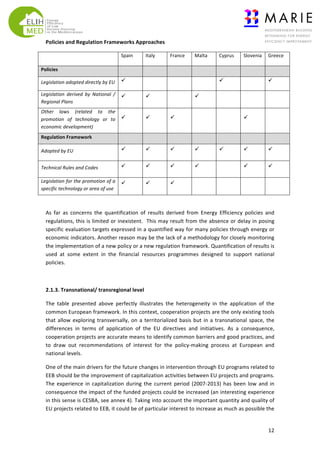
   table	
   below	
   presents	
   a	
   simplified	
   scheme	
   of	
   the	
   decision	
   levels	
   and	
  
competences	
  repartition	
  concerning	
  energy	
  efficiency	
  in	
  the	
  Mediterranean	
  countries.	


11	
  
Policies	
  and	
  Regulation	
  Frameworks	
  Approaches	


Spain	


Italy	


France	
  

Malta	
  

Cyprus	
  

Slovenia	
   Greece	
  

Policies	


Legislation	
  adopted	
  directly	
  by	
  EU	
   ü	


ü	


ü	
  

Legislation	
   derived	
   by	
   National	
   /	
   ü	
  
Regional	
  Plans	
  

ü	


ü	


Other	
   laws	
   (related	
   to	
   the	
  
promotion	
   of	
   technology	
   or	
   to	
   ü	
  
economic	
  development)	


ü	
  

ü	


ü	


Regulation	
  Framework	


Adopted	
  by	
  EU	
  

ü	
  

ü	
  

ü	
  

ü	
  

ü	
  

ü	
  

ü	
  

Technical	
  Rules	
  and	
  Codes	


ü	
  

ü	
  

ü	
  

ü	


ü	
  

ü	
  

Legislation	
  for	
  the	
  promotion	
  of	
  a	
   ü	
  
specific	
  technology	
  or	
  area	
  of	
  use	
  

ü	
  

ü	


As	
   far	
   as	
   concerns	
   the	
   quantification	
   of	
   results	
   derived	
   from	
   Energy	
   Efficiency	
   policies	
   and	
  
regulations,	
  this	
  is	
  limited	
  or	
  inexistent.	
  	
  This	
  may	
  result	
  from	
  the	
  absence	
  or	
  delay	
  in	
  posing	
  
specific	
  evaluation	
  targets	
  expressed	
  in	
  a	
  quantified	
  way	
  for	
  many	
  policies	
  through	
  energy	
  or	
  
economic	
  indicators.	
  Another	
  reason	
  may	
  be	
  the	
  lack	
  of	
  a	
  methodology	
  for	
  closely	
  monitoring	
  
the	
  implementation	
  of	
  a	
  new	
  policy	
  or	
  a	
  new	
  regulation	
  framework.	
  Quantification	
  of	
  results	
  is	
  
used	
   at	
   some	
   extent	
   in	
   the	
   financial	
   resources	
   programmes	
   designed	
   to	
   support	
   national	
  
policies.	


2.1.3.	
  Transnational/	
  transregional	
  level	
  
The	
   table	
   presented	
   above	
   perfectly	
   illustrates	
   the	
   heterogeneity	
   in	
   the	
   application	
   of	
   the	
  
common	
   European	
   framework.	
   In	
   this	
   context,	
   cooperation	
   projects	
   are	
   the	
   only	
   existing	
   tools	
  
that	
   allow	
   exploring	
   transversally,	
   on	
   a	
   territorialized	
   basis	
   but	
   in	
   a	
   transnational	
   space,	
   the	
  
differences	
   in	
   terms	
   of	
   application	
   of	
   the	
   EU	
   directives	
   and	
   initiatives.	
   As	
   a	
   consequence,	
  
cooperation	
   projects	
   are	
   accurate	
   means	
   to	
   identify	
   common	
   barriers	
   and	
   good	
   practices,	
   and	
  
to	
   draw	
   out	
   recommendations	
   of	
   interest	
   for	
   the	
   policy-­‐making	
   process	
   at	
   European	
   and	
  
national	
  levels.	
  
One	
  of	
  the	
  main	
  drivers	
  for	
  the	
  future	
  changes	
  in	
  intervention	
  through	
  EU	
  programs	
  related	
  to	
  
EEB	
  should	
  be	
  the	
  improvement	
  of	
  capitalization	
  activities	
  between	
  EU	
  projects	
  and	
  programs.	
  
The	
   experience	
   in	
   capitalization	
   during	
   the	
   current	
   period	
   (2007-­‐2013)	
   has	
   been	
   low	
   and	
   in	
  
consequence	
  the	
  impact	
  of	
  the	
  funded	
  projects	
  could	
  be	
  increased	
  (an	
  interesting	
  experience	
  
in	
   this	
   sense	
   is	
   CESBA,	
   see	
   annex	
   4).	
   Taking	
   into	
   account	
   the	
   important	
   quantity	
   and	
   quality	
   of	
  
EU	
  projects	
  related	
  to	
  EEB,	
  it	
  could	
  be	
  of	
  particular	
  interest	
  to	
  increase	
  as	
  much	
  as	
  possible	
  the	


12	
  
levels	
   of	
   interaction	
   and	
   the	
   capitalization	
   activities	
   between	
   projects	
   and	
   initiatives	
  
related	
  to	
  EEB	
  in	
  the	
  new	
  period.	
  
The	
   on-­‐going	
   capitalization	
   call	
   of	
   the	
   MED	
   programme,	
   the	
   generalization	
   of	
   capitalization	
  
activities	
   in	
   the	
   application	
   forms	
   and	
   the	
   creation	
   of	
   sustainable	
   capitalization	
   structures	
   is	
  
part	
   of	
   this	
   process	
   and	
   could	
   strongly	
   enhance	
   the	
   impact	
   and	
   sustainability	
   of	
   the	
   new	
  
funded	
  projects	
  (2014-­‐2020).	
  
The	
  coordination	
  of	
  the	
  funds	
  dedicated	
  to	
  energy	
  efficiency	
  remains	
  the	
  main	
  challenge	
  and	
  
till	
   now,	
   administrative	
   constraints	
   and	
   competences	
   compartmentalization	
   at	
   European,	
  
national,	
   regional	
   and	
   local	
   levels	
   make	
   difficult	
   this	
   articulation	
   and	
   partly	
   explain	
   the	
   existing	
  
gap	
  between	
  the	
  available	
  funding,	
  its	
  execution	
  and	
  the	
  concrete	
  achievements.	
  
The	
   coordination	
   challenge	
   also	
   consists	
   in	
   establishing	
   strong	
   interdependences	
   between	
  
territorial	
   cooperation	
   and	
   competitiveness	
   and	
   cohesion	
   objectives.	
   Today,	
   territorial	
  
cooperation	
   remains	
   marginalized.	
   People	
   dealing	
   with	
   cooperation	
   projects	
   are	
   often	
  
disconnected	
   from	
   the	
   operational	
   technical	
   services.	
   The	
   definition	
   of	
   priorities	
   at	
   regional	
  
level	
   through	
   the	
   operational	
   plans	
   does	
   not	
   integrate	
   the	
   definition	
   of	
   a	
   cooperation	
   strategy	
  
on	
   the	
   priority	
   topics.	
   Territorial	
   cooperation	
   projects	
   on	
   energy	
   efficiency	
   still	
   need	
   to	
  
demonstrate	
   their	
   accuracy	
   to	
   achieve	
   a	
   strong	
   added	
   value	
   in	
   the	
   regional	
   and	
   local	
   policy	
  
making	
  and	
  implementation	
  processes.	


2.1.4.	
  Mediterranean	
  level	
  
Delays	
  in	
  the	
  achievement	
  of	
  the	
  2020	
  objectives	
  
A	
   trend-­‐setting	
   scenario	
   was	
   developed	
   in	
   the	
   framework	
   of	
   ELIH-­‐Med	
   project,	
   using	
   data	
  
available	
  in	
  each	
  project	
  country	
  regarding	
  the	
  energy	
  efficiency	
  targets	
  set	
  during	
  the	
  timeline	
  
from	
   2010	
   to	
   2020,	
   and	
   data	
   extracted	
   from	
   the	
   forecasted	
   evolution	
   of	
   the	
   achievement	
   of	
  
these	
   targets	
   as	
   described	
   and	
   presented	
   in	
   each	
   country’s	
   National	
   Energy	
   Efficiency	
   Action	
  
Plan	
  (NEEAP).	
  This	
  scenario	
  portrays	
  the	
  expected	
  gap	
  between	
  the	
  2020	
  target	
  set	
  on	
  energy	
  
efficiency	
  (20%	
  energy	
  saving	
  according	
  to	
  EU)	
  and	
  the	
  real	
  energy	
  reduction	
  achieved	
  due	
  to	
  
the	
   measures	
   adopted	
   in	
   the	
   NEEAP	
   of	
   each	
   country.	
   It	
   must	
   be	
   indicated	
   that	
   the	
   EU	
   20%	
  
target	
   concerns	
   reduction	
   in	
   primary	
   energy	
   use	
   compared	
   with	
   projected	
   levels,	
   while	
   the	
  
National	
  Energy	
  Efficiency	
  Action	
  Plans	
  have	
  defined	
  their	
  targets	
  for	
  the	
  final	
  energy	
  use,	
  as	
  
indicated	
   in	
   the	
   energy	
   services	
   directive	
   2006/32/CE.	
   In	
   this	
   study,	
   ELIH-­‐Med	
   partners	
   have	
  
applied	
   the	
   same	
   target	
   of	
   20%	
   for	
   reduction	
   in	
   final	
   energy	
   use.Since	
   EU	
   indicates	
   at	
   least	
  
20%	
  in	
  primary	
  energy	
  saving,	
  ELIH-­‐Med	
  is	
  in	
  line	
  with	
  this	
  objective,	
  since	
  the	
  target	
  of	
  20%	
  
based	
  on	
  final	
  energy	
  use	
  is	
  more	
  ambitious.	
  
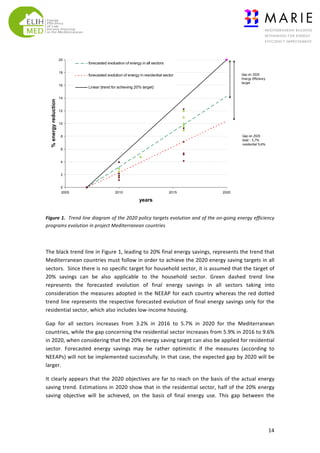
Figure	
   1	
   presents	
   the	
   gap	
   for	
   energy	
   savings	
   in	
   2020	
   for	
   all	
   sectors	
   such	
   as	
   buildings	
  
(residential	
   and	
   tertiary),	
   industry	
   and	
   transport	
   as	
   well	
   as	
   for	
   the	
   residential	
   sector	
  
specifically.	


13	
  
 
20

18

% energy reduction

16

forecasted evoluation of energy in all sectors
Gap on 2020
Energy Efficiency
target

forecasted evolution of energy in residential sector
Linear (trend for achieving 20% target)

14

12

10
Gap on 2020
total : 5,7%
residential 9,6%

8

6

4

2

0
2005

2010

2015

years

2020


Figure	
  1.	
  	
  Trend	
  line	
  diagram	
  of	
  the	
  2020	
  policy	
  targets	
  evolution	
  and	
  of	
  the	
  on-­‐going	
  energy	
  efficiency	
  
programs	
  evolution	
  in	
  project	
  Mediterranean	
  countries	


The	
  black	
  trend	
  line	
  in	
  Figure	
  1,	
  leading	
  to	
  20%	
  final	
  energy	
  savings,	
  represents	
  the	
  trend	
  that	
  
Mediterranean	
  countries	
  must	
  follow	
  in	
  order	
  to	
  achieve	
  the	
  2020	
  energy	
  saving	
  targets	
  in	
  all	
  
sectors.	
  	
  Since	
  there	
  is	
  no	
  specific	
  target	
  for	
  household	
  sector,	
  it	
  is	
  assumed	
  that	
  the	
  target	
  of	
  
20%	
   savings	
   can	
   be	
   also	
   applicable	
   to	
   the	
   household	
   sector.	
   Green	
   dashed	
   trend	
   line	
  
represents	
   the	
   forecasted	
   evolution	
   of	
   final	
   energy	
   savings	
   in	
   all	
   sectors	
   taking	
   into	
  
consideration	
   the	
   measures	
   adopted	
   in	
   the	
   NEEAP	
   for	
   each	
   country	
   whereas	
   the	
   red	
   dotted	
  
trend	
   line	
   represents	
   the	
   respective	
   forecasted	
   evolution	
   of	
   final	
   energy	
   savings	
   only	
   for	
   the	
  
residential	
  sector,	
  which	
  also	
  includes	
  low-­‐income	
  housing.	
  	
  
Gap	
   for	
   all	
   sectors	
   increases	
   from	
   3.2%	
   in	
   2016	
   to	
   5.7%	
   in	
   2020	
   for	
   the	
   Mediterranean	
  
countries,	
   while	
   the	
   gap	
   concerning	
   the	
   residential	
   sector	
   increases	
   from	
   5.9%	
   in	
   2016	
   to	
   9.6%	
  
in	
  2020,	
  when	
  considering	
  that	
  the	
  20%	
  energy	
  saving	
  target	
  can	
  also	
  be	
  applied	
  for	
  residential	
  
sector.	
   Forecasted	
   energy	
   savings	
   may	
   be	
   rather	
   optimistic	
   if	
   the	
   measures	
   (according	
   to	
  
NEEAPs)	
  will	
  not	
  be	
  implemented	
  successfully.	
  In	
  that	
  case,	
  the	
  expected	
  gap	
  by	
  2020	
  will	
  be	
  
larger.	
  	
  
It	
   clearly	
   appears	
   that	
   the	
   2020	
   objectives	
   are	
   far	
   to	
   reach	
   on	
   the	
   basis	
   of	
   the	
   actual	
   energy	
  
saving	
   trend.	
   Estimations	
   in	
   2020	
   show	
   that	
   in	
   the	
   residential	
   sector,	
   half	
   of	
   the	
   20%	
   energy	
  
saving	
   objective	
   will	
   be	
   achieved,	
   on	
   the	
   basis	
   of	
   final	
   energy	
   use.	
   This	
   gap	
   between	
   the	


14	
  
European	
   objectives	
   and	
   the	
   effective	
   energy	
   consumption	
   reduction	
   is	
   a	
   complex	
  
challenge	
  that	
  Mediterranean	
  countries	
  and	
  regions	
  are	
  facing.	
  
There	
   are	
   many	
   causes	
   for	
   the	
   projected	
   gap	
   in	
   the	
   residential	
   sector	
   by	
   2020	
   and	
   most	
   of	
  
them	
   are	
   associated	
   with	
   delays	
   on	
   the	
   implementation	
   of	
   Energy	
   Performance	
   of	
   Buildings	
  
Directive	
   (2002/91/EC	
   and	
   2010/31/EU).	
   Additionally,	
   considering	
   the	
   high	
   percentage	
   of	
   LIH	
  
(30	
   to	
   40%)	
   in	
   Mediterranean	
   area,	
   lack	
   of	
   available	
   and	
   accessible	
   funding	
   mechanisms	
  
designed	
  for	
  end	
  users	
  and	
  especially	
  for	
  LIH	
  is	
  hindering	
  the	
  expected	
  energy	
  savings	
  goals.	
  	
  In	
  
most	
   cases,	
   the	
   private-­‐public	
   financing	
   synergies	
   are	
   not	
   enough	
   for	
   all	
   the	
   low-­‐income	
  
housing	
  end-­‐users,	
  the	
  Third	
  Party	
  Financing	
  is	
  not	
  developed	
  and	
  supported	
  to	
  a	
  satisfactory	
  
degree	
   and	
   the	
   scheme	
   of	
   tax	
   incentives	
   for	
   energy	
   efficiency	
   investment	
   is	
   not	
   followed	
   by	
  
the	
  most	
  of	
  users.	
  This	
  is	
  also	
  due	
  to	
  lack	
  of	
  information	
  and	
  awareness	
  by	
  the	
  end-­‐users	
  about	
  
the	
   necessity	
   and	
   the	
   environmental	
   and	
   economic	
   benefits	
   of	
   the	
   energy	
   efficiency	
   in	
  
households.	
  Energy	
  efficient	
  end-­‐user	
  behaviour	
  is	
  a	
  critical	
  parameter	
  to	
  the	
  success	
  of	
  each	
  
national	
  policy	
  and	
  programs.	


The	
  Mediterranean	
  specificities	
  
Low	
  energy	
  efficiency	
  of	
  the	
  buildings	
  
As	
  compared	
  with	
  the	
  rest	
  of	
  Europe,	
  Med	
  area	
  presents	
  in	
  terms	
  of	
  energy	
  efficiency	
  some	
  
specific	
   climatic,	
   physical	
   and	
   social	
   characteristics	
   which	
   require	
   special	
   attention.	
   The	
  
climatic	
   conditions	
   have	
   led	
   to	
   a	
   low	
   emphasis	
   on	
   insulation	
   and	
   to	
   a	
   growing	
   use	
   of	
   air	
  
conditioning.	
  In	
  most	
  countries,	
  the	
  law	
  on	
  thermal	
  insulation	
  was	
  passed	
  late	
  in	
  the	
  1970's.	
  
Therefore	
   approximately	
   1/2	
   -­‐2/3	
   of	
   low-­‐income	
   housing	
   stock	
   across	
   the	
   participant	
   Med	
  
countries	
  are	
  non-­‐insulated	
  buildings,	
  having	
  been	
  built	
  prior	
  to	
  1980.	
  
Structure	
  of	
  the	
  ownership	
  
The	
  ageing	
  building	
  stock	
  of	
  low-­‐income	
  households	
  (LIH)	
  especially	
  in	
  urban	
  centres	
  with	
  high	
  
energy	
   intensity,	
   the	
   lack	
   of	
   strong	
   and	
   well	
   structures	
   social	
   houses	
   operators	
   and	
   a	
   high	
  
proportion	
  of	
  owners	
  are	
  also	
  typical	
  characteristics	
  of	
  LIH	
  at	
  Med	
  area.	
  
Restricted	
  public	
  financial	
  support	
  
Possibilities	
   of	
   renovation	
   suffer	
   from	
   a	
   limited	
   financial	
   support	
   coming	
   from	
   the	
   public	
  
administration.	
  
Low	
  refurbishment	
  rates	
  	
  
The	
  current	
  energy	
  efficiency	
  refurbishment	
  rates	
  in	
  MED	
  regions	
  range	
  from	
  0.12%	
  to	
  0.26%,	
  
which	
   corresponds	
   to	
   a	
   2-­‐3	
   times	
   slower	
   energy	
   refurbishment	
   rate	
   than	
   the	
   North-­‐Western	
  
EU	
   Countries.	
   The	
   very	
   slow	
   spontaneous	
   refurbishment	
   rate	
   in	
   the	
   MED	
   area	
   further	
  
demonstrates	
  the	
  need	
  for	
  urgent	
  policy	
  action.	
  	
  
Lack	
  of	
  detailed	
  data	
  
The	
  lack	
  of	
  data	
  related	
  to	
  buildings	
  in	
  the	
  Med	
  area	
  is	
  a	
  persistent	
  issue	
  for	
  acting	
  on	
  energy	
  
efficiency.	
   After	
   one	
   year	
   of	
   compiling	
   data	
   and	
   information	
   from	
   all	
   the	
   MARIE	
   regions	
   and	
  
countries,	
  the	
  main	
  conclusion	
  is	
  that	
  there	
  is	
  not	
  complete	
  energy	
  information	
  over	
  the	
  MED	
  
building	
  stock.	
  For	
  instance,	
  the	
  majority	
  of	
  information	
  is	
  compiled	
  by	
  national	
  census	
  done	
  in	


15	
  
2001;	
  only	
  Malta	
  (2005)	
  and	
  France	
  (2006)	
  have	
  actualized	
  data.	
  For	
  tertiary	
  buildings,	
  
the	
   information	
   related	
   to	
   the	
   energy	
   efficiency	
   and	
   consumption	
   of	
   their	
   stock	
   is	
   poor	
   or	
  
inexistent.	
  
Nevertheless,	
   a	
   solid	
   understanding	
   and	
   analysis	
   of	
   the	
   representative	
   low	
   income	
   buildings	
  
and	
   groups	
   is	
   performed	
   within	
   ELIH-­‐MED	
   project	
   in	
   order	
   to	
   be	
   used	
   as	
   a	
   base	
   for	
   the	
  
identification	
  of	
  effective	
  technical	
  solutions	
  and	
  innovative	
  financial	
  and	
  social	
  practices	
  in	
  the	
  
framework	
  of	
  large-­‐scale	
  energy	
  efficiency	
  schemes	
  for	
  LIH.	


A	
  multidimensional	
  approach	
  of	
  energy	
  efficiency	
  improvement	
  
At	
   the	
   different	
   stages	
   of	
   a	
   refurbishing	
   process,	
   several	
   topics	
   particularly	
   complex	
   are	
   at	
  
stake.	
   Ownership,	
   behaviours,	
   buildings	
   characteristics	
   offer	
   a	
   mix	
   of	
   configurations	
   that	
   make	
  
each	
   energy	
   efficiency	
   refurbishment	
   process	
   a	
   singular	
   operation.	
   As	
   a	
   consequence,	
   the	
  
implementation	
  of	
  policies	
  has	
  to	
  deal	
  with	
  this	
  heterogeneity.	
  
The	
  number	
  and	
  diversity	
  of	
  involved	
  stakeholders	
  may	
  hamper	
  the	
  refurbishment	
  process.	
  In	
  
many	
  cases,	
  a	
  great	
  variety	
  of	
  entities	
  are	
  involved	
  in	
  the	
  retrofitting	
  of	
  low-­‐income	
  housing:	
  
occupiers,	
   the	
   constructor,	
   banks	
   for	
   the	
   loans,	
   and	
   local	
   or	
   national	
   administration	
   for	
  
permits.	
   This	
   leads	
   to	
   time	
   consuming	
   and	
   complicated	
   procedures	
   that	
   deter	
   participants,	
  
cause	
   delays	
   and	
   increase	
   costs.	
   Difficulties	
   to	
   ensure	
   adequate	
   use	
   and	
   maintenance	
   of	
   the	
  
building	
  after	
  the	
  renovation	
  reduced	
  the	
  achieved	
  savings.	


In	
   any	
   case,	
   occupiers’	
   behaviour	
   determines	
   refurbishment	
   success.	
   Nevertheless,	
  
coordination	
  and	
  mutual	
  efforts	
  of	
  occupiers	
  to	
  improve	
  energy	
  efficiency	
  are	
  made	
  difficult	
  by	
  
the	
   lack	
   of	
   tenants’	
   associations	
   and	
   by	
   their	
   inappropriate	
   rules	
   and	
   decision-­‐making	
   process.	
  
Furthermore,	
   occupiers	
   may	
   be	
   reluctant	
   towards	
   centralised	
   solutions	
   because	
   of	
   distrust	
  
between	
  them,	
  or	
  towards	
  the	
  project	
  itself	
  due	
  to	
  a	
  lack	
  of	
  awareness	
  on	
  the	
  future	
  benefits	
  
of	
  the	
  refurbishment.	
  As	
  an	
  example,	
  in	
  some	
  buildings,	
  occupiers	
  cannot	
  control	
  individually	
  
the	
  heating	
  system	
  for	
  their	
  dwelling:	
  heating	
  costs	
  are	
  divided	
  between	
  apartments	
  according	
  
to	
  their	
  size.	
  Therefore,	
  there	
  is	
  no	
  incentive	
  for	
  occupiers	
  to	
  apply	
  energy	
  efficiency	
  measures.	
  
It	
   is	
   also	
   important	
   to	
   take	
   into	
   consideration	
   user	
   behaviour	
   related	
   to	
   hot	
   water	
   use,	
  
thermostat	
  settings,	
  etc.	
  in	
  order	
  to	
  have	
  a	
  comprehensive	
  energy	
  savings	
  measurement.	
  
The	
  active	
  involvement	
  of	
  the	
  entire	
  community	
  in	
  the	
  design	
  of	
  energy	
  efficiency	
  schemes	
  at	
  
territorial	
   level	
   via	
   participatory	
   planning	
   procedures	
   is	
   essential.	
   Participation	
   can	
   be	
  
facilitated	
   by	
   written	
   communication,	
   online	
   tools	
   and	
   face-­‐to-­‐face	
   communication	
   via	
  
individual	
   consultation,	
   group	
   meetings,	
   round	
   tables.	
   A	
   communication	
   policy,	
   adopted	
   by	
  
decision	
   makers,	
   residents	
   and	
   all	
   relevant	
   stakeholders	
   should	
   be	
   planned	
   along	
   with	
  
motivations	
   to	
   citizens	
   through	
   energy	
   saving	
   competitions,	
   offers	
   of	
   energy	
   saving	
   kits	
   and	
  
opportunity	
   for	
   residents	
   themselves	
   to	
   be	
   involved	
   in	
   the	
   implementation	
   of	
   structural	
   works	
  
(self-­‐rehabilitation	
  work).	


16	
  
To	
   a	
   general	
   extent,	
   cultural	
   aspects	
   (importance	
   of	
   building	
   energy	
   efficiency,	
  
awareness	
  on	
  energy	
  use	
  impacts,	
  etc.)	
  are	
  very	
  important	
  in	
  order	
  to	
  determine	
  final	
  results	
  
in	
  energy	
  consumption	
  in	
  buildings.	


2.2	
  Identified	
  barriers	


ELIH-­‐MED	
   and	
   MARIE	
   investigations	
   and	
   observations	
   have	
   permitted	
   to	
   draw	
   precise	
  
conclusions	
  on	
  the	
  real	
  situations	
  in	
  the	
  MED	
  territories.	
  The	
  most	
  operative	
  result	
  of	
  the	
  MED	
  
context	
  analysis	
  is	
  the	
  identification	
  and	
  description	
  of	
  the	
  main	
  barriers	
  that	
  make	
  it	
  difficult	
  
the	
  achievement	
  of	
  EU	
  20-­‐20-­‐20	
  objectives	
  related	
  to	
  MED	
  building	
  stock.	
  These	
  barriers	
  come	
  
from	
   the	
   Regional	
   Benchmark	
   Analysis	
   that	
   MARIE	
   partners	
   prepared	
   during	
   2011	
   and	
   2012	
  
and	
   from	
   the	
   analysis	
   of	
   obstacles	
   encountered	
   by	
   ELIH-­‐MED	
   partners	
   within	
   their	
   pilot	
  
actions.	
  
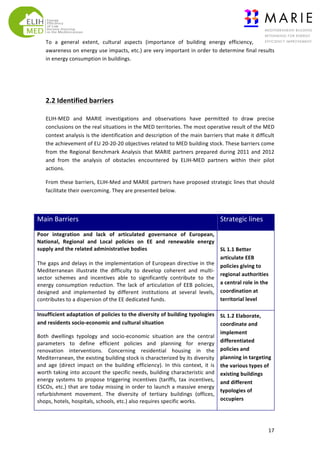
From	
  these	
  barriers,	
  ELIH-­‐Med	
  and	
  MARIE	
  partners	
  have	
  proposed	
  strategic	
  lines	
  that	
  should	
  
facilitate	
  their	
  overcoming.	
  They	
  are	
  presented	
  below.	


Main	
  Barriers	
  

Strategic	
  lines	
  

Poor	
   integration	
   and	
   lack	
   of	
   articulated	
   governance	
   of	
   European,	
  
National,	
   Regional	
   and	
   Local	
   policies	
   on	
   EE	
   and	
   renewable	
   energy	
  
supply	
  and	
  the	
  related	
  administrative	
  bodies	


The	
  gaps	
  and	
  delays	
  in	
  the	
  implementation	
  of	
  European	
  directive	
  in	
  the	
  
Mediterranean	
   illustrate	
   the	
   difficulty	
   to	
   develop	
   coherent	
   and	
   multi-­‐
sector	
   schemes	
   and	
   incentives	
   able	
   to	
   significantly	
   contribute	
   to	
   the	
  
energy	
   consumption	
   reduction.	
   The	
   lack	
   of	
   articulation	
   of	
   EEB	
   policies,	
  
designed	
   and	
   implemented	
   by	
   different	
   institutions	
   at	
   several	
   levels,	
  
contributes	
  to	
  a	
  dispersion	
  of	
  the	
  EE	
  dedicated	
  funds.	


Insufficient	
   adaptation	
   of	
   policies	
   to	
   the	
   diversity	
   of	
   building	
   typologies	
  
and	
  residents	
  socio-­‐economic	
  and	
  cultural	
  situation	


Both	
   dwellings	
   typology	
   and	
   socio-­‐economic	
   situation	
   are	
   the	
   central	
  
parameters	
   to	
   define	
   efficient	
   policies	
   and	
   planning	
   for	
   energy	
  
renovation	
   interventions.	
   Concerning	
   residential	
   housing	
   in	
   the	
  
Mediterranean,	
  the	
  existing	
  building	
  stock	
  is	
  characterized	
  by	
  its	
  diversity	
  
and	
   age	
   (direct	
   impact	
   on	
   the	
   building	
   efficiency).	
   In	
   this	
   context,	
   it	
   is	
  
worth	
  taking	
  into	
  account	
  the	
  specific	
  needs,	
  building	
  characteristic	
  and	
  
energy	
   systems	
   to	
   propose	
   triggering	
   incentives	
   (tariffs,	
   tax	
   incentives,	
  
ESCOs,	
   etc.)	
   that	
   are	
   today	
   missing	
   in	
   order	
   to	
   launch	
   a	
   massive	
   energy	
  
refurbishment	
   movement.	
   The	
   diversity	
   of	
   tertiary	
   buildings	
   (offices,	
  
shops,	
  hotels,	
  hospitals,	
  schools,	
  etc.)	
  also	
  requires	
  specific	
  works.	


SL	
  1.1	
  Better	
  
articulate	
  EEB	
  
policies	
  giving	
  to	
  
regional	
  authorities	
  
a	
  central	
  role	
  in	
  the	
  
coordination	
  at	
  
territorial	
  level	
  
SL	
  1.2	
  Elaborate,	
  
coordinate	
  and	
  
implement	
  
differentiated	
  
policies	
  and	
  
planning	
  in	
  targeting	
  
the	
  various	
  types	
  of	
  
existing	
  buildings	
  
and	
  different	
  
typologies	
  of	
  
occupiers	
  

17	
  
Incapacity	
   of	
   conventional	
   financial	
   instruments	
   and	
   institutions	
   to	
  
make	
   EE	
   renovations	
   feasible	
   and	
   lack	
   of	
   new/alternative	
   financial	
  
models	
  and	
  organizations	
  able	
  to	
  contribute	
  to	
  a	
  significant	
  increase	
  of	
  
the	
  EE	
  renovation	
  rate	
  in	
  a	
  financial	
  crisis	
  context	
  
The	
   Mediterranean	
   space	
   is	
   facing	
   a	
   painful	
   crisis.	
   The	
   proportion	
   of	
   low-­‐
income	
  inhabitants	
  is	
  higher	
  in	
  this	
  area	
  than	
  in	
  the	
  rest	
  of	
  Europe,	
  and	
  
much	
   more	
   now	
   because	
   of	
   the	
   unemployment	
   rate	
   explosion	
   since	
  
2008.	
   Whereas	
   a	
   lot	
   of	
   people	
   are	
   the	
   owners	
   of	
   their	
   principal	
  
residence,	
   they	
   have	
   less	
   and	
   less	
   economic	
   resources	
   to	
   launch	
   the	
  
necessary	
   energy	
   efficiency	
   refurbishment	
   workings.	
   Furthermore,	
   public	
  
aids	
   to	
   support	
   owners,	
   particularly	
   low-­‐income	
   owners,	
   are	
   not	
  
attractive	
   enough	
   to	
   push	
   them	
   into	
   refurbishing	
   their	
   housing.	
   Public	
  
authorities	
  are	
  direct	
  victims	
  of	
  the	
  crisis,	
  with	
  reduced	
  available	
  budgets	
  
and	
  very	
  limited	
  capacities	
  of	
  investment.	
  The	
  private	
  sector,	
  industries,	
  
commerce,	
   services,	
   tourism,	
   is	
   experiencing	
   the	
   same	
   precariousness	
  
and	
  investment	
  facilities	
  are	
  limited.	


Lack	
  of	
  knowledge	
  on	
  behaviours	
  and	
  know-­‐how	
  on	
  social	
  acceptation	
  
and	
  end-­‐users	
  involvement	
  
Even	
   if	
   all	
   the	
   buildings	
   were	
   refurbished	
   and	
   became	
   high-­‐class	
   energy	
  
efficient,	
   energy	
   consumption	
   would	
   always	
   depend	
   on	
   the	
   final	
   users	
  
behavior.	
   An	
   efficient	
   building	
   does	
   not	
   imply	
   a	
   mechanic	
   energy	
  
consumption	
   reduction	
   (and	
   particularly	
   if	
   it	
   is	
   not	
   well	
   adapted	
   to	
   the	
  
users’	
  needs).	
  The	
  involvement	
  of	
  final	
  users	
  (before,	
  during	
  and	
  after	
  the	
  
refurbishment	
   measures)	
   will	
   contribute	
   to	
   the	
   successful	
  
implementation	
   of	
   energy	
   efficiency	
   in	
   buildings	
   policies	
   and	
   the	
  
appropriation	
  of	
  this	
  problematic	
  by	
  all	
  in	
  our	
  daily	
  life.	
  The	
  development	
  
of	
  participative	
  methods	
  and	
  inclusive	
  policies	
  is	
  more	
  and	
  more	
  essential	
  
in	
  a	
  context	
  of	
  development	
  of	
  smart	
  metering.	


Dispersion	
   of	
   the	
   energy	
   efficiency	
   competences	
   and	
   absence	
   of	
  
collaborative	
   structuration	
   of	
   the	
   professionals	
   and	
   companies	
   on	
   a	
  
multidisciplinary	
  basis	
  able	
  to	
  increase	
  their	
  profitability	
  and	
  quality	
  of	
  
offers	
  

SL	
  1.3	
  Develop	
  
financial	
  engineering	
  
capabilities	
  to	
  
leverage	
  ERDF	
  and	
  
other	
  public	
  funds	
  
on	
  private	
  financial	
  
resources	
  

SL	
  1.4	
  Develop	
  
inclusive	
  policies,	
  
participatory	
  
methods	
  and	
  
community	
  energy	
  
renovation	
  projects	
  
involving	
  final	
  users	
  

SL	
  2.1	
  Create	
  
dynamic	
  energy	
  
Endogenous	
  development	
  relies	
  on	
  local	
  ecosystems,	
  which	
  integrate	
  all	
  
efficiency	
  economic	
  
the	
  agents	
  of	
  the	
  value	
  chain	
  in	
  the	
  energy	
  efficiency,	
  in	
  our	
  case,	
  in	
  the	
  
building	
   sector:	
   private	
   companies	
   (including	
   energy	
   services,	
   ecosystems	
  
construction,	
   engineering,	
   installation,	
   maintenance,	
   manufacturer,	
   ICT,	
  
software,	
  
energy	
  
management	
  
systems,	
  
architecture…),	
   	
  
research/technological	
   centers	
   and	
   public	
   administration.	
   Through	
   its	
  
interdependences	
  at	
  local	
  level,	
  this	
  ecosystem	
  will	
  have	
  a	
  strong	
  positive	
  
impact	
  on	
  the	
  economic	
  growth	
  and	
  development	
  of	
  its	
  location	
  place.	


Difficulties	
   for	
   quick	
   adaptation	
   of	
   all	
   kinds	
   of	
   professionals	
   to	
   the	
  
energy	
   renovation	
   of	
   buildings	
   (ERB)	
   large	
   scale	
   process,	
   lack	
   of	
   SL	
  2.2	
  Promote	
  
training	
  for	
  existing	
  
adapted	
  skills	
  and	
  know-­‐how.	


and	
  new	
  
New	
  or	
  adapted	
  professional	
  profiles	
  will	
  have	
  to	
  be	
  developed	
  to	
  get	
  the	


18	
  
necessary	
   impact	
   in	
   energy	
   renovation	
   of	
   buildings	
   in	
   MED	
   space.	
   The	
   professional	
  profiles	
  
creation	
  of	
  effective	
  training	
  actions	
  will	
  facilitate	
  the	
  quick	
  adaptation	
  of	
  
professionals	
   to	
   the	
   ERB	
   requirements.	
   	
   Profit	
   coming	
   from	
   energy	
  
savings	
  can	
  also	
  constitute	
  a	
  triggering	
  element	
  for	
  job	
  creation.	
  
Difficulty	
   to	
   develop	
   incentives	
   to	
   increase	
   the	
   EE	
   building	
   retrofitting	
  
rate	
  in	
  a	
  context	
  of	
  reduced	
  public	
  financing	
  
Evaluation	
   of	
   the	
   2020	
   objectives	
   demonstrated	
   the	
   gap	
   between	
   targets	
  
and	
   energy	
   efficiency	
   improvement	
   real	
   trend.	
   Whereas	
   budget	
   cut	
   are	
  
more	
  and	
  more	
  important	
  in	
  public	
  authorities	
  in	
  the	
  Mediterranean,	
  few	
  
possibilities	
   exist	
   to	
   encourage	
   energy	
   efficiency	
   investment.	
   As	
   a	
  
consequence,	
   the	
   few	
   remaining	
   public	
   investment	
   funds	
   should	
  
systematically	
  promote	
  energy	
  efficiency.	
  In	
  order	
  to	
  increase	
  the	
  quality,	
  
innovation	
   and	
   multiplying	
   effect	
   of	
   these	
   funds,	
   a	
   new	
   kind	
   of	
   public	
  
procurements,	
   based	
   on	
   evaluation	
   derived	
   from	
   the	
   established	
   Life	
  
Cycle	
   Analysis	
   (LCA),	
   has	
   started	
   to	
   be	
   used.	
   This	
   kind	
   of	
   methodology,	
  
which	
  is	
  currently	
  under	
  discussion	
  in	
  the	
  process	
  of	
  adoption	
  of	
  the	
  new	
  
Directive	
   on	
   Public	
   Procurement,	
   is	
   headed	
   to	
   improve	
   the	
  
competitiveness	
   of	
   the	
   local	
   SMEs	
   working	
   in	
   the	
   building	
   sector,	
   helping	
  
them	
   in	
   qualifying	
   their	
   products	
   and	
   in	
   providing	
   better	
   and	
   more	
  
innovative	
   products,	
   and	
   to	
   use	
   the	
   Public	
   Sector	
   as	
   a	
   driver	
   for	
  
technological	
  innovation	
  in	
  the	
  SMEs.	


Misreading	
   of	
   social	
   sector	
   initiatives	
   potential	
   as	
   concrete	
   and	
   useful	
  
alternatives	
  to	
  develop	
  EEB	
  
Several	
   initiatives,	
   launched	
   by	
   entities	
   of	
   the	
   social	
   economy	
   sector,	
  
have	
   demonstrated	
   their	
   pertinence	
   in	
   both	
   involving	
   final	
   users	
   in	
   the	
  
energy	
  refurbishment	
  process	
  and	
  creating	
  jobs.	
  This	
  sector	
  can	
  propose	
  
adapted	
   solutions	
   based	
   on	
   an	
   economic	
   model	
   in	
   which	
   there	
   is	
   no	
  
objective	
  of	
  profitability,	
  but	
  only	
  a	
  fair	
  retribution	
  of	
  the	
  work	
  done.	
  This	
  
base	
   of	
   small	
   enterprises,	
   insertion	
   companies,	
   associations	
   that	
   work	
   on	
  
self-­‐accompanied	
   rehabilitation,	
   offers	
   interesting	
   perspectives	
   for	
   the	
  
energy	
  efficiency	
  sector.	


Absence	
  of	
  an	
  integrated	
  approach	
  of	
  the	
  energy	
  efficiency	
  value	
  chain	
  
by	
  traditional	
  economic	
  actors	
  and	
  poor	
  level	
  of	
  technical	
  innovation	
  

SL	
  2.3	
  Use	
  public	
  
procurements	
  as	
  an	
  
energy–efficiency-­‐
oriented	
  investment	
  
tool	
  

SL	
  2.4	
  Encourage	
  
innovative	
  
initiatives	
  in	
  the	
  
social	
  economy	
  
sector	
  

Research	
   and	
   innovation	
   activities	
   that	
   propose	
   to	
   improve	
   the	
   global	
  
energy	
   savings	
   of	
   the	
   building	
   stock	
   in	
   Mediterranean	
   regions	
   must	
   be	
   SL	
  2.5	
  Encourage	
  
based	
   on	
   an	
   integral	
   vision	
   of	
   the	
   building	
   process	
   -­‐	
   usually	
   called	
   “Life	
   and	
  finance	
  research	
  
Cycle	
   Assessment	
   (LCA)”:	
   design,	
   building	
   materials,	
   energy	
   equipment,	
   related	
  to	
  ERB	
  
construction	
   process,	
   performance	
   monitoring	
   and	
   management,	
   and	
  
end	
   of	
   the	
   building	
   life.	
   Improvement	
   and	
   innovation	
   in	
   each	
   of	
   these	
  
aspects	
   taking	
   into	
   account	
   their	
   interdependences	
   will	
   be	
   necessary	
   to	
  
obtain	
  an	
  energy	
  efficient	
  building	
  industry.	
  
Complexity	
   and	
   difficulty	
   for	
   end-­‐users	
   and	
   companies	
   to	
   prioritize	
  
energy	
   efficiency	
   investments,	
   non-­‐integration	
   of	
   environmental	


19	
  
positive	
  impact	
  and	
  comfort	
  increase	
  in	
  the	
  profitability	
  calculation	


Stakeholders	
  are	
  not	
  always	
  aware	
  of	
  the	
  benefits	
  that	
  could	
  result	
  from	
  
energy	
   efficiency	
   improvement.	
   Energy	
   efficiency	
   improvement	
   is	
   too	
  
often	
   considered	
   as	
   a	
   niche	
   market,	
   in	
   particular	
   by	
   investors,	
   even	
  
though	
   awareness	
   has	
   started	
   to	
   rise	
   on	
   opportunities	
   it	
   can	
   bring.	
  
Professionals	
   are	
   also	
   not	
   always	
   well	
   trained	
   since	
   training	
   which	
  
specifically	
   relates	
   to	
   techniques	
   in	
   energy	
   efficiency	
   has	
   grown	
   at	
   the	
  
same	
  time	
  as	
  market,	
  so	
  quite	
  recently.	
  

SL	
  3.1	
  Raise	
  
awareness	
  on	
  
energy	
  efficiency	
  
opportunities	
  
among	
  the	
  major	
  
stakeholders

In	
  addition,	
  occupiers	
  and	
  owners	
  of	
  the	
  dwellings	
  are	
  not	
  always	
  aware	
  
of	
   the	
   benefits	
   energy	
   rehabilitation	
   can	
   bring	
   them.	
   They	
   would	
   rather	
  
invest	
   in	
   aesthetics,	
   bigger	
   space,	
   interior	
   decoration,	
   well-­‐being	
   than	
  
refurbishment	
  works	
  perceived	
  as	
  intrusive,	
  complex	
  and	
  annoying,	
  while	
  
not	
  being	
  able,	
  also,	
  to	
  estimate	
  the	
  return	
  on	
  investment.	


Current	
  energy	
  prices	
  not	
  reflecting	
  the	
  real	
  (environmental	
  and	
  social)	
  
cost	
  of	
  energy,	
  rendering	
  energy	
  efficiency	
  less	
  profitable	


The	
   energy	
   market	
   in	
   buildings	
   evolution	
   shows	
   a	
   general	
   increase	
   on	
  
prices	
  but	
  there	
  are	
  a	
  lot	
  of	
  external	
  costs	
  (as	
  pollution,	
  climate	
  change,	
  
and	
   other	
   environmental	
   and	
   social	
   risks)	
   not	
   enough	
   integrated	
   in	
   the	
  
market	
  prices.	


In	
   this	
   context	
   dwellings’	
   users	
   and	
   owners	
   do	
   not	
   consider	
   the	
   energy	
  
cost	
  as	
  something	
  important	
  in	
  their	
  daily	
  decision	
  as	
  consumers.	


Absence	
   of	
   compensation	
   for	
   economic	
   actors	
   that	
   would	
   accept	
   the	
  
long-­‐term	
  payback	
  risk	


Energy	
   refurbishment	
   is	
   most	
   of	
   the	
   time	
   profitable	
   only	
   on	
   the	
   long	
  
term,	
   which	
   can	
   discourage	
   investors,	
   in	
   particular	
   when	
   dealing	
   with	
  
low-­‐income	
  owners.	
  That	
  is	
  the	
  main	
  point	
  for	
  energy	
  service	
  companies	
  
(ESCOs),	
   which	
   are	
   remunerated	
   thanks	
   to	
   the	
   energy	
   savings	
   realized	
  
during	
   the	
   pay	
   back	
   period.	
   Therefore,	
   when	
   owners	
   do	
   not	
   have	
   the	
  
financial	
   capacity	
   to	
   support	
   refurbishment,	
   it	
   is	
   often	
   difficult	
   for	
   them	
  
to	
  find	
  other	
  funding	
  resources	
  or	
  loans.	


Incomplete,	
   unshared,	
   unstable,	
   spread	
   or	
   asymmetric	
   information	
   on	
  
energy	
   consumption	
   repartition.	
   Lack	
   of	
   tools	
   to	
   orient	
   the	
   complex	
  
decision	
  making	
  for	
  multi-­‐owners	
  buildings.	


There	
   is	
   no	
   complete	
   energy	
   information	
   over	
   the	
   MED	
   building	
   stock.	
  
The	
  development	
  of	
  reporting	
  methods	
  is	
  more	
  and	
  more	
  essential	
  in	
  a	
  
context	
  of	
  development	
  of	
  smart	
  metering.	


Absence	
  of	
  the	
  sufficient	
  infrastructure,	
  skills	
  and	
  commitment	
  to	
  take	
  
benefit	
  of	
  Iarge	
  scale	
  intelligent	
  energy	
  management	
  potential	


The	
   most	
   significant	
   barriers	
   that	
   hinder	
   the	
   general	
   introduction	
   of	


SL	
  3.2	
  Create	
  and	
  
develop	
  a	
  series	
  of	
  
incentives	
  to	
  
overcome	
  the	
  
market	
  barriers	
  

SL	
  3.3	
  Lower	
  the	
  
financial	
  risk	
  
through	
  guarantee	
  
system	
  and	
  financial	
  
facilities	
  

SL	
  4.1	
  Improve	
  the	
  
available	
  
information	
  on	
  
energy	
  consumption	
  
for	
  users	
  and	
  
providers	
  
SL	
  4.2	
  Develop	
  
interconnected	
  
intelligent	
  energy	
  
management	
  

20	
  
smart	
  metering	
  through	
  mass	
  roll-­‐outs	
  are:	
  
systems	
  at	
  all	
  urban	


scales	
  
• There	
   remains	
   much	
   uncertainty	
   about	
   the	
   quantification	
   of	
  
benefits,	
   especially	
   related	
   to	
   energy	
   savings,	
   because	
   practical	
  
experience	
  and	
  historical	
  data	
  are	
  lacking.	
  
• Many	
  parties	
  are	
  involved,	
  and	
  the	
  benefits	
  of	
  smart	
  metering	
  may	
  
accrue	
   to	
   other	
   parties	
   than	
   the	
   ones	
   that	
   bear	
   the	
   costs.	
   The	
  
effectiveness	
   of	
   savings	
   for	
   the	
   final	
   consumer	
   whereas	
   energy	
  
providers	
  have	
  a	
  clear	
  interest	
  in	
  it.	
  
• The	
   cost	
   of	
   installation.	
   Large	
   scale	
   roll	
   outs	
   of	
   smart	
   metering	
   are	
  
very	
   long	
   and	
   costly	
   processes,	
   requiring	
   considerable	
   capital	
  
expenditures	
  from	
  the	
  responsible	
  market	
  actors.	
  
• The	
  safety	
  and	
  anonymousness	
  of	
  the	
  data	
  transfer.	
  	
  
• There	
   is	
   still	
   insufficient	
   modularity	
   and	
   flexibility	
   of	
   present	
   mass	
  
market	
   smart	
   metering	
   products	
   and	
   lack	
   of	
   full	
   interoperability	
  
among	
   available	
   commercial	
   AMI	
   systems.	
   This	
   leads	
   to	
   high	
   extra	
  
costs	
   when	
   customizing	
   systems	
   to	
   meet	
   the	
   local	
   requirements	
   of	
  
demand	
   response,	
   consumer	
   information,	
   energy	
   efficiency	
  
automation	
  and	
  services,	
  distributed	
  generation	
  and	
  power	
  quality.	
  
• Lack	
   of	
   Spatial	
   Data	
   Infrastructure	
   for	
   buildings	
   at	
   regional	
   scale	
   in	
  
order	
   to	
   facilitate	
   the	
   treatment	
   and	
   use	
   of	
   data	
   for	
   planning,	
  
controlling	
  and	
  reporting	
  EU	
  2020	
  objectives	


It	
   is	
   very	
   crucial	
   to	
   stress	
   that	
   smart	
   metering	
   initiatives	
   come	
   mostly	
  
from	
   governments,	
   so	
   the	
   future	
   of	
   smart	
   metering	
   will	
   depend	
   heavily	
  
on	
  the	
  policy	
  and	
  decisiveness	
  of	
  the	
  governmental	
  bodies	
  involved	
  and	
  
their	
   integration	
   in	
   a	
   global	
   information	
   system	
   for	
   energy	
   efficiency	
   in	
  
buildings	
  at	
  all	
  scales.	


21	


3.	
  IMPROVING	
  ENERGY	
  EFFICIENCY	
  IN	
  BUILDINGS	
  IN	
  THE	
  
MED	
  SPACE	
  
Main	
  strategic	
  lines	
  point	
  out	
  the	
  critical	
  actions	
  that	
  are	
  needed	
  to	
  overcome	
  the	
  barriers	
  that	
  exist	
  in	
  the	
  way	
  to	
  
improve	
  EE	
  in	
  Buildings	
  in	
  the	
  Mediterranean,	
  each	
  of	
  them	
  containing	
  the	
  essential	
  measures	
  that	
  have	
  to	
  be	
  
carried	
  out	
  for	
  their	
  global	
  implementation	
  and	
  effectiveness.	
  A	
  final	
  estimate	
  of	
  the	
  resources	
  needed	
  to	
  put	
  all	
  
in	
  place	
  gives	
  an	
  overview	
  of	
  this	
  part	
  of	
  the	
  proposal	
  by	
  MARIE	
  and	
  ELIH-­‐Med.	
  
The	
  following	
  strategic	
  lines	
  correspond	
  to	
  the	
  priorities	
  identified	
  by	
  MARIE	
  and	
  ELIH-­‐MED	
  projects	
  to	
  overcome	
  
the	
  abovementioned	
  barriers.	
  They	
  represent	
  the	
  structure	
  on	
  which	
  the	
  next	
  transnational	
  operational	
  
programme	
  for	
  the	
  Mediterranean	
  should	
  rely	
  on	
  concerning	
  the	
  improvement	
  of	
  energy	
  efficiency	
  in	
  buildings.	
  
It	
  is	
  worth	
  mentioning	
  that	
  the	
  energy	
  efficiency	
  is	
  a	
  clear	
  priority	
  to	
  become	
  one	
  of	
  the	
  main	
  lines	
  of	
  financing.	
  
Moreover,	
  the	
  introduction	
  of	
  a	
  Common	
  Strategic	
  Framework	
  by	
  the	
  European	
  Commission	
  paves	
  the	
  way	
  for	
  a	
  
better	
  coordination	
  and	
  concentration	
  of	
  structural	
  funds,	
  opening	
  opportunities	
  for	
  the	
  elaboration	
  of	
  a	
  
Mediterranean	
  macro-­‐regional	
  strategy.	
  In	
  case	
  the	
  Mediterranean	
  macro-­‐region	
  becomes	
  a	
  reality,	
  these	
  
strategic	
  lines	
  could	
  be	
  the	
  priorities	
  for	
  this	
  new	
  macro-­‐region	
  concerning	
  the	
  energy	
  efficiency	
  topic.	


3.1	
  Main	
  strategic	
  lines	
  to	
  achieve	
  EU	
  2020	
  targets	
  in	
  Energy	
  Efficiency	
  in	
  
Buildings	
  (EEB)	
  in	
  the	
  Mediterranean	


The	
  MED	
  market	
  does	
  not	
  move	
  towards	
  an	
  increase	
  of	
  the	
  energy	
  efficiency	
  refurbishment	
  of	
  
the	
  existing	
  building	
  stock	
  and	
  several	
  barriers	
  are	
  blocking	
  the	
  development	
  of	
  investments	
  in	
  
that	
  field;	
  therefore	
  a	
  coordinated	
  common	
  strategy	
  will	
  help	
  putting	
  the	
  Mediterranean	
  space	
  
on	
  a	
  better	
  track	
  to	
  achieve	
  the	
  EU	
  objectives	
  in	
  2020.	
  
According	
  to	
  the	
  above,	
  MARIE	
  and	
  ELIH-­‐MED	
  projects	
  have	
  developed	
  common	
  strategic	
  lines	
  
as	
  the	
  general	
  framework	
  on	
  which	
  the	
  development	
  of	
  a	
  macro-­‐regional	
  approach	
  could	
  rely	
  
on	
  in	
  the	
  particular	
  domain	
  of	
  energy	
  efficiency.	
  	
  
Four	
   sets	
   of	
   strategic	
   lines	
   have	
   been	
   considered	
   essential	
   to	
   overcome	
   the	
   existing	
   barriers	
  
and	
  to	
  organize	
  future	
  interventions	
  in	
  the	
  MED	
  space:	
  
1.
2.
3.
4.

Territorial	
  and	
  financial	
  governance	
  	
  
Competitiveness,	
  economic	
  activities	
  and	
  employment	
  	
  
Market	
  activation	
  	
  
Smart	
  energy	
  management	
  systems	
  and	
  services	


1.	
  Territorial	
  and	
  financial	
  governance	


Strategic	
  line	
  1.1.	
  	
  
Articulation	
   of	
   EEB	
   policies	
   giving	
   to	
   regional	
   authorities	
   a	
   central	
   role	
   in	
   coordination	
   at	
  
territorial	
  level	


22	
  
A	
  decentralized	
  approach	
  at	
  a	
  multilevel	
  governance	
  of	
  the	
  EEB	
  challenges	
  is	
  needed.	
  
Clarification	
   of	
   the	
   role	
   of	
   local	
   and	
   regional	
   governments	
   and	
   administrations	
   in	
   the	
  
implementation	
   of	
   EEB	
   policies	
   should	
   be	
   done	
   under	
   the	
   leadership	
   of	
   regional	
   authorities	
  
and	
   regional	
   or	
   local	
   energy	
   agencies.	
   The	
   articulation	
   of	
   EEB	
   policies	
   should	
   be	
   based	
   on	
   a	
  
more	
   coherent	
   and	
   efficient	
   use	
   of	
   available	
   funds	
   and	
   on	
   an	
   integrated	
   approach	
   of	
   the	
   EE	
  
chain.	
   At	
   regional	
   level,	
   a	
   specific	
   governance	
   system,	
   based	
   in	
   a	
   single	
   entry	
   point,	
   should	
  
ensure	
  the	
  coordinated	
  distribution	
  of	
  funds	
  (if	
  possible,	
  private	
  and	
  public,	
  including	
  Energy	
  
Emissions	
  Certificates)	
  dedicated	
  to	
  EEB	
  and	
  the	
  harmonization	
  of	
  procedures	
  to	
  facilitate	
  the	
  
access	
  to	
  energy	
  efficiency	
  financings.	


Mediterranean	
  added	
  value	
  
Mediterranean	
   area	
   is	
   considered	
   less	
   “advanced”	
   than	
   Northern	
   Europe	
   in	
   the	
  
implementation	
  of	
  European	
  directives	
  on	
  energy	
  efficiency.	
  The	
  improvement	
  of	
  EEB	
  policies	
  
and	
   governance	
   system	
   in	
   the	
   Mediterranean	
   should	
   be	
   a	
   continuous	
   focal	
   point	
   for	
  
stakeholders	
  in	
  order	
  to	
  facilitate	
  the	
  catching	
  up	
  and	
  achievement	
  of	
  the	
  European	
  20%	
  goals.	


Strategic	
  line	
  1.2.	
  
Elaboration,	
  coordination	
  and	
  implementation	
  of	
  differentiated	
  policies	
  and	
  plans	
  targeting	
  
the	
  various	
  typologies	
  of	
  existing	
  buildings	
  and	
  the	
  different	
  types	
  of	
  owners	


One	
  single	
  EEB	
  policy	
  will	
  not	
  allow	
  to	
  target	
  the	
  different	
  typologies	
  of	
  owners	
  and	
  buildings.	
  
So	
   it	
   is	
   necessary	
   to	
   design	
   and	
   implement	
   differentiated	
   territorial	
   policies	
   and	
   planning	
   to	
  
different	
   segments	
   of	
   population	
   and	
   types	
   of	
   buildings	
   (i.e:	
   private	
   owned	
   housing,	
   low	
  
income	
   private	
   owned	
   housing,	
   private	
   rented	
   housing,	
   students’	
   residences,	
   social	
   housing,	
  
tourism,	
   public	
   equipment	
   and	
   buildings,	
   commerce	
   and	
   services,	
   hospitals,	
   etc).	
   Each	
  
segmented	
  policy	
  should	
  be	
  designed	
  to	
  reach	
  the	
  optimum	
  between	
  the	
  global	
  cost	
  of	
  energy	
  
efficiency	
  investments	
  and	
  their	
  global	
  benefits,	
  considering	
  the	
  kind	
  of	
  targeted	
  public.	
  Such	
  
policies	
  should	
  be	
  part	
  of	
  the	
  regional	
  and/or	
  local	
  energy	
  concepts	
  or	
  strategies.	
  The	
  higher	
  
energy	
  performance	
  is	
  not	
  always	
  the	
  ideal	
  objective	
  to	
  globally	
  maximize	
  energy	
  savings	
  and	
  
reduce	
  payback	
  periods,	
  even	
  more	
  in	
  a	
  crisis	
  period	
  of	
  low	
  investment	
  capacities.	


Mediterranean	
  added	
  value	
  
The	
   Mediterranean	
   added	
   value	
   relies	
   on	
   common	
   specificities:	
   the	
   first	
   one	
   is	
   the	
  
Mediterranean	
  climate.	
  In	
  consequence,	
  EEB	
  stakeholders	
  need	
  to	
  integrate	
  thermal	
  comfort	
  
including	
   summer	
   comfort	
   (potentially	
   cooling	
   consumption)	
   and	
   lower	
   potential	
   savings	
   in	
  
terms	
  of	
  heating	
  and	
  insulation.	
  The	
  second	
  factor	
  is	
  the	
  high	
  rate	
  of	
  poor	
  owners-­‐occupiers,	
  
living	
  in	
  different	
  conditions,	
  “far	
  to	
  reach”	
  with	
  classic	
  and	
  non-­‐segmented	
  public	
  policies.	
  The	
  
last	
   point	
   is	
   the	
   importance	
   of	
   tourism	
   and	
   the	
   need	
   for	
   a	
   dedicated	
   policy	
   to	
   tourism	
   facilities	
  
and	
  buildings	
  (hotels,	
  commercial,	
  etc.).	
  
The	
   co-­‐financing	
   of	
   the	
   energy	
   renovation	
   of	
   the	
   buildings	
   including	
   the	
   integration	
   of	
   the	
  
renewable	
   energy	
   sources	
   is	
   the	
   opportunity	
   to	
   enhance	
   local/regional	
   development	
   and	
   to	
  
strength	
  the	
  local	
  economies.	


23	
  
 
Strategic	
  line	
  1.3.	
  
Development	
   of	
   financial	
   engineering	
   capabilities	
   to	
   leverage	
   the	
   European	
   Regional	
  
Development	
  Fund	
  (ERDF)	
  and	
  other	
  public	
  funds	
  on	
  private	
  financial	
  resources	


In	
   the	
   current	
   economic	
   and	
   financial	
   crisis	
   context,	
   the	
   challenge	
   consists	
   in	
   using	
   limited	
  
available	
   funds	
   in	
   an	
   efficient	
   way.	
   Public	
   funds	
   have	
   to	
   create	
   a	
   leverage	
   effect	
   on	
   private	
  
funds.	
  The	
  coordination	
  of	
  funding	
  has	
  to	
  become	
  a	
  priority	
  in	
  order	
  to	
  give	
  them	
  a	
  spreading	
  
and	
  multiplying	
  effects.	
  The	
  ratio	
  investment/energy	
  savings	
  has	
  to	
  be	
  maximized.	


Mediterranean	
  added	
  value	
  
Coordination	
  of	
  structural	
  funds	
  is	
  a	
  key	
  issue	
  to	
  avoid	
  dispersion.	
  In	
  the	
  Mediterranean	
  area,	
  a	
  
stronger	
   integration	
   of	
   territorial	
   cooperation	
   programs	
   and	
   their	
   articulation	
   with	
   regional	
  
operational	
  program	
  through	
  a	
  macroregional	
  approach	
  could	
  open	
  new	
  perspectives.	


Strategic	
  line	
  1.4.	
  
Development	
  of	
  inclusive	
  policies	
  involving	
  final	
  users	


Policies	
   often	
   focus	
   on	
   technical	
   and	
   financial	
   issues	
   and	
   final	
   users	
   remain	
   out	
   in	
   the	
  
refurbishment	
  process	
  whereas	
  they	
  will	
  be	
  the	
  real	
  decision	
  makers	
  in	
  terms	
  of	
  reduction	
  of	
  
energy	
  consumption,	
  which	
  directly	
  concern	
  standards	
  and	
  ways	
  of	
  living.	
  A	
  lot	
  of	
  policies	
  have	
  
failed	
  because	
  of	
  the	
  lack	
  of	
  knowledge	
  on	
  behaviors	
  and	
  social	
  acceptation.	
  The	
  design	
  and	
  
implementation	
   of	
   inclusive	
   policies,	
   adapted	
   to	
   end	
   users	
   socio-­‐economic	
   situation	
   is	
   an	
  
important	
  challenge	
  that	
  requires	
  a	
  systemic	
  approach	
  of	
  energy	
  efficiency	
  retrofitting	
  and	
  the	
  
creation	
  of	
  multidisciplinary	
  teams	
  to	
  make	
  EEB	
  inclusive	
  policies	
  successful.	


Mediterranean	
  added	
  value	
  
Since	
   environmental	
   concerns	
   rose	
   on	
   in	
   the	
   1970s,	
   the	
   Mediterranean	
   area	
   has	
   not	
   been	
   a	
  
leader	
  in	
  this	
  domain.	
  Transition	
  towards	
  greener	
  territories	
  was	
  slower	
  than	
  in	
  the	
  Northern	
  
Europe.	
  The	
  creation	
  of	
  a	
  shared	
  awareness	
  on	
  environmental	
  issues	
  still	
  remains	
  an	
  on-­‐going	
  
long	
   process.	
   Socio-­‐economic	
   priorities	
   also	
   put	
   energy	
   efficiency	
   and	
   environmental	
   issues	
  
out	
   of	
   sight.	
   Direct	
   participation	
   of	
   final	
   users	
   will	
   contribute	
   to	
   facilitate	
   the	
   final	
   users	
  
understanding	
  of	
  energy	
  efficiency	
  objectives	
  and	
  advantages.	


2.	
  	
  Competitiveness,	
  economic	
  activities	
  and	
  employment	
  
Strategic	
  line	
  2.1.	
  
Creation	
  of	
  dynamic	
  energy	
  efficiency	
  economic	
  ecosystems	


Besides	
  the	
  existing	
  merchant	
  relationships	
  between	
  the	
  economic	
  agents	
  and	
  their	
  business	
  
environment,	
   the	
   consolidation	
   of	
   a	
   dynamic	
   ecosystem	
   requires	
   the	
   strengthening	
   of	
   the	
  
existing	
   networks	
   or	
   their	
   creation,	
   at	
   local,	
   regional,	
   national	
   and	
   European	
   level.	
   The	


24	
  
reorientation	
   of	
   the	
   building	
   ecosystems	
   towards	
   energy	
   efficiency	
   concern	
   and	
   the	
  
development	
  of	
  energy	
  efficiency	
  clusters	
  should	
  be	
  the	
  priority	
  actions.	


Mediterranean	
  added	
  value	
  
In	
  the	
  Mediterranean	
  area,	
  there	
  are	
  existing	
  networks	
  and	
  clusters	
  that	
  could	
  constitute	
  the	
  
skeleton	
   of	
   these	
   ecosystems.	
   Territorial	
   cooperation	
   projects	
   have	
   already	
   developed	
  
propositions	
  and	
  pilots	
  of	
  transnational	
  clusters.	
  Through	
  these	
  networks,	
  it	
  is	
  today	
  possible	
  
to	
   enlarge	
   the	
   number	
   of	
   companies,	
   to	
   facilitate	
   innovation	
   transfer	
   and	
   collaboration,	
   so	
  
that	
  the	
  MED	
  agents	
  can	
  be	
  better	
  interconnected	
  and	
  competitive.	


Strategic	
  line	
  2.2.	
  	
  
Promotion	
  of	
  training	
  for	
  existing	
  and	
  new	
  professional	
  profiles	


The	
   proper	
   definition	
   of	
   these	
   new	
   professional	
   profiles,	
   together	
   with	
   the	
   associated	
  
functions	
   and	
   competences	
   (a	
   dynamic	
   combination	
   of	
   attributes	
   in	
   relation	
   to	
   knowledge,	
  
skills,	
   attitudes	
   and	
   responsibilities)	
   requires	
   the	
   involvement	
   of	
   the	
   building	
   sector	
  
professionals	
   and	
   training	
   centers.	
   The	
   objective	
   is	
   to	
   develop	
   new	
   qualified	
   jobs	
   –	
   “green	
  
jobs”	
  –	
  with	
  specialized	
  profiles	
  that	
  should	
  improve	
  the	
  impact	
  of	
  building	
  renovation	
  in	
  terms	
  
of	
  energy	
  efficiency,	
  in	
  the	
  MED	
  Countries.	
  	
  
Mediterranean	
  added	
  value	
  
Job	
  creation	
  is,	
  nowadays,	
  one	
  of	
  the	
  main	
  goals	
  for	
  most	
  countries	
  in	
  the	
  Med	
  area.	
  Energy	
  
efficiency	
  actions	
  should	
  also	
  contribute	
  to	
  improve	
  job	
  situation	
  since	
  measures	
  could	
  bring	
  
profits	
   related	
   to	
   “double	
   dividend”	
   concept	
   (UNEP/ILO,	
   2008):	
   the	
   implementation	
   of	
   these	
  
measures	
   will	
   not	
   only	
   bring,	
   as	
   a	
   result,	
   an	
   environmental	
   profit	
   but	
   also	
   a	
   reversion	
   of	
   the	
  
profit	
  obtained	
  in	
  new	
  jobs	
  creation.	


Strategic	
  line	
  2.3.	
  
Use	
  of	
  public	
  procurement	
  as	
  an	
  energy–efficiency	
  oriented	
  investment	
  tool	


Till	
   now,	
   public	
   procurements	
   were	
   designed	
   to	
   strictly	
   respond	
   to	
   an	
   identified	
   need.	
   The	
  
challenge	
  consists	
  in	
  introducing	
  gradually	
  the	
  above-­‐mentioned	
  methodology	
  (cf.	
  barriers)	
  in	
  
a	
   traditionally	
   “conservative”	
   market,	
   particularly	
   in	
   the	
   building	
   sector,	
   helping	
   the	
   private	
  
stakeholders	
   to	
   systematically	
   propose	
   these	
   new	
   systemic	
   public	
   tender	
   approaches.	
   As	
   in	
  
any	
   procurement,	
   getting	
   the	
   best	
   solution	
   is	
   primarily	
   determined	
   by	
   how	
   well	
   the	
  
procurement	
   process	
   itself	
   is	
   carried	
   out	
   and	
   by	
   the	
   terms	
   of	
   reference	
   writers’	
   skills	
   and	
  
competences.	


Mediterranean	
  added	
  value	
  
The	
  application	
  this	
  methodology	
  in	
  MED	
  Area	
  make	
  possible	
  improving	
  the	
  competitiveness	
  
of	
  the	
  local	
  SMEs	
  working	
  in	
  the	
  building	
  sector	
  and	
  to	
  qualify	
  products,	
  services	
  and	
  materials	
  
more	
   efficient	
   and	
   innovative.	
   In	
   this	
   way	
   the	
   Mediterranean	
   Public	
   Sectors	
   could	
   become	
   a	
  
driver	
  for	
  technological	
  innovation.	


25	
  
 
Strategic	
  line	
  2.4.	
  
To	
  encourage	
  innovative	
  initiatives	
  in	
  the	
  social	
  economy	
  sector	


Till	
   now,	
   these	
   initiatives	
   have	
   been	
   considered	
   as	
   marginal	
   and	
   charitable,	
   but	
   never	
   as	
   a	
  
concrete	
   alternative	
   to	
   the	
   barriers	
   and	
   failure	
   of	
   energy	
   efficiency	
   in	
   buildings	
   policies	
   and	
  
market.	
   The	
   involvement	
   of	
   the	
   social	
   economy	
   actors	
   in	
   the	
   policy-­‐making	
   process,	
   the	
  
creation	
   of	
   tools	
   to	
   propose	
   them	
   adapted	
   financings,	
   the	
   development	
   of	
   incentives	
   to	
  
promote	
  their	
  multiplication	
  are	
  the	
  first	
  step	
  to	
  take	
  advantage	
  of	
  their	
  strong	
  potential.	


Mediterranean	
  added	
  value	
  
The	
   social	
   economy	
   model	
   could	
   be	
   developed	
   in	
   all	
   the	
   Mediterranean	
   countries,	
   thanks	
   to	
  
the	
   support	
   of	
   the	
   existing	
   network	
   of	
   alternative	
   financial	
   institutions	
   (FEBEA).	
   Moreover,	
   it	
  
offers	
   perspectives	
   that	
   perfectly	
   match	
   with	
   the	
   needs	
   of	
   territories	
   in	
   crisis	
   (job	
   creation,	
  
insertion,	
  social	
  accompaniment).	


Strategic	
  line	
  2.5.	
  	
  
To	
  encourage	
  and	
  finance	
  the	
  research	
  on	
  integrated	
  energy	
  construction.	


In	
  general,	
  energy	
  efficiency	
  in	
  building	
  is	
  first	
  evaluated	
  at	
  the	
  building	
  design	
  level,	
  without	
  
considering	
   the	
   operational	
   phase,	
   i.e.	
   when	
   the	
   building	
   is	
   in	
   use.	
   Despite	
   the	
   energy	
  
consumption	
   in	
   the	
   operational	
   phase	
   is	
   between	
   60	
   and	
   80%,	
   without	
   including	
   the	
  
consumption	
  at	
  the	
  different	
  steps	
  of	
  construction	
  and	
  destruction	
  of	
  the	
  building	
  gives	
  to	
  us	
  a	
  
non-­‐complete	
   picture	
   of	
   the	
   energy	
   consumption	
   in	
   buildings.	
   A	
   life-­‐cycle	
   approach	
   of	
   the	
  
building	
  allows	
  integrating	
  all	
  the	
  building	
  industry	
  chain	
  in	
  the	
  global	
  calculation	
  of	
  the	
  energy	
  
savings,	
   avoiding	
   counterproductive	
   investments.	
   An	
   important	
   effort	
   needs	
   to	
   be	
   done	
   to	
  
improve	
   the	
   phase	
   when	
   the	
   building	
   is	
   in	
   use	
   to	
   reduce	
   the	
   actual	
   energy	
   consumption	
  
through	
   control	
   and	
   information	
   and	
   have	
   design	
   tools	
   to	
   predict	
   better	
   the	
   actual	
   energy	
  
response,	
   partly	
   dependent	
   of	
   the	
   occupants	
   behavior.	
   New	
   concepts,	
   tools	
   and	
   products,	
  
especially	
  adapted	
  to	
  the	
  retrofitting	
  of	
  the	
  building	
  stock,	
  towards	
  an	
  integrated	
  energy	
  vision	
  
in	
  all	
  the	
  construction	
  phases	
  are	
  an	
  urgent	
  need	
  to	
  have	
  a	
  breakthrough	
  in	
  this	
  sector.	


Mediterranean	
  added	
  value	
  
The	
  life-­‐cycle	
  analysis	
  can	
  have	
  a	
  positive	
  impact	
  for	
  local	
  economies	
  and	
  products.	
  Revisiting	
  
traditional	
  building	
  material,	
  processes	
  and	
  vernacular	
  energy	
  solutions	
  with	
  a	
  new	
  integrated	
  
and	
   holistic	
   approach	
   could	
   help	
   to	
   solve	
   the	
   life-­‐cycle	
   equation.	
   In	
   Mediterranean	
   regions	
   the	
  
building	
   solutions	
   should	
   consider	
   two	
   aspects	
   in	
   the	
   building	
   stock:	
   reduce	
   the	
   heating	
  
demand	
   (in	
   terms	
   of	
   annual	
   energy	
   balance)	
   and	
   minimize	
   the	
   cooling	
   peak	
   power	
   demand,	
   in	
  
order	
   to	
   reduce	
   the	
   energy	
   use	
   of	
   the	
   dwellings	
   and	
   improve	
   environmental	
   comfort	
   of	
   the	
  
users.	
   Due	
   to	
   the	
   geographic,	
   climatic	
   and	
   geological	
   common	
   characteristics,	
   exchange	
   of	
  
experiences	
  and	
  transfer	
  of	
  innovation	
  could	
  spread	
  out	
  all	
  over	
  the	
  Mediterranean.	


26	


3.	
  	
  Market	
  activation	


Strategic	
  line	
  3.1.	
  	
  
To	
  raise	
  awareness	
  of	
  the	
  opportunities	
  on	
  energy	
  efficiency	
  among	
  the	
  major	
  stakeholders	


Stakeholders	
   related	
   to	
   energy	
   efficiency	
   market	
   –	
   professionals	
   as	
   well	
   as	
   occupiers	
   –	
   are	
  
often	
  drowned	
  out	
  by	
  a	
  lack	
  of	
  knowledge	
  and	
  confusion	
  on	
  the	
  possibilities	
  brought	
  by	
  energy	
  
efficiency.	
   Therefore,	
   it	
   is	
   necessary	
   for	
   main	
   market	
   actors	
   (building	
   users,	
   owners,	
   ESCO,	
  
Public	
   Administrations,	
   local/regional	
   energy	
   agencies…)	
   to	
   clarify	
   well	
   the	
   opportunities,	
  
difficulties,	
  costs	
  and	
  benefits	
  related	
  to	
  energy	
  efficiency	
  improvement.	
  	
  
Mediterranean	
  added	
  value	
  
It	
   is	
   therefore	
   important	
   to	
   raise	
   awareness	
   on	
   energy	
   efficiency	
   opportunities	
   among	
   the	
  
major	
   targets.	
   As	
   the	
   Mediterranean	
   shares	
   common	
   characteristics	
   –	
   climate	
   with	
   mild	
  
winters	
   and	
   warm	
   summers,	
   ancient	
   building	
   stock,	
   high	
   percentage	
   of	
   households	
   suffering	
  
from	
   energy	
   poverty	
   –	
   investors	
   as	
   well	
   as	
   enterprises	
   are	
   confronted	
   to	
   the	
   same	
   obstacles	
  
which	
  could	
  be	
  overpassed	
  by	
  common	
  incentives.	
  That	
  is	
  why	
  this	
  scale	
  seems	
  appropriate	
  to	
  
take	
  common	
  action	
  in	
  order	
  to	
  increase	
  awareness	
  raising.	


Strategic	
  line	
  3.2.	
  	
  
Creation	
  and	
  development	
  of	
  incentives	
  to	
  overcome	
  the	
  main	
  market	
  barriers	
  
Incentives	
  should	
  be	
  developed	
  by	
  public	
  authorities	
  to	
  compensate	
  or	
  overcome	
  the	
  market	
  
barriers	
   that	
   impede	
   professionals	
   to	
   invest	
   in	
   energy	
   efficiency	
   refurbishment.	
   The	
   most	
  
effective	
  incentives	
  should	
  be	
  designed	
  according	
  to	
  each	
  group	
  of	
  stakeholders.	
  Normally	
  tax	
  
incentives	
   would	
   be	
   interesting	
   to	
   be	
   considered	
   but	
   also	
   other	
   kinds	
   of	
   economic	
   and	
   non	
  
economic	
   incentives	
   should	
   be	
   generated	
   in	
   order	
   to	
   involve	
   very	
   well	
   all	
   the	
   key	
   actors	
  
groups.	
  	
  
Mediterranean	
  added	
  value	
  
The	
  creation	
  of	
  a	
  market	
  focused	
  on	
  the	
  Mediterranean	
  area	
  makes	
  sense	
  when	
  considering	
  
similarities	
   throughout	
   the	
   region,	
   not	
   only	
   in	
   terms	
   of	
   techniques,	
   but	
   also	
   of	
   public	
  
addressed.	
  This	
  could	
  generate	
  more	
  economies	
  of	
  scale	
  since	
  performing	
  on	
  a	
  greater	
  region.	


Strategic	
  line	
  3.3.	
  
Lower	
  the	
  financial	
  risk	
  through	
  guarantee	
  system	
  and	
  financial	
  facilities	


Creating	
   guarantee	
   funds	
   in	
   order	
   to	
   support	
   ambitious	
   and	
   innovative	
   energy	
   retrofitting	
  
programs	
   and	
   cover	
   the	
   risks	
   associated	
   with	
   more	
   disadvantaged	
   groups	
   would	
   permit	
   the	
  
inclusion	
  of	
  these	
  groups	
  in	
  the	
  modernisation	
  of	
  the	
  residential	
  sector	
  and	
  progress	
  in	
  EE.	
  The	
  
guarantee	
   system	
   could	
   be	
   controlled	
   in	
   a	
   subsidiary	
   way	
   through	
   regional	
   agencies,	
   and	
   it	


27	
  
could	
   support	
   consortiums	
   composed	
   by	
   ESCOs,	
   energy	
   providers	
   and	
   financial	
  
institutions	
  in	
  order	
  to	
  encourage	
  their	
  collaboration.	


Mediterranean	
  added	
  value	
  
The	
   Mediterranean	
   area	
   differentiates	
   from	
   Northern	
   regions	
   and	
   justifies	
   the	
   need	
   of	
   a	
  
change	
   in	
   the	
   market	
   model	
   in	
   the	
   region.	
   In	
   Mediterranean	
   regions	
   with	
   a	
   warm	
   climate,	
  
indeed,	
   the	
   economic	
   savings	
   achieved	
   by	
   performing	
   an	
   energy	
   retrofitting	
   are	
   relatively	
   low,	
  
with	
  long	
  repayment	
  periods,	
  and	
  that	
  is	
  why	
  ESCOs	
  are	
  not	
  interested.	
  Therefore,	
  ESCOs	
  are	
  a	
  
good	
   choice	
   for	
   cold	
   climates,	
   where	
   the	
   retrofitting	
   generates	
   enough	
   energy	
   savings	
   for	
  
short	
   investment	
   returns	
   periods.	
  	
   So,	
   for	
   Mediterranean	
   climate,	
   where	
   the	
   returns	
   periods	
  
are	
   too	
   long,	
   investments	
   in	
   energy	
   efficiency	
   should	
   not	
   only	
   be	
   linked	
   to	
   other	
   needed	
  
interventions	
  in	
  existing	
  buildings,	
  but	
  also	
  be	
  guaranteed.	


4.	
  	
  Smart	
  energy	
  management	
  systems	
  and	
  services	
  
Strategic	
  line	
  4.1.	
  
Improvement	
  of	
  the	
  available	
  information	
  on	
  energy	
  consumption	
  for	
  users	
  and	
  providers	
  
Smart	
   meters	
   can	
   give	
   consumers,	
   at	
   an	
   affordable	
   cost,	
   clear	
   and	
   comprehensive	
   information	
  
about	
   their	
   energy	
   consumption	
   and,	
   giving	
   them	
   better	
   information,	
   can	
   help	
   consumers	
  
become	
   more	
   energy	
   efficient.	
   But	
   it	
   can	
   also	
   improve	
   information	
   given	
   to	
   the	
   providers:	
  
smart	
   metering	
   records	
   customer	
   consumption	
   and	
   other	
   parameters	
   with	
   bidirectional	
  
communication	
   between	
   utility	
   and	
   its	
   clients.	
   It	
   implies	
   a	
   new	
   relation	
   model	
   between	
   the	
  
utility	
  and	
  its	
  clients,	
  using	
  telecommunications	
  to	
  interchange	
  information	
  between	
  the	
  utility	
  
and	
   the	
   devices	
   installed	
   in	
   every	
   supply.	
   Smart	
   metering	
   should	
   add	
   value	
   to	
   the	
   service,	
  
giving	
  better	
  information	
  to	
  the	
  customers	
  and	
  optimizing	
  the	
  use	
  of	
  the	
  demanded	
  power	
  and	
  
consumed	
  energy.	
  The	
  information	
  generated	
  by	
  smart	
  metering	
  systems	
  should	
  be	
  also	
  very	
  
useful	
   for	
   planning,	
   controlling	
   and	
   reporting	
   energy	
   efficiency	
   objectives	
   achievement.	
   The	
  
storage	
  and	
  treatment	
  of	
  data	
  obtained	
  should	
  be	
  based	
  on	
  interoperability	
  systems	
  as	
  Spatial	
  
Data	
  Infrastructures.	
  	
  
Nevertheless,	
  smart	
  meters	
  should	
  be	
  conceived	
  not	
  only	
  according	
  to	
  energy	
  suppliers	
  needs,	
  
as	
   it	
   is	
   mostly	
   the	
   case	
   now,	
   but	
   as	
   a	
   tool	
   of	
   information	
   and	
   adaptation	
   of	
   energy	
  
consumption	
  addressed	
  to	
  inhabitants.	
  
Mediterranean	
  added	
  value	
  
Interconnected	
   management	
   systems	
   registering	
   changes	
   and	
   improvements	
   in	
   energy	
  
efficiency	
   of	
   buildings	
   could	
   help	
   complete	
   information	
   on	
   energy	
   consumption	
   of	
   buildings,	
  
which	
  is	
  very	
  poor	
  in	
  the	
  MED	
  buildings,	
  and	
  which	
  is	
  essential	
  to	
  plan	
  interventions,	
  but	
  also	
  
to	
  register	
  the	
  impacts	
  of	
  these	
  interventions.	
  For	
  this	
  reason	
  it	
  is	
  essential	
  to	
  develop	
  a	
  shared	
  
information	
   system	
   allowing	
   the	
   EU-­‐MED	
   regions	
   to	
   characterize	
   and	
   compare	
   energy	
  
consumption	
  in	
  buildings	
  by	
  end	
  use	
  typology	
  and	
  energy	
  sources.	
  This	
  shared	
  system	
  will	
  also	
  
facilitate	
   the	
   development	
   and	
   implementation	
   of	
   smart	
   energy	
   management	
   systems	
   as	
   a	
  
priority.	


28	


Strategic	
  line	
  4.2.	
  
Developement	
  of	
  interconnected	
  intelligent	
  energy	
  management	
  systems	
  at	
  urban	
  scale	
  
Innovation	
  and	
  development	
  of	
  the	
  energy	
  management	
  in	
  buildings	
  has	
  a	
  big	
  saving	
  potential	
  
but	
   it	
   is	
   necessary	
   to	
   develop	
   solutions	
   adapted	
   to	
   each	
   typology	
   of	
   buildings.	
   The	
   main	
  
challenges	
  are	
  in	
  residential	
  buildings	
  where	
  normally	
  there	
  are	
  several	
  users/owners	
  in	
  each	
  
building.	
   The	
   current	
   energy	
   management	
   systems	
   in	
   multifamily	
   buildings	
   are	
   not	
   enough	
  
actualized	
   and	
   depend	
   a	
   lot	
   of	
   the	
   user	
   profile	
   and	
   their	
   decisions.	
   Externalise	
   and	
   standardize	
  
energy	
  management	
  of	
  collective	
  housing	
  could	
  be	
  an	
  interesting	
  solution	
  to	
  reach	
  savings	
  and	
  
energy	
  efficiency	
  improvements	
  at	
  large	
  scales.	
  Another	
  kind	
  of	
  management	
  that	
  should	
  be	
  
developed	
   is	
   the	
   interaction	
   between	
   the	
   local	
   renewable	
   energy	
   production,	
   the	
   energy	
  
demand	
  by	
  the	
  users	
  and	
  the	
  available	
  energy	
  offer	
  from	
  the	
  utilities.	
  This	
  management	
  can	
  be	
  
done	
  at	
  building	
  or	
  district	
  level	
  including	
  new	
  and	
  old	
  buildings	
  with	
  different	
  kind	
  of	
  needs.	


Mediterranean	
  added	
  value	
  
Smart	
   metering	
   implementation	
   depends	
   heavily	
   on	
   the	
   legislation	
   boundaries	
   of	
   energy	
  
sector	
   and	
   specific	
   technical	
   conditions	
   of	
   local	
   energy	
   supply.	
   Now,	
   each	
   Mediterranean	
  
country	
  has	
  some	
  specific	
  legal	
  and	
  technical	
  boundaries.	
  Nevertheless,	
  the	
  Med	
  area	
  shares	
  
common	
   characteristics	
   which	
   for	
   instance	
   hinder	
   some	
   uses	
   of	
   Demand	
   response	
   (space	
  
heating	
   and	
   lightning	
   needs	
   are	
   not	
   high)	
   but	
   can	
   concentrate	
   on	
   air	
   conditioning	
   systems	
  
which	
   are	
   perfect	
   for	
   DSM.	
   The	
   Med	
   regions	
   have	
   ideal	
   climatic	
   conditions	
   to	
   integrate	
  
renewable	
   energy	
   in	
   buildings,	
   for	
   this	
   reason	
   is	
   important	
   developing	
   advanced	
   integration	
  
concepts	
   and	
   advanced	
   management	
   systems	
   in	
   order	
   to	
   achieve	
   important	
   progress	
   in	
   that	
  
field.	
   In	
   addition	
   Med	
   area	
   lacks	
   gas	
   and	
   district	
   heating	
   grids.	
   Therefore	
   electricity	
   utilities	
  
must	
  be	
  involved	
  as	
  much	
  as	
  possible	
  to	
  take	
  advantages	
  of	
  existing	
  electricity	
  grid	
  and	
  utilities	
  
infrastructure.	


3.2	
  Identification	
  of	
  the	
  Resources	
  needed	


The	
  development	
  of	
  the	
  4	
  strategic	
  lines	
  and	
  14	
  sub-­‐lines	
  (point	
  3.1)	
  in	
  the	
  MED	
  space	
  during	
  
the	
  period	
  2014-­‐2020	
  will	
  produce	
  an	
  important	
  impact	
  in	
  environmental,	
  economic	
  and	
  social	
  
terms.	
   This	
   impact	
   will	
   depend	
   on	
   the	
   quantity	
   and	
   quality	
   of	
   public	
   resources	
   used	
   in	
  
leveraging	
   private	
   investment.	
   In	
   this	
   sense	
   a	
   first	
   quantification	
   effort	
   has	
   been	
   done	
   in	
   order	
  
to	
   plan	
   how	
   much	
   public	
   funding	
   is	
   needed	
   to	
   raise	
   the	
   private	
   investment	
   and	
   achieve	
   the	
  
challenging	
  objectives	
  of	
  the	
  EU	
  Strategy	
  2020	
  in	
  MED	
  Space.	
  
The	
   MARIE	
   Project	
   and	
   the	
   Catalonia	
   region	
   as	
   lead	
   partner	
   have	
   launched	
   a	
   study	
   to	
   quantify	
  
the	
   needed	
   resources.	
   The	
   quantification	
   is	
   calculated	
   with	
   a	
   specific	
   methodology	
   for	
   each	
  
strategic	
  line. The	
  final	
  estimates	
  will	
  be	
  reviewed	
  by	
  partner	
  regions	
  in	
  MARIE	
  and	
  ELIH-­‐Med	
  
during	
  2013	
  (13	
  regions),	
  in	
  this	
  sense	
  the	
  actual	
  figures	
  are	
  not	
  final.	


29	
  
-­‐
-­‐

-­‐

-­‐

Estimations	
   for	
   MED	
   space	
   consider	
   113.782	
   Millions	
   of	
   inhabitants	
   living	
   in	
  
49	
  regions	
  and	
  1.940	
  cities	
  with	
  more	
  than	
  10.000	
  inhabitants.	


The	
  relationship	
  between	
  investment	
  and	
  impact	
  has	
  been	
  considered	
  a	
  main	
  criteria.	
  
For	
  the	
  residential	
  sector	
   the	
  rate	
  considered	
  is:	
  0.185	
  	
  ktep/M€,	
  and	
  for	
  the	
  tertiary	
  
sector:	
  	
  0.180	
  ktep/M€.
The	
   relationship	
   between	
   public	
   investments	
   to	
   public	
   funds	
   is	
   also	
   a	
   key	
   criteria.	
   In	
  
this	
  case	
  estimations	
  consider	
  less	
  than	
  the	
  1%	
  of	
  EU	
  public	
  funds	
  of	
  total	
  investment	
  
raised.	


The	
  global	
  relationship	
  between	
  public	
  and	
  private	
  investment	
  will	
  be	
  25%	
  for	
  public	
  	
  
and	
  75%	
  for	
  private.


The	
  estimated	
  needs	
  are	
  based	
  in	
  a	
  detailed	
  calculation	
  realized	
  in	
  Catalonia	
  (see	
  annex)	
  and	
  
have	
   been	
   extended	
   to	
   the	
   other	
   49	
   MED	
   regions	
   according	
   to	
   the	
   number	
   of	
   buildings	
   and	
  
population.	
  

The	
   first	
   hypothesis	
   of	
   needed	
   investment	
   (Investment,	
   management	
   and	
   complementary	
  
measures)	
  for	
  the	
  development	
  of	
  the	
  14	
  strategic	
  lines	
  in	
  the	
  EU	
  MED	
  space	
  between	
  2014	
  
and	
  2020	
  is	
  of	
  94	
  billion	
  Euros	
  (private	
  and	
  public	
  investment)	
  with	
  a	
  contribution	
  from	
  the	
  
EU	
  public	
  related	
  programs	
  of	
  900	
  million	
  Euros.	


4.	
  RECOMMENDATIONS	
  FOR	
  NEXT	
  EU	
  PROGRAMMING	
  
IN	
  MED	
  SPACE	
  
The	
  dispersion	
  of	
  the	
  public	
  European	
  Funds	
  among	
  different	
  programmes	
  is	
  one	
  of	
  the	
  main	
  problems	
  to	
  
become	
  efficient	
  and	
  obtain	
  results	
  on	
  the	
  EU	
  investments.	
  This	
  is	
  specifically	
  serious	
  in	
  the	
  Mediterranean	
  area.	
  
A	
  recommendation	
  is	
  given	
  to	
  concentrate	
  the	
  available	
  resources	
  and	
  to	
  consider	
  the	
  macro-­‐regions,	
  one	
  of	
  the	
  
accepted	
  formulas	
  in	
  the	
  EU	
  Commission,	
  as	
  a	
  valid	
  interlocutor	
  and	
  a	
  way	
  to	
  avoid	
  duplicities	
  and	
  facilitate	
  the	
  
achievement	
  of	
  economic,	
  environmental	
  and	
  social	
  objectives.


The	
   on-­‐going	
   programming	
   period	
   is	
   characterized	
   by	
   the	
   permanent	
   discussion	
   on	
   how	
   to	
  
improve	
   territorial	
   cooperation	
   and	
   make	
   it	
   more	
   efficient.	
   One	
   of	
   the	
   most	
   interesting	
  
experiences,	
   already	
   tested	
   in	
   the	
   Baltic	
   Sea	
   region,	
   is	
   the	
   creation	
   of	
   macro-­‐regional	
  
strategies.	
   They	
   aim	
   at	
   prioritizing,	
   concentrating	
   and	
   coordinating	
   funds	
   on	
   multilevel-­‐
consented	
   strategic	
   actions.	
   In	
   the	
   Mediterranean	
   region,	
   the	
   context	
   is	
   different,	
   mainly	
  
because	
   it	
   is	
   a	
   multidimensional	
   geographic	
   and	
   political	
   space	
   and	
   the	
   perimeter	
   of	
   a	
  
potential	
  macro-­‐region	
  remains	
  a	
  nagging	
  question.	
  Nevertheless,	
  this	
  consideration	
  does	
  not	
  
impede	
   territorial	
   cooperation	
   stakeholders	
   from	
   studying	
   the	
   possibility	
   of	
   a	
   Mediterranean	
  
macro-­‐region	
   that	
   could	
   offer	
   the	
   best	
   way	
   to	
   go	
   forward	
   with	
   this	
   new	
   governance	
   of	
   the	
  
whole	
  cohesion-­‐policy	
  system.	


30	
  
4.1	
  Coordination	
  between	
  MED	
  program	
  and	
  other	
  EU	
  programs	
  
related	
  to	
  EEB	


Everybody	
   agrees	
   on	
   the	
   necessity	
   of	
   a	
   better	
   coordination	
   between	
   programs	
   and	
   funds	
  
related	
   to	
   a	
   same	
   topic,	
   in	
   our	
   case,	
   energy	
   efficiency	
   in	
   buildings.	
   Despite	
   the	
   fact	
   that	
   a	
  
Mediterranean	
   macroregional	
   approach	
   will	
   be	
   initiated	
   or	
   not,	
   ELIH-­‐MED	
   and	
   MARIE	
   projects	
  
have	
  identified	
  the	
  actual	
  lack	
  of	
  coordination	
  as	
  one	
  of	
  the	
  main	
  problems	
  to	
  be	
  solved	
  in	
  the	
  
perspective	
  of	
  the	
  next	
  programming	
  period.	
  
The	
   common	
   capitalization	
   process	
   initiated	
   by	
   MARIE	
   and	
   ELIH-­‐MED	
   projects	
   has	
   identified	
  
key	
   actors	
   and	
   projects	
   working	
   in	
   the	
   same	
   direction.	
   Their	
   involvement	
   in	
   the	
   MARIE	
   and	
  
ELIH-­‐MED	
  joint	
  capitalization	
  process	
  is	
  a	
  strong	
  strength	
  because	
  it	
  offers	
  a	
  larger	
  territorial	
  
and	
   multilevel	
   basis	
   to	
   draw	
   out	
   a	
   realistic	
   and	
   powerful	
   diagnosis	
   and	
   allows	
   a	
   debate	
   and	
   an	
  
appropriation	
  of	
  common	
  orientations	
  and	
  recommendations.	
  
MARIE	
  and	
  ELIH-­‐MED	
  projects	
  suggest	
  to:	
  
-­‐
-­‐

-­‐

-­‐

-­‐

Identify	
   the	
   actors	
   dealing	
   with	
   EEB	
   in	
   each	
   General	
   Directorate	
   of	
   the	
   European	
  
Commission	
  and	
  launch	
  a	
  direct	
  dialogue	
  with	
  the	
  program	
  authorities	
  	
  
Identify	
   contact	
   points	
   and	
   responsible	
   people	
   of	
   funding	
   programs	
   focused	
   or	
   related	
  
with	
   EEB	
   (CIP,	
   FP7,	
   IEE,	
   ICT,	
   EIB,	
   ERDF,	
   etc.)	
   and	
   promote	
   a	
   direct	
   dialogue	
   with	
   the	
  
program	
  authorities	
  
Find	
  synergies	
  in	
  the	
  implementation	
  of	
  programs	
  financed	
  by	
  the	
  Cohesion	
  Policy,	
  the	
  
European	
   Neighbourhood	
   Policy	
   and	
   Pre-­‐Adhesion	
   Instruments,	
   as	
   the	
   Commission	
  
clearly	
  encouraged	
  it	
  (cf.	
  proposition	
  dated	
  14/03/121)	
  
Test	
  the	
  elaboration,	
  launch,	
  monitoring	
  and	
  evaluation	
  of	
  joint	
  calls	
  for	
  projects	
  based	
  
on	
   a	
   common	
   framework	
   and	
   priorities,	
   as,	
   for	
   instance,	
   the	
   ones	
   defined	
   in	
   the	
  
chapter	
  3	
  of	
  this	
  document	
  
Agree	
   on	
   amounts	
   and	
   coordination	
   modalities	
   to	
   define	
   the	
   shared	
   contribution	
   of	
  
the	
   programs	
   to	
   next	
   period	
   transnational	
   cooperation	
   actions	
   related	
   to	
  
correspondent	
  strategic	
  sub-­‐lines	
  (defined	
  in	
  chapter	
  3).	


4.2	
  Towards	
  the	
  implementation	
  of	
  a	
  macro-­‐regional	
  approach	


MARIE	
  and	
  ELIH-­‐MED	
  projects	
  are	
  aware	
  that	
  tools	
  are	
  necessary	
  to	
  better	
  articulate	
  programs	
  
and	
   mix	
   funds.	
   As	
   mentioned	
   above,	
   in	
   its	
   proposition	
   dated	
   14Th	
   March	
   2012,	
   about	
   the	
  
European	
   Territorial	
   Communication,	
   the	
   Commission	
   gives	
   room	
   to	
   the	
   elaboration	
   of	
   new	
  
cooperation	
   framework	
   called	
   macroregional	
   strategies,	
   tested	
   in	
   the	
   Baltic,	
   Danube	
   and	
  
Adriatic	
  regions,	
  and	
  that	
  could	
  also	
  be	
  developed	
  in	
  the	
  Mediterranean.	


1

	
  Proposal	
  for	
  a	
  REGULATION	
  OF	
  THE	
  EUROPEAN	
  PARLIAMENT	
  AND	
  OF	
  THE	
  COUNCIL	
  on	
  specific	
  provisions	
  for	
  the	
  support	
  from	
  
the	
  European	
  Regional	
  Development	
  Fund	
  to	
  the	
  European	
  territorial	
  cooperation	
  goal.	
  14/03/12	
  
http://ec.europa.eu/regional_policy/sources/docoffic/official/regulation/pdf/2014/proposals/regulation/etc/etc_proposal_en.pdf	


31	
  
Chapter	
  II	
  -­‐	
  Article	
  6	
  –	
  Investment	
  priorities	
  
“In	
  addition	
  to	
  Article	
  5	
  of	
  Regulation	
  (EU)	
  No	
  […]/2012	
  [the	
  ERDF	
  Regulation],	
  the	
  ERDF	
  shall	
  support	
  
the	
   sharing	
   of	
   human	
   resources,	
   facilities	
   and	
   infrastructures	
   across	
   border	
   under	
   the	
   different	
  
investment	
  priorities,	
  as	
  well	
  as	
  the	
  following	
  investment	
  priorities	
  within	
  the	
  thematic	
  objectives:	
  	
  
(…)	
   under	
   transnational	
   cooperation:	
   development	
   and	
   implementation	
   of	
   macro-­‐regional	
   and	
   sea-­‐basin	
  
strategies	
   (within	
   the	
   thematic	
   objective	
   of	
   enhancing	
   institutional	
   capacity	
   and	
   an	
   efficient	
   public	
  
administration).”	
  

Chapter	
  III	
  -­‐	
  Article	
  7	
  –	
  Contents	
  of	
  cooperation	
  programmes	
  
“	
  A	
  cooperation	
  programme	
  shall	
  set	
  out:	
  
(…)	
   the	
   contribution	
   to	
   the	
   integrated	
   strategy	
   for	
   territorial	
   development	
   set	
   out	
   in	
   the	
   partnership	
  
contract	
  including;	
  
(…)	
  where	
  appropriate,	
  the	
  contribution	
  of	
  the	
  planned	
  interventions	
  towards	
  macro	
  regional	
  strategies	
  
and	
  sea	
  basin	
  strategies;	
  “	


ELIH-­‐MED	
   and	
   MARIE	
   strongly	
   support	
   the	
   elaboration	
   of	
   a	
   renovated	
   governance	
  
framework	
   of	
   cooperation	
   programs	
   in	
   the	
   Mediterranean	
   based	
   on	
   the	
   application	
   of	
  
macroregional	
  principles.	
  The	
  following	
  propositions	
  aim	
  to	
  support	
  the	
  implementation	
  of	
  
an	
   efficient	
   macroregional	
   approach,	
   articulated	
   with	
   the	
   other	
   existing	
   initiatives	
   and	
  
actors.	


4.2.1	
  What	
  will	
  a	
  macroregional	
  approach	
  be	
  useful	
  for?	
  
The	
   macroregion	
   consists	
   in	
   an	
   agreement	
   between	
   the	
   European	
   Commission	
   and	
   Member	
  
States	
  representatives	
  about	
  the	
  definition	
  of	
  priorities	
  and	
  flagship	
  projects	
  to	
  be	
  co-­‐funded	
  
by	
  the	
  structural	
  funds	
  (territorial	
  cooperation	
  and	
  operational	
  programs)	
  and	
  thematic	
  funds	
  
coming	
   from	
   programs	
   directly	
   financed	
   by	
   the	
   Commission,	
   such	
   as	
   the	
   Intelligent	
   Energy	
  
Europe	
   programme	
   (IEE).	
   Cofinancing	
   from	
   national	
   governments,	
   local	
   and	
   regional	
  
authorities	
  and	
  private	
  sector	
  can	
  also	
  complete	
  the	
  flagship	
  projects	
  financing	
  scheme.	
  
This	
  new	
  macroregional	
  cooperation	
  framework	
  should:	
  
-­‐
-­‐

-­‐

ensure	
  a	
  simplification	
  and	
  harmonization	
  of	
  cooperation	
  priorities	
  and	
  procedures	
  in	
  
the	
  Mediterranean	
  space	
  (MED,	
  South	
  East	
  Europe,	
  ENPI,	
  cross-­‐border	
  programs,	
  etc.)	
  
mix	
   the	
   structural	
   funds	
   on	
   a	
   multilevel	
   and	
   multi	
   program	
   approach	
   to	
   give	
  
sustainability	
   and	
   coherence	
   to	
   cohesion	
   actions	
   initiated	
   by	
   the	
   beneficiary	
   at	
  
territorial	
  level	
  
facilitate	
  the	
  improvement	
  of	
  the	
  efficiency	
  of	
  the	
  European	
  transnational	
  cooperation	
  
funding	
  on	
  Mediterranean	
  priorities,	
  give	
  visibility	
  to	
  concrete	
  realizations,	
  encourage	
  
a	
  better	
  functioning	
  of	
  the	
  Single	
  Market.	
  

Member	
   States	
   and	
   the	
   European	
   Commission	
   are	
   the	
   final	
   decision-­‐makers	
   concerning	
   the	
  
effective	
   creation	
   of	
   a	
   new	
   macroregion.	
   Agreements	
   between	
   Member	
   States	
   are	
   the	
   first	
  
requisite	
  to	
  make	
  the	
  macroregional	
  approach	
  a	
  reality.	


32	
  
In	
  this	
  hypothetic	
  process,	
  the	
  strong	
  involvement	
  of	
  territorial	
  cooperation	
  actors	
  is	
  
necessary	
   to	
   get	
   the	
   endorsement	
   and	
   commitment	
   by	
   program	
   authorities	
   and	
   Member	
  
states	
  representatives	
  in	
  this	
  ambitious	
  project.	


4.2.2	
  Our	
  Mediterranean	
  approach	
  	
  
This	
   macroregional	
   approach	
   presented	
   above	
   and	
   applied	
   to	
   the	
   Mediterranean	
   can	
   be	
  
illustrated	
  with	
  the	
  following	
  scheme:	


33	
  
 
4.2.3	
  Steps	
  towards	
  a	
  Mediterranean	
  macroregional	
  strategy	
  
The	
  proposed	
  steps	
  to	
  pave	
  the	
  way	
  to	
  a	
  Mediterranean	
  macroregional	
  strategy	
  are:	
  
-­‐
-­‐

-­‐

-­‐

-­‐

The	
  dissemination	
  of	
  this	
  concept	
  through	
  the	
  capitalization	
  activities	
  
The	
   creation	
   of	
   a	
   large	
   consensus-­‐based	
   movement,	
   joining	
   structural	
   funds	
  
beneficiaries,	
   local	
   and	
   regional	
   governments,	
   political	
   representatives	
   at	
   national	
   and	
  
European	
   levels,	
   and	
   able	
   to	
   carry	
   out	
   a	
   demand	
   for	
   a	
   Mediterranean	
   macro-­‐region	
   at	
  
the	
  European	
  Commission	
  level.	
  MED	
  program	
  authorities	
  could	
  lead	
  this	
  initiative.	
  
The	
   elaboration	
   of	
   a	
   road	
   map	
   towards	
   a	
   Mediterranean	
   macroregion.	
   Member	
   States	
  
representatives,	
   cooperation	
   program	
   authorities	
   and	
   local	
   and	
   regional	
   authorities	
  
should	
   be	
   consulted.	
   It	
   will	
   basically	
   identify	
   the	
   modalities	
   to	
   be	
   set	
   up	
   in	
   order	
   to	
  
agree	
   on	
   the	
   definition	
   of	
   its	
   objectives,	
   priorities	
   and	
   delimitation,	
   on	
   the	
  
identification	
   of	
   the	
   funds	
   to	
   be	
   put	
   in	
   common	
   at	
   a	
   macroregional	
   level	
   and	
   on	
   the	
  
governance	
  of	
  the	
  macroregional	
  strategy	
  implementing	
  body.	
  
Negotiations	
   between	
   stakeholders	
   to	
   establish	
   the	
   principles	
   and	
   legal	
   basis	
   of	
   the	
  
transnational	
   governance	
   in	
   charge	
   of	
   leading	
   the	
   macroregional	
   strategy	
  
implementation.	
  Negotiations	
  to	
  create	
  a	
  consensus	
  on	
  the	
  strategic	
  lines,	
  taking	
  into	
  
account	
  the	
  Mediterranean	
  specificities,	
  which	
  could	
  feed	
  a	
  potential	
  action	
  plan.	
  	
  
Proposition	
  to	
  the	
  European	
  Commission	
  of	
  a	
  governance	
  system,	
  demonstrating	
  the	
  
existing	
  capacities	
  of	
  implementation	
  of	
  this	
  strategy	
  in	
  the	
  Mediterranean.	


The	
  present	
  policy	
  paper	
  only	
  deals	
  with	
  energy	
  efficiency	
  in	
  buildings	
  issue	
  and	
  its	
  priorities	
  
but	
   this	
   does	
   not	
   mean	
   that	
   other	
   topics	
   such	
   as	
   jobs	
   creation	
   and	
   innovation	
   would	
   not	
   be	
  
included	
  in	
  a	
  macroregional	
  approach.	
  These	
  two	
  topics	
  could	
  be	
  developed	
  in	
  the	
  same	
  way	
  
to	
  propose	
  a	
  complete	
  set	
  of	
  priority	
  axis	
  of	
  intervention,	
  in	
  line	
  with	
  the	
  2014-­‐2020	
  cohesion	
  
policy	
  framework.	


5.	
  EEB	
  priority	
  and	
  cooperation	
  innovations	
  
The	
  Mediterranean	
  area	
  has	
  some	
  critical	
  conditions	
  much	
  different	
  from	
  those	
  of	
  Northern	
  Europe,	
  a	
  lower	
  
economic	
  activity,	
  growing	
  unemployment	
  and	
  an	
  energy	
  dependency	
  that	
  does	
  not	
  decrease	
  as	
  it	
  should.	
  
Investments	
  in	
  the	
  EEB	
  sector	
  can	
  help	
  to	
  improve	
  those	
  conditions.	
  In	
  addition,	
  to	
  organize	
  more	
  structured	
  
objectives	
  on	
  the	
  MED	
  Programme,	
  concentrating	
  the	
  planned	
  investments,	
  would	
  contribute	
  to	
  achieve	
  better	
  
results	
  and	
  to	
  be	
  more	
  efficient.


5.1	
  Energy	
  efficiency	
  priority	
  at	
  European	
  level	


Besides	
   the	
   fact	
   that	
   a	
   macroregional	
   approach	
   will	
   be	
   implemented	
   or	
   not,	
   it	
   is	
   clear	
   that	
  
energy	
   efficiency	
   in	
   buildings	
   topic	
   will	
   be	
   a	
   priority	
   of	
   the	
   next	
   programming	
   period.	
   The	
  
EU2020	
  strategy	
  will	
  be	
  the	
  core	
  reference	
  to	
  reorient	
  the	
  cohesion	
  policy,	
  and	
  climate	
  change	
  
and	
   energy	
   objectives	
   one	
   of	
   the	
   five	
   top-­‐priorities	
   of	
   the	
   European	
   agenda.	
   The	
   EU2020	


34	
  
strategy	
   adopted	
   in	
   2007	
   the	
   Climate-­‐Energy	
   Plan	
   targets	
   and	
   its	
   objectives:	
   a	
   20%	
  
increase	
   of	
   energy	
   efficiency,	
   a	
   20%	
   decrease	
   of	
   GHG	
   emissions	
   and	
   a	
   target	
   of	
   20%	
   of	
  
renewable	
  energies	
  by	
  2020.	
  
In	
   the	
   actual	
   crisis	
   context	
   that	
   particularly	
   affects	
   the	
   Mediterranean	
   area,	
   it	
   is	
   worth	
  
underlining	
  that	
  energy	
  efficiency	
  investments	
  correspond	
  to	
  future	
  savings.	
  Moreover,	
  energy	
  
efficiency	
  is	
  a	
  particularly	
  relevant	
  issue	
  that	
  fits	
  with	
  the	
  European	
  Commission	
  orientations	
  
towards	
   a	
   greener,	
   smarter	
   and	
   more	
   inclusive	
   growth.	
   Energy	
   efficiency	
   investments	
   will	
  
allow	
   a	
   decrease	
   of	
   the	
   greenhouse	
   gases	
   emissions,	
   but	
   they	
   also	
   represent	
   potential	
   new	
  
jobs	
  and	
  new	
  needs	
  in	
  terms	
  of	
  innovation.	
  Because	
  it	
  could	
  become	
  a	
  territorialized	
  economic	
  
reservoir,	
  energy	
  efficiency	
  is	
  even	
  more	
  strategic	
  for	
  Mediterranean	
  territories.	


The	
   newly	
   adopted	
   directive	
   on	
   energy	
   efficiency	
   aims	
   to	
   achieve	
   the	
   20%	
   targets	
   but	
   with	
  
some	
   possible	
   adjustments	
   and	
   relaxing.	
   The	
   interesting	
   point	
   is	
   that	
   this	
   directive	
   focuses	
  
particularly	
  on	
  the	
  high	
  potential	
  of	
  savings	
  in	
  the	
  building	
  sector	
  (see	
  Section	
  2.1.1).	
  
Moreover,	
  the	
  Consultation	
  Paper	
  “Financial	
  Support	
  for	
  Energy	
  Efficiency	
  in	
  Buildings”	
  issued	
  
in	
   February	
   2012	
   by	
   the	
   Directorate-­‐General	
   for	
   Energy	
   pointed	
   out	
   the	
   risk	
   of	
   not	
   reaching	
  
the	
  planned	
  savings	
  target	
  of	
  20%	
  and	
  the	
  relevance	
  of	
  buildings	
  as	
  key	
  sector	
  to	
  achieve	
  this	
  
objective:	
  	
  
“… calculations show that the EU is not on track to realise this goal. Although the latest
'business-as-usual' scenario shows a break in the trend towards ever-increasing energy
demand, the reduction in energy consumption is estimated to be only about 9% in 2020 (i.e.
a gap of 204 Million tonnes of oil equivalent (Mtoe) in primary energy use.
(…)
Buildings must be central to the EU's energy efficiency policy, as nearly 40% of final energy
consumption (and 36% of greenhouse gas emissions) is in houses, offices, shops and other
buildings. Moreover, buildings provide the second largest untapped cost-effective potential
for energy savings after the energy sector.”

In	
   this	
   context,	
   MARIE	
   and	
   ELIH-­‐MED	
   encourage	
   the	
   new	
   authorities	
   in	
   charge	
   of	
   the	
  
transnational	
  cooperation	
  in	
  the	
  Mediterranean	
  to	
  transform	
  energy	
  efficiency	
  in	
  buildings	
  in	
  a	
  
top	
   priority	
   of	
   the	
   program,	
   regardless	
   the	
   forms	
   and	
   nature	
   of	
   this	
   future	
   program,	
   and	
   to	
  
dedicate	
   an	
   ambitious	
   envelope	
   to	
   energy	
   efficiency	
   of	
   buildings	
   projects	
   (In	
   section	
   3.2	
   a	
   first	
  
estimation	
   of	
   resources	
   needed	
   from	
   EU	
   programs	
   related	
   is	
   around	
   900	
   M	
   of	
   €).	
   The	
   increase	
  
of	
  funds	
  available	
  for	
  energy	
  efficiency	
  in	
  buildings	
  and	
  their	
  strategic	
  orientations	
  in	
  function	
  
of	
  the	
  lever	
  effect	
  they	
  could	
  have	
  on	
  other	
  funds	
  is	
  necessary	
  to	
  achieve	
  the	
  EU2020	
  target	
  in	
  
the	
  MED	
  space.	
  	
  
The	
  attribution	
  of	
  this	
  substantial	
  amount	
  of	
  money	
  through	
  the	
  new	
  program	
  (2014-­‐2020)	
  has	
  
to	
   take	
   into	
   account	
   the	
   experience	
   of	
   the	
   ongoing	
   strategic	
   projects,	
   evaluating	
   and	
  
capitalizing	
  on	
  their	
  results.	
  
Energy	
  efficiency	
  in	
  buildings	
  topic	
  has	
  the	
  particularity	
  to	
  be	
  strongly	
  interrelated	
  with	
  urban	
  
planning	
  and	
  socio-­‐economic	
  challenges.	
  MARIE	
  and	
  ELIH-­‐MED	
  projects	
  stressed	
  the	
  fact	
  that	
  a	
  
transverse	
  approach	
  integrating	
  these	
  parameters,	
  has	
  to	
  be	
  encouraged	
  and	
  promoted	
  by	
  the	


35	
  
program	
  authorities.	
  Energy	
  efficiency	
  issues	
  should	
  be	
  an	
  entrance	
  and	
  a	
  strong	
  lever	
  
to	
  tackle	
  sustainability	
  challenges	
  in	
  Mediterranean	
  territories.	
  
A	
   particular	
   effort	
   has	
   to	
   be	
   done	
   to	
   coordinate	
   and	
   put	
   in	
   line	
   national	
   and	
   regional	
  
operational	
  programs,	
  which	
  will	
  rule	
  the	
  use	
  of	
  European	
  cohesion	
  funds,	
  with	
  the	
  territorial	
  
cooperation	
   operational	
   programs.	
   Ideally,	
   territorial	
   cooperation	
   programs	
   should	
   become	
  
pilot	
   programs	
   able	
   to	
   bring	
   more	
   innovation	
   and	
   efficiency	
   in	
   the	
   implementation	
   of	
   the	
  
competitiveness	
  and	
  cohesion	
  objectives.	


5.2	
  Recommendations	
  and	
  propositions	
  regarding	
  the	
  structure	
  and	
  
contents	
  of	
  the	
  next	
  period	
  program	


Strategic	
  objective	
  	
  
Achieve	
  EU	
  2020	
  targets	
  in	
  Energy	
  Efficiency	
  of	
  Buildings	
  in	
  the	
  Mediterranean	
  

General	
  objective	
  
Improve	
   the	
   implementation	
   and	
   multilevel	
   coordination	
   of	
   energy	
   efficiency	
   in	
   buildings	
  
policies	
   and	
   directives	
   in	
   the	
   Mediterranean	
   area,	
   maximize	
   the	
   impacts	
   of	
   European	
   funds	
  
and	
  tools	
  on	
  the	
  environment,	
  society	
  and	
  economy.	
  

Specific	
  objectives	
  in	
  the	
  Mediterranean	
  area	
  context	
  
-­‐

-­‐
-­‐

-­‐
-­‐
-­‐
-­‐
-­‐
-­‐


Develop	
   a	
   specific	
   social	
   approach,	
   taking	
   into	
   account	
   the	
   lower	
   standards	
   of	
   living	
   in	
  
the	
  Mediterranean	
  and	
  people’s	
  behaviors	
  and	
  degree	
  of	
  awareness	
  on	
  environmental	
  
issues.	
  
Adopt	
   incentives	
   measures	
   able	
   to	
   target	
   the	
   private	
   owned	
   building	
   sector,	
   taking	
  
into	
  account	
  the	
  high	
  rate	
  of	
  owners	
  occupiers	
  in	
  the	
  Mediterranean	
  area.	
  
Develop	
   and	
   disseminate	
   the	
   use	
   of	
   innovative	
   financing	
   to	
   launch	
   refurbishment	
  
operations,	
   in	
   a	
   context	
   of	
   economic	
   crisis	
   and	
   reduction	
   of	
   public	
   budgets,	
   and	
   taking	
  
into	
   account	
   the	
   longer	
   payback	
   period	
   due	
   to	
   the	
   climatic	
   conditions	
   in	
   the	
  
Mediterranean.	
  
Base	
  energy	
  efficiency	
  in	
  building	
  policies	
  on	
  a	
  segmented	
  approach	
  that	
  will	
  allow	
  to	
  
propose	
  specific	
  incentives	
  adapted	
  to	
  different	
  categories	
  of	
  occupiers	
  and	
  buildings	
  
Develop	
   a	
   targeted	
   approach	
   to	
   reduce	
   energy	
   consumption	
   in	
   the	
   buildings	
   and	
  
infrastructures	
  dedicated	
  to	
  tourism.	
  
Develop	
   a	
   targeted	
   approach	
   to	
   ensure	
   a	
   cost	
   effective	
   refurbishment	
   of	
   old	
   buildings,	
  
some	
  of	
  them	
  having	
  particular	
  architectural	
  and	
  patrimonial	
  values.	
  
Develop	
  methods,	
  material,	
  devices	
  and	
  policies	
  able	
  to	
  lower	
  the	
  energy	
  consumption	
  
necessary	
  to	
  ensure	
  a	
  better	
  summer	
  comfort	
  to	
  all	
  the	
  Mediterranean	
  people.	
  
Develop	
   onsite	
   monitoring	
   to	
   improve	
   the	
   knowledge	
   on	
   Mediterranean	
   buildings	
   and	
  
adapt	
  the	
  technical	
  and	
  support	
  measures	
  needed.	
  
Develop	
   and	
   implement	
   smart	
   energy	
   management	
   of	
   existing	
   buildings	
   as	
   previous	
  
condition	
  for	
  investments	
  and	
  refurbishment	
  of	
  buildings.	


36	
  
-­‐

-­‐

Establish	
   realistic	
   objectives	
   for	
   Energy	
   Efficiency	
   improvement,	
   GHG	
  
emissions	
  reduction	
  and	
  renewable	
  energy	
  implementation	
  in	
  buildings.	
  The	
  definition	
  
of	
  these	
  objectives	
  should	
  be	
  adapted	
  to	
  the	
  new	
  EU	
  Directive.	
  
The	
   impact	
   reached	
   by	
   projects	
   should	
   be	
   monitored	
   in	
   detail	
   in	
   order	
   to	
   demonstrate	
  
at	
  the	
  end	
  of	
  the	
  period	
  (2020)	
  the	
  real	
  effect	
  of	
  the	
  program	
  implementation.	


Priority	
  axis	
  of	
  intervention	
  
The	
  priority	
  axes	
  of	
  intervention	
  correspond	
  to	
  the	
  strategic	
  lines	
  defined	
  in	
  chapter	
  3.1.	
  For	
  
each	
   strategic	
   line,	
   strategic	
   actions	
   are	
   detailed.	
   In	
   some	
   cases,	
   a	
   proposition	
   of	
   flagship	
  
project	
  is	
  submitted.	


Flagship	
  projects	
  
Ø 	
  	
  	
  Development	
  of	
  Green	
  procurement	
  approach	
  
Public	
   administrations	
   at	
   national,	
   regional	
   and	
   local	
   level	
   should	
   agree	
   with	
   European	
  
Commission	
   a	
   common	
   assessment	
   system	
   for	
   all	
   building	
   energy	
   renovation	
   projects	
   and	
  
measures	
   included	
   in	
   the	
   common	
   MED	
   BEE	
   strategy.	
   The	
   Green	
   Procurement	
   approach	
   could	
  
orient	
  this	
  common	
  assessment	
  system	
  but	
  an	
  important	
  effort	
  is	
  needed	
  to	
  discus	
  and	
  	
  create	
  
such	
  assessment	
  tool.	


Ø Creation	
   of	
   a	
   common	
   Mediterranean	
   research	
   program	
   on	
   energy	
   consumption	
  
behaviours	
  	
  
Research	
   centers	
   and	
   universities	
   of	
   all	
   the	
   Med	
   spaces	
   will	
   develop	
   a	
   common	
   protocol	
   to	
  
define	
   a	
   sociological	
   study	
   on	
   energy	
   consumption	
   behaviors	
   in	
   the	
   Mediterranean.	
   The	
  
protocol	
  should	
  include	
  post-­‐occupancy	
  evaluation	
  based	
  on	
  monitoring	
  data	
  and	
  surveys,	
  in	
  
order	
   to	
   relate	
   the	
   behavior	
   of	
   the	
   users	
   with	
   the	
   environmental	
   comfort	
   and	
   the	
   energy	
  
consumption.	
   The	
   scientific	
   committee	
   will	
   identify	
   the	
   research	
   axis	
   and	
   define	
   common	
  
thresholds	
  and	
  correspondences	
  between	
  existing	
  nomenclatures	
  and	
  sociological	
  categories.	
  
The	
   implementation	
   of	
   this	
   research	
   protocol	
   will	
   be	
   done	
   in	
   each	
   country	
   at	
   the	
   same	
   time	
  
and	
   each	
   research	
   team	
   will	
   report	
   its	
   results	
   to	
   the	
   scientific	
   committee.	
   One	
   of	
   the	
   main	
  
outputs	
   of	
   this	
   research	
   effort	
   should	
   be	
   scientific	
   orientation	
   to	
   develop	
   communication	
  
campaigns	
   all	
   over	
   to	
   Mediterranean	
   and	
   to	
   make	
   recommendations	
   for	
   the	
   design	
   and	
   the	
  
choices	
  of	
  the	
  refurbishing	
  measures	
  and	
  the	
  support	
  measures	
  needed.	
  Other	
  output	
  should	
  
be	
   to	
   create	
   models	
   to	
   predict	
   user	
   behavior	
   in	
   order	
   to	
   be	
   used	
   in	
   design	
   tools	
   and	
  
management	
  systems.	


Ø Communication	
  campaigns	
  all	
  over	
  the	
  Mediterranean	
  
Stress	
   has	
   to	
   be	
   put	
   on	
   communication	
   efforts,	
   notably	
   to	
   modify	
   the	
   expenditure	
   priorities	
  
and	
  engage	
  an	
  in-­‐depth	
  mutation	
  in	
  our	
  energy	
  consumption	
  habits.	
  Continuous	
  and	
  targeted	
  
awareness	
  campaigns	
  will	
  be	
  launched	
  at	
  different	
  levels	
  in	
  the	
  Med	
  area,	
  sharing	
  a	
  common	
  
message	
   with	
   a	
   same	
   focus	
   on	
   the	
   promotion	
   of	
   everyone’s	
   responsibility	
   in	
   saving	
   energy.	
  
Other	
   communication	
   tools	
   will	
   be	
   used,	
   such	
   as	
   linking	
   webs,	
   messages	
   for	
   different	
   target	
  
groups,	
   ICT,	
   social	
   networks.	
   The	
   Mediterranean	
   scale	
   will	
   permit	
   to	
   base	
   on	
   common	


37	
  
specificities	
   (climate,	
   types	
   of	
   buildings,	
   etc.)	
   while	
   adapting	
   the	
   messages	
   to	
   the	
  
specificities	
  of	
  each	
  territory.	


Ø Develop	
  a	
  multi-­‐sites	
  experimentation	
  of	
  intelligent	
  energy	
  management	
  	
  
A	
  consortium	
  of	
  utilities	
  and	
  public	
  authorities	
  (at	
  least	
  one	
  of	
  each	
  per	
  country)	
  will	
  define	
  the	
  
needs	
  and	
  conditions	
  for	
  installing	
  an	
  intelligent	
  energy	
  management	
  system,	
  including	
  public	
  
and	
   private	
   building	
   energy	
   consumption	
   but	
   also	
   public	
   space	
   consumption	
   (lighting,	
   traffic	
  
lights,	
   electrical	
   vehicle	
   and	
   urban	
   furniture).	
   The	
   system	
   should	
   be	
   able	
   to	
   adapt	
   the	
  
performance	
   of	
   the	
   building	
   (or	
   buildings)	
   to	
   their	
   necessities,	
   without	
   forgetting	
   the	
  
environmental	
   comfort	
   of	
   the	
   users	
   and	
   the	
   purpose	
   of	
   the	
   building.	
   The	
   definition	
   of	
   the	
  
perimeters	
   and	
   technical	
   characteristics	
   of	
   the	
   systems	
   will	
   be	
   done	
   at	
   local	
   level	
   in	
   parallel	
  
with	
   a	
   transnational	
   exchange	
   of	
   experiences.	
   Adaptation	
   to	
   the	
   Mediterranean	
   specificities	
  
will	
  be	
  one	
  of	
  the	
  main	
  transnational	
  subjects	
  discussed	
  at	
  the	
  project	
  level.	
  The	
  installation	
  of	
  
this	
   system	
   has	
   to	
   include	
   decentralized	
   renewable	
   energy	
   production	
   at	
   local	
   level	
   if	
   any.	
  	
  
Feedbacks	
  from	
  these	
  pilot	
  experiences	
  and	
  energy	
  savings	
  measurement	
  will	
  be	
  the	
  outputs	
  
of	
  this	
  project.	


Ø Develop	
  a	
  network	
  of	
  cutting-­‐edge	
  research	
  laboratories	
  
A	
  network	
  of	
  laboratories	
  in	
  Med	
  space	
  in	
  research	
  center	
  and	
  universities	
  should	
  be	
  created	
  
with	
   the	
   objective	
   to	
   assess	
   the	
   development	
   and	
   integration	
   of	
   renewable	
   energy	
   solutions	
  
and	
   innovative	
   thermal	
   and	
   electrical	
   equipment	
   that	
   are	
   designed	
   to	
   improve	
   energy	
  
efficiency	
   in	
   buildings	
   and	
   energy	
   systems.	
   The	
   laboratory	
   should	
   be	
   provided	
   with	
   cutting-­‐
edge	
  technology	
  comprising	
  systems	
  for	
  energy	
  generation,	
  heat	
  and	
  cold	
  storage	
  and	
  state-­‐
of-­‐the-­‐art	
   facilities	
   for	
   testing	
   HVAC	
   &	
   electrical	
   equipment	
   and	
   the	
   interaction	
   of	
   energy	
  
systems	
  with	
  the	
  grid.	
  The	
  laboratories	
  should	
  be	
  pioneer	
  in	
  addressing	
  the	
  smart	
  integration	
  
of	
  electrical	
  and	
  thermal	
  components	
  and	
  aims	
  to	
  become	
  the	
  leading	
  experimental	
  facilities	
  
for	
   improving	
   the	
   development	
   of	
   Net	
   Zero	
   Energy	
   Buildings	
   adapted	
   to	
   the	
   Mediterranean	
  
context.	
  The	
  research	
  laboratories	
  activities	
  should	
  include:	
  the	
  development	
  and	
  integration	
  
of	
   innovative	
   sustainable,	
   renewable	
   building	
   energy	
   supply	
   systems,	
   research	
   in	
  
thermal/chemical/electrical	
   storage	
   technologies	
   for	
   using	
   fluctuating	
   renewable	
   energy	
  
resources	
   in	
   buildings	
   and	
   the	
   industry	
   and	
   experimental	
   testing	
   of	
   thermal	
   and	
   electrical	
  
equipment	
   performance	
   under	
   real-­‐life	
   dynamic	
   conditions,	
   addressing	
   a	
   range	
   of	
   climate	
  
zones	
  and	
  thermal	
  building	
  behaviour	
  scenarios.	


Ø Pilot	
   implementation	
   of	
   regional	
   offices	
   in	
   charge	
   of	
   coordinating	
   EE	
   funds	
   and	
  
incentives	
  
A	
   consortium	
   of	
   Mediterranean	
   regional	
   authorities,	
   at	
   least	
   one	
   per	
   MED	
   country,	
   will	
   launch	
  
the	
  feasibility	
  study	
  for	
  the	
  creation	
  of	
  a	
  regional	
  bureau	
  for	
  energy	
  efficiency.	
  This	
  office	
  will	
  
have	
   transverse	
   competences	
   on	
   energy	
   efficiency	
   and	
   will	
   be	
   in	
   charge	
   of	
   reallocating	
   EE	
  
dedicated	
   funds	
   coming	
   from	
   different	
   sources	
   of	
   funding.	
   This	
   Bureau	
   will	
   gather	
   a	
   sample	
   of	
  
professional	
   profiles,	
   who	
   will	
   be	
   in	
   charge	
   of	
   implementing	
   regional	
   energy	
   efficiency	
   policies	
  
and	
  designing	
  incentives	
  targeting	
  all	
  the	
  segment	
  of	
  the	
  population	
  and	
  economic	
  actors.	
  This	
  
Bureau	
  will	
  become	
  the	
  interface	
  between	
  energy	
  end	
  users	
  and	
  policy-­‐makers.	
  Feedbacks	
  on	
  
this	
   experimental	
   reorganization	
   aiming	
   at	
   improving	
   EE	
   governance	
   will	
   be	
   shared	
   at	
  
transnational	
  level.	


38	


Ø Private-­‐Public	
   partnership	
   addressed	
   to	
   develop	
   and	
   market	
   energy	
   design	
   tools	
   at	
  
district	
  and	
  urban	
  level	
  
Create	
  a	
  private-­‐public	
  alliance	
  with	
  the	
  objective	
  of	
  adapt,	
  develop,	
  market	
  and	
  disseminate	
  
energy	
   design	
   and	
   planning	
   tools	
   to	
   be	
   used	
   at	
   planning	
   level	
   with	
   especial	
   consideration	
   of	
  
challenges	
   in	
   Mediterranean	
   regions	
   and	
   cities.	
   The	
   final	
   objective	
   should	
   be	
   to	
   create	
   a	
  
portfolio	
   of	
   tools,	
   services	
   and	
   companies	
   dedicated	
   to	
   that	
   field	
   which	
   should	
   support	
   local	
  
and	
  regional	
  entities	
  to	
  develop	
  projects	
  for	
  both	
  new	
  and	
  existing	
  areas.	
  Initial	
  involvement	
  of	
  
public	
   bodies	
   and	
   use	
   of	
   existing	
   or	
   new	
   public	
   information	
   tools	
   is	
   a	
   must,	
   despite	
   the	
   final	
  
objective	
  is	
  to	
  create	
  a	
  competitive	
  market	
  on	
  that	
  field.	


Categories	
  of	
  projects	


-­‐

Experience-­‐sharing	
  projects	
  

It	
   corresponds	
   to	
   the	
   classical	
   projects	
   category.	
   Their	
   objective	
   consists	
   in	
   an	
   experience-­‐
sharing	
  process	
  on	
  a	
  specific	
  topic	
  with	
  the	
  involvement	
  of	
  several	
  kinds	
  of	
  partners	
  from	
  all	
  
over	
  the	
  Mediterranean	
  space.	
  Diversity	
  of	
  situations,	
  policies,	
  tools	
  and	
  results	
  are	
  valorized.	
  
Transferability	
  potential	
  is	
  at	
  the	
  core	
  of	
  the	
  cooperation	
  process.	
  
-­‐

Strategic	
  projects	
  

This	
   kind	
   of	
   projects	
   should	
   be	
   focused	
   on	
   the	
   definition	
   and	
   commitment	
   of	
   regional	
  
strategies	
   for	
   EEB	
   in	
   MED	
   regions.	
   They	
   would	
   be	
   led	
   directly	
   by	
   regional	
   authorities,	
  
complementarily	
   with	
   their	
   energy	
   efficiency	
   policies	
   financed	
   by	
   the	
   cohesion	
   funds	
   they	
  
manage.	
   Strategic	
   projects	
   could	
   become	
   large	
   scale	
   pilot	
   projects	
   at	
   regional	
   level,	
   to	
  
promote	
  policy	
  innovation	
  in	
  this	
  domain.	
  
-­‐

Multi-­‐phase	
  projects	
  

These	
   projects	
   should	
   be	
   focused	
   on	
   the	
   implementation	
   of	
   strategies	
   approved	
   and	
   on	
  
development.	
   They	
   would	
   explore	
   opportunities	
   for	
   multiphase	
   financing	
   that	
   would	
   ensure	
  
continuity	
   to	
   some	
   successful	
   projects	
   and	
   avoid	
   losing	
   the	
   benefits	
   of	
   the	
   projects	
   once	
  
ended.	
   These	
   opportunities	
   would	
   take	
   into	
   account	
   mid-­‐term	
   and	
   long	
   term	
   project	
  
dynamics.	
  This	
  system	
  should	
  be	
  based	
  on	
  a	
  strong	
  qualitative	
  evaluation.	
  The	
  coherence	
  and	
  
continuity	
   between	
   the	
   different	
   calls	
   of	
   a	
   same	
   period,	
   but	
   also	
   between	
   two	
   periods,	
   should	
  
be	
  ensured.	
  
-­‐

Experimentation	
  platforms	
  

They	
   would	
   be	
   open	
   projects	
   able	
   to	
   welcome	
   new	
   members	
   during	
   their	
   implementation,	
  
with	
   the	
   objective	
   to	
   test	
   and	
   disseminate	
   concrete	
   experimentations	
   and	
   tools.	
   These	
  
platforms	
  would	
  be	
  characterized	
  by	
  their	
  flexibility	
  and	
  sustainability	
  on	
  the	
  long	
  run.	
  	
  
-­‐


Capitalization	
  projects	
  

39	
  
Based	
   on	
   identified	
   successful	
   results	
   and	
   deliverables,	
   capitalization	
   projects	
   would	
  
aim	
   at	
   disseminating	
   these	
   results	
   and	
   consolidating	
   the	
   project	
   implementation	
   conclusions	
  
to	
   improve	
   the	
   ongoing	
   functioning	
   of	
   a	
   programmation	
   period	
   and	
   in	
   prevision	
   of	
   the	
  
following	
  one.	
  	
  
-­‐

Twinning	
  

These	
   specific	
   projects	
   would	
   gather	
   two	
   institutions.	
   They	
   would	
   allow	
   to	
   develop	
   and	
  
promote	
  twinning	
  initiatives	
  and	
  peer-­‐reviews	
  to	
  facilitate	
  experience	
  sharing	
  by	
  associating	
  a	
  
territorial	
   cooperation	
   usual	
   partner,	
   with	
   high	
   competencies	
   in	
   the	
   implementation	
   of	
  
European	
   projects	
   and	
   long	
   experience	
   in	
   energy	
   efficiency	
   promotion,	
   with	
   an	
   entity	
   that	
   has	
  
no	
  experience	
  in	
  this	
  domain.	
  All	
  the	
  beneficiaries	
  of	
  the	
  transnational	
  programs	
  could	
  have	
  an	
  
agreement	
   with	
   a	
   non-­‐beneficiary	
   entity	
   and	
   elaborate	
   a	
   common	
   exchange	
   of	
   experience	
  
plan.	


Transverse	
  dimensions	
  in	
  EEB	
  projects	


Every	
  project	
  dealing	
  with	
  energy	
  efficiency	
  of	
  buildings	
  should	
  propose	
  a	
  transverse	
  approach	
  
mixing	
  the	
  following	
  dimensions:	
  
-­‐
-­‐
-­‐
-­‐

Behaviors	
  and	
  awareness	
  raising	
  innovation	
  
Skills	
  improvement	
  and	
  job	
  creation	
  
Technical	
  innovation	
  
Financial	
  innovation	
  

And	
  also:	
  
-­‐
-­‐

Environment	
  
Gender	
  equality	


Principles	
  to	
  strengthen	
  governance	
  and	
  generate	
  good	
  quality	
  projects	


The	
  recommendations	
  below	
  have	
  been	
  drawn	
  from	
  the	
  specific	
  difficulties	
  pilot	
  projects	
  have	
  
experimented	
   in	
   ELIH-­‐Med	
   and	
   MARIE	
   strategic	
   projects:	
   they	
   are	
   therefore	
   of	
   particular	
  
relevance	
  for	
  measures	
  aiming	
  to	
  improve	
  the	
  territorial	
  cooperation.	
  
-­‐
-­‐
-­‐
-­‐
-­‐


Introduce	
   in	
   the	
   terms	
   of	
   reference	
   of	
   calls	
   for	
   projects	
   and	
   in	
   their	
   selection	
   criteria	
   a	
  
preference	
  for	
  innovative	
  policy-­‐making	
  oriented	
  pilots	
  projects	
  
Their	
  transnational	
  dimension	
  and	
  added-­‐value	
  	
  
Capacities	
  to	
  influence	
  public	
  policies	
  at	
  several	
  levels	
  	
  
Systematically	
  integrate	
  capitalization	
  exigencies	
  in	
  the	
  call	
  for	
  projects	
  
Simplify	
   the	
   program	
   administrative	
   rules,	
   facilitating	
   the	
   integration	
   of	
   new	
   key	
  
partners	
  in	
  the	
  projects	
  partnerships	


40	
  
-­‐

-­‐

-­‐
-­‐

-­‐

-­‐

Establish	
   new	
   financing	
   and	
   eligibility	
   rules	
   that	
   will	
   facilitate	
   the	
   participation	
  
of	
  the	
  private	
  sector	
  to	
  the	
  project	
  and	
  in	
  parallel,	
  ensure	
  that	
  projects	
  keep	
  non-­‐profit	
  
objectives	
  and	
  policy-­‐making	
  orientations	


Include	
   new	
   budget	
   categories,	
   such	
   as	
   equipment	
   and	
   infrastructures,	
   in	
   order	
   to	
  
initiate	
   a	
   real	
   empowerment	
   and	
   scale	
   change	
   of	
   territorial	
   cooperation,	
   from	
  
experience	
  sharing	
  to	
  policy-­‐making	
  oriented	
  pilots	
  projects	
  
Clarify	
  who	
  are	
  the	
  final	
  beneficiaries	
  and	
  foresee	
  several	
  aid	
  regime	
  possibilities	
  
Establish	
   a	
   strict	
   evaluation	
   system	
   of	
   the	
   fund	
   considering	
   the	
   relationship	
   between	
  
funds	
   and	
   real	
   improvements	
   in	
   EEB	
   (for	
   refurbishment,	
   include	
   a	
   period	
   of	
  
monitoring:	
   3	
   years	
   of	
   refurbishment	
   +	
   1	
   year	
   of	
   monitoring	
   to	
   enhance	
   the	
  
capitalization)	
  
Flexibility:	
  	
  It	
  would	
  be	
  necessary	
  to	
  modify	
  the	
  legal	
  framework	
  of	
  European	
  funds	
  in	
  
order	
   to	
   make	
   possible	
   their	
   use	
   in	
   a	
   more	
   flexible	
   way,	
   as	
   tools	
   of	
   financial	
  
engineering,	
   meaning	
   as	
   complement	
   and/or	
   guarantee	
   of	
   private	
   funds,	
   loans,	
  
microcredit,	
   etc.	
   This	
   would	
   contribute	
   to	
   multiply	
   their	
   leverage	
   effect	
   on	
   private	
  
funds	
  
The	
   final	
   payment	
   of	
   funds	
   should	
   be	
   conditioned	
   to	
   reach	
   and	
   demonstrate	
   results	
   in	
  
terms	
  of	
  energy	
  efficiency	
  improvement	
  during	
  at	
  least	
  one-­‐year	
  operation.	
  Also	
  in	
  this	
  
case	
  the	
  common	
  assessment	
  system	
  should	
  be	
  developed	
  for	
  the	
  use	
  of	
  the	
  building.	


Indicators	


Indicators	
   are	
   essential	
   to	
   assess	
   the	
   impact	
   of	
   the	
   program	
   to	
   reach	
   EU	
   2020	
   strategy	
  
objectives.	
   In	
   this	
   sense	
   the	
   three	
   main	
   objectives	
   should	
   be	
   measured	
   and	
   monitored	
   in	
   all	
  
projects	
   funded	
   by	
   the	
   program.	
   To	
   measure	
   the	
   degree	
   of	
   accomplishment	
   with	
   these	
  
objectives,	
  three	
  main	
  indicators	
  can	
  be	
  used:	
  	
  
-­‐

-­‐

-­‐

Calculated	
   and	
   estimated	
   decrease	
   of	
   GHG	
   in	
   Tones	
   of	
   CO2	
   equivalents	
   and	
   in	
  
percentage	
  with	
   respect	
   to	
   the	
   previous	
   consumption	
   (before	
   interventions	
   funded)	
   in	
  
existing	
  buildings	
  
Calculated	
   and	
   estimated	
   increase	
   in	
   energy	
   efficiency	
   in	
   kWh/m2/year	
   and	
   in	
  
percentage	
  with	
  respect	
  to	
  the	
  previous	
  consumption	
  (before	
  intervention	
  funded)	
  in	
  
existing	
  buildings	
  
Calculated	
   and	
   estimated	
   increase	
   in	
   the	
   renewable	
   energy	
   used	
   in	
   buildings	
   in	
  
percentage	
  with	
  respect	
  to	
  the	
  previous	
  consumption	
  (before	
  intervention	
  funded)	


These	
   indicators	
   can	
   be	
   calculated	
   at	
   building	
   scale	
   but	
   also	
   aggregated	
   at	
   MED	
   scale	
   to	
  
evaluate	
  the	
  impacts	
  of	
  the	
  program.	


Other	
  indicators	
  that	
  can	
  be	
  used	
  to	
  complement	
  the	
  evaluation	
  of	
  effects	
  are:	
  	
  
-­‐
-­‐
-­‐


Number	
  of	
  households	
  with	
  improved	
  energy	
  consumption	
  classification	
  	
  
Decrease	
  of	
  primary	
  energy	
  consumption	
  of	
  public	
  buildings	
  in	
  kWH	
  /year	
  
Number	
  of	
  additional	
  energy	
  users	
  connected	
  to	
  smart	
  grids	


41	
  
-­‐

Estimated	
  decrease	
  of	
  GHG	
  in	
  CO2	
  equivalents	
  

These	
  indicators	
  are	
  simple	
  and	
  at	
  the	
  same	
  time	
  very	
  relevant	
  to	
  be	
  applied	
  at	
  a	
  wide	
  scale.	
  	
  
The	
  capitalization	
  process	
  ELIH-­‐MED	
  and	
  MARIE	
  are	
  involved	
  in	
  is	
  an	
  ideal	
  forum	
  to	
  define	
  and	
  
propose	
  other	
  relevant	
  criteria	
  to	
  be	
  included	
  in	
  future	
  evaluation	
  exercises.	
  At	
  the	
  moment,	
  
the	
   following	
   criteria	
   could	
   enrich	
   the	
   Commission	
   list,	
   trying	
   to	
   valorize	
   qualitative	
   policy-­‐
making	
  oriented	
  projects	
  looking	
  for	
  long	
  term	
  impact.	
  
-­‐
-­‐
-­‐

Number	
  of	
  direct	
  jobs	
  created	
  
Investment	
  raised	
  in	
  Euros	
  
New	
  energy	
  management	
  systems	
  implemented	


The	
  main	
  indicators	
  that	
  the	
  European	
  Commission	
  and	
  entities	
  in	
  charge	
  of	
  programs	
  related	
  
to	
  EEB	
  could	
  consider	
  for	
  capitalization	
  are:	
  
-­‐
-­‐

Relationship	
   between	
   the	
   amount	
   of	
   funding	
   and	
   impacts	
   of	
   the	
   project	
   (in	
   energy,	
  
economic	
  and	
  social	
  terms)	
  	
  
Number	
  of	
  projects	
  with	
  similar	
  objectives	
  connected	
  and	
  common	
  outputs	
  produced	


Monitoring	
   of	
   projects	
   and	
   works	
   to	
   improve	
   passive	
   and	
   active	
   elements	
   of	
   the	
   building	
   is	
  
also	
   a	
   key	
   cross	
   cutting	
   aspect.	
   In	
   this	
   sense	
   and	
   to	
   ensure	
   real	
   positive	
   impact	
   of	
  
interventions,	
  a	
  common	
  assessment	
  system	
  should	
  be	
  established.	


Coherence	
  with	
  national,	
  regional	
  and	
  local	
  strategies	


Coherence	
   is	
   a	
   key	
   word	
   of	
   this	
   Policy	
   Paper.	
   Municipalities	
   and	
   local	
   governments,	
   regional	
  
governments	
  and	
  other	
  public	
  and	
  private	
  institutions	
  at	
  national	
  level	
  can	
  actually	
  access	
  to	
  
several	
   EU	
   funds	
   without	
   coherence	
   conditions	
   because	
   there	
   is	
   no	
   coherent	
   and	
   common	
  
strategic	
  approach	
  at	
  all	
  scales	
  for	
  EEB	
  improvement.	
  
Nowadays,	
  the	
  main	
  need	
  before	
  programming	
  the	
  next	
  period	
  is	
  to	
  build	
  the	
  basis	
  for	
  such	
  
coherence.	
   ELIH-­‐MED	
   and	
   MARIE	
   public	
   institutional	
   partners	
   (3	
   are	
   national	
   institutions,	
   13	
  
are	
  regional	
  institutions	
  and	
  5	
  are	
  municipalities)	
  are	
  aware	
  of	
  this	
  important	
  lack	
  of	
  coherence	
  
and	
   are	
   producing	
   together	
   the	
   basis	
   for	
   a	
   macro-­‐strategy	
   at	
   transnational	
   level	
   that	
   can	
  
facilitate	
  the	
  coherence	
  between	
  all	
  the	
  decision	
  scales.	
  	
  
A	
   first	
   proposal	
   of	
   basis	
   for	
   a	
   transnational	
   strategy	
   that	
   will	
   provide	
   coherence	
   to	
   national,	
  
regional	
   and	
   local	
   strategies	
   is	
   in	
   chapter	
   3.	
   This	
   proposal	
   has	
   been	
   discussed	
   in	
   deep	
   and	
  
agreed	
  by	
  all	
  institutional	
  and	
  non	
  institutional	
  partners	
  of	
  MARIE	
  and	
  ELIH-­‐MED	
  and	
  can	
  be	
  
considered	
   as	
   an	
   advanced	
   output	
   that	
   must	
   be	
   reviewed	
   and	
   tested	
   by	
   the	
   different	
   pilot	
  	
  
activities	
  that	
  both	
  projects	
  will	
  develop	
  during	
  2013	
  and	
  2014.	


42	
  
The	
   intensive	
   effort	
   to	
   produce	
   now	
   this	
   proposal	
   has	
   been	
   done	
   to	
   facilitate	
   the	
  
incorporation	
   of	
   coherence	
   strategic	
   concepts	
   in	
   the	
   elaboration	
   of	
   next	
   operative	
   EU	
  
programs	
  related	
  to	
  EEB.	


6.	
  Conclusions	


After	
   one	
   year	
   of	
   intensive	
   work,	
   MARIE	
   and	
   ELIH-­‐MED	
   projects	
   have	
   produced	
   this	
   Policy	
  
Paper	
   that	
   facilitates	
   their	
   collaboration	
   with	
   the	
   MED	
   Management	
   Authority	
   and	
   the	
  
European	
   Commission,	
   in	
   order	
   to	
   discuss	
   and	
   agree	
   with	
   European	
   Institutions	
   the	
   strategy	
  
proposed	
  by	
  both	
  projects	
  to	
  prepare	
  the	
  next	
  programming	
  period	
  in	
  MED	
  space.	
  	
  
Improving	
   energy	
   efficiency	
   of	
   MED	
   buildings	
   can	
   produce	
   an	
   important	
   impact	
   in	
   terms	
   of	
  
energy	
   saving,	
   jobs	
   creation	
   and	
   market	
   activation.	
   The	
   analysis	
   of	
   the	
   MED	
   context	
   related	
   to	
  
energy	
   efficiency	
   of	
   buildings	
   (EEB)	
   highlights	
   the	
   main	
   difficulties	
   to	
   implement	
   EU	
   strategic	
  
objectives	
   (named	
   20,	
   20	
   and	
   20)	
   in	
   MED	
   regions	
   and	
   cities.	
   14	
   main	
   barriers	
   have	
   been	
  
defined	
  and	
  put	
  in	
  relation	
  with	
  14	
  strategic	
  lines	
  to	
  overcome	
  them.	
  
Each	
   strategic	
   line	
   has	
   been	
   described	
   considering	
   also	
   the	
   Mediterranean	
   added	
   value.	
   A	
   first	
  
estimation	
   of	
   resources	
   needed	
   has	
   been	
   done	
   in	
   order	
   to	
   determine	
   the	
   costs	
   and	
   the	
  
possible	
  contributions	
  of	
  the	
  different	
  stakeholders.	
  	
  
ELIH-­‐MED	
   and	
   MARIE	
   propose	
   to	
   the	
   European	
   Commission	
   the	
   possibility	
   to	
   debate	
   the	
  
strategy	
   implementation	
   formulas.	
   One	
   option	
   would	
   be	
   the	
   Macroregional	
   approach	
  
envisaged	
  in	
  the	
  new	
  ERDF	
  proposal	
  of	
  Regulation.	


Finally,	
  ELIH-­‐MED	
  and	
  MARIE	
  propose	
  to	
   the	
  MED	
  Management	
  Authority	
  to	
  consider	
  EEB	
  as	
  a	
  
priority	
   for	
   the	
   next	
   MED	
   period	
   and	
   recommend	
   how	
   to	
   consider	
   this	
   priority	
   in	
   the	
   next	
  
period	
  program.	


43	
  

Marie project policy paper

  • 1.
            POLICY  PAPER      IMPROVING  MED  TRANSNATIONAL  COOPERATION   ANSWERS  TO  ENERGY  EFFICIENCY  CHALLENGES  IN   BUILDINGS           Finalized  version  prepared  by  the  DTES  Generalitat  of  Catalonia  and  the   Mediterranean  Institute  (France)  –  11th  January  2013     1  
  • 2.
  • 3.
      For  readers   MARIE   and   ELIH-­‐MED   strategic   projects   were   approved   within   the   MED   transnational   cooperation  programme  early  2011.  As  strategic  projects,  they  have  a  key  capitalization  role  to   play   in   order   to   allow   the   European   community   to   take   benefit   of   the   main   experiences,   outputs   and   results   of   these   two   projects,   as   well   as   of   the   transnational   projects   related   to   energy  efficiency  in  buildings  in  the  Mediterranean  area.     After   several   meetings,   MARIE   and   ELIH-­‐MED   decided   to   develop   a   common   capitalization   based  on  a  close  collaboration  in  the  elaboration  of  this  policy  paper.  During  several  months,   projects  teams  from  the  Department  of  Housing  of  the  Generalitat  of  Catalonia  and  from  the   Mediterranean   Institute   (based   in   Marseille,   France)   have   gathered   data   and   analyses   on   energy   efficiency   of   buildings   in   the   Mediterranean.   Furthermore,   the   parallel   implementation   of  their  project  activities  has  constituted  a  substantial  resource  which  has  been  the  basis  for   the  elaboration  of  the  priorities  and  recommendations  presented  in  this  policy  paper.     PROFORBIOMED,  a  strategic  MED  project  also  approved  in  early  2011,  and  which  pursues  the   promotion   of   the   residual   forest   biomass   for   energy,   sustains   the   policy   paper   engaged   by   ELIH-­‐MED   and   MARIE   projects.   PROFORBIOMED   will   use   their   experiences   with   bio-­‐energy   (wooden  biomass)  and  the  network  of  contacts  at  MED  and  international  level  to  support  the   present  paper.     A  first  draft  version  of  the  policy  paper  has  been  submitted  in  priority  to  the  partners  of  ELIH-­‐ MED   and   MARIE   projects,   who   have   been   invited   to   bring   their   contributions.   Associated   partners,   local   and   regional   actors   involved   in   pilots,   institutions   dealing   with   energy   issues,   European  projects  and  cooperation  programmes  have  also  been  invited  to  read  and  comment   this  draft.     The   policy   paper   was   presented   at   the   MEDBEE   Forum   (Med   Buildings   Energy   Efficiency)   in   Brussels   on   the   22nd   of   November   2012.   The   on-­‐going   capitalization   workshop   cycle   and   planned  conferences  (Malaga,  Cyprus,  Brussels)  were  the  main  tools  to  facilitate  the  diffusion   of  the  first  results  of  the  policy  paper.   This  is  now  the  finalized  version  of  the  policy  paper,  which  will  be  addressed  in  priority  to  the   MED   programme   authorities   and   European   Commission   at   the   beginning   of   2013   and,   in   a   second  step,  largely  disseminated  throughout  the  Mediterranean  space.     3  
  • 4.
     Summary         1.  INTRODUCTION  .....................................................................................................  6   1.1  Scope  of  the  Policy  Paper  ................................................................................................  6   1.2  Potential  Impact  of  energy  efficiency  in  buildings  ..........................................................  7   1.3  Objectives  of  the  Policy  Paper  on  energy  efficiency  in  buildings  ....................................  9     2.  MED  CONTEXT  ANALYSIS/STATE  OF  THE  ART  ....................................  10   2.1  EEB  state  of  the  art  in  the  Mediterranean  area  and  identified  barriers  to  reach  the  EU   2020  targets  ........................................................................................................................  10   2.1.1.  European  level   ...........................................................................................  10   2.1.2.  National  level  ............................................................................................  11   2.1.3.  Transnational/  transregional  level  ............................................................  12   2.1.4.  Mediterranean  level  ..................................................................................  13   2.2  Identified  barriers  .........................................................................................................  17     3.  IMPROVING  ENERGY  EFFICIENCY  IN  BUILDINGS  IN  THE  MED  SPACE  ..  22   3.1  Main  strategic  lines  to  achieve  EU  2020  targets  in  Energy  Efficiency  in  Buildings  (EEB)   in  the  Mediterranean  ..........................................................................................................  22   1.  Territorial  and  financial  governance  ...............................................................  22   2.    Competitiveness,  economic  activities  and  employment  ................................  24   3.    Market  activation  ...........................................................................................  27   4.    Smart  energy  management  systems  and  services  .........................................  28   3.2  Identification  of  the  Resources  needed  ........................................................................  29     4.  RECOMMENDATIONS  FOR  NEXT  EU  PROGRAMMING  IN  MED  SPACE  30   4.1  Coordination  between  MED  program  and  other  EU  programs  related  to  EEB  .............  31   4.2  Towards  the  implementation  of  a  macro-­‐regional  approach  .......................................  31   4.2.1  What  will  a  macroregional  approach  be  useful  for?  ..................................  32   4.2.2  Our  Mediterranean  approach  ....................................................................  33   4.2.3  Steps  towards  a  Mediterranean  macroregional  strategy   ...........................  34     4  
  • 5.
      5.  EEB  priority  and  cooperation  innovations  .........................................  34   5.1  Energy  efficiency  priority  at  European  level  .................................................................  34   5.2  Recommendations  and  propositions  regarding  the  structure  and  contents  of  the  next   period  program  ...................................................................................................................  36   Strategic  objective   .......................................................................................................  36   General  objective  ........................................................................................................  36   Specific  objectives  in  the  Mediterranean  area  context  ..............................................  36   Priority  axis  of  intervention   .........................................................................................  37   Flagship  projects  .........................................................................................................  37   Categories  of  projects  .................................................................................................  39   Transverse  dimensions  in  EEB  projects  .......................................................................  40   Principles  to  strengthen  governance  and  generate  good  quality  projects  .................  40   Indicators  ....................................................................................................................  41   Coherence  with  national,  regional  and  local  strategies  ..............................................  42     6.  Conclusions  .......................................................................................  43     ANNEX  1  –  Contributions  .............................................  Erreur  !  Signet  non  défini.   ANNEX  2  –  Need  of  resources  ....................................  Erreur  !  Signet  non  défini.5   ANNEX  3  -­‐  Project  bibliography  ...........................................................................  58   ANNEX  4  -­‐  CESBA  Initiative  for  Capitalisation  .....................................................  60                                                               5  
  • 6.
    1.  INTRODUCTION     This  introduction  highlights  the  importance  of  the  improvement  of  the  Energy  Efficiency  (EE)  in  the  existing   buildings  in  the  Mediterranean.  It  is  divided  in  three  points,  the  scope  of  the  Policy  Paper,  a  consideration  of  the   potential  impact  of  the  EE  in  buildings  and  finally,  a  description  of  the  objectives  of  the  Policy  Paper  with  respect   to  the  above.     1.1  Scope  of  the  Policy  Paper     Economic,   social   and   environmental   urgencies   are   today,   maybe   more   than   ever,   strongly   interrelated.   In   this   stressful   context,   energy   efficiency   is   a   point   of   convergence.   Whereas   the   economic   perspectives   are   depressing   and   the   invoice   of   oil   importations   is   increasing   for   Europe,  scientists  agree  to  alert  decision-­‐makers  on  greenhouse  gases  impacts  on  climate  and   environment.   In   consequence,   a   broad   consensus   exists   on   the   necessity   of   developing   new   economic  models  and  standards  of  living  based  on  energy  efficiency  and  the  European  Union   adopted  common  patterns  to  achieve  the  ambitious  target  of  an  increase  in  energy  efficiency   of  20%  up  to  2020.   This   challenge,   common   to   all   the   European   countries,   has   a   specific   resonance   in   the   Mediterranean  space,  where  the  economic  crisis  is  stronger  than  elsewhere  in  Europe  with  a   greater   rate   of   unemployment.   Households,   enterprises   and   also   public   bodies   have   little   solvability  and  need  to  reduce  substantially  their  expenses,  including  the  energy  bills.   The   second   common   characteristic   is   the   connection   between   climatic   conditions   and   an   important  and  ancient  existing  building  stock.  Energy  efficiency  renovation  of  buildings  in  the   Mediterranean   face   expensive   investments   in   the   context   of   a   lower   potential   of   savings   (particularly  concerning  heating),  older  building  stock  and  poorest  population  than  in  Northern   Europe.  Moreover,  the  Mediterranean  space  faces  a  specific  issue,  not  taken  into  account  till   now:  the  summer  comfort  challenge.   In  this  complex  Mediterranean  framework,  it  makes  sense  to  test,  at  a  transnational  level,  new   approaches  and  tools  that  may  contribute  to  overcome  the  main  barriers  that  today  prevent   from   a   clear   improvement   of   energy   efficiency   in   buildings.   It   is   one   of   the   topics   that   have   achieved   legitimacy   as   an   essential   axis   of   the   territorial   cooperation,   because   it   requires,   more  than  other  topics,  a  multilevel  coordination.   This   policy   paper   will   consider   both:   energy   efficiency   policies   and   territorial   cooperation,   trying   to   pave   the   way   for   an   empowerment   of   them   as   central   topics   at   the   next   programming  period  operational  programs.   It   also   aims   to   reinforce   the   linkage   between   territorial   cooperation   initiatives   on   energy   efficiency,   public   policies   and   access   to   new   sources   of   funding.   A   greater   cooperation   on   energy  efficiency  issues  and  specific  efforts  to  test,  innovate  and  fundraise  ambitious  projects   and   policies   are   necessary   if   we   want   to   make   the   20%   energy   efficiency   increase   objective   more  realistic.     6  
  • 7.
      1.2  Potential  Impact  of  energy  efficiency  in  buildings     Energy   efficiency   in   buildings   (EEB)   is   today   a   common   challenge   to   all   the   Mediterranean   territories.  As  the  EU  Consultation  Paper  (Financial  support  for  Energy  Efficiency  in  Buildings,   released  in  February  2012)  says,  “buildings  must  be  central  to  the  EU  energy  efficiency  policies   as  nearly  the  40%  of  final  energy  consumption  (and  36%  of  the  greenhouse  gas  emissions)  is  in   houses,   offices   and   shops”.   Now,   the   increase   of   the   global   sustainability   of   building   stock   and   construction   sector   will   depend   on   the   ability   of   energy   efficiency   policies   to   deal   with   the   diversity   of   the   building   stock   (residential   buildings,   shops   and   commercial   buildings,   offices,   restaurants  and  hotels,  hospitals  and  health  care  buildings,  schools).     Furthermore,   the   ancient   building   stock   in   the   Mediterranean   is   characterized   by   low   renovation   rates   (2-­‐3   times   lower   than   the   average   energy   refurbishment   rate   in   north-­‐ western   EU   countries;   BPIE   and   FI   2011).   To   transform   this   energy   saving   potential   in   real   energy   and   economic   savings,   the   ancient   building   stock   has   to   become   a   priority   topic   in   policies  and  strategies,  which  have  to  target  all  the  relevant  public  and  private  stakeholders.     In   the   Mediterranean   area,   there   is   energy   saving   potential   in   ancient   building   stock,   in   low-­‐ income   housing,   but   also   in   tertiary   buildings   considering   the   increase   of   cooling   demand.   Nowadays,   policies   mainly   impact   public   social   housing,   through   specific   credit   lines,   ERDF   funds  and  ambitious  objectives  of  renovation.  Nevertheless,  the  low-­‐income  housing  sector  in   the  MED  space  is  characterized  by  the  importance  of  the  private  housing.  Now,  private  owners   are   “far   to   reach”   by   existing   policies:   a   particular   effort   has   to   be   made,   in   awareness   and   financial  formulas,  as  a  priority  to  adapt  policies  to  low-­‐income  owners  and  create  innovative   incentives.   Apart   from   the   direct   impact   foreseen   in   energy   and   monetary   terms   for   users,   large   scale   energy  refurbishment  operations  should  also  create  positive  economic  and  social  externalities.           Several   studies   and   analysis   from   the   European   Commission   and   other   European   institutions   have  demonstrated  the  enormous  potential  of  buildings  energy  efficiency  improvement  in  the   MED  space  economy.  The  investment  needs  per  year  for  EU  27  countries,  indeed,  are  valued  at   60  billion  Euros  and  the  related  job  creation  is  estimated  at  800.000.  However,  actually  there   are   important   barriers   that   impede   the   development   of   this   captive   market.   The   Mediterranean  countries  should  understand  how  these  barriers  can  be  unblocked  according  to   other  countries  and  sectors’  experiences.           Currently,  the  energy  renovation  of  buildings  is  considered  by  investors  as  a  difficult  question,   with   unclear   profitability   and   with   a   long   administrative   process   to   reach   public   subsidies   or   grants.   More   than   the   context   of   economic   crisis   and   environmental   pressure,   the   EPBD   Directives   implementation   starts   nevertheless   to   open   the   mind   of   the   main   stakeholders   in   considering   energy   efficiency   improvement   of   buildings   as   an   important   and   mandatory   challenge.       7  
  • 8.
    However,   important   gaps   still   remain   between   countries   and   regions   in   the   implementation   of   the   European   legal   framework.   And   this   framework   will   not   be   sufficient   to   compel   all   the   stakeholders   to   endorse   their   responsibilities.   In   this   context,   transnational   cooperation   projects   could   actively   contribute   to   create   a   local   and   regional   movement   towards  a  better  implementation  of  this  framework  and  an  involvement  in  EE  policies,  which   could   encourage   investment,   and,   on   the   long   run,   jobs   creation.   Moreover,   cooperation   projects   should   also   facilitate   citizens’   awareness   concerning   the   importance   of   energy   renovation  and  buildings  opportunities.   Territorial   cooperation   is   a   key   option   to   overcome   as   quickly   as   possible   the   enormous   barriers   that   prevent   from   developing   the   energy   renovation   of   buildings   in   MED   space.   Territorial  Cooperation  would  facilitate:   -­‐ Benchmark   and   comparative   analysis   between   different   realities.   In   this   sense,   territorial   cooperation   can   facilitate   the   production   of   more   complete   analysis   and   knowledge  of  reality.     -­‐ Create   uniform   criteria   for   assessing   the   effects   of   EE   measures   and   evaluation   of   achieved  savings.   -­‐ Share   of   solutions   and   measures   and   integration   of   the   achieved   experience-­‐based   knowledge   -­‐ Generation  and  share  of  common  approaches  to  overcome  common  barriers   -­‐ Achievement  of  economies  of  scale  in  investment  and  efforts  development   -­‐ More  dynamic  markets  in  quantitative  and  qualitative  terms     Energy   efficiency   in   buildings   could   become   a   strong   pilot   sector   for   transnational   cooperation   in  the  Mediterranean.  This  topic  is  particularly  relevant  not  only  because  it  is  in  line  with  the   EU2020   strategy   and   priorities,   but   also   because   experience-­‐sharing   opportunities   are   numerous   and   policy   development   in   this   sector   is   complex   and   requires   pilot   action   and   innovation.   In   this   domain,   multilevel   coordination   and   governance   issues   are   the   main   barriers  and  transnational  cooperation  can  facilitate  this  multilevel  dialogue.   Nevertheless,  transnational  cooperation  is  still  a  marginal  source  of  funding  and  projects  have   difficulties  to  directly  innervate  policies  at  local  and  regional  level.     In   this   sense,   preparing,   sharing   and   developing   a   common   MED   strategy   to   improve   energy   efficiency   of   buildings   is   a   clear   positive   example   of   the   usefulness   of   territorial   cooperation   approach,  even  if  efforts  should  be  continually  done  to  combine  transnational  projects  with  an   efficient   multilevel   governance   system   able   to   generate   consequent   impacts   up   to   the   EU2020   objectives.   This   Policy   Paper   is   a   key   tool   to   combine   both   vertical   (multilevel   governance)   and   horizontal   (territorial   cooperation   and   policies)   approaches   and   to   avoid   the   usual   fragmentation  and  barriers  in  EU  policies  implementation.                             8  
  • 9.
      1.3  Objectives  of  the  Policy  Paper  on  energy  efficiency  in  buildings     As  the  ongoing  programming  period  for  European  territorial  cooperation  is  coming  to  an  end,   the  preparation  of  the  next  programming  period  for  2014-­‐2020  is  currently  in  discussion.  Now,   ELIH-­‐Med   and   MARIE   are   persuaded   that   both   projects,   as   well   as   PROFORBIOMED   and   others   belonging  to  European  programs  related  to  these  issues,  can  bring  results  and  lessons  of  their   experiences   as   a   real   added   value   to   the   next   programming   period.   This   is   the   object   of   this   Policy   Paper   that   aims   to   propose   to   the   Managing   Authority   of   the   MED   programme   a   consensus-­‐based   set   of   recommendations   to   contribute   to   the   next   programming   period   preparation,   providing   answers   to   the   challenges   related   to   energy   efficiency   in   buildings   shared  by  the  Northern  Med  regions  and  countries.     This  document  presents  a  review  of  the  current  situation  in  the  Med  area,  which  analyses  the   gap   between   the   objectives   and   the   real   ongoing   investments   and   mutations.   Investigations   have   allowed   MARIE   and   ELIH-­‐MED   partners   to   agree   on   strategic   lines   aiming   to   improve   energy  efficiency  in  buildings  that  are  the  skeleton  of  the  shared  vision  both  projects  advocate   for.  In  addition,  the  last  part  of  the  document  focuses  on  macro  regional  perspectives  for  the   territorial  cooperation  process  and  proposes  recommendations  on  improving  cooperation  on   energy  efficiency  issues  in  the  Mediterranean  area.   PROFORBIOMED,   a   strategic   MED   project   that   pursues   the   promotion   of   the   residual   forest   biomass  for  energy,  sustains  the  present  Policy  Paper  and  the  conclusions  elaborated  by  ELIH-­‐ MED  and  MARIE  projects.                     9  
  • 10.
      2.  MED  CONTEXT  ANALYSIS/STATE  OF  THE  ART   A  diagnosis  of  the  situation  related  to  the  EE  in  the  Med  area  is  provided  with  a  further  definition  of  the  barriers   associated  to  each  one  of  the  main  strategic  lines  for  improvement.     2.1  EEB  state  of  the  art  in  the  Mediterranean  area  and  identified  barriers   to  reach  the  EU  2020  targets       2.1.1.  European  level   The   European   legislation   framework   concerning   the   energy   efficiency   in   buildings   mainly   consists  in  the  European  directive  2002/91/EC  on  the  Energy  Performance  of  Buildings  (EPBD)   and  its  recast,  directive  2010/31/EU:   § § The   2002/91/EC   introduces   an   energy   certification   scheme,   a   methodology   for   the   calculation   of   the   energy   performance   of   buildings,   applying   in   the   same   time   minimum   requirements   on   the   energy   performance   of   new   buildings,   and   of   existing   buildings  that  are  subject  to  major  renovation.     Its   recast,   directive   2010/31/EU,   comes   to   reduce   the   large   differences   between   Member  States'  practices  in  this  sector.     Other  relevant  directives  related  with  energy  efficiency  in  buildings  are  the  following:     • The  co-­‐generation  directive  2004/8/EC  establishes  a  general  transparent  framework  to   promote  and  facilitate  the  installation  of  cogeneration  facilities.     • The   directive   2006/32/EC   on   energy   end-­‐use   efficiency   and   energy   services   aims   to   make   the   end   use   of   energy   more   economic   and   efficient   in   Member   States:   on   the   one   hand   by   providing   mechanisms,   incentives   and   general   (institutional,   financial   and   legal)   regulations,   in   order   to   eliminate   current   obstacles   in   the   market;   and   on   the   other  hand  by  creating  the  conditions  necessary  for  the  development  and  promotion   of   an   energy   services   market   and   for   the   provision   of   other   energy   efficiency   improvement  measures  aimed  at  final  consumers.     • The   directive   2009/28/EC   could   also   be   a   useful   instrument   for   improving   energy   efficiency   in   buildings,   by   promoting   the   use   of   energy   from   renewable   sources.   According   to   this   directive,   each   member   State   should   establish   national   plans   including   compulsory   objectives   regarding   the   use   of   renewable   energy   sources   in   transport,  electricity  and  production  of  heating  and  refrigeration  for  2020.       10  
  • 11.
    The   directive   on   energy   efficiency   2012/27/UE,   in   discussion   for   long   months,   was   adopted  in  October  and  published  in  November  2012.  It  repeals  the  directives  2004/8/EC  and   2006/32/EC,   with   the   aim   to   ensure   the   achievement   of   the   20%   primary   energy   consumption   saving   target   by   2020   and   pave   the   way   for   further   energy   efficiency   improvements   beyond   that   date   in   transport,   residential,   tertiary   sector   and   industry.   The   means   used   are   simple   but   it   introduces   ambitious   measures   such   as   national   obligations   of   energy   saving   set   by   member   States,   initiation   of   energy   efficiency   projects   from   public   sector   and   incentives   for   the   achievement  of  major  energy  savings  from  consumers.     In   particular,   the   directive   states   that   member   States   will   have   to   “establish   a   long-­‐term   strategy   for   mobilising   investment   in   the   renovation   of   the   national   stock   of   residential   and   commercial   buildings,   both   public   and   private”.   This   roadmap   will   have   to   be   ready   for   April   2014.   Nevertheless,   the   question   of   financing   remains   one   of   the   main   barriers   to   the   implementation   of   energy   efficiency   measures,  and   in   particular,   mobilising   the   initial   up-­‐ front  capital  is  a  recurring  sticking  point.    Now,  even  though  emphasis  is  put  on  cost-­‐effective   approaches   for   renovations,   and   low   and   medium   households   are   mentioned   as   part   of   potential   users   of   innovative   financing   mechanisms,   the  directive   does   not   include   any   specific   provision   to   address   this   issue:   it   can   not   anticipate  any   negotiation   that   will   take   place   during   the  adoption  of  the  EU  Multiannual  Financial  Framework,  although  EU’s  budget  for  the  2014-­‐ 2020   period   is   expected   to   be   one   the   main   direct   sources   of   public   funds   to   finance   energy   efficiency  in  buildings.     The   European   institutions   have   adopted   a   considerable   set   of   common   rules   and   ambitious   objectives   to   encourage   energy   efficiency   schemes.   Each   national   or   regional   legislation   on   energy   efficiency   directly   corresponds   to   the   application   of   this   common   European   legal   framework.   Nevertheless,   delays   and   distortions   in   the   application   of   this   framework   still   remain,  and  particularly  in  the  Mediterranean.     2.1.2.  National  level   In   most   Mediterranean   countries,   policies   are   designed   at   national   level.   The   decentralised   public   administration   model   that   applies   in   some   Med   countries   (like   Spain,   Italy   and   to   a   lesser   extent   France)   is   a   reason   of   the   existence   of   various   regional/   local   laws   and   regulations.   The   table   below   presents   a   simplified   scheme   of   the   decision   levels   and   competences  repartition  concerning  energy  efficiency  in  the  Mediterranean  countries.               11  
  • 12.
    Policies  and  Regulation  Frameworks  Approaches     Spain     Italy     France   Malta   Cyprus   Slovenia   Greece   Policies                   Legislation  adopted  directly  by  EU   ü         ü     ü   Legislation   derived   by   National   /   ü   Regional  Plans   ü     ü         Other   laws   (related   to   the   promotion   of   technology   or   to   ü   economic  development)     ü   ü       ü     Regulation  Framework                   Adopted  by  EU   ü   ü   ü   ü   ü   ü   ü   Technical  Rules  and  Codes     ü   ü   ü   ü     ü   ü   Legislation  for  the  promotion  of  a   ü   specific  technology  or  area  of  use   ü   ü             As   far   as   concerns   the   quantification   of   results   derived   from   Energy   Efficiency   policies   and   regulations,  this  is  limited  or  inexistent.    This  may  result  from  the  absence  or  delay  in  posing   specific  evaluation  targets  expressed  in  a  quantified  way  for  many  policies  through  energy  or   economic  indicators.  Another  reason  may  be  the  lack  of  a  methodology  for  closely  monitoring   the  implementation  of  a  new  policy  or  a  new  regulation  framework.  Quantification  of  results  is   used   at   some   extent   in   the   financial   resources   programmes   designed   to   support   national   policies.       2.1.3.  Transnational/  transregional  level   The   table   presented   above   perfectly   illustrates   the   heterogeneity   in   the   application   of   the   common   European   framework.   In   this   context,   cooperation   projects   are   the   only   existing   tools   that   allow   exploring   transversally,   on   a   territorialized   basis   but   in   a   transnational   space,   the   differences   in   terms   of   application   of   the   EU   directives   and   initiatives.   As   a   consequence,   cooperation   projects   are   accurate   means   to   identify   common   barriers   and   good   practices,   and   to   draw   out   recommendations   of   interest   for   the   policy-­‐making   process   at   European   and   national  levels.   One  of  the  main  drivers  for  the  future  changes  in  intervention  through  EU  programs  related  to   EEB  should  be  the  improvement  of  capitalization  activities  between  EU  projects  and  programs.   The   experience   in   capitalization   during   the   current   period   (2007-­‐2013)   has   been   low   and   in   consequence  the  impact  of  the  funded  projects  could  be  increased  (an  interesting  experience   in   this   sense   is   CESBA,   see   annex   4).   Taking   into   account   the   important   quantity   and   quality   of   EU  projects  related  to  EEB,  it  could  be  of  particular  interest  to  increase  as  much  as  possible  the     12  
  • 13.
    levels   of   interaction   and   the   capitalization   activities   between   projects   and   initiatives   related  to  EEB  in  the  new  period.   The   on-­‐going   capitalization   call   of   the   MED   programme,   the   generalization   of   capitalization   activities   in   the   application   forms   and   the   creation   of   sustainable   capitalization   structures   is   part   of   this   process   and   could   strongly   enhance   the   impact   and   sustainability   of   the   new   funded  projects  (2014-­‐2020).   The  coordination  of  the  funds  dedicated  to  energy  efficiency  remains  the  main  challenge  and   till   now,   administrative   constraints   and   competences   compartmentalization   at   European,   national,   regional   and   local   levels   make   difficult   this   articulation   and   partly   explain   the   existing   gap  between  the  available  funding,  its  execution  and  the  concrete  achievements.   The   coordination   challenge   also   consists   in   establishing   strong   interdependences   between   territorial   cooperation   and   competitiveness   and   cohesion   objectives.   Today,   territorial   cooperation   remains   marginalized.   People   dealing   with   cooperation   projects   are   often   disconnected   from   the   operational   technical   services.   The   definition   of   priorities   at   regional   level   through   the   operational   plans   does   not   integrate   the   definition   of   a   cooperation   strategy   on   the   priority   topics.   Territorial   cooperation   projects   on   energy   efficiency   still   need   to   demonstrate   their   accuracy   to   achieve   a   strong   added   value   in   the   regional   and   local   policy   making  and  implementation  processes.         2.1.4.  Mediterranean  level   Delays  in  the  achievement  of  the  2020  objectives   A   trend-­‐setting   scenario   was   developed   in   the   framework   of   ELIH-­‐Med   project,   using   data   available  in  each  project  country  regarding  the  energy  efficiency  targets  set  during  the  timeline   from   2010   to   2020,   and   data   extracted   from   the   forecasted   evolution   of   the   achievement   of   these   targets   as   described   and   presented   in   each   country’s   National   Energy   Efficiency   Action   Plan  (NEEAP).  This  scenario  portrays  the  expected  gap  between  the  2020  target  set  on  energy   efficiency  (20%  energy  saving  according  to  EU)  and  the  real  energy  reduction  achieved  due  to   the   measures   adopted   in   the   NEEAP   of   each   country.   It   must   be   indicated   that   the   EU   20%   target   concerns   reduction   in   primary   energy   use   compared   with   projected   levels,   while   the   National  Energy  Efficiency  Action  Plans  have  defined  their  targets  for  the  final  energy  use,  as   indicated   in   the   energy   services   directive   2006/32/CE.   In   this   study,   ELIH-­‐Med   partners   have   applied   the   same   target   of   20%   for   reduction   in   final   energy   use.Since   EU   indicates   at   least   20%  in  primary  energy  saving,  ELIH-­‐Med  is  in  line  with  this  objective,  since  the  target  of  20%   based  on  final  energy  use  is  more  ambitious.   Figure   1   presents   the   gap   for   energy   savings   in   2020   for   all   sectors   such   as   buildings   (residential   and   tertiary),   industry   and   transport   as   well   as   for   the   residential   sector   specifically.       13  
  • 14.
      20 18 % energy reduction 16 forecastedevoluation of energy in all sectors Gap on 2020 Energy Efficiency target forecasted evolution of energy in residential sector Linear (trend for achieving 20% target) 14 12 10 Gap on 2020 total : 5,7% residential 9,6% 8 6 4 2 0 2005 2010 2015 years 2020   Figure  1.    Trend  line  diagram  of  the  2020  policy  targets  evolution  and  of  the  on-­‐going  energy  efficiency   programs  evolution  in  project  Mediterranean  countries     The  black  trend  line  in  Figure  1,  leading  to  20%  final  energy  savings,  represents  the  trend  that   Mediterranean  countries  must  follow  in  order  to  achieve  the  2020  energy  saving  targets  in  all   sectors.    Since  there  is  no  specific  target  for  household  sector,  it  is  assumed  that  the  target  of   20%   savings   can   be   also   applicable   to   the   household   sector.   Green   dashed   trend   line   represents   the   forecasted   evolution   of   final   energy   savings   in   all   sectors   taking   into   consideration   the   measures   adopted   in   the   NEEAP   for   each   country   whereas   the   red   dotted   trend   line   represents   the   respective   forecasted   evolution   of   final   energy   savings   only   for   the   residential  sector,  which  also  includes  low-­‐income  housing.     Gap   for   all   sectors   increases   from   3.2%   in   2016   to   5.7%   in   2020   for   the   Mediterranean   countries,   while   the   gap   concerning   the   residential   sector   increases   from   5.9%   in   2016   to   9.6%   in  2020,  when  considering  that  the  20%  energy  saving  target  can  also  be  applied  for  residential   sector.   Forecasted   energy   savings   may   be   rather   optimistic   if   the   measures   (according   to   NEEAPs)  will  not  be  implemented  successfully.  In  that  case,  the  expected  gap  by  2020  will  be   larger.     It   clearly   appears   that   the   2020   objectives   are   far   to   reach   on   the   basis   of   the   actual   energy   saving   trend.   Estimations   in   2020   show   that   in   the   residential   sector,   half   of   the   20%   energy   saving   objective   will   be   achieved,   on   the   basis   of   final   energy   use.   This   gap   between   the     14  
  • 15.
    European   objectives   and   the   effective   energy   consumption   reduction   is   a   complex   challenge  that  Mediterranean  countries  and  regions  are  facing.   There   are   many   causes   for   the   projected   gap   in   the   residential   sector   by   2020   and   most   of   them   are   associated   with   delays   on   the   implementation   of   Energy   Performance   of   Buildings   Directive   (2002/91/EC   and   2010/31/EU).   Additionally,   considering   the   high   percentage   of   LIH   (30   to   40%)   in   Mediterranean   area,   lack   of   available   and   accessible   funding   mechanisms   designed  for  end  users  and  especially  for  LIH  is  hindering  the  expected  energy  savings  goals.    In   most   cases,   the   private-­‐public   financing   synergies   are   not   enough   for   all   the   low-­‐income   housing  end-­‐users,  the  Third  Party  Financing  is  not  developed  and  supported  to  a  satisfactory   degree   and   the   scheme   of   tax   incentives   for   energy   efficiency   investment   is   not   followed   by   the  most  of  users.  This  is  also  due  to  lack  of  information  and  awareness  by  the  end-­‐users  about   the   necessity   and   the   environmental   and   economic   benefits   of   the   energy   efficiency   in   households.  Energy  efficient  end-­‐user  behaviour  is  a  critical  parameter  to  the  success  of  each   national  policy  and  programs.       The  Mediterranean  specificities   Low  energy  efficiency  of  the  buildings   As  compared  with  the  rest  of  Europe,  Med  area  presents  in  terms  of  energy  efficiency  some   specific   climatic,   physical   and   social   characteristics   which   require   special   attention.   The   climatic   conditions   have   led   to   a   low   emphasis   on   insulation   and   to   a   growing   use   of   air   conditioning.  In  most  countries,  the  law  on  thermal  insulation  was  passed  late  in  the  1970's.   Therefore   approximately   1/2   -­‐2/3   of   low-­‐income   housing   stock   across   the   participant   Med   countries  are  non-­‐insulated  buildings,  having  been  built  prior  to  1980.   Structure  of  the  ownership   The  ageing  building  stock  of  low-­‐income  households  (LIH)  especially  in  urban  centres  with  high   energy   intensity,   the   lack   of   strong   and   well   structures   social   houses   operators   and   a   high   proportion  of  owners  are  also  typical  characteristics  of  LIH  at  Med  area.   Restricted  public  financial  support   Possibilities   of   renovation   suffer   from   a   limited   financial   support   coming   from   the   public   administration.   Low  refurbishment  rates     The  current  energy  efficiency  refurbishment  rates  in  MED  regions  range  from  0.12%  to  0.26%,   which   corresponds   to   a   2-­‐3   times   slower   energy   refurbishment   rate   than   the   North-­‐Western   EU   Countries.   The   very   slow   spontaneous   refurbishment   rate   in   the   MED   area   further   demonstrates  the  need  for  urgent  policy  action.     Lack  of  detailed  data   The  lack  of  data  related  to  buildings  in  the  Med  area  is  a  persistent  issue  for  acting  on  energy   efficiency.   After   one   year   of   compiling   data   and   information   from   all   the   MARIE   regions   and   countries,  the  main  conclusion  is  that  there  is  not  complete  energy  information  over  the  MED   building  stock.  For  instance,  the  majority  of  information  is  compiled  by  national  census  done  in     15  
  • 16.
    2001;  only  Malta  (2005)  and  France  (2006)  have  actualized  data.  For  tertiary  buildings,   the   information   related   to   the   energy   efficiency   and   consumption   of   their   stock   is   poor   or   inexistent.   Nevertheless,   a   solid   understanding   and   analysis   of   the   representative   low   income   buildings   and   groups   is   performed   within   ELIH-­‐MED   project   in   order   to   be   used   as   a   base   for   the   identification  of  effective  technical  solutions  and  innovative  financial  and  social  practices  in  the   framework  of  large-­‐scale  energy  efficiency  schemes  for  LIH.       A  multidimensional  approach  of  energy  efficiency  improvement   At   the   different   stages   of   a   refurbishing   process,   several   topics   particularly   complex   are   at   stake.   Ownership,   behaviours,   buildings   characteristics   offer   a   mix   of   configurations   that   make   each   energy   efficiency   refurbishment   process   a   singular   operation.   As   a   consequence,   the   implementation  of  policies  has  to  deal  with  this  heterogeneity.   The  number  and  diversity  of  involved  stakeholders  may  hamper  the  refurbishment  process.  In   many  cases,  a  great  variety  of  entities  are  involved  in  the  retrofitting  of  low-­‐income  housing:   occupiers,   the   constructor,   banks   for   the   loans,   and   local   or   national   administration   for   permits.   This   leads   to   time   consuming   and   complicated   procedures   that   deter   participants,   cause   delays   and   increase   costs.   Difficulties   to   ensure   adequate   use   and   maintenance   of   the   building  after  the  renovation  reduced  the  achieved  savings.         In   any   case,   occupiers’   behaviour   determines   refurbishment   success.   Nevertheless,   coordination  and  mutual  efforts  of  occupiers  to  improve  energy  efficiency  are  made  difficult  by   the   lack   of   tenants’   associations   and   by   their   inappropriate   rules   and   decision-­‐making   process.   Furthermore,   occupiers   may   be   reluctant   towards   centralised   solutions   because   of   distrust   between  them,  or  towards  the  project  itself  due  to  a  lack  of  awareness  on  the  future  benefits   of  the  refurbishment.  As  an  example,  in  some  buildings,  occupiers  cannot  control  individually   the  heating  system  for  their  dwelling:  heating  costs  are  divided  between  apartments  according   to  their  size.  Therefore,  there  is  no  incentive  for  occupiers  to  apply  energy  efficiency  measures.   It   is   also   important   to   take   into   consideration   user   behaviour   related   to   hot   water   use,   thermostat  settings,  etc.  in  order  to  have  a  comprehensive  energy  savings  measurement.   The  active  involvement  of  the  entire  community  in  the  design  of  energy  efficiency  schemes  at   territorial   level   via   participatory   planning   procedures   is   essential.   Participation   can   be   facilitated   by   written   communication,   online   tools   and   face-­‐to-­‐face   communication   via   individual   consultation,   group   meetings,   round   tables.   A   communication   policy,   adopted   by   decision   makers,   residents   and   all   relevant   stakeholders   should   be   planned   along   with   motivations   to   citizens   through   energy   saving   competitions,   offers   of   energy   saving   kits   and   opportunity   for   residents   themselves   to   be   involved   in   the   implementation   of   structural   works   (self-­‐rehabilitation  work).         16  
  • 17.
    To   a   general   extent,   cultural   aspects   (importance   of   building   energy   efficiency,   awareness  on  energy  use  impacts,  etc.)  are  very  important  in  order  to  determine  final  results   in  energy  consumption  in  buildings.           2.2  Identified  barriers     ELIH-­‐MED   and   MARIE   investigations   and   observations   have   permitted   to   draw   precise   conclusions  on  the  real  situations  in  the  MED  territories.  The  most  operative  result  of  the  MED   context  analysis  is  the  identification  and  description  of  the  main  barriers  that  make  it  difficult   the  achievement  of  EU  20-­‐20-­‐20  objectives  related  to  MED  building  stock.  These  barriers  come   from   the   Regional   Benchmark   Analysis   that   MARIE   partners   prepared   during   2011   and   2012   and   from   the   analysis   of   obstacles   encountered   by   ELIH-­‐MED   partners   within   their   pilot   actions.   From  these  barriers,  ELIH-­‐Med  and  MARIE  partners  have  proposed  strategic  lines  that  should   facilitate  their  overcoming.  They  are  presented  below.     Main  Barriers   Strategic  lines   Poor   integration   and   lack   of   articulated   governance   of   European,   National,   Regional   and   Local   policies   on   EE   and   renewable   energy   supply  and  the  related  administrative  bodies       The  gaps  and  delays  in  the  implementation  of  European  directive  in  the   Mediterranean   illustrate   the   difficulty   to   develop   coherent   and   multi-­‐ sector   schemes   and   incentives   able   to   significantly   contribute   to   the   energy   consumption   reduction.   The   lack   of   articulation   of   EEB   policies,   designed   and   implemented   by   different   institutions   at   several   levels,   contributes  to  a  dispersion  of  the  EE  dedicated  funds.       Insufficient   adaptation   of   policies   to   the   diversity   of   building   typologies   and  residents  socio-­‐economic  and  cultural  situation       Both   dwellings   typology   and   socio-­‐economic   situation   are   the   central   parameters   to   define   efficient   policies   and   planning   for   energy   renovation   interventions.   Concerning   residential   housing   in   the   Mediterranean,  the  existing  building  stock  is  characterized  by  its  diversity   and   age   (direct   impact   on   the   building   efficiency).   In   this   context,   it   is   worth  taking  into  account  the  specific  needs,  building  characteristic  and   energy   systems   to   propose   triggering   incentives   (tariffs,   tax   incentives,   ESCOs,   etc.)   that   are   today   missing   in   order   to   launch   a   massive   energy   refurbishment   movement.   The   diversity   of   tertiary   buildings   (offices,   shops,  hotels,  hospitals,  schools,  etc.)  also  requires  specific  works.         SL  1.1  Better   articulate  EEB   policies  giving  to   regional  authorities   a  central  role  in  the   coordination  at   territorial  level   SL  1.2  Elaborate,   coordinate  and   implement   differentiated   policies  and   planning  in  targeting   the  various  types  of   existing  buildings   and  different   typologies  of   occupiers   17  
  • 18.
    Incapacity   of   conventional   financial   instruments   and   institutions   to   make   EE   renovations   feasible   and   lack   of   new/alternative   financial   models  and  organizations  able  to  contribute  to  a  significant  increase  of   the  EE  renovation  rate  in  a  financial  crisis  context   The   Mediterranean   space   is   facing   a   painful   crisis.   The   proportion   of   low-­‐ income  inhabitants  is  higher  in  this  area  than  in  the  rest  of  Europe,  and   much   more   now   because   of   the   unemployment   rate   explosion   since   2008.   Whereas   a   lot   of   people   are   the   owners   of   their   principal   residence,   they   have   less   and   less   economic   resources   to   launch   the   necessary   energy   efficiency   refurbishment   workings.   Furthermore,   public   aids   to   support   owners,   particularly   low-­‐income   owners,   are   not   attractive   enough   to   push   them   into   refurbishing   their   housing.   Public   authorities  are  direct  victims  of  the  crisis,  with  reduced  available  budgets   and  very  limited  capacities  of  investment.  The  private  sector,  industries,   commerce,   services,   tourism,   is   experiencing   the   same   precariousness   and  investment  facilities  are  limited.     Lack  of  knowledge  on  behaviours  and  know-­‐how  on  social  acceptation   and  end-­‐users  involvement   Even   if   all   the   buildings   were   refurbished   and   became   high-­‐class   energy   efficient,   energy   consumption   would   always   depend   on   the   final   users   behavior.   An   efficient   building   does   not   imply   a   mechanic   energy   consumption   reduction   (and   particularly   if   it   is   not   well   adapted   to   the   users’  needs).  The  involvement  of  final  users  (before,  during  and  after  the   refurbishment   measures)   will   contribute   to   the   successful   implementation   of   energy   efficiency   in   buildings   policies   and   the   appropriation  of  this  problematic  by  all  in  our  daily  life.  The  development   of  participative  methods  and  inclusive  policies  is  more  and  more  essential   in  a  context  of  development  of  smart  metering.       Dispersion   of   the   energy   efficiency   competences   and   absence   of   collaborative   structuration   of   the   professionals   and   companies   on   a   multidisciplinary  basis  able  to  increase  their  profitability  and  quality  of   offers   SL  1.3  Develop   financial  engineering   capabilities  to   leverage  ERDF  and   other  public  funds   on  private  financial   resources   SL  1.4  Develop   inclusive  policies,   participatory   methods  and   community  energy   renovation  projects   involving  final  users   SL  2.1  Create   dynamic  energy   Endogenous  development  relies  on  local  ecosystems,  which  integrate  all   efficiency  economic   the  agents  of  the  value  chain  in  the  energy  efficiency,  in  our  case,  in  the   building   sector:   private   companies   (including   energy   services,   ecosystems   construction,   engineering,   installation,   maintenance,   manufacturer,   ICT,   software,   energy   management   systems,   architecture…),     research/technological   centers   and   public   administration.   Through   its   interdependences  at  local  level,  this  ecosystem  will  have  a  strong  positive   impact  on  the  economic  growth  and  development  of  its  location  place.     Difficulties   for   quick   adaptation   of   all   kinds   of   professionals   to   the   energy   renovation   of   buildings   (ERB)   large   scale   process,   lack   of   SL  2.2  Promote   training  for  existing   adapted  skills  and  know-­‐how.       and  new   New  or  adapted  professional  profiles  will  have  to  be  developed  to  get  the     18  
  • 19.
    necessary   impact   in   energy   renovation   of   buildings   in   MED   space.   The   professional  profiles   creation  of  effective  training  actions  will  facilitate  the  quick  adaptation  of   professionals   to   the   ERB   requirements.     Profit   coming   from   energy   savings  can  also  constitute  a  triggering  element  for  job  creation.   Difficulty   to   develop   incentives   to   increase   the   EE   building   retrofitting   rate  in  a  context  of  reduced  public  financing   Evaluation   of   the   2020   objectives   demonstrated   the   gap   between   targets   and   energy   efficiency   improvement   real   trend.   Whereas   budget   cut   are   more  and  more  important  in  public  authorities  in  the  Mediterranean,  few   possibilities   exist   to   encourage   energy   efficiency   investment.   As   a   consequence,   the   few   remaining   public   investment   funds   should   systematically  promote  energy  efficiency.  In  order  to  increase  the  quality,   innovation   and   multiplying   effect   of   these   funds,   a   new   kind   of   public   procurements,   based   on   evaluation   derived   from   the   established   Life   Cycle   Analysis   (LCA),   has   started   to   be   used.   This   kind   of   methodology,   which  is  currently  under  discussion  in  the  process  of  adoption  of  the  new   Directive   on   Public   Procurement,   is   headed   to   improve   the   competitiveness   of   the   local   SMEs   working   in   the   building   sector,   helping   them   in   qualifying   their   products   and   in   providing   better   and   more   innovative   products,   and   to   use   the   Public   Sector   as   a   driver   for   technological  innovation  in  the  SMEs.     Misreading   of   social   sector   initiatives   potential   as   concrete   and   useful   alternatives  to  develop  EEB   Several   initiatives,   launched   by   entities   of   the   social   economy   sector,   have   demonstrated   their   pertinence   in   both   involving   final   users   in   the   energy  refurbishment  process  and  creating  jobs.  This  sector  can  propose   adapted   solutions   based   on   an   economic   model   in   which   there   is   no   objective  of  profitability,  but  only  a  fair  retribution  of  the  work  done.  This   base   of   small   enterprises,   insertion   companies,   associations   that   work   on   self-­‐accompanied   rehabilitation,   offers   interesting   perspectives   for   the   energy  efficiency  sector.     Absence  of  an  integrated  approach  of  the  energy  efficiency  value  chain   by  traditional  economic  actors  and  poor  level  of  technical  innovation   SL  2.3  Use  public   procurements  as  an   energy–efficiency-­‐ oriented  investment   tool   SL  2.4  Encourage   innovative   initiatives  in  the   social  economy   sector   Research   and   innovation   activities   that   propose   to   improve   the   global   energy   savings   of   the   building   stock   in   Mediterranean   regions   must   be   SL  2.5  Encourage   based   on   an   integral   vision   of   the   building   process   -­‐   usually   called   “Life   and  finance  research   Cycle   Assessment   (LCA)”:   design,   building   materials,   energy   equipment,   related  to  ERB   construction   process,   performance   monitoring   and   management,   and   end   of   the   building   life.   Improvement   and   innovation   in   each   of   these   aspects   taking   into   account   their   interdependences   will   be   necessary   to   obtain  an  energy  efficient  building  industry.   Complexity   and   difficulty   for   end-­‐users   and   companies   to   prioritize   energy   efficiency   investments,   non-­‐integration   of   environmental       19  
  • 20.
    positive  impact  and  comfort  increase  in  the  profitability  calculation     Stakeholders  are  not  always  aware  of  the  benefits  that  could  result  from   energy   efficiency   improvement.   Energy   efficiency   improvement   is   too   often   considered   as   a   niche   market,   in   particular   by   investors,   even   though   awareness   has   started   to   rise   on   opportunities   it   can   bring.   Professionals   are   also   not   always   well   trained   since   training   which   specifically   relates   to   techniques   in   energy   efficiency   has   grown   at   the   same  time  as  market,  so  quite  recently.   SL  3.1  Raise   awareness  on   energy  efficiency   opportunities   among  the  major   stakeholders In  addition,  occupiers  and  owners  of  the  dwellings  are  not  always  aware   of   the   benefits   energy   rehabilitation   can   bring   them.   They   would   rather   invest   in   aesthetics,   bigger   space,   interior   decoration,   well-­‐being   than   refurbishment  works  perceived  as  intrusive,  complex  and  annoying,  while   not  being  able,  also,  to  estimate  the  return  on  investment.       Current  energy  prices  not  reflecting  the  real  (environmental  and  social)   cost  of  energy,  rendering  energy  efficiency  less  profitable     The   energy   market   in   buildings   evolution   shows   a   general   increase   on   prices  but  there  are  a  lot  of  external  costs  (as  pollution,  climate  change,   and   other   environmental   and   social   risks)   not   enough   integrated   in   the   market  prices.       In   this   context   dwellings’   users   and   owners   do   not   consider   the   energy   cost  as  something  important  in  their  daily  decision  as  consumers.       Absence   of   compensation   for   economic   actors   that   would   accept   the   long-­‐term  payback  risk     Energy   refurbishment   is   most   of   the   time   profitable   only   on   the   long   term,   which   can   discourage   investors,   in   particular   when   dealing   with   low-­‐income  owners.  That  is  the  main  point  for  energy  service  companies   (ESCOs),   which   are   remunerated   thanks   to   the   energy   savings   realized   during   the   pay   back   period.   Therefore,   when   owners   do   not   have   the   financial   capacity   to   support   refurbishment,   it   is   often   difficult   for   them   to  find  other  funding  resources  or  loans.     Incomplete,   unshared,   unstable,   spread   or   asymmetric   information   on   energy   consumption   repartition.   Lack   of   tools   to   orient   the   complex   decision  making  for  multi-­‐owners  buildings.     There   is   no   complete   energy   information   over   the   MED   building   stock.   The  development  of  reporting  methods  is  more  and  more  essential  in  a   context  of  development  of  smart  metering.     Absence  of  the  sufficient  infrastructure,  skills  and  commitment  to  take   benefit  of  Iarge  scale  intelligent  energy  management  potential       The   most   significant   barriers   that   hinder   the   general   introduction   of     SL  3.2  Create  and   develop  a  series  of   incentives  to   overcome  the   market  barriers   SL  3.3  Lower  the   financial  risk   through  guarantee   system  and  financial   facilities   SL  4.1  Improve  the   available   information  on   energy  consumption   for  users  and   providers   SL  4.2  Develop   interconnected   intelligent  energy   management   20  
  • 21.
    smart  metering  through  mass  roll-­‐outs  are:   systems  at  all  urban     scales   • There   remains   much   uncertainty   about   the   quantification   of   benefits,   especially   related   to   energy   savings,   because   practical   experience  and  historical  data  are  lacking.   • Many  parties  are  involved,  and  the  benefits  of  smart  metering  may   accrue   to   other   parties   than   the   ones   that   bear   the   costs.   The   effectiveness   of   savings   for   the   final   consumer   whereas   energy   providers  have  a  clear  interest  in  it.   • The   cost   of   installation.   Large   scale   roll   outs   of   smart   metering   are   very   long   and   costly   processes,   requiring   considerable   capital   expenditures  from  the  responsible  market  actors.   • The  safety  and  anonymousness  of  the  data  transfer.     • There   is   still   insufficient   modularity   and   flexibility   of   present   mass   market   smart   metering   products   and   lack   of   full   interoperability   among   available   commercial   AMI   systems.   This   leads   to   high   extra   costs   when   customizing   systems   to   meet   the   local   requirements   of   demand   response,   consumer   information,   energy   efficiency   automation  and  services,  distributed  generation  and  power  quality.   • Lack   of   Spatial   Data   Infrastructure   for   buildings   at   regional   scale   in   order   to   facilitate   the   treatment   and   use   of   data   for   planning,   controlling  and  reporting  EU  2020  objectives     It   is   very   crucial   to   stress   that   smart   metering   initiatives   come   mostly   from   governments,   so   the   future   of   smart   metering   will   depend   heavily   on  the  policy  and  decisiveness  of  the  governmental  bodies  involved  and   their   integration   in   a   global   information   system   for   energy   efficiency   in   buildings  at  all  scales.           21  
  • 22.
      3.  IMPROVING  ENERGY  EFFICIENCY  IN  BUILDINGS  IN  THE   MED  SPACE   Main  strategic  lines  point  out  the  critical  actions  that  are  needed  to  overcome  the  barriers  that  exist  in  the  way  to   improve  EE  in  Buildings  in  the  Mediterranean,  each  of  them  containing  the  essential  measures  that  have  to  be   carried  out  for  their  global  implementation  and  effectiveness.  A  final  estimate  of  the  resources  needed  to  put  all   in  place  gives  an  overview  of  this  part  of  the  proposal  by  MARIE  and  ELIH-­‐Med.   The  following  strategic  lines  correspond  to  the  priorities  identified  by  MARIE  and  ELIH-­‐MED  projects  to  overcome   the  abovementioned  barriers.  They  represent  the  structure  on  which  the  next  transnational  operational   programme  for  the  Mediterranean  should  rely  on  concerning  the  improvement  of  energy  efficiency  in  buildings.   It  is  worth  mentioning  that  the  energy  efficiency  is  a  clear  priority  to  become  one  of  the  main  lines  of  financing.   Moreover,  the  introduction  of  a  Common  Strategic  Framework  by  the  European  Commission  paves  the  way  for  a   better  coordination  and  concentration  of  structural  funds,  opening  opportunities  for  the  elaboration  of  a   Mediterranean  macro-­‐regional  strategy.  In  case  the  Mediterranean  macro-­‐region  becomes  a  reality,  these   strategic  lines  could  be  the  priorities  for  this  new  macro-­‐region  concerning  the  energy  efficiency  topic.     3.1  Main  strategic  lines  to  achieve  EU  2020  targets  in  Energy  Efficiency  in   Buildings  (EEB)  in  the  Mediterranean     The  MED  market  does  not  move  towards  an  increase  of  the  energy  efficiency  refurbishment  of   the  existing  building  stock  and  several  barriers  are  blocking  the  development  of  investments  in   that  field;  therefore  a  coordinated  common  strategy  will  help  putting  the  Mediterranean  space   on  a  better  track  to  achieve  the  EU  objectives  in  2020.   According  to  the  above,  MARIE  and  ELIH-­‐MED  projects  have  developed  common  strategic  lines   as  the  general  framework  on  which  the  development  of  a  macro-­‐regional  approach  could  rely   on  in  the  particular  domain  of  energy  efficiency.     Four   sets   of   strategic   lines   have   been   considered   essential   to   overcome   the   existing   barriers   and  to  organize  future  interventions  in  the  MED  space:   1. 2. 3. 4. Territorial  and  financial  governance     Competitiveness,  economic  activities  and  employment     Market  activation     Smart  energy  management  systems  and  services     1.  Territorial  and  financial  governance         Strategic  line  1.1.     Articulation   of   EEB   policies   giving   to   regional   authorities   a   central   role   in   coordination   at   territorial  level     22  
  • 23.
    A  decentralized  approach  at  a  multilevel  governance  of  the  EEB  challenges  is  needed.   Clarification   of   the   role   of   local   and   regional   governments   and   administrations   in   the   implementation   of   EEB   policies   should   be   done   under   the   leadership   of   regional   authorities   and   regional   or   local   energy   agencies.   The   articulation   of   EEB   policies   should   be   based   on   a   more   coherent   and   efficient   use   of   available   funds   and   on   an   integrated   approach   of   the   EE   chain.   At   regional   level,   a   specific   governance   system,   based   in   a   single   entry   point,   should   ensure  the  coordinated  distribution  of  funds  (if  possible,  private  and  public,  including  Energy   Emissions  Certificates)  dedicated  to  EEB  and  the  harmonization  of  procedures  to  facilitate  the   access  to  energy  efficiency  financings.     Mediterranean  added  value   Mediterranean   area   is   considered   less   “advanced”   than   Northern   Europe   in   the   implementation  of  European  directives  on  energy  efficiency.  The  improvement  of  EEB  policies   and   governance   system   in   the   Mediterranean   should   be   a   continuous   focal   point   for   stakeholders  in  order  to  facilitate  the  catching  up  and  achievement  of  the  European  20%  goals.       Strategic  line  1.2.   Elaboration,  coordination  and  implementation  of  differentiated  policies  and  plans  targeting   the  various  typologies  of  existing  buildings  and  the  different  types  of  owners       One  single  EEB  policy  will  not  allow  to  target  the  different  typologies  of  owners  and  buildings.   So   it   is   necessary   to   design   and   implement   differentiated   territorial   policies   and   planning   to   different   segments   of   population   and   types   of   buildings   (i.e:   private   owned   housing,   low   income   private   owned   housing,   private   rented   housing,   students’   residences,   social   housing,   tourism,   public   equipment   and   buildings,   commerce   and   services,   hospitals,   etc).   Each   segmented  policy  should  be  designed  to  reach  the  optimum  between  the  global  cost  of  energy   efficiency  investments  and  their  global  benefits,  considering  the  kind  of  targeted  public.  Such   policies  should  be  part  of  the  regional  and/or  local  energy  concepts  or  strategies.  The  higher   energy  performance  is  not  always  the  ideal  objective  to  globally  maximize  energy  savings  and   reduce  payback  periods,  even  more  in  a  crisis  period  of  low  investment  capacities.     Mediterranean  added  value   The   Mediterranean   added   value   relies   on   common   specificities:   the   first   one   is   the   Mediterranean  climate.  In  consequence,  EEB  stakeholders  need  to  integrate  thermal  comfort   including   summer   comfort   (potentially   cooling   consumption)   and   lower   potential   savings   in   terms  of  heating  and  insulation.  The  second  factor  is  the  high  rate  of  poor  owners-­‐occupiers,   living  in  different  conditions,  “far  to  reach”  with  classic  and  non-­‐segmented  public  policies.  The   last   point   is   the   importance   of   tourism   and   the   need   for   a   dedicated   policy   to   tourism   facilities   and  buildings  (hotels,  commercial,  etc.).   The   co-­‐financing   of   the   energy   renovation   of   the   buildings   including   the   integration   of   the   renewable   energy   sources   is   the   opportunity   to   enhance   local/regional   development   and   to   strength  the  local  economies.         23  
  • 24.
      Strategic  line  1.3.   Development   of   financial   engineering   capabilities   to   leverage   the   European   Regional   Development  Fund  (ERDF)  and  other  public  funds  on  private  financial  resources     In   the   current   economic   and   financial   crisis   context,   the   challenge   consists   in   using   limited   available   funds   in   an   efficient   way.   Public   funds   have   to   create   a   leverage   effect   on   private   funds.  The  coordination  of  funding  has  to  become  a  priority  in  order  to  give  them  a  spreading   and  multiplying  effects.  The  ratio  investment/energy  savings  has  to  be  maximized.     Mediterranean  added  value   Coordination  of  structural  funds  is  a  key  issue  to  avoid  dispersion.  In  the  Mediterranean  area,  a   stronger   integration   of   territorial   cooperation   programs   and   their   articulation   with   regional   operational  program  through  a  macroregional  approach  could  open  new  perspectives.         Strategic  line  1.4.   Development  of  inclusive  policies  involving  final  users     Policies   often   focus   on   technical   and   financial   issues   and   final   users   remain   out   in   the   refurbishment  process  whereas  they  will  be  the  real  decision  makers  in  terms  of  reduction  of   energy  consumption,  which  directly  concern  standards  and  ways  of  living.  A  lot  of  policies  have   failed  because  of  the  lack  of  knowledge  on  behaviors  and  social  acceptation.  The  design  and   implementation   of   inclusive   policies,   adapted   to   end   users   socio-­‐economic   situation   is   an   important  challenge  that  requires  a  systemic  approach  of  energy  efficiency  retrofitting  and  the   creation  of  multidisciplinary  teams  to  make  EEB  inclusive  policies  successful.     Mediterranean  added  value   Since   environmental   concerns   rose   on   in   the   1970s,   the   Mediterranean   area   has   not   been   a   leader  in  this  domain.  Transition  towards  greener  territories  was  slower  than  in  the  Northern   Europe.  The  creation  of  a  shared  awareness  on  environmental  issues  still  remains  an  on-­‐going   long   process.   Socio-­‐economic   priorities   also   put   energy   efficiency   and   environmental   issues   out   of   sight.   Direct   participation   of   final   users   will   contribute   to   facilitate   the   final   users   understanding  of  energy  efficiency  objectives  and  advantages.       2.    Competitiveness,  economic  activities  and  employment   Strategic  line  2.1.   Creation  of  dynamic  energy  efficiency  economic  ecosystems     Besides  the  existing  merchant  relationships  between  the  economic  agents  and  their  business   environment,   the   consolidation   of   a   dynamic   ecosystem   requires   the   strengthening   of   the   existing   networks   or   their   creation,   at   local,   regional,   national   and   European   level.   The     24  
  • 25.
    reorientation   of   the   building   ecosystems   towards   energy   efficiency   concern   and   the   development  of  energy  efficiency  clusters  should  be  the  priority  actions.     Mediterranean  added  value   In  the  Mediterranean  area,  there  are  existing  networks  and  clusters  that  could  constitute  the   skeleton   of   these   ecosystems.   Territorial   cooperation   projects   have   already   developed   propositions  and  pilots  of  transnational  clusters.  Through  these  networks,  it  is  today  possible   to   enlarge   the   number   of   companies,   to   facilitate   innovation   transfer   and   collaboration,   so   that  the  MED  agents  can  be  better  interconnected  and  competitive.       Strategic  line  2.2.     Promotion  of  training  for  existing  and  new  professional  profiles     The   proper   definition   of   these   new   professional   profiles,   together   with   the   associated   functions   and   competences   (a   dynamic   combination   of   attributes   in   relation   to   knowledge,   skills,   attitudes   and   responsibilities)   requires   the   involvement   of   the   building   sector   professionals   and   training   centers.   The   objective   is   to   develop   new   qualified   jobs   –   “green   jobs”  –  with  specialized  profiles  that  should  improve  the  impact  of  building  renovation  in  terms   of  energy  efficiency,  in  the  MED  Countries.     Mediterranean  added  value   Job  creation  is,  nowadays,  one  of  the  main  goals  for  most  countries  in  the  Med  area.  Energy   efficiency  actions  should  also  contribute  to  improve  job  situation  since  measures  could  bring   profits   related   to   “double   dividend”   concept   (UNEP/ILO,   2008):   the   implementation   of   these   measures   will   not   only   bring,   as   a   result,   an   environmental   profit   but   also   a   reversion   of   the   profit  obtained  in  new  jobs  creation.       Strategic  line  2.3.   Use  of  public  procurement  as  an  energy–efficiency  oriented  investment  tool     Till   now,   public   procurements   were   designed   to   strictly   respond   to   an   identified   need.   The   challenge  consists  in  introducing  gradually  the  above-­‐mentioned  methodology  (cf.  barriers)  in   a   traditionally   “conservative”   market,   particularly   in   the   building   sector,   helping   the   private   stakeholders   to   systematically   propose   these   new   systemic   public   tender   approaches.   As   in   any   procurement,   getting   the   best   solution   is   primarily   determined   by   how   well   the   procurement   process   itself   is   carried   out   and   by   the   terms   of   reference   writers’   skills   and   competences.       Mediterranean  added  value   The  application  this  methodology  in  MED  Area  make  possible  improving  the  competitiveness   of  the  local  SMEs  working  in  the  building  sector  and  to  qualify  products,  services  and  materials   more   efficient   and   innovative.   In   this   way   the   Mediterranean   Public   Sectors   could   become   a   driver  for  technological  innovation.         25  
  • 26.
      Strategic  line  2.4.   To  encourage  innovative  initiatives  in  the  social  economy  sector     Till   now,   these   initiatives   have   been   considered   as   marginal   and   charitable,   but   never   as   a   concrete   alternative   to   the   barriers   and   failure   of   energy   efficiency   in   buildings   policies   and   market.   The   involvement   of   the   social   economy   actors   in   the   policy-­‐making   process,   the   creation   of   tools   to   propose   them   adapted   financings,   the   development   of   incentives   to   promote  their  multiplication  are  the  first  step  to  take  advantage  of  their  strong  potential.       Mediterranean  added  value   The   social   economy   model   could   be   developed   in   all   the   Mediterranean   countries,   thanks   to   the   support   of   the   existing   network   of   alternative   financial   institutions   (FEBEA).   Moreover,   it   offers   perspectives   that   perfectly   match   with   the   needs   of   territories   in   crisis   (job   creation,   insertion,  social  accompaniment).       Strategic  line  2.5.     To  encourage  and  finance  the  research  on  integrated  energy  construction.     In  general,  energy  efficiency  in  building  is  first  evaluated  at  the  building  design  level,  without   considering   the   operational   phase,   i.e.   when   the   building   is   in   use.   Despite   the   energy   consumption   in   the   operational   phase   is   between   60   and   80%,   without   including   the   consumption  at  the  different  steps  of  construction  and  destruction  of  the  building  gives  to  us  a   non-­‐complete   picture   of   the   energy   consumption   in   buildings.   A   life-­‐cycle   approach   of   the   building  allows  integrating  all  the  building  industry  chain  in  the  global  calculation  of  the  energy   savings,   avoiding   counterproductive   investments.   An   important   effort   needs   to   be   done   to   improve   the   phase   when   the   building   is   in   use   to   reduce   the   actual   energy   consumption   through   control   and   information   and   have   design   tools   to   predict   better   the   actual   energy   response,   partly   dependent   of   the   occupants   behavior.   New   concepts,   tools   and   products,   especially  adapted  to  the  retrofitting  of  the  building  stock,  towards  an  integrated  energy  vision   in  all  the  construction  phases  are  an  urgent  need  to  have  a  breakthrough  in  this  sector.       Mediterranean  added  value   The  life-­‐cycle  analysis  can  have  a  positive  impact  for  local  economies  and  products.  Revisiting   traditional  building  material,  processes  and  vernacular  energy  solutions  with  a  new  integrated   and   holistic   approach   could   help   to   solve   the   life-­‐cycle   equation.   In   Mediterranean   regions   the   building   solutions   should   consider   two   aspects   in   the   building   stock:   reduce   the   heating   demand   (in   terms   of   annual   energy   balance)   and   minimize   the   cooling   peak   power   demand,   in   order   to   reduce   the   energy   use   of   the   dwellings   and   improve   environmental   comfort   of   the   users.   Due   to   the   geographic,   climatic   and   geological   common   characteristics,   exchange   of   experiences  and  transfer  of  innovation  could  spread  out  all  over  the  Mediterranean.           26  
  • 27.
        3.    Market  activation     Strategic  line  3.1.     To  raise  awareness  of  the  opportunities  on  energy  efficiency  among  the  major  stakeholders       Stakeholders   related   to   energy   efficiency   market   –   professionals   as   well   as   occupiers   –   are   often  drowned  out  by  a  lack  of  knowledge  and  confusion  on  the  possibilities  brought  by  energy   efficiency.   Therefore,   it   is   necessary   for   main   market   actors   (building   users,   owners,   ESCO,   Public   Administrations,   local/regional   energy   agencies…)   to   clarify   well   the   opportunities,   difficulties,  costs  and  benefits  related  to  energy  efficiency  improvement.     Mediterranean  added  value   It   is   therefore   important   to   raise   awareness   on   energy   efficiency   opportunities   among   the   major   targets.   As   the   Mediterranean   shares   common   characteristics   –   climate   with   mild   winters   and   warm   summers,   ancient   building   stock,   high   percentage   of   households   suffering   from   energy   poverty   –   investors   as   well   as   enterprises   are   confronted   to   the   same   obstacles   which  could  be  overpassed  by  common  incentives.  That  is  why  this  scale  seems  appropriate  to   take  common  action  in  order  to  increase  awareness  raising.       Strategic  line  3.2.     Creation  and  development  of  incentives  to  overcome  the  main  market  barriers   Incentives  should  be  developed  by  public  authorities  to  compensate  or  overcome  the  market   barriers   that   impede   professionals   to   invest   in   energy   efficiency   refurbishment.   The   most   effective  incentives  should  be  designed  according  to  each  group  of  stakeholders.  Normally  tax   incentives   would   be   interesting   to   be   considered   but   also   other   kinds   of   economic   and   non   economic   incentives   should   be   generated   in   order   to   involve   very   well   all   the   key   actors   groups.     Mediterranean  added  value   The  creation  of  a  market  focused  on  the  Mediterranean  area  makes  sense  when  considering   similarities   throughout   the   region,   not   only   in   terms   of   techniques,   but   also   of   public   addressed.  This  could  generate  more  economies  of  scale  since  performing  on  a  greater  region.         Strategic  line  3.3.   Lower  the  financial  risk  through  guarantee  system  and  financial  facilities     Creating   guarantee   funds   in   order   to   support   ambitious   and   innovative   energy   retrofitting   programs   and   cover   the   risks   associated   with   more   disadvantaged   groups   would   permit   the   inclusion  of  these  groups  in  the  modernisation  of  the  residential  sector  and  progress  in  EE.  The   guarantee   system   could   be   controlled   in   a   subsidiary   way   through   regional   agencies,   and   it     27  
  • 28.
    could   support   consortiums   composed   by   ESCOs,   energy   providers   and   financial   institutions  in  order  to  encourage  their  collaboration.     Mediterranean  added  value   The   Mediterranean   area   differentiates   from   Northern   regions   and   justifies   the   need   of   a   change   in   the   market   model   in   the   region.   In   Mediterranean   regions   with   a   warm   climate,   indeed,   the   economic   savings   achieved   by   performing   an   energy   retrofitting   are   relatively   low,   with  long  repayment  periods,  and  that  is  why  ESCOs  are  not  interested.  Therefore,  ESCOs  are  a   good   choice   for   cold   climates,   where   the   retrofitting   generates   enough   energy   savings   for   short   investment   returns   periods.     So,   for   Mediterranean   climate,   where   the   returns   periods   are   too   long,   investments   in   energy   efficiency   should   not   only   be   linked   to   other   needed   interventions  in  existing  buildings,  but  also  be  guaranteed.       4.    Smart  energy  management  systems  and  services   Strategic  line  4.1.   Improvement  of  the  available  information  on  energy  consumption  for  users  and  providers   Smart   meters   can   give   consumers,   at   an   affordable   cost,   clear   and   comprehensive   information   about   their   energy   consumption   and,   giving   them   better   information,   can   help   consumers   become   more   energy   efficient.   But   it   can   also   improve   information   given   to   the   providers:   smart   metering   records   customer   consumption   and   other   parameters   with   bidirectional   communication   between   utility   and   its   clients.   It   implies   a   new   relation   model   between   the   utility  and  its  clients,  using  telecommunications  to  interchange  information  between  the  utility   and   the   devices   installed   in   every   supply.   Smart   metering   should   add   value   to   the   service,   giving  better  information  to  the  customers  and  optimizing  the  use  of  the  demanded  power  and   consumed  energy.  The  information  generated  by  smart  metering  systems  should  be  also  very   useful   for   planning,   controlling   and   reporting   energy   efficiency   objectives   achievement.   The   storage  and  treatment  of  data  obtained  should  be  based  on  interoperability  systems  as  Spatial   Data  Infrastructures.     Nevertheless,  smart  meters  should  be  conceived  not  only  according  to  energy  suppliers  needs,   as   it   is   mostly   the   case   now,   but   as   a   tool   of   information   and   adaptation   of   energy   consumption  addressed  to  inhabitants.   Mediterranean  added  value   Interconnected   management   systems   registering   changes   and   improvements   in   energy   efficiency   of   buildings   could   help   complete   information   on   energy   consumption   of   buildings,   which  is  very  poor  in  the  MED  buildings,  and  which  is  essential  to  plan  interventions,  but  also   to  register  the  impacts  of  these  interventions.  For  this  reason  it  is  essential  to  develop  a  shared   information   system   allowing   the   EU-­‐MED   regions   to   characterize   and   compare   energy   consumption  in  buildings  by  end  use  typology  and  energy  sources.  This  shared  system  will  also   facilitate   the   development   and   implementation   of   smart   energy   management   systems   as   a   priority.       28  
  • 29.
        Strategic  line  4.2.   Developement  of  interconnected  intelligent  energy  management  systems  at  urban  scale   Innovation  and  development  of  the  energy  management  in  buildings  has  a  big  saving  potential   but   it   is   necessary   to   develop   solutions   adapted   to   each   typology   of   buildings.   The   main   challenges  are  in  residential  buildings  where  normally  there  are  several  users/owners  in  each   building.   The   current   energy   management   systems   in   multifamily   buildings   are   not   enough   actualized   and   depend   a   lot   of   the   user   profile   and   their   decisions.   Externalise   and   standardize   energy  management  of  collective  housing  could  be  an  interesting  solution  to  reach  savings  and   energy  efficiency  improvements  at  large  scales.  Another  kind  of  management  that  should  be   developed   is   the   interaction   between   the   local   renewable   energy   production,   the   energy   demand  by  the  users  and  the  available  energy  offer  from  the  utilities.  This  management  can  be   done  at  building  or  district  level  including  new  and  old  buildings  with  different  kind  of  needs.                       Mediterranean  added  value   Smart   metering   implementation   depends   heavily   on   the   legislation   boundaries   of   energy   sector   and   specific   technical   conditions   of   local   energy   supply.   Now,   each   Mediterranean   country  has  some  specific  legal  and  technical  boundaries.  Nevertheless,  the  Med  area  shares   common   characteristics   which   for   instance   hinder   some   uses   of   Demand   response   (space   heating   and   lightning   needs   are   not   high)   but   can   concentrate   on   air   conditioning   systems   which   are   perfect   for   DSM.   The   Med   regions   have   ideal   climatic   conditions   to   integrate   renewable   energy   in   buildings,   for   this   reason   is   important   developing   advanced   integration   concepts   and   advanced   management   systems   in   order   to   achieve   important   progress   in   that   field.   In   addition   Med   area   lacks   gas   and   district   heating   grids.   Therefore   electricity   utilities   must  be  involved  as  much  as  possible  to  take  advantages  of  existing  electricity  grid  and  utilities   infrastructure.         3.2  Identification  of  the  Resources  needed     The  development  of  the  4  strategic  lines  and  14  sub-­‐lines  (point  3.1)  in  the  MED  space  during   the  period  2014-­‐2020  will  produce  an  important  impact  in  environmental,  economic  and  social   terms.   This   impact   will   depend   on   the   quantity   and   quality   of   public   resources   used   in   leveraging   private   investment.   In   this   sense   a   first   quantification   effort   has   been   done   in   order   to   plan   how   much   public   funding   is   needed   to   raise   the   private   investment   and   achieve   the   challenging  objectives  of  the  EU  Strategy  2020  in  MED  Space.   The   MARIE   Project   and   the   Catalonia   region   as   lead   partner   have   launched   a   study   to   quantify   the   needed   resources.   The   quantification   is   calculated   with   a   specific   methodology   for   each   strategic  line. The  final  estimates  will  be  reviewed  by  partner  regions  in  MARIE  and  ELIH-­‐Med   during  2013  (13  regions),  in  this  sense  the  actual  figures  are  not  final.     29  
  • 30.
    -­‐ -­‐ -­‐ -­‐ Estimations   for   MED   space   consider   113.782   Millions   of   inhabitants   living   in   49  regions  and  1.940  cities  with  more  than  10.000  inhabitants.       The  relationship  between  investment  and  impact  has  been  considered  a  main  criteria.   For  the  residential  sector   the  rate  considered  is:  0.185    ktep/M€,  and  for  the  tertiary   sector:    0.180  ktep/M€. The   relationship   between   public   investments   to   public   funds   is   also   a   key   criteria.   In   this  case  estimations  consider  less  than  the  1%  of  EU  public  funds  of  total  investment   raised.         The  global  relationship  between  public  and  private  investment  will  be  25%  for  public     and  75%  for  private.   The  estimated  needs  are  based  in  a  detailed  calculation  realized  in  Catalonia  (see  annex)  and   have   been   extended   to   the   other   49   MED   regions   according   to   the   number   of   buildings   and   population.   The   first   hypothesis   of   needed   investment   (Investment,   management   and   complementary   measures)  for  the  development  of  the  14  strategic  lines  in  the  EU  MED  space  between  2014   and  2020  is  of  94  billion  Euros  (private  and  public  investment)  with  a  contribution  from  the   EU  public  related  programs  of  900  million  Euros.     4.  RECOMMENDATIONS  FOR  NEXT  EU  PROGRAMMING   IN  MED  SPACE   The  dispersion  of  the  public  European  Funds  among  different  programmes  is  one  of  the  main  problems  to   become  efficient  and  obtain  results  on  the  EU  investments.  This  is  specifically  serious  in  the  Mediterranean  area.   A  recommendation  is  given  to  concentrate  the  available  resources  and  to  consider  the  macro-­‐regions,  one  of  the   accepted  formulas  in  the  EU  Commission,  as  a  valid  interlocutor  and  a  way  to  avoid  duplicities  and  facilitate  the   achievement  of  economic,  environmental  and  social  objectives.     The   on-­‐going   programming   period   is   characterized   by   the   permanent   discussion   on   how   to   improve   territorial   cooperation   and   make   it   more   efficient.   One   of   the   most   interesting   experiences,   already   tested   in   the   Baltic   Sea   region,   is   the   creation   of   macro-­‐regional   strategies.   They   aim   at   prioritizing,   concentrating   and   coordinating   funds   on   multilevel-­‐ consented   strategic   actions.   In   the   Mediterranean   region,   the   context   is   different,   mainly   because   it   is   a   multidimensional   geographic   and   political   space   and   the   perimeter   of   a   potential  macro-­‐region  remains  a  nagging  question.  Nevertheless,  this  consideration  does  not   impede   territorial   cooperation   stakeholders   from   studying   the   possibility   of   a   Mediterranean   macro-­‐region   that   could   offer   the   best   way   to   go   forward   with   this   new   governance   of   the   whole  cohesion-­‐policy  system.       30  
  • 31.
    4.1  Coordination  between  MED  program  and  other  EU  programs   related  to  EEB     Everybody   agrees   on   the   necessity   of   a   better   coordination   between   programs   and   funds   related   to   a   same   topic,   in   our   case,   energy   efficiency   in   buildings.   Despite   the   fact   that   a   Mediterranean   macroregional   approach   will   be   initiated   or   not,   ELIH-­‐MED   and   MARIE   projects   have  identified  the  actual  lack  of  coordination  as  one  of  the  main  problems  to  be  solved  in  the   perspective  of  the  next  programming  period.   The   common   capitalization   process   initiated   by   MARIE   and   ELIH-­‐MED   projects   has   identified   key   actors   and   projects   working   in   the   same   direction.   Their   involvement   in   the   MARIE   and   ELIH-­‐MED  joint  capitalization  process  is  a  strong  strength  because  it  offers  a  larger  territorial   and   multilevel   basis   to   draw   out   a   realistic   and   powerful   diagnosis   and   allows   a   debate   and   an   appropriation  of  common  orientations  and  recommendations.   MARIE  and  ELIH-­‐MED  projects  suggest  to:   -­‐ -­‐ -­‐ -­‐ -­‐ Identify   the   actors   dealing   with   EEB   in   each   General   Directorate   of   the   European   Commission  and  launch  a  direct  dialogue  with  the  program  authorities     Identify   contact   points   and   responsible   people   of   funding   programs   focused   or   related   with   EEB   (CIP,   FP7,   IEE,   ICT,   EIB,   ERDF,   etc.)   and   promote   a   direct   dialogue   with   the   program  authorities   Find  synergies  in  the  implementation  of  programs  financed  by  the  Cohesion  Policy,  the   European   Neighbourhood   Policy   and   Pre-­‐Adhesion   Instruments,   as   the   Commission   clearly  encouraged  it  (cf.  proposition  dated  14/03/121)   Test  the  elaboration,  launch,  monitoring  and  evaluation  of  joint  calls  for  projects  based   on   a   common   framework   and   priorities,   as,   for   instance,   the   ones   defined   in   the   chapter  3  of  this  document   Agree   on   amounts   and   coordination   modalities   to   define   the   shared   contribution   of   the   programs   to   next   period   transnational   cooperation   actions   related   to   correspondent  strategic  sub-­‐lines  (defined  in  chapter  3).       4.2  Towards  the  implementation  of  a  macro-­‐regional  approach       MARIE  and  ELIH-­‐MED  projects  are  aware  that  tools  are  necessary  to  better  articulate  programs   and   mix   funds.   As   mentioned   above,   in   its   proposition   dated   14Th   March   2012,   about   the   European   Territorial   Communication,   the   Commission   gives   room   to   the   elaboration   of   new   cooperation   framework   called   macroregional   strategies,   tested   in   the   Baltic,   Danube   and   Adriatic  regions,  and  that  could  also  be  developed  in  the  Mediterranean.                                                                                                                           1  Proposal  for  a  REGULATION  OF  THE  EUROPEAN  PARLIAMENT  AND  OF  THE  COUNCIL  on  specific  provisions  for  the  support  from   the  European  Regional  Development  Fund  to  the  European  territorial  cooperation  goal.  14/03/12   http://ec.europa.eu/regional_policy/sources/docoffic/official/regulation/pdf/2014/proposals/regulation/etc/etc_proposal_en.pdf       31  
  • 32.
    Chapter  II  -­‐  Article  6  –  Investment  priorities   “In  addition  to  Article  5  of  Regulation  (EU)  No  […]/2012  [the  ERDF  Regulation],  the  ERDF  shall  support   the   sharing   of   human   resources,   facilities   and   infrastructures   across   border   under   the   different   investment  priorities,  as  well  as  the  following  investment  priorities  within  the  thematic  objectives:     (…)   under   transnational   cooperation:   development   and   implementation   of   macro-­‐regional   and   sea-­‐basin   strategies   (within   the   thematic   objective   of   enhancing   institutional   capacity   and   an   efficient   public   administration).”   Chapter  III  -­‐  Article  7  –  Contents  of  cooperation  programmes   “  A  cooperation  programme  shall  set  out:   (…)   the   contribution   to   the   integrated   strategy   for   territorial   development   set   out   in   the   partnership   contract  including;   (…)  where  appropriate,  the  contribution  of  the  planned  interventions  towards  macro  regional  strategies   and  sea  basin  strategies;  “     ELIH-­‐MED   and   MARIE   strongly   support   the   elaboration   of   a   renovated   governance   framework   of   cooperation   programs   in   the   Mediterranean   based   on   the   application   of   macroregional  principles.  The  following  propositions  aim  to  support  the  implementation  of   an   efficient   macroregional   approach,   articulated   with   the   other   existing   initiatives   and   actors.       4.2.1  What  will  a  macroregional  approach  be  useful  for?   The   macroregion   consists   in   an   agreement   between   the   European   Commission   and   Member   States  representatives  about  the  definition  of  priorities  and  flagship  projects  to  be  co-­‐funded   by  the  structural  funds  (territorial  cooperation  and  operational  programs)  and  thematic  funds   coming   from   programs   directly   financed   by   the   Commission,   such   as   the   Intelligent   Energy   Europe   programme   (IEE).   Cofinancing   from   national   governments,   local   and   regional   authorities  and  private  sector  can  also  complete  the  flagship  projects  financing  scheme.   This  new  macroregional  cooperation  framework  should:   -­‐ -­‐ -­‐ ensure  a  simplification  and  harmonization  of  cooperation  priorities  and  procedures  in   the  Mediterranean  space  (MED,  South  East  Europe,  ENPI,  cross-­‐border  programs,  etc.)   mix   the   structural   funds   on   a   multilevel   and   multi   program   approach   to   give   sustainability   and   coherence   to   cohesion   actions   initiated   by   the   beneficiary   at   territorial  level   facilitate  the  improvement  of  the  efficiency  of  the  European  transnational  cooperation   funding  on  Mediterranean  priorities,  give  visibility  to  concrete  realizations,  encourage   a  better  functioning  of  the  Single  Market.   Member   States   and   the   European   Commission   are   the   final   decision-­‐makers   concerning   the   effective   creation   of   a   new   macroregion.   Agreements   between   Member   States   are   the   first   requisite  to  make  the  macroregional  approach  a  reality.       32  
  • 33.
    In  this  hypothetic  process,  the  strong  involvement  of  territorial  cooperation  actors  is   necessary   to   get   the   endorsement   and   commitment   by   program   authorities   and   Member   states  representatives  in  this  ambitious  project.       4.2.2  Our  Mediterranean  approach     This   macroregional   approach   presented   above   and   applied   to   the   Mediterranean   can   be   illustrated  with  the  following  scheme:       33  
  • 34.
      4.2.3  Steps  towards  a  Mediterranean  macroregional  strategy   The  proposed  steps  to  pave  the  way  to  a  Mediterranean  macroregional  strategy  are:   -­‐ -­‐ -­‐ -­‐ -­‐ The  dissemination  of  this  concept  through  the  capitalization  activities   The   creation   of   a   large   consensus-­‐based   movement,   joining   structural   funds   beneficiaries,   local   and   regional   governments,   political   representatives   at   national   and   European   levels,   and   able   to   carry   out   a   demand   for   a   Mediterranean   macro-­‐region   at   the  European  Commission  level.  MED  program  authorities  could  lead  this  initiative.   The   elaboration   of   a   road   map   towards   a   Mediterranean   macroregion.   Member   States   representatives,   cooperation   program   authorities   and   local   and   regional   authorities   should   be   consulted.   It   will   basically   identify   the   modalities   to   be   set   up   in   order   to   agree   on   the   definition   of   its   objectives,   priorities   and   delimitation,   on   the   identification   of   the   funds   to   be   put   in   common   at   a   macroregional   level   and   on   the   governance  of  the  macroregional  strategy  implementing  body.   Negotiations   between   stakeholders   to   establish   the   principles   and   legal   basis   of   the   transnational   governance   in   charge   of   leading   the   macroregional   strategy   implementation.  Negotiations  to  create  a  consensus  on  the  strategic  lines,  taking  into   account  the  Mediterranean  specificities,  which  could  feed  a  potential  action  plan.     Proposition  to  the  European  Commission  of  a  governance  system,  demonstrating  the   existing  capacities  of  implementation  of  this  strategy  in  the  Mediterranean.     The  present  policy  paper  only  deals  with  energy  efficiency  in  buildings  issue  and  its  priorities   but   this   does   not   mean   that   other   topics   such   as   jobs   creation   and   innovation   would   not   be   included  in  a  macroregional  approach.  These  two  topics  could  be  developed  in  the  same  way   to  propose  a  complete  set  of  priority  axis  of  intervention,  in  line  with  the  2014-­‐2020  cohesion   policy  framework.     5.  EEB  priority  and  cooperation  innovations   The  Mediterranean  area  has  some  critical  conditions  much  different  from  those  of  Northern  Europe,  a  lower   economic  activity,  growing  unemployment  and  an  energy  dependency  that  does  not  decrease  as  it  should.   Investments  in  the  EEB  sector  can  help  to  improve  those  conditions.  In  addition,  to  organize  more  structured   objectives  on  the  MED  Programme,  concentrating  the  planned  investments,  would  contribute  to  achieve  better   results  and  to  be  more  efficient.     5.1  Energy  efficiency  priority  at  European  level     Besides   the   fact   that   a   macroregional   approach   will   be   implemented   or   not,   it   is   clear   that   energy   efficiency   in   buildings   topic   will   be   a   priority   of   the   next   programming   period.   The   EU2020  strategy  will  be  the  core  reference  to  reorient  the  cohesion  policy,  and  climate  change   and   energy   objectives   one   of   the   five   top-­‐priorities   of   the   European   agenda.   The   EU2020     34  
  • 35.
    strategy   adopted   in   2007   the   Climate-­‐Energy   Plan   targets   and   its   objectives:   a   20%   increase   of   energy   efficiency,   a   20%   decrease   of   GHG   emissions   and   a   target   of   20%   of   renewable  energies  by  2020.   In   the   actual   crisis   context   that   particularly   affects   the   Mediterranean   area,   it   is   worth   underlining  that  energy  efficiency  investments  correspond  to  future  savings.  Moreover,  energy   efficiency  is  a  particularly  relevant  issue  that  fits  with  the  European  Commission  orientations   towards   a   greener,   smarter   and   more   inclusive   growth.   Energy   efficiency   investments   will   allow   a   decrease   of   the   greenhouse   gases   emissions,   but   they   also   represent   potential   new   jobs  and  new  needs  in  terms  of  innovation.  Because  it  could  become  a  territorialized  economic   reservoir,  energy  efficiency  is  even  more  strategic  for  Mediterranean  territories.       The   newly   adopted   directive   on   energy   efficiency   aims   to   achieve   the   20%   targets   but   with   some   possible   adjustments   and   relaxing.   The   interesting   point   is   that   this   directive   focuses   particularly  on  the  high  potential  of  savings  in  the  building  sector  (see  Section  2.1.1).   Moreover,  the  Consultation  Paper  “Financial  Support  for  Energy  Efficiency  in  Buildings”  issued   in   February   2012   by   the   Directorate-­‐General   for   Energy   pointed   out   the   risk   of   not   reaching   the  planned  savings  target  of  20%  and  the  relevance  of  buildings  as  key  sector  to  achieve  this   objective:     “… calculations show that the EU is not on track to realise this goal. Although the latest 'business-as-usual' scenario shows a break in the trend towards ever-increasing energy demand, the reduction in energy consumption is estimated to be only about 9% in 2020 (i.e. a gap of 204 Million tonnes of oil equivalent (Mtoe) in primary energy use. (…) Buildings must be central to the EU's energy efficiency policy, as nearly 40% of final energy consumption (and 36% of greenhouse gas emissions) is in houses, offices, shops and other buildings. Moreover, buildings provide the second largest untapped cost-effective potential for energy savings after the energy sector.” In   this   context,   MARIE   and   ELIH-­‐MED   encourage   the   new   authorities   in   charge   of   the   transnational  cooperation  in  the  Mediterranean  to  transform  energy  efficiency  in  buildings  in  a   top   priority   of   the   program,   regardless   the   forms   and   nature   of   this   future   program,   and   to   dedicate   an   ambitious   envelope   to   energy   efficiency   of   buildings   projects   (In   section   3.2   a   first   estimation   of   resources   needed   from   EU   programs   related   is   around   900   M   of   €).   The   increase   of  funds  available  for  energy  efficiency  in  buildings  and  their  strategic  orientations  in  function   of  the  lever  effect  they  could  have  on  other  funds  is  necessary  to  achieve  the  EU2020  target  in   the  MED  space.     The  attribution  of  this  substantial  amount  of  money  through  the  new  program  (2014-­‐2020)  has   to   take   into   account   the   experience   of   the   ongoing   strategic   projects,   evaluating   and   capitalizing  on  their  results.   Energy  efficiency  in  buildings  topic  has  the  particularity  to  be  strongly  interrelated  with  urban   planning  and  socio-­‐economic  challenges.  MARIE  and  ELIH-­‐MED  projects  stressed  the  fact  that  a   transverse  approach  integrating  these  parameters,  has  to  be  encouraged  and  promoted  by  the     35  
  • 36.
    program  authorities.  Energy  efficiency  issues  should  be  an  entrance  and  a  strong  lever   to  tackle  sustainability  challenges  in  Mediterranean  territories.   A   particular   effort   has   to   be   done   to   coordinate   and   put   in   line   national   and   regional   operational  programs,  which  will  rule  the  use  of  European  cohesion  funds,  with  the  territorial   cooperation   operational   programs.   Ideally,   territorial   cooperation   programs   should   become   pilot   programs   able   to   bring   more   innovation   and   efficiency   in   the   implementation   of   the   competitiveness  and  cohesion  objectives.     5.2  Recommendations  and  propositions  regarding  the  structure  and   contents  of  the  next  period  program     Strategic  objective     Achieve  EU  2020  targets  in  Energy  Efficiency  of  Buildings  in  the  Mediterranean   General  objective   Improve   the   implementation   and   multilevel   coordination   of   energy   efficiency   in   buildings   policies   and   directives   in   the   Mediterranean   area,   maximize   the   impacts   of   European   funds   and  tools  on  the  environment,  society  and  economy.   Specific  objectives  in  the  Mediterranean  area  context   -­‐ -­‐ -­‐ -­‐ -­‐ -­‐ -­‐ -­‐ -­‐   Develop   a   specific   social   approach,   taking   into   account   the   lower   standards   of   living   in   the  Mediterranean  and  people’s  behaviors  and  degree  of  awareness  on  environmental   issues.   Adopt   incentives   measures   able   to   target   the   private   owned   building   sector,   taking   into  account  the  high  rate  of  owners  occupiers  in  the  Mediterranean  area.   Develop   and   disseminate   the   use   of   innovative   financing   to   launch   refurbishment   operations,   in   a   context   of   economic   crisis   and   reduction   of   public   budgets,   and   taking   into   account   the   longer   payback   period   due   to   the   climatic   conditions   in   the   Mediterranean.   Base  energy  efficiency  in  building  policies  on  a  segmented  approach  that  will  allow  to   propose  specific  incentives  adapted  to  different  categories  of  occupiers  and  buildings   Develop   a   targeted   approach   to   reduce   energy   consumption   in   the   buildings   and   infrastructures  dedicated  to  tourism.   Develop   a   targeted   approach   to   ensure   a   cost   effective   refurbishment   of   old   buildings,   some  of  them  having  particular  architectural  and  patrimonial  values.   Develop  methods,  material,  devices  and  policies  able  to  lower  the  energy  consumption   necessary  to  ensure  a  better  summer  comfort  to  all  the  Mediterranean  people.   Develop   onsite   monitoring   to   improve   the   knowledge   on   Mediterranean   buildings   and   adapt  the  technical  and  support  measures  needed.   Develop   and   implement   smart   energy   management   of   existing   buildings   as   previous   condition  for  investments  and  refurbishment  of  buildings.       36  
  • 37.
    -­‐ -­‐ Establish   realistic   objectives   for   Energy   Efficiency   improvement,   GHG   emissions  reduction  and  renewable  energy  implementation  in  buildings.  The  definition   of  these  objectives  should  be  adapted  to  the  new  EU  Directive.   The   impact   reached   by   projects   should   be   monitored   in   detail   in   order   to   demonstrate   at  the  end  of  the  period  (2020)  the  real  effect  of  the  program  implementation.         Priority  axis  of  intervention   The  priority  axes  of  intervention  correspond  to  the  strategic  lines  defined  in  chapter  3.1.  For   each   strategic   line,   strategic   actions   are   detailed.   In   some   cases,   a   proposition   of   flagship   project  is  submitted.     Flagship  projects   Ø      Development  of  Green  procurement  approach   Public   administrations   at   national,   regional   and   local   level   should   agree   with   European   Commission   a   common   assessment   system   for   all   building   energy   renovation   projects   and   measures   included   in   the   common   MED   BEE   strategy.   The   Green   Procurement   approach   could   orient  this  common  assessment  system  but  an  important  effort  is  needed  to  discus  and    create   such  assessment  tool.             Ø Creation   of   a   common   Mediterranean   research   program   on   energy   consumption   behaviours     Research   centers   and   universities   of   all   the   Med   spaces   will   develop   a   common   protocol   to   define   a   sociological   study   on   energy   consumption   behaviors   in   the   Mediterranean.   The   protocol  should  include  post-­‐occupancy  evaluation  based  on  monitoring  data  and  surveys,  in   order   to   relate   the   behavior   of   the   users   with   the   environmental   comfort   and   the   energy   consumption.   The   scientific   committee   will   identify   the   research   axis   and   define   common   thresholds  and  correspondences  between  existing  nomenclatures  and  sociological  categories.   The   implementation   of   this   research   protocol   will   be   done   in   each   country   at   the   same   time   and   each   research   team   will   report   its   results   to   the   scientific   committee.   One   of   the   main   outputs   of   this   research   effort   should   be   scientific   orientation   to   develop   communication   campaigns   all   over   to   Mediterranean   and   to   make   recommendations   for   the   design   and   the   choices  of  the  refurbishing  measures  and  the  support  measures  needed.  Other  output  should   be   to   create   models   to   predict   user   behavior   in   order   to   be   used   in   design   tools   and   management  systems.       Ø Communication  campaigns  all  over  the  Mediterranean   Stress   has   to   be   put   on   communication   efforts,   notably   to   modify   the   expenditure   priorities   and  engage  an  in-­‐depth  mutation  in  our  energy  consumption  habits.  Continuous  and  targeted   awareness  campaigns  will  be  launched  at  different  levels  in  the  Med  area,  sharing  a  common   message   with   a   same   focus   on   the   promotion   of   everyone’s   responsibility   in   saving   energy.   Other   communication   tools   will   be   used,   such   as   linking   webs,   messages   for   different   target   groups,   ICT,   social   networks.   The   Mediterranean   scale   will   permit   to   base   on   common     37  
  • 38.
    specificities   (climate,   types   of   buildings,   etc.)   while   adapting   the   messages   to   the   specificities  of  each  territory.     Ø Develop  a  multi-­‐sites  experimentation  of  intelligent  energy  management     A  consortium  of  utilities  and  public  authorities  (at  least  one  of  each  per  country)  will  define  the   needs  and  conditions  for  installing  an  intelligent  energy  management  system,  including  public   and   private   building   energy   consumption   but   also   public   space   consumption   (lighting,   traffic   lights,   electrical   vehicle   and   urban   furniture).   The   system   should   be   able   to   adapt   the   performance   of   the   building   (or   buildings)   to   their   necessities,   without   forgetting   the   environmental   comfort   of   the   users   and   the   purpose   of   the   building.   The   definition   of   the   perimeters   and   technical   characteristics   of   the   systems   will   be   done   at   local   level   in   parallel   with   a   transnational   exchange   of   experiences.   Adaptation   to   the   Mediterranean   specificities   will  be  one  of  the  main  transnational  subjects  discussed  at  the  project  level.  The  installation  of   this   system   has   to   include   decentralized   renewable   energy   production   at   local   level   if   any.     Feedbacks  from  these  pilot  experiences  and  energy  savings  measurement  will  be  the  outputs   of  this  project.     Ø Develop  a  network  of  cutting-­‐edge  research  laboratories   A  network  of  laboratories  in  Med  space  in  research  center  and  universities  should  be  created   with   the   objective   to   assess   the   development   and   integration   of   renewable   energy   solutions   and   innovative   thermal   and   electrical   equipment   that   are   designed   to   improve   energy   efficiency   in   buildings   and   energy   systems.   The   laboratory   should   be   provided   with   cutting-­‐ edge  technology  comprising  systems  for  energy  generation,  heat  and  cold  storage  and  state-­‐ of-­‐the-­‐art   facilities   for   testing   HVAC   &   electrical   equipment   and   the   interaction   of   energy   systems  with  the  grid.  The  laboratories  should  be  pioneer  in  addressing  the  smart  integration   of  electrical  and  thermal  components  and  aims  to  become  the  leading  experimental  facilities   for   improving   the   development   of   Net   Zero   Energy   Buildings   adapted   to   the   Mediterranean   context.  The  research  laboratories  activities  should  include:  the  development  and  integration   of   innovative   sustainable,   renewable   building   energy   supply   systems,   research   in   thermal/chemical/electrical   storage   technologies   for   using   fluctuating   renewable   energy   resources   in   buildings   and   the   industry   and   experimental   testing   of   thermal   and   electrical   equipment   performance   under   real-­‐life   dynamic   conditions,   addressing   a   range   of   climate   zones  and  thermal  building  behaviour  scenarios.     Ø Pilot   implementation   of   regional   offices   in   charge   of   coordinating   EE   funds   and   incentives   A   consortium   of   Mediterranean   regional   authorities,   at   least   one   per   MED   country,   will   launch   the  feasibility  study  for  the  creation  of  a  regional  bureau  for  energy  efficiency.  This  office  will   have   transverse   competences   on   energy   efficiency   and   will   be   in   charge   of   reallocating   EE   dedicated   funds   coming   from   different   sources   of   funding.   This   Bureau   will   gather   a   sample   of   professional   profiles,   who   will   be   in   charge   of   implementing   regional   energy   efficiency   policies   and  designing  incentives  targeting  all  the  segment  of  the  population  and  economic  actors.  This   Bureau  will  become  the  interface  between  energy  end  users  and  policy-­‐makers.  Feedbacks  on   this   experimental   reorganization   aiming   at   improving   EE   governance   will   be   shared   at   transnational  level.     38  
  • 39.
        Ø Private-­‐Public   partnership   addressed   to   develop   and   market   energy   design   tools   at   district  and  urban  level   Create  a  private-­‐public  alliance  with  the  objective  of  adapt,  develop,  market  and  disseminate   energy   design   and   planning   tools   to   be   used   at   planning   level   with   especial   consideration   of   challenges   in   Mediterranean   regions   and   cities.   The   final   objective   should   be   to   create   a   portfolio   of   tools,   services   and   companies   dedicated   to   that   field   which   should   support   local   and  regional  entities  to  develop  projects  for  both  new  and  existing  areas.  Initial  involvement  of   public   bodies   and   use   of   existing   or   new   public   information   tools   is   a   must,   despite   the   final   objective  is  to  create  a  competitive  market  on  that  field.     Categories  of  projects       -­‐ Experience-­‐sharing  projects   It   corresponds   to   the   classical   projects   category.   Their   objective   consists   in   an   experience-­‐ sharing  process  on  a  specific  topic  with  the  involvement  of  several  kinds  of  partners  from  all   over  the  Mediterranean  space.  Diversity  of  situations,  policies,  tools  and  results  are  valorized.   Transferability  potential  is  at  the  core  of  the  cooperation  process.   -­‐ Strategic  projects   This   kind   of   projects   should   be   focused   on   the   definition   and   commitment   of   regional   strategies   for   EEB   in   MED   regions.   They   would   be   led   directly   by   regional   authorities,   complementarily   with   their   energy   efficiency   policies   financed   by   the   cohesion   funds   they   manage.   Strategic   projects   could   become   large   scale   pilot   projects   at   regional   level,   to   promote  policy  innovation  in  this  domain.   -­‐ Multi-­‐phase  projects   These   projects   should   be   focused   on   the   implementation   of   strategies   approved   and   on   development.   They   would   explore   opportunities   for   multiphase   financing   that   would   ensure   continuity   to   some   successful   projects   and   avoid   losing   the   benefits   of   the   projects   once   ended.   These   opportunities   would   take   into   account   mid-­‐term   and   long   term   project   dynamics.  This  system  should  be  based  on  a  strong  qualitative  evaluation.  The  coherence  and   continuity   between   the   different   calls   of   a   same   period,   but   also   between   two   periods,   should   be  ensured.   -­‐ Experimentation  platforms   They   would   be   open   projects   able   to   welcome   new   members   during   their   implementation,   with   the   objective   to   test   and   disseminate   concrete   experimentations   and   tools.   These   platforms  would  be  characterized  by  their  flexibility  and  sustainability  on  the  long  run.     -­‐   Capitalization  projects   39  
  • 40.
    Based   on   identified   successful   results   and   deliverables,   capitalization   projects   would   aim   at   disseminating   these   results   and   consolidating   the   project   implementation   conclusions   to   improve   the   ongoing   functioning   of   a   programmation   period   and   in   prevision   of   the   following  one.     -­‐ Twinning   These   specific   projects   would   gather   two   institutions.   They   would   allow   to   develop   and   promote  twinning  initiatives  and  peer-­‐reviews  to  facilitate  experience  sharing  by  associating  a   territorial   cooperation   usual   partner,   with   high   competencies   in   the   implementation   of   European   projects   and   long   experience   in   energy   efficiency   promotion,   with   an   entity   that   has   no  experience  in  this  domain.  All  the  beneficiaries  of  the  transnational  programs  could  have  an   agreement   with   a   non-­‐beneficiary   entity   and   elaborate   a   common   exchange   of   experience   plan.     Transverse  dimensions  in  EEB  projects     Every  project  dealing  with  energy  efficiency  of  buildings  should  propose  a  transverse  approach   mixing  the  following  dimensions:   -­‐ -­‐ -­‐ -­‐ Behaviors  and  awareness  raising  innovation   Skills  improvement  and  job  creation   Technical  innovation   Financial  innovation   And  also:   -­‐ -­‐ Environment   Gender  equality     Principles  to  strengthen  governance  and  generate  good  quality  projects     The  recommendations  below  have  been  drawn  from  the  specific  difficulties  pilot  projects  have   experimented   in   ELIH-­‐Med   and   MARIE   strategic   projects:   they   are   therefore   of   particular   relevance  for  measures  aiming  to  improve  the  territorial  cooperation.   -­‐ -­‐ -­‐ -­‐ -­‐   Introduce   in   the   terms   of   reference   of   calls   for   projects   and   in   their   selection   criteria   a   preference  for  innovative  policy-­‐making  oriented  pilots  projects   Their  transnational  dimension  and  added-­‐value     Capacities  to  influence  public  policies  at  several  levels     Systematically  integrate  capitalization  exigencies  in  the  call  for  projects   Simplify   the   program   administrative   rules,   facilitating   the   integration   of   new   key   partners  in  the  projects  partnerships     40  
  • 41.
    -­‐ -­‐ -­‐ -­‐ -­‐ -­‐ Establish   new   financing   and   eligibility   rules   that   will   facilitate   the   participation   of  the  private  sector  to  the  project  and  in  parallel,  ensure  that  projects  keep  non-­‐profit   objectives  and  policy-­‐making  orientations       Include   new   budget   categories,   such   as   equipment   and   infrastructures,   in   order   to   initiate   a   real   empowerment   and   scale   change   of   territorial   cooperation,   from   experience  sharing  to  policy-­‐making  oriented  pilots  projects   Clarify  who  are  the  final  beneficiaries  and  foresee  several  aid  regime  possibilities   Establish   a   strict   evaluation   system   of   the   fund   considering   the   relationship   between   funds   and   real   improvements   in   EEB   (for   refurbishment,   include   a   period   of   monitoring:   3   years   of   refurbishment   +   1   year   of   monitoring   to   enhance   the   capitalization)   Flexibility:    It  would  be  necessary  to  modify  the  legal  framework  of  European  funds  in   order   to   make   possible   their   use   in   a   more   flexible   way,   as   tools   of   financial   engineering,   meaning   as   complement   and/or   guarantee   of   private   funds,   loans,   microcredit,   etc.   This   would   contribute   to   multiply   their   leverage   effect   on   private   funds   The   final   payment   of   funds   should   be   conditioned   to   reach   and   demonstrate   results   in   terms  of  energy  efficiency  improvement  during  at  least  one-­‐year  operation.  Also  in  this   case  the  common  assessment  system  should  be  developed  for  the  use  of  the  building.                 Indicators     Indicators   are   essential   to   assess   the   impact   of   the   program   to   reach   EU   2020   strategy   objectives.   In   this   sense   the   three   main   objectives   should   be   measured   and   monitored   in   all   projects   funded   by   the   program.   To   measure   the   degree   of   accomplishment   with   these   objectives,  three  main  indicators  can  be  used:     -­‐ -­‐ -­‐ Calculated   and   estimated   decrease   of   GHG   in   Tones   of   CO2   equivalents   and   in   percentage  with   respect   to   the   previous   consumption   (before   interventions   funded)   in   existing  buildings   Calculated   and   estimated   increase   in   energy   efficiency   in   kWh/m2/year   and   in   percentage  with  respect  to  the  previous  consumption  (before  intervention  funded)  in   existing  buildings   Calculated   and   estimated   increase   in   the   renewable   energy   used   in   buildings   in   percentage  with  respect  to  the  previous  consumption  (before  intervention  funded)       These   indicators   can   be   calculated   at   building   scale   but   also   aggregated   at   MED   scale   to   evaluate  the  impacts  of  the  program.       Other  indicators  that  can  be  used  to  complement  the  evaluation  of  effects  are:     -­‐ -­‐ -­‐   Number  of  households  with  improved  energy  consumption  classification     Decrease  of  primary  energy  consumption  of  public  buildings  in  kWH  /year   Number  of  additional  energy  users  connected  to  smart  grids     41  
  • 42.
    -­‐ Estimated  decrease  of  GHG  in  CO2  equivalents   These  indicators  are  simple  and  at  the  same  time  very  relevant  to  be  applied  at  a  wide  scale.     The  capitalization  process  ELIH-­‐MED  and  MARIE  are  involved  in  is  an  ideal  forum  to  define  and   propose  other  relevant  criteria  to  be  included  in  future  evaluation  exercises.  At  the  moment,   the   following   criteria   could   enrich   the   Commission   list,   trying   to   valorize   qualitative   policy-­‐ making  oriented  projects  looking  for  long  term  impact.   -­‐ -­‐ -­‐ Number  of  direct  jobs  created   Investment  raised  in  Euros   New  energy  management  systems  implemented         The  main  indicators  that  the  European  Commission  and  entities  in  charge  of  programs  related   to  EEB  could  consider  for  capitalization  are:   -­‐ -­‐ Relationship   between   the   amount   of   funding   and   impacts   of   the   project   (in   energy,   economic  and  social  terms)     Number  of  projects  with  similar  objectives  connected  and  common  outputs  produced           Monitoring   of   projects   and   works   to   improve   passive   and   active   elements   of   the   building   is   also   a   key   cross   cutting   aspect.   In   this   sense   and   to   ensure   real   positive   impact   of   interventions,  a  common  assessment  system  should  be  established.           Coherence  with  national,  regional  and  local  strategies     Coherence   is   a   key   word   of   this   Policy   Paper.   Municipalities   and   local   governments,   regional   governments  and  other  public  and  private  institutions  at  national  level  can  actually  access  to   several   EU   funds   without   coherence   conditions   because   there   is   no   coherent   and   common   strategic  approach  at  all  scales  for  EEB  improvement.   Nowadays,  the  main  need  before  programming  the  next  period  is  to  build  the  basis  for  such   coherence.   ELIH-­‐MED   and   MARIE   public   institutional   partners   (3   are   national   institutions,   13   are  regional  institutions  and  5  are  municipalities)  are  aware  of  this  important  lack  of  coherence   and   are   producing   together   the   basis   for   a   macro-­‐strategy   at   transnational   level   that   can   facilitate  the  coherence  between  all  the  decision  scales.     A   first   proposal   of   basis   for   a   transnational   strategy   that   will   provide   coherence   to   national,   regional   and   local   strategies   is   in   chapter   3.   This   proposal   has   been   discussed   in   deep   and   agreed  by  all  institutional  and  non  institutional  partners  of  MARIE  and  ELIH-­‐MED  and  can  be   considered   as   an   advanced   output   that   must   be   reviewed   and   tested   by   the   different   pilot     activities  that  both  projects  will  develop  during  2013  and  2014.       42  
  • 43.
    The   intensive   effort   to   produce   now   this   proposal   has   been   done   to   facilitate   the   incorporation   of   coherence   strategic   concepts   in   the   elaboration   of   next   operative   EU   programs  related  to  EEB.               6.  Conclusions     After   one   year   of   intensive   work,   MARIE   and   ELIH-­‐MED   projects   have   produced   this   Policy   Paper   that   facilitates   their   collaboration   with   the   MED   Management   Authority   and   the   European   Commission,   in   order   to   discuss   and   agree   with   European   Institutions   the   strategy   proposed  by  both  projects  to  prepare  the  next  programming  period  in  MED  space.     Improving   energy   efficiency   of   MED   buildings   can   produce   an   important   impact   in   terms   of   energy   saving,   jobs   creation   and   market   activation.   The   analysis   of   the   MED   context   related   to   energy   efficiency   of   buildings   (EEB)   highlights   the   main   difficulties   to   implement   EU   strategic   objectives   (named   20,   20   and   20)   in   MED   regions   and   cities.   14   main   barriers   have   been   defined  and  put  in  relation  with  14  strategic  lines  to  overcome  them.   Each   strategic   line   has   been   described   considering   also   the   Mediterranean   added   value.   A   first   estimation   of   resources   needed   has   been   done   in   order   to   determine   the   costs   and   the   possible  contributions  of  the  different  stakeholders.     ELIH-­‐MED   and   MARIE   propose   to   the   European   Commission   the   possibility   to   debate   the   strategy   implementation   formulas.   One   option   would   be   the   Macroregional   approach   envisaged  in  the  new  ERDF  proposal  of  Regulation.           Finally,  ELIH-­‐MED  and  MARIE  propose  to   the  MED  Management  Authority  to  consider  EEB  as  a   priority   for   the   next   MED   period   and   recommend   how   to   consider   this   priority   in   the   next   period  program.         43