Marginal Return of Investment
Definition
The marginal return of investment is the marginal return, or the amount of revenue per
additional item, divided by marginal cost (the cost per additional item produced). In other
words, it's the amount of additional revenue that a business can expect to earn per each
additional dollar that it spends on production.
My Understanding
For example: If spending increases from Rs 70 to Rs 100 and the predicted revenue increases
from Rs 150 to Rs 200, then MROI will be Rs (50/30)= 1.67
Law of diminishing returns
The defining feature of diminishing marginal returns is that as total investment increases, the
total return on investment as a proportion of the total investment (the average product
or return) decreases.
Application
By breaking our strategy down into separate components, such as advertising on different
media, we can predict what spending more on particular components would deliver.
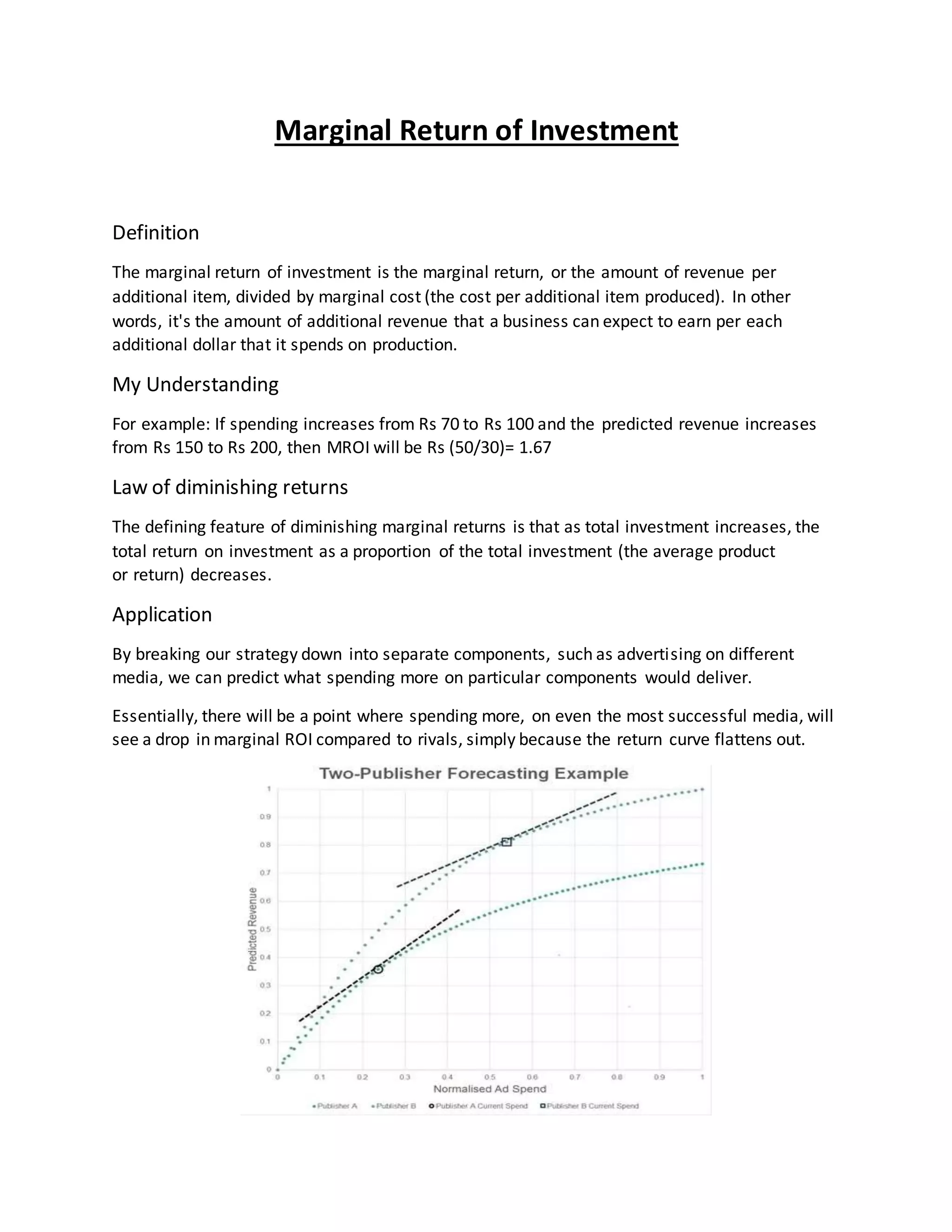
Essentially, there will be a point where spending more, on even the most successful media, will
see a drop in marginal ROI compared to rivals, simply because the return curve flattens out.
In this example, we can see that Publisher B delivers a higher overall ROI. However given where
we are on the curve, investing our next rupee of marketing spend with Publisher A would give
us a greater incremental return for that particular pound, at least until spending on Publisher A
moves further up the x-axis.
This is typical of a scenario when a marketer underspends on a media – when the spending
catches up with the other media then the curve will flatten and marginal ROI lessens.

Marginal return of investment

  • 1.
    Marginal Return ofInvestment Definition The marginal return of investment is the marginal return, or the amount of revenue per additional item, divided by marginal cost (the cost per additional item produced). In other words, it's the amount of additional revenue that a business can expect to earn per each additional dollar that it spends on production. My Understanding For example: If spending increases from Rs 70 to Rs 100 and the predicted revenue increases from Rs 150 to Rs 200, then MROI will be Rs (50/30)= 1.67 Law of diminishing returns The defining feature of diminishing marginal returns is that as total investment increases, the total return on investment as a proportion of the total investment (the average product or return) decreases. Application By breaking our strategy down into separate components, such as advertising on different media, we can predict what spending more on particular components would deliver. Essentially, there will be a point where spending more, on even the most successful media, will see a drop in marginal ROI compared to rivals, simply because the return curve flattens out.
  • 2.
    In this example,we can see that Publisher B delivers a higher overall ROI. However given where we are on the curve, investing our next rupee of marketing spend with Publisher A would give us a greater incremental return for that particular pound, at least until spending on Publisher A moves further up the x-axis. This is typical of a scenario when a marketer underspends on a media – when the spending catches up with the other media then the curve will flatten and marginal ROI lessens.