Technology, Users and Budgets: A Discussion of the
   Challenges Faced by the 21st-Century Research and
             Instructional Services Librarian


Claire Parker, BA, MA, MLIS
Tuesday March 26, 2013
The D.B. Weldon Library, Teaching Support Centre, Room 121
“ Identify up to three trends or issues
affecting academic libraries and give a
big-picture description of how they might
affect Research and Instructional Services
librarians.”
1. Technology and the Digital Campus


•   Information Literacy
•   Pedagogical & Promotional Tools
•   Reference Questions (Laguardia, 2011)
•   Library Anxiety (Melon, 1986; Brown 2011)


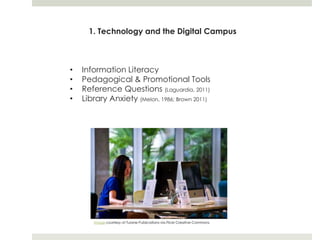
       Image courtesy of Tulane Publications via Flickr Creative Commons
2. Need for Local, User-Oriented Services

“our students are not your students, and your students are not our students.”
                                  -Cheryl Laguardia, Research Librarian, Harvard University (2011)


          • Needs Assessment
          • Course-specific Resources & Services


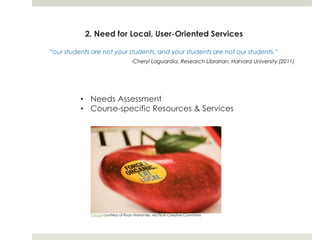
             Image courtesy of Ryan Mahoney, via Flickr Creative Commons
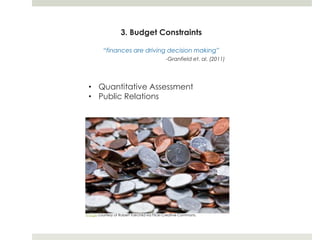
3. Budget Constraints

         “finances are driving decision making”
                                             -Granfield et. al. (2011)


 • Quantitative Assessment
 • Public Relations


Image courtesy of Robert Fairchild via Flickr Creative Commons.
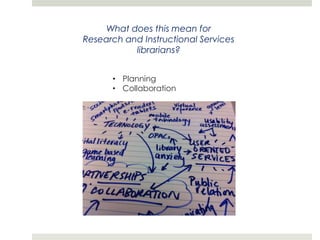
What does this mean for
Research and Instructional Services
           librarians?


      • Planning
      • Collaboration
References
                                                               Melon, Constance A. “Library Anxiety: A Grounded Theory
ACRL Research Planning and Review Committee.                   and Its Development.” College & Research Libraries 47, 2
“2012 Top Ten Trends in Academic Libraries: A Review of        (1986): 160-167.
the Current Literature. College & Research Libraries News
73, 6 (2012): 311-320.                                         “NMC Horizon Report: 2012 Higher Education Edition.”
                                                               2012. Retrieved from: http://www.nmc.org/pdf/2012-
ACRL Standards Committee. “Information Literacy                horizon-report-HE.pdf
Competency Standards for Higher Education.” American
Library Association, 2000. Retrieved from                      Rowley, Jennifer. “Innovation for Survival: From Co-
http://www.ala.org/acrl/sites/ala.org.acrl/files/content/sta   operation to Collaboration.” In Librarianship in Times of
ndards/standards.pdf                                           Crisis, edited by Anne Woodsworth, 207-225. Emerald
                                                               Publishing Group Limited, 2011.
Chan, Christopher. “Marketing the Academic Library with
Online Social Network Advertising.” Library Management         Seal, Robert A. “Trends, Issues and Innovation in Academic
33, 8/9 (2012): 479-489.                                       Library Services: Introduction.” Journal of Library
                                                               Administration 51, 3 (2011): 255-258.
Bawden, David. “Origins and concepts of digital literacy.”
In Digital Literacies: Concepts, Policies and                  Shakeri, Sedigheh, Akbaridaryan, Saeedeh, Mohammadi, F
Practices, edited by Colin Lankshear and Michele               arnaz. “Comparison of Traditional and Digital Reference
Knobel, 17-32. New York: Peter Lang, 2008.                     Questions and Responses at the National Library and
                                                               Archives of I.R. of Iran (NLAI)” Reference & User Services
Brown, Lesley J. “Trending Now-Reference Librarians: How       Quarterly 52, 2 (2012): 136-144.
Reference Librarians Work to Prevent Library Anxiety.”
Journal of Library Administration 51, 3 (2011): 309-317.       Smale, Maura A. “Learning through Quests and Contests:
                                                               Games in Information Literacy Instruction.” Journal of
Granfield, Diane, Mary Kandiuk, Harriet Sonne de Torrens.      Library Innovation 2, 2 (2011): 36-55.
“Academic Librarianship: A Crisis or an Opportunity?”
Partnership: the Canadian Journal of Library and               Wilson, Sally, and Graham McCarthy. “The Mobile
Information Practice and Research 6, 2 (2011): 701-707.        University: From the Library to the Campus.” Reference
                                                               Services Review 38, 2 (2010): 214-232.
Laguardia, Cheryl. “Library Instruction in the Digital Age.”
Journal of Library Administration 51 (2011): 301-308.          Wong, Shun Han Rebekah and T.D. Webb. “Uncovering
                                                               Meaningful Correlation Between Student Academic
Lippincott, Joan K. “A Mobile Future for Academic              Performance and Library Material Usage.” College &
Libraries.” Reference Services Review 38, 3 (2010): 205-213.   Research Libraries 72, 4 (2011): 361–70.
Thank you!
                                              Questions? Comments?


Email: claire.parker@uwo.ca
Phone: 519-661-2111 x83441
Web: http://claireelizabethparker.wordpress.com/
Slides are available online:


This work is licensed under a Creative Commons Attribution-NonCommercial-ShareAlike 3.0 Unported License.

March 26 2013

  • 1.
    Technology, Users andBudgets: A Discussion of the Challenges Faced by the 21st-Century Research and Instructional Services Librarian Claire Parker, BA, MA, MLIS Tuesday March 26, 2013 The D.B. Weldon Library, Teaching Support Centre, Room 121
  • 2.
    “ Identify upto three trends or issues affecting academic libraries and give a big-picture description of how they might affect Research and Instructional Services librarians.”
  • 3.
    1. Technology andthe Digital Campus • Information Literacy • Pedagogical & Promotional Tools • Reference Questions (Laguardia, 2011) • Library Anxiety (Melon, 1986; Brown 2011) Image courtesy of Tulane Publications via Flickr Creative Commons
  • 4.
    2. Need forLocal, User-Oriented Services “our students are not your students, and your students are not our students.” -Cheryl Laguardia, Research Librarian, Harvard University (2011) • Needs Assessment • Course-specific Resources & Services Image courtesy of Ryan Mahoney, via Flickr Creative Commons
  • 5.
    3. Budget Constraints “finances are driving decision making” -Granfield et. al. (2011) • Quantitative Assessment • Public Relations Image courtesy of Robert Fairchild via Flickr Creative Commons.
  • 6.
    What does thismean for Research and Instructional Services librarians? • Planning • Collaboration
  • 7.
    References Melon, Constance A. “Library Anxiety: A Grounded Theory ACRL Research Planning and Review Committee. and Its Development.” College & Research Libraries 47, 2 “2012 Top Ten Trends in Academic Libraries: A Review of (1986): 160-167. the Current Literature. College & Research Libraries News 73, 6 (2012): 311-320. “NMC Horizon Report: 2012 Higher Education Edition.” 2012. Retrieved from: http://www.nmc.org/pdf/2012- ACRL Standards Committee. “Information Literacy horizon-report-HE.pdf Competency Standards for Higher Education.” American Library Association, 2000. Retrieved from Rowley, Jennifer. “Innovation for Survival: From Co- http://www.ala.org/acrl/sites/ala.org.acrl/files/content/sta operation to Collaboration.” In Librarianship in Times of ndards/standards.pdf Crisis, edited by Anne Woodsworth, 207-225. Emerald Publishing Group Limited, 2011. Chan, Christopher. “Marketing the Academic Library with Online Social Network Advertising.” Library Management Seal, Robert A. “Trends, Issues and Innovation in Academic 33, 8/9 (2012): 479-489. Library Services: Introduction.” Journal of Library Administration 51, 3 (2011): 255-258. Bawden, David. “Origins and concepts of digital literacy.” In Digital Literacies: Concepts, Policies and Shakeri, Sedigheh, Akbaridaryan, Saeedeh, Mohammadi, F Practices, edited by Colin Lankshear and Michele arnaz. “Comparison of Traditional and Digital Reference Knobel, 17-32. New York: Peter Lang, 2008. Questions and Responses at the National Library and Archives of I.R. of Iran (NLAI)” Reference & User Services Brown, Lesley J. “Trending Now-Reference Librarians: How Quarterly 52, 2 (2012): 136-144. Reference Librarians Work to Prevent Library Anxiety.” Journal of Library Administration 51, 3 (2011): 309-317. Smale, Maura A. “Learning through Quests and Contests: Games in Information Literacy Instruction.” Journal of Granfield, Diane, Mary Kandiuk, Harriet Sonne de Torrens. Library Innovation 2, 2 (2011): 36-55. “Academic Librarianship: A Crisis or an Opportunity?” Partnership: the Canadian Journal of Library and Wilson, Sally, and Graham McCarthy. “The Mobile Information Practice and Research 6, 2 (2011): 701-707. University: From the Library to the Campus.” Reference Services Review 38, 2 (2010): 214-232. Laguardia, Cheryl. “Library Instruction in the Digital Age.” Journal of Library Administration 51 (2011): 301-308. Wong, Shun Han Rebekah and T.D. Webb. “Uncovering Meaningful Correlation Between Student Academic Lippincott, Joan K. “A Mobile Future for Academic Performance and Library Material Usage.” College & Libraries.” Reference Services Review 38, 3 (2010): 205-213. Research Libraries 72, 4 (2011): 361–70.
  • 8.
    Thank you! Questions? Comments? Email: claire.parker@uwo.ca Phone: 519-661-2111 x83441 Web: http://claireelizabethparker.wordpress.com/ Slides are available online: This work is licensed under a Creative Commons Attribution-NonCommercial-ShareAlike 3.0 Unported License.